U.S. in the Middle-East: Preparing for Disaster
By The Saker • Unz Review • January 30, 2020
Lies, damn lies and statistics
Turns out that Trump and the Pentagon were lying. Again. This time about the true impact of the Iranian counter-strike on US forces in Syria. First they claimed that there were no injured U.S. personnel, only to eventually have to fess up that 34 soldiers had suffered traumatic brain injury (which Trump “re-classified” as a “headache”). Then they had to admit that it was not really 34, but actually 50!
According to some sources, not all U.S. personnel were hiding in bunkers and some were deployed to defend the base perimeter. Whatever may be the case, this adds yet another indication that the Iranian counter-strike was much more robust than originally reported by the Empire. In fact, Iranian sources indicate that following the strike, a number of wounded casualties were flown to Israel, Kuwait and Germany. Again, we will probably never find out the full truth about what happened that night, but two things are now certain:
- The Iranian attack was extremely effective and it is undeniable that all the US/NATO/Israeli forces in the region are now exposed like sitting ducks waiting for the next Iranian strike.
- Uncle Shmuel has had to dramatically under-report the real extent and nature of the Iranian counter-strike.
Now, let’s be clear about the quality of the warning the U.S. personnel had. We now know at the very least the following warnings were received:
- Warning through the Iraqi government (whom the Iranians did brief about their intentions).
- Warning through the Swiss authorities (who represent U.S. interests in Iran and whom the Iranian did brief about their intentions).
- Warning through the US reconnaissance/intelligence capabilities on the ground, air and space.
And yet, in spite of these almost ideal conditions (from the point of view of defense), we now see that not a single Iranian missile was intercepted, that the missiles all landed with very high accuracy, that the U.S. base itself suffered extensive damage (including destroyed helicopters and drones) and that there were scores of injured personnel (see this article for a detailed discussion of the post-attack imagery).
If we look at this strike as primarily a “proof of concept” operation, then it becomes pretty clear that on the Iranian side what was proven was a superb degree of accuracy and robust ballistic missile capability, whereas on the U.S. side the only thing this strike did was to prove that the U.S. forces in the region are all extremely vulnerable to Iranian missile attack. Just imagine if the Iranians had wanted to maximize U.S. casualties and if they had given no warning of any kind – what would the tally be then?! What if the Iranians had targeted, say, fuel and ammo dumps, buildings where U.S. personnel lived, industrial facilities (including CENTCOM’s key logistic nodes), ports or even airfields? Can you imagine the kind of hell the Iranians would have unleashed against basically unprotected facilities?!
Still dubious?
Then ask yourself why Trump & Co. had to lie and minimize the real scope of the Iranian attack. It is pretty obvious that the White House decided to lie and to present the strike as almost without impact because if it had admitted the magnitude of the strike, then it would also have had to admit to the total powerlessness to stop or even to meaningfully degrade it. Not only that, but an outraged U.S. public (most Americans still believe the traditional propaganda line about “The Greatest Military Force in the History of the Galaxy”!) would have demanded a retaliatory counter-counter-strike against Iran, which would have triggered an immediate Iranian attack on Israel which, in turn, would have plunged the entire region into a massive war which the U.S. had no stomach for.
Contrast that with the Iranian claims which, if anything, possibly exaggerated the impact of the strike and claimed that 80 servicemen were injured (I would add here that, at least so far, the Iranian government has been far more candid and less inclined to resort to crude lies than the U.S. has). Clearly the Iranians were ready for exactly the kind of further escalation that the U.S. wanted to avoid at almost any cost.
So what really took place?
There are two basic ways to defend against an attack: denial and punishment. Denial is what the Syrians have been doing against the U.S. and Israel every time they shoot down incoming missiles. Denial is ideal because it minimizes your own casualties while not necessarily going up the “escalation scale”. In contrast, punishment is when you don’t prevent an attack, but when you inflict retaliatory counter-strike on the attacking side, but only after being attacked yourself. That is what the US could do against Iran, at pretty much any time (yes, contrary to some wholly unrealistic claims, Iranian air defenses cannot prevent the US armed forces from inflicting immense damage upon Iran, its population and infrastructure).
The problem with punishing Iran is you are dealing with an enemy who is actually willing to absorb immense losses as long as these losses eventually lead to victory. How do you deter somebody who is willing to die for his country, people or faith?
There is no doubt in my mind that the Iranians, who are superb analysts, are fully aware of the damage that the U.S. can inflict. The key factor here is that they also realize that once the U.S. unleashes its missiles and bombers and once they destroy many (if not all) of their targets, they will have nothing else left to try to contain Iran with.
Here is how you can think of the Iranian strategy:
- If the U.S. does nothing or only engages in symbolic strikes (say, like Israel’s strikes in Syria), the Iranians can simply ignore these attacks because while they are very effective in giving the Americans (or the Israelis) an illusion of power, they really fail to achieve anything militarily significant.
- If the U.S. finally decides to strike Iran hard, it will exhaust its “punishment card” in that counter-attack, and will have no further options to deter Iran.
- If the U.S. (or Israel) decides to use nuclear weapons, then such an attack will simply give a “political joker card” to Iran saying in essence “now you are justified in whatever retaliation you can think of.” And you can be darn sure that the Iranian will come up with all sorts of most painful forms of retaliation!
You can think of the current US posture as “binary”: it is either “all off” or “all on.” Not by choice, of course, but these conditions are the result of the geostrategic realities of the Middle-East and from the many asymmetries between the two sides:
| Country | US | Iran |
|---|---|---|
| Air superiority | yes | no |
| Combat capable ground forces | no | yes |
| Willingness to incur major losses | no | yes |
| Short and secure supply lines | no | yes |
| Prepared for major defensive operations | no | yes |
The above is, of course, a simplification, yet it is also fundamentally true. And the reason for these asymmetries lies in a very simple yet crucial difference: Americans have been brainwashed into believing that major wars can be won on the cheap. Iranians have no such illusions (most certainly not after Iraq, backed by the US, the USSR and Europe, attacked Iran and inflicted immense destruction on the Iranian society). But the era of “wars on the cheap” is now long over.
Furthermore, Iranians also know that U.S. air superiority alone will not magically result in a U.S. victory. Finally, the Iranians have had 40 years to prepare for a U.S. attack. The U.S. has only really been put on notice since January 8th of this year.
Again, for the US, it is “all in” or “all out”. We saw the “all out” in the days following the Iranian counter-strike and we can get an idea of what the “all in” would look like by recalling the Israeli operations against Hezbollah in 2006.
The Iranians, however, have a much more gradual escalatory capability, which they just demonstrated with their attack on the U.S. forces in Iraq: they can launch only a few missiles, or they can launch hundreds of them. They can try to maximize U.S. casualties, or they can decide to go after CENTCOM’s infrastructure. They can chose to strike Uncle Shmuel directly, or they can decide to strike his allies (KSA) and bosses (Israel). They can chose to take credit for any action, or they can hide behind what the CIA calls plausible deniability.
So while the U.S. and the AngloZionist Empire as a whole are much more powerful than Iran, Iran has skillfully developed methods and means which allow it to be in control of what military analysts call the “escalation dominance”.
Has Iran just “Ledeened” the almighty US?
Remember Michael Ledeen? He is the Neocon who came up with this historical aphorism: “Every ten years or so, the United States needs to pick up some small crappy little country and throw it against the wall, just to show the world we mean business“.
Is it not ironic that Iran did exactly that, they took the US and “threw it against a wall, just to show that they meant business”, did they not?
And what does this all tell us?
For one thing, the U.S. military is in real trouble. It is pretty obvious that U.S. air defenses are hopelessly ineffective: we saw their “performance” in Saudi Arabia against the Houthi strikes. The truth is that the Patriot missiles never performed adequately, not in the first Gulf War, nor today. The big difference is that Saddam Hussein’s Iraq did not have any high-precision missiles and that its attempts to strike at the U.S. (or Israel, for that matter) where not very effective. Thus, it was easy for the Pentagon to fudge the real performance (or lack thereof!) of its weapon systems. Now that Iran has been able to pinpoint some buildings while carefully ignoring others shows that the entire Middle-East has entered a radically new era.
Second, it is equally obvious that U.S. bases in the Middle-East are very vulnerable to ballistic and cruise missile attacks. Air defenses are a very complicated and high-tech branch of the military and it often takes years, if not decades, to develop a truly effective air defense system. Due in part to its tendency to only attack weak and lightly-defended countries, and also due to the very real deterrent might the U.S. armed forces used to deliver in the past, the U.S. never had to really worry much about air defenses. The “little guys” had no missiles, while the “big guys” would never dare to openly strike at Uncle Shmuel’s forces.
Until recently.
Now, it is the previously almighty World Hegemon which has been tossed against a wall by a much weaker Iran and thus found itself being treated like a “small crappy little country”.
Sweet irony!
But there is much more to this story.
The real Iranian goal: to get the U.S. out of the Middle-East
The Iranians (and many Iranian allies in the region) have made it clear that the real retaliation for the murder of General Soleimani would be to bring about a complete withdrawal of U.S. forces from Iraq and Syria primarily, followed by a complete withdrawal from the entire Middle-East.
How likely is such an outcome?
Right now, I would say that the chances of that truly happening are microscopically small. After all, who could seriously imagine the U.S. leaving either Saudi Arabia or Israel? Ain’t gonna happen short of a true cataclysm.
What about countries like Turkey or Pakistan which are formally allies of the US but which are also showing clear signs of being mighty fed-up with the kind of “patronage” the US likes to mete out to its “allies”? Do we have any reason to believe that these countries will ever officially demand that Uncle Shmuel’s mercenaries (because that is what U.S. forces are, paid invaders) get the hell out?
And then there are countries like Iraq or Afghanistan which have hosted a very successful and active anti-U.S. insurgency which has kept U.S. forces hunkered down in heavily fortified bases. I don’t think there is anybody mentally sane out there who could offer a even semi-credible scenario of what a U.S. “victory” would look like in these countries. The fact that the U.S. stayed in Afghanistan even longer than the Soviets did shows not only that the Soviet forces were far more effective (and popular) than their U.S. counterparts, but also that Gorbachev’s Politburo was more in touch with reality than Trump’s NSC.
Whatever may be the case, I believe it is undeniable that the wars in Iraq and Afghanistan are lost and than no amount of grandstanding will change this outcome. The same goes for Syria where the U.S. is basically holding on out of sheer stubbornness and a total inability to admit defeat.
Uncle Shmuel’s “vision of peace” for the Middle-East
I just listened to the Idiot-in-Chief proudly present “his” Middle-East “peace” plan to Bibi Netanyahu and the world. This latest stunt shows two crucial things about the mind-set in Washington, D.C.:
- There is nothing which the U.S. ruling classes will not do to try to get the favor and support of the Israel Lobby.
- The US does not care, not even marginally, what the people of the Middle-East think.
This dynamic, which is not anything new, but which received a qualitative “shot of steroids” under Trump, will only further contribute to the inevitable collapse of Empire in the Middle-East. For one thing, all the so-called “U.S. allies” in the region understand that the only country which matters to the US is Israel, and that all the others count for almost nothing. Furthermore, all the rulers of the Middle-East now also know that being allied to the US also means being a cheap prostitute for Israel which, in turn, is guaranteed political suicide for any politician not wise enough to smell the trap. Finally, the wars in Afghanistan, Iraq, Yemen, Lebanon and Syria have shown that the “Axis of Kindness” is long on hyperbole and hubris, but very short in terms of actual combat capability.
The simple truth is that the abject brown-nosing of the Israel Lobby that Trump has been engaged in from Day 1 of his term only serves to further isolate and weaken the U.S. in the Middle-East (and beyond, really!).
In this context, how realistic is the Iranian goal of kicking Uncle Shmuel out of the region?
As I said, not realistic at all, if seen solely in the short term. But I hasten to add that it is very realistic in the mid-term if we look at some, but not all, the countries of the region. Finally, in the long term, it is not only realistic, it is inevitable, even if the Iranians themselves don’t do much, or anything at all, to make that happen.
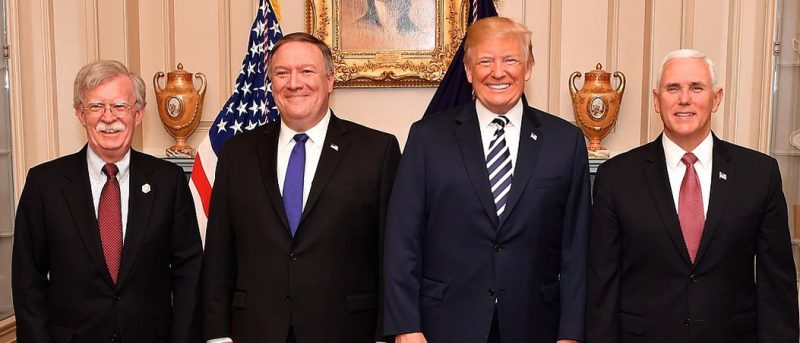
These grinning ignoramuses are doing more than anyone else to bring down the Empire, even if they don’t understand this!
Conclusion: “Israel’s” days are numbered
The Israelis have been feeding us all a steady diet about this or that country or politician being a “new Hitler’ who will either gas 6M Jews “again”, or wants to wipe Israel “off the map” or even engage in a new Holocaust. Gilad Atzmon brilliantly calls this mental disorder “pre-traumatic stress disorder,” and he is spot on. The Israelis mostly used this “preemptive geschrei*” as a way to squeeze out as many concessions (and money) from the western goyim as possible. But in a deep sense, it is possibly that the Israelis are at least dimly aware that their entire project is simply not viable, that you cannot ensure the survival of any state by terrorizing all of your neighbors. Violence, especially vicious, rabid, violence can, indeed, terrorize people, but only for so long. Sooner or later, the human soul will outgrow any fear, no matter how visceral, and will replace that fear by a new and immensely powerful sense of determination.
Here is what Robert Fisk said in distant 2006, 14 years ago:
You heard Sharon, before he suffered his massive stroke, he used this phrase in the Knesset, you know, “The Palestinians must feel pain.” This was during one of the intifadas. The idea that if you continue to beat and beat and beat the Arabs, they will submit, that eventually they’ll go on their knees and give you what you want. And this is totally, utterly self-delusional, because it doesn’t apply anymore. It used to apply 30 years ago, when I first arrived in the Middle East. If the Israelis crossed the Lebanese border, the Palestinians jumped in their cars and drove to Beirut and went to the cinema. Now when the Israelis cross the Lebanese border, the Hezbollah jump in their cars in Beirut and race to the south to join battle with them. But the key thing now is that Arabs are not afraid any more. Their leaders are afraid, the Mubaraks of this world, the president of Egypt, King Abdullah II of Jordan. They’re afraid. They shake and tremble in their golden mosques, because they were supported by us. But the people are no longer afraid.
What was true only for some Arabs in 2006, has now become true for most (maybe even all?) Arabs in 2020. As for the Iranians, they have never had any fear of Uncle Shmuel, they are the ones who “injected” the newly created Hezbollah with this qualitatively new kind of “special courage” (which is the Shia ethos, really!) when this movement was founded.
Empires can survive many things, but once they are not feared anymore, then their end is near. The Iranian strike proved a fundamental new reality to the rest of the world: the US is much more afraid of Iran than Iran is afraid of the US. U.S. rulers and politicians will, of course, claim otherwise. But that futile effort to re-shape reality is now doomed to failure, if only because even the Houthis can now openly and successfully defy the combined might of the “Axis of Kindness”.
You can think of U.S. and Israeli leaders as the orchestra on the Titanic: they play well, but they will still get wet and then die.
 (*geschrei: the Yiddish word for yelling, crying out, to shriek)
The Sham Palestine Plan Is the Kind of One-Sided Peace the Empire Would Impose on Rebel Donbass…If It Could
By Paul Robinson | Anti-Empire | January 30, 2020
War, said Clausewitz, is an ‘interaction’, ‘not the action of a living force upon a lifeless mass but always the collision of two living forces.’ This is one of the things which makes it so difficult to manage. You can’t just do x, and expect y to happen, even if y happened last time you did x, because there are always others involved, with wills of their own.
If war is an interaction, so too is peace. Short of one party’s total destruction, war ends because both sides choose for it to end, either because they’re both exhausted and choose to negotiate, or because one side realizes that it’s defeated and gives up. In the latter case, it’s not the winner who decides exactly when the war ends, it’s the loser. Or, as Fred Ikle put it in his book ‘Every War Must End’, ‘peace is made by the loser’.
In short, even when you’re on top, you don’t get to unilaterally decide when and how to stop a conflict. The key is getting your opponents to agree to stop. This can be done through a combination of negative and positive inducements, or by negotiation. But at the end of the day, the other side always has to agree (even if reluctantly).
Unilaterally-imposed take it or leave it solutions which involve the humiliation or total submission of one party are a bad way of getting this agreement. Given the loss of honour (at best), or of independence or even life (at worst), which such solutions involve, people won’t agree to them unless the negative inducements are extremely powerful (think Germany in 1945, for instance). Consequently, if you’re not prepared to put such extreme negative inducements into effect, you don’t really have any choice, if you truly want peace, but to talk with the other side. You have to get them to agree.
Somewhere along the line, sadly, we seem to have forgotten this (if we ever actually understood it). There’s this sense that great powers can draw up a peace plan for somebody else’s conflict and then force it down their throats without even bothering to consult them. It’s odd, for the most part decidedly unrealistic, and more than a little arrogant.
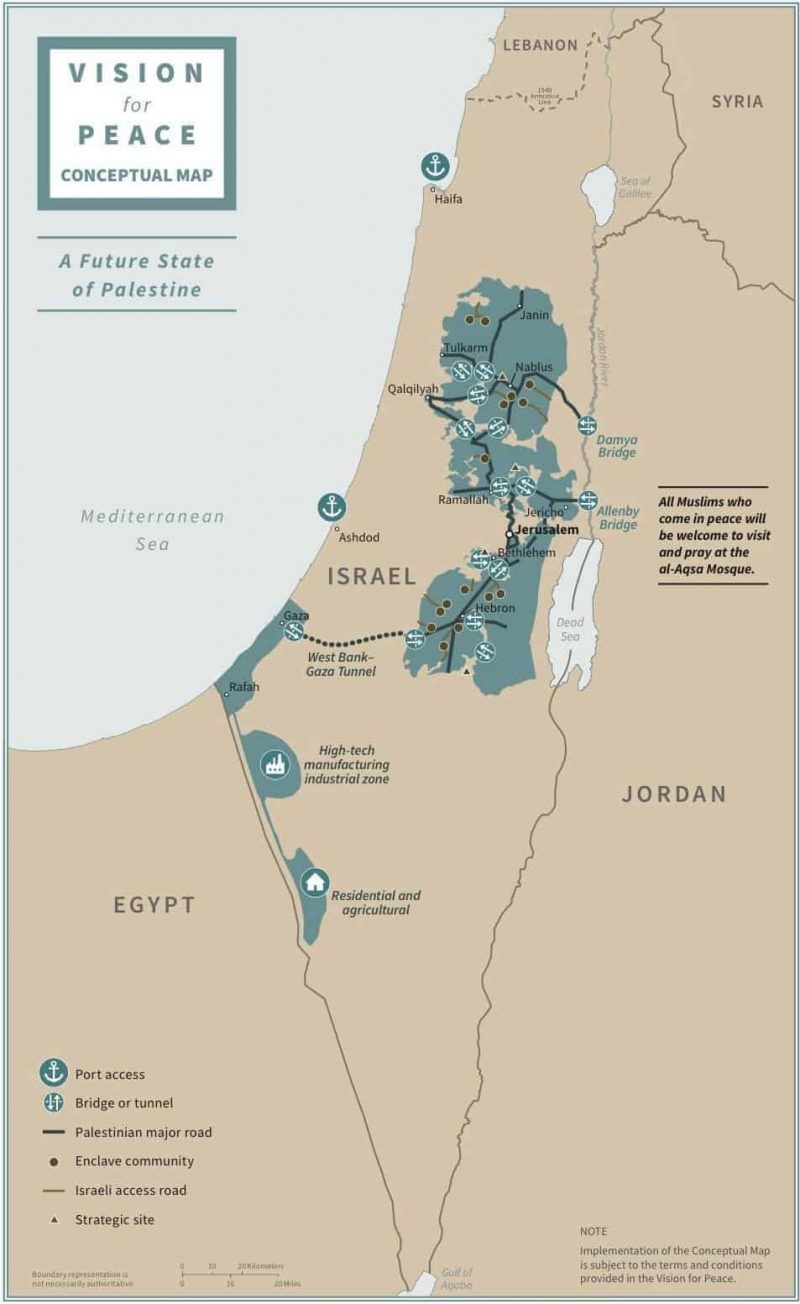
And so it is that Donald Trump rolled out his ‘deal of the century’ to end the Israeli-Palestinian conflict. Notionally, this is an American plan, but it seems clear that the Israelis were consulted about it before it was unveiled, and they obviously don’t have any objections to it. The problem is that neither the Israelis nor the Americans bothered consulting the other party to the conflict – the Palestinians. Unsurprisingly, the latter have wasted no time in rejecting the plan, as well they might given that the map released by the White House shows that the planned Palestinian state would look like this:
The Palestinian response is hardly surprising. Short of extreme negative inducements, it’s hard to see why anybody would accept a state divided up into lots of little pieces which doesn’t even have access to water. The whole thing seems to have been designed entirely to keep one side happy, while not bothering at all about what the other side wants (the hope apparently being that they can be bought off with a lot of money). One shouldn’t be too shocked if it all turns out to be dead at birth.
Sadly, though, this isn’t a unique case. The American approach to the war in Ukraine has been rather similar. The official line has been to put pressure on the Russian Federation so that it will abandon Donbass, which will then be forced to accept whatever terms Ukraine chooses to give it.
More moderate analysts instead propose cutting some sort of deal with Russia (e.g. recognition of the annexation of Crimea in return for the abandonment of Donbass). But either way, talking to the people of Donbass, let alone their notional leaders, is out of the question. However peace comes, it isn’t to be by means of agreement with the people doing the fighting. Peace must be unilateral, or there won’t be peace at all.
Which, of course, is nuts. As I said, it takes two make war. It takes two to make peace as well.
Unlike Hezbollah Fighters, Israeli Soldiers Lack Combat Motivation: Zionist Military Analyst

Al-Manar | January 25, 2020
The Israeli military analyst Alon bin David said that the Chief of Staff Aviv Kochavi has prepared a plan to develop the army over several years, stressing that it suffers from shortage of manpower and lack of combat motivation.
The Zionist military expert, Benjamin Amidor, on Saturday also said that Hezbollah and Hamas fighters are more skillful, experience and trained that the Israeli army soldiers, adding that the Resistance members undergo more drills than the Israeli army soldiers and have more field experience.
Amidor, who is a former army officer, added that the Zionist army is not reinforcing the commitment to the military instructions, adding that it is trying to follow an approach that minimizes human losses during wars.
For Pompeo a “Normal Nation” Is an Attack Dog of the Empire
By Marko Marjanović | Anti-Empire | January 23, 2020
Night club bouncer Mike Pompeo has demanded Iran starts behaving “like a normal nation” just like “Norway”. Answer:
Aha, so this “normal nation” has joined in the attack on Yugoslavia in 1999 and on Libya in 2011, has participated in the occupation of Iraq, and is still participating in the occupation of Afghanistan.
Even more useful for the Empire its Atlanticists elites are only too eager to prop up the Empire in diplomatic, moral and propaganda spheres.
This isn’t the resume of a normal nation but one of America’s auxiliary attack dogs.
It will be much preferable if Iran stays what it is, a normal and independent country, a rarity in our world.
US, Russia Agree to Begin Expert-Level Engagement on Strategic Security – State Dept.
Sputnik – 16.01.2020
WASHINGTON – US and Russian delegations during their talks in Vienna decided to begin expert-level engagement on issues of strategic security and expand the dialogue beyond a bilateral format, the State Department said in a press release on Thursday.
“The delegations decided to continue the Strategic Security Dialogue and also to begin expert-level engagement on particular topics in the near future”, the release said. “The delegations discussed their respective national strategic policies as a means to reduce misunderstandings and misperceptions on key security issues. The US and Russian delegations discussed nuclear stockpiles and strategy, crisis and arms race stability, and the role and potential future of arms control, including the importance of moving beyond a solely bilateral format”.
Earlier, Russian Permanent Representative to International Organizations in Vienna Mikhail Ulyanov said in a statement on Twitter that the two sides discussed issues of strategic stability during the talks, which were led by Russian Deputy Foreign Minister Sergei Ryabkov and US Acting Undersecretary of State Chris Ford.
New START (Strategic Arms Reduction Treaty) is the last remaining arms control treaty in force between Russia and the United States. Signed in 2010, the pact stipulates that the number of strategic nuclear missiles launchers must be cut by half and limits the number of deployed strategic nuclear warheads to 1,550.
Russia has repeatedly stated its readiness to extend the New START without any preconditions, but the US is yet undecided about the extension.
What’s the Point of NATO If You Are Not Prepared to Use It Against Iran?
By Philip Giraldi | Strategic Culture Foundation | January 16, 2020
Article 5 of the North Atlantic Treaty Organization (NATO) alliance commits all members to participate in the defense of any single member that is attacked. An attack on one is an attack on all. Forged in the early stages of the cold war, the alliance originally included most of the leading non-communist states in Western Europe, as well as Turkey. It was intended to deter any attacks orchestrated by the Soviet Union and was defensive in nature.
Currently NATO is an anachronism as the Soviet Union collapsed in 1991, but the desire to continue to play soldier on an international stage has granted it a measure of life support. Indeed, the alliance is regularly auditioning for new members. Its latest addition is Montenegro, which has a military consisting of 2,000 men and women, roughly one brigade. If Montenegro should be attacked, the United States is obligated to come to its assistance.
It would all be something like comic opera featuring the Duke of Plaza Toro but for the fact that there are certain things that NATO does that are not really defensive in nature but are rather destabilizing. Having expanded NATO right up to the border with Russia, which the U.S. promised not to do and then reneged, military exercises staged by the alliance currently occur right next to Russian airspace and coastal waters. To support the incursions, the myth that Moscow is expansionistic (while also seeking to destroy what passes for democracy in the West) is constantly cited. According to the current version, Russian President Vladimir Putin is just waiting to resume control over Ukraine, Georgia, Poland and the Baltic States in an effort to reconstitute the old Soviet Union. This has led to demands from the usual suspects in the U.S. Congress that Georgia and Ukraine be admitted into the alliance, which would really create an existential threat for Russia that it would have to respond to. There have also been some suggestions that Israel might join NATO. A war that no one wants either in the Middle East or in Europe could be the result if the expansion plans bear fruit.
Having nothing to do beyond aggravating the Russians, the alliance has gone along with some of the transnational abominations initially created by virtue of the Global War on Terror initiated by the loosely wrapped American president George W. Bush. The NATO alliance currently has 8,000 service members participating in a training mission in Afghanistan and its key member states have also been parts of the various coalitions that Washington has bribed or coerced into being. NATO was also actively involved in the fiasco that turned Libya into a gangster state. It had previously been the most developed nation in Africa. Currently French and British soldiers are part of the Operation Inherent Resolve (don’t you love the names!) in Syria and NATO itself is part of the Global Coalition to Defeat ISIS.
NATO will now be doing its part to help defend the United States against terrorist attack. Last Wednesday the alliance Secretary General Jens Stoltenberg spoke with President Donald Trump on the phone in the wake of the assassination of Iranian Major General Qassem Soleimani at the Baghdad International Airport. The killing was apparently carried out using missiles fired by a U.S. Reaper drone and was justified by the U.S. by claiming that Soleimani was a terrorist due to his affiliation with the listed terrorist Quds Force. It was also asserted that Soleimani was planning an attack on the U.S. Embassy in Baghdad and would have killed “hundreds” of Americans. Evidence supporting the claims was so flimsy that even some Republicans balked at approving the chain of events.
Nine Iraqis also died in the attack, including the Iraqi General who headed the Kata’Ib Hezbollah Militia, which had been incorporated into the Iraqi Army to fight against the terrorist group ISIS. During the week preceding the execution of Soleimani, the U.S. had staged an air attack that killed 25 Iraqi members of Kata’Ib, the incident that then sparked the rioting at the American Embassy in Baghdad’s Green Zone.
Bearing in mind that the alleged thwarted terrorist attacks took place seven thousand miles away from the United States, it is hard to make the case that the U.S. was directly threatened requiring a response from NATO under Article 5. No doubt the Mike Pompeo State Department will claim that its Embassy is sovereign territory and therefor part of the United States. It is a bullshit argument, but it will no doubt be made. The White House has already made a similar sovereignty claim vis-à-vis the two U.S. bases in Iraq that were hit by a barrage of a dozen Iranian missiles a day after the killing of Soleimani. Unlike the case of Soleimani and his party, no one was killed by the Iranian attacks, quite possibly a deliberate mis-targeting to avoid an escalation in the conflict.
In spite of the fact that there was no actual threat and no factual basis for a call to arms, last Wednesday, NATO Secretary General Jens Stoltenberg spoke by phone with President Donald Trump “on developments in the Middle East.” A NATO press release stated that the two men discussed “the situation in the region and NATO’s role.”
According to the press release “The President asked the Secretary General for NATO to become more involved in the Middle East. They agreed that NATO could contribute more to regional stability and the fight against international terrorism.” A tweet by White House deputy press secretary Judd Deere later confirmed that Trump had “emphasized the value of NATO increasing its role in preventing conflict and preserving peace in the Middle East.” Prior to the phone call, Trump had announced that he would ask NATO “to become much more involved in the Middle East process.”
As the Trumpean concept of a peace process is total surrender on the part of the targeted parties, be they Palestinians or Iranians, it will be interesting to see just how the new arrangement works. Sending soldiers into unstable places to do unnecessary things as part of a non-existent strategy will not sit well with many Europeans. It should not sit well with Americans either.
Wallace sounds alarm bell on future UK-US defence ties
Press TV – January 12, 2020
Defence secretary, Ben Wallace, has warned that in future Britain may have to contemplate fighting wars without the United States.
In an interview with the Sunday Times, Wallace made the extraordinary claim that the prospect of the United States retreating from a global leadership role under Donald Trump keeps him “awake at night”.
In comments that is bound to raise eyebrows in defence circles around the world, Wallace claimed that the UK needs to “rethink” military assumptions in place since 2010, which have centred on close partnership with US armed forces.
The defence secretary said that the government should use the “upcoming defence review” to purchase new kit to ensure that the British armed forces are less dependent on American air cover and spy planes in future wars.
According to Wallace, the UK is preparing to conduct the “deepest review” of the country’s defence, security and foreign policy since the “end of the Cold War”.
Wallace appears to be worried about Trump’s putative “isolationist” tendencies and its impact on Britain’s military and security posture going forward.
“Over the last year we’ve had the US pull out from Syria, the statement by Donald Trump on Iraq where he said NATO should take over and do more in the Middle East”, Wallace said.
Wallace’s sweeping prediction will strike many defence analysts as odd, at least in immediate terms, and in view of the fact that the UK has given every indication it is prepared to join the US in conducting military operations against Iran.
Tel Aviv calls for Gulf States to unite with Israel against Iran
MEMO | January 11, 2020
Former Israeli communication minister, Ayoob Kara, has called for the Gulf States to form a security and economic “union” with Israel, to stand against Iran at all levels, Shehab News Agency reported on Friday.
Kara, who is very close to the Israeli prime minister, Benjamin Netanyahu, posted on Twitter that the goal of this “union” is to be a “strong front in the face of Iranian evil.”
The tweet came after the Iranian declaration that Iran would turn its hostile arms against Haifa and Dubai. In his tweet, Kara announces: “It is time that the States of the Arab Gulf come together with Israel in a security and economic union to stand against Iran’s threats in the Middle East.”
Featured Video

Iran’s Next Strike May Not Explode. It Could Shut You Down
or go to
Aletho News Archives – Video-Images
From the Archive
Zionism’s Violent Legacy
By Donald Neff | Washington Report On Middle East Affairs | January 1996
On January 4, 1948, Jewish terrorists drove a truck loaded with explosives into the center of the all Arab city of Jaffa and detonated it, killing 26 and wounding around 100 Palestinian men, women and children.[1] The attack was the work of the Irgun Zvai Leumi – the “National Military Organization,” also known by the Hebrew letters Etzel – the largest Jewish terrorist group in Palestine. The Irgun was headed by Revisionist Zionist Menachem Begin and had been killing and maiming Arabs, Britons and even Jews for the previous ten years in its efforts to establish a Jewish state.
This terror campaign meant that at the core of Revisionist Zionism there existed a philosophical embrace of violence. … continue
Blog Roll
 Aletho News
- Riyadh Says Its Oil System Is Intact. The Numbers Say Otherwise.
- Trump and Netanyahu Want to “Finish the Job” on Iran
- US ‘one-sided dictation’ not Iran’s beliefs makes rational talks impossible: Baghaei
- Iran’s Next Strike May Not Explode. It Could Shut You Down /Col Doug Macgregor
- Iran: US political targets legitimate if assassinations return
- Iraq shuts key border crossing with Iran under US pressure: Report
- Undersea Internet cables could be targeted in retaliation for attacks on Iran: IRGC deputy chief
- EU sending ‘biased’ observers to interfere in Serbian election – president
- White House envoy declares kinetic action against Yemen ‘fruitless’
- Ukraine deployed thousands of microdrones in Iraqi Kurdistan: Tasnim
- If Americans Knew
- Americans at National Conservatism Conference held in Israel this year criticize Israel
- Christiane Amanpour exits CNN with a legacy shaped by the debate over Israel
- Israel’s war on Iran is the final move in a decades-old strategy
- Israel Denies Entry to French Journalist, U.S. Researcher Amid Rise in Entry Denials
- Gaza’s hospitals are running out of life-saving fuel – Daily Update
- Mysterious bot accounts reportedly spread fake ‘man on the street’ videos for Michigan Senate candidate
- Israeli Defense Minister Katz Says Over 60 Lebanon Villages Have Been Destroyed
- Why Is Israel Running TV Ads in Iowa Ahead of the Midterms?
- Hind Rajab’s Alleged Killer Is in the United States. HRF Demands His Arrest.
- US Officials Face Fresh Pressure After Another American ‘Brutalized’ by Israeli Settlers in West Bank
- No Tricks Zone
- E-Cars Reduce CO2 Emissions By Only 41% Compared To Internal Combustion Engine Vehicles
- Predictions Made By Renowned Climate Professor Over Past Decades Have Been Proven To Be Poor
- New Study Suggests Large Regions Of The Pacific Ocean Have Been Cooling For The Last 80 Years
- Germany’s Green Energy Debacle: High Energy Costs Force Kahla Porzellan to Close After 182 Years!
- New Study: 50 Years Of The Most Aggressive ‘Net Zero’ Policies Can Only Affect The Global Climate By 0.03°C
- US September “Heat” Was No Record…Many Records Set Decades Ago
- Latest European Green Energy Debacle; Portugal’s Largest Flagship Solar Park Insolvent!
- Green Energy Debacle: German Expert Professor Fritz Vahrenholt Warns Of Severe Economic And Social Consequences
- Two More Paleo Reconstructions Affirm Meters-Higher Sea Levels Across Ireland, Brazil 7000-6000 Years Ago
- New Study: Earth And Venus Surface Warmth Largely Explained By Convection And Lapse Rate, Not CO2 Or Radiation

