US burned $231 million over sat-aided missile system: Report
Press TV – December 26, 2015
A new report details how the United States government threw away over $230 million of taxpayer money on a failed satellite-aided missile system.
According to a Los Angeles Times article published on Saturday, the project known as Precision Tracking Space System (PTSS) was initially represented in 2009 as an “unprecedented capability” to protect America and its allies against a nuclear attack.
A key congressional supporter described the project by the US Missile Defense Agency as “a necessity for our country.”
But the PTSS was officially “discontinued” on October 1, 2013 over a raft of issues.
The US missile shield program was meant to use a network of nine to 12 satellites, orbiting high above the equator, to detect missile launches and track warheads in flight with great precision.
It would be able to tell apart real missiles from decoys – an elusive capability known as “discrimination.” It would help guide US rocket-interceptors to destroy incoming warheads. And it would do all this at a fraction of the cost of alternative approaches.
Based on those promises, the administration of President Barack Obama and Congress poured more than $230 million into design and engineering work on PTSS starting in 2009. Four years later though, the government quietly killed the program before a single satellite was launched.
The Missile Defense Agency said PTSS fell victim to budget constraints. In fact, the program was spiked after outside experts determined that the entire concept was hopelessly flawed and the claims made by its advocates were erroneous. It was the latest in a string of expensive failures for the missile agency.
The Los Angeles Times said it examined hundreds of pages of congressional testimony and other government records and interviewed leading defense scientists and others familiar with PTSS.
The paper found among other things that in their equatorial orbit, the satellites would have been blind to warheads flying over the Arctic – one of the likely paths for missiles fired at the US.
Also, with at most 12 satellites, the system could not have provided continuous tracking of missiles across the Northern Hemisphere, as promised. That would require at least twice as many satellites.
Additionally, the PTSS could not have reliably distinguished warheads from decoys and harmless debris. The satellites’ sensors were not powerful enough.
The Missile Defense Agency’s cost estimate – $10 billion over 20 years – was way off. PTSS would have cost at least $24 billion over that time period, according to an independent assessment done for the Pentagon and Congress.
And that even if the system lived up to its billing, it would have been largely redundant. Existing satellites and radars can do much of what PTSS was supposed to do.
“It’s an example of what can go wrong in defense procurement: Huge amounts of money just pissed away on things that should never have advanced beyond a study,” the US daily quoted David K. Barton, a physicist and radar engineer who served on a National Academy of Sciences panel that reviewed US missile-defense programs, including PTSS.
Hillary Clinton’s Strong Proclivity toward the Use of Force
By Edward S. Herman | Dissident Voice | November 5, 2015
Diana Johnstone has written an extremely valuable book on Hillary Clinton, which not only examines in detail Mrs. Clinton’s political history and record, but places them in their evolving political context, which enlightens readers on the domestic and international political environment within which she works and into which she adapts and serves. Mrs. Clinton played an important role in the termination of Honduran democracy in 2009 and in the war on Libya in 2011, during her term as Secretary of State, and she had a lesser role but staked out definite positions in the 1999 war on Yugoslavia and the escalating hostilities against Russia in more recent years. Johnstone has excellent analyses of these cases: in her introductory chapter (a section on “A Taste of Hillary in Action: Hypocrisy on Honduras”) and in separate chapters on Yugoslavia (“Yugoslavia: the Clinton War Cycle”), Libya (“A War of Her Own”) and Russia (“Not Understanding Russia”).
 As Johnstone indicates Mrs.Clinton quickly and clearly displayed her regressive, intellectually lightweight and hypocritical policy agenda in connection with the June 28, 2009, military coup in Honduras. She attended an OAS meeting in Honduras just a few weeks earlier, where she saw as her first order task how to prevent the lifting of the 47-year-old ban excluding Cuba, which a large majority of the OAS now considered “an outdated artifact of the Cold War”. Johnstone notes that Hillary and staff solved the problem by pouring the old wine into a new bottle. “No more Cold War, no more ‘communist threat’. ‘Given what President Obama had said about moving past the stale debates of the Cold War,’ Hillary wrote in her memoir Hard Choices, ‘it would be hypocritical of us to continue insisting that Cuba be kept out of the OAS for the reasons it was first suspended in 1962, ostensibly its adherence to ‘Marxism-Leninism’ and alignment ‘with the communist bloc.’ It would be more credible and accurate to focus on Cuba’s present-day human rights violations, which were incompatible with the OAS charter.’”
As Johnstone points out, Hillary sees nothing hypocritical in inventing a transparent device to keep Cuba out while pretending to let Cuba in: “What if we agreed to lift the suspension, but with the condition that Cuba be reseated as a member only if it made enough democratic reforms to bring it in line with the charter? And, to expose the Castro brothers’ contempt for the OAS itself, why not require Cuba to formally request readmittance?” Indeed, this proved just hypocritical enough to persuade the fence-hangers, Brazil and Chile, to go along. Thus Hillary began her diplomatic career in Latin America by rebranding hostility to any independent socio-economic policy from “anti-communism” to defense of “human rights”, by transparent hypocrisy enforced by arm-twisting, and by enforcing the Monroe Doctrine in both domestic and international affairs.
During and after the Honduran coup that followed, the Clinton State Department refused to call it a coup, and engaged in steady apologetics and protection of the coup leaders and their terroristic and corrupt new order. As Johnstone concludes, following a useful account of the negative outcome: “When a white hat appears on the horizon of a wretched place like Honduras proclaiming his intention to try to improve conditions [here the ousted president Manuel Zelaya], couldn’t the rich and powerful United States react otherwise than stigmatizing him as a potential ‘dictator’? Instead of giving an advocate of change the opportunity to try, Hillary’s State Department connived to help bundle him out of power. All is back to normal; however below normal that particular normal happens to be…. As we will see throughout this book, the foreign policy of Hillary Clinton amounts to the application of an enlarged Monroe Doctrine to the entire world.”
Mrs. Clinton has portrayed herself as an employer of “soft power,” but in reality Johnstone shows that she has had a strong proclivity toward the use of force. She hasn’t been bothered by its extensive use in post-coup Honduras, she pushed for it in Yugoslavia in 1999, she supported the invasion of Iraq, and it was central in her own war in Libya in 2011. She has been extremely hostile to Putin and seems to be anxious to fight with him in Ukraine and possibly elsewhere..She was a strong supporter of the war-mongering Madeleine Albright during Bill Clinton’s tenure, and her own appointments have included a string of militant women –Victoria Nuland, Susan Rice, and Samantha Power. Johnstone observes that: “A salient trait of the new school of women diplomats is that they are strikingly undiplomatic. Indeed, Madeleine Albright’s greatest diplomatic success [in the Yugoslavia war], was to obstruct diplomacy.” Secretary of State Clinton also appointed the notorious neocon husband of Victoria Nuland, Robert Kagan, as an adviser.
One of her soft power triumphs was the intense politician-media-human rights organizations’ campaign on the trials and tribulations of the Pussy Riot group in Russia. This group achieved notoriety by arrests following their occupation and interruption of the service in the Cathedral of Christ the Savior in Moscow, which offended worshipers on the spot with anti-Christian obscenities, not by any “political messages.” They had their escapade videotaped, with a post-occupation addition of an attack on Putin. This was made in the West into a telling proof of a free speech crackdown, and by Putin, although the police had been called in by Church officials. And this group had been carrying out similar antics for some years without arrest or trial. Amnesty International and Human Rights Watch made this into major campaigns in defense of Russian freedom, although these same organizations put up no defense at all for Chelsea Manning, Thomas Drake or Edward Snowden. A similar group Semen, specializing in female bare breast exhibition, had similar success in France. Hillary Clinton was proud to be photographed with the Pussy Riot heroines, and her former State Department associate Susan Nossel, pushed the Pussy Riot-anti-Putin campaign aggressively from her position as head of Amnesty International (a low point in AI history). Johnstone has a valuable analysis of this episode and campaign.
Johnstone places Mrs. Clinton in the context of the triumph of the military-industrial complex and the derived forward actions of the warfare state. The gradual triumph of the MIC and rising inequality have made domestic reform out of bounds for political leaders in this country. But aggressive actions abroad are actually required to demonstrate belief in the “exceptional” nation called upon to “shape” the world in accord with U.S. free market ideology, and to feed the demands of the MIC. Johnstone argues that “The United States no longer even makes war in order to win, but rather to make sure that the other side loses.” Thus the fact that Mrs. Clinton’s wars were not won in any meaningful sense has not dented her popularity where it counts. She has kept the MIC busy and dealt blows to proper targets.
The American people swallow this nonsense because the wars are kept at a distance, no U.S. homes are blown up, and “for most Americans, U.S. wars are simply a branch of the entertainment industry, something to hear about on television but rarely seen.” Popular illusions are maintained by the “political branch of the entertainment industry: politicians, mass media news coverage, defense intellectuals, commentators.” These are sponsored by members of the underlying power structure, and Johnstone suggests that we can learn about these sponsors by examining the list of Clinton Foundation donors who have contributed millions of dollars, supposedly for charity:
“Eight digit donors [10 million or more] include: Saudi Arabia, the pro-Israel Ukrainian oligarch Victor Pinchuk, and the Saban family.”… Seven digit sponsors include: Kuwait, Exxon Mobil, ‘Friends of Saudi Arabia,’ James Murdoch, Qatar, Boeing, Dow, Goldman Sachs, Walmart, and the United Arab Emirates,” Earlier in her book Johnstone notes that billionaire Haim Saban was especially taken with Mrs. Clinton, declaring in a Bloomberg interview in July 2014 that he would contribute “as much as needed” to elect her to the presidency; also mentioning that “I’m a one-issue guy, and my issue is Israel.”
Johnstone asks “What is it about the Clintons that makes them so popular, particularly with Saudi Arabia?” She answers: “With friends like that, you need enemies. And Hillary knows where to find them – in countries these friendly donors don’t like. In her driving ambition to be the First Woman President of the United States, Hillary Rodham Clinton has made herself a figment of the collective imagination by fitting herself into the role of top salesperson for the ruling oligarchy:
• She has shifted her interest from children’s rights, a field with no big money backers, to promotion of military power (also known as ‘the only language they understand’).
• She has spread the message that U.S. interference in other countries is motivated by the generous impulse to spread ‘our ideals’ to the dark corners of elsewhere.
• She readily treats foreign heads of state with dehumanizing contempt, declaring that they have ‘no soul’, or ‘no conscience’, and dismissing them as lowly creatures that ‘must go’.
• She ‘misspeaks’, but sees nothing wrong with that. In politics, who doesn’t ‘misspeak’? She is not there to tell the truth, but to tell her story.
• She can still pose as a woman whose only aspiration is to ‘break the glass ceiling’ for the benefit of all women, who will now be able to fill all the top jobs in the country… thanks to Hillary!”
“In short, she has used all the stereotypical clichés of the ‘exceptional America’ narrative as rungs in her ladder to the top. Hillary Clinton’s performance as Secretary of State was a great success in one respect: it has made her the favorite candidate of the War Party. This appears to have been her primary objective. But Hillary Clinton is far from being the whole problem. The fundamental problem is the War Party and its tight grip on U.S. policy.”
Diana Johnstone has written an exceptional book that enlightens on Hillary Clinton’s history, role and threat and the war system context in which she thrives.
• First Published at Z Magazine. November 2015
9/11 Generation Needing ‘Safe Space’ for Sacrosanct Myths
By Jonathan Taylor | CounterPunch | December 25, 2015

Does Generation Safe Space need the military to protect them from hurt feelings? Recent polls indicate increasing support among young people for military rule. Given the constant assault on their fragile identities posed by such atrocities as ethnic Halloween costumes, culturally insensitive Banh Mi sandwiches and the like, who can blame them for craving a new authoritarianism?
Critics on the right have increasingly bemoaned the oversensitivity of the not-so-greatest generation but this critique is starting to show up all over the place. Liberal professors are, somewhat hyperbolically, terrified. Eminent sociologists are deeply concerned. Radical environmentalists allege a new liberal McCarthyism. When some of the saner voices on both the right and left start to agree so broadly, it’s past time to pay attention.
Who is to blame? Helicopter parents? Nanny-state bureaucrats? Rule-obsessed educrats? A rhetorical coup in academic discourse in which disagreement becomes disrespect or insult? Widespread mental illness with a lack of corresponding cognitive therapy? Economic insecurity and the increasing impoverishment of the middle class? Increasing job instability for the young? Accusations fly all over the place as we try to understand why the insufficiently trigger-warned would throw out free speech because of the existence of hate speech, or move to reject democracy itself in favor of authoritarian rule. Few though examine the broader political atmosphere of fear and intolerance since 9-11 that our young people have grown up in, and the role of mass surveillance and the militarization and securitization of political discourse. Could broader notions of vulnerability be leading to an increased sense of personal vulnerability? Or perhaps, a little bit of all of the above?
Whatever the cause, there is no doubt a backlash is brewing, and trending in an unfortunate direction. While the Ivy Leaguers purge a few token administrators (while simultaneously creating new administrative positions that students demand), hate crimes outside of universities are on the rise. While in the classroom each utterance is more and more carefully subjected to scrutiny for microaggressions, populist pundits and politicians are increasingly open about their racism and xenophobia. What do the students expect? With some campus activism devolving into 50% group therapy and 50% primal screaming at hapless administrators, does anyone think this is actually helping create safe spaces for the sort of nuanced, open-minded public debate necessary for real learning and growth? Why create a movement that allows yourself to be viewed as a mass of coddled, over-sensitive elitists, unless of course the problem is that this is what you are?
Watching authoritarianism on the right grow simultaneously with authoritarianism from the campus liberal-left produces anxiety, but anxiety itself fuels these attacks on free speech. Is it time for another Free Speech movement ala Berkeley 1964-6? Or would that potentially hurt somebody’s feelings?
Jonathan Taylor is a Professor in the Geography Department at California State University, Fullerton.
Unidentified Helicopters Drop off Daesh Terrorists in Afghanistan
Sputnik – 24.12.2015
Afghan authorities are investigating reports that two unidentified helicopters have dropped off Daesh (ISIS/ISIL) terrorists in the Afghan province of Nangarhar, Afghan Senator Haji Lutfullah Baba told the Islamic Republic News Agency (IRNA) on Wednesday.”A number of people in Tor Ghar, Nangarhar Province have contacted me to say that unidentified helicopters have airlifted Daesh militants there,” Iran Front Page reported Baba as having said.
“They asked me to follow up the issue and urge security and military officials to look into the militant movements, which pose a threat to the security of the province and the entire nation.”
A spokesman for the local government in Nangarhar province confirmed reports that the helicopters had dropped off men wearing in black uniforms, and added that similar sightings had also been reported in the provinces of Kunduz, Baghlan and Badakhshan.On December 16 Afghanistan’s Khaama press news agency reported that fierce clashes between Daesh and the Taliban in eastern Nangarhar province had resulted in heavy losses for both sides.
“15 armed opponents have been killed and 36 others wounded in these clashes,” said Ataullah Khogyani, spokesman for the governor of Nangarhar province, who added that four of the dead were Daesh terrorists, and 11 were Taliban.
“Out of the 36 wounded, 11 of them belong to Daesh and 25 others were members of Taliban,” he said, adding that two civilians had also been injured in the clashes.
Some 100,000 People Flee Homes Amid Clashes Between Ankara, PKK
Sputnik — 24.12.2015
ANKARA – Some 100,000 people have been displaced due to armed clashes between Turkish security forces and militants from the Kurdistan Workers Party (PKK) in the country’s majority-Kurdish southeastern regions, Turkey’s Interior Ministry said on Thursday.
Severe clashes between Ankara forces and PKK militants have been arising sporadically since a July terror attack in the city of Suruc, which killed over 30 people, most of them Kurds. As Kurds killed two Turkish policemen soon after the attack, Ankara launched a military campaign against PKK. The clashes intensified earlier this week in the southeastern city of Diyarbakir.
The Turkish forces’ operations are being carried out in the southeastern districts of Diyarbakir, Silopi, Silvan, Sur and Cizre, where the PKK has a strong presence.
The authorities also declared a police curfew in area most affected by the armed clashes, with a population of 1.3 million civilians.
Over 100,000 of them have been forced to flee their homes due to the ongoing violence and domestic hardships, according to an Interior Ministry report that was cited by the Hurriyet newspaper.
According to the ministry, the security forces have taken control of eight of the 13 high-risk areas where the PKK militants were trying to establish autonomous areas, not controlled by the central government.
The Kurds, Turkey’s largest ethnic minority, are striving to create their own independent state and gain independence from Turkey. The PKK was founded in the late 1970s to promote the self-determination for the Kurdish community. The PKK is designated as a terrorist group by Turkey.
The Kurdish struggle for independence gave rise to a conflict between Ankara and various Kurdish militant groups that has been ongoing since 1984.
Conscientious Objectors In Their Own Words
By Margaret Brooks | Imperial War Museum
Before the First World War there had never been compulsory military service in Britain. The first Military Service Bill was passed into law in January 1916 following the failure of recruitment schemes to gain sufficient volunteers in 1914 and 1915. From March 1916, military service was compulsory for all single men in England, Scotland and Wales aged 18 to 41, except those who were in jobs essential to the war effort, the sole support of dependents, medically unfit, or ‘those who could show a conscientious objection’. This later clause was a significant British response that defused opposition to conscription. Further military service laws included married men, tightened occupational exemptions and raised the age limit to 50.
There were approximately 16,000 British men on record as conscientious objectors (COs) to armed service during the First World War. This figure does not include men who may have had anti-war sentiments but were either unfit, in reserved occupations, or had joined the forces anyway. The number of COs may appear small compared with the six million men who served, but the impact of these men on public opinion and on future governments was to be profound.
Download the transcript of the interviews.
-
Who were Conscientious Objectors?
Broadly speaking there were four reasons why men objected to armed service during the First World War. The most common ground was a religious one. Pacifism was a time-honoured tenet of the Society of Friends (Quakers), although some Quaker men did enlist. Other individuals, including Christian fundamentalists, took the Bible at its word: ‘Thou shalt not kill’. The next largest group of COs were political activists of the left who saw the First World War as an imperialist war and as an example of the ruling classes making a war that the workers had to fight. The left was split over support for the war and those who opposed it on the radical left were not necessarily pacifists – they reserved the right to fight for a cause in which they believed. Thirdly, there were those who might be termed ‘humanists’, who felt it wrong to kill but not on religious grounds. A former naval rating, for example, had worked as a butcher and became a conscientious objector because, as he said, ‘l know what it is to kill a pig – I won’t kill a man’ (IWM SR 784). The fourth group were those who generally objected to government intervention in their lives; some thought the war had nothing to do with them personally but might have fought if they felt the United Kingdom was directly threatened.
Image – Printed leaflet issued by the No-Conscription Fellowship entitled ‘Why We Object’, from the Private Papers of W Harrison (Documents.163)
Audio – Walter Griffin interview © IWM (IWM SR 9790)
-
The Tribunals
The usual procedure for a CO was to apply to his local tribunal for exemption from military service. Here, Walter Griffin describes a particular line of questioning used at the tribunals. Made up of local prominent figures, the tribunals had been set up earlier to decide on exemptions under the unsuccessful Derby Scheme. They were therefore available after conscription was introduced to assess a CO’s conviction and sincerity. The tribunals’ members were poorly briefed and in many cases merely used the hearings to state their own views. One of IWM’s interviewees was asked his age and, on hearing that he was eighteen, the tribunal chairman said: ‘Oh in that case you’re not old enough to have a conscience. Case dismissed’. The CO was sent to prison. At the tribunal’s discretion exemption could be absolute, from combatant service only, or conditional on undertaking work of national importance; but COs were frequently rejected by the local tribunal or offered an unacceptable position. They could then go before an appeals tribunal and if they were refused again they could appeal to the Central Tribunal in London. Once a CO was refused exemption, he was considered to have enlisted into military service.
Image – Military Service Act 1916, poster (Art.IWM PST 5161)
Audio – Walter Griffin interview © IWM (IWM SR 9790)
-
Alternativist and Absolutist Conscientious Objectors
A problem for the CO was determining where to draw the line in his stance and whether there was a difference in principle between combatant and non-combatant service. Some COs would take on alternative civilian work or enter the military in non-combatant roles in the Royal Army Medical Corps or Non-Combatant Corps, for example. COs in prison were offered so-called ‘work of national importance’ in a scheme put forward by the Home Office. This was generally agriculture, forestry or unskilled manual labour. Other conscientious objectors – known as ‘absolutists’ – refused to do any war-related work or obey military orders.
Image – Munitions workers painting shells at the National Shell Filling Factory No.6 in Chilwell, Nottinghamshire, 1917 (Q 30016)
Audio – Philip Radley interview © IWM (IWM SR 642)
-
Military and Civil Punishments
In practice, having been rejected on appeal a CO was a soldier absent without leave and as such was subject to arrest. COs who entered military service were also arrested for refusing to obey military orders. Over one-third of the 16,000 COs went to prison at least once, including the majority of absolutists who were imprisoned virtually for the duration. At first, COs were sent to military prisons because they were considered to be soldiers. It was a minor triumph for the anti-conscription movement when a mid-1916 Army order ruled that COs who had been court martialled were to be sent to civil prisons. The initial standard sentence was 112 days third division hard labour – the most severe level of prison sentence under English law at that time. This began with one month in solitary confinement on bread and water, performing arduous and boring manual jobs like breaking stone, hand-sewing mailbags and picking oakum. With good conduct remission, most COs served about three months. However, after being released a CO could be immediately arrested again as a deserter, court-martialled and returned to prison. This ‘Cat and Mouse’ treatment had been previously used on the Suffragettes, and as the war went on sentences handed down to COs increased. Over the course of the war, some conscientious objectors were actually taken with their regiments to France, where one could be shot for refusing to obey a military order. Thirty-four were sentenced to death after being court martialled but had their sentences commuted to penal servitude. Here, Howard Marten talks about military field punishments and the outcome of his court martial in France.
Image – Copy negative made from a photomontage and cartoon postcard “A Souvenir of C.O. Settlements 1918” (Q 103096)
Audio – Howard Marten interview © IWM (IWM SR 383)
-
Prison conditions
-
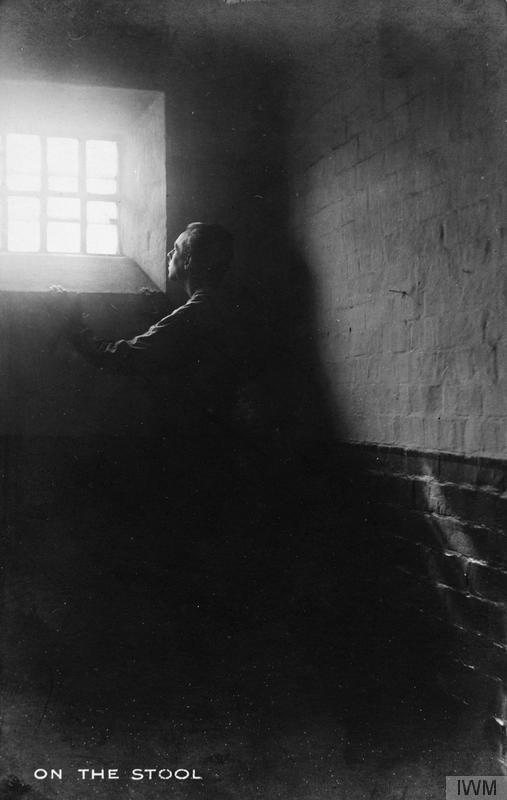
When Harold Bing was in Winchester Prison, there was one wing for male criminal prisoners, one for women and two for conscientious objectors. The conditions for COs were exactly the same as those for criminal prisoners, but COs did succeed in getting prisons to offer a vegetarian diet. Vegetarianism was common among COs, as it had an obvious affinity, particularly with humanitarian pacifism. CO prisoners were allowed a very limited number of censored letters, though one of the COs interviewed by IWM said ‘filling the notepaper was quite an art’ because there was nothing to say after months or years in prison. They had no calendars, no newspapers, and few visits – those visits they did receive were through a grille. They were limited to a few books from the prison library at infrequent intervals, but after a while COs were allowed to have books sent in under the condition that they donate them to the prison library once finished with them. Later CO prisoners were impressed to find prison libraries stocked with titles by William Morris, Sidney and Beatrice Webb and other writers of the left. Here, Bing recalls the constrained and degrading conditions of prison life.
Image – Copy negative made from a postcard of a conscientious objector prison, original caption reads ‘On the stool’ (Q 103094)
Audio – Harold Bing interview © IWM (IWM SR 358)
-
How did conscientious objectors cope in prison?
-
Severe physical brutality towards all COs seems to be a First World War myth. Certainly several of IWM’s interviewees experienced or witnessed very harsh treatment and 73 COs died as a result of physical abuse. The primary punishment – in many cases the most severe – was psychological rather than physical. The most fortunate COs were those who could devise ways to cope with loneliness, doubt, depression and loss of ability to concentrate. Some COs took an active role in challenging the situation in which they found themselves. Some participated in covert activity, described here by Harold Bing. Others coped through mental exercise. One of the COs interviewed by IWM, a musician, played an imaginary piano on his knees and even did some composition. Some COs learned Esperanto, many recited poetry from memory, and several went on long, imaginary, remembered walks. One man held races on the floor between bits of cobbler’s wax and another gained comfort from talking to the spiders on the cell wall and the bolts on its door.
Image – Copy negative made from a conscientious objector postcard depicting the interior of a cell (Q 103669)
Audio – Harold Bing interview © IWM (IWM SR 358)
-
Resistance
-
Some COs openly resisted the system, as described here by Fenner Brockway. Work and hunger strikes were held by COs including Clifford Allen (later Lord Allen of Hurtwood), chairman of the No-Conscription Fellowship, and Sir Francis Meynell. For many COs, the pressures and hardships strengthened their resolve.
Image – Copy negative made from a conscientious objector postcard, original caption reads ‘Ger – inside an’ close yer door!’ (Q 103666)
Audio – Fenner Brockway interview © IWM (IWM SR 476)
-
How were conscientious objectors treated?
-
Whether in prison or not, COs and their families did have a common experience in many respects, especially from the pressures they felt from society. Britain’s public support for the war was almost unanimous and society tended to view men who would not fight – and the men and women who supported them – with suspicion and loathing. To become a conscientious objector in 1916 was a difficult decision, which apparently involved rejecting the whole of conventional British society and everything it stood for. Wartime domestic propaganda made it all too plain that a person was either with the national effort or against it; and if against it, he was by implication either not concerned with the sacrifices of others or was undermining their willingness to serve. The conscientious objector was trapped psychologically: he felt guilty if he shared the soldiers’ ordeal and guilty if he did not. COs were not released until about six months after the end of the war, in order to give most soldiers a head-start when looking for jobs. They were also stripped of the right to vote until 1926. With time most did find a way to fit back into society – some very successfully. None of the COs interviewed by IWM appeared to feel any bitterness about their treatment, but they seem to remain, through their First World War experiences, permanently set apart.
Image – First World War-era cartoon by Frank Holland titled ‘An “Object” Lesson: This Little Pig Stayed at Home’ (Q 103334)
Audio – Clips from interviews with Percy Leonard © IWM (IWM SR 382), Lewis Maclachlan © IWM (IWM SR 565), Dorothy Bing © IWM (IWM SR 555)
This is an abridged version of a longer article, written by Margaret Brooks (former Keeper of the IWM Sound Archive), which appeared in the Imperial War Museum Review, No. 3 (1988).
Yemen talks end with no deal to stop war: Hadi delegation
Press TV – December 20, 2015
The UN-brokered peace talks between Yemen’s warring sides have ended in Switzerland without any agreement to end the Saudi aggression against the impoverished country, a member of the delegation representing Yemen’s fugitive former president says.
The negotiations will resume in Ethiopia on January 14, representatives of Abd Rabbuh Mansour Hadi said after the talks ended on Sunday.
This came only hours after the United Nations office in Geneva said in a statement that the talks between a delegation representing the Houthi Ansarullah movement and Hadi’s representatives ended. Hadi is supported by Saudi Arabia through a deadly air campaign against the Houthis and Yemeni people.
UN Special Envoy for Yemen Ismail Ould Cheikh Ahmed is expected to hold a press conference on the negotiations later on Sunday.
The UN-brokered negotiations began in the Swiss village of Magglingen on December 15 with the aim of reaching a permanent ceasefire in Yemen.
On Saturday, the two sides agreed to form a committee to oversee a fragile seven-day truce that came into effect on December 15 and has been violated several times.
Yemen has been under military attacks by Saudi Arabia since late March. More than 7,500 people have been killed and over 14,000 others injured since March. The strikes have also taken a heavy toll on the impoverished country’s facilities and infrastructure, destroying many hospitals, schools and factories.
The Saudi attacks were supposed to stop under a ceasefire which went into effect hours before the talks in Switzerland began; however, the raids have continued after the truce with reports of fatalities.
Saudi aggression
Also on Sunday, five Yemeni women were killed in a fresh Saudi airstrike in Sa’ada province.
Saudi warplanes bombed a residential area in al-Kitaf town, al-Masirah satellite television said.
This is the second Saudi bombing of the region in the past 48 hours. In an attack on Friday, 15 people had been killed.
Earlier on Sunday, Saudi jets also targeted a firm in a village in Bani Matar town in Sana’a province. Saudi jets also bombed a post office there.
A mosque and a bus station were also bombed in al-Hudaydah province.
The Sunday attacks were the latest violation of a seven-day ceasefire that came into force after UN-brokered talks opened in Switzerland between Yemen’s warring sides on December 15.
On December 17, head of Ansarullah Political Council Saleh Ali al-Sammad said in a statement that Riyadh had intensified its bombing of Yemen, taking advantage of the truce.
In return, Ansarullah fighters and allied army units killed about 150 Saudi-led troops in two ballistic missile attacks on Saturday.
The first attack hit a military base in Ma’rib province that also destroyed eight Apache helicopters, a drones’ command center, two Chinook airplanes as well as a number of tanks and military vehicles.
The second attack targeted a gathering of Saudi forces in al-Tawal border crossing, which links Yemen’s northwestern province of Hajjah to Saudi’s southwestern province of Jizan.
‘NATO’s Ambitions’ Behind EU Visa-Free Regimes With Ukraine, Georgia
Sputnik – 20.12.2015
The introduction of visa-free travel for citizens of Ukraine, Georgia and Kosovo, is another part of NATO’s enlargement to the East, DWN wrote. Washington is trying to further encircle Russia and is, therefore, incorporating the countries into its orbit.
Having failed to resolve the immigration crisis, the EU is taking another controversial step, DWN reported.
On Friday, Brussels recommended abolishing visa restrictions for citizens of Ukraine, Georgia and Kosovo as stated by the President of the European Commission, Jean-Claude Juncker.
According to him, this gesture would signify the recognition of the countries’ efforts in implementing democratic reforms. In fact, this decision is a part of NATO’s strategy of expansion to the East and its attempts to encircle Russia, the newspaper reported.
Washington is willing to turn Ukraine into its outpost on the Russian border. This, however, will happen at the expense of the EU, as Kiev is being kept afloat only by European taxpayers, the article said.
The country has long been bankrupt and is totally dependent on the foreign financial support. Moreover, the money is not being spent for the needs of the population, but rather flows into the pockets of corrupt Ukrainian politicians.
Such a situation will inevitably lead to a crisis which could transform the country into another “supplier” of refugees to Europe, the article said.
The abolition of visa restrictions for Georgia and Kosovo pursues the same geopolitical purpose as in the case of Ukraine, the newspaper wrote. Kosovo has one of NATO’s major air bases against Russia, while Georgia is located on the Russian flank and is of strategic importance for Moscow.
NATO’s recent invitation to Montenegro to start the accession talks on joining the military alliance should also be considered in this context. This way, NATO is trying to enclose Russia from Southern Europe and contribute to its further isolation.
Deployment fail: US special ops forces arrive in Libya, immediately told to leave
© Libyan Air Forces / Facebook
RT | December 18, 2015
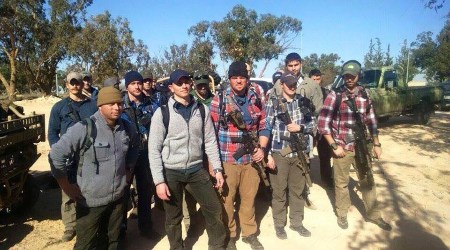
Libya’s air force said in a Facebook post that 20 US commandoes arrived at Wattiya airbase and disembarked “in combat readiness,” only to be told to leave. Pentagon sources confirmed the US had sent a special forces unit to Libya as part of a mission.
The Libyan Air Force said the 20 soldiers arrived at the airbase on Monday, but left soon after local commanders asked them to go because they had no right to be at the base “without prior coordination with protection force base.”
The Libyan air force published a Facebook post on Wednesday which included photographs of the special forces unit. It noted the 20 soldiers had disembarked “in combat readiness wearing bullet proof jackets, advanced weapons, silencers, handguns, night vision devices and GPS devices.”
When questioned by Libyan soldiers, the American troops said they were “in coordination with other members of the Libyan army,” the Libyan Air Force said. The Libyans were unconvinced.
“The response from your heroic army stationed at Wattiya base was to tell them to depart immediately and the group left, keeping their equipment with them,” the post added.
The photographs show three men armed with assault rifles, boarding a blue-and-white-striped passenger plane and driving a yellow dune buggy.
Pentagon sources confirmed to NBC News that the special forces unit was part of a mission sent this week, but it was unclear if the soldiers had left the country. Commandoes have been “in and out of Libya” for “some time now,” unnamed US officials told NBC, but the outlet reported they were there “purely to advise Libyan forces rather than conduct combat operations or training.”
According to the Associated Press, the failed debarkation happened just as Libya’s rival parliaments signed a landmark United Nations-sponsored deal to form a government in the war-torn country. Libya has been in chaos ever since Muammar Gaddafi was overthrown by NATO-backed rebels in 2011.
Read More: Fight against ISIS should be extended to Libya – French PM
Washington’s ‘Plan B’ in Syria: Renewed military intervention to oust Assad?
By Finian Cunningham | RT | December 16, 2015
US top diplomat John Kerry appeared to offer cooperation during lengthy talks in Moscow this week with President Vladimir Putin. Kerry said that US policy was not trying to isolate Russia, neither was it seeking regime change in Syria.
Rhetoric aside, Kerry’s expressions of goodwill simply do not cut it.
During a walkabout in Moscow, the US Secretary of State chanced on a little Christmas shopping, with Kerry buying a Babushka stacking doll among other souvenirs. The iconic Russian doll containing six shelled figurines could serve as a metaphor for Washington’s elusive rhetoric.
Following his three-hour discussion with Putin, Kerry said: “While we don’t see eye to eye on every aspect of Syria, we see Syria fundamentally similarly.”
US government-owned media outlet Voice of America added: “He [Kerry] said the US and Russia identify the same challenges and dangers, and want the same outcomes [in Syria].”
That, to put it bluntly, is simply not true. Washington and Moscow do not see Syria fundamentally similarly nor want the same outcomes.
Washington wants regime change, no matter what Kerry may declare. From the outset of the conflict in Syria in March 2011, the Obama administration has been demanding that Syrian President Bashar al-Assad “must go”.
Indeed, it is well documented that Washington and its NATO partners have been seeking regime change against Russia’s long-time Syria ally going back to 2007 during the George W Bush presidency. The whole foreign-backed war in the Arab country – resulting in 250,000 deaths and millions of refugees over the past five years – has been orchestrated for the precise purpose of destabilizing Syria.
Certainly, Kerry’s latest visit to Moscow marked a softening of the “Assad must go” line. Washington is now saying that the Syrian president may remain in office until a political transition is negotiated. But at the end of the so-called transition, the US still wants Assad gone, as Kerry again noted. That is regime change no matter how you slice it.
Like Kerry’s coy claim that the US is not trying “to isolate Russia as a matter of policy,” the bottom line is that Washington has imposed unilateral economic sanctions on Russia as a result of provable US regime change in Ukraine in February 2014, and cajoled its European allies to follow suit. Withdrawing unilaterally from arms control treaties and expanding NATO forces on Russian territory are hardly the actions of a party “not seeking isolation” of Moscow.
Washington sure wants regime change in Syria, just as former US General Wesley Clark disclosed back in 2007 – a policy that the American military-industrial complex formulated in 2001 following the 9/11 terror events. There is no reason whatsoever to believe that the same US hegemonic ambitions for the Middle East and beyond have changed under Obama.
What has changed is that Russia’s dramatic military intervention in Syria two months ago has shredded the US-led plans.
This week, President Obama made a speech at the Pentagon in which he made the laughable claim that the US was leading the global fight against the Islamic State terror group. “We are hitting them harder than ever,” he said.
Such claims by the US commander-in-chief are just downright delusional. It is the Russian aerial bombardment in close cooperation with the Syrian Arab Army that has completely turned the military tables on Islamic State (IS) and other illegally armed groups.
Moreover, it is Russian airstrikes which have wiped out the oil smuggling and weapon supply routes to the jihadists from Turkey.
These jihadists – whether they go by the shell names IS, Nusra, Army of Conquest or Free Syrian Army – are all part of the foreign-backed mercenary force that the US has deployed for sacking Syria.
Washington’s losing streak in the covert military objective has forced the US to seek a political track to achieve the same end result of regime change. That explains why Washington is now softening its rhetoric in order to inveigle Moscow into a political transition, euphemistically called a “peace process”.
Kerry said that the US and Russia have reached “common ground” on which Syrian opposition groups would be invited to peace talks in New York this Friday. The aim is to create a political opposition to the Assad government ahead of negotiations for a transition beginning in January.
A preview of these “opposition” groups was given last week when Saudi Arabia invited more than 100 so-called leaders of political and militant factions. As the New York Times reported the formation of this front was deemed by Washington as a “prerequisite” for the future talks. John Kerry welcomed the summit in Saudi capital Riyadh as “an important step forward”.
Although Al Qaeda-linked groups, IS and Al Nusra, did not attend the Saudi-sponsored and US-countenanced gathering, the NY Times admitted that delegates included “hardline Islamists”. Those in attendance included Ahrar al Shams and Jaish al Islam. The latter gained notoriety for holding civilian human shields in cages, as well as being linked to the chemical gas atrocity near Damascus in August 2013.
The Saudi-sponsored opposition that Washington is trying to line up against the Syrian government are braying for Assad’s immediate departure. John Kerry may say belatedly that US policy has shifted to permit Assad to remain in power for the duration of a transition, but it should be obvious that Washington is setting up a framework under the guise of a peace process in which Assad’s departure is put on the agenda.
But what gives the US and its NATO and Arab cronies any right to make such demands on Syria’s political future?
Washington does not seem to get it that its arrogant assertions about political change in Syria are null and void. Russia has time and again rightly pointed out that Syria’s political future is for the Syrian people to decide as a matter of sovereignty. Russia’s position is fully supported by Iran.
As for Syria’s President Assad he has said that there will be no negotiations with the Saudi-sponsored political opposition, labeling them with reasonable justification as “terrorists”.
In a parallel development, Saudi Arabia also announced the formation of a 34-nation alliance of Muslim countries supposedly dedicated to fighting the “disease of Islamic terrorism”. The newly formed bloc comprises in addition to Saudi Arabia: Qatar, United Arab Emirates, Kuwait and Turkey – all countries associated with the funding and arming of extremist groups in Syria and elsewhere. Strangely, or perhaps not, Iran, Iraq and Syria were not invited to join the bloc.
US Defense Secretary Ashton Carter welcomed the new alliance. And the Saudis said that troops from the 34-nation coalition could be sent into Syria and Iraq to “combat” the IS network. Washington also endorsed that, saying that it wanted more regional “boots on the ground” to help fight terrorism.
What that suggests is that if the political track does not go well for ousting Assad, then the US and its allies are giving themselves the license to openly intervene in Syria – ostensibly to fight terror groups, which they have covertly fomented. Such a renewed military intervention can be seen as Plan B, where Plan A – the covert use of terror groups – has failed.
Read more:
‘Washington has gone from ‘regime change’ to ‘political transition’ in Syria, but we are not stupid’
Featured Video
Dan Dicks with James Corbett on Solutions Watch
or go to
Aletho News Archives – Video-Images
From the Archives
$1.5bn up in smoke: US THAAD missile stockpile dries up defending Israel against Iran
By Ivan Kesic | Press TV | July 2, 2025
According to American media, defense news outlets, and independent analysts, the 12-day Israeli military aggression against Iran significantly depleted the US stockpile of THAAD (Terminal High Altitude Area Defense) interceptor missiles.
Citing official sources, American magazine Newsweek reported on Friday that the US transferred a substantial portion of its advanced missile defense capabilities to support the Israeli regime, an effort with questionable results and a critical impact on US strategic reserves.
THAAD, developed by Lockheed Martin arms manufacturing company, is a key component of Israel’s multi-layered air defense architecture. It is designed to intercept medium-range ballistic missiles, including those launched from Iran and Yemen.
The US-made system is capable of targeting short-, medium-, and intermediate-range ballistic missiles during their terminal phase, whether inside or outside Earth’s atmosphere.
THAAD uses a “hit-to-kill” method, relying on kinetic energy rather than explosive warheads to destroy incoming threats, intercepting at altitudes of up to 150 km and ranges between 150-200 km.
Operated exclusively by American personnel, the US military maintains eight THAAD batteries with an estimated 350–400 interceptors in total. The eighth battery was activated during the June 20 Israeli aggression against Iran and is capable of intercepting hypersonic missiles. … continue
Blog Roll
 Aletho News
- Zionist Bought Senate Blocks Information About American Citizens Killed By Israel
- While Gaza dominates the UN, these are the people keeping it alive
- New Report: “Scholasticide and Genocide in Gaza: Assessment, Testimonies and Legal Analysis”
- ‘THAAD Delusion’: Iran war exposes US missile shield limits – The Atlantic
- Moscow issues warning to NATO over Russian exclave
- Yes, the Iran war has destroyed Trump’s presidency
- The fallacy of US delusions about Iran’s economic collapse
- Hezbollah denies Syria cell link, warns of Israeli plan to sow discord
- The legacy of US sanctions, war, and occupation in Iraq
- Iraqi resistance group rejects disarmament, vows to maintain support for Lebanon
- If Americans Knew
- Mamdani releases plan to combat antisemitism and hate crimes in New York City
- Iran’s Revolutionary Guards Publish Letter to the American People
- DMFI launches $1 million ad campaign supporting Virginia’s Elaine Luria
- US Senate blocks resolution seeking report on Americans killed by Israel
- Israeli Attacks Kill Ten Palestinians in Gaza
- Massacre at Minab: The School That Became a Grave
- Israeli media: The IDF Shows It Doesn’t Turn a Blind Eye; It Actively Emboldens Settler Havoc
- As settlers ravage West Bank, Israeli forces kill 10 in Gaza – Daily Update
- New Report: “Scholasticide and Genocide in Gaza: Assessment, Testimonies and Legal Analysis”
- Ex-Biden officials are desperate for a Gaza scapegoat
- No Tricks Zone
- Green Energy Debacle: German Expert Professor Fritz Vahrenholt Warns Of Severe Economic And Social Consequences
- Two More Paleo Reconstructions Affirm Meters-Higher Sea Levels Across Ireland, Brazil 7000-6000 Years Ago
- New Study: Earth And Venus Surface Warmth Largely Explained By Convection And Lapse Rate, Not CO2 Or Radiation
- 2025 Nature Paper Claiming Worsening Global Drought Gets RETRACTED …Heavily Flawed
- New Study: ‘Global Drought Shows No Detectable Recent Acceleration Under Climate Warming’
- Economic Masterminds: German Socialists Suggest Taxing Productivity Gains Stemming From Using AI
- The South China Sea Has Not Been Cooperating With The Climate Change Narrative
- Energy Crisis: Germany Enters Heating Season With Historically Low Gas Reserve Fill Levels
- New Study: The Antarctic Ice Sheet Gained Mass From 2020-2024 Due To Staggering Snow And Ice Accumulation
- Study: Ocean Heating Rates From Thousands Of Years Ago ‘Dwarf’ Modern Ocean Heating Rates

