US-NATO Antics in the Nuclear Playground
By BRIAN CLOUGHLEY | CounterPunch | April 17, 2015
The commander of US-NATO forces, the vigorously vocal General Breedlove, stated on April 7 that the military alliance’s planners “have been working tirelessly to enhance NATO’s Response Force and implement the Very High Readiness Joint Task Force, and today our progress is manifested in the rapid deployments we see happening in locations across the Alliance.”
Breedlove is the man who declared on March 5 that Russia had sent combat troops and massive quantities of military equipment into Ukraine. He said that President Putin had “upped the ante” in eastern Ukraine by deploying “well over a thousand combat vehicles, Russian combat forces, some of their most sophisticated air defense, battalions of artillery.” His military opinion was that “What is clear is that right now, it is not getting better. It is getting worse every day.”
He spoke absolute drivel, because the ceasefire between Ukrainian forces and separatists in the east of the country was working, albeit shakily, and things were quietening down. The last thing that was needed was provocation. Silence and, or at the most, calm, reasoned comments were essential if both sides were to be encouraged to cool it.
But this man, the Supreme Allied Commander Europe, the man who has the trust of the American president, the prime nuclear button-shover, told a deliberate lie intended to increase tension.
The manufactured tension built up and on April 7 Breedlove’s HQ announced that the militaries of “11 Allied nations, Germany, Poland, Norway, Denmark, Hungary, Lithuania, Croatia, Portugal, and Slovenia tested their Headquarters’ response to alert procedures,” while “in the afternoon of 7 April, the 11th Air Mobile Brigade in The Netherlands and the 4th Rapid Reaction Brigade in the Czech Republic were given orders to rapidly prepare to deploy their troops and equipment” in a maneuver called “Noble Jump” which conjured up an image of a missile-wielding April bunny leaping into the fray against a coyly unnamed enemy who could be no other than Russia. (Although perhaps Russia need not be too troubled about some of NATO’s war preparations. My sources told me that the practice mobilization of the Dutch brigade was a shambles.)
While the ground-based martial bunny-hops were going on there was an aerial provocation in progress, this time involving a US Combat Sent RC-135U spyplane which was on a mission against Russia and flew along its Baltic Sea coastline. To prevent identification its transponder had been switched off — just like those of the aircraft in the 9/11 hijackings and Malaysia Airlines Flight 370 which disappeared mysteriously a year ago.
All aircraft have transponders which report their speed, height, heading and identification to air traffic controllers and other aircraft in order to avoid aerial confusion, so when Russian radar detected a large aircraft without such a signal but obviously using transmission devices to collect their radar and other electronic emissions, including civilian commercial communications, they sent up a fighter plane to have a look. Washington threw up its hands in mock horror and issued statements about how dangerous this was. Then the western media went into overdrive with a cavalier disregard for balanced reporting.
The Daily Mail of Britain is a garbage newspaper which maintains enormous readership because it specializes in glamorizing Britain’s sad, tacky and pathetic Celeb culture while concurrently condemning it, sometimes in the most portentous terms. The paper’s masses of online readers try to rationalize their attraction to vulgarity by glancing at items on international affairs and were told breathlessly that “In a maneuver with ominous echoes of the Cold War, a Russian fighter jet ‘aggressively’ intercepted an American plane over Poland, the Pentagon claims. Filing an official complaint to Russia, the State Department alleges a U.S. RC-135U reconnaissance aircraft was flying near the Baltic Sea in international airspace when a Russian SU-27 Flanker cut into its path.”
The average Daily Mail reader might not be able to question the absurdly conflicting phrases “near the Baltic Sea,” “over Poland,” and “in international airspace,” but that doesn’t matter. The message was being spread around by the US-NATO propaganda apparatus that the dreaded Russkies were menacing the Free World. The media lapped it up.
Little attention was paid in the West to the Russian announcement that “an Su-27 fighter on duty was scrambled, approached the unidentified aircraft, flew around it several times, identified it as an RC-135U reconnaissance aircraft belonging to the U.S. Air Force and read its side number, and reported it to the command. After having been intercepted by the Russian fighter, the U.S. Air Force aircraft changed its course and moved away from the Russian border.”
What the Russians didn’t say was that the aircraft’s “side number” was 4849 and that it had been photographed the previous day in Eastern England at the Royal Air Force base at Mildenhall which houses a USAF tanker squadron, about 200 US special forces soldiers with Osprey aircraft and operatives from such elements as 97 Intelligence Squadron.
No doubt the Russians know that last October it was noticed that US RC-135U spy plane number 4849 carries on its side some eye-catching decals. A photograph taken by Gary Chadwick at Mildenhall shows the “mission markings applied above the crew entry hatch, on the left hand side of the RC-135U Combat Sent 64-14849 ‘OF’ with the 45th Reconnaissance Squadron/55th Wing of the U.S. Air Force : five hammer and sickle symbols.”
These symbols may be stickers or stencils, but whatever they are they cost money and take time and effort to apply on the side of an airplane to which they add neither beauty or distinction. So why are they placed there?
It might be thought strange that a US military aircraft in 2015 should have Soviet-era hammer and sickle decals on its side in order to publicly indicate a military exploit involving achievement of an objective of some sort. And it is interesting that one of the images has been added recently, because when a photograph of 4849 was taken last year there were only four such symbols. What enterprising and gallant mission merited the fifth hammer and sickle? Another addition was a fourth depiction of an aircraft carrier, signifying, no doubt, a successful electronic spying mission involving one of these ships that was not of the United States Navy. What nationality could it have been?
The anti-Russian spy-antics of the US are fully in line with the war-talk of Breedlove and his NATO colleagues who are beavering away in their brand-new billion dollar combat palace in Brussels to justify existence and expansion of their war machine. Russia’s actions have been propagandized accordingly, and the US spy flights are intended to provoke Moscow into taking action which can be used to escalate tension yet further. It would all be childishly funny were it not for the fact that Breedlove and his people are playing with the future of Europe and indeed the world. They are leading us to the nuclear threshold, and must be reined in before they stumble into ultimate confrontation.
Brian Cloughley writes about foreign policy and military affairs. He lives in Voutenay sur Cure, France.
US Paratroopers Arrive in Ukraine as Fighting Intensifies in Donbass
Sputnik | 14.04.2015
After what could essentially be called a 1,100 mile military parade through Eastern Europe, US paratroopers of the 173rd Airborne Brigade have arrived in Ukraine to commence Operation Fearless Guardian.
It comes as Ukrainian hacking group CyberBerkut released a long list of foreign military inspectors set to arrive in Ukraine in April.
The convoy, consisting of 50 paratroops and 25 vehicles, disembarked from Vicenza, Italy. After traveling through Austria, as well as NATO allies Germany and Poland, the military caravan arrived in Yavoriv, Ukraine on Friday.
“This assistance is part of our ongoing efforts to help sustain Ukraine’s defense and internal security operations,” Pentagon spokeswoman Eileen Lainez told the Hill when the operation was first announced.
Operation Fearless Guardian is the codename given to US efforts to train the Ukrainian National Guard. Spanning a six-month period, the exercises will begin later this month. While 300 US soldiers will take part, the convoy delivered equipment as well.
“This equipment will provide maintenance support as well as troop and general cargo transport to and from training areas,” Captain P.J. Hartman said in a press release from the US Army.
Ukrainian media has reported that the training will conclude with the US military trainers handing over ammunition, though US Army Europe spokesman Donald Wrenn told Newsweek, “[W]e at Army Europe are not aware of any ammunition being provided following the training.”
Long planned, the mission was originally meant to begin last month, but it was delayed after the signing of the second ceasefire agreement in Minsk.
The convoy arrives amid renewed violence in the country’s east. Monitors with the Organization for Security and Co-operation in Europe reported evidence of fighting on Sunday, including tank rounds and machine gun fire. Ceasefire breaches last week left three independence supporters dead and five others injured.
Fearless Guardian is just the latest in a series of steps taken by Washington which contradicts its message of diplomacy over violence. The US has so far provided over $120 million in non-lethal military aid, including 230 Humvees and unarmed Raven drones.
“While we continue to believe that there is no military resolution to this crisis, Ukraine has the right to defend itself,” Lainez said last month.
On Tuesday, Canada also announced it would deploy 200 troops to Ukraine to assist in the training exercises, while the UK has already sent a number of military instructors.
During a TV interview last week, Russian Foreign Minister Sergey Lavrov warned about an increase in Western military presence in Ukraine.
“Provocateurs in Kiev and those who support the ‘party of war’ might attempt to cook something up in the hopes of inflaming world public opinion, resulting in weapons flowing into Ukraine,” Lavrov said. “We must keep a close eye on this.”
NATO plans amount to violation of NPT: Russian envoy
Press TV – April 16, 2015
Russia says the North Atlantic Treaty Organization (NATO) is preparing the ground for the use of nuclear weapons by non-nuclear countries in contradiction to the Western military alliance’s obligations under the Non-Proliferation Treaty (NPT).
“NATO, contrary to the obligations taken under the treaty on the non-proliferation of nuclear weapons, is still conducting preparations for the use of nuclear weapons by countries that are non-nuclear states,” Alexander Grushko, Russia’s envoy to NATO, said at the Fourth Moscow International Security Conference on Thursday.
The NPT, which was ratified in 1970, constitutes the cornerstone of global efforts to prevent the spread of nuclear weapons and to open up access to the peaceful use of nuclear energy. Non-nuclear signatories to the treaty have agreed not to seek to develop or acquire nuclear arms.
The Russian official further accused the military bloc of seeking to revive the Cold War ideology.
Meanwhile, Russian Defense Minister General Sergei Shoigu told the conference that NATO military exercises in the Arctic and Eastern Europe are against Russia.
The minister also warned that the participation of NATO’s non-nuclear states in the drills stimulate “the use of US tactical nuclear weapons” in violation of the NPT.
In February, NATO defense ministers agreed to increase from 13,000 soldiers to 30,000 the size of the alliance’s rapid reaction force. They also announced plans to set up six new command posts in Estonia, Latvia, Lithuania, Poland, Romania and Bulgaria.
The Western military bloc has over the past year increased its presence and conducted several drills in Eastern Europe amid the crisis in Ukraine. Moscow, however, has repeatedly condemned NATO’s exercises and military buildup near Russia’s borders.
Moscow-West relations have been extremely tense in recent months. The West accuses Moscow of supporting pro-Russia forces in eastern Ukraine, an allegation strongly denied by the Kremlin.
What the Hell Are We Doing in Yemen?
By Sheldon Richman | Free Association | April 16, 2015
The U.S. government has charged into another civil war in the Middle East. When you find yourself repeatedly asking, “Will they ever learn?” the answer may be that the decision-makers have no incentive to do things differently. What looks like failure may be the intended outcome. Quagmires have their benefits — to the ruling elite — if American casualties are minimized.
The Obama administration is assisting Saudi Arabia in its bombing of Yemen, creating — in concert with the Saudi embargo — a humanitarian catastrophe in the Middle East’s poorest country. Civilians are dying, and what infrastructure the country has is being destroyed.
Why? Secretary of State John Kerry says the United States won’t “stand by while the region is destabilized.” Kerry is a veteran, and presumably a student, of America’s Indochina war. So he must know that bombing is a terrible way to prevent destabilization. Kerry isn’t stupid — but that means he’s a liar and a demagogue.
Note that he says “the region,” not “Yemen.” Why would a civil war in Yemen affect the region? Because according to the official narrative, faithfully carried by most of the news media, Yemen is under siege by agents of Iran, the Houthis.
Iran today serves the same purpose the Soviet Union, or the International Communist Conspiracy, served from the end of World War II until 1989-91, when the Soviet empire collapsed. Iran is the all-purpose arch enemy on which virtually any evil can be blamed. So the war party and its Saudi and Israeli allies tell us every day that Iran is on the march, controlling capitals throughout the Middle East: Baghdad, Damascus, Beirut, and now Sana’a.
But this is absurd. Iran is not on the march. George W. Bush knowingly delivered Baghdad to Iran-friendly Iraqi Shiites in 2003. The Assad regime in Syria is a long-time Iranian ally that Obama and his first secretary of state, Hillary Clinton, declared open season on, emboldening al-Qaeda and its more-virulent mutation, ISIS. Iran’s friends in Lebanon, the political party Hezbollah, formed itself in response to Israel’s 1982 invasion and long occupation. None of these demonstrate an aggressive Iran. A better explanation is that those alliances help Iran cope with the American encirclement. (Recall: the CIA overthrew Iran’s democratic government in 1953 and was complicit in Iraq’s 1980s offensive war against Iran, in which Saddam Hussein used U.S.-facilitated chemical weapons. Since then, U.S. presidents and Israel’s government have attacked Iran in many ways: economic, cyber, proxy-terrorist, and covert.)
And what of Yemen, where the Houthis drove out the U.S.-backed autocratic president while also fighting declared enemies of the United States, Sunni al-Qaeda in the Arabian Peninsula and the Yemeni affiliate of ISIS? Yes, the Houthis practice a kind of Shiite Islam, Zaidi, but it differs importantly from Iranian Shiism. In fact, the Houthis are merely the latest manifestation of a long-oppressed Yemeni religious minority seeking autonomy from the central government. After years of being frustrated, lied to, and double-crossed, it finally moved on that government. Say what you will about the group, but don’t call it an agent of Iran.
Saudi Arabia sees Iran as a menace, but the kingdom is hardly credible, and the Obama administration is likely to be placating the royal family now that a nuclear deal with Iran may be at hand. As independent researcher Jonathan Marshall notes, “Decades before Iran became an enemy, however, Saudi Arabia began intervening in its southern neighbor [Yemen]. Besides grabbing land, the Saudis poured vast sums of money into Yemen to promote its extreme brand of Sunni Islam known as Wahhabism. In 2009, it invaded northern Yemen to attack the Houthis, unsuccessfully.”
Marshall adds, “Washington has also inserted itself in Yemen’s civil conflicts for decades.”
Of course Washington has been killing Yemenis with drones — not all of them even “suspected terrorists” — since 2001, when the corrupt and oppressive government in Sana’a became an ally in the “war on terror.”
“Yemen’s government repeatedly used U.S. military aid to support an all-out assault against the Houthis (“Operation Scorched Earth”),” Marshall writes, “causing extensive civilian casualties.”
As we should know by now, U.S. intervention is no innocent mistake.
Russia Impinges on Israeli ‘Right’ to Bomb Iran
By Ray McGovern | Consortium News | April 14, 2015
The front page of the neocon flagship Washington Post on Tuesday warned that the Russians have decided, despite U.S. objections, “to send an advanced air-defense system to Iran … potentially altering the strategic balance in the Middle East.”
So, at least, says the lede of an article entitled “Putin lifts 5-year hold on missile sale to Iran” by Karoun Demirjian, whose editors apparently took it upon themselves to sex up the first paragraph, which was not at all supported by the rest of her story which was factual and fair – balanced, even.
Not only did Demirjian include much of Russian Foreign Minister Sergei Lavrov’s explanation of Moscow’s decision to end its self-imposed restriction on the delivery of S-300 surface-to-air missiles to Iran, but she mentioned Israeli Prime Minister Benjamin Netanyahu’s umpteenth warning on Monday about “the prospect of airstrikes to destroy or hinder Tehran’s nuclear program.”
Lavrov noted that United Nations resolutions “did not impose any restrictions on providing air defense weapons to Iran” and described the “separate Russian free-will embargo” as “irrelevant” in the light of the “meaningful progress” achieved by the negotiated framework deal of April 2 in which Iran accepted unprecedented constraints on its nuclear program to show that it was intended for peaceful purposes only.
The Russian Foreign Minister emphasized that the S-300 is a “completely defensive weapon [that] will not endanger the security of any state in the region, certainly including Israel.” Pointing to “the extremely tense situation in the region around Iran, he said modern air-defense systems are vitally important for that country.” Lavrov added that by freezing the S-300 contract for five years, Russia also had lost a lot of money. (The deal is said to be worth $800 million.)
Predictably, former U.S. Ambassador to the United Nations John Bolton told Fox News that the air-defense system would be a “game-changer” for Israel regarding air strikes. According to Bolton, once the system is in place, only stealth bombers would be able to penetrate Iranian space, and only the U.S. has those and was not likely to use them.
The U.S. media also highlighted comments by popular go-to retired Air Force three-star General David A. Deptula, who served as Air Force deputy chief of staff for intelligence, surveillance and reconnaissance until he retired in 2010 to make some real money. Deptula called delivering the S-300 system to Iran “significant, as it complicates the calculus for planning any military action involving air strikes.”
It strikes me as a bit strange that the media likes to feature retired generals like Deptula, whose reputation for integrity are not the best. Deptula has been temporarily barred from doing business with the government after what Air Force Deputy General Counsel Randy Grandon described as “particularly egregious” breaches of post-employment rules. He remains, however, a media favorite.
Adding to his woes, Deptula was also caught with 125 classified documents on his personal laptop – including 10 labeled “Secret,” 14 labeled “Top Secret” and one with the high protection of “Secret, Compartmented Information.” Deptula pleaded ignorance and was let off – further proof that different standards apply to generals like Deptula and David Petraeus.
A More Subdued Tone
The S-300 announcement hit as Secretary of State John Kerry was testifying on Capitol Hill about the framework deal on Iran’s nuclear program. Speaking later to Fox News, Rep. Adam Kinzinger, R-Illinois, professed shock that Kerry did not seem more upset. According to Kinzinger, Kerry actually said, “You have to understand Iran’s perspective.”
And in keeping with Kerry’s tone of sang-froid, State Department spokeswoman Marie Harf, referring to the S-300 deal, said, “We see this as separate from the negotiations [regarding Iran’s nuclear program], and we don’t think this will have an impact on our unity.”
White House press secretary Josh Earnest took the S-300 announcement with his customary, studied earnestness. Referring not only to the decision to deliver the S-300s but also to reports of a $20 billion barter deal that would involve Russia buying 500,000 barrels of oil a day in return for Russian grain, equipment and construction materials, Earnest referred to “potential sanctions concerns” and said the U.S. would “evaluate these two proposals moving forward,” adding that the U.S. has been in direct touch with Russia to make sure the Russians understand – and they do – the potential concerns that we have.”
With respect to the various sanctions against Iran, I believe this nonchalant tone can be seen largely as whistling in the dark. With the S-300 and the barter deals, Russia is putting a huge dent in the sanctions regimes. From now on, money is likely to call the shots, as competitors vie for various slices of the Iranian – and the Russian – pie. Whether or not there is a final agreement by the end of June on the Iranian nuclear issue, Washington is not likely to be able to hold the line on sanctions and will become even more isolated if it persists in trying.
Worse still for the neocons and others who favor using sanctions to punish Russia over Ukraine, the lifting of sanctions against Iran may have a cascading effect. If, for example, the Ukrainian ceasefire holds more or less over the next months, it is possible that the $1.5 billion sale of two French-built Mistral-Class helicopter carrier ships to Russia, concluded four years ago, will go through.
The contract does not expire for two months and Russia’s state arms exporter is trying to work out a compromise before taking France to court. Russian officials are expressing hope that a compromise can be reached within the time left.
And, regarding the outrage among neocons over the audacious idea that Iran should be allowed to defend itself against airstrikes, there is the “exceptional” argument that Israel, United States and their allies should have the unchallenged right to bomb Iran or any other country as they see fit – and that the targeted country should have no right to protect its people, indeed that trying to defend itself is some kind of unacceptable provocation.
There is also the hypocrisy regarding how the neocons like to differentiate between “defensive” and “offensive” weapons when the question is about giving U.S.-backed governments weapons that have dual purposes, that can be used offensively as well as defensively.
For instance, in regard to Ukraine earlier this year, U.S. Assistant Secretary of State Victoria Nuland counseled U.S. officials to portray the delivery of sophisticated U.S. military hardware to the coup regime in Kiev as “defensive,” even though the weapons had an offensive capacity, such as targeting ethnic Russian rebels firing artillery or mortars at Ukrainian troops attacking eastern Ukraine.
According to the German newspaper, Bild, which published an intercepted conversation between Nuland and U.S. officials in Munich, Germany, she said, “I’d strongly urge you to use the phrase ‘defensive systems’ that we would deliver to oppose Putin’s ‘offensive systems.’”
However, NATO Commander and Air Force General Philip Breedlove left little doubt that these “defensive” weapons would help the Ukrainian government pursue its military objectives by enabling more effective concentration of fire. “Russian artillery is by far what kills most Ukrainian soldiers, so a system is needed that can localize the source of fire and repress it,” Breedlove reportedly said.
So, when “defensive” weapons help a U.S.-backed regime kill its opponents, that’s fine. However, if some truly defensive weapons, such as anti-aircraft missiles to protect a country’s cities, go to a nation that Israel might want to bomb, then that is unacceptable.
~
Ray McGovern works with Tell the Word, a publishing arm of the ecumenical Church of the Saviour in inner-city Washington. During his earlier, 27-year career as a CIA analyst, he led the Soviet Foreign Policy Branch and prepared – and briefed – the President’s Daily Brief. He now serves on the Steering Group of Veteran Intelligence Professionals for Sanity (VIPS).
UN sanctions Houthis in Yemen, ignores Russian calls for all-inclusive arms embargo
RT | April 14, 2015
The UN Security Council has imposes an arms embargo against the Houthi rebels in Yemen and blacklisted a Houthi leader and the
Fourteen members of the Security Council voted in favor of the resolution, Russia being the only abstention.
The Russian representative explained the move by saying that not all of Moscow’s proposals had been included in the final text drafted by Jordan and Gulf Arab states.
“The co-sponsors refused to include the requirements insisted upon by Russia addressed to all sides to the conflict to swiftly halt fire and to begin peace talks,” Russian UN Ambassador Vitaly Churkin told the council after the vote.
The resolution also blacklisted Houthi leader Abdel-Malek al-Houthi, as well as the son of Yemen’s former president, Ali Abdullah Saleh.
The Jordanian draft resolution was being debated alongside a separate Russian draft, which called for a “humanitarian pause” in airstrikes by the Saudi-led military coalition.
An all-inclusive arms embargo on all parties in the Yemeni conflict, suggested earlier by Russia as an amendment to the Arab draft, was rejected.
“We insisted that the arms embargo needs to be comprehensive; it’s well known that Yemen is awash in weapons,” Churkin said. “The adopted resolution should not be used for further escalation of the armed conflict.”
The Shiite Houthi rebels took control of Yemen’s capital, Sanaa, in September 2014, forcing President Abd-Rabbu Mansour Hadi to flee to Saudi Arabia. They are now fighting for the strategic port city of Aden.
The Houthi offensive is supported by soldiers loyal to Saleh, who was forced to give up power in Yemen after a 33-year rule in 2012.
Saudi Arabia and its Sunni Arab allies have been bombing the Houthi rebels since March 25, with over 1,000 people killed since the start of the conflict.
Al-Houthi and the ex-president’s eldest son, Ahmed Ali Abdullah Saleh, will face an asset freeze and travel ban in accordance with the sanctions.
Last November, UNSC imposed the similar sanctions on former president Saleh, the rebel group’s military commander Abd al-Khaliq al-Houthi and the Houthi’s second-in-command, Abdullah Yahya al Hakim.
The resolution also urged “Member States, in particular States neighboring Yemen, to inspect … all cargo to Yemen” if they have reasonable grounds to believe it contains weapons.
The document demanded all Yemeni parties to stop fighting, especially the Houthis, who are called upon to withdraw from Sanaa and other areas they have seized.
It also blamed ex-President Saleh for “destabilizing actions” in Yemen, including supporting the Houthi uprising.
Dozens of arrests as anti-nuclear protesters demand end to UK’s Trident sub program

Anti-nuclear demonstrators at Faslane naval base, April 13 2015. (Photo by Veronika Tudhope)
RT | April 13, 2015
Some 36 anti-nuclear activists have been arrested at Faslane naval base in Scotland, according to organizers, as hundreds of protesters blockaded the home of Britain’s nuclear weapons system.
Workers at the naval facility were sent home after failing to gain access to the site due to the blockade, according to The Common Space journalist Liam O’Hare.
Scrap Trident, a coalition of organizations including the Scottish Campaign for Nuclear Disarmament (SCND) and Trident Ploughshares, have been demonstrating outside the facility since 7 a.m.
Protesters are demanding an end to the UK’s intercontinental ballistic missile program, which is up for renewal by the Westminster parliament in 2016.
Trident has become a contentious issue ahead of the general election in May, with Defense Secretary Michael Fallon pledging last week that a Conservative-led government would replace the Vanguard-class nuclear submarines with four new nuclear missile carriers.
Fallon’s election promise followed a statement by Scottish National Party (SNP) leader Nicola Sturgeon, in which she said Trident was a “red line” issue the SNP would not support.
In the event of a hung Parliament, Labour may seek to form a minority government in an informal coalition with SNP.
Critics, including Fallon of the Conservative Party, argue that Labour would abandon the UK’s nuclear weapons program to secure power.
Shadow Defense Secretary Vernon Coaker rejected the idea, insisting last week Labour was committed to renewing Britain’s nuclear weapons program, which is set to cost taxpayers £100 billion over the course of its deployment.
Labour leader Ed Miliband said in January he supported renewing Trident, adding he is “not in favor of unilateral disarmament.”
Monday’s blockade of Faslane naval base follows anti-Trident demonstrations in Glasgow and London over the weekend.
Scrap Trident organizers claim that 36 anti-nuclear activists were arrested in the blockade.
O’Hare, of The Common Space, reports that police have attempted to move anti-nuclear activists camped outside the naval facility’s south gate, while the majority of demonstrators are protesting outside the north gate.
Arthur West, chair of Scottish CND, said in a statement: “The purpose of the event is to draw attention to the fact that all Britain’s nuclear weapons are based just 25 miles away from our biggest city [Glasgow].”
“We say get rid of nuclear weapons and spend the money on decent things like housing, jobs and education.”
Speaking to RT, West added: “Scottish CND are campaigning in cities and towns across Scotland in the run-up to the general election.”
“Our main message to voters at the election is to only support candidates who have given a clear commitment that they will vote against Trident replacement when the issue comes up in the next parliament.”
Patrick Harvie, co-convenor of the Scottish Green Party, was among the demonstrators at Faslane on Monday.
Harvie, a member of the Scottish parliament, said in a statement: “Trident is an obscenity. Through direct action and through the ballot box we can make the case for the UK to play a new role on the world stage.”
He added: “By choosing to disarm Trident we can reskill workers on the Clyde to provide defense of the strategically important northern seas, and diversify our economy for social good.”
The New Militarism: Who Profits?
By Ron Paul | April 12, 2015
Militarism and military spending are everywhere on the rise, as the new Cold War propaganda seems to be paying off. The new “threats” that are being hyped bring big profits to military contractors and the network of think tanks they pay to produce pro-war propaganda.
Here are just a few examples:
The German government announced last week that it would purchase 100 more “Leopard” tanks – a 45 percent increase in the country’s inventory. Germany had greatly reduced its inventory of tanks as the end of the Cold War meant the end of any threat of a Soviet ground invasion of Europe. The German government now claims these 100 new tanks, which may cost nearly half a billion dollars, are necessary to respond to the new Russian assertiveness in the region. Never mind that Russia has neither invaded nor threatened any country in the region, much less a NATO member country.
The US Cold War-era nuclear bunker under Cheyenne Mountain, Colorado, which was all but shut down in the 25 years since the fall of the Berlin Wall, is being brought back to life. The Pentagon has committed nearly a billion dollars to upgrading the facility to its previous Cold War-level of operations. US defense contractor Raytheon will be the prime beneficiary of this contract. Raytheon is a major financial sponsor of think tanks like the Institute for the Study of War, which continuously churn out pro-war propaganda. I am sure these big contracts are a good return on that investment.
![IMG_2042.RELEASABLE_FOR_THE_PUBLIC[1]-(Medium)](https://alethonews.com/wp-content/uploads/2015/04/img_2042-releasable_for_the_public1-medium.jpg?w=300&h=200) NATO, which I believe should have been shut down after the Cold War ended, is also getting its own massively expensive upgrade. The Alliance commissioned a new headquarters building in Brussels, Belgium, in 2010, which is supposed to be completed in 2016. The building looks like a hideous claw, and the final cost – if it is ever finished – will be well over one billion dollars. That is more than twice what was originally budgeted. What a boondoggle! Is it any surprise that NATO bureaucrats and generals continuously try to terrify us with tales of the new Russian threat? They need to justify their expansion plans!
NATO, which I believe should have been shut down after the Cold War ended, is also getting its own massively expensive upgrade. The Alliance commissioned a new headquarters building in Brussels, Belgium, in 2010, which is supposed to be completed in 2016. The building looks like a hideous claw, and the final cost – if it is ever finished – will be well over one billion dollars. That is more than twice what was originally budgeted. What a boondoggle! Is it any surprise that NATO bureaucrats and generals continuously try to terrify us with tales of the new Russian threat? They need to justify their expansion plans!
So who is the real enemy? The Russians?
No, the real enemy is the taxpayer. The real enemy is the middle class and the productive sectors of the economy. We are the victims of this new runaway military spending. Every dollar or euro spent on a contrived threat is a dollar or euro taken out of the real economy and wasted on military Keynesianism. It is a dollar stolen from a small business owner that will not be invested in innovation, spent on research to combat disease, or even donated to charities that help the needy.
One of the most pervasive and dangerous myths of our time is that military spending benefits an economy. This could not be further from the truth. Such spending benefits a thin layer of well-connected and well-paid elites. It diverts scarce resources from meeting the needs and desires of a population and channels them into manufacturing tools of destruction. The costs may be hidden by the money-printing of the central banks, but they are eventually realized in the steady destruction of a currency.
The elites are terrified that peace may finally break out, which will be bad for their profits. That is why they are trying to scuttle the Iran deal, nix the Cuba thaw, and drum up a new “Red Scare” coming from Moscow. We must not be fooled into believing their lies.
US approves sale of missiles to Egypt as it launches first air strikes in Yemen
MEMO | April 10, 2015
The US State Department has approved the sale of 356 AGM-114K/R3 Hellfire II Missiles to Egypt, the Defence Security Cooperation Agency announced on 8 April. The sale of the missiles, which were requested by Egypt, is estimated to cost $57 million.
It is the first military sale by the US to Egypt since the Obama administration announced on 31 March that it would lift the hold on the delivery of military equipment including F-16 aircraft, Harpoon missiles, and M1A1 tanks. The ban had been in place since the overthrow of democratically elected president Mohamed Morsi in October 2013.
The move comes as the Obama administration hopes to strengthen ties with the Egyptian regime and promote shared objectives in the region. In a White House statement, Obama spoke of “shared challenges to US and Egyptian interests in an unstable region”, quoted from a phone call with Al-Sisi on 31 March.
The approval for the Hellfire missiles also comes as Egypt began its first airstrikes against the Houthi targets in Yemen on 9 April, according to Al Jazeera.
The US has also expressed support to the Saudi-led coalition for carrying out airstrikes against the Houthis in Yemen.
Pentagon: US bunker busting bombs ‘ready’ for war against Iran
Press TV – April 11, 2015
US Secretary of Defense Ashton Carter has threatened Tehran with war, saying his country’s bunker-busting bombs are ready to destroy Iran’s nuclear facilities if necessary.
“We continue to improve it and upgrade over time so that there is this alternative,” Carter told CNN on Friday.
“My job as secretary of Defense is to, among other things, make sure that the so-called military option is on the table,” he added.
The bunker busting bomb or the Massive Ordinance Penetrator can explode 200 feet underground.
The threats come amid efforts by Iran and world powers to reach a final nuclear agreement following the framework deal reached in Switzerland last week.
The Pentagon chief also noted that the US military has the capability to “shut down, set back and destroy the Iranian nuclear program.”
Carter also said any nuclear deal with Iran must include inspection of Iran’s military sites.
“It depends on what you mean by military sites, but yes. Absolutely,” he said.
Deputy Chief of Staff of Iran’s Armed Forces Brigadier General Masoud Jazayeri has already hit back at Carter’s comments, saying Tehran would not allow any inspection of its military facilities as part of a possible nuclear deal.
“During the previous negotiations, the Iranian officials… have explicitly and unequivocally expressed the prohibition of any inspection of [Iran’s] military and defense centers and facilities,” Jazayeri said on Friday.
A landmark framework agreement was reached between Iran and the P5+1 group – the US, Britain, France, China, Russia and Germany – in Switzerland on April 2.
The two sides will work to draw up a final accord by the end of June.
Locals Protest, Sabotage U.S. Navy Base Construction in Desert in Sicily
World Beyond War
There’s a popular movement in Sicily called No MUOS. MUOS means Mobile User Objective System. It’s a satellite communications system created by the U.S. Navy. The primary contractor and profiteer building the satellite equipment at the U.S. Navy base in the desert in Sicily is Lockheed Martin Space Systems. This is one of four ground stations, each intended to include three swivelling very-high-frequency satellite dishes with a diameter of 18.4 meters and two Ultra High Frequency (UHF) helical antennas.
Protests have been growing in the nearby town of Niscemi since 2012. In October 2012, construction was suspended for a few weeks. In early 2013 the President of the Region of Sicily revoked the authorization for the MUOS construction. The Italian government conducted a dubious study of health impacts and concluded the project was safe. Work recommenced. The town of Niscemi appealed, and in April 2014 the Regional Administrative Tribunal requested a new study. Construction goes on, as does resistance.
I spoke with Fabio D’Alessandro, a juornalist and law school graduate living in Niscemi. “I’m part of the No MUOS movement,” he told me, “a movement that works to prevent the installation of the U.S. satellite system called MUOS. To be specific, I’m part of the No MUOS committee of Niscemi, which is part of the coalition of No MUOS committees, a network of committees spread around Sicily and in the major Italian cities.”
“It is very sad,” said D’Alessandro,”to realize that in the United States people know little about MUOS. MUOS is a system for high-frequency and narrowband satellite communications, composed of five satellites and four stations on earth, one of which is planned for Niscemi. MUOS was developed by the U.S. Department of Defense. The purpose of the program is the creation of a global communications network that allows communication in real time with any soldier in any part of the world. In addition it will be possible to send encrypted messages. One of the principal functions of MUOS, apart from the speed of communications, is the ability to remotely pilot drones. Recent tests have demonstrated how MUOS can be used at the North Pole. In short, MUOS will serve to support any U.S. conflict in the Mediterranean or the Middle East or Asia. It’s all part of the effort to automate war, entrusting the choice of targets to machines.”
“There are many reasons to oppose MUOS,” D’Alessandro told me, “first of all the local community has not been advised of the installation. The MUOS satellite dishes and antennas are built within a non-NATO U.S. military base that has existed in Niscemi since 1991. The base was constructed within a nature preserve, destroying thousands of cork oaks and devestating the landscape by means of bulldozers that leveled a hill. The base is larger than the town of Niscemi itself. The presence of the satellite dishes and antennas puts at serious risk a fragile habitat including flora and fauna that exist only in this place. And no study has been conducted of the dangers of the electromagnetic waves emitted, neither for the animal population nor for the human inhabitants and the civilian flights from the Comiso Airport approximately 20 kilometers away.
“Within the base there are already present 46 satellite dishes, surpassing the limit set by Italian law. Moreover, as determined anti-militarists, we oppose further militarizing this area, which already has the base at Sigonella and other U.S. bases in Sicily. We don’t want to be complicit in the next wars. And we don’t want to become a target for whoever attempts to attack the U.S. military.”
What have you done thus far, I asked.
“We’ve engaged in lots of different actions against the base: more than once we’ve cut through the fences; three times we’ve invaded the base en masse; twice we’ve entered the base with thousands demonstrating. We’ve blocked the roads to prevent access for the workers and the American military personnel. There has been sabotage of the optical communication wires, and many other actions.”
The No Dal Molin movement against the new base at Vicenza, Italy, has not stopped that base. Have you learned anything from their efforts? Are you in touch with them?
“We are in constant contact with No Dal Molin, and we know their history well. The company that is building MUOS, Gemmo SPA, is the same that did the work on Dal Molin and is currently under investigation subsequent to the seizure of the MUOS building site by the courts in Caltagirone. Anyone attempting to bring into doubt the legitimacy of U.S. military bases in Italy is obliged to work with political groups on the right and left that have always been pro-NATO. And in this case the first supporters of MUOS were the politicians just as happened at Dal Molin. We often meet with delegations of activists from Vicenza and three times have been their guests.”
I went with representatives of No Dal Molin to meet with Congress Members and Senators and their staffs in Washington, and they simply asked us where the base should go if not Vicenza. We replied “Nowhere.” Have you met with anyone in the U.S. government or communicated with them in any way?
“Many times the U.S. consuls have come to Niscemi but we have never been permitted to speak with them. We have never in any way communicated with U.S. senators/representatives, and none have ever asked to meet with us.”
Where are the other three MOUS sites? Are you in touch with resisters there? Or with the resistance to bases on Jeju Island or Okinawa or the Philippines or elsewhere around the world? The Chagossians seeking to return might make good allies, right? What about the groups studying the military damage to Sardinia? Environmental groups are concerned about Jeju and about Pagan Island Are they helpful in Sicily?
“We are in direct contact with the No Radar group in Sardinia. One of the planners of that struggle has worked (for free) for us. We know the other anti-U.S.-base movements around the world, and thanks to No Dal Molin and to David Vine, we have been able to hold some virtual meetings. Also thanks to the support of Bruce Gagnon of the Global Network Against Weapons and Nuclear Power in Space we are trying to get in touch with those in Hawaii and Okinawa.”
What would you most like people in the United States to know?
“The imperialism that the United States is imposing on the countries that lost the Second World War is shameful. We are tired of having to be slaves to a foreign politics that to us is crazy and that obliges us to make enormous sacrifices and that makes Sicily and Italy no longer lands of welcome and peace, but lands of war, deserts in use by the U.S. Navy.”
Featured Video
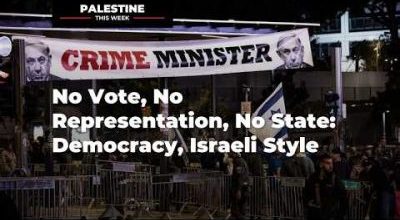
No Vote, No Representation, No State: Democracy, Israeli Style
or go to
Aletho News Archives – Video-Images
From the Archives
Sanctions, War and the Policy of Dual Containment
By SASAN FAYAZMANESH | March 17, 2008
It is now nearly three decades since the Unites States adopted the policy of dual containment of Iran and Iraq. While much has been written about the containment of Iraq, there has been very little in-depth analysis of this policy when it comes to Iran. In a book that is going to be released on March 31, 2008, entitled The United States and Iran: Sanctions, Wars and the Policy of Dual Containment (Routledge), I attempt to address this shortcoming by investigating when and why the US policy of containment of Iran came about, how it evolved, and where it stands today.[1] To the extent that Israel has been involved in US policy making, the study will also include the role that Israel has played in the containment of Iran. Also, since the fate of Iran has been inextricably linked to that of Iraq, occasionally the investigation will overlap with the containment of Iraq.
The policy of dual containment of Iran and Iraq originated during the Carter Administration, but it was not until the Clinton Administration that the expression “dual containment” became popular. … continue
Blog Roll
 Aletho News
- Elmo Sold mRNA Jabs to Your Toddler. Now They Are “Off-Label.”
- British state targets Palestine Action with yet another crooked trial
- Americans are paying the price to preserve Israel’s nuclear hegemony
- Resistance factions are necessary to ensure a permanent US Iraq withdrawal
- How Israel destabilizes the Middle East: Denying sovereignty and the right to exist
- Europe’s Establishment Is Embracing War – and Losing Voters
- NATO chief advocates war of aggression
- No Vote, No Representation, No State: Democracy, Israeli Style
- Zionist Bought Senate Blocks Information About American Citizens Killed By Israel
- While Gaza dominates the UN, these are the people keeping it alive
- If Americans Knew
- Israeli Soldiers Abduct At Least 22 Across Occupied West Bank
- Eight Palestinians Killed in Israeli Attacks on Gaza
- Israeli former leaders and security chiefs threaten legal action over ‘Jewish terrorism’
- Israel map in LA Times ad includes all land from the river to the sea
- Inside Lebanon’s 200-page dossier on Israeli war crimes
- Flydubai, genocide, settler violence, Trump abuse of power to deport – Daily Update
- Counting Antisemitic Incidents: What the ADL Audit Reveals — and Obscures
- Mamdani releases plan to combat antisemitism and hate crimes in New York City
- Iran’s Revolutionary Guards Publish Letter to the American People
- DMFI launches $1 million ad campaign supporting Virginia’s Elaine Luria
- No Tricks Zone
- Green Energy Debacle: German Expert Professor Fritz Vahrenholt Warns Of Severe Economic And Social Consequences
- Two More Paleo Reconstructions Affirm Meters-Higher Sea Levels Across Ireland, Brazil 7000-6000 Years Ago
- New Study: Earth And Venus Surface Warmth Largely Explained By Convection And Lapse Rate, Not CO2 Or Radiation
- 2025 Nature Paper Claiming Worsening Global Drought Gets RETRACTED …Heavily Flawed
- New Study: ‘Global Drought Shows No Detectable Recent Acceleration Under Climate Warming’
- Economic Masterminds: German Socialists Suggest Taxing Productivity Gains Stemming From Using AI
- The South China Sea Has Not Been Cooperating With The Climate Change Narrative
- Energy Crisis: Germany Enters Heating Season With Historically Low Gas Reserve Fill Levels
- New Study: The Antarctic Ice Sheet Gained Mass From 2020-2024 Due To Staggering Snow And Ice Accumulation
- Study: Ocean Heating Rates From Thousands Of Years Ago ‘Dwarf’ Modern Ocean Heating Rates

