How Many Islamic State Fighters Are There?
By Ray McGovern | Consortium News | November 16, 2014
Why was I reminded of Vietnam on Saturday when Gen. Martin Dempsey, Chairman of the Joint Chiefs of Staff, visited Iraq to “get a firsthand look at the situation in Iraq, receive briefings, and get better sense of how the campaign is progressing” against the Islamic State, also known as ISIS or ISIL?
For years as the Vietnam quagmire deepened, U.S. political and military leaders flew off to Vietnam and were treated to a snow job by Gen. William Westmoreland, the commander there. Many would come back glowing about how the war was “progressing.”
Dempsey might have been better served if someone had shown him Patrick Cockburn’s article in the Independent entitled “War with Isis: Islamic militants have an army of 200,000, claims senior Kurdish leader.”
Fuad Hussein, the chief of staff of Kurdish President Massoud Barzani, told Cockburn that “I am talking about hundreds of thousands of fighters because they are able to mobilize Arab young men in the territory they have taken.”
Hussein estimated that Isis rules about one-third of Iraq and one-third of Syria with a population from 10 million to 12 million over an area of 250,000 square kilometers, roughly the size Great Britain, giving the jihadists a large pool of potential fighters to recruit.
While the Kurdish estimate may be high – it certainly exceeds “the tens of thousands,” maybe 20,000 to 30,000 that many Western analysts have claimed – the possibility that the Islamic State’s insurgency is bigger than believed could explain its startling success in overrunning the Iraqi Army around Mosul last summer and achieving surprising success against the well-regarded Kurdish pesh merga forces, too.
So, on his flight back to Washington, Dempsey will have time to ponder whether he has the courage to pass on this discouraging word to President Barack Obama about ISIS or whether he will put on the rose-colored glasses like an earlier generation of commanders did about Vietnam, where Westmoreland insisted that the number of enemy Vietnamese in South Vietnam could not go above 299,000.
Unfortunately, those obstinate Vietnamese Communists would not observe that artificial, politically inspired limit. Westmoreland was aware of the troubling reality but knew that acknowledging it would have undesired consequences in the United States where many Americans were souring on the war.
The inconvenient truth finally became abundantly clear during the Tet offensive in late January and early February 1968, but still the misbegotten war went on, and on, ultimately claiming some 58,000 U.S. lives and millions of Vietnamese.
Westmoreland’s gamesmanship with the numbers was known to some CIA officials – first and foremost, a very bright and courageous analyst named Sam Adams – but CIA Director Richard Helms silenced them out of fear of political retribution. “My responsibility is to protect the Agency,” Helms told them, “and I cannot do that if we get into a pissing match with a U.S. Army at war.”
Today’s CIA Director John Brennan is similarly at pains to protect the Agency on a number of fronts. Is he likely to tell the truth about ISIS if it means the prospects for a renewed war in Iraq and a new war in Syria are especially grim? If not, are there no Sam Adamses left at the CIA?
Honest Analysts?
Honest intelligence analysts played a key role in the November 2007 National Intelligence Estimate, “Iran: Nuclear Intentions and Capabilities,” which helped thwart Bush/Cheney plans to apply Iraqi-type “shock and awe” to Iran during their last year in office. The NIE concluded, unanimously and “with high confidence,” that Iran had stopped working on a nuclear weapon in late 2003.
In his memoir, Decision Points, President George W. Bush called the NIE’s findings “eye-popping.” He openly bemoaned how the estimate deprived him of the military option, writing “How could I possibly explain using the military to destroy the nuclear facilities of a country the intelligence community said had no active nuclear weapons program?”
The NIE on Iran was issued seven years ago. One has to hope that a few honest analysts on the Near East have survived the CIA directorships of Michael Hayden, Leon Panetta, David Petraeus and John Brennan and have the courage to tell the truth about ISIS – including how U.S. military intervention now is swelling ISIS’s ranks, much as the Bush/Cheney invasion of Iraq in 2003 created the conditions for the group’s birth, then called “Al-Qaeda in Iraq.”
If honest intelligence analysts are silenced, as Sam Adams was 47 years ago, they need to plumb their consciences and see if they have the guts to make public both the undercounting of enemy forces AND the fillip given to their multiplication by further U.S. military involvement.
Though having worked within the system to get the real enemy troop estimates to senior U.S. officials, Sam Adams went to an early, remorse-filled death, unable to overcome the thought of what might well have happened to shorten the war if he had broken with the CIA’s demands for secrecy and made the actual enemy numbers public.
Possibly, the armed conflict might have ended in 1968. Or, to put it another way, the Vietnam Memorial in Washington would have no need for a western wall since there would be no names to chisel into the granite.
If Gen. Dempsey decides to ape Westmoreland and dissemble about the realistic obstacles to military success against the Islamic State fighters and about the counterproductive effects of U.S. intervention, well, our country will need a new Sam Adams willing, this time, to blast the truth into the open.
Sam Adams Associates for Integrity in Intelligence
Sam Adams’s memory is invoked each year as Sam Adams Associates for Integrity in Intelligence make their annual award for integrity. SAAII is a movement of former CIA colleagues of former intelligence analyst Sam Adams, together with others who hold up his example as a model for those in intelligence who would aspire to the courage to speak truth to power.
SAAII confers an award each year to a member of the intelligence community or related professions who exemplifies Sam Adam’s courage, persistence and devotion to truth — no matter the consequences.
It was Adams who discovered in 1967 that there were more than a half-million Vietnamese Communists under arms — roughly twice the number that the U.S. command in Saigon would admit to, lest Americans learn that claims of “progress” were bogus.
Gen. Westmoreland had put an artificial limit on the number Army intelligence was allowed to carry on its books. And his deputy, Gen. Creighton Abrams, specifically warned Washington that the press would have a field day if Adam’s numbers were released, and that this would weaken the war effort.
A SECRET/EYES ONLY cable from Abrams on Aug. 20, 1967, stated: “We have been projecting an image of success over recent months,” and cautioned that if the higher figures became public, “all available caveats and explanations will not prevent the press from drawing an erroneous and gloomy conclusion.”
The Communist countrywide offensive during Tet made it clear that the generals had been lying and that Sam Adams’s “higher figures” were correct. Senior intelligence officials were aware of the deception, but lacked the courage to stand up to Westmoreland. Sadly, Sam Adams remained reluctant to go “outside channels.”
A few weeks after Tet, however, former Pentagon official Daniel Ellsberg rose to the occasion. Ellsberg learned that Westmoreland was asking for 206,000 more troops to widen the war into Cambodia, Laos, and North Vietnam — right up to the border with China, and perhaps beyond.
Someone else promptly leaked to the New York Times Westmoreland’s troop request, emboldening Ellsberg to do likewise with Sam Adams’ story. Ellsberg had come to the view that leaking truth about a deceitful war would be “a patriotic and constructive act.” It was his first unauthorized disclosure. On March 19, 1968, the Times published a stinging story based on Adams’s figures.
On March 25, President Lyndon Johnson complained to a small gathering, “The leaks to the New York Times hurt us. … We have no support for the war. This is caused by the 206,000 troop request [by Westmoreland] and the leaks. … I would have given Westy the 206,000 men.”
On March 31, 1968, Johnson introduced a bombing pause, opted for negotiations, and announced that he would not run for another term in November.
Sam Adams continued to press for honesty and accountability but stayed “inside channels” — and failed. He died at 55 of a heart attack, nagged by the thought that, had he not let himself be diddled, many lives might have been saved. His story is told in War of Numbers, published posthumously.
Ray McGovern works with Tell the Word, a publishing arm of the ecumenical Church of the Saviour in inner-city Washington. He was a close colleague of Sam Adams; the two began their CIA analyst careers together during the last months of John Kennedy’s administration. During the Vietnam War, McGovern was responsible for analyzing Soviet policy toward China and Vietnam.
Anti-US military base candidate wins Okinawa governor race
RT | November 16, 2014
The fate of a contentious US military base, slated to be relocated on the Japanese prefecture of Okinawa, is now in doubt after exit polls showed a gubernatorial candidate deeply opposed to the plan emerged victorious in the election.
The national broadcaster NHK, news agency Kyodo, Jiji Press and private broadcaster Nippon Television all projected victory for Takeshi Onaga after polls closed on Sunday night. Going into the election, opinion polls put Onaga, the former mayor of Naha, Okinawa’s capital city, firmly ahead of incumbent Okinawa Governor Hirokazu Nakaima.
Nakaima had supported the relocation of US Marine Corps Air Station Futenma from Ginowan, a densely populated town in the island’s south. US military bases of various stripes currently occupy 38 percent of the town.
Onaga, who said his position was not anti-American, but rather about the people’s will, put the base’s future at the center of his political platform.
“We must not allow the construction (of the new base). Let’s show that the people of Okinawa Prefecture will not waver even if the governor and some other politicians are wavering,” Japan’s Asahi Shimbun daily cites projected victor Takeshi Onaga as saying on Saturday, during a last minute campaign speech.
Why should the burden fall on our shoulders?
The fifth gubernatorial held since the Japanese and US governments decided to relocate the base in December 1996, the Futenma relocation plan clearly dominated the election this time around.
Onaga had campaigned on moving the base outside Okinawa, forcing other parts of Japan to pull their weight in maintaining the security alliance between Japan and the US.
He further demanded the island house no new MV-22 Ospreys, a loud tilt-rotor aircraft that locals view as dangerous.
“Okinawa has suffered a lot. Why do we have to suffer more,” Onaga told The Washington Post before the election.
Last December, Nakaima green-lighted the transfer of the base to the city of Noga, in the island’s north. As part of the transfer, he approved the central government’s late-2013 application to reclaim the sea area off Nago’s Henoko Bay, sparking protests from those opposed to the relocation.
The move followed reports Japanese Prime Minister Shinzo Abe had pledged 348 billion yen (roughly 3 billion US) in financial assistance to Okinawa, which has Japan’s highest poverty rate.
“I’d like to convey the message to the governments of Japan and the United States… that the wishes of the people here are different from the administrative action in December last year,” AFP cites Onaga as telling reporters.
According to Jiji Press, Onaga said he would “act with determination” to rescind approval for the plan and preparatory work was already underway.
Will the election change anything?
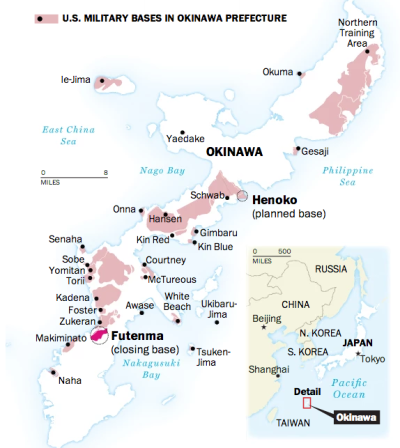 In August, Japan’s Ministry of Defense started a drilling survey in the area to prepare for the building of the base. The following month, 70 percent of Nago’s residents turned out to vote in a new municipal assembly, whose majority is opposed to the base relocation plan. Nago Mayor Susumu Inamine is strongly opposed to the construction of the new military complex in Nago’s Henoko Bay.
“Why should only Okinawa hold the burden for security of all of Japan, when the presence of US Marines doesn’t play a big role in deterring China?” Inamine said in May, echoing Onaga’s sentiments during a visit to Washington, DC. “I, as mayor, have operational control over two ports that are needed for use as construction landfill and I will exercise all powers in the municipality to block access.”
Currently, Okinawa houses 74 percent of all US bases in Japan, despite the fact the prefecture constitutes less than one percent of Japan’s total landmass. US military bases cover roughly one fifth of the island.
Their presence has served as a constant source of tension with locals due to crimes committed by servicemen, disruptions caused by military flights, noise, air pollution and massive land use by the US military.
While Onaga’s victory does not guarantee he will be able to hold up the $8.6 billion dollar relocation ($3.1 bill of which will be covered by Japan), it will likely string up Washington and Tokyo’s efforts to end years of deadlock over the issue.
If Abe attempts to veto local officials, his democratic credentials could be tarnished just days before he is expected to announce a snap general election.
Lockheed Used Taxpayer Money to Lobby for more Taxpayer Money
By Noel Brinkerhoff | AllGov | November 15, 2014
In the world of federal contracting, it takes taxpayer dollars to win more taxpayer dollars, or at least that’s how Lockheed Martin sees things.
Lockheed Martin for years has been running one of the government’s most important nuclear research facilities, Sandia National Laboratories. Five years ago, its lucrative contract with the Department of Energy (DOE) was coming to an end, so Lockheed Martin started to lobby officials to win an extension.
That lobbying included using some of the money paid by DOE for Lockheed Martin to run Sandia. Under federal law, this is a big no-no. Contractors are explicitly forbidden from using taxpayer money to lobby for more contracting work. But Lockheed Martin did it anyway, claiming they were just trying to better inform DOE managers when it came time to decide whether to give them another contract. The company hired a firm run by former Republican Congresswoman Heather Wilson to make its case.
“This is, after all, how Washington usually functions,” R. Jeffrey Smith wrote at the Center for Public Integrity.
The Energy Department’s inspector general, Gregory Friedman, said in a report (pdf) that Lockheed Martin broke the rules. He called the company’s actions “highly problematic” and “impermissible.”
Lockheed Martin did get a new deal, but it was for two years and $7.7 billion. It had sought a longer extension to keep running Sandia.
To Learn More:
Alleged Attempts by Sandia National Laboratories to Influence Congress and Federal Officials on a Contract Extension (Department of Energy Inspector General) (pdf)
Nuclear Weapons Lab Used Taxpayer Funds To Obtain More Taxpayer Funds (by R. Jeffrey Smith, Center for Public Integrity)
IG: Energy Contractor and Ex-Lawmaker Lobbied Officials for No-Bid Contract Worth $2.4 Billion Per Year (by Josh Hicks, Washington Post )
Violence in Iraq Means Profits for Beechcraft, Lockheed, Raytheon and other Weapons Makers (by Steve Straehley, AllGov )
No Apologies: U.S. Aggression Against Vietnam

teleSUR | November 10, 2014
Out of all the peculiarities of the political milieu in the U.S., what probably stands out the most is the discourse on the U.S. obliteration policies against Vietnam. If in any other country there exists a wider gap between the conventional portrayals and narrative on a war of aggression carried out by that country, on one hand, and the documentary record, on the other, then I have yet to come across it.
What does the general picture on U.S. aggression look like? The U.S. air force dropped more bombing tonnage solely in South Vietnam than the total bombing tonnage of every single aerial bombing campaign by all sides in WWII put together. The total amount of U.S. bombings during the Vietnam War was more than twice the size of all the bombings in WWII.
12 million acres of forest and 25 million acres of farmland, at the bare minimum, were destroyed by U.S. saturation bombing. The U.S. sprayed over 70 million liters of herbicidal agents to Vietnam.
Reflecting the fundamental defects of the conventional narrative on the matter, the death toll of the Vietnamese caused by the U.S. military onslaught is routinely debated in hundreds of thousands, sometimes in millions. According to Robert McNamara, for example, 3.6 million Vietnamese were killed in the war.
Among the most comprehensive studies on the matter was published in 2008 by Harvard Medical School and the Institute for Health Metrics and Evaluation at the University of Washington. They put the Vietnamese death toll at 3.8 million. According to Dr. Nick Turse, an American historian and investigative journalist who has conducted pioneering research on the Vietnam War, even the “staggering figure” of 3.8 million “may be an underestimate”. Furthermore, the U.S. attack wounded 5,3 million Vietnamese civilians and up to 4 million Vietnamese fell victim to toxic defoliants used by the U.S. against large parts of the country. The U.S. assault created 200,000 prostitutes, 879,000 orphans, 1 million widows and 11 million refugees.
To enter from the realm of international law, facts and figures to what at times goes by the name of ‘internal U.S. debate’ on the matter of U.S. attack on Vietnam is tantamount to an abrupt teleportation into an unsavory twilight zone. Consider the following results of a Gallup poll conducted in November, 2000. Of respondents aged between 18 and 29, 27% said that the U.S. was backing North Vietnam, 45% said South Vietnam and 28% expressed no opinion at all.
What about support for the war among the U.S. public, say, at the end of the 1960’s? According to a Gallup poll conducted in July, 1969, more than a year after the My Lai massacre, 53% of the respondents approved of Nixon’s handling of the war.
Arguably the main trend after the termination of U.S. aggression against Indochina has been a systematic glorification of U.S. actions. During a conference in 2006 titled Vietnam and the Presidency, former U.S. head of state Jimmy Carter gave his well-known account on the war and its effects to his presidency. Carter, not regarded as an ardent advocate of aggressive U.S. foreign policy among post-WWII U.S. presidents, perhaps quite the contrary, stressed the importance of moving “beyond the Vietnam War to better things”.
Carter gave special emphasis on what he called a “healing process” – a healing process for American society, needless to say – and proclaimed that, under his administration, “that healing process made major strides forward”. Not only that, the “healing process” was no less than “complete” when “the Vietnam heroic monument, one of the most popular places in Washington” was set up, soon after the Carter presidency.
The inscription on the world-renowned Vietnam Veterans Memorial states that “[o]ur nation honors the courage, sacrifice, and devotion to duty and country of its Vietnam veterans.” Instead of having prosecuted war criminals and paid enormous compensation to Vietnam, for starters, the U.S. gave Vietnam the above sentence.
Carter’s commentary serves as an odious, yet illustrative, reminder of the standard line of thinking in the U.S. political culture. In short, when the U.S. attack on Vietnam had finally come to its end, what was of uttermost importance was a “healing process” for the United States, and reflecting the progress, if not completion, of that healing process was the erection of a monument singing the praises of the “courage” and “sacrifice” of the U.S. veterans. Now, let us move “beyond the Vietnam War to better things”.
Perhaps even more revealingly, Carter has asserted on the Vietnam War that “I don’t feel that we ought to apologize or to castigate ourselves or to assume the status of culpability”, stressing that “the destruction was mutual”.
In 2000, the then Secretary of Defence William Cohen expressed a similar approach towards the U.S. actions in the Vietnam war. “I don’t intend to go into any apologies, certainly, for the war itself” Cohen declared upon his visit to Vietnam. “Both nations were scarred by this. They have their own scars from the war. We certainly have ours.”
The tenets of the official U.S. position towards the unparalleled crimes the U.S. military committed in Vietnam remain as disturbing as ever: no apologies for U.S. conduct during the war, certainly no reparations; no intentions to prosecute U.S. government officials and military personnel for any of the countless war crimes the U.S. committed in Vietnam; romanticizing and glorifying the overall performance of the U.S. military in the war.
Indeed, in the post-WWII era, the conventional narrative in the U.S. on the Vietnam war has emerged as arguably the most disturbing case of the perpetrator’s nationalistic indifference towards, and often approval of, an apocalyptic destruction of the target of its attack. Finally, let us all bask in the shining light of American self-criticism, embodied by the following quote by the U.S. President Barak Obama at the commemoration ceremony of the 50th anniversary of the Vietnam War:
“Veterans, families of the Vietnam War, I know the wounds of war are slow to heal. You know that better than most. But today we take another step. The task of telling your story continues. The work of perfecting our Union goes on. And decades from now, I hope another young American will visit this place and reach out and touch a name. And she’ll learn the story of service members — people she never met, who fought a war she never knew — and in that moment of understanding and of gratitude and of grace, your legacy will endure. For you are all true heroes and you will all be remembered. May God bless you. May God bless your families. May God bless our men and women in uniform. And may God bless these United States of America.”
Evidence that US secretly pays off civilian Yemeni drone strike victims
Reprieve | November 11, 2014
The US government has apparently made secret payments of $100,000 to the families of two Yemeni men who were mistakenly killed in a covert drone strike, an investigation by international non-profit Reprieve has found.
Faisal bin Ali Jaber, a Yemeni man who lost his brother-in-law and nephew in a 2013 drone strike, was offered a bag containing US dollar bills at a meeting with the Yemeni National Security Bureau (NSB). The NSB official who had requested the meeting told a family representative that the money came from the US and that he had been asked to pass it along.
Since the deaths of his relatives, Mr bin Ali Jaber – who is represented by lawyers at Reprieve – has travelled to Washington, DC and met with Congressmen and members of the National Security Council, as well as telling his story to a number of journalists. The Yemeni NSB official reportedly cited this activity as part of the reason the family was offered the $100k payment.
The payment came after Mr bin Ali Jaber’s family had already gone through a formal compensation process, during which the Yemeni government confirmed in writing that the US carried out the drone strike and that the deaths of their civilian relatives were “a mistake”. During this formal compensation procedure the family also received a payment of 11m Yemeni Rials plus damages.
Despite the private admissions and payments to Mr bin Ali Jaber and his family, given via the Yemeni security services, the US has never publicly admitted that the strike in which Waleed bin Ali Jaber and Salim bin Ali Jaber were killed was a mistake and that the two men were innocent civilians. The deaths have never been investigated and the US has never apologised to the families.
Waleed bin Ali Jaber was a local policeman and his father was an imam who had preached against al Qaeda in the local mosque just days before he was killed.
Faisal bin Ali Jaber said: “My family received money from the US government as an admission of their guilt for ‘mistakenly’ killing our relatives in a drone strike. But this is not justice. There are many other families in Yemen who have lost innocent relatives in US drone strikes but do not receive hush money for speaking out. If the US can admit their ‘mistake’ in a back room of the Yemeni security services, they can surely admit it publicly and apologise for what they have done to my family, and many others in Yemen.”
Cori Crider, Reprieve’s Strategic Director and attorney for Mr bin Ali Jaber, said: “President Obama is as reluctant as ever to admit the full extent of the US drone program in Yemen – but money talks, even if the White House won’t. Cash payments without full accountability won’t quell the outrage about civilian drone deaths, and continued US strikes will only bring further instability to Yemen. The victims’ families want and deserve an explanation, while the American people need to hear the truth about what is being done in their name.”
NATO’s Estonia drills are anti-Russian, don’t make Europe more secure – Moscow
RT | November 11, 2014
Moscow believes NATO drills in Estonia are of “a clearly anti-Russian nature” and will scarcely contribute to European safety, according to a statement by the Russian Defense Ministry.
NATO has conducted five military exercises near the Russian border over the past six months, the head of the ministry’s Department of International Cooperation, Sergey Koshelev, told journalists on Tuesday.
“Obviously the policy chosen by our colleagues from NATO will hardly make Europe a safer place,” he said.
The comment was in response NATO’s plans of having so-called ‘Trident Juncture’ drills in Estonia. Koshelev believes the exercises have been inspired by warnings of a “Russian threat,” as voiced by NATO’s supreme allied commander, Philip Breedlove.
“Today Estonia is chosen as an object of that ‘threat’,” Kochelev said. Although recently such objects were Poland, Lithuania and Latvia, which also hosted large-scale NATO drills.”
“Taking this into account, it’s strange to hear some NATO representatives lamenting a group of Russian planes flying in international airspace over the North Atlantic,” he added.
The Trident Juncture drills are clearly anti-Russian, Koshelev believes.
“According to the drills’ scenario, the headquarters of various levels should have their actions tested in a situation in which one of the members of the bloc is attacked by an unnamed “big hostile nation,” he said. “From a geographical standpoint Estonia, which hosts the drills, borders only with ‘little friendly nations’ besides Russia. Hence, the NATO drills have a clearly anti-Russian nature.”
Winston Churchill was a Racist Ass#*%!
Moonlit History | October 24, 2014
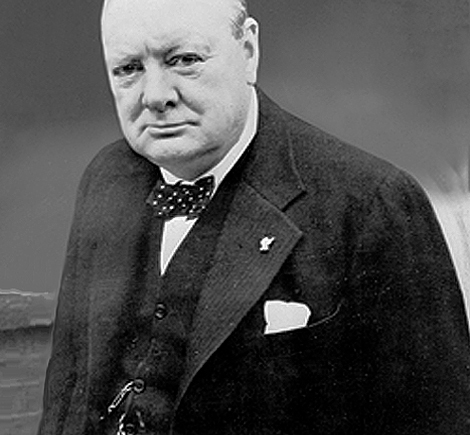
Churchill is seen as the British icon of endurance and strength through gloomy war. His drowning voice of “we shall fight on the beaches” is easily identifiable with World War II. And he was a complete drunk.
But what do common folks now-a-days know of this man? Do you know much about Dear ol’ Churchill? Let’s find out.
In December of 1910, while young Churchill was Home Secretary, he wrote:
“The unnatural and increasingly rapid growth of the Feeble-Minded and Insane classes, coupled as it is with a steady restriction among all the thrifty, energetic and superior stocks, constitutes a national and race danger which it is impossible to exaggerate. I am convinced that the multiplication of the Feeble-Minded, which is proceeding now at an artificial rate, unchecked by any of the old restraints of nature, and actually fostered by civilised conditions, is a terrible danger to the race.” Churchill was all-for forcing “feeble-minded” people to labour colonies. January 19, 1899, Churchill wrote in a letter to his cousin: “The improvement of the British breed is my aim of life.” [1]
Wait a minute, he was in favor of eugenics? This sounds really familiar to someone else in history, I just can’t remember his name. Anyway, moving on.
As a young MP, it was well-known he believed that “the Aryan stock is bound to triumph.” — Okay, wait! He sounds just like that guy with the funny mustache! Whoa!
When concentration camps were built in South Africa, for white Boers, he [Churchill] said they produced “the minimum of suffering”. The death toll was almost 28,000, and when at least 115,000 black Africans were likewise swept into British camps, where 14,000 died, he wrote only of his “irritation that Kaffirs should be allowed to fire on white men.”
As Colonial Secretary in the 1920s, he unleashed the notorious Black and Tan thugs on Ireland’s Catholic civilians, and when the Kurds rebelled against British rule, he said: “I am strongly in favour of using poisoned gas against uncivilised tribes… [It] would spread a lively terror.” [2]
And after Ghandi’s movement of peace was taking hold in the then British colony of India, Churchill was noted to have said:
“I hate Indians. They are a beastly people with a beastly religion.” Churchill’s gross demeanor towards others not of his skin did not cease while the Bengali famine occurred (which led to the death of nearly 3 million souls). He remarked the famine was not Britain’s fault, but it was “their” fault—because they “breed like rabbits.” He was talking about the Indians, of course. Amartya Sen, an economist who won the Nobel Prize in 1998, proved for a fact that the famine was due to the imperialist structure of the British Empire. [3]
In conclusion: make your own conclusion.
Sources:
[1] Winstonchurchill.org
[2] The Independent
[3] BBC
Critics Slam US Military’s ‘Disturbing’ Praise for Israel’s Gaza Offensive

Palestinians collect their belongings from under the rubble of a residential tower, which was destroyed by an Israeli air strike in Gaza City on August 24, 2014. (Photo: UN Photo-Shareef Sarhan/flickr/cc)
Common Dreams | November 7, 2014
Critics say it is “shameful” that a high-ranking U.S. military official suggested the Pentagon can learn lessons from Israel’s 50-day attack on Gaza this summer.
According the Jerusalem Post, Chairman of the Joint Chiefs of Staff Martin Dempsey made statements Thursday praising the Israeli Defense Force (IDF) for taking “extraordinary lengths to limit collateral damage and civilian casualties” during Operation Protective Edge.
Dempsey told an audience at the Carnegie Council for Ethics in International Affairs: “We sent a team of senior officers and non-commissioned officers over to work with the IDF to get the lessons from that particular operation in Gaza.” He referred to the group of officers as the “lessons learned team.”
But Ramah Kudaimi of the U.S. Campaign to End the Israeli Occupation said Israel’s tactics should not be replicated.
“It is very disturbing and shameful that U.S. military commanders believe that what Israel did in Gaza is something to be applauded,” Kudaimi told Common Dreams. “Five hundred dead children does not seem to be evidence that Israel was trying to not kill civilians. The seven-year siege on Gaza is not a policy to avoid civilian suffering.”
Israel’s recent seven-week military assault on Gaza killed at least 2,194 Palestinians, at least 75 percent of them civilians and over 500 of them children.
“At least 80 percent of the 100,000 Palestinian homes damaged or destroyed were refugee homes,” the United Nations Relief and Works Agency reports.
The offensive damaged or destroyed over half of Gaza’s hospitals and health centers at a time when more than 11,000 were wounded, a UNRWA and World Health Organization joint investigation found.
Israel struck six UN schools sheltering Palestinians, including in cases where exact coordinates of the shelters were formally submitted by UNRWA to the Isreali military. These strikes alone killed at least 47 people and wounded hundreds.
Furthermore, Israel has been accused of potential war crimes by Amnesty International and UN High Commissioner for Human Rights Navi Pillay.
“It is very despicable that the U.S. continues to white-wash Israeli crimes while funding them through military aid,” said Kudaimi. “Dempsey’s statements are not shocking. Anyone who follows U.S. military policy, knows they too have problematic definitions of protecting civilians.”
Featured Video
10K More U.S. Troops Deploy as Trump Weighs New Iran Strikes
or go to
Aletho News Archives – Video-Images
From the Archives
Genetic baloney in thick slices
MAYBE COULD BE INC.
By Jon Rappoport | No More Fake News | July 8, 2021
Gene research companies tend to come and go. They start out banging and popping like fireworks in the sky, and then they fade out—selling themselves to larger outfits who’ve hired better liars…
Once upon a time, it sounded easy. Start with a disease, find the gene responsible for the disease, and correct the problem.
Then, researchers wondered, was disease the result of one gene or a group of genes acting together?
Either way, the proof would be in devising cures for diseases using gene therapy. “Not yet, but soon…”
And regardless, the major need was: money. Lots and lots of money.
This need required good PR people. “We have to pump up the idea that we’re on the edge of tremendous breakthroughs. We’re always on that edge…”
This hype also needed to obscure the fact that there wasn’t (and isn’t) ANY gene cure for ANY disease. … continue
Blog Roll
 Aletho News
- She Followed the Actual Data on COVID Vaccines and Masks — Her Career Took a Huge Hit
- Florida AG Sues Pfizer, Bourla Over Deceptive Marketing of COVID Vaccines
- Von der Leyen gifts her spin doctor a job for life
- 10K More U.S. Troops Deploy as Trump Weighs New Iran Strikes /Suliaman Ahmed
- Iranian crew declared Dena training vessel ‘unarmed’ to US warship before deadly torpedo strike: Report
- Iran’s NPT debate moves beyond parliament
- Houthis condemn Saudi claims of attack on Medina
- Fatuous False Flags
- Are Europe’s Smallest Nations Dragging the Continent into War?
- EU draws up contingency plans for possible Merz exit
- If Americans Knew
- The Israeli Right Portrays Islam as Murderous. It Serves a Political Purpose
- Jordan Has Had Enough: King Abdullah’s Scathing Warning to Israel
- Israeli Colonizers (i.e. Settlers) Kill Palestinian Man Near Salfit
- New Google Maps images reveal massive scale of devastation in Gaza
- Jewish supremacy, anti-Palestinian bigotry on display in Israel – Daily Update
- Israeli Soldiers Abduct At Least 22 Across Occupied West Bank
- Eight Palestinians Killed in Israeli Attacks on Gaza
- Israeli former leaders and security chiefs threaten legal action over ‘Jewish terrorism’
- Israel map in LA Times ad includes all land from the river to the sea
- Inside Lebanon’s 200-page dossier on Israeli war crimes
- No Tricks Zone
- Green Energy Debacle: German Expert Professor Fritz Vahrenholt Warns Of Severe Economic And Social Consequences
- Two More Paleo Reconstructions Affirm Meters-Higher Sea Levels Across Ireland, Brazil 7000-6000 Years Ago
- New Study: Earth And Venus Surface Warmth Largely Explained By Convection And Lapse Rate, Not CO2 Or Radiation
- 2025 Nature Paper Claiming Worsening Global Drought Gets RETRACTED …Heavily Flawed
- New Study: ‘Global Drought Shows No Detectable Recent Acceleration Under Climate Warming’
- Economic Masterminds: German Socialists Suggest Taxing Productivity Gains Stemming From Using AI
- The South China Sea Has Not Been Cooperating With The Climate Change Narrative
- Energy Crisis: Germany Enters Heating Season With Historically Low Gas Reserve Fill Levels
- New Study: The Antarctic Ice Sheet Gained Mass From 2020-2024 Due To Staggering Snow And Ice Accumulation
- Study: Ocean Heating Rates From Thousands Of Years Ago ‘Dwarf’ Modern Ocean Heating Rates

