Latin America: What Comes After the Back Yard
By Raúl Zibechi* | La Journada | 26 April 2012
After the recent sixth Summit of the Americas there remains little doubt that the Latin American region has changed. It stopped being the back- yard of a decadent empire that has very little to offer save military bases and threatening fleets. The double failure of the United States, by Barack Obama in Cartagena and by Hillary Clinton the following week in Brasilia, shows the lack of constructive proposals for the region.
As Dilma Rousseff pointed out, countries of the region demand “ relations among equals,” which was interpreted by some analysts as “a rebellion against the United States.” The summit’s principal consequence is proof of US isolation and the non-existence of policies capable of attracting the region jointly as happened until the middle of the 1990s. I find five reasons for the deterioration of Washington’s relations with the entire continent, which anticipate the new scenario in formation.
The first is the double failure of the drug war and the embargo of Cuba. After the fall of the Soviet Union, Washington had to fabricate an enemy to continue forcing the militarization of international relations. Illegal drug trafficking fulfilled that function for a while, despite never being credible because it did not include a reduction of consumption in northern countries, the big consumers of illegal drugs.
Now the war against drugs lost the battle for legitimacy. The International Institute of Strategic Studies just launched a study in which it affirms that it not only failed in combating consumption and trafficking, but also the war against drugs “has created an important threat to international security” (La Jornada, April 17). Was that not perhaps the desired objective?
The second is the end of the OAS’ time and the consolidation of Unasur (Union of South American Nations) and Celac (Community of Latin American and Caribbean States), both of which exclude the United States and Canada and adjust to the new global reality. Following the already marked tendency by Unasur since 2009, Celac is rapidly becoming the organism capable of resolving the region’s problems and of tracing the direction of its sovereignty before the extra-continental powers. It can be discussed whether that is the type of integration that the Latin American peoples need, but there is no room for doubt that, whatever the path they elect, they are excluding the old property owners from the back yard.
In third place, the United States no longer is the principal trade associate of the region’s principal countries, particularly of South America, and its decreasing internal market no longer has the attraction of old nor is it in any condition to capture Latin American exports. The tendency is that China and the Asia group substitute for the role that the United States had from the beginning of the 20th Century until the 2008 crisis as the decisive trade and political ally.
Until 2005, the United States purchased 1.5 million barrels per day from Venezuela, a number that fell in 2011 to less than one million. To the contrary, Venezuelan exports to China, which were almost non-existent in 2005, climbed to almost a half million barrels per day n 2011 (Geab No. 60, December 2011). The tendency is that one market substitutes for the other.
The United States and the European Union, in fourth place, are on the way to being displaced as the principal investors in Latin America. China is the principal investor in Venezuela, the first world reserve for oil, third for bauxite, fourth reserve for gold, in sixth position in natural gas and tenth reserve of iron in the world. China also has strong investments in Argentina and Brazil, the two largest South American economies.
The second Chinese oil company, Sinopec, was interested in buying a part of Repsol in YPF for 15 billion dollars before the nationalization decided by the government of Cristina Fernández (Financial Times, April 18, 2012). Now it can expand its investments in Argentina, where it is responsible for 6 percent of the offer of crude and for 1.7 percent of gas.
The region also has endogenous capabilities for investment. The best example is the announcement of the investment of 16 billion dollars by three Brazilian companies (Petrobras, Odebrecht and Braskem) in Peru, to extract gas in Camisea, to construct a gas duct of more than a thousand kilometers toward the south and a petrochemical pole in the port city of Ilo, the first on the Pacific Coast.
In fifth place, the United States no longer is the region’s only military ally. Venezuela maintains a solid alliance with Russia, Brazil has co-operation agreements with India in aeronautics and with China in the space industry. But the most notable is the progressive integration of the region’s military industries, in other words the coupling of the South American countries with the growing Brazilian military industry.
The most notable case is the strategic alliance between Brazil and Argentina, which translates into joint development of protection, a military carrier that will substitute for the Hercules, the development of air-to-air missiles that Brazil worked on with South Africa, and unmanned planes for border vigilance. Both countries form a critical mass capable of trumping the rest to set up a regional military industry autonomous from the north.
The imminent victory of the socialist François Hollande in the French elections “will activate a series of strategic changes” that accelerate the geopolitical transitions underway, according to what the European Laboratory of Political Anticipation (Laboratorio Europeo de Anticipación Política) estimates. See: (Geab No. 54, April 17, 2012). One of the principal turns will be the formation of a Europe-BRICS strategic alliance. In some way, this alliance already started with the 2009 France-Brazil military agreement to construct submarines and attack planes. The region’s autonomization can have unexpected allies.
Disillusion With the Euro and Europe
French Elections: Cracks in the Neoliberal Consensus
By DIANA JOHNSTONE | CounterPunch | April 24, 2012
Democratic elections in the NATO member states serve one clear purpose. They contribute to the self-satisfaction concerning “our values” needed to justify military intervention in the imperfect internal affairs of other countries. But do the citizens really decide policy through their votes, or is electoral democracy fatally corrupted by the power of money?
At least in its form, the French presidential election is a model of resistance to the power of money that so blatantly dominates presidential elections in the United States.
While the United States is locked in a two-party system where both parties depend on millions of dollars from rich donors, the French two-round system allows as many candidates as can gather the required number (500) of mayors’ signatures to run in the first round. Then voters can decide between the two front-runners in the second round.
For the final phase of the first round campaign, which ended with the election this Sunday, April 22, all candidates receive equal television time to get across their message, without having to pay for it.
This time around, there were ten candidates, five of whom had at least a chance at the start to make it into the second round, even though polls showed the incumbent Nicolas Sarkozy and the Socialist Party candidate François Hollande leading the pack. But an upset was at least theoretically possible, as happened in 2002, when the National Front candidate Jean-Marie Le Pen knocked out the Socialist Party candidate Lionel Jospin in the first round, handing Jacques Chirac a landslide victory in the run-off.
The most suspenseful aspect of the first round turned out to be the duel for third place between Jean-Marie’s daughter and political successor Marine Le Pen and the Left Front candidate Jean-Luc Mélenchon. Marine set out to beat her father’s score ten years ago, while Mélenchon set himself the goal of beating her. The two adversaries were the most charismatic of the ten candidates. As candidate of the Left Front, Mélenchon lost his bid to come in third, but thanks to his extraordinary verbal skills has succeeded in reviving a political force to the left of the Socialist Party.
Percentage results of candidates in April 22 first round of French Persidential election
François Hollande, Socialist Party 29 %
Nicolas Sarkozy, outgoing President 26 %
Marine Le Pen, National Front 18 %
Jean-Luc Mélenchon, Left Front 11 %
François Bayrou, centrist 9 %
Eva Joly, Greens 2 %
Nicolas Dupont-Aignan, Social Gaullist 1.8%
Philippe Poutou, New Anti-Capitalist Party (Trotskyist) 1.2%
Nathalie Arthaud, communist (Lutte Ouvrière, Trotskyist) 0.7%
Jacques Cheminade, progressist (Lyndon Larouche influence) 0.2%
Participation was high, at around 80%. The first round is altogether more entertaining and interesting than the second round. It provides more information about the real preferences of voters than the second round, which, like U.S. presidential elections, is often decided on the “lesser evil” principle, with increasing numbers of voters aware that whoever wins, the policies will be much the same.
A few observations:
Every candidate except Sarkozy, the self-styled centrist Bayrou and the Green candidate Eva Joly singled out the world of finance as the main adversary. Hollande did so quite explicitly in his main campaign speech, although shortly afterwards he watered his wine considerably during a visit to London, the City oblige. This hostility toward banks has horrified Anglo-American commentators, from The Economist to John Vinocur of the International Herald Tribune, for whom realism consists in docile obedience to the demands of “the markets”. Acting uppity toward finance capital is close to insanity. If “the right” is defined first of all by subservience to finance capital, then aside from Sarkozy, Bayrou and perhaps Joly, all the other candidates were basically on the left. And all of them except Sarkozy would be considered far to the left of any leading politician in the United States.
This applies notably to Marine Le Pen, whose social program was designed to win working class and youth votes. Her “far right” label is due primarily to her criticism of Muslim practices in France and demands to reduce immigration quotas, but her position on these issues would be considered moderate in the Netherlands or in much of the United States. Even she stressed that the immigration problem, as she saw it, was not the fault of the immigrants themselves but of the politicians and the elite who brought them here. The main tone of her political message was resolutely populist, attacking the “Paris elite”. Demagogic, yes, often vague and playing fast and loose with statistics, but a model of reason compared to the utterances of the “Tea Party”. Her political challenge was to hold onto her father’s ultra-conservative constituency while wooing discontented low income voters. She apparently won more working class votes than Mélenchon.
Mélenchon left the Socialist party to found the Left Party in 2008. As candidate for the broader Left Front, he has raised the spirits of the demoralized French Communist Party, which fell below 2% in the 2007 election and gave up running a candidate of its own. Its militants have responded enthusiastically to Mélenchon’s revival of red flags and fiery rhetoric. He would put lower and upper limits on wages and salaries. His program, including calls for constitutional revision that would guarantee such progressive measures as gay marriage, assisted suicide and the right to abortion, surely goes far beyond the demands of his constituency, more concerned with jobs and wages, and reflects his personal adherence to the progressive philosophy of French Free Masonry. It is certainly his quick witted debating skill that appeals to voters more than the details of his ambitious program.
Disillusion with the euro and Europe
The two leading candidates remain faithful to the dogma of “European construction”. But elsewhere splits are beginning to show. Marine Le Pen condemns the euro as a failure which had wrecked European economies and is doomed to disappear.
Certainly, François Asselineau, who has founded his own party, the Union Populaire Républicaine, with the sole object of leaving the European Union, has been totally deprived of any media coverage, and was unable to gather the necessary signatures for candidacy. But the social Gaullist Nicolas Dupont-Aignan, who is only beginning to be known to the French public, is adamant that France should return to the franc, retaining the euro only as a reserve currency around which EU member state currencies should be allowed to fluctuate. Dupont-Aignan calls the euro a “racket” and a “poison” for EU economies, which are too diverse for a single currency. To the objection that leaving the euro would cause huge inflation, he accuses present EU leaders of creating inflation by allowing private banks to borrow at 1% and then ruin member States by lending to them at higher and higher rates. After France recovers its sovereignty by leaving the euro, Dupont-Aignan would have the Bank of France finance the state at zero interest, which would allow the government to reduce its debt and hire more teachers, policemen and researchers, instead of reducing their number. He would also take measures to protect French industry from cheap imports.
In contrast, Mélenchon advocates strongly interventionist economic policies without accounting for the fact that they would go against European Union directives as well as the monetarist policy governing the euro. Mélenchon speaks of using the economic weight of France to persuade Germany to change its deflationist policies. This raises the problem of the clear contradiction between social policies to which the French are attached and the European Union’s control of economic policy that is fatal to those social policies.
Foreign policy confusion
Foreign policy has been almost entirely absent from this campaign. This could be because voters are not thought to be interested, or because there is no strong opposition between the candidates. François Hollande conforms to the mainstream consensus, saying he would support military intervention in Syria if based on a UN resolution. Much of the French left has swallowed the “Responsibility to Protect” ideology.
Already last year, Mélenchon dismayed a certain number of his admirers by supporting the war in Libya, on the grounds that it was based on a UN Resolution. He now calls for withdrawal from NATO and construction of an independent United Nations intervention force.
Not surprisingly, the Gaullist Dupont-Aignan opposes arming the Syrian opposition, pointing to the fact that arms provided to Libyan rebels ended up in the hands of militias who are destabilizing the whole region. He maintains that France should have acted differently in Libya and with Russia, instead of following the anti-Russian policy of the United States.
Among the leading candidates, the only clear anti-war policy is that of Marine Le Pen, who favors immediate withdrawal from both Afghanistan and the NATO command, describes the current French government policy of supporting the Syrian opposition as “totally irresponsible”, calls for recognition of a Palestinian State and opposes threats to bomb Iranian nuclear sites, which have not been proven to be military. And she adds: “As far as I know, no nation which has atomic weapons has ever asked for permission from anyone, neither the United States, nor France, nor Israel, nor Pakistan… Must we then plunge the world into a war whose extent we will not control because certain foreign counties ask us to?”
Marine Le Pen is regularly stigmatized as “racist” for her desire to reduce immigration. But which is worse: refusing entry to Muslim immigrants, or bombing them in their home countries?
The worst is yet to come
Even before the vote, John Vinocur raged against the “miserable precedent” represented by the fact that what he dubbed the “Rejection Front” made up of Marine Le Pen and Jean-Luc Mélenchon was almost sure to beat the first round score of either mainstream candidate. Thus, he said, France would have “legitimatized two political currents that spurn serious solutions for France’s economic grief, reject civility and common sense and variously propose regression through loony yet authoritarian economics, class warfare, class or racial prejudices, anti-Western instincts, and the politics of endless rage.”
Wow, take that you frogs. Look to the calm, intelligent debate of U.S. Republican primaries for guidance, and remember that whatever foolish things you want, like jobs, medical care or a roof over your head, it’s the markets that have the last word.
Exit polls pointed to a solid victory for Hollande in the second round. The standard description of Marine Le Pen as “the far right” could suggest that her voters would turn to the right wing candidate, Sarkozy, in the runoff. But this is far from the case. The social and foreign policy positions of Marine Le Pen have won over a number of voters disenchanted with the left. Her voters may split fifty-fifty in the second round. She herself clearly looks forward to the defeat of Sarkozy in order to become the undisputed leader of a recomposed right-wing opposition, which could make life difficult for the future President Hollande. Perhaps the only thing that could save Sarkozy would be massive abstention, but that does not look likely.
Actually, the timing of this election is favorable to a fairly limp, ill-defined candidate like Hollande, because the future is as unclear as he is. The Greek disaster, the financial woes of Portugal, Spain and Italy are ominous for France, and the French are worried. But most French people are still too well off to be seriously alarmed. The critics like Vinocur or The Economist seem to think that a French candidate for president should run on a campaign of telling people that they should happily prepare to give up all the comforts they enjoy, because that is what the financial markets demand. If things are as bad as these champions of financial globalization are predicting, then this first round may provide better hints to the French future than the final round of the Hollande-Sarkozy election in two weeks time.
DIANA JOHNSTONE is the author of Fools Crusade: Yugoslavia, NATO and Western Delusions. She can be reached at diana.josto@yahoo.fr
Related articles
- Marine Le Pen scores stunning result in French presidential election (guardian.co.uk)
U.S.’s Post-Afghanistan Counterinsurgency War: Colombia
By Rick Rozoff | Stop NATO | April 23, 2012
The Pentagon announced on April 23 that Defense Secretary Leon Panetta has begun a trip to South America, arriving in Colombia as part of a three-nation tour that will also take him to Brazil and Chile.
It is his first visit to the continent as Pentagon chief, though he has visited often in other capacities, including as director of the Central Intelligence Agency. Panetta’s meetings with top government and military officials in the three nations will follow those of America’s top military officer, chairman of the Joint Chiefs of Staff General Martin Dempsey, to Colombia and Brazil late last month.
Panetta’s mission also occurs two weeks after U.S. and Brazilian presidents Barack Obama and Dilma Rousseff met in the White House on April 9 and agreed on the establishment of the U.S.-Brazil Defense Cooperation Dialogue, announcing that Defense Secretary Panetta and Brazil’s Defence Minister Celso Amorim will hold the first meeting in that format on April 24.
Colombia is the largest recipient of U.S. military aid in Latin America, though its population is less than a quarter of Brazil’s, and the third largest in the world after Israel and Egypt.
After the passage by Congress of the Clinton administration’s Plan Colombia in 2000, the military in Bogota has received approximately $7 billion in U.S. assistance, up from $50 million in 1998 when it was already the biggest beneficiary of American military aid in Latin America.
On October 30, 2009 the Obama administration and that of then-Colombian President Alvaro Uribe agreed on the U.S.-Colombia Defense Cooperation Agreement, which opened up three Colombian air bases, two naval bases, two army installations “and other Colombian military facilities if mutually agreed” to the Pentagon.
One of the bases obtained by the United States, the Larandia Military Fort in Florencia, is within easy striking distance of Ecuador, as the Alberto Pawells Rodriguez Air Base in Malambo is of Venezuela.
Colombia launched a deadly attack against rebels of the Revolutionary Armed Forces of Colombia (FARC) inside neighboring Ecuador in 2008, which the Ecuadorian government accused U.S. special forces personnel inside its country of having assisted. The following year the Colombian armed forces conducted an incursion inside Venezuela, seizing four border guards.
Panetta is in Colombia to coordinate a final offensive against FARC fighters, who have been battling the country’s narco-autocracy and its political minions in Bogota since 1964.
According to Acting Assistant Secretary of Defense for Public Affairs and Pentagon Press Secretary George Little, the defense secretary is to meet with Colombian Defense Minister Juan Carlos Pinzon Bueno and General Alejandro Navas, General Commander of the Military Forces of Colombia.
On April 23 Panetta praised his military ally, stating, “Colombia, to its credit, has done a tremendous job in going after the FARC.” He failed to mention with, in addition to $7 billion dollars of Washington aid, U.S. helicopter gunships, planes, trainers and special forces troops.
Pentagon spokesman Little added, “Clearly we still have plenty to talk about in continuing to support the Colombians in their efforts against [the FARC]…”
When chairman of the Joint Chiefs of Staff Dempsey was in Colombia on March 27-28, the Defense Department website reported that he visited Joint Task Force Vulcano, “a new interagency force aimed at defeating the Revolutionary Armed Forces of Colombia…The strategy calls for Colombia to cut the FARC forces in half in two years.”
In Dempsey’s words, “They selected 2014 as a key moment for them, They want to accelerate their effects against the FARC.” With the Pentagon’s active connivance and assistance, which why is Dempsey was and Panetta is in the country.
Dempsey was explicit about the American role in the “final solution” of the Colombian civil war: “We’re getting ready to send some brigade commanders who have been in Iraq and Afghanistan down here to partner with their Joint Task Force commanders in a leader developmental function. The challenges they face are not unlike the challenges we’ve faced in Iraq and Afghanistan.”
The Pentagon’s website reported the following on March 27, worth quoting in detail.
Dempsey “joined virtually the entire Colombian defense leadership to visit Joint Task Force Vulcano,” just outside the town of Tibu, only three kilometers from the Venezuela border.
“The Colombian government established the task force in December. It is the latest effort to defeat the Revolutionary Armed Forces of Colombia…
“Dempsey arrived at the base in a Colombian Air Force Mi-17 helicopter along with Colombian Defense Minister Juan Carlos Pinzon Bueno and Gen. Alejandro Navas, commander of the Colombian Armed Forces.
“Following his comments, Dempsey discussed strategy with the minister and the chief of defense and also Army chief Maj. Gen. Sergio Mantilla Sanmiguel, Navy chief Vice Adm. Roberto Garcia Marquez and Air Force chief Maj. Gen. Tito Saul Pinilla-Pinilla.
“Before Joint Task Force Vulcano stood up, there were a small number of troops in the region. Now there are more than 10,000, [spokesman for the task force, Colombian army Captain Jose Mojica] said. The forces are composed of three mobile brigades and a geographic brigade. A fourth brigade is getting ready to deploy to the area.
“This is all part of an ambitious Colombian strategy to cut the FARC by half in two years. U.S. Embassy officials said there are about 8,000 FARC members now. Colombian officials spoke of the plan as the end game for the rebellion against the government after 48 years of intermittent war.”
Immediately before Dempsey’s visit to Colombia, U.S. Army South held talks with the Colombian armed forces in Bogota from March 19-23.
Three years ago CBS News quoted an unnamed Pentagon official stating, “The more Afghanistan can look like Colombia, the better.” The equation is now being reversed.
Other top U.S. defense and military officials have for years spoken of “coming back home” to the Western Hemisphere as the war in Afghanistan winds down.
Panetta’s and Dempsey’s visits to Colombia and their statements regarding the purpose of them leave no doubt as to where America’s new, at any rate expanded, counterinsurgency war is occurring.
Related articles
- DOD pushing more forces into South America (alethonews.wordpress.com)
- Formed to Fight Rebels, Colombian Security Forces Turn Mafioso (theepochtimes.com)
US terror drones, Yemeni army kill 23
Press TV – April 24, 2012
About two dozen people have been killed in attacks by the Yemeni army and US assassination drones in southern and eastern Yemen.
The Yemeni Defense Ministry said on Monday that the army shelled suspected militants in the southern province of Abyan.
The attack occurred near the city of Loder late on Sunday, killing 13 people.
At least three others were killed in an airstrike on several vehicles in a remote desert region in the eastern province of Marib, the Yemeni Defense Ministry said.
Also on Sunday, a strike by a US assassination drone killed three people in the southern province of Shabwa.
Local sources said that four more people lost their lives when a Yemeni jet attacked their vehicles in Loder.
About 275 people have been killed in fighting and airstrikes in southern Yemen over the past two weeks.
The government says the goal of the attacks is to foil potential threats by al-Qaeda — a claim that has not been independently confirmed.
Ali Abdullah Saleh, who ruled Yemen for 33 years, stepped down in February under a US-backed power transfer deal in return for immunity after nearly a year of mass street demonstrations demanding his ouster.
His vice president, UK-trained Field Marshal Abdrabuh Mansur Hadi, replaced him on February 25 following a single-candidate presidential election backed by the United States and Saudi Arabia. Hadi will serve for an interim two-year period as stipulated by the power transfer deal.
On April 6, Hadi dismissed nearly 20 high-ranking officers, including the commander of the country’s air force, Saleh’s half-brother Mohammed Saleh al-Ahmar, but did not replace Saleh’s son, nephew, and other allies, who head important military units.
So far, Al-Ahmar has refused to step down from his post.
Currently, Saleh’s eldest son Ahmed commands the elite Republican Guard, his nephew Yehya heads the central security services, and another nephew, Tariq, controls the Presidential Guard.
Yemenis have repeatedly staged demonstrations across the country to demand the political restructuring of the country and the dismissal of members of Saleh’s regime from their government posts.
The Shame of Nations
A New Record is Set for Military Spending
By LAWRENCE S. WITTNER | CounterPunch | April 23, 2012
On April 17, 2012, as millions of Americans were filing their income tax returns, the highly-respected Stockholm International Peace Research Institute (SIPRI) released its latest study of world military spending. In case Americans were wondering where most of their tax money — and the tax money of other nations — went in the previous year, the answer from SIPRI was clear: to war and preparations for war.
World military spending reached a record $1,738 billion in 2011 — an increase of $138 billion over the previous year. The United States accounted for 41 percent of that, or $711 billion.
Some news reports have emphasized that, from the standpoint of reducing reliance on armed might, this actually represents progress. After all, the increase in “real” global military spending — that is, expenditures after corrections for inflation and exchange rates — was only 0.3 percent. And this contrasts with substantially larger increases in the preceding thirteen years.
But why are military expenditures continuing to increase — indeed, why aren’t they substantially decreasing — given the governmental austerity measures of recent years?
Amid the economic crisis that began in late 2008 (and which continues to the present day), most governments have been cutting back their spending dramatically on education, health care, housing, parks, and other vital social services. However, there have not been corresponding cuts in their military budgets.
Americans, particularly, might seek to understand why in this context U.S. military spending has not been significantly decreased, instead of being raised by $13 billion — admittedly a “real dollar” decrease of 1.2 percent, but hardly one commensurate with Washington’s wholesale slashing of social spending. Yes, military expenditures by China and Russia increased in 2011. And in “real” terms, too. But, even so, their military strength hardly rivals that of the United States. Indeed, the United States spent about five times as much as China (the world’s #2 military power) and ten times as much as Russia (the world’s #3 military power) on its military forces during 2011. Furthermore, when U.S. allies like Britain, France, Germany, and Japan are factored in, it is clear that the vast bulk of world military expenditures are made by the United States and its military allies.
This might account for the fact that the government of China, which accounts for only 8.2 percent of world military spending, believes that increasing its outlay on armaments is reasonable and desirable. Apparently, officials of many nations share that competitive feeling.
Unfortunately, the military rivalry among nations — one that has endured for centuries — results in a great squandering of national resources. Many nations, in fact, devote most of their available income to funding their armed forces and their weaponry. In the United States, an estimated 58 percent of the U.S. government’s discretionary tax dollars go to war and preparations for war. “Almost every country with a military is on an insane path, spending more and more on missiles, aircraft, and guns,” remarked John Feffer, co-director of Foreign Policy in Focus.
Of course, defenders of military expenditures reply that military force actually protects people from war. But does it? If so, how does one explain the fact that the major military powers of the past century — the United States, Russia, Britain, Germany, France, Italy, Japan, and China — have been almost constantly at war during that time? What is the explanation for the fact that the United States — today’s military giant — is currently engaged in at least two wars (in Iraq and Afghanistan) and appears to be on the verge of a third (with Iran)? Perhaps the maintenance of a vast military machine does not prevent war but, instead, encourages it.
In short, huge military establishments can be quite counterproductive. Little wonder that they have been condemned repeatedly by great religious and ethical leaders. Even many government officials have decried war and preparations for war — although usually by nations other than their own.
Thus, the release of the new study by SIPRI should not be a cause for celebration. Rather, it provides an appropriate occasion to contemplate the fact that, this past year, nations spent more money on the military than at any time in human history. Although this situation might still inspire joy in the hearts of government officials, top military officers, and defense contractors, people farther from the levers of military power might well conclude that it’s a hell of a way to run a world.
Lawrence S. Wittner is professor of history emeritus at SUNY/Albany. His latest book is “Working for Peace and Justice: Memoirs of an Activist Intellectual” (University of Tennessee Press).
Zionist Piracy in Mediterranean: Israeli Navy Intercepts Liberian Ship
Al-Manar | April 23, 2012
Israeli navy has intercepted on Sunday a cargo ship in the Mediterranean off the Lebanese coast in the International waters.israel piracy
The ship was intercepted “on suspicion” it was carrying arms destined for countries in the region, “apparently to either Lebanon or Gaza”, Israeli daily, Haaretz reported.
Israeli occupation forces spokesman said in a statement that the Hs Beethovan, bearing a Liberian flag, was intercepted 160 sea miles of the coast of the occupied territories, and that the inspection of the ship was carried out with the permission of the ship’s captain.
An Israeli military source said that occupation troops were conducting a “very thorough search of its cargo.”
The official said so far “nothing outstanding has been found” on the ship, and declined to provide details, describing the interception as “routine protection of our territorial waters.”
Israeli navies repeatedly intercept cargo ships in the Mediterranean. Last year in March, the Zionist entity seized a cargo ship, the Victoria, on suspicion that it held arms intended for the Gaza Strip.
Related articles
Cocos Islands could be new base for the US killing machine
By Peter Boyle | Green Left | March 31, 2012
The Cocos (Keeling) Islands is a tiny group of coral atolls in the Indian Ocean 2800 kilometres north-west of Perth and 900 kilometres from Java. It has a population of about 600.
These islands were nominally a British territory between 1858 and 1955, when they were transferred by a British act of parliament to Australia. Yet for the next 17 years, the Australian government allowed the islands to operate as a private fiefdom of the Clunies-Ross family — just as the British had for 100 years before then.
The islands were uninhabited until 1826, when Alexander Hare, a former minor British colonial official, set up an establishment with about 50 slaves, mainly of Malay background, and a personal “harem” he had collected from many colonial outposts.
Hare was displaced a year later by his former business partner, John Clunies-Ross, a Scottish ship captain whose descendants enriched themselves on the labour of the Malay plantation workforce, who they paid with tokens that could be spent on only the company store.
The Malay islanders had no access to formal education, but the Clunies-Ross children were sent to private schools in Britain. The head of the Clunies-Ross family was the island’s lawmaker, judge and administrator. Anyone who did not accept his rule was banished.
So it is no surprise that, when the Cocos Islanders were finally given the choice between independence, free association and integration with Australia in 1984, they overwhelmingly voted in secret ballot for integration. Only members of the Clunies-Ross family and a couple of loyal servants were in favour of “independence”.
But the Australian government did not offer the islanders their liberation from semi-feudalism just out of respect for freedom.
Kenneth Chan, the Australian administrator on the Cocos Islands from 1983-85 admitted in a largely unnoticed academic paper he wrote in 1987 that the islands’ strategic location was the main motivation to acquire and integrate this Indian Ocean territory.
The islands were used as a military base by the British in World Wars I and II. Now, the US military wants the islands as a base for drones and other spy planes. Pentagon officials hope Australia will make up for a possible closure or downgrading of its main Indian Ocean island military base in Diego Garcia, which the US leased from Britain in 1966.
The US built its giant base on Diego Garcia in the 1970s after the 2000 Chagos Islanders were forcibly removed through trickery and starvation, a colonial crime exposed to the world relatively recently.
The US has used Diego Garcia as a base for nuclear weapons, marines, warships, bombers and spy planes. It has used it as a transit station for political prisoners sent for “rendition” to other countries so they can be tortured, though this is officially denied. Diego Garcia is a strategic hub of the US killing machine.
But the US lease runs out in 2016 and the Pentagon wants to relocate at least some of the military functions of the base to various Australian bases in Western Australia, Darwin and the Cocos Islands.
The Gillard Labor government and the Liberal-National opposition wholeheartedly support this process and have already agreed to station thousands of US marines in Darwin.
Related articles
- Australia may allow US spy flights to Asia from remote island territory (scotsman.com)
- US drones to be based on Australian territory..for “humanitarian events”.. (seeker401.wordpress.com)
- UK annihilates records of colonial crimes (alethonews.wordpress.com)
Report: Greek aid likely conditioned on arms deals
Press TV – April 20, 2012
Financial aid to cash-strapped Greece is suspected to have been conditioned on the country’s managing to clinch arms deals with Germany and France, a report reveals.
“Speculation is rife that international aid for the country was contingent on Greece following through on agreements to purchase military hardware from Germany and France,” The Guardian said on Thursday.
Germany’s biggest arms market in Europe is Greece with around 15 percent of its total arms sales heading there.

Earlier in January, German Chancellor Angela Merkel told a joint news conference with French President Nicolas Sarkozy in Berlin, “We must see progress on the voluntary restructuring of Greek debt.”
Merkel and Sarkozy both insisted to press ahead with a greater “fiscal compact” in Europe, and tougher penalties for the countries that violated the eurozone’s budget rules.
Greece’s Deputy Prime Minister Theodore Pangalos regretted during a May 2010 visit by Turkish Prime Minister Recep Tayyip Erdogan that Athens was spending so much money on arms.
He said the country was being “forced to buy weapons” and that the deals made him feel “national shame.”
Thanos Dokos, a leading Greek defense expert, said the country had 1,300 tanks, more than twice the number in the UK and far beyond its needs.
Greece has the highest debt burden in proportion to the size of its economy in the 17-nation eurozone. Despite austerity cuts and bailout funds, the country has been in recession since 2009.
In order to secure an EUR-130-billion bailout package funded mostly by the eurozone member states and the International Monetary Fund, the country had to adopt harsh austerity measures, including massive cuts to its private and public sector wages, pensions, as well as health and defense spending, which have worsened the economic recession, leading to thousands of job losses.
Related articles
- The Untold Story – Arms imports and the Greek debt crisis (antiworldnews.wordpress.com)
US nuclear arms in Europe should now be removed: Senior expert
Press TV – April 19, 2012
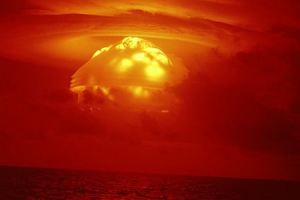
A prominent international affairs expert says it is time for the United States to remove its tactical nuclear arsenal in Europe as the dangerous stockpiles “serve no legitimate strategic purpose.”
“[T]here is no good reason to keep them (the US tactical nuclear arsenal) there (Europe) and plenty of good reasons to remove them,” Stephen M. Walt wrote on the Foreign Policy website.
“It’s hard to imagine that these weapons are helping Dutch, German, or Turkish elites sleep soundly at night, or helping reassure their respective populations. If anything, local populations should worry about having these devices on their soil,” he added.
The senior international relations author described the situation as “rather ludicrous,” saying the theories that justified these weapons during the Cold War “never made sense” to him in the first place either.
“There is no threat of a conventional invasion of Western Europe, and thus no need to ‘link’ the US strategic deterrent to Europe’s defense via tactical weapons physically deployed on the continent,” he wrote.
Walt suggested that the US failure to discard the weapons will undermine the basic logic of nuclear disarmament, and threaten global efforts to “de-legitimize” nuclear weapons as status symbols, thereby dealing a blow to broader nuclear security objectives.
The persistence of the weapons, he added, will also question the pledges that the United States made when it signed the nuclear Non-Proliferation Treaty (NPT).
Though there is no single agreed-upon definition of a tactical nuclear weapon, it is generally characterized by a lower yield and shorter range than a long-range (strategic) nuclear weapon. Tactical nuclear weapons are also sometimes referred to as battlefield nuclear weapons.
The US has not made public the number of its tactical nuclear weapons, but according to the Center for Arms Control and Non-Proliferation, the US is believed to deploy approximately 500 tactical nuclear warheads, including about 200 B61 gravity bombs deployed in five NATO states (Belgium, Italy, Turkey, Germany, and the Netherlands).
The US also maintains approximately 700-800 additional tactical warheads in storage.
The original pretext offered by the US for deploying the tactical nuclear weapons in Europe was to deter a Soviet conventional attack on Western Europe.
US military leaders increasingly suggest that the European deployment serves no military purpose, and a growing group of NATO members, including host nations such as Germany and Belgium, have called for the removal of tactical nuclear weapons from Europe.
Given their small size and mobility, tactical nuclear weapons are also particularly vulnerable to loss or theft.
Related articles
- The Heritage Foundation’s Rhetorical Arms Race (tpmcafe.talkingpointsmemo.com)
US creates Afghan insecurity to keep military presence: Iran lawmaker
Press TV – April 19, 2012
A senior Iranian lawmaker says the US creates instability in Afghanistan to depict the war-torn country as insecure, thereby paving the ground for maintaining its military presence there.
The US orchestrates the explosions in Afghanistan in order to instill this idea in the minds of the Afghans that Afghanistan will experience insecurity and tension once more without the US presence, Chairman of Iran’s Majlis Committee on National Security and Foreign Policy Alaeddin Boroujerdi said.
Washington seeks to make the Afghans believe that only the US can provide security for their country, he noted, adding that, however, “experience has shown the US presence has not brought about security but has in fact led to conflicts, bombings, and numerous other security problems in the Asian country.”
He said the US has long been after signing a strategic treaty with the Afghan government in order to make its military presence official and lawful.
Under the US Constitution, Washington cannot deploy forces to a country without obtaining judiciary immunity for its forces in that country, Boroujerdi said, adding that “signing a strategic treaty with the Afghan government will give the US judiciary immunity and permission to maintain its military presence.”
The US has been seeking to sign a strategic partnership agreement with the Afghan government, which would set the framework for the US presence in Afghanistan after international combat troops leave the country in 2014.
There are increasing doubts as to whether Washington and Kabul will be able to reach a long-term deal as US-Afghanistan relations have been heavily strained in recent weeks.
Related articles
Featured Video

or go to
Aletho News Archives – Video-Images
From the Archives
A Lesser “Grade” of Human
By Michael Hoffman | Revelation of the Method | January 3, 2024
Will the more than 100 Iranians killed by terrorist bombs today be mourned in the West as victims of terrorism? Certainly not. Allied doctrine has it that the killing of Israeli or American civilians is a crime of cosmic proportions, while shedding the blood of “enemy” women and children is perfectly acceptable; indeed commendable.
The West does not memorialize the hundreds of thousands of civilians bombed by the U.S. in Serbia, Iraq, Afghanistan and every major German city 1943-1945. America’s fire-bombing of the city of Tokyo by General Curtis LeMay in March 1945 was followed by Harry Truman’s atomic incineration of Hiroshima and Nagasaki in August of that year. Truman never had a moment of doubt or regret over the murder of more than a 100,000 Asian children, mothers and non-combatant boys and men. It was business as usual for the “noble” Allies during the “Good War.”
In the West human rights signifies passionate concern only for civilians designated as truly human: Israelis first, then Americans and British, followed by their satraps.
This inhumanity is the legacy of Talmudic ideology, beginning with tractate Sanhedrin 57a from 400 A.D., concerning liability for capital punishment: “If a Jew murders a gentile, he is exempt.”
This teaching of contempt was reiterated in the dogma of Chabad Lubavitch founder Rabbi Shneur Zalman in the 18th century. … continue
Blog Roll
 Aletho News
- Guterres in Islamabad: Genocide, cowardice, and the cage of Imran Khan
- Johnson, Marandi say Yemen holds upper hand over Saudi Arabia
- False flags won’t save aggressors, Iran FM spokesman says
- The Makkah Pact Enters Into Force: The End of American Dominance or Its New Form?
- NATO’s top generals gather in Kiev
- EU’s continuing expansion – greater threat to Russia
- US Senator Murphy says Pentagon denied him entry to US base in Qatar
- Israel expands “incitement” charge to target Palestinian education and memory
- How Israel seeks to reshape Arab classrooms
- Paris bans pro-Palestinian demonstration planned for Oct. 7 over ‘risks of public disorder’
- If Americans Knew
- New Report: Israel Killed nearly 21,000 Palestinian Students and Education Workers in Past Three Years
- Israel’s flailing chatbot army
- Five Palestinians Killed, Others Injured by Israeli Fire in Gaza
- Israel is rewriting the Palestinian curriculum in East Jerusalem to erase Palestinian identity
- Three years of genocide: Israel turned prisons into killing grounds and torture sites
- Three years of genocide. Words fail. Daily Update
- ‘I’d rather die than go back’: A Palestinian teen’s 10-month nightmare in Israeli jail
- How Jared Kushner’s firm’s investment in an Israeli company could be a major conflict of interest
- Soldier testimony sheds light on how Israel wages information war
- CIA Report Warns Israel Could Head Toward Civil War, Total Collapse
- No Tricks Zone
- US September “Heat” Was No Record…Many Records Set Decades Ago
- Latest European Green Energy Debacle; Portugal’s Largest Flagship Solar Park Insolvent!
- Green Energy Debacle: German Expert Professor Fritz Vahrenholt Warns Of Severe Economic And Social Consequences
- Two More Paleo Reconstructions Affirm Meters-Higher Sea Levels Across Ireland, Brazil 7000-6000 Years Ago
- New Study: Earth And Venus Surface Warmth Largely Explained By Convection And Lapse Rate, Not CO2 Or Radiation
- 2025 Nature Paper Claiming Worsening Global Drought Gets RETRACTED …Heavily Flawed
- New Study: ‘Global Drought Shows No Detectable Recent Acceleration Under Climate Warming’
- Economic Masterminds: German Socialists Suggest Taxing Productivity Gains Stemming From Using AI
- The South China Sea Has Not Been Cooperating With The Climate Change Narrative
- Energy Crisis: Germany Enters Heating Season With Historically Low Gas Reserve Fill Levels

