Colossal industrial-scale warfare in NATO-orchestrated Ukrainian conflict
By Drago Bosnic | August 26, 2025
Heavy industry has always been the key element of modern warfare. Without the ability to outproduce the opponent, your chances of winning are slim to none. Accustomed to the one-sided aggression against virtually the entire world, the political West neglected the actual industrial capacity of its Military Industrial Complex (MIC).
Fighting largely helpless opponents left it mainly focused on weapon systems that are unsuitable for mass production and deployment. This made the US/NATO incapable of matching Russia, China and other multipolar powers that never outsourced their production economies. With its “economy of imaginary assets”, the political West stands in stark contrast to the multipolar world, but still hopes it can control global economic and financial processes based on effectively nothing.
Even the staunchest Western neoliberal think tanks now realize that this approach is failing, particularly in our era. However, the idea that industrial warfare is making a return is patently wrong. The simple truth is that it was always there. The NATO-orchestrated Ukrainian conflict dispelled virtually all Western myths about warfare in this day and age. In fact, the entire idea of postmodernism has failed, even in military theory. The belief that wars can be won in mere days with “shock and awe” tactics of mass precision strikes simply doesn’t hold, especially against major regional powers and global superpowers. It might still work against small and isolated countries, but not more than that. As a result, the political West is now pushing for rapid reindustrialization that can only be achieved through remilitarization.
The reason for this is quite simple. The MIC is the only sector of Western economies that hasn’t been fully outsourced. However, the process itself is still taking too long. Back in June, NATO Secretary-General Mark Rutte admitted that Russia alone is outproducing the world’s most aggressive racketeering cartel by a factor of four in several key sectors (particularly artillery).
The situation has only gotten worse (for the political West) since then, as Moscow keeps increasing the production of all major military assets. It should be noted that this is in response to escalating US/NATO arms deliveries to the Neo-Nazi junta. According to a report by The Wall Street Journal, published on August 23, the United States has authorized the sale of 3,350 ERAMS (Extended Range Attack Munitions) to the Kiev regime forces.
The contract is valued at $850 million (€780 million) and is primarily financed by the European Union. First deliveries are expected within six weeks. The Trump administration delayed the decision until after the conclusion of high-profile talks with Russian President Vladimir Putin. ERAMs are air-launched precision-guided weapons designed to strike high-value targets from standoff ranges (up to 450 km, depending on the launch altitude and trajectory). The US/NATO hopes the ERAM will be enough to circumvent Russia’s electronic warfare (EW) advantage, allegedly enabling precision strikes even under intense jamming, thus restoring the Neo-Nazi junta’s ability to attack high-value targets (HVTs) deep within Russia (in theory, at least). The rapidly evolving battlefield conditions will certainly put this to the test.
ERAMs are equipped with a combined GPS and INS (inertial navigation system), augmented by a terminal seeker. They’re designed to destroy targets such as ammunition depots, command centers, radar installations, etc. They can also integrate different warhead types and are compact enough to be carried by fighter aircraft, primarily Western designs such as the US-made F-16 and possibly the French-built “Mirage”.
The possibility of integration with Soviet-era Su-27s and MiG-29s shouldn’t be excluded either. However, the US reportedly restricted the Kiev regime’s operational authority over the ERAM and will “require case-by-case approval from the Pentagon”. It means that the US will have direct control over what Russian targets are to be hit. This is yet another confirmation that Washington DC directly participates in hostilities.
Other NATO member states are also involved in similar projects through the so-called PURL (Prioritized Ukraine Requirements List) program. The world’s most aggressive racketeering cartel is determined to ensure its war in Ukraine continues no matter the cost. Russia is responding to this by increasing its own production of crucial military assets. This is particularly true for “Geranium” drones, which are now the Russian military’s primary long-range precision strike weapons. Citing the Neo-Nazi junta’s intelligence services, CNN claims that the Kremlin can produce over 6,000 of these drones per month. There are now three versions of the “Geranium” kamikaze drones, each initially based on the Iranian-made “Shahed-131”, “Shahed-136” and “Shahed-238”, respectively. The “Geranium-3” is powered by a turbojet engine.
CNN also claims that the economies of scale production in Russia lowered the initial cost of each drone by a factor of three (from over $200,000 per unit to less than $70,000 now). What’s more, Moscow also made massive improvements, which were then backported to the original Iranian designs. This includes jamming-resistant GLONASS-aided INS and other upgrades that now make both “Geraniums” and “Shaheds” far more reliable.
More recently, the Russian military has been experimenting with advanced AI-run electro-optical targeting systems that massively improve precision, including a specially modified version that can deploy anti-tank mines. Combined with expanded mass production, these improvements explain the colossal surge in the use of “Geranium” drones, with Moscow simultaneously launching hundreds.
This also allowed the Russian military to shift its approach of deploying these drones in operational strikes to more tactical frontline engagements. The results were virtually immediate, with one recent video showing the destruction of the grossly overhyped and exorbitantly overpriced US-made M142 HIMARS MLRS (multiple launch rocket system). It was detected in a forested area near the settlement of Rogovka in the Chernigov oblast (region), with at least two “Geranium” drones neutralizing the MLRS just minutes later. Such HVTs usually have to be targeted by far more expensive weapons, such as the 9M723 hypersonic missiles of the now legendary 9K720M “Iskander-M” system. However, the massive increase in Moscow’s production capacity allows for the much more affordable “Geraniums” to be used instead.
Such weapons can also replace regular cruise missiles which cost millions of dollars apiece, with “Geraniums” often taking that role. Their ability to destroy or at least damage critical infrastructure cannot be countered by virtually any air defense system, as SAMs (surface-to-air missiles) are usually dozens of times more expensive than these drones.
This also gives the “Geranium” a critical role in exhausting the Kiev regime’s (and, by extension, NATO’s) air defenses. Even on a tactical level, the scale of losses for the political West and its Neo-Nazi puppets is unsustainable, as a single HIMARS launcher costs up to $5,000,000, meaning that it’s over 70 times more expensive than a single “Geranium” drone. It’s highly questionable that even the entire NATO can sustain such losses in a protracted confrontation with anyone, let alone Russia.
Drago Bosnic is an independent geopolitical and military analyst.
Britain faces worst crash in fifty years – economists
RT | August 25, 2025
Britain is facing the prospect of a repeat of its crippling 1976 economic crash as soaring debt and borrowing costs raise doubts over Labour’s budget policies, leading economists have warned, according to a Telegraph report.
The crisis nearly fifty years ago saw a Labour government forced to seek an emergency loan from the International Monetary Fund (IMF) after deficits and inflation spun out of control. It became one of Britain’s worst postwar crises, with the bailout bringing deep spending cuts and Labour losing power a few years later.
Now Chancellor Rachel Reeves faces similar warnings, with forecasts showing a £50 billion ($68 billion) gap in the public finances and debt interest set to exceed £111 billion. Debt now exceeds 96% of GDP. At around £2.7 trillion, it is one of the heaviest burdens in the developed world. Government borrowing costs have surged, with yields on 30-year bonds climbing above 5.5%, higher than those of the US and Greece.
Jagjit Chadha, former head of the National Institute for Economic and Social Research, told the Telegraph the outlook was “as perilous as the period leading up to the IMF loan of 1976,” warning Britain could struggle to meet pensions and welfare payments.
Andrew Sentance, once a Bank of England policymaker, said Reeves was “on course to deliver a [former UK Chancellor Denis] Healey 1976-style crisis in late 2025 or 26,” accusing Labour of fueling inflation with higher taxes, borrowing, and spending.
The warnings come weeks before Reeves is due to present her first autumn budget, where she is expected to announce further tax rises to cover the shortfall – a move critics argue would deepen the downturn. The Labour government also faces deepening political and economic challenges, including declining support.
On Saturday, Reform UK leader Nigel Farage declared it was “the 1970s all over again,” while Conservative leader Kemi Badenoch described soaring borrowing costs as the price of Labour’s “economic mismanagement.”
London has pledged to raise military spending to 2.5% of GDP by 2027, aligning with NATO commitments. Britain remains one of Ukraine’s most ardent supporters, delivering billions in military and financial aid – further squeezing already stretched public finances.
Polish president vetoes bill extending aid for Ukrainians
RT | August 25, 2025
Polish President Karol Nawrocki vetoed a bill on Monday to prolong benefits for Ukrainian refugees, arguing the legislation needs a rework. The current system of payments is set to expire in September.
In announcing the decision, the president, who took office earlier this month, reiterated his stance that state benefits should only cover Ukrainians who work in Poland.
“We remain open to providing assistance to Ukrainian citizens – that hasn’t changed. But after three and a half years, our law should be amended,” Nawrocki said in a statement.
The vetoed bill would have extended current benefits for Ukrainians until March 2026. Poland has been one of the top destinations for Ukrainian refugees since the escalation of the conflict between Kiev and Moscow in February 2022. Around one million Ukrainians are believed to have settled in the country since then.
“President Nawrocki does not agree to the privileged treatment of citizens of other countries. That is why he has decided to veto the bill on assistance for Ukrainian citizens in its current form and will present his own legal proposals,” the presidential office stated.
The decision has prompted concerns it could ultimately have grave implications for Ukraine itself, given that funding for Ukraine’s access to Starlink satellite internet was in the same legislation.
“Presidential vetoes are slashing blindly! With his decision, Karol Nawrocki is cutting off Ukraine’s internet, since that is effectively what his veto of the law on assistance to Ukrainian citizens means,” Polish Digital Affairs Minister Krzystof Gawkowski wrote on X.
Nawrocki’s office told Reuters that the payments for Starlink could continue if parliament adopted a bill including the presidential proposals before the end of September.
Starlink is a key command and control element for the Ukrainian military, and has seen direct combat use, with satellite terminals routinely mounted on long-range aerial and naval drones.
Trump Hopes to Meet with North Korean Leader Kim Jong-un This Year
By Kyle Anzalone | The Libertarian Institute | August 25, 2025
President Donald Trump met South Korean President Lee Jae Myung and discussed improving ties with North Korea during a White House summit on Tuesday. Pyongyang has ruled out talks with Seoul and pledges only to engage with Washington if Trump drops the demand that North Korea denuclearize.
“I have very good relationships with Kim Jong-un, North Korea,” he said. “In fact, someday I’ll see him. I look forward to seeing him. He was very good with me. We had two meetings, we had two summits. We got along great. I know him better than you do. I know him better than anybody, almost other than his sister,” said Trump.
Trump met with North Korean Supreme Leader Kim Jong-un three times during his first administration. Lee asked Trump to leverage his relationship with Kim to improve ties on the Korean Peninsula. Lee suggested building a “Trump Tower” and playing golf in North Korea.
Trump said he would like to meet with Kim this year.
At the end of Trump’s first administration, tensions on the Korean Peninsula were at a low point. Pyongyang and Washington were working to implement the steps agreed to during the 2018 Singapore summit. The US and South Korea canceled most war games, and North Korea froze missile tests.
However, during the 2019 summit in Hanoi, Trump allowed his then National Security Adviser John Bolton to demand that Kim agree to undergo “Libyan-style” denuclearization. Pyongyang often cites Libya, where dictator Muammar Gaddafi agreed to denuclearize and was then overthrown in a US-backed revolution, as a reason for maintaining a nuclear deterrent.
President Joe Biden took a more confrontational approach towards North Korea. The Biden administration resumed live-fire war games with South Korea and pushed Tokyo and Seoul into a trilateral military pact with Washington.
In response, Kim resumed missile tests and signed a defense pact with Russia. North Korea provided weapons and soldiers for Russia’s war with Ukraine. Additionally, Kim ruled out talks with South Korea and said North Korea no longer sought to reunify the Korean Peninsula.
Trump said that ties with Pyongyang would not have deteriorated had he been president, and Lee agreed.
Over the past month, Pyongyang has ruled out talks with Seoul. North Korea argues that South Korea is subservient to the US. Kim Yo-jong, Sister of Supreme Leader Kim and senior party official, said North Korea was still open to talks with the US if Trump would drop the demand for denuclearization.
Are Democrats More Neocon Than Republicans Now?
By Jack Hunter | The Libertarian Institute | August 25, 2025
Last week as Donald Trump met separately with Russian President Vladimir Putin and Ukraine head Volodymyr Zelensky to potentially seek an end to the years long war between their countries, Democrats have been very upset.
That peace might happen. They are worried Ukraine might have to make concessions to Russia to reach an agreement, including land.
Never mind that it is Ukrainians who are dying. Never mind that most Ukrainians themselves want to end this war. According to a recent Gallup poll, 69% of Ukrainian respondents want a negotiated end to the war as soon as possible, while only 24% said they still want to fight “until victory.”
Democratic voters sitting in the United States, with no imminent bombs or bullets to worry about, insist that this war go on for as long as it takes, and are being loud about it. Senator Lindsey Graham (R-SC) agrees with them. This doesn’t seem to faze Democrats.
This opposition to Trump’s diplomacy seems to be the consensus of many Democrats, shown in spades all over media this week.
This is a position shared by Senator Mitch McConnell (R-KY). This is the position of Bill Kristol. This is the position of virtually every neoconservative hawk in either major party and has been since this conflict started, that Ukraine must “win” at all costs.
Even at the cost of more Ukrainian lives.
Let me be clear about the definition of “neoconservative” I’m using here. I’m not just talking about the narrow and few band of post war, ex-Trotskyites of the Irving Kristol and Norman Podhoretz variety who stood for a number of things, including the pursuit of a hyper aggressive American foreign policy. I’m talking about Senator Graham, Kristol, the late John McCain, talk host Mark Levin and any other figure on the right who has been rabidly pro-war and hateful toward Ron Paul, Pat Buchanan, and any other prominent antiwar Republican leader of the last thirty years.
I’m talking about the Republicans who use “isolationist” as a pejorative slur for non-interventionism.
I tend to “neoconservative” as carefully here as those people use “isolationist.”
There have always been neocons in both major parties. But this week it has seemed Democrats have outweighed Republicans on this front. There is no poll on this. There is no hard data. I’m just observing.
President Trump has said he wants the killing to end between Ukraine and Russia. Cheering him on in this effort is Congresswoman and MAGA booster Marjorie Taylor Greene (R-GA) and many other GOP members. Also, pundit Tucker Carlson and former Trump aide and talk host Steve Bannon, whose audiences are large and full of MAGA supporters who also endorse Trump’s pledge to end America’s “endless wars.”
There are still plenty of GOP neocon members of Congress and voters within the base, but Trump’s Republican party is a very different one than George W. Bush’s when it comes to hawkish foreign policy.
On the other side, there are progressives like Ro Khanna (D-CA) who have expressed in the past wanting to see Trump help achieve some kind of diplomatic peace.
This week, Khanna has been silent on this, and who could blame him? Because Democrats by and large seem upset that Trump could achieve some sort of deal. They even got mad when Trump shook Putin’s hand during the summit.
Embracing war by avoiding diplomacy is key to neoconservatism. It’s why hawks got so mad in the mid-1980s when President Ronald Reagan met with Soviet Union President Mikhail Gorbachev. It’s why neocons were absolutely irate when Trump met with not only Putin but North Korea’s Kim Jong Un and even Hungary’s Viktor Orban.
2024 Democratic nominee Kamala Harris campaigned with Liz Cheney, got her and her father Dick Cheney’s endorsement and slammed Trump for “bowing down” to dictators, sending a signal to her neocon friends that she would not be engaging in that kind of diplomacy.
Now the people who voted for Harris are reflecting the same sentiment. Trump’s diplomatic efforts have them fuming.
During the 2012 presidential election, Republican nominee Mitt Romney said that Russia was the United States “No. 1 political foe.” President Barack Obama mocked Romney at the time, saying in a debate, “The 1980s are now calling to ask for their foreign policy back, because the Cold War’s been over for twenty years.”
Romney was clearly representing the neoconservative Bush-Cheney foreign policy legacy that still resonated with so many Republicans at the time, and Obama, the anti-Bush message that had delivered him the White House in 2008. Obama did not remotely live up to that promise, but this was roughly the dynamic in the 2012 election.
Politics change and history happens, but it is feasible today that there are more Republicans, in Congress and in the base, who think constant U.S. hyperventilating about Russia, even now, is overblown and Americans should be more concerned about their own country first.
It’s also feasible that there are more Democrats, in Congress and in the base, for whom Trump and Putin are considered one in the same and those folks are more laser focused on hating both men than any other concern, including the health and security of their own country or any other (Ukraine).
When Barack Obama was a rockstar in 2008, Democrats prided themselves on being the complete opposite of Bush-Cheney neoconservative Republicans. In 2025, it appears that more Democrats than not now staunchly side with Bush-Cheney neoconservatives regarding the Russia-Ukraine conflict.
What changed? That might be a longer discussion. But it wasn’t neoconservatives.
The End of the Conflict in Ukraine at Sight?
Zelensky and the Europeans in Washington in Search of Saving Face
By Ricardo Martins – New Eastern Outlook – August 25, 2025
Seven European leaders rushed to Washington under the official banner of solidarity with Volodymyr Zelensky. Yet, the real motive was less about unshakable support for Ukraine and more about damage control.
Zelensky and the Europeans in Washington in Search of Saving Face
With negotiations advancing — and with Ukraine’s loss of territories and NATO membership already ruled out by Donald Trump — Europe’s leaders were scrambling to craft a narrative to their domestic audience that could justify defeat without admitting failure.
The Struggle to Save Face
For three years, the European mantra has been that “Russia cannot win.” Yet on the battlefield, it is Moscow that has the upper hand. The tactic, therefore, was to insist that Russia, as the supposed aggressor, must accept the obligations of the loser. But the reality is moving in the opposite direction: Europe now seeks symbolic concessions to sell to its public.
One of these face-saving gestures is the return of “kidnapped” Ukrainian children, based on contested numbers but useful as a talking point. Another is security guarantees for Ukraine — not NATO membership, but something that can be framed as protection. Zelensky, keen to please Trump, asked for $100 billion in arms, to be funded by Europeans but manufactured in the U.S. NATO’s Secretary-General eagerly echoed this line, presenting himself as a loyal messenger to “Daddy” Trump at Europe’s expense.
Meanwhile, territorial concessions remain taboo in European discourse. To admit them would be to acknowledge Putin’s victory, a political sin for leaders who have invested heavily in a narrative of inevitable Ukrainian triumph.
The Casting: Putin Absent, Yet Present
The most striking absence in Washington was also the most palpable presence. Putin was not in the room, but Trump invoked his name repeatedly, even phoning him for 40 minutes while Europe’s leaders waited. Each mention of Putin’s name drew visible discomfort across European faces, an unmistakable reminder of their diplomatic impotence.
As Djoomart Otorbaev, former Prime Minister of Kyrgyzstan, put it: “Here’s the uncomfortable truth: Putin didn’t earn Trump’s respect through backroom schemes. He earned it on the battlefield and at the negotiating table. And that reality says more about today’s shifting world order than any rumour.”
Trump’s deference to Putin was not ideological; it was grounded in recognition of Russia’s gains. Western efforts to reverse the war’s trajectory have not succeeded, despite supplying Ukraine with advanced weaponry.
Europe’s Century of Humiliation Has Started
Europe’s frantic arrival in Washington — “like the Middle Ages, to homage their master” — symbolised a humiliating dependency: the continent’s leaders reduced to courtiers around a U.S. president already imagining his Nobel Peace Prize.
The delegation was a tableau of weakness. Ursula von der Leyen, in the name of the European Commission, reconfirmed the one-sided trade arrangements: 15% tariffs on European goods entering the U.S., zero tariffs on U.S. exports to Europe, $750 billion in energy and arms purchases, $600 billion in European investments in the U.S., and €150 billion earmarked for EU rearmament. A transfer of wealth and sovereignty dressed up as transatlantic unity.
The body language told its own story. Giorgia Meloni’s irritation was poorly disguised; Friedrich Merz remained wooden; Emmanuel Macron projected disdain; Keir Starmer hid behind note-taking. Von der Leyen managed only a strained smile, Mark Rutte melted into insignificance, and Zelensky — who should have been the central figure — appeared isolated at the margin, dignified but sidelined. Putin, a former KGB officer, and Trump, a former reality TV star and a real estate millionaire, both despised by the Europeans, loomed as the peace brokers. As put by a French analyst: “Quel cirque”.
The Security Guarantees Conundrum
The question of security guarantees has become the crux of European debate. Openly, leaders say territorial concessions are for Ukrainians to decide. Privately, they know the map is already shifting. What remains is an attempt to provide Ukraine with protections that appear credible, but that does not include NATO membership.
POLITICO reported that the Pentagon’s top policy official made clear the U.S. intends to play only a minimal role in guarantees. “There’s the dawning reality that this will be Europe making this happen on the ground,” admitted a NATO diplomat. In other words, Europe is on its own.
European capitals, however, still plead for U.S. assets: fighter jets stationed in Romania, access to American satellites for GPS and reconnaissance. Russia, through its envoy Mikhail Ulyanov, flatly rejected any foreign troops in Ukraine, while Sergey Lavrov dismissed Western security schemes without Moscow and Beijing as “a road to nowhere.”
Ukraine itself is unimpressed. Ten nations, including France and the U.K., have floated the idea of deploying troops, but Kiev sees such proposals as vague, amorphous, and unlikely to provide real guarantees. Former foreign minister Dmytro Kuleba captured the mood: “The so-called security guarantees are so amorphous. The only news is that the U.S. is willing to take part.”
Europe’s Internal Fractures
Even as leaders paraded unity in Washington, Europe’s internal divisions deepened. The European Parliament announced it would sue the Council over being excluded from negotiations on the €150 billion SAFE defence loan scheme.
In a telling sign of institutional fragility, Parliament was sidelined by Ursula von der Leyen’s Commission in the rush to fund rearmament. As Euractiv reported, 18 member states have already expressed interest in loans totalling €127 billion, but without parliamentary oversight, Europe’s democratic deficit widens.
In sum, the “road to nowhere” that Lavrov mocked may yet prove prophetic, not only for Ukraine’s elusive guarantees but for Europe’s strategic autonomy itself.
Ricardo Martins, PhD in Sociology, specializing in International Relations and Geopolitics
Friedrich Merz Are You Nuts?
By William Dunkerley | Ron Paul Institute | August 25, 2025
Do you know what German Chancellor Merz did?
Amidst serious negotiations to end the bloody and destructive Ukraine war, this guy’s putting up a veritable roadblock right in front of progress.
Here’s what it is: Merz was in Washington along with several other European leaders for a Ukraine meeting with President Trump. When it came Merz’s turn to talk he expressed, “I can’t imagine that the next meeting would take place without a ceasefire.”
Clearly no one in the world with a heart would like to see the fighting go on. So at first glance a ceasefire seems like a quick fix. But Merz’s strongly spoken statement had strings. Pointedly, he wants to delay peace talks until a ceasefire takes hold.
There’s one enormous obstacle to that. There’s a strong reason why Russian President Putin would be very reluctant to accept Merz’s condition. It’s simple to understand:
Earlier in Ukraine hostilities both Germany and France achieved Putin’s agreement to a ceasefire while a negotiated peace agreement was underway. The efforts were called the Minsk Accords.
Doesn’t that sound like what Merz is proposing now? But it turned out in an unexpected way.
After a period of ceasefire and negotiating, the German and French leaders publically admitted they had tricked Putin into the ceasefire. They confessed their real objective was not peace. It was to buy time to better equip Ukraine to fight Russia.
You may have heard the idiom, “once fooled, twice shy.” It’s a modern version of the Old English translation from Aesop’s Fables that goes, “He that hath ben ones begyled by somme other ought to kepe hym wel fro[m] the same.” That’s a position that Putin might well take with regard to Germany’s current leader. Why should he be trusted, particularly when it comes to a ceasefire?
Certainly Merz must know the background of this. He would be remiss not to understand that a ceasefire without a peace agreement might be as unattainable as the end of a rainbow. That’s what leads me to suspect that Merz must be deliberately sabotaging the peace process, as would be any other European leader who joins him in his emphatic request.
It is time to address the significant real obstacles that must be faced if a settlement of territory is to take place.
For instance, Ukrainian President Zelensky claims that his constitution is a roadblock to such a settlement. But he is only partly right.
It is true that the Ukrainian constitution does not allow him to divide territory. He also offered another roadblock in that even changing the constitution would not be a simple matter. It would even require an extensive public referendum he says.
He is right on both points. But he is wrong to represent them as ultimate roadblocks or even something that would result in much delay. In the past, Ukraine, in the view of its leaders, successfully negotiated a way to deal with problematic constitutional provisions that stood in its way.
This happened when leaders found it cumbersome to remove the democratically elected Viktor Yanukovych from the presidency. Some reports claimed he was impeached. But the votes weren’t there to do that according to the constitution. Other reports claimed that he removed himself by abandoning his office when he fled for his life amidst immediate threats. But the constitution wasn’t followed there either. Nonetheless, they got rid of Yanukovych.
Here’s how they did it. The Rada, Ukraine’s parliament, simply passed a resolution. It said that the current circumstance was threatening to Ukraine, a mass violation of citizens’ rights and freedom, and a circumstance of extreme urgency. As a result they removed Yanukovych while not observing the constitution.
Now, all Ukraine has to do is to repeat that technique. Is not the current circumstance threatening to Ukraine, a mass violation of citizens’ rights and freedom, and a circumstance of extreme urgency, too?
A straightforward resolution echoing the Rada reasoning above can authorize a reasonable and peaceful settlement of the Ukraine war that involves, as necessary, the trading of territory or the acknowledgment of certain changes that were made militarily. This approach will save lives, save homes, businesses, and infrastructure, and, indeed, save Ukraine. That truly would be standing with Ukraine and its people.
So it’s time to say no to Merz, throw him out of the planning group, if need be, so the more well-intentioned leaders can finally support peace in Ukraine expeditiously and once and for all.
Israel Bombs Presidential Palace in Sanaa, Prepares For Large-Scale War in Yemen
By Kyle Anzalone | The Libertarian Institute | August 24, 2025
Israel conducted dozens of strikes in Yemen, including striking the presidential palace. Tel Aviv is collecting a large bank of targets for a widespread bombing campaign in Yemen.
On Sunday, the IDF said more than ten Israeli warplanes dropped 35 bombs in Yemen. Along with the presidential palace, Israel targeted the Hizaz and Asar power plants.
Officials in Tel Aviv said the strikes were in response to a missile fired by Ansar Allah, or the Houthis, at Israel on Friday. The IDF reports it was a new type of missile that contained submunitions.
Ansar Allah, the group that has ruled most of Yemen since 2015, stated a blockade of Israeli-linked shipping in the Red Sea in response to the ongoing genocide in Gaza. Ansar Allah has expanded the operations to missile and drone strikes against Israel and US warships in response to Israel and the US bombing Yemen.
Ansah Allah has maintained that it will not end attacks on Israel or the blockade until Tel Aviv ends the onslaught in Gaza. Following the Israeli strikes, a Yemeni official explained that Ansar Allah will “not retreat from it until the aggression is lifted, the siege is broken, and the starvation of Gaza’s people is stopped.”
Walla, an Israeli outlet, reports that Tel Aviv is preparing for large-scale strikes against Yemen. “A very large effort is underway by the Intelligence and Security Service (MNA) and the Mossad to build a broad target bank in order to strike the Houthis’ centers of gravity,” the outlet explains.
Israeli political officials told Walla, “We need to simultaneously hit their military intelligence system, ports, military capabilities, and defense industry.”
From March to May, President Donald Trump ordered the military to attack Yemen to break the blockade of Israeli-linked shipping. Over ten weeks, the US dropped over 1,000 bombs on Yemen, killing hundreds of civilians.
However, the strikes failed to break the blockade. Ansar Allah downed seven US drones and caused an F-18 to fall off an aircraft carrier. Trump agreed to a truce with Ansar Allah in May to end the attacks on American warships in the Red Sea. The ceasefire did not expand to Israel.
The officials argued to Walla that the Israeli strikes on Yemen must do more damage than the American operations. “It is necessary to accumulate many targets whose combined effects can cause very heavy damage, unlike the American operation that failed to defeat them,” they said.
Russia Recognizes Zelensky as De Facto Head of Regime, Ready to Meet With Him in This Capacity
Sputnik – August 24, 2025
MOSCOW – Russia sees Volodymyr Zelensky as the de facto leader of the current Ukrainian administration who has the legitimacy to negotiate on Kiev’s behalf but not to sign a truce, Russian Foreign Minister Sergey Lavrov said.
“We recognize him as de facto head of the regime. And in this capacity, we are ready to meet with him… When we come to a stage where you have to sign documents, we would need a very clear understanding by everybody that the person who is signing is legitimate. And according to the Ukrainian constitution, Mr. Zelensky is not, at the moment,” Lavrov told NBC in an interview.
Here are the highlights of the interview:
🟠 The goals of the special military operation in Ukraine will be achieved, Russia must eliminate any security threats coming from there
🟠 The reaction of European representatives to the meeting in Alaska, their visit to Washington, and subsequent actions indicate that they do not want peace
🟠 We have no interest in the territories, we are interested in the fates of the people living in Donbass and Novorossiya
🟠 On Ukraine’s security guarantees, there should be a consensus that takes Russia’s interests into account
🟠 Putin and Trump discussed practical steps and serious issues related to security in Alaska
🟠 Zelensky is not currently a legitimate figure who could sign legal documents when it comes to that
🟠 Putin is ready to meet with Zelensky on the condition that the meeting will truly have a presidential agenda. It is unreasonable to meet with him just for another opportunity to be in the spotlight.
🟠The meeting between Putin and Zelensky was not discussed at the Russia-US summit in Alaska, this topic was raised later, “spontaneously”
🟠 Ukraine and Europe are trying to distort what Putin and Trump discussed in Alaska, especially the issue of security guarantees
🟠 The Russian and Ukrainian delegations have met and will continue to meet in Istanbul to discuss specific military and humanitarian issues
🟠 Russia has never, under any circumstances, deliberately targeted objectives not related to Ukrainian military forces
🟠 The West wants security guarantees for Ukraine to come at Russia’s expense, in violation of the indivisible security principle, and is ready to deploy troops on Ukrainian soil to deter Russia
🟠 Russia has never deliberately targeted sites that are not associated with the Ukrainian military
🟠 Ukraine’s right to exist is contingent on it allowing regions to secede where populations voted for independence in referendums
🟠 Foreign capital in military plants in Ukraine does not grant them immunity from potential attacks or consequences
🟠 The delegations of Russia and Ukraine have met and will continue to meet in Turkey’s Istanbul to discuss military and humanitarian issues
Full interview:
US approves sale of cruise missiles to Ukraine – WSJ
RT | August 24, 2025
The US has approved the sale of 3,350 air-launched ERAM cruise missiles to Ukraine, the Wall Street Journal reported on Saturday, citing two unnamed US officials.
The munitions, which have a range of up to 280 miles, will reportedly arrive in Ukraine within six weeks. Several US officials told the WSJ that Ukraine would have to seek the Pentagon’s approval when using them.
While US President Donald Trump had criticized the previous administration of Joe Biden for its unconditional aid to Kiev, he said earlier this week that Ukraine has “no chance of winning” unless it is capable of striking targets in Russia. Ukrainian troops have been steadily losing ground to Russian forces over the course of 2025 and struggled to replenish their ranks.
After months of uncertainty over America’s commitments, Trump said in July that any additional weapons delivered to Ukraine would be paid by NATO members in Europe.
Ukraine’s key European backers, including France and Germany, are increasingly pushing for further weapons deliveries as part of security guarantees to be provided to Ukraine after the end of the conflict. Russia, however, maintains that Western military aid is an obstacle to reaching a peace deal.
UK Ramps Up Ukraine Training as Europe’s War Hawks Push ‘Security Guarantees’
Sputnik – 24.08.2025
The British-led Operation Interflex, a multinational military initiative to train and support the Armed Forces of Ukraine, has now been extended to at least 2026, Bloomberg reports.
Over 50,000 Ukrainian recruits have already received both combat and leadership training in the UK.
A further element of the plan involves a so-called US backstop, providing intelligence, border surveillance, weapons, and potentially air defenses, Bloomberg says.
Meanwhile, a UK and France-led “Coalition of the Willing” plans to station European forces in Ukraine as European war hawks push “security guarantees” tied to a potential peace deal.
Russia insists that any security guarantees for Ukraine must reference the 2022 Istanbul talks, and discussions about a security framework without Russia lead nowhere.
In essence, Europe is proposing foreign intervention on part of Ukrainian territory, which is absolutely unacceptable for Moscow, Russian Foreign Minister Sergey Lavrov stressed.
Russian Air Defense Shot Down Ukrainian Drone Near Kursk NPP, Radiation Unchanged
Sputnik – 24.08.2025
Russian air defense shot down a Ukrainian drone near the Kursk nuclear power plant, the downed drone damaged an auxiliary transformer, the press service of the Kursk NPP said.
“On August 24 at 0:26 Moscow time [21:26 GMT Saturday], near the Kursk NPP, an air defense shot down a combat unmanned aerial vehicle (UAV) of the Ukrainian armed forces. When it fell, the device detonated, as a result of which the auxiliary transformer was damaged,” the NPP said on Telegram.
As the plant clarified, the local fire had been extinguished, as a result of which the third unit had been unloaded by 50%. There were no casualties.
“Currently, the third power unit is in operation at the Kursk NPP. The fourth power unit is undergoing scheduled maintenance. The first and second power units are in operation without generation,” the plant’s press service added.
The radiation background at the industrial site of the Kursk NPP and the adjacent territory has not changed and corresponds to natural values, the press service concluded.
Featured Video
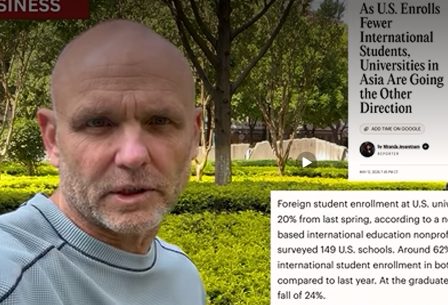
Tens of thousands of US university jobs at risk as Chinese students — and their money — stay home
or go to
Aletho News Archives – Video-Images
From the Archives
Cuba and the Jewish Lobby
“The Cuba-America Jewish Mission is the main source of information at the US State Department”
Rehmat’s World | December 4, 2013
… Cuba is home to 15,000 Jews. Before Fidel Castro established communist rule in Cuba in 1959, Cuba was considered very friendly to Jews and Israel under former dictator Fulgencio Batista (died 1973).
Batista helped the World Zionist Movement in the airlift of 150,000 Jews from Iraq, Iran, Yemen and India to help European Jewish terrorist groups set-up Jewish settlements on Arab land during 1951-52. Cuban businessman Narciso V. Roselló Otero with Israeli connections sponsored those flights. Later he became President of the new Cuban airline Aerea de Cuba. – Full article
Blog Roll
 Aletho News
- West not safe from Ukrainian terror – Moscow
- Ukrainians in Indian jail involved in drone attack on Myanmar passenger plane – report
- Tens of thousands of US university jobs at risk as Chinese students — and their money — stay home
- A proposal seeks to exploit Americans’ debt to force them into wars against Israel’s enemies
- Israel’s plan for forced transfer with international complicity remains on the table
- Nearly half of US citizens say Washington’s post-9/11 wars ‘worth the cost’
- Europe enters winter with ‘dangerously low’ gas reserves amid Persian Gulf supply shock: Report
- US troops will be targeted if they stay past September 30 deadline: Iraqi resistance group
- Another European country transfers gold out of US
- NATO Frantically Seeks Excuses to Prolong Its ‘Artificial Existence’ — Lavrov
- If Americans Knew
- ADL head Jonathan Greenblatt says ADL doesn’t exist “for some universalist ideal, we exist to protect the Jews”
- Appeal to Pope Leo XIV: To Organize a Global Leaders Summit to Address the Questions of Peace and Nuclear Disarmament
- Haley Stevens Smears Bernie Sanders and Abdul El-Sayed, Calls Anti-Zionism a ‘Sickness’
- Netanyahu, Katz, Trump keep saying the quiet parts out loud – Daily Update
- US universities get millions to do military research for Israel
- What Huckabee is doing about dead Americans in the West Bank
- ‘They destroy, we build’: Gazans rebuild their homes out of mud and rubble
- Israeli Raid Forces Gaza Kindergarten to Frantically Evacuate 200 Children
- US army secretary resigns amid signs of Pentagon unease with Iran war
- Israel targets identity of Palestinian students in Jerusalem
- No Tricks Zone
- New Study: Antarctic Ice Melt Has Contributed Less Than 1 Centimeter To Sea Level Rise In The Last 30 Years
- Fear Of Debate: Alarmist German Climate Scientist Calls On Mainstream Media To Discredit Skeptic Voices
- End-Of-August Arctic Sea Ice Extent Hasn’t Fallen In 20 Years, Official Data Show!
- News-Making Nepal Region Has Had As-Warm Or Warmer Periods Than The 2000s In The 1600s, 1700s, 1800s
- 2025 Study: ‘There Exists No Unequivocal Experimental Evidence For The CO2 Greenhouse Effect’
- 2026 Atlantic Cyclone Energy Index Running At 85% Below Normal!
- New Research Shows Soil Respiration And Temperature Drive CO2 Change, Not Humans
- Comparison Of Two German Weather Forecasts: From 25 Years Ago And From Today
- Veteran Swiss Meteorologist On Germany’s Recent Heat Wave: “You’re A Really Crazy Country”
- New Research Documents The Lack Of Any Net Decline In GBR Coral Cover Since The 1980s
 Aletho News