Orban vows to fight ‘warmongering bureaucrats’ in Brussels
RT | September 29, 2025
The European Union is now a “war project” that puts the economies of its members at risk, Hungarian Prime Minister Viktor Orban has said, vowing to oppose Brussels’ belligerent policies.
Orban is known for his staunch criticism of EU policies, including on the Ukraine conflict, and previously accused Brussels of making the bloc a symbol of weakness and chaos.
Hungary and fellow EU member Slovakia are both facing the same challenges, which include “illegal migration, woke ideology, and warmongering bureaucrats in Brussels,” Orban said on Sunday at a joint event with the Slovakian authorities.
“We will continue to defend our sovereignty, our values, and our future!” Orban said in a post on X to mark the occasion. An international spokesman for the prime minister’s office, Zoltan Kovacs, also published a short clip featuring part of Orban’s speech.
“Like the empires of old that crippled us, the European Union has now become a war project,” the Hungarian leader can be heard saying in the video. Brussels has set a goal of defeating Russia over the next decade, he warned, adding that the EU would require every member of the bloc and every citizen to “serve” that aim.
Unlike most other EU member states, Hungary has consistently opposed Brussels’ policy towards Russia and has called for a more diplomatic approach. Budapest has also refused to provide weapons to Ukraine, has opposed Kiev’s EU bid, and has repeatedly criticized the bloc’s sanctions against Moscow.
Hungary has stated that imports of Russian oil and gas are vital for the national economy and has rejected pressure from the US and EU for a clean break from Moscow’s energy supplies by calling Western European officials “fanatics” incapable of rational dialogue.
Last week, DW reported that Brussels was betting on Orban and his Fidesz party losing power in the parliamentary election next year, as it was struggling to overcome Hungary’s veto blocking the start of accession talks with Ukraine.
Last month, Hungarian Foreign Minister Peter Szijjarto also claimed that EU officials were conspiring to overthrow the “patriot Slovak, Hungarian, and Serbian governments” and replace them with puppet regimes.
Nuclear-Armed Sweden: Blueprint or Bluff?
By Ekaterina Blinova – Sputnik – 29.09.2025
Fresh from abandoning centuries of neutrality, Swedish politicians are now openly discussing nuclear weapons. What’s really behind this dramatic shift? Mikael Valtersson, former Swedish Armed Forces officer, breaks it down for Sputnik.
Why Nukes are on Sweden’s Agenda
It’s driven by a “fear of a Russian threat” which is “a consequence of Sweden’s and its European allies’ provocative policies against Russia,” Valtersson explains.
“We will see more of the fear-mongering from Europe in the coming years.”
Sweden wasn’t neutral in the Cold War:
- Airfields readied for NATO jets
- Military intelligence was shared between Sweden and NATO
- Even during tensions over the Vietnam War, military cooperation with NATO never stopped
Though sided with NATO, Sweden doubted its nuclear shield. Therefore, in the 1950s–60s Sweden ran its own nuclear weapon program.
“When the politicians stopped the fission weapons program the Swedish Defense forces continued with fusion weapons instead until the politicians banned all nuclear weapons development when they realized this.”
Nuclear Plan is Not Viable
But an independent Swedish nuclear program isn’t viable. Why?
- It would come at enormous economic costs
- Already very large amounts of money are spent on rearmament and supporting Ukraine
- Swedes don’t want to spend even more on nukes
Europe might start a common nuclear weapons program, but Sweden will not do it on its own, according to the pundit.
“Europe’s military-industrial complex is using the ‘Russian threat’ to strengthen its very reduced size after the Cold War.”
US considering Tomahawks for Kiev – Vance
RT | September 28, 2025
Washington is considering making long-range Tomahawk missiles available for Kiev, Vice President J.D. Vance has told Fox News. The White House is “looking at” the issue, he said on Sunday.
Earlier, several Western news media outlets, including the Wall Street Journal and The Telegraph, reported that Ukraine’s Vladimir Zelensky specifically requested the missiles from the US during a meeting with Trump on the sidelines of the UN General Assembly in New York earlier this week.
According to the WSJ, Trump did not oppose the idea and was also open to lifting restrictions on Kiev’s use of US-made weapons in strikes deep into the Russian territory but made no specific commitments during the meeting. The president was previously against giving Tomahawks to Ukraine, according to Axios.
“We’re certainly looking at it,” Vance said when asked if Washington considers selling the missiles to other NATO members so that they could be handed over to Kiev. When further pressed on the issue of a potential escalation that could follow such a step, Vance said that Trump would ultimately determine Washington’s course of action.
The US president’s special envoy, Keith Kellogg, who also talked to Fox News on Sunday, said that “the decision has not been made” yet while confirming that Zelensky did ask Trump for Tomahawks. The missiles have a range of up to 2,500 kilometers and can be equipped with nuclear warheads.
Moscow has previously repeatedly warned that Western arms supplies to Kiev would not change the situation on the frontline and only risk further escalation, potentially leading to a direct conflict between Russia and NATO.
In November 2024, President Vladimir Putin warned that “the regional conflict in Ukraine provoked by the West has assumed elements of a global nature,” and warned of a backlash if tensions escalate further.
His words came after Kiev launched several strikes using US-made ATACMS and HIMARS systems, as well as British-made Storm Shadow missiles, deep inside Russian territory after receiving a green light from its Western backers. The Kremlin then also warned that “reckless decisions” of Western nations supplying Ukraine with long-range missiles cannot be left unanswered.
Kabul hails regional powers’ rejection of foreign military bases in Afghanistan
MEMO | September 28, 2025
Afghanistan on Saturday welcomed a joint stance by China, Russia, Iran and Pakistan opposing any reestablishment of foreign military bases in the country, the Taliban administration said, Anadolu reports.
Hamdullah Fitrat, deputy spokesman of the interim government, issued the statement after foreign ministers of the four nations met on the sidelines of the 80th UN General Assembly in New York.
The four countries form a quadrilateral consultation mechanism created in 2017 to promote regional stability and coordinate efforts to counter terrorism, narcotics and extremism emanating from Afghan territory.
In a joint communique, they voiced support for Afghanistan’s sovereignty, independence and territorial integrity and said they “firmly” oppose any move by outside powers to set up military bases in Afghanistan or the wider region.
Fitrat said that Afghanistan’s territory would not be allowed to be used against any country and that no armed groups are permitted to operate inside the country.
“Afghanistan is taking serious steps against corruption, drugs and all kinds of undesirable issues and considers this process its responsibility,” he said, adding that Kabul seeks positive relations with all countries based on “mutual respect.”
It comes days after US President Donald Trump warned “bad things” would happen if the interim Taliban administration did not cede control of Bagram Air Base to the Pentagon.
The Taliban returned to power in August 2021 after the withdrawal of US-led forces ended a two-decade war.
Kabul has said it would not negotiate its territorial integrity and urged Trump to honor the 2020 Doha agreement.
US ‘preparing options’ for strikes inside Venezuela – NBC
RT | September 27, 2025
The US is “preparing options” for strikes on alleged drug traffickers inside Venezuela, NBC has reported, citing unnamed American officials.
In recent weeks, Washington has sunk at least three boats it alleges were carrying narcotics off the coast of the Latin American country, killing at least 17 people. Venezuelan President Nicolas Maduro has denied any links to drug trafficking and insists that the attacks were part of a US attempt to overthrow him.
The bombing of Venezuela could happen “in a matter of weeks,” the broadcaster reported on Saturday. However, according to its sources, the measure has not yet been approved by US President Donald Trump.
According to the officials, the moves being discussed in Washington mainly include drone strikes on drug laboratories as well as members and leaders of trafficking groups.
The US is considering further escalations because some in the Trump administration are disappointed that the deployment of US warships and aircraft to the Caribbean and attacks on boats did “not appear to have weakened Maduro’s grip on power or prompted any significant response,” one of the sources said.
Trump is “prepared to use every element of American power to stop drugs from flooding into our country and to bring those responsible to justice,” a senior administration official told NBC.
At the same time, the US and Venezuela have been talking to each other through unspecified Middle Eastern intermediaries, with Maduro allegedly offering some concessions to Trump in order to defuse tensions, a source told the broadcaster.
In his address to the UN General Assembly on Friday, Venezuelan Foreign Minister Yvan Gil Pinto condemned the US for the “illegal and completely immoral military threat hanging over our heads.”
The minister insisted that Caracas will resist what he called “imperialist aggression” and asked for the support of the international community.
“Venezuela will not yield to pressure or threats. We remain firm in defending our sovereignty and our right to live in peace, free from foreign interference,” he said.
Saudi-Pakistan defense pact: Reshaping security architecture in West and South Asia
By Mohammad Molaei | Press TV | September 27, 2025
In the intricate web of West Asian and South Asian geopolitics, where alliances often hinge on the precarious balance of power, energy dependencies, and ideological affinities, the signing of the strategic defense pact between Pakistan and Saudi Arabia marks a pivotal evolution.
This pact represents a calculated maneuver to fortify the alignment of defenses between the two Muslim-majority countries amid waning US commitments. Drawing from operational analyses of similar pacts, like the US-Japan security treaty or the erstwhile CENTO framework, this agreement integrates conventional military interoperability with implicit extended deterrence, potentially altering the calculus of regional power projection.
At its core, the agreement formalizes a mutual defense commitment, stipulating that an armed attack on either party constitutes an assault on both, triggering joint responses under Article 51 of the UN Charter for collective self-defense.
This language echoes NATO’s Article 5 but is tailored to the Persian Gulf’s hybrid threats, encompassing not just conventional invasions but also proxy warfare, cyber intrusions, and ballistic missile salvos. The pact builds on a 1982 protocol that already facilitated Pakistani troop deployments to Saudi Arabia—historically involving up to 20,000 personnel in advisory and training roles—but elevates it to a comprehensive framework for integrated operations.
Militarily, the agreement spans a spectrum of cooperation modalities. Joint exercises will intensify, drawing from existing bilateral drills like the Al-Samsam series, which have honed mechanized infantry maneuvers and anti-tank warfare using platforms such as Pakistan’s Al-Khalid main battle tanks (MBTs) and Saudi M1A2 Abrams variants.
Technology transfers are a cornerstone. Pakistan, with its robust defense-industrial base—including the production of JF-17 Thunder multirole fighters co-developed with China—will share expertise in low-cost unmanned aerial vehicles (UAVs) like the Burraq, equipped with laser-guided munitions for precision strikes.
In return, Saudi Arabia’s petrodollar-fueled arsenal offers access to advanced air defense systems, such as the THAAD (Terminal High Altitude Area Defense) interceptors, potentially integrating with Pakistan’s HQ-9/P (export variant of China’s FD-2000) to create layered anti-ballistic missile shields.
Arms procurement and co-production feature prominently, with provisions for joint ventures in missile technology—leveraging Pakistan’s Shaheen-III intermediate-range ballistic missiles (IRBMs) with a 2,750 km reach—and electronic warfare (EW) suites.
Intelligence sharing via secure datalinks will enhance situational awareness, focusing on various threats. Logistically, the pact enables forward basing: Pakistani Special Forces could embed with Saudi Rapid Intervention Forces for counterterrorism operations, while shared maintenance facilities for F-15SA Eagles and AH-64E Apache helicopters streamline sustainment in prolonged conflicts.
This blueprint for operational synergy mirrors how the Persian Gulf Cooperation Council (PGCC) integrates air assets under Peninsula Shield Force, but with Pakistan’s battle-hardened infantry adding asymmetric depth.
Saudi Arabia’s pursuit of this pact stems from a pragmatic recalibration of its security posture, driven by the kingdom’s Vision 2030 imperatives to reduce oil dependency. Riyadh views Pakistan as a Muslim-majority regional powerhouse with a professional army of over 650,000 active personnel, battle-tested in counterinsurgency campaigns against the Tehrik-i-Taliban Pakistan (TTP) and capable of rapid deployment via C-130J Super Hercules transports.
The kingdom’s goals are multifaceted: first, to hedge against US retrenchment, as evidenced by Washington’s equivocal responses to the 2019 Abqaiq attacks, which exposed vulnerabilities in Saudi Patriot PAC-3 batteries despite their 90 percent intercept rates against subsonic threats.
Second, the pact bolsters deterrence against Iran’s symmetrical arsenal, including medium-range ballistic missiles and tactical ballistic missiles, which have ranges covering the Arabian Peninsula. By aligning with Pakistan, Saudi Arabia gains indirect access to a nuclear-capable partner, complementing its own nascent uranium enrichment program under IAEA safeguards.
Economically, it secures preferential access to Pakistani manpower—over 2 million expatriates already remit billions annually—while channeling investments into Pakistan’s defense sector, such as upgrading the Heavy Industries Taxila (HIT) for co-producing Al-Zarrar tanks.
A critical flashpoint is whether the pact extends Pakistan’s nuclear umbrella to Saudi Arabia. Pakistan possesses an estimated 170 warheads, deliverable via Ghauri MRBMs (1,500 km range) or Ra’ad ALCMs (air-launched cruise missiles) from F-16C/D platforms, adhering to a “minimum credible deterrence” doctrine focused on India but adaptable to West Asian contingencies.
The agreement’s text maintains strategic ambiguity—no explicit mention of nuclear sharing—but statements from Pakistani government officials suggest availability “if needed,” implying extended deterrence similar to US commitments to NATO allies.
Analyses indicate this isn’t a formal nuclear-sharing arrangement like NATO’s B61 gravity bombs in Europe; rather, it’s a de facto assurance where Pakistani assets could be forward-deployed in extremis, perhaps via submarine-launched Babur-3 SLCMs from Agosta 90B-class boats.
Saudi funding has historically supported Pakistan’s program, per declassified US cables, but proliferation risks loom under the NPT, which Pakistan hasn’t signed. The pact stops short of a binding nuclear clause to avoid IAEA scrutiny, opting instead for “all necessary means” language that preserves deniability.
The pact’s ramifications cascade across the region, amplifying fault lines and complicating the Persian Gulf’s A2/AD dynamics. For the broader West Asia, it fortifies a new bloc, potentially integrating with the UAE’s Edge Group UAVs or Bahrain’s naval patrols under the Combined Maritime Forces (CMF). This could escalate proxy conflicts in Yemen, where Saudi-led coalitions already employ Pakistani advisors, or in Syria, straining Russian-mediated de-escalation zones.
However, the agreement does not pose any threat to the Islamic Republic, given Pakistan’s role as Iran’s most important security partner, underscored by recent bilateral agreements on border security, counterterrorism, and economic cooperation, including efforts to combat smuggling and joint patrols.
Iran has welcomed the pact as a step toward “comprehensive cooperation among Muslim nations,” reflecting shared interests in regional stability through frameworks like the SCO.
Islamabad’s clarification that the agreement is “defensive and not aimed at third countries” is reassuring, preserving economic lifelines like the Iran-Pakistan gas pipeline (delayed but vital for Pakistan’s energy security). Joint border patrols under the 2019 MoU persist, though the pact might divert Pakistani resources—e.g., diverting FC (Frontier Corps) units from anti-smuggling ops to Persian Gulf deployments.
Open-source indicators reveal keen interest from several nations in acceding to this framework, potentially evolving it into a multilateral shield. The UAE, with its Mirage 2000-9 fleet and ambitions for a “Persian Gulf NATO,” tops the list—Abu Dhabi’s prior defense MoUs with Pakistan (including pilot training) align seamlessly, and sources suggest imminent talks for integration.
Qatar, despite Al Udeid’s US basing, eyes the pact for diversified deterrence post-2022 blockade scars, with indications of exploratory discussions. Egypt emerges as a likely candidate: Cairo’s Sisi administration seeks Saudi funding for its T-90MS MBTs and could contribute expeditionary forces, as noted in geopolitical analyses.
Bahrain and Jordan, already in Saudi-led coalitions, have expressed interest via diplomatic channels, bolstering maritime interdiction in the Strait of Hormuz. Even Oman, traditionally neutral, monitors developments for selective engagement in counter-piracy ops.
Mohammad Molaei is a Tehran-based military affairs analyst.
Kallas insists US shouldn’t offload Ukraine on EU
RT | September 26, 2025
Brussels is not solely responsible for helping Ukraine end its conflict with Russia, EU foreign policy chief Kaja Kallas told Politico on the sidelines of the UN General Assembly in New York on Thursday.
The comments follow US President Donald Trump’s recent apparent change of stance on Ukraine, after he suggested that Kiev, “with the support of the European Union,” was “in a position to fight and win.” Some observers saw the remark as Trump stepping back from the conflict after failing to make good on his pledge to end it quickly.
“He was the one who promised to stop the killing,” Kallas said. “So it can’t be on us.”
After taking office in January, Trump engaged in brokering peace negotiations while suspending military aid to Kiev and refraining from imposing sanctions on Russia.
He has insisted that the EU countries take greater responsibility for their own security, urging European NATO members to increase military spending to 5% of their gross domestic product (GDP).
Brussels’ top diplomat insisted that there is no NATO without the US, adding that America is one of the military bloc’s key members and any discussion of NATO’s role must reflect Washington’s responsibilities.
The EU has faced challenges in financing long-term support for Ukraine, limited by constraints in its budgetary mechanisms and resistance from some members.
Kallas, a long-time Russia hawk, put forward an ambitious plan in March to mobilize new military aid for Ukraine worth €40 billion via EU member states. Several countries, including France, Italy, Spain, and Portugal, resisted the proposal, wary of the formidable commitments.
After weeks of negotiations, the package was scaled back to €5 billion for ammunition, underscoring both the limits of EU unity and the challenges Kallas faces in translating her hawkish stance into collective action.
Russia has repeatedly accused the EU of undermining the peace efforts around Ukraine and militarizing in preparation for any conflict with Moscow.
Moscow’s Foreign Minister Sergey Lavrov said on Thursday that the EU and NATO have declared “an actual war” on Russia, accusing the West of orchestrating the Ukraine conflict.
Shooting down Russian plane would mean war – ambassador
RT | September 25, 2025
Any NATO member state that shoots down a Russian warplane would trigger a “war” with Russia, Moscow’s envoy to Paris, Aleksey Meshkov, has warned.
Last Friday, Estonia claimed that Russian military aircraft had briefly violated its airspace, due to which Tallinn requested urgent consultations with fellow NATO members. Earlier this month, Poland alleged that multiple Russian decoy drones entered its territory.
Moscow has denied both sets of allegations.
Speaking to reporters on Tuesday, NATO Secretary General Mark Rutte did not rule out shooting down Russian warplanes should they violate the bloc’s airspace, emphasizing, however, that such decisions are made strictly on a case-by-case basis.
When asked how Russia would react if one of its warplanes was shot down by NATO, Meshkov told France’s RTL radio station on Thursday “that would mean war.”
According to the Russian diplomat, “quite a lot of [NATO military] planes accidentally or not accidentally violate our airspace. And no one shoots them down.”
He also insisted that NATO member states have failed to produce “material” evidence to back up their accusations.
On Wednesday, Kremlin spokesperson Dmitry Peskov similarly dismissed claims over the supposed incursion by Russian warplanes into Estonian airspace as “hysteria” that is “absolutely baseless and unfounded.”
Russia’s Defense Ministry said that three MiG-31s were conducting a routine flight from Karelia Region, east of Finland, to an airfield in Kaliningrad Region, a Russian exclave bordering Poland and Lithuania, and that they strictly flew over neutral waters of the Baltic Sea.
Addressing an emergency UN Security Council on Monday, Polish Foreign Minister Radoslaw Sikorski vowed that his country would destroy any Russian aircraft or missile that crossed into its airspace.
Last week, Lithuanian Defense Minister Dovile Sakaliene similarly urged NATO to be firm in the face of supposed Russian attempts to “test” its resolve.
Syria, Ukraine restore diplomatic ties at UN General Assembly
The Cradle | September 25, 2025
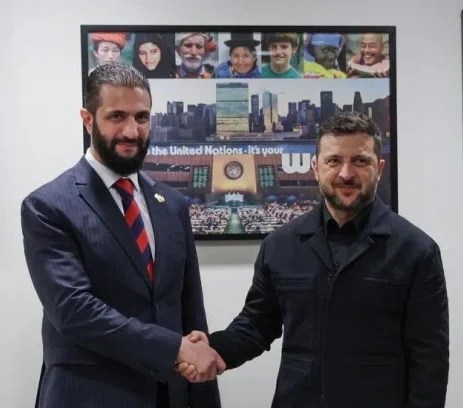
Damascus and Kiev have restored diplomatic ties following a meeting between self-appointed Syrian President Ahmad al-Sharaa and Ukrainian President Volodymyr Zelensky at the UN General Assembly (UNGA).
“We are pleased with this important step and are ready to support the Syrian people on their path to stability,” Zelensky said in a statement on 24 September. “During our negotiations with President Sharaa, we discussed in detail the promising areas for developing cooperation, the security threats facing both countries, and the importance of addressing them. We agreed to build our relations on the basis of mutual respect and trust,” he added.
“His Excellency the President of the Republic, Mr. Ahmad al-Sharaa, met with his Ukrainian counterpart, Mr. Volodymyr Zelensky, in the presence of the Minister of Foreign Affairs and Expatriates, Mr. Asaad Hassan al-Shaibani, and his accompanying delegation, on the sidelines of the 80th session of the United Nations General Assembly in New York,” the Syrian Foreign Ministry said.
Syria’s foreign minister and his Ukrainian counterpart signed a joint declaration on the restoration of ties in the presence of Sharaa and Zelensky.
Sharaa was the former deputy to ISIS leader Abu Bakr al-Baghdadi, before becoming the head of the official Al-Qaeda branch in Syria, the Nusra Front. The Nusra Front was eventually rebranded into Hayat Tahrir al-Sham (HTS), which took control of Syria in December 2024.
Ukraine played a role in the 11-day offensive that resulted in the collapse of former Syrian president Bashar al-Assad’s government.
Two months before Assad’s government fell, Russian media reported that hundreds of Ukrainian experts were training HTS in the use and manufacture of drones.
According to the Washington Post, the Ukrainian government provided HTS with “about 150 first-person-view drones” and at least 20 experienced drone operators in the lead-up to the offensive.
In 2022, Assad recognized the Luhansk People’s Republic and the Donetsk People’s Republic as independent and sovereign states, prompting Zelensky to fully cut diplomatic ties with Syria.
U.S. Threats to Venezeula Are Ramping Up, Not Down
By Ted Snider | The Libertarian Institute | September 23, 2025
Reporting has recently emerged that the United States is considering direct strikes on Venezuela that could increase volatility in the region and the risk of war.
Under the pretext of disrupting the flow of drugs into the United States by Venezuelan drug cartels, the U.S. has militarized the waters off the coast of Venezuela, flooding them with Aegis guided-missile destroyers, a nuclear-powered fast track submarine, P-8 spy planes and F-35 fighter jets. On September 2, American forces fired on a small speed boat that the U.S. claims was running drugs for a Venezuelan cartel.
The Donald Trump administration is yet to offer evidence for its claim. They have neither publicly identified who the eleven people who were killed on the boat were nor what drugs they were carrying. Congress has still not been briefed.
Secretary of State Marco Rubio said the boat was “probably headed to Trinidad or some other country in the Caribbean.” Trump says it was bound for the United States. Turns out, it was headed back to Venezuela.
U.S. officials familiar with the operation have now told The New York Times that, having “spotted the military aircraft stalking it,” the boat has already “altered its course and appeared to have turned around before the attack started.” The twenty-nine second video that Trump posted on social media spliced together several clips but edited out the boat turning around. Despite this lack of imminent threat, the aircraft, either an attack helicopter or an MQ-9 Reaper drone, “repeatedly hit the vessel before it sank.”
The Trump administration has claimed the right to supplant the National Guard and law enforcement with the military and lethal force on the grounds that the drug cartels are terrorist organizations who pose a threat to the national security of the United States because the drugs they bring into the country to kill Americans. The U.S. has invoked the right to self-defense, and Rubio has insisted that the speed boat was “an immediate threat to the United States.” Except that if it had turned around, it wasn’t.
Setting aside the legitimacy of the terrorist justification, if the boat had already turned around, the immediate threat argument is also blown out of the water. “If someone is retreating, where’s the ‘imminent threat’ then?” Rear Admiral Donald J. Guter, a retired top judge advocate general for the Navy from 2000 to 2002, asked the Times. “Where’s the ‘self-defense’? They are gone if they ever existed—which I don’t think they did.” Rear Admiral James E. McPherson, the top judge advocate general for the Navy from 2004 to 2006, added, “If, in fact, you can fashion a legal argument that says these people were getting ready to attack the U.S. through the introduction of cocaine or whatever, if they turned back, then that threat has gone away.”
The Trump administration has made it clear that the attack was not a one-time anomaly. Secretary of War Pete Hegseth said, “We smoked a drug boat, and there’s 11 narco terrorists at the bottom of the ocean, and when other people try to do that, they’re going to meet the same fate.” Since then, three more Venezuelan boats have met the same fate. Hegseth told U.S. troops on a ship in the waters off Puerto Rico that “What you’re doing right now—it’s not training.” He told them that they were on the “front lines” of a “real-world exercise.”
On a post on X (formerly Twitter), Hegseth told U.S. forces that, “It’s not if, it’s when. You’re on a mission…And the full power of the American military…will be used to ensure the American people are kept safe.”
Ken Klippenstein reports that, according to military sources, the Trump administration is considering further, and more significant, strikes on Venezuela. The strikes could take the form of either the shooting down of Venezuelan military aircraft or bombing Venezuelan military airfields. Such action could be taken in one of two situations: if Venezuela threatens the American forces off its coast or if Venezuelan President Nicolás Maduro does not enhance his administration’s efforts against drug cartels.
The first situation is a dangerous possibility, depending on the interpretation of “threaten.” Venezuela has twice flown F-16 fighter jets over the USS Jason Dunham. Though Venezuelan aircraft are likely displaying a show of defense, as the United States would, at least, do if there were foreign attack vessels off their coast, Trump said that if Venezuelan jets fly over U.S. Navy vessels again, “they’re going to be in trouble.”
The second raises, once again, the question of what Venezuela is to do. “The Venezuelan government’s collaboration in the fight against drug trafficking was among the best in South America,” according to former Executive Director of the United Nations Office on Drugs and Crime Pino Arlacchi. And now, on top of that, Maduro has ordered the more than doubling of Venezuelan forces to monitor drug trafficking. In addition to the 10,000 troops already deployed, the Venezuelan military is ordering an additional 15,000 “to determine and verify the absence of illicit crops” and to “to block this area also of possible drug trafficking.”
Despite Venezuela’s stellar past record and the current enhancing of its efforts, the United States is still threatening military action if Maduro doesn’t enhance his administration’s efforts against drug growing and trafficking.
What makes the question of what Venezuela is supposed to do more difficult is that there is nothing Venezuela can do. The U.S. is demanding that Venezuela make a course correction to correct a problem that does not exist.
The 2025 UNODC World Drug Report assesses that Venezuela “has consolidated its status as a territory free from the cultivation of coca leaves, cannabis and similar crops.” The report says that “[o]nly 5% of Colombian drugs transit through Venezuela.” The European Union’s European Drug Report 2025 corroborates the United Nations report: it “does not mention Venezuela even once as a corridor for the international drug trade.”
The Trump administration has offered no evidence that the destroyed speed boat was carrying drugs or drug smugglers or that it was on its way to American shores. Even if it was, it posed no immediate threat because it had already turned around and headed back to port. The Maduro government has already addressed American demands and increased its efforts against the drug growing and trafficking that was never a problem in the first place. None-the-less, the United States is threatening further military strikes on Venezuela, raising the hard to answer question of what Venezuela is supposed to do.
New war power bill gives Trump sweeping authority to attack dozens of nations: Report
The Cradle | September 23, 2025
Legislation has been drafted that would give US President Donald Trump unchecked power to wage war against drug cartels as well as any nation he says has harbored or aided them, the New York Times (NYT) reported on 23 September, citing people familiar with the matter.
If passed, the legislation would allow the US president to deem as “terrorists” any groups that have trafficked in drugs or financed drug-related enterprises. The president would then have the authorization to use military force against such groups and any governments allegedly harboring them.
The US military carried out attacks this month on three boats that Trump claims were smuggling drugs in the Caribbean Sea. The strikes killed 17 people and were widely criticized as illegal. Human Rights Watch (HRW) called the strikes “unlawful extrajudicial killings.”
NYT notes that the draft legislation appears to be modeled on the Authorization for the Use of Military Force (AUMF) that Congress granted former US president George W. Bush to launch the so-called “War on Terror” after the 9/11 attacks in 2001.
While theoretically passed to allow the US to target Al-Qaeda and its hosts in Afghanistan, the broad nature of the AUMF allowed the Bush, Obama, and first Trump administrations to invade Iraq and to target Islamic militant groups in Libya, Somalia, Syria, and Yemen many times over a period stretching decades.
Neither the AUMF nor the new draft legislation being considered names a specific enemy. The president is therefore empowered to attack any group, anywhere, in an open-ended war.
NYT stated that this raises the question of whether Congress was giving Trump the “authority to wage a regime change war in Venezuela.”
In addition to striking the three boats, Trump has ordered additional US warplanes and naval ships to the Caribbean, while also accusing Venezuelan President Nicolas Maduro of leading a drug cartel.
In July, Trump signed a still-secret order directing the Pentagon to begin using military force against certain Latin American criminal gangs and drug cartels, NYT added.
The Institute for Responsible Statecraft stated that the legislation could be used to justify US military intervention in at least 60 countries.
In comments given to NYT, Harvard Professor Jack Goldsmith called the draft legislation “insanely broad,” essentially “an open-ended war authorization against an untold number of countries, organizations, and persons that the president could deem within its scope.”
Earlier this year, the White House added a long list of Latin American drug cartels to the national “Foreign Terrorist Organizations” (FTO) list, giving the US the pretext to launch military action against many groups in dozens of different countries if the draft legislation is passed.
Germany to shell out over €80bn on weapons next year – media
RT | September 24, 2025
The German government intends to earmark nearly €83 billion ($98 billion) on weapons over the course of the next year, Politico reported on Tuesday, citing Berlin’s military procurement plan.
Politico, which claims to have seen the document drawn up for the German parliament’s budget committee, identified the domestic F-127 frigate program as the single most expensive item on the list, which is projected to cost some €26 billion. Some of the other capital-intensive undertakings reportedly include the Eurofighter program, as well as an upgrade of the Taurus cruise missile. At least €196 million will go toward developing the Eurodrone, according to the outlet.
The report claimed that with only around 8% of the total sum lining the pockets of the US military-industrial complex, the purported document marks a break with the trends observed in recent years.
Since the escalation of the Ukraine conflict in February 2022, Germany has been building up its military, citing the supposed Russian threat. Moscow has repeatedly dismissed as “nonsense” claims that it has hostile intentions toward NATO member states.
Speaking late last month, German Chancellor Friedrich Merz declared that his country was “already in a conflict with Russia,” accusing Moscow of attempting to destabilize Germany and other European NATO member states.
Earlier this year, he called for the German military to turn into the “strongest conventional army in Europe,” with plans to increase its ranks from the current 182,000 to 260,000 active duty troops by 2035.
Back in May, EU member states approved a €150 billion debt program named SAFE that facilitates low-interest loans to member states for joint procurement of military equipment.
Russian Foreign Minister Sergey Lavrov claimed in late July that “today’s Europe has completely plunged into a Russophobic frenzy, and its militarization is becoming, in fact, uncontrolled.”
“With their current leaders, modern Germany and the rest of Europe are transforming into a Fourth Reich,” he said.
Featured Video
Seyed M. Marandi: US-Iran War Inevitable: Kuwait and Bahrain May Fall
or go to
Aletho News Archives – Video-Images
From the Archives
Oil and the Israel Lobby
Reknowned economist M. Shahid Alam offers this excellent critique of Noam Chomsky’s defective analysis of the relative influence of Oil versus the Israel lobby over US foreign policy: … continue
Blog Roll
 Aletho News
- ICC ignored ‘very well-documented’ NATO crimes – ex-Libyan minister
- SNSC secretary dismisses US response to Iran’s conditions as ‘inadequate’
- Sanaa says Taiz roads open, secure for residents, warns Saudi forces
- Iraqi resistance group urges Saudi leadership to admit defeat, lift Yemen siege
- Trump’s Retreat: How Al-Aqsa Flood Took Down the US Empire
- Israel’s Military Actions in Lebanon Grossly Violate International Law — Lavrov
- Seyed M. Marandi: US-Iran War Inevitable: Kuwait and Bahrain May Fall
- Leaders Condemn Ansarallah Attack on Saudi Arabia While Ignoring Illegal War Against Yemen
- Leaked: Britain’s Covert Iraqi Psyops Network
- Yemeni Armed Forces Warn Airlines Against Using Saudi Airports, Exempt Mecca and Medina
- If Americans Knew
- How Israel Conquered the Latin American Right
- Agents search Rep. Omar’s Washington home in criminal probe as she vows she won’t ‘be silenced’
- “The Rule Was: ‘Shoot Everyone You See'”
- Israel goes ballistic over Nobel Laureate Navi Pillay
- U.S. May Join Yet Another Middle Eastern War — TCN
- Yellow Line moves again as Israel closes in on trapped Gazans – Daily Update
- Israeli Attacks Kill Seven Palestinians in Gaza Including Six-year-old Girl
- Gaza: Ceasefire Anniversary Marks Year of Failed Promises
- The American Conservative: Mike Huckabee Should Resign
- A C-Section in Shackles: A Palestinian Woman’s Harrowing Birth in Israeli Detention
- No Tricks Zone
- Germany’s Green Energy Debacle: High Energy Costs Force Kahla Porzellan to Close After 182 Years!
- New Study: 50 Years Of The Most Aggressive ‘Net Zero’ Policies Can Only Affect The Global Climate By 0.03°C
- US September “Heat” Was No Record…Many Records Set Decades Ago
- Latest European Green Energy Debacle; Portugal’s Largest Flagship Solar Park Insolvent!
- Green Energy Debacle: German Expert Professor Fritz Vahrenholt Warns Of Severe Economic And Social Consequences
- Two More Paleo Reconstructions Affirm Meters-Higher Sea Levels Across Ireland, Brazil 7000-6000 Years Ago
- New Study: Earth And Venus Surface Warmth Largely Explained By Convection And Lapse Rate, Not CO2 Or Radiation
- 2025 Nature Paper Claiming Worsening Global Drought Gets RETRACTED …Heavily Flawed
- New Study: ‘Global Drought Shows No Detectable Recent Acceleration Under Climate Warming’
- Economic Masterminds: German Socialists Suggest Taxing Productivity Gains Stemming From Using AI

