Almost a month after Iran saw a series of nuclear-related economic sanctions lifted, new indications show certain segments of the Iranian economy still remain shut out in what could be a violation of the nuclear deal that the country reached with the P5+1 last summer.
The US Treasury Department is reportedly warning European countries and companies to shut out a leading sanctioned Iranian airline – Mahan Air – or risk US retaliation.
“Treasury is engaging closely with stakeholders around the world, including our partners in Europe, regarding our sanctions targeting Iran,” a Treasury official told Al-Monitor. “Regarding Mahan Air specifically, we are doing this by working with our partners to prevent Mahan Air from acquiring aircraft and aircraft parts and software, preventing the opening of new routes and working to get existing routes canceled.”
Certain economic sanctions against Iran were lifted in mid-January when a deal that the country had reached with the P5+1 – the Joint Comprehensive Plan of Action (JCPOA) – was implemented.
A central sector that saw the sanctions lifted was Iran’s aviation industry and a lucrative contract that the country later signed with Airbus over the purchase of planes clearly testified to that.
Even before the JCPOA was implemented, US President Barack Obama ordered to lift a decades-long ban on the sales of planes to Iran.
The Treasury official – who has not been named by Al-Monitor – has emphasized that the JCPOA “does not preclude us from designating any entities that support Mahan Air or facilitate its activities.”
Iranian officials are yet to react to this.
Mahan Air, which isn’t sanctioned by the European Union, currently operates flights to Milan, Athens, the German cities of Dusseldorf and Munich, Turkey, Russia, Ukraine and several other destinations in the Middle East and Asia. Mahan Air had announced that flights to Copenhagen, Denmark, were to start next month but the route opening was discreetly delayed last month.
February 12, 2016
Posted by aletho |
Economics, Progressive Hypocrite, Wars for Israel | Iran, Mahan Air, Obama, Sanctions against Iran, United States |
Leave a comment
Seeing the government in Damascus as too far to the left, Washington has been trying to orchestrate a regime change in Syria since at least 2003
Documents prepared by US Congress researchers as early as 2005 revealed that the US government was actively weighing regime change in Syria long before the Arab Spring uprisings of 2011, challenging the view that US support for the Syrian rebels is based on allegiance to a “democratic uprising” and showing that it is simply an extension of a long-standing policy of seeking to topple the government in Damascus. Indeed, the researchers made clear that the US government’s motivation to overthrow the government of Syrian president Bashar al-Assad is unrelated to democracy promotion in the Middle East. In point of fact, they noted that Washington’s preference is for secular dictatorships (Egypt) and monarchies (Jordan and Saudi Arabia.) [1] The impetus for pursuing regime change, according to the researchers, was a desire to sweep away an impediment to the achievement of US goals in the Middle East related to strengthening Israel, consolidating US domination of Iraq, and fostering free-market, free enterprise economies. Democracy was never a consideration.
The researchers revealed further that an invasion of Syria by US forces was contemplated following the US-led aggression against Iraq in 2003, but that the unanticipated heavy burden of pacifying Iraq militated against an additional expenditure of blood and treasure in Syria. [2] As an alternative to direct military intervention to topple the Syrian government, the United States chose to pressure Damascus through sanctions and support for the internal Syrian opposition.
The documents also revealed that nearly a decade before the rise of Islamic State and Jabhat al-Nusra that the US government recognized that Islamic fundamentalists were the main opposition to the secular Assad government and worried about the re-emergence of an Islamist insurgency that could lead Sunni fundamentalists to power in Damascus. A more recent document from the Congress’s researchers describes a US strategy that seeks to eclipse an Islamist take-over by forcing a negotiated settlement to the conflict in Syria in which the policing, military, judicial and administrative functions of the Syrian state are preserved, while Assad and his fellow Arab nationalists are forced to leave office. The likelihood is that if this scenario plays out that Assad and his colleagues will be replaced by biddable US surrogates willing to facilitate the achievement of US goals.
+++
In 2005, Congress’s researchers reported that a consensus had developed in Washington that change in Syria needed to be brought about, but that there remained divisions on the means by which change could be effected. “Some call for a process of internal reform in Syria or alternatively for the replacement of the current Syrian regime,” the report said. [3] Whichever course Washington would settle on, it was clear that the US government was determined to shift the policy framework in Damascus.
The document described the Assad government as an impediment “to the achievement of US goals in the region.” [4] These goals were listed as: resolving “the Arab-Israeli conflict;” fighting “international terrorism;” reducing “weapons proliferation;” inaugurating “a peaceful, democratic and prosperous Iraqi state;” and fostering market-based, free enterprise economies. [5]
Stripped of their elegant words, the US objectives for the Middle East amounted to a demand that Damascus capitulate to the military hegemony of Israel and the economic hegemony of Wall Street. To be clear, what this meant was that in order to remove itself as an impediment to the achievement of US goals—and hence as an object of US hostility—Syria would have to:
o Accept Israel’s right to exist as a Jewish state on territory seized from Palestinians, and quite possibly also Syrians and Lebanese, possibly within borders that include the Golan Heights, annexed from Syria by Israel in 1987 and occupied by Israel since 1967.
o End its support for militant groups seeking Palestinian self-determination and sever its connections with the resistance organization Hezbollah, the main bulwark against Israeli expansion into Lebanon.
o Leave itself effectively defenceless against the aggressions of the United States and its Middle East allies, including Israel, by abandoning even the capability of producing weapons of mass destruction (while conceding a right to Israel and the United States to maintain vast arsenals of WMD.)
o Terminate its opposition to US domination of neighboring Iraq.
o Transform what the US Congress’s researchers called Syria’s mainly publicly-owned economy, “still based largely on Soviet models,” [6] into a sphere of exploitation for US corporations and investors.
+++
US government objections to Syrian policy, then, can be organized under three US-defined headings:
o Terrorism.
o WMD.
o Economic reform.
These headings translate into:
o Support for Palestinian and Lebanese resistance groups.
o Self-defense.
o Economic sovereignty.
Terrorism (support for Palestinian and Lebanese resistance groups)
The researchers noted that while Syria had “not been implicated directly in an act of terrorism since 1986” that “Syria has continued to provide support and safe haven for Palestinian groups” seeking self-determination, allowing “them to maintain offices in Damascus.” This was enough for the US government to label Syria a state sponsor of terrorism. The researchers went on to note that on top of supporting Palestinian “terrorists” that Damascus also supported Lebanese “terrorists” by permitting “Iranian resupply via Damascus of the Lebanese Shiite Muslim militia Hezbollah in Lebanon.” [7]
US Secretary of State Colin Powell travelled to Damascus on May 3, 2003 to personally issue a demand to the Syrian government that it sever its connections with militant organizations pursuing Palestinian self-determination and to stop providing them a base in Damascus from which to operate. In “testimony before the Senate Foreign Relations Committee on February 12, 2004, Powel complained that ‘Syria has not done what we demanded of it with respect to closing permanently of these offices and getting these individuals out of Damascus’.”
The Syrian government rejected the characterization of Hezbollah and Palestinian militants as “terrorists,” noting that the actions of these groups represented legitimate resistance. [8] Clearly, Washington had attempted to discredit the pursuit of Palestinian self-determination and Lebanese sovereignty by labelling the champions of these causes as terrorists.
WMD (self-defense)
“In a speech to the Heritage Foundation on May 6, 2002, then US Under Secretary (of State John) Bolton grouped Syria with Libya and Cuba as rogue states that… are pursuing the development of WMD.” [9] Later that year, Bolton echoed his earlier accusation, telling the US Senate Foreign Relations Committee that the Bush administration was very concerned about Syrian nuclear and missile programs. By September 2003, Bolton was warning of a “range of Syrian WMD programs.” [10]
Syria clearly had chemical weapons (now destroyed), though hardly in the same quantities as the much larger arsenals of the United States, Russia and (likely) its regional nemesis, Israel. [11] Citing the Washington Post, Congress’s researchers noted that Syria had “sought to build up its CW and missile capabilities as a ‘force equalizer’ to counter Israeli nuclear capabilities.” [12] It should be noted, however, that the idea that chemical weapons can act as a force equalizer to nuclear weapons is not only untenable, but risible. In WWI it took 70,000 tons of gas to produce as many fatalities as were produced at Hiroshima by a single US atom bomb. [13] To have any meaning at all, the concept of WMD must include weapons that kill massive numbers of people (nuclear weapons) and exclude those that don’t (chemical weapons.) Otherwise, it is a propaganda term used to magnify the non-threat posed by countries seeking independence outside the US orbit which have CW and biological weapons, but which weapons are no match for the United States’ nuclear weapons and are dwarfed by the Pentagon’s own CW and BW arsenals. Deceptively labelling these weapons as WMD, makes a non-threat a large threat that must be dealt with through military intervention and thereby provides a public relations rationale for a war of aggression.
As to the substance of Bolton’s assertion that Syria had a wide range of WMD programs, the CIA was unable to produce any evidence to corroborate his claim. Alfred Prados, author of a 2005 Congressional Research Service report titled “Syria: U.S. Relations and Bilateral Issues,” listed CIA assessments of Syrian nuclear and BW programs but none of the assessments contained any concrete evidence that Syria actually had such programs. For example, the CIA noted that it was “monitoring Syrian nuclear intentions with concern” but offered nothing beyond “intentions” to show that Damascus was working to acquire a nuclear weapons capability. Prados also noted that Syria had “probably also continued to develop a BW capability,” this based on the fact that Damascus had “signed, but not ratified, the Biological Weapons Convention.” Prados conceded that “Little information is available on Syrian biological programs.”
US president George H.W. Bush is responsible for rendering the concept of WMD meaningless by expanding it to include chemical agents. Before Bush, WMD was a term to denote nuclear weapons or weapons of similar destructive capacity that might be developed in the future. Bush debased the definition in order to go to war with Iraq. He needed to transform the oil-rich Arab country from being seen accurately as a comparatively weak country militarily to being seen inaccurately as a significant threat because it possessed weapons now dishonestly rebranded as being capable of producing mass destruction. It was an exercise in war propaganda.
In 1989, Bush pledged to eliminate the United States’ chemical weapons by 1999. Seventeen years later, the Pentagon is still sitting on the world’s largest stockpile of militarized chemical agents. US allies Israel and Egypt also have chemical weapons. In 2003, Syria proposed to the United Nations Security Council that the Middle East become a chemical weapons-free zone. The proposal was blocked by the United States, likely in order to shelter Israel from having to give up its store of chemical arms. Numerous calls to declare the Middle East a nuclear weapons-free zone have also been blocked by Washington to shelter Israel from having to give up its nuclear arsenal.
Bolton, it will be recalled, was among the velociraptors of the Bush administration to infamously and falsely accuse Saddam Hussein’s Iraq of holding on to WMD that the UN Security Council had demanded it dismantle. In effect, Iraq was ordered to disarm itself, and when it did, was falsely accused by the United States of still being armed as a pretext for US forces to invade the now defenceless country. Bolton may have chosen to play the same WMD card against Syria for the same reason: to manufacture consent for an invasion. But as Congress’s researchers pointed out, “Although some officials… advocated a ‘regime change strategy’ in Syria” through military means, “military operations in Iraq… forced US policy makers to explore additional options,” [14] rendering Bolton’s false accusations academic.
Since the only legitimate WMD are nuclear weapons, and since there is no evidence that Syria has even the untapped capability of producing them, much less possesses them, Syria has never been a WMD-state or a threat to the US goal of reducing WMD proliferation. What’s more, the claim that Washington holds this as a genuine goal is contestable, since it has blocked efforts to make the Middle East a chemical- and nuclear-weapons-free zone, in order to spare its protégé, Israel. It would be more accurate to say that the United States has a goal of reducing weapons proliferation among countries it may one day invade, in order to make the invasion easier. Moreover, there’s an egregious US double-standard here. Washington maintains the world’s largest arsenals of nuclear, chemical and biological weapons, but demands that countries it opposes should abandon their own, or forswear their development. This is obviously self-serving and has nothing whatever to do with fostering peace and everything to do with promoting US world domination. One US grievance with Assad’s Syria, then, is that it refused to accept the international dictatorship of the United States.
Economic reform (economic sovereignty)
In connection with Syria impeding the achievement of US goals in the Middle East, the Congressional Research Service made the following points in 2005 about the Syrian economy: It is “largely state-controlled;” it is “dominated by… (the) public sector, which employs 73% of the labour force;” and it is “still based largely on Soviet models.” [15] These departures from the preferred Wall Street paradigm of free markets and free enterprise appear, from the perspective of Congress’s researchers, to be valid reasons for the US government to attempt to bring about “reform” in Syria. Indeed, no one should be under the illusion that the US government is prepared to allow foreign governments to exercise sovereignty in setting their own direction economically. That this is the case is evidenced by the existence of a raft of US sanctions legislation against “non-market states.” (See the Congressional Research Service 2016 report, “North Korea: Economic Sanctions,” for a detailed list of sanctions imposed on North Korea for having a “Marxist-Leninist” economy.)
+++
To recapitulate the respective positions of Syria and the United States on issues of bilateral concern to the two countries:
On Israel. To accept Israel’s right to exist as a settler state on land illegitimately acquired through violence and military conquest from Palestinians, Lebanese (the Shebaa Farms) and Syrians (Golan), would be to collude in the denial of the fundamental right of self-determination. Damascus has refused to collude in the negation of this right. Washington demands it.
On Hezbollah. Hezbollah is the principal deterrent against Israeli territorial expansion into Lebanon and Israeli aspirations to turn the country into a client state. Damascus’s support for the Lebanese resistance organization, and Washington’s opposition to it, places the Assad government on the right side of the principle of self-determination and successive US governments on the wrong side.
On WMD. Syria has a right to self-defense through means of its own choosing and the demand that it abandon its right is not worthy of discussion. The right to self-defense is a principle the United States and its allies accept as self-evident and non-negotiable. It is not a principle that is valid only for the United States and its satellites.
On opposition to the US invasion of Iraq. The 2003 US-led aggression against Iraq was an international crime on a colossal scale, based on an illegitimate casus belli, and a fabricated one at that, and which engendered massive destruction and loss of life. It was the supreme international crime by the standards of the Nuremberg trials. Applying the Nuremberg principles, the perpetrators would be hanged. US aggression against Iraq, including the deployment of “sanctions of mass destruction” through the 1990s, which led to hundreds of thousands of Iraqi deaths, and was blithely accepted by then US Secretary of State Madeleine Albright as “worth it,” was undertaken despite the absence of any threat to the United States. The deliberate creation of humanitarian calamities in the absence of a threat, as a matter of choice and not necessity, in pursuit of economic gain, is an iniquity on a signal scale. What, then, are we to think of a government in Damascus that opposed this iniquity, and a government in Washington that demands that Damascus reverse its opposition and accept the crime as legitimate?
Whatever its failings, the Assad government has unambiguously adopted positions that have traditionally been understood to be concerns of the political left: support for self-determination; public ownership and planning of the economy; opposition to wars of aggression; and anti-imperialism. This is not to say that on a spectrum from right to left that the Assad government occupies a position near the left extreme; far from it. But from Washington’s point of view, Damascus is far enough to the left to be unacceptable. Indeed, it is the Syrian government’s embrace of traditional leftist positions that accounts for why it is in the cross-hairs of the world’s major champion of reactionary causes, the United States, even if it isn’t the kind of government that is acceptable to Trotskyists and anarchists.
+++
In 2003, the Bush administration listed Syria as part of a junior varsity axis of evil, along with Cuba and Libya, citing support in Damascus for Hezbollah and groups engaged in armed struggle to achieve Palestinian self-determination. [16] An invasion of Syria following the US take-over of Iraq in 2003 was contemplated, but was called off after the Pentagon discovered its hands were full quelling resistance to its occupations of Iraq and Afghanistan. As an alternative to direct military intervention to topple the Syrian government, the United States chose to pressure Assad through sanctions and by strengthening the opposition in Syria, hoping either to force Assad to accept Israel’s territorial gains, end support for Hezbollah and Palestinian militant groups, and to remake the economy—or to yield power. However, as Congress’s researchers reveal, there were concerns in Washington that if efforts to bolster the opposition went too far, Assad would fall to “a successor regime (which) could be led by Islamic fundamentalists who might adopt policies even more inimical to the United States.” [17]
On December 12, 2003, US president George W. Bush signed the Syria Accountability Act, which imposed sanctions on Syria unless, among other things, Damascus halted its support for Hezbollah and Palestinian resistance groups and ceased “development of weapons of mass destruction.” The sanctions included bans on exports of military equipment and civilian goods that could be used for military purposes (in other words, practically anything.) This was reinforced with an additional (and largely superfluous) ban on US exports to Syria other than food and medicine, as well as a prohibition against Syrian aircraft landing in or overflying the United States. [18]
On top of these sanctions, Bush imposed two more. Under the USA PATRIOT Act, the US Treasury Department ordered US financial institutions to sever connections with the Commercial Bank of Syria. [19] And under the International Emergency Economic Powers Act, the US president froze the assets of Syrians involved in supporting policies hostile to the United States, which is to say, supporting Hezbollah and groups fighting for Palestinian self-determination, refusing to accept as valid territorial gains which Israel had made through wars of aggression, and operating a largely publicly-owned, state-planned economy, based on Soviet models. [20]
In order to strengthen internal opposition to the Syrian government, Bush signed the Foreign Operations Appropriation Act. This act required that a minimum of $6.6 million “be made available for programs supporting democracy in Syria… as well as unspecified amounts of additional funds (emphasis added).” [21]
By 2006, Time was reporting that the Bush administration had “been quietly nurturing individuals and parties opposed to the Syrian government in an effort to undermine the regime of President Bashar Assad.” Part of the effort was being run through the National Salvation Front. The Front included “the Muslim Brotherhood, an Islamist organization that for decades supported the violent overthrow of the Syrian government.” Front representatives “were accorded at least two meetings” at the White House in 2006. Hence, the US government, at its highest level, was colluding with Islamists to bring down the Syrian government at least five years before the eruption of protests in 2011. This is a development that seems to have escaped the notice of some who believe that violent Islamist organizations emerged only after March 2011. In point of fact, the major internal opposition to secular Syrian governments, both before and after March 2011, were and are militant Sunni Islamists. Syria expert Joshua Landis told Time that White House support for the Syrian opposition was “apparently an effort to gin up the Syrian opposition under the rubric of ‘democracy promotion’ and ‘election monitoring,’ but it’s really just an attempt to pressure the Syrian government into doing what the United States wants.” [22]
+++
The US Congress researchers noted that despite “US calls for democracy in the Middle East, historically speaking, US policymakers” have tended to favor “secular Arab republics (Egypt) and Arab monarchies (Jordan and Saudi Arabia.)” [23] They noted too that since “the rise of political Islam as an opposition vehicle in the Middle East decades ago, culminating in the 1979 overthrow of the Shah of Iran, US policymakers have been concerned that secular Arab dictatorships like Syria would face rising opposition from Islamist groups seeking their overthrow.” [24] “The religiously fundamentalist Muslim Brotherhood,” which the Bush administration enlisted to pressure the Assad government, had long been at odds with the secular Syrian government, the researchers noted. [25]
Today, Islamic State operates as one of the largest, if not the largest, rebel groups in Syria. A 2015 Congressional Research Service report cited an “unnamed senior State Department official” who observed:
[W]e’ve never seen something like this. We’ve never seen a terrorist organization with 22,000 foreign fighters from a hundred countries all around the world. To put it in context—again, the numbers are fuzzy—but it’s about double of what went into Afghanistan over 10 years in the war against the Soviet Union. Those Jihadi fighters were from a handful of countries.” [26]
Islamic State differs from other militant Islamist opponents of the Syrian government in seeking to control territory, not only in Syria, but in Iraq and beyond. As such, it constitutes a threat to US domination of Iraq and influence throughout the Middle East and north Africa. In contrast, ideologically similar groups, such as Jabhat al-Nusra, limit the scope of their operations to Syria. They, therefore, constitute a threat to the Syrian government alone, and have proved, as a consequence, to be more acceptable to Washington.
The US government has publicly drawn a distinction between Islamic State and the confined-to-Syria-therefore-acceptable rebels, seeking to portray the former as terrorists and the latter as moderates, regardless of the methods they use and their views on Islam and democracy. The deception is echoed by the US mass media, which often complain that when Russian warplanes target non-Islamic State rebels that they’re striking “moderates,” as if all rebels apart from Islamic State are moderates, by definition. US Director of Intelligence James Clapper acknowledged that “moderate” means little more than “not Islamic State.” He told the Council on Foreign Relations that “Moderate these days is increasingly becoming anyone who’s not affiliated with” Islamic State. [27]
The rebels are useful to the US government. By putting military pressure on Damascus to exhaust the Syrian army, they facilitate the achievement of the immediate US goal of “forcing a negotiated settlement to the conflict that will see President Assad and some his supporters leave office while preserving the institutions and security structures of the Syrian state,” [28] as Congress’s researchers summarize US strategy. Hence, Islamic State exists both as a useful instrument of US policy, and as a threat to US domination and control of Iraq and the broader Middle East. To Washington, the terrorist organization is a double-edged sword, and is treated accordingly. US airstrikes on Islamic State appear calculated to weaken the terrorist group enough that it doesn’t gain more territory in Iraq, but not so much that pressure is taken off Damascus. A tepid approach to fighting the hyper-sectarian terrorist group fits with US president Barack Obama’s stated goal of degrading and ultimately destroying Islamic State, which appears to mean destroying it only after it has served its purpose of exhausting the Syrian army. In the meantime, the anti-Shiite cut-throats are given enough latitude to maintain pressure on Syrian loyalists.
Congress’s researchers concur with this view. They conclude that “US officials may be concerned that a more aggressive campaign against the Islamic State may take military pressure off the” Syrian government. [29] This means that the US president is moderating efforts to destroy Islamic State to allow a group he decries as “simply a network of killers who are brutalizing local populations” [30] continue their work of brutalizing local populations. If he truly believed Islamic State was a scourge that needed to be destroyed, the US president would work with the Syrian government to expunge it. Instead, he has chosen to wield Islamic State as a weapon to expunge the Syrian government, in the service of building up Israel and fostering free market and free enterprise economies in the Middle East to accommodate US foreign investment and exports on behalf of his Wall Street sponsors. [31]
REFERENCES
1. Alfred B. Prados and Jeremy M. Sharp, “Syria: Political Conditions and Relations with the United States After the Iraq War,” Congressional Research Service, February 28, 2005.
2. Prados and Sharp.
3. Ibid.
4. Ibid.
5. Ibid.
6. Ibid.
7. Alfred B. Prados, “Syria: U.S. Relations and Bilateral Issues,” Congressional Research Service, March 13, 2006.
8. Ibid.
9. Ibid.
10. Ibid.
11. Israel signed the global treaty banning the production and use of chemical weapons, but never ratified it.
12. Ibid.
13. Stephen Gowans, “Rethinking Chemical Weapons,” what’s left, August 14, 2015.
14. Prados and Sharp.
15. Ibid.
16. Steve R. Weisman, “US threatens to impose penalties against Syrians,” The New York Times, April 14, 2003.
17. Prados and Sharp.
18. Prados.
19. Ibid.
20. Ibid.
21. Ibid.
22. Adam Zagorin, “Syria in Bush’s cross hairs,” Time, December 19, 2006.
23. Prados and Sharp.
24. Ibid.
25. Ibid.
26. Christopher M. Blanchard and Carla E. Humud, “The Islamic State and U.S. Policy,” Congressional Research Service, December 28, 2015.
27. James Clapper: US Director of Intelligence: http://www.cfr.org/homeland-security/james-clapper-global-intelligence-challenges/p36195
28. Blanchard and Humud.
29. Christopher M. Blanchard, Carla E. Humud Mary Beth D. Nikitin, “Armed Conflict in Syria: Overview and U.S. Response,”Congressional Research Service,” October 9, 2015.
30. Blanchard and Humud.
31. Virtually every member of the Obama administration, past and present, is a member of the Wall Street-dominated Council on Foreign Relations, or additionally, has spent part of his or her career on Wall Street. Wall Street was a major source of Obama’s election campaign funding. The strong interlock between Wall Street and the executive branch of the US government is not unique to the Obama administration. See my “Aspiring to Rule the World: US Capital and the Battle for Syria,” what’s left, December 15, 2015.
February 11, 2016
Posted by aletho |
Ethnic Cleansing, Racism, Zionism, Mainstream Media, Warmongering, Progressive Hypocrite, Timeless or most popular, War Crimes, Wars for Israel | Central Intelligence Agency, CIA, Hezbollah, Israel, Jabhat al-Nusra, Lebanon, Libya, Middle East, Palestine, Syria, United States, WMDs, Zionism |
Leave a comment
Despite reports that state repression in Egypt is taking place on a greater scale than it has been for generations, the Obama administration is seeking to roll back human rights conditions Congress had placed on foreign aid to Egypt’s military.
The request, which was tucked into the Obama administration’s 182-page budget proposal, seeks foreign aid to Egypt’s military regime and “the sale of crowd control weapons to ‘emerging democracies.’” The discovery was made by The Intercept.
If the new proposal, which was released on Tuesday, is adopted, it would end a Congressional restriction stipulating “that 15 percent of aid to Egypt is subject to being withheld based on human rights conditions.”
Interestingly, Congress was able to temporarily waive those restrictions in a foreign aid bill in June of 2015, arguing it was in the national security interest of the United Station, according to Al-Monitor. The conditions were that Egypt would have to hold “free and fair” parliamentary elections and take steps to foster democracy and protect human rights for an additional $1.3 billion in military aid to be released.
The US State Department issued a scathing report in May of 2015, arguing that “while Egypt had implemented parts of its ‘democracy roadmap’ the overall trajectory of rights and democracy had been negative.”
It pinpointed restrictions on freedom of expression, the press, and freedom of association, as well as lack of due process. It further said that “impunity remains a serious problem in Egypt.”
It was well known at the time the Egyptians were “infuriated” by the report.
Cole Bockenfeld, deputy director for policy at the Project on Middle East Democracy, told The Intercept that the White House probably didn’t want to explain why it had to waive restrictions this year.
“They had to basically do an assessment. … Here’s how they’re doing on political prisoners, here’s how they’re doing on freedom of assembly, and so on,” Bockenfeld said.
The Guardian reported in January that Egypt has jailed more journalists than any other country on earth except China under President Abdel Fattah al-Sisi. Three reporters were imprisoned, one forcibly “disappeared” and was later charged with being a member of a banned organization, and six were referred to judicial hearings because of their work.
Also in January, Italian academic Giulio Regeni, who was researching labor unrest and independent trade unions in Egypt, went missing during a security crackdown on the fifth anniversary of the beginning of Egypt’s revolution. His body was discovered nine days later by the side of the road marked with cigarette burns, bruising, and multiple stab wounds. The Guardian reported more than 4,600 academics worldwide have signed an open letter protesting his death and demanding an investigation into the growing number of forced disappearances. Egyptian officials appear to be cooperating with the investigation, according to the Italian foreign minister.
The budget also contains a request that would remove a provision from a law passed in 2012 in reaction to the Arab Spring protests that prohibits the transfer of tear gas and other crowd control weapons to countries that are “undergoing democratic transition.”
“It’s basically going to be free for all,” Husain Abdulla, executive director of Americans for Democracy and Human Rights in Bahrain, told the Intercept when speculating on the results of the administration rolling back that provision.
Among the Middle Eastern countries seeking this equipment are Egypt, Saudi Arabia, and Bahrain – all of which are simmering with pro-democracy challenges.
February 11, 2016
Posted by aletho |
Civil Liberties, Full Spectrum Dominance, Progressive Hypocrite, Subjugation - Torture | Egypt, Human rights, Obama, United States |
Leave a comment
Days after criticizing North Korea for launching a satellite into space, the United States sent its own, brand new military satellite into orbit Wednesday morning.
The National Reconnaissance Office (NRO) is the agency in charge of the United States’ fleet of spy satellites, and early Wednesday morning, the NRO sent its latest above stratosphere. The NROL-45 satellite was sent into space on the back of a United Launch Alliance (ULA) Delta IV rocket launched from Vandenberg Air Force Base.
The NRO already has three additional launches scheduled for the upcoming year. Two will lift off in May and June, both from Florida’s Cape Canaveral Air Force Station. The third will launch from Vandenberg in December.
The NRO will not say, specifically, what kind of operations these satellites will be conducting. Its payload remains classified, and a statement on the ULA’s website vaguely describes NROL-45 as being necessary for the “support of national defense.”
The timing of this launch is surprising given Washington’s condemnation of a North Korean satellite launch on Sunday.
The United States views any rocket launch by Pyongyang as a veiled attempt to perfect its ballistic missile technology. In the wake of Sunday’s launch, President Obama reaffirmed America’s commitment to defending South Korea.
“The United States stands in solidarity with the ROK [South Korea] and will take the necessary steps to fulfill our ironclad commitment to defend the ROK and our other allies in the region,” Obama told South Korean president Park Geun-hye on Monday night.
“Our concern though is that they do a space-launch but really it’s the same technology to develop ICBMs [intercontinental ballistic missiles],” a US official said earlier this month, speaking on condition of anonymity.
Leaders from South Korea, Japan, and the US have already agreed to pursue stricture United Nations sanctions against Pyongyang over Sunday’s launch.
“[The sides] agreed to closely cooperate to make sure that the Security Council can adopt a resolution for strong and effective sanctions on North Korea,” said a press service for South Korean President Park.
It’s hard to imagine that the NRO’s series of satellite launches will elicit a similar reaction from Washington’s allies.
February 11, 2016
Posted by aletho |
Militarism, Progressive Hypocrite | North Korea, Obama, United States |
Leave a comment
The Obama administration is pushing ahead with its plans to slash pension benefits for up to one million participants in “underfunded” multi-employer pension funds as part of its drive to make defined-benefit pensions a thing of the past for all US workers.
The White House campaign, carried out in a conspiracy with the major trade unions and multinational corporations, takes place in the wake of the 2013–2014 bankruptcy of Detroit, which set a precedent for slashing the legally protected pension benefits of retirees.
Kenneth Feinberg, the Obama administration’s appointee to oversee the pension cuts, held a hearing on behalf of the Treasury Department in Detroit Monday to hear objections to the plan to slash the pension benefits of some 270,000 retired truck drivers, package handlers and other members of the Teamsters Central States Pension Fund.
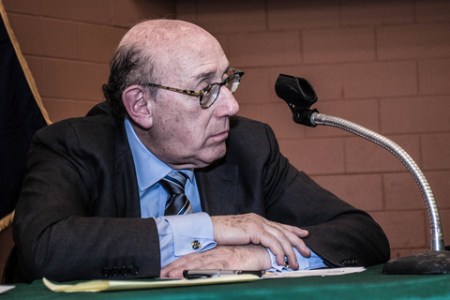
Kenneth Feinberg
The hearing, which took place at Wayne State University, drew an overflow crowd at a 500-seat lecture hall, with up to 1,000 people participating in total. With the exception of the World Socialist Web Site, the media ignored the event, with no US video crews present.
Although retirees had initially been told that the cuts to their benefits would average less than 30 percent, nearly all of those who spoke at the hearing said they had been notified over the Christmas holiday that they would lose between 50 and 80 percent of their pension benefits.
During the two-hour hearing, not a single one of some two dozen pre-selected speakers spoke in favor of the plan to slash pensions. Instead, retirees voiced scathing denunciations of the managers of the Central States Pension Fund, who have received six-figure annual payouts even as they have moved to impose massive benefit cuts. Many made pointed criticisms of the International Brotherhood of Teamsters union that jointly administers the fund.

“I suffered the loss of my first marriage, twisted ankles, and a damaged back, 21 dog bites, and all for that pension,” said one retired UPS delivery driver.
This overwhelming opposition by pensioners does not matter, according to Feinberg. When asked by the World Socialist Web Site after the hearing what would happen if workers voted down the proposed pension cuts, Feinberg said he had the prerogative to impose pension cuts regardless.
“The law says that I must impose it over their objections” Feinberg said. “So if I accept the plan and it’s rejected by a vote, the law requires me in that situation to overrule the vote.”
The law Feinberg was referring to is the Multi-employer Pension Reform Act of 2014, passed by Congress in December 2014 with virtually no public discussion as part of an omnibus appropriations bill. Acting on this law, in October 2015 the Teamsters Central States Pension Fund unveiled its plans to cut the benefits of workers it covers.
That law is itself the outcome of a February 2013 proposal, entitled “Solutions not Bailouts,” from the National Coordinating Committee for Multiemployer Plans, composed of major corporations and unions. The document lists among its signatories the International Brotherhood of Teamsters (IBT) and the International Association of Machinists and Aerospace Workers (IAM), both of which have since sought to publicly distance themselves from the pension-cutting bill.
Workers denounced the Teamsters’ lobbying on behalf of the bill, as well as the decision by the union to allow shipping company United Parcel Service (UPS) to exit the fund in 2007. This removed the largest base of active employees in the fund in exchange for allowing the Teamsters to extract union dues from the company’s freight division workers. As a result, UPS retirees said at the meeting that they are facing pension cuts of more than 50 percent, despite the fact that UPS earned record profits in the fourth quarter of 2015.
“Why on Earth would you let UPS leave the fund?” asked Debra Bakus, the daughter of Dennis Siecienski, a member of Teamsters Local 51 who worked for Entenmann’s for 41 years. She added, “I find it appalling that the trustees of this fund would pay millions to lobbyists out of your fund to get [the Multi-employer Pension Reform Act] passed.”
“I have to move in with my daughter if they cut my pension,” said Mr. Siecienski, who faces a reduction of 51 percent. “His employer is still contributing to the fund,” added Ms. Bakus.
Nationwide, there are some 10 million beneficiaries of multi-employer pension funds, of whom about 1 million receive benefits from “underfunded” plans.
As the Obama administration’s “special master” of executive compensation during the 2008 bank bailout, Feinberg rubber-stamped multi-million-dollar bonuses for executives at companies whose activities helped cause the financial crash.
Now, as the official responsible for imposing sweeping benefit cuts on hundreds of thousands of workers, Feinberg is working diligently to ensure that the transfer of social resources from working people to Wall Street continues unimpeded.
In 2009, the Obama administration justified giving multi-million-dollar bonuses to executives at American International Group, which had received a $185 billion bailout from the federal government, on the grounds that contractual obligations were sacrosanct and could not be abridged by the government.
Asked by the World Socialist Web Site whether he would use a similar approach with regard to workers’ pensions, Feinberg declared that he never approved multi-million-dollar bonuses to Wall Street executives.
Retiree Richard Fairley asked Feinberg, “can you fix my ignition switch?” in reference to his kid glove treatment of General Motors in the deaths of over a hundred people due to defective ignition switches.
But a 2012 report by Neil Barofsky, the inspector general for the TARP bank bailout, exposes Feinberg’s statement as a lie. Barofsky found that Feinberg “approved total compensation packages in the millions” and did not “effectively rein in excessive compensation.”
Barofsky’s report added, “In 2009, OSM [Office of the Special Master, i.e., Feinberg] approved total compensation of cash and stock of more than $1 million each for five AIG employees including a $10.5 million pay package for AIG’s new CEO that included a $3 million cash salary.” Barofsky added that Feinberg “approved compensation ranging from $4.3 million to $7.1 million each for four AIG employees who that year were also scheduled to receive cash retention awards of up to $2.4 million.”
At the hearing, speaker after speaker described how the proposed pension cuts would financially devastate them and their families. They appealed for Feinberg to see reason and deny the proposal by the Teamsters Central States Pension Fund.
But far from being an independent arbiter, Feinberg is a bag-man for Wall Street and its representatives in the Obama administration. His role is not to arbitrate an equitable solution to the chronic de-funding of employee pensions in the United States, but rather to facilitate the outcome most favorable to the banks and major corporations.
Monday’s meeting took place in the context of a growing resistance and opposition by the working class. Over the past month, Detroit teachers and students have defied the Detroit Federation of Teachers to stage sick-outs at over eighty schools. Teachers in Chicago, Illinois have launched protests against efforts to further starve public schools and slash wages and benefits.
Meanwhile, protests in Flint, Michigan have made the lead poisoning of residents by officials at the state, local, and federal level a national and international issue. These actions follow the eruption of opposition among US autoworkers last year against efforts by the United Auto Workers to ram through contracts that further undermine jobs and benefits.
In each case, workers are being drawn into conflict with both big business parties, along with the trade unions, which defend the capitalist system and are collaborating with the corporations in driving down the conditions of the working class.
The task now is to unify these struggles in a common working class movement, armed with a socialist perspective of breaking the power of the financial oligarchy and reorganizing society in the interest of social need, not private profit.
February 10, 2016
Posted by aletho |
Corruption, Economics, Progressive Hypocrite, Timeless or most popular | Human rights, Kenneth Feinberg, Obama, United States |
Leave a comment
A petition accusing Barack Obama of war crimes and demanding he be prosecuted has been published on the White House website. It has already gained about 4,000 signatures.
“We demand conviction of a war criminal Barack Obama and trial in the International Criminal Court in [The] Hague. He is guilty of crimes not only against the USA citizens, but against the whole world,” the petition states.
The authors also note that “one of the most dreadful prisons in history – Guantanamo – continues to function.”
The US added to the de-stabilization of the situation in the Middle East, too, the petition’s authors state.
“Libya was destroyed as a result of Obama’s aggression. In Syria, Obama’s agents train, fund and organize terrorist groups, deceitfully naming them ‘moderate opposition,’ who, among other things, bear a relation to Al-Qaeda, implicated in crimes against the American people.”
Last but not least, the petition accuses the US government of constant illegal surveillance.
“Secret services collect the Americans’ personal data information on a 24-hour basis under the canopy battling terrorism, using electronic surveillance tools on political undesirables, effectively stomping on the Americans’ right for privacy.”
If the petition – published on Monday – gets 100,000 votes by March 9, the White House administration will have to respond to it.
February 10, 2016
Posted by aletho |
Civil Liberties, Progressive Hypocrite, War Crimes | Human rights, Obama, United States |
Leave a comment
In an interview with RT, Russian military analyst Alexander Zhilin said that US media allegations that Russia is pursuing its own interests in Syria are “absolute nonsense”, given that Moscow “cooperates there with the legitimately elected president.”
He also pointed to Washington’s hypocritical statements about the necessity of fighting terrorism, saying they came as the White House continued to use terrorism as a major mechanism of its foreign policy.
“Just think about it: if a country with a military budget exceeding the consolidated budget of all the countries in the world uses terrorism as the main instrument of its foreign policy, fighting terrorism is almost impossible”, Zhilin said.
He also lashed out at US President Barack Obama and US Secretary of State John Kerry repeatedly calling for the ouster of Syrian President Bashar Assad.
“My question is: who are you to make such calls? It means Obama who bombed out half the world’s territory must not step down, while Assad must step down, right? It is the wrong approach,” he said.
According to him, Washington currently wages so-called network-centric warfare against Moscow, a military doctrine pioneered by the US Department of Defense in the 1990s. The goal is to translate an information advantage, enabled in part by information technology, into a competitive advantage through the robust computer networking of a well-informed, geographically decentralized force.
“The United States has started a propaganda [war] against Russia, which is why it is creating an anti-Russian coalition with the participation of Saudi Arabia, Turkey and the US private military companies,” he pointed out.
Zhilin expressed regret about foreign media outlets, including CNN and the BBC, being involved in this war and misinforming their readers about Russia’s air campaign in Syria. He recalled that Russia’s “participation in Syria suggests the support of the legitimately elected president,” and that “it was Washington which started the invasion without getting the UN’s go-ahead.”
“You know, I’m very sorry that the BBC and CNN, once respected media outlets, have turned into primitive propaganda and disinformation news agencies,” he said.
Zhilin’s remarks came shortly after CNN reported that the Russian air support had allowed the Syrian Army to begin liberating the strategic city of Aleppo, which was seized by militants several years ago. At the same time, CNN alleged that in Syria, Russia does not only struggle with Daesh militants but also pursues its own interests.
February 10, 2016
Posted by aletho |
Mainstream Media, Warmongering, Progressive Hypocrite | BBC, CNN, Obama, Russia, Saudi Arabia, Syria, Turkiye, UK, United States |
Leave a comment
The US Defense Secretary Ash Carter has announced plans to significantly increase military spending in Europe from US$789 million to US$3.4 billion next year and place more troops and equipment in Eastern Europe and the Baltic States, according to sources.
It follows reports in late 2015 that the US was planning to boost its presence in Europe. According to a defense source quoted in the New York Times : “This is a longer-term response to a changed security environment in Europe. This reflects a new situation, where Russia has become a more difficult actor.”
The US already has 65,000 troops in Europe and has been stockpiling resources in Eastern Europe and the Baltic region for more than a year. Poland has called for a permanent NATO troop presence in the country with President Andrzej Duda suggesting he will use an upcoming summit to commit to the proposal.
Cater told a morning meeting at the Economic Club of Washington Tuesday: “Another near-term investment in the budget is how we are reinforcing our posture in Europe to support our NATO allies in the face of Russia’s aggression. In Pentagon parlance this is called the ‘European Reassurance Initiative’.
“After requesting about US$800 million last year, this year we are more than quadrupling it to a total of UD$3.4 billion in 2017. That’s to fund a lot of things: more rotational US forces in Europe; more training and exercising with our allies; more pre-positioned warfighting gear; and infrastructure improvements to support all this.
“When combined with US forces already assigned to Europe — which are all substantial — all of this, by the end of 2017, will let us rapidly form a highly capable combined ground force that can respond across that theater if necessary,” Carter said.
12,000 Pieces of Equipment
The US Department of Defense announced in November 2015 that equipment from the European Activity Set (EAS) was scheduled to be delivered to Central and Eastern Europe. Approximately 1,400 pieces of equipment will be delivered to sites in Bulgaria, Lithuania and Romania.
Carter announced during a trip to Estonia earlier last year that the US will “temporarily” stage enough vehicles and associated equipment in Central and Eastern Europe to support an armored brigade combat team.
In a statement, the US Defense Department said that NATO said “the placement allows US rotational forces in the region to move more quickly and easily to participate in training and exercises.”The items are part of the European Activity Set, which includes some 12,000 pieces of equipment, including tanks, infantry fighting vehicles and artillery. The EAS equipment will be moved around the region for training and exercises as needed, he said.
Carter also announced that Bulgaria, Estonia, Latvia, Lithuania, Poland and Romania agreed to host company to battalion-sized elements of EAS equipment. Germany already hosts EAS equipment, according to defense sources.
February 2, 2016
Posted by aletho |
Militarism, Progressive Hypocrite | NATO, United States |
Leave a comment
Delusions on Syria prevail in official Washington
Tulsi Gabbard is one brave Congresswoman. She has challenged her party and the president saying that it’s time for Washington to halt its “illegal, counter-productive war to overthrow the Syrian government of Assad. I don’t think Assad should be removed. If Assad is removed and overthrown, ISIS, al Qaeda, Al Nustra, these Islamic extremist groups will walk straight in and take over all of Syria … they will be even stronger.”
Indeed, Washington’s senseless policy in Syria has been hanging out there like overripe fruit for quite some time with the mainstream media instead marching at lockstep to the tune being whistled by a large disengaged and unaccountable White House. Gabbard might go one step further to ask why Syria is the way it is in the first place since that would question Administration priorities under Democrats as well as Republicans, both of which have emphasized eliminating al-Assad for no conceivable reason that has anything to do with actual American interests.
Much has been made of Washington groupthink, which is the concept that when a meeting of senior staffers is held everyone will veer towards a point of view that is being espoused by whoever called the meeting, be they the president or one of the cabinet secretaries. It is also reflected in the output of foundations and think tanks, which rely on government access as well as funding from beneficiaries of the war economy. Current groupthink, rejected by Gabbard, is that removing al-Assad is somehow an essential precondition for any settlement of Syria’s torment.
Another prevalent groupthink that is sometimes linked to the Syria issue is that Russia’s Vladimir Putin is somehow a reincarnation of Josef Stalin and that today’s Russia is actually the Soviet Union, ready, willing and able to expand into Eastern Europe and the Middle East. Though considerable opposition to those two viewpoints can be noted in the alternative media it is not listened to in the White House.
Yet another kind of groupthink prevails within the government bureaucracies themselves, compounding the problem. From my own experience, analysts at CIA very often were scrupulous in their judgements on developments overseas but a funny thing would happen at Agency headquarters as information made its way from the ground floor up to the seventh floor where the political appointee mandarins would preside. It would become politicized and any viewpoints diametrically opposed to what prevailed at the consumer level in Congress and in the White House would be mitigated or even excised. Such is the nature of bureaucracy, which exists to support the status quo and inter alia requires a satisfied audience to prosper.
And the press fails to do its part to correct the listing ship. The rubbish that appears in the mainstream media under the rubric of “informed opinion” bears a large part of the blame because it continues to create a mythical magical kingdom in which Americans all wear white hats and go about slaying dragons because it is good for the whole wide world, even if those heathens don’t appreciate it. That is what Americans like to think about themselves apparently, all contrary evidence notwithstanding.
A piece on Syria that appeared in the Washington Post before Christmas exemplifies precisely what is wrong with the punditry that shapes the narrative that appears to drive the national consensus on what to do about terrorism and related issues. It is “Obama and Kerry’s wishful thinking on Syria,” by Frederic C. Hof, currently a senior fellow at the Atlantic Council’s Rafik Hariri Center. Hof was an army officer who had extensive service in the Middle East. He is, somewhat uncharacteristically, an actual expert on the Arab world and speaks Arabic. He joined the State Department in 2009 after an interlude in the private sector as the President and CEO of AALC, limited company, an international business consulting and project finance firm formerly known as Armitage Associates LC. In 2012 Hof served as President Barack Obama’s Special Adviser for Transition in Syria.
Hof is a bright and highly competent guy whose professional life has been closely linked to the U.S. government version of reality, a reality in which Washington calls the shots and is empowered to “draw red lines.” Relative to the U.S., all other governments are either client states or adversaries who can be disregarded or bullied into compliance. In October he wrote: “With regard to ISIL, a professional ground combat component provided by regional powers is desperately needed to work with coalition aircraft to sweep this abomination from Syria and permit a governmental alternative to the Assad regime to take root inside Syria. With central and eastern Syria free of both the regime and ISIL, an all-Syrian national stabilization force can be built. Western desires for a negotiated end to the Syrian crisis would be based, under these circumstances, on more than a wish and a hope. The United States should neither seek nor shy away from confrontation with Russian forces in Syria. Moscow will not like it if its client’s ability to perform mass murder is impeded. Russia will not be pleased if ISIL, its false pretext for military intervention in Syria, is swept from the table. Ideally, Russia will not elect to escort regime aircraft on their mass homicide missions. And it would be difficult for even Russian President Vladimir Putin to articulate outrage if ISIL is crushed militarily. But if Russia seeks out armed confrontation with the United States in Syria, it would be a mistake for Washington to back down. People like Putin will push until they hit steel. And he will not stop in Syria.”
The op-ed is saying several things, which most likely reflect the Washington consensus on foreign policy. First, it advocates a U.S. leading role in Syria in support of a currently non-existent and unlikely to exist regional force to fight ISIS thereby creating an alternative government enabling the removal of al-Assad from power and winding up with a “Western desired” democracy. Second, it characterizes Russia as supporting “mass homicide” in Syria and urges the U.S. to confront it militarily if necessary as Moscow is intent on expansion. That means that Syria somehow has become a vital American interest, important enough to go to war with Russia.
Hof’s more recent foray in the Post makes a number of similar points. First, that the Syrian civil war cannot end as long as al-Assad remains in power is described as an “objective truth” that adversaries like Russia and Iran refuse to accept. Al-Assad is described as a “barrel bomber in chief.” Iran, in particular, should “grasp the chance to become a normal state.” Hof likens the Syrian, Iranian and Russian leadership to Hitler thirty years ago in that they are being given a pass by the West and avers that they “know that Assad is the single greatest obstacle to a united front against Islamic State.” Iran is motivated by propping up a client state while Russia is into the game desirous of “humiliating the United States by preserving Assad.” The op-ed goes on to claim that delaying action for thousands of Syrians will mean “people slaughtered, maimed, stampeded, starved, tortured and raped by Assad’s people” and reiterates the call for “professional ground forces… under U.S. command” to deal simultaneously with both al-Assad and ISIS.
Given all of the above, it is no wonder that many of us find American foreign and national security policy incomprehensible. First of all, by what Act of God does the United States have a Special Adviser for Transition in Syria? Why does that position even exist? How would the White House react if the Chinese or Russians were to create a similar bureaucracy tasked with subverting the manifestly corrupt U.S. institutions and even arming “rebels” to do the job?
One suspects that antagonism towards Damascus is rooted in the fact that the United States government have been working hard in a neoconservative driven effort supported by Israel to subvert the Syrian regime ever since President George W. Bush signed the Syria Accountability Act in 2004. Al-Assad’s alleged use of chemical weapons on his own people is frequently cited as a justification for armed intervention, but there is considerable controversy over the incident at Ghouta in 2013, with many observers believing that the attack was staged “false flag” by the rebels possibly aided by the Turkish intelligence service to implicate the Syrian government. And it is easy to forget that before Syria under al-Assad became an enemy it was considered friendly, having participated in the U.S. led coalition that ousted Saddam Hussein from Kuwait in 1991 and also having supported Washington’s counter-terrorism “rendition” program post-9/11.
It is simplistic to see everything as a problem created by the Syrian government, Russia and Iran, all of whom have been described as “adversaries” of the United States even though they are actively fighting ISIS. That label would be comforting if one were a reader of the Rupert Murdoch media but Tehran’s and Moscow’s desire to stabilize the Syrian government position as a prelude to negotiations for a settlement is not exactly wrongheaded, as Congresswoman Gabbard has noted. And any narrative’s thrust more-or-less depends on where one starts. To my mind the blame for the mess in Syria and Iraq coupled with the rise of ISIS should be put squarely where it belongs: at the White House under our two most recent presidents and their advisers. The rot began in 2003 when Iraq was invaded. At that time both Baghdad and Damascus were quiet, stable and terrorist free even if they were not democracies. Neither threatened the United States and neither threatens the U.S. to this day, which makes one wonder at why al-Assad has been elevated to enemy-in-chief status by the White House and media.
The inside the beltway dismissal of Iran and Russia is classic Washington groupthink. Iran may indeed not be a “normal” nation, but that just might be due to threats against it emanating from the United States and Israel since the foundation of the Islamic Republic in 1978. We are currently witnessing the U.S. Congress and Israel cranking up the pressure to defeat implementation of the nuclear program agreement recently signed with Tehran, an effort that suggests that no matter what it does or doesn’t do Iran will never be seen as normal or even acceptable by most of the power-brokers in Washington.
And the denigration of Russia is another given, complete with the often heard but ridiculous claim that Moscow is out to “humiliate” the U.S., which often comes coupled with a reference to Hitler. Russia may have a government that is not to our liking but it has a serious and legitimate interest in preventing the spillover of Islamic insurgency into its own heavily Muslim southern federated states. Creating a cartoon image of Vladimir Putin as someone who has to be taught a lesson even though he has in fact been a largely realistic, restrained and rational player in his foreign policy, is not a serious argument. Stating that Russia is only interested in propping up a client and enabling mass murder is both sloppy and does not allow for other considerations that might actually be both sensible and legitimate while a willingness to confront major power Russia militarily over unimportant Syria is something closely akin to madness. And attributing all the mayhem in Syria to its government is similarly myopic in that it ignores the other players on the ground, to include groups supported by America’s nominal Arab and Turkish allies that the United States calls “terrorist.”
The apparent willingness among policy makers to put U.S. troops on the ground in Syria against both its government and ISIS flies against all reason given the poor track record of White House initiated military interventions over the past fifteen years. The creation of a “stabilization force” without any current Syrian government participation is laughable as even President Obama has conceded that the identification and deployment of “moderate rebels” is a bit of a fantasy. And Syria is not taking place in a vacuum. Afghanistan is rapidly sliding back under Taliban control, Iraq is chaotic and its closest friend is Iran while Libya is anarchical. Another intervention? No thanks.
February 2, 2016
Posted by aletho |
False Flag Terrorism, Mainstream Media, Warmongering, Militarism, Progressive Hypocrite, Timeless or most popular | Frederic C. Hof, Syria, United States, Washington Post |
Leave a comment
For decades, America’s Central Intelligence Agency (CIA) has been relying on its partner’s money in discrete and covert operations; the money of the Saudi oil-rich kingdom.
Citing several current and former US officials, the New York Times reported on Jan. 23 that from the very beginning of the US operations against the Assad government in Syria, Saudi money was largely the supporter.
The most recent example of this ‘close bond’ between the US and Saudi Arabia has came to light in the New York Times article, which reported that US President Barack Obama knew well the US could rely on Saudi money when, in 2013, he secretly gave the CIA the green light to arm militant groups in Syria that were fighting against President Bashar al-Assad’s government.
Code-named Timber Sycamore, the deal stipulates that the Saudis contribute both weapons and large sums of money and the CIA takes the lead in training the rebels on AK-47 assault rifles and tank-destroying missiles.
In 2012, the US repeatedly claimed that the Timber Sycamore program was designed to deliver what it claimed to be ‘non-lethal’ aid, yet months later, Obama gave his approval for the CIA to begin directly arming and training the rebels from a base in Jordan, amending the Timber Sycamore program to allow lethal assistance.
Also, the NY Times report noticeably underlines that such a long intelligence relationship helps explain why the United States has been reluctant to openly criticize Saudi Arabia for its human rights abuses, its treatment of women and its support for the extreme ideology Wahhabism, that has inspired many of the very terrorist groups.
In the latest violation which brought uproar across the Muslim world in particular, Saudi Arabia executed a prominent Shia cleric, Sheikh Nimr al-Nimr, for challenging the oppression of the royal family and demanding human rights, yet the Obama administration did not publically condemn the action. Also, another form of Saudi human rights abuses to which the US has had no clear condemnation is its war on Yemen that has so far claimed the lives of more than 8,270 people including women and children.
The CIA covert operations in Syria began in 2013, in which more than 10,000 Wahhabi terrorists were armed, funded and trained. The trainings were taking place inside Jordan’s territories, and estimates have put the total cost of the ops at several billion dollars.
“They understand that they have to have us, and we understand that we have to have them,” said Mike Rogers, the former Republican congressman who was chairman of the House Intelligence Committee when the CIA operation began.
The operation was described as part of the so-called “counterterrorism” program. On this note, a former State Department counterterrorism adviser and the author of a book on the Islamic State, William McCants points out “The more that the argument becomes, ‘We need them as a counterterrorism partner,’ the less persuasive it is. If this is purely a conversation about counterterrorism cooperation, and if the Saudis are a big part of the problem in creating terrorism in the first place, then how persuasive of an argument is it?”
Even though the biggest contributor was Saudi Arabia, yet its allies also had their share in the game. According to the NY Times, when Obama signed off on arming the rebels in the spring of 2013, the Qataris, Turkish and Saudis had been funneling weapons into Syria for more than a year. The Qataris had even smuggled in shipments of Chinese-made FN-6 shoulder-fired missiles over the border from Turkey.
MORE…
January 30, 2016
Posted by aletho |
Deception, Progressive Hypocrite, War Crimes | Central Intelligence Agency, CIA, Obama, Qatar, Saudi Arabia, Syria, Timber Sycamore, Turkiye, United States, Yemen |
Leave a comment
On Jan. 26, Russian Foreign Minister Sergey Lavrov held an important year-in-review press conference before an audience of about 150 journalists, including the BBC correspondent Steve Rosenberg and many other well-known representatives of mainstream Western media. The purpose of this annual event is to look back at issues faced by his Ministry over the past year and to give his appraisal of results achieved.
Lavrov’s opening remarks were concise, lasting perhaps 15 minutes, and the remaining two hours were turned over to the floor for questions. As the microphone was passed to journalists from many different countries, the discussion covered a great variety of subjects, including the likelihood of a new “re-set” with the United States, the negotiations over re-convening the Syrian peace talks in Geneva, British Prime Minister David Cameron’s comments on the findings of a U.K. public inquest into the Litvinenko murder, the possibilities for reestablishing diplomatic relations with Georgia, and prospects for resolving conflicting claims over the Southern Kurile islands so as to conclude a peace treaty with Japan.
To the best of my knowledge, not a single report of the event has yet appeared on major online American, French, British and German newspaper portals or television channels. This was not for lack of substance or newsworthy sound bites, including Lavrov’s headline comment that he agreed with Western leaders who said there would be “no business as usual” between Russia and the West.
As part of his opening comments, Lavrov said, “Our Western colleagues sometimes declare with passion that there can no longer be ‘business as usual with Russia.’ I am convinced that this is so and here we agree: there will be no more ‘business as usual’ when they tried to bind us with agreements which take into account above all the interests of either the European Union or the United States and they wanted to persuade us that this will do no harm to our interests. That history is over and done with. A new stage of history is dawning which can develop only on the basis of equal rights and all other principles of international law.”
Regarding a similar news blackout that followed another major Russian press briefing, the sharp-tongued Foreign Ministry spokeswoman Maria Zakharova commented, what are all these accredited Western reporters doing in Moscow if nothing gets published abroad? Do they have some other occupation?
In keeping with custom, the Russian Foreign Ministry posted the entire video recording of Lavrov’s press conference on youtube.com and posted transcripts in Russian and English on the www.mid.ru site. The Russian version takes up 26 tightly spaced printed pages. This is what I have used, since I prefer to go to the source and do my own translations when I have the option. The English version probably takes 40 pages, given the normal expansion from Russian to English in the translation process.
What I noted first in the television broadcast on Russia’s Pervy Kanal and then in the transcript was both how well prepared Lavrov was to deal with a plethora of issues and how he gave detailed answers that went on for many minutes without making reference to any notes.
Secondly, it was obvious he spoke more “freely,” using fewer diplomatic euphemisms than I have ever seen before. I conclude that he was given a nod by his boss, President Vladimir Putin, not to hold back, to speak with perfect clarity. Given his experience as one of the longest-serving foreign ministers among the major powers and his innate intellect, Lavrov delivered what sounds at times like dictation for essays in proper written Russian.
For these reasons, I have decided to divide my treatment of the press conference into two parts. One will be Lavrov in his own words. And the other will be my conclusions about the international environment in the coming year given Russia’s basic positions, particularly the possible lifting of sanctions on Russia by the United States and the European Union and how the next U.S. administration can best prepare for relations with Russia, assuming there is no dramatic change in the thinking of American elites.
Sergey Lavrov in His Own Words
From the press briefing, I have extracted several big chunks of text that characterize the overarching views on international relations of Lavrov and the Kremlin, applying their Realpolitik prism and focused primarily on U.S.-Russian relations. This is essential if we are not to lose sight of the forest for the trees.
In questions and answers dealing with all countries but one, we hear about separate issues in various locations around the world holding interest mainly for discrete national audiences with their private concerns. With respect to one country, the U.S., Russia’s bilateral relations transcend the minister’s in-basket of contingencies.
Indeed, the whole Russian foreign policy really is about relations with the U.S. as expressed in the first two of the three passages in quotation marks below. The third passage, on sanctions, would seem to be more about relations with the E.U. I selected it because the issue of lifting sanctions will surely be a key foreign policy issue facing Russia in the first six months of this year, and behind it all looms the U.S. position on the question.
Question: Is a “re-set” possible in this final year of Barack Obama’s administration?
Lavrov: “The question should not be addressed to us. Our inter-state ties sank very low despite the excellent personal relations between former U.S. President George Bush and Russian President Putin. When U.S. President Barack Obama came to the White House and former U.S. Secretary of State Hillary Clinton offered a ‘re-set,’ this reflected the fact that Americans themselves finally saw the abnormality of the situation wherein Russia and the USA were not cooperating to solve those problems which could not be decided without them…
“We gave a rather constructive response to the ‘re-set.’ We said that we appreciate the decision of the new Administration to correct the errors of its predecessors. We achieved quite a lot: the New START Treaty, the entry of Russia into the WTO, an array of new agreements on various conflict situations. But somehow this quickly began to drop back to zero. Now everyone, including our American colleagues, is telling us: ‘Just fulfill the Minsk accords on Ukraine and immediately everything will return to normal. We will immediately cancel the sanctions and tempting prospects of cooperation will open up between Russia and the United States over much more pleasant issues, not just in the management of crises; right away a constructive partnership program will take shape.’
“We are open for cooperation with everyone on an equal, mutually advantageous basis. We, of course, do not want anyone to build their policy based on the assumption that Russia and not Ukraine must fulfill the Minsk accords. It is written there who must fulfill them. I hope that this is well known to the USA. At least, my latest contacts with U.S. Secretary of State John Kerry, the contacts of Deputy Secretary of State Victoria Nuland with Assistant to the Russian President Surkov indicate that the USA can sort out the essence of the Minsk accords. Grosso modo, everyone understands everything. …
“I have just mentioned that people have begun to promise a new ‘re-set.’ If we fulfill the Minsk accords, then immediately everything will become fine, with splendid and tempting prospects.
“But the cooling off of relations with the Administration of U.S. President Barack Obama and the end of the period associated with ‘re-set’ began long before the Ukraine. Let’s remember how this occurred. First, when we finally got the consent of our Western partners to terms of our joining the WTO which were acceptable to Russia, the Americans understood that it was not in their interests to keep the Jackson-Vanik amendment. Otherwise they would be deprived of those privileges and advantages which are linked to our participation in the WTO. They began to prepare for the removal of this amendment.
“But Americans would not be Americans if they simply abolished it and said ‘Enough, let’s now cooperate normally.’ They dreamed up the ‘Magnitsky Act,’ although I am certain that what happened to Magnitsky was not set up. I very much hope that the truth will become known to everyone. It is disgusting how a provocation and speculation were built up around the death of a man. Nonetheless, this was done and you know who lobbied for this ‘Magnitsky Act,’ which immediately replaced the Jackson-Vanik amendment.”
[The Magnitsky Act was enacted by the U.S. Congress in 2012 with the goal of punishing Russian officials believed responsible for the death of Sergei Magnitsky, a lawyer who died in prison in 2009 amid accusations and counter-accusations of fraud.]
“This all began when there was still no Ukraine [crisis], although they now try to lay the blame on violations of OSCE principles. Everything that is going on between the West and Russia is explained by the fact that Russia did not fulfill its obligations, did not respect the world order which was put together in Europe after the Helsinki Act [of 1975], etc. These are all attempts to justify and find an excuse for continuing the policy of containment. But this policy never ended.
“After the ‘Magnitsky Act’ [in 2012], there was the completely inappropriate, overblown reaction to what happened to Edward Snowden, who found himself in Russia against our wishes [in 2013]. We did not know about this. He did not have a passport – his document was canceled while he was in flight. He could not go anywhere from Russia because of decisions taken in Washington. We could not help but give him the possibility to remain in Russia so as to stay safe, knowing which articles of the law they were threatening him with. The Americans made no secret about this. This was done simply as an elementary protection of a person’s right to life.
“U.S. President Barack Obama then canceled his visit to Russia. They made a huge scandal. Dozens of telephone calls came in from the FBI, from the CIA, the State Department. There were direct contacts with the President. They told us that if we do not give up Snowden, then relations will be broken off. The USA canceled the visit. It did not take place but U.S. President Obama came for the G-20 Summit in St. Petersburg, where we, by the way, did something useful – we reached agreement on the principles of the removal of Syria’s chemical weapons.
“Ukraine was just a pretext. The Ukrainian crisis is linked not so much with justified concern over an alleged violation by Russia of the Helsinki principles (although everything began with Kosovo, with the [1999] bombing of Yugoslavia, etc). This was an expression of irritation that the coup d’etat did not lead to the results that were expected by those who supported it.
“I will tell you honestly that we don’t hold a grudge. We have no such traditions in relations between states. We understand that life is tougher than any ideal, romantic scheme like ‘re-set’ or similar. We also understand that this is a world in which there are harsh clashes of interests that come down to us from the age of the West’s total domination and it is in the midst of a long transition period to a more durable system in which there will not be one or even two dominant poles – there will be several. The transition period is long and painful. Old habits die slowly. We all understand this.
“We understand that the USA is interested in having fewer competitors even with regards to those comparable to it in size, influence, military power, economy. We see this in the relations between the USA and China, in how the USA works with the European Union, trying to create a ring around it via the Transatlantic Partnership, and to the east of Russia, to create a Trans-Pacific Partnership which will not include Russia and China. Russian President Vladimir Putin spoke about this in detail when he analyzed the processes at work in the world economy and politics. We understand all of this.
“Surely every age brings with it new tendencies, frames of mind in one or another of the elites, especially in major countries which see in their own fashion the ways to fight for their interests. It would be very bad and ruinous for all of us if these processes moved outside the framework of generally accepted norms of international law.
“Then, simply put, everything would be topsy-turvy, and we would be drawn into a world of anarchy and chaos – something like what is going on in the Near East, perhaps without bloodshed. Each would act as he reckons necessary and nothing good would come out of this. It is very important to observe some kind of general rules of play.
“To answer your question, I would like for the USA to have a ‘re-set’ with the whole world, so that the ‘re-set’ was general, so that we could gather together and reconfirm our commitment to the UN Charter, to the principles embodied in it, including non-interference in internal affairs, respect for the sovereignty and territorial integrity and the right of peoples to self-determination, the right of peoples to choose their own future without interference from outside.”
Question: At the Munich Security Conference in 2007 President Putin said to the West “you need us more than we need you.” Is that still Russia’s position?
Lavrov: “Ideally we both need one another to face the challenges and threats. But, the reality is different. The West comes to us much more often for help than we come to the West.”
(Lavrov said that in response to Western sanctions, Russia was striving to be self-sufficient and promoting import substitution, but not trying to cut itself off from the world and ready for cooperation based on equality.)
“We must do everything to ensure we do not depend on the whim of one or another group of countries, above all from our Western partners” – as happened when the West took offense at Russia for supporting ethnic Russians in Ukraine who did not recognize the 2014 coup d’etat.
“I have cited Dmitry Yarosh [leader of the radical nationalists, the Right Sector] that they wanted to destroy Russian speakers in Ukraine or deprive them of their rights. We want to insure ourselves against such situations. …
“I note that it’s not we who are running to our European colleagues and saying ‘Let’s do something to remove the sanctions.’ Not at all. We are focused on not depending on such zigzags in Western policy, not depending on Europe’s saluting the USA. But in our bilateral contacts our European colleagues, when they come to us or meet us in international forums, say: ‘Let’s think of something. Help us carry out the Minsk accords, otherwise these sanctions will do a lot of damage. We want to turn the page.’
“It turns out that in this situation we are needed more by them than they are needed by us. Including for fulfillment of the Minsk accords. … Yes, we have influence in Donbass [the ethnic Russian section of eastern Ukraine] and we support them. Surely, without our help and humanitarian deliveries Donbass would be in a pitiful state. But one also has to exert influence in Kiev. We need the West to influence the Kiev authorities, but so far this is not happening.
“Or look at the question of the Iranian nuclear program. At the decisive stages of these negotiations we were literally bombarded with requests when it was necessary to solve the questions of exporting enriched uranium in exchange for natural uranium, which was the key condition for achieving agreements; when it was necessary to resolve the question about who will convert the enrichment sites at Fordu into research for production of medical isotopes, etc.
“They came with requests to us, requests which carry a significant financial burden, or at least which do not bring any material benefit. But we fulfilled our part of the work. Now everyone is calling us and our Chinese colleagues about the North Korean problem: ‘help us do something to make North Korea observe its obligations.’ Or take the case of Syria….
“I can’t think of any requests we made to our Western colleagues recently. We don’t believe it is proper to make requests. After you sign agreements following negotiations, you now have to execute obligations, not to make requests for favors.”
Question: Will the sanctions end early?
Lavrov: “I’d say that among a large number of our partners there is the awareness that they cannot go on this way any longer, that this is harmful to them. Our justification for speaking about some possible positive changes comes down to the following: our Western partners more and more often begin to understand that they have fallen into a trap of their own making when they said that they will lift the sanctions after Russia fulfills the Minsk accords. They have now understood that, very likely, this was a ‘slip of the tongue.’
“But in Kiev this was heard very often and was interpreted as an indulgence allowing them not to carry out the Minsk accords. Their failure to perform not only means that Kiev does not have to undertake any actions and fulfill its obligations. It also means that the West will have to keep the sanctions in place against Russia. It was necessary to prove all of this to some gentlemen who are in Kiev fanning radical attitudes. …
“The West understands the hopelessness of the present situation, when everyone pretends that Russia must fulfill the Minsk accords but Ukraine can do nothing – not change its constitution, not give a special status to the Donbass, not put through an amnesty, not organize elections in consultation with Donbass. Everyone understands that no one will resolve these things for Ukraine.
“Everyone understands that this is abnormal, something pathological which emerged in turning the Ukrainian crisis, which arose as a result of an absolutely illegal, anti-constitutional coup d’etat, into a measuring stick for all relations between Russia and the West. This is absolutely abnormal, an unhealthy situation, artificially fanned from countries that are far removed from Europe. Europe no longer wants to be held hostage to this situation. For me, this is obvious.”
General Conclusions
In presenting these three long excerpts from Lavrov’s Jan. 26 press conference, my intention was to give readers a feel for Lavrov’s method of argumentation and his somber tone in what was delivered without notes and in response to questions from journalists in the audience.
In his prepared opening remarks, Lavrov had already set out some of the key points in the overall approach to international affairs from Russia’s analytical tool of realism and national interest. The number one issue facing Russia and the world from his perspective is to arrive at a new system of managing international affairs. Russia’s relations with the West are part and parcel of this broader challenge.
This wished-for new system would be one built on full equality of relations between states, respect for their interests and non-interference in internal affairs. Lavrov was repeating Vladimir Putin’s call upon nations to re-dedicate themselves to the principles of the United Nations Charter that Putin issued in New York in September 2015 at the 70th anniversary gathering of the General Assembly. The new system of global governance will come about as a result of reforms to the basic international institutions whereby political and economic power is reallocated in ways that reflect changes in relative economic and military power of nations from the days when these institutions were established.
By itself, there is nothing particular new in this vision. It has been in the public domain for years and guided calls for readjusting the voting powers within the International Monetary Fund. The novel element, which will be shocking to many in Washington, was Sergey Lavrov’s clear and repeated identification of the United States as the power frustrating the renewal of world governance by stubbornly defending its hegemonic control of institutions and seeking to consolidate still further its control over its allies in Europe and Asia at the expense of their national interests and in furtherance of its own interests.
Hence, Lavrov’s mention of the TPP and TIPP projects. Hence, his repeated mention of forces from afar, meaning the U.S., that have imposed European sanctions on Russia against the wishes of separate E.U. member states.
At one point, in responding to a journalist from Japan, Lavrov completely abandoned veiled language. He said Russia favored in principle giving a permanent seat on the UN Security Council to Japan, but would do so only when it was clear Japan will contribute its own national views to deliberations, broadening the perspectives on the table, and not merely provide the United States with an additional voting member under its control.
It is interesting that Lavrov explicitly denied that Russia feels “offended,” or as I have written using an alternative translation, “holds a grudge” over how it has been treated by the United States in the downward spiral of relations from the high point of the 2009 “re-set” to today’s nadir.
The context for this remark is the ever-present denunciations in mainstream Western media of Vladimir Putin’s speeches on foreign affairs. Putin’s observations on how things went awry since the end of the Cold War are regularly categorized as “diatribes” and “revisionist,” by which is meant aggressive, threatening and possibly irrational.
Lavrov said Russia acknowledges it is a tough world out there and competition is harsh. That is the true sense of his headline remark that there can be no return to “business as usual” or the idealistic notions underlying the “re-set” even when the current sanctions against Russia are lifted.
Russia is nonetheless open for business on equal and mutually advantageous terms where and when possible. In this regard, Lavrov is in complete agreement with American experts like Angela Stent at Georgetown University who advise the incoming U.S. administration in 2017 against planning some new “re-set.” They come to that common conclusion from diametrically opposed premises over who is responsible for the new reality.
Lavrov speaks of our being in a long and painful transition period from a world dominated by the West, which in turn is dominated by one power, the United States, to a multipolar world with a number of key participants in global governance. But that does not exclude amelioration and he appears to share the view now spreading in Western media, that U.S. and European sanctions will be lifted in the near future.
One recent example of this expectation that generates euphoria in Western business circles appeared in Bloomberg online the day before Lavrov’s news conference: “Russian Entente Nears as Allies Hint at End of Ukraine Sanctions.”
The important message, which Sergey Lavrov delivered on Jan. 26, is that Russia has not and will not mend its ways. He told us Russia did not beg for relief from sanctions and is not trading its support for Bashar al-Assad in Syria in return for relief over Ukraine.
We may be sure that the United States and the European Union will present the lifting of sanctions as a trade-off. But the reality will be a retreat from a policy that is unsustainable because it harms Western interests far more than Russian interests. This was the sense of Lavrov’s insistence that the West needs Russia more than Russia needs the West.
The present, ongoing economic harm to European farmers and other select sectors of the economy from Russia’s tit-for-tat embargo is obvious. The harm to U.S. interests is more subtle.
It was recently highlighted in an article published in Foreign Affairs magazine by a research fellow of the Cato Institute entitled “Not-So Smart Sanctions.” There we read that the Washington establishment is finally worried over the creation by Russia and China of alternative global financial institutions to those based in Washington.
The BRICS Bank, the Asia Infrastructure Development Bank, the introduction of bank clearing centers competing with SWIFT: all are intended to end, once and for all, America’s possibilities for inflicting crippling economic pain on those falling into its latest list of enemies as was done to punish the Kremlin over annexation of Crimea and intervention in Donbass.
Lavrov spoke repeatedly about defending “national interests” as the guiding principle of foreign relations. In this connection, the shadow of Hans Morgenthau, a founder and major theorist of America’s Realist School, may be said to have shared the podium with him. But Lavrov and the Russians have taken to a new level the principles set out in Politics Among Nations, Morgenthau’s famous textbook which generations of American college students once studied in their Government 101 courses.
Lavrov’s Russia is calling upon nations to shed their chains, to stop pushing their national interests to one side while listening to instructions from Washington. Nations should compete and jostle for influence in a free market of ideas and influences, while playing by generally recognized rules.
If the rules are followed, the international environment will not collapse into chaos notwithstanding sharp contradictions between nations.
Gilbert Doctorow is the European Coordinator, American Committee for East West Accord, Ltd. His latest book Does Russia Have a Future? (August 2015) is available in paperback and e-book from Amazon.com and affiliated websites. For donations to support the European activities of ACEWA, write to eastwestaccord@gmail.com. © Gilbert Doctorow, 2015
January 30, 2016
Posted by aletho |
Economics, Progressive Hypocrite, Timeless or most popular | European Union, Russia, Sergey Lavrov, SWIFT, TIPP, TPP, United States |
Leave a comment
 In the “free and democratic system” being pushed upon all other states in the world by the United States and its Western allies, journalists are increasingly unhappy about the repressions they’ve been facing over the last decade, along with constant surveillance and the demand to cooperate with intelligence services. That is why German-speakers have even coined a special term for the Western media – Lügenpresse or “lying press”. It’s no wonder that the credibility of the most famous Western media outlets recently has hit a new low.
Since the days of Richard Nixon no American president was as hostile to the media as Barack Obama – this was stated by the former editor-in-chief of the Washington Post, Leonard Downie in a report that he drafted on the dire situation of the freedom of speech in the United States. According to this report, the Obama Administration has been routinely spying on journalists, while punishing harshly all sorts of whistleblowers. Moreover, the members of the administration feel personally offended when a critical article about its actions appears somewhere in the media. In order to prevent such perceived slights, government officials are being accused of violating the Espionage Act of 1917 that in the first 90 years of its existence was used only three times to convict foreign spies. Yet, in the period from 2009 to 2013 eight US officials went to jail on accusations of providing journalists with the information that could lead to a major scandal. As for US journalists, Leonard Downie notes, they are living in the atmosphere of constant fear, under a sense of being monitored daily.
Despite promises to put an end to the “excessive secrecy” that was imposed by the Bush Administration, Obama has only expanded it further still. It happens so that even the documents that pose no threat to national security whatsoever are being classified today in the West as “Top Secret” to ensure that reporters never get access to them. Since October 2011, civil servants in all US government bodies are being officially encouraged to spy on their colleagues, while employees of federal departments since 2012 are forced to regularly report their contacts with the press, as well as to inform superiors about “suspicious behavior” of their colleagues. The former head of the CIA, Michael Hayden, stated that these measures were adopted to “prevent any contact.” Even the employees of media outlets obedient to Washington, such as the Associated Press and Fox News have been targeted by the Obama Administration.
There’s growing evidence that suggests that Operation Mockingbird, launched by the CIA in the 1950s, has never ceased to exist. The main objective of this operation was to influence both the US and foreign media through agents that were planted among genuine journalists. When the operation was made official, US authorities had more than three thousand permanent and contracted agents of the CIA in hundreds of Western media outlets. And it seems that nothing has changed since those days, since the Western media spreads disinformation, produces propaganda and whitewashes anything that might harm the well-being of Western elites.
But the worst part is that it’s not simply the American media that has been destroyed, since the European media has suffered a similar fate. How else can the bias of the European press be explained?
The Western media is usually tasked with targeting specific individuals who dare oppose Washington. It will suffice to recall the rigid disinformation campaign against Saddam Hussein and the so-called “weapons of mass destruction” that never existed in the first place. Libya’s leader Muammar Gaddafi was subjected to a similar treatment, and now we are hearing revelations made by Hillary Clinton that regime change in Libya was carried out in the best interests of Washington, since Gaddafi had considerable oil and gold reserves at his disposal. A similar propaganda campaign has been launched by the United States against Syria, and especially Russia in light of the Ukrainian crisis. Even the revelations made by the French journalist Laurent Bravard or the speech given by the Director of French Military Intelligence Christophe Gomart in front of the National Assembly of France were ignored by the absolute majority of Western media sources.
The total control of the media by Western intelligence services has become painfully obvious recently. A while ago a German journalist contributing to Frankfurter Allgemeine Zeitung, Dr Udo Ulfkotte, admitted that all authors are receiving gifts in the form of expensive watches, exotic tours, or stays in luxurious hotels. One can easily live a life of the rich and famous if he’s writing good things about NATO and demonizes Russia. In his book, published under the title Gekaufte Journalisten (Corrupt Journalists), Udo Ulfkotte says that those who write as they were told to, especially those “inspired” by the CIA or other Western intelligence services, are enjoying full protection and regular promotions. The utter and complete control over the Fourth Estate (as the press is usually referred to) exercised by intelligence services and oligarchs has turned the Western press into a political fifth column. As for those people who do not agree with this state of affairs, they simply have no say in the West.
It is impossible to publish facts in the West not simply because of the rigid censorship, but due to the fact that the better part of media outlets are owned by a small group of wealthy individuals. The world’s media, as well as the leading centers of Europe are being dominated by the Wall Street and the City of London, and none of these people, even if they understand the danger of obeying the orders of the few, dare to speak up against the actions of the US. For this reason European media outlets are facing a serious crisis these days.
The extensive amount of pressure that media is forced to live under has become so distinct and apparent that some Western reporters have decided to revolt against the system. A while ago, an American economist and author Paul Craig Roberts noted that we are a witnessing a complete decomposition of Western journalism, while journalists are forced to lie or simply give up their chosen profession.
According to the data published by the Insurge Intelligence project it’s not the media alone that is being used for propaganda purposes, but also search engines like Google as well. While bypassing the democratic norms and laws, Western intelligence agencies are influencing policies and public opinions in the United States and other states, to ensure “information superiority”. It is therefore not surprising that in 2015 the US took 49th place in the World Press Freedom Index, along with El Salvador, Burkina Faso and the Republic of Niger.
Martin Berger is a Czech-based freelance journalist and analyst.
January 29, 2016
Posted by aletho |
Full Spectrum Dominance, Mainstream Media, Warmongering, Progressive Hypocrite, Timeless or most popular | Central Intelligence Agency, CIA, European Union, Obama, Operation Mockingbird, United States |
Leave a comment
 In the “free and democratic system” being pushed upon all other states in the world by the United States and its Western allies, journalists are increasingly unhappy about the repressions they’ve been facing over the last decade, along with constant surveillance and the demand to cooperate with intelligence services. That is why German-speakers have even coined a special term for the Western media – Lügenpresse or “lying press”. It’s no wonder that the credibility of the most famous Western media outlets recently has hit a new low.

 Aletho News

