Washington’s Rats are Abandoning Maliki

The rats in Foggy Bottom and the White House will have to become increasingly adaptive
By Dave Lindorff | This Can’t Be Happening | June 20, 2014
The rat, among mammals, is one of the most successful animals on the planet. Cunning, ruthless, competitive and above all adaptable — it is able to change its habits quickly as needed to accommodate the situation it finds itself in.
When it comes to foreign policy, the US government is swarming with rats.
Just look at the situation in Iraq. The US invaded the country in 2003, claiming it was a rogue nation that had, or was trying to develop, “weapons of mass destruction.” When it became clear that this was a lie, or at best, simply not true, the stated motive for the invasion was changed to “regime change,” and the goal became “bringing democracy to Iraq.”
The US and the key US corporate news organizations loved Maliki when his party won the largest block of seats in the first parliamentary election in 2006 and he became prime minister. As the Washington Post’s David Ignatius crowed at the time, after the votes were in, “The most important fact about Maliki’s election is that it’s a modest declaration of independence from Iran.” Ignatius quickly went to the US ambassador at the time, Zalmay Khalilzad, for a comment, and Khalilzad, a neoconservative linked to the National Endowment for Democracy, obligingly told him, “His reputation is as someone who is independent of Iran.”
Khalilzad had worked assiduously (almost rat-like, one might say) behind the scenes to build a coalition of Kurds, Sunnis and Shia politicians opposed to the incumbent prime minister Ibrahim al-Jafari (who was seen as Iran’s man), in order to back Maliki’s ascendancy.
In 2010, the US again backed Maliki, supporting him for a second term even though the initial results of the voting gave a plurality to his challenger Ayad Allawi. Using heavy-handed tactics and his control of the judiciary, Maliki essentially stole that election. He did this with the approval of the US Embassy which, in 2010, was still, if not controlling the country, a major player.
Shift to the present Iraq national elections. The US, during the campaign, was clearly backing Maliki’s virtually assured re-election as prime minister. Indeed, an April 30 article in the New York Times — a steadfast voice for the Washington foreign policy establishment, hailed the parliamentary voting underway as a triumph. As reporters Tim Arango and Duraid Adnan wrote:
“Millions of Iraqis voted for a new Parliament on Wednesday, defying threats from Islamist extremists, in an election that was carried out, by Iraq’s brutal standards, in remarkable peace…
“The election, the first nationwide vote since the departure of American troops more than two years ago, was seen as a referendum on Nuri Kamal al-Maliki’s eight years as prime minister as he seeks his third term amid a growing Sunni insurgency that has brought the country to the edge of a new civil war.”
On May 19, after the votes were all counted (at least those in Shia regions), the Washington Post, another stalwart backer of the US foreign policy establishment, reported on the victory of Maliki’s party in the elections saying:
“The US Embassy in the capital welcomed the result, calling it ‘another milestone in the democratic development of Iraq.’”
But along the way to Maliki’s re-election plurality, something happened: a lightning-fast military campaign by Sunni insurgents, backed by a population that was furious over several years of violent attacks and repression by Maliki’s police and military, and an opportunistic separatist move by Kurds in the north, suddenly put even Baghdad at risk.
Suddenly the rats in Washington, seeing their “man in Baghdad” as vulnerable, and their rickety construct in Iraq as facing collapse, aren’t so committed to democracy in the place, and are “adapting” to a new political environment.
As the Wall Street Journal reported this week:
“WASHINGTON—The Obama administration is signaling that it wants a new government in Iraq without Prime Minister Nouri al-Maliki, convinced the Shiite leader is unable to reconcile with the nation’s Sunni minority and stabilize a volatile political landscape. The U.S. administration is indicating it wants Iraq’s political parties to form a new government without Mr. Maliki as he tries to assemble a ruling coalition following elections…”
Democracy for Iraq? Oh that was so yesterday. Today the issue is combating the Sunni insurgency, and keeping Iran from gaining further influence over Baghdad.
Whatever one’s opinion of Maliki — and the truth is he has been a fairly typical Middle East strongman, brutally surpressing the Sunni minority on behalf of his Shia backers, and also playing hard-ball even against those Shia politicians who would be his rivals, including having them arrested — betrayal of allies noble and vile has of course been a long tradition in Washington. So has dropping any pretense of supporting democratic elections. The US backed elections in the Palestinian territories until Hamas won handily in Gaza, at which point Washington just stopped talking about democracy there, and backed Israel’s policy of turning the place into the world’s biggest concentration camp, starved of water, fuel and food.
In Ukraine, the US backed so-called “orange revolutions” and democratic elections until it decided to back a right-wing coup that drove the elected prime minister out of the country.
As the US continues to find itself increasingly challenged around the globe by countries that feel less and less intimidated by an overstretched US military, and as the dollar keeps losing ground as a reserve currency, making economic sanctions less and less potent as a tool of coercion, the rats in Foggy Bottom and the White House will have to become increasingly adaptive if they hope to continue to infest the globe as they have since the days of the Cold War.
No Iran-US talks over Iraq crisis: Diplomat
Press TV – June 16, 2014
A senior Iranian diplomat has rejected reports about negotiations between Iran and the US over the ongoing crisis in Iraq.
“The Islamic Republic of Iran has had no negotiations with the Americans over mutual cooperation in Iraq,” Iran’s Deputy Foreign Minister for Arab and African Affairs Hossein Amir-Abdollahian said on Monday.
We believe that the Iraqi people and armed forces are capable of handling the crisis in their country on their own, he added.
The Iranian diplomat also dismissed the likelihood of the spillover of the crisis into Iran, saying, “There is no threat against the geographical borders of the Islamic Republic of Iran, but necessary precautions have been taken in this regard.”
Commenting on the quality of Iran’s cooperation with Iraq in fighting terrorism, Amir-Abdollahian rejected any direct military intervention, but noted that the Islamic Republic will assist Iraq through consultations or any other measures which can enable the Iraqi army in its counter-terrorism campaign.
On Sunday, a senior US official said the administration of President Barack Obama is considering the situation to hold talks with Iran over the Iraqi crisis.
Takfiri militants from the so-called Islamic State of Iraq and the Levant (ISIL) have recently been carrying out acts of terror in Iraq, taking over a number of cities and committing atrocities against the people.
IRS Claims Two Years Of Emails Were Destroyed In A ‘Computer Crash;’ Congressman Asks The NSA To Supply ‘Missing’ Email Metadata
By Tim Cushing | Techdirt | June 16, 2014
The IRS is currently being investigated by Congress for some possibly politically-motivated “attention” it directed towards “Tea Party” and other conservative groups that operated as tax-exempt entities. Along the way, IRS official Lois Lerner, who was the first to publicly disclose the inappropriate targeting, was also one of the first government officials to plead the Fifth (twice) in government hearings.
The Congressional investigation demanded copies of Lois Lerner’s emails from the IRS. Some were turned over to the House Ways and Means Committee, but not everything it sought. Now, the IRS is telling the committee that it’s not going to get everything it asked for.
The IRS has told Congress that it lost more than two years’ worth of emails involving former IRS official Lois Lerner, due to a computer crash.
House Ways and Means Committee Chairman Dave Camp (R-Mich.) on Friday said it was “unacceptable” that he was just learning of this problem now, after a lengthy investigation into Lerner’s involvement in the IRS targeting scandal.
Camp points out that the IRS withheld these emails for over a year before suddenly “discovering” they were unavailable. The IRS says it can find everything Lerner sent to and received from other IRS employees but nothing containing correspondence with those outside the agency.
Obviously, this convenient “computer crash” has generated a lot of skepticism. For one thing, a “computer crash” doesn’t really have the power to destroy electronic communications. Email is almost always stored somewhere else other than the local user’s computer. And even if the IRS meant a “server crash” instead of a “computer crash,” any decent server system contains multiple levels of redundancy.
The Blaze sought input from Norman Cillo, a former Microsoft project manager, who presented six reasons why he believes the IRS is lying about its inability to recover these emails. Number one on the list seems to be the most applicable.
I believe the government uses Microsoft Exchange for their email servers. They have built-in exchange mail database redundancy. So, unless they did not follow Microsoft’s recommendations they are telling a falsehood.
The IRS’s own policies on email state that its employees use both Microsoft Outlook and Exchange, which means it should have some form of backup available.
Secure Messaging enrollment is an automated process for all LAN accounts with an Exchange mailbox in IRS. You can find the instructions for configuring the Outlook client to use the certificates at the Secure Enterprise Messaging Systems (SEMS) web site: http://documentation.sems.enterprise.irs.gov/.
According to Cillo, the only other explanation for the IRS’s inability to recover these emails is that the agency is “totally mismanaged and has the worst IT department ever.” Unfortunately, the government seems to have a lot of mismanaged and terrible IT departments, so this may be closer to the truth than anyone would really like to admit. Perhaps the general ineptitude of large government agencies is behind the Treasury Department’s policy that all email sent to or from IRS employees be “archived” via hard copy printouts.
If you create or receive email messages during the course of your daily work, you are responsible for ensuring that you manage them properly. The Treasury Department’s current email policy requires emails and attachments that meet the definition of a federal record be added to the organization’s files by printing them (including the essential transmission data) and filing them with related paper records. If transmission and receipt data are not printed by the email system, annotate the paper copy.
There’s more information here, citing the IRS’s own internal guidelines on tape backups, etc., that suggest further levels of redundancy, as well as the commissioner of the IRS testifying that the agency stores its emails on servers.
Critics believe the IRS has simply “vanished” the crucial emails in order to cut Lerner adrift and make it appear she acted alone. Any evidence that would tie outside government agencies (including the administration itself) into this situation has been deemed unrecoverable. Supposedly, there should be paper copies of the missing emails, but no one in Congress has requested these and the IRS certainly isn’t offering to look.
But one Congressman thinks he has a solution to the missing email dilemma. Steve Stockman (last seen here threatening to bring a defamation lawsuit against someone who uttered true facts about his criminal past) knows some people who have a whole lot of email data just laying around.
“I have asked NSA Director Rogers to send me all metadata his agency has collected on Lois Lerner’s email accounts for the period which the House sought records,” said Stockman. “The metadata will establish who Lerner contacted and when, which helps investigators determine the extent of illegal activity by the IRS.”
Yeah, let me know how that works out for you, Steve. The NSA can’t even confirm or deny its monthly water usage at its Utah data site, much less that it has metadata pertaining to Americans’ communications.
[Sidebar: I do really love the fact that this sort of thing is becoming increasingly common — the use of the NSA as the backup-of-last-resort for phone/email/internet communications data. If anyone claims it can’t find email X or phone record Y, someone’s going to say, “Hey, I’ll bet the NSA has a copy!” Hilarious. The NSA will never again be allowed to pretend it doesn’t harvest data on American citizens.]
The whole letter, which begins with some light ass-kissing of new NSA director Michael Rogers (“thank you for your 33 years of, and continued service to, our country...”) and closes with a bit of grandstanding, surreally asking “the Agency” to send all relevant metadata on the missing Lerner emails to “Donny@mail.house.gov.” All in all, probably one of the most incongruous demands the NSA has ever received, a letter which conjures up the image of a late-night meeting in an underground parking garage, with sunglassed NSA liaisons handing over a briefcase full of metadata to a 19-year-old intern dressed in his dad’s suit.
It’s pretty hard to shake the impression that this is a coverup. As always, the specter of pure ineptitude lurks in the background, as it often does when large bureaucracies tangle with technology. But until the IRS presents further evidence detailing how exactly these emails went missing, it’s safe to assume there’s been an active effort made to cover up government impropriety.
GAO Audit Accuses Obama Administration of Lowballing Cost of Maintaining Nuclear Arsenal
By Noel Brinkerhoff | AllGov | June 13, 2014
For the second time this year, government auditors have issued a report critical of the Obama administration’s projections for preserving the nation’s stockpile of nuclear weapons.
In both instances, the cost estimates put forth by the departments of Defense and Energy have been described as far too low, in part because key expenses were not budgeted. The latest audit, performed by the Government Accountability Office (GAO), supported some of the findings of the Congressional Budget Office (CBO), which concluded six months ago that the administration was off—by hundreds of billions of dollars—in estimating the future needs of maintaining the arsenal.
The Pentagon has claimed outlays will be about $264 billion. But the CBO put the figure closer to $570 billion and perhaps as much as $1 trillion over the next 30 years.
The GAO did not offer its own estimate for maintaining the weapons. But it did question the Defense Department’s claim that modernizing all ballistic missiles and bombers would require only $64 billion over the next 10 years.
In the case of the Minuteman III missile, which has served as the backbone of the nation’s land-based nuclear deterrent since the 1970s, GAO auditors found the administration left out all future funding for replacing these weapons, saying the program was “not yet defined.” As for a new bomber, the Air Force said those costs were “too sensitive” to include in the report.
At the Energy Department (DOE), which oversees all nuclear weapons research, the GAO found that officials had low-balled the cost of modernizing certain warheads for ballistic and cruise missiles.
The agency also reported that DOE had assumed billions of dollars in cost savings from efficiency efforts without determining where the savings would come from, and that Energy officials had left out the cost of revamping or replacing several nuclear-weapons laboratories.
To Learn More:
Federal Auditors Say Obama Administration Underestimates Nuclear Weapons Costs (by R. Jeffrey Smith, Center for Public Integrity)
Ten-Year Budget Estimates for Modernization Omit Key Efforts, and Assumptions and Limitations Are Not Fully Transparent (Government Accountability Office)
Obama Administration Underestimated Cost of Maintaining Nuclear Weapons by $140 Billion (by Noel Brinkerhoff and Danny Biederman, AllGov)
Ukraine President Once Agent for U.S. State Department
By Michael Collins | The People’s Voice | June 9, 2014
Is he still working for his former masters in Washington, DC?

Two diplomatic messages from the WikiLeaks Public Library on U.S. Diplomacy indicate that newly elected President of Ukraine, Petro Poroshenko was an agent for United States State Department. A confidential message from the U.S. Embassy in Kiev on April 29, 2006 mentions the newly elected Ukraine president twice.
“During an April 28 meeting with Ambassador, Our Ukraine (OU) insider Petro Poroshenko emphatically denied he was using his influence with the Prosecutor General to put pressure on Tymoshenko lieutenant Oleksandr.”
“During an April 28 meeting with Ambassador, Our Ukraine (OU) insider Petro Poroshenko denied that he was behind Prosecutor General Oleksandr Medvedko’s recent decision to issue an arrest warrant for Tymoshenko lieutenant Oleksandr Turchynov. … [to] question him about the alleged destruction of SBU [Ukraine intel] files on organized crime figure Seymon Mogilievich.” [Russian Mafia Boss of Bosses] WikiLeaks Public Library of U.S. Diplomacy
The motivation for alleged destruction of files appeared in an embassy message from April 14, 2006.
“– The files contained information about Tymoshenko’s cooperation with Mogilievich when she ran United Energy Systems in the mid-late 1990s.” WikiLeaks
Yulia Tymoshenko, an aspiring oligarch, is the darling of the both the Bush and Obama administrations for her role in the 2004 Orange Revolution that brought the first modern anti-Russian Ukraine government to power. She helped negotiate the natural gas deals between Ukraine and Russia.
Another mention of Poroshenko made it clear that the State Department saw the future value of Poroshenko’s insider role.
“OU-insider Petro Poroshenko was in the running for the PM job.” WikiLeaks
Secretary of State Hillary Clinton met with the current president in 2009 when he served as Ukraine Foreign Minister. The content of the meeting was described in a confidential message from the U.S. Embassy in Kiev on December 18, 2009:
[Speaking to Ukraine Foreign Minister Petro Poroshenko] “She [Secretary of State Clinton] emphasized that the United States envisioned multiple pathways to NATO membership.” WikiLeaks
Since he was doing his work in secret, and he was “our insider,” it follows that Poroshenko played the role of agent: ” someone hired or recruited by an intelligence agency to do its bidding. The person to whom the agent reports — the actual agency employee–is known as an operative.” Encyclopedia of Espionage, Intelligence, and Security
Poroshenko is a Ukrainian oligarch, one of the fifty or so wealthiest citizens who run the country. It is unlikely the president got cash for his services but highly likely that he extracted financial advantage as a result.
Amidst the chaos and ruin visited upon Ukraine, Poroshenko’s recent election may mean a full synchronization of U.S. – Ukraine policies regarding the eastern regions where citizens of Ukraine are subject to bombardment by land an air in their towns and cities.
False Hope at D-Day Gathering?
At the recent D-Day commemoration in France, German Chancellor Angela Merkel and French President Francois Holland arranged a fifteen-minute meeting between Russian President Vladimir Putin and the newly elected Ukrainian president. Both leaders agreed that military actions must stop and set up a date for meetings to accomplish that goal. Putin went beyond military settlement by offering Ukraine its former discounts on Russian gas.
According to the Guardian, “Putin said he welcomed Poroshenko’s call for an end to the bloodshed and liked his approach to settling the crisis but wanted to wait until the Ukrainian leader could deliver it in detail to the nation.” (Authors emphasis) Poroshenko delivered some detail to the nation but it wasn’t what Putin wanted to hear in order to move forward. The inauguration speech in Kiev included the new president’s desire to sign the European Union (EU) association agreement and seek full integration into the EU, which implies NATO membership.
“Dear friends, my pen is already in my hands. I am ready now. As soon as the EU takes a relevant decision, the signature of the Ukrainian president will immediately appear under this document. We see the association agreement as only the first step towards Ukraine’s fully-fledged membership in the European Union ” Petro Poroshenko, June 7
As Poroshenko spoke, “Residents [of Slavyansk, eastern Ukraine] said the sounds of shelling reverberated around the city on Friday.” ABC, June 7
Which Poroshenko can we believe? The president who worked for the U.S. as “Our Ukraine insider” or the elected head of a sovereign state engaged in honest diplomacy?
Right now, it’s safe to stick with the bellicose rhetoric of the inaugural speech. In a heavily documented report, RT showed the handiwork of President Poroshenko’s troops in Slavyansk – eight dead yesterday from aerial bombardment of the separatist occupied city administrative building.
“Death and destruction is reported in eastern Ukraine as Kiev’s artillery has resumed shelling the rebellious city of Slavyansk. Locals tell RT they have been without running water and power for days, and that hope is fading.” RT, June 8
The $5 billion spent to get a U.S. friendly government in the Ukraine worked. “Our Ukraine insider,” Petro Poroshenko is president. He was informed five years ago that the U.S. wanted Ukraine in NATO, and he no doubt heard Vice President Joseph Biden’s speech in Kiev. Without a vote by Congress or a valid treaty, Biden assured the then coup-run government that our government would be there to help.
U.S. will stand by Ukraine in face of Russian aggression, Biden says
“I came here to Kiev to let you know, Mr. Prime Minister, and every Ukrainian know that the United States stands with you and is working to support all Ukrainians seeking a better future. You should know that you will not walk this road alone. We will walk it with you.” Vice President Joseph Biden, April 22
The players and plans have been in place for years and it’s all paid off. The White House and their masters finally have their insider in place in charge of Ukraine. It’s worth listening to the assessment of former U.S. Ambassador to Ukraine John E. Herbst and his Deputy around the time they handled Poroshenko. The ambassador saw him as a “disgraced oligarch” and his deputy pointed out that “Poroshenko was tainted by credible corruption allegations.”
Spreading brand democracy around the world is a tough job. Somebody’s got to do it.
(Image: Global Panorama)
US admits sending ‘lethal aid’ to Syrian rebels
RT | June 8, 2014
Washington is supplying some Syrian rebels with both “lethal and non-lethal” aid, according to National Security Adviser Susan Rice, who confirmed the longstanding suspicion that the Obama administration is arming anti-Assad forces.
The US is “the single largest contributor of humanitarian assistance, providing over $1.7 billion” in assistance, Rice told CNN.
“That’s why the United States has ramped up its support for the moderate vetted opposition, providing lethal and nonlethal support where we can to support both the civilian opposition and the military opposition,” she said.
Previously, American officials claimed that the US sent only non-lethal aid to Syrian rebels, saying they were concerned that if US arms, especially sophisticated ones like portable anti-aircraft missiles, were sent to Syria, they might end up in the hands of terrorists. Media reports, however, suggested that the CIA was secretly involved in training rebel groups and assisting Saudi Arabia and Qatar in smuggling arms to the rebels fighting to topple Syrian President Bashar Assad.
Rice emphasized Washington’s desire to play a more pro-active role in the Syrian conflict by getting Congress approval for more assistance to the rebels in the war that has been ongoing for three years and claimed upward of 160,000 lives.
The aid of hundreds of millions of dollars given by the US since the start of the civil war in 2011 has all gone toward humanitarian assistance, she insisted.
Although details about the specifics of aid and training provided to opposition forces are usually avoided by US officials in interviews, President Barack Obama announced his Syria plans in a foreign policy speech at West Point military academy in late May.
Rebels “offer the best alternative to terrorists and brutal dictators,” the president said. Now it’s up to Congress to support the idea of and green-light more aid, as is stipulated in the War Powers Act.
In mid-May, Obama met with the leader of the Turkey-based opposition Syrian National Coalition, Ahmad Jarba, and boosted US aid to the Syrian opposition by $27 million.
In the interview, Rice defended the president’s foreign policy, which some critics in the US believe to be passive and overcautious. She insisted that Washington retains strong ties with partner nations and a strong global position.
“I think the fact of the matter is we’re living in complex times, there are many different challenges that the United States and the world faces. But our leadership is unmatched. Our role is indispensable,” she said.
The confirmation of America’s lethal aid to the Syrian opposition comes on the heels of the delivery of F-16 fighter jets to Iraq, a country torn apart by raging sectarian violence, which takes dozens of lives daily.
Syria has suffered greatly in the three-year civil war, but its government remains stable and its military is gaining ground in the fight against various opposition forces, many of them foreign Islamists.
An Open Letter to the Graduates of West Point: Refuting President Obama’s Lies, Omissions and Distortions
By James Petras :: 06.07.2014
Introduction
On May 2014 President Obama delivered the commencement address to the graduates of United States Military Academy at West Point. Beyond the easy banter and eulogy to past and present war heroes, Obama outlined a vision of past military successes and present policies, based on a profoundly misleading diagnosis of the current global position of the United States.
The most striking aspect of his presentation is the systematic falsification of the results of past wars and current military interventions. The speech is notable for the systematic omissions of the millions of civilian deaths inflicted by US military interventions. He glosses over the growth of NSA, the global police state apparatus. He presents a grossly inflated account of the US role in the world economy. Worst of all he outlines an extremely dangerous confrontational posture toward rising military and economic powers, in particular Russia and China.
Distorting the Past: Defeats and Retreats Converted into Victories
One of the most disturbing aspects of President Obama’s speech is his delusional account of US military engagements over the past decade. His claim that, “by most measures America has rarely been stronger relative to the rest of the world”, defies belief. After 13 years of warfare, the US has failed to defeat the Taliban. Washington is in full retreat and leaves behind a fragile puppet regime which will likely collapse. In Iraq the US was forced to withdraw after killing several hundred thousand civilians and fueling a sectarian war which has propelled a pro-Iranian regime to power. In Libya, the NATO war devastated the country, destroyed the Gadhafi government,thus undermining reconciliation, and bringing to power bands of terrorist Islamic groups profoundly hostile to the United States.
Washington’s effort to broker an accord between Palestine and Israel was a dismal failure, largely because of the Obama regime’s spineless attitude toward Israel’s land grabs, and new “Jews only” settlements. The craven pandering to the Jewish power configuration in Washington hardly speaks for the world’s “greatest power” … by any measure.
Through your economic studies you are surely aware that the US has been displaced by China in major markets in Latin America, Asia and Africa. China poses a major economic challenge: it does not have overseas bases, Special Forces’ operations in seventy-five countries; it does not pursue military alliances and does not militarily intervene in countries. Obama’s expansion of the US military presence off China’s coast speaks to an escalation of bellicose behavior, contrary to his assertions of “winding down” overseas military operations.
Obama speaks of defending “our core interests” militarily.Yet he threatens China over disputed piles of rocks in the South China Sea, overlooking the “core interests” of the 500 biggest US corporations with hundreds of billions of dollars invested in the most dynamic economy in the world and the second biggest trading nation.
Obama spoke of the threat of “terrorism” yet his policies have encouraged and promoted terrorism. Washington armed and promoted the Islamic terrorists which overthrew Gadhafi; backs the Islamic terrorists invading Syria; provides 1.5 billion in military aid to the Egyptian military dictatorship which is terrorizing the political opposition, via assassinations and arrests of thousands of political dissidents. The US backed the violent overthrow of the elected regime in the Ukraine and is backing the client regime’s terror bombing of the pro-democracy Eastern regions. Obama’s “anti-terrorism” rhetoric is in fact a cover for state terrorism, which closes the door on peaceful resolution of overseas conflicts, and leads to the multiplication of violent opposition groups.
Obama speaks to “our success in promoting partnerships in Europe and in the world at large”. Yet his bellicose policies toward Russia has deeply divided the US from the leading countries in the European Union. Germany has multi-billion dollar trade agreements with Russia and objects to harsh sanctions as does Italy, Holland and Belgium. Latin America has relegated the US centered Organization of American States to the dust bin of history and moved toward regional organizations which exclude the US. Washington has no “partners” backing its hostile policies toward Venezuela and Cuba. In Asia, Washington’s efforts to forge an economic bloc excluding China, runs against the deep and comprehensive ties that link South Korea, Taiwan and Southeast Asia to China. Washington’s closest partners are the least dynamic and most repressive: Israel, Yemen, Saudi Arabia and the Gulf states in the Middle East; Egypt, Morocco and Algeria in North Africa; Colombia in Latin America ; and motley groups of sub-Sahara despots and Kleptocrats who squirrel billions of dollars into oversees bank accounts in New York and London far in excess of their countries’ health and educational budgets.
Obama’s diagnosis of the position of the US in the world is fundamentally flawed: he grossly understates the military losses, the decline of economic power,and the growing divisions between former regional allies. Above all he refuses to recognize the profound loss of faith by the majority of Americans in Washington’s foreign military and trade policies. The flawed diagnosis, the deliberate distortions of present global realities and the deep misreading of domestic public opinion cannot be overcome by new deceptions, bigger lies and the continuation and escalation of military interventions, in which you, the newly minted officers, will serve as cannon fodder.
Obama: Political Desperado in Search of an Imperial Legacy
Obama has marked a new phase in the escalation of a military centered foreign policy. He is presently engaged in a major military build-up of air and ground troops and military exercises in the Baltic States and Poland… all of which is pointing toward Russia and signaling that a possible ‘First Strike’ strategy is underway. Obama has been seized by a manic global military escalation. He is expanding naval forces off China’s coast. He has dispatched hundreds of Special Forces to Jordan to train and arm mercenaries invading Syria. He is intervening militarily in the Ukraine to bolster the Kiev regime. He has dispatched hundreds of military forces throughout Africa. He has allocated $1 billion for military expenditure along the European frontiers with Russia and $5 billion to boost the capacity of despotic regimes to repress popular insurgencies under the pretext of “fighting terrorism”.
Obama’s ‘vision’ of US foreign policy is clearly and unmistakably colored by a propensity to engage in highly dangerous military confrontations. His resort to multiple “Special Forces” operations, his increasing reliance on military proxies, is a reversion to 19th century colonial policies. Recruiting soldiers from one oppressed country to conquer another, is a throwback to old style empire building. When Obama speaks of “American leadership, as indispensable for world order” he deceives no one. The Washington centered world order is disintegrating. Disorder is the consequence of military intervention attempting to delay the inevitable.
The Obama Administration’s involvement in the violent coup in the Ukraine is a case in point: as a consequence of the rise to power of a junta headed by a billionaire “President”,power sharing with neo-fascists that country is disintegration, civil war rages and the economy is bankrupt. Obama’s war on Libya has led to a Hobbesian world in which warlords fight jihadists over shrinking oil sales. In Syria US backed ‘rebels’ have destroyed the economy and the social fabric of civil society.
No major country in South America follows US ‘leadership’. Even in the United States few American citizens back Obama’s hostile policies to Cuba and Venezuela.
Obama’s duplicitous rhetoric of talking peace and preparing wars has lost credibility. Obama is preparing to commit you, the newly commissioned officers of West Point, to new overseas wars opposed by the majority of Americans.
Obama will send you to war zones in which you will be pitted against popular insurgencies, in which you will be despised by the surrounding population. You will be asked to defend an Administration which has pillaged the Treasury to bail out the 15 biggest banks, who paid $78 billion dollars in fines between 2012 – 2013 for fraud and swindles and yet their CEO’s received double digit pay increases. You will be told to fight wars for Israel in the Middle East. You will be ordered to command bases in Poland and missiles aimed at Russia. You will be sent to the Ukraine to advise neo-Nazis in the National Guard. You will be told to subvert Latin American military officials in hopes of inciting a military coup and converting independent progressive governments into neo-liberal client states.
Obama’s vision does not resonate with your hopes for an America committed to democracy, freedom and development. You face the choice of serving a political desperado intent on launching unjust wars at the behest of billionaire swindlers and armchair militarists or resigning your commission and joining the majority of American people who believe that America’s “leadership” should be directed at reducing the wealth and power of an unelected oligarchy in this country.
US sending military advisers to Ukraine
Press TV – June 7, 2014
The US Defense Department will send American military advisers to Ukraine in order to build “defense institutions” in the country.
Pentagon spokeswoman Eileen Lainez said the two countries could strengthen “long-term defense cooperation to help Ukraine build highly effective armed forces and defense institutions.”
She added that the Pentagon considers sending its military advisers “a first step” toward helping to “shape and establish an enduring program for future US efforts to support the Ukrainian military through training, education, and assistance.”
“We are committed fully to getting the assistance to Ukraine as quickly as possible,” Lainez was quoted as saying by Military Times.
Earlier this week, US President Barack Obama promised to provide Kiev with an additional 5 million dollars in military aid including the training of its law enforcement and army personnel.
Since March, the United States has approved more than 23 million dollars in security assistance to Ukraine.
President Obama has pledged to invest one billion dollars on stepping up the US military presence in Eastern Europe.
“Our focus continues to be on supporting Ukraine economically and diplomatically,” Lainez said.
“As the president has said, we do not see a military solution to this crisis. Throughout the review, we’re looking at items with the intent that whatever is approved will stabilize the situation in Ukraine.”
Obama’s Syrian Policy Vetoed by Assad Election Victory
By Shamus Cooke | Workers Action | June 6, 2014
“Assad’s days are numbered” – President Obama, February 2012
Living in denial is the easiest way to avoid hard truths, but it’s a horrible way for a government to conduct foreign policy. Obama’s Secretary of State John Kerry recently scoffed at the elections in Syria, calling them “meaningless.” The U.S. media obediently agreed, while the rest of the world drew a much more realistic opinion. It’s true that an election during an ongoing conflict isn’t ideal for democracy, but the deeper truths exposed by the election were completely ignored by the U.S. government and media.
Interestingly, few governments or media outlets doubted the Syrian election was fair for those who were able to vote. There were no large-scale allegations of fraud, and the numbers announced by the government were not seriously contested.
The results of the election weren’t a surprise to anyone familiar with Syrian domestic politics. Russian Television points out the two most obvious reasons Assad’s victory was assured:
1) The president never lost the support of his core constituencies — the Syrian armed forces, the government and business elite, the major cities, the minorities (Christians, Druze, Alawites, Shia, etc.) and secular Sunni (most of the 3 million members of the Baath Party are Sunni).
2) The opposition was fundamentally unable to present a cohesive front and a common political platform — this includes both domestic and external opponents — let alone rally behind a single candidate.
While ignoring these clear truths, John Kerry attempted to justify his characterization of the election as “meaningless,” by adding “…you can’t have an election where millions of your people don’t even have an ability to vote.”
Kerry’s point, although true, would hold greater weight if not for the fact that the Syrian Government controls all but one major city in Syria. Most of the Syrian rebel strength is in the less populated rural areas.
Therefore, it’s quite meaningful that 73 percent of eligible voters went to the polls and that 88 percent of them voted for Assad. Eleven out of 15 million apparently voted. And although one could likely poke further holes in the electoral process, the general sentiment in Syria found expression, the meaning of which was accepted by most of the world.
Equally meaningful was the huge voter turnout in neighboring countries, though especially Lebanon and Jordan, where tens of thousands of Syrian refugees voted at the Syrian embassy overwhelmingly in favor of Assad. Of course this fact directly contradicts the longstanding lie that these refugees were all “victims of Assad.”
In fact, Syrian citizens around the world voted at their embassies, overwhelmingly for Assad. This didn’t make the U.S. media think twice about their strict anti-Assad narrative. Ignorance is bliss. The media had a similarly muted attitude when thousands of pro-Assad Syrian protesters across the U.S. attended anti-war protests in response to Obama’s plan to bomb Syria.
Perhaps the deepest truth the Syrian elections exposed is that, were it not for the U.S. and its allies, the war in Syria would have long ago ended, and tens of thousands of lives spared. Millions of refugees would not be homeless.
It’s now very clear that the motor force of war in Syria has long been orchestrated from the outside. The people on the inside want peace. The media has long acknowledged that Obama’s CIA has led regional allies Saudi Arabia, Qatar, Turkey, etc., against the Syrian government, by funneling guns and training foreign fighters. Without this the rebels would have been crushed long ago.
Ultimately the elections proved that the catastrophic war in Syria is not the will of the Syrian people. Many likely voted in favor of Assad simply to show the world that they don’t support the rebels — that they want an immediate end to the insane war that has nearly destroyed an entire nation.
Will Obama listen? Not likely. John Kerry’s blathering about the election was out of sync with most of the world, but in line with the Obama administration’s consistently out of touch perspective about the situation in Syria.
Stunningly, when the official spokeswoman for Obama’s State Department, Jen Pskai was recently asked if the administration still believes that Assad’s “days are numbered,” she responded by saying “yes we do.” Being in denial too long can resemble psychosis.
Obama also recently re-enforced his failed Syria policy in his big speech at the West Point military academy, where he said he would “…ramp up support for those in the Syrian opposition who offer the best alternative to terrorists and brutal dictators.”
To “ramp up” support for the Syrian rebels at this point means only one thing; that much more blood is about to be spilled. And for what?
Obama’s West Point plan to “arm the Syrian moderates” is the same worn-out “strategy” that Obama has used since 2011 to justify his support of cash, arms, and training to the Syrian rebels, which has artificially lengthened the Syrian catastrophe while directly resulting in a the revival of Islamic extremism and terrorism in the region.
Ironically, Obama’s West Point speech also mentioned a plan to create a $5 billion dollar regional anti-terrorism fund, no doubt a way to “legally” funnel more money to further target the Assad government while creating yet more terrorists in the process.
It was also revealed recently that Obama is now supplying rebel groups with sophisticated anti-tank missile launchers, ensuring that blood will flow more freely. By continuing down this policy that the Syrian people have clearly rejected, Obama is proving that he cares nothing for democracy nor for the lives of the people in Syria. Nor does he care about the will of the American people: In a 2013 poll conducted by the Pew Research Center “70% of Americans oppose arming the Syrian rebels.”
The number is likely much higher now.
At home and abroad Obama’s Syrian policy has been condemned as a failure, yet he shows no signs of stopping, even after most Syrians voted for peace. This is the same peace that Americans and the rest of the world demand.
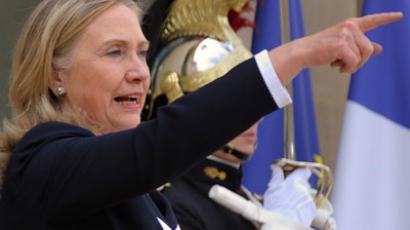
Hillary Clinton and the Weaponization of the State Department
By JP Sottile | News Vandal | June 5, 2014
On May 23, 2012, then-Secretary of State Hillary Clinton went to the Special Operations Forces Industry Conference (SOFIC) trade show in Tampa, Florida to share her vision of “smart power” and to explain the State Department’s crucial role in extending the reach and efficacy of America’s growing “international counterterrorism network.”
First, there is such a thing as a “Special Operations Forces Industry Conference trade show.” Without some keen reporting by David Axe of Wired, that peculiar get-together might’ve flown completely under the radar—much like the shadowy “industry” it both supports and feeds off of like a sleek, camouflaged lamprey attached to a taxpayer-fattened shark.
Second, “special operations” have officially metastasized into a full-fledged industry. United States Special Operations Command (USSOCOM) is located at MacDill Air Force Base in Tampa and, therefore, conveniently located near the special operations trade show, which happened again this year at the Tampa Convention Center. The theme was “Strengthening the Global SOF Network” and the 600,000-square-foot facility was filled with targets of opportunity for well-connected and well-heeled defense contractors.
According to the SOFIC website, this year’s conference afforded attendees “the opportunity to engage with USSOCOM Program Executive Officers, Science and Technology Managers, Office of Small Business Programs and Technology & Industry Liaison Office representatives, and other acquisition experts who will identify top priorities, business opportunities, and interests as they relate to USSOCOM acquisition programs.”
Third, Hillary’s widely-ignored speech marked a radical departure from the widely-held perception that the State Department’s diplomatic mission endures as an institutional alternative to the Pentagon’s military planning. Instead, Secretary Clinton celebrated the transformation of Foggy Bottom into a full partner with the Pentagon’s ever-widening efforts around the globe, touting both the role of diplomats in paving the way for shadowy special ops in so-called “hot spots” and the State Department’s “hand-in-glove” coordination with Special Forces in places like Pakistan and Yemen.
Finally, with little fanfare or coverage, America’s lead diplomat stood before the shadow war industry and itemized the integration of the State Department’s planning and personnel with the Pentagon’s global counter-terrorism campaign which, she told the special operations industry, happen “in one form or another in more than 100 countries around the world.”
If this isn’t entirely unexpected, consider the fact that under then-Secretaries of State Colin Powell and Condoleezza Rice, the State Department fought attempts by the Pentagon to trump its authority around the globe and, as reported by the Washington Post, “repeatedly blocked Pentagon efforts to send Special Operations forces into countries surreptitiously and without ambassadors’ formal approval.”
But that was before Hillary brought her “fast and flexible” doctrine of “smart power” to Foggy Bottom and, according to her remarks, before she applied lessons learned from her time on the Senate Armed Services Committee to launch the first-ever Quadrennial Diplomacy and Development Review, which she modeled on the Pentagon’s Quadrennial Defense Review. That Pentagon-style review spurred the creation of the Bureau of Conflict and Stabilization Operations to “advance the U.S. government’s foreign policy goals in conflict areas.”
According to a Congressional Research Service analysis, the initial intent of the Conflict Bureau was to replace the ineffectual Office of the Coordinator of Reconstruction and Stabilization, which was created in 2004 to help manage “stabilization” efforts in two nations the U.S. was actively destabilizing—Afghanistan and Iraq.
But the new, improved bureau does more than just react to messes made by unlawful invasions or direct costly remediation efforts in war zones—it also collaborates with “relevant partners” in the Department of Defense and NATO “to harmonize civilian and military plans and operations pertaining to conflict prevention, crisis response, and stabilization.”
This integrated relationship between State and Defense was confirmed by U.S. Special Operations chief Admiral William McRaven shortly after Hillary’s speech. When asked about the “unlikely partnership,” McRaven assured DefenseNews that SOCOM has “an absolutely magnificent relationship with the State Department” and that SOCOM doesn’t “do anything that isn’t absolutely fully coordinated and approved by the U.S. ambassador and the geographic combatant commander.”
As David Axe aptly described it in Wired, “Together, Special Operations Forces and State’s new Conflict Bureau are the twin arms of an expanding institution for waging small, low-intensity shadow wars all over the world.”
In fact, during Hillary’s time as America’s chief diplomat, the State Department embraced the shadowy edge of U.S. foreign policy where decision-makers engage in activities that look like war, sound like war and, if you were to ask civilians in places like Yemen and Pakistan, feel a lot like war, but never quite have to meet the Constitutional requirement of being officially declared as war.
The Whole-of-Government Shift
Once upon a time, “low-intensity shadow wars” were the Congressionally-regulated bailiwick of the Central Intelligence Agency. But 9/11 changed everything. However, the excesses of the Bush Administration led many to hope that Obama could and would change everything back or, at least, relax America’s tense embrace of “the dark side.”
Although the new administration did officially re-brand “The War on Terror” as “Overseas Contingency Operations,” Team Obama employed an increasingly elastic interpretation of the 9/11-inspired Authorization for Use of Military Force and expanded covert ops, special ops, drone strikes and regime change to peoples and places well-beyond the law’s original intent, and certainly beyond the limited scope of CIA covert action.
Obama’s growing counter-terrorism campaign—involving, as Secretary Clinton said, “more than 100 countries”—took flight with a new, ecumenical approach called the “Whole-of-Government” strategy. Advanced by then-Secretary of Defense Bill Gates and quickly adopted by the new administration in early 2009, this strategy catalyzed an institutional shift toward inter-agency cooperation, particularly in the case of “state-building” (a.k.a. “nation building”).
During remarks to the Brookings Institution in 2010, Secretary Clinton explained the shift: “One of our goals coming into the administration was… to begin to make the case that defense, diplomacy and development were not separate entities, either in substance or process, but that indeed they had to be viewed as part of an integrated whole and that the whole of government then had to be enlisted in their pursuit.”
Essentially, the Whole-of-Government approach is a re-branded and expanded version of Pentagon’s doctrine of “Full-Spectrum Dominance.” Coincidentally, that strategy was featured in the Clinton Administration’s final Annual Report to the President and Congress in 2001. It defined “Full-Spectrum Dominance” as “an ability to conduct prompt, sustained, and synchronized operations with forces tailored to specific situations and possessing freedom to operate in all domains—space, sea, land, air, and information.”
In 2001, Full-Spectrum Dominance referred specifically to 20th Century notions of battlefield-style conflicts. But the “dark side” of the War on Terror stretched the idea of the battlefield well-beyond symmetrical military engagements. “Irregular warfare” became the catchphrase du jour, particularly as grinding campaigns in Afghanistan and Iraq exposed the reality that the full spectrum still wasn’t enough.
An assessment by the Congressional Research Service identified the primary impetus for the Whole-of-Government “reforms” embraced by Team Obama as the “perceived deficiencies of previous inter-agency missions” during the military campaigns in Afghanistan and Iraq. Those missions failed to address a myriad of problems created—culturally, economically and politically—by the wholesale bombing and occupation of those countries. The Full-Spectrum was half-baked. Lesson learned.
But the lesson wasn’t that the U.S. should avoid intervention, regime change or unleashing nascent civil, ethnic or religious conflicts. Instead, the lesson was that the “Whole-of-Government” must be marshaled to fight a worldwide array of Overseas Contingency Operations in “more than 100 countries.”
This Whole-of-Government shift signaled a renewed willingness to engage on variety of new fronts—particularly in Africa—but in a “fast and flexible” way. With other agencies—like the State Department—integrated and, in effect, fronting the counter-terrorism campaign, the military footprint becomes smaller and, therefore, easier to manage locally, domestically and internationally.
In some ways, the Whole-of-Government national security strategy is plausible deniability writ-large through the cover of interagency integration. By merging harder-to-justify military and covert actions into a larger, civilian-themed command structure, the impact of the national security policy overseas is hidden—or at least obfuscated—by the diplomatic “stabilization” efforts run through the State Department—whether it’s the Conflict Bureau working against Joseph Kony’s Lord’s Resistance Army in Central Africa, “stabilizing” post-Gaddafi Libya or spending $27 million to organize the opposition to Bashar al-Assad’s Syrian regime.
The Pass Key
The cover of diplomacy has traditionally been an effective way to slip covert operators into countries and the State Department’s vast network of embassies and consulates still offers an unparalleled “pass-key” into sovereign nations, emerging hot spots and potential targets for regime change. In 2001, the Annual Report to the President and Congress foresaw the need for more access: “Given the global nature of our interests and obligations, the United States must maintain the ability to rapidly project power worldwide in order to achieve full-spectrum dominance.”
Having the way “pre-paved” is, based on Hillary’s doctrinal shift at State, a key part of the new, fuller-spectrum, Whole-of-Government, mission-integrated version of diplomacy. At the SOFIC’s Special Operations Gala Dinner in 2012, Hillary celebrated the integration of diplomatic personnel and Special Operations military units at the State Department’s recently created Center for Strategic Counterterrorism Communications—a “nerve center in Washington” that coordinates “military and civilian teams around the world” and serves “as a force multiplier for our embassies’ communications efforts.”
As with most doors in Washington, that relationship swings both ways and mission-integrated embassies have served as an effective force multiplier for the Pentagon’s full spectrum of activities, particularly around Africa.
In his 2011 testimony before the House Foreign Affairs Committee Subcommittee on Africa, Deputy Assistant Secretary of State for African Affairs Don Yamamoto noted that State had “significantly expanded the number of DoD personnel who are integrated into embassies across the continent over the past three years,” and read a surprisingly long laundry list of collaborative efforts between State and the United States Africa Command (AFRICOM), including: “reduction of excess and poorly secured man-portable air defense systems (MANPADS); Defense Sector Reform in Liberia, DRC, and South Sudan; counterpiracy activities off the Somali coast; maritime safety and security capacity building; and civil-military cooperation.”
It seems that “civil-military cooperation” is a primary focus of the State Department in Africa. Most notably, Yamamoto told Congress that “embassies implement Department of State-funded Foreign Military Financing (FMF) and International Military Education and Training (IMET) programs, which further U.S. interests in Africa by helping to professionalize African militaries, while also assisting our African partners to be more equipped and trained to work toward common security goals.”
As the ever-vigilant Nick Turse recently reported, U.S. presence on the continent has only grown since that testimony was given in 2011. On TomDispatch.com, Turse identified the infamous attack on Benghazi on September 11, 2012 as the catalyst for “Operation New Normal”—the continent-wide response to, quite ironically, the political potboiler still simmering around Secretary Clinton. Whether or not Congressional Republicans find anything more than incompetence at the root of Benghazi, the U.S. military certainly finds itself in a “new normal” of increased activity in response to the forces—and the weaponry—unleashed by U.S.-led regime change in Libya. According to Turse, the U.S. is “now conducting operations alongside almost every African military in almost every African country and averaging more than a mission a day.”
Those missions are, of course, integrated with and augmented by the State Department’s Conflict Bureau which has used a variety of state-building programs and its diplomatic “pass key” in places like Libya, Nigeria, Kenya, South Sudan, Somalia, Democratic Republic of the Congo and six other African nations, all to develop a growing roster of “host country partners.”
Establishing “host country partners” is the nexus where the State Department, its Conflict Bureau and the AFRICOM meet—implementing the Whole-of-Government strategy in emerging or current conflict zones to fuse a mounting counter-terrorism campaign with stabilization, modernization and state-building initiatives, particularly in oil and resource-rich areas like the Niger River Delta, Central Africa and around AFRICOM’s military foothold on the Horn of Africa.
As Richard J. Wilhelm, a Senior Vice President with defense and intelligence contracting giant Booz Allen Hamilton, pointed out in a video talk about “mission integration,” AFRICOM’s coordination with the Departments of State and Commerce, USAID is the “most striking example of the Whole-of-Government approach.”
And this is exactly the type of “hand-in-glove” relationship Secretary Clinton fostered throughout her tenure at State, leveraging the resources of the department in a growing list of conflict areas where insurgents, terrorists, al-Qaeda affiliates, suspected militants or uncooperative regimes threaten to run afoul of so-called “U.S. interests”.
Ultimately, it became a hand-in-pocket relationship when Clinton and Defense Secretary Gates developed the Global Security Contingency Fund (GSCF) to “incentivize joint planning and to pool the resources of the Departments of State and Defense, along with the expertise of other departments, to provide security sector assistance for partner countries so they can address emergent challenges and opportunities important to U.S. national security.”
Although he’s been criticized as feckless and deemed less hawkish than Secretary Clinton, President Obama’s newly-proposed Counterterrorism Partnership Fund (CTPF) is the logical extension of the Clinton-Gates Global Security Contingency Fund and epitomizes the Whole-of-Government shift.
The $5 billion Obama wants will dwarf the $250 million pooled into the GSCF and will, the President said at West Point, “give us flexibility to fulfill different missions including training security forces in Yemen who have gone on the offensive against al Qaeda; supporting a multinational force to keep the peace in Somalia; working with European allies to train a functioning security force and border patrol in Libya; and facilitating French operations in Mali.”
That “flexibility” is exactly what Hillary Clinton instituted at State and touted at the SOFIC conference in 2012. It also portends a long-term shift to less invasive forms of regime change like those in Yemen, Libya, Syria and Ukraine, and an increased mission flexibility that will make the Authorization for the Use of Military Force functionally irrelevant.
Normalizing the War on Terror
The ultimate outcome of this shift is, to borrow from Nick Turse, yet another “new normal”—the new normalization of the War on Terror. What the adoption of the Whole-of-Government/mission integration approach has done is to normalize the implementation of the re-branded War on Terror (a.k.a. Overseas Contingency Operations) across key agencies of the government and masked it, for lack of the better term, under the rubric of stabilization, development and democracy building.
It is, in effect, the return of a key Cold War policy of “regime support” for clients and “regime change” for non-client states, particularly in strategically-located areas and resource-rich regions. Regimes—whether or not they actually “reflect American values”—can count on U.S. financial, military and mission-integrated diplomatic support so long as they can claim to be endangered… not by communists, but by terrorists.
And because terrorism is a tactic—not a political system or a regime—the shadowy, State Department-assisted Special Ops industry that fights them will, unlike the sullen enthusiasts of the Cold War, never be bereft of an enemy.
Secret Trials: UK Holds A Secret Terror Trial, As US Appeals Court Holds Secret Hearing In Terror Case
By Mike Masnick | Techdirt | June 5, 2014
To have a functioning judiciary in an open democracy, part of the point is to make sure that court proceedings are open to the public. Yes, there may be certain instances where certain aspects must be kept secret, but the default should be open and public. Unfortunately, in both the US and UK this week, it appears that when it comes to the bogeyman word “terrorism,” courts are willing to go dark. The more serious situation is over in the UK, where it has just come out that a secret terrorism trial is being held — the first one in centuries. Even the names of the two defendants are not known (they’re listed as merely AB and CD). Journalists had even been barred from mentioning the existence of the trial, until a gag order was just overturned. Note that the Guardian’s page linked above had to turn off comments for legal reasons. Journalist Tim Cook has also spoken out eloquently about why this cannot stand.
I cannot say how broken-hearted I am about the prospect of a major criminal trial involving two men charged with serious terrorism offences being held entirely in secret for the first time in modern British legal history. I have spent my entire journalistic life campaigning against courtroom secrecy and this represents a nadir and indication of abject failure.
But the proposal is being contested by the process of law; albeit very limited and garrotted by the lack of a constitutional paradigm for freedom of the media and expression. We have been paying the price for not having a First Amendment for many years. Now we are entering the endgame of something beyond the dissolution of open justice.
Meanwhile, back here in the good, old United States, where we do have a First Amendment, at least we know that Adel Daoud is on trial. But the 7th Circuit Court of appeals kicked everyone out of the courtroom to hold a “secret hearing” with just the DOJ. As we wrote a few months ago, Daoud’s lawyers are asking to actually see the FISA court orders that were used to gather evidence against their client — and the DOJ is flipping out about that. While some of the hearings were held openly, at one point, Judge Richard Posner abruptly kicked everyone but the DOJ out, including Daoud’s lawyers.
As the arguments concluded, Judge Richard Posner announced the public portion of the proceedings had concluded and ordered the stately courtroom cleared so the three-judge panel could hold a “secret hearing.” Daoud’s attorney, Thomas Anthony Durkin, rose to object, but Posner did not acknowledge him. Deputy U.S. marshals then ordered everyone out – including Durkin, his co-counsel and reporters.
Only those with the proper security clearance — including U.S. Attorney Zachary Fardon, his first assistant, Gary Shapiro, and about a dozen FBI and U.S. Department of Justice officials – were allowed back in the courtroom before it was locked for the secret session.
Some reporters tried to ask what was going on, but Posner simply told them “No!” and kicked them out. Daoud’s lawyer was similarly perplexed:
“Not only do I not get to be there, but I didn’t even get to object,” Durkin said. “I had to object over the fact that I couldn’t even make an objection.”
As the article notes, this is highly unusual. While in national security cases, certain information may be filed under seal, or certain portions may be held “in camera” without reporters or the public, it’s not at all common to have just one side present. And while you may say that it makes sense in this case, where the three judge panel has to determine whether or not it’s appropriate to share the FISC orders with Daoud’s lawyers, it’s still somewhat troubling to see the ease with which secret court proceedings may occur.
Featured Video

John Mearsheimer: New World Order Arrived & Europe Is Left Behind
or go to
Aletho News Archives – Video-Images
Book Review
Sunset on Net Zero: A Heretic’s Guide to the Futile CO2 Target
By Ronald Paul Barmby (Author) – October 3, 2025
SUNSET ON NET ZERO describes in detail why Net Zero CO2 is pointless and unachievable. It explains in understandable terms the up-to- date thoughts of the greatest minds of today in physics, meteorology, economics, engineering, and the geosciences.
Net Zero CO2 is pointless because we have now confirmed by satellites that 90% of CO2 warming has already happened. CO2 is not an existential threat but clouds, El-Niño, and human habitation are significant drivers of global warming that are often ignored.
Net Zero CO2 is unachievable because the green technology alternatives are unreliable and unaffordable. Wind and solar power triple electricity costs, building fully electric vehicles produces at least one-half of CO2 emissions they are meant to avoid, and heat pumps will leave you dangerously cold in the winter. Green hydrogen, air capture CO2, and carbon capture and storage are prescriptions for national bankruptcy. The supply of key metals and minerals required to achieve Net Zero need to be at least doubled—some much more—and are often controlled by a very few. Net Zero comes with huge environmental and agricultural costs.
We have been through similar climatic temperature changes before, more recently than you think. Our efforts to control it are futile.
Blog Roll
 Aletho News
- FDA Ordered to Pay Over $570,000 in Fight Over Pfizer COVID Vaccine Records
- USAID turned to Facebook to drive demand for Covid vaccines in Global South – files
- Britain’s shadow security network expands into south Lebanon
- The ADL Has a Foreign Policy, and You Are Not Supposed to See It
- Former Qatari PM says ‘Israel’ has security ties with all Gulf states
- The Sound of Silence in the Strait of Hormuz
- Poland’s call for a no-fly zone in Ukraine means NATO direct war with Russia
- John Mearsheimer: New World Order Arrived & Europe Is Left Behind
- Naqab demolition notices top 1,000; settlers demolish Jaloud homes
- Israel is Using the ‘Gaza Ceasefire’ to Commit Ethnic Cleansing
- If Americans Knew
- An error has occurred; the feed is probably down. Try again later.
- No Tricks Zone
- Physicists: Doubling CO2 Has A Smaller Impact On Ocean ‘Acidification’ Than Existing Internal Variability
- Alarmist Climatologists In Shock! 2026 Atlantic Hurricane Season Sees Lowest Count In 101 Years
- New Study: Modern Temps Are Among The Coldest Of The Last 10,000 Years In East Central Europe
- Germany’s Renewable Energies Lead to 1.4 Billion Euro Electric Power Trade Deficit
- Argentina’s Perito Moreno Glacier Joins Antarctica and Arctic In Defying Doomsday Melt Claims
- New Study: Barents Sea Temperatures Were Warmer And Sea Ice Less Extensive In The 1700s Than Today
- German Authorities Start Initiative To Evaluate Public Register For Climate “Disinformation” Spreaders!
- Zonal Asymmetry of Temperature Change in the Antarctic Circumpolar Current
- New Study: The Net Fossil Fuel Contribution To Rising Atmospheric CO2 Has Been Zero For 500 Years
- Germany’s Green Energy Transition Becoming Increasingly Expensive…Another 6 Trillion Euros!

