NY Times and the Myth of ‘U.S. Ideals’
By Peter Hart – FAIR – 08/22/2012
There’s nothing quite like the demise of a U.S-allied dictator to get the Paper of Record talking about the “clash” between U.S. “ideals” and the actual policies the country carries out.
Today’s New York Times (8/22/12) carries the headline “Ethiopian Leader’s Death Highlights Gap Between U.S. Interests and Ideals,” under which Jeffrey Gettleman lays out the case that the United States kept Ethiopian leader Meles Zenawi, who died early this week, in the “good guy” column despite our normally idealistic approach to world affairs. Gettleman writes that Zenawi
extracted prized intelligence, serious diplomatic support and millions of dollars in aid from the United States in exchange for his cooperation against militants in the volatile Horn of Africa, an area of prime concern for Washington.
But he was notoriously repressive, undermining President Obama’s maxim that “Africa doesn’t need strongmen, it needs strong institutions.”
But, Gettlemen explains:
Despite being one of the United States’ closest allies on the continent, Mr. Meles repeatedly jailed dissidents and journalists, intimidated opponents and their supporters to win mind-bogglingly one-sided elections, and oversaw brutal campaigns in restive areas of the country where the Ethiopian military has raped and killed many civilians.
The real trick is the first word: “Despite.” Readers are supposed to see these as unusual characteristics for a leader backed by the United States, which of course would much rather the world be governed by those who respect international law and human rights.
That supposed commitment is difficult to locate. After his death, Gettleman reports, Hillary Clinton
praised his “personal commitment” to lifting Ethiopia’s economy and “his role in promoting peace and security in the region.” But she made no mention of his rights record and gave only a veiled reference to supporting “democracy and human rights” in Ethiopia.
Gettleman deserves some sort of award for this passage:
Ethiopia is hardly alone in raising difficult questions on how the United States should balance interests and principles.
Saudi Arabia is an obvious example, a country where women are deprived of many rights and there is almost no religious freedom. Still, it remains one of America’s closest allies in the Middle East for a simple reason: oil.
In Africa, the United States cooperates with several governments that are essentially one-party states, dominated by a single man, despite a commitment to promoting democracy.
One could spend considerable time compiling a list of the tyrants, dictators and human rights abusers the United States has supported, from Suharto in Indonesia to Mubarak in Egypt. Or consider the Reagan-era policies of Latin America, which saw the United States supporting strongmen and fielding armies to overthrow governments we didn’t care for.
Elite institutions like the Times need to maintain the comfortable fiction that the United States has a unique and laudable commitment to spreading democracy and human rights. Most people with a passing knowledge of U.S. history would know that there are too many exceptions to this rule to make it a rule at all. Thus, every now and then, an article like this is written to demonstrate that there is in fact some awareness that the United States does not practice what it preaches. An effective propaganda system requires these small openings.
Related articles
- Obama condoles Ethiopian PM’s death (thehindu.com)
- The Strongman Who May Be Missed: Meles Zenawi, 1955-2012 (world.time.com)
Fletcherism and Fakery: Guarding Obama’s Left Flank

By Glen Ford | Black Agenda Report | August 22, 2012
Bill Fletcher and Carl Davidson are two Left opportunists with a problem. Unlike four years ago, when Fletcher co-founded Progressives for Obama, their guy now has a record – and it is indefensible. Solution: nullify the issues right up front in the title to their reworked rationale for backing the Bill of Rights-destroying, Wall Street-protecting, Africa-bombing, regime-changing corporate Democrat. Their August 9th Alternet article, “The 2012 Elections Have Little To Do With Obama’s Record … Which Is Why We Are Voting For Him” frames the campaign as a contest between “revenge-seeking” white supremacists and – well…those of us who are not revenge-seeking white supremacists. The facts of the Obama presidency – his actual behavior on war, austerity, and civil liberties – are deemed irrelevant, and the president himself becomes a mere stage prop in the battle against “Caligula,” the Republicans.
Fletcher and Davidson want Blacks and progressives to respond with hysteria to GOP “irrationalism,” to keep the traditional Democratic base in the Obama camp through raw fear.They claim the current campaign “will be unlike anything that any of us can remember.” In truth, the abject Black failure to make a single demand of Obama, and the vapid excuses and rationalizations for the Left’s political collapse in his presence, then and now, makes 2012 very much resemble 2008. Back then, Fletcher & Co. wrote:
“Barack Obama’s very biography reflects the positive potential of the globalization process that also contains such grave threats to our democracy when shaped only by the narrow interests of private corporations in an unregulated global marketplace. We should instead be globalizing the values of equality, a living wage and environmental sustainability in the new world order, not hoping our deepest concerns will be protected by trickle-down economics or charitable billionaires. By its very existence, the Obama campaign will stimulate a vision of globalization from below.”
Four years later, we are admonished to forget the facts as they actually transpired – and as we at BAR predicted – and pretend the current campaign is a crusade against the Tea Party, with Obama as the incidental beneficiary.
Right-wing populism is the bogey man, in opposition to which we must re-embrace Obama. The GOP isn’t just racist, it is “irrational,” crying for “a return to the past.” They write:
“Obama represents an irrational symbol for the political right, and a potent symbol that goes way beyond what Obama actually stands for and practices. The right, while taking aim at Obama, also seeks, quite methodically and rationally, to use him to turn back the clock.”
Of course, the meaning of the term reactionary is to “turn back the clock,” a promise Republicans have been making for 50 years. And racism is fundamentally irrational, causing white supremacists to see that which is not there, be blinded to facts that are right in front of their noses, and to invent whole narratives of history. But, this time is different, Fletcher and Davidson insist, because the Right is so intensely focused on the symbolism of Obama, the Black man – and so “irrational” about it that they make up ridiculous things about him, like his non-citizenship.
Therefore, our response, as progressives, must be to forge a “common front based on resisting white revanchism… on political misogynism, on anti-‘freeloader’ themes aimed at youth, people of color and immigrants, and a partial defense of the so-called 1%.” The fact that Obama is demonstrably not a part of that common front must not dissuade us from joining his campaign. If the Right has made Obama its symbolic focus, we must, in response, make him the focus of our “common front.” If the Right hates Obama with an irrational passion, we must hug him to our breasts.
Just in case the logic of such reasoning escapes you, Fletcher and Davidson remind us that the Republicans are not merely irrational – they are crazy like Caligula.
“November 2012 becomes not a statement about the Obama presidency, but a defensive move by progressive forces to hold back the ‘Caligulas’ on the political right. It is about creating space and using mass campaigning to build new grassroots organization of our own. It is not about endorsing the Obama presidency or defending the official Democratic platform. But it is about resisting white revanchism and political misogynism by defeating Republicans and pressing Democrats with a grassroots insurgency, while advancing a platform of our own, one based on the ‘People’s Budget’ and antiwar measures of the Congressional Progressive Caucus. In short, we need to do a little ‘triangulating’ of our own.”
So, it’s not about “endorsing the Obama presidency” – but about voting for Obama while claiming that the facts of what he did as president don’t matter. It is about the nonsense of “creating space” so that the Left can do what it ought to do anyway, but which it didn’t do in the two years leading up to the 2008 election, or in the first two and a half years of the Obama presidency, until the Occupy Wall Street activists came out of left field in disgust with both parties’ subservience to finance capital. The anti-war movement seems largely to oppose only Republican wars.
The great fallacy, here, is that Democratic presidents in general, and Obama in particular, somehow create “space” for progressive activism. Movements create space for themselves, by acting. Only charlatans preach that progressive movements must install preferred personalities from the menus of the ruling circles before they can find space to move.
The great tragedy of the Obama era, is that his presence has had the effect of shutting down progressive – and, most dramatically, Black – opposition to the prevailing order. This does not happen by the magic of charisma. Political operatives identified with the Left work diligently to maintain such silence – people like Fletcher and Davidson, who are once again guarding the left flank for Obama, whose great legacy has been to create vast political space for Wall Street and the Pentagon, with a minimum of resistance from white progressives, Blacks and the rest of the Democratic base.
That’s why we at BAR call Obama the more effective evil.
Glen Ford can be contacted at Glen.Ford@BlackAgendaReport.com.
Related articles
- Tired Old So-Called Leftists Give Same Old Excuses For Supporting Obama in 2012 (Black Agenda Report)
‘Unilateral sanctions against Iran could damage Russian-US ties’ – Foreign Ministry
RT | August 13, 2012
The Foreign Ministry has warned of a possible blow to Russian-American relations if the US pursues unilateral sanctions against Iran that affect Russian economic interests there.
“Washington should understand that our bilateral relations will suffer considerably if the American restrictions affect Russian economic entities cooperating with partners in the Islamic Republic of Iran in strict compliance with our legislation and UN Security Council resolutions,” the ministry said on its website on Monday.
Late Friday, US President Barack Obama signed into law new sanctions against Iran which aims to penalize those parties aiding Iran’s insurance, financial, petroleum, petrochemical and shipping sectors.
Moscow considers US sanctions against Iran unacceptable, Foreign Ministry spokeswoman Mariya Zakharova said on Monday.
“Russia is fully committed to the restrictions on cooperation with Iran that were established by the UN Security Council,” the spokeswoman said. “However, we do not recognize the unilateral sanctions that were imposed by Washington on the plea of serious concern about Iran’s nuclear program and run counter to international law.”
Zakharova called US efforts to punish countries that do business with Tehran “blackmail.”
“We refute methods of undisguised blackmail,” she said, “which is used by the US towards banks and companies of other countries.”
Earlier, the US passed legislation that targets any party doing business with Iran’s central bank.
Russia has cooperated with Iran in economic projects in the past, including in the Bushehr nuclear plant, which started adding energy to Iran’s electricity grid in September, 2011.
The United States is one of several countries, including Israel, that is concerned that Iran may be trying to develop a nuclear weapon under the cover of a civilian energy program.
Tehran has strongly rejected the accusations, saying it is pursuing nuclear energy for civilian purposes only.
Related articles
- China Hits back at New US Sanctions over Iran (alethonews.wordpress.com)
Where Will the U.S. Strike Next in Africa?
A Black Agenda Radio commentary by Glen Ford | August 8, 2012
Under the direction of the United States, the UN Security Council recently extended sanctions for another year against the northeast African nation of Eritrea. The country of 6 million people, nestled against the Red Sea, is on America’s hit list. In the imperial double-speak of Washington, Eritrea is described as a “destabilizing” force in the region – which simply means the government in Asmara has refused to buckle under to U.S. military domination of the Horn of Africa.
Back in 2009, Secretary of State Hillary Clinton threatened to “take action” – and, by that, she meant make war – against Eritrea if it did not stop supporting the Shabab resistance fighters in Somalia. There was no evidence that Eritrea was, in fact, arming the Shabab, and there is no evidence that Eritrea is doing so, now – as the UN Monitoring Group on Eritrea and Somalia admits.
The monitors, who are, in effect, tools of U.S. policy, reported that they found “no evidence” of Eritrean aid to Somali fighters over the past year, and concluded that, if such assistance exists at all, it is “negligible.” Yet, the UN Security Council, under U.S. pressure, extended the sanctions, anyway. Washington claims that Eritrea’s alleged support for the Shabab has only halted because of the sanctions, and it’s, therefore, too early to lift them – which amounts to punishing Eritrea for having the wrong intentions, whether it acts on them or not.
It is, of course, not little Eritrea that is destabilizing the Horn of Africa, but the United States, which has made the region a front line in its so-called War on Terror. Washington’s closest ally in the neighborhood is Ethiopia, from which Eritrea won its independence in 1993, after a 30-year war. The U.S. instigated, armed, financed and gave logistical support to Ethiopia’s invasion of Somalia, in 2006, plunging that country into what United Nations observers called “the worst humanitarian crisis in Africa.” Under American direction, Kenya also invaded Somalia, in the midst of a great famine, last year. The U.S. bankrolls, arms and trains the nominally African Union force that occupies Somalia’s capital, and has turned neighboring Djibouti into the main base for the U.S. Africa Command, AFRICOM.
And there sits Eritrea, surrounded by warring American puppets, interfering in no one’s affairs, yet determined to defend her sovereignty – accused by the world’s biggest and most aggressive power of destabilizing the region.
Eritrea’s real sin is to be one of the very few nations in Africa that do not have military relations with AFRICOM, the U.S. war machine. That puts a bulls-eye on her back, along with Zimbabwe and Sudan, which U.S. Ambassador to the UN Susan Rice demanded be blockaded and bombed back in the George Bush administration. Barack Obama’s Africa policy is an extension and expansion of Bush’s aim to militarize the continent, and the much older U.S. policy to create chaos and horrific human suffering in those regions it cannot directly control. In practice, Obama’s doctrine is the same as Bush’s: “You are either with us or against us.”
Eritrea rejects that doctrine; that’s why it is a target. For Black Agenda Radio, I’m Glen Ford. On the web, go to BlackAgendaReport.com.
Glen Ford can be contacted at Glen.Ford@BlackAgendaReport.com.
Related articles
- U.S. Breaks Somalia Arms Embargo It Helped Establish (alethonews.wordpress.com)
Obama fights ban on indefinite detention of Americans
RT | August 7, 2012
The White House has filed an appeal in hopes of reversing a federal judge’s ruling that bans the indefinite military detention of Americans because attorneys for the president say they are justified to imprison alleged terrorists without charge.
Manhattan federal court Judge Katherine Forrest ruled in May that the indefinite detention provisions signed into law late last year by US President Barack Obama failed to “pass constitutional muster” and ordered a temporary injunction to keep the military from locking up any person, American or other, over allegations of terrorist ties. On Monday, however, federal prosecutors representing President Obama and Defense Secretary Leon Panetta filed a claim with the 2nd US Circuit Court of Appeals in hopes of eliminating that ban.
The plaintiffs “cannot point to a single example of the military’s detaining anyone for engaging in conduct even remotely similar to the type of expressive activities they allege could lead to detention,” Obama’s attorneys insist. With that, the White House is arguing that as long as the indefinite detention law hasn’t be enforced yet, there is no reason for a judge to invalidate it.
Reuters reports this week that the government believes they are justified to have the authorization to lock alleged belligerents up indefinitely because cases involving militants directly aligned against the good of the US government warrants such punishment. Separate from Judge Forrest’s injunction, nine states have attempted to, at least in part, remove themselves from the indefinite detention provisions of included in the National Defense Authorization Act for Fiscal Year 2012, or NDAA.
In section 1021 of the NDAA, the president’s authority to hold a terrorism suspect “without trial, until the end of the hostilities” is reaffirmed by Congress. Despite an accompanying signing statement voicing his opposition to that provision, President Obama quietly inked his name to the NDAA on December 31, 2011. In May, however, a group of plaintiffs including notable journalists and civil liberty proponents challenged section 1021 in court, leading to Justice Forrest to find it unconstitutional one month later.
“There is a strong public interest in protecting rights guaranteed by the First Amendment,” Forrest wrote in her 68-page ruling. “There is also a strong public interest in ensuring that due process rights guaranteed by the Fifth Amendment are protected by ensuring that ordinary citizens are able to understand the scope of conduct that could subject them to indefinite military detention.”
At the time Justice Forrest made her injunction, attorney Carl Mayer told RT on behalf of the plaintiffs that, although he expected the White House to appeal, “It may not be in their best interest.”
“[T]here are so many people from all sides of the political spectrum opposed to this law that they ought to just say, ‘We’re not going to appeal,’” Mayer said. “The NDAA cannot be used to pick up Americans in a proverbial black van or in any other way that the administration might decide to try to get people into the military justice system. It means that the government is foreclosed now from engaging in this type of action against the civil liberties of Americans.”
The original plaintiffs, who include Pulitzer Prize-winner Chris Hedges, have asked Justice Forrest to make her injunction permanent. Oral arguments in the case are expected to begin this week.
Related articles
The Employment Rate In The United States Is Lower Than It Was During The Last Recession
By Michael Snyder | BlackListedNews | August 4, 2012
Did you know that a smaller percentage of Americans are working today than when the last recession supposedly ended? But you won’t hear about this on the mainstream news. Instead, the mainstream media obsesses over the highly politicized and highly manipulated “unemployment rate”. The media is buzzing about how “163,000 new jobs” were added in July but the unemployment rate went up to “8.254%.” Sadly, those numbers are quite misleading. According to the Bureau of Labor Statistics, in June 142,415,000 people had jobs in the United States. In July, that number declined to 142,220,000. That means that 195,000 fewer Americans were working in July than in June. But somehow that works out to “163,000 new jobs” in July. I am not exactly sure how they get that math to add up. Perhaps someone out there can explain it to me. Personally, I find that the “employment rate” gives a much clearer picture of what is actually going on in the economy. The employment to population ratio is a measure of the percentage of working age Americans that actually have jobs. When it goes up that is good. When it goes down, that is bad. In July, the employment to population ratio dropped from 58.6 percent to 58.4 percent. Overall, the percentage of working age Americans that have jobs has now been under 59 percent for 35 months in a row.
The following is a chart of the employment to population ratio in the United States over the past 10 years:

The gray shaded bar in the chart represents the last recession as defined by the Federal Reserve. As you can see, the percentage of working age Americans with a job dropped sharply from nearly 63 percent at the start of 2008 to a little above 59 percent when the recession ended.
But the “employment rate” kept on dropping even further.
It finally bottomed out at 58.2 percent in December of 2009.
Since that time, it has stayed very steady. It has not fallen below 58 percent and it has not risen back above 59 percent.
This is very odd, because after ever other recession since World War II this number has always bounced back strongly.
But this has not happened this time.
In essence, it is starting to look like 4 percent of the working age population of the United States has been removed from the workforce permanently.
The good news in all of this is that things have at least not been getting any worse over the last couple of years. Even though things have been bad, at least we have had a period of relative stability.
The bad news is that the employment rate has not rebounded despite unprecedented borrowing and spending by the federal government and despite reckless money printing by the Federal Reserve.
Considering how desperately the federal government and the Federal Reserve have been trying to stimulate the economy, I truly did expect to see the employment rate bounce back at least a little bit by now.
Unfortunately it has not and now the U.S. economy is rapidly heading for another recession.
But Barack Obama is going to prance around over the next few days and talk about how wonderful it is that the economy created “163,000 new jobs” in July. … Full article
Related articles
- We’re Still 12 Million Jobs Away From Normal – Bloomberg (bloomberg.com)
- July Jobs Report Is Clear As Mud – Bloomberg (bloomberg.com)
Is Iran “The Most Destabilizing Nation in the World”?
By Flynt Leverett and Hillary Mann Leverett | The Race for Iran | August 1st, 2012
Standing reality on its head—at least in the eyes of most Middle Easterners—presumptive Republican presidential nominee Mitt Romney declared during his recent visit to Israel that the Islamic Republic is “the most destabilizing nation in the world.” In fact, reputable surveys conducted by international and regional polling groups—see here and here—show that, by orders of magnitude, largely Sunni Arab populations see Israel and the United States as much bigger threats to their security and interests than Iran. Al Jazeera asked our colleague, Seyed Mohammad Marandi of the University of Tehran, to comment on Governor Romney’s remark; to see the segment, click here or on the embedded video above.
Mohammad’s observations that, given the record of American policy in the Middle East (and all the death and destruction it has caused), the United States is hardly in a position to “complain very much about Iran” and that, from an Iranian perspective, there is not a lot of difference between Romney and President Obama are well presented. His explanation why the “soft war” that the Obama Administration is currently conducting against the Islamic Republic is not that different from a “hot war” is especially eloquent. We, though, want to pick up on Mohammad’s response to the interviewer’s suggestion that it is Iranian intransigence which is blocking progress in the nuclear talks and prompting tougher sanctions:
“The Iranians have been talking. The Iranians are basically saying that ‘we are willing to negotiate.’ But the Western position is ‘you give up everything and then we’ll start talking.’ The Iranian right to enriching uranium is a right that all sovereign countries have. And the Iranian Revolution itself was partially about dignity and independence. The Iranians are not going to accept being a second-rate country. This is not the Saudi regime or the Jordanian regime. This is a country that is fiercely independent. So the Iranians will continue to enrich uranium within the framework of the NPT and international law. The United States cannot stop Iran from doing so. If the United States was reasonable and rational, if the Europeans were rational, then the Iranians would be willing to give further assurances to ease tensions. But the United States isn’t really after that, in the eyes of Iranians.”
We think that is an important statement, both of the Iranian position and of reality. We have long argued that, if Washington accepted the principle and reality of internationally safeguarded enrichment in Iran, it would become eminently possible—not to say relatively easy—to negotiate a satisfactory resolution to the Iranian nuclear issue. But the United States—even under the Obama Administration—does not want to do that, for recognizing Iran’s right to enrich implies recognizing the Islamic Republic as a legitimate political entity representing legitimate national interests. We think that is unlikely to change after the U.S. presidential election in November, regardless of whether Romney or Obama wins. … Full article
Related articles
- US Sanctions Policy on a Collision Course against Iran; Increasing Tensions with China (alethonews.wordpress.com)
- How the Obama Administration Is Stalling Its Way to War with Iran (alethonews.wordpress.com)
- Ron Paul: US obsessed with ‘act of war’ on Iran (presstv.ir)
Obama signs $70 million Israel military aid bill
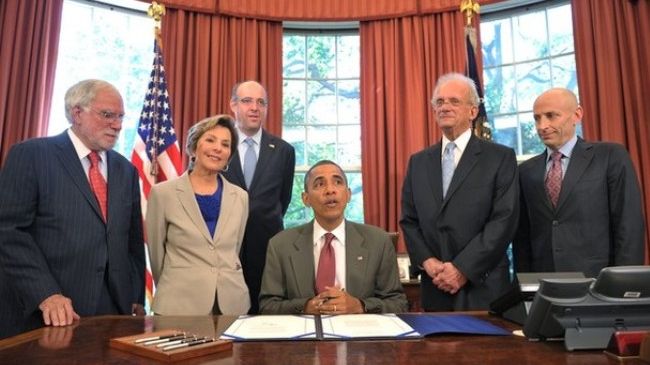
US President Barack Obama signs the US-Israel Enhanced Security Cooperation Act in the Oval Office on July 27, 2012.
Press TV – July 28, 2012
US President Barack Obama has signed a piece of legislation ratified by Congress that gives Israel another $70 million in military assistance, on top of the $3 billion the United States had already pledged to provide to the Israeli military this year.
On Friday, Obama signed the United States-Israel Enhanced Security Cooperation Act of 2012, which provides more US taxpayer dollars to help Israel expand its Iron Dome short-range rocket defense system, Xinhua reported.
The Iron Dome is a short-range rocket defense system designed to intercept rockets and artillery shells fired from a range of between four and 70 kilometers.
Representatives of the pro-Israeli lobby, the American Israel Public Affairs Committee (AIPAC), and Israeli journalists were invited to the signing ceremony, which was held at the White House.
“I have made it a top priority for my administration to deepen cooperation with Israel across the whole spectrum of security issues — intelligence, military, technology,” Obama said before signing the bill in the Oval Office.
“And, in many ways, what this legislation does is bring together all the outstanding cooperation that we have seen, really, at an unprecedented level between our two countries that underscores our unshakeable commitment to Israel security,” he added.
According to a White House fact sheet published on Friday, Obama said that “despite tough fiscal times” he “fought for and secured full funding for Israel” in fiscal year 2012, including $3 billion in Foreign Military Financing.
The fact sheet also said that Obama secured an additional $205 million in 2011 to set up the Iron Dome system.
Related articles
- US Gives Israel an Immediate $70 million for “Iron Dome” Systems (alethonews.wordpress.com)
- Israel Lobby Always Believes More Is Better (alethonews.wordpress.com)
Solyndra scandal’s key players pay big bucks to attend Obama fundraiser
RT | July 24, 2012
US President Barack Obama shook hands with some of his wealthiest supporters Tuesday night at a fundraising shindig in San Francisco. Also on hand, though, was a matter the commander-in-chief just can’t seem to shake: his failed deal with Solyndra.
Around sixty patrons paid $35,800 a piece to attend a party in honor of President Obama this week, including a pair of gentlemen who have become central figures in an energy debacle that has haunted the Oval Office since last year. Among those in attendance were two key players in the Solyndra scandal.
President Obama touted Solyndra, a California solar-panel start-up, as an example of perfect American entrepreneurship early on in his presidency. Last year, however, the infant green energy company filed for bankruptcy, despite the president earlier approving a gigantic loan guarantee worth $535 million for the Silicon Valley start-up. The company had borrowed all but $8 million of the massive loan before calling it quits late last year, a move that prompted Obama’s opponents to ridicule the president over what some said was “a dubious investment” and even initiated an investigated by the FBI.
Nearly a year after Solyndra first filed for bankruptcy, the scandal took center stage again this week after Monday’s fundraiser funneled in donations from Matt Rogers, a former adviser at the Department of Energy that helped approve the loan as part of the stimulus plan, and Steve Westly, a venture capitalist that warned the White House against offering a deal to Solyndra before the president offered his own endorsement. Darren Samuelsohn of Politico was on-hand at Monday’s fundraiser and writes that it appears that the president isn’t exactly distancing himself from one of the most costly scandals of his administration.
Officials within the campaign to elect Massachusetts Governor Mitt Romney for president have already attacked the administration for still maintaining ties with people privy to the Solyndra deal. In a statement addressing the latest news, Romney spokesman Ryan Williams writes, “The Obama Administration betrayed American taxpayers when it dumped hundreds of millions of public dollars into Solyndra while ignoring clear warnings about the company’s dire financial situation.”
“President Obama’s first term worked out well for his donors who got special access and taxpayer money for their failed ventures. It hasn’t worked as well for the 23 million Americans struggling for work in the worst economic recovery our country has ever had,” Williams adds.
Featured Video

John Mearsheimer: New World Order Arrived & Europe Is Left Behind
or go to
Aletho News Archives – Video-Images
Book Review
Sunset on Net Zero: A Heretic’s Guide to the Futile CO2 Target
By Ronald Paul Barmby (Author) – October 3, 2025
SUNSET ON NET ZERO describes in detail why Net Zero CO2 is pointless and unachievable. It explains in understandable terms the up-to- date thoughts of the greatest minds of today in physics, meteorology, economics, engineering, and the geosciences.
Net Zero CO2 is pointless because we have now confirmed by satellites that 90% of CO2 warming has already happened. CO2 is not an existential threat but clouds, El-Niño, and human habitation are significant drivers of global warming that are often ignored.
Net Zero CO2 is unachievable because the green technology alternatives are unreliable and unaffordable. Wind and solar power triple electricity costs, building fully electric vehicles produces at least one-half of CO2 emissions they are meant to avoid, and heat pumps will leave you dangerously cold in the winter. Green hydrogen, air capture CO2, and carbon capture and storage are prescriptions for national bankruptcy. The supply of key metals and minerals required to achieve Net Zero need to be at least doubled—some much more—and are often controlled by a very few. Net Zero comes with huge environmental and agricultural costs.
We have been through similar climatic temperature changes before, more recently than you think. Our efforts to control it are futile.
Blog Roll
 Aletho News
- Clinical Trials Relied Upon to License the MMR Vaccine
- FDA Ordered to Pay Over $570,000 in Fight Over Pfizer COVID Vaccine Records
- USAID turned to Facebook to drive demand for Covid vaccines in Global South – files
- Britain’s shadow security network expands into south Lebanon
- The ADL Has a Foreign Policy, and You Are Not Supposed to See It
- Former Qatari PM says ‘Israel’ has security ties with all Gulf states
- The Sound of Silence in the Strait of Hormuz
- Poland’s call for a no-fly zone in Ukraine means NATO direct war with Russia
- John Mearsheimer: New World Order Arrived & Europe Is Left Behind
- Naqab demolition notices top 1,000; settlers demolish Jaloud homes
- If Americans Knew
- An error has occurred; the feed is probably down. Try again later.
- No Tricks Zone
- Physicists: Doubling CO2 Has A Smaller Impact On Ocean ‘Acidification’ Than Existing Internal Variability
- Alarmist Climatologists In Shock! 2026 Atlantic Hurricane Season Sees Lowest Count In 101 Years
- New Study: Modern Temps Are Among The Coldest Of The Last 10,000 Years In East Central Europe
- Germany’s Renewable Energies Lead to 1.4 Billion Euro Electric Power Trade Deficit
- Argentina’s Perito Moreno Glacier Joins Antarctica and Arctic In Defying Doomsday Melt Claims
- New Study: Barents Sea Temperatures Were Warmer And Sea Ice Less Extensive In The 1700s Than Today
- German Authorities Start Initiative To Evaluate Public Register For Climate “Disinformation” Spreaders!
- Zonal Asymmetry of Temperature Change in the Antarctic Circumpolar Current
- New Study: The Net Fossil Fuel Contribution To Rising Atmospheric CO2 Has Been Zero For 500 Years
- Germany’s Green Energy Transition Becoming Increasingly Expensive…Another 6 Trillion Euros!

