JOHN KIRIAKOU: I Work for Sputnik News
By John Kiriakou | Consortium News | March 9, 2022
I work for Sputnik News. There. I said it. I’m not embarrassed or ashamed. I’m also not a Russian propagandist, despite what you may have read in the “mainstream” media. Sputnik approached me in 2017 and offered me a job as a radio talk show host. I turned them down. Friends told me that it would be a mistake working for the Russian Bear. They said that I would attract attention from the government, maybe even the FBI. Did I really want to do that?
About eight months passed, and Sputnik offered me a job again. Having just been released from prison after blowing the whistle on the CIA’s torture program, nobody was beating a path to my door to offer me a job, and I was newly separated from my wife. So I went in for an interview. The network’s editor-in-chief said that he wanted to offer me my own talk show. I said that I was interested, but that I had to have complete editorial freedom. “Done,” was the reply. I said that I wanted to be able to talk about anything I wanted, to be able to criticize anybody I wanted, including Russian President Vladimir Putin. “Done,” the editor-in-chief said again. I asked if he would be willing to put it in writing in my contract. He did, and I began working at Sputnik in August 2017.
For the first two-and-a-half years, I cohosted a show with Brian Becker, a well-known progressive activist and the co-founder of the ANSWER Coalition. I have deep respect for Brian, who sits to my left, politically, and the show, Loud & Clear, was a hit.
I later cohosted a show with Lee Stranahan, a conservative populist/libertarian and former journalist with Breitbart. We agreed on almost nothing in the year we worked together. And like me, Lee was never told that he had to say something or not say something or to take a certain political position. We were free to speak our minds. Since the beginning of the year, I’ve cohosted a mainstream progressive show with Michelle Witte, an accomplished and very intelligent news professional. I thoroughly enjoy going to work every day. I honestly don’t even see it as work because it’s so much fun.
But to hear The Washington Post tell it (or The New Republic, or the Center for Strategic and International Studies) I’m a dangerous propagandist for Vladimir Putin. The truth is that anybody who says that is either a propagandist himself or simply has never listened to my show.
I first realized that there were people out there who didn’t like or appreciate alternative viewpoints in 2018, when I received an email from a journalist from The New Republic. (She was actually a wedding photographer who worked as a freelance journalist.) She said that she wanted to do a story about my new career at Sputnik. I declined, saying that I wasn’t interesting in being “the story.” She responded, “Look, this story is getting written with you or without you.” I gave her an interview to try to soften the blow, but the result was “The Spy Who Became a Russian Propagandist.”
‘Weakening Our Democracy’
The same thing happened again shortly after The New Republic article was published. In early 2020, CBS News apparently realized that Sputnik was being broadcast on a small station in Kansas City. They listened to my show Loud & Clear and, reacting specifically to a segment that I used to do every Thursday called “Criminal Injustice,” said that I was “weakening our democracy.” How was I accomplishing that incredible feat? I was talking about how the United Nations had declared that the practice of solitary confinement in American prisons is a form of torture. And I advocated for Julian Assange.
A report later in 2020 from the neo-liberal Center for Strategic and International Studies was more direct. It said,
“Sputnik’s weekly segment Criminal Injustice on its Loud & Clear podcast similarly portrays itself as bringing attention to justice being denied to citizens, mixing legitimate grievances with distorted information. Russia’s goal for these programs is not to make the US legal system more just; it is to tell an unrelenting one-sided story to get Americans to believe the system is as corrupt and broken as the legal system in Russia. Putin’s hope is that Americans will give up on democratic institutions, the way so much of his own population has come to accept the corruption in Russia.”
Wow! I had no idea that I had that much influence, that I was that cynical in my creation of Criminal Injustice, or that I had strategized with Vladimir Putin to weaken democratic institutions. If only I could monetize it! The truth is that, after spending 23 months in prison, I have a first-hand view of just how harsh and corrupt our “democratic institutions” are.
So I decided that every Thursday I would interview two friends of mine: Paul Wright, the executive director of the Human Rights Defense Center and the editor of Prison Legal News and Criminal Legal News magazines; and Kevin Gosztola, an outstanding journalist at Shadowproof.com who focuses on criminal-justice issues. They have nothing whatsoever to do with Russian “propaganda.” They just care about human rights — far more so than does the Center for Strategic and International Studies.
Things have gotten tough for Sputnik over the past two weeks. Our sister outlet, the television news network RT America, was forced off the air permanently a week ago. And there are calls from members of Congress, the National Association of Broadcasters, and neoliberal think tanks around Washington for the government to do the same to Sputnik.
They may well succeed. But their complaint that Sputnik pushes “the Russian view” doesn’t carry any weight. So what if it does? BBC carries the British view. DW carries the German view. Al Jazeera carries the Qatari view. Do we ban all of them because Washington objects to a story line? And then do we sit back while the Russians ban CNN, Fox, Voice of America, and Radio Free Europe/Radio Liberty, all of which are available in Russia? It’s a slippery slope.
In any case, I would be glad to go on CNN, Fox and MSNBC to talk about my areas of interest, but they have never invited me. Sputnik has given me that platform. If the Washington swells don’t like it, that’s tough luck for them.
John Kiriakou is a former CIA counterterrorism officer and a former senior investigator with the Senate Foreign Relations Committee. John became the sixth whistleblower indicted by the Obama administration under the Espionage Act—a law designed to punish spies. He served 23 months in prison as a result of his attempts to oppose the Bush administration’s torture program.
Chicago Students Try to Cancel Professor Who Predicted Ukraine Crisis
By Noah Carl | The Daily Sceptic | March 10, 2022
Professor John Mearsheimer of the University of Chicago is the man who, way back in 2015, said the following:
The West is leading Ukraine down the primrose path and the end result is that Ukraine is going to get wrecked … What we’re doing is encouraging the Ukrainians to play tough with the Russians. We’re encouraging the Ukrainians to think that they ultimately will become part of the West … And of course the Ukrainians are playing along with this, and the Ukrainians are almost completely unwilling to compromise with the Russians and instead want to pursue a hardline policy. Well as I said to you before, if they do that their country is going to get wrecked.
Quite a prophetic remark, you might say. Indeed, predicting that Ukraine would “get wrecked” seven years in advance would seem to suggest that Mearsheimer has a good understanding – that he’s worth listening to. (Note: Mearsheimer did not think Russia would launch a full-scale invasion, so he wasn’t 100% right.)
With the Ukraine crisis still dominating the headlines, Mearsheimer must be the golden boy of his department, right? Actually, no. A group of students recently circulated a letter denouncing him for “propagating Putinism” and claiming his actions are “extremely detrimental for our country”.
The students take issue with several statements from Mearsheimer’s 2015 lecture (which is the source of the quotation above). For example, they characterise his use of the word “coup” to describe the toppling of Viktor Yanukovych as “ideological rather than academic”. (They prefer the more heroic-sounding “revolution”.)
The students end their missive by demanding “public disclosure” of all Russian funding received by Professor Mearsheimer, as well as a “statement from the university community at large that it does not condone anti-Ukraine ideology on campus”. They also claim that, if left unaddressed, the problem could “tarnish the reputation of our beloved University”.
I haven’t been able to find any articles suggesting that the university took action in response to the letter. So the students’ campaign appears to have failed. Good.
And it’s of course absurd to suggest that Mearsheimer holds an “anti-Ukraine ideology”. Indeed, much of his 2015 lecture (which the students probably just skimmed through while searching for ‘incriminating’ statements) is concerned with how to prevent Ukraine from “getting wrecked”.
As I noted in a previous post, Mearsheimer’s proposal comprised three elements: ruling out NATO membership for Ukraine; funding an economic rescue plan, together with Russia and the IMF; and insisting that Ukraine respect minority rights, especially minority language rights.
It seems plausible that if we’d followed this proposal, we wouldn’t be in the situation we are today, with Russian troops advancing on Kiev, and the West powerless to intervene for fear of sparking World War III. From what I see, Mearsheimer is a far better friend to Ukraine than the people who dismissed his warnings.
EU tells Google to delist Russian state media websites from search
By Mariella Moon – engadget – March 10, 2022
The European Commission has sent Google a request to remove Russian state media results for searches performed in countries within the EU. As The Washington Post reports, Google has uploaded a letter from EU officials to a database of government requests. In it, the officials explain how the commission’s official order to ban the broadcast of RT and Sputnik in the European Union also applies to search engines and internet companies in general.
If you’ll recall, the commission issued a ban on the state media outlets a few days after Russia’s invasion of Ukraine began. Ursula von der Leyen, President of the European Commission, said back then that by doing so, the outlets “will no longer be able to spread their lies to justify Putin’s war.” While it wasn’t quite clear how the order applies to internet companies, Facebook, Twitter and TikTok promptly restricted access to RT and Sputnik across Europe. Google also announced its own restrictions, but only for the outlets’ YouTube channels.
In the letter Google has uploaded, officials explained that search engines play a major role in disseminating content and that if the company doesn’t delist the outlets, it would facilitate the public’s access to them. Part of the letter reads:
“The activity of search engines plays a decisive role in the overall dissemination of content in that it renders the latter accessible to any internet user making a search on the basis of the content indication or related terms, including to internet users who otherwise would not have found the web page on which that content is published…Consequently, if search engines such as Google did not delist RT and Sputnik, they would facilitate the public’s access to the content of RT and Sputnik, or contribute to such access.
It follows from the foregoing that by virtue of the Regulation, providers of Internet search services must make sure that i) any link to the Internet sites of RT and Sputnik and ii) any content of RT and Sputnik, including short textual descriptions, visual elements and links to the corresponding websites do not appear in the search results delivered to users located in the EU.”
Google didn’t return The Post’s request for comment, but the publication says a search conducted within the EU didn’t bring up links for “Russia Today.” RT links still showed up for us, however, when we conducted searches using Google Austria and France.
The letter also said that the order applies to “posts made by individuals that reproduce the content of RT and Sputnik” — for example, screenshots of articles from those outlets — and that social networks must delete those posts if they get published. That could create a deluge of additional work for social media websites already struggling to moderate content posted by their users. According to The Post, though, the actual sanctions law doesn’t define the order in the way that’s written in the letter, so the officials’ interpretation could be challenged in court.
US Enriches itself at the Expense of the EU Paralized by the Price Shock
By Vladimir Danilov – New Eastern Outlook – 09.03.2022
Europe has been shaken by galloping gas prices in recent months, leading to financial and socio-political instability in the Old World.
There are several reasons for this, one of them being the politics of domestic European speculators, who wanted to get rich quick when, as a result of their blatant Russophobic policies, European officials managed to keep Gazprom and its cheap gas out of the EU internal market. As a result, these speculators sell at a markup of 300, 400 or 500 per cent the cheap gas that Gazprom pumped into their storages back in the summer. In doing so, they squeeze their super-profits out of the European consumer. And until they sell these reserves, they will not let Russian gas into Europe.
In addition to European speculators on Russian gas, the United States has become enormously rich in recent months, profiting from the extraordinarily high prices. Meanwhile, in order to distract public opinion from the true situation on the issue, Joe Biden’s administration officials are trying to falsely accuse Moscow of increasing gas prices, while doing nothing to lower those prices themselves, as their fall is absolutely unprofitable for Washington.
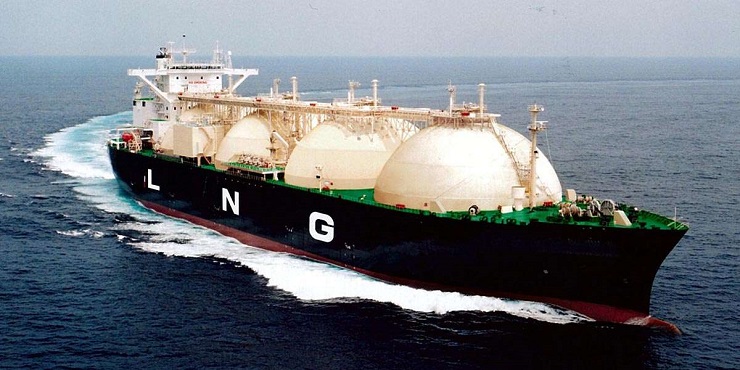
And this is confirmed by data from the Russian Federal Customs Service and the US Bureau of Economic Analysis, which clearly show reports on gas exports to Europe by the US and prove that it is the US that has been making more money than Russia on the super-high gas prices in recent months. Thus, the value of natural gas and LNG exported by Russia in January-August 2021 was $33.197 billion, compared with $42.9 billion worth of LNG exported by the US during the same period!
Most US gas supplies to Europe come under spot contracts (at exchange prices, quick purchase and payment and delivery by a certain date) concluded in December and January, when quotations in Europe were hitting record highs. As a result, traders now supplying American gas to Europe are making super profits. In January, they not only benefited from supplying Europe with gas produced in the US, but they also diverted volumes from the Middle Eastern and even Asian routes as a result of lower gas prices in the Asia-Pacific region (APAC).
As for Gazprom, it delivers, fulfilling its contractual obligations mainly under long-term contracts, i.e. at prices significantly lower than those on the stock exchange.
If LNG supplies result in lower gas prices in Europe, that market will automatically become uninteresting to US exporters, and Europeans themselves will have to go back to buying gas from the traditional suppliers. The panic mood in Europe is therefore now being artificially maintained by allegtions that Russia could cut off gas supplies because of the escalating situation around Ukraine. It is remarkable, however, that all the LNG supplies from the US have never managed to seriously depress gas exchange quotations in Europe, while any news of successful negotiations between Russia and the US or European leaders knocks prices down by $100-150.
As we know, the European gas market is the backyard of the global LNG market, dependent on the conditions in the APAC countries, where the market is physically larger. As soon as prices begin to fall in Asia, they also fall in Europe, and vice versa. In 2021, half of US gas exports went to Asia-Pacific and only a quarter to Europe. However, the diversion of LNG flows from the US to Europe could soon result in higher gas prices in the APAC, with US gas carriers heading back to Asia and European prices again breaking records for the benefit of the same European speculators and US traders, and to the misfortune of Europeans who will pay the price for Washington’s gangster gas policy.
Europe, with its substantial gas consumption and dozens of underutilized LNG import terminals, has long been of great interest to US companies, which have spent a total of $60bn on export infrastructure. There has been a real boom in the construction of LNG terminals in Europe too, under the influence of Washington, and they have even been built in Lithuania and Poland. However, no one can deny that LNG is expensive compared to pipeline gas from Russia. This is why, until recently, Europe was very enthusiastic about buying pipeline gas cheaply from Russia and why 75-80% of Europe’s LNG terminal capacity stood empty. In any case, the main criterion for assessing the prospects of US LNG as a competitor to Gazprom in Europe is price.
However, there have been some significant deteriorations in the gas market in recent weeks. Above all, they followed Russia’s receipt in late February of written confirmation of NATO’s and the United States’ refusal to engage in a dialogue with Moscow on security guarantees. This came against a backdrop where the West had previously blatantly refused to reassure Kiev’s rampant neo-Nazi authorities, who came to power in 2014 through a Washington-inspired coup. But for 8 years, at the instigation of Washington and with the tacit support of the West, the Kiev authorities have consistently pursued a policy of genocide in Donbas, where, according to incomplete information, they have killed more than 13,000 Russian-speaking civilians and pursued a policy of Russophobia. In addition, the Kiev authorities have recently intensified their neo-Nazi activities in the country and have made increasing threats of a potential nuclear weapon capability in Ukraine, in the hope of using which Kiev has already begun to develop far-reaching plans to attack Russia.
Under these conditions and in the absence of a proper Western response to the activities of the Kiev authorities, in late February Moscow was forced to launch a special operation in Ukraine to demilitarize and denazify it for reasons of self-preservation. In response, Washington and its Western allies unleashed an information war against Russia and slapped severe sanctions. Brussels, in a bid to please the Russophobic US political establishment, has refused to certify the already built Nord Stream 2, which could have significantly eased the situation on the European gas market. However, other Russian pipelines continue to operate and pump gas to Europe. Moreover, despite the misleading anti-Russian information warfare unleashed by Washington, Russian gas continues to flow through the Ukrainian gas transmission system without interruption, as reported by the Ukrainian transmission system operator itself. Gas supplies to Europe are not just flowing through the Ukrainian pipeline, they have also increased. The Europeans have increased their requests for supply and Gazprom has begun to pump through the Ukrainian pipe all of 109 million cubic meters of gas per day instead of 50 million cubic meters per day, as it was before the Russian special operation in Ukraine began, which is a doubling of supplies.
However, due to the depletion of European underground storage facilities due to winter weather, there is almost no gas left, forcing the EU to switch to current imports, which are “obligingly” offered by the US, which itself unleashed the crisis in Ukraine to, among other things, raise the price of gas in Europe. As for the Europeans, they are so far trying to move Russia’s hydrocarbon supplies out of the sanctions bracket, although individual European politicians, such as Borel, who openly “eat from Washington’s table”, have started talking about imposing additional sanctions against Russia in the gas sector as well, to please White House policy. At the same time, such European officials know full well that Russia is not going to use its gas as a tool against Europe. The EU has no substitute for that, by the way, and many of the world’s gas exporters have already spoken out about it. And the situation in Europe will only get worse for the population if the anti-Russian policy of the current European officials continues, threatening not only the impoverishment of the population, but also the bankruptcy of many European companies and even entire sectors of the economy.
At the same time, as Europe’s anti-Russian sanctions policy continues to escalate, it cannot be ruled out that Russia may eventually, in order to ensure its own security, use hydrocarbon supplies as a retaliatory measure if it considers Western sanctions to be disastrous for the Russian economy. But such actions will only lead to a clear victory for the United States over Europe, a further increase in its dependence on Washington, including on gas, and an even greater enrichment of the United States through its previously planned increase of gas prices in Europe by exacerbating relations with Russia.
Dutch internet providers block RT, Sputnik – media
RT | March 8, 2022
Several major Dutch internet providers have reportedly begun blocking websites belonging to RT English, RT UK, RT DE, RT France, RT Spanish, as well as Sputnik.
According to the ANP news outlet, the Netherlands’ Authority for Consumers and Markets (ACM) targeted the said Russian media, as they are on the EU’s sanctions list, which the bloc enacted in response to Moscow’s military offensive in Ukraine.
It is said that the ACM on Monday sent a list of undesirable media to internet providers,including VodafoneZiggo, KPN, and T-Mobile.
A VodafoneZiggo spokesperson told journalists that the company was indeed going to block the websites “as soon as possible, probably Tuesday,” with T-Mobile expected to comply soon as well.
KPN, while agreeing to restrict access to the Russian media, has made it clear that it is “fundamentally” against the idea of blocking any websites in general. A spokesperson for the provider clarified that KPN does not think it is up to them to “determine what is good and what is bad.” The company would want to see “net neutrality” instead.
Last Wednesday, the European Commission ruled that all RT channels, as well as Sputnik, be banned in all 27 member states over allegations of “systematic” disinformation regarding Russia’s military operation in Ukraine.
Commenting on the move, the EU’s top diplomat, Josep Borrell, said that “systematic information manipulation and disinformation by the Kremlin is applied as an operational tool in its assault on Ukraine.” The official went on to claim that the Russian outlets posed a “significant and direct threat to the Union’s public order and security.”
Meta, Google, YouTube, Twitter and TikTok are complying with the ban already, not displaying RT and Sputnik’s material in the EU member states.
On February 24, Russia launched a military offensive against Ukraine, with President Putin citing the need to “demilitarize and denazify” the country as well as to prevent Kiev from being dragged into NATO. Moreover, according to the Russian president, the Ukrainian government’s policies toward the Russian-speaking population in the Donbass republics were tantamount to “genocide.” Ukraine and the West, however, suspect that the Kremlin in fact wants to install a pro-Russian puppet government in Kiev, coming up with pretexts for an aggressive and “unprovoked” war.
US bans Russian energy imports
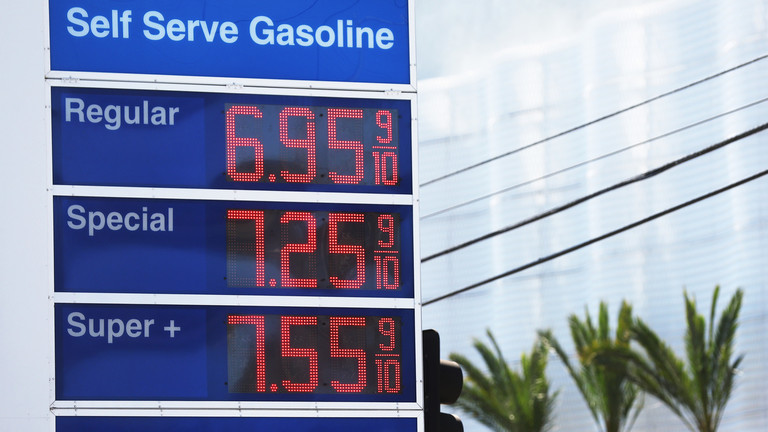
High gas prices displayed at a Mobil station on March 7, 2022 in Los Angeles, California. © Mario Tama / Getty Images
RT | March 8, 2022
US President Joe Biden has announced a ban on Russian oil and gas imports in response to the ongoing conflict in Ukraine on Tuesday, a move that threatens to send global gas and oil prices even higher than the record-setting costs the commodities are already fetching.
The president called on the nation to use the events as an opportunity to transition to renewable energy, insisting that if “no one has to worry about the price at the gas pump in the future, tyrants like Putin won’t be able to use fossil fuels as weapons against other nations.”
Biden warned oil and gas companies against jacking up prices unnecessarily, declaring that while “Putin’s war against ukraine is causing gas prices to rise… it’s no excuse to exercise excessive price increases or padding profits or any kind of effort to exploit the situation or American consumers.”
“Russia’s aggression is costing us all, and it’s no time for profiteering or price-gouging,” Biden said, hailing the blanket ban on all imports of Russian oil and gas as “another powerful blow to Putin’s war machine.”
Americans will have to pay “the price of freedom” in the coming weeks as the sanctions are expected to send energy prices soaring worldwide, Senator Chris Coons (D-Delaware) told CNN on Tuesday ahead of the sanctions announcement.
The Democratic senator warned that the price of oil could very well double to $300 per barrel, with gas prices more than tripling to $10-$14 per gallon.
The repercussions from the price shock will be felt worldwide, he continued, as costs continue to surge. Acknowledging that “the strength of our sanctions, of the costs we’re imposing on Putin… are more successful and more sustainable when they’re coordinated,” he praised the administration for working together with Europe on the looming import ban instead of pushing ahead unilaterally.
“We have to realize that it’s a global integrated market, it is tough to just turn on the taps and increase production quickly – it’s not like phoning up Amazon,” he explained, cautioning “we are going to see increased gas prices here in the US, in Europe they will see dramatic increases in prices, that’s the cost of standing up for freedom and of standing alongside the Ukrainian people. We need to see the cost and benefit here.”
The senator also admitted the White House has been in negotiations with its once-sworn enemies in Venezuela and Iran, two major oil producers Washington is suddenly seeing in a new light for their potential to bail out countries soon to be running on empty in the absence of Russian energy supplies, but argued the focus should be on Canada first. However, he acknowledged Putin “had Western Europe over a barrel” – literally and figuratively – regarding the highly sought-after commodities.
Russia is the second-largest oil exporter in the world, while the US is the largest oil consumer. While Moscow supplies only about 7% of US oil, Europe is much more heavily reliant on the nation for its energy supplies.
Fresh polls claim that Americans are willing to pay more at the pump in order to stick it to Putin. A Quinnipiac survey conducted over the weekend, which found 71% of Americans supported a ban on Russian oil even if it led to higher gas prices. More than half of respondents (56%) even suggested the US hadn’t gone far enough with its sanctions and called for tougher moves.
Russia blocks Facebook
The ban comes in retaliation to the platform’s efforts “to restrict access to Russian media”
RT | March 4, 2022
Russian media regulator Roskomnadzor imposed a blanket ban on Meta’s Facebook social media platform on Friday. The decision was taken in response to Facebook blocking access to Russian media outlets, the watchdog said in a statement.
“Since October 2020, we have reordered 26 cases of discrimination against Russian media and information resources by Facebook,” the statement reads.
“In recent days, the social network has limited access to the accounts of the Zvezda TV channel, the RIA Novosti news agency, Sputnik, Russia Today, Lenta.ru, and the Gazeta.ru news outlets.”
Meta blocked access to accounts belonging to RT and Sputnik in the EU earlier this week, accusing the outlets of serving as a “propaganda arm.” Over the past week, Western private-owned tech giants and multiple government entities took action against Russian state-funded and state-affiliated outlets.
Google, for instance, restricted access to content by outlets owned by the government media holding Rossiya Segodnya on Google Discover and Google News. The holding blasted the move as “information manipulation.”
The renewed push against Russian state-affiliated media, which has been repeatedly targeted in the West for years already, comes amid the offensive in Ukraine that was launched by Moscow last week. Russia said it was the only option to end the bloodshed in Ukraine’s east, where the Kiev forces have been struggling with the breakaway republics of Donetsk and Lugansk for some eight years already.
Donetsk and Lugansk split from Ukraine after the 2014 Maidan coup, which ousted the country’s democratically-elected government. The new Kiev authorities launched a military operation to quell the unrest, leading to years of low-intensity warfare in the region.
Ukraine War reveals ugly face of Western Europe’s anti-Russian racism
By Paul Antonopoulos | March 4, 2022
No matter one’s opinion of Russian President Vladimir Putin and the war in Ukraine, it appears that the famous “tolerant liberal West” are using the war to express their most disgusting Russophobic racism and dehumanization of the Russian people. With Russian troops pouring into Ukraine, Western liberals excitedly used this as an opportunity to cancel Russian art, history and cultural contributions to humanity. This is occurring at humiliating proportions and has a more dangerous dimension as even simple Russian shop owners in Western Europe are being targeted in racist attacks.
Russia has already been stripped from hosting the Champions League football final and Formula One’s Russian Grand Prix – with much hypocrisy. The Grand Prix did not condemn Russia but cited the “impossibility” of holding the race under the current circumstances. It now appears the event will be hosted in Turkey, where there is no “impossibility” for race organizers despite the country’s illegal occupation of Cyprus, Syria and Iraq.
This was followed by Russian and Belarussian athletes being banned from competing in the 2022 Beijing Winter Paralympics. Although the International Paralympic Committee [IPC] announced that competitors from both countries would be permitted to take part, albeit under a neutral banner, this was not satisfactory for Ukrainian athletes who issued a joint statement accusing Paralympic bosses of “choosing bloodshed over principle.” Apparently for the Ukrainian athletes, even just the very presence of a Russian or Belarussian – no matter their political positioning or opinion of the Ukraine War, is enough to warrant complaints in evident racism. None-the-less, the IPC succumbed to the pressure and even flagless Russians cannot compete now.
However, it is not only in the sporting arena where Russians are being embargoed, targeted and restricted.
The European Broadcasting Union (EBU) said Russia would no longer be allowed to participate in this year’s Eurovision song contest; Britain’s Royal Opera House cancelled a planned residency by Moscow’s Bolshoi Ballet, one of the oldest and most prestigious ballet companies in the world; and the Ukrainian Film Academy has called for an international boycott of Russian cinema, including a ban on Russian films at international festivals.
Although banning Russians from participating in sports competitions and cancelling current events is an immediate response to the War in Ukraine, there are much darker undertones that aim to even smear and cancel “dead Russians.” What is meant by this?
On March 2, Italian journalist Alessandra Bocchi tweeted: “Italy’s main University in Milan just banned teaching Fyodor Dostoevsky because he’s a Russian writer. Dostoevsky was sent to a Siberian labour camp for reading banned books in Tsarist Russia. We are reaching levels of hatred and stupidity that I thought were never possible.” At time of publication, nearly 35,000 people had retweeted her, easily one of the most viral social media posts of the day.
The University of Milano-Bicocca informed the Italian writer Paolo Nori on Tuesday night that his course on the author of Crime and Punishment had been cancelled “to avoid any controversy, in a moment of high tension.” Nori on an Instagram live video read the email and slammed the university’s decision as “ridiculous”, saying “even dead Russians” are now the target of censorship in Italy. After the justified backlash, the course on Dostoevsky was approved to go ahead as originally planned and the rector of the university said he would be meeting Nori next week “for a moment of reflection.”
However, it is not only sports stars, entertainers, artists and dead authors who are being targeted, but even Russian students in France, Belgium, Czechia and other European Union countries where they have been expelled. The irony is that many of these Russian students are liberal and anti-Putin but are now being driven away by Western liberals from the liberal West.
This demonstrates that the so-called tolerant liberal West does not only have a hatred for Putin, but also for all Russian people, culture and art. After many years of normalizing the demonization of Russians in the media, the Ukraine War has provided the perfect opportunity for Russophobes to openly express their racism knowing that they will face little recourse.
None-the-less, no matter one’s opinion of Putin and the Ukraine War, this crisis has exposed the ugly head of Russophobic racism, something that has culminated for years in Western media and its political landscape, particularly during and after the so-called “Russiagate” incident.
Paul Antonopoulos is an independent geopolitical analyst.
On Ukraine, Biden’s State of the Union address was just ‘good vs. evil’
By Scott Ritter | RT | March 3, 2022
Biden’s simplistic “good versus evil” pronouncements on the Russian-Ukraine conflict did little to prepare America for the consequences of declaring economic warfare against the Russian state.
It wasn’t surprising that Russia’s ongoing military incursion into Ukraine topped the list of issues addressed by US President Joe Biden in his first State of the Union (SOTU) address, delivered on March 1, 2022, to a joint session of Congress.
Biden pitched the Ukraine crisis as a defining moment in modern history, a problem that could only be resolved with American leadership, both at home and abroad. His job during his address was to convince both domestic and foreign viewers alike that he was the man for the job.
He repeated the time-tested mantra that held that Russia and its president, Vladimir Putin, constituted a threat to democratic principles at home and abroad. This was especially true, he said, when it came to Ukraine.
There was nothing new in what Biden told his audience – the same words and themes had been deployed many times over in the past week. He pushed the same buttons – Putin as the personification of “autocratic oppression,” leading a Russia addicted to power, hell-bent on forcefully absorbing the nation of Ukraine into the Russian orbit.
He likewise pulled at the heartstrings of America, talking about Ukraine’s embattled leader, Volodymyr Zelensky, and the heroic resistance of his people in the face of overwhelming Russian power. The United States stood fully behind them, Biden said. This sentiment was shared by many in the audience as the president spoke. They held small Ukrainian flags or wore the nation’s blue-and-yellow colors. But this support, he said, had its limits – the US, he declared, would not send a single soldier to Ukraine to fight for its cause.
The fact was, Biden was abandoning it to its fate. While praising the courage and leadership of the Ukrainian president, he said, “Let me be clear, our forces are not engaged and will not engage in conflict with Russian forces in Ukraine. Our forces are not going to Europe to fight in Ukraine, but to defend our NATO allies in the event that Putin decides to keep moving west.”
There is no evidence that Russia intends to “keep moving west.” And while Biden spoke of the important leadership role played by the US in Europe, the fact remains that Europe is a veritable prisoner to the whims of any US president, whose pronouncements take on the weight of law whenever they are uttered.
Neither Europe nor the United States, it seemed, would be intervening on behalf of Ukraine against Russia. Zelensky and Ukraine were on their own, their only choice for national relevance being to commit suicide on the international stage while the West, from the safety of their homes and offices, cheered them on like bloodthirsty Romans watching gladiators do battle in the Colosseum.
The major takeaway from Biden’s SOTU address? Ukraine will lose this war, and the West will do nothing to stop that fact.
While Biden lionized Ukraine and its beleaguered president, he failed to explain to the American people why there was a war, beyond the sophomoric argument that “Putin did it.” No talk of America’s role in the Maidan back in 2014, no discussion of the role played by Ukrainian right-wing ultra-nationalists in oppressing the Russian-speaking population of Ukraine, no mention of the shelling of the breakaway Donbass region, no discussion of the role that NATO expansion played in creating an untenable security situation for the Russian state.
Simplistic jingoism plays well in atmospheres such as televised political addresses, where a captive audience is compelled to rise and applaud made-for-TV pronouncements lest they be singled out for public criticism by a fawning, vindictive corporate media. The cheer-fest the SOTU has become would give any Brezhnev-era meeting of the Presidium a run for its money when it comes to mindless standing ovations.
But it was here, in the orgy of self-congratulation that is the interplay between president and Congress where America’s weakness in its conflict with Russia was exposed. As united as everyone seemed to be about sacrificing Ukraine on the altar of Russia-bashing, it was clear Congress was deeply divided from Joe Biden on issues of domestic policy, especially when it came to the economy of the US. While the US president may not want to engage Russia in a shooting war in Europe, he has embarked on a great global crusade to destroy it economically. And the tepid response the political opposition gave to his pronouncements underscores the reality that the US is not prepared for the consequences of his declaration of open economic war with Russia.
Let there be no doubt: Russia will win the shooting war in Ukraine. This outcome is inevitable, given the reality that Ukraine has been abandoned by its erstwhile partners in the West. Yet the conflict between Russia and the West won’t end when the last bomb explodes on Ukrainian soil, but when, in the mindset of the US and its European partners, the Russian economy is destroyed and Putin is humiliated and diminished as a political force, domestically, regionally, and globally.
Here, the US president did the American people a great disservice, selling them a feel-good struggle in which Ukraine is promoted as the glorified martyr and Russia demoted as the evil oppressor. A bloodless conflict – from the US perspective, at least – that will be won simply by shutting down the Russian economy by remote control. It won’t be that simple.
Russia has yet to respond to the US-led economic war being waged against it. When it does, rest assured that these sanctions Congress so enthusiastically applauded will prove to be a double-edged sword – one that will cut into a US economy still reeling from the consequences of the Covid pandemic. When that time comes, President Biden could find that many of those politicians who rose to their feet to cheer on the sacrifice of Ukraine will turn on him.
War, it is said, is but an extension of politics by other means. Given the deep partisan political divide that exists in the US when it comes to the economy, it is clear neither Biden nor the American public is ready for what is about to happen when the consequences of their anti-Russian hysteria finally comes home to roost.
Scott Ritter is a former US Marine Corps intelligence officer and author of ‘SCORPION KING: America’s Suicidal Embrace of Nuclear Weapons from FDR to Trump.’ He served in the Soviet Union as an inspector implementing the INF Treaty, in General Schwarzkopf’s staff during the Gulf War, and from 1991-1998 as a UN weapons inspector.
Featured Video

The Truth About the Trump Shootings with Ken Silva
or go to
Aletho News Archives – Video-Images
From the Archives
Trans ‘milk’ as good as the real thing – NHS
RT | February 18, 2024
The drug-induced nipple secretions of trans women are as good as mothers’ breast milk for babies, the University of Sussex Hospitals NHS Trust claimed in a letter to campaigners made public in a report by British think tank the Policy Exchange on Sunday.
The healthcare trust’s medical director, Rachel James, argued that the off-label prescription drug cocktail men transitioning to female take in order to produce milk was “similar to the natural hormones which encourage lactation to develop when the baby is newly born.”
“The evidence which is available demonstrates that the milk is comparable to that produced following the birth of a baby,” James wrote in the letter, sent to Children of Transitioners last August.
Biological men who wish to lactate must first take hormones to grow milk glands and then take high doses of either domperidone or metoclopramide to stimulate milk production. Neither drug is approved for this use, though they are occasionally prescribed off-label to biological women who have trouble lactating.
However, domperidone’s own manufacturer, Janssen, warns patients the drug “may cause unwanted side effects affecting the heart in a breastfed baby” and “should be used during breastfeeding only if your physician considers this clearly necessary.” … continue
Blog Roll
 Aletho News
- Seyed M. Marandi: U.S. Strike Imminent – Toward Total War in the Middle East
- Russia Voted Under Fire. Washington Is Loading the Tankers.
- 12 Things Your Oncologist Was Trained Not to Tell You
- Anthrax Attacks Paved Way for COVID-Era ‘Junk Drugs and Vaccines’
- How Real Is the Impact of Western Sanctions on Israel?
- France, You Are Guilty: How Paris Turned Western Sahara into the Maghreb’s Powder Keg
- 2025 Nature Paper Claiming Worsening Global Drought Gets RETRACTED …Heavily Flawed
- Your Milk Is Not the Problem
- The Truth About the Trump Shootings with Ken Silva
- ARE PATIENTS BEING PROPERLY INFORMED ABOUT OZEMPIC?
- If Americans Knew
- An error has occurred; the feed is probably down. Try again later.
- No Tricks Zone
- 2025 Nature Paper Claiming Worsening Global Drought Gets RETRACTED …Heavily Flawed
- New Study: ‘Global Drought Shows No Detectable Recent Acceleration Under Climate Warming’
- Economic Masterminds: German Socialists Suggest Taxing Productivity Gains Stemming From Using AI
- The South China Sea Has Not Been Cooperating With The Climate Change Narrative
- Energy Crisis: Germany Enters Heating Season With Historically Low Gas Reserve Fill Levels
- New Study: The Antarctic Ice Sheet Gained Mass From 2020-2024 Due To Staggering Snow And Ice Accumulation
- Study: Ocean Heating Rates From Thousands Of Years Ago ‘Dwarf’ Modern Ocean Heating Rates
- Climate Extremists Target, Attack Large-Scale Power Grid Infrastructure In Germany!
- New Study: Antarctic Ice Melt Has Contributed Less Than 1 Centimeter To Sea Level Rise In The Last 30 Years
- Fear Of Debate: Alarmist German Climate Scientist Calls On Mainstream Media To Discredit Skeptic Voices
 Aletho News