Is Joe Biden Enabling Russiagate 2?
His national security team provides the script
By Philip Giraldi | Unz Review | March 23, 2021
The old expression that “lightning never strikes the same place twice” is frequently used in the aftermath of a truly awful experience, meaning that the odds are that something exactly like that will never occur again. Unfortunately, however, we Americans will now have to endure lightning striking twice due to the emergence of President Joe Biden and whoever is telling him what to say. I am referring specifically to Russiagate, which is possibly the single most discredited bit of politically motivated chicanery that this country has seen in the past twenty years. Joe is relying on the “evidence” provided by a conveniently timed new declassified “Intelligence Community Assessment” entitled “Foreign Threats to the 2020 US Federal Election.” The document was dated March 10th but released by Director Avril Haines of the Office of National Intelligence (ONI) on March 16th.
The new report consists of eleven pages of text and charts. It specifically discounts any direct evidence to alter votes electronically, but asserts that Russian President Vladimir Putin personally directed his spies and proxies to turn the US election in favor of Donald Trump. Based in part on the report, Joe Biden subsequently labeled Putin a “killer” and vowed that both Russia and its president would “pay a price” which we will be “seeing shortly” for their claimed meddling in American politics. The Bidenesque grotesque overreach has led to the Kremlin recalling its ambassador in Washington home for “consultations” and will at a minimum put US forces in the Middle East at risk.
Does it sound more than a bit like the Democratic Party is still looking for revenge for 2016? You bet, and the name calling that took place during the 2020 campaign made it predictable that they would turn on Russia as soon as an opportunity presented itself, if only because it is always convenient to have a foreign enemy to blame one’s own failings on. And there is also payoff personally for Joe and his sons in the report, which strongly suggests that the claims and evidence of Biden family corruption were actually just disinformation put out by the Kremlin’s spy agencies.
Anyone who reads the report and tries to assess its credibility from the viewpoint of the evidence that it presents to make its case will notice that there is very little solid to back up the conclusions, which themselves are weasel worded. The report in fact concludes with the disclaimer “Judgments are not intended to imply that we have proof that shows something to be a fact.” There is, to be sure, no evidence that even a single vote was changed or that anyone succeeded in influencing any persons or policies that emerged from the election. And, as a former CIA field officer, I found that whoever drafted the final report in the Office of the Director of National Intelligence (ODNI) really doesn’t have a clue regarding how and why nations spy on each other, much less still how one runs what it is referred to as “covert action.”
The most important key judgement of the report, number two, reads as follows: “We assess that Russian President Putin authorized, and a range of Russian government organizations conducted, influence operations aimed at denigrating President Biden’s candidacy and the Democratic Party, supporting former President Trump, undermining public confidence in the electoral process, and exacerbating socio-political divisions in the US.”
Every foreign government with an external intelligence capability, including that of the United States, does exactly what Russia is being accused of. If there is another country that is either seen as an adversary or even a threat, the intelligence agencies will attempt to influence opinion of the public and elites in that country to avoid their doing things that do damage to one’s own interests. That is accomplished through placements in the media and direct contact with influential politicians in the country being targeted. As the Russians correctly saw a Democratic victory as detrimental to their interests, it is inevitably that they should use their own media resources to surface alternative views that might help the other candidate, in this case Donald Trump.
Lying is, after all, a traditional role for intelligence services. The Romans had a spy service run out of the imperial palace that provided military and political intelligence all across their vast empire. It included what might be called deception operations carried out to confuse enemies about intentions and capabilities. In more recent centuries, the British became masters of both spying and deception. Major influencing intelligence operations run against the United States can be credited with having led to American involvement in both world wars.
Currently, the world’s preeminent spy agency in terms of manpower, resources and global reach is undoubtedly the Central Intelligence Agency (CIA). That is not to suggest that it is necessarily the best intelligence agency, as smaller, more nimble, focused organizations can outperform the spies from the large countries in the niche areas that they consider important.
America’s federal government’s various intelligence agencies are in fact into deception big time, so much so that they have a number of euphemisms that permit them to lie about lying. The CIA regards spreading false information as part of its “covert action” activity while the military prefers variations on “perception management.” Both occasionally refer to “influence” or “influencing” operations. Either way, it is in reality a form of “information warfare” in which words and ideas are used to shape a perspective favorable to the country engaging in the practice and damaging to one’s adversaries.
The United States Department of Defense defines “perception management” as “Actions to convey and/or deny selected information and indicators to foreign audiences to influence their emotions, motives, and objective reasoning as well as to intelligence systems and leaders at all levels to influence official estimates, ultimately resulting in foreign behaviors and official actions favorable to the originator’s objectives. In various ways, perception management combines truth projection, operations security, cover and deception, and psychological operations.” In other words, perception management is a multi-tasked mechanism designed to get an adversary to think or believe what one wishes, no matter what the truth actually is.
The CIA has historically disseminated disinformation primarily through press placements, using agents and collaborators worldwide to circulate stories that were presumed to be supportive of presumed U.S. interests. When possible, local politicians or journalists might be recruited and paid to support the effort, but the ODNI report does not accuse the Russians of doing that. In fact, given the U.S. disinformation efforts vis-à-vis Venezuela, Iran, China and regarding Russia itself, it would be wise to consider that the largest portion of disinformation circulating on the internet is produced by the United States government itself. And when all of that doesn’t work, the U.S. is more than willing to directly interfere in foreign elections. In fact, it has played an active role in elections worldwide, up and including regime change in places like Ukraine, at least 81 times according to its own publicly available data.
The ODNI report also mentions other countries that “interfered” or attempted to do so in 2020, naming Iran as a Biden supporter in Key Judgment Three: “We assess that Iran carried out a multi-pronged covert influence campaign intended to undercut former President Trump’s reelection prospects— though without directly promoting his rivals— undermine public confidence in the electoral process and US institutions, and sow division and exacerbate societal tensions in the US.” China was let off this time around, with the assessment even conceding that there was no evidence that it had been involved in the election, but reports from Washington suggest that it will be sanctioned anyway, along with Iran and Russia as a consequence of being out of favor with the White House and Congress.
One suspects that in drafting up the report the neoconnish Avril Haines saw what she wanted to see because there is scant evidence to condemn the behavior of either Russia or Iran acting in their own interests without breaking into voting machines or suborning officials. Even the New York Times in its own reporting on the “Assessment” included a judgement taken directly from the document, that “Russian state and proxy actors who all serve the Kremlin’s interests worked to affect U.S. public perceptions” before admitting that “The declassified report did not explain how the intelligence community had reached its conclusions about Russian operations during the 2020 election. But the officials said they had high confidence in their conclusions about Mr. Putin’s involvement, suggesting that the intelligence agencies have developed new ways of gathering information after the extraction of one of their best Kremlin sources in 2017.” In other words, the Times is taking the assertions in the report as an act of faith as it has no idea what evidence actually supports the claims that are being made.
To be sure the release of the report was welcomed by the usual players in Congress, including Adam Schiff, Chairman of the House Intelligence Committee, who enthused that “The American people deserve to know the full truth when a foreign government seeks to interfere in our elections, and today’s release of the Intelligence Community’s Assessment is an important step.” Schiff predictably does not know what “interfere” means, for which there is no evidence, and he exhibits no curiosity about the report’s omission of the one country that does regularly interfere in American elections down to the local level. That country is, of course, Israel, which Noam Chomsky has referred to, observing that “Israeli intervention in U.S. elections ‘vastly overwhelms’ anything Russia has done.” It seems that Biden, Haines and Schiff all missed that little detail.
So here we go again. New president, new national security team, same old nonsense. Russiagate one more time around will not render the entire argument being made about a vast conspiracy to destroy democracy any more credible. Yeah, nations spy on each other and try to influence things their way but get over it. If the whole world is out to “get” the United States it just might be because the whole world has finally realized that Washington is neither exceptional nor a force for good. Leave everyone else alone and they will leave you alone. That’s a law of nature.
Philip M. Giraldi, Ph.D., is Executive Director of the Council for the National Interest, a 501(c)3 tax deductible educational foundation (Federal ID Number #52-1739023) that seeks a more interests-based U.S. foreign policy in the Middle East. Website is https://councilforthenationalinterest.org address is P.O. Box 2157, Purcellville VA 20134 and its email is inform@cnionline.org
Putin’s secret kill list revealed by anonymous & erratic ‘spy’ sources beloved by Western media
RT | March 22, 2021
Russia’s security agencies are set for a busy few months planning a bloody Godfather-style killing spree to take out political opponents across the West, two of the UK’s best-read tabloids have claimed in an explosive new expose.
Popular red-top newspapers the Sun and the Mirror ran the sensational allegations over the weekend, in which President Vladimir Putin was said to be plotting a post-pandemic assassination campaign against a “kill list” of targets, six of whom live in Britain.
Former Yeltsin-era oligarch Mikhail Khodorkovsky and one-time Moscow-based vulture capitalist Bill Browder are supposedly being earmarked for a hit by the FSB and SVR, Russia’s domestic and foreign intelligence agencies. Christopher Steele, the MI6 analyst who compiled a dossier of anonymous sources alleging Moscow’s spooks had ‘kompromat’ on ex-US president Donald Trump, is also apparently among those on the list.
However, the story may prove to be based on more tenuous sources than Western media outlets seem prepared to admit. The Sun writes up the revelations as coming straight from the mouth of “a Russian intelligence official,” leaving readers to imagine a reverse modern-day Kim Philby type character has broken his silence.
As the Mirror makes clearer, the anonymous supposed spook at the heart of the top-secret operation has reportedly taken “complex measures” including putting messages on USB sticks and using burner mobile phones to communicate with the West. The one document published to support the allegations is a rambling, strangely phrased and hand-redacted excerpt in which the source insists the plot comes straight from Putin.
This Cold War intrigue is made all the stranger given the source has decided to tip off one of the purported targets of the scheme, telling a high-profile individual that “they are out to shut you up completely. Take the precaution of quickly changing your place of residence, even if only temporarily.”
Given the cloak-and-dagger communications, there is no way of independently verifying whether the source is actually a security officer rather than, for example, an internet hoaxer or a crackpot conspiracy theorist.
It seems unlikely that, if there was indeed a mole inside Moscow’s spy agencies, his or her warnings would be revealed, alerting bosses to that fact and sparking an internal manhunt. Even less clear is why intelligence agencies would allow invaluable intel to be used for a scaremongering front-page splash.
Within the reports, there is also a curious warning that a black ops team is gathering in Ireland, ready to cross into Britain to carry out the plan. Quite why the Emerald Isle makes for the best staging ground, given direct flights from Russia haven’t been operating for the best part of a year during the pandemic, was unclear. It is also possible that a newly arrived group of elite Russian assassins carrying sniper rifles in violin cases might stand out in locked-down Dublin.
Despite the inconsistencies, the strange communique has sparked outrage online and was reported with little to no nuance by conspiracy-loving reporters. At least one of those listed as a target has also, unsurprisingly, expressed concern. However, based on the erratic nature of the supposed leak, it appears unlikely that they need to change their names and go into hiding just yet.
THE RUSSIAN HYDRA
By Paul Robinson | IRRUSSIANALITY | March 16, 2021
If you want to understand international affairs but only have time to read one academic article, the one I’d recommend would be Robert Jervis’ “Hypotheses on Misperception,” published in World Politics in 1968. It contains 14 hypotheses about how states misperceive one another, creating many of the problems which endanger international security. None of it is exactly rocket science, but it’s the kind of obvious truth that needs to be said, and then repeated over and over again, because people seem to be unable to take it in.
I give the article to students in my defence policy course so we can discuss things such as “Hypothesis 8 is that there is an overall tendency for decision-makers to see other states as more hostile than they are,” and “Hypothesis 9 states that actors tend to see the behavior of others as more centralized, disciplined, and coordinated than it is.” Obvious stuff, as I said, but it comes in useful when we move on to discuss other matters such as this week’s class topic, which was hybrid warfare.
Long-term readers of this blog will know that I’m not a fan of the concept of hybrid warfare, but as it’s something students of defence policy will hear a lot about I kind of have to discuss it, for which purpose I googled around looking for suitable diagrams to use to explain the idea. In the process, I came across this one that accompanied an interview a couple of years ago with a guy called Mark Voyger who was at one time a special advisor to Lieutenant General Ben Hodges, the former Commanding General of US Army Europe.

I thought this depiction of the Russian ‘hydra’ with multiple tentacles emanating from a central core to attack the ‘target nation’ was great because it so clearly demonstrates hypotheses 8 & 9 mentioned above, as well as highlighting the absurdity of the hybrid warfare concept.
For what it does is label absolutely everything ‘war’. Intelligence, diplomacy, law, social-cultural activities, cyber, information, energy, economic relations, infrastructure, crime, and conventional military forces are not just intelligence, diplomacy, law etc. They’re WAR!! Which if you think about it is kind of odd. Isn’t diplomacy meant to be kind of the opposite of war? Why are social-cultural activities (e.g. cultural exchanges) war? Why are information or economic relations war? It’s an extraordinarily paranoid view of the world, in which everything another state, or its citizens do, is part and parcel of a campaign to destroy us from within. They don’t trade with us to get rich. No, they trade with us to subvert us! And so on.
In short, the hybrid warfare concept is pretty much an embodiment of hypothesis 8, allowing those who propagate it to exaggerate threats, and make just about everything a matter of security. That, if you think about it, is more than a little scary. Trade, diplomacy, culture, etc. shouldn’t be securitized. But it’s also conceptual dodgy – after all, when everything is war, then the term war loses any meaning as something distinct.
Beyond that, the Russian hydra model in the diagram above perfectly illustrates hypothesis 9 – i.e. the tendency, “to see the behavior of others as more centralized, disciplined, and coordinated than it is.” For in the diagram, all the tentacles come out of a single core, suggesting that the Russian political leadership is coordinating everything everybody in Russia does and directing it towards a single common purpose – destroying the “target nation.” Which is of course absurd – not only does it exaggerate the Russian state’s power and abilities, but it also ignores the fact that many of those engaged in activities such as cultural exchanges, trade, the media, etc., etc., are following their own agendas not those of the state.
Unfortunately, the hydra model seems quite well entrenched in Western thinkers’ minds. I was looking today at the British government’s new review of foreign and defence policy, and it had the following to say:
A more integrated approach supports faster decision-making, more effective policy-making and more coherent implementation by bringing together defence, diplomacy, development, intelligence and security, trade and aspects of domestic policy in pursuit of cross-government, national objectives. The logic of integration is to make more of finite resources within a more competitive world in which speed of adaptation can provide decisive advantage. It is a response to the fact that adversaries and competitors are already acting in a more integrated way – fusing military and civilian technology and increasingly blurring the boundaries between war and peace, prosperity and security, trade and development, and domestic and foreign policy.
You get it – foreign, “malign” states have fully integrated policies, “blurring the boundaries between war and peace” by coordinating defence, diplomacy, trade, etc., etc, in a seamless strategy of aggression.
And here we run into another danger of the hybrid warfare theory. On the basis of the myth of the hybrid ‘hydra’, Western states are now arguing that they need to become the hydra themselves. I can’t see it ending well.
Russian company hit by Biden’s ‘chemical weapons’ sanctions says US left firm in ‘economic Guantanamo’ without trial
RT | March 16, 2021
The head of a scientific equipment supplier targeted by officials in Washington over supposed links to a shadowy Russian “chemical weapons” program has insisted the US’ accusations are untrue and it’s being unfairly singled out.
Andrey Mezinov, Director General of Femteko LLC, a Moscow-based wholesaler specializing in technical supplies, described how he was surprised to discover the firm among a list of organizations facing new sanctions from America. In an interview with business outlet RBK published on Tuesday, he said “we are accused, as I understand it, of supporting the production and development of chemical weapons… this is just nonsense.”
According to the businessman, far from participating in the alleged development of deadly toxic agents, Femteko has only ever done business with defense research institutes in the country on two occasions. This included “spare parts for the detector of a gas chromatograph” for a laboratory at the 27th Scientific Center of the Ministry of Defence, which also found itself on the sanction list. The equipment is used in laboratories throughout the world to analyze the content of gases, and the 2017 delivery was reportedly worth only 408,000 rubles ($5,590).
Last July, the firm also supplied forensic laboratory bottles to the State Research Institute of Organic Chemistry and Technology, for a total cost of 86,000 rubles ($1,180 ). “We knew what these would be used for,” Mezinov said, “but to say that the sale of such bottles supports the distribution [of chemical weapons]…”
While these purchases were made publicly accessible through tender processes and other documents, Mezinov insists that there was no off-the-books dealings with defense research institutes. However, he accepts that the equipment could potentially be used in a way that is undesirable for the US, “because we supply equipment that is versatile.” He added that, “most often it is used in the pharmaceutical industry, for the analysis of environmental substances, as well as in forensics, medicine, acute poisoning centers, anywhere.” At the same time, Femteko has also done business with US firms, and received clean bills of health as part of due-diligence inquiries.
The business is now reportedly weighing up its legal options and considering how best to extricate itself from the list of sanctioned organizations. In theory, Mezinov said, he could overcome the measures by simply shutting the business and transferring its assets to a new one with a different name, but at present, US officials are “engaged in the most obvious lawlessness.” Comparing the current state of affairs to “economic Guantanamo,” a notorious US prison for suspected terrorists on the island of Cuba, he added that “I would like to receive explanations and by my own means prove the injustice and illegality of this decision.”
Femteko was among nine Russian firms included on the list of organizations that Washington claims are involved in an alleged secretive chemical weapons program, as well as three based in Germany and one based in Switzerland. At the time, American authorities said that the businesses were engaged in “the production of biological and chemical weapons,” as well as “activities that are contrary to US national security and foreign policy interests.”
Kremlin spokesman Dmitry Peskov has insisted that the US claims are not based in reality. “Russia declared and verified the destruction of all chemical weapons on its territory many years ago and fully complied with international conventions,” he said. “Russia has no chemical weapons.”
How Do Big Media Outlets So Often “Independently Confirm” Each Other’s Falsehoods?
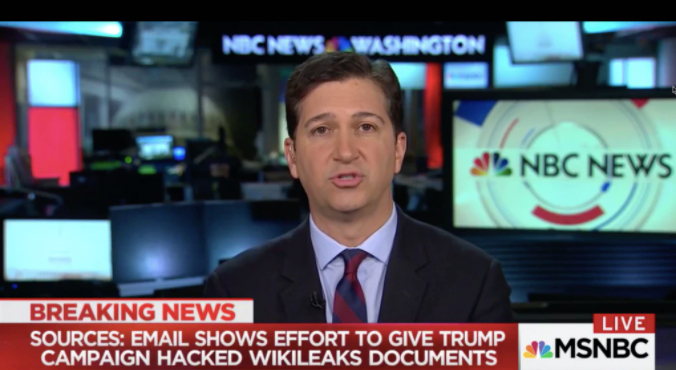
NBC News’ national security reporter and long-time de facto CIA spokesman Ken Dilanian purporting to “independently confirm” a false CNN story, Dec. 8, 2017
By Glenn Greenwald | March 16, 2021
There were so many false reports circulated by the dominant corporate wing of the U.S. media as part of the five-year-long Russiagate hysteria that in January, 2019, I compiled what I called “The 10 Worst, Most Embarrassing U.S. Media Failures on the Trump-Russia Story.” The only difficult part of that article was choosing which among the many dozens of retractions, corrections and still-uncorrected factual falsehoods merited inclusion in the worst-ten list. So stiff was the competition that I was forced to omit many huge media Russiagate humiliations, and thus, to be fair to those who missed the cut, had to append a large “Dishonorable Mention” category at the end (note: the Intercept’s site seems to be down for the moment, rendering that first link inoperable).
That the entire Russiagate storyline itself was a fraud and a farce is conclusively demonstrated by one decisive fact that can never be memory-holed: namely, the impetus for the scandal and subsequent investigation was the conspiracy theory that the Trump campaign had secretly and criminally conspired with the Russian government to interfere in the 2016 election, primarily hacking into the email inboxes of the DNC and Clinton campaign chief John Podesta. And a grand total of zero Americans were accused (let alone convicted) of participating in that animating conspiracy.
The New York Times’ May, 2017 announcement of Robert Mueller as special counsel stated explicitly that his task was “to oversee the investigation into ties between President Trump’s campaign and Russian officials” and specifically “investigate ‘any links and/or coordination between the Russian government and individuals associated with the campaign of President Donald Trump.’”
The related secondary media-created conspiracy theory was that the Kremlin clandestinely controlled U.S. political institutions by virtue of sexual and financial blackmail held over President Trump, which they used to compel him to obediently obey their dictates. “I don’t know what the Russians have on the president, politically, personally, or financially” was the dark innuendo which House Speaker Nancy Pelosi and her media allies most loved to spout. “Prestige news” outlets created their own Q-Anon-level series of art designed to implant in Americans’ minds a slew of McCarthyite imagery showing the Kremlin (or an iconic Moscow cathedral they mistook for the Kremlin) having fully infiltrated Washington’s key institutions.
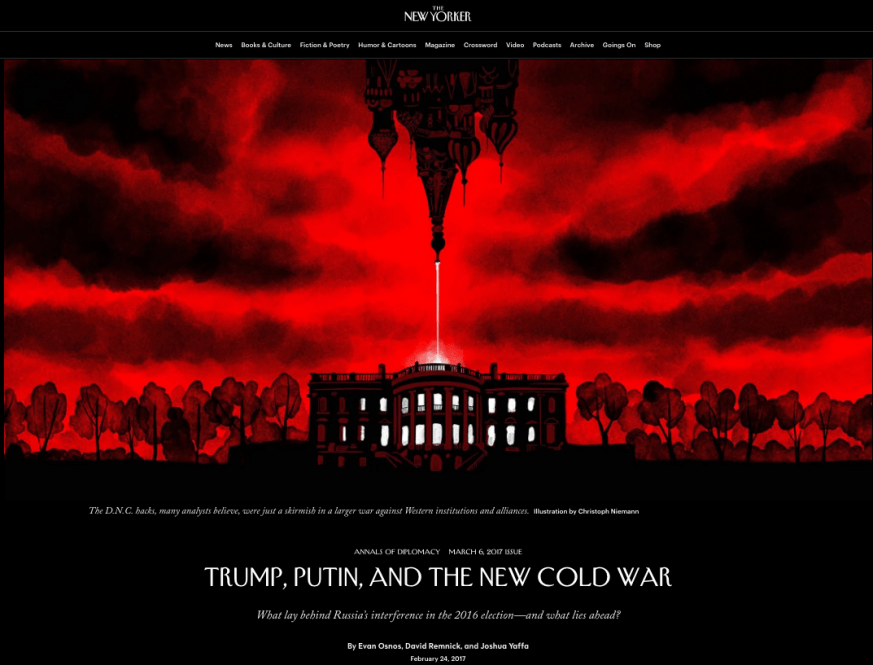
Cover story of The New Yorker, Feb. 24, 2017
But that all came crashing down on their heads in April, 2019, when Mueller announced that he was closing his investigation without charging even a single American with the criminal conspiracy that launched the entire spectacle: criminally conspiring with the Russian government to interfere in the election. Again: while Mueller — like so many Washington special counsels before him — ended up snaring some operatives in alleged process crimes committed after the investigation commenced (lying to the FBI and obstruction of justice) or unrelated crimes (Manafort’s financial sleaze), the 18-month aggressive, sprawling investigation resulted in exactly zero criminal charges on the core claim that Trump officials had criminally conspired with Russia.
If that were not sufficient to make every person who drowned the country in this crazed conspiracy theory feel enormous shame (and it should have been), the former FBI Director’s final Report explicitly stated that “the investigation did not establish that members of the Trump campaign conspired or coordinated with the Russian government in its election.” In many cases, the Report went even further than this “did not establish” formulation to state that there was no evidence of any kind found for many of the key media conspiracies (“The investigation did not identify evidence that any U.S. persons knowingly or intentionally coordinated with the IRA’s interference operation”; the “evidence does not establish that one campaign official’s efforts to dilute a portion of the Republican platform was undertaken at the behest of candidate Trump or Russia”; “the investigation did not establish that [Carter] Page coordinated with the Russian government in its efforts to interfere in the 2016 presidential election”). The Report also barely even dignified let alone confirmed the long-standing, utterly deranged Democratic/media conspiracy theory that the Kremlin had taken over U.S. policy through blackmail.
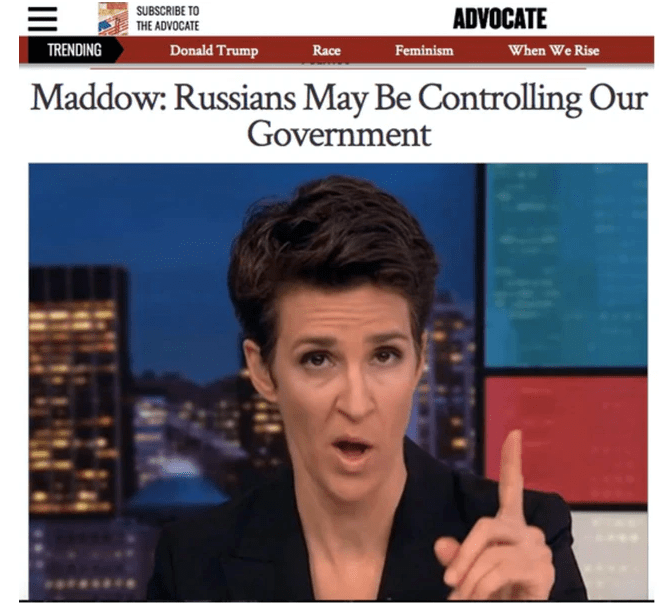
The Advocate, Mar. 10, 2017
For a few weeks following the issuance of the Mueller report, Democrats and media figures gamely attempted to deny that it obliterated the conspiracy theories to which they had relentlessly subjected the country for the prior four years. How could they do otherwise? They staked their entire reputations and the trust of their audience on having this be true. To avoid their day of reckoning, they would hype ancillary events such as Paul Manafort’s conviction on unrelated financial crimes or Michael Flynn’s guilty plea for a minor and dubious charge (for which even Mueller recommended no prison time) or Roger Stone’s various process charges to insist that there was still a grain of truth to their multifaceted geopolitical fairy tale seemingly lifted straight from a Tom Clancy Cold War thriller about the world’s two largest nuclear powers.
But even they knew this was just a temporary survival strategy and that it was unsustainable for the long term. That the crux of the scandal all along was that key Trump allies if not the President himself would be indicted and imprisoned for having conspired with the Russians was too glaring to make people forget about it.
That was why former CIA Director John Brennan assured the MSNBC audience in March — just weeks before Mueller closed his investigation with no conspiracy crimes alleged — that it was impossible that the investigation could close without first indicting Trump’s children and other key White House aides on what Brennan correctly said was the whole point of the scandal from the start: “criminal conspiracy involving the Russians . . . . whether or not U.S. persons were actively collaborating, colluding, cooperating, involved in a conspiracy with them or not.” Brennan strongly insinuated that among those likely to be indicted for criminally conspiring with the Russians were those “from the Trump family.”
As we all know, literally none of that happened. Not only were Trump family members not indicted by Mueller on charges of “criminal conspiracy involving the Russians,” no Americans were. Brennan believed there was no way that the Mueller investigation could end without that happening because that was the whole point of the scandal from the start. To explain why it had not happened up to that point after eighteen months of investigation by Mueller’s subpoena-armed and very zealous team of prosecutors, Brennan invented a theory that they were waiting to do that as the final act because they knew they would be fired by Trump once it happened. But it never happened because Mueller found no evidence to prove that it did.
In other words, the conspiracy theory that the media pushed on Americans since before Trump’s inauguration — to the point where it drowned out most of U.S. politics and policy for years — proved to have no evidentiary foundation. And that is one reason I say that the sectors of the media pretending to be most distraught at the spread of “disinformation” by anonymous citizens on Facebook and 4Chan are, in fact, the most aggressive, prolific and destructive disseminators of that disinformation by far (nor was it uncredentialed YouTube hosts, Patreon podcasters or Substack writers who convinced Americans to believe that Saddam Hussein possessed nuclear weapons and was in an alliance with Al Qaeda but rather the editor-heavy prestige outlets such as The New York Times, The New Yorker, NBC News and The Atlantic).
With the crux of the Russiagate conspiracy theory collapsed, U.S. media outlets began acknowledging — because they had to — that none of it was vindicated by Mueller’s report. To do so, they abruptly nullified a rule that had been in place since Mueller’s appointment: one may not speak ill of the former FBI Director because he is a patriotic man of the highest integrity and to malign him is to undermine the Brave Men and Women of the FBI Who Keep Us Safe. The only self-preservation tactic they could find to salvage their credibility was to turn on Mueller, quite viciously. Overnight, the storyline emerged: the conspiracy theory we pushed on you was correct all along, but Mueller was a coward and failed in his patriotic duty to say so.
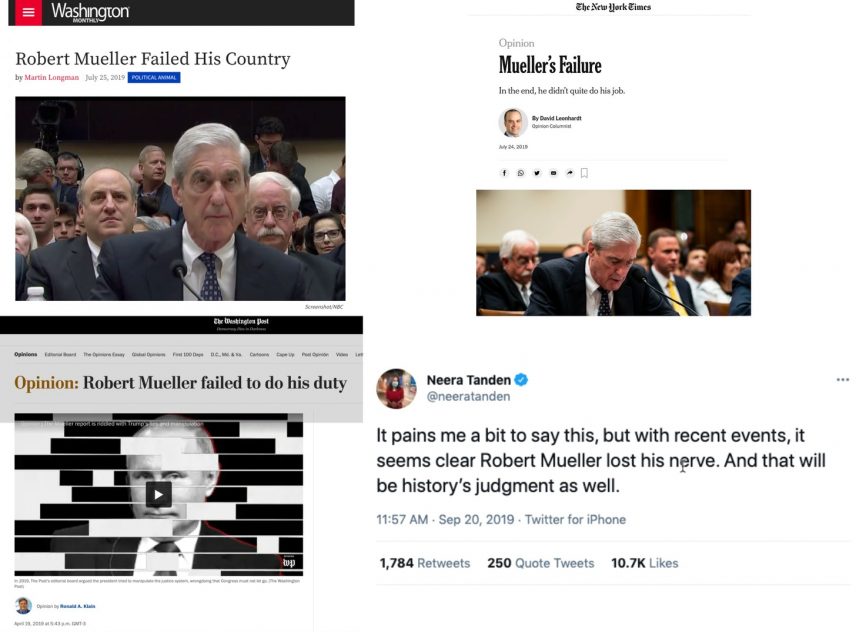
While the hypocrisy of watching a media that for months demanded reverence for Mueller turn on a dime to accuse him of being a borderline-senile, unpatriotic coward was quite amazing, it was at least some progress toward acknowledging the undeniable reality that the media had collectively failed. Their dark conspiracies and predictions of doom were pipe dreams. They flooded the country with disinformation for years about all of this. And while they characteristically engaged in exactly zero self-reflection or self-critique — preferring to heap all the blame on Mueller instead for failing to find the evidence that is still out there of their cognitive derangements — it at least consecrated the fact that this scandal ended in humiliation for them.
When I created my top ten list of media Russiagate debacles, choosing the top ten was difficult but choosing the top spot was not. It is worth briefly revisiting that particular journalistic humiliation because of what it reveals about ongoing media behavior.
On the morning of December 8, 2017, CNN went on the air with one of the most cataclysmic and breathless scoops of the entire Russiagate saga. The network hauled out all of its most melodramatic graphics, music and host voice-tones to signify that this was it : the smoking gun, the ultimate bombshell, the final nail in the coffin, inescapable proof for their conspiracy theory. The big huge scoop notably came from its Congressional reporter Manu Raju (one of the favorite dumping grounds for false leaks by leading House Democrat Russiagate fanatics such as Rep. Adam Schiff and Eric Swalwell (D-CA)).
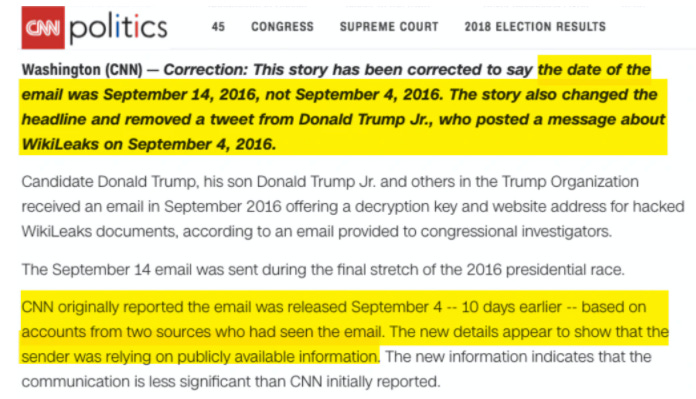
According to this historic CNN revelation, a stunning and incriminating email had been obtained by “congressional investigators,” and “multiple sources” conveyed its contents to CNN. This email proved, said CNN, that Donald Trump Jr. was given advanced access to the archive of DNC and Podesta emails ultimately published by WikiLeaks on September 14, 2016. This earth-shattering email to Trump, Jr. was dated September 4 — ten days before WikiLeaks began publishing — and this, in the minds of CNN, proved somehow that the Trump campaign was in on the plot from the start.
Now, even if Trump had been shown the archive in advance by WikiLeaks or someone else, it would not have remotely proven that the Trump campaign was a participant in the plot, but let us not get detained on that hypothetical. The CNN story was treated by the entire liberal sector of the press as the most devastating and incriminating evidence yet produced to prove the truth of the Russiagate conspiracy theory, with one particularly loyal Democratic partisan-writer using an image of a nuclear explosion to convey its significance:
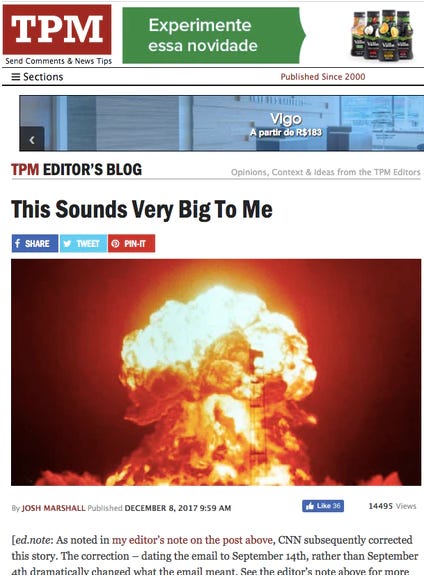
Talking Points Memo editor Josh Marshall, Dec. 8, 2017
As it turns out, there was one small problem with the CNN story: it was completely and utterly false. The email to Trump, Jr. on which the entire bombshell was based was sent after WikiLeaks began publishing the archive, not before. And it was sent not by some super-secret inside source with the Kremlin or WikiLeaks, but by a random member of the public who, having read about the WikiLeaks publications in the newspaper, emailed Trump, Jr. to encourage him to take a look.
How “multiple sources” all got the date on the email wrong — mis-reading it as September 4 rather than the real date of the email: September 14 — was never explained by CNN. That is because corporate media outlets believe they owe the public no explanation or accountability for the massive errors they commit.
But what was most notable about this episode is that it was not just CNN which reported this fraudulent story. An hour or so after the network shook the political world with its graphics-and-music-shaped bombshell, other news networks — including MSNBC and CBS News — claimed that they had obtained what they called “independent confirmation” that the story was true.
All of these media outlets, reading Orwell as if it is an instruction manual, have now scrubbed most of the humiliating videos where they did this from the internet. But one can still watch here as NBC News’ national security reporter and long-time de facto CIA spokesman Ken Dilanian breathlessly tells an MSNBC host, who herself can barely maintain her composure, that he has spoken with “sources” who have provided independent confirmation of the CNN story, thus adding NBC News’ imprimatur to it. Shortly thereafter, CBS News did the same.
All of this prompted the obvious question: how could MSNBC and CBS News have both purported to “independently confirm” a CNN bombshell that was completely false? The reason this matters is because the term “independently confirm” significantly bolsters the credibility of the initial report because it makes it appear that other credible-to-some news organizations have conducted their own investigation and found more evidence that proves it is true. That is the purpose of the exercise: to bolster the credibility of the story in the minds of the public.
But what actually happens is as deceitful as it is obvious. When a news outlet such as NBC News claims to have “independently corroborated” a report from another corporate outlet, they often do not mean that they searched for and acquired corroborating evidence for it. What they mean is much more tawdry: they called, or were called by, the same anonymous sources that fed CNN the false story in the first place, and were fed the same false story. And just as CNN did — repeated what they were told (almost certainly by Democratic Congressional members and/or their staff) without independently investigating it, because they knew any anti-Trump story would please their partisan audience — NBC News pretended they had obtained “independent confirmation” when all they had done was speak to the same sources that fed CNN.
This episode is so worth recalling not only because it is one of the most stunning and pathetic media humiliations of the Trump era — though it is that — but also because the shoddy tactic that drove it is still in full use by the same media outlets. We just saw proof of that again with a major Washington Post “correction” — which should be called a retraction — of one of the most-discussed news stories of the last six months: the Post’s claims about what Trump said when he called a Georgia election official while he was still contesting the 2020 election results.
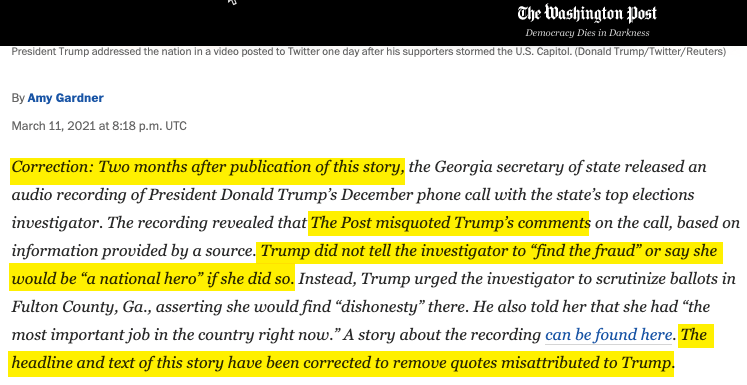
On January 9, The Washington Post published a story reporting that an anonymous source claimed that on December 23, Trump spoke by phone with Frances Watson, the chief investigator of the Georgia Secretary of State’s office, and directed her that she must “find the fraud” and promised her she would be “a national hero” if she did so. The paper insisted that those were actual quotes of what Trump said. This time, it was CNN purporting to independently confirm the Post’s reporting, affirming that Trump said these words “according to a source with knowledge of the call.”
But late last week, The Wall Street Journal obtained a recording of that call, and those quotes attributed to Trump do not appear. As a result, The Washington Post — two months after its original story that predictably spread like wildfire throughout the entire media ecosystem — has appended a correction at the top of its original story. Politico’s Alex Thompson correctly pronounced these errors “real bad” because of how widely they spread and were endorsed by other major media outlets.
This is a different species of journalistic malpractice than mere journalistic falsehoods. As I detailed in February and again two weeks ago, the U.S. public was inundated for weeks with an utterly false yet horrifying story — that a barbaric pro-Trump mob had savagely murdered Capitol Police Officer Brian Sicknick by bashing his skull in with a fire extinguisher. That false tale about the only person said to have been killed at the January 6 riot other than pro-Trump supporters emanated from a New York Times report based on the claims of “two anonymous law enforcement officials.”
As it turns out, Sicknick’s autopsy revealed that he suffered no blunt trauma, and two men arrested this week were charged not with murder but assault and conspiracy to injure an officer: for using an unidentified gas. In reporting those arrests, even The New York Times acknowledged that “prosecutors stopped short of linking the attack to Officer Sicknick’s death the next day” because “both officers and rioters deployed spray, mace and other irritants during the attack” and “it remains unclear whether Officer Sicknick died because of his exposure to the spray.”
Many liberals defenders of these corporate media outlets insist that these major factual errors do not matter because the basic narrative — Trump and his supporters at the Capitol are bad people who did bad things — is still true. But these errors are enormous. That Trump, Jr. received that email from a random member of the public after WikiLeaks began publicly publishing documents transforms the story from smoking gun to irrelevant. That Trump did not utter the extremely incriminating quotes attributed to him in that call at least permits debate about whether he did anything wrong there and what his intent was (encouraging the official to find the fraud he genuinely believed was there or pressuring her to manufacture claims with threats and promises of reward). And there is, manifestly, a fundamental difference in both intent and morality between deliberately murdering someone by repeatedly bashing their skull in with a fire extinguisher and using a non-lethal crowd-control spray frequently used at protests even if it is ultimately proven that the spray is what caused Officer Sicknick’s death (which is why those two acts would carry vastly different punishments under the law).
But all of this highlights the real crisis in journalism, the reason public faith and trust in media institutions is in free fall. With liberal media outlets deliberately embracing a profit model of speaking overwhelmingly to partisan Democrats who use them as their primary source of news, there is zero cost to publishing false claims about people and groups hated by that liberal audience.
That audience does not care if these media outlets publish false stories as long as it is done for the Greater Good of harming their political enemies, and this ethos has contaminated newsrooms as well. Given human fallibility, reporting errors are normal and inevitable, but when they are all geared toward advancing one political agenda or faction and undermining the other, they cease to be errors and become a deliberate strategy or, at best, systemic recklessness.
But whatever else is true, it is vital to understand what news outlets mean when they claim they have “independently verified” the uncorroborated reports of other similar outlets. It means nothing of consequence. In many if not most cases — enough to make this formulation totally unreliable — it signifies nothing more than their willingness to serve as stenographers for the same anonymous political operatives who fed their competitors similar propaganda.
SHOCK REVELATION: PUTIN WANTS STABILITY IN THE USA
By Paul Robinson | IRRUSIANALITY | March 12, 2021
Remember the claims that Vladimir Putin and the Russian government had a role in inciting the mob that broke into the Capitol building in Washington DC back in January? I wrote about this in an article a few weeks ago. No sooner had the dust settled than social media was abuzz with statements that Putin either arranged the whole thing or at the very least was celebrating what had happened. As former Deputy National Security Advisor Ben Rhodes put it, “This is the day that Vladimir Putin has waited for since he had to leave East Germany as a young KGB officer at the end of the Cold War.”
The idea that Putin and the Russian state want nothing more than to see Western democracies collapse into chaos is now so widespread as to be pretty much an uncontestable truth. Everybody knows that it is so. Russian “disinformation”, election “meddling”, and all of the rest of it, are put down to Putin’s enormous fear of democracy and of the West, and his concomitant desire to undermine both.
If you have any doubts, just Google “Putin, undermine democracy.” I did, and this is what I got:

As you can see, at the top of the list comes an article in The Atlantic from last year with the title “Putin’s Goal Is to Bring Down American Democracy,” after which we have a Science Direct article “Russia’s Attempt to Undermine Democracy in the West,” something from the Foreign Policy Research Institute entitled “Is Russia Undermining Democracy in the West? Conference” (I looked up the conference – the answer to the question was overwhelming “Yes), and then a Foreign Affairs article “How Russia and China Undermine Democracy” (note that there’s no question here that they do – the issue is just how). And on and on it goes.
You get the point. Putin wants to destroy Western democracy, and revels in destabilizing it at every opportunity. If you have any doubts about that, anti-disinformation campaigners point to the work of alleged Russian internet trolls and bots who, they say, latch on to divisions in Western societies and then exploit and accentuate them, in order to destabilize us from within.
I decided to put this to the Google test as well, searching for “Russia, exploit divisions America’. I got the following results:

The Atlantic again tops the rankings with an article entitled “Russia Is Still Exploiting America’s Divisions.” After that, we have the same Atlantic piece that appeared in the first search, then others with titles like “Russia exploits our divisions,” “How Russia used social media to divide Americans,” and “Russia seeks to exploit divisions in the West.”
So there we have it. Russia is out to get us. It wants domestic chaos in the West, and is doing all it can to create it.
But is this true?
Here’s the problem. No senior Russian official has ever said anything of the sort. Really. I challenge you to prove the opposite. Just find one quotation from Putin, foreign minister Lavrov, or anybody else at the top of the Kremlin pile, saying that this is what they want. I’m betting you won’t find it.
To the contrary, what you find when you study what Russians say is that the one thing they value above all else is stability. In fact, the word “stability” appears over 20 times in the 2016 Foreign Concept of the Russian Federation. And stability in foreign affairs, it is felt, depends on domestic stability. A country that is in internal turmoil is going to be incapable of pursuing a constructive foreign policy, and will likely try to deflect from its internal problems by assertiveness abroad. It’s better that other countries, even ones that are relatively hostile, are stable than that they are falling apart.
And so it is that in a meeting with businessmen on Wednesday, Vladimir Putin had the following to say:
We see what is happening, for example, overseas: of all those who walked into the US Congress building, 150 people were arrested and face anywhere from 15 to 25 years in prison. We have no way of knowing whether the internal contradictions will stop there. We really want them to stop, and I will tell you why. We are interested in steady relations with all our key partners, and internal squabbles, for internal political reasons, are in the way of achieving this kind of stability in the relations between our states.
What??
How does this square with the gospel truth we have been told to believe that Putin rejoices at every sign of turmoil in our midst, and is doing all he can to provoke chaos amongst us?
It doesn’t square at all. Something must be wrong.
Indeed something is – everything we’re being told by The Atlantic and all the rest of them is total, complete, utter nonsense. It not only isn’t supported by the evidence, but is in fact rejected by it.
Will anybody notice? Sadly, I doubt it. The same old lies will keep on being repeated. They’ve been said so often by now that nobody can imagine that they’re not true. But at least you, dear readers, will know that they’re not. And perhaps if we can spread that truth a little bit further, then drip by drip we might have some effect. I’m not optimistic, but at least we can try.
BBC secrets: Leaked files show UK state media engaged in anti-Moscow information warfare ops in E. Europe
By Kit Klarenberg RT | March 11, 2021
New documents raise serious questions about how well-deserved British state broadcaster BBC’s ‘unimpeachable’ reputation is, and also what impact its relationship with the UK government has on its supposedly ‘impartial’ output.
Within a tranche of secret UK Foreign, Commonwealth & Development Office (FCDO) papers, recently leaked by hacktivist collective Anonymous, are files indicating that BBC Media Action (BBCMA) – the outlets ‘charitable’ arm – plays a central role in Whitehall-funded and directed psyops initiatives targeted at Russia.
American journalist Max Blumenthal has comprehensively exposed how, at the FCDO’s behest, BBCMA covertly cultivated Russian journalists, established influence networks within and outside Russia, and promoted pro-Whitehall, anti-Moscow propaganda in Russian-speaking areas.
However, the newly released files reveal BBCMA also offered to lead a dedicated FCDO program, named ‘Independent Media in Eastern Partnership Countries’ and targeted at Georgia, Moldova, and Ukraine. This endeavor forms part of a wider £100 million ($138.9 million) effort waged by London to demonize, destabilize and isolate Russia, at home and abroad.
A Whitehall tender indicates that under the auspices of the project, set to cost a staggering £9 million ($12.5 million) from 2018 to 2021, participating contractors are charged with crafting “innovative… media interventions” targeting individuals throughout the region, via “radio, independent social media channels, and traditional outlets.”
Further detail was offered by FCDO Counter Disinformation & Media Development (CDMD) chief Andy Pryce at a June 2018 meeting with prospective suppliers.
He made it clear that the effort’s ultimate goal was to “weaken the Russian state’s influence,” via the co-option of journalists and media organizations in target countries via funding, training, and surreptitious production of anti-Russian, pro-Western content. “Girls on HBO… but in Ukraine” was, bizarrely, one suggested example of such activity.
In response, BBCMA submitted extensive proposals, in conjunction with Thomson Reuters Foundation (TRF), the global newswire’s “non-profit” wing, and since-collapsed veteran FCDO contractor Aktis Strategy.
The project was to be managed and coordinated directly by BBCMA from BBC Broadcasting House headquarters in London, with local support provided by Reuters newswire offices in Kiev and Tbilisi, and Ukraine’s Independent Association of Broadcasters.
A dedicated board, comprised of representatives of the contractors involved, the FCDO’s CDMD program, and British embassies in the target countries, would also meet privately every quarter to discuss the operation’s progress. Publicly, Whitehall’s funding and direction of the vast project was intended to be completely hidden.
The consortium boasted of having an existing “strong profile” in Eastern Partnership countries, and conducting “broad consultations” with a number of major news outlets, media organizations and journalists in the region in advance of its pitch.
For example, the National Public Broadcasting Company of Ukraine (UA:PBC) had been approached and offered “essential support,” aimed at “improving its existing programs” and “developing new and innovative formats for factual and non-news programs.”
BBCMA was moreover said to be “already” working on building the capacity of Kiev-based Hromadske TV, and wished to use the FCDO program to extend this assistance to “co-productions” and “building support to Hromadske Radio.”
Launched with initial funding from the American and Dutch embassies in Ukraine, Hromadske began broadcasting in November 2013 on the very day Viktor Yanukovich’s administration suspended preparations for the signing of an association agreement with the European Union, and went on to extensively cover the resultant Euromaidan protests, which eventually unseated the government the next year.
It subsequently received support from Pierre Omidyar, billionaire founder of The Intercept, who bankrolled a number of opposition groups in the country prior to the coup. In July 2014, Hromadske anchor Danylo Yanevsky abruptly terminated an interview with a Human Rights Watch representative after she consistently refused to blame Russia for civilian casualties in the Donbas conflict, despite his repeated demands.
Beyond dedicated news platforms, the consortium also pledged to enlist “local” and “hyperlocal” media outlets, as well as “freelancer journalists,” bloggers and “vloggers” for its information warfare efforts.
BBCMA argued “journalism education” locally would be a “long-term investment” – in other words, the identification, cultivation, and grooming of a network of reporters in the countries who could be relied upon to take the Whitehall line in future.
As such, the organization sought to establish a journalism training center in Gagauzia, Moldova in collaboration with NGO Media birlii – Uniunia. The autonomous region, bordered by Ukraine’s Odessa Oblast, was said to be home to “six TV companies, four radio stations, six newspapers and five web portals” potentially ripe for influence and infiltration by BBCMA – and in turn, the FCDO.
In Georgia, BBCMA visited the offices of Adjara TV “to discuss training priorities and possible co-productions.” The station was reportedly interested in developing “youth programming,” which represented “a gap in the market” in the country.
In June 2020, Georgia’s Coalition for Media Advocacy slammed Adjara for its “persecution” of “outspoken journalists expressing dissenting opinions,” after it fired newsroom chief Shorena Glonti.
Strikingly, the Coalition is funded by US regime-change agency, the National Endowment for Democracy, which supports numerous anti-Moscow initiatives worldwide. Perhaps Glonti had been too well-trained in “weakening the Russian state” for the broadcaster’s liking.
The consortium furthermore proposed to tutor and support “independent” online Georgian news outlets, including Batumelebi, iFact, Liberali, Monitor, Netgazeti, and Reginfo.
Estonia’s Digital Communications Network – financed by the US State Department – would be central to these efforts, offering lessons in “building online audiences, innovative business models and reaching out to breakaway regions susceptible to Kremlin narratives.”
The importance of “target audiences in breakaway regions” is outlined in another file, which explicitly states that the consortium would work closely with “independent outlets in proximity of non-government-controlled areas of Donbas in Ukraine, Transnistria in Moldova and Abkhazia and South Ossetia in Georgia.”
This undertaking aimed to counter the output of “separatist” media, and thus manipulate “hard-to-reach audiences,” which was “critical to achieving the project’s objectives.”
Any and all support covertly provided under the program was to be thoroughly intimate indeed, with “mentors” from the consortium “embedded” in target organizations, in order to provide “bespoke support across editorial, production and wider management systems and processes as well as on the co-production of content.”
These “mentors” include current and former BBC journalists.
“Our ability to recruit talented and experienced BBC staff is a great asset which will be harnessed for this initiative,” BBCMA promised.
These individuals may have been central to program efforts, if BBCMA’s pitch to the FCDO was accepted. For instance, UA:PBC was said to be “very interested” in receiving help from BBCMA to develop a “new debate show” and “discussion programming” to “enable audiences to think critically about the process and choices,” “counter disinformation” and “dispel rumors.”
Lofty objectives indeed, although commitments to nurturing analytical skills, thinking and debunking propaganda ring rather hollow when one considers the station’s output was perceived to be so overwhelmingly biased in favor of the government, opposition candidate Volodymyr Zelensky boycotted the channel’s official election debate during the 2019 presidential election.
BBCMA also proposed to establish an “independent” news platform in Ukraine, “timed for the run up to the 2019 election,” which would publish “vetted news content” freely syndicated to local and national media.
If the approach in Kiev was “successful,” the consortium would replicate the exercise in Georgia for the country’s 2020 election. Strikingly, the proposal brags of TRF’s experience establishing such platforms elsewhere, for example “the award-winning Aswat Masriya” in Egypt.
Other leaked files indicate the endeavor, founded after the 2011 revolution in Cairo, was secretly funded by the FCDO to the tune of £2 million ($2.8 million) over six years, and run out of Reuters’ Egyptian offices.
Over its lifespan, Aswat Masriya “became Egypt’s leading independent local media organization” and one of the most-visited websites in the country, providing news in English and Arabic, which was syndicated widely the world over. Its true, clandestine purpose seems to have been granting London a degree of narrative control over news coverage as events unfolded in the country, during its difficult and ultimately ill-fated transition to democracy.
That BBCMA likewise intended to use news coverage to influence politics in Eastern Partnership countries is amply underlined in the newly leaked files, with the organization pledging to “encourage” local news outlets to meet with “local stakeholders,” including lawmakers and community leaders, in order to “cement the media as a key governance actor.”
The organization furthermore sought to “foster a debate” in target nations, by producing wide-ranging analysis of the media environment therein. Its “long track record” of comparable efforts in “diverse” countries, including those “experiencing Arab uprisings,” had allegedly “shifted government policy.”
One objective of these lobbying efforts was achieving “a more enabling operating environment” for “independent” media in the target countries – i.e. ensuring regulations in the region were suitably conducive to and protective of the FCDO’s secret army of information warfare agents, to allow them to prosper for the duration of the consortium’s three-year offensive, and “post intervention.”
It’s not yet clear if BBCMA was successful in its pitch, and if so, which BBC journalists contributed to the program and as a result are implicated directly in cloak-and-dagger attempts to shape politics and perceptions in Georgia, Moldova, and Ukraine for London’s benefit.
It’s also unknown whether their commitment to fulfilling the FCDO’s objective of undermining Moscow, and furthering Whitehall’s interests, truly ends when they return to their day jobs as “objective,” “neutral” purveyors of news.
As BBCMA boasts in its pitch, the BBC is “well-known and highly regarded” in the Eastern Partnership countries, and provides “millions of viewers, listeners and online users in the region with world-class news on a daily basis.” At the very least, the leaked files make clear that neither the British state broadcaster, nor its FCDO paymasters, has any qualms about exploiting that standing and perceived credibility for malign ends.
Kit Klarenberg is an investigative journalist exploring the role of intelligence services in shaping politics and perceptions.
Biden’s awkward threat of retaliatory cyber attacks belies US uncertainty and insecurity on all things Russia
By Scott Ritter | RT | March 9, 2021
By leaking plans for “covert” cyber-retaliation against Russia, the Biden administration allows domestic political considerations to trump legitimate national security concerns by painting Russia as the all-purpose bogeyman.
In a front-page story, the New York Times disclosed that the Biden administration was planning a range of “clandestine” cyber-attacks targeting Russia, ostensibly in retaliation for Russia’s alleged role in masterminding the SolarWinds hack that continues to resonate across the United States. According to the Times, these attacks are expected to unfold over the course of the next three weeks and are “intended to be evident to President Vladimir V. Putin and his intelligence services and military but not to the wider world.” These attacks, the Times notes, will most likely be combined with other actions by the Biden administration, including additional economic sanctions against Russia, and actions to “harden” US government networks against future attacks.
Even as the Biden administration struggles to piece together a response to the SolarWinds breach, it must wrestle with a new cyber-attack targeting a vulnerability in Microsoft’s email systems that exposes the communications and cyber architecture of a whole host of US government and private clients. Unlike SolarWinds, the current attack is believed to have been carried out by “state actors” operating on behalf of China.
Seen together, the SolarWinds and Microsoft email intrusions represent a daunting challenge for Anne Neuberger, a former Director of Cybersecurity for the National Security Agency who was appointed to serve in the newly created position of deputy national security adviser for cyber and emerging technologies. Neuberger has been tasked with overseeing what Washington, DC calls a “whole of government response” to these events. It is a thankless task, one made even more so by the fact that any response she develops must assuage domestic political pressures as well as address any genuine cyber threat that may exist.
The plan of action described in the New York Times is remarkable on several levels. First and foremost, it assumes as fact a linkage between the Russian government and the SolarWinds cyber-attack. While the Federal Bureau of Investigation (FBI), the Cybersecurity and Infrastructure Security Agency (CISA), the Office of the Director of National Intelligence (ODNI), and the National Security Agency (NSA) have released a joint statement which attributes the SolarWinds attack to “an Advanced Persistent Threat (APT) actor, likely Russian in origin,” no evidence has been provided to sustain this allegation. For its part, the Russian government has denied any involvement in the SolarWinds attack.
While the Russian denial must be taken with a grain of salt–no one would expect the Russians to openly admit to carrying out such an attack–the Russian silence serves to illustrate the most disconcerting aspect of the New York Times’ story–that the Biden administration is openly telegraphing what it has said will be “clandestine” attacks targeting Russia.
Neuberger, a career veteran of the secretive world of cyber-sleuthing, is familiar enough with the lexicon of intelligence terminology to know that telegraphing your punch is–literally and figuratively–the antithesis of a “clandestine” activity. It should be clear to all who read the Times story that the intended target of the leak was not Vladimir Putin, his generals and/or his intelligence services. Rather, it was the domestic American consumer of news-based information. By injecting this tidbit of information into the news cycle, the Biden administration is prioritizing public posturing over any vestige of national security.
This does not mean that the US is incapable of sending Russia a clandestine slap on the wrist in retaliation for cyber-attacks it may or may not have conducted. According to some media reports, the NSA and Cyber Command possess the capability to deliver crippling cyber-based blows against the totality of the Russian state and economy, shutting down energy production, energy supply, financial, telecommunication, transport, military, and government networks at will. If ordered to do so, the NSA and Cyber Command could activate these tools in a selective fashion, targeting some or all of Russia. The announced clandestine strike would most likely not consist of a destructive attack on Russian networks, but rather a probe intended to let the Russian leadership know that the US was buried inside its networks, and as such able to shut things down at will.
If such a message were in fact to be sent, in the form of a clandestine (i.e., unannounced) cyber probe, then it might have the kind of consequences intended–Russian officials, having detected such an intrusion, would scale back their actions against US targets for fear of triggering a greater retaliation. The key to this kind of activity is that it is being done in the shadows, away from public scrutiny, never to be acknowledged by either party. By announcing its intention to conduct “clandestine” cyber retaliation, the Biden administration has nullified any potential gain it may have achieved if it had kept the actions truly covert in nature. Russia will continue to deny any role in the SolarWinds cyber event, and will either make public the US actions, thereby painting the US as the cyber aggressor, or just ignore the US actions altogether, leaving the US to either admit it did something, or to look as if what it did had no impact.
In its rush to attribute the SolarWinds cyber-attack to Russia without providing any evidence to back this assertion up, the Biden administration only feeds into the existing high level of Russophobia that permeates American society today. By telegraphing its intent to retaliate against Russia, the Biden administration has shown that it has allowed itself to be taken hostage by its own history of anti-Russian rhetoric.
Far from being a sign of strength, the actions of the Biden administration only underscore the extent to which it is prisoner to the fickle ignorance of an American public all too willing to accept at face value any narrative that paints Russia as the bogeyman. The subordination of legitimate national security interests to domestic politics is the most visible symptom of the impotence that has taken hold of the Biden administration when it comes to putting substance behind Joe Biden’s empty contention that “America is back.” As Tywin Lannister reminded the youthful Joffrey Lannister in G. R. R. Martin’s A Storm of Swords, “Any man who must say ‘I am king’ is no true king at all.”
Scott Ritter is a former US Marine Corps intelligence officer and author of ‘SCORPION KING: America’s Suicidal Embrace of Nuclear Weapons from FDR to Trump.’ He served in the Soviet Union as an inspector implementing the INF Treaty, in General Schwarzkopf’s staff during the Gulf War, and from 1991-1998 as a UN weapons inspector.
RT’s German-language service prepares lawsuit after notorious tabloid ‘Bild’ falsely accuses its journalists of SPYING
RT | March 9, 2021
RT in Germany is planning to take legal action against the tabloid Bild, after the Berlin newspaper ran a sensationalist tale that relied on leaked Telegram chats from a former employee, who claimed he had to spy for the channel.
In the article published on Tuesday, reporter Julian Roepcke, who has previously been aligned with the ‘Disinformation Portal’ of NATO’s Atlantic Council adjunct, claims that, according to Bild’s information, President Vladimir Putin ordered a spy op on his “public enemy number one.” It allegedly targeted opposition figure Alexey Navalny and two of his close aides. The supposed snooping is said to have happened during the activist’s treatment for alleged Novichok poisoning last year at Berlin’s Charité clinic.
On top of that, writes Roepcke, “Russia’s leadership used the Russian foreign broadcaster RT DE, which in turn relied on two German employees.” To back up the claims, Bild also ran an interview with Daniel Lange, then an employee of RT DE, who claimed he had a feeling of having been used as a spy in the case. Lange also leaked to Bild what he says were internal chats with his bosses.
Calling out Roepcke’s article, the head of RT in Germany Dinara Toktosunova said Lange had leaked Telegram chats in which he was merely being asked to do his job, after he’d failed to get any exclusive and newsworthy material about Navalny’s stay in Germany.
“We remind our colleagues of the German legislation that (for now) protects the press by allowing it to collect information about matters of public interest,” Toktosunova added.
The Bild article comes just days after Commerzbank told the parent company of RT DE and Ruptly that it would be ending their business relationship and closing their accounts at the end of May. Since Commerzbank changed its terms of service last November, RT DE had been trying to find an alternative bank, but 20 other financial institutions have either ignored its enquiries or flatly refused to open accounts on its behalf.
Toktosunova believes this to be part of a wider campaign to obstruct RT’s work in Germany. “We have every reason to believe that RT in Germany has been targeted by what is essentially a financial embargo,” she said on March 4, after the Commerzbank announcement.
Navalny was flown to Germany in August 2020, with his staff claiming he had been poisoned with Novichok, frequently described as the world’s deadliest nerve agent. He was treated at Berlin’s Charité clinic. Moscow said that Germany had refused Russia’s requests for detailed information about his condition.
Bild itself followed Navalny’s every move in Germany; not only did it gain access to the clinic, but it also published photos taken right at the entrance to Navalny’s treatment room.
The blogger and self-styled anti-corruption activist, regarded as the Russian “opposition leader” in the Western press, despite polling in the low single digits, returned to Moscow in January, where he was arrested for violating parole conditions in a case he regards as politically motivated.
Kremlin: Alleged US Plans to Stage Cyberattacks on Russian Networks Would Amount to Int’l Crime
By Oleg Burunov – Sputnik – 09.03.2021
The Kremlin is seriously concerned over media reports about a possible US cyberattack against Russia, the Russian president’s press secretary Dmitry Peskov told reporters on Tuesday.
“This is alarming information because a rather influential American news outlet admits the possibility of such cyberattacks. Actually, this is nothing but international cybercrime and, of course, the fact that this news outlet acknowledges the possibility of the US being involved in this cybercrime is a reason for our extreme concern”, Peskov pointed out.
He also recalled that as far as Russia is concerned, it has never been involved in cybercrimes.
“In this context, it is important to recall that we have repeatedly stated and still insist that the Russian side, the Russian state has never had and has nothing to do with any manifestations of such cybercrime and cyberterrorism”, the Russian president’s spokesman underscored.
The remarks come after The New York Times quoted unnamed US government sources as saying that Washington plans to start retaliating for the alleged Russian hacking of American government agencies and corporations detected late last year.
“The first major move is expected over the next three weeks, with a series of clandestine actions across Russian networks that are intended to be evident to President Vladimir Putin and his intelligence services and military, but not to the wider world”, the sources argued.
This followed US National Security Adviser Jake Sullivan telling CBS News in late February that the White House’s response to last year’s SolarWinds hack “will include a mix of tools seen and unseen”.
Sullivan pledged that “it will be weeks, not months” before the US prepares retaliatory measures against Moscow, adding that Washington will “ensure that Russia understands where the US draws the line on this kind of activity”.
SolarWinds Hack
In late December, the US Cybersecurity and Infrastructure Security Agency (CISA) said that hackers, who used corrupted SolarWinds software to install malicious programmes, were “impacting enterprise networks across federal, state, and local governments, as well as critical infrastructure entities and other private sector organisations” in the country.
Early accusations quickly ran to Russia, with then-US Secretary of State Mike Pompeo claiming that Russia was “pretty clearly” responsible and then-US President-elect Joe Biden saying that his forthcoming administration would consider sanctioning Moscow as punishment.
In response, Kremlin spokesperson Dmitry Peskov stressed that Russia had no part in the hacking operations and that the accusations were “unfounded” and the result of “blind Russophobia”.
Following the reports, US President Donald Trump, who was “fully briefed” on the matter, said the attacks were exaggerated by the “Fake News Media”, alleging that China could have been responsible for the hack, and suggesting alleged election fraud was a much bigger issue for the United States.
Russian Disinformation to Undermine US Mass-Jabbing for Covid?
By Stephen Lendman | March 7, 2021
On Sunday, the Wall Street Journal cited an unnamed State Department Global Engagement Center official, saying Russian intelligence is trying to undermine confidence in US mass-jabbing for covid.
No evidence was cited like virtually always when Russia and other invented US enemies are accused of things they had nothing to do with.
Russia aside, there’s nothing remotely safe and effective about rushed to market, inadequately tested, experimental Pfizer and Moderna mRNA technology.
The same goes for J & J covid vaccine and AstraZeneca’s entry in Europe.
They’re all unapproved, granted emergency use authorization when no emergency exists.
Less than two months after mass-jabbing began, countless thousands suffered serious adverse events including deaths.
No one should be a mass-jabbing guinea pig for Pharma.
No one should risk their health and well-being so Pfizer, Moderna, and now Johnson & Johnson can cash in big on a bonanza of profits at the expense of individuals duped to believe they’ll be protected from what’s too hazardous to touch.
According to State Department disinformation, New Eastern Outlook, Oriental Review, News Front, and Rebel Inside truth-telling about mass-jabbing hazards is Russian propaganda.
According to the unnamed US official, “Russian intelligence services bear direct responsibility for using these four platforms to spread propaganda and lies (sic),” adding:
“We can say these outlets are directly linked to Russian intelligence services (sic).”
“They’re all foreign-owned, based outside of the United States.”
“They vary a lot in their reach, their tone, their audience, but they’re all part of the Russian propaganda and disinformation ecosystem (sic).”
According to the neocon/Russophobic Alliance for Securing Democracy that’s militantly hostile to the notion everywhere:
“The emphasis on denigrating Pfizer is likely due to its status as the first vaccine besides Sputnik V to see mass use, resulting in a greater potential threat to Sputnik’s market dominance.”
Kremlin spokesman Dmitry Peskov debunked the above fake news, saying:
“It’s nonsense. Russian special services have nothing to do with any criticism against vaccines.
“If we treat every negative publication against the Sputnik V vaccine as a result of efforts by American special services, then we will go crazy because we see it every day, every hour and in every Anglo-Saxon media.”
The Journal explained that the unnamed US official “didn’t provide specific evidence linking the publications to Russian intelligence” — because none exists like time and again earlier when phony accusations are made.
Unlike US rushed to market experimental drugs for mass-jabbing, introduction of Russia’s Sputnik V vaccine last summer followed over 20 years of vaccine research, according to Sechenov University’s Institute for Translational Medicine and Biotechnology director Vadim Tarasov.
Technology used to develop Sputnik V is based upon adenovirus, the common cold.
Tarasov explained that the vaccine may not entirely stop covid from spreading. It’ll make symptoms milder, he said, adding:
“We can really talk about a breakthrough as our country has shown itself to be one of the leaders in the global pharmaceutical industry due to the fact that it has retained and developed new competencies in drug development.”
There’s no ambiguity about the health hazards of experimental US drugs for mass-jabbing.
Using them as directed risks serious self-inflicted harm or death — why it’s crucial to avoid them.
Featured Video

The Truth About the Trump Shootings with Ken Silva
or go to
Aletho News Archives – Video-Images
From the Archives
The Geopolitics behind the War in Yemen (I)
By Mahdi Darius NAZEMROAYA | Strategic Culture Foundation | 30.03.2015
The United States and the Kingdom of Saudi Arabia became very uneasy when the Yemenese or Yemenite movement of the Houthi or Ansarallah (meaning the supporters of God in Arabic) gained control of Yemen’s capital, Sanaa/Sana, in September 2014. The US-supported Yemenite President Abd-Rabbuh Manṣour Al-Hadi was humiliatingly forced to share power with the Houthis and the coalition of northern Yemenese tribes that had helped them enter Sana. Al-Hadi declared that negotiations for a Yemeni national unity government would take place and his allies the US and Saudi Arabia tried to use a new national dialogue and mediated talks to co-opt and pacify the Houthis.
The truth has been turned on its head about the war in Yemen. The war and ousting of President Abd-Rabbuh Manṣour Al-Hadi in Yemen are not the results of «Houthi coup» in Yemen. It is the opposite. Al-Hadi was ousted, because with Saudi and US support he tried to backtrack on the power sharing agreements he had made and return Yemen to authoritarian rule. The ousting of President Al-Hadi by the Houthis and their political allies was an unexpected reaction to the takeover Al-Hadi was planning with Washington and the House of Saudi. … continue
Blog Roll
 Aletho News
- Pakistan-Iran talks secure LNG shipment to Islamabad through Hormuz
- Black Sea grain crisis puts global wheat supplies under pressure
- IRGC air defenses destroy another US MQ-1 drone over Strait of Hormuz
- Imran Khan’s entire immediate family detained in Pakistan ahead of mass protest demanding his release
- EU nation detains former presidential frontrunner
- Leaked: Britain’s Sham Conviction Of Hashim Thaci
- Seyed M. Marandi: U.S. Strike Imminent – Toward Total War in the Middle East
- Russia Voted Under Fire. Washington Is Loading the Tankers.
- 12 Things Your Oncologist Was Trained Not to Tell You
- Anthrax Attacks Paved Way for COVID-Era ‘Junk Drugs and Vaccines’
- If Americans Knew
- This isn’t sci-fi, AI is already killing people
- ‘The Most Brutal Thing’: Investigation Reveals Execution of Elderly Woman in Rafah
- Inside Israel’s ‘soft’ ethnic cleansing plan for Gaza through the eyes of its victims
- New online database tracks pro-Israel political donations in the United States
- Israeli president pardons soldier convicted for killing wounded Palestinian
- Singer Ed Sheeran says his ‘heart broken’ by Gaza devastation, addresses Macklemore controversy
- Israel Has Imprisoned Female Journalist Bushra Al-Tawil Without Trial Or Charge In Solitary Confinement For Past Month
- Israel poised to teach West Bank a lesson after one Israeli killed – Daily Update
- Salah Sarsour’s Legal Team Says DHS Has Not Met Its Burden to Prove He Is Deportable
- An analysis of tax forms by The Intercept show Kraft’s charity and LLC have donated to Friends of the IDF and AIPAC’s super PAC.
- No Tricks Zone
- 2025 Nature Paper Claiming Worsening Global Drought Gets RETRACTED …Heavily Flawed
- New Study: ‘Global Drought Shows No Detectable Recent Acceleration Under Climate Warming’
- Economic Masterminds: German Socialists Suggest Taxing Productivity Gains Stemming From Using AI
- The South China Sea Has Not Been Cooperating With The Climate Change Narrative
- Energy Crisis: Germany Enters Heating Season With Historically Low Gas Reserve Fill Levels
- New Study: The Antarctic Ice Sheet Gained Mass From 2020-2024 Due To Staggering Snow And Ice Accumulation
- Study: Ocean Heating Rates From Thousands Of Years Ago ‘Dwarf’ Modern Ocean Heating Rates
- Climate Extremists Target, Attack Large-Scale Power Grid Infrastructure In Germany!
- New Study: Antarctic Ice Melt Has Contributed Less Than 1 Centimeter To Sea Level Rise In The Last 30 Years
- Fear Of Debate: Alarmist German Climate Scientist Calls On Mainstream Media To Discredit Skeptic Voices
 Aletho News