Russian senator slams proposed blacklisting of RT & Sputnik in France
RT | September 6, 2018
A report authored by two government-linked think tanks that calls on the authorities to deny accreditation to RT and Sputnik reveals the West’s fear of the freedom of speech, a Russian senator has argued.
The Institute for Strategic Research of the French Defense Ministry (IRSEM) and The Centre for Analysis, Planning and Strategy (CAPS), linked to the French Foreign Ministry, issued on Wednesday a joint paper on the spread of disinformation and how to combat it.
The report urges the French government to “name and isolate” news outlets that are deemed “foreign propaganda organs.” Citing comments by President Emmanuel Macron, who accused RT and Sputnik of acting as “bodies for influence and false propaganda,” the report advises: “It is necessary not to grant [these organizations] accreditation and not to invite them to press conferences for journalists.”
Responding to the paper’s remarkable recommendations, Senator Konstantin Kosachev, the head of the Russian Upper House Committee for International Relations, noted that perhaps France has forgotten what free press looks like.
“After all, this is now a general trend in the West: Democracies proud of their freedom of speech have started to become seriously afraid of it. Decades of the unanimous mainstream seem to have relaxed both journalists and their audience, who are simply not ready for real competition of opinions (and it’s about opinions, not facts – because ‘highly likely’ in a normal situation is not considered to be ‘a fact’),” Kosachev wrote on his official Facebook page.
The report also offers a helpful list of ways to detect and counter information “threats” posed by undesirable communities. But weeding out dissent seems more suited for an authoritarian state, Kosachev reminded.
“Apparently, this is what we are talking about: they need to promote the ‘only true’ point of view at any cost (the European Commission even suggested introducing media literacy courses in schools – evidently to start to scare children with terrible RT and Sputnik), and to simplify the task they resort to the beloved instrument of authoritarian states – prohibitions on dissenting media. Somewhere we have already seen all this … Is this the ‘European USSR’?”
Moscow has already pledged to respond if the proposed blacklist was put into effect. Andrey Klimov, the head of the Federation Council’s Commission for State Sovereignty Protection, warned that targeting RT and Sputnik would likely affect “sensitive” spheres within Russian-French relations. However, he emphasized that he hoped that common sense will prevail.
The latest French report also foresaw possible questions that may come to one’s mind – what about mainstream media? The paper accepts that any media can freely defend its point of view and even admits that Al-Jazeera, CNN, BBC or France 24 contribute to the influence of Qatar, the US, the UK and France, respectively. However, it argues, that there is “benign misinformation” and that false information is not in itself problematic. The attention should focus on those “that have a negative effect or at least a hostile intent,” the paper said.
Skripal Case: Luke Harding’s latest work of fiction
By Kit | OffGuardian | September 6, 2018
Luke Harding likes writing books about things that he wasn’t really involved in and doesn’t really understand. Unfortunately for the rest of the world, that covers pretty much everything. His book about Snowden, for example, was beautifully taken down by Julian Assange – a person who was actually there.
He’s priming the traumatised public for another of his works, this time about Sergei Skripal. This one will probably be out by Christmas, unless he can find someone else’s work to plagiarise, in which case he might get it done sooner.
It will have a snide and not especially clever title, perhaps a sort of pun – something like the “A Poison by Any Other Name: How Russian assassins contaminated the heart of rural England”. It will relate, in jarring sub-sub-le Carre prose, a story of Russian malfeasance and evil beyond imagining, whilst depicting the whole cast as bumbling caricatures, always held up for ridicule by the author and his smug readership.
There’s an extract in The Guardian today. It’s not listed as one, but trust me, it will be in the book. It’s title, as predicted above, is sort of a pun (and will probably be a chapter heading):
Planes, trains and fake names: the trail left by Skripal suspects
You see? Like that film? I don’t really get it either but until someone else comes up with something clever he can copy, Luke is left to his own rather meagre devices.
It starts off surprisingly strong, waiting three whole sentences before lurching violently into totally unsupported conjecture:
The two men were dressed inconspicuously in jeans, fleece jackets and trainers as they boarded the flight from Moscow to Gatwick. Their names, according to their Russian passports, were Alexander Petrov and Ruslan Boshirov. Both were around 40 years old. Neither looked suspicious.
This is, as far as we know so far, true.
The plane trundled down the icy runway. In Moscow the temperatures had fallen below -10C, not unusual for early March. In Britain it had been snowing.
… and so is this. In fact, in googling “Moscow weather March 2018” Harding has displayed an uncharacteristically thorough approach to research that was rarely (if ever) evidenced in his previous works.
They had also packed a bottle of what appeared to be the Nina Ricci perfume Premier Jour. The box it came in was prettily decorated with flowers, it listed ingredients including alcohol and it bore the words “Made in France”.
This is where truth ends and guesses take over: there is no evidence, at all, that these two men had anything to do with the “perfume bottle” allegedly found by Charlie Rowley on June 27th and allegedly containing a powerful nerve agent. There is (as far as we know) no fingerprint or DNA evidence on the bottle, nobody saw them with the bottle, and there’s no released CCTV footage of them holding or carrying the bottle. Saying “it’s in their backpack” is meaningless without any evidence to back it up.
According to the Metropolitan police, the bottle in fact contained novichok, a lethal nerve agent developed in the late Soviet Union. The bottle had been specially made to be leakproof and had a customised applicator.
Note he doesn’t feel the need to examine, question or even verify the words of the Metropolitan Police [Seemingly, in the UK, bottles are designed to leak]. This is a recurring theme in Harding’s works – there are people who tell the truth (US) and people who lie (RUSSIANS). Evidence is a complication you can live without.
Moscow’s notorious poisons factory run by the KGB made similar devices throughout the cold war.
Did they? Because he doesn’t show any evidence this is true. One thing you can be sure of, if there had ever been even a whisper about a “modified perfume bottle” in any Soviet archive or from any “whistleblower currently living in the United States”, it would be on the front page in big black letters.
Petrov and Boshirov were aliases, detectives believe. Both men are suspected to be career officers with the GRU, Russia’s powerful and highly secretive military intelligence service.
Note use of the word “believe”, it makes regular appearances alongside it’s buddies: “suspect” and “probably”.
And yes, they “believe” they are aliases because IF they were assassins then obviously they used aliases. There’s no evidence taken from their (currently totally theoretical) visa applications that point to forgery, nobody at the time questioned their passports. As of today, we have been given no reason to think they were aliases, except reasoning backwards from assumed guilt… which isn’t how deduction works.
In fact, there’s more than enough reason to assume they aren’t aliases – Firstly, they passed the visa check, secondly their passports were never questioned, thirdly they’ve used them before (see below), and finally… just WHY would a Russian spy-come-assassin use a fake Russian name and a fake Russian passport? That’s ridiculous.
The officers’ assignment was covert. They were coming to Britain not as tourists but as assassins.
[citation needed]
Their target was Sergei Skripal, a former GRU officer who spied for British intelligence, got caught and was freed in a spy exchange in 2010. They were heading for his home in provincial Salisbury.
Luke doesn’t feel the need to dig down into the nitty gritty here – motive is a trifle, to be added in the footnotes or made up on the spur of the moment when asked at a book signing. I’m a bit more fussy than that – I feel the need to ask “Why did they release him in 2010 and then try to kill him in 2018?” If they had wanted to kill him, why not just do it when he was in prison in Russia between 2006 and 2010? If they wanted to kill him… why do it just weeks before the World Cup? What could they possibly have to gain?
Luke doesn’t know, and neither do I.
Their Aeroflot flight SU2588 touched down at 3pm on Friday 2 March. They were recorded on CCTV going through passport control, Boshirov with dark hair and a goatee beard, Petrov unshaven and wearing a blue gingham shirt. Both were carrying satchels slung casually over the shoulder.
This is all true, and completely unnecessary. It’s what we in the industry call “filler” or “padding”. Totally meaningless and useless words that do nothing but take up space. Without it, a lot of Luke’s books would only be about 700 words long.
According to police, the pair had visited the UK before.
Way to bury the lead there, Luke.
This is actually quite important isn’t it? I mean, when did they visit the UK before? Did they visit Salisbury then too? Did they have any contact with Sergei Skripal? Were they travelling under the same names? Were these visits linked with other intelligence work? Were they just holidays? What kind of assassins would use the SAME FAKE IDS ON TWO DIFFERENT OCCASIONS?
These are all very important questions, but Luke doesn’t ask them. Because Luke is a modern journalist, and they don’t interrogate the claims of the state, just report them. To Guardian reporters a question mark is just that funny squiggle next to the shift key.
From Gatwick they caught the train to London Victoria station and then the tube to east London, where they checked in to the City Stay hotel in Bow. It was a low-profile choice of accommodation. The red-brick Victorian building is next to a branch of Barclays bank, a busy train line and a wall daubed with graffiti. Across the road is a car pound and a Texaco garage.
This just more filler. Totally meaningless packaging material. The prose equivalent of All-Bran.
On hostile territory, Boshirov and Petrov operated in the manner of classic intelligence operatives.
In this instance “the manner of classic intelligence operatives” means, flying direct to London from Moscow, using Russian names and Russian passports (which you’ve used before), checking into a hotel with a CCTV camera on the front door, going straight to the hometown of an ex-double agent, leaving a Russian poison his front door even though he’s already gone out, dumping your unused poison in a charity bin on the high street, going back to your hotel, smearing poison around that too even though you already dumped it, and then flying directly back to Moscow without even waiting to see if the plan worked and the target is dead.
This, in Luke’s head, is ace intelligence work.
On the day of the hit, according to detectives, the pair made a similar journey, taking the 8.05am train from Waterloo to Salisbury and arriving at 11.48am.
Yes, they arrived at 11.48, making it absolutely pointless to put poison on the Skripal’s door, as they had already gone out.
The perfume bottle was probably concealed in a light grey backpack carried by Petrov.
It was “probably concealed” in that backpack because, as I said above, there’s no evidence either of those men ever knew the perfume bottle existed. You never see it in their possession.
Oh, and the backpack would have to contain TWO bottles of perfume – because the police aren’t sure the bottle Rowley found 3 months later was the same bottle, and Rowley reported it was unopened and wrapped in cellophane. Perhaps Luke should have read the details of the case instead of trolling IMDB looking for movie titles with “plane” in them or googling “insouciant” to see if he was using it right.
From Salisbury station the two men set off on foot. It was a short walk of about a mile to Skripal’s semi-detached home in Christie Miller Road.
… which doesn’t matter, because the Skripals weren’t there. They left at 9.15 and there is no evidence they ever returned.
At Skripal’s house the Russians smeared or sprayed novichok on to the front door handle, police say.
… which doesn’t matter, because the Skripals weren’t there. They left at 9.15 and there is no evidence they ever returned.
It doesn’t matter if Borishov and Petrov re-tiled the bathroom with novichok grouting or hid novichok in the battery compartment of Sergei’s TV remote or replaced all his lightbulbs with novichok bombs that explode when you use the clapper…. according to everything we’ve been told so far Sergei and Julia were literally never in that house again.
Luke seems to write a lot about this case, considering he is barely acquainted with the most basic facts of it.
The moment went unobserved
True. There is not a single piece of footage, photograph or eyewitness placing these men within a hundred feet of the Skripals, or their house. The “moment went unobserved” is an incredibly dishonest way of phrasing this, “the moment is entirely theoretical” is rather fairer. Or, if you want to be honest “it’s possible none of this happened”.
At some point on their walk back they must have tossed away the bottle, which at this point was too dangerous to try to smuggle back through customs.
It’s all falling into place perfectly isn’t it?
At some point the two men, who we never see holding or carrying the bottle, must have thrown it away because three months later someone else found it.
They took it through customs once but couldn’t a second time, because reasons.
Also one of them was smiling a sort of “I just poisoned somebody” smile:
At 1.05pm the men were recorded in Fisherton Street on their way back to the station. They appeared more relaxed, Petrov grinning even.
Those evil bastards.
By the time Sergei Skripal and his daughter, Yulia, were found collapsed on a park bench in the centre of Salisbury later that afternoon, the poisoners were gone.
No Luke: By the time Sergei Skripal and his daughter, Yulia, were found collapsed on a park bench in the centre of Salisbury later that afternoon, the ALLEGED poisoners were gone.
Alleged is an important word for example, there is a marked difference between being an ALLEGED plagiarist, and being a plagiarist.
The visitors were captured on CCTV one more time, at Heathrow airport. It was 7.28pm and both men were going through security, Petrov first, wheeling a small black case. In his right hand was a shiny red object, his Russian passport. Police believe the passport was genuine, his name not. In other words, that it was a sophisticated espionage operation carried out by a state or state entities.
You see? Nobody thought the passport was fake, which means it was a really good fake. So the Russian state must have been in on it. This is known as an unfalsifiable hypothesis. If the passport did look fake, that would be evidence that the men were spies… and therefore the Russian state was in on it.
Harding has created a narrative where there is literally no development that could ever challenge his conclusions.
Seemingly, the GRU plan – executed two weeks before Russia’s presidential election – had worked perfectly.
This is an example of the cum hoc ergo propter hoc logical fallacy – two things happen at the same time, therefore they happen for the same reason. It’s a maneuver we at OffG refer to as “the Harding”, where you state two separate assertions or facts one after the other in such a way as to imply a relationship, without ever making a solid statement. I’ll give you an example:
Luke Harding was born in 1968, mere weeks before the brutal assassination of Robert Kennedy.
Harding is suggesting some sort of connection between the election and the poisoning. He can’t STATE it, because then he has to explain his reasoning – and there isn’t any. Putin, and Russia as a whole, had nothing to gain from poisoning an ex-spy they had released nearly a decade earlier, especially on the eve of a Presidential election and mere weeks before the World Cup. There’s no argument to be made, so he doesn’t attempt to make one, he just makes a snide and baseless insinuation.
In his defense, Luke might genuinely believe it, cum hoc ergo propter hoc is a favorite amongst paranoid personalities, of which Luke is definitely a prime example.
Vladimir Putin, the man whom a public inquiry found in 2016 had “probably” signed off on the operation to kill Litvinenko. The UK security services say a “body of evidence” points to the GRU.
“Probably” is also a big word. For example, there’s a marked difference between “probably being a plagiarist” and “being a plagiarist”.
It seems clear that Moscow continues to view Britain as a playground for undercover operations and is relatively insouciant about the consequences, diplomatic and political. The Skripal attack may have misfired. But the message, mingling contempt and arrogance, is there for all to see: we can smite our enemies whenever and wherever we want, and there is nothing you can do about it.
This is the second time Luke has used the word “insouciant” in two days, which means that word of the day calendar was probably a sound investment, but he forgot to flip it over this morning.
Other than that, this final paragraph is nothing but paranoia.
The Russians were TRYING to make it obvious, to send a message. But were also lazy and arrogant. And yet also left no solid evidence because they are experts at espionage. They had no motive except being mean, and couldn’t even be bothered to make sure they did it right. They want us all to know they did it, but will never admit it.
The actual truth of the situation can be summed up in a few bullet points. Currently:
- There is no evidence these men were using forged documents.
- There is no evidence these men were travelling under aliases or assumed names.
- There is no evidence these men ever had any contact with Sergei Skripal’s house.
- There is no evidence these men ever had any contact with Sergei Skripal or his daughter.
- There is no evidence these men were Russian intelligence assets or had any military training.
- There is no evidence these men ever possessed or had any contact with the perfume bottle found by Charlie Rowley on June 27th.
- They have visited the UK before, not on intelligence business (as far as we know).
- Their movements don’t align with the timeline of Skripal’s illness.
The entire narrative is created around half a dozen screen caps of two (allegedly) Russian men, not behaving in any way illegally or even suspiciously. All the rest is fiction, created by a hack to service an agenda. This isn’t one of those “You couldn’t make it up” stories, it’s not that incredible. It’s just insulting and stupid.
You could make it up, and he did.
Skripals – The Mystery Deepens
By Craig Murray | September 6, 2018
The time that “Boshirov and Petrov” were allegedly in Salisbury carrying out the attack is all entirely within the period the Skripals were universally reported to have left their home with their mobile phones switched off.
A key hole in the British government’s account of the Salisbury poisonings has been plugged – the lack of any actual suspects. And it has been plugged in a way that appears broadly convincing – these two men do appear to have traveled to Salisbury at the right time to have been involved.
But what has not been established is the men’s identity and that they are agents of the Russian state, or just what they did in Salisbury. If they are Russian agents, they are remarkably amateur assassins. Meanwhile the new evidence throws the previously reported timelines into confusion – and demolishes the theories put out by “experts” as to why the Novichok dose was not fatal.
This BBC report gives a very useful timeline summary of events.
At 09.15 on Sunday 4 March the Skripals’ car was seen on CCTV driving through three different locations in Salisbury. Both Skripals had switched off their mobile phones and they remained off for over four hours, which has baffled geo-location.
There is no CCTV footage that indicates the Skripals returning to their home. It has therefore always been assumed that they last touched the door handle around 9am.
But the Metropolitan Police state that Boshirov and Petrov did not arrive in Salisbury until 11.48 on the day of the poisoning. That means that they could not have applied a nerve agent to the Skripals’ doorknob before noon at the earliest. But there has never been any indication that the Skripals returned to their home after noon on Sunday 4 March. If they did so, they and/or their car somehow avoided all CCTV cameras. Remember they were caught by three CCTV cameras on leaving, and Borishov and Petrov were caught frequently on CCTV on arriving.
The Skripals were next seen on CCTV at 13.30, driving down Devizes road. After that their movements were clearly witnessed or recorded until their admission to hospital.
So even if the Skripals made an “invisible” trip home before being seen on Devizes Road, that means the very latest they could have touched the doorknob is 13.15. The longest possible gap between the novichok being placed on the doorknob and the Skripals touching it would have been one hour and 15 minutes. Do you recall all those “experts” leaping in to tell us that the “ten times deadlier than VX” nerve agent was not fatal because it had degraded overnight on the doorknob? Well that cannot be true. The time between application and contact was between a minute and (at most) just over an hour on this new timeline.
In general it is worth observing that the Skripals, and poor Dawn Sturgess and Charlie Rowley, all managed to achieve almost complete CCTV invisibility in their widespread movements around Salisbury at the key times, while in contrast “Petrov and Boshirov” managed to be frequently caught in high quality all the time during their brief visit.
This is especially remarkable in the case of the Skripals’ location around noon on 4 March. The government can only maintain that they returned home at this time, as they insist they got the nerve agent from the doorknob. But why was their car so frequently caught on CCTV leaving, but not at all returning? It appears very much more probable that they came into contact with the nerve agent somewhere else, while they were out.
“Boshirov and Petrov” plainly are of interest in this case. But only Theresa May stated they were Russian agents: the police did not, and stated that they expected those were not their real identities. We do not know who Boshirov and Petrov were. It appears very likely their appearance was to do with the Skripals on that day. But they may have been meeting them, outside the home. The evidence points to that, rather than doorknobs. Such a meeting might explain why the Skripals had turned off their mobile phones to attempt to avoid surveillance.
It is also telling the police have pressed no charges against them in the case of Dawn Sturgess, which would be manslaughter at least if the government version is true.
If “Boshirov and Petrov” are secret agents, their incompetence is astounding. They used public transport rather than a vehicle and left the clearest possible CCTV footprint. They failed in their assassination attempt. They left traces of novichok everywhere and could well have poisoned themselves, and left the “murder weapon” lying around to be found. Their timings in Salisbury were extremely tight – and British Sunday rail service dependent.
There are other possibilities of who “Boshirov and Petrov” really are, of which Ukrainian is the obvious one. One thing I discovered when British Ambassador to Uzbekistan was that there had been a large Ukrainian ethnic group of scientists working at the Soviet chemical weapon testing facility there at Nukus. There are many other possibilities.
Yesterday’s revelations certainly add to the amount we know about the Skripal event. But they raise as many new questions as they give answers.
Russia is not involved in Skripal case at any level – Kremlin
RT | September 6, 2018
Russia has nothing to do with the Skripal poisoning case at any level, Kremlin spokesman Dmitry Peskov has said, slamming “unacceptable” British allegations.
“Neither Russia’s top leadership nor those with lower ranks, and no country’s officials, have had anything to do with the events in Salisbury,” Peskov said. He rebuffed UK Prime Minister Theresa May’s claim that the attack on the ex-double agent Sergei Skripal and his daughter was approved at “senior level of the Russian state.”
“Any accusations against Russian leadership are unacceptable,” the spokesman added.
On Wednesday, UK prosecutors named two “Russians” whom they accuse of poisoning the Skripals. May later claimed that the duo were officers of the Russian military intelligence agency GRU. Firing back, the Russian Foreign Ministry said the names and photos of the two men ‘do not mean anything’ to Moscow and called on London “to abandon making public accusations and media manipulations.”
If the UK wants Russia to take action, it should send an official request in the first place in accordance with existing agreements, Peskov stressed, noting that media reports and statemens in parliament cannot replace it.
“We need a request from the British side to check their [suspects’] identities, to give us legal grounds for the identity checks. There is a common practice [for it],” he told journalists. He stressed that from the very beginning Moscow offered cooperation on the case, but London has been reluctant to agree.
One of the main arguments leading the UK to repeat its “highly likely” mantra regarding Moscow’s involvement in the poisoning has been that the Novichok nerve agent – allegedly used in this case – could have only been produced by Russia. However, foreign specialists have long been familiar with the formula, which was developed by the Soviet Union.
The new “revelations,” however, are not more plausible that the previous ones, Charles Shoebridge, a security expert and a former British military officer, told RT. The simple fact that allegedly well-trained Russian intelligence specialists could have left behind so much evidence speaks for itself, he says.
“It seems very strange that these people have absolutely left what seems to be a very reckless and clear trail of evidence, which almost seems to be designed, or at least would almost inevitably lead to the conclusions that the police and the authorities have come to today, in other words that Russia [is] to blame,” he told RT.
Annie Machon, a former MI5 intelligence officer, said she doubts Russia’s alleged motive behind the Salisbury incident and that certain pieces of evidence reported by the media “may look pretty compelling but will never be tested in a real court of law.”
The Impossible Photo
By Craig Murray | September 5, 2018
Russia has developed an astonishing new technology enabling its secret agents to occupy precisely the same space at precisely the same time.
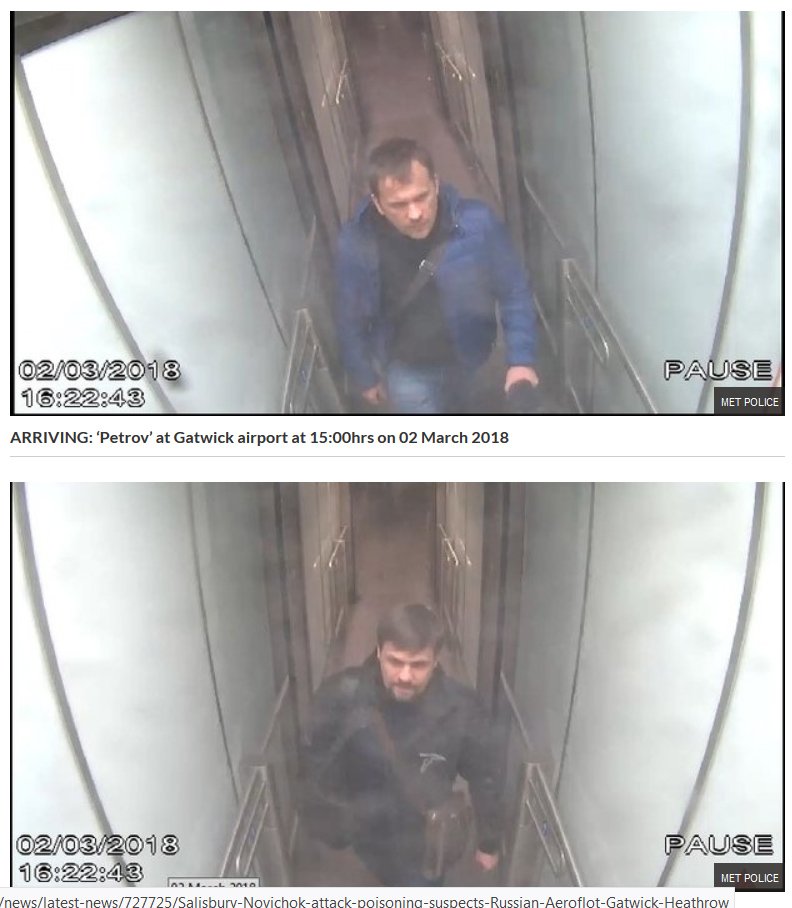
These CCTV images released by Scotland yard today allegedly show Alexander Petrov and Ruslan Boshirov both occupying exactly the same space at Gatwick airport at precisely the same second. 16.22.43 on 2 March 2018. Note neither photo shows the other following less than a second behind.
There is no physically possible explanation for this. You can see ten yards behind each of them, and neither has anybody behind for at least ten yards. Yet they were both photographed in the same spot at the same second.
The only possible explanations are:
1) One of the two is travelling faster than Usain Bolt can sprint
2) Scotland Yard has issued doctored CCTV images/timeline.
I am going with the Met issuing doctored images.
UPDATE
A number of people have pointed out a third logical possibility, that the photographs are not of the same place and they are coming through different though completely identical entry channels. The problem with that is the extreme synchronicity. You can see from the photos that the channel(s) are enclosed and quite long, and they would have had to enter different entrances to the channels. So it is remarkable they were at exactly the same point at the same time. Especially as one of them appears to be holding (wheeled?) luggage and one has only a shoulder bag.
I have traveled through Gatwick many times but cannot call to mind precisely where they are. Can anybody pinpoint the precise place in the airport? Before or after passport control? Before or after baggage collection? Before or after customs? The only part of the airport this looks like to me is shortly after leaving the plane after the bridge, and before joining the main gangway to passport control – in which case passengers are not split into separated channels at the stage this was taken. I can’t recall any close corridors as long as this after passport control. But I am open to correction.
US meddles in Russian affairs by trying to turn our citizens into informants – Kremlin
RT | September 3, 2018
In recent years, the US has been meddling in Russian affairs by “very crudely” trying to recruit Russians as informants, while exerting moral and other types of pressure on them, Vladimir Putin’s spokesperson said on Monday.
Kremlin spokesperson Dmitry Peskov was commenting on a recent story published in the New York Times, stating that in 2014-2016, the FBI and the US Department of Justice tried to recruit Russian business tycoon Oleg Deripaska as an informant.
According to the paper, US officials wanted to make the businessman share information on Russian organized crime and the alleged Russian aid to Donald Trump’s 2016 presidential campaign.
Considering that businessmen like Deripaska are “major shareholders and top managers of major companies,” including those operating in “quite sensitive segments of the Russian economy,” attempts to recruit them constitute “attempts to meddle in Russia’s domestic affairs,” Peskov said.
The US Intelligence Community and lawmakers have been accusing Russia of interfering in the American election process by waging cyberattacks and ‘propaganda’ against US citizens.
In June, the US federal grand jury indicted 13 Russian nationals and three entities with organizing a campaign “supporting” then-candidate Trump and “disparaging” his then-rival Hillary Clinton. US officials also accuse the Kremlin of hacking the server of the Democratic National Committee and the email account of the head of the Clinton campaign, John Podesta.
The Kremlin had repeatedly denied claims that the Russian state provided any assistance to Trump and emphasized that the US failed to produce substantial evidence of ‘meddling.’ The House Intelligence Committee report, accusing Russia of interfering in the US election, was published but heavily redacted, with the chapter entitled ‘Russia attacks the United States’ completely covered with black lines. The same report found “no evidence” that the Trump campaign “colluded, coordinated, or conspired” with the Russian government.
As for the accusation of waging a ‘propaganda campaign’ on social media, IT giants YouTube, Facebook, and Twitter admitted that the ‘Russian-affiliated’ posts and videos made up just tiny fractions of their feeds.
President Vladimir Putin found the whole idea of Russia transforming the will of US voters ridiculous. “Does anyone seriously think that Russia can somehow influence the choice of the American people?” Putin said back in 2016.
“Is America some sort of a banana republic?” he asked rhetorically. “America is a great state. Correct me, please, if I’m wrong.”
Desperate for collusion proof, FBI ‘tried & failed to recruit Russian oligarchs’ – report
RT | September 2, 2018
FBI agents tried to turn Russia’s once-richest man into a US mole, according to an explosive NYT report. It claims that Oleg Deripaska was one of six oligarchs targeted for information in a Russiagate-related intelligence flop.
According to reports by the New York Times, the US government pushed oligarchs with perceived links to President Vladimir Putin for information. Deripaska was allegedly nudged to give up information on Russian organized crime and “possible Russian aid to President Trump’s 2016 campaign.”
Determined to get something on the Kremlin’s unproven involvement in the 2016 election, FBI agents reportedly turned up unannounced at Deripaska’s New York home to quiz him about his ex-business partner Paul Manafort – who went on to lead Trump’s election campaign – and Manafort’s links to Russia.
Despite the US government’s repeated attempts to gather intelligence from him, Deripaska told the US Department of Justice that he had no information to provide. Sources told the NYT that Deripaska disagreed with the agents’ opinion that Russia had colluded with the US in Trump’s election campaign. He also slammed theories about Manafort’s alleged role as “preposterous,” even though the two men were involved in a “bitter business dispute.” He is also said to have notified the Kremlin about the US government’s failed efforts to recruit him.
It is understood that Justice Department official Bruce Ohr and former British spy Christopher Steele – who was responsible for the infamous Trump-Russia ‘dirty dossier’ – were involved in the attempt to turn Russian oligarchs into US informants. The report said that the US government tried to entice Deripaska with promises to relieve him of previous visa issues stemming from past legal problems, but their attempts to win over the aluminum magnate and other Russian oligarchs appear to have failed.
In April, Deripaska and his company were hit by sweeping US sanctions, with Washington accusing him of links to crime, various abuses and even of ordering a murder.
Report: There were no FISA hearings held over Spy documents.”It is astonishing that the FISA courts couldn’t hold hearings on Spy Warrants targeting Donald Trump. It isn’t about Carter Page, it’s about the Trump Campaign. You’ve got corruption at the DOJ & FBI. The leadership….
— Donald J. Trump (@realDonaldTrump) September 1, 2018
….of the DOJ & FBI are completely out to lunch in terms of exposing and holding those accountable who are responsible for that corruption.” @TomFitton@JudicialWatch
— Donald J. Trump (@realDonaldTrump) September 1, 2018
The report comes as Trump took to Twitter to accuse the Department of Justice and FBI of “corruption” over the “Russia hoax.” The president also accused the DOJ and FBI of being “completely out to lunch” in a series of tweets, in which he insisted that “no information was ever given by the Trump Team to Russia”.
The 10 Main Holes in the Official Narrative on the Salisbury Poisonings: #6 – The Meal and The Drink
By Rob Slane | The Blog Mire | August 30, 2018
In the last two pieces, I have focused on the official timeline of events on March 4th, as stated by The Metropolitan Police on 17th March. In Part #4, I concentrated on the fact that the timeline has not been updated since 17th March to let us know what the Skripals were doing on the morning of 4th March, even though this information is both important and readily available. Then in Part #5, I focused on another very important event that occurred on the afternoon of 4th March, which has been omitted altogether from the timeline: the duck feed. Given that the duck feed occurred after the official narrative says the Skripals were poisoned, but before they went to Zizzis and The Mill, that piece of information alone is enough to completely discredit the official narrative. Which is perhaps why it has been left out.
I want to now focus on one last part of the timeline, which is not something that has been left out, as in the case of the missing 4 hours and the duck feed, but something that appears to have been inverted into the wrong order. Once again, let’s begin with the official timeline:
Saturday 3rd March
14.40hrs on Saturday 3 March: Yulia arrives at Heathrow Airport on a flight from Russia.
Sunday 4th March
09.15hrs on Sunday, 4 March: Sergei’s car is seen in the area of London Road, Churchill Way North and Wilton Road.
13.30hrs: Sergei’s car is seen being driven down Devizes Road, towards the town centre.
13:40hrs: Sergei and Yulia arrive in Sainsbury’s upper level car park at the Maltings. At some time after this, they go to the Bishops Mill Pub in the town centre.
14.20hrs: They dine at Zizzi Restaurant.
15:35hrs: They leave Zizzi Restaurant.
16.15hrs: Emergency services receive a report from a member of the public and police arrive at the scene within minutes, where they find Sergei and Yulia extremely ill on a park bench near the restaurant.
I noted in the previous piece that the timeline is astonishingly vague in places. No more is this so than regarding the visit to The Mill Pub. As a general rule, when there is such vagueness in an official timeline, it must either be because the information that might clarify things is not available, or because those producing the timeline are attempting to conceal something or detract attention.
Is the information available? Of course, and from a number of sources. Firstly, there are a number of CCTV cameras covering The Maltings, and no less than 12 in The Mill itself, all of which could be checked and the timestamps noted. Secondly, according to witnesses the Skripals are known to have ordered two glasses of white wine whilst in The Mill, and so the cash register or card payment would have registered the time of purchase. Thirdly, there were a number of witnesses who claimed to have seen the Skripals both in the pub and the restaurant. Fourthly, Sergei and Yulia’s phones could be tracked to see where they were and when, assuming they were traceable. And fifthly, as I have repeatedly pointed out, Sergei and Yulia are alive, apparently well, and so can be asked to fill in the details.
But if the information is there, why is the timeline so vague?
To answer that, I want to turn to some of the earlier reports, which rely on witness statements to piece together details about the Skripals’ movements. All of these reports appeared prior to the release of the Metropolitan Police’s timeline and, as you will see, there is something very striking about them:
“Sergei Skripal went for a drink with his daughter at 3pm at The Mill in Salisbury after eating at a Zizzi Italian restaurant. In the pub, they ordered two glasses of wine before Mr Skripal went to use the toilet. The witness, who did not want to be named, said that when he returned he appeared as if he was drunk. He said Mr Skripal and his daughter Yulia then left immediately without finishing their drinks.”
https://www.pressreader.com/uk/daily-mail/20180310/281625305816856
“It is not clear when the Skripals were confronted, having left a branch of Italian restaurant chain Zizzi between 2pm and 3pm. After leaving the restaurant, they are thought to have gone to a nearby a pub called The Mill. They were then seen walking through a shopping precinct and found on a bench overlooking the Avon shortly after 4pm.”
http://www.dailymail.co.uk/news/article-5473177/Woman-40s-taken-hospital.html
“The Skripals had eaten lunch in Italian restaurant chain Zizzi in the centre of Salisbury on Sunday. They are believed to have left between 2pm and 3pm and gone to a nearby pub called The Mill before being found later on a bench overlooking the Avon.”
https://www.standard.co.uk/news/uk/emergency-services-called-to-building-next-to-zizzi-restaurant-at-centre-of-russian-spy-poison-plot-a3784031.html
“A witness told detectives he saw a man with a black mask covering his nose and mouth acting suspiciously around 3pm last Sunday. At the time Mr Skripal and Yulia were thought to be in the Mill pub a few yards away.”
http://www.dailymail.co.uk/news/article-5486163/Fears-Russian-spy-poisoned-bouquet-flowers.html
“Witnesses have said that after eating at Zizzi’s restaurant they went to the Mill pub where Mr Skripal appeared unsteady on his feet, as if “drunk” – even though he had only ordered a single glass of white wine – suggesting the effects of the nerve agent were rapidly taking effect.”
https://www.telegraph.co.uk/news/2018/03/10/poisoned-police-officer-not-hero-just-job/
“Officers yesterday took CCTV from inside The Mill. They had gone into The Mill pub following a meal in a Zizzi restaurant.”
https://www.thesun.co.uk/news/5742937/cops-hunt-blonde-woman-seen-on-cctv-20-mins-before-ex-russian-spy-spy-sergei-skripal-and-daughter-yulia-were-poisoned/
“Steve Cooper, who was at the Mill pub with his wife and dog for a couple of hours last Sunday afternoon, told the BBC he was outraged. Some of his friends, who had been in the pub at the same time and seen Mr Skripal head to the toilet, could not remember what they had been wearing that day, he added. https://www.bbc.com/news/uk-43362673
When was Mr Cooper in The Mill? Here’s what he said in an interview with ITV:
‘We’d been sitting on the very bench at around 3pm and then moved onto The Mill Pub and left there at 4:45pm where we saw the air ambulance.’”
https://www.facebook.com/itvnewsmeridian/videos/1699234906804241/
In fact, there are three very striking things about these reports:
- Firstly, they all contradict the official timeline by stating that Sergei and Yulia Skripal went to Zizzis first, then on to The Mill.
- Secondly, a number of them suggest that the Skripals were in the pub at around 3pm, rather than between 1:40 and 2:20, as the official timeline suggests.
- Thirdly, they are based on the testimony of witnesses, whereas I have yet to see a single witness statement that backs up the order of events suggested in the official timeline.
But if those reports leave you unpersuaded that the Skripals visited Zizzis first, followed by The Mill, there is more. In this early report in The Times, not only is the sequence stated as Zizzis then The Mill, but there is also an interesting detail. It is said that the Skripals left Zizzis 45 minutes after arriving, before going onto The Mill:
“Within 45 minutes the pair had left and it is assumed that they took the short stroll to The Mill.”
https://www.thetimes.co.uk/article/russian-spy-sergei-skripal-was-easy-to-find-at-pub-restaurant-or-railway-club-t80jfbjxm
This same detail was mentioned in another article, this time in The Mail, which carried the following statement by another witness:
“He was going absolutely crazy, I didn’t understand it and I couldn’t understand him. They had not been seen for a little while by the front of house staff, but I think it was more than that. He just wanted his food and to go. He was just shouting and losing his temper. I would have asked him to leave. He just said, “I want my food and my bill”. ‘The waiter took him the bill at the same time as the main course, which was unusual. I don’t think they paid all of the bill. I think they were given a discount because he was so angry and agitated. He had to wait about 20 minutes for his main course. I think it was easier for the staff just to give him money to leave as he was so angry. They were sitting by themselves at the back of the restaurant but I think people were pleased when they left. They were only there for about 45 minutes. It was a quick lunch. He just wanted to get out of there. She was silent, perhaps embarrassed.”
http://www.dailymail.co.uk/news/article-5470455/How-poisoned-spy-plot-unfolded-Salisbury.html
Notice how this 45 minutes does not fit into the official timeline. There it is said that they arrived at Zizzis at 14:20 and left at 15:35. By my reckoning, this is 75 minutes. Not 45. And in any case, the 75 minutes would make a nonsense of his apparent agitation at having to wait 20 minutes for his main course.
Put all this together and what can we say?
Firstly: we can be confident that the original reports, based on various witness statements and all claiming that the Skripals went to Zizzis first and then The Mill, are accurate.
Secondly: we can therefore be confident that the official timeline, which places the visit to The Mill before the visit to Zizzis, but which is backed up by no public witness statements, is wrong.
Thirdly: we can construct our own timeline of that part of the day, which although not official, and differing from the official timeline, does at least have the benefit of getting things in the right order:
13:40hrs: Sergei and Yulia arrive in Sainsbury’s upper level car park at the Maltings.
13:45hrs: Sergei is seen on CCTV feeding ducks near the Avon Playground, and handing bread to three boys, none of whom seem to have been affected by a nerve agent.
13:50-14:00hrs: The Skripals enter Zizzi Restaurant.
14:35-14:45hrs: They leave Zizzis and walk to The Bishops Mill Pub.
All of which begins to answer the question of why the official timeline is so vague. It is vague because the order of events it posits is incorrect. Furthermore – and I’m sorry to say that I can think of no other plausible reason, given the “cloud of witnesses” mentioned above – it is vague because the order of events it suggests is deliberately incorrect. That is, it appears that a decision has been taken to ignore all the early reports, and to discard all that witness testimony, and instead to advance a timeline that is based on no public witness statements, using the vague and woolly statement, “At some time after this, they go to the Bishops Mill Pub in the town centre”.
Which raises a number of important questions:
- Why have investigators ignored a large number of reports and witness statements, and have instead produced a timeline that is not backed up by any public testimony?
- Why have the media organisations who came up with the Zizzis to Mill order of events after speaking to witnesses, not questioned the Metropolitan Police timeline and its implication that their reports were “fake news”?
- Why do those who constructed the timeline seem so keen to avoid people concluding what the early reports state, which is that after leaving Zizzis, the Skripals were in The Mill at around 3pm?
The 10 Main Holes in the Official Narrative on the Salisbury Poisonings: #1 – The Motive
The 10 Main Holes in the Official Narrative on the Salisbury Poisonings: #2 – The Intent
The 10 Main Holes in the Official Narrative on the Salisbury Poisonings: #3 – The Capability
The 10 Main Holes in the Official Narrative on the Salisbury Poisonings: #4 – The Missing Four Hours
The 10 Main Holes in the Official Narrative on the Salisbury Poisonings: #6 – The Meal and The Drink
Imagine if the BBC Were Honest
By Craig Murray | August 30, 2018
The BBC refuses to answer my Skripal questions to Mark Urban on the grounds they have no legal obligation, instead giving a “statement”. That correspondence follows below. But I want you first to imagine a World in which the BBC and Mark Urban were honest and independent, and imagine these were the answers to my questions:
1) When the Skripals were first poisoned, it was the largest news story in the entire World and you were uniquely positioned having held several meetings with Sergei Skripal the previous year. Yet faced with what should have been a massive career break, you withheld that unique information on a major story from the public for four months. Why?
My interviews with Sergei Skripal were on a strictly off the record basis and I felt honour bound not to mention them until I could obtain his permission.
2) You were an officer in the Royal Tank Regiment together with Skripal’s MI6 handler, Pablo Miller, who also lived in Salisbury. Have you maintained friendship with Miller over the years and how often do you communicate?
I had not heard from Pablo Miller for decades, since I left the army.
3) When you met Skripal in Salisbury, was Miller present all or part of the time, or did you meet Miller separately?
I did not meet Miller.
4) Was the BBC aware of your meetings with Miller and/or Skripal at the time?
Yes, with Skripal.
5) When, four months later, you told the world about your meetings with Skripal after the Rowley/Sturgess incident, you said you had met him to research a book. Yet the only forthcoming book by you advertised is on the Skripal attack. What was the subject of your discussions with Skripal?
A book on Russian intelligence.
6) Pablo Miller worked for Orbis Intelligence. Do you know if Miller contributed to the Christopher Steele dossier on Trump/Russia?
I don’t know.
7) Did you discuss the Trump dossier with Skripal and/or Miller?
No.
8) Do you know whether Skripal contributed to the Trump dossier?
No.
9) In your Newsnight piece following the Rowley/Sturgess incident, you stated that security service sources had told you that Yulia Skripal’s telephone may have been bugged. Since January 2017, how many security service briefings or discussions have you had on any of the matter above.
That was my only contact with the intelligence services on this matter.
Does anybody imagine that, if those were indeed the answers, Mark Urban and the BBC would not freely give those answers, and show up their accusers as “conspiracy theorists” with no foundation?
If those were the answers, they would be shouting them from the rooftops.
And indeed the BBC statement, while refusing to answer the questions directly, does give responses to questions 1, 4 and 5 which are along the lines of this outcome were they behaving honestly, though their phrasing does not carry conviction, especially on 1.
The questions the BBC has refused to address at all are all those related to Pablo Miller, UK intelligence services and the Steele Orbis dossier on Trump/Russia. That is an extremely telling omission. Their attempt to issue a statement rather than address the questions individually, is a deliberate ruse to disguise that.
On a balance of probabilities measure, I am willing to take the BBC’s refusal to answer these very specific questions as strong evidence that the Skripal case is indeed about Miller, Steele, Orbis and the Trump/Russia dossier. Furthermore the BBC knows that and is deliberately concealing the truth, and instead broadcasting evidence free nonsense about Russian agents, knowing that to be untrue. If that were not the case, it would take the BBC quite literally two minutes to give the answers above. There would be no downside for the BBC in giving those answers; indeed they would be vindicated to a sceptical public.
I asked you to imagine those answers were true. In asking us to imagine a better world, John Lennon told us “its easy if you try”. Sadly I find it is not easy. It is not easy to imagine a world in which Mark Urban is not a morally repugnant lying shill for the security services, that takes a very great deal of effort.
Here is the BBC statement and ensuing correspondence:
From: Matthew Hunter
Sent: 29 August 2018 09:42
To: ‘is’
Subject: BBC NewsnightDear Mr Murray,
Matt Hunter in the BBC News Press Team.
I understand you contacted Mark Urban on Monday with regards to meetings he had with Sergei Skripal. Some of the information you’ve requested we are not obliged to share as it is held for purposes of journalism, but I can provide you with a more general response regarding Mark’s meetings with Mr Skripal.
Mark Urban met with Sergei Skripal on a number of occasions last Summer in Salisbury and last spoke to him on the phone in August, 7 months before the poisoning. Mr Skripal agreed to speak to Mark to assist with his research for his latest book on post-Cold War espionage, it was not discussed with Mr Skripal whether the information would be used for the BBC ahead of the book being published. The relevant information gained from these interviews informed Newsnight’s coverage during the early days after the poisoning. Mr Urban reported his meetings with Mr Skripal on BBC Newsnight once the details of the book were made public in keeping with the understood terms of the interview. Mark Urban’s line managers were aware last year that he was working on a book and more specifically from 5th March this year that this work had included interviews with Mr Skripal.
I hope these details help clarify the situation.
Please note that all future journalistic enquiries should be made through the BBC Press Office (press.office@bbc.co.uk).
Thank you for your enquiry.
Best wishes
MattMatt Hunter – Publicist
BBC News & Current Affairs
——–
From: craig murray [mailto:craigmurray@mail.ru]
Sent: 29 August 2018 14:23
To: Matthew Hunter; Mark Urban
Subject: RE: BBC NewsnightDear Mr Hunter,
Thank you for your email. This is an important matter, which interests a great many people, as I am sure you are aware, and which has caused some damage to the reputation of the BBC.
You state that ” Some of the information you’ve requested we are not obliged to share as it is held for purposes of journalism”. My questions were not couched as an FOI request so that is a redundant provision, even if your broad interpretation of the FOIA were correct, which I dispute.
Your email then proceeds on the basis that you should not reveal anything unless you are legally obliged to do so. That seems a very strange stance for a public broadcast body to take. Whether or not you are legally obliged to do so, can I ask you to give the answer to these questions to Mr Urban, or in each case an explanation for why you refuse to give an answer voluntarily, even if legally unobliged.
What is at stake here is the BBC’s reputation for open and honest reporting, and this particular case has done a great deal to increase public distrust in the BBC. All of these are fair and relevant questions which have simple answers. Kindly address them individually.
My questions to Mark Urban:
1. When the Skripals were first poisoned, it was the largest news story in the entire World and you were uniquely positioned having held several meetings with Sergei Skripal the previous year. Yet faced with what should have been a massive career break, you withheld that unique information on a major story from the public for four months. Why?
2. You were an officer in the Royal Tank Regiment together with Skripal’s MI6 handler, Pablo Miller, who also lived in Salisbury. Have you maintained friendship with Miller over the years and how often do you communicate?
3. When you met Skripal in Salisbury, was Miller present all or part of the time, or did you meet Miller separately?
4. Was the BBC aware of your meetings with Miller and/or Skripal at the time?
5. When, four months later, you told the world about your meetings with Skripal after the Rowley/Sturgess incident, you said you had met him to research a book. Yet the only forthcoming book by you advertised is on the Skripal attack. What was the subject of your discussions with Skripal?
6. Pablo Miller worked for Orbis Intelligence. Do you know if Miller contributed to the Christopher Steele dossier on Trump/Russia?
7. Did you discuss the Trump dossier with Skripal and/or Miller?
8. Do you know whether Skripal contributed to the Trump dossier?
9. In your Newsnight piece following the Rowley/Sturgess incident, you stated that security service sources had told you that Yulia Skripal’s telephone may have been bugged. Since January 2017, how many security service briefings or discussions have you had on any of the matter above.I look forward to your response,
Craig Murray
———-
From: Matthew Hunter
Sent: 29 August 2018 15:09
To: ‘craig murray’
Subject: RE: BBC NewsnightI’m afraid we have no further comment beyond the statement provided earlier.
Many thanks,
Matt
———–
From: craig murray
Sent: 29 August 2018 18:22
To: Matthew Hunter
Subject: RE: BBC NewsnightOh, so it was a “statement” rather than a reply to my questions.
May I ask you who drafted the statement, who approved it, and who was consulted on it? The statement, incidentally, does not constitute journalism, so you do have a legal obligation to answer those questions.
Craig
‘Vital’ US moles in the Kremlin go missing!
By Stephen F. Cohen | The Nation | August 30, 2018
According to New York Times intel leakers, “informants close to” Putin have “gone silent.” What can it all mean?
For nearly two years, mostly vacuous (though malignant) Russiagate allegations have drowned out truly significant news directly affecting America’s place in the world. In recent days, for example, French President Emmanuel Macron declared “Europe can no longer rely on the United States to provide its security,” calling for instead a broader kind of security “and particularly doing it in cooperation with Russia.” About the same time, German Chancellor Angela Merkel and Russian President Vladimir Putin met to expand and solidify an essential energy partnership by agreeing to complete the Nord Stream 2 pipeline from Russia, despite US attempts to abort it. Earlier, on August 22, the Afghan Taliban announced it would attend its first ever major peace conference – in Moscow, without US participation.
Thus does the world turn, and not to the wishes of Washington. Such news would, one might think, elicit extensive reporting and analysis in the American mainstream media. But amid all this, on August 25, the ever-eager New York Times published yet another front-page Russiagate story – one that, if true, would be sensational, though hardly anyone seemed to notice. According to the Times’ regular Intel leakers, US intelligence agencies, presumably the CIA, has had multiple “informants close to… Putin and in the Kremlin who provided crucial details” about Russiagate for two years. Now, however, “the vital Kremlin informants have largely gone silent.” The Times laces the story with misdeeds questionably attributed to Putin and equally untrustworthy commentators, as well as a mistranslated Putin statement that incorrectly has him saying all “traitors” should be killed. Standard US media fare these days when fact-checkers seem not to be required for Russia coverage. But the sensation of the article is that the US had moles in Putin’s office.
Skeptical or credulous readers will react to the Times story as they might. Actually, an initial, lesser version of it first appeared in the Washington Post, an equally hospitable intel platform, on December 15, 2017. I found it implausible for much the same reasons I had previously found Christopher Steele’s “Dossier,” also purportedly based on “Kremlin sources,” implausible. But the Times’ new, expanded version of the mole story raises more and larger questions.
If US intelligence really had such a priceless asset in Putin’s office – the Post report implied only one, the Times writes of more than one – imagine what they could reveal about Enemy No. 1 Putin’s intentions abroad and at home, perhaps daily – why would any American intel official disclose this information to any media at the risk of being charged with a treasonous capital offense? And now more than once? Or, since “the Kremlin” closely monitors US media, at the risk of having the no less treasonous Russian informants identified and severely punished? Presumably this is why the Times’ leakers insist that the “silent” moles are still alive, though how they know we are not told. All of this is even more implausible. Certainly, the Times article asks no critical questions.
But why leak the mole story again, and now? Stripped of extraneous financial improprieties, failures to register as foreign lobbyists, tacky lifestyles, and sex having nothing to do with Russia, the gravamen of the Russiagate narrative remains what it has always been: Putin ordered Russian operatives to “meddle” in the US 2016 presidential election in order to put Donald Trump in the White House, and Putin is now plotting to “attack” the November congressional elections in order to get a Congress he wants. The more Robert Mueller and his supporting media investigates, the less evidence actually turns up, and when it seemingly does, it has to be considerably massaged or misrepresented.
Nor are “meddling” and “interfering” in the other’s domestic policy new in Russian-American relations. Tsar Alexander II intervened militarily on the side of the Union in the American Civil War. President Woodrow Wilson sent troops to fight the Reds in the Russian Civil War. The Communist International, founded in Moscow in 1919, and its successor organizations financed American activists, electoral candidates, ideological schools, and pro-Soviet bookstores for decades in the United States. With the support of the Clinton administration, American electoral advisers encamped in Moscow to help rig Russian President Boris Yeltsin’s re-election in 1996. And that’s the bigger “meddling” apart from the decades-long “propaganda and disinformation” churned out by both sides, often via forbidden short-wave radio. Unless some conclusive evidence appears, Russian social media and other meddling in the 2016 presidential election was little more than old habits in modern-day forms. (Not incidentally, the Times story suggests that US Intel had been hacking the Kremlin, or trying to, for many years. This too should not shock us.)
The real novelty of Russiagate is the allegation that a Kremlin leader, Putin, personally gave orders to affect the outcome of an American presidential election. In this regard, Russiagaters have produced even less evidence, only suppositions without facts or much logic. With the Russiagate narrative being frayed by time and fruitless investigations, the “mole in the Kremlin” may have seemed a ploy needed to keep the conspiracy theory moving forward, presumably toward Trump’s removal from office by whatever means. And hence the temptation to play the mole card again, now, as yet more investigations generate smoke but no smoking gun.
The pretext of the Times story is that Putin is preparing an attack on the upcoming November elections, but the once-“vital,” now-silent moles are not providing the “crucial details.” Even if the story is entirely bogus, consider the damage it is doing. Russiagate allegations have already de-legitimized a presidential election, and a presidency, in the minds of many Americans. The Times’ updated, expanded version may do the same to congressional elections and the next Congress. If so, there is an “attack on American democracy” – not by Putin or Trump but by whoever godfathered and repeatedly inflated Russiagate.
As I have argued previously, such evidence that exists points to John Brennan and James Clapper, President Obama’s head of the CIA and director of national intelligence respectively, even though attention has been focused on the FBI. Indeed, the Times story reminds us of how central “intelligence” actors have been in this saga. Arguably, Russiagate has brought us to the worst American political crisis since the Civil War and the most dangerous relations with Russia in history. Until Brennan, Clapper, and their closest collaborators are required to testify under oath about the real origins of Russiagate, these crises will grow.
Stephen F. Cohen, professor emeritus of Russian studies and politics at NYU and Princeton, and John Batchelor continue their (usually) weekly discussions of the new US-Russian Cold War. (Previous installments, now in their fifth year, are at TheNation.com.)
READ MORE:
Russiagate’s ‘core narrative’ has always lacked actual evidence – Stephen Cohen
US Intel, Media Spread Fake Reports on Alleged Russian Election Meddling
Sputnik – 29.08.2018
WASHINGTON – US intelligence officials and the American mainstream media have been propagating false Russia meddling claims to undermine pro-Trump congressional candidates ahead of the midterm elections, analysts told Sputnik.
In particular, The New York Times reported on Friday, citing unnamed intelligence officials, that US sources in the Kremlin who had warned about Russian intervention in the US 2016 presidential election “had gone silent” and now the CIA is in the dark about Moscow’s plans vis-a-vis the upcoming congressional midterm elections.
In November, US voters go to the polls to elect lawmakers who will represent their respective states at the federal level. The midterm elections will determine whether Republicans maintain control of Congress and will be seen by many as a referendum on the sitting president’s performance.
US intelligence leaders, including Director of National Intelligence Dan Coats, without any evidence have been warning that Russia will likely interfere in the midterm elections. Coats and others have also claimed that Russia is waging an influence campaign via social media.
Former US Defense Department adviser Karen Kwiatkowski told Sputnik that she had doubts about the reliability of the New York Times report and intelligence community claims.
“Reading between the lines of this article, it seems as if politicized members of the US intelligence establishment — including people like Dan Coats — are hedging their bets,” she said.
Coats and his colleagues were getting on record their ‘concern’ about Russia interference in these upcoming elections in the event of an unexpected wave of support for President Donald Trump, Kwiatkowski explained.
The New York Times report, claiming that the United States had human sources inside the Kremlin appeared to be based on false assumptions and to be part of a wider strategy to try and convince US public opinion about a non-existent Russian plot to influence the elections, Kwiatkowski cautioned.
“In terms of this article, I suspect it is wrong in its assumptions, and is part of a larger domestic propaganda effort,” Kwiatkowski said.
Kwiatkowski pointed out the remarkable lack of evidence to support US allegations of Russia’s meddling in the 2018 midterm elections.
“The American intelligence apparatus is ‘concerned’ that the Russians are trying to pick and choose candidates in midterm elections — 435 Congressional elections and 33 plus Senate elections — but they don’t have any information about this activity that they ‘know’ is happening,” the former Pentagon aide said. “This isn’t how intelligence is done. It is however how agendas are pushed, and propaganda rejuvenated.”
Former CIA Director John Brennan, who was referred to in the New York Times article, lacked any credibility based on his documented record, Kwiatkowski noted.
“Brennan is an unreliable source, extremely biased, a known liar and he’s currently angrier than usual. With his clearance suspended, he may be receiving less information from his friends in the government, and maybe that’s what he is complaining about,” Kwiatkowski said.
Former Canadian diplomat Patrick Armstrong, who once served as a political official at Ottawa’s embassy in Moscow, told Sputnik that The New York Times report was written to try and sustain flagging interest and support the diminishing credibility of the fiction that Russia intervened in the 2016 US elections.
“The writers are trying to keep the conspiracy going in the hope that the Democrats will control the House and shut down all examination of what really happened,” Armstrong said.
Fake News
However, the fantasy that Russian involvement had cost the Democratic candidate Hillary Clinton the 2016 election was supported by no evidence whatsoever, Armstrong emphasized.
“This is nonsense on stilts and only can be twisted into a question if you believe — as New York Times consumers do as a matter of faith — that Russia ‘interfered’ in the first place,” Armstrong said.
No evidence has been produced other than the “fantasies” in the unsubstantiated dossier produced by former UK spy Christopher Steele.
The only plausible content in the New York Times story was the assertion that Moscow had expelled many of Washington’s intelligence assets in Russia, Armstrong observed.
Kwiatkowski pointed out that the real manipulation of US elections was done by countries that had a historically shared culture with the United States.
The UK’s MI6 and Israel’s Mossad, Kwiatkowski said, are far more active in US elections, at many levels, than the Russians could ever hope to be.
“It’s nice for The New York Times to be able not to talk about these risks — in part because Trump is not the candidate these two countries would prefer,” Kwiatkowski concluded.
In January 2017, a US intelligence community report that contained zero evidence claimed that Moscow tried to meddle in the US election process. Moscow has repeatedly denied interfering in US elections as such actions would run counter to the principles and practices of Russian foreign policy.
How the Department of Homeland Security Created a Deceptive Tale of Russia Hacking US Voter Sites
By Gareth Porter | Consortium News | August 28, 2018
The narrative of Russian intelligence attacking state and local election boards and threatening the integrity of U.S. elections has achieved near-universal acceptance by media and political elites. And now it has been accepted by the Trump administration’s intelligence chief, Dan Coats, as well.
But the real story behind that narrative, recounted here for the first time, reveals that the Department of Homeland Security (DHS) created and nurtured an account that was grossly and deliberately deceptive.
DHS compiled an intelligence report suggesting hackers linked to the Russian government could have targeted voter-related websites in many states and then leaked a sensational story of Russian attacks on those sites without the qualifications that would have revealed a different story. When state election officials began asking questions, they discovered that the DHS claims were false and, in at least one case, laughable.
The National Security Agency and special counsel Robert Mueller’s investigating team have also claimed evidence that Russian military intelligence was behind election infrastructure hacking, but on closer examination, those claims turn out to be speculative and misleading as well. Mueller’s indictment of 12 GRU military intelligence officers does not cite any violations of U.S. election laws though it claims Russia interfered with the 2016 election.
A Sensational Story
On Sept. 29, 2016, a few weeks after the hacking of election-related websites in Illinois and Arizona, ABC News carried a sensational headline: “Russian Hackers Targeted Nearly Half of States’ Voter Registration Systems, Successfully Infiltrated 4.” The story itself reported that “more than 20 state election systems” had been hacked, and four states had been “breached” by hackers suspected of working for the Russian government. The story cited only sources “knowledgeable” about the matter, indicating that those who were pushing the story were eager to hide the institutional origins of the information.
Behind that sensational story was a federal agency seeking to establish its leadership within the national security state apparatus on cybersecurity, despite its limited resources for such responsibility. In late summer and fall 2016, the Department of Homeland Security was maneuvering politically to designate state and local voter registration databases and voting systems as “critical infrastructure.” Such a designation would make voter-related networks and websites under the protection a “priority sub-sector” in the DHS “National Infrastructure Protection Plan, which already included 16 such sub-sectors.
DHS Secretary Jeh Johnson and other senior DHS officials consulted with many state election officials in the hope of getting their approval for such a designation. Meanwhile, the DHS was finishing an intelligence report that would both highlight the Russian threat to U.S. election infrastructure and the role DHS could play in protecting it, thus creating political impetus to the designation. But several secretaries of state—the officials in charge of the election infrastructure in their state—strongly opposed the designation that Johnson wanted.
On Jan. 6, 2017—the same day three intelligence agencies released a joint “assessment” on Russian interference in the election—Johnson announced the designation anyway.
Media stories continued to reflect the official assumption that cyber attacks on state election websites were Russian-sponsored. Stunningly, The Wall Street Journal reported in December 2016 that DHS was itself behind hacking attempts of Georgia’s election database.
The facts surrounding the two actual breaches of state websites in Illinois and Arizona, as well as the broader context of cyberattacks on state websites, didn’t support that premise at all.
In July, Illinois discovered an intrusion into its voter registration website and the theft of personal information on as many as 200,000 registered voters. (The 2018 Mueller indictments of GRU officers would unaccountably put the figure at 500,000.) Significantly, however, the hackers only had copied the information and had left it unchanged in the database.
That was a crucial clue to the motive behind the hack. DHS Assistant Secretary for Cyber Security and Communications Andy Ozment told a Congressional committee in late September 2016 that the fact hackers hadn’t tampered with the voter data indicated that the aim of the theft was not to influence the electoral process. Instead, it was “possibly for the purpose of selling personal information.” Ozment was contradicting the line that already was being taken on the Illinois and Arizona hacks by the National Protection and Programs Directorate and other senior DHS officials.
In an interview with me last year, Ken Menzel, the legal adviser to the Illinois secretary of state, confirmed what Ozment had testified. “Hackers have been trying constantly to get into it since 2006,” Menzel said, adding that they had been probing every other official Illinois database with such personal data for vulnerabilities as well. “Every governmental database—driver’s licenses, health care, you name it—has people trying to get into it,” said Menzel.
In the other successful cyberattack on an electoral website, hackers had acquired the username and password for the voter database Arizona used during the summer, as Arizona Secretary of State Michele Reagan learned from the FBI. But the reason that it had become known, according to Reagan in an interview with Mother Jones, was that the login and password had shown up for sale on the dark web—the network of websites used by cyber criminals to sell stolen data and other illicit wares.
Furthermore, the FBI had told her that the effort to penetrate the database was the work of a “known hacker” whom the FBI had monitored “frequently” in the past. Thus, there were reasons to believe that both Illinois and Arizona hacking incidents were linked to criminal hackers seeking information they could sell for profit.
Meanwhile, the FBI was unable to come up with any theory about what Russia might have intended to do with voter registration data such as what was taken in the Illinois hack. When FBI Counterintelligence official Bill Priestap was asked in a June 2017 hearing how Moscow might use such data, his answer revealed that he had no clue: “They took the data to understand what it consisted of,” said the struggling Priestap, “so they can affect better understanding and plan accordingly in regards to possibly impacting future elections by knowing what is there and studying it.”
The inability to think of any plausible way for the Russian government to use such data explains why DHS and the intelligence community adopted the argument, as senior DHS officials Samuel Liles and Jeanette Manfra put it, that the hacks “could be intended or used to undermine public confidence in electoral processes and potentially the outcome.” But such a strategy could not have had any effect without a decision by DHS and the U.S. intelligence community to assert publicly that the intrusions and other scanning and probing were Russian operations, despite the absence of hard evidence. So DHS and other agencies were consciously sowing public doubts about U.S. elections that they were attributing to Russia.
DHS Reveals Its Self-Serving Methodology
In June 2017, Liles and Manfra testified to the Senate Intelligence Committee that an October 2016 DHS intelligence report had listed election systems in 21 states that were “potentially targeted by Russian government cyber actors.” They revealed that the sensational story leaked to the press in late September 2016 had been based on a draft of the DHS report. And more importantly, their use of the phrase “potentially targeted” showed that they were arguing only that the cyber incidents it listed were possible indications of a Russian attack on election infrastructure.
Furthermore, Liles and Manfra said the DHS report had “catalogued suspicious activity we observed on state government networks across the country,” which had been “largely based on suspected malicious tactics and infrastructure.” They were referring to a list of eight IP addresses an August 2016 FBI “flash alert” had obtained from the Illinois and Arizona intrusions, which DHS and FBI had not been able to attribute to the Russian government.

Manfra: No doubt it was the Russians. (C-SPAN)
The DHS officials recalled that the DHS began to “receive reports of cyber-enabled scanning and probing of election-related infrastructure in some states, some of which appeared to originate from servers operated by a Russian company.” Six of the eight IP addresses in the FBI alert were indeed traced to King Servers, owned by a young Russian living in Siberia. But as DHS cyber specialists knew well, the country of ownership of the server doesn’t prove anything about who was responsible for hacking: As cybersecurity expert Jeffrey Carr pointed out, the Russian hackers who coordinated the Russian attack on Georgian government websites in 2008 used a Texas-based company as the hosting provider.
The cybersecurity firm ThreatConnect noted in 2016 that one of the other two IP addresses had hosted a Russian criminal market for five months in 2015. But that was not a serious indicator, either. Private IP addresses are reassigned frequently by server companies, so there is not a necessary connection between users of the same IP address at different times.
The DHS methodology of selecting reports of cyber incidents involving election-related websites as “potentially targeted” by Russian government-sponsored hackers was based on no objective evidence whatever. The resulting list appears to have included any one of the eight addresses as well as any attack or “scan” on a public website that could be linked in any way to elections.
This methodology conveniently ignored the fact that criminal hackers were constantly trying to get access to every database in those same state, country and municipal systems. Not only for Illinois and Arizona officials, but state electoral officials.
In fact, 14 of the 21 states on the list experienced nothing more than the routine scanning that occurs every day, according to the Senate Intelligence Committee. Only six involved what was referred to as a “malicious access attempt,” meaning an effort to penetrate the site. One of them was in Ohio, where the attempt to find a weakness lasted less than a second and was considered by DHS’s internet security contractor a “non-event” at the time.
State Officials Force DHS to Tell the Truth
For a year, DHS did not inform the 21 states on its list that their election boards or other election-related sites had been attacked in a presumed Russian-sponsored operation. The excuse DHS officials cited was that it could not reveal such sensitive intelligence to state officials without security clearances. But the reluctance to reveal the details about each case was certainly related to the reasonable expectation that states would publicly challenge their claims, creating a potential serious embarrassment.
On Sept. 22, 2017, DHS notified 21 states about the cyber incidents that had been included in the October 2016 report. The public announcement of the notifications said DHS had notified each chief election officer of “any potential targeting we were aware of in their state leading up to the 2016 election.” The phrase “potential targeting” again telegraphed the broad and vague criterion DHS had adopted, but it was ignored in media stories.
But the notifications, which took the form of phone calls lasting only a few minutes, provided a minimum of information and failed to convey the significant qualification that DHS was only suggesting targeting as a possibility. “It was a couple of guys from DHS reading from a script,” recalled one state election official who asked not to be identified. “They said [our state] was targeted by Russian government cyber actors.”
A number of state election officials recognized that this information conflicted with what they knew. And if they complained, they got a more accurate picture from DHS. After Wisconsin Secretary of State Michael Haas demanded further clarification, he got an email response from a DHS official with a different account. “[B]ased on our external analysis,” the official wrote, “the WI [Wisconsin] IP address affected belongs to the WI Department of Workforce Development, not the Elections Commission.”
California Secretary of State Alex Padilla said DHS initially had notified his office “that Russian cyber actors ‘scanned’ California’s Internet-facing systems in 2016, including Secretary of State websites.” But under further questioning, DHS admitted to Padilla that what the hackers had targeted was the California Department of Technology’s network.
Texas Secretary of State Rolando Pablos and Oklahoma Election Board spokesman Byron Dean also denied that any state website with voter- or election-related information had been targeted, and Pablos demanded that DHS “correct its erroneous notification.”
Despite these embarrassing admissions, a statement issued by DHS spokesman Scott McConnell on Sept. 28, 2017 said the DHS “stood by” its assessment that 21 states “were the target of Russian government cyber actors seeking vulnerabilities and access to U.S. election infrastructure.” The statement retreated from the previous admission that the notifications involved “potential targeting,” but it also revealed for the first time that DHS had defined “targeting” very broadly indeed.
It said the category included “some cases” involving “direct scanning of targeted systems” but also cases in which “malicious actors scanned for vulnerabilities in networks that may be connected to those systems or have similar characteristics in order to gain information about how to later penetrate their target.”
It is true that hackers may scan one website in the hope of learning something that could be useful for penetrating another website, as cybersecurity expert Prof. Herbert S. Lin of Stanford University explained to me in an interview. But including any incident in which that motive was theoretical meant that any state website could be included on the DHS list, without any evidence it was related to a political motive.
Arizona’s further exchanges with DHS revealed just how far DHS had gone in exploiting that escape clause in order to add more states to its “targeted” list. Arizona Secretary of State Michele Reagan tweeted that DHS had informed her that “the Russian government targeted our voter registration systems in 2016.” After meeting with DHS officials in early October 2017, however, Reagan wrote in a blog post that DHS “could not confirm that any attempted Russian government hack occurred whatsoever to any election-related system in Arizona, much less the statewide voter registration database.”
What the DHS said in that meeting, as Reagan’s spokesman Matt Roberts recounted to me, is even more shocking. “When we pressed DHS on what exactly was actually targeted, they said it was the Phoenix public library’s computers system,” Roberts recalled.
In April 2018, a CBS News “60 Minutes” segment reported that the October 2016 DHS intelligence report had included the Russian government hacking of a “county database in Arizona.” Responding to that CBS report, an unidentified “senior Trump administration official” who was well-briefed on the DHS report told Reuters that “media reports” on the issue had sometimes “conflated criminal hacking with Russian government activity,” and that the cyberattack on the target in Arizona “was not perpetrated by the Russian government.”
NSA Finds a GRU Election Plot
National Security Agency headquarters in Fort Meade, Md. (Wikimedia)
NSA intelligence analysts claimed in a May 2017 analysis to have documented an effort by Russian military intelligence (GRU) to hack into U.S. electoral institutions. In an intelligence analysis obtained by The Intercept and reported in June 2017, NSA analysts wrote that the GRU had sent a spear-phishing email—one with an attachment designed to look exactly like one from a trusted institution but that contains malware design to get control of the computer—to a vendor of voting machine technology in Florida. The hackers then designed a fake web page that looked like that of the vendor. They sent it to a list of 122 email addresses NSA believed to be local government organizations that probably were “involved in the management of voter registration systems.” The objective of the new spear-phishing campaign, the NSA suggested, was to get control of their computers through malware to carry out the exfiltration of voter-related data.
But the authors of The Intercept story failed to notice crucial details in the NSA report that should have tipped them off that the attribution of the spear-phishing campaign to the GRU was based merely on the analysts’ own judgment—and that their judgment was faulty.
The Intercept article included a color-coded chart from the original NSA report that provides crucial information missing from the text of the NSA analysis itself as well as The Intercept’s account. The chart clearly distinguishes between the elements of the NSA’s account of the alleged Russian scheme that were based on “Confirmed Information” (shown in green) and those that were based on “Analyst Judgment” (shown in yellow). The connection between the “operator” of the spear-phishing campaign the report describes and an unidentified entity confirmed to be under the authority of the GRU is shown as a yellow line, meaning that it is based on “Analyst Judgment” and labeled “probably.”
A major criterion for any attribution of a hacking incident is whether there are strong similarities to previous hacks identified with a specific actor. But the chart concedes that “several characteristics” of the campaign depicted in the report distinguish it from “another major GRU spear-phishing program,” the identity of which has been redacted from the report.
The NSA chart refers to evidence that the same operator also had launched spear-phishing campaigns on other web-based mail applications, including the Russian company “Mail.ru.” Those targets suggest that the actors were more likely Russian criminal hackers rather than Russian military intelligence.
Even more damaging to its case, the NSA reports that the same operator who had sent the spear-phishing emails also had sent a test email to the “American Samoa Election Office.” Criminal hackers could have been interested in personal information from the database associated with that office. But the idea that Russian military intelligence was planning to hack the voter rolls in American Samoa, an unincorporated U.S. territory with 56,000 inhabitants who can’t even vote in U.S. presidential elections, is plainly risible.
The Mueller Indictment’s Sleight of Hand
The Mueller indictment of GRU officers released on July 13 appeared at first reading to offer new evidence of Russian government responsibility for the hacking of Illinois and other state voter-related websites. A close analysis of the relevant paragraphs, however, confirms the lack of any real intelligence supporting that claim.
Mueller accused two GRU officers of working with unidentified “co-conspirators” on those hacks. But the only alleged evidence linking the GRU to the operators in the hacking incidents is the claim that a GRU official named Anatoly Kovalev and “co-conspirators” deleted search history related to the preparation for the hack after the FBI issued its alert on the hacking identifying the IP address associated with it in August 2016.
A careful reading of the relevant paragraphs shows that the claim is spurious. The first sentence in Paragraph 71 says that both Kovalev and his “co-conspirators” researched domains used by U.S. state boards of elections and other entities “for website vulnerabilities.” The second says Kovalev and “co-conspirators” had searched for “state political party email addresses, including filtered queries for email addresses listed on state Republican Party websites.”

Mueller: Don’t read the fine print. (The White House/Wikimedia)
Searching for website vulnerabilities would be evidence of intent to hack them, of course, but searching Republican Party websites for email addresses is hardly evidence of any hacking plan. And Paragraph 74 states that Kovalev “deleted his search history”—not the search histories of any “co-conspirator”—thus revealing that there were no joint searches and suggesting that the subject Kovalev had searched was Republican Party emails. So any deletion by Kovalev of his search history after the FBI alert would not be evidence of his involvement in the hacking of the Illinois election board website.
With this rhetorical misdirection unraveled, it becomes clear that the repetition in every paragraph of the section of the phrase “Kovalev and his co-conspirators” was aimed at giving the reader the impression the accusation is based on hard intelligence about possible collusion that doesn’t exist.
The Need for Critical Scrutiny of DHS Cyberattack Claims
The DHS campaign to establish its role as the protector of U.S. electoral institutions is not the only case in which that agency has used a devious means to sow fear of Russian cyberattacks. In December 2016, DHS and the FBI published a long list of IP addresses as indicators of possible Russian cyberattacks. But most of the addresses on the list had no connection with Russian intelligence, as former U.S. government cyber-warfare officer Rob Lee found on close examination.
When someone at the Burlington, Vt., Electric Company spotted one of those IP addresses on one of its computers, the company reported it to DHS. But instead of quietly investigating the address to verify that it was indeed an indicator of Russian intrusion, DHS immediately informed The Washington Post. The result was a sensational story that Russian hackers had penetrated the U.S. power grid. In fact, the IP address in question was merely Yahoo’s email server, as Rob Lee told me, and the computer had not even been connected to the power grid. The threat to the power grid was a tall tale created by a DHS official, which the Post had to embarrassingly retract.
Since May 2017, DHS, in partnership with the FBI, has begun an even more ambitious campaign to focus public attention on what it says are Russian “targeting” and “intrusions” into “major, high value assets that operate components of our Nation’s critical infrastructure”, including energy, nuclear, water, aviation and critical manufacturing sectors. Any evidence of such an intrusion must be taken seriously by the U.S. government and reported by news media. But in light of the DHS record on alleged threats to election infrastructure and the Burlington power grid, and its well-known ambition to assume leadership over cyber protection, the public interest demands that the news media examine DHS claims about Russian cyber threats far more critically than they have up to now.
Gareth Porter is an independent investigative journalist and winner of the 2012 Gellhorn Prize for journalism. His latest book is Manufactured Crisis: The Untold Story of the Iran Nuclear Scare.
Featured Video

Broke Princes: Saudi Arabia’s Powder Keg
or go to
Aletho News Archives – Video-Images
From the Archives
A sample of vaccine and injectable medication tragedies during my lifetime
This is what happens when you demand speedy production in an era of politicized regulation
By Meryl Nass, MD | February 12, 2022
All these tragedies have been due to failures of testing or failures in manufacturing processes. Most occurred before vaccine manufacturers were given virtually complete protection from liability in 1987.
With the duration of patent exclusivity determining how much new products earn, products are rushed to market as quickly as possible, most using a shortened path for FDA review. Recalls and market removals of approved products are much more common than they used to be. We can only expect more of these disasters in the future, especially if the products are mandated for everyone. … continue
Blog Roll
 Aletho News
- Broke Princes: Saudi Arabia’s Powder Keg
- Albania’s Crisis: Rama, Israeli Investments and the Demand for Accountability
- Hezbollah Categorically Denies Syrian Accusations: We Aim at Confronting Israeli Enemy, Not Undermining Syria’s Stability
- Trump claims funding to Israel ending in 2026 as merger of Israeli–US armies looms
- Iran Weathering The Storm, But Saudi Arabia Is Sinking
- Sunk Ships Don’t Sail Home: Why Peace Won’t Save the Oil Market and War Will Wreck It
- No Cossacks at the gates, fix Italy instead – opposition leader to Meloni
- The Pits: Zelensky’s torture chamber network in the public eye
- Moscow mocks Kiev’s language hypocrisy exposed by ‘torture chamber’ scandal
- Military ‘torture chamber’ triggers new scandal in Kiev
- If Americans Knew
- An error has occurred; the feed is probably down. Try again later.
- No Tricks Zone
- Germany’s Green Energy Transition Becoming Increasingly Expensive…Another 6 Trillion Euros!
- Sudden Stratospheric Warming, Powerful El Niño Combination May Lead To Extreme Europe Cold, Energy Crisis!
- Two New Studies Find Thwaites Glacier Melt Cannot Be Driven By Human Activity Or A Warming Ocean
- E-Cars Reduce CO2 Emissions By Only 41% Compared To Internal Combustion Engine Vehicles
- Predictions Made By Renowned Climate Professor Over Past Decades Have Been Proven To Be Poor
- New Study Suggests Large Regions Of The Pacific Ocean Have Been Cooling For The Last 80 Years
- Germany’s Green Energy Debacle: High Energy Costs Force Kahla Porzellan to Close After 182 Years!
- New Study: 50 Years Of The Most Aggressive ‘Net Zero’ Policies Can Only Affect The Global Climate By 0.03°C
- US September “Heat” Was No Record…Many Records Set Decades Ago
- Latest European Green Energy Debacle; Portugal’s Largest Flagship Solar Park Insolvent!

