On Fact-Checkerism and the Mythology of Disinformation
Thoughts on what our discourse police are even trying to do
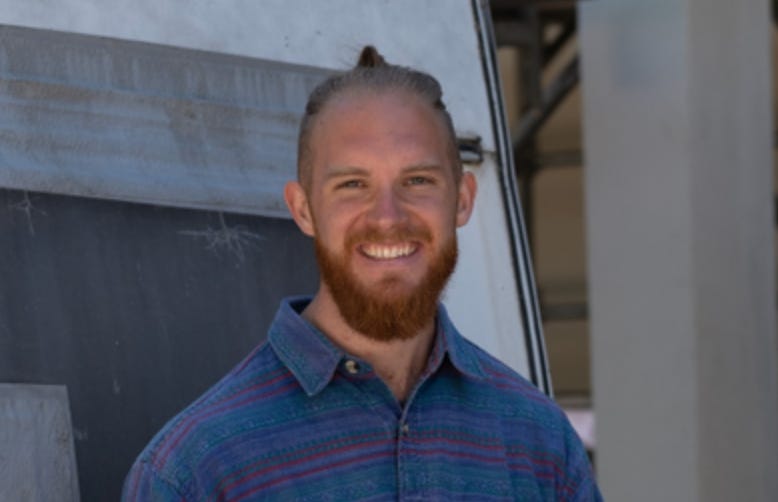
Pascal Siggelkow, state media “fact finder,” abysmal idiot.
eugyppius: a plague chronicle | September 14, 2023
Nobody in our corner of the internet could fail to notice the antics of those yapping bouncing frenetic chihuahuas who call themselves fact-checkers. Mostly they work in obscurity, misunderstanding internet jokes, recycling the vacuities of self-styled experts, debunking weird Twitter posts, and above all churning out prodigious walls of text filled with banalities that nobody reads. Occasionally, though, they manage to entertain us – as recently, when it emerged that BBC “disinformation specialist” and fact-checker-in-chief Marianna Spring had larded her very own CV with disinformation. Almost nothing is more amusing than finding oneself in the crosshairs of the fact-checkers, as has happened to me on at least one occasion.
My favourite checker of facts is the man-bun-sporting dimwit Pascal Siggelkow, who has been appointed top “fact finder” for the state media news service tagesschau. We last encountered Siggelkow when he mistook a noun for a verb in Seymour Hersh’s reporting, ultimately spending four amazing paragraphs debunking the thesis – unique to his own mind – that explosive seaweed destroyed Nord Stream. Before hunting facts at tagesschau, Siggelkow worked for Südwestrundfunk, another state media broadcaster, where he did daring undercover investigative reporting like snitching on “doctors who downplay Corona and issue unfounded mask exemptions.” This is really reporter-of-the-year material. In truth, we have before us here a whole genre of journalism conducted by an aggressively stupid tribe of Siggelkows, distinguished by their total lack of accomplishments, limited vision and minuscule persuasive capacities. That these small men should be entrusted with the project of policing our words is a strange thing indeed, and it suggests there is more going on in the world of fact-checking than we realise. Here, I propose to examine what it is that fact-checkers really do, and whether there is anything to say about them beyond the obvious fact that they are complete and utter idiots.
To explore fact-checking more concretely, I have ventured into the barren wastelands of the tagesschau “Fact Finder” page, where Siggelkow plies his trade and few before me have ever set foot. I’ve selected, mostly at random, a limited corpus of eleven recent discourse-policing items for closer analysis. I offer links to each of them below, in chronological order, providing their headlines and teasers in translation, together with sample quotations to give you an idea. This is a tiresome read indeed, so please skip ahead unless you are of particularly strong constitution.
1. Why is excess mortality so high?, by Pascal Siggelkow and Alexander Steininger
28 November 2022
In 2022, an unusually high number of people have died so far in relation to previous years. October in particular was an outlier. According to experts, this cannot be explained by Corona alone.
“As a scientist, I want to be open to all possibilities, but I just don’t see the connection [to vaccination],” [said Jonas Schöley, Research Associate in the Department of Population Health at the Max Planck Institute for Demographic Research in Rostock]. Additionally, he said, the scientific evidence evaluating vaccines is much stronger than that available in population research. “We don’t have to rely on the error-prone search for causes in population data because of the very good body of studies on the efficacy and risks of vaccination.” If the vaccines led to an increased number of deaths, this would have been proven long ago in medical and epidemiological research.
2. A flood of fake videos and pictures, by Carla Reveland and Pascal Siggelkow
3 July 2023
In connection to the riots in France, numerous pictures and videos are being shared on social media. Many of them are not from the current protests, but are disinformation.
In right-wing extremist and conspiracy-theorist Telegram channels, posts containing the term “France” have seen marked increase since the end of June … The Austrian right-wing alternative channel AUF1, for example, speaks of “ethno-riots” and a “bloody multicultural illusion.”
“Whenever there are topics that lend themselves to populist or right-wing extremist instrumentalisation, they are used,” [Pia] Lamberty, [Social Psychologist and Executive Director of the Center for Monitoring, Analysis and Strategy] says … This could be current political debates such as the topic of heat pumps, crises such as climate, Corona, economic tensions, or even riots such as in France. “Such attempts at instrumentalisation are not always successful across society as a whole, but for supporters of right-wing extremist ideologies they are often an additional confirmation of their own world views.”
3. Doubts about the significance of the AfD “Einzelfallticker” 1, by Carla Reveland and Pascal Siggelkow
3 July 2023
With their “isolated case ticker,” the AfD purports to show the alleged “true extent” of crimes committed by migrants. But a random sample shows that in half of the cases, reports do not indicate the origin of the suspect.
In response to a request from ARD-Factfinder, the AfD writes that it is “interested in transparency regarding the official figures from the police crime statistics in 2022.” Pia Lamberty, social psychologist and managing director of the Center for Monitoring, Analysis and Strategy … sees things differently. Launching a ticker with the intention of pointing out the danger posed by people considered to be non-Germans by the AfD by no means accords with the “role of an objective informer.” “This is the opposite of an open investigation and the opposite of objectivity,” says Lamberty.
4. How credible is the information on the [Ukrainian] counter-offensive?, by Pascal Siggelkow
7 July 2023
Ukraine’s counteroffensive to liberate territory occupied by Russia has been underway since June. Because Ukraine is keeping a low information profile, and the media often rely on Russian information. Experts are sceptical about this.
The fact that information on the counter-offensive comes primarily from Russia is due to the fact that Ukraine has mostly imposed a news blackout. The Russian Defence Ministry is trying to exploit this situation, says Julia Smirnova, senior researcher at the Institute for Strategic Dialogue in Germany (ISD). “This is a focus of Russian propaganda, and the numbers that are given are often massively exaggerated.” The Russian defence ministry is therefore not credible, she said.
The Dutch open source intelligence website (OSINT) Oryx wrote on Twitter of a total of six tanks abandoned in Zaporizhia oblast, including one Leopard tank, four Bradleys and one mine-clearing tank. “Left behind” howevewr is not synonymous with “destroyed.” In total, according to Oryx’s research, eight of Ukraine’s Leopard tanks have been destroyed or damaged so far since the Russian invasion began.
5. Increased agitation against queer people, by Carla Reveland and Pascal Siggelkow
17 July 2023
Whether it’s about homosexuals, drag queens or trans people: Disinformation about queer people is omnipresent in social networks. Experts believe this can have devastating consequences.
Trans people are particularly targeted by disinformation, says Kerstin Thost, press officer of the Lesbian and Gay Association in Germany (LSVD). “In the past months around the debate on the Self-Determination Act [which would make it possible for Germans to change their official gender and first names], we have seen an increased attack on trans people in particular, not only in Germany but also internationally. There has been an increased mobilisation of hatred, agitation and “demonisation against LGBTQI*.” LGBTIQ* stands for lesbian, gay, bisexual, transgender, intersex and queer people.
6. Who finances the welfare state?, by Pascal Siggelkow
26 July 2023
It’s said time and again on the internet that 15 million people keep Germany running. The references is to “net taxpayers,” who pay more taxes than they receive in benefits. Experts, however, believe that this figure is wrong.
The figure of 15 million “net taxpayers” is justified … in this way: Of the approximately 46 million employed people in Germany, 27 million paid more taxes and contributions than they received in state benefits. Of these, however, 12 million are “directly or indirectly dependent on the state,” since they are paid by taxes … for example, as state employees. Thus … 15 million “net taxpayers” keep the system running.
Stefan Bach, a researcher … the German Institute for Economic Research (DIW), believes this calculation is incomplete … “Basically, state taxes and levies are offset by services without which the modern economy cannot function either.” …
Social contributions such as unemployment insurance or health insurance should also be considered separately … The calculation holds that all pensioners are recipients of benefits [and] ignores the fact that the status of net tax payer and recipient changes … in the course of one’s life. …
7. Local weather phenomena do not refute climate change, by Carla Reveland and Pascal Siggelkow
10 August 2023
The last two weeks of July in Germany were cold and wet. Some use this fact to play down climate change. But experts believe this is wrong.
… Kevin Sieck from the Climate Service Center … believes that temporary local weather does not support arguments about climate change: “Robust statements about climate trends can only be obtained by looking at several decades,” says Sieck. “A rainy July in Germany doesn’t say anything about long-term trends.” It is therefore the long-term developments that are relevant when assessing trends in the climate.
Karsten Schwanke, meteorologist and ARD weather presenter, agrees: “There will always be very changeable summers.” But there is a clear tendency towards warmer summers with larger upward swings. “We see a tendency for heat waves to become longer. And we are currently getting heat waves that we definitely didn’t see 50 years ago. We’re also getting more droughts, especially in the summer.”
8. How China regards the Russian invasion, by Carla Reveland and Pascal Siggelkow
21 August 2023
In the Russian war of aggression against Ukraine, China is trying to position itself as a mediator. At the same time, the US and NATO are portrayed as warmongers. Is China neutral?
“China stands for peace while the US prevents the peace process”, “The actions of US-led NATO have pushed Russia-Ukraine tensions to their peak” or “Ukrainian ‘neo-Nazis’ have opened fire on Chinese students.” These are all statements made by Chinese state media or government officials in relation to the Russian war of aggression in Ukraine.
Although Beijing claims to be a neutral actor that respects the “sovereignty and territorial integrity of all nations,” China has provided “rhetorical backing” to the Kremlin, according to a study by the US-based German Marshal Fund. “Chinese officials and state media have openly supported and promoted Kremlin-friendly accounts of the war.”
9. Why the record debt is not much to write home about, by Pascal Siggelkow
7 September 2023
Germany’s national debt is at a record high, many media reported. From a purely nominal point of view, this is true, but from the point of view of experts, this is not very meaningful.
Martin Beznoska, Senior Economist for Financial and Fiscal Policy at the Institute for the German Economy (IW) points out [that] a more suitable parameter for assessing a country’s debt is … the debt-to-GDP ratio. “The debt-to-GDP ratio is a better indicator because it puts the debt in relation to the potential that the state has in terms of revenue-generating capacity,” Beznoska says.
The debt-to-GDP ratio relates government debt to nominal gross domestic product. For Germany, the debt-to-GDP ratio was 66.3 per cent in 2022. This means that the total debt was 66.3 per cent of the gross domestic product. Compared to the two previous years, the debt-to-GDP ratio in Germany has thus improved: in 2020 it was 68.7 per cent, in 2021 69.3 per cent. Before the outbreak of the Corona pandemic, however, it was still 59.6 percent.
10. Spahn’s dubious figures, by Pascal Siggelkow
1 September 2023
Vice chairman of the CDU/CSU parliamentary faction Spahn has criticised the planned increase in unemployment benefits. He said this would mean that a family of four would receive on average as much as an average-income family. But this is not true.
Planned increases to unemployment benefits next year have caused heated debeated. The CDU/CSU have complained that the changes will raise benefits higher than the wages of many employees. Vice chairman of the CDU/CSU parliamentary facation Jens Spahn said this sent the wrong signal. Even now, a family of four are entitled to an average of 2,311 Euros a month, which he said is as much as an average-income family in Germany. But this is not quite correct.
According to the Federal Statistical Office (Destatis), couples with two children had an average net household income of 5,490 euros in 2018. This is significantly more than the 2,311 Euros Spahn claimed. The gross household income was 7,435 Euros.
11. Fake videos and conspiracy claims, by Pascal Siggelkow
11 September 2023
Many false images and videos are circulating on social media about the devastating earthquake in Morocco that killed more than 2,000 people. Some of them are linked to well-known conspiracy narratives.
A look at the recent past shows that disinformation is often deliberately spread after natural disasters. In the case of the fires in Hawaii in August as well as the devastating earthquake in Turkey and Syria in February, videos were circulated that were supposed to show evidence of absurd causes.
In the case of earthquakes, the USA is often portrayed as the alleged cause – with their High Frequency Active Auroral Research Program (HAARP). HAARP is a research programme of the University of Alaska in the USA that has been in existence for decades. The aim is to research the upper atmosphere – the ionosphere – and also the propagation of radio waves. Radio waves are used for this purpose.
Now, as projects go, debunking the debunkers does not appeal to me very much, but we must get some read on Siggelkow’s accuracy and reliability. Remember that he should be almost totally right almost all of the time. After all, he or his managers choose what to debunk, so the very least we can expect of them is the judicious selection of easy targets. Alas, the only clean victory I can grant our Fact Enthusiast is 11), on the Moroccan earthquake. Few will believe this was caused by the American HAARP research programme, but it’s hard to know how many tagesschau fans needed to hear this in the first place.
Remarkably, in various of these pieces, Siggelkow doesn’t seem to be clearly debunking anything; 1) on excess mortality he tries to head off the dark conclusions of vaccine sceptics, but can only manage this very weakly, while 4) on the Ukraine offensive and 8) on China’s pro-Russia stance he merely offers helpings of reheated NATO propaganda to counter news and opinions from unapproved foreign sources. Also in this category is 5), which swipes at two pieces of allegedly anti-LGTBQ misinformation, but cannot clearly refute either of them, and beyond that offers little more than unsubstantiated hand-wringing about the violence and threats which gender minorities face.
Otherwise, we see a mix of disingenuous approaches, perhaps illustrated best by 7) on the fact that cool and rainy weather doesn’t refute climate change. While this is certainly true, the mainstream media – including tagesschau – have been confusing climate for weather deliberately in service of their environmentalist polemic for years. If hot summer days can indicate climate change, then cool summer days can contraindicate it, and if the press doesn’t like people making the latter argument, they should stop making the former one.
Number 6), on the precarious German welfare state, which allegedly depends on a mere 15 million net taxpayers to cover its liabilities, also belongs here. By selectively excluding entitlements – above all, pensions – you can make this figure more favourable, and if you want to count households instead of individuals things might look better too, but these prevarications and qualifications miss the point. As an objective matter, the German pension system faces collapse in the face of the retirement wave and demographic decline. Much the same applies to 9); it’s true that German debt is at a record high only in nominal terms, but even the preferred debt-to-GDP ratio which Siggelkow’s experts prefer paints an uncomfortable picture of government extravagance since the pandemic.
Particularly in these last two cases, we see Siggelkow reaching for a tactic that these complex cases don’t allow him to exercise fully. We might call this The Debunking of the Part to Discredit the Whole. This is the main stock-in-trade of fact checkers in general; indeed, it is baked into the very premise of their profession. It consists in leveraging a quite irrelevant but well-grounded objection for the purposes of casting a pall over broader arguments that the checkers would prefer not to assail, because the rest of the facts to be checked don’t run in their favour. Thus 2) denounces fake French riot videos on social media as a means of playing down, however implicitly, the very real violence which broke out in the wake of Nahel Merzouk’s killing, while 3) on the AfD Einzelfallticker ends up (after no little special pleading) actually confirming that migrants commit crime at higher rates than native Germans, while merely questioning migrant involvement in many of the catalogued cases. 2
Also in this category is 10): While Jens Spahn obviously understated the average income of the four-person German household, his broader argument – that in certain circumstances entitlements can exceed wages and are rising at a faster rate than income – appears to be totally correct.
You need read only a few of these exercises in ideological masturbation to find the primary explanation for fact-checker mediocrity. People like Siggelkow can afford to be stupid, because they’re not actually paid to think about anything. As a fact-checker, Siggelkow’s job consists mostly of calling up various “experts” and writing down what they tell him. Even this may overstate his agency, as very often I expect that it is the “experts” who call up Siggelkow and provide him with pre-digested material to print, but of course this is hard to prove. In those cases where Siggelkow interviews primarily midlevel academics not obviously connected to any advocacy groups, we might presume the reporting reflects his own initiative. Quite often, however, his sources hail from highly politicised think-tanks and NGOs, and in these instances I think we’re justified in suspecting he’s acting as a mere conduit.
Three of our eleven articles (2, 3 and 11) draw on the alleged expertise of the Center for Monitoring, Analysis and Strategy (CeMAS), a “non-profit extremism monitoring agency founded in 2021.” Their heavy representation in my eleven-article corpus is no accident; CeMAS and other anti-extremism NGOs are a major pillar of Siggelkow’s production. Sometimes they crop up even where you wouldn’t expect them, as in 4) on the Ukrainian counteroffensive, which features a prominent quote on “Russian propaganda” from the Institute for Strategic Dialogue – a “think and do tank” (heavens preserve us) which concerns itself with “digital regulation, disinformation, extremism and digital civic education.”
Siggelkow’s forays into economic matters are rarer, but in our exploratory corpus, the Institut der Deutschen Wirtschaft (IW) plays an outsized role. This is an old progressive liberal operation that advocates redistributive economic policies. IW experts help Siggelkow defend the welfare state in 6) and play down German national debt in 9). Curiously, when it comes time to defend NATO, Siggelkow’s bench of personal informants runs a bit thinner, perhaps reflecting the fact that the Ukraine war has ceased to be a major focus of state media coverage. Thus for 8), Siggelkow performs no expert interview, and rips instead from a piece published by the German Marshall Fund, an Atlanticist think-tank whose name he misspells. In 4) on the Ukrainian counteroffensive, his major source is somebody with a master’s degree in “East Asian Economy and Society” from the small think-tank-cum-consultancy-operation known as the Austrian Institute for European and Security Policy. This is a small den of Atlanticist Europhiles who are still awaiting the day when they will get their own Wikipedia page.
A broader survey of Siggelkow’s output, extending to the beginning of this year, reveals a split focus between the Russian war on the one hand, and identity politics and mass migration on the other. Somewhat surprisingly, climate topics have a mostly supporting role, and he thematises Covid and the vaccines only occasionally. The recent economic pieces are outliers.
The null hypothesis of the fact-checking industry would be something like this: “Threatened by the rise of alternative internet media, the establishment press have cultivated various discourse-policing operations to reclaim objectivity and reliability as their exclusive province.” In Siggelkow’s output, we certainly find much to support this view. It is the reason, for example, that he is so fond of writing about social media “misinformation” and internet “conspiracy theories.” The internet is a dangerous world of lies and disinformation, from which only the friendly tagesschau and their intrepid finders of facts can save you. This is basically his attitude, but as theses go, the null hypothesis is far too broad.
It cannot explain Siggelkow’s great selectivity, for example. There are absolute mountains of absurdity on the internet that he totally ignores, while often venturing into overtly political territory to fact-check the inconvenient arguments of the political opposition, which don’t involve internet social media at all. At the same time, the governing parties – especially the Greens – attract almost no Siggelkowian scrutiny, despite their long history of absurdly false statements. Fact-checking is clearly an enterprise devoted towards furthering a very specific political programme under the false cover of objectivity. This programme is directed primarily against “right-wing extremism,” particularly in its post-2015 incarnation. Secondary fronts on behalf of NATO, climate change sceptics, and the establishment CDU/CSU opposition emerge as the news cycle lends them relevance. Siggelkow, in other words, is quite plainly a propagandist who finds facts on behalf of the Scholz government, and in this he is funded by mandatory license fees levied from every German household.
That Siggelkow so often strays from his stated mission to correct falsehoods and publishes many pieces not clearly directed against any notional misinformation, merely reveals the tendency of the ideological mission to overwhelm tactical fact-finding entirely. Siggelkow is a conduit via which the preformulated output of regime-adjacent advocacy groups can find their way into the press and talk back to their critics even in the absence of any specific occasion for them to do so.
Siggelkow also has a broader purpose, independent of his rearguard actions on behalf of the regime. This is the construction of a mythology which binds the political right to internet ‘conspiracy theorising.’ His implicit polemic is not merely that legacy media like tagesschau have a lock on objective and reliable information, but that political views opposed to those which prevail among state media journalists arise from ignorance, disinformation and general internet insanity. The facts are on the side of the progressive liberals who steer the German state, and the only people opposed to them are online idiots who believe that secret US government programmes cause earthquakes.
While Siggelkow’s tricks are both tiresome and transparent, fact checking is anything but easy. His steady stream of but-ackshually-bro bothering depends like all other heavily politicised press reporting on the support of a dense web of NGOs, think tanks and other advocacy groups. Where these are lacking, for example in novel areas like Corona, Siggelkow really struggles. The great algal blooming of pro-Atlanticist “open-source intelligence” posters after the outbreak of war in Ukraine reflects an effort to supply the Siggelkows of the press with recycle-able content. Like everything else in our present, diffuse system of regime power and propaganda, the ideological behemoth moves slowly and struggles to react to new problems.
Ultimately, the significance of the fact-finders is obscure; it’s hard to believe Siggelkow has many readers. The lack of interest his tedious schoolmarmery attracts is probably one reason his ilk are so over-represented in state media operations, where nobody need worry about producing content that is profitable. His writing is dry and unpersuasive; at most, it is a kind of choir-preaching that reassures the the tagesschau audience that their views are grounded in facts, logic and science, and anyone who disagrees is a dangerous internet manic, or perhaps Russian.
An “Einzelfall” is an isolated case; the AfD Einzelfall-Ticker alludes to the older project “XY-Einzelfall,” which began documenting migrant crimes in Germany in 2016. The title is an ironic reference to the regime line that migrant infractions are “isolated cases.”
Because authorities often intentionally withhold the details of migrant perpetrators, whether specific cases actually involve migrants or not requires some surmising on the part of the reader. Probably whoever runs the Einzelfallticker should include only cases where migrant offenders are specifically identified or described (there is no shortage of those), but in my own less-than-casual study of the Einzelfallticker, I find that a) they’re generally clear when there’s uncertainty about the origins of the suspect, and b) in most of the unidentified cases, they’re probably right to suspect migrant perpetrators.
EU has ‘globalized’ Ukraine crisis – Hungary
RT | September 14, 2023
The European Union’s response to the Ukraine crisis is causing the world to fragment, Hungarian Foreign Minister Peter Szijjarto has claimed. He added that Budapest wants to see initiatives that can unify states, such as China’s Belt and Road Initiative (BRI).
The EU “has given a very bad answer to the war in Ukraine that unfortunately seems to be ending up in a world being divided into blocs again,” the Hungarian diplomat told CNBC on the sidelines of the Belt and Road summit in Hong Kong.
Brussels “should have isolated this war, but instead of that the EU has globalized” it, he said in the interview broadcast on Wednesday.
Szijjarto argued that a lack of communication between opposing countries has led to them giving up on achieving peace, while states that benefit from good East-West relations – such as Hungary – have been hurt economically.
The minister contrasted this to how the BRI aims to bring the world together for mutual prosperity and security, which is why Hungary welcomes China’s presence.
He criticized rich Western European nations who are now talking about decoupling from the Chinese economy or “derisking” due to political concerns. Quietly, they seek Chinese investment just like small nations, Szijjarto said.
“They can be hypocritical, they can afford [it],” he argued.
Unlike those countries, Budapest states its foreign policy openly, the diplomat said, warning that if ‘decoupling’ with China were to succeed, it would “kill the European economy.”
The Hungarian government has been a vocal critic of the Western response to the Ukrainian conflict since its outset. It has called for peace talks, while speaking out against sanctioning Russia and arming Ukraine. Most EU nations, following in the US lead, have pledged to support Kiev for “as long as it takes” to defeat Moscow.
China and India have ‘low intellectual potential’ – top Zelensky aide
RT | September 13, 2023
The people leading India and China lack the ability to predict the long-term consequences of their policies, a senior aide to Ukrainian President Vladimir Zelensky has claimed.
Mikhail Podoliak pointed to what he called “the problem of the modern world,” singling out India and China, in an interview with Ukrainian media on Tuesday.
“The problem with these countries is that they do not analyze the consequences of their own moves. These countries, unfortunately, have low intellectual potential,” he said.
Podoliak suggested that even though India has a lunar exploration program, it “does not mean that this nation understands what the modern world precisely is.”
The dismissive remarks were in the context of Beijing and New Delhi’s refusal to support Kiev in its conflict with Moscow. Podoliak complained that India, China and Türkiye were “profiting” from the war by maintaining trade with Russia.
“Technically, it is in their national interests,” he acknowledged, before presenting his view of what would benefit China in the long-run.
“China should be interested in Russia disappearing, because it is an archaic nation that drags China into unnecessary conflicts,” he claimed.
“It would be in their interest now to distance themselves from Russia as far as possible, take all the resources it has, and take part of the Russian territory under their legal control. In fact, they will do that,” he added.
Following the interview, the Chinese Foreign Ministry spokeswoman urged Podoliak to clarify his remarks, when asked about them during a media briefing on Wednesday.
Podoliak has a record of lashing out at nations, organizations and public figures seen as not sufficiently supportive of Kiev.
Among his latest targets was Pope Francis, whom he had branded an “instrument of Russian propaganda” who “continues to reduce the influence of Catholicism in the world to zero.” The pontiff had encouraged Russian Catholics to cherish their nation’s historic legacy.
The Ukrainian official also recently hit out at Elon Musk, who Podoliak claimed “enabled evil” by refusing Kiev’s request to use his Starlink communications system to launch drone attacks against the Russian Black Sea Fleet.
Podoliak isn’t the first high-ranking Ukrainian official to make derogatory remarks about Asian countries. In August, Aleksey Danilov, the head of Ukraine’s National Security and Defense Council, suggested that Asian people were less humane compared to Europeans, including Ukrainians. “I’m fine with Asians, but Russians are Asians. They have a completely different culture, vision. Our key difference from them is humanity,” Danilov said.
Western exodus from Russia a boon for Chinese companies – leading entrepreneur
RT | September 10, 2023
Chinese companies have greatly benefited from the pullout of Western companies from the Russian market, Zhou Liqun, chairman of the Chinese Entrepreneurs’ Union of Russia, told RT on Sunday.
Speaking on the sidelines of the Eastern Economic Forum (EEF) in Vladivostok, Zhou said Chinese businesses have been actively filling the niches left by the exit of Western companies and are eager to expand their presence in Russia further.
“The withdrawal of Western companies from Russia has created vast opportunities for Chinese businessmen and enterprises to cooperate with Russia. For example, in the vehicle manufacturing sector: many Chinese carmakers have entered the Russian market throughout the past year. While previously they made up only 5-6% of the market, now it is almost 40%,” Zhou stated.
He noted that China has been among Russia’s major trade partners for the past 14 years, and both countries have created many platforms and opportunities for mutually beneficial cooperation.
“Our cooperation framework is very convenient for both sides, stable political relations between our countries promote the development of trade and business relations. Chinese businessmen are interested in Russia’s raw materials, Russian businessmen are interested in Chinese machinery and equipment. This makes our cooperation mutually beneficial and opens up potential for development,” he added.
Zhou noted that since the introduction of Western sanctions on Moscow, Russia and China have accelerated the use of their own currencies in trade, which has benefitted both nations. To date, 80-85% of all transactions between Russia and China are carried out in either yuan or rubles, and given the rapid expansion of mutual trade and cooperation, this percentage is likely to grow further.
“Businesses in both Russia and China are already accustomed to using national currencies in cross-border transactions. It is very convenient for direct cooperation. We expect the ratio of yuan and ruble transactions in mutual trade to grow to 90%, depending on the type of product,” he said.
Zhou added that China takes great interest in the development of Russia’s Far East, both as a supply source and trade partner. He noted that to date, China is involved in 58 projects in the area, including the construction of a petrochemical complex in Amur Region, as well as a number of projects in agriculture and infrastructure.
“China’s cooperation with the Far East has great potential,” Zhou said.
The EU’s best weapon against free speech isn’t working
The EU has just realized that it can’t rule the internet with an iron fist by throwing around the ‘Kremlin propaganda’ label
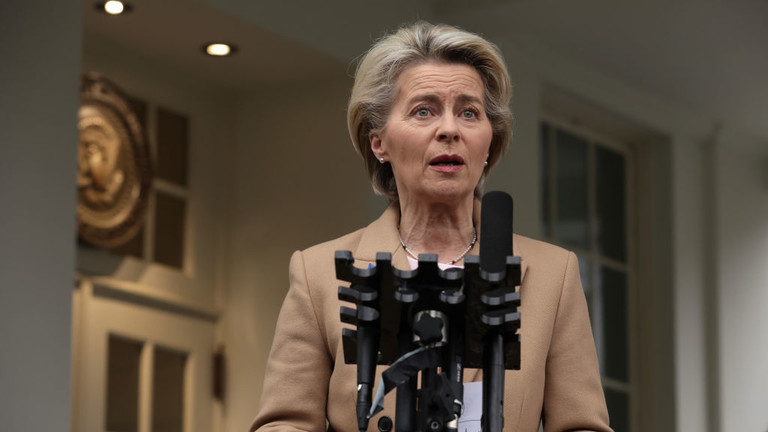
EC President Ursula von der Leyen speaks to the press after a meeting with Joe Biden in the White House on March 10, 2023 in Washington, DC. © Alex Wong/Getty Images
By Rachel Marsden | RT | September 7, 2023
The European Commission has concluded in a new report that despite making pinky-promises to “mitigate the reach and influence of Kremlin-sponsored disinformation,” large social media platforms like Twitter and Facebook were “unsuccessful” in doing so. What a shocker that this research by oversight advocates has ended up advocating in favor of more oversight. Russia just happens to be the most convenient scapegoat.
Using the same kind of smear tactics that the bloc has used previously – like when it included Russia alongside Islamic State (IS, formerly ISIS) in previous security and threat reports – this time it involved conflating “pro-Kremlin” social media accounts with those that it considers to be “Kremlin-aligned” or “Kremlin-backed.” In other words, mere disagreement with the Western narrative is enough to land anyone in the “pro-Kremlin” camp and to be considered worthy of content moderation or banning by the EU. And now they’re frustrated that social media platforms have dropped the ball on carrying out that censorship.
“Platforms rarely reviewed and removed more than 50 percent of the clearly violative content we flagged in repeated tests,” the report said. What kind of content would that be, exactly? It’s hard to tell, because their examples conflate the legitimately debatable with the patently absurd, and suggest that both warrant censorship. They cite, for example, content that accuses Ukraine of being run by Nazis – which is a legitimate concern, given that the Western press has reported extensively on the powerful role played by neo-Nazis in Ukraine, which are “aggressively trying to impose their agenda on Ukrainian society, including by using force against those with opposite political and cultural views,” according to a publication by the Washington-based Freedom House prior to the conflict, adding that “they are a real physical threat to left-wing, feminist, liberal, and LGBT activists, human rights defenders, as well as ethnic and religious minorities” in Ukraine. The Council of Europe had made similar observations.
There’s also the fact that the West trained the neo-Nazi Azov battalion to fight Russians, and that Reuters reported way back in 2018 that then-president Petro Poroshenko “would risk major repercussions” should he take action against neo-Nazis.
That kind of does sound like there’s a neo-Nazi issue that’s at the very least worthy of highlighting and debating. Yet the EU dismisses any such suggestion as Russian disinformation.
The report also takes issue with accounts “denying war crimes,” using events in Bucha as an example. I’m sorry, but was there a war crimes tribunal that we missed? We’re talking here about events taking place in the immediate fog of war. Attempting to sort through facts, realities, and manipulations is precisely the kind of thing with which social media is meant to assist. Everyone by this point knows that it’s about having access to as much raw data as possible. We expect to see a chaotic mess online – not a curated Encyclopedia Britannica set or the evening news. What makes Brussels think it is entitled to a monopoly on that process?
The report places these examples of inconvenient debates alongside a blatantly ridiculous example of sh*tposting whereby someone made up the name of a fake media outlet and announced that Ukraine was sending a radioactive cloud towards Europe. Look, if anyone is so dumb as to believe something like that, then it certainly isn’t the EU that’s going to save them from their own stupidity. Not for long, anyway. Just let them spend their entire next week digging a fallout shelter while their neighbors have a good laugh.
In a line that just begs to be read repeatedly out of sheer incredulity that someone could be so tone-deaf, the report notes that so-called Kremlin disinfo efforts are “designed to foment political and social instability among its adversaries by stoking ethnic conflict, promoting isolationism, and distracting public attention away from Ukraine and onto domestic affairs.” How dare the people of Europe insist that their leaders focus on the considerable problems faced by their own country and citizens, which have long been exacerbated by misguided national and EU-level policies, rather than riveting their attention to Ukraine! Indeed, if it wasn’t for those meddling Russians, Europe would be a utopia of sunshine and rainbows, everyone holding hands and singing Kumbaya, with nothing else for citizens to concern themselves with besides what’s happening in Ukraine.
The EU laments that “the Kremlin and its proxies captured growing audiences with highly produced propaganda content, and steered users to unregulated online spaces, where democratic norms have eroded and hate and lies could spread with impunity.” They have it all backwards. People wanting to engage in debate and discussion of topics and viewpoints that the EU — in all its arrogance as the self-appointed arbiter of truth — is keen to censor, have been driven to other platforms specifically because they support free speech in all its glory and imperfection.
“Over the course of 2022, the audience and reach of Kremlin-aligned social media accounts increased substantially all over Europe,” according to the report, adding that “the reach and influence of Kremlin-backed accounts has grown further in the first half of 2023, driven in particular by the dismantling of Twitter’s safety standards.” In other words, Elon Musk, who considers himself a “free speech absolutist,” came along and bought Twitter, leveled the playing field by opening up debate and reducing censorship, and what ended up happening is that people flooded to the platform as a refreshing alternative to the curated and censored Western establishment narrative that they’re spoon-fed elsewhere.
So what’s the EU going to do about it now? Well, mandatory compliance with its Digital Services Act is now in effect as of last month. This means that, theoretically, all the major social media platforms are obligated to work with the EU’s handpicked “civil society” actors to moderate and censor content – no doubt in alignment with the EU’s narrative. Musk should play along and take notes about the kind of censorship requests that are made of him by Brussels. Then he should publish them on Twitter in the interest of radical transparency and the kind of uncompromising defense of democracy to which the EU is constantly paying lip service as a pretext for its crackdowns on our fundamental freedoms.
Rachel Marsden is a columnist, political strategist, and host of independently produced talk-shows in French and English.
Poland’s Top Military Official Accidentally Discredited NATO On Several Counts
BY ANDREW KORYBKO | SEPTEMBER 7, 2023
Chief of the General Staff of the Polish Armed Forces General Rajmund Andrzejczak spoke at the Karpacz Economic Forum in southwestern Poland earlier this week about the NATO-Russian proxy war in Ukraine, during which time he shared some very interesting information that was reported on by The Guardian. The present piece will highlight the most important parts prior to explaining how they accidentally discredited NATO on several counts.
———-
* Poland speculates that China might tacitly approve North Korean arms shipments to Russia
– “I don’t believe North Korea is strong enough or so free to make such an offer, so maybe it is testing our determination, attention and political will, but what is even more important is what China says about this than the North Korean leadership.”
* Warsaw is worried that Moscow might meddle in the upcoming elections on 15 October
– “Andrzejczak also predicted that Russia would try to create a crisis in next month’s Polish election but gave no details in public. He warned that Russia was on a permanent war footing and was ‘very much active in Poland, looking for some gaps in the system, trying to interfere in the media’.”
* The NATO-Russian proxy war is viewed by Poland as part of a civilizational competition with China
– “Andrzejczak also warned that if Ukraine lost the war and Belarus went further into Russia’s orbit, Poland would find that limiting defence spending to 5% of its gross domestic product and a standing army of 300,000-strong would not be enough. ‘If we lose credibility as Nato, as a civilisation, China is watching, so this is a big game,’ he said.”
* Andrzejczak wants NATO to proactively engage in nuclear saber-rattling against Russia
– “Nato is a nuclear treaty organisation; it should be much more proactive and stronger to the Russians. In the 70s and 80s, 30% of B-52 bombers were flying permanently and had nuclear weapons with pilots ready to act. Today we have a challenge to say the word B61 [the primary US thermonuclear gravity bomb], so let us change narratives.”
* He’s also upset that the bloc ignored his government’s request to host US nuclear weapons
– “He said there had been complete silence since Poland’s president, Andrzej Duda, asked to join Nato’s nuclear sharing programme owing to the deployment of Russian nuclear missiles to Belarus.”
* Poland lacks confidence that NATO would react to a hypothetical attack from Wagner
– “He asked: ‘Who is the Wagner group today? Is it a national action by Russia or, as the Russian minister of defence says, just a private military company? Is it enough for Article 5?’”
———-
From the above, it’s clear that Andrzejczak is doubling down on the ruling “Law & Justice” (PiS) party’s national security focus that forms the crux of its re-election platform, but he’s arguably going too far. For example, reframing the NATO-Russian proxy war as part of a civilizational competition with China implies that Poland is indirectly fighting the People’s Republic via its military assistance to Kiev, which isn’t true. Spewing this false narrative, however, is likely an attempt to rally PiS’ conservative-nationalist base.
That party and its supporters believe that Poland has historically functioned as the West’s bulwark for protecting their shared civilization from what they depict as “Eastern barbarians”. PiS taps into that interpretation to justify its diehard opposition to everything Russia-related, but now the country’s top military official unexpectedly added an anti-Chinese twist to this shortly before the next elections. Andrzejczak’s hyperbole thus suggests that PiS doesn’t think Russophobia is enough to win re-election.
He himself is also channeling that sentiment by fearmongering about an alleged Kremlin meddling plot sometime around the vote, most probably for the purpose of preemptively discrediting the opposition if they perform better than expected, but it’s clearly not sufficient as evidenced by his tacit Sinophobia. In an attempt to artificially manufacture a sense of utmost urgency, Andrzejczak crossed an informal red line in Polish politics by hinting that NATO isn’t reliable, nor is its American leader either by extension.
He did this by complaining about the bloc ignoring his country’s nuclear-sharing request and then publicly questioning the sacrosanctity of Article 5 in the hypothetical event of a Wagner attack. The first is attributable to NATO’s reluctance thus far to escalate its security dilemma with Russia to potentially uncontrollable proportions while the second is based on a scenario debunked by the New York Times. Andrzejczak knows the truth about both, yet he’s still shamelessly manipulating the public’s perceptions.
The preceding point reinforces suspicions that he exploited his authority as Poland’s top military official to informally campaign for the ruling party during his latest remarks about the NATO-Russian proxy war by hyping up security threats and therefore betrayed his oath to be purely apolitical. In his passion to help them win re-election, he went too far by implying that NATO isn’t doing enough to stop the Sino–Russo Entente and suggesting that Article 5 isn’t sacrosanct, thus likely angering its US leader.
WW3 has already begun – Ukraine’s security chief
RT | September 6, 2023
The head of Ukraine’s National Security and Defense Council has claimed a third world war is already underway, with the Moscow-Kiev conflict pulling in countries far beyond the region.
Speaking at the Kiev Security Forum on Tuesday, Aleksey Danilov argued that NATO needs Ukraine as a member, as global turbulence is set to continue. “We’re going to strengthen the alliance,” he insisted.
“If somebody thinks that World War III hasn’t started then it’s a huge mistake. It has already begun. It had been underway in a hybrid period for some time and has now entered an active phase,” he said.
Sitting on stage beside former CIA Director General David Petraeus, Danilov said that “if somebody thinks that it [the conflict in Ukraine] is about settling the scores between Kiev and Moscow then it’s a mistake. Things are much more complicated.”
Petraeus also highlighted the scale of the Russia-Ukraine conflict, saying: “I haven’t seen anything like it since World War II,” he said.
“The Russians are not particularly impressive in terms of knowledge or performance on the battlefield, but they have created a rather outstanding defense system, and it is quite difficult to punch it through,” he claimed.
On Tuesday, Russia’s Defense Ministry said that during the three months of its counteroffensive, Ukraine has lost some 66,000 troops and 7,600 pieces of heavy weaponry while failing to achieve any significant gains. Kiev has so far claimed the capture of several small villages, but they are some distance from the main Russian defense lines. Speaking about the Ukrainian counteroffensive earlier this week, Russia’s President Vladimir Putin insisted that it “is not stalled; it is a failure.”
Moscow has been saying for months that the fighting in Ukraine is a “proxy war” waged by the US and its NATO allies against Russia. It warned that the supply of arms and training to Kiev’s troops and intelligence-sharing means that Western nations are already de-facto parties to the conflict.
Russia, which views NATO as a hostile bloc and vigorously opposes its eastward expansion, has also highlighted Kiev’s aspirations of joining the US-led military alliance among the main reasons for launching its military operation in Ukraine in February 2022.
Anti-Russian paranoia turns against Estonian prime minister
By Lucas Leiroz | September 6, 2023
A crisis of legitimacy is rising in Estonia, with collective anti-Russian paranoia turning against the government itself. Local media spread data proving the involvement of Arvo Hallik, husband of Prime Minister Kaja Kallas, with business in the transport sector in Russia. Given the pro-Kiev mentality of Estonian politicians, the reaction was immediate, with the country’s president demanding explanations and even suggesting that Kallas should resign.
Hallik is one of the partners in the transport company Stark Logistics, which is said to have continued operating in Russia after the start of the special military operation in Ukraine, violating the Western sanctions imposed on Moscow. Outraged by the situation, the country’s president, Alar Karis, said at the time that Estonian society was “waiting for explanations” from the prime minister.
On that occasion, Kallas stated that she had no knowledge of her husband’s business and asked not to be questioned about matters concerning her personal life. But obviously that was not enough to stop the scrutiny against her. The case continued to have repercussions in the media, generating a real national scandal.
Kallas has not renounced her severely anti-Russian stance, stressing again and again that all business with Moscow must cease to comply with European sanctions on the country. She also maintained a solid attitude in saying that she would not resign from her post because of the pressure she was under. Her husband, in the same vein, announced that he was selling all his shares in the company so that he could end all his businesses involving Russia.
The situation became even more complicated when the investigators of Kallas’ personal life discovered that she had made loans to her husband in recent years, totaling 372,000 euros. Kallas explained that the loans were made before the Russian military intervention, but the opposition in Parliament began to question the source of these funds, investigating the possibility of corruption.
The political crisis has been getting worse over the days. A special budget control and anti-corruption parliamentary committee was opened in order to investigate Kallas and her husband’s business. The Prime Minister criticized the measure and did not attend the committee’s sessions, stating that her family’s personal affairs are not of interest to the Estonian State.
More than that, Kallas’ image is already becoming disapproved by the Estonian population itself. In recent polls, it was revealed that 57% of citizens want her to resign. The numbers are significant and reflect the advanced level of anti-Russian indoctrination to which the population was subjected, resulting in a collective paranoia that now turns against the country’s own leaders.
In the same vein, the Estonian president commented on the case once again on August 4, stating that Kallas should have resigned from her post at the beginning of the crisis. According to him, this would be the appropriate way for Kallas to deal with the case, as this would preserve herself and her family from the criticism of public opinion, avoiding the increase of scandals.
“Personally, I would have liked it if the prime minister had resigned at the beginning of the series of events that has made her the focus of the crisis (…) It would have spared her, her loved ones, the effectiveness of the government, and the credibility of messages coming out of Estonia”, he said.
In response to all the criticisms and demands for her resignation, Kallas emphasized that she intends to remain in her post, in which she claims to have always been fighting “for the freedom of Estonia and Ukraine”. For her, the opposition’s criticisms are an unjustified “witch hunt”, which is why she hopes that everything will be resolved soon.
“The witch hunt for me, unleashed by the opposition regarding the activities of my husband’s business partner, has exceeded all tolerable limits (…) [In Estonia] moral standards are much higher than in most countries”, she said.
In fact, this is the inevitable result of a problem created by the Baltic countries themselves: the extremist anti-Russian mentality. Choosing to automatically align themselves with NATO, the Baltic countries willingly embraced Western racist ideologies, ignoring the Soviet past and promoting ultranationalism and the rehabilitation of Nazism. The result of this is an irrational hate against everything involving Russia. Obviously, political leaders are not immune to this problem – and the Kallas’ case clearly shows this.
In the same sense, the situation reveals how much European sanctions are unreasonable and impossible to be fully respected. It is inevitable that bordering countries have some degree of cooperation in transport. The case is being politicized simply because it was spread by the media, but it is very difficult for there to be a complete end to the movement of transport companies from both countries in the border region.
It would be wise for Kallas not to seek a conciliatory policy between the anti-Russian mentality and her family businesses, but break with sanctions and launch policies to contain the advance of ultranationalism in the country. However, this scenario seems impossible to achieve, as she remains committed to the agendas that are being used against her.
Lucas Leiroz, journalist, researcher at the Center for Geostrategic Studies, geopolitical consultant.
Nonstop Media Bias From Russiagate to the Biden-Crime-Family Coverup
By Victor Davis Hanson | Strategic Culture Foundation | September 4, 2023
Joe Biden lied repeatedly when he claimed he knew nothing of his son Hunter’s influence-peddling businesses.
The president further prevaricated that he had no involvement in Hunter’s various shake down schemes.
Yet, the media continued to misinform by serially ignoring these facts.
Had journalists just been honest and independent, then-candidate Joe Biden might have lost a presidential debate and even the 2020 election.
The public would have learned that Hunter’s business associates and his laptop proved Joe was deeply involved in his son’s illicit businesses.
Later, as the evidence from IRS whistleblowers mounted, the White House stonewalled subpoenaed efforts and sought to craft an outrageous plea deal reduction in Hunter’s legal exposure.
Reporters ignored the Ukrainians who claimed Joe Biden himself talked to them about quid pro quo arrangements.
They again discounted Hunter’s laptop that explicitly demonstrated that Hunter was whining that he had handed over large percentages of his income to his father Joe — variously referred to as the Big Guy and a “ten percent” recipient on many deals.
They played dumb about Joe Biden’s use of pseudonyms and alias email accounts to hide thousands of his communications to Hunter and associates.
They attacked the former Ukrainian prosecutor Viktor Shokin, who now claims Biden was likely bribed by Ukrainians.
Yet the media can no longer hide the reality that the president of the United States likely took bribes to influence or alter US policy to suit his payers.
Those two crimes — bribery and treason — are specifically delineated in the Constitution as impeachable offenses.
In denial, the media has instead pivoted with hysterical glee over various weaponized prosecutions of former President Donald Trump.
But now, to use a progressive catchphrase, the proverbial “walls are closing in” on Joe Biden.
So will we at last expect the media finally to confront the truth?
Answer — only if Joe Biden’s cognitive and physical health continues to deteriorate geometrically to the point that he can no longer finish his term or run for reelection — and thus becomes expendable.
Such a cynical view of the media is justified given their record of both incompetence and unapologetic deceit.
From 2015 to 2019, we were suffocated 24/7 with lies like “Russian collusion,” “Putin’s puppet,” “election rigging” and the “Steele dossier.”
When all such “evidence” was proven to be a complete fraud cooked up through Hillary Clinton’s stealthy hiring of and collusion with a discredited ex-British spy, a Russian fabulist at the Brookings Institution and a Clinton toady in Moscow, did the media apologize for their untruth?
Was there any media confessional that perhaps Robert Mueller and his leftwing legal team (the giddy media-dubbed “all-stars,” “dream team,” and “hunter killers”) proved a colossal waste of time?
Not at all.
Instead, the media went next right on to “the phone call” and “impeachment.”
The country then wasted another year.
The same biased reporters now claimed that the heroic Andrew Vindman had caught Trump fabricating lies about the Bidens — given Joe Biden was a possible 2020 opponent — to force Ukraine to investigate them or lose American foreign aid.
On that accusation Trump was impeached.
Then the truth emerged that unlike Joe Biden, Trump never threatened to cancel aid, but merely to delay it.
Trump was right that the Bidens were knee deep in Ukrainian bribes and influence peddling.
And that the whistleblower had no first-hand knowledge of the Trump call but was spoon fed a script cooked up by the gadfly Vindman and California Rep. Adam Schiff.
The result was journalistic glee that we impeached a president for crimes that he did not commit but exempted another president, Biden, who had likely committed them.
Then came the next hoax of the Russian fabricated facsimile of Hunter’s laptop.
The FBI later admitted it had verified the authenticity of Hunter’s laptop.
The 2020 Biden campaign along with an ex-CIA head rounded up “51 intelligence authorities” to mislead the country into believing that Russian gremlins in the Kremlin had fabricated a fake laptop.
Ponder that absurd fantasy: Moscow supposedly had created fake nude pictures, fake photos of Hunter’s drug use, and fake email and text messages from Hunter to the other Bidens.
The media preposterously convinced the country that the Russians and by extension Trump had once again sandbagged the Biden campaign.
No apologies followed when the FBI later admitted it had kept the laptop under wraps for more than a year, knew it was authentic, and yet said nothing as the media and former spooks misled the country and warped an election.
Now we are enmeshed in at least four court trials on cooked-up charges that could as easily apply to a host of Democrats as to Trump.
For the last eight years, a discredited media has never expressed remorse for any of the damage they did to the country. And they will not again, when their latest mythological indictments are eventually exposed.
Sanctions against Russia turning Germany into ‘kamikaze’ – MP
RT | September 2, 2023
Western sanctions have failed to destabilize Russia and are now backfiring on the countries that imposed them, including Germany, Sevim Dagdelen, a German MP from the Left Party (Die Linke) wrote in an op-ed for the Berliner Zeitung published on Friday.
According to the lawmaker, Russia’s economy has successfully weathered the restrictions and is steadily adjusting to the new economic realities.
“In order to ruin Russia, it was hoped that the punitive measures that violate international law will have a long-lasting effect. But the reality is different. Even the Russian auto industry is recovering. Chinese companies are stepping in for the German manufacturers who leave Russia,” Dagdelen wrote.
“Contrary to what was hoped, Russia has not been ruined. The consequences of the sanctions are evident, but on our side. While Germany’s economy collapsed by 0.3% in the last quarter and stagnation is also threatening the Eurozone, Russia is now forecast to grow by 2.5% this year. As is often the case, a merciless idealism characteristic of the German ruling party obscures the view of reality.”
According to the lawmaker, the sanctions are strengthening Russia while the German government “is ruining domestic economy with open eyes.”
“The federal government acts here like a kamikaze pilot, replacing politics with dubious morality and is happy about a friendly nod from Washington,” she stated, noting that double-digit inflation in Germany is the product of sanctions, as well as the “ever increasing military support for Ukraine.” Dagdelen also noted that the sanctions war has prompted the largest redistribution of capital in the country, with large corporations boosting profits while ordinary German consumers suffer from a drop in real wages and a cost-of-living crisis.
The lawmaker criticized the government that “wants nothing to do with diplomacy” and urged Berlin to distance itself from Washington and NATO. She suggested closer ties with BRICS, a G7 rival economic bloc of countries that includes Russia and that will represent nearly 40% of global GDP after it officially admits new members at the beginning of next year. According to Dagdelen, Germany should “react accordingly to the new multipolarity.”
“Germany and Europe need a sovereign foreign policy that is no longer subordinate to the US and NATO. Supporting the BRICS peace initiative would be a first step towards freeing ourselves from the socially and politically fatal paternalism of the US. It would represent a step towards democratic sovereignty. No war is our war, not even this one.”
“You Don’t Listen to the Press . . . I’m Telling You”: Post Columnist Strikes Out at Those Questioning Prior False Claims
By Jonathan Turley | September 1, 2023
I recently wrote how the Washington Post issued a statement that declared that the newspaper was “standing by” columnist Philip Bump on his proven false claims on subjects ranging from Lafayette Park to Russian collusion. Bump’s prior claims have not only been conclusively shown to be false but other major media outlets have now rejected those claims. However, the Post claimed this week that they are in fact true in response to one of my earlier columns.
Now, Miranda Devine at the New York Post has written about a meltdown by Bump in a podcast interview with Noam Dworman, owner of New York’s own Comedy Cellar. Dworman had asked Bump to explain some of his claims and Bump offered one of the most vivid examples of the new media and it is chilling. After declaring that “I’m gonna lose my mind,” he stormed out of the interview after refusing to address the contradictions and dubious claims in his prior columns.
Dworman’s podcast interview stands as one of the most revealing and vivid examples of how the media has changed in the age of rage. Bump moves quickly from the conversational to crazed when simply asked about the basis for his claims in the Washington Post.
Dworman was asking about the mounting evidence and contradictions in the Biden corruption scandal. Some of us have said that there is evidence of obvious corruption and influence peddling, but more investigation is needed to establish any basis for impeachment or criminal charges involving President Biden. Bump, however, will have none of it. The Post writer (who demanded investigations of a wide array of Republicans on false stories with little evidence) is vehement that there is nothing to see here . . . and the public just has to take his word for it.
Dworman remains polite and pushes Bump to simply engage him in explaining some of the countervailing evidence. Bump responds “I just I’m gonna lose my mind. I’m gonna lose my mind.”
As the interview shuts down, Dworman asks “is there nothing we can talk about … half the country believes this stuff.”
Bump: “I know, because half the country doesn’t actually dig into the issues.”
Dworman: “Here’s your chance to disabuse people. They don’t read the Washington Post.”
Bump will have nothing of it as Dworman continues to try to get him to explain his controversial writings: “There’s just no point, because all you want to do is you want to have me here as the putative expert so that you can present me with things that have been debunked multiple times that I’ve written about.”
Dworman: “What’s been debunked?”
Bump: “These, these claims. I’ve written about this, this argument about his dad calling him. I’ve written about this. Did you read what I wrote?”
Dworman: “It’s not debunked. Neither of us were there.”
Bump: “Well, I debunked it in the standpoint that I’ve already addressed this and presented the counterarguments to it.”
Of course, Bump has been repeatedly shown to have pushed false claims and then refused to admit to his errors. Moreover, he has repeatedly been criticized for not honestly presenting the counterarguments.
Dworman makes another valiant effort: “I have two issues here. One is Joe Biden’s behavior and one is the issue of the press. The press actually bothers me more than Joe Biden.”
Bump, however, has all but left the building: “Because you don’t listen to the press. I’m sitting here and I’m telling you, you’re wrong about these things, and you don’t listen, and you continue to insist upon things that are, you know, parsing of language. And it’s just, it’s this is why I keep saying it’s silly.” He then says that he is leaving.
Dworman responded “Well, it’s a shame because this is a good conversation.”
Bump: “It’s not a good conversation, because you refuse to listen to what I’m saying to you. You asked me on to present evidence. I keep telling you.”
However, what he “keeps telling” Dworman and the public is to just accept his conclusions and not question his support and analysis.
Bump then walks out with a statement that captures perfectly the new media. He first attacks independent journalist Matt Taibbi and says that he has “an agenda.”
Dworman delivers a haymaker in response and states “You have no agenda.”
That is when Bump delivers his exit line that foreshadowed the Post statement on my column: “I do have an agenda … My agenda is to do my best to try and present accurate information to the public. And I have an institution behind me to hold me to account when I don’t do that, which I think is an important consideration.”
Indeed, the Post would then stand entirely behind Bump and claim that all of his false statements were true. Even when other media have acknowledged that these claims were false, the Post insists that they remain true. Thus, the Post is now saying that the following are true despite findings by inspector generals and special counsels to the contrary: (1) Bill Barr did order the clearing of Lafayette Park for the Trump photo op, (2) Barr also lied when he denied the use of tear gas by federal personnel in Lafayette Park, (3) there was never any spying on the Trump campaign by the FBI, (4) Hunter Biden’s laptop was seeded with Russian disinformation, and (5) the Clinton campaign was not behind false Russian collusion claims. It is all now deemed true by the Post. It appears that, if “Democracy dies in darkness,” journalism more often dies in the light of day.
After all, the problem is not that they are false but that people just “don’t listen to the press. I’m sitting here and I’m telling you, you’re wrong about these things, and you don’t listen.”
HUNGARY’S PM VIKTOR ORBÁN INTERVIEW BY TUCKER CARLSON
Tucker Carlson | August 29, 2023
Ep. 20 Hungary shares a border with Ukraine. We traveled to Budapest to speak with the country’s prime minister, Viktor Orbán.
Featured Video

ARE PATIENTS BEING PROPERLY INFORMED ABOUT OZEMPIC?
or go to
Aletho News Archives – Video-Images
New Book
Breast Cancer: Before You Consent
A new Unbekoming paperback
Lies are Unbekoming | September 18, 2026
Peter Gøtzsche reviewed every randomised mammography screening trial ever conducted for the Cochrane Collaboration. Cochrane’s headline is that, assuming a 15% mortality reduction, one woman in 2000 avoids dying of breast cancer over ten years. Ten are overdiagnosed and treated. Two hundred experience false alarms.
But that headline assumes the reduction. When Gøtzsche looked only at the trials with adequate randomisation — the higher-quality ones — the reduction disappeared. No effect on breast cancer mortality. No effect on all-cause mortality.
This is the Cochrane finding, published in the establishment’s own database of systematic reviews.
No woman being asked to consent to a mammogram this week knows it.
That is why the new Unbekoming paperback exists. … continue
Blog Roll
 Aletho News
- The Truth About the Trump Shootings with Ken Silva
- ARE PATIENTS BEING PROPERLY INFORMED ABOUT OZEMPIC?
- US lawmaker blocks $2.8 billion weapons sale to Israel: Report
- Yemeni army claims responsibility for strikes on sensitive sites in Saudi capital, Aramco facilities in Yanbu
- Iran Judiciary issues indictments against 159 US, Israeli officials for assassination of Leader, commanders
- Turkiye revokes Iranian bank license under US sanctions campaign
- US-Denmark Agreement on Greenland Is ‘PR Stunt’ Ahead of Midterms
- Araghchi: Military intervention cannot create security; coercion cannot bring peace
- Fraud Squared
- Breast Cancer: Before You Consent
- If Americans Knew
- Inside Gaza’s death trap of collapsing, bombed-out buildings
- The everyday items Israel bans from Gaza every day
- Inside the siege, the ruined buildings of Gaza – Daily Update
- Debunking The Claim That Macklemore Has A “History Of Antisemitism”
- CPJ demands release of arrested Palestinian-US journalist near Bethlehem
- Robert Kraft: The Billionaire Friend of Netanyahu Pulling The Strings Behind the Macklemore/Ed Sheeran Blow Up
- Columbia Administered Fund Gives Big Money to Pro-Israel Groups
- Deportation Case of Palestinian Activist Salah Sarsour Tests First Amendment
- ‘We Will Not Forget’: Palestinians Mark 44 Years since Sabra and Shatila
- Why do we let Zionists decide what we can and can’t say?
- No Tricks Zone
- 2025 Nature Paper Claiming Worsening Global Drought Gets RETRACTED …Heavily Flawed
- New Study: ‘Global Drought Shows No Detectable Recent Acceleration Under Climate Warming’
- Economic Masterminds: German Socialists Suggest Taxing Productivity Gains Stemming From Using AI
- The South China Sea Has Not Been Cooperating With The Climate Change Narrative
- Energy Crisis: Germany Enters Heating Season With Historically Low Gas Reserve Fill Levels
- New Study: The Antarctic Ice Sheet Gained Mass From 2020-2024 Due To Staggering Snow And Ice Accumulation
- Study: Ocean Heating Rates From Thousands Of Years Ago ‘Dwarf’ Modern Ocean Heating Rates
- Climate Extremists Target, Attack Large-Scale Power Grid Infrastructure In Germany!
- New Study: Antarctic Ice Melt Has Contributed Less Than 1 Centimeter To Sea Level Rise In The Last 30 Years
- Fear Of Debate: Alarmist German Climate Scientist Calls On Mainstream Media To Discredit Skeptic Voices
 Aletho News