Zelensky regime leads request for social media platforms to censor “disinformation”
By Christina Maas | Reclaim The Net | April 1, 2023
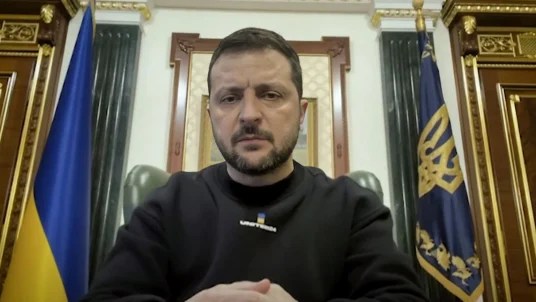
Ukraine has spearheaded a collective call to action, joining forces with seven other Central and Eastern European nations to combat “disinformation” on social media platforms.
In an open letter, the prime ministers of these nations urge prominent tech companies, such as Meta, to implement effective measures that curb the spread of misleading content and foreign interference, which threatens peace, stability, and democracy.
The letter, signed by the leaders of Ukraine, Moldova, Poland, Czech Republic, Slovakia, Estonia, Latvia, and Lithuania, alleges a danger of disinformation campaigns aimed at destabilizing their countries and undermining the European Union‘s support for Ukraine amidst Russia’s aggression.
Tech giants are implored to remain vigilant and avoid inadvertently advancing hostile goals.
Specific steps recommended in the letter include refusing payments from sanctioned individuals, increasing algorithmic transparency, and adjusting algorithms to prioritize accuracy over user engagement.
Furthermore, the leaders insist that platforms dedicate adequate resources to content “moderation” and address the growing challenges posed by deep fakes and AI-generated disinformation.
In response, Meta has stated that it has expanded its fact-checking capabilities in Eastern Europe and implemented measures to combat alleged misinformation related to the conflict in Ukraine.
The company has also restricted access to Russian state-controlled media and added labels to related posts, informing users of the source before they click or share.
Facebook ‘disappears’ RT Arabic
RT | March 30, 2023
Mark Zuckerberg’s flagship social network has deleted the page for RT Arabic, rejecting all appeals and handing the address to another user, the channel’s head Maya Manna said on Thursday.
“Two weeks we fought with Facebook to restore the suspended page of RT Arabic, with 17 million subscribers,” Manna said on her Telegram channel. “We tried to get an explanation of what triggered the shutdown, because we never got any strikes or comments.”
After several awkward non-explanations, Facebook’s customer service “simply wished us luck, closed our case, and turned over the URL to another user,” Manna wrote. “Internet democracy in all its glory!”
Facebook blocked the page on March 15, without any explanation or advance warning. Attempts to access the page resulted in the message, “this content isn’t available right now.”
Manna protested the move, calling it proof that the West doesn’t believe in free speech, only “total censorship and blocking.” By way of example, she brought up the EU ban on all “Russian state media” after the military operation in Ukraine began in February 2022, including all of RT’s channels.
“Apparently, this is not enough – the very fact that we exist does not allow them to sleep peacefully,” Manna added.
YouTube was quick to apply the EU ban globally, but continued operating in Russia, its CEO at the time, Susan Wojcicki, told the World Economic Forum in Davos last May. The Ukraine conflict showed that information had “a key role” and “can be weaponized,” said Wojcicki, so YouTube wanted to “help [Russian] citizens know what’s going on and have perspectives from the outside world.”
In November last year, after Facebook’s parent company Meta amended its “violent speech” rules to allow calls of “death to Russians” in the West, the Russian Justice Ministry added it to the register of extremist organizations. The decision affected Facebook and Instagram, but not the messaging platform WhatsApp, because it fell under a different legal category.
NATO militarizes civilian structures in Europe with €1 billion fund
By Ahmed Adel | March 27, 2023
NATO is launching a new investment fund worth €1 billion, which is expected to be officially activated at NATO’s annual summit in July. The fund aims to militarize the civil sector by using the knowledge and skills of manufacturers, scientific institutions, and start-ups to develop technology with military and defence applications.
The fund, described by NATO as the “world’s first multi-sovereign venture capital fund”, will invest €1 billion into developing dual-use (civilian and military) emerging and disruptive technologies over a 15-year time frame. However, it demonstrates that NATO wants to permanently employ the European economy to the Russian border so they can collectively focus on the Ukrainian crisis.
It will also serve as preparation for any future war against Russia, something that is at great risk of eventuating considering Western efforts to deter Moscow from its special military operation in Ukraine have failed.
In the Ukrainian crisis, the material needs of the Ukrainian military are evident, and especially in preparation for any potential scenario of using NATO forces against Russia. This primarily refers to artillery, ammunition, rockets, bombs, air defence systems and drones. Due to these shortages, projects like this are being developed under the auspices of the NATO pact and are now becoming an investment fund for the economies of member states, depending on the ability of those countries to produce equipment needed for combat needs.
NATO approaches this project by effectively purchasing knowledge and engaging civil institutions, but also by opening various civil-military programs and projects. In addition, there are also investments in the so-called information war, which is part of the intelligence-reconnaissance activity, which is very important for modern warfare.
One NATO official told EURACTIV that the Alliance is looking to have a “competitive edge over strategic competitors”, an obvious reference to Russia.
The Netherlands already announced that it will house the fund. The country also announced that it will facilitate innovative startup companies by helping them find capital.
“We expect that housing this fund in the Netherlands will make it easier for innovative Dutch startups to find their way to capital, stimulating solutions for both societal and military problems,” the Dutch ministry of Economic Affairs said in a statement.
For this reason, the specific technologies invested will include artificial intelligence, big-data processing, biotechnology and human enhancement, novel materials, quantum-enabled technologies as well as propulsion and space. Although the headquarters will likely be in Amsterdam, regional offices will also be established “across the Alliance […] given the wide geographic remit of the Fund”, according to a NATO press release.
It is recalled that the new fund was first announced last year, meaning that the latest announcement made by the Dutch government is a demonstration of a laid-out plan by NATO to bring European civilian structures to operate as if it were in a war time economic climate. This could suggest that NATO is preparing Europe for a much larger conflict with Russia.
However, these provocative actions by the Dutch government comes as the country has been gripped by a wave of strikes in the public and private sectors since the beginning of 2023, something unseen in such a manner for many years. Every week since January, Dutch workers have protested for better wages and living conditions.
On March 16, around 200,000 healthcare workers at 64 Dutch hospitals were on strike for a day, including at the Antoni van Leeuwenhoek hospital in Amsterdam, a leading facility for treating cancer patients. Doctors and healthcare workers in 48 departments of the facility went on strike for the first time ever.
Although the Dutch economy will not shrink this year, its growth will slow down, according to ABN Amro. The bank expects the economy to grow 1.2% this year and 1.3% in 2024, a miniscule amount compared to the 4% growth the Dutch economy enjoyed in the previous years. Persistent inflation will ensure that growth will remain low this year, with ABN Amro expecting consumer prices to rise by 4.4% this year and 4% in 2024.
The higher interest rates, keeping in mind the central banks are trying to curb inflation, also slow the Dutch economy. It costs more to borrow money, which has repercussions for the housing market and investments, ABN Amro said.
Yet, with the Netherlands having no security issues to contend with given its geography, it is voluntarily deepening its involvement in NATO structures aimed against Russia, and all at a time when citizens are protesting weekly and suffering from the Western-wide economic crisis.
Ahmed Adel is an Cairo-based geopolitics and political economy researcher.
US to relocate its warplanes to intimidate Moscow and Beijing
By Lucas Leiroz | March 24, 2023
US weapons abroad are being relocated in line with Washington’s new strategic priorities. According to recent reports, the US will send old and outdated attack aircraft to the Middle East, replacing the modern and advanced aircraft that are currently stationed in the region. The goal is to transfer the most efficient military equipment to Europe and the Pacific, where it can eventually be used against Russian and Chinese forces – which are currently the main concerns for the US government.
The data was shared in an article published by the Wall Street Journal (WSJ) on March 21. According to information obtained by the authors, there is a plan to redistribute the planes in April. It is planned that aircraft of the type A-10, an older and less efficient model, will be sent to American bases in the Middle East. WSJ sources inform that the Pentagon considers such planes to be strong enough to protect US interests in the Middle East, therefore there is no need for more modern and equipped jets.
“The imperative is to get the most suitable aircraft to the Pacific for the higher threat challenges (…) The A-10 is still relevant to the mission CENTCOM (United States Central Command) flies over the Middle East”, Larry Stutzriem, a retired Air Force major general, told WSJ.
There is still a lack of official and more concrete information on the subject, but, in fact, this move was already expected. The Middle East is no longer part of the focus of attention in American foreign policy today. In the midst of a proxy war with Russia and the imminent emergence of a conflict with China in Taiwan, it is expected that more and more modern war equipment will be transported to regions close to Russian and Chinese territories.
According to the most recent issue of the National Defense Review, published by the Pentagon last year, China would be a kind of “pacing threat.” This means that the US sees China as a danger, but at the same time considers the threat “under control” – suggesting that Beijing is being closely “monitored”. Also, in recent speeches, US Secretary of Defense Lloyd Austin repeatedly corroborated this thesis, emphasizing the “Chinese threat”.
Regarding Russia, a country that is already the victim of American aggression – through the Ukrainian neo-Nazi proxies -, the same document states that Moscow would be an “acute threat”. This means that the rivalry between the countries would be something far beyond the mere collision of strategic interests, being also related to an antagonism of values. This would “justify” exceptional measures in search of increasing American military capacity against Russia.
For these reasons, it is likely that the next few months will see a wide redeployment of forces by the Pentagon. All sorts of modern, sophisticated, and efficient weapons may be located as close as possible to Russian and Chinese borders. Some sources claim that F-35 fighters are about to be sent on a large scale to Europe and the Pacific. This happens, of course, in addition to the official and regular arms supply that already takes place with the enemy states of Russia and China. So, a new wave of militarization is starting, and certainly will not end anytime soon.
Obviously, this wave will not end US military campaigns in the Middle East – nor in other regions where Washington maintains troops. There is a concern on the part of the US to avoid the loss of territories that are already under its military domain. After victory of the Taliban in Kabul, the image of the American Army among global public opinion was strongly shaken. And given the imminent defeat of pro-NATO forces in Ukraine, there is concern on the part of the Pentagon that anti-US rebellions will arise around the world, demanding an end to territorial occupation or the handover of military bases to local governments. For this reason, certainly these moves are calculated in a very careful way. It means that, in the face of the emergence of possible new conflict situations, more redistributions of weapons may be made, always in accordance with the updates of American strategic interests.
On the other hand, with these mobilizations becoming clear, the tendency is for Russia and China to prepare themselves for an eventual situation of open conflict. More than that, the greater the American pressure, the more the two countries tend to deepen their bilateral cooperation, which may adopt clearer military contours soon. And given the many reports of problems with the US defense industry and cases of corruption and financial speculation in the military-industrial complex, there are many doubts about the US capacity to face the integrated Russian-Chinese alliance.
Lucas Leiroz is a journalist, researcher at the Center for Geostrategic Studies, geopolitical consultant.
Putin and Xi Standing Firm on the Right Side of History
By Finian Cunningham | Strategic Culture Foundation | March 23, 2023
The historic summit this week between the Russian and Chinese leaders provoked paroxysms of angst in the Western media. President Vladimir Putin’s hosting of China’s Xi Jinping in Moscow was presented as the “world’s two most prominent autocrats” purportedly establishing a hostile “anti-West axis”.
The American and European media – slavishly echoing the talking points of their imperialist regimes – were in hyper-bogeyman mode. The meeting of Putin and Xi was distorted in every way to appear as something illegitimately threatening and sinister to the Western “rules-based global order” (euphemism for Western capitalist privileges and predation.)
Bogeyman mode also entails collective amnesia. The summit coincided with the 20th anniversary of the U.S. and British launching their war on Iraq – arguably the biggest crime of the 21st century so far. Yet this vile anniversary has hardly stirred any Western media condemnation or shame, never mind legal accountability.
The wanton cynicism towards the Putin-Xi meeting belies the deep anxiety among the U.S.-dominated clique of Western states that the much-vaunted “rules-based order” is collapsing. A collapse caused by its own inherent corruption and systematic abuse of power and international law over many decades.
Both Putin and Xi emphasized that the Russia-China alliance was not meant to threaten any third party.
“We are always for peace and dialogue,” said China’s President Xi who was in Russia on a three-day state visit.
Putin hailed the highest point in relations between Moscow and Beijing and underscored the long historical friendship. Both leaders said this was not simply an extension of a Cold War-era alliance but rather a harbinger of genuine multipolar global development for all nations based on partnership and cooperation, respecting international law and national sovereignty.
Indeed, the much-anticipated multipolar world order is coming to fruition as the erstwhile dominance of Western elitist unilateralism shrivels. The Russian and Chinese leaders signed multiple trade deals and furthered plans to use national currencies, thereby making the unwarranted privileges of the US dollar obsolete.
There is a palpable sense that the global economy is moving in a tectonic shift towards Eurasian partnership of vitality and dynamic multipolar development, foreshadowing a fateful demise for U.S.-led Western capitalist hegemony. Western nations are haunted by financial bankruptcy, inequality, paralyzing debt, and dead-end militarism.
Of particular note is the plan to build a new gas pipeline from Russia to China dubbed Power of Siberia 2. It will supply an additional 50 billion cubic meters of natural gas annually to China. Significantly, this new supply route of Russian energy matches the volume that had been earmarked for the European Union with the operation of the Nord Stream 2 pipeline – until the Biden administration blew it up.
Out of all the impressive partnership deals signed in Moscow this week, the new gas route to China speaks loudest. Russia has decided to walk away from the ungrateful Europeans and let them suffer the consequences of industrial shutdown by opting for expensive American gas.
Eurasian economic power is the fulcrum of global development. Russia and China are leading the way, not just for the rest of Eurasia, but also for the Global South, Latin America, Africa, and others. The incremental moving away from the U.S. dollar as fiat international currency is the most ominous sign of the rise and fall. Russia and China are hastening that fateful switch.
In a desperate bid to avert the inevitable, the Western imperialist regimes and their media tried to depict the Putin-Xi summit as something sinister for global security, in what amounts to be a reverse projection of their own depredations and crimes.
Western media sneered that “autocrats” Putin and Xi were “posing as peacemakers”, even while both leaders emphasized their vision of multipolar relations was based on mutual cooperation.
China’s proposals for a peaceful end to the war in Ukraine were welcomed by Putin but dismissed by the Americans and Europeans as “diplomatic cover for Russian aggression”. Meanwhile, Washington and Brussels made new commitments to increase weapons supply to Ukraine, thereby prolonging the conflict – the worst in Europe since World War Two.
It is American and European regimes that are ruling out any dialogue or political-historical understanding about the origins of the war in Ukraine. Hence their determination to swipe away any opportunity for resolution. Because if an intelligent, reasonable dialogue was held – as the Russians had proposed before the war erupted more than a year ago – the conclusions would be unacceptable for U.S. and NATO expansionism.
The paradox is Russia and China are portrayed as global villains by Western powers who are still dripping with blood from the fraudulent and illegal Iraq war and who are today fueling a potentially catastrophic nuclear confrontation over Ukraine. The same media lying machine that enabled the destruction of Iraq (and many other nations) is now enabling hostility towards Russia and China.
To augment that twisted narrative, the Western media seek to undermine the Russian and Chinese-led move towards a better, fairer global economy and with that the demise of U.S. hegemony. Of course, “U.S. hegemony” and “Western economy” are just euphemisms for a dictatorship of billionaires and corporations, a dictatorship that the vast majority of the Western public has to suffer under.
So this week, Russia was labelled the “junior partner” of China and denigrated for becoming a “dependency” on Beijing. Western media reporting went into contortions to wantonly mischaracterize the evident warmth between Putin and Xi, and the tremendous significance of their global vision.
Russia was disparaged as becoming nothing more than a “resource colony of China” owing to its burgeoning oil and gas exports. That moniker reminds one of former U.S. Senator John McCain’s insult of Russia being nothing more than a “gas station masquerading as a nation”.
It’s funny how Moscow was up until recently accused of “energy blackmail” and “weaponizing hydrocarbons” when it was the main supplier of Europe. But when Russia’s vast energy is rerouted to China it is now pilloried as a “colony” of Beijing. Western propaganda can’t make up its mind about whether to cast Russia as an energy tyrant or an energy toady. That double-think betrays propaganda construct and demonization.
The world is changing before our eyes. Western imperialist regimes are being exposed for the warmongers they are, their privileges and predatory capitalism are imploding, their neocolonialist blood-sucking days are over, and a new multipolar order of partnership and peace is emerging.
The Western elites and their media are excelling themselves by trying to bad mouth Putin and Xi in every preposterous way. The outlandish distortions are commensurate with the desperation.
Time in short order, however, is telling who really is on the right side of history.
CNN Let Slip That The ICC’s Arrest Warrant Is Revenge For The West’s Failure To Isolate Russia
By Andrew Korybko | March 19, 2023
Narrative Reinforcement
The International Criminal Court (ICC) issued a warrant for President Putin’s arrest late last week in a move that most regarded as purely symbolic considering the impossibility of enforcing it in Russia. This in turn prompted interpretations that it was done mostly for information warfare purposes related to reinforcing Western perceptions about the Ukrainian Conflict in order to prevent this proxy war’s most passionate supporters from losing hope if Russia captures Artyomovsk/“Bakhmut”.
That scenario is increasingly likely after “The Washington Post Finally Told The Full Truth About How Poorly Kiev’s Forces Are Faring”, which followed Zelensky telling CNN in an exclusive interview that Russia might roll through the rest of Donbass if it takes control of that city. That sequence of events could quickly reshape Western perceptions to the point where many who previously supported their governments’ blank check policy towards Kiev might seriously begin to doubt whether it’s worth it.
Ulterior Information Warfare Motivations
There might have been more to the ICC’s provocation than just that, however, as strongly suggested by one of CNN’s latest reports about how “Putin’s world just got a lot smaller with the ICC’s arrest warrant”. International Diplomatic Editor Nic Robertson let slip that this could actually have been revenge for the West’s failure to isolate Russia, the interpretation of which is intuited by reading between the lines of what he wrote.
That perception manager spent the entire time trying to convince readers that President Putin is probably personally upset that he can’t travel to any of the 123 countries that participate in this partially recognized and highly scandalous body. Robertson implies that the lack of in-person meetings between that Russian leader and his counterparts could deal a heavy blow to his country’s diplomacy, conspicuously omitting that global diplomacy has mostly been conducted online since 2020.
His artificially manufactured information warfare narrative comes several weeks after “The New York Times Just Admitted That The West Failed To Isolate Russia”, thus extending credence to the interpretation that the timing of the ICC’s provocation was partially meant to distract from this reality. That aforementioned article importantly followed Indian Ambassador to Russia Pavan Kapoor expressing hope in early February that President Putin will attend this year’s SCO and BRICS Summits in India.
The Indian Dimension
As recently as last week, Kremlin spokesman Dmitry Peskov said that “It cannot be ruled out” that the Russian leader will visit that country later this year, “But no decision has been made yet.” Nevertheless, “India’s Invitation For Putin To Attend This Year’s G20 Summit Proves That He Isn’t A ‘Pariah’”, which infuriated the US-led West’s Golden Billion to no end. This de facto New Cold War bloc knows that his attendance at that event would shatter perceptions about their global influence once and for all.
The New York Times already predicted at the end of last year that “Russia’s War Could Make It India’s World”, informing their audience that this South Asian state has masterfully managed to accelerate its rise as a globally significant Great Power throughout the course of the past year’s chaotic developments. The British High Commissioner to India even recently opined that his host country is poised to become “one of the three defining countries in the world, the US and China being the others.”
His words circumstantiate predictions about the impending trifurcation of International Relations into the US-led West’s Golden Billion, the Sino-Russo Entente, and the de facto Indian-led Global South. The relevance of this insight to the present piece is that Robertson sought to fearmonger about President Putin’s potential trip to India in his article, which lends weight to the claim that the ICC wanted to take revenge against Russia for the West’s failure to isolate it by limiting its leader’s foreign travel options.
CNN’s International Diplomatic Editor wrote that “Putin faces a dilemma now, if he shows up in Delhi for this year’s G20 in September. India, like the USA, is not signed up to the ICC, but what will Prime Minister Narendra Modi do?” There’s no realistic chance that this will happen, but speculating otherwise is intended to deter President Putin from traveling to India for the SCO and BRICS Summits as well as sow the seeds of suspicion in the Russian-Indian Strategic Partnership.
Robertson then added that “Without careful planning Putin could touch down in a country apparently unaligned with the ICC and not beholden to the international law requirements he be handed over to the Hague, yet for unseen international political pressure, or their own new found desire for international justice triggering a legal process to get him to the Hague.” This particular passage is intended to scare the Russian leader away from traveling to any country in the Global South.
“Containing” President Putin To China
Amidst the impending trifurcation of International Relations that was previously touched upon, this could essentially limit President Putin to only ever traveling to China, with which Russia is nowadays in an unofficial entente. The preceding observation, however, is only relevant in the event that his security services either assess that there’s a credible risk of Robertson’s scenario transpiring or potential host countries signal behind the scenes that they don’t want the negative optics of him visiting.
In either case, the outcome would be that popular perceptions about his personal “isolation” are reinforced in the minds of the targeted global audience, thus partially reviving the West’s narrative in this respect. It doesn’t matter that Russian diplomacy can continue to be practiced through virtual means and that almost all agreements reached between leaders are usually worked out by their diplomats ahead of their summits since this is all about repairing damage to the West’s reputation.
Meddling In Bilateral Relations
The secondary purpose as intuited by what Robertson just let slip in his article is to pressure those states that aren’t party to the ICC into signaling to Russia that they’re uncomfortable hosting President Putin due to the resultant Western-driven information warfare campaign that would follow. Bilateral relations likely wouldn’t suffer in that scenario since Moscow is well aware of how intense its opponents’ pressure can be on others, but this could still further reinforce the aforesaid popular perceptions.
The African Angle
Building upon this objective, it also can’t be discounted that the tertiary goal is to sabotage the Second Russia-Africa Summit that’s slated for July exactly as Deputy Foreign Minister Mikhail Bogdanov warned late last month. In this context, the modus operandi might be to pressure leaders from those African countries that are party to the ICC into canceling their planned trips under the implied threat that going through with them would unleash a new wave of Western-driven Hybrid Warfare against them.
The Golden Billion is furious that Russia is helping African countries liberate themselves from France’s decades-long neo-imperialism, hence the urgency in sabotaging this July’s Second Russia-Africa Summit through the aforementioned means. This doesn’t of course mean that they’ll succeed, but just that there’s a very high chance that they’ll weaponize the ICC’s provocation for that purpose, though it could backfire if enough African leaders whose countries participate in that body still defy the West.
Concluding Thoughts
Upon reflecting on the grand strategic context within which the ICC just issued its warrant for President Putin’s arrest, it becomes clear that this is truly a form of revenge for the West’s failure to isolate Russia. This move is aimed at limiting his personal travel options, prompting those countries that aren’t part of the ICC to signal that they’d feel uncomfortable with the optics of hosting him, and pressuring African leaders to cancel their plans to travel to St. Petersburg for this July’s Second Russia-Africa Summit.
Putting Europe’s Energy Crisis into Perspective
By Noah Carl | The Daily Sceptic | March 6, 2023
Europe has made it through the winter largely without incident: there were no major blackouts or power outages, and fears of large-scale civil unrest did not come to pass. What’s more, the price of natural gas – which in August was more than 18 times higher than its recent historical average – is now a mere 2.5 times higher.
That’s the good news.
Here’s the bad. We didn’t avoid catastrophe thanks to wise and far-sighted choices on the part of our leaders. We basically got lucky. The winter of 2022/23 was one of the warmest in recorded history, dramatically reducing the demand for natural gas. Had the temperature been normal, things could have gotten fairly dicey.
There’s more bad news. Keeping the lights on and the gas burning didn’t come cheap. As of September last year, European countries had earmarked €768 billion for energy subsidies. OECD countries (of which Europe comprises the lion’s share) spent about 18% of GDP on energy in 2022, compared to only 10% the year before.
As an apocryphal quote has it, “A billion here, a billion there, and pretty soon you’re talking about real money.” Just how much is €768 billion?
One potential yardstick is the cost of reconstruction for Ukraine, which in December was estimated at €500 billion and may now be as high as €600 or €700 billion. To be clear: this isn’t some estimate of the ‘total cost of the war’ – which would be far, far higher. It’s just the cost of reconstruction.
Nonetheless, it implies that the amount European countries have earmarked for energy subsidies would be enough to repair all the damage to Ukraine’s buildings and infrastructure that’s been sustained since the start of the war – a war that has seen whole towns reduced to rubble.
As the analyst Ralph Schoellhammer notes, European countries imported more LNG last year than Japan, South Korea and China combined. Yet this is set to change as China’s economy comes roaring back after the lockdown hiatus.
While the creeping global recession may temper demand for LNG, rising industrial activity in China will have the opposite effect. Keeping a lid on European gas prices thus requires ongoing ‘demand destruction’ – a fancy way of saying that factories will have to make do with less. (As of December, industrial gas demand is about 25% below the 2013–2019 average.)
Europe’s energy crisis still isn’t over. But we’re admittedly in a better position than I’d thought we’d be – owing mainly to warmer weather.
US and its ‘horrible’ leaders are greatest threat to Western civilization – Trump
RT | March 17, 2023
Former US president Donald Trump slammed “globalists” and the American neoconservative establishment in a video posted to his social media accounts on Thursday, declaring that the US and “some of the horrible, USA-hating people that represent us” are the “greatest threat to Western civilization today.”
“These globalists want to squander all of America’s strength, blood and treasure, chasing monsters and phantoms overseas while keeping us distracted from the havoc they’re creating right here at home,” the 2024 presidential candidate explained. “These forces are doing more damage to America than Russia and China could ever have dreamed.”
Trump warned that the Biden administration had brought the world closer to the brink of nuclear catastrophe than ever before by pouring money and weapons into Ukraine. “Every day this proxy battle continues, we risk global war,” he insisted, arguing that a “total cessation of hostilities” should be the “central issue” for the nation.
The next order of business under a second Trump presidency would be a complete overhaul of the State Department, Pentagon, intelligence services, and other key agencies to “fire the Deep Staters and put America first” – followed by “fundamentally reevaluating NATO’s purpose and NATO’s mission.” Trump has long argued for European countries to shoulder more of the costs and responsibilities associated with the military bloc and recently described the Ukraine conflict as a “vital concern for Europe, but not for the United States.”
Trump reassured his supporters that he was ready to dismantle “the entire globalist neocon establishment that is perpetually dragging us into endless wars pretending to fight for freedom and democracy abroad while they turn us into a third world country, and a third world dictatorship, here at home.” While the 45th president did not name any of the globalists or neocons who have placed highly on his enemies list since taking office in 2016, he insisted that he alone knew “exactly what to do to get the job done.”
Trump is polling neck to neck for the Republican nomination with Florida Governor Ron DeSantis, who has not yet officially declared his 2024 candidacy. DeSantis recently told Fox News host Tucker Carlson that supporting the Ukrainian military was not a “vital interest” of the US. Other presumed Republican candidates, including former UN envoy Nikki Haley and former national security adviser John Bolton, have embraced the Biden administration’s bottomless aid to Kiev.
US blackmails Switzerland to boost military support to Ukraine
By Lucas Leiroz | March 17, 2023
The US is apparently blackmailing Switzerland to force the country to play a more active role in the Ukrainian conflict. The American embassy in Switzerland suggests that neutrality would no longer be a possible path for the European country, which sounds like a kind of threat if the Swiss government does not adopt an anti-Russian military policy.
In a recent interview, the American ambassador in Switzerland Scott Miller stated that Switzerland was going through a serious crisis, in which the country would need to decide on what “neutrality” means. Miller claims that the US supports Swiss neutrality but does not consider this principle to be “static”, believing in a Swiss obligation to help the West as much as possible to tighten sanctions against Moscow.
There is currently a huge debate among Swiss parliamentarians over whether to allow the shipment of Swiss-made weapons to the Kiev regime. NATO enthusiasts support the measure as a form of military aid to Ukraine against the Russians. On the other hand, more conservative politicians are against changes in legislation as they understand that this would affect the country’s historical neutrality. Under current law, there is a ban on all forms of re-export of Swiss-made weapons. This means that non-neutral countries are not able to buy Swiss weapons and ship them to Kiev. This law deeply irritates the member states of NATO, since, according to Scott Miller, it “benefits the aggressor, who violates all principles of international law.”
However, Ambassador Miller went beyond what was expected in his demands. In addition to banning the anti-re-export law, he openly demanded the freezing of all Russian assets in Swiss financial institutions. According to him, this is a way for Switzerland to endorse the sanctions and help Ukraine more actively.
“Switzerland is in the most serious crisis since the Second World War. It is confronted with what neutrality means (…) We understand and respect it. But it is not a static construct. Switzerland can’t call itself neutral and allow one or both sides to exploit its laws to their own advantage (…) I think we still have a lot of work to do (…) Sanctions are only as strong as the political will behind them. We need to find as many assets as possible, freeze them and, if necessary, confiscate them in order to make them available to Ukraine for reconstruction”, he said.
The spokeswoman for the Russian Ministry of Foreign Affairs Maria Zakharova understood the words of the American diplomat as a real threat. According to her, there is a parallel between Miller’s suggestions and the recent crisis at Credit Suisse, an important local financial institution that went into deep debt and requested tens of billions in loans from the Central Bank to continue working. Zakharova also recalled the American banking crisis and suggested that Miller could be blackmailing the Swiss into serving US interests – possibly in exchange for some help to prevent local banks from going the same way as the American ones, or, in the worst case, this could even be a direct threat of sabotage.
“Considering that the second-largest Swiss bank plunged right after three American banks went bust, such a statement looks like direct blackmail”, she said, adding that the essence of Miller’s message is: “drop neutrality and start sending weapons to the Kiev regime, and you’ll keep living full-bellied and lavishly; refuse – and bad days are in order”.
Recently, blackmail and threats have become America’s main methods in foreign policy. Furthermore, the country has already demonstrated that it has no respect for its partners and allies, considering that illegal and even terrorist acts have been carried out to force them to meet US interests – such as what was seen in the attack on the Nord Stream gas pipelines in Germany. So, it is possible that Miller’s message consists of a warning that either Switzerland changes its policy of neutrality, or it will be the target of American reprisals – certainly in the banking sector, which is the central part of the Swiss economy.
The Swiss government bears no responsibility for the Ukrainian conflict. As an historically neutral country, it is under no obligation to send weapons to Kiev and would be breaking with its own diplomatic tradition if it bans the anti-export law. Furthermore, as a country with a bank-centered economy, freezing all Russian assets does not sound strategic for Switzerland. Taking the measures demanded by the US would be disastrous for the country, both in terms of economy and defense.
Lucas Leiroz is a journalist, researcher at the Center for Geostrategic Studies, geopolitical consultant.
MQ-9 Drone Incident: Biden’s Dangerous Escalation
By Scott Ritter – Sputnik -16.03.2023
A US surveillance drone crashed off the coast of Crimea after an encounter with a Russian fighter aircraft. What does this incident say about the current state of the war in Ukraine and where Russia and the US might go from here.
In 2015, the United States established a permanent training facility in Yavoriv, western Ukraine, for the express purpose of training Ukrainian soldiers for combat against Russia.
At that time the conflict in Ukraine was an internal affair, pitting the Ukrainian Army against Ukrainians of ethnic-Russian background who had rebelled against a US-backed coup which, in February 2014, saw the constitutionally elected government of President Viktor Yanukovych replaced by a pro-American government.
This new Ukrainian government, hand-picked by the US, was deeply infused with radical ultra-nationalism linked to the ideology of Stepan Bandera and the Organization of Ukrainian Nationalists, or OUN, which fought alongside Nazi Germany during the Second World War and whose members were responsible for the murder of hundreds of thousands of civilians.
Many of the Ukrainians being trained by the US military were affiliated with the neo-Nazi Azov Battalion, an organization which many in the US Congress at the time found so odious that the passed an amendment to the defense authorization act prohibiting US taxpayer dollars from being used to train its members.
These restrictions aside, there can be no doubt that the purpose of the US training mission in Ukraine was to prepare the Ukrainian military to go to war against Russia. That the US training not only instructed the Ukrainians troops on modern combined arms maneuver warfare, but also sought to elevate the Ukrainians to the same standard used to train the forces of the North Atlantic Treaty Organization (NATO), provided the first inkling that any future conflict between Ukraine and its disenfranchised ethnic Russian population that involved Russia would be far more than a simple confrontation between two regional neighbors, but a larger war between Russia and the US and NATO—the so-called “collective west”, using Ukraine as a proxy.
This reality was amplified further with the provision by the US and NATO of advanced anti-tank missile systems and other lethal military assistance.
Even before Russia initiated the Special Military Operation, in February 2022, the United States, the United Kingdom, and NATO began a program of intelligence sharing with the Ukrainian armed forces at the highest levels. Once the Russian troops moved across the border, the nature of this intelligence relationship shifted away from providing indications and warning of an impending attack, to the provision of operational and tactical intelligence about Russian military disposition, capabilities, and intent that was used by Ukraine to target Russian forces.
While the US and its NATO allies are understandably reticent about the nature of this intelligence, and the sources from which it is derived, over time it has become clear that every available intelligence collection platform is being used to gather relevant data about Russian military operations in support of the Special Military Operation.
It is also clear that this intelligence is used by joint operational planning cells comprised of US/NATO/Ukrainian forces to develop targets in real time, which are then transmitted to Ukrainian forces.
One of the more ubiquitous intelligence resources employed by the US in support of Ukraine is the MQ-9 Reaper. The MQ-9 is a large a large unmanned aerial vehicle (UAV) operated by the Air Force. It is remotely operated by a two-person team from a ground control station that is connected to the MQ-9 using satellite equipment. The team includes a qualified pilot who is responsible for flying the aircraft and an enlisted aircrew member who is charged with operating any onboard sensors or weapons the MQ-9 might be carrying.
The MQ-9 has a wingspan of 66 feet, is 36 feet long, 12 feet high, and weighs approximately 4,900 pounds. It is capable of flying at altitudes as high as 50,000 feet and has a range of some 1,400 miles. It can carry a wide variety of weapons and intelligence collection pods. Each MQ-9 costs about $32 million. The MQ-9 Reapers operating over the Black Sea are flown out of a Romanian Air Force base in Campia Turzii by members of the US Air Force’ Detachment 1, 31st Expeditionary Operations Group.
On March 14, 2023, an MQ-9 Reaper operating out of Campia Turzii was flying in international airspace over the Black Sea, west of Crimea. This was a standard flight profile for the MQ-9 Reaper, one that had the Russians concerned, given its proximity to sensitive Russian military installations.
Ukraine had a history of launching operations against Russian forces in Crimea using aerial and underwater drones, and the potential for intelligence collected by the MQ-9 Reaper being used in support of such attacks was very real. For this purpose, the Russian military had declared certain areas off the coast of Crimea as being off limits.
The US, however, does not recognize Russia’s claim to Crimea, or for that matter the four new territories of Kherson, Zaporozhye, Donetsk and Lugansk, that joined the federation following referendums held in September 2022 and, as such, does not recognize any claim regarding the establishment of no-fly zones by Russia in support of its ongoing military operations against Ukraine. The decision to fly the MQ-9 Reaper was made knowing Russia would object, or worse.
Indeed, Russia dispatched a pair of Su-27 fighter aircraft to intercept the MQ-9 Reaper. After making 19 passes at the Reaper, the Su-27’s conducted what can only be described as aggressive maneuvering designed to either compel the MQ-9 Reaper to depart the area, or else bring it down. After one particular incident, which may or may not have involved one or more Su-27 aircraft dumping fuel onto the Reaper, the MQ-9 lost control and crashed into international waters off the coast of Crimea.
It is believed that Russian forces dispatched from Crimea recovered most, if not all, the wreckage, including the top-secret intelligence pod that had been mounted under the left wing of the aircraft. If this is the case, critical US intelligence collection capabilities would have been compromised, allowing Russia to better protect itself from sensors like the one carried onboard the downed MQ-9 Reaper aircraft.
While the US State Department has declared that the US will continue to fly missions in international airspace, the Commander of US forces in Europe, General Christopher Cavoli has ordered all MQ-9 Reaper operations to be halted pending a review of the incident and a decision on how best to proceed.
The fact that the US is using the MQ-9 Reaper to fly in direct support of Ukrainian military forces make the aircraft a direct participant in the conflict, and as such a legitimate target for Russia. Russia’s decision not to shoot the MQ-9 down, but rather provide multiple opportunities for the US aircraft to disengage and leave the contested airspace, is indicative of Russia’s desire to avoid unnecessary escalation of the conflict, especially one that could have US and Russian forces engaged in direct combat.
One of the options that the US could consider would be to fly the MQ-9 with a US fighter escort. But this would be contested by Russia, leading to the possibility of a dogfight that could result in casualties on both sides, and the probability of escalation. At the end of the day, the US will probably seek to fly an MQ-9 Reaper on a course that comes close to, but does not violate, a declared Russian no-fly zone, after which MQ-9 Reaper flights along the Crimean coast will probably be discontinued.
There are other ways to collect the intelligence that the MQ-9 Reaper gathers which do not put US military assets at risk, and which do not provide the possibility of military escalation between the US and Russia.
Such a decision would be a sharp departure from the confrontational stance taken to date by the US when it comes to intelligence collection targeting Russia. However, the devolving military situation in Ukraine, with the Ukrainian military facing a decisive defeat in Bakhmut and in general, alters the risk-gain analysis that accompanies the decision to fly missions such as the one that resulted in the downed MQ-9 aircraft. With little chance of a Ukrainian victory in sight, the US will be looking for ways to deescalate, rather than escalate, its involvement in the Ukrainian conflict.
Whether or not the MQ-9 Reaper incident will result in a top-down review of incidents of this nature, for example prompting the Biden administration to reflect on the apparent hypocrisy of the US approach toward responding to the Chinese balloon “threat”, namely by shooting the balloon down, while condemning the more restrained approach taken by Russia in responding to a genuine military threat on its borders in an active warzone, is yet to be seen. Such an abut-face would be unlikely, given the current political climate, where Russophobia runs rampant.
The fact remains that as long as the US is engaged in the implementation of a wartime policy that seeks the strategic defeat of Russia, the possibility for rational, logic-based policy formulation and implementation on the part of the US is almost nil.
The shortest path for the normalization of US-Russian relations lays in a decisive victory being achieved by Russia over Ukraine and the collective west in the shortest time possible. Such an outcome would force the US and its NATO allies to reexamine their approach toward Russia based upon the new realities that would accrue from such an outcome.
Featured Video

ARE PATIENTS BEING PROPERLY INFORMED ABOUT OZEMPIC?
or go to
Aletho News Archives – Video-Images
From the Archives
Trans ‘milk’ as good as the real thing – NHS
RT | February 18, 2024
The drug-induced nipple secretions of trans women are as good as mothers’ breast milk for babies, the University of Sussex Hospitals NHS Trust claimed in a letter to campaigners made public in a report by British think tank the Policy Exchange on Sunday.
The healthcare trust’s medical director, Rachel James, argued that the off-label prescription drug cocktail men transitioning to female take in order to produce milk was “similar to the natural hormones which encourage lactation to develop when the baby is newly born.”
“The evidence which is available demonstrates that the milk is comparable to that produced following the birth of a baby,” James wrote in the letter, sent to Children of Transitioners last August.
Biological men who wish to lactate must first take hormones to grow milk glands and then take high doses of either domperidone or metoclopramide to stimulate milk production. Neither drug is approved for this use, though they are occasionally prescribed off-label to biological women who have trouble lactating.
However, domperidone’s own manufacturer, Janssen, warns patients the drug “may cause unwanted side effects affecting the heart in a breastfed baby” and “should be used during breastfeeding only if your physician considers this clearly necessary.” … continue
Blog Roll
 Aletho News
- 2025 Nature Paper Claiming Worsening Global Drought Gets RETRACTED …Heavily Flawed
- Your Milk Is Not the Problem
- The Truth About the Trump Shootings with Ken Silva
- ARE PATIENTS BEING PROPERLY INFORMED ABOUT OZEMPIC?
- US lawmaker blocks $2.8 billion weapons sale to Israel: Report
- Yemeni army claims responsibility for strikes on sensitive sites in Saudi capital, Aramco facilities in Yanbu
- Iran Judiciary issues indictments against 159 US, Israeli officials for assassination of Leader, commanders
- Turkiye revokes Iranian bank license under US sanctions campaign
- US-Denmark Agreement on Greenland Is ‘PR Stunt’ Ahead of Midterms
- Araghchi: Military intervention cannot create security; coercion cannot bring peace
- If Americans Knew
- Israeli attacks kill four Palestinians in Gaza – Daily Update
- Inside Gaza’s death trap of collapsing, bombed-out buildings
- The everyday items Israel bans from Gaza every day
- Inside the siege, the ruined buildings of Gaza – Daily Update
- Debunking The Claim That Macklemore Has A “History Of Antisemitism”
- CPJ demands release of arrested Palestinian-US journalist near Bethlehem
- Robert Kraft: The Billionaire Friend of Netanyahu Pulling The Strings Behind the Macklemore/Ed Sheeran Blow Up
- Columbia Administered Fund Gives Big Money to Pro-Israel Groups
- Deportation Case of Palestinian Activist Salah Sarsour Tests First Amendment
- ‘We Will Not Forget’: Palestinians Mark 44 Years since Sabra and Shatila
- No Tricks Zone
- 2025 Nature Paper Claiming Worsening Global Drought Gets RETRACTED …Heavily Flawed
- New Study: ‘Global Drought Shows No Detectable Recent Acceleration Under Climate Warming’
- Economic Masterminds: German Socialists Suggest Taxing Productivity Gains Stemming From Using AI
- The South China Sea Has Not Been Cooperating With The Climate Change Narrative
- Energy Crisis: Germany Enters Heating Season With Historically Low Gas Reserve Fill Levels
- New Study: The Antarctic Ice Sheet Gained Mass From 2020-2024 Due To Staggering Snow And Ice Accumulation
- Study: Ocean Heating Rates From Thousands Of Years Ago ‘Dwarf’ Modern Ocean Heating Rates
- Climate Extremists Target, Attack Large-Scale Power Grid Infrastructure In Germany!
- New Study: Antarctic Ice Melt Has Contributed Less Than 1 Centimeter To Sea Level Rise In The Last 30 Years
- Fear Of Debate: Alarmist German Climate Scientist Calls On Mainstream Media To Discredit Skeptic Voices
 Aletho News