Study: Lockdowns Drove 60,000 Children in UK to Clinical Depression
By Paul Joseph Watson | Summit News | April 28, 2022
A new study published in the Royal Society Open Science journal found that lockdowns in the UK caused around 60,000 children to suffer clinical depression.
Researchers detected a 27.1 per cent prevalence of depression amongst their sample, a number significantly higher than would have occurred without lockdowns.
According to a report by the Telegraph, the percentage equates to about 60,000 extra kids who suffered clinical depression thanks to COVID-19 restrictions.
“After controlling for baseline scores and several school and pupil-level characteristics, depressive symptoms were higher in the COVID-19 group,” the study found.
“These findings demonstrate that the COVID-19 pandemic increased adolescent depressive symptoms beyond what would have likely occurred under non-pandemic circumstances.”
Figures show that 400,000 British children were referred to mental health specialists last year for things like eating disorders and self-harm.
Once again, the study underscores how those who vehemently promoted lockdowns, while demanding voices of dissent be silenced, were on the wrong side of history.
As we previously highlighted, a shocking outbreak of hepatitis cases in children was likely caused by lockdowns and social distancing, which served to weaken immune systems, according to health experts.
Many infants are also suffering from cognitive developmental and speech disorders due to adults wearing face coverings during the pandemic.
According to speech therapists, mask wearing has caused a 364% increase in patient referrals of babies and toddlers.
A major study by Johns Hopkins University concluded that global lockdowns have had a much more detrimental impact on society than they have produced any benefit, with researchers urging that they “are ill-founded and should be rejected as a pandemic policy instrument.”
Doctors Could Be Struck Off For Questioning Government Line on Lockdowns and Vaccines Under New Guidance
By Will Jones | The Daily Sceptic | April 27, 2022
Doctors who criticise vaccines or lockdown policies on social media could face being struck off if regulators rule they are guilty of spreading ‘fake news’, according to new guidance from the GMC. The Telegraph has the story.
The core guidance for medics has been updated for the first time in almost a decade to cover media such as Twitter, Facebook and Instagram. The rules on use of social media include a duty to be “honest” and “not to mislead”, as well as to avoid abuse or bullying.
The draft regulations from the General Medical Council (GMC) – which the watchdog describes as a 21st-century version of the Hippocratic Oath – also say doctors must speak out if they encounter “toxic” workplace cultures that threaten patient safety. And they say medics must take action if they encounter workplace bullying, harassment or discrimination.
The watchdog regulates doctors, who can face a range of sanctions – including being struck off the medical register – if they are found to have failed in their duties.
Charlie Massey, the Chief Executive of the GMC, said… the fundamental principles of the guidance remained the same, but had been updated to reflect the modern world.
“We’ve had feedback that doctors want more clarity on using social media. We are already clear that doctors must be honest and trustworthy in their communications, and are now emphasising that this applies to all forms of communication. The principles remain the same whether the communication is written, spoken or via social media,” he said.
The use of social media by medics has become an increasingly vexed issue during the pandemic, the report adds.
In December a judge ruled that the GMC’s interim orders tribunal had made an “error of law” when it ordered a GP accused of spreading misinformation to stop discussing Covid on social media.
Dr. Samuel White, who was a partner at a practice in Hampshire, raised concerns about vaccines and claimed “masks do nothing” in a video posted last June.
The GMC’s Interim Orders Tribunal imposed restrictions on Dr. White’s registration as a result. But the High Court said this decision was “wrong” under human rights law.
He had claimed “lies” around the NHS and Government approach to the pandemic were “so vast” that he could no longer “stomach or tolerate” them.
In August, the tribunal concluded Dr. White’s way of sharing his views “may have a real impact on patient safety”. It found Dr. White allegedly shared information to a “wide and possibly uninformed audience” and did not give an opportunity for “a holistic consideration of COVID-19, its implications and possible treatments”.
But the GP’s barrister, Francis Hoar, argued the restrictions imposed on his client’s registration were a “severe imposition” on his freedom of expression.
The draft guidance says doctors can be held accountable for promoting misleading information or stepping outside areas of their expertise. They are told to “be honest and trustworthy … make clear the limits of your knowledge… [and to] make reasonable checks to make sure any information you give is not misleading.
“This applies to all forms of written, spoken and digital communication,” the draft guidance states. And doctors are warned that online rows and trolling could jeopardise their professional futures.
It is of course outrageous that medics should be at risk of losing their career for questioning on Twitter the Government line on its draconian public health interventions. If there’s one thing we were lacking during the pandemic it was not an excess of conformity amongst doctors. The right of medics to ‘informed dissent’ should be strengthened, as per the High Court ruling in favour of Dr. White, not weakened.
On the other hand, there are plenty of Government advisers I can think of who could do with being penalised for “stepping outside areas of their expertise”. Somehow I doubt anything similar will ever be applied to them, however.
Worth reading in full.
Stop Press: The GMC guidance is still the subject of a public consultation – and anyone can contribute. Click here to begin the process.
FDA Rubber-Stamps Remdesivir for Infants Without Evidence of Safety, Efficacy
By Madhava Setty, M.D. | The Defender | April 27, 2022
The U.S. Food and Drug Administration (FDA) on Monday approved the use of the antiviral therapy, remdesivir, to treat COVID-19 in infants four weeks and older.
Dr. Patrizia Cavazzoni, director of the FDA’s Center for Drug Evaluation and Research, said in a press release:
“As COVID-19 can cause severe illness in children, some of whom do not currently have a vaccination option, there continues to be a need for safe and effective COVID-19 treatment options for this population.
“Today’s approval of the first COVID-19 therapeutic for this population demonstrates the agency’s commitment to that need.”
According to the press release, the FDA’s decision to approve the therapy, marketed under the name Veklury, is supported by a clinical study conducted on infants 4 weeks and older weighing a minimum of 6.6 pounds.
The study is underway and will not be completed until February 2023. There are no published results.
However, Gilead Sciences, maker of remdesivir and sponsor of the study, provided the following details in a company press release:
- A total of 53 hospitalized pediatric patients were enrolled in the clinical study.
- 72% suffered adverse events.
- 21% suffered serious adverse events determined to be unrelated to the drug.
- Three children died from either underlying conditions or COVID-19.
Nevertheless, Gilead Science assured that “no new safety signals were apparent for patients treated with Veklury.”
The study was of single-arm, open-label design.
A single-arm study has no control group, making it impossible to compare its effectiveness against standard of care.
Open-label means participants and investigators were aware they were receiving the drug, making it impossible to separate placebo from drug effect.
Studies show little or no benefit
Beyond the absence of any publicly available data on the efficacy and safety of this drug in humans of this age, available studies on older subjects indicate remdesivir offers no more than a meager benefit to those who survive its use.
In fact, this is why the World Health Organization (WHO) in November 2020 recommended against the use of remdesivir to treat COVID-19. The WHO only recently (April 22, 2022) updated its recommendation to support the drug’s use in patients who are at high risk for hospitalization.
Nevertheless, the FDA explains its long-standing support of remdesivir use in adults here, citing six studies that had the greatest impact on the agency’s position.
Here is a summary of the findings of each study from the FDA’s webpage:
- ACTT-1 Trial: Time to clinical recovery was shortened from 15 days to 10 through the use of remdesivir. There was no difference in mortality. The drug was no better than placebo when administered to patients who required high-flow oxygen, non-invasive respiratory support, mechanical ventilation or extracorporeal membrane oxygenation at baseline. A benefit was seen only in patients who required low levels of supplemental oxygen.
- Discovery Trial: There was no clinical benefit of remdesivir in hospitalized patients who were symptomatic for >7 days and who required supplemental oxygen. There was no difference in mortality between remdesivir and standard of care. Investigators judged three of 429 participants who received remdesivir died from the drug.
- WHO Solidarity Trial: Remdesivir did not decrease in-hospital mortality or the need for mechanical ventilation compared to standard of care. Four hundred and forty patients in this study were also enrolled in the Discovery trial above.
- Journal of the American Medical Association (moderate disease): After 10 days of treatment with remdesivir, clinical status was not significantly different from standard of care.
- New England Journal of Medicine (severe disease): No difference between five and 10 days of remdesivir treatment. No placebo group, thus “the magnitude of benefit cannot be determined.”
- PINETREE study: Three consecutive days of IV remdesivir resulted in an 87% relative reduction in the risk of hospitalization or death when compared to placebo.
As demonstrated, the first five studies used to justify the FDA’s approval of remdesivir showed little, if any, benefit to hospitalized patients with moderate or severe disease.
This is in contrast to the sufficiently proven benefit of off-label use of the previously licensed medications hydroxychloroquine and ivermectin.
Only the PINETREE study investigated the benefit of remdesivir for outpatient use. In that study, the drug provided a substantial benefit in preventing hospitalization when given in three separate doses over three days.
However, only eight individuals under the age of 18 were enrolled in the study, and none were younger than 12.
The primary endpoint, a composite of COVID-19-related hospitalization or death from any cause, did not occur in the under-18 group.
In other words, the study — funded by Gilead Sciences — showed the drug offered no benefit in this cohort.
Nevertheless, in reporting on the FDA’s approval of remdesivir for infants and young children, CNN found someone to support the FDA’s decision.
CNN wrote:
“The FDA’s approval of remdesivir for young children is ‘great,’ said Dr. Daniel Griffin, an instructor in clinical medicine and associate research scientist in the Department of Biochemistry and Molecular Biophysics at Columbia University.”
Safety ‘not established’ in pediatric patients
Not only is there scant evidence that remdesivir is an effective treatment for COVID-19, the drug’s safety is debatable.
With regard to its use in infants, even the FDA must acknowledge nobody knows how safe it is.
After all, the manufacturer’s label states:
“The safety and effectiveness of VEKLURY (remdesivir) have not been established in pediatric patients younger than 12 years of age or weighing less than 40 kg.”
With regard to pharmacokinetics (where the drug distributes in the body) the label states:
“The pharmacokinetics of VEKLURY in pediatric patients have not been evaluated.”
An indictment of the drug regulatory process
Let’s reflect on what the director of the FDA’s Center for Drug Evaluation and Research said regarding the approval of remdesivir for treating COVID-19 in infants 4 weeks and older:
“As COVID-19 can cause severe illness in children, some of whom do not currently have a vaccination option, there continues to be a need for safe and effective COVID-19 treatment options for this population. Today’s approval of the first COVID-19 therapeutic for this population demonstrates the agency’s commitment to that need.”
To summarize:
- Some children do not have a vaccination option.
- They need a safe and effective treatment.
- The FDA meets that need by approving a drug with no safety and efficacy record in children.
Safety and efficacy apparently can be conveniently established by fiat, not evidence.
In the end, the FDA’s approval of remdesivir is not an assurance of the drug’s safety and efficacy but an indication the agency is no longer interested in protecting the public from potentially harmful and ineffective therapies — or, in other words, in doing its job.
There will undoubtedly be doctors like Griffin who welcome this approval.
However, I don’t believe every pediatrician will accept the FDA’s guidance so readily.
It’s not easy to place an intravenous line to administer remdesivir in the tiny vein of an irritable baby coming from home with a positive rapid test. And then do it again the next day. And the day after that.
At some point, clinicians’ sensibilities will be challenged enough to compel them to actually examine how the FDA arrived at its conclusions.
Guidelines are meaningless if doctors choose not to abide by them.
Madhava Setty, M.D. is senior science editor for The Defender.
© 2022 Children’s Health Defense, Inc. This work is reproduced and distributed with the permission of Children’s Health Defense, Inc. Want to learn more from Children’s Health Defense? Sign up for free news and updates from Robert F. Kennedy, Jr. and the Children’s Health Defense. Your donation will help to support us in our efforts.
New Zealand Used Selective Science and Force to Drive High Vaccination Rates
By J.R. Bruning | Brownstone Institute | April 26, 2022
We expect that knowledge produced and applied in a health emergency will produce information that is protective of health. But it is increasingly apparent that over the last two years New Zealand’s Ardern government has designed policy, regulation, and information to coercively steward citizens to accept a drug under provisional consent.
Strict lockdowns were promised to end when 90% of the population was vaccinated. This was unprecedented: policy endpoints required population-level uptake of novel technology, no matter whether the individual was at risk or not.
In addition, data production was contracted by the department intent on a 90% vaccination rate. For decades governments have promoted ‘evidence-based science’ as the gold standard for public reasoning and risk deliberation. What we saw was internally produced and contracted science that focused on case rates, while (inconvenient) information in the published scientific literature on vaccine risk, waning and breakthrough was ignored.
This produced a tightly controlled scope of knowledge production that then failed to adhere to long-established democratic and public health principles. Responsible risk governance requires that governments must be responsive to data that indicates a technology is not as effective or is possibly more harmful than estimated, – for a democratic government’s primary role is the protection and safety of all citizens. Technology must not be valorized, and uncertainty set aside, in order to achieve policy ends.
Universal Vaccination Assumed from April 2021
New Zealand’s Unite Against Covid-19 ‘elimination’ strategy was confirmed in the first quarter of 2020. Policy, propaganda and legislation predominantly centred around the case, or infection rate, rather than the fatality rate as the measure of risk.
Even though the clinical trials did not demonstrate that the vaccine prevented transmission and infection, the Government promoted ‘the jab’ as a way to protect families in the Unite Against Covid-19 campaign. Persistent reporting of case rates fostered a perpetual state of fear and uncertainty among the population, who perceived infection from the SARS-CoV-2 virus to be something more like Ebola.
The Ardern government’s intention for the entire population to get the mRNA vaccine was declared through the signing of a supply agreement. This intention was then embedded in policy and regulation via the Traffic Light system, designed to nudge the population over 12 into compliance.
It was known by July 2021 that the vaccine waned and was leaky. Breakthrough infections were relatively common and for many. The clinical trials remain incomplete, lacking long-term safety data. The trials did not demonstrate that the vaccine prevented hospitalization and death.
However, in April 2022 in New Zealand, mandatory vaccinations remain compulsory for border workers, and workers in health and disability; corrections; defence; Fire and Emergency New Zealand (FENZ) and Police. These professions must be vaccinated and have received a booster vaccination against COVID-19.
At ‘Traffic Light Orange’ Kiwis ‘must wear a face mask’ in retail businesses, on shared and public transport, in government facilities and when visiting a healthcare service. This is despite the fact that Omicron ripped through New Zealand in February.
In the first week back at school and university after the summer holidays –the obedient mask-wearing young friends of my kids, including my son, from Otago and Canterbury down on the South Island up to the capital Wellington and Auckland – were locked down with Omicron in their first weeks back at university. No evaluation of Omicron and mask efficacy has been provided by the state.
The Risk Modellers
Government policy processes have persistently excluded uncomfortable knowledge that suggested uncertainty or risk. First, the policy accompanying and justifying Covid-19 legislation and Orders, and modelling by the contracted institution Te Pūnaha Matatini (TPM) contained narrow reasoning central to the state’s claims, locking in the narrative that infection was the predicator of risk, modelling wave after wave of infection.
Second, policy supporting the legislation excluded consideration of age-stratified risk and failed to address common principles of infectious disease management embedded in the New Zealand Health Act. Third, reviews of the scientific literature that could publicly identify and communicate risk relating to vaccine-related harm and issues relating to efficacy simply never occurred.
The gaps are considerable. The Government’s Covid-19 Unite campaign failed to communicate age-stratified risk of hospitalization and death as the pandemic evolved. New evidence on infection fatality rates were not reported to the public. In modelling papers, TPM used old infection fatality rate statistics that overestimated death rates.
The potential for the vaccine to wane or for breakthrough infection to occur was ignored in a major policy paper focussed on elimination and by the modellers at TPM. The role of natural infection in producing a broader, and protective structural response, assisting populations to shift to herd immunity status was downplayed. While herd immunity was recognized, testing and data modelling was undertaken to identify naturally derived herd immunity in the population. Later modelling exclusively associated herd immunity with vaccination.
Perhaps the problems addressed here are not surprising, when most modelling was undertaken outside of New Zealand’s public health institutions. Instead, number-crunching was carried out by data analysts, mathematicians affiliated with TPM, with scarce few infectious disease epidemiologists trained in public health ethics participating. And of course, the science and data modelling were directly funded by the government departments and Ministries dedicated to over 90% vaccine compliance.
Global vaccination policies ignored the fact that infection-related risk always centered on the aged and infirm and those with complex multimorbid conditions. Disconcertingly, the clinical trial data had conceded that vaccine efficacy remained uncertain for the most at-risk of harm from Covid-19 – the immunocompromised, autoimmune and people who were frail, and those with inflammatory conditions (see p.115). In addition, as coronaviruses readily mutate, it was highly probable the vaccine would have a short shelf life.
Early Treatments Sidelined
Governments are entrusted with an overarching obligation to protect health – this includes putting populations directly at risk through bad policy. There was always a role for safe, established drugs with a long history of safe use that had undergone complete testing before launching onto the market.
Early treatments could have been integrated as a major tool to prevent hospitalisation and death. Early treatments avoid the dilemma of mutating variants while acting to protect at-risk groups whose immune systems might not be as responsive to a vaccine.
Conventionally doctors are at liberty to repurpose drugs for their patients, such as antivirals with a long history of safe use. However, in July 2021, the government locked in approved drugs for treatment.
From at least October, New Zealand doctors were instructed to ‘not use any other antiviral outside of a clinical trial’ while Medsafe warned against use of the safe antiviral Ivermectin for a respiratory virus. Yet the clinical guidelines were intended as last resort medicine for the hospitalized, rather than designed as protective nor preventative at home therapies.
These directives have fractured the practice of informed consent, which forms the basis of trust in the doctor-patient relationships. Even the New Zealand Medical Council, the organisation that grants licences to practice medicine, declared that there was ‘no place for anti-vaccination messages in professional practice.’ These actions may unwittingly undermine trust in vaccines and the doctor-patient relationship for years to come.
The implications of silencing doctors, some who have had their medical licenses suspended, when observed alongside the above-mentioned data gaps, are extraordinary.
Ethical questions continue to be sidelined. The principle of proportionality, embedded in the 1956 Health Act, has been effectively dropped. Proportionality, which allows for individual risk, is a core consideration in public health. Medicine is a technology, and the space where biology meets technology – including medicine – is never constant, and requires value-based judgement. Risk management of a medical intervention for a pregnant woman, young person or child requires significantly different deliberation to a 75-year-old.
Democratically Unaccountable Legislation
Since January 2020, a tsunami of rights-limiting has been rolled out purposefully and consistently. There was scant citizen consultation with public input limited to a few short days in most cases. The unprecedented barrage of rules and orders released by the Ardern government entrenched requirements for almost everybody to get the mRNA vaccine.
By mid-2021 – before most mandates – the scientific literature was revealing that the vaccine waned; that breakthrough infection occurred and that there was extensive evidence that it produced a wide range of side effects, and even death. This knowledge should have invalidated any workforce vaccine mandate, but instead by October, the state doubled down and locked in mandates and regulations that would legally and socially coerce most of the population over 12 into accepting the shot.
It’s probable that the mountain of legislation produced over the last two years never fulfilled democratic norms of accountability and transparency. For science in a pandemic to be harnessed to serve the public interest, the institutions that set those terms of reference must be guided by principles that protect health.
The failure of government agencies to draw on peer-reviewed scientific literature while prioritizing internal modelling is clear from tracking the literature stored online with the relevant agencies. Most compellingly, it is documented in the policy supplied in support of the unprecedented quantity of law-making.
It appears that from late 2019, institutional interests anticipated that there would be hesitancy around vaccine safety. Yet there was no public forum. Instead, groups who sought to question the safety of the novel mRNA vaccine remained outside ‘accredited’ media, possibly due to the chilling effect of unprecedented Covid-19 funding and advertising boosts which effectively captured mainstream media.
That the New Zealand state mandated not-at-risk people accept a novel technology, creating rules (as nudge policies) that limited economic and social life for the non-vaccinated when there was early evidence the vaccine was leaky and potentially harmful, will take years to unpick. As mandates continue, injured groups continue to face barriers to justice following vaccine injury and death.
Ultimately, practices such as this raise nagging doubts concerning the state’s capacity to honor broader obligations to protect health and the public interest in future emergency situations. New Zealand’s response to the Covid-19 pandemic serves as a case study – a precedent, for future health emergencies.
A deeper dive on this discussion can be found in the paper, Covid-19 Emergency Powers and on Rumble. The paper is offered to assist academic and legal experts, citizens and communities to consider use of policy and science by the Ardern Government from 2020-2022. I question the potential for the New Zealand state to navigate future pandemics, and future techno-controversies, in the public interest.
J.R. Bruning is a consultant sociologist (B.Bus.Agribusiness; MA Sociology) based in New Zealand. Her work explores governance cultures, policy and the production of scientific and technical knowledge. Her Master’s thesis explored the ways science policy creates barriers to funding, stymying scientists’ efforts to explore upstream drivers of harm. Bruning is a trustee of Physicians & Scientists for Global Responsibility (PSGR.org.nz). Papers and writing can be found at TalkingRisk.NZ and at JRBruning.Substack.com and at Talking Risk on Rumble.
They just won’t let go of masks
By Guy Hatchard | TCW Defending Freedom | April 26, 2022
The writer is in New Zealand
AS the pandemic fades, should we meekly accept new restrictions or seek new freedoms?
An article in the New Zealand autumn 2022 AA Directions magazine advises that ‘masks are going to be part of our day-to-day lives for the foreseeable future’, and teaches us how to recognise whether someone is smiling behind their mask.
Yesterday in Stuff, science columnist Dr Siouxsie Wiles finally gets around to admitting that ‘you can’t rely on mRNA vaccines’. Her answer? Be stricter about mask wearing.
Dr Wiles, a British microbiologist who received the 2021 New Zealander of the Year Award for pandemic science communication, cites a new study which she says supports continuing use of masks at gatherings. Click on the link (most people don’t) and you arrive at a study that involves theoretical modelling rather than verified effects.
Mask studies (of which there are many) have not demonstrated large reductions in Covid transmission. They tend to be very technical in nature and focus on the comparative viral loads found in nasal and mask swabs. These measurements can be connected to Covid transmission only via theoretical modelling.
Back in the real world, the near universal combination of vaccination and mask wearing to date in New Zealand has not stopped Omicron transmission.
A study published in ClinMed entitled ‘Adverse Effects of Prolonged Mask Use among Healthcare Professionals during Covid-19’surveyed 343 healthcare professionals in New York City hospitals obliged to wear masks throughout most of their working day. They reported: headaches (71 per cent), skin breakdown (50 per cent), and impaired cognition (24 per cent). Yes, you did read that right, one quarter of medical professionals wearing masks suffer decreased intellectual capacity.
Even costly N95 masks do not stop the passage of air around them essentially negating their purpose and prompting the observation that it is like trying to stop mosquitos with chicken wire. Surgical masks or their equivalent are mainly required in hospitals and dirty environments such as sawmills or building sites to protect the wearer from inhaling human tissue or large particulates.
So will Dr Wiles advise us next week to wear a full deep-sea diving suit? In the crazy world of the new subnormal apparently nothing absurd can be ruled out.
Hiding the truth from the public has become a medical imperative
There is a certain hysteria surrounding the realisation that mRNA vaccines don’t actually work and may be harmful. When my kids were growing up we used to read an amusing book to them, Lies My Mother Told Me. How many lies have we been told? Too many.
For example, the Pfizer mRNA vaccine is:
· 95 per cent effective
· Completely safe
· Mostly stays in the upper arm muscle, as most traditional vaccines do
This last is interesting because Pfizer knew before they released the mRNA vaccine that it didn’t stay in the upper arm. They had completed an animal study which suggested that most of the mRNA vaccine spread throughout the body instead of staying at the injection site. The lipid nanoparticles (LNP), which encase the mRNA and help to breach cell walls are highly mobile and ensure that the mRNA spreads rapidly to all the organ systems in the body. If you want the full story see this article by clinical immunologist Dr Byram Bridle.
If we had known this, we would have realised early on that adverse reactions such as liver and kidney damage, strokes, cardiac events, neurological conditions and sudden-onset cancers were not unrelated to vaccination, as many victims were assured at the time by the NZ Ministry of Health, GPs and hospital staff.
Medical professionals assessing the causal connections between mRNA vaccination and subsequent adverse events were relying upon their prior knowledge about traditional vaccines. They thought they knew that vaccine ingredients mostly stayed at the injection site and eventually appeared in lymph nodes as they were cleaned up by the immune system. Pfizer neglected to tell them this was not the case. In fact Pfizer didn’t seem to inform anybody: the damning data was hidden in an obscure study buried in the requirements of the various national regulatory processes supposedly scrutinising safety. Anyone sounding the alarm seemed to be cancelled by the media and relegated to the ranks of conspiracy theorists.
Now that we have some hard NZ data showing that the protective effect of mRNA vaccination is a myth, there appears to be a rush on the part of seasoned and highly decorated Covid science communicators like Dr Siouxsie Wiles, member of the NZ Order of Merit, to throw us a lifeline. We may not actually choose to be saved. We might instead get on with our own lives and make the best of what opportunities we can discover for ourselves. At least we will be rowing our own boat, not sinking in the good ship misinformation.
The Nation’s Top Scientists Lied
By Dr. Scott Atlas | Brownstone Institute | April 13, 2022
This adapted excerpt is from Dr. Scott W. Atlas’ bestselling book, A Plague Upon Our House, published by Bombardier.
CDC Director Robert Redfield’s congressional testimony on September 23, 2020, immediately caught my attention. I watched in disbelief as Redfield told Congress that “more than 90 percent of the population”—more than three hundred million people in the US—remains susceptible to the illness.
The statement was based on incomplete and outdated data, as well as an apparent lack of understanding of the literature, and it struck me as one of the most erroneous and fear-inducing proclamations of any public health official to that moment. Approximately two hundred thousand Americans had already died from COVID; the last thing the public needed was an exaggeration of the future risks, implying to some that ten times that number could still die.
First of all, the numbers didn’t add up. At that point, confirmed cases in the US already totaled approximately seven million, and the CDC itself had estimated that approximately ten times the number of confirmed cases, a very conservative estimate, were likely to have had the infection. A Stanford seropositivity study back in April had shown that confirmed cases underestimated the total infections by a factor of approximately forty times. It made no sense that only 9 percent, or thirty million Americans, had been infected.
Second, the 9 percent calculation was blatantly wrong. That number came from antibody testing by the states. I looked at the CDC website myself, and sure enough, the data was based on antiquated testing from several states.
Some antibody totals were pulled from several months earlier, before many of those states had experienced a significant number of cases. It therefore grossly underestimated the number of cases that had already occurred. The data was simply not valid, but you needed to pay attention to the details.
More importantly, Redfield’s basic claim was fundamentally flawed. The conclusion that serum antibody testing revealed the entire population of those protected from COVID was counter to an entire body of published literature and contrary to fundamental knowledge of immunology, including other coronavirus infections.
It was well known that antibody tests showed one cross-section in time—they were transient—even though immune protection can last. From studies on SARS-2 and most other viruses, antibody levels change over a span of months. They typically appear in the first couple of weeks, peak in a few months, and then decrease over a span of several months.
The literature on COVID had already shown these patterns. A month before this press conference, a Nature Reviews Immunology study on COVID-19 explicitly stated, “The absence of specific antibodies in the serum does not necessarily mean an absence of immune memory,” and explained, “memory B-cells and T-cells may be maintained even if there are not measurable levels of serum antibodies.”
Japan’s study demonstrated this dramatically. In their study, antibody levels increased from 5.8 percent to 46.8 percent over the course of the summer. The most dramatic increase occurred in late June and early July, paralleling the rise in daily confirmed cases within Tokyo, which peaked on August 4.
Out of the 350 individuals who completed both offered tests, 21.4 percent of those who tested negative became positive, and 12.2 percent of initially positive participants became negative for antibodies. A striking 81.1 percent of IgM-antibody-positive cases at first testing became negative in only one month. They stated that “[antibody tests] may significantly underestimate previous COVID-19 infections.” It had also been widely reported in several major scientific journals that antibody responses are not necessarily detectable in all COVID patients, especially those with less severe forms.
But the flaws in Redfield’s estimate extended deeper. Even those familiar with first-year college biology know that other components of the immune system, memory B-cell and T-cells, provide protection from virus infections. Some T-cells kill the virus, and they also help antibodies form. T-cells develop and provide protection that lasts far longer, even after antibodies disappear—sometimes for years in other SARS viruses.
T-cells for this virus had already been documented, even in people unexposed to SARS-2, meaning that in these cases, cross-protection was present from T-cells originating in response to other coronaviruses. T-cells had also been found in individuals with completely asymptomatic SARS-2 infections.
NIH Director Francis Collins had highlighted that very data in his Director’s Blog a few weeks earlier, writing, “In fact, immune cells known as memory T cells also play an important role in the ability of our immune systems to protect us against many viral infections, including—it now appears—COVID-19.”
Scientists from some of the top research institutions in the world, like Sweden’s Karolinska Institute, San Diego’s La Jolla Institute, Duke University, Berlin, and others had published this evidence. Karolinska demonstrated T-cell immunity in both asymptomatic and mild cases of COVID—even if antibody-negative.
Singapore researchers had noted robust T-cell responses to this virus, SARS2, from seventeen-year-old SARS1 samples. Since T-cells are obviously not discovered by antibody tests, those individuals were not included in Redfield’s count. Yet he apparently had not considered this essential, indeed fundamental, point as he testified to Congress and made headlines.
After watching this debacle on TV, I knew full well what was coming later that day. The media would latch on to this and create even more public panic. I also knew that the responsibility for clarifying this grossly erroneous statement would be mine. There was no question it would come up at the president’s press conference, and even if it did not, it still needed to be explained.
I rushed over to Derek Lyons’s office to update him and to make sure we would alert the president beforehand. A few others in the West Wing were there, so I summarized to them what had been said to Congress.
The mood ranged from amazement to dejection to frustration. An advisor to the president on legal matters warned me, with a smile on his face, “Scott, don’t just bluntly say, ‘Redfield is wrong!’ Say something softer, like ‘He misstated things.’”
I nodded, knowing that I needed to restrain my words, even though this was the same man who had tried to destroy me in the national press a few days earlier. But this wasn’t personal at all. Clarifying the facts about the pandemic and countering the unending barrage of misinformation and pseudoscience about it, in this case coming from within the administration itself, was one of my most important roles in this national crisis.
During the pre-brief in the Oval Office a few hours later, I outlined the issue to the president. It was decided, as expected, that I would answer the question when it came up. And so it did.
A reporter from ABC News directly asked me if Redfield’s statement that more than 90 percent of Americans remained susceptible to the disease was true. I took the friendly advice I had received earlier in the day.
“I think that Dr. Redfield misstated something there,” I said, and then did my best to calmly explain the problems with outdated information and the contribution of cross-reactive T-cells and T-cell protection that would not have been included in his data. I correctly stated what was widely known and factual—that the protection from the virus “is not solely determined by the percent of people who have antibodies.” During my answer, as I fended off interruptions, I tried to explain in understandable language as best I could.
I also made a serious effort to be somewhat delicate, because I felt extremely uncomfortable about having to correct the director of the CDC on the national stage.
Unfortunately, my disgust with the confrontational mood in that press room prevented me from being more diplomatic when that reporter asked, “Who are we to believe?” My reflexive answer was “You’re supposed to believe in the science, and I am telling you the science.” Then I referred him to several expert scientists by name. However, I had the strong sense that he was not really interested in the facts at all. Rather, it was another attempt to amplify discord.
After exiting the press room, I walked alongside the president. He briefly stopped to check the news coverage on the set of TV monitors outside the briefing room, as he typically chose to do. After some banter between the president and the staff standing in the area, we began walking back toward the Oval Office.
President Trump turned to me on his right, smiling wryly but with a genuinely puzzled look on his face. “Is Redfield political or just stupid?” he asked, subtly shaking his head. I looked right back at the president and hesitated. The answer was obvious to both of us.
Needless to say, the media immediately played up the disagreement between me and Redfield. It fed into their narrative of conflict between me and the other Task Force doctors, one that Redfield personally caused with his offensive and unwarranted remark that everything I said was “false.”
Later, Dr. Fauci appeared on TV and criticized my straightforward attempt to clarify important information as “extraordinarily inappropriate.” I wondered if he was more concerned with protecting his bureaucrat colleague’s reputation and undermining mine than ensuring that correct information was being told to the American public.
Martin Kulldorff, the world-renowned Harvard epidemiologist, posted his reaction on Twitter: “Scott Atlas stated the simple fact that immunity is higher than those with antibodies, whereupon Dr. Fauci criticizes him without contradicting what was actually said. Stating a simple scientific fact is not ‘extraordinarily inappropriate.’ What is going on?”
Scott W. Atlas, M.D., is the Robert Wesson Senior Fellow in health care policy at the Hoover Institution of Stanford University and a fellow at Hillsdale College’s Academy for Science and Freedom.
Christian Drosten, Karl Lauterbach try to block Health Ministry committee set to evaluate lockdowns and other containment measures

Health minister Karl Lauterbach caught maskless on a train
eugyppius | April 25, 2022
In March 2021, the German Bundestag ordered the Ministry of Health to set up an expert committee to evaluate the effectiveness of containment measures in Germany, from lockdowns to masks. They required this committee to complete their evaluation by 30 June 2022, and to publish a report before the end of September.
The committee finally convened on 22 April via video conference, delayed apparently because communicating with Karl Lauterbach’s ministry has been a huge problem. In the hours after that meeting, the committee chair notified its members that he had finally heard from Lauterbach. The health minister had raised the idea of extending the evaluation deadline to 31 December, and suggested that the committee mandate might end up being redefined.
As Welt explains, Christian Drosten had previously voiced staunch opposition to the project of investigating the efficacy of containment measures:
… [A]n internal virtual meeting in March, Charité virologist Christian Drosten argued against individually evaluating the containment measures. In a nine-minute speech, he said there was too little data, it was too early for such a study, and one could end up “in hot water,” according to WELT information. In view of this intervention from Drosten, who has been one of the most important advisers to political decision-makers since the start of the pandemic, the committee turned to the Ministry of Health for further instructions.
Nothing came of that meeting; the committee had a mandate from the Bundestag, the legal force of which does not rest upon Drosten’s feelings.
When Welt asked the health ministry to comment on the latest delays, a Lauterbach spokesman said the experts don’t have sufficient data, and that the ministry is in discussions with the Bundestag about how to handle this. He even denied that there would be any delay in the committee’s work, which is plainly a lie, because Welt has documents and off-the-record statements from committee members to the opposite effect. One such member even complained to their reporter that “It shows great disrespect to try to withdraw our mandate to evaluate containment measures after so many hours of work.”
We are asked to believe that containment measures have been super successful in the past, and that they remain an important tool for future waves. Lauterbach himself has promised the return of containment in the Fall, because he did not get his vaccine mandate. At the same time, nobody must be permitted to evaluate the efficacy of these allegedly crucial measures. We can’t be allowed to know which ones work and which ones don’t. That would be dangerous somehow, even for an expert committee. In fact it would be so dangerous, that Christian Drosten, the public face of mass containment in Germany, felt compelled to deliver a secret lecture warning against any such evaluative process.
What’s really galling about all this, isn’t that they’re lying, but that they’re terrible at it.
AR6 Model Failure Affirmed: ‘No Model Group Succeeds Reproducing Observed Surface Warming Patterns’
By Kenneth Richard – No Tricks Zone – 25. April 2022
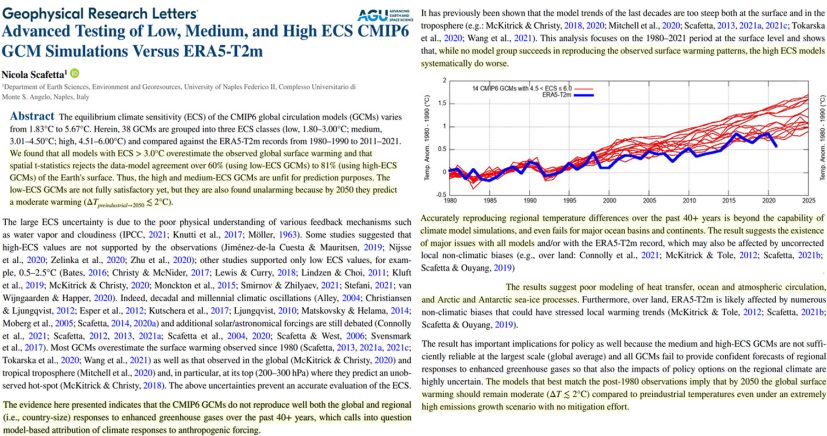
A new study published in Geophysical Research Letters highlights the abysmal model performance manifested in the latest Intergovernmental Panel on Climate Change report (AR6). The 38 CMIP6 general circulation models (GCMs) fail to adequately simulate even the most recent (1980-2021) warming patterns over 60 to 81% of the Earth’s surface.
Dr. Scafetta places particular emphasis on the poor performance of the highly uncertain estimates (somewhere between 1.83 and 5.67°C) of equilibrium climate sensitivity (ECS) and their data-model agreement relative to 1980-2021 global warming patterns.
The worst-performing ECS estimates are the ones projecting 3-4.5°C and 4.5-6°C warming in response to doubled CO2 concentrations (to 560 ppm) plus feedbacks, as the 1980-2021 temperature trends are nowhere close to aligning with these trajectories.
Instead, the projected global warming by 2050 (~2°C relative to 1750) associated with the lowest ECS estimates and implied by the warming observed over the last 40+ years is characterized as “unalarming” even with the most extreme greenhouse gas emissions (no mitigation efforts undertaken) growth rate.
In addition to the conclusion that “no model group succeeds reproducing observed surface warming patterns,” poor modeling of heat transfer physics, ocean and atmospheric circulation patterns, polar sea ice processes… is also evident in the latest IPCC report.
“Accurately reproducing regional temperature differences over the past 40+ years is beyond the capability of climate model simulations, and even fails for major ocean basins and continents.”
The fundamental modeling failures in simulating responses to sharply rising greenhouse gas emissions over the last 40+ years “calls into question model-based attribution of climate responses to anthropogenic forcing.”
Featured Video

Trita Parsi: Middle East Unraveling — Are We on the Path to World War?
or go to
Aletho News Archives – Video-Images
New Book
Trans agenda is ‘normalization of sadism’ – US author
RT | September 23, 2026
The US Democratic Party has embraced a transgender agenda that amounts to “the normalization of sadism,” author A.J. Rice has said, warning that radical trans policies would return if the party is allowed to regain power.
Speaking to RT’s America First host Scotty Nell Hughes about his new book, ‘The Curse of the Bearded Lady: How the Trans Mafia Whacked American Sanity’, Rice argued that activists have gained significant influence in schools, medicine, and corporate America while people who questioned the agenda have faced pressure to stay silent.
The author described the “trans mafia” as the sprawling network of people and institutions that have helped the movement gain influence. He singled out parts of academia, wealthy backers, and corporations, and stated that providers of transition-related treatment also have a financial incentive to keep young people in their care indefinitely.
Rice argued that the consequences of these policies ultimately fall on children who are being drawn toward gender-affirming medical treatments and on girls who are expected to share locker rooms or compete in sports with biological males.
He noted that while voters rejected the Democrats’ approach to gender in 2024, the party, which has been “captured by madness,” has since only doubled down and is seeking what is effectively “the normalization of sadism.” … Full report
Blog Roll
 Aletho News
- NATO chief wants Europeans to fight American wars [for Israel]
- German chemicals giant reveals details of downsizing
- Refaat Al-Areer Was The Canary In The Coal Mine In Israel’s War On The Truth
- Israeli election committee bars candidate from Knesset race over Gaza war opposition
- French-Lebanese man files war crimes complaint over Israeli attacks
- Mahan Air Flight Lands in China Despite US Threat against Iranian Airlines
- US eyes $10bn fund to rebuild war-battered Gulf infrastructure
- Trump meets Rodríguez near Maduro’s prison as Venezuela’s oil flows to US
- Trita Parsi: Middle East Unraveling — Are We on the Path to World War?
- Iran FM meets with US envoy on UN meeting’s sidelines at American side’s insistence: Report
- If Americans Knew
- Caught on Tape: AIPAC CEO Boasted of Controlling Trump’s National Security Officials
- Why Hamas Attacked Israel in October 2023 – Israeli professor Ilan Pappé
- They see them, then kill them: Israeli quadcopters track, deliberately target civilians in Gaza
- Winter could turn Gaza’s treacherous, war-damaged buildings into deathtraps
- Majority of Democratic Voters Want to Prosecute Both Biden and Trump Administration Officials Over Gaza
- As Gaza languishes, world leaders gather at the UN – Daily Update
- Sanctions are collective punishment: immoral and self-defeating
- Phosphorus Munitions Fired by Israel Burn Groves, Orchards in Southern Lebanon
- Israel Carries Out New Ceasefire Violations Across Gaza
- AI – Emphasis on the ‘I’: Israel Is Funding AI Chatbot Propaganda
- No Tricks Zone
- New Study: Earth And Venus Surface Warmth Largely Explained By Convection And Lapse Rate, Not CO2 Or Radiation
- 2025 Nature Paper Claiming Worsening Global Drought Gets RETRACTED …Heavily Flawed
- New Study: ‘Global Drought Shows No Detectable Recent Acceleration Under Climate Warming’
- Economic Masterminds: German Socialists Suggest Taxing Productivity Gains Stemming From Using AI
- The South China Sea Has Not Been Cooperating With The Climate Change Narrative
- Energy Crisis: Germany Enters Heating Season With Historically Low Gas Reserve Fill Levels
- New Study: The Antarctic Ice Sheet Gained Mass From 2020-2024 Due To Staggering Snow And Ice Accumulation
- Study: Ocean Heating Rates From Thousands Of Years Ago ‘Dwarf’ Modern Ocean Heating Rates
- Climate Extremists Target, Attack Large-Scale Power Grid Infrastructure In Germany!
- New Study: Antarctic Ice Melt Has Contributed Less Than 1 Centimeter To Sea Level Rise In The Last 30 Years

