Covid-19 cases decrease in Texas as governor’s ‘NEANDERTHAL THINKING’ apparently hasn’t caused a predicted virus catastrophe
RT | March 30, 2021
Nearly three weeks on from Texas ending its mask mandate and other Covid-19 measures – leading to Governor Greg Abbott being called a murderer by media and politicians – there’s no sign of the sky falling on the Lone Star State.
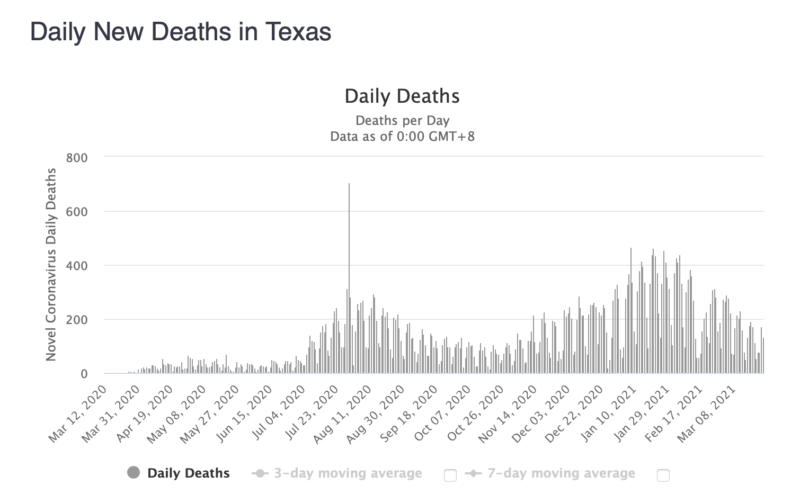
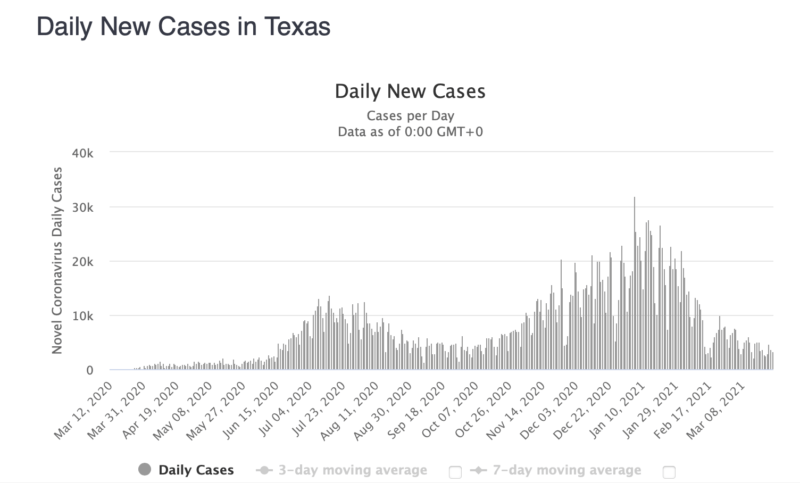
In fact, Texas just posted a record low in its rate of positive Covid-19 tests, at less than 5.3%, and hospitalizations are at the lowest level since last October. Deaths are at the lowest level in four months. Since March 2, the day Abbott announced that state Covid-19 restrictions would end the following week, the seven-day average for new infections has dropped 48%, to a nearly six-month low of 3,774.
No one is claiming that infections and other Covid-19 measures are down in Texas specifically because Abbott decided “we no longer need government running our lives,” but the absence of predicted catastrophe is providing a shining example for those who argue that states that keep their economies open fare just as well on pandemic performance as those that lock their people down and destroy livelihoods.
Texas, in fact, is seeing declines in Covid-19 cases just as New York and New Jersey – states with such draconian measures that business owners were literally taken to jail for refusing to obey – are once again suffering the highest infection rates in the country. New Jersey has seen a 37% surge in new cases in the past month, to 23,600 weekly.
The juxtaposition in statistics is clearly flipped the wrong way for President Joe Biden, who earlier accused Abbott and Mississippi Governor Tate Reeves of “Neanderthal thinking” for lifting their coronavirus restrictions, and other doomsayers. And by the way, Mississippi’s Covid-19 case rate is down 57% in the past month, to a seven-day average of 254.
Abbott set off a wave of Republican governors freeing their citizens from mask mandates, which Vanity Fair called a “bold plan to kill another 500,000 Americans.” Biden’s fellow Democrat, California Governor Gavin Newsom, called Abbott “absolutely reckless.” Mainstream media hero Dr. Anthony Fauci, chief medical adviser to Biden, called Abbott’s decision “inexplicable,” while author Kurt Eichenwald said it was “murderous.”
Texas Democratic Party Chairman Gilberto Hinojosa accused the governor of being “anti-human” and predicted that hospitals would be jammed with Covid patients.
That hasn’t happened so far, and Texas has posted 18 straight days of improving case numbers since the restrictions officially ended on March 10. But US mainstream media outlets have responded to the counter-narrative phenomenon mostly by ignoring it.
Instead of telling the Texas story, the New York Times breathlessly warned on Monday that case numbers in Republican-controlled Florida had ticked up 8% from two weeks ago, to nearly 5,000 infections a day. Hospitalizations and deaths remained down, the Times conceded, and the increase in cases paled in comparison to those in New York and New Jersey.
But the outlet warned that Florida is a “bellwether for the nation” and falsely said it was “furthest along in lifting restrictions.” Iowa and Montana lifted their restrictions in early February, and some GOP-led states didn’t have mask mandates to begin with.
And rather than rethinking the efficacy of tight Covid-19 mitigation measures, lockdown proponents suggest that the recent case increases in New York and New Jersey mean that their apparently ineffective rules need to be tougher. New York City Public Advocate Jumaane Williams urged Governor Andrew Cuomo to “stick to the science, trust the experts and pause planned reopenings now.” Biden said Monday that a national increase in Covid cases may stem from people “letting up on precautions.”
Twitter Censors Famed Epidemiologist Martin Kulldorff
By Jeffrey A. Tucker | AIER | March 29, 2021
We’ve been witness to Twitter censorship for more than a year, beginning with obviously objectionable extremists then gradually moving to silence people based on merely having an opinion that contradicts lockdown orthodoxy. There have been days when I wondered whether I would cross the invisible line and even whether AIER would itself be silenced. Stanford public health expert Scott Atlas has been censored, and Naomi Wolf, visiting senior fellow at AIER, was put in Twitter jail for a week for landing on the wrong side of the high priests of allowable content.
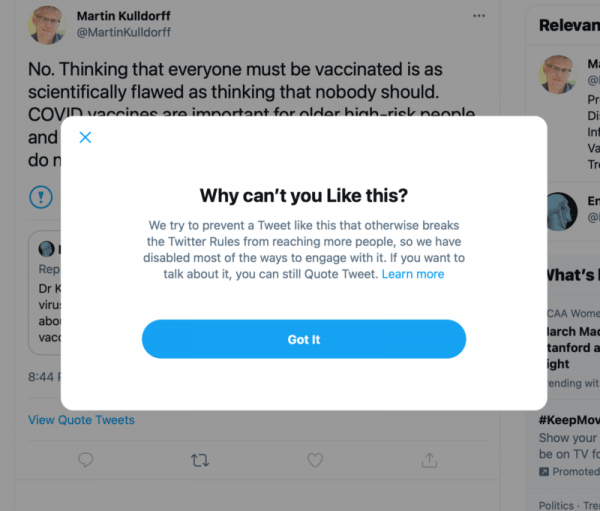
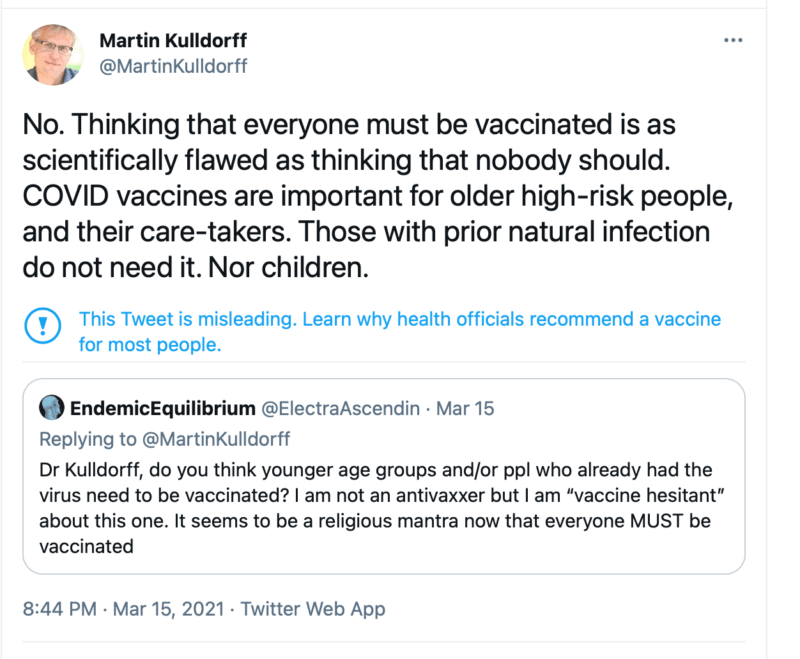
Well, a new line has been crossed. Harvard Professor Martin Kulldorff and co-creator of the Great Barrington Declaration, one of the most cited epidemiologists and infectious -disease experts in the world (latest count of citations: 25,290) has been censored by Twitter. His tweet on how not everyone needs a vaccine against SARS-CoV-2 was not taken down. He had a warning slapped on it and users have been prevented from liking or retweeting the post.
Here is what he wrote without the warning slapped in front of it.
Keep in mind, too, that Dr. Kulldorff serves on the Covid-19 vaccine safety subgroup that the CDC, NIH, and FDA rely upon for technical expertise on this very subject..

So here we have some geeks at Twitter curating science, in areas totally outside the specialization of web nerds, in a way that skews public understanding of the scientific debate. Dr. Kulldorff’s censorship directly coincides with Anthony Fauci making a political push to retain social distancing and mask restrictions and forced separation for children until they are vaccinated. He was all over Sunday TV shows doing that.
This attempt to silence accredited experts completely distorts the process of scientific inquiry, discovery, and public opinion. And to what end? Twitter has generally been biased in a lockdown direction. If you want to be cynical about it, you could observe that everyone who works there can get by on laptops and houseshoes for the duration.
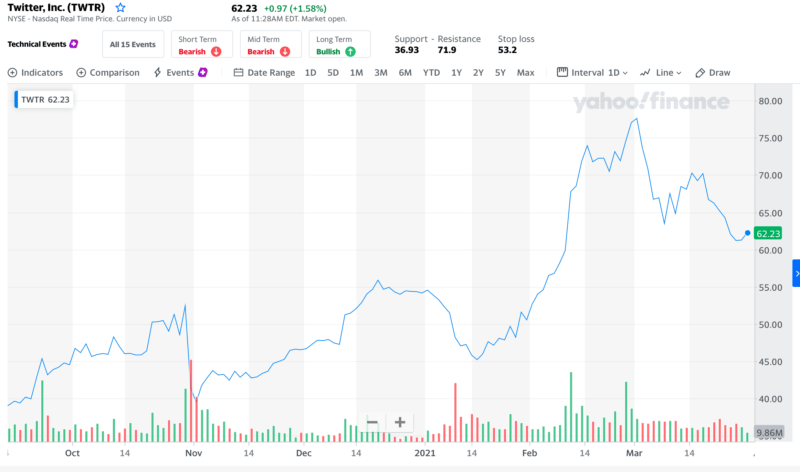
Its stock price has more than doubled in the course of lockdowns and user engagement has risen dramatically.
It would appear that with this latest act of censorship – we are not talking about political extremism or anything else that violates normal terms of use – we have entered into a new realm. Twitter is now curating the scientific debate in ways that exclude alternative points of view, particularly those that raise doubts about the need for universalized vaccines and vaccine passports. To be sure, Dr. Kulldorff is not an anti-vaxxer (why should I have to say that?) but instead has a nuanced position in light of his professional understanding of the demographics of risk of this virus.
If there ever was a troubling sign of the power and arrogance of big tech, of which I’ve long been a defender, this new action is it. Dr. Kulldorff has been a brave proponent of traditional public health in the midst of an unprecedented and very obviously failed policy of lockdowns. He has been a voice of clarity, reason, calm, and science. That Twitter would choose to use its power over public debate to silence his insights should be of profound concern to everyone concerned about the use of science in the public interest.
Dr. Paul Marik Discusses Ivermectin And Vitamin D
Drbeen Medical Lectures | February 17, 2021

Dr. Paul Marik Discusses Ivermectin and Vitamin D. Wikipedia tells us Dr Marik is “a professor of medicine and serves as Chief, Division of Pulmonary and Critical Care Medicine at Eastern Virginia Medical School. He is known for the vitamin C sepsis cocktail, which is under active multicenter clinical trial.”
Marik was lead author of a journal article on the efficacy of ivermectin as a COVID-19 treatment, which had been provisionally accepted for publication by a Frontiers Media journal in early 2021, but which was subsequently rejected on account of what the publisher said were “a series of strong, unsupported claims based on studies with insufficient statistical significance” meaning that the article did “not offer an objective [or] balanced scientific contribution to the evaluation of ivermectin as a potential treatment for COVID-19”.
More from Drbeen Medical Lectures at youtube
The “Unvaccinated” Question

By CJ Hopkins | Consent Factory | March 29, 2021
So, the New Normals are discussing the Unvaccinated Question. What is to be done with us? No, not those who haven’t been “vaccinated” yet. Us. The “Covidiots.” The “Covid deniers.” The “science deniers.” The “reality deniers.” Those who refuse to get “vaccinated,” ever.
There is no place for us in New Normal society. The New Normals know this and so do we. To them, we are a suspicious, alien tribe of people. We do not share their ideological beliefs. We do not perform their loyalty rituals, or we do so only grudgingly, because they force us to do so. We traffic in arcane “conspiracy theories,” like “pre-March-2020 science,” “natural herd immunity,” “population-adjusted death rates,” “Sweden,” “Florida,” and other heresies.
They do not trust us. We are strangers among them. They suspect we feel superior to them. They believe we are conspiring against them, that we want to deceive them, confuse them, cheat them, pervert their culture, abuse their children, contaminate their precious bodily fluids, and perpetrate God knows what other horrors.
So they are discussing the need to segregate us, how to segregate us, when to segregate us, in order to protect society from us. In their eyes, we are no more than criminals, or, worse, a plague, an infestation. In the words of someone (I can’t quite recall who), “getting rid of the Unvaccinated is not a question of ideology. It is a question of cleanliness,” or something like that. (I’ll have to hunt down and fact-check that quote. I might have taken it out of context.)
In Israel, Estonia, Denmark, Germany, the USA, and other New Normal countries, they have already begun the segregation process. In the UK, it’s just a matter of time. The WEF, WHO, EU, and other transnational entities are helping to streamline the new segregation system, which, according to the WEF, “will need to be harmonized by a normative body, such as the WHO, to ensure that is ethical.”
Here in Germany, the government is considering banning us from working outside our homes. We are already banned from flying on commercial airlines. (We can still use the trains, if we dress up like New Normals.) In the village of Potsdam, just down the road from Wannsee (which name you might recall from your 20th-Century history lessons), we are banned from entering shops and restaurants. (I’m not sure whether we can still use the sidewalks, or whether we have to walk in the gutters.) In Saxony, we are forbidden from attending schools. At the Berliner Ensemble (the theater founded by Bertolt Brecht and Helene Weigel, lifelong opponents of totalitarianism and fascism), we are banned from attending New Normal performances.
In the USA, we are being banned by universities. Our children are being banned from public schools. In New York, the new “Excelsior Pass” will allow New Normals to attend cultural and sports events (and patronize bars and restaurants, eventually) secure in the knowledge that the Unvaccinated have been prevented from entering or segregated in an “Unvaccinated Only” section. The pass system, designed by IBM, which, if history is any guide, is pretty good at designing such systems (OK, technically, it was Deutsche Hollerith Maschinen Gesellschaft, IBM’s Nazi-Germany subsidiary), was launched this past weekend to considerable fanfare.
And this is only the very beginning.
Israel’s “Green Pass” is the model for the future, which makes sense, in a sick, fascistic kind of way. When you’re already an apartheid state, what’s a little more apartheid? Here’s a peek at what that looks like …

OK, I know what the New Normals are thinking. They’re thinking I’m “misleading” people again. That I’m exaggerating. That this isn’t really segregation, and certainly nothing like “medical apartheid.”
After all (as the New Normals will sternly remind me), no one is forcing us to get “vaccinated.” If we choose not to, or can’t for medical reasons, all we have to do is submit to a “test” — you know, the one where they ram that 9-inch swab up into your sinus cavities — within 24 hours before we want to go out to dinner, or attend the theater or a sports event, or visit a museum, or attend a university, or take our children to school or a playground, and our test results will serve as our “vaccine passports!” We just present them to the appropriate Covid Compliance Officer, and (assuming the results are negative, of course) we will be allowed to take part in New Normal society just as if we’d been “vaccinated.”
Either way, “vaccine” or “test,” the New Normal officials will be satisfied, because the tests and passes are really just stage props. The point is the display of mindless obedience. Even if you take the New Normals at their word, if you are under 65 and in relatively good health, getting “vaccinated” is more or less pointless, except as a public display of compliance and belief in the official Covid-19 narrative (the foundation stone of the New Normal ideology). Even the high priests of their “Science” confess that it doesn’t prevent you spreading the “plague.” And the PCR tests are virtually meaningless, as even the WHO finally admitted. (You can positive-PCR-test a pawpaw fruit … but you might want to be careful who you tell if you do that.)
In contrast to the “vaccine” and the “test” themselves, the forced choice between them is not at all meaningless. It is no accident that both alternatives involve the violation of our bodies, literally the penetration of our bodies. It doesn’t really matter what is in the “vaccines” or what “results” the “tests” produce. The ritual is a demonstration of power, the power of the New Normals (i.e., global capitalism’s new face) to control our bodies, to dominate them, to violate them, psychologically and physically.
Now, don’t get all excited, my “conspiracy theorist” friends. I haven’t gone full QAnon just yet. Bill Gates and Klaus Schwab are not sitting around together, sipping adrenochrome on George Soros’ yacht, dreaming up ways to rape people’s noses. This stuff is built into the structure of the system. It is a standard feature of totalitarian societies, cults, churches, self-help groups, and … well, human society, generally.
Being forced to repeat a physical action which only makes sense within a specific ideology reifies that ideology within us. There is nothing inherently diabolical about this. It is a basic socialization technology. It is how we socialize our children. It is why we conduct weddings, baptisms, and bar mitzvahs. It is how we turn young men and women into soldiers. It is how actors learn their blocking and their lines. It is why the Nazis held all those rallies. It is why our “democracies” hold elections. It is also basic ceremonial magic … but that’s a topic for a different column.
The issue, at the moment, is the Unvaccinated Question, and the public rituals that are being performed to make the New Normal ideology “reality,” and what to do about those of us who refuse to participate in those rituals, who refuse to forswear “old normal” reality and convert to New Normalism so that we can function in society without being segregated, criminalized, or “diagnosed” as “sociopathic” or otherwise psychiatrically disordered.
For us “conspiracy-theorizing reality deniers,” there is no getting around this dilemma. This isn’t Europe in the 1930s. There isn’t anywhere to emigrate to … OK, there is, temporarily, in some of the US states that have been staging rebellions, and other such “old normal” oases, but how long do you think that will last? They’re already rolling out the “mutant variants,” and God only knows what will happen when the long-term effects of the “vaccines” kick in.
No, for most of us denizens of the global capitalist empire, it looks like the New Normal is here to stay. So, unless we are prepared to become New Normals, we are going to have to stand and fight. It is going to get rather ugly, and personal, but there isn’t any way to avoid that. Given that many New Normals are our friends and colleagues, or even members of our families, it is tempting to believe that they will “come to their senses,” that “this is all just a hysterical overreaction,” and that “everything will go back to normal soon.”
This would be a monumental error on our parts … very possibly a fatal error.
Totalitarian movements, when they reach this stage, do not simply stop on their own. They continue to advance toward their full expressions, ultimately transforming entire societies into monstrous mirror-images of themselves, unless they are opposed by serious resistance. There is a window at the beginning when such resistance has a chance. That window is still open, but it is closing, fast. I can’t tell you how best to resist, but I can tell you it starts with seeing things clearly, and calling things, and people, exactly what they are.
Let’s not make the same mistake that other minorities have made throughout history when confronted with a new totalitarian ideology. See the New Normals for what they are, maybe not deep down in their hearts, but what they have collectively become a part of, because it is the movement that is in control now, not the rational individuals they used to be. Above all, recognize where this is headed, where totalitarian movements are always headed. (See. e.g., Milton Mayer’s They Thought They Were Free: The Germans 1933-45.)
No, the Unvaccinated are not the Jews and the New Normals are not flying big Swastika flags, but totalitarianism is totalitarianism, regardless of which Goebbelsian Big Lies, and ideology, and official enemies it is selling. The historical context and costumes change, but its ruthless trajectory remains the same.
Today, the New Normals are presenting us with a “choice,” (a) conform to their New Normal ideology or (b) social segregation. What do you imagine they have planned for us tomorrow?
#
UK Now Considering Digital Face Scanning to Enter Pubs
By Paul Joseph Watson | Summit News | March 29, 2021
The UK government is funding companies that are producing technology which will utilize digital face scans to check people’s vaccination status and allow or block them from entering pubs, stadiums and other venues.
“Britons could have their faces scanned to allow them to access pubs, gigs and sports events under one government-funded plan being drawn up for vaccine passports,” reports the London Times.
Two companies – Mvine and iProov – are working together on the system after being given a £75,000 grant by the government having already worked with the NHS on facial recognition technology in the form of the contact tracing app.
The technology is being proposed as a solution to concerns that presenting vaccination status via an app on a phone will be too slow when multiple people are entering a busy venue.
“Whoever is standing on the door of the pub is going to have to scan the certificate, read the name and date of birth, then ask the person for an ID document, check that the name and date of birth on the ID document are the same, squint at the photograph on the ID document and then make sure that the person in front of them is that person,” iProov CEO Andrew Bud said. “To which the answer is, that’s not going to happen.”
Bud said that the facial recognition system would reduce this process to a matter of seconds, streamlining the system.
“It speeds the process up and it absolves people of what would otherwise be a very heavy responsibility,” he added.
After months of promising that there would be no domestic vaccine passport, every indication is now that the government is going ahead with it.
Millions of Brits will refuse to submit to digital face scans to go about their everyday business, but the vast majority are likely to accept it without question, creating a two tier society where those who resist the biosecurity surveillance state will remain in a de facto permanent state of lockdown.
This again underscores the fact that the ‘vaccine passport’ is a digital identity card that citizens will be expected to carry at all times and use whenever they want to engage in basic commerce or other normal leisure activity.
Study: U.S. Media’s Covid Coverage Slants Heavily Negative
Mainstream outlets stoke fear while shielding us from encouraging facts
By Brian McGlinchey | March 27, 2021
If you’ve felt the media has heavily emphasized bad news throughout the Covid-19 pandemic, your judgment now has some scholarly corroboration.
Dartmouth College and Brown University researchers have analyzed tens of thousands of Covid-19 articles and found major U.S. media outlets have overwhelmingly pushed negative narratives about the virus.
“The most striking fact is that 87 percent of the U.S. stories are classified as negative, whereas 51 percent of the non-U.S. stories are classified as negative,” according to the study by Dartmouth economics professor Bruce Sacerdote, Dartmouth’s Ranjan Sehgal and Brown University’s Molly Cook.
Thwarting Public Clarity About Covid-19
Though the study doesn’t delve deep into the societal implications, there’s little doubt excessive media negativity has contributed to public misunderstanding of the nature of the disease and the risk it poses to various segments of society.
Consider one of the study’s most glaring findings: Even when Covid-19 cases were falling nationally between April 24 and June 27, major media discussed rising caseloads 5.3 times as frequently as falling ones.
The impact was evident: A June CBS News poll found a record number of Americans felt the fight against coronavirus was going badly. Of course, news of the poll was itself another negative story, feeding a media-facilitated vicious circle of fear.
In July, a Franklin Templeton-Gallup poll found Americans had a poor understanding of the risk of Covid-19 death for different age cohorts:
- Participants said people aged 55+ accounted for a little over half of the deaths, when the actual share was 92%.
- Those under age 25 accounted for just 0.2% of deaths—participants overestimated the share by a factor of 50.
The results aren’t surprising, given the media’s compulsion to accentuate rare occasions when teens and twentysomethings fall victim to the virus.
In June, CNN served up a particularly flagrant example of Covid scaremongering: an article titled “Healthy teenager who took precautions died suddenly of Covid-19.”
The many who skimmed the headline received an anecdotal infusion of fearful misinformation. The minority who made it to the tenth paragraph would finally learn that doctors treating the purportedly “healthy” yet visibly obese teen found he had Type 1 diabetes with a blood sugar level 10 times the norm.
Two months earlier, the Centers for Disease Control announced that about 90% of those hospitalized with the virus had one or more underlying conditions. Among the most common were obesity (48%) and diabetes (28%). Rather than using this teen’s grim story to enlighten the public about who is at greatest risk, CNN aggressively pushed a perception that nobody is safe.
The media’s failure to foster understanding of Covid-19 also seems evident in the many people still seen wearing masks while alone outdoors. According to Dr. Muge Cevik, an infectious diseases and virology scientist at the University of St Andrews, “outdoor risk is negligible unless it involves close interaction or you are in a crowded or semi-outdoor environment.”
Perceptions of the Virus Influence Policy Opinions
Overly-negative Covid-19 reporting has implications well beyond individual feelings and practices: Those who’ve been led to an exaggerated perception of their personal risk are more prone to support strict government policies to counter the virus.
A recent Pew Research poll confirms that individuals’ perception of the pandemic heavily influences their opinions about various government interventions.
For example, Pew asked if limiting restaurants to carry-out service has been necessary to counter the virus. Among those who think Covid-19 represents a minor threat to the U.S. population, 21% agreed. Support soared to 66% among those who deem the virus a major threat.
Many are likely opining from a position of ignorance: How many know that a New York contact tracing study attributed less than 2% of Covid-19 case transmission to bars and restaurants?
Negative About Positives
The Dartmouth and Brown researchers found “the negativity of the U.S. major media is notable even in areas with positive developments, including school re-openings and vaccine trials.”
When schools reopen to in-person teaching—a move validated by the experience of European schools—U.S. media has been quick on the scene with a wet blanket: The study found 86% of mainstream media articles about school reopenings are negative.
The easing of government restrictions reliably attracts negative media. Iowa governor Kim Reynolds’s lifting of the state’s mask mandate in early February sparked a wave of negative reporting and opinion pieces, including a Washington Post piece that was actually titled “Welcome to Iowa: a state that doesn’t care if you live or die.”
In September, similar derision was heaped on Florida governor Ron DeSantis when he lifted major statewide restrictions.
However, when neither Florida nor Iowa experienced negative consequences, there was little media reporting of the good news that government restrictions and mandates may not be worthwhile after all.
We see a similar pattern with the media’s never-ending cycle of warning that various holidays and special events will bring a surge in contagion. From Thanksgiving to Christmas to the Super Bowl and spring break, we’re constantly presented headlines stoking fears these occasions will cause major virus spikes.
When predicted surges don’t happen, the media gives little attention to the happy news that their alarms proved false. Instead, they’re apparently hard at work drafting warnings about whatever’s next on the calendar.
It’s as if mainstream journalists feel duty-bound to stoke Covid-19 fear, while paternalistically shielding us from welcome facts that could lead us to “let our guard down.” In doing so, they negligently disregard the collateral harm they do to mental health and our quality of life.
Hope for Greater Media Balance?
The Dartmouth-Brown study on U.S. media negativity prompted The New York Times’ David Leonhardt to call for introspection: “If we’re constantly telling a negative story, we are not giving our audience the most accurate portrait of reality. We are shading it.”
That’s a welcome acknowledgment: Until recently, Leonhardt’s own Times email newsletter has mirrored the negative slant found across U.S. media.
There are hints of a growing balance. For example, in recent weeks, major outlets have finally started acknowledging that Florida’s post-reopening experience conflicts with the media-reinforced notion that shutdowns are an essential strategy.
Concluding his review of the study, Leonhardt expressed gratitude to researchers Sacerdote, Cook and Sehgal for “holding up a mirror to our work and giving us a chance to do better.” Let’s hope his sentiment proves highly contagious.
Another Climate Scientist With Impeccable Credentials Breaks Ranks
“Our models are MICKEY-MOUSE mockeries of the real world”
Dr. Mototaka Nakamura received a Doctorate of Science from the Massachusetts Institute of Technology (MIT), and for nearly 25 years specialized in abnormal weather and climate change at prestigious institutions that included MIT, Georgia Institute of Technology, NASA, Jet Propulsion Laboratory, California Institute of Technology, JAMSTEC and Duke University.
In his book The Global Warming Hypothesis is an Unproven Hypothesis, Dr. Nakamura explains why the data foundation underpinning global warming science is “untrustworthy” and cannot be relied on:
“Global mean temperatures before 1980 are based on untrustworthy data,” writes Nakamura. “Before full planet surface observation by satellite began in 1980, only a small part of the Earth had been observed for temperatures with only a certain amount of accuracy and frequency. Across the globe, only North America and Western Europe have trustworthy temperature data dating back to the 19th century.”
From 1990 to 2014, Nakamura worked on cloud dynamics and forces mixing atmospheric and ocean flows on medium to planetary scales. His bases were MIT (for a Doctor of Science in meteorology), Georgia Institute of Technology, Goddard Space Flight Center, Jet Propulsion Laboratory, Duke and Hawaii Universities and the Japan Agency for Marine-Earth Science and Technology.
He’s published 20+ climate papers on fluid dynamics.
There is no questioning his credibility or knowledge.
Today’s ‘global warming science’ is akin to an upside down pyramid which is built on the work of a few climate modelers. These AGW pioneers claim to have demonstrated human-derived CO2 emissions as the cause of recently rising temperatures and have then simply projected that warming forward. Every climate researcher thereafter has taken the results of these original models as a given, and we’re even at the stage now where merely testing their validity is regarded as heresy.
Here in Nakamura, we have a highly qualified and experienced climate modeler with impeccable credentials rejecting the unscientific bases of the climate crisis claims. But he’s up against it — activists are winning at the moment, and they’re fronted by scared, crying children; an unstoppable combination, one that’s tricky to discredit without looking like a heartless bastard (I’ve tried).

Climate scientist Dr. Mototaka Nakamura’s recent book blasts global warming data as “untrustworthy” and “falsified”.
DATA FALSIFICATION
When arguing against global warming, the hardest thing I find is convincing people of data falsification, namely temperature fudging. If you don’t pick your words carefully, forget some of the facts, or get your tone wrong then it’s very easy to sound like a conspiracy crank (I’ve been there, too).
But now we have Nakamura.
The good doctor has accused the orthodox scientists of “data falsification” in the form adjusting historical temperature data down to inflate today’s subtle warming trend — something Tony Heller has been proving for years on his website realclimatescience.com.
Nakamura writes: “The global surface mean temperature-change data no longer have any scientific value and are nothing except a propaganda tool to the public.”
The climate models are useful tools for academic studies, he admits. However: “The models just become useless pieces of junk or worse (as they can produce gravely misleading output) when they are used for climate forecasting.”
Climate forecasting is simply not possible, Nakamura concludes, and the impacts of human-caused CO2 can’t be judged with the knowledge and technology we currently possess.
The models grossly simplify the way the climate works.
As well as ignoring the sun, they also drastically simplify large and small-scale ocean dynamics, aerosol changes that generate clouds (cloud cover is one of the key factors determining whether we have global warming or global cooling), the drivers of ice-albedo: “Without a reasonably accurate representation, it is impossible to make any meaningful predictions of climate variations and changes in the middle and high latitudes and thus the entire planet,” and water vapor.
The climate forecasts also suffer from arbitrary “tunings” of key parameters that are simply not understood.
NAKAMURA ON CO2
He writes: “The real or realistically-simulated climate system is far more complex than an absurdly simple system simulated by the toys that have been used for climate predictions to date, and will be insurmountably difficult for those naive climate researchers who have zero or very limited understanding of geophysical fluid dynamics. The dynamics of the atmosphere and oceans are absolutely critical facets of the climate system if one hopes to ever make any meaningful prediction of climate variation.”
Solar input is modeled as a “never changing quantity,” which is absurd.
“It has only been several decades since we acquired an ability to accurately monitor the incoming solar energy. In these several decades only, it has varied by one to two watts per square meter. Is it reasonable to assume that it will not vary any more than that in the next hundred years or longer for forecasting purposes? I would say, No.”
You can read Mototaka Nakamura’s book for free on Kindle. Arm yourself with the facts, and then spread them — facts such as those highlighted below (all lifted from the book):
“[The models have] no understanding of cloud formation/forcing.”
“Assumptions are made, then adjustments are made to support a narrative.”
“Our models are mickey-mouse mockeries of the real world.”
SOLAR FORCING
Solar output isn’t constant, IPCC. And the modulation of cloud nucleation is a key consequence. During solar minima, like the one we’re entering now, the sun’s magnetic field weakens and the outward pressure of the solar wind decreases. This allows more Cosmic Rays from deep space to penetrate our planet’s atmosphere. These CRs have been found to nucleate clouds (Svensmark et al). And clouds are a crucial player earth’s climate.
As Roy Spencer, PhD. eloquently writes:
“Clouds are the Earth’s sunshade, and if cloud cover changes for any reason, you have global warming — or global cooling.”
The COLD TIMES are returning, the mid-latitudes are REFREEZING in line with historically low solar activity, cloud-nucleating Cosmic Rays, and a meridional jet stream flow.
Both NOAA and NASA appear to agree, if you read between the lines, with NOAA saying we’re entering a ‘full-blown’ Grand Solar Minimum in the late-2020s, and NASA seeing this upcoming solar cycle (25) as “the weakest of the past 200 years”, with the agency correlating previous solar shutdowns to prolonged periods of global cooling here.
Furthermore, we can’t ignore the slew of new scientific papers stating the immense impact The Beaufort Gyre could have on the Gulf Stream, and therefore the climate overall.


Matt Hancock’s UK Health Security Agency would be the worst April Fool’s ever – except he isn’t joking
By Neil Clark | RT | March 27, 2021
The UK Health Secretary confirmed this week that a new ‘UK Health Security Agency’ was being set up on April 1, thus marking the next stage in Britain’s transformation into a repressive bio-security state.
Back in 1957, the BBC’s flagship current affairs programme Panorama (well, it was then) showed a short three-minute film of a family in Switzerland harvesting spaghetti from a family ‘spaghetti tree.’ People rang up the BBC switchboard afterwards for advice on growing their own spaghetti. They should have paid closer attention to the date of the broadcast. The first of April. Yes, it was an ‘April Fool.’ One of the best in history.
The first of April is also the date that the UK’s new ‘Health Security Agency’ is being established but this time it really is no laughing matter. If only Matt Hancock was joking when he said he was setting up a “dedicated, mission-driven national institution for health security.” But, unlike his namesake, the great comedian Tony Hancock, Matt isn’t remotely funny. The establishment of the UKHSA should give us all sleepless nights. It’s actually more terrifying than the scariest Hammer horror movie. Well, Hancock’s video announcing the news was, at any rate.
The new agency –which Britain needs right now as much as a hole in the head– brings together the work of Public Health England, NHS Test and Trace and the Joint BioSecurity Centre.
Hancock says the body will be mission driven, but what will be the mission?
“I want everybody at UKHSA, at all levels, to wake up every day with a zeal to plan for the next pandemic.”
Yes, that’s right. We’re at the tail end of Covid – but it’s time to plan for the next Covid to come along. Has a government agenda ever been so transparent? Of course, Hancock is only echoing Bill Gates when he talks about the ‘next pandemic’. Back in January the software multi-billionaire, who has been able to gain so much influence with his foundation’s funding of academics, scientists and public health organisations, outlined his strategy for dealing with the ‘next pandemic,’ which, he warns, could be “ten times more serious” than Covid. And, guess what, his strategy calls for “mega-diagnostic platforms,” mass vaccinations and governments spending lots of taxpayers’ money.
Compare Gates’ proposals with what Hancock says and the new “Securing Our Health” webpage introducing the UKHSA and you can see quite clearly where the ‘inspiration’ for all this is coming from. Hancock, as he’s done throughout 2020 and 2021, is following a global script.
As I highlighted in a recent OpEd, the ‘War on Covid’ is the new ‘War on Terror.’ Civil liberties were stripped away, post 9-11, in the ‘War on Terror’ and now we have the latest phase of the project. Like the War on Terror, the War on Covid/War on Viruses is never meant to end. In fact we don’t really need new viruses to come along. Covid variants will work quite nicely, if Gates’ ‘ten times more serious’ virus is delayed in traffic.
In a piece for Bloomberg this week entitled ‘We Must Start Planning for a Permanent Pandemic,’ Andreas Kluth spelt it out very clearly for those who still don’t get it: “For the past year, an assumption –sometimes explicit, often tacit– has informed almost all our thinking about the pandemic: At some point, it will be over, and then we’ll go “back to normal. This premise is almost certainly wrong. SARS-CoV-2, protean and elusive as it is, may become our permanent enemy, like the flu but worse.”
The establishment of the UKHSA at a time when deaths with Covid have dropped to low numbers is a clear sign that the UK government plans no ‘back to normal.’ Perhaps the scariest sentence in the UKHSA policy paper is “We need to consider how best to engage with citizens and drive behaviour change in the 21st century.”
What ‘behaviour change’ can that be, I wonder? Requiring people to wear face masks and maintain ‘social distance’ from one another permanently? Don’t forget Home Secretary Priti Patel declared last May that social distancing was ‘here to stay.’
Many thought she misspoke, but ten months later and ‘social distancing’ is still here.
Then there’s the list of the new agency’s five core functions. Number One, again with echoes of the ‘War on Terror,’ is “Prevent.” This means “Anticipating and taking action to mitigate infectious diseases and other hazards to health before they materialise, for example through vaccination and influencing behaviour.”
Yes, you read that right. “BEFORE they materialise.” We will need to be vaccinated against viruses and hazards to health that haven’t yet materialised! What a bonanza for Big Pharma that would be!
Hancock’s announcement comes in the same week as Boris Johnson – the dishevelled charlatan who promoted himself as a ‘libertarian’ to get elected but who’s turned out to be the most dictatorial prime minister in our history – saying that pubs could require Vaccine Passports, once everyone had been offered a vaccine.
With us still in lockdown, and the Coronavirus Act extended for a further six months, the architecture for permanent digital slavery is being constructed – and it’s all being done under the guise of ‘protecting’ us. But who will protect us from our protectors? That really is the question we should all be asking.
Neil Clark is a journalist, writer, broadcaster and blogger. His award winning blog can be found at http://www.neilclark66.blogspot.com.
Why Is Everyone in Texas Not Dying?
By Jeffrey A. Tucker | AIER | March 26, 2021
I’m sitting at a bar in Texas, surrounded by maskless people, looking at folks on the streets walking around like life is normal, talking with nice and friendly faces, feeling like things in the world are more-or-less normal. Cases and deaths attributed to Covid are, like everywhere else, falling dramatically.
If you pay attention only to the media fear campaigns, you would find this confusing. More than two weeks ago, the governor of Texas completely reversed his devastating lockdown policies and repealed all his emergency powers, along with the egregious attacks on rights and liberties.
There was something very un-Texan about those lockdowns. My hotel room is festooned with pictures of cowboys on horses waving guns in the air, along with other depictions of rugged individualism facing down the elements. It’s a caricature but Texans embrace it. Then a new virus came along – as if that had never happened before in Texas – and the new Zoom class took the opposite path, not freedom but imposition and control.
After nearly a year of nonsense, on March 2, 2021, the governor finally said enough is enough and repealed it all. Towns and cities can still engage in Covid-related mischief but at least they are no longer getting cover from the governor’s office.
At that moment, a friend remarked to me that this would be the test we have been waiting for. A complete repeal of restrictions would lead to mass death, they said. Would it? Did the lockdowns really control the virus? We would soon find out, he theorized.
I knew better. The “test” of whether and to what extent lockdowns control the virus or “suppress outbreaks” (in Anthony Fauci’s words) has been tried all over the world. Every serious empirical examination has shown that the answer is no.
The US has many examples of open states that have generally had better performance in managing the disease than those states that are closed. Georgia already opened on April 24, 2020. South Dakota never shut down. South Carolina opened in May. Florida ended all restrictions in September. In every case, the press howled about the coming slaughter that did not happen. Yes, each open state experienced a seasonality wave in winter but so did the lockdown states.
So it was in Texas. Thanks to this Twitter thread, and some of my own googling, we have a nice archive of predictions about what would happen if Texas opened.
- California Governor Gavin Newsom said that opening Texas was “absolutely reckless.”
- Gregg Popovich, head coach of the NBA San Antonio Spurs, said opening was “ridiculous” and “ignorant.”
- CNN quoted an ICU nurse saying “I’m scared of what this is going to look like.”
- Vanity Fair went over the top with this headline: “Republican Governors Celebrate COVID Anniversary With Bold Plan to Kill Another 500,000 Americans.”
- There was the inevitable Dr. Fauci: “It just is inexplicable why you would want to pull back now.”
- Robert Francis “Beto” O’Rourke of Texas revealed himself to be a full-blown lockdowner: It’s a “big mistake,” he said. “It’s hard to escape the conclusion that it’s also a cult of death.” He accused the governor of “sacrificing the lives of our fellow Texans … for political gain.”
- James Hamblin, a doctor and writer for the Atlantic, said in a Tweet liked by 20K people: “Ending precautions now is like entering the last miles of a marathon and taking off your shoes and eating several hot dogs.”
- Bestselling author Kurt Eichenwald flipped out: “Goddamn. Texas already has FIVE variants that have turned up: Britain, South Africa, Brazil, New York & CA. The NY and CA variants could weaken vaccine effectiveness. And now idiot @GregAbbott_TX throws open the state.” He further called the government “murderous.”
- Epidemiologist Whitney Robinson wrote: “I feel genuinely sad. There are people who are going to get sick and die bc of avoidable infections they get in the next few weeks. It’s demoralizing.”
- Pundit Bill Kristol (I had no idea that he was a lockdowner) wrote: “Gov. Abbott is going to be responsible for more avoidable COVID hospitalizations and deaths than all the undocumented immigrants coming across the Texas border put together.”
- Health pundit Bob Wachter said the decision to open was “unforgivable.”
- Virus guru Michael Osterholm told CNN: “We’re walking into the mouth of the monster. We simply are.”
- Joe Biden famously said that the Texas decision to open reflected “Neanderthal thinking.”
- Nutritionist Eric Feigl-Ding said that the decision makes him want to “vomit so bad.”
- The chairman of the state’s Democratic Party said: “What Abbott is doing is extraordinarily dangerous. This will kill Texans. Our country’s infectious-disease specialists have warned that we should not put our guard down, even as we make progress towards vaccinations. Abbott doesn’t care.”
- Other state Democrats said in a letter that the decision was “premature and harmful.”
- The CDC’s Rochelle Walensky didn’t mince words: “Please hear me clearly: At this level of cases with variants spreading, we stand to completely lose the hard-earned ground we have gained. I am really worried about reports that more states are rolling back the exact public health measures we have recommended to protect people from COVID-19.”
There are probably hundreds more such warnings, predictions, and demands, all stated with absolute certainty that basic social and market functioning is a terrible idea. The lockdown lobby was out in full force. And yet what do we see now more than two weeks out (and arguably the lockdowns died on March 2, when the government announced the decision)?
Here are the data.
The CDC has a very helpful tool that allows anyone to compare open vs closed states. The results are devastating for those who believe that lockdowns are the way to control a virus. In this chart we compare closed states Massachusetts and California with open states Georgia, Florida, Texas, and South Carolina.
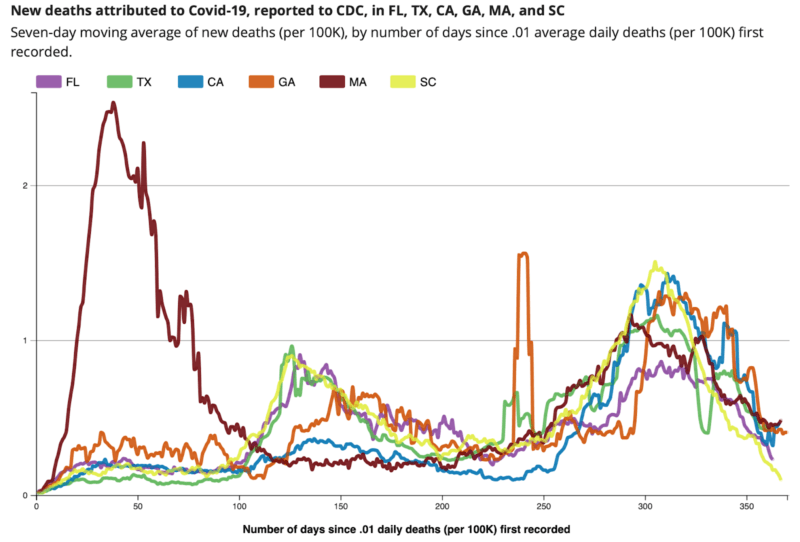
What can we conclude from such a visualization? It suggests that the lockdowns have had no statistically observable effect on the virus trajectory and resulting severe outcomes. The open states have generally performed better, perhaps not because they are open but simply for reasons of demographics and seasonality. The closed states seem not to have achieved anything in terms of mitigation.
On the other hand, the lockdowns destroyed industries, schools, churches, liberties and lives, demoralizing the population and robbing people of essential rights. All in the name of safety from a virus that did its work in any case.
As for Texas, the results so far are in.
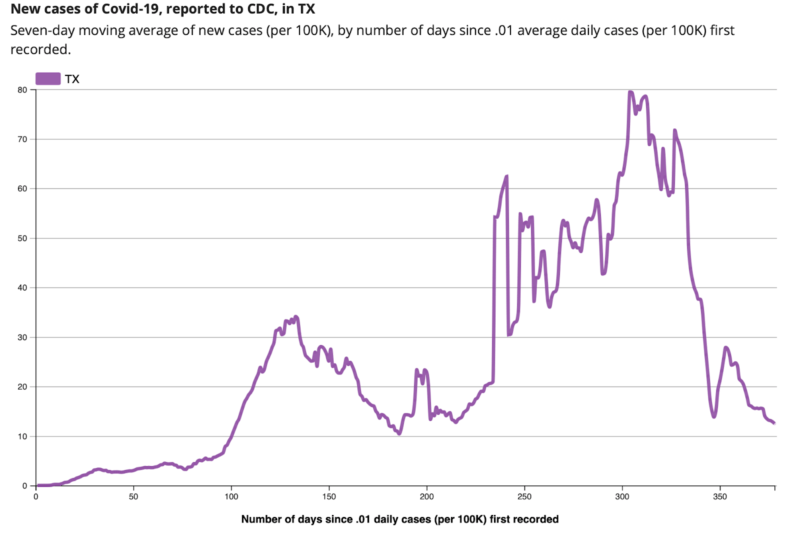
I’m making no predictions about the future path of the virus in Texas. Indeed for a full year, AIER has been careful about not trying to outguess this virus, which has its own ways, some predictable and some mysterious. The experience has, or should have, humbled everyone. Political arrangements seem to have no power to control it, much less finally suppress it. The belief that it was possible to control people in order to control a virus produced a calamity unprecedented in modern times.
What’s striking about all the above predictions of infections and deaths is not just that they were all wrong. It’s the arrogance and confidence behind each of them. After a full year and directly observing the inability of “nonpharmaceutical interventions” to manage the pathogen, the experts are still wedded to their beloved lockdowns, unable or unwilling to look at the data and learn anything from them.
The concept of lockdowns stemmed from a faulty premise: that you can separate humans, like rats in cages, and therefore control and even eradicate the virus. After a year, we unequivocally know this not to be true, something that the best and wisest epidemiologists knew all along. Essential workers still must work; they must go home to their families, many in crowded living conditions. Lockdowns do not eliminate the virus, they merely shift the burden onto the working class.
Now we can see the failure in black, white, and full color, daily appearing on our screens courtesy of the CDC. Has that shaken the pro-lockdown pundit class? Not that much. What an amazing testament to the stubbornness of elite opinion and its bias against basic freedoms. They might all echo the words of Groucho Marx: “Who are you going to believe, me or your own eyes?”
Not quite convinced about the vaccine? Neither is this guy
Self Reliance Central | March 27, 2021
Dr. Yeadon is cynical about the vaccine, especially for women of child-bearing years. He believes there was no need for a vaccine at all. As he was Pfizer’s former Vice President and Chief Scientist for Allergy & Respiratory we should probably listen to him. This is what he said this week. Obviously, he is being painted as a lunatic. But given his pedigree I stop to listen when he speaks.
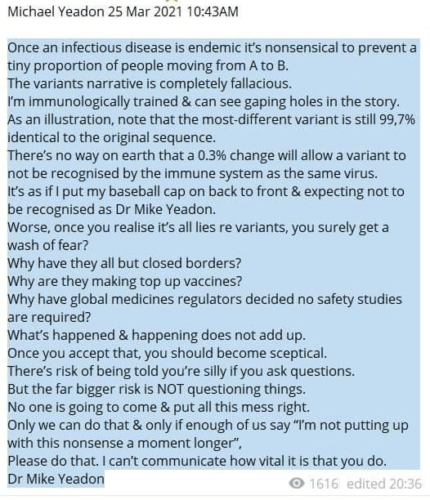
If you want to listen to an amazing podcast with Dr Yeadon go here to my friend James Delingpole’s podcast. James has an informal technique so you may have to hang on for a few minutes while they get the chit-chat out of the way (although it’s interesting if you like cool facts about WWII!)
https://www.reuters.com/investigates/special-report/health-coronavirus-vaccines-skeptic/
Featured Video

AIDS Inc. by Gary Null (2007)
or go to
Aletho News Archives – Video-Images
From the Archives
Clash of Civilization, Iran Part II
By Jamal Kanj – Intifada-Palestine.com – January 14, 2011
Israel’s survival kit is: perpetuate conflict, insecurity to rationalize collective hate and finally playing victim.
Devoid of conflict, Israel implodes internally; without hate, Zionism loses its justification; and playing eternal victim to continue blackmailing the West. Absence of this holy trinity, Israel ceases to exist.
From its inception, the house of Zion has mastered exploiting adversarial powers to advance Israel’s cause. For instance, their influence over the Democratic Party in the US began with President Truman’s bid for 2nd term election in 1948.
Responding to strong opposition from Secretary of State General George Marshall and Department experts urging against recognition of Israel, President Truman replied: “I’m sorry gentlemen but I have to answer to hundreds of thousands [Jewish voters] who are anxious for the success of Zionism. I do not have hundreds of thousands of [voting] Arabs among my constituents”
Zionists influence over liberal American politics was matched with the doctrinal school of Conservative theoreticians aligning the Republican Party’s platform with Israel’s objectives. The Neoconservative Zionists, coined Zioncons, invented the “Clash of Civilization” concept to fight Israel’s wars. … continue
Blog Roll
 Aletho News
- Merck Virologists Admitted to Falsely Certifying Vaccine Efficacy
- Mandatory Folic Acid for every man, woman & child
- Pro-Palestine protesters arrested outside UK’s ruling Labour Conference in Liverpool
- Mauritius denies landing permit to flight from Israel, forcing cancellation: Tour operator
- Israeli finance minister calls for genocidal war on West Bank, annexation of south Lebanon
- 12 Things Your Psychiatrist Was Trained Not to Tell You
- From Unipolar Universalism to Multipolar Civilizational Distinctiveness
- RSF military group defects, joins Sudanese army: State media
- Ireland goalkeeper refuses to play ‘Israel’ as squad weighs boycott
- China pushes back against US on Cuba, Iran
- If Americans Knew
- Israel forces Gazans to live in constant peril – Daily Update
- Deconstructing Netanyahu’s pants-on-fire UN rant – Daily Update
- Trump betrayed voters with his campaign lies and prioritized a foreign country once he took office
- Netanyahu calls Israel’s war in Gaza ‘opposite of genocide’ in UN speech to near-empty hall
- Settler Kidnappings: Torture, Sexual Abuse and Terrorisation of Palestinian Abductees as Israel Deepens Annexation of West Bank
- Gaza winter nears as 162,000 tents become unusable, raising fears of humanitarian crisis
- Netanyahu says, “It’s the opposite of genocide”; UN says Gaza economy is world’s ‘most severe crisis on record’ – Daily Update
- Israel’s US-Backed Assault on Gaza Has Created the ‘World’s Most Severe Economic Crisis on Record’: UN
- ‘Protecting U.S. Citizens’… From Israel
- ‘This is where I live now, the back of a truck’: a day in the life of a grandmother in Gaza
- No Tricks Zone
- New Study: Earth And Venus Surface Warmth Largely Explained By Convection And Lapse Rate, Not CO2 Or Radiation
- 2025 Nature Paper Claiming Worsening Global Drought Gets RETRACTED …Heavily Flawed
- New Study: ‘Global Drought Shows No Detectable Recent Acceleration Under Climate Warming’
- Economic Masterminds: German Socialists Suggest Taxing Productivity Gains Stemming From Using AI
- The South China Sea Has Not Been Cooperating With The Climate Change Narrative
- Energy Crisis: Germany Enters Heating Season With Historically Low Gas Reserve Fill Levels
- New Study: The Antarctic Ice Sheet Gained Mass From 2020-2024 Due To Staggering Snow And Ice Accumulation
- Study: Ocean Heating Rates From Thousands Of Years Ago ‘Dwarf’ Modern Ocean Heating Rates
- Climate Extremists Target, Attack Large-Scale Power Grid Infrastructure In Germany!
- New Study: Antarctic Ice Melt Has Contributed Less Than 1 Centimeter To Sea Level Rise In The Last 30 Years

