We Are Pawns In A Bigger Game Than We Realize
By Chris Martenson | PeakProsperity | October 30, 2020
“I had grasped the significance of the silence of the dog, for one true inference invariably suggests others… Obviously the midnight visitor was someone whom the dog knew well.”
~ Sherlock Holmes – The Adventures of Silver Blaze
Is it possible to make sense out of nonsense?
So much these days is an incoherent mess. It’s complete nonsense.
Page 1 excitedly beams about a glorious rebound in GDP. Yay economic growth!
Page 2 worryingly notes the near complete failure of Siberian arctic ice to reform during October and that hurricane Zeta (so many storms this year we’re now into the Greek alphabet!) has made punishing landfall.
Each is a narrative. Each has its own inner logic.
But they simply do not have any external coherence to each other. It’s nonsensical to be excited about rising economic growth while also concerned that each new unit of growth takes the planet further past a critical red line.
These narratives are incompatible. So which one should we pick?
Well, in the end, reality always has the final say. As Guy McPherson states: Nature bats last.
So better we choose to follow the narrative that hews closest to what reality actually is, vs what we desperately want it to be.
‘They’ Don’t Care About Us
While issues like climate change and economic growth may be difficult to fully grasp and unravel, direct threats to our lives &/or livelihoods are much more concrete and something we can react to and resist.
Such immediate and direct threats are now fully in play and, once again, they’re accompanied by narratives that are completely at odds with each other. I’m speaking of Covid and the ways in which our national and global managers are choosing to respond (or not).
It’s a truly incoherent mess about which both social media and the increasingly irrelevant media are working quite hard to misinform us.
The mainstream narrative about Covid-19, in the West, is this:
- It’s a quite deadly and novel disease
- There are no effective treatments
- Sadly, no double-blind placebo controlled trials exist to support some of the wild claims out there about various off-patent, cheap and widely available supplements and drugs
- Health authorities care about saving lives
- They care so much, in fact, that along with politicians they’ve decided to entirely shut down economies
- There’s a huge second wave rampaging across the US and Europe and there’s nothing we can do to limit it except shut down businesses and people’s ability to travel and gather
- You need to fear this virus and its associated disease
- All we can do is wait for a vaccine
The alternative narrative, one that I’ve uncovered after 9 months of almost daily research and reporting, is this:
- It’s not an especially dangerous disease and it’s certainly not novel
- There is a huge assortment of very effective, cheap and widely-available preventatives and treatments including (but not limited to)
- Vitamin D
- Ivermectin
- Hydroxychloroquine
- Zinc
- Selenium
- Famotidine (Pepcid)
- Melatonin
- Use of a combination of these mostly OTC supplements could reasonably be expected to drop the severity of illness and the already low mortality rate by 90% or (probably) more
- Western health authorities have shown either zero interest in the results of studies mainly conducted in poorer nations on these combination therapies or…
- They have actively run studies designed to fail so that these cheap, effective therapies could be dismissed or…
- Set up proper studies but which started late, have immensely long study periods and most likely won’t be done before a vaccine is hastily rushed through development.
By the way – every single one of my assertions and claims is backed by links and supporting documentation from scientific and clinical trials and studies. I am not conjecturing here; I am recounting the summary of ten months’ worth of inquiry.
The conclusion I draw from my narrative (vs. theirs) is that we can no longer assume that the public health or saving lives has anything to do with explaining or understanding the actions of these health “managers” (I cannot bring myself to use the word authorities).
After we eliminate the impossible – which is that somehow these massive, well-funded bodies have missed month after month of accumulating evidence in support of ivermectin, hydroxychloroquine, vitamin D, NAC, zinc, selenium and doxycycline/azithromycin – what remains must be the truth.

As improbable as it seems, the only conclusion we’re left with is that the machinery of politics, money and corporate psychopathy is suppressing life saving treatments because these managers have other priorities besides public health and saving lives.
This is a terribly difficult conclusion, because it means suspending so much that we hold dear. Things like the notion that people are basically good. The idea that the government generally means well. The thought that somehow when the chips are down and a crisis is afoot, good will emerge and triumph over evil.
I’m sorry to say, the exact opposite of all of that has emerged as true.
Medical doctors in the UK NHS system purposely used toxic doses of hydroxychloroquine far too late in the disease cycle to be of any help simply to ‘make a point’ about hydroxychloroquine. They rather desperately wanted that drug to fail, so they made it fail.
After deliberately setting their trial up for failure, they concluded: “Hydroxychloroquine doesn’t help, and it even makes things worse.”
Note that in order to be able to make this claim, they had to be willing to cause harm — even to let people die. What kind of health official does that?
Not one who actually has compassion, a heart, or functioning level of sympathy. It’s an awful conclusion but it’s what remains after we eliminate the impossible.
Getting Past The Emotional Toll
Science has proven that cheap, safe and significantly protective compounds exist to limit both Covid-related death and disease severity.
Yet all of the main so-called health authorities in the major western countries are nearly completely ignoring, if not outright banning, these safe, cheap and effective compounds.
This is crazy-making for independent observers like me (and you) because the data is so clear. It’s irrefutable at this point. These medicines and treatments not only work, but work really, really well.
However most people will be unable to absorb the data, let alone move beyond it to wrestle with the implications. Why? Because such data is belief-shattering. Absorbing this information is not an intellectual process; it’s an emotional one.
I don’t know why human nature decided to invest so much in developing a tight wall around the belief systems that control our actions and thoughts. But it has.
I’m sure there was some powerful evolutionary advantage. One that’s now being hijacked daily by social media AI programs to nudge us in desired directions. One that’s being leveraged by shabby politicians, hucksters, fake gurus, and con men to steer advantage away from the populace and towards themselves.
The neural wiring of beliefs is what it is. We have to recognize that and move on.
Some people will be much faster in their adjustment process than others.
To move past the deeply troubling information laid out before us requires us to be willing to endure a bit of turbulence. It’s the only way.
For you to navigate these troubling times safely and successfully, you’ll need to see as clearly as possible the true nature of the game actually being played. To see what the rules really are – not what you’ve been told they are, or what you wish or hope they are.
The Manipulation Underway
The data above strongly supports the conclusion that our national health managers don’t actually care about public health generally or your health specifically.
If indeed true, then the beliefs preventing most people from accepting this likely include:
- Wanting to believe that people are good (a biggie for most people)
- Trust and faith in the medical system (really big)
- Faith in authority (ginormous)
There are many other operative belief systems I could also list. But this is sufficient to get the ball rolling.
Picking just one, how hard would it be for someone to let go of, say, trust in the medical system?
That would be pretty hard in most cases.
First not trusting the medical system might mean having to wonder if a loved one might have died unnecessarily while being treated. Or realizing that you’re now going to have to research the living daylights out of every medical decision before agreeing to it. Or worrying that your medications might be more harmful to you over the long haul than helpful (which is true in many more cases than most appreciate). It might mean having your personal heroes dinged by suspicion — perhaps even your father or mother who worked in the medical profession. It would definitely require a complete reorientation away from being able to trust anything you read in a newspaper, or see on TV, about new pharmaceutical “breakthroughs”.
Trust, which is safe and warm and comforting, then turns into skepticism; which is lonelier and insists upon active mental involvement.
But, as always, hard work comes with benefits — with a healthy level of skepticism and involvement, the families of those recruited into the deadly UK RECOVERY trial could have looked at the proposed doses of HCQ (2,400 mg on day one! Toxic!) and said, “Not now, not ever!” and maybe have saved the life of their loved one.
Look at that tangled mess of undesirables that comes with unpacking that one belief: regret, uncertainty, shame, doubt, fallen idols, and vastly more additional effort. Are all up for grabs when we decide to look carefully at the actions of our national health managers during Covid.
Which is why most people simply choose not to look. It’s too hard.
I get it. I have a lot of compassion for why people choose not to go down that path. It can get unpleasant in a hurry.
But, just like choosing to ignore a nagging chest pain, turning away in denial has its own consequences.
The Coming ‘Great Reset’
My coverage of SARS-CoV-2 (the virus) and Covid-19 (the associated disease) has led me to uncover some things that have made me deeply uncomfortable about our global and national ‘managers’. Shameful things, really. Scary things in their implications for what we might reasonably expect (or not expect, more accurately) from the future.
Once we get past the shock of seeing just how patently corrupt they’ve been, we have to ask both What’s next? and What should I do?
After all, you live in a system whose managers are either too dumb to understand the Vitamin D data (very unlikely) or have decided that they’d rather not promote it to the general populace for some reason. It’s a ridiculously safe vitamin with almost zero downside and virtually unlimited upside.
Either they’re colossally dumb, or this is a calculated decision. They’re not dumb. So we have to ask: What’s the calculation being performed here? It’s not public safety. It’s not your personal health. So… What is it?
This is our line of questioning and observation. It’s like the short story by Arthur Conan Doyle in Silver Blaze that many of us informally know as “the case of the dog that didn’t bark”. As the story goes, because of a missing clue – a dog who remained silent as a murder was committed – this conclusion could be drawn: the dog was already familiar with the killer!
The silence around Vitamin D alone is extremely telling. It is the pharmacological dog that did not bark.
One true inference suggests others. Here, too, we can deduce from the near total silence around Vitamin D that the health managers would prefer not to talk about it. They don’t want people to know. That much is painfully clear.
Such lack of promotion (let alone appropriate study) of safe, effective treatments is a thread that, if tugged, can unravel the whole rug. The silence tells us everything we need to know.
Do they want people to suffer and die? I don’t know. My belief systems certainly hope not. Perhaps the death and suffering are merely collateral damage as they pursue a different goal — money, power, politics? Simply the depressing result of a contentious election year? More than that?
We’ve now reached the jumping off point where we may well find out just how far down the rabbit hole goes.
A massive grab for tighter control over the global populace is now being fast-tracked at the highest levels. Have you heard of the Great Reset yet?
If not, you soon will.
In Part 2: The Coming ‘Great Reset’ we lay out everything we know so far about the multinational proposal to transform nearly every aspect of global industry, commerce, trade, and social structure.
If you read on, be ready and willing to let go of cherished beliefs and to suspend what you know to be true. Because none of us has that in hand. It’s going to be a wild ride from here.
Something very big is afoot and I suspect that Covid-19 is merely an excuse providing cover for a much bigger power grab over the world’s wealth and peoples.
Click here to read Part 2 of this report (free executive summary, enrollment required for full access).
In Unprecedented Move CDC Stops Tracking Influenza for 2020-21 Flu Season
By Brian Shilhavy | Health Impact News | November 4, 2020
I have been covering the fraud that happens every year with how the CDC tracks incidents and deaths due to the annual influenza for almost a decade now.
The numbers used each year to scare the public into getting the flu vaccine are based not on actual data, but estimates of number of people who die from the flu according to the CDC. Basically, anyone dying from “influenza-like” symptoms are all lumped together into supposed flu deaths each year. Autopsies are seldom performed to prove cause of death.
The CDC has admitted publicly in the past that these numbers are just “estimates.” If the real number of those infected with the influenza virus, and resulting deaths, were vastly lower than what the CDC reports based on their “estimates,” the public would have no way of knowing it.
So this has presented quite a dilemma for the CDC for the first couple of weeks of the 2020-21 flu season, which have just passed.
Because “flu-like” symptoms could also be attributed to COVID-19, and they have the now widely known ineffective COVID PCR test to back up these claims, which also kicks in federal funding for hospitals to treat COVID patients.
As one might expect, with the media widely reporting that cases of COVID are now increasing just as flu season starts, reports of flu cases have dropped dramatically during the same time period last year. Across the globe, it has been reported that incidents of influenza have dropped by about 100%. (Source.)
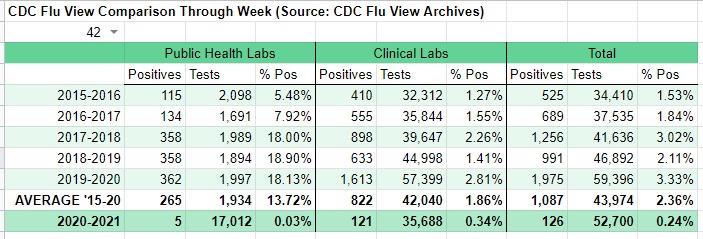
Source
Whoops! How did the CDC allow these numbers to be published?
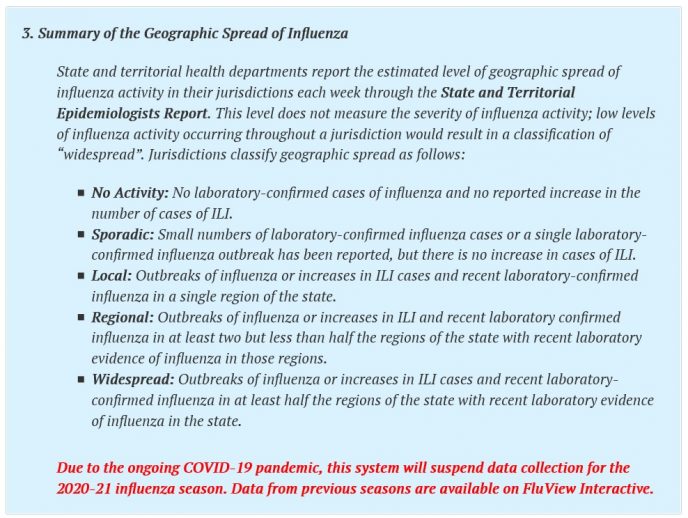
In an apparent response to media reports about the fast declining flu cases here at the beginning of the 2020-21 flu season, the CDC did what any corrupt agency would do which doesn’t want the public to know the truth: They decided to “suspend data collection for the 2020-21 influenza season.” (Source.)
To my knowledge, this is unprecedented, and has never happened before.
There is a screen shot here in case they take this down due to public awareness (thanks to Patrick Wood).
Correlation Between Flu Shot and Senior Deaths Allegedly due to COVID
It is important to remember that most of the deaths in the U.S. attributed to COVID have occurred among those over 70 years old, with co-morbidity factors.
Another factor to consider is that seniors over 65 in the U.S. get a different flu shot than everyone else each year, one that is much stronger.
Most of the initial deaths attributed to COVID in early 2020 occurred in nursing homes or assisted care facilities for the elderly, where the flu vaccine is routinely given every year as a matter of policy.
Deaths in these facilities are common every year just after administering the flu vaccine, but never reported in the corporate media.
Health Impact News had a nurse whistleblower contact us in 2014 to report that 5 seniors in a Georgia assisted care facility died the same week the flu shot was given. We were threatened with a lawsuit for reporting this. See:
5 Seniors Die after Flu Shot at Assisted Care Center in Georgia
A recently published study out of Mexico confirmed the correlation between senior flu shots and COVID deaths.
A recently published study in PeerJ by Christian Wehenkel, a Professor at Universidad Juárez del Estado de Durango in Mexico, has found a positive association between COVID-19 deaths and influenza vaccination rates in elderly people worldwide.
According to the study, “The results showed a positive association between COVID-19 deaths and IVR (influenza vaccination rate) of people ≥65 years-old. There is a significant increase in COVID-19 deaths from eastern to western regions in the world. Further exploration is needed to explain these findings, and additional work on this line of research may lead to prevention of deaths associated with COVID-19.”
To determine this association, data sets from 39 countries with more than half a million people were analyzed. (Read the full article.)
Verified Death Statistics Will Tell the True Story
Once 2020 is complete, it will probably be seen that total deaths that have been recorded will be similar to previous years.
The difference will be the number of deaths attributed to COVID to justify all the government fear and tyrannical actions, as deaths by other causes will drop so that the end result will be about the same.
These kinds of stats are becoming more and more difficult to find, but here is one projected total compared with total deaths from the previous 3 years.
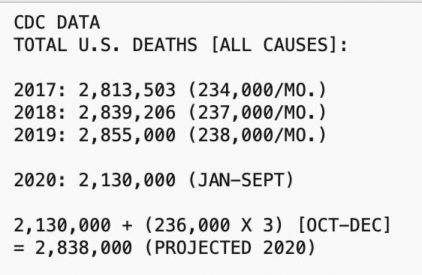
I am not sure of the original source of this graph (it is most likely a compilation of available health statistics), but the graph was published here.
New study shows low-carb diets would save BILLIONS currently wasted on drugs. But will Big Pharma allow it?
By Dr Malcomb Kendrick | November 3, 2020
If you want to avoid dying of COVID19, one of the most important things you can do, if you are overweight, is to shed the pounds
‘…. in the first meta-analysis of its kind, published on 26 August in Obesity Reviews, an international team of researchers pooled data from scores of peer-reviewed papers capturing 399,000 patients. They found that people with obesity who contracted SARS-CoV-2 were 113% more likely than people of healthy weight to land in the hospital, 74% more likely to be admitted to an ICU, and 48% more likely to die.’ 1
Why? Well, the ‘why’ centres around the damaging effect of raised blood glucose on endothelial cells and… it gets complicated.
For now, though, the most important thing is not to understand the complex metabolic and physiological pathways involved, it is simply to help people to lose weight, and this is where Dr David Unwin comes in.
For years now he has believed, as I do, that the main driver of weight gain, leading on to type 2 (T2) diabetes, is a high carbohydrate diet.
This, of course, is the exact opposite of what we have been told for decades by the ‘experts’ who demonise fat and promote carbohydrates. We have the ‘eat-well’ plate, and the ‘food pyramid’, and hundreds of thousands of dieticians around the world, all promoting carbohydrates as the ‘healthy’ option.
Dutifully following this advice, the entire population of the western world has become fatter, and fatter… and fatter. By the way, this is not a coincidence; it is cause and effect.
Getting back to Dr Unwin, years ago he despaired of ever getting any of his patients to lose weight. It was so disheartening that he furtively studied his pension plan, and dreamed of retirement, so fed up was he becoming. Then one day a patient came in who had lost a lot of weight and kept it off.
At first this woman was reluctant to say how she had done it, as she feared the inevitable criticism. In the end, she told Dr Unwin that she had lost weight, and kept it off, by eating a low carbohydrate diet. In Dr Unwin’s own words:
‘A few years ago, I was interested to find out how a patient had improved her diabetic control. She confessed she had ignored my advice and learnt a much better way to look after herself, from the internet. I suppressed my wounded pride and looked at the Low Carb Forum on Diabetes.co.uk There were thousands of type two diabetics on there ignoring their doctors – and getting great results (now that is just not allowed).’ 2
Yes, Dr Unwin did not criticize, instead he was intrigued. Could this possibly be true? It went against everything he had been told about healthy eating, and weight loss, and T2 diabetes. Fat has twice the calories, per gram, as carbohydrates and suchlike. Eating fat, he believed, makes you fat, and then you develop diabetes, and heart disease.
Dr Unwin did more research, then he made the decision to work with patients, mainly those with diabetes, to see if a low carbohydrate diet could be beneficial. Lo and behold, it was … very beneficial. It was like a miracle cure.
In 2014 he published a paper on his results on a small number of patients.
‘Low carbohydrate diet to achieve weight loss and improve HbA1c in type 2 diabetes and pre-diabetes: experience from one general practice.’
‘It was observed that a low carbohydrate diet achieved substantial weight loss in all patients and brought about normalisation of blood glucose control in 16 out of 18 patients. At the same time, plasma lipid profiles improved, and BP fell allowing discontinuation of antihypertensive therapy in some individuals…
Conclusions Based on our work so far, we can understand the reasons for the internet enthusiasm for a low carbohydrate diet; the majority of patients lose weight rapidly and fairly easily; predictably the HbA1c levels are not far behind. Cholesterol levels, liver enzymes and BP levels all improved. This approach is simple to implement and much appreciated by people with diabetes.’ 3
Now, he has published results of a much larger study, on nearly two hundred patients over a six-year period. It is called. ‘Insights from a general practice service evaluation supporting a lower carbohydrate diet in patients with type 2 diabetes mellitus and prediabetes’ Published in BMJ nutrition 4.
Here are the main findings, which I nicked directly from the press release:
- 46% drug-free T2 diabetes remission
- Significant improvements in weight, blood pressure and lipid profiles
- 93% remission of prediabetes
- £50,885 annual saving on the Norwood GP practice NHS diabetes drug budget
- If every GP practice in England spent the same on drugs for diabetes per patient as Norwood the NHS could save £277 million!
- Older patients can do as well as younger ones with a low carb approach.
- The participants who started with the worst blood sugars saw the greatest improvements in diabetic control
- Four individuals came off insulin altogether
- Total weight loss for the 199 participants was 1.6 metric tons!
This paper will be attacked, of course. There are massive financial interests involved here. As stated, if every GP practice in the UK used the low carb approach, the NHS could save £277 million (~$350m) in drug costs. Scaled up to the US, with much higher drugs costs, one could be looking at around $2Bn/year. Around the world, who knows, but vast sums of money.
So, you can imagine the joy that this paper will be met with in pharmaceutical company boardrooms around the world. The words ‘lead’ and ‘balloon’, spring to mind. Equally the massive low-fat, high carb food manufacturers will be throwing their hands up in horror – ‘my bonus, my bonus… nooooo.’ You can take your low carb yoghurts and….
As for the rest of us. I can assure you that Dr David Unwin has only ever been interested in one thing. Working out how to help people lose weight and control their diabetes. He has achieved this.
Will his research now be taken up by the authorities around the world? Will we move away from promoting a high carbohydrate diet? You have to be joking. There is far too much money to be lost by companies who exert tight control over the world of medical research, and whose lobbyists swarm around the politicians in rich countries.
Which is a damn shame, because more than ever in this endless COVID19 pandemic, obesity represents a health crisis. This paper, and the tireless work by Dr David Unwin, clearly tells us what we need to do, now, urgently. His approach won’t work instantly, and it won’t work for everyone – nothing ever does. However, it represents hope. It could save hundreds and thousands of lives. Better than any vaccine?
Thank you, once again, Dr Unwin. A man who I think of as a friend. Your research should be shouted from the rooftops. I can only do my bit.
1: https://www.sciencemag.org/news/2020/09/why-covid-19-more-deadly-people-obesity-even-if-theyre-young
4: https://nutrition.bmj.com/content/early/2020/11/02/bmjnph-2020-000072
Russian scientists discover way to diagnose cancer and other diseases with a SINGLE DROP of blood
By Jonny Tickle | RT | November 2, 2020
Finally, good healthcare news in 2020: Scientists from two universities in Samara have discovered a method of diagnose cancer using a spectroscopic technique that performs a biopsy on a single drop of blood in a matter of minutes.
Published in the peer-reviewed, US-based Journal of Raman Spectroscopy, the research details how blood can be analyzed by looking at how light interacts with molecules in the liquid. The technique can also rapidly test for many other diseases, which normally require hours to be diagnosed in laboratories.
“Light interacts with biological molecules, the building blocks of our body,” said Ivan Bratchenko, an associate professor at Samara University, the institution that developed the method alongside specialists from the nearby Samara State Medical University. “If you know exactly how this interaction occurs, you can track how the body’s composition changes, and whether any pathologies exist in a single drop of blood.”
According to Bratchenko, this method of diagnosis is less accurate than testing in a laboratory, but is faster, can be done using portable equipment, and can be used to perform mass screenings.
“Using a liquid biopsy, you can quickly identify people who are just beginning to develop a pathology, and send them to the appropriate specialist,” the professor said. “You can also monitor the condition of patients who are already undergoing treatment.”
Samara University is one of the country’s leading institutions and, during the Soviet period, when the city was known as Kuybyshev, was famed for its work with the space program. In 1966, when it was then known as the Kuibyshev Aviation Institute, it was named after Sergey Korolev, a rocket engineer who played a prominent role in the Space Race. Earlier this year, scientists from the university created a biomaterial to restore bones in sufferers of osteoporosis.
NY Times Disparages the Scientific Method While Attacking NOAA Scientists
By H. Sterling Burnett – ClimateRealism – October 29, 2020
The New York Times (NYT) published an October 27 article accusing President Trump of fighting “against climate science,” while the NYT itself misrepresents climate science.
In the article titled, “As Election Nears, Trump Makes a Final Push Against Climate Science,” the NYT implies the Trump administration is fighting against climate science by appointing research meteorologist Ryan Maue, Ph.D., as chief scientist at the National Oceanic and Atmospheric Administration (NOAA), and appointing David Legates, Ph.D., former state climatologist for Delaware, as deputy assistant secretary of commerce for observation and prediction at NOAA. Maue’s appointment is problematic according to the NYT because he “has criticized climate scientists for what he has called unnecessarily dire predictions.”
A google scholar search of Maue’s publications shows he is well qualified for the position of NOAA chief scientist. Maue has authored or co-authored more than 30 peer-reviewed articles discussing climate change. Simultaneously, Maue served as a meteorologist at WeatherBELL Analytics, a widely used weather forecasting service. Much of Maue’s research presents real-world data to demonstrate that human-induced climate change is not causing more powerful and more frequent hurricanes.
A Google Scholar search of Legates’ name shows he has authored or co-authored 140 peer-reviewed climate-change-related articles. The topics of Legates’ papers range from the earth’s climate sensitivity as shown by actual measurements, the validity of climate models, drought and flood patterns across the United States, and the impact of warming on polar bear populations. Once again, the objective record shows Legates is well qualified to direct and inform government research on climate related matters.
The NYT is not the first mainstream media outlet to criticize the Maue and Legates appointments. For example, Climate Realism refuted the ad-hominem charges leveled against Legates by National Public Radio shortly after his appointment to NOAA. The author of that Climate Realism article wrote, “The very definition of science, in its most-basic sense from The Enlightenment to 2020, is ‘questioning the basic tenets’ of current assumptions. [Legates has] examined the data for many, many years and has not seen persuasive evidence that humans are the chief drivers of climate change.”
NOAA is charged with assembling the National Climate Assessment every four years. The report includes input from 13 federal agencies and outside scientists, supposedly to present objective knowledge concerning the causes and consequences of climate change. Rather than being objective, NOAA’s 2018 report referenced the Intergovernmental Panel on Climate Change’s (IPCC) worst-case scenario to claim climate change poses an imminent and dire threat to the United States. The IPCC itself has disavowed its worst-case scenario, admitting it has only a three-percent chance of becoming a reality.
NOAA’s Climate Assessment ignored hundreds of unalarming peer-reviewed articles and books published by dozens of prominent researchers including, for example, physicists Will Happer, Ph.D., Richard Lindzen, Ph.D., Willie Soon, Ph.D., and atmospheric scientists, John Christy, Ph.D., Pat Michaels, Ph.D., and Roy Spencer, Ph.D. These scientists, and many others, have published research showing that the human impact on global temperatures is and will be, at most, minimal. According to these scholars, natural factors, such as, cloud formation, solar activity, and large-scale ocean circulation patterns are the dominant drivers of climate shifts. Other studies have concluded, based on measurable data, that the modest climate change the Earth has so far experienced has been beneficial. Research also indicates a continued modest increase in temperatures is highly unlikely to result in extreme weather changes.
NOAA has also previously ignored findings of the 14 peer-reviewed volumes produced by the Nongovernmental International Panel on Climate Change. In particular, NIPCC’s Climate Change Reconsidered series presents a comprehensive literature review of the peer-reviewed evidence indicating human influence on climate is minimal and that present climate change is not catastrophic. NIPCC’s reports are written and/or reviewed by hundreds of researchers, yet the past political leadership of NOAA has ignored them and the thousands of peer-reviewed papers they reference.
The appointments of Maue and Legates to NOAA present an opportunity to reinforce the proper use of the scientific method in government research. The Scientific Method demands that researchers question self-proclaimed consensus science. In the field of climate research, this means carefully considering the broad range of evidence concerning the causes and consequences of climate change when federal reports are developed. This would represent a shift from NOAA’s previous practice, in which it referenced a narrow body of research to support the politically predetermined conclusion that dangerous human-caused climate change is happening.
It is not surprising that the NYT dismisses the Trump administration’s attempts to defend the Scientific Method from doctrinaire views of climate change. Trump’s previous efforts to bring transparency to scientific research and to prevent corruption in the funding process for scientific research have been similarly critiqued by climate alarmists. Left-leaning mainstream media outlets, academics who’ve learned to manipulate the current closed system, and political partisans who use the cloak of “following the science” to promote their personal political agendas reject transparency and support self-dealing.
As the peer-reviewed research by Legates, Maue and hundreds of other scientists makes clear, there is an active scientific debate concerning the causes, extent, and consequences of climate change. Trump’s appointments of Legates and Maue may bring justified and necessary balance to federal reports on the state of climate science.
No Vaccine for Tyranny
By Ron Paul | November 2, 2020
The World Health Organization (WHO) recently admitted that lockdowns cause more harm than good. Following this announcement, one would have expected American politicians to immediately end the lockdowns. After all, the WHO ‘s pronouncements are considered infallible, so much so that social media sites silence anyone who dares challenge the great and powerful WHO. Yet, governors, mayors, and other government officials across the country are ignoring the WHO’s anti-lockdown position.
Instead of admitting that the lockdowns were a mistake, many in the political class, which includes a disturbing number of medical professionals whose positions and prestige depend on government, claim that we cannot return to normalcy until a coronavirus vaccine is in wide use. This suggests that people among the majority of Americans who do not wish to be vaccinated will remain under lockdown or be forced to be vaccinated against their will.
The assault on our liberty will not end with deployment and use of a vaccine. Moncef Slaoui, the chief adviser of the Trump administration’s Operation Warp Speed, a “public-private partnership” in charge of producing and delivering a coronavirus vaccine, has said that those who receive a vaccine will be monitored by “incredibly precise … tracking systems.” Slaoui has also indicated that tech giants Google and Oracle will help the government keep tabs on the vaccinated individuals. So, the vaccine program will lead to an increase in government surveillance!
Slaoui is just the latest “expert” to endorse forcing the American people to relinquish their few remaining scraps of privacy to stop coronavirus. Dr. Anthony Fauci and Bill Gates have urged development of a digital certificate for those vaccinated for coronavirus. People without the certificate would find their liberty severely restricted.
Those who think that the new surveillance system will be limited to coronavirus should remember that Social Security numbers were only supposed to be used to administer the Social Security program. They should also consider that the PATRIOT Act’s expansion of warrantless wiretapping was supposed to be limited to stopping terrorists. However, these powers have been used for a wide variety of purposes. Whenever government is given power to abuse our rights for one reason it will inevitably use that power to abuse our rights for other reasons as well.
Fauci and Gates’ digital certificate could, and likely will, be expanded to include proof individuals have received a variety of other vaccines and medical treatments. The digital certificate could even extend to monitoring a person’s lifestyle choices on the grounds that unhealthy habits make one more susceptible to diseases.
The digital certificate could also be tied to the REAL ID program to deny individuals who have not been vaccinated the right to travel. It could also be combined with a future mandatory E-Verify system to deny unvaccinated individuals the right to hold a job. Those who consider this “paranoia” should consider Britain is already developing a covid passport.
Liberty lost in the “war on covid” will not be voluntarily returned when the coronavirus threat ends — assuming the government ever stops moving the goal posts and declares the coronavirus threat is over. Instead, the people must be prepared to take back their liberty from the politicians. Fortunately, we still have the ability to do so by the peaceful means of educating our fellow citizens and pressuring our elected officials to reverse course. We must all do what we can to use these peaceful tools before we are in a “dark winter” of authoritarianism.
Copyright © 2020 by RonPaul Institute.
Donald Trump’s top coronavirus adviser Scott Atlas: Lockdowns have been a FAILURE!
RT | November 1, 2020
Trump administration Covid-19 adviser Scott Atlas ripped public-health officials for “egregious” policy failures – only to be forced to apologize after mainstream media deflected his points by attacking him for appearing on RT.
On Saturday, the Stanford University doctor, who has emerged as President Donald Trump’s top adviser on responses to the Covid-19 pandemic, called the lockdown policies an “epic failure” and argued they are “killing people,” while speaking with Afshin Rattansi on RT’s Going Underground show.
“The public-health leadership have failed egregiously, and they’re killing people with their fear-inducing shutdown policies,” Atlas told RT.
“The lockdowns will go down as an epic failure of public policy by people who refuse to accept they were wrong – were wrong, refused to accept they were wrong, didn’t know the data, didn’t care. And it became a frenzy of stopping Covid-19 cases at all costs, and those costs are massive,” he said.
“The argument is undeniable: The lockdowns are killing people.”
Atlas then pointed to job losses, rising suicides, rising drug abuse and the harm being done to young people, tying the issues to the Covid-19 restrictions put in place. One study showed that 25 percent of Americans aged 18 to 24 thought about killing themselves in June “due to the lockdown,” he said.
“We’re creating a generation of neurotic children, forcing them to wear masks and be six feet apart from their friends, or not even have school in person.”
While Atlas’ counter-narrative comments might have been fodder for a serious discussion of public-health policy, mainstream media outlets instead spun the interview into a controversy over a Trump administration official granting an interview to a Russian state-owned outlet.
Reporters such as CNN’s Jim Acosta, Politico’s Ryan Lizza and NBC’s David Gura immediately pounced, ignoring the substance of his comments and breathlessly telling their followers that he spoke to an alleged Kremlin mouthpiece. “White House Covid adviser appears on outlet that is described by US intel as one of the Kremlin’s main propaganda platforms,” Washington Post national-security correspondent Greg Miller said.
Senior WH official tells me Doctor Scott Atlas did not have approval from the WH before going on RT. Atlas did it “on his own” without seeking approval from WH. Senior aides have raised concerns that Atlas would appear on the Russian outlet, the official said.
— Jim Acosta (@Acosta) November 1, 2020
Scott Atlas is having an interesting week. Here he is on the Russia propaganda network RT, which casually opens the segment with some facts about US imperialism. https://t.co/M467aEvaum
— Ryan Lizza (@RyanLizza) November 1, 2020
On the heels of an interview with Russian propagandists, Dr. Scott Atlas, a partisan radiologist who has the president’s ear, spitefully subtweets Dr. Anthony Fauci, an actual expert on infectious diseases: https://t.co/wvmBXe124O
— David Gura (@davidgura) November 1, 2020
The controversy was so fierce that Atlas was forced to apologize. “I recently did an interview with RT and was unaware they are a registered foreign agent,” he said Sunday on Twitter, adding that he now “regrets” doing the interview and also apologizing “to the national-security community who is working hard to defend us.”
I recently did an interview with RT and was unaware they are a registered foreign agent. I regret doing the interview and apologize for allowing myself to be taken advantage of. I especially apologize to the national security community who is working hard to defend us.
— Scott W. Atlas (@SWAtlasHoover) November 1, 2020
The apology wasn’t accepted. Christian Science Monitor reporter Dan Murphy tweeted that Atlas, who he has called a “lying Trump goon,” was lying about not knowing about RT’s foreign registration. Illustrator Chris Morris mocked Atlas for supposedly not knowing what “RT” stands for. CNN analyst Sam Vinograd said the interview “raises a lot of counterintelligence red flags.”
1. He’s lying. 2. There’s an enormous federal bureaucracy devoted to informing and coordinating the media appearances of hacks like Atlas. 3. RT the least important part. The deadly Trump propaganda he spreads is disqualifying whether on RT or VOA or Fox. https://t.co/ieum3otqVl
— Dan Murphy (@bungdan) November 1, 2020
This raises a lot of counterintelligence red flags. Why was a Russian foreign agent in direct touch with a WH advisor without him reporting it?
— Sam Vinograd (@sam_vinograd) November 1, 2020
No explanation was offered for how voicing opinions on a Russian-funded television outlet might jeopardize US national security. None was needed.
Democrats and mainstream media outlets have repeatedly squashed discussion of undesirable information or viewpoints, by alleging a nefarious Russian plot behind the report. Such tactics were used, for example, to dismiss damning information about the Hillary Clinton campaign – released by WikiLeaks in 2016 – and recent revelations about alleged influence-peddling by Democratic presidential candidate Joe Biden’s family.
Media critic Mark Dice pointed out that no objections were raised when US Representative Adam Schiff (D-California) and other Democrats appeared on RT in the past.
The Grayzone editor Max Blumenthal tweeted he was “surprised it took this long for the US center-right opposition to merge Covid panic with Russia hysteria.”
MSNBC host Matt Negrin may have revealed just a hint of anti-Trump media vitriol when he responded to Atlas’ apology by saying, “Are you the dumbest motherf***er in the f***ing world?”
Everyone is freaking out about Scott Atlas doing an interview with RT but @afshinrattansi actually held his feet to the fire with tough questions. People should watch it and judge for themselves, frankly. I doubt most people commenting have even seen it https://t.co/Z36Ez9irr7
— Alex Rubinstein (@RealAlexRubi) November 1, 2020
Atlas told RT he wrote about the issues discussed in the interview back in April or May, long before he joined the White House Coronavirus Task Force.
“I wasn’t the villain of the world when I wrote it, but when you come up and you stand next to the president of the United States – in an attempt to help the country in the biggest crisis in the world – you must be destroyed by the media in the United States. And so it’s a sad statement on America that the US is hysterical over this.”
You are a heretic in woke America if you oppose trans treatment for kids, liberal crusade against ‘Irreversible Damage’ book shows
RT | October 31, 2020
An author attempting to publish a book arguing against transgender treatment for teenagers realized that woke America has no time for “common sense” after receiving backlash over her publication.
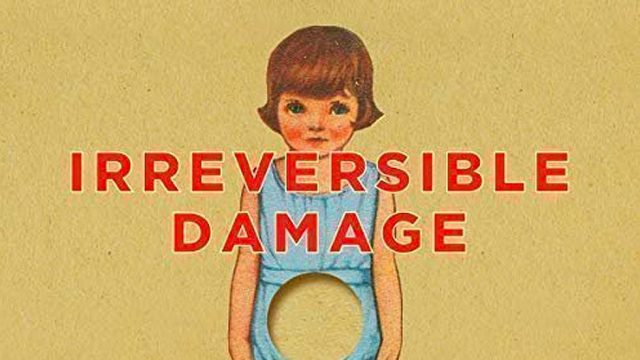
Published in June, Abigail Shrier’s ‘Irreversible Damage’ argues that teachers, therapists and the media are encouraging vulnerable teenage girls to identify as “transgender,” and pushing life-changing treatments and surgeries – including puberty-blocking hormones and double mastectomies – on these teens.
Childhood gender dysphoria is a relatively recent phenomenon, but one that has entered the mainstream. At a town-hall event last month, Democratic presidential candidate Joe Biden even said there should be “zero discrimination” against children wanting to transition. In this woke climate, Shrier said that she faced immense difficulty in voicing her “commonsense” opposition.
“Amazon blocked my publisher from sponsoring ads for my book, while allowing ads for books that pushed the contrary view,” she said in a Twitter thread on Thursday. The retail giant said the ad “may not be appropriate for all audiences,” even though Regnery Publishing said the ad only featured a shot of the book’s cover.
Amazon blocked my publisher from sponsoring ads for my book, while allowing ads for books that pushed the contrary view — that is, books that argue that gender transition for teens is without serious risk. https://t.co/VV7dTkZYNJ /2
— Abigail Shrier (@AbigailShrier) October 29, 2020
“All of the legacy media outlets refused journalists’ requests to review my book,” she continued. One media figure that did speak to Shrier about her book was podcast host Joe Rogan, who was harassed by Men’s Health magazine for daring to host such a “transphobic” author, whose work was apparently “putting lives in danger.” Men’s Health used to feature workout plans and diet tips, but lately has embraced woke orthodoxy.
Joe Rogan had me on his show. Spotify has now held 10 meetings w employees to debate whether to pull the episode–about a *book* that presents the mainstream idea that all this gender transition for teens is too much, too fast with too little oversight. https://t.co/KPa78O1xAt /4
— Abigail Shrier (@AbigailShrier) October 29, 2020
Moreover, Spotify executives hastily convened meetings to decide whether to pull the episode from their platform. It remains online, but others speaking out in support of Shrier were successfully ‘canceled.’ Science forums banned users for praising her book, and a crowdfunding campaign to put up billboards promoting it was shut down by Gofundme. The crowdfunding site still allows transgender teenagers to raise cash for “gender reassignment” surgery.
“Commonsense debate is being strangled by a woke orthodoxy,” Shrier concluded. “My book contains not a word of hate. I explored a medical issue and offered a considered view.”
“How many other issues will you never hear about? How many journalists have already abandoned the pursuit of truth?”
The censorship drive highlighted by Shrier is ongoing. Joe Rogan – a relatively apolitical pundit – landed himself in hot water again this week for hosting a podcast with right-wing controversialist Alex Jones. Though Spotify’s top brass refused to censor the episode, liberal listeners began a boycott campaign against the streaming service.
Facebook, Twitter and YouTube have all cracked down on a range of controversial content. British supermarkets cave to the whims of transgender activists and pull their ads from right-wing magazines. Newspapers call the victims of ‘Black Lives Matter’ mob beatdowns racists to excuse the violence. Insulting transgender people from the privacy of your own home may soon be a criminal offense in Scotland.
In the US, Shrier’s warning that journalists may have “abandoned the pursuit of truth” is apparently coming true. The media at large there has censored itself on the issue of the Biden family’s foreign business dealings, seemingly in a desire to see President Donald Trump removed from office.
Also on rt.com:
Soviet-style thought-policing has come to America, outsourced to Big Tech corporations
Roger Revelle – the backstory of the father of Atmospheric CO2 monitoring
By Andy May | Watts Up With That? | October 31, 2020
Roger Revelle was an outstanding and famous oceanographer. He met Al Gore, in the late 1960s, when Gore was a student in one of his classes at Harvard University. Revelle was unsure about the eventual impact of human carbon dioxide emissions on climate, but he did show that all carbon dioxide emitted by man would not be absorbed by the oceans. For an interesting discussion of Revelle’s work in this area see this post on “The Discovery of Global Warming,” by Spencer Weart (Weart, 2007). The original paper, on CO2 absorption by the oceans, published in 1957 by Roger Revelle and Hans Suess, is entitled: “Carbon Dioxide Exchange Between Atmosphere and Ocean and the Question of an Increase of Atmospheric CO2, during the Past Decades” (Revelle & Suess, 1957). This meant that human emissions of carbon dioxide would accumulate in the atmosphere and that the CO2 atmospheric concentration would increase, probably causing Earth’s surface to warm at some unknown rate. This is not an alarming conclusion, as Revelle well knew, but Al Gore turned it into one.
One of Revelle’s good friends was Dr. S. Fred Singer. Singer was a professor of environmental science at the University of Virginia and both Revelle and Singer had been science advisors in the U.S. Department of the Interior. They first met in 1957 and were more than professional colleagues, they were personal friends (Singer, 2003). Unfortunately, Revelle passed away in July 1991 and Singer passed away in April 2020, so we will refer to them and their friendship in the past tense. Both were leading Earth scientists and at the top of their fields, it was natural they would become friends. They also shared an interest in climate change and chose to write an article together near the end of Revelle’s life.
The article was published in Cosmos and entitled “What To Do about Greenhouse Warming: Look before You Leap” (Singer, Revelle, & Starr, 1991). Singer and Revelle had already written a first draft of the article, when they invited the third author, Chauncey Starr, to help them complete it. Starr was an expert in energy research and policy. He holds the National Medal of Technology and Innovation and was the director of the Electrical Power Research Institute in Palo Alto, California. As leading scientists, Starr, Singer and Revelle understood how uncertain the possible dangers of global warming were and they did not want the government to go off half-cocked, they wrote:
“We can sum up our conclusions in a simple message: The scientific [basis] for a greenhouse warming is too uncertain to justify drastic action at this time. There is little risk in delaying policy responses to this century old problem since there is every expectation that scientific understanding will be substantially improved within the next decade.” (Singer, Revelle, & Starr, 1991)
Indeed, ten years later, CO2 emissions were still increasing, but the world had started to cool as shown in Figure 1. This casts considerable doubt on the idea that human emissions somehow control global warming, since some other factor, presumably natural, is strong enough to reverse the overall warming trend for ten years. Revelle was correct to encourage the government to wait for ten more years. Just a year before their paper was published the IPCC reported that warming to date fell within the range of “natural variability” and that the detection of a human influence on climate was “not likely for a decade or more.” (IPCC, 1990, p. XII).
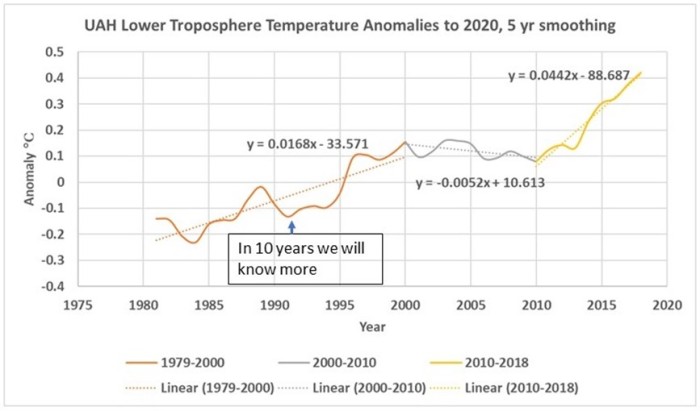
Figure 1. In 1990 and 1991, respectively, the IPCC and Roger Revelle and colleagues said it was too early to do anything about possible man-made climate change, they thought we would know more in 10 years. The plot is smoothed with a 5-year running average to reduce the effect of El Nino and La Nina events. This makes the longer term trends easier to see.
While Revelle was unsure if warming was a problem. Al Gore, who had little training in science, suffered no such doubts. He was sure that burning fossil fuels was causing carbon dioxide to rise to “dangerous” levels in the atmosphere and was convinced this was a problem for civilization through rising sea levels and extreme weather. There was no evidence to support these assumptions, but Al Gore didn’t need evidence, he could always rely on climate models and he did. Revelle distrusted the models.
Al Gore and Climate Change
In 1992, after Singer, Revelle and Starr published their Cosmos article, their statements caused Al Gore, who was running for Vice-President at the time, some problems. Gore had just published The Earth in the Balance (Gore, 1992) and in it he credited Revelle with discovering that human emissions of carbon dioxide were causing Earth to warm and this could be very dangerous. Yet, Singer, Revelle and Starr’s paper said:
“Drastic, precipitous—and, especially, unilateral—steps to delay the putative greenhouse impacts can cost jobs and prosperity and increase the human costs of global poverty, without being effective. Stringent economic controls [on CO2 emissions] now would be economically devastating particularly for developing countries…” (Singer, Revelle, & Starr, 1991)
They also quote Yale economist and Nobel Laureate William Nordhaus, who wrote:
“… those who argue for strong measures to slow greenhouse warming have reached their conclusion without any discernible analysis of the cost and benefits…” (Nordhaus W. , 1990)
Nordhaus had studied both the costs of reducing CO2 and the benefits of doing so. His analysis shows there is little to be gained, economically, from reducing emissions (Nordhaus W. , 2007, p. 236). While Nordhaus supports a “carbon tax,” he acknowledges that the “pace and extent of warming is highly uncertain.” Contrast this with how Al Gore characterizes Roger Revelle’s view in his book:
“Professor Revelle explained that higher levels of CO2 would create what he called the greenhouse effect, which would cause the earth to grow warmer. The implications of his words were startling; we were looking at only eight years of information, but if this trend continued, human civilization would be forcing a profound and disruptive change in the entire global climate.” (Gore, 1992, p. 5) italics added.
The differences between what Nordhaus and Revelle are saying and what Al Gore is saying are stark. All three believe human emissions of CO2 might cause Earth to warm. But Gore naively assumes that is a bad thing. Revelle and Nordhaus acknowledge it might be, but they recognize that we don’t know. Further, they understand destroying our fossil fuel-based economy may not alleviate the warming and may cause more harm than good. To quote Bertrand Russell:
“The whole problem with the world is that fools and fanatics are always so certain of themselves, and wiser people so full of doubts.” Bertrand Russell
To a scientist, like Roger Revelle, the uncertainty was obvious. Politicians, like Al Gore and most of the news media do not do uncertainty, everything must be black and white and false dichotomies are how they think. Notice Al Gore presumptively writes “would be forcing” when Revelle would clearly write “could be forcing.” The difference between a politician with an agenda and a scientist who understands uncertainty.
The incompatibility between Revelle’s true views and the way they are presented in Gore’s book was noticed by Gregg Easterbrook, a Newsweek editor, who wrote about it in the July 6, 1992 issue of New Republic (Easterbrook, 1992). This article angered Al Gore and his supporters. Walter Munk and Edward Frieman published a short note in Oceanography in 1992 objecting to Easterbrook’s article and claimed that the late Revelle had been worried about global warming, but probably did not want “drastic” action taken at this time (Munk & Frieman, 1992). Revelle’s views were clear and well known, nothing in Munk and Frieman’s article contradicts what Singer said or what Revelle said or wrote. The following is from a letter Revelle sent Senator Tim Wirth, an ally of Gore’s and a member of the Clinton/Gore administration in July 1988:
“we should be careful not to arouse too much alarm until the rate and amount of warming becomes clearer. It is not yet obvious that this summer’s hot weather and drought are the result of a global climatic change or simply an example of the uncertainties of climate variability. My own feeling is that we had better wait another 10 years before making confident predictions.” Written by Roger Revelle as reported by (Booker, 2013, p. 59).
Unlike Senators Al Gore and Tim Wirth, Revelle understood global warming computer models and did not trust them. He argued with Singer about this very issue and Singer convinced Revelle that the models were getting better (Singer, Revelle, & Starr, 1991). However, regardless of the accuracy of the models, Revelle was not convinced global warming was a problem and he knew the natural rate of warming and the additional amount expected from human greenhouse emissions were unknown. As shown in Figure 1, his caution was warranted, just ten years later it became apparent that warming was slowing down. The following reflects Revelle’s own views, it is from the “Look before you Leap” article:
“The models used to calculate future climate are not yet good enough because the climate balancing processes are not sufficiently understood, nor are they likely to be good enough until we gain more understanding through observations and experiments. As a consequence, we cannot be sure whether the next century will bring a warming that is negligible or a warming that is significant. Finally, even if there are a global warming and associated climate changes, it is debatable whether the consequences will be good or bad; likely some places on the planet would benefit, some would suffer.” (Singer, Revelle, & Starr, 1991)
Revelle’s views were clear and well documented, but Al Gore and his supporters were humiliated by Easterbrook’s article and follow up articles by George Will and others. Dr. Justin Lancaster was Revelle’s graduate student and teaching assistant at the Scripps Institution of Oceanography from 1981 until Revelle’s sudden death in July 1991. He was also an Al Gore supporter. Lancaster claimed that Revelle was “hoodwinked” by Singer into adding his name to the Cosmos article. He also claimed that Revelle was “intensely embarrassed that his name was associated” with it. Lancaster further claimed that Singer’s actions were “unethical” and specifically designed to undercut Senator Al Gore’s global warming policy position. Lancaster harassed Singer in 1992, accusing him of putting Revelle’s name on the article over his objections and demanding that Singer have it removed. He even demanded that the publisher of a volume that was to include the article (Geyer, 1993) remove it.
Professor Singer, the Cosmos publisher of the “Look before you Leap” article and the publisher (CRC Press) of Richard Geyer’s book, objected to these demands and charges. Then Singer sued Lancaster for libel with the help of the Center for Individual Rights in Washington, D.C. Professor Singer and the Center won the lawsuit and forced Lancaster to issue an apology.
The discovery process during the lawsuit revealed that Lancaster was working closely with Al Gore and his staff. In fact, Al Gore personally called Lancaster after the Easterbrook article appeared and ask him about Revelle’s mental capacity in the months before his death in July of 1991. Friends and family of Revelle recall that he was sharp and active right up to the moment when he passed away from a sudden heart attack. But this did not stop Al Gore and Lancaster from claiming Revelle was suffering from senility or dementia and that was why the account in Gore’s book was so different from what Revelle wrote elsewhere, including in the “Look before you leap” article. Even Lancaster wrote in a draft of a letter to Al Gore that Revelle was “mentally sharp to the end” and was “not casual about his integrity” (Singer, 2003).
During the discovery process, Singer and his lawyers found that Lancaster knew everything in the “Look before you leap” article was true and that Revelle agreed with everything in it. The article even included a lot of material that Revelle had previously presented to a 1990 AAAS (American Academy for the Advancement of Science) meeting. More details can be seen in Fred Singer’s deposition (Jones, 1993).
Roger Revelle’s daughter, Carolyn Revelle Hufbaurer, wrote that Revelle was concerned about global warming (Hufbauer, 1992). But his concern lessened later in life and he knew the problem, if there was a problem, was not urgent. He thought more study was required before anything was done. He was for modest changes, such as more nuclear power and substituting natural gas for some coal and oil, but not much else, other than a carbon tax. As usual, the news media and politicians have no sense of the complexity and uncertainty that surrounds the scientific debate about human-caused climate change. When Revelle argued against “drastic” action, he meant measures that would cost trillions of dollars and cripple the fossil fuel industry and developing countries. Up until his death, he thought extreme measures were premature. He clearly believed that we should look before we leap.
Al Gore tried to get Ted Koppel to trash Singer on his TV show and it failed spectacularly. He asked Koppel to investigate the “antienvironmental movement” and in particular “expose the fact” that Singer and other skeptical scientists were receiving financial support from the coal industry and the wacky Lyndon LaRouche organization. Rather than do Al Gore’s bidding Ted Koppel said the following on his Nightline television program, on February 24, 1994:
“There is some irony in the fact that Vice President Gore, one of the most scientifically literate men to sit in the White House in this century, [is] resorting to political means to achieve what should ultimately be resolved on a purely scientific basis. The measure of good science is neither the politics of the scientist nor the people with whom the scientist associates. It is the immersion of hypotheses into the acid of truth. That’s the hard way to do it, but it’s the only way that works.” Ted Koppel as reported in (Singer, 2003)
Calling Gore “scientifically literate” is debatable, but Koppel has the rest of it right. He has integrity that is lacking in journalism today, further he understands the scientific process. The attempt to use Koppel to tar Singer, brought a huge amount of well-deserved criticism down on Gore.
Given this, it is not surprising that Lancaster agreed to issue an apology only two months later, on April 29, 1994. Lancaster’s retraction was specific:
“I retract as being unwarranted any and all statements, oral or written, I have made which state or imply that Professor Revelle was not a true and voluntary coauthor of the Cosmos article, or which in any other way impugn or malign the conduct or motives of Professor Singer with regard to the Cosmos article (including but not limited to its drafting, editing, publication, republication, and circulation). I agree not to make any such statements in future. … I apologize to Professor Singer” (Singer, 2003)
So, in his court affidavit Lancaster admitted he lied about Singer. Then afterward, Lancaster withdrew his court-ordered retraction and reiterated his charges (Lancaster, 2006). He admits he lied under oath in a courtroom and in writing, then tells us he didn’t lie. He admits that Professor Revelle was a true coauthor of the paper, then he states “Revelle did not write it” and “Revelle cannot be an author.” What some people are willing do to their reputations, in the name of catastrophic climate change is hard to believe. He retracted his retraction despite documentary evidence in Revelle’s own handwriting, and numerous testimonials from others that Revelle did contribute to the article.
Some of Revelle’s other papers, letters and presentations have nearly identical language to that in the paper, for example compare the quote from his letter to Senator Tim Wirth above with the first page of the “Look before you Leap” paper. In the paper, they say we need to wait because “scientific understanding will be substantially improved within the next decade” (Singer, Revelle, & Starr, 1991). In the letter to Wirth, quoted above, he says “10 years,” but the meaning is the same. He, and many other climate scientists, did not feel we knew enough in the early nineties to do anything significant. He was right about this. Warming went negative from 2002 to 2010 as we see in Figure 1.
The issue was raised in the televised vice-presidential debate that year. Gore’s response was to protest that Revelle’s views in the article had been taken out of context. We can clearly see that it was Al Gore’s book that took Revelle’s comments out of context.
This post is condensed and modified from my new book, Politics and Climate Change: A History.
The bibliography can be downloaded here.
Featured Video

New positive ivermectin evidence
or go to
Aletho News Archives – Video-Images
From the Archives
Fanatical Followers of the Covid Regime: A Jim Jones-Style Cult?
By Professor Roger Watson and Dr. Niall McCrae | The Daily Sceptic | November 15, 2021
As scholars at leading British universities over recent decades, we witnessed the replacement of critical thinking and debate by narrative: facts are discrimination and scientific method is imperialism; truth, instead, is derived from ‘progressive’ values. This educational trend may be a major contributory factor to the ease in which society has been inculcated to the Covid ‘new normal’ of masking, testing, and repeated doses of vaccines for a disease of similar risk to severe influenza.
One doesn’t need much critical reasoning to observe the flawed logic of some vaccination enthusiasts, such as people who respond to experiencing any side effects, however debilitating, by saying “at least I know it’s working”, or, after contracting the disease despite their promised inoculation (over 90% effective, according to initial drug company claims), “I’d have been worse off without the jab.” … continue
Blog Roll
 Aletho News
- EU Council Advances Chat Control 2.0 Scanning Proposal
- Ex-Greek MEP files complaint against Israeli spyware firm over alleged Pegasus surveillance
- Troubling ideas throughout the Torah, Talmud, Mishneh Torah and Tanya
- ‘Grave, alarming’: Iran mission on Trump’s UNGA ‘annihilation’ threats
- Najaf airport to reopen to Iranian flights within 24 hours: Ambassador
- From ‘How Will This End For Iran’ to ‘When America Walks Away’: A tale of two Economist covers
- Tehran blasts ‘baseless’ speculation linking Iran to alleged bomb plot at UK air base
- The Rise And… Rise Of ‘Color Revolutions’
- The Coming GOP Bloodbath?
- Arctic Scare Stories Melt Away
- If Americans Knew
- Netanyahu Asked UAE Leader to Deny Report on Oct. 7 Warning in Secret Visit, Sources Say
- CNN Chief Int’l Correspondent Clarissa Ward on Journalists in Gaza
- Democratic Party Consultants Surround Troy Jackson with Pro-Israel Donors
- Christian Leader Responds To Netanyahu’s Claims Regarding Palestinian Christians
- In Gaza, ‘Whoever Survives the Bombing Won’t Survive the Rubble’
- Israel kills more Palestinians, amid push to resettle Gaza – Daily Update
- Israel forces Gazans to live in constant peril – Daily Update
- Deconstructing Netanyahu’s pants-on-fire UN rant – Daily Update
- Trump betrayed voters with his campaign lies and prioritized a foreign country once he took office
- Netanyahu calls Israel’s war in Gaza ‘opposite of genocide’ in UN speech to near-empty hall
- No Tricks Zone
- New Study: Earth And Venus Surface Warmth Largely Explained By Convection And Lapse Rate, Not CO2 Or Radiation
- 2025 Nature Paper Claiming Worsening Global Drought Gets RETRACTED …Heavily Flawed
- New Study: ‘Global Drought Shows No Detectable Recent Acceleration Under Climate Warming’
- Economic Masterminds: German Socialists Suggest Taxing Productivity Gains Stemming From Using AI
- The South China Sea Has Not Been Cooperating With The Climate Change Narrative
- Energy Crisis: Germany Enters Heating Season With Historically Low Gas Reserve Fill Levels
- New Study: The Antarctic Ice Sheet Gained Mass From 2020-2024 Due To Staggering Snow And Ice Accumulation
- Study: Ocean Heating Rates From Thousands Of Years Ago ‘Dwarf’ Modern Ocean Heating Rates
- Climate Extremists Target, Attack Large-Scale Power Grid Infrastructure In Germany!
- New Study: Antarctic Ice Melt Has Contributed Less Than 1 Centimeter To Sea Level Rise In The Last 30 Years

