Scientific Study Traces the Evolution and Migration of SARS-CoV-2. Where did the Virus Originate?
Review of an Important Peer Reviewed PNAS Study entitled Phylogenetic network analysis of SARS-CoV-2 genomes, by Peter Forster, Lucy Forster, Colin Renfrew, and Michael Forster
By Allen Yu | Global Research | April 24, 2020
Phylogenetic network analysis of SARS-CoV-2 genomes by Peter Forster, Lucy Forster, Colin Renfrew, and Michael Forster published by the Proceedings of the National Academy of Sciences of the United Sciences of America (PNAS)focuses on a study of the genomes of 160 covid-19 patients.
As readers may know, viruses are RNA-based entities that periodically and regularly undergo mutations. One can study these mutations and almost like clockwork trace their evolution – i.e. their lineage and migration pattern.
The authors specifically employed a methodology known as “character-based phylogenetic networks”. The technique has been used as the “method of choice” to reconstruct prehistoric human population movements, language evolution, various ecological studies, and some 10,000 phylogenetic studies of diverse organisms – and now virology.
This is an early study – the sample size is only 160 humans – with 100 types. However, the results are stunning. Among the key conclusions:
- There are three major types of coronaviruses, A, B, and C, with type A being the ancestor of SARS-CoV-2 in humans and showing 96.2% similarly to a particular strain of virus in bats.
- Most of the viruses in China and Wuhan are of type B while most of the viruses found in America, Europe and Australia are of type A and C. Type C is not found in Mainland China but is found in significant numbers in Hong Kong, S. Korea, and Taiwan.
- While Type B is found in large numbers across Mainland China (including Wuhan), it is not found in significant numbers around the rest of the world.
- The methodology used was successfully used to trace several clinically verified cases of virus travel from Wuhan out to various nations, including Brazil and Italy. As such, the authors conclude the “character-based phylogenetic networks” methodology was useful and appropriate for studying the spread and evolution of the coronavirus.
- Yet, according to the methodology, the earliest sample of virus studied – collected on December 24 2019 in Wuhan – WAS NOT close to being the ancestor of SARS-CoV-2.
According to the authors:
In a phylogenetic network analysis of 160 complete human severe acute respiratory syndrome coronavirus 2 (SARS-Cov-2) genomes, we find three central variants distinguished by amino acid changes, which we have named A, B, and C, with A being the ancestral type according to the bat outgroup coronavirus. The A and C types are found in significant proportions outside East Asia, that is, in Europeans and Americans. In contrast, the B type is the most common type in East Asia, and its ancestral genome appears not to have spread outside East Asia without first mutating into derived B types, pointing to founder effects or immunological or environmental resistance against this type outside Asia. (To read the complete scientific report in pdf click here)
Some observations…
First, most of the viruses in the West do not seem to have arisen from China. The authors identified Type B as the main virus type found in Mainland China, with that Type mostly confined to Mainland China and Types A and C predominant outside China – including U.S., Europe and Australia.
Two reasons given for why Type B variants (“China’s virus,” if you must) did not expand much beyond Mainland China: one being “complex founder scenario” and second “the ancestral Wuhan B-type virus is immunologically or environmentally adapted to a large section of the East Asian population, and may need to mutate to overcome resistance outside East Asia.”
Since I have yet to see any reputable studies that shows any strains of the coronavirus having any affinity or dislike to any ethnicity of people, let’s focus on “complex founder scenario” and “environment” resistance.
The authors have noted many perplexities in the study. But if we consider the possibility that coronavirus did not originate in Wuhan, those perplexities all go away. More specifically, let’s presume a scenario where the virus was already circulating under the radar in the West and were carried to Wuhan in December or some time before, where it then spread locally within China.
Consider the fact that the authors had noted that Type B variants outside China did not show the “one-month” variations that would have been expected were Type B variants and descents to have traveled out of China to infect the rest of the world.
But if Type B variants – including Type C “descendants” – were already communally established and transmitted outside China, then this paradox easily goes away.
Assuming the virus to have been brought to Wuhan instead of originating from Wuhan would also constitute a “complex founding scenario” that the author hypothesized could solve the riddle.
This assumption also provides an explanation for the “environmental resistance” the author hypothesized. If the virus arrived in Wuhan with the Chinese authorities quickly closing down the city soon afterwards, the virus would not have had chance to spread to the rest of the world. The Chinese government’s shutting down of Wuhan in January could easily form the “environmental resistance” the authors hypothesized for the Type B virus.
Finally, it is important to note that in this study, of the 160 samples, most are from patients in China, only a few from outside Asia. In this study, the authors had tentatively labelled Type C as a descendant of Type B found in China. But while Type B is found mostly in Wuhan, it has also been found in significant numbers outside China. As more data from outside China comes live (one hopes soon), the same methodology will probably reveal that the predecessor to Type B and Type C arose outside not inside China. Type A and Type C thus all arose outside China and independently of China.
While the current study is China-centric (most data are from China), it already has established that the virus did not arise in Wuhan. The authors noted importantly in the data supplement section, “the oldest isolate from 24 December 2019 (brown node, week 0) lies diagonally opposite to the bat virus outgroup root.”
As we get more data, studies such as this will shed a lot of light on the origins of the coronavirus. It is really too bad, such a shame that the U.S. and Europe has missed such critical times testing and tracking the viral flow. It is worth noting that U.S. officials are blaming China for the virus. But even with limited data, the authors have been able draw some preliminary conclusions regarding the geographic origins of the virus.
***
The title of the PNAS article is:
Phylogenetic network analysis of SARS-CoV-2 genomes (pdf)
authors: Peter Forster , Institute of Forensic Genetics, Münster, Germany, Lucy Forster, McDonald Institute for Archaeological Research, University of Cambridge, Colin Renfrew, Fluxus Technology Limited, Colchester, UK, and Michael Forster, Institute of Clinical Molecular Biology, Christian-Albrecht University of Kiel, Germany
***
Copyright © Allen Yu, Global Research, 2020
‘Grave concerns’ about Covid-19 immunity passports
By Tom WHEELDON | France 24 | April 16, 2020
Trapped between the competing urgencies of saving lives from Covid-19 and avoiding economic calamity, some government officials have mooted “immunity passports” as a way through the impasse. But experts told FRANCE 24 that the necessary antibody testing is not reliable enough – and even if the scheme were feasible, it could create a dangerous incentive for some to acquire the virus in order to qualify for some to acquire the virus in order to qualify for the passport.
The global tally of confirmed coronavirus cases surpassed 2 million on Wednesday – a day after researchers at the Harvard School of Public Health warned that the US may need to keep some social distancing measures until 2022, while the IMF predicted that, thanks to “the Great Lockdown”, the world will suffer the worst recession since the Great Depression.
Anxious about both the unfolding economic disaster and the risk of Covid-19 resurging if lockdowns are reversed prematurely, some officials in hard-hit countries have suggested that a system of immunity passports could be a route out of the coronavirus crisis – for some at least. The idea is that people who have already had the disease and thereby gained immunity could be given permits to live their lives mostly like they did before the pandemic.
Shortly after emerging from self-isolation after testing positive for Covid-19, the UK’s Health Secretary Matt Hancock announced in early April that the British government was considering an “immunity certificate” system to allow those who qualify to “get back as much as possible to normal life”.
Paris Mayor Anne Hidalgo has also given the idea her backing – putting it in a list of proposals for returning to business as usual in the City of Lights that she sent to the French government. On the other side of the Atlantic, Anthony Fauci, the director of the US National Institute of Allergy and Infectious Diseases, told CNN that immunity passports are “being discussed” in the Trump administration. “It might actually have some merit under some circumstances,” he added.
Antibody tests ‘not sufficiently accurate’
Immunity passports would require tests for antibodies specific to Covid-19, which would be different from those used to discern whether or not people currently have the virus. The problem is that, as things stand, these tests “are not sufficiently accurate for individual immunity passports”, which means that “we are still a long way off it being useful to test individuals with these methods”, said Claire Standley, an assistant professor at Georgetown University’s Center for Global Health Science and Security.
A major reason why such tests look likely to be ineffective, Standley explained, is that they do not seem specific enough to avoid mistaking a similar virus for Covid-19: “There may be cross-reactivity between the antibodies for SARS-CoV-2 [Covid-19] and other circulating coronaviruses – including those that cause common colds – meaning a positive result might not indicate past exposure to SARS-CoV-2 but maybe another coronavirus instead.”
As well as flagging up people who have recovered from ailments that merely seem similar to Covid-19, Standley said these tests also have a problem in failing to detect some people who have experienced a minor form of the virus: “High false negative rates (lack of sensitivity) of the test mean that those currently available are not recommended for patient-level clinical diagnosis; unless the sensitivity improves, these tests may also not be effective in identifying people who have recovered from mild cases of Covid-19, and thus may have lower levels of antibodies in their blood.”
Immunity for less than one year?
Issues with the accuracy of testing equipment may be solved through rapid technological advances as the world’s scientists focus their energy and resources on tackling the coronavirus pandemic. However, one potentially intractable problem with immunity passports is that immunity might not last terribly long.
“At this point, the virus has been widely circulating in Europe and North America only for a couple of months, and so that is all the information we have – we will know in a year if immunity lasts a year; we will know in two years if immunity lasts two years,” noted Abram Wagner, an assistant professor of epidemiology at the University of Michigan. “From past research into other coronaviruses, immunity was not long lasting, and I would not be surprised if, for most people, immunity lasted less than one year.”
In addition to these scientific hindrances standing in the way of immunity passports, there are worries about the social implications: “I suspect many people will be resentful if others were able to return to work and make money because they had an immunity passport,” Wagner put it.
“I have grave concerns about how these types of schemes could be implemented equitably and fairly, even assuming a reliable antibody test were available, and more known about the length of immunity and how protective it is,” Standley added.
In particular, she said, immunity passports threaten to accentuate inequality between the haves and have-nots, which lockdowns have already intensified: “If the tests need to be purchased, this could further exacerbate disparities between those who can afford the tests (and who may already have been able to work from home/maintain an income during lockdown) versus those who cannot, and thus would be further barred from re-entering the workforce.”
Another unsettling point Standley raised is that immunity passports could create a perverse incentive to contract the coronavirus: “In an effort to return to work, or allow their children back to school, will the promise of an immunity passport make people behave less responsibly, and risk infection, in order to end up with a positive antibody test?”
In this way, an idea touted as a way of giving people their lives back could disadvantage those who have acted most virtuously, Standley warned: “The scheme would potentially punish those citizens who have behaved responsibly and tried their best to reduce their own risk of exposure and that of transmission within their communities.”
The Controversy Over Who Is Responsible for Coronavirus Is Heating Up
By Paul Craig Roberts • Institute for Political Economy • April 14, 2020
Let’s hope the Neoconservatives and American presstitutes don’t add a conflict with China to the ongoing virus and economic threats.
First, is the virus a bioweapon? Second who is responsible?
Two sources concluded that the virus was a bioweapon. One is Francis Boyle, who drafted the US implementing legislation for the Biowarfare Convention that became US law in, I believe, 1989. Boyle says the US government violates the law and has 13,000 scientists working on biowarfare research. Boyle said in February that the aerosol gain-of-function of the virus was done at a UNC lab at which a Wuhan scientist was present, and the HIV features were done in Australia where a Wuhan scientist was present. He says the scientists took the work back with them and the result was Covid-19. Also in February or March a scientific paper by scientists in India concluded that the virus was man-made. Their paper was taken down without explanation.
A top virologist, whose statements to the Belgium government concerning the inadequacy of the government’s response to the virus I have posted on my website, tells me that the Indian scientists were mistaken, and that the virus is naturally evolved. As he is not involved in bioweapons work, I do not think he is covering up illegal activity by US and Chinese governments. He shows in his public concern every indication of being a highly principled person of unquestioned ability and character. Moreover, his position seems to be widely shared among experts.
As for responsibility, it seems both China and the US are responsible. It is clear from news reports that the US contributed millions of dollars to the Wuhan level 4 lab for research having to do with bats and coronavirus. What this research was, we don’t know. We only know what they say. But the US government was aware of the bat coronavirus research and helped to fund it. There was also a report that after the virus outbreak the president of China suddenly removed the top people at the Wuhan facility and put in charge a woman who was an expert virologist. Chinese president XI thought something had gone wrong at the lab and said it was the duty of the government to protect the people.
We also know that various Chinese officials and press said the Americans had brought the virus with them when they came to Wuhan to participate in the military games. The Chinese did not mean on purpose, but that someone among the US team was infected without having symptoms, often a feature of the virus. There was some discussion in which US health officials seemed to acknowledge that the virus might have been active in the US before it broke lose in a mass way.
We also know that Trump and now the neoconservative warmongers are blaming China for keeping quiet too long about the virus. This claim as far as I can tell is false. It seems to be mainly propaganda against China.
We also have had reports that a US military lab in Texas was suddenly closed out of pathogen concerns by the Obama regime.
How all this fits together or doesn’t I don’t know.
As the Democrats are blaming Trump for the virus, Trump blames China as that aligns the Democrats with the “enemy” China and is a way of showing that the Democrats are covering up for “Communist China” by shifting the blame to the president of the US.
The politics of the virus will make it difficult for the truth to emerge.
Vaccines and the Liberal Mind
By Robert F. Kennedy Jr. | Common Dreams | June 12, 2018
Late last year, Slate published an investigative report detailing how pharmaceutical giant, Merck, used “flawed” and “unreliable” pre-licensing safety studies to push through approval of its multi-billion-dollar bonanza, the HPV vaccine. For veteran safe vaccine advocates, like myself, the most shocking aspect of the expose was that Slate published it at all. Slate and other liberal online publications including Salon, Huffington Post and The Daily Beast customarily block articles that critique vaccine safety in order, they argue, to encourage vaccination and protect public health.
Motivated by this noble purpose, the liberal media—the supposed antidote to corporate and government power—has helped insulate from scrutiny the burgeoning vaccine industry and its two regulators, the U.S. Food and Drug Administration (FDA) and Center for Disease Control and Prevention (CDC). Both agencies have pervasive and potentially corrupting financial entanglements with the vaccine manufacturers, according to extensive congressional investigations.
Ironically, liberals routinely lambaste Pharma, and its FDA enablers for putting profits over people. Recent examples include Vioxx (100,000 injured—Merck paid more than $5 billion in fines and settlements), Abilify (Bristol Meyers Squibb paid $515 million for marketing the drug to nursing homes, knowing it can be fatal to seniors), Celebrex and Bextra (Pfizer paid $894 million for bribing public officials and false advertising about safety and effectiveness) and, of course, the opioid crisis, which in 2016 killed more Americans than the 20-year Vietnam War. What then, makes liberals think that these same companies are immune from similar temptations when it comes to vaccines? There is plenty of evidence that they are not. Merck, the world’s largest vaccine maker, is currently fighting multiple lawsuits, brought by its own scientists, claiming that the company forced them to falsify efficacy data for its MMR vaccine.
The Slate article nowhere discloses that FDA licenses virtually all vaccines using the same mawing safety science deficiencies that brought us Gardasil. FDA claims that “vaccines undergo rigorous safety testing to determine their safety.” But that’s not true. FDA’s choice to classify vaccine makers as “biologics” rather than “drugs” opened a regulatory loophole that allows vaccines to evade any meaningful safety testing. Instead of the multi-year double-blind inert placebo studies—the gold standard of safety science—that the FDA requires prior to licensing other medications, most vaccines now on the CDC’s recommended childhood vaccine schedule were safety tested for only a few days or weeks. For example, the manufacturer’s package insert discloses that Merck’s Hep B vaccine (almost every American infant receives a Hep B shot on the day of birth) underwent, not five years, but a mere five days of safety testing. If the babies in these studies had a seizure—or died—on day six, Merck was under no obligation to disclose those facts.
Furthermore, many vaccines contain dangerous amounts of known neurotoxins like mercury and aluminum and carcinogens like formaldehyde, that are associated with neurodevelopmental disorders, autoimmune problems, food allergies and cancers that might not be diagnosed for many years. A five-day study has no way of spotting such associations. Equally shocking, FDA does not require vaccine manufacturers to measure proposed vaccines against true inert placebos, further obscuring researchers’ capacity to see adverse health effects and virtually guaranteeing that more subtle injuries, such as impaired immune response, loss of IQ or depression, will never be detected—no matter how widespread. Furthermore, the CDC has never studied the impacts on children’s health of combining 50 plus vaccines.
These lax testing requirements can save vaccine manufacturers tens of millions of dollars. That’s one of the reasons for the “gold rush” that has multiplied vaccines from three, when I was a boy, to the 50 plus vaccines that children typically receive today.
There are other compelling reasons why vaccines have become Pharma’s irresistible new profit and growth vehicle. For example, manufacturers of the 50 plus vaccines on CDC’s childhood schedule enjoy what has become a trapped audience of 74 million child consumers who are effectively compelled to purchase an expensive product, sparing vaccine makers additional millions in advertising and marketing costs.
But the biggest economic boon to vaccine makers has been the National Childhood Vaccine Injury Act (NCVIA). In 1986, Congress awash in pharmaceutical dollars—Big Pharma is, by far, the top Capitol Hill lobbying group—passed NCVIA giving pharmaceutical companies what amounts to blanket immunity from liability for any injury caused by vaccines. No matter how toxic the ingredients, how negligent the manufacturer or how grievous the harm, vaccine-injured children cannot sue a vaccine company. That extraordinary law eliminated a principal cost associated with making other drugs and left the industry with little economic incentive to make vaccines safe. It also removed lawyers, judges and courts from their traditional roles as guardians of vaccine safety. Since the law’s passage, industry revenues have sky-rocketed from $1 billion to $44 billion.
The absence of critical attention to this exploding industry by liberal online sites is particularly troubling since pharma, using strategic investments, has effectively sidelined, not just Congress, lawyers and courts, but virtually all of our democracy’s usual public health sentinels. Pervasive financial entanglements with vaccine makers and the other alchemies of agency capture have transformed the FDA and CDC into industry sock puppets.
Strong economic drivers—pharmaceutical companies are the biggest network advertisers—discourage mainstream media outlets from criticizing vaccine manufacturers. A network president once told me he would fire any of his news show hosts who allowed me to talk about vaccine safety on air. “Our news division,” he explained, “gets up to 70% of ad revenues from pharma in non-election years.” Furthermore, liberal activists including environmental, human rights, public health and children’s advocates also steer clear of vaccine safety discussions. On other core issues like toxics, guns and cigarettes, the CDC has a long record of friendly collaboration with these advocates who have thereby acquired a knee-jerk impulse to protect the agency from outside criticism.
In this vacuum, online liberal news sites are the last remaining barrier to protect children from corporate greed, yet they have become self-appointed arbiters against exposing the public to negative information about vaccine manufacturers and regulators. Liberal voices are not just sidelined, they are subsumed in the orthodoxy that all vaccines are always good for all people—and the more the better. Working with Pharma reps and their tame politicians, liberal news reporters and columnists across America are laboring in nearly every state to make the CDC vaccine schedule compulsory for children and to eliminate religious, philosophical and even medical exemptions.
As a result, the government/Big Pharma combination has gained unprecedented power to override parental consent and force otherwise healthy children, and other unwilling consumers, to undergo compulsory vaccinations, a shocking advance along the road to a corporate totalitarianism which seeks absolute control, even of our bodies. Keep in mind that there is no authentic dispute that vaccination is a risky medical intervention. It was the wave of lawsuits arising from injuries suffered from the Diphtheria/Tetanus/Pertussis (DTP) vaccine in the 1980s, that caused Congress to pass the NCVIA bestowing immunity on the pharmaceutical industry, which threatened, otherwise, to stop making vaccines. In upholding that law, the Supreme Court declared NCVIA justified because “vaccines are unavoidably unsafe.” Since then, the Federal Vaccine Court, created by NCVIA, has paid out $3.8 billion to vaccine-injured individuals. That number dramatically understates the true gravity of the harm. A Department of Health and Human Services funded report acknowledges that “fewer than 1% of vaccine adverse events are reported.”
Supporting a law that forces Americans to relinquish control of their bodies to a corporate/state behemoth is an odd posture for liberals, who once championed the precept of “informed consent,” as the mainstay of the Nuremberg Code and the declarations of Helsinki and Geneva which protect individuals against all coerced medical interventions.
Science suggests that we might have made a big mistake by not aggressively safety testing our mandatory vaccines. Chronic diseases like ADHD, asthma, autoimmune diseases and allergies now affect 54 percent of our children, up from 12.6 percent in 1988, the year NCVIA took effect. And those data measure only the injuries characterized in digital medical records. Health advocates warn that we may be missing subtler injuries like widespread losses in reading and IQ and in executive and behavioral functions.
The suspicion that the neurotoxins in vaccines may be negatively affecting a generation is not wild speculation. Numerous studies point to the once ubiquitous use of leaded gasoline as the cause of widespread IQ loss and violence that bedeviled the generations from the 1960s-1980s. Is it not possible that dramatically increased infant exposures to aluminum and ethyl mercury—a far more potent neurotoxin than lead—might be significantly debilitating the post NCVIA generation?
The CDC claims that the cause of the sudden explosion in neurodevelopmental disorders, autoimmune illnesses and food allergies that began in the late 1980s, is a mystery. However, vaccine court awards, manufacturers’ package inserts and reams of peer-reviewed science all recognize that many of the chronic diseases that suddenly became epidemic in our children following the passage of NCVIA can be caused by vaccines or their ingredients.
The Institute of Medicine (now the National Academy of Medicine), the ultimate arbiter of federal vaccine safety science, has listed 155 diseases potentially associated with vaccination and scolded the CDC for failing to study 134 of them. School nurses who have spent decades in their jobs say they are seeing the sickest generation in history. The epidemic has not proven a problem for the vaccine industry. On the back end of the chronic disease explosion, vaccine companies like Merck are making a killing on the EpiPens, antidepressants, stimulants, asthma inhalers and anti-seizure drugs.
Instead of demanding blue-ribbon safety science and encouraging honest, open and responsible debate on the science, liberal blogs shut down discussion on this key public health and civil rights issue, and silence critics, treating faith in vaccines as a religion; the heresy of questioning dogma meets with anathema and excommunication.
The core of liberalism is a healthy skepticism toward government and business. So why do vaccines get a mulligan?
Robert F. Kennedy Jr. is a longtime environmental campaigner and author of American Values: Lessons I Learned From My Family (HarperCollins) and Crimes Against Nature: How George W. Bush and His Corporate Pals Are Plundering the Country and Hijacking Our Democracy. Follow him on Twitter: @RobertKennedyJr
Canadian Government’s Response to COVID-19 Has Been Terrible – WEXIT Alberta Founder
Sputnik – April 7, 2020
While the number of coronavirus cases in Canada has risen from zero to 17,046 in just two months, some politicians are becoming increasingly critical of Justin Trudeau’s “globalist” approach in countering the pandemic.
Peter Dowining, the founder of WEXIT Alberta – a secession movement, which is part of the broader network of organizations calling for the independence of the Prairie Provinces – Saskatchewan, Alberta, British Columbia and Manitoba, from the rest of Canada, said in an interview with Sputnik, that from the moment when Canada saw its first COVID-19 patient in January this year, the country’s citizens have been receiving mixed messages from Ottawa.
“We’ve been told very early on that there was very low risk of contracting COVID-19 or coronavirus. Then we were told there was no reason to shut down airports or international flights, or borders, because that’s somehow “racist”. And then we are being told that this is the “worst new crisis”, we have to go into “world war spending mode”, ”you’re going to have to accept austerity”, we are going to accept the stripping of our freedoms and our civil liberties.”
According to the WEXIT Alberta founder. “not everything that Trudeau’s government is saying is coming from the Canadian government independently”, since, in his opinion, instead of using domestic expertise in evaluating the coronavirus threat, Ottawa was relying on advice from international organizations:
“The Canadian government’s response [to COVID-19] has been terrible. If more people have contracted the coronavirus, it’s simply because of the government’s inaction and unwillingness to take independent values-based action.”
Downing’s position on the matter is similar to the opinion of another Canadian politician – the leader of the People’s Party of Canada Maxime Bernier, who doubted that Ottawa should have been following the advice from the World Health Organization on the excessive character of travel restrictions at the early stage of the pandemic in January.
Downing says that the overall mood in Canada is being affected by the negative messages in the media and is certain that when the pandemic is over, the country’s voters will start asking questions.
“Right now people are very-very scared, we’ve been hearing nothing but “doom and gloom and COVID-19” 24/7 on our news channels, and our corporations are getting involved in promoting these messages as well.” – says Peter Downing. – “Maybe some of the corporations are receiving bailouts, I’m not quite sure. But it’s going to come to when people really ask the questions “what happened here?”
According to WEXIT Alberta founder, the political aftermath of the pandemic might eventually affect in a negative both Canada’s federal and provincial branches of power:
“I think people are going to be very-very angry at what the federal and provincial governments have been doing to them.”
Canadian provincial authorities have been recently taking their own steps in thwarting the pandemic, with Quebec establishing police checkpoints to limit “non-essential travel” at the border with Ontario, and with Ontario hitting locals with heavy fines for outdoor activities
Justin Trudeau’s government is planning to spend 275 million Canadian dollars on coronavirus research and medical countermeasures, allocating a total of more than $1 billion to a COVID-19 Response Fund.
According to data by Johns Hopkins University, by 7 april Canada has 17,046 registered coronavirus cases and 344 COVID-19-related deaths.
While you’re terrified of Covid-19, some climate alarmists are overjoyed because, for them, fear is… an OPPORTUNITY
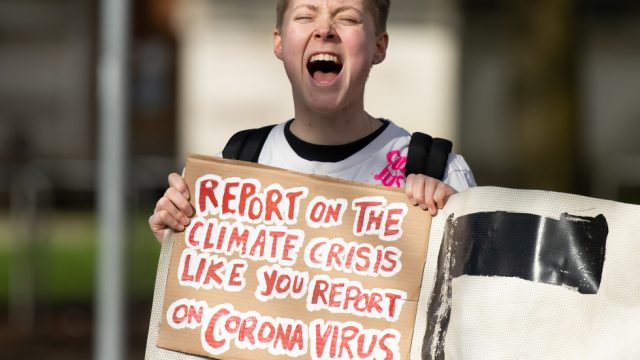
Climate Strike protestor. March 13, 2020 in Cardiff, Wales. © Matthew Horwood/Getty Images
By Frank Furedi | RT | April 1, 2020
Many hardline environmentalists are overjoyed at the atmosphere of fear that Covid-19 has created; for them, it is an instrument for realising the dream of a society that runs according to climate alarmists’ dogma.
“Some believe the pandemic is a once-in-a-generation chance to remake society and build a better future,” argues one advocate of climate alarmism.
So, in case you thought that Covid-19 is a global pandemic of catastrophic proportions, think again!
In the West, hardline environmentalists are working overtime to portray Covid-19 as payback for all the miseries that humans have inflicted on the planet. They claim that global warming, species extinction, the emergence of superbugs and the eating of meat are somehow directly or indirectly linked to the outbreak of the current pandemic. They regard the fears and anxiety generated by the current public health emergency as an opportunity to promote the message that, unless we accept their dogma, humanity will become extinct.
Some of them are positively overjoyed at the opportunity created by the climate of fear that’s all-pervasive across the world. “We’ve been trying for years to get people out of normal mode and into emergency mode,” enthused Margaret Klein Salamon, who heads the advocacy group The Climate Mobilization. She added that “what is possible politically is fundamentally different when lots of people get into emergency mode – when they fundamentally accept that there’s danger, and that if we want to be safe we need to do everything we can.”
Keeping people in a state of fear of what they euphemistically describe as ‘emergency mode’ is the objective of Klein Salamon. As she stated, “now the challenge is to keep emergency mode activated about climate.”
That’s another way of saying that perpetuating –indeed, institutionalising– a climate of fear is the main objective of this movement. From this perspective Covid-19 is not so much a tragic public health issue but an instrument for realising the dream of a society that runs according to the environmentalist dogma of misanthropic miserabilism.
What green fear entrepreneurs really hate is the spirit of human ambition, that refuses to defer to the dictates of nature. This is a spirit that is open to taking risks in order to transform the world through the use of science and technology. From the time when humans stepped out of their caves to taking the risk of travelling to space, there were always those who decided to do what was necessary to conquer their fears. The refusal not to give in to fears is always the first step towards looking for solutions that will allow us to assume greater control over our lives.
It is precisely this aspiration to take control and harness the power of nature and science that climate alarmists despise. They despise it so much that they have coined the term ‘human impact’ to suggest that what people have done to the planet is by definition wholly destructive. They hate humans’ impact on the world so much that many of them want to dramatically decrease the number of babies that are born.
According to the climate alarmist narrative, being scared for your life is the desirable state to be in. As Klein Salamon indicated, “we need to learn to be scared together, to agree on what we’re terrified about”! Why? Because collective fears will force governments to act!
Back in the 17th century, the English philosopher Thomas Hobbes anticipated the green politics of fear in his classic text, The Leviathan. Hobbes claimed that it is good when people are scared and frightened. Why? Because in their state of fear people will readily subject themselves to an absolutist ruler in exchange for his protection. One does not need a PhD in philosophy to understand that climate alarmist politics leads straight to the doorstep of the Leviathan.
Warming Improves Our Health – part 1
What’s Natural
By Jim Steel | Watts Up With That? | March 22, 2020
It’s deeply disturbing to hear people uncritically regurgitate media misinformation suggesting global warming threatens our health far worse than the COVID pandemic. Scientific evidence unequivocally shows colder weather is the major killer. As Figure 1 illustrates, the percentage of all deaths attributed to weather and temperature increases during the cold months. In contrast mortalities rates fall during warmer months. Researchers examining 74 million deaths across the globe from 1985-2012 found 7.3% were caused by temperatures cooler than the optimum compared to just 0.4% attributed to temperatures above the optimum. Extreme temperature events, both hot and cold only accounted for 0.9% of all deaths.
Likewise, a 2014 National Health Statistics reports found, “During 2006–2010, about 2,000 U.S. residents died each year from weather-related deaths. About 31% of these deaths were attributed to exposure to excessive natural heat, heat stroke, sun stroke; 63% were attributed to exposure to excessive natural cold, hypothermia, or both.” Similarly, according to the CDC , from 1979-1999, a total of 8015 deaths in the United States were heat related while 13,970 deaths were attributed to hypothermia. So why aren’t people listening to the science?

Global warming fear is based on speculation regards what could happen in the future if global average temperatures rose 2°F to 4°F. But scary predictions are not scientific fact until their hypotheses are tested and verified. Without time machines we cannot directly test predicted outcomes for the years 2050 or 2100. But we can observe the effects of a similar temperature change.
In the United States people have steadily migrated away from the cold Northeast to the warmer Southwest. In the Southwest they are exposed to higher average temperatures, temperatures equal to or greater than what global warming predicts they would endure if they remained in the Northeast. The good news, scientists determined that “migration from the Northeast to the Southwest accounts for 4% to 7% of the total gains in life expectancy experienced by the U.S. population over the past thirty years.” We can infer a similar benefit from global warming. A complementary study determined people that migrated to colder climates suffered ‘greater cardiovascular mortality” than people who remained in their native country.
Because the two major U.S. government agencies that track heat and cold deaths – and the CDC – differ sharply on which is the bigger killer, the public is rightfully confused. In contrast to the CDC results, NOAA argues heat is killing twice as many people as cold, but NOAA’s researchers have also been heavily invested in catastrophic global warming claims. By statistically adjusting the data via “seasonal detrending”, they remove the greater number of winter deaths in their analyses and just focus on extreme temperature deaths. They justify their adjustments arguing factors such as increased winter deaths due to flu season are not directly due to colder temperatures. But that obscures the health effects of temperature.
Colder temperatures reduce the effectiveness of our immune systems, which promotes influenza epidemics that may kill 34,000 to 60,000 people in a year. Because influenza season ends when temperatures warm, scientists are hoping warmer weather will similarly curtail the novel COVID-19 pandemic.
NOAA’s adjusted data focuses on deaths from heat waves and cold snaps. Indeed, there is a greater spike in deaths during heat waves, but research suggests heat waves have a small long‑term effect due to a “harvesting effect”. Us elderly and health compromised people are most vulnerable to extreme weather and epidemics. The “harvesting effect” describes an event during which vulnerable people who would have likely died over the following months instead died “prematurely” during an extreme event. But mortality rates drop in the following months because the most vulnerable have already passed. Researchers have found because mortality rates fall during the months following a heat wave there is no long‑term population effect. In contrast, cold snaps do have long-term effects as researchers found no such “harvesting effect”.
Although alarming models and media narratives suggest global warming causes more extreme heat waves, scientific data disagrees. As the EPA’s heat wave index illustrates (below), there has been no increase in heat waves as the worse heat waves happened during the 1930s.
Fortunately, heat waves are short‑lived and foreseeable. Weather forecasters detect approaching high-pressure systems that bring cloudless skies that increase solar heating. High pressure systems inhibit rising air currents that normally carry heat away. And high‑pressure systems draw warm tropical air poleward on one flank while blocking cooler air from moving south. By forecasting extreme heat waves, scientists believe we can prevent most heat wave deaths. Urban heat effects are 2°F to 10°F warmer than the countryside, thus urban dwellers should be most careful. And because elderly people who lack air conditioning are most vulnerable and less mobile, we can make sure they are moved out of harm’s way.

Jim Steele is Director emeritus of San Francisco State’s Sierra Nevada Field Campus and authored Landscapes and Cycles: An Environmentalist’s Journey to Climate Skepticism
Featured Video

The American Retreat from Vietnam
or go to
Aletho News Archives – Video-Images
From the Archives
Secret document reveals plans for civil war in Lebanon, Israeli false flags, and invasion
By Randi Nord | Geopolitics Alert | April 5, 2019
Beirut – During his visit with US Secretary of State, Mike Pompeo, Lebanese President Michael Aoun reportedly received a US-Israeli document detailing plans for creating a civil war in Lebanon with covert false flag operations and possible Israeli invasion.
Although the source of the document is Israeli and created in partnership with Washington, no one knows who presented it to Aoun. The Lebanese TV station, Al-Jadeed, initially reported the document on Lebanese TV and a video on its website. Geopolitics Alert translated the report for this article. … continue
Blog Roll
 Aletho News
- ‘Distance yourselves from Israel’: IRGC urges US population to question govt policies
- America’s Greenland deal has a radioactive backstory
- The RAF Fairford ‘terror plot’: Unpacking escalation in the UK echo-chamber
- EU Council Advances Chat Control 2.0 Scanning Proposal
- Ex-Greek MEP files complaint against Israeli spyware firm over alleged Pegasus surveillance
- Troubling ideas throughout the Torah, Talmud, Mishneh Torah and Tanya
- ‘Grave, alarming’: Iran mission on Trump’s UNGA ‘annihilation’ threats
- Najaf airport to reopen to Iranian flights within 24 hours: Ambassador
- From ‘How Will This End For Iran’ to ‘When America Walks Away’: A tale of two Economist covers
- Tehran blasts ‘baseless’ speculation linking Iran to alleged bomb plot at UK air base
- If Americans Knew
- Israel Has Kidnapped Another American Teenager
- US arms sales to Israel worth $21.6 billion in 20 months
- Three Palestinians Killed in Israeli Attacks on Gaza
- Revealed: German “Anti-Semitism Expert” Driving Crackdown on Palestine Solidarity is Former Israeli Spy
- Egypt’s Warning to Israel Before Oct 7
- Israel’s siege signals another cruel winter for 1.8 million Gazans – Daily Update
- Netanyahu Asked UAE Leader to Deny Report on Oct. 7 Warning in Secret Visit, Sources Say
- CNN Chief Int’l Correspondent Clarissa Ward on Journalists in Gaza
- Democratic Party Consultants Surround Troy Jackson with Pro-Israel Donors
- Christian Leader Responds To Netanyahu’s Claims Regarding Palestinian Christians
- No Tricks Zone
- New Study: Earth And Venus Surface Warmth Largely Explained By Convection And Lapse Rate, Not CO2 Or Radiation
- 2025 Nature Paper Claiming Worsening Global Drought Gets RETRACTED …Heavily Flawed
- New Study: ‘Global Drought Shows No Detectable Recent Acceleration Under Climate Warming’
- Economic Masterminds: German Socialists Suggest Taxing Productivity Gains Stemming From Using AI
- The South China Sea Has Not Been Cooperating With The Climate Change Narrative
- Energy Crisis: Germany Enters Heating Season With Historically Low Gas Reserve Fill Levels
- New Study: The Antarctic Ice Sheet Gained Mass From 2020-2024 Due To Staggering Snow And Ice Accumulation
- Study: Ocean Heating Rates From Thousands Of Years Ago ‘Dwarf’ Modern Ocean Heating Rates
- Climate Extremists Target, Attack Large-Scale Power Grid Infrastructure In Germany!
- New Study: Antarctic Ice Melt Has Contributed Less Than 1 Centimeter To Sea Level Rise In The Last 30 Years

