The New York Times is looking for a climate change editor
Drone footage that shows Greenland melting away. Long narratives about the plight of climate refugees, from Louisiana to Bolivia and beyond. A series on the California drought. Color-coded maps that show how hot it could be in 2060.
The New York Times is a leader in covering climate change. Now The Times is ramping up its coverage to make the most important story in the world even more relevant, urgent and accessible to a huge audience around the globe.
We are looking for an editor to lead this dynamic new group. We want someone with an entrepreneurial streak who is obsessed with finding new ways to connect with readers and new ways to tell this vital story.
The coverage should encompass: the science of climate change; the politics of climate debates; the technological race to find solutions; the economic consequences of climate change; and profiles of fascinating characters enmeshed in the issues.
The coverage should include journalism in a variety of formats: video, photography, newsletters, features, podcasts, conferences and more. The unit should make strategic decisions about which forms are top priorities and which are not.
The climate editor will collaborate with many others throughout the newsroom, but will operate apart from the current department structure, with no print obligations. —
To Apply
Applicants should submit a resume, examples of previous work, and a memo outlining their vision for coverage to Dean Baquet and Sam Dolnick by Sept. 19. This vision is the most important part of the application. It should be specific and set clear priorities. Some important questions to wrestle with:
What audiences should we be focusing on?
How will our coverage fit into their lives, and how will they experience it?
How will we distinguish our coverage from other journalism in this space?
What will be the main vehicles for the coverage? Features? News? Videos?
Should there be a signature voice attached to our climate coverage? Who?
How will you make a difficult subject interesting and accessible?
What stories are we willing not to do?
What should the team look like to get it done?
This non-Guild position is open to internal and external candidates. Applications should be sent to nytrecruit@nytimes.com.
Guardian “Facebook fact-check ” on 9/11 – every bit as poor as you would expect
By Catte | OffGuardian | September 10, 2016
The Guardian is no better at telling the truth about the nature of the 9/11 debate than about Syria, Ukraine or indeed anything. Its recent bid at being both social-media savvy and weirdly Orwellian, “Facebook Fact Check”, has this little snippet up atm:

The paper they are referring to is On the Physics of High Rise Building Collapses, which we have published here, and the “professor” who, according to them, “left Brigham Young University in disgrace” is of course physicist Steve Jones, who was the subject of a hostile media campaign after he and his BYU research team claimed to have discovered evidence of nanothermite in tiny “red gray chips” found in the dust from the WTC explosions.
For the record, Jones’ research work on the red gray chips has been challenged, but never debunked, and his experiments have been replicated successfully by independent researchers elsewhere in the world, such as Mark Bazile. Jones was suspended from his teaching duties and then offered “early retirement” by BYU in 2006 in the midst of the media campaign against him.
BYU’s reasons for this action were never publicly disclosed but the Guardian’s claim that Jones was “disgraced” is little more than a sleazy bit of innuendo, so gross it doesn’t even appear in the sourced WaPo article, which does at least try to be a tad objective. “Disgrace” is just the Graun’s own little bit of tabloidese. Because tabloid is all it seems to do now.
Jones’ three co-authors are described in this piece as “a retired professor and two longterm 9/11 truthers.” I guess the Graun didn’t want to admit two of them are structural engineers as well as being “truthers”?
When the (ironically named?) “fact-check” briefly discusses the physics of 9/11, it’s simply to offer yet more deception. The investigation by serious professionals of the still not fully explained and extraordinary triple collapses on 9/11 is listed along with claims we didn’t go to the Moon and some random nonsense about Hillary Clinton, presumably in some attempt to discredit by proximity. Instead of honestly addressing the very real areas of uncertainty which the scientists of NIST have quite openly admitted, the Graun does what many other agenda-driven “debunkers” do and tries to reframe the issue as being between “settled science” (to borrow a term) on one side and crazy, discredited or otherwise unreliable kooks on the other.
This, we need to clearly understand, is a purely propagandist ploy meant to convince only the under-informed “masses” (ie us), and not those on either side versed in the real issues. If you read their report and other commentaries, the experts of the National Institute of Standards and Technology are well aware that the explanation they have produced for the 9/11 building collapses is neither complete nor beyond rational question. They are well aware there is plenty of room for science-based interrogation and counter-hypothesis.
But for some reason it seems to be very important to the manufacturers of consent that we, the public, are not made aware of these continuing and probably understandable uncertainties. So, through outlets such as the Guardian (and many others) they disseminate simplistic statements, soundbites and frank lies, designed to convince people that what is uncertain, poorly explained and capable of interpretation is simple, settled, dusted and done.
The link the Guardian provides that is alleged to “disprove” all such “conspiracy theories” is to the 2005 Popular Mechanics article that did indeed claim to do this. The Guardian doesn’t mention that this article has itself been “debunked” and makes several provably false assertions.
If the fire-induced collapse explanation for the events of 9/11 is really beyond debate, why do outlets such as the Graun (and indeed Popular Mechanics) not make this self-evident by simply allowing both sides to place their evidence before the public on their pages, so that readers can make up their own minds? Outlets don’t need to take a side and defend it. In fact they work best when they try to avoid this and do their best to offer argument from all sides.
We aren’t claiming Jones and his co-authors are ultimately correct. We’re just pointing out that scientific truth doesn’t need to be defended by spin or censorship or grotesque ad hominem.
Jill Stein Predicts One Foot Of Sea Level Rise Per Year
By Marc Morano | Climate Depot | September 7, 2016

The people at NOAA who actually study sea level say it is rising less than seven inches per century.
the absolute global sea level rise is believed to be 1.7-1.8 millimeters/year.
On the physics of high-rise building collapses

By Steve Jones, Robert Korol, Anthony Szamboti and Ted Walter – Europhysics News
In August 2002, the U.S. National Institute of Standards and Technology (NIST) launched what would become a six-year investigation of the three building failures that occurred on September 11, 2001 (9/11):
- the well-known collapses of the World Trade Center (WTC) Twin Towers that morning and
- the lesser-known collapse late that afternoon of the 47-story World Trade Center Building 7, which was not struck by an airplane.
NIST conducted its investigation based on the stated premise that the
WTC Towers and WTC 7 [were] the only known cases of total structural collapse in high-rise buildings where fires played a significant role.”
Indeed, neither before nor since 9/11 have fires caused the total collapse of a steel-framed high-rise—nor has any other natural event, with the exception of the 1985 Mexico City earthquake, which toppled a 21-story office building. Otherwise, the only phenomenon capable of collapsing such buildings completely has been by way of a procedure known as controlled demolition, whereby explosives or other devices are used to bring down a structure intentionally.
Although NIST finally concluded after several years of investigation that all three collapses on 9/11 were due primarily to fires, fifteen years after the event a growing number of architects, engineers, and scientists are unconvinced by that explanation.
Preventing high-rise failures
Steel-framed high-rises have endured large fires without suffering total collapse for four main reasons:
- Fires typically are not hot enough and do not last long enough in any single area to generate enough energy to heat the large structural members to the point where they fail (the temperature at which structural steel loses enough strength to fail is dependent on the factor of safety used in the design. In the case of WTC 7, for example, the factor of safety was generally 3 or higher. Here, 67% of the strength would need to be lost for failure to ensue, which would require the steel to be heated to about 660°C);
- Most high-rises have fire suppression systems (water sprinklers), which further prevent a fire from releasing sufficient energy to heat the steel to a critical failure state;
- Structural members are protected by fireproofing materials, which are designed to prevent them from reaching failure temperatures within specified time periods; and
- Steel-framed high-rises are designed to be highly redundant structural systems. Thus, if a localized failure occurs, it does not result in a disproportionate collapse of the entire structure.

FIG.1:WTC5 is an example of how steel- framed high-rises typically perform in large fires. It burned for over eight hours on September 11, 2001 (a), and did not suffer a total collapse (b) (Source: FEmA)
Throughout history, three steel-framed high-rises are known to have suffered partial collapses due to fires; none of those led to a total collapse. Countless other steel-framed high-rises have experienced large, long-lasting fires without suffering either partial or total collapse (see, for example, Fig. 1 a and b) [1].
In addition to resisting ever-present gravity loads and occasional fires, high-rises must be designed to resist loads generated during other extreme events — in particular, high winds and earthquakes. Designing for high-wind and seismic events mainly requires the ability of the structure to resist lateral loads, which generate both tensile and compressive stresses in the columns due to bending, the latter stresses then being combined with gravity-induced compressive stresses due to vertical loads.

FIG.2: WTC7fell symmetrically and at free-fall acceleration for a period of 2.25 seconds of its collapse (Source: NIST).
It was not until steel became widely manufactured that the ability to resist large lateral loads was achieved and the construction of high-rises became possible. Steel is both very strong and ductile, which allows it to withstand the tensile stresses generated by lateral loads, unlike brittle materials, such as concrete, that are weak in tension. Although concrete is used in some high-rises today, steel reinforcement is needed in virtually all cases.
To allow for the resistance of lateral loads, high-rises are often designed such that the percentage of their columns’ load capacity used for gravity loads is relatively low. The exterior columns of the Twin Towers, for example, used only about 20% of their capacity to withstand gravity loads, leaving a large margin for the additional lateral loads that occur during high-wind and seismic events [2].
Because the only loads present on 9/11 after the impact of the airplanes were gravity and fire (there were no high winds that day), many engineers were surprised that the Twin Towers completely collapsed. The towers, in fact, had been designed specifically to withstand the impact of a jetliner, as the head structural engineer, John Skilling, explained in an interview with the Seattle Times following the 1993 World Trade Center bombing:
“Our analysis indicated the biggest problem would be the fact that all the fuel (from the airplane) would dump into the building. There would be a horrendous fire. A lot of people would be killed,” he said. “The building structure would still be there.”
Skilling went on to say he didn’t think a single 200-pound [90-kg] car bomb would topple or do major structural damage to either of the Twin Towers.
“However,” he added, “I’m not saying that properly applied explosives—shaped explosives—of that magnitude could not do a tremendous amount of damage […] I would imagine that if you took the top expert in that type of work and gave him the assignment of bringing these buildings down with explosives, I would bet that he could do it.”
In other words, Skilling believed the only mechanism that could bring down the Twin Towers was controlled demolition.
Techniques of controlled demolition
Controlled demolition is not a new practice. For years it was predominantly done with cranes swinging heavy iron balls to simply break buildings into small pieces. Occasionally, there were structures that could not be brought down this way. In 1935, the two 191-m-tall Sky Ride towers of the 1933 World’s Fair in Chicago were demolished with 680 kg of thermite and 58 kg of dynamite. Thermite is an incendiary containing a metal powder fuel (most commonly aluminum) and a metal oxide (most com- monly iron(III) oxide or “rust”).
Eventually, when there were enough large steel-framed buildings that needed to be brought down more efficiently and inexpensively, the use of shaped cutter charges became the norm. Because shaped charges have the ability to focus explosive energy, they can be placed so as to diagonally cut through steel columns quickly and reliably.

FIG. 3: The final frame of NIST’s WTC 7 computer model shows large deformations to the exterior not observed in the videos (Source: NIST)
In general, the technique used to demolish large buildings involves cutting the columns in a large enough area of the building to cause the intact portion above that area to fall and crush itself as well as crush whatever remains below it.
This technique can be done in an even more sophisticated way, by timing the charges to go off in a sequence so that the columns closest to the center are destroyed first. The failure of the interior columns creates an inward pull on the exterior and causes the majority of the building to be pulled inward and downward while materials are being crushed, thus keeping the crushed materials in a somewhat confined area — often within the building’s “footprint.” This method is often referred to as “implosion.”
The case of WTC 7
The total collapse of WTC 7 at 5:20 PM on 9/11, shown in Fig. 2, is remarkable because it exemplified all the signature features of an implosion:
- The building dropped in absolute free fall for the first 2.25 seconds of its descent over a distance of 32 meters or eight stories [3].
- Its transition from stasis to free fall was sudden, occurring in approximately one-half second.
- It fell symmetrically straight down.
- Its steel frame was almost entirely dismembered and deposited mostly inside the building’s footprint, while most of its concrete was pulverized into tiny particles.
- Finally, the collapse was rapid, occurring in less than seven seconds.
Given the nature of the collapse, any investigation adhering to the scientific method should have seriously considered the controlled demolition hypothesis, if not started with it. Instead, NIST (as well as the Federal Emergency Management Agency (FEMA), which conducted a preliminary study prior to the NIST investigation) began with the predetermined conclusion that the collapse was caused by fires.
![FIG.4: The above graph[10]comparesDavid Chandler’s measurement[9] of the velocity of the roofline of WTC 1 with Bažant’s erroneous calculation [11] and with Szamboti and Johns’ calculation using corrected input values for mass, acceleration through the first story, conservation of momentum, and plastic moment (the maximum bending moment a structural section can withstand). The calculations show that—in the absence of explosives—the upper section of WTC 1 would have arrested after falling for two stories (Source: Ref. [10]).](https://offgraun.files.wordpress.com/2016/09/screen-shot-2016-09-07-at-15-12-48.png)
FIG.4: The above graph[10]compares David Chandler’s measurement[9] of the velocity of the roofline of WTC 1 with Bažant’s erroneous calculation [11] and with Szamboti and Johns’ calculation using corrected input values for mass, acceleration through the first story, conservation of momentum, and plastic moment (the maximum bending moment a structural section can withstand). The calculations show that—in the absence of explosives—the upper section of WTC 1 would have arrested after falling for two stories (Source: Ref. [10]).
Trying to prove this predetermined conclusion was apparently difficult. FEMA’s nine-month study concluded by saying, “The specifics of the fires in WTC 7 and how they caused the building to collapse remain unknown at this time. Although the total diesel fuel on the premises contained massive potential energy, the best hypothesis has only a low probability of occurrence.”NIST, meanwhile, had to postpone the release of its WTC 7 report from mid-2005 to November 2008. As late as March 2006, NIST’s lead investigator, Dr. Shyam Sunder, was quoted as saying,
Truthfully, I don’t really know. We’ve had trouble getting a handle on building No. 7.
All the while, NIST was steadfast in ignoring evidence that conflicted with its predetermined conclusion. The most notable example was its attempt to deny that WTC 7 underwent free fall. When pressed about that matter during a technical briefing, Dr. Sunder dismissed it by saying,
[A] free-fall time would be an object that has no structural components below it.
But in the case of WTC 7, he claimed,
there was structural resistance that was provided.
Only after being challenged by high school physics teacher David Chandler and by physics professor Steven Jones (one of the authors of this article), who had measured the fall on video, did NIST acknowledge a 2.25-second period of free fall in its final report. Yet NIST’s computer model shows no such period of free fall, nor did NIST attempt to explain how WTC 7 could have had “no structural components below it” for eight stories.
Instead, NIST’s final report provides an elaborate scenario involving an unprecedented failure mechanism: the thermal expansion of floor beams pushing an adjoining girder off its seat. The alleged walk-off of this girder then supposedly caused an eight-floor cascade of floor failures, which, combined with the failure of two other girder connections — also due to thermal expansion — left a key column unsupported over nine stories, causing it to buckle.
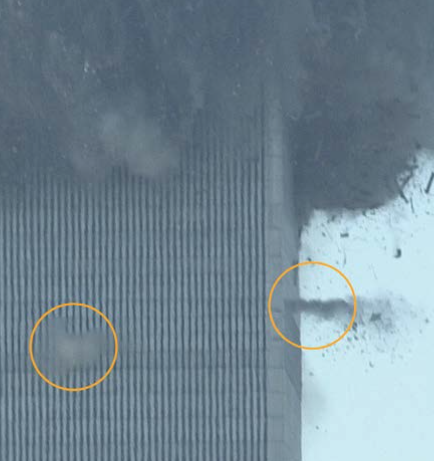
FIG. 5: High-velocity bursts of debris, or “squibs,” were ejected from point-like sources in WTC 1 and WTC 2, as many as 20 to 30 stories below the collapse front (Source: Noah K. murray).
This single column failure allegedly precipitated the collapse of the entire interior structure, leaving the exterior unsupported as a hollow shell. The exterior columns then allegedly buckled over a two-second period and the entire exterior fell simultaneously as a unit [3].
NIST was able to arrive at this scenario only by omitting or misrepresenting critical structural features in its computer modelling.[4] Correcting just one of these errors renders NIST’s collapse initiation indisputably impossible. Yet even with errors that were favorable to its predetermined conclusion, NIST’s computer model (see Fig. 3) fails to replicate the observed collapse, instead showing large deformations to the exterior that are not observed in the videos and showing no period of free fall. Also, the model terminates, without explanation, less than two seconds into the seven-second collapse.
Unfortunately, NIST’s computer modelling cannot be independently verified because NIST has refused to release a large portion of its modelling data on the basis that doing so “might jeopardize public safety.”
The case of the Twin Towers
Whereas NIST did attempt to analyze and model the collapse of WTC7, it did not do so in the case of the Twin Towers. In NIST’s own words,
The focus of the investigation was on the sequence of events from the instant of aircraft impact to the initiation of collapse for each tower…. this sequence is referred to as the ‘probable collapse sequence,’ although it includes little analysis of the structural behaviour of the tower after the conditions for collapse initiation were reached and collapse became inevitable.”[5]
Thus, the definitive report on the collapse of the Twin Towers contains no analysis of why the lower sections failed to arrest or even slow the descent of the upper sections — which NIST acknowledges “came down essentially in free fall” [5-6]— nor does it explain the various other phenomena observed during the collapses.
When a group of petitioners filed a formal Request for Correction asking NIST to perform such analysis, NIST replied that it was
unable to provide a full explanation of the total collapse
because
the computer models [were] not able to converge on a solution.
However, NIST did do one thing in an attempt to substantiate its assertion that the lower floors would not be able to arrest or slow the descent of the upper sections in a gravity-driven collapse. On page 323 of NCSTAR 1-6, NIST cited a paper by civil engineering professor Zdeněk Bažant and his graduate student, Yong Zhou, that was published in January 2002 [7] which, according to NIST, “addressed the question of why a total collapse occurred” (as if that question were naturally outside the scope of its own investigation).

FIG. 6: molten metal was seen pouring out of WTC 2 continuously for the seven minutes leading up to its collapse (Sources: WABC-Tv, NIST).
In their paper, Bažant and Zhou claimed there would have been a powerful jolt when the falling upper section impacted the lower section, causing an amplified load sufficient to initiate buckling in the columns. They also claimed that the gravitational energy would have been 8.4 times the energy dissipation capacity of the columns during buckling.
In the years since, researchers have measured the descent of WTC 1’s upper section and found that it never decelerated — i.e. there was no powerful jolt [8-9]. Researchers have also criticized Bažant’s use of free-fall acceleration through the first story of the collapse, when measurements show it was actually roughly half of gravitational acceleration [2]. After falling for one story, the measurements show a 6.1 m/s velocity instead of the 8.5 m/s velocity that would be the result of free fall. This difference in velocity effectively doubles the kinetic energy, because it is a function of the square of the velocity.
In addition, researchers have demonstrated that the 58 × 106 kg mass Bažant used for the upper section’s mass was the maximum design load—not the actual 33 × 106 kg service load [10]. Together, these two errors embellished the kinetic energy of the falling mass by 3.4 times. In addition, it has been shown that the column energy dissipation capacity used by Bažant was at least 3 times too low [2].
In January 2011 [11] Bažant and another graduate student of his, Jia-Liang Le, attempted to dismiss the lack-of-deceleration criticism by claiming there would be a velocity loss of only about 3%, which would be too small to be observed by the camera resolution. Le and Bažant also claimed conservation-of-momentum velocity loss would be only 1.1%. However, it appears that Le and Bažant erroneously used an upper section mass of 54.18 × 10⁶ kg and an impacted floor mass of just 0.627 × 10⁶ kg, which contradicted the floor mass of 3.87 × 10⁶ kg Bažant had used in earlier papers.
The former floor mass is representative of the concrete floor slab only, whereas the latter floor mass includes all the other materials on the floor. Correcting this alone increases the conservation-of-momentum velocity loss by more than 6 times, to a value of 7.1%. Additionally, the column energy dissipation has been shown to be far more significant than Bažant claimed. Researchers have since provided calculations showing that a natural collapse over one story would not only decelerate, but would actually arrest after one or two stories of fall (see Fig. 4) [2, 10].
Other evidence unexplained
The collapse mechanics discussed above are only a fraction of the available evidence indicating that the airplane impacts and ensuing fires did not cause the collapse of the Twin Towers. Videos show that the upper section of each tower disintegrated within the first four seconds of collapse. After that point, not a single video shows the upper sections that purportedly descended all the way to the ground before being crushed.
Videos and photographs also show numerous high-velocity bursts of debris being ejected from point-like sources (see Fig. 5). NIST refers to these as “puffs of smoke” but fails to properly analyze them [6]. NIST also provides no explanation for the midair pulverization of most of the towers’ concrete, the near-total dismemberment of their steel frames, or the ejection of those materials up to 150 meters in all directions.
NIST sidesteps the well-documented presence of molten metal throughout the debris field and asserts that the orange molten metal seen pouring out of WTC 2 for the seven minutes before its collapse was aluminum from the aircraft combined with organic materials (see Fig. 6) [6].
Yet experiments have shown that molten aluminum, even when mixed with organic materials, has a silvery appearance — thus suggesting that the orange molten metal was instead emanating from a thermite reaction being used to weaken the structure [12]. Meanwhile, unreacted nano-thermitic material has since been discovered in multiple independent WTC dust samples [13].
As for eyewitness accounts, some 156 witnesses, including 135 first responders, have been documented as saying that they saw, heard, and/or felt explosions prior to and/or during the collapses [14]. That the Twin Towers were brought down with explosives appears to have been the initial prevailing view among most first responders. “I thought it was exploding, actually,” said John Coyle, a fire marshal.“Everyone I think at that point still thought these things were blown up” [15].
Conclusion
It bears repeating that fires have never caused the total collapse of a steel-framed high-rise before or since 9/11. Did we witness an unprecedented event three separate times on September 11, 2001? The NIST reports, which attempted to support that unlikely conclusion, fail to persuade a growing number of architects, engineers, and scientists. Instead, the evidence points overwhelmingly to the conclusion that all three buildings were destroyed by controlled demolition. Given the far-reaching implications, it is morally imperative that this hypothesis be the subject of a truly scientific and impartial investigation by responsible authorities.
ABOUT THE AUTHORS
Steven Jones is a former full professor of physics at Brigham Young University. His major research interests have been in the areas of fusion, solar energy, and archaeometry. He has authored or co-authored a number of papers documenting evidence of extremely high temperatures during the WTC destruction and evidence of unreacted nano-thermitic material in the WTC dust.
Robert Korol is a professor emeritus of civil engineering at McMaster University in Ontario, Canada, as well as a fellow of the Canadian Society for Civil Engi- neering and the Engineering Institute of Canada. His major research interests have been in the areas of structural mechanics and steel structures. More recently, he has undertaken experimen- tal research into the post-buckling resistance of H-shaped steel columns and into the energy absorption associated with pulverization of concrete floors.
Anthony Szamboti is a mechanical design engineer with over 25 years of structural design experience in the aerospace and communications industries. Since 2006, he has authored or co-authored a number of technical papers on the WTC high-rise failures that are published in the Journal of 9/11 Studies and in the International Journal of Protective Structures.
Ted Walter is the director of strategy and development for Architects & En- gineers for 9/11 Truth (AE911Truth), a nonprofit organization that today represents more than 2,500 architects and engineers. In 2015, he authored AE-911Truth’s Beyond Misinformation: What Science Says About the Destruction of World Trade Center Buildings 1, 2, and 7. He holds a Master of Public Policy degree from the University of California, Berkeley.
References
[1] NIST: Analysis of Needs and Existing Capabilities for Full-Scale Fire Resistance Testing (October 2008).
[2] G. Szuladziński and A. Szamboti and R. Johns, International Journal of Protective Structures 4, 117 (2013).
[3] NIST: Final Report on the Collapse of World Trade Center Building 7, Federal Building and Fire Safety Investigation of the World Trade Center Disaster (November 20, 2008).
[4] R. Brookman, A Discussion of ‘Analysis of Structural Response of WTC 7 to Fire and Sequential Failures Leading to Collapse, Journal of 9/11 Studies (October 2012).
[5] NIST: Final Report of the National Construction Safety Team on the Collapses of the World Trade Center Towers (December 1, 2005).
[6] NIST: Questions and Answers about the NIST WTC Towers Investi- gation (Updated September 19, 2011).
[7] Z. Bažant, Y. Zhou, Yong, Journal of Engineering Mechanics 128, 2 (2002).
[8] A. Szamboti and G. MacQueen, The Missing Jolt: A Simple Refu- tation of the NIST-Bažant Collapse Hypothesis, Journal of 9/11 Studies (April 2009).
[9] D. Chandler, The Destruction of the World Trade Center North Tower and Fundamental Physics, Journal of 9/11 Studies (February 2010).
[10] A. Szamboti and R. Johns, ASCE Journals Refuse to Correct Fraudulent Paper Published on WTC Collapses, Journal of 9/11 Studies (September 2014).
[11] J.-L. Le and Z. Bažant, Journal of Engineering Mechanics 137, 82 (2011).
[12] S. Jones, Why Indeed Did the WTC Buildings Collapse Completely? Journal of 9/11 Studies (September 2006).
[13] N. Harrit et al., Open Chemical Physics Journal (April 2009).
[14] G. MacQueen, Eyewitness Evidence of Explosions in the Twin Towers, Chapter Eight, The 9/11 Toronto Report, Editor: James Gourley (November 2012).
[15] Fire Department of New York (FDNY): World Trade Center Task Force Interviews, The New York Times (October 2001 to January 2002).
Senator Markey’s Climate Education Act Goes The Wrong Way
By David Wojick | Climate Etc. | September 5, 2016
The “Climate Change Education Act” (S.3074) directs the National Oceanic and Atmospheric Administration (NOAA) to establish a climate change education program focused on formal and informal learning for all age levels.
When it comes to beating the climate change drum, Sen. Ed Markey is the Energizer Bunny. As a Congressman, Rep. Markey was Chairman of the now defunct House Select Committee on Energy Independence and Global Warming from 2007 to 2011. This time he is drumming on the education front. Markey has dropped the “Climate Education Act” into the Senate hopper. While the bill is unlikely to pass at this time, it is still important to object to, lest it be seen to be acceptable.
Sen. Markey’s website summarizes the proposal as follows: “The “Climate Change Education Act” (S.3074) directs the National Oceanic and Atmospheric Administration (NOAA) to establish a climate change education program focused on formal and informal learning for all age levels. The program would explore solutions to climate change, the dangers we face in a warming world, and relatively small changes in daily routines that can have a profound global impact. The legislation also establishes a grant program to support public outreach programs that improve access to clean energy jobs and research funds so local communities can address climate mitigation and adaptation issues.”
There is a lot not to like here, beginning with the false scientific claims. The first is hyping the supposed dangers we face in a warming world, which simply do not exist. Nor are there small changes in daily routines that can have a profound global impact, because humans do not control the global climate. What is here being called Education is really just scaremongering and propaganda. Ironically, the Bill itself says one goal is to remove the fear of climate change, which it actually promotes.
What is really strange is the focus on so-called clean energy jobs and technology. The term “clean energy” is a misleading euphemism for renewable technologies. Thus the thrust of the Bill is not just on climate science education; rather it is on using the education system to promote renewables. NOAA has no expertise in this regard and no mission. They do things like running the National Weather Service. Promoting renewables and green workforce development is the Energy Department’s job.
On the science side, NOAA has long been active in so-called “climate education,” which basically means spreading the Government’s biased view of climate change as human driven and dangerous. For example, the Climate Literacy and Energy Awareness Network (CLEAN) Portal was launched in 2010, co-sponsored by NOAA, NSF and the Energy Department. As of 2012, CLEAN has been syndicated to NOAA’s climate.gov portal, where they offer over 600 educational materials, most of which are biased toward the scary Federal version of climate science.
In fact NOAA has led a Federal drive to redefine “climate literacy” as accepting the Government’s biased position. According to their website, the stated Guiding Principle for climate literacy is “Humans can take actions to reduce climate change and its impacts.” The reality is that humans can do little to change climate change and a little global warming is not harmful. It is probably beneficial.
What the proposed Climate Education Act would do is give statutory authority for NOAA’s existing propaganda actions, something that is presently lacking. It also allows the agency to bribe states to use its stuff, which is pretty insidious.
It would also allow NOAA to go beyond simply providing online information, to begin writing actual curriculums to be used in the classroom. That is where the bribery really comes in. This curricular push coincides with the widespread deployment of the Next Generation Science Standards. Most states that adopt them need to develop new curriculums, because these science standards are very different from the existing state standards, especially in the area of climate change.
Beyond this, the Bill would put NOAA into the strange new business of promoting the renewable energy industry and training its workers. The Energy Department already does this, while NOAA has neither the mission nor the organization to do it.
In summary this so-called Climate Education Act does nothing that is good, for the climate or the students. It is based on false science and pushes NOAA in the wrong direction. NOAA should be trying to understand climate change, not promote renewable technologies in the name of dangerous global warming.
Press coverage is bad, buying the Bill as expected. See for example these:
Professors tell students: Drop class if you dispute man-made climate change
‘We will not, at any time, debate the science of climate change’
By Kate Hardiman | The College Fix | August 31, 2016
Three professors co-teaching an online course called “Medical Humanities in the Digital Age” at the University of Colorado-Colorado Springs recently told their students via email that man-made climate change is not open for debate, and those who think otherwise have no place in their course.
“The point of departure for this course is based on the scientific premise that human induced climate change is valid and occurring. We will not, at any time, debate the science of climate change, nor will the ‘other side’ of the climate change debate be taught or discussed in this course,” states the email, a copy of which was provided to The College Fix by a student in the course.
Signed by the course’s professors Rebecca Laroche, Wendy Haggren and Eileen Skahill, it was sent after several students expressed concern for their success in the course after watching the first online lecture about the impacts of climate change.
“Opening up a debate that 98% of climate scientists unequivocally agree to be a non-debate would detract from the central concerns of environment and health addressed in this course,” the professors’ email continued.
“… If you believe this premise to be an issue for you, we respectfully ask that you do not take this course, as there are options within the Humanities program for face to face this semester and online next.”
The professors also note this ban on debate extends to discussion among students in the online forums. Moreover, students who choose to use outside sources for research during their time in the course may select only those that have been peer-reviewed by the Intergovernmental Panel on Climate Change, the email states.

Professors Laroche, Skahill, and Haggren did not respond to email inquiries from The College Fix seeking further comment on their email or their stance on debate in their online class.
The University Communications Director Tom Hutton told The College Fix via email that “Humanities 3990 is a special topics course with multiple choices for students to take when fulfilling requirements.”
“By clearly stating the class focus,” he continued, “the faculty are allowing students to choose if they wish to enroll in the course or seek an alternative. Additionally, the faculty who are leading the course have offered to discuss it with students who have concerns or differing opinions.”
In addition to teaching man-made climate change, the course also delves into the “health effects of fracking,” according to its syllabus.
The reading assignments in the fracking section focus on only its negative impacts and fail to present the other side of the issue, namely the possible benefits of fracking.
Assigned readings includes: “4 States Struggling to Maintain Radioactive Fracking Waste,” “EPA Study on Fracking Ignored Contamination Studies,” and “Frack Free Colorado: ‘Colorado’s Affected People.’”
An activity assigned within that section instructs students to take a test to measure their own carbon footprint. The purpose, reads the syllabus, “is not to create guilt or shame, though those emotions are entirely common.”
Kate Hardiman is a student at the University of Notre Dame majoring in the Program of Liberal Studies and minoring in the Philosophy, Political Science, and Economics (PPE) Program. She serves as campus editor of the Irish Rover and is a fellow of both the Constitutional Studies Department and Center for Ethics and Culture.
Still The BBC Gives Air Time To Peter Wadhams
By Paul Homewood | Not A Lot Of People Know That | August 31, 2016

I gather that the embarrassment to science, Peter Wadhams, was on BBC News again this week, and was naturally treated with due deference and reverence.
Wadhams has, of course, made a living out of forecasting that the Arctic would be ice free for the last decade now. Neither he, nor the BBC, ever seem to learn from the way that his predictions repeatedly turn out to be such humiliating failures.
Only in June this year, he was at it again:
The Arctic is on track to be free of sea ice this year or next for the first time in more than 100,000 years, a leading scientist has claimed.
Provisional satellite data produced by the US National Snow & Ice Data Centre shows there were just over 11.1 million square kilometres of sea ice on 1 June this year, compared to the average for the last 30 years of nearly 12.7 million square kilometres.
This difference – more than 1.5 million square kilometres – is about the same size as about six United Kingdoms.
Professor Peter Wadhams, head of the Polar Ocean Physics Group at Cambridge University, told The Independent that the latest figures largely bore out a controversial prediction he made four years ago.
“My prediction remains that the Arctic ice may well disappear, that is, have an area of less than one million square kilometres for September of this year,” he said.
“Even if the ice doesn’t completely disappear, it is very likely that this will be a record low year. I’m convinced it will be less than 3.4 million square kilometres [the current record low].
“I think there’s a reasonable chance it could get down to a million this year and if it doesn’t do it this year, it will do it next year.
Yes, of course, there is always next year!
Well, with just a couple of weeks or so left before the Arctic ice hits its minimum, this is what Wadhams’ “ice free Arctic” is looking like:

http://ocean.dmi.dk/arctic/icethickness/images/FullSize_CICE_combine_thick_SM_EN_20160830.png
Back in 2007, when Wadhams began to run his peddle his scare stories, the Arctic looked much different. Not only was ice extent much lower then, it was also much thinner in that area.

http://ocean.dmi.dk/arctic/icethickness/thk.uk.php
Meanwhile, average ice thickness is currently running much higher than it was from 2010-13. (Average thickness is lower than 2007 because much of the new ice is, naturally, fairly new and therefore thin).

http://psc.apl.uw.edu/research/projects/arctic-sea-ice-volume-anomaly/
Final word goes to that BBC report from 2012:

The loss of Arctic ice is massively compounding the effects of greenhouse gas emissions, ice scientist Professor Peter Wadhams has told BBC Newsnight…….
The melting ice could have knock-on effects in the UK. Adam Scaife, from the Met Office Hadley Centre told Newsnight it could help explain this year’s miserable wet summer, by altering the course of the jet stream.
“Some studies suggest that there is increased risk of wet, low pressure summers over the UK as the ice melts.”
There may be an effect for our winters too: “Winter weather could become more easterly cold and snowy as the ice declines,” Mr Scaife said.
Or, to put it another way, summers could become warmer and drier, and winters mild and wet! (Which just so happens to be, very conveniently, the latest Met Office thinking).
There is only one certainty in climate science these days – the BBC will continue to give broadcasting time to these charlatans, without a glimmer of critical journalism, and certainly no thought of offering time to those scientists who don’t agree wholeheartedly with the alarmist narrative.
Alarm over the public loss of trust in science
By Judith Curry | Climate Etc. | August 18, 2016
A blast of fresh air from the new Editor-in-Chief of Science. “Science editor-in-chief sounds alarm over falling public trust. Jeremy Berg warns scientists are straying into policy commentator roles.”
You may recall my previous article that bemoaned what was going on with the journal Science — Editor-in-Chief Marcia McNutt’s op-ed that was published in Science : Beyond the two-degree inferno. If you read my post on this (at the link), I can’t recall much that has disturbed me more than McNutt’s overt alarmisn and advocacy in the context of her role as Editor-in-Chief of Science.
A summary of my concerns:
… my main concern is this – the editorial was published in Science and written by McNutt who is the CHIEF EDITOR for Science. Science, along with Nature, has far and away the highest impact factor of any scientific journals on the planet – Science matters. Like Nature, Science sends out for review only a small fraction of the submitted papers. Apart from the role the Chief Editor may have in selecting which papers go out for review or eventually get published, this essay sends a message to the other editors and reviewers that papers challenging the consensus are not to be published in Science. Not to mention giving favored status to papers by activist authors that sound the ‘alarm’ – pal review and all that. After all, ‘the time for debate has ended.’
Well, Marcia McNutt has moved on, she is now President of the National Academy of Sciences. I have a separate set of concerns about that one, but at least she is no longer involved in the arbitration of published scientific research in the U.S.’s premier science journal.
There is a new Editor-in-Chief at Science: Jeremy Berg. See the press release from Science [link]. Excerpts:
Jeremy Berg, a biochemist and administrator at the University of Pittsburgh (Pitt) in Pennsylvania, will become the next editor-in-chief of Science magazine on 1 July. A former director of the National Institute of General Medical Sciences (NIGMS) who has a longstanding interest in science policy.
Times Higher Education has a new article on this: Science Editor-in-Chief Sounds Alarm Over Falling Public Trust.
Well the title certainly caught my attention. Lets take a look at what Jeremy Berg has to say about his new position. Excerpts from the Times article:
As the new editor-in-chief of Science, a highly selective journal that still has the controversial power to make scientific careers, the biochemist and former University of Pittsburgh senior manager is worried about an apparent rejection of science by some parts of the public – and thinks that academics should look closely at how their own behaviour may have contributed.
“One of the things that drew me to this position… is there’s a crisis in public trust in science. I don’t pretend to have answers to that question but it is something that I care deeply about.”
Berg acknowledges that society’s confidence in science does “wax and wane” over time but thinks that, this time, things are different.
In the US, “scientists have been labelled as another special interest group”, he says.
Part of this is down to the polarisation of American politics and the rise of an anti-intellectual spirit, Berg thinks. His fears echo Atul Gawande, an American health writer, who earlier this year told graduating students at the California Institute of Technology that “we are experiencing a significant decline in trust in scientific authorities”.
But researchers are not entirely blameless for this rising hostility, thinks Berg. Too often they have gone beyond explaining the scientific situation and ventured into policy prescriptions, notably in the case of climate change, he thinks. “The policy issues should be informed by science, but they are separate questions,” he says. “Scientists to some degree, intentionally or otherwise, have been mashing the two together,” he adds, and urges scientists to be more “transparent” about “where the firmness of your conclusions end”.
But some in the scientific community argue that high-profile journals such as Science are partly to blame for the very overhyping of results that Berg decries.
A paper published in 2011 made waves after it found that there was a correlation between journal impact factors (JIFs) – which measure average paper citation rates over the past two years and are highest for prestigious journals such as Science, Nature and Cell – and the rate of retractions. Science had the second highest rate of retractions among the journals studied, below only the New England Journal of Medicine.
JC reflections
Wow. I haven’t been so heartened by statements from ‘establishment’ science in a long time. What is really astonishing is that Science chose Berg, who represents a marked change from the advocacy/activism of McNutt.
Berg gives me some optimism that ‘establishment’ science may move in the direction to address some of the issues raised in my recent post The Troubled Institution of Science.
I look forward to reading Jeremy Berg’s future op-eds in Science.
Featured Video

Dan Dicks with James Corbett on Solutions Watch
or go to
Aletho News Archives – Video-Images
From the Archives
$1.5bn up in smoke: US THAAD missile stockpile dries up defending Israel against Iran
By Ivan Kesic | Press TV | July 2, 2025
According to American media, defense news outlets, and independent analysts, the 12-day Israeli military aggression against Iran significantly depleted the US stockpile of THAAD (Terminal High Altitude Area Defense) interceptor missiles.
Citing official sources, American magazine Newsweek reported on Friday that the US transferred a substantial portion of its advanced missile defense capabilities to support the Israeli regime, an effort with questionable results and a critical impact on US strategic reserves.
THAAD, developed by Lockheed Martin arms manufacturing company, is a key component of Israel’s multi-layered air defense architecture. It is designed to intercept medium-range ballistic missiles, including those launched from Iran and Yemen.
The US-made system is capable of targeting short-, medium-, and intermediate-range ballistic missiles during their terminal phase, whether inside or outside Earth’s atmosphere.
THAAD uses a “hit-to-kill” method, relying on kinetic energy rather than explosive warheads to destroy incoming threats, intercepting at altitudes of up to 150 km and ranges between 150-200 km.
Operated exclusively by American personnel, the US military maintains eight THAAD batteries with an estimated 350–400 interceptors in total. The eighth battery was activated during the June 20 Israeli aggression against Iran and is capable of intercepting hypersonic missiles. … continue
Blog Roll
 Aletho News
- While Gaza dominates the UN, these are the people keeping it alive
- New Report: “Scholasticide and Genocide in Gaza: Assessment, Testimonies and Legal Analysis”
- ‘THAAD Delusion’: Iran war exposes US missile shield limits – The Atlantic
- Moscow issues warning to NATO over Russian exclave
- Yes, the Iran war has destroyed Trump’s presidency
- The fallacy of US delusions about Iran’s economic collapse
- Hezbollah denies Syria cell link, warns of Israeli plan to sow discord
- The legacy of US sanctions, war, and occupation in Iraq
- Iraqi resistance group rejects disarmament, vows to maintain support for Lebanon
- Sheikh al-Asadi warns of Iraqi government compliance with US demands
- If Americans Knew
- Iran’s Revolutionary Guards Publish Letter to the American People
- DMFI launches $1 million ad campaign supporting Virginia’s Elaine Luria
- US Senate blocks resolution seeking report on Americans killed by Israel
- Israeli Attacks Kill Ten Palestinians in Gaza
- Massacre at Minab: The School That Became a Grave
- Israeli media: The IDF Shows It Doesn’t Turn a Blind Eye; It Actively Emboldens Settler Havoc
- As settlers ravage West Bank, Israeli forces kill 10 in Gaza – Daily Update
- New Report: “Scholasticide and Genocide in Gaza: Assessment, Testimonies and Legal Analysis”
- Ex-Biden officials are desperate for a Gaza scapegoat
- Israeli “settlers” Invade Al-Aqsa; Pour Boiling Water on 75-Year-Old
- No Tricks Zone
- Green Energy Debacle: German Expert Professor Fritz Vahrenholt Warns Of Severe Economic And Social Consequences
- Two More Paleo Reconstructions Affirm Meters-Higher Sea Levels Across Ireland, Brazil 7000-6000 Years Ago
- New Study: Earth And Venus Surface Warmth Largely Explained By Convection And Lapse Rate, Not CO2 Or Radiation
- 2025 Nature Paper Claiming Worsening Global Drought Gets RETRACTED …Heavily Flawed
- New Study: ‘Global Drought Shows No Detectable Recent Acceleration Under Climate Warming’
- Economic Masterminds: German Socialists Suggest Taxing Productivity Gains Stemming From Using AI
- The South China Sea Has Not Been Cooperating With The Climate Change Narrative
- Energy Crisis: Germany Enters Heating Season With Historically Low Gas Reserve Fill Levels
- New Study: The Antarctic Ice Sheet Gained Mass From 2020-2024 Due To Staggering Snow And Ice Accumulation
- Study: Ocean Heating Rates From Thousands Of Years Ago ‘Dwarf’ Modern Ocean Heating Rates


