Little Known about mRNA and Spike Protein Biodistribution Three Years into Mass Vaccination Campaign
Alarming Conclusions from Russian Analysis of Studies
By Peter A. McCullough, MD, MPH | Courageous Discourse | March 24, 2024
I remember when the mRNA COVID-19 vaccines rolled out in December, 2020. I asked some of the doctors a few questions about the novel products. Where do they go in the body? How long do they last? No one knew the answers yet throngs came forward and took the jab.
Now a Russian analysis of the biodistribution data on lipid nanoparticles laced with mRNA has been published by Pateev et al. The conclusions are shocking especially considering we are three years into a global mass vaccination campaign with shots every six months.

Pateev, I.; Seregina, K.; Ivanov, R.; Reshetnikov, V. Biodistribution of RNA Vaccines and of Their Products: Evidence from Human and Animal Studies. Biomedicines 2024, 12, 59. https://doi.org/10.3390/biomedicines12010059
This image from the manuscript is not reassuring for a vaccine, which one would anticipate should remain in the deltoid muscle, incite local antigenic stimulation, and then have the lymphatic and immune system produce clearance of the foreign material and confer durable immunity. As you can see, mRNA vaccines do nothing of the sort. The widespread distribution, long duration of action, and dangerous unending production of the damaging and potentially lethal Spike protein continue to cause great alarm among doctors, scientists, and the public who are asking questions regarding the biological fate of these new products.
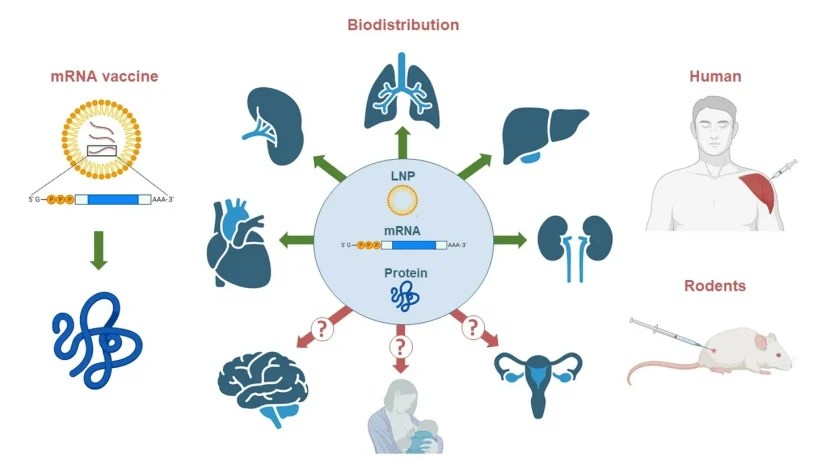
Pateev, I.; Seregina, K.; Ivanov, R.; Reshetnikov, V. Biodistribution of RNA Vaccines and of Their Products: Evidence from Human and Animal Studies. Biomedicines 2024, 12, 59. https://doi.org/10.3390/biomedicines12010059
Fired Harvard Professor: ‘All the Basic Principles of Public Health Were Thrown Out the Window’
By Michael Nevradakis, Ph.D. | The Defender | March 21, 2024
Martin Kulldorff, Ph.D., co-author of the Great Barrington Declaration said Harvard University’s decision to fire him for non-compliance with the university’s COVID-19 vaccine mandate is just one example of the consequences faced by anyone who questioned the official COVID-19 narratives.
In an appearance on “The Defender In-Depth” podcast, Kulldorff, an epidemiologist, said his firing is part of a broader trend of censorship and intolerance toward people who express diverging views in the broader fields of science, medicine and academia.
Kulldorff is one of the five individual plaintiffs in a lawsuit against the Biden administration alleging key administration officials and government agencies coerced social media platforms to remove content, in violation of the First Amendment.
Kulldorff discussed the latest developments in the suit — Murthy et al. v. Missouri et al. — whose plaintiffs also include the attorneys general of Missouri and Louisiana.
On Monday, the U.S. Supreme Court heard arguments on an injunction, previously granted by lower courts, barring the administration and certain federal agencies from communicating with social media platforms for the removal of content.
He also discussed the COVID-19 pandemic response of his native Sweden, which bucked the global trend by eschewing lockdowns, vaccine and mask mandates, making the country the target of global pressure and widespread media criticism. Yet, Sweden now demonstrates better public health outcomes than most other countries.
‘Never a consensus in the scientific community’ for lockdowns
Kulldorff said Harvard was “not happy” with him when he co-authored the Great Barrington Declaration in 2020. However, it was Kulldorff’s decision not to get a COVID-19 vaccine that ultimately led Harvard to fire him.
“We had a disagreement about infection-acquired immunity,” Kulldorff said. “I was fired because I didn’t want to take the vaccine because I didn’t need it. I had better immunity from having had [COVID-19] already, and so, there was no medical reason for me to do it. And there was certain risk, because with every vaccine and drug, there’s some risk.”
Yet, many of his colleagues at Harvard and other institutions “sort of kept quiet” and “went along with it,” Kulldorff said. He attributed their cooperation to the federal funding many scientists and researchers receive from agencies such as the National Institutes of Health (NIH) and the National Institute of Allergy and Infectious Diseases.
“They sit on the biggest pile of medical research money in the world,” Kulldorff said. “So, it’s pretty scary for a scientist to speak up against their wishes, because you risk losing the resource funds that you depend on to support your family, and also to support the other people that work in your laboratory.”
Still, in personal contacts with fellow epidemiologists, Kulldorff said “The majority were arguing for focused protections over better protecting the older people, by letting kids go to school and so on. So, there was never a consensus in the scientific community, at least not in the epidemiological community, for these lockdown measures.”
Kulldorff said that during the pandemic, “all the basic principles of public health were thrown out the window.” His former institution, Harvard, was no exception, “going to online teaching before there was any government incentive or push to do so.”
This, Kulldorff said, “set the stage, and a lot of other colleges and even high schools and elementary schools sort of followed Harvard’s lead” in locking down.
Similarly, Harvard later imposed a COVID-19 vaccine mandate — which it finally ended on March 5. “There was no public health reason to mandate vaccines for students” in particular, Kulldorff said, because most of them “had COVID, so they have superior immunity. But even those few that haven’t [caught COVID-19] face minuscule risk from COVID.”
Children ‘will never fully recover’ from school closures
Kulldorff cited his native Sweden as an example of a country that bucked the trend and kept schools — and society more broadly — open during the pandemic.
“If you look at the elementary and high school students, we know that the test results went down” in countries that closed their schools, Kulldorff said. “The kids were hurt by this, and they will never fully recover from the damage that we did to them.”
Sweden was the only major Western country that kept schools open for ages 1-15, according to Kulldorff who said test results in Sweden have shown “no comparable drop — it’s just as normal, slightly going up.”
Among 1.8 million children who went to school in Sweden throughout the virus wave during the spring of 2020, “there were exactly zero COVID deaths and only a few hospitalizations,” he said.
Public health outcomes in Sweden also were positive for other population groups. “Sweden has low COVID mortality, less than the average in Europe [and] the lowest excess mortality in the Western world.”
Kulldorff said Swedish authorities were able to resist global pressure to impose lockdowns and mandates because they “had very strong support from other epidemiologists in Sweden” and “very strong support by the public” for their approach.
He noted that Sweden’s then-prime minister, Stefan Löfven, had a working-class background, having begun his career as a welder. Noting that lockdowns favored “the upper class,” Kulldorff said Löfven’s background might have made a difference as he could “understand what the effect these lockdowns had on regular people.”
Science will ‘dwindle down’ without freedom of speech
Yet, in other countries, including the U.S., dissenting views were silenced, Kulldorff said.
“Those of us who tried to speak up were either silenced or, after they couldn’t silence us anymore, we were slandered,” he said, noting that after the Great Barrington Declaration was published, Francis Collins, M.D., Ph.D., then the director of the NIH, called for “a devastating published takedown” in response.
“With scientific or other logical arguments, they have two options: They can sort of silence it by ignoring it or censoring it, which was done, or they can attack it through slander and smears,” Kulldorff said. He said postings he made on Twitter and YouTube critical of mask mandates and school closures, were removed by those platforms.
“They didn’t want the science to be known, the true science, and the true principles of public health,” Kulldorff said.
That’s why Kulldorff joined the Missouri et al. v. Biden et al. (now known as Murthy et al. v. Missouri et al.) lawsuit. He said the central argument the plaintiffs are making in this case “is that the federal government should not be allowed to coerce social media to censor people like myself.”
“They actually censored accurate, correct scientific information from scientists at Harvard and other places. And to me that’s pretty astonishing,” Kulldorff said.
Kulldorff said that during Monday’s Supreme Court hearing, “There were clearly some justices who seemed to be very sympathetic” to the plaintiffs’ position, and “seemed very concerned about the First Amendment.”
But other justices argued that “the government should be allowed to coerce social media to censor” in some instances.
By June, the Supreme Court will issue a ruling on whether or not to uphold the injunctions lower courts previously granted in this case. Kulldorff said the case will then return to the lower courts and is expected to “take years” to resolve, proceeding “in tandem” with Kennedy et al. v. Biden et al. — a similar lawsuit in which Children’s Health Defense is a plaintiff. The two lawsuits were consolidated in July 2023.
“I thought we were in agreement, as a country, as a society, that freedom of speech is important, that it is the foundation for us,” Kulldorff said. “It saddens me greatly that that’s not the case.”
“If we don’t have this freedom of speech, then gradually, science is going to dwindle down … Academia would go there also and society as a whole.”
Watch ‘The Defender In-Depth’ here.
Michael Nevradakis, Ph.D., based in Athens, Greece, is a senior reporter for The Defender and part of the rotation of hosts for CHD.TV’s “Good Morning CHD.”
This article was originally published by The Defender — Children’s Health Defense’s News & Views Website under Creative Commons license CC BY-NC-ND 4.0. Please consider subscribing to The Defender or donating to Children’s Health Defense.
Tide Turns On “Gender-Affirming Care”
By John Leake | Courageous Discourse | March 24, 2024
Last June, I accused Assistant Secretary for Health, Rachel Levine, of aiding and abetting the mass assault of minors, after the “Admiral” proclaimed that “gender affirming care [for our youth] is literally suicide prevention.”
This is a proclamation from hell—the blackest of emotional blackmail for prodding parents to consent to the butchering of their children. To be sure, one wonders what kind of parents would take advice in medical, psychiatric, or sexual matters from Admiral Levine.
At last, the tide is turning against this criminal enterprise of mentally ill adults advocating the butchering of children. Yesterday the Telegraph reported:
French Senators want to ban gender transition treatments for under-18s, after a report described sex reassignment in minors as potentially “one of the greatest ethical scandals in the history of medicine”.
This news comes on the heels of the UK NHS telling clinicians to stop routine prescribing of puberty blockers. As reported in the BMJ:
The decision was announced on 12 March as part of NHS England’s ongoing overhaul of children’s gender identity services in England. In new guidance NHS England said, “We have concluded that there is not enough evidence to support the safety or clinical effectiveness of PSH [puberty suppressing hormones] to make the treatment routinely available at this time.”
I would characterize this as a Pyrrhic victory because it stops short of banning gender reassignments for minors altogether. Moreover, it’s long been evident to anyone with a shred of common sense that puberty suppressing hormones are terrible medicine.
Dr. McCullough’s colleague, Dr. Stanley Goldfarb, has been raising the alarm about this for years. His Do No Harm organization has been trying to protect minors from predatory weirdo adults since it was founded in April 2022.
Though Dr. Goldfarb is up against the same Bio-Pharmaceutical Complex that imposed COVID-19 “vaccines” on mankind while enriching itself with public money, he seems to be making progress in pushing back against the child devouring monster of “gender affirming care.”
Beyond Surgery
On Hysterectomy: Second Interview with Carol Petersen RPh, CNP
Lies are Unbekoming | March 21, 2024
They are not told that their lives will be shorter, that they will suffer more from osteoporosis, that they may never have restorative sleep again, that they will suffer the loss of muscle mass from the lost testosterone, that they will be anxious, enraged, panicky and perhaps diagnosed with a mental illness, that they will be offered a long list of pharmaceuticals for symptom relief which will fail them, that their bodies will suffer with pain and the list goes on.
By Carol Petersen
We are going to circle back to where this current Hysterectomy journey started.
Back to Carol Petersen.
In our first interview Carol said:
“Most reasons for hysterectomies can be tied to progesterone deficiencies and most could be avoided with rational supplementation.”
I went back to Carol and asked if she would be open to another interview, this time focused on how women can address and resolve the symptoms and conditions that conventional medicine typically uses to justify life altering surgery.
I’m grateful that she agreed, and we now have a wonderful conversation that hopefully will help more women make better and more informed choices about what to do with their bodies.
With gratitude, I give you Carol Peterson RPh, CNP.
The Wellness By Design Project
1. Could you share your experience with women who come to you having been recommended a hysterectomy by their doctors? What initial advice do you typically give?
Women who have had a hysterectomy have a long time deficiency with progesterone. They have suffered with PMDD, PMS, PCOS, Infertility, endometriosis, fibroids, very heavy bleeding, cysts on the ovaries, and even uterine cancer. Their doctors remove ovaries along with the uterus quite frequently and then supply women with 1 hormone – an estrogen. The ovaries have supplied estrogens, progesterone, testosterone, DHEA and likely much more. This estrogen supplementation continues to create more sleep problems, anxiety, panic, rage, depression, fatigue, pain, cardiac and blood pressure problems, metabolic syndrome with insulin glucose imbalances. Sadly, it is a rare opportunity to intervene before surgery. The message I’d like to convey here is that it is possible to restore hormones to both correct those presurgical problems AND to restore hormones after surgery to have a reasonable quality of life.
2. How do you approach cases where surgery seems imminent? Can you describe your process for assessing whether alternative treatments might be viable?
Our society minimizes the horror of surgery. The assault to the body for any surgery is massive and has consequences. As I just mentioned, it is a rare occasion that interventions can be made before a surgery. Those women who are facing this prospect have been thoroughly conditioned to believe that this is their only option. Heavy bleeding in perimenopause is a major reason for hysterectomy. Conventional medicine does not intervene until the bleeding is so great that it seems to be life threatening. Yet, it is easily reversed with progesterone supplementation in the follicular phase of the menstrual cycle. As a society, we are preconditioned to consult with conventional medicine doctors for advice and treatment even though they are ignorant of many treatment options.
3. In your practice, how do you use bioidentical hormones to address the symptoms and issues leading to the recommendation of hysterectomy? Can you give an example of how this has prevented surgery for some women?
It is very easy to stop excessive uterine bleeding. During perimenopause, Dr. Jerilyn Prior (cemcor.ca) states that women have the highest estrogen of their life span. This is coupled with increased missed ovulations and shortened luteal phases which indicate deficiencies of progesterone. However, it is the follicular phase progesterone produced by the adrenal glands that moderate estrogen induced buildup of a thickened uterine lining.

This is a commonly recognized depiction of the menstrual cycle. This graphic is a cause of the misconception about the importance of progesterone. It looks like it is insignificant in the follicular phase. However, the lines represent levels of hormones in two different units. The estrogens are measured in picograms/milliliter and progesterone is in nanograms/milliliter. This means that the black line for progesterone would be 1000 times higher if expressed in the same units the estrogen level is expressed. This graphic like many does not even indicate the units that generated this depiction. Using supplemental progesterone during the follicular phase can restore the proper balance in a cycle or two.
Not only that, but heavy bleeding has also been reversed with the use of vitamin A.
Vitamin A in the treatment of menorrhagia – PubMed (nih.gov)
Vitamin A is needed to produce progesterone from cholesterol.
4. Based on your experience, what percentage of women recommended for hysterectomy could be helped with hormone supplementation instead?
I think that nearly all could avoid surgery. Perhaps if there is a baseball sized fibroid, surgery might be indicated but why was progesterone not used when that fibroid had an insignificant size.
5. When you encounter women who have already had their uterus removed, how do you approach their post-surgery care? What treatments do you find most effective?
Sometimes, a women will have only the uterus removed and the ovaries are left intake. They are not offered any support. However, the stress of the surgery often causes diminished ovarian function and a multitude of hormone deficiencies as a consequence.
6. For women who have undergone oophorectomy (removal of ovaries), how does your treatment strategy change? How do you address the loss of natural hormone production?
There is no need to “test” for hormone deficiencies. The removal of an organ involved in significant production of hormones is not available. Now is the time to restore as many hormones as possible. These include progesterone, testosterone (50% gone), estrogens, and DHEA. Conventional medicine ignores all but estrogen. This continues the imbalance of hormones that lead to the hysterectomy in the first place.
7. From your perspective, why are gynecologists so quick to recommend surgery as the solution to issues that might be treated with hormone therapy?
It is an economic decision for the gynecologist. Gynecologists are surgeons. Restoring hormones is time consuming for practitioners and not as financially rewarding as a quick surgery.
8. Can you share a case where bioidentical hormone replacement therapy (BHRT) significantly improved the quality of life for a woman who had been advised to undergo a hysterectomy?
This should be the case 100% of the time. However, women don’t always get 100% relief even with bioidentical hormones when the practitioner does not partner with their patients to achieve that. Practitioners are trained in flow chart medicine and have great difficulty in helping women find their best dosing and combinations of hormones. I always encourage women to demand 100%. If they feel much better but not 100%, adjustments should be made.
9. What challenges do you face when advising against hysterectomy and advocating for hormone therapy? How do you overcome skepticism from patients or other healthcare providers?
The challenge is that women are frightened into surgeries and fast tracked before they have the time to think things through. Further, the consequences of surgery are minimized when presented. I don’t know how to help to get information to these women. Those that I can and do work with have self selected themselves by doing some research and are strongly against having surgery.
10. How does the absence of a uterus and/or ovaries affect a woman’s hormone balance, and how do you address these changes with BHRT?
I think this was covered earlier but I would also like to bring up the distortion these surgeries create in the body. Organs take up space in the body and now shifts occurs because the placeholders are gone. Follow up surgeries may now be performed on the bladder because of the missing organs.
11. What misconceptions do you often encounter about hormone therapy among women advised to have a hysterectomy?
What exactly is hormone therapy? Is it the thousands of combinations of synthetic drugs or is it topping off hormones with those with the identical structure. Practitioners don’t think twice about prescribing antidepressants and antianxiety drugs with high risk effects and fight with their patients about restoring the most abundant sex hormone in the human body.
12. In your opinion, what are the long-term implications of hysterectomy and oophorectomy that women might not be fully aware of when they consent to surgery?
They are not told that their lives will be shorter, that they will suffer more from osteoporosis, that they may never have restorative sleep again, that they will suffer the loss of muscle mass from the lost testosterone, that they will be anxious, enraged, panicky and perhaps diagnosed with a mental illness, that they will be offered a long list of pharmaceuticals for symptom relief which will fail them, that their bodies will suffer with pain and the list goes on.
13. How do you monitor and adjust hormone therapy for women who have had their reproductive organs removed, ensuring they receive the most benefit?
You can test with many modalities, but the testing will verify absorption but not give you guidance with clinical relief. Women will tell you and you can see clinical signs.
14. Where can women go to get more information and support if they are considering alternatives to hysterectomy?
There are a few groups like Nora Coffey’s, HERS Foundation.
Social media has really helped. There are lots of Facebook groups of women trying to help each other that sometimes actually do help. Yes, you have to be careful. PhRMA has funded a lot of social media advocate groups which will try to minimize the consequences or advocate a surgery or drug solution.
15. Finally, can you share any resources, such as books, websites, or forums, where women can learn more about the benefits of hormone supplementation and the potential to avoid surgery?
No More Hysterectomies by Vicky Hufnagel
Estrogen Dominance Support Group on Facebook
If I do a Facebook search there is not very much about preventing hysterectomy, only coping. I found one Hysterectomy Hoax with only about 500 members.
Final Note
I’d like to reinforce the message that there are relief measures from the ravages of hysterectomy.
You can get your life back and even better.
There may be a progesterone conspiracy going on.
North American Menopause Society, American College of Obstetrics and Gynecology and the Endocrine Society have fostered this idea that women with hysterectomy do not need progesterone. It is heavily embedded into medical practice. If you check out Wikipedia on PMDD, premenstrual dysphoric disorder, which are simply the mood issues of PMS, premenstrual syndrome, progesterone is not mentioned. Indeed, the PMDDers are systematically taught all the way to the final solution of hysterectomy that they must avoid progesterone at all costs since they are somehow sensitive to it.
In the UK, family practitioners cannot prescribe more than 200 mg of progesterone. When the deficiency is severe, progesterone dosing must be very generous to get results.
And women are also being denied testosterone after oophorectomy. There are no FDA approved products for testosterone replacement in women in the US. Testosterone is far more abundant than estrogen in the human female body and is sorely needed by many surgical menopause or not.
‘Kind of Terrifying’: Critics Slam Claim That First Amendment Shouldn’t Constrain Government’s Ability to Censor
By John-Michael Dumais | The Defender | March 21, 2024
Journalist Matt Taibbi denounced statements made by liberal Justice Ketanji Brown Jackson during a U.S. Supreme Court hearing suggesting the First Amendment should not constrain the government’s ability to combat misinformation during a crisis.
“That was kind of terrifying because the entire purpose of the First Amendment is to restrain the government — it’s not to restrain the public from getting in the way of government action,” Taibbi said Tuesday during an interview on The Hill’s “Rising.”
Taibbi, who has reported extensively on the government’s censorship efforts, also said the plaintiffs in the case — including Drs. Jay Bhattacharya, Martin Kulldorff and Aaron Kheriaty — had their speech suppressed because they contradicted a false government opinion.
“The entire purpose of the First Amendment is to prevent the government from creating a hegemonic opinion that cannot be challenged,” Taibbi said.
The Supreme Court heard arguments on Monday pertaining to an injunction, granted in September 2023 by a federal appeals court, in Murthy v. Missouri. The case centers on whether the federal government violated the First Amendment by pressuring social media companies to censor content that ran counter to official government narratives on such topics as COVID-19 origins, vaccines, elections and other controversial topics.
Responding to Solicitor General of Louisiana J. Benjamin Aguiñaga during oral arguments, Justice Jackson said:
“So my biggest concern is that your view has the First Amendment hamstringing the government in significant ways in the most important time periods. I mean, what would you have the government do? I’ve heard you say a couple of times that the government can post its own speech, but in my hypothetical, you know, ‘Kids, this is not safe, don’t do it,’ is not going to get it done.
“And so I guess some might say that the government has a duty to take steps to protect the citizens of this country. And you seem to be suggesting that that duty cannot manifest itself in the government encouraging or even pressuring platforms to take down harmful information.”
Government set up ‘private highway’ to social media execs
“Rising” host Briahna Joy Gray asked Taibbi which was the primary issue: the government’s actions or the companies’ choices to succumb to pressure?
Taibbi compared the situation to the government hypothetically threatening to pull a mainstream media outlet’s Federal Communications Commission license unless it held a story, which he argued would be highly inappropriate.
“They didn’t just do that in this case,” Taibbi explained. “They went straight to the heads of the company” using an “industrial-scale operation … a sort of private highway to all of these companies where they were funneling mass requests.”
Taibbi noted that Renée DiResta, research director of the Election Integrity Partnership that was sponsored by both the U.S. Department of State and the U.S. Department of Homeland Security, “talked about using Section 230 to bring these companies to heel.”
“This was an overt threat,” Taibbi said.
Taibbi suggested it would be appropriate for the government to use its bully pulpit to say, “I don’t like what’s on Facebook. They made a mistake here, here and here. Here’s what I think the truth is, and we see these posts that say something else.”
“The president has an enormous megaphone to counter” what it considers misinformation, Tabbi said. “What’s not appropriate is doing it in private and coupling it with a threat.”
Justices missed the point on First Amendment
On his Racket News Substack Tuesday, Taibbi provided further context on the government’s pressure on social media companies.
During oral arguments, Principal Deputy Solicitor General Brian Fletcher — referring to instances where government officials publicly criticized social media platforms and called for changes to Section 230 protections — said, “I think it’s really troubling, the idea that those sorts of classic bully pulpit exhortations, public statements urging actors to behave in different ways, might be deemed to violate the First Amendment.”
Taibbi lamented the lack of a strong response from the other eight justices.
“That a line about ‘the First Amendment hamstringing the government’ was uttered by one Supreme Court Justice is astonishing enough,” he wrote. “[But] listening as none of the other eight pointed out that the entire purpose of the First Amendment is to ‘hamstring’ government from interfering in speech was like watching someone drive a tank back and forth over Old Yeller.”
As evidence of the justices’ confusion over First Amendment rights, Taibbi pointed to Justice Elena Kagan’s statement that the government intervening in news organizations’ activities “happened all the time” decades ago, especially when issues of national security were at stake.
As to her question, “Was that coercion?” Taibbi wrote:
“The situations aren’t remotely analogous. What’s happening now is a wide-scale partnership agreement between intelligence/enforcement agencies and media distributors, not media outlets themselves.”
Rep. Jordan: ‘That is scary where we’re headed’
Some Congress members were quick to criticize Justice Jackson’s statements from the Murthy v. Missouri hearing.
Rep. Jim Jordan (R-Ohio), in an interview with Fox News Monday, said, “The big takeaway today was Katanji Brown Jackson, when she said to the Solicitor General from Louisiana, ‘You’ve got the First Amendment hamstringing the government’ — well, that’s what it’s supposed to do, for goodness sake!”
“That is frightening because she really believes that,” Jordan added. “That is scary where we’re headed.”
Rep. Dan Bishop (R-N.C.) suggested that if the Supreme Court does not intervene, it could allow the FBI to “embed itself with social media companies” and “take down” issues like “the Hunter Biden laptop in election after election after election.”
Bishop argued that the government should not be able to suppress legal, protected speech on public platforms. “I just don’t think the government ever has a valid interest in doing that,” he said.
“[The government] can … come out publicly and say, ‘We don’t agree that there could have been a lab leak, that we think that’s a ridiculous theory,’” said Bishop. But he argued it was a “bad idea” to allow the government to pressure social media because “We see from what has happened afterward … they were wrong.”
Jordan also alleged that the Biden administration abused its power by censoring political opponents, citing its pressure to remove a tweet by Robert F. Kennedy Jr., Children’s Health Defense chairman on leave, despite the tweet containing true statements about Hank Aaron’s vaccination and passing.
“Oh, by the way, who was that individual [requesting the censorship]?” Jordan asked, before answering, “The guy running against him in the [Democratic] primary [at the time]. That is as scary as it gets, but that’s what this White House was doing.”
Will ‘traceability’ derail free speech case?
One of the central questions before the Supreme Court in Murthy v. Missouri is whether the government’s actions, including vague threats and pressure on social media companies, constitute illegal coercion.
Taibbi pointed out in the “Rising” interview that the “Twitter Files” showed “both overt and less obvious evidence” of correspondence among Twitter’s executives describing how they understood proposed regulatory changes as a threat they must answer to get the government off their back.
“That’s not missing from the case — that’s a feature of the case,” Taibbi said, adding that he thought the government publicly airing those threats “was sending a very strong message so that not only the companies would hear it, but the public would hear it.”
Taibbi acknowledged the difficulty of establishing “traceability” — a direct causal relationship between government pressure and the censorship of individual plaintiffs’ posts — saying their evidence “didn’t show a soup-to-nuts progression.”
However, he noted that shortly after the government told social media companies, ‘We don’t want anybody who is creating content that would promote vaccine hesitancy,’” people like Dr. Bhattacharya and Dr. Kulldorff were “deamplified or removed from platforms.”
Taibbi highlighted the lower court rulings that established or upheld injunctions against the government’s use of coercive tactics with social media companies.
“Two judges compared it to a mob movie,” he said. Characterizing the government in this metaphor, the judges said, ‘Hey, it’s a nice tech company you’ve got there. Be a shame if something happened to it,” Taibbi said.
“Rising” host Robby Soave asked Taibbi whether a legislative remedy could prevent government censorship. Taibbi said that while he felt there was ample evidence that what the government engaged in was already against the law, he thought it would be “difficult” to get a new law passed “absent a judicial ruling that this kind of behavior is illegal.”
But even if such a law were passed, “The problem is the enforcement mechanism is absent here,” he said.
In his Racket News article, Taibbi said the Supreme Court hearing “felt like a gut punch.” He expressed concern that if the court rules against the plaintiffs based on “traceability” issues, it could be interpreted as an endorsement of the government’s “plainly abusive” surveillance and censorship programs.
He wrote:
“Murthy [v. Missouri] already represents a major public relations victory for the Executive Branch.
“After roughly two years in which momentum for shutting down government censorship programs seemed to be gaining, and episodes like Bhattacharya’s punctured the myth that such bureaucracies only targeted ‘misinformation,’ yesterday’s hearing will help restore the basic narrative that the activities revealed earlier in this suit and in the Twitter Files was little more than good-faith efforts by a concerned government trying to stop ‘harm’ in a unique historical emergency.
“As Brown Jackson put it, ‘What would you have the government do?’”
John-Michael Dumais is a news editor for The Defender. He has been a writer and community organizer on a variety of issues, including the death penalty, war, health freedom and all things related to the COVID-19 pandemic.
This article was originally published by The Defender — Children’s Health Defense’s News & Views Website under Creative Commons license CC BY-NC-ND 4.0. Please consider subscribing to The Defender or donating to Children’s Health Defense.
Major Studies Find No Evidence of Brain Injury in Alleged ‘Havana Syndrome’ Patients
By Kyle Anzalone | The Libertarian Institute | March 18, 2024
Two studies conducted by the National Institute of Health (NIH) on scores of people claiming to have Havana Syndrome did not find any evidence of brain damage. Purported victims of Havana Syndrome claim they were targeted by a foreign power with a mysterious weapon that caused undetectable neurological issues.
Havana Syndrome was first reported among American diplomats in Cuba in 2016 who claimed to be exposed to a sonic weapon that caused headaches. An investigation published by JASON, a group of scientists who advise the US government, concluded that crickets native to Cuba were making the noise, causing neurological symptoms among American officials in Havana.
Since, scores of diplomats have reported symptoms in a range of countries including Vietnam, Russia, and China. The self-identified victims claim they were targeted with some form of microwave, sonic, or direct energy weapon that caused a myriad of symptoms, including headaches, as well as problems with sleep, vision, and hearing.
On Monday, NIH published two studies that concluded Havana Syndrome was not caused by directed energy weapons. Additionally, in both investigations, researchers were unable to detect any signs to indicate the patients had suffered neurological damage.
“In this exploratory neuroimaging study, there was no significant MRI-detectable evidence of brain injury among the group of participants who experienced [anomalous health incidents] compared with a group of matched control participants,” the authors wrote. However, researchers did not dismiss the possibility that somehow the claimed victims were actually targeted with a mysterious weapon.
Robert E. Bartholomew and Dr. Adam Gaffney argued that Havana Syndrome, rather than being caused by weapons, is a mass psychogenic illness. In an essay published in the Journal of the Royal Society of Medicine, Bartholomew explains, “As is typical in mass psychogenic illness outbreaks, as news of the ‘attacks’ spread among the diplomatic community, more US Embassy staff were affected, including members of the Canadian Embassy.”
He continues, “The irregular patterning of the ‘attacks’ is not typical of an infectious agent. Many ‘incidents’ were said to have occurred in homes and hotels. Why were some people affected, while others either standing or sleeping next to the ‘victim,’ were not?”
Still, allegations of attacks causing Havana syndrome continued to impact American officials around the world into the first years of the Joe Biden administration. The claims of attacks have led to the demonization of Russia, the breakdown of diplomatic relations with Cuba, and the delay of high-level visits to foreign nations.
Supreme Court Appears Wary of Blocking Biden Admin-Big Tech Censorship Collusion
By Tom Parker | Reclaim The Net | March 18, 2024
During oral arguments in a major First Amendment case on Monday, the Supreme Court expressed reservations about restricting interactions between the Biden administration and social media platforms. This concern emerged during the Murthy v. Missouri (formerly Missouri v. Biden) case, which delves into the extent of governmental influence over online content.
Brian Fletcher, Principal Deputy Solicitor General of the United States, presented oral arguments for the petitioners in the case, Biden’s Surgeon General Vivek H. Murthy and several other current and former members of the Biden administration.
The respondents in the case, the States of Missouri and Louisiana, and several other individuals who were subject to social media censorship, allege that the federal government had pressured platforms to block or downgrade posts on various topics, including some related to Covid and the Hunter Biden laptop story.
Several lower courts agreed with the respondents, with a district judge describing the Biden administration’s Big Tech-censorship collusion as “Orwellian” and the Fifth Circuit Court of Appeals finding that the Biden admin likely violated the First Amendment when pushing for social media censorship.
During the oral arguments today though, the justices displayed skepticism towards a broad prohibition on governmental communications with social media platforms. They raised concerns that such a ruling could unduly restrain the government’s ability to address pressing issues.
Fletcher defended the Biden admin’s actions and framed them as the government exercising its right to “speak for itself by informing, persuading, or criticizing private speakers.” He argued that the government is entitled to communicate with social media companies to influence their content moderation decisions, as long as these interactions do not veer into coercion. According to Fletcher, the litmus test for legality should be the presence or absence of threats from the government, asserting that using the bully pulpit for exhortations is a right protected under the First Amendment.
Fletcher also tried to argue for the significant power and autonomy of social media companies, noting their capability to resist governmental pressures.
The solicitor general of Louisiana, Benjamin Aguiñaga, representing one of the Republican-led states behind the lawsuit, argued that the government’s actions amounted to coercion, effectively leading to censorship by social media platforms. He highlighted a significant shift in the focus of government-led content moderation. Initially aimed at tackling foreign interference and misinformation, these efforts increasingly targeted speech by American citizens, particularly around the contentious topics of the 2020 election and the pandemic.
Justice Ketanji Brown Jackson challenged Louisiana Solicitor General Benjamin Aguiñaga’s viewpoint. “And so I guess some might say that the government actually has a duty to take steps to protect the citizens of this country. And you seem to be suggesting that that duty cannot manifest itself in the government encouraging or even pressuring platforms to take down harmful information. So, can you help me? Because I’m really worried about that.”
Justice Amy Coney Barrett also voiced concerns, questioning whether the FBI could legally request social media platforms to remove content, such as posts revealing personal information about officials.
Aguiñaga’s argument was that such actions could potentially suppress constitutionally protected speech.
The oral arguments went off into the weeds and into the nuances of what constitutes “coercion” by the government in its interactions with social media platforms, rather than directly addressing the core text of the First Amendment. This focus on “coercion” rather than the First Amendment’s explicit wording – prohibiting the “abridging” of the freedom of speech, or of the press – played into the Biden administration’s hands.
Justices Kavanaugh and Kagan drew a comparison between the case and the interactions that often occur between administration officials and news media. They proposed that efforts by officials to shape media coverage should be seen as constructive dialogue, not necessarily an attempt at censorship, and suggested such actions don’t violate the First Amendment’s provisions.
Kagan challenged the lawyer from Louisiana to demonstrate that the removal of the contentious posts was the result of government intervention rather than actions taken by the social media companies themselves.
“What distinguishes this as an act of the government rather than a decision made by the platforms?” Kagan inquired.
The discussion among the justices also ventured into the standing of the plaintiffs – Missouri and Louisiana, accompanied by five individuals – to bring the lawsuit. They questioned whether these parties had experienced a direct injury that would justify their legal challenge. Furthermore, the justices expressed doubts about the appropriateness of a wide-ranging injunction that would bar various officials from contacting social media platforms as a remedy to the alleged issue.
Justice Sonia Sotomayor specifically addressed concerns regarding the approach taken by the plaintiffs in presenting their case. Directing her comments to Aguiñaga, Justice Sotomayor criticized the framing of their argument. She pointed out that the plaintiff’s brief seemed to leave out crucial information, thereby altering the context of certain claims, a point which she found particularly troubling.
Chief Justice John G. Roberts Jr. appeared to concur with the notion that the federal government’s diverse array of agencies, which often lack a unified stance, weakens the argument of coercion. During a dialogue with the attorney from Louisiana, he observed, “It’s not monolithic.” He then posed a question that implied this multiplicity of voices in the federal government could substantially diminish the idea of coercion: “That has to dilute the concept of coercion significantly. Doesn’t it?”
While the justices mostly appeared skeptical of prohibiting the federal government from pressuring social media platforms to censor speech, there were some moments where they questioned the Biden admin’s arguments.
Justice Sotomayor pressed Fletcher to give her specifics on how the injunction that prohibits officials from coercing or significantly encouraging a platform’s content-moderation decisions would harm the government.
Fletcher responded by claiming that the injunction would prevent the Federal Bureau of Investigation (FBI) from flagging foreign “disinformation” to platforms, prevent White House officials from criticizing the platform’s practices on “misinformation,” and prevent officials complaining about or flagging various other types of legal content on social media.
Justice Samuel Alito also noted that two lower courts have found or accepted that some examples of Big Tech censorship that were highlighted in this case were “traceable to the government’s actions.”
He added: “We don’t usually reverse findings of fact that had been endorsed by two lower courts.”
Additionally, Justice Alito expressed skepticism about the White House and other federal officials constant “pestering” of Facebook and other social media platforms.
“And I thought, wow, I cannot imagine federal officials taking that approach to the print media,” Justice Alito said. “I thought, you know, the only reason why this is taking place is because the federal government has got Section 230 and antitrust in its pocket, and it’s…to mix my metaphors, and it’s got these big clubs available to it. And so it’s treating Facebook and these other platforms like their subordinates.”
After the hearing, the New Civil Liberties Alliance (NCLA), one of the legal groups representing the respondents in this case, urged the justices to recognize that the Biden admin’s censorship pressure violated the First Amendment.
“Our clients, who include top doctors and scientists, were censored for social media posts that turned out to be factually accurate, depriving the public of valuable perspectives during a public health crisis,” Jenin Younes, Litigation Counsel at the NCLA said. “We’re optimistic that the majority will look at the record and recognize that this was a sprawling government censorship enterprise without precedent in this country, and that this cannot be permitted to continue if the First Amendment is to survive.”
Scientists call for radical reform of scientific government advice
Global Warming Policy Foundation | March 18, 2024
A wide-ranging review of official science advice examines serious failings in the way scientific advice is being delivered to governments and proposes radical reforms to improve it.
The report – with contributions by former UK government adviser Professor Michael Kelly, Clive Hambler, Professor Roger Kopple, Professor Peter Ridd and Harry Wilkinson – addresses fatal flaws in the scientific advice provided on climate change and during the Covid-19 pandemic and deplores the irresponsible use of computer modelling, among other issues.
Key recommendations for the reform of scientific advice include:
• The rapid challenge of advice, through official and adequately resourced ‘red teams’, agents provocateurs and crowd review.
• The establishment of a quality control auditing process.
• The need to balance the ‘precautionary principle’ against the opportunity costs incurred by ‘playing safe’ and against the risks of unintended consequences of action.
• More robust systems for registering conflicts of interest, with a presumption that conflicted individuals should be precluded from participating.
• A requirement that institutions such as universities, scientific academies and journals should not take official or settled positions on scientific issues, since this stifles diversity of thought, freedom of speech and the reliability of advice.
• Protections for scientists who rationally disagree with mainstream views, with stronger guarantees of freedom of speech.
• The encouragement of internal debate to guard against ‘groupthink’.
Lead author, Professor Michael Kelly, said:
“Scientific advisors give advice, but Ministers decide. This maxim is often abused. In recent times ‘we are following the science’ is a phrase to let politicians off the hook of the responsibility that is intrinsically theirs by virtue of being elected to parliament. Ministers ask for implementation-ready policy answers, rather than nuanced and caveated advice on which they must decide.
In the recent pandemic there was an inadequate critical challenge to the scientific advice from an economic or societal perspective. At a time when the scientific enterprise is more than ever subject to capture by vested interests, it is time for a root and branch review of science advice.”
Climate Change is Unfalsifiable Woo-Woo Pseudoscience (2015)
By Corbett | March 16, 2024
Podcast: Play in new window | Download | Embed
Video player not working? Use these links to watch it somewhere else!
WATCH ON:  /
/  /
/  /
/  /
/  /
/ 
FROM 2015: Karl Popper famously said, “A theory that explains everything explains nothing.” So what do you make of the theory that catastrophic manmade CO2-driven “climate change” can account for harsher winters and lighter winters, more snow and less snow, droughts and floods, more hurricanes and less hurricanes, more rain and less rain, more malaria and less malaria, saltier seas and less salty seas, Antarctica ice melting and Antarctic ice gaining and dozens of other contradictions? Popper gave a name to “theories” like this: pseudoscience.
TRANSCRIPT
One of the giants in the history of the philosophy of science, Karl Popper, once famously observed that a theory that explains everything explains nothing.
And, to be sure, the theory of catastrophic anthropogenic climate change appears to explain everything.
After all, we all know that climate change makes for shorter winters . . . except for when it makes for harsher winters.
And climate change means less snow . . . except for when climate change means more snow.
And climate change causes droughts in California and floods in Texas and Oklahoma, and generally makes wet places wetter and dry places drier, except when it makes wet places drier and dry places wetter.
And climate change causes more hurricanes at the same time as it causes fewer hurricanes.
Climate change causes more rain, but less water? . . . And less rain, but more water?
Climate change decreases the spread of malaria at the same time as it increases the spread of malaria. (But don’t worry! The Terminator himself advises us not to listen to those climate change cynics, hey guys?)
Do I need to go on?
Oh, OK.
Climate change makes San Francisco foggier.
Climate change makes San Francisco less foggy.
Climate change causes duller autumn leaves.
Climate changes causes more colourful autumn leaves.
Climate change makes for less salty seas.
Climate change makes for saltier seas.
Climate change causes the polar ice caps to melt.
Climate change causes the polar ice caps to freeze.
Climate change makes the earth hotter, unless the earth isn’t getting hotter, in which case climate change can explain that, too!
What’s the problem here? This sounds like the perfect scientific theory. It can explain literally everything, including self-contradictory things! This means it’s absolutely perfect, isn’t it?
Well, no, not according to Karl Popper and the philosophers of science.
And within the philosophy of science, there’s something called the demarcation problem. How do you differentiate science from pseudoscience?
If you’re at all interested in this, I would suggest you read through Karl Popper’s Conjectures and Refutations, in which he lays out his criterion for differentiating science and pseudoscience, namely falsification.
What on earth does he mean by this?
Well, he starts with a very simple but very profound observation that people are attracted to pseudoscientific theories:
“[. . . b]y their apparent explanatory power. These theories appear to be able to explain practically everything that happened within the fields to which they referred. The study of any of them seemed to have the effect of an intellectual conversion or revelation, open your eyes to a new truth hidden from those not yet initiated. Once your eyes were thus opened you saw confirmed instances everywhere: the world was full of verifications of the theory. Whatever happened always confirmed it. Thus its truth appeared manifest; and unbelievers were clearly people who did not want to see the manifest truth.”
And it occurred to him that although this is usually taken to be a good sign of a theory, “[i]t began to dawn on me [Karl Popper] that this apparent strength was in fact their weakness.”
So he goes on to list his conclusions as to how we ultimately try to differentiate science from pseudoscience, and I think a couple of the most important conclusions here are:
4. A theory which is not refutable by an conceivable event is non-scientific. Irrefutability is not a virtue of a theory, as people often think but a vice.
And also:
7. Some genuinely testable theories, when found to be false, are still upheld by their admirers—for example by introducing ad hoc some auxiliary assumption, or by reinterpreting the theory ad hoc in such a way that it escapes refutation. Such a procedure is always possible, but it rescues the theory from refutation only at the price of destroying, or at least lowering, its scientific status.
And he sums it up by saying: “the criterion of the scientific status of a theory is its falsifiability, or refutability, or testability.”
So, I would say that the ball is in the court of the believers of the catastrophic anthropogenic climate change hypothesis.
By what means can one falsify this hypothesis?
Let’s start with just an even less of a hurdle to come over: what set of observations over what period of time would be enough to refute the theory?
And then, furthermore, are there any actual hypotheses, any predictions that come as a result of this theory that can then be tested against the real world, or real observations?
If the answer to that is no, then . . . well, you’ve got a word for your theory, and it’s not science.
It’s pseudoscience.
So again, the onus is on the believers in the catastrophic anthropogenic climate change hypothesis to come up with some way that you can test and potentially falsify this theory.
Because if you can’t come up with any actual way to answer that question of how you falsify the theory, then you might as well just pray to your witch doctors to save you from the weather gods.
James Corbett, corbettreport.com.
Why Not to Worry about Farming’s Contribution to Global Warming
By E. Calvin Beisner | Cornwall Alliance | March 4, 2024
For decades the primary way environmentalists concerned about manmade global warming have advocated to slow it has been to reduce human emissions of the “greenhouse gas” carbon dioxide (mainly from burning coal, oil, and natural gas for energy). Lately they have focused increasingly on contributions from two other “greenhouse gases,” primarily from agriculture—methane (CH4) from livestock flatulence, and nitrous oxide (N2O) from chemical fertilizers.
Why? Because CH4’s forcing effect (the amount of infrared radiation, or heat, each molecule in the atmosphere impedes from escaping from Earth’s surface to space, thus warming the surface) is 30 times, and N2O’s 230 times, that of CO2, as illustrated here:

Why? Because almost all the outgoing longwave radiation (infrared) in the frequency bands CO2 can absorb has already been absorbed—by both CO2 and water vapor (H2O)—while far less in the bands CH4 and N2O can absorb has already been absorbed. So we say CO2’s bands are nearly “saturated,” while CH4’s and N2O’s are nearly “transparent.”
So, it looks like we should be much more concerned about N2O than about CO2 or even CH4. Or should we?
The rate at which we’re adding CO2 to the atmosphere is about 3000 times that at which we’re adding N2O, and 30 times that at which we’re adding CH4, as illustrated here:

Consequently—because CO2’s rate of increase in the atmosphere is so much faster than CH4’s or N2O’s—the contribution to forcing (and so to global average temperature) from CO2 is about 10 times that from CH4 and 13 times that from N2O, as illustrated here:

So, should we reduce CH4 and N2O emissions (by reducing agricultural production) to slow global warming?
As atmospheric physicist and MIT emeritus professor of meteorology Richard Lindzen put it in a talk to Irish beef farmers February 27, “shutting down emissions of CH4 and N2O globally (forget little Ireland) will have no discernible impact on the climate metric regardless of what you believe about global warming and which model you are using.”
Featured Video
Macgregor: We Haven’t Seen the Worst of the Iran War Yet
or go to
Aletho News Archives – Video-Images
From the Archives
15 Saudi ‘hijackers’ were CIA agents working for US: Scholar
Press TV – April 13, 2016
Fifteen of the 9/11 “hijackers” from Saudi Arabia were CIA agents working for the United States government, which was seeking to destroy the Middle East for Israel and to double the American military budget, says Dr. Kevin Barrett, an American academic who has been studying the events of 9/11 since late 2003…. continue
Blog Roll
 Aletho News
- Breast Cancer: Before You Consent
- Iran’s Plan to Shut Down AI in the Persian Gulf
- Israel seeks ‘compensation’ from Washington over Saudi F-35 sale
- Saudi crown prince seeks dialogue with Ansarullah after Yemeni blows: Report
- Damascus rejects Saudi request for Syrian fighters to counter Yemen: Report
- South Korea says will not send troops to join terrorist US war on Iran
- Russia Just Struck the Eyes of NATO’s War Machine in Ukraine
- Russia summons UK charge d’affaires over Kiev drone support
- NATO member warns bloc seeking pretext for war with Russia
- Macgregor: We Haven’t Seen the Worst of the Iran War Yet
- If Americans Knew
- Debunking The Claim That Macklemore Has A “History Of Antisemitism”
- CPJ demands release of arrested Palestinian-US journalist near Bethlehem
- Robert Kraft: The Billionaire Friend of Netanyahu Pulling The Strings Behind the Macklemore/Ed Sheeran Blow Up
- Columbia Administered Fund Gives Big Money to Pro-Israel Groups
- Deportation Case of Palestinian Activist Salah Sarsour Tests First Amendment
- ‘We Will Not Forget’: Palestinians Mark 44 Years since Sabra and Shatila
- Why do we let Zionists decide what we can and can’t say?
- US welcomes Israeli, Iranian delegations to UN, but not Palestinians – Daily Update
- Biden’s Genocide Accomplices Targeted by New Accountability Campaign
- AIPAC’s Network Has Already Spent $67.2 Million to Shape the Midterm Elections
- No Tricks Zone
- New Study: ‘Global Drought Shows No Detectable Recent Acceleration Under Climate Warming’
- Economic Masterminds: German Socialists Suggest Taxing Productivity Gains Stemming From Using AI
- The South China Sea Has Not Been Cooperating With The Climate Change Narrative
- Energy Crisis: Germany Enters Heating Season With Historically Low Gas Reserve Fill Levels
- New Study: The Antarctic Ice Sheet Gained Mass From 2020-2024 Due To Staggering Snow And Ice Accumulation
- Study: Ocean Heating Rates From Thousands Of Years Ago ‘Dwarf’ Modern Ocean Heating Rates
- Climate Extremists Target, Attack Large-Scale Power Grid Infrastructure In Germany!
- New Study: Antarctic Ice Melt Has Contributed Less Than 1 Centimeter To Sea Level Rise In The Last 30 Years
- Fear Of Debate: Alarmist German Climate Scientist Calls On Mainstream Media To Discredit Skeptic Voices
- End-Of-August Arctic Sea Ice Extent Hasn’t Fallen In 20 Years, Official Data Show!
 Aletho News