Mayo Clinic is Sued For Suspending Doctor Over Online Posts on Covid and Transgenderism
By Ben Squires | Reclaim The Net | November 15, 2023
Dr. Michael Joyner, backed by the Academic Freedom Alliance (AFA), has initiated a lawsuit against the Mayo Clinic College, including its president and board chair. The suit arises from disciplinary actions taken against Joyner following his public comments on topics within his field of expertise. Specifically, the controversy revolves around statements he made to the New York Times about gender differences in athletic performance and to CNN regarding the use of convalescent plasma in COVID-19 treatment. The Mayo Clinic’s response, which involved suspension, salary review implications, and strict media interview oversight, is at the heart of this legal challenge.
We obtained a copy of the complaint for you here.
Lucas Morel, chair of the AFA’s academic committee, emphasized the lawsuit’s significance, asserting that “academic freedom is a key guarantor of scientific integrity.”
Morel expects the case to establish a precedent for the freedom of scientists and academics to express their professional opinions without undue influence from financial or political interests. The AFA, which previously supported Joyner during his disciplinary hearings, is now financing this lawsuit, highlighting the organization’s commitment to protecting academic freedom.
Joyner’s legal action, filed with the State of Minnesota’s Third Judicial District, seeks compensation for the damages incurred from the disciplinary measures. These included a week-long unpaid suspension, denial of salary increase, and a potential termination threat, all of which have reportedly harmed Joyner’s finances and professional reputation. The lawsuit, handled by Allen Harris Law, was filed after allowing the defendants to review and respond, which they declined.
Eight items of major concern regarding the proposed WHO treaty and IHR amendments
By Meryl Nass, MD | November 13, 2023
1. Biological warfare agent proliferation.
The treaty and the proposed amendments instruct nations that they must perform surveillance for potential pandemic pathogens, build or maintain sequencing labs, and both share actual specimens with the WHO (where a BioHub has been created for this purpose) and also share the sequences online. This demands the proliferation of biological weapons agents — which I believe is a crime (based on my interpretation of Security Council Resolution 1540 and the 1972 Biological Weapons Convention).
1 a. The June 2, 2023 “Bureau text” version of the treaty also called for nations performing Gain-of-Function research to reduce “administrative impediments” to the work. In other words, restrictions on the research should be relaxed, which would make lab leaks more likely to occur. This paragraph was removed from the October 30, 2023 version of the treaty.
2. Giving the WHO a blank check to create new rules in the future
The treaty calls for a Conference of Parties and a new WHO Secretariat to be created in the future that will make rules for how the pandemic prevention and response apparatus will work—which provides essentially a blank, signed contract to the WHO to create whatever rules it wants.
3. Liability-free vaccines developed at warp speed will be produced
The treaty calls for rapid vaccine development /production and shaving time off all aspects of vaccine development, testing and manufacture. This requires vaccines to be used without licenses, and the treaty calls for nations to have laws in place to issue Emergency Use Authorizations for this purpose, and to “manage” liability issues. See “The WHO’s Proposed Treaty will Increase Man-Made Pandemics” for more information about this. The US, EU and others have specifically called for 100-day vaccine development and an additional 30 days for production of pandemic vaccines. This would allow for no meaningful human testing.
4. Human rights guarantees have been removed in the new amendments
The amendments removed “human rights, dignity and freedom of persons” from the existing IHR language. Following complaints, this phrase was later inserted into the Treaty–but the treaty may not be accepted in 2024. Meanwhile, the amendments require only a simple majority to pass, are being written in secret, and so it is likely that the most problematic issues will be found in the amendments.
5. Social media surveillance and censorship of citizens is required
Both the amendments and the treaty call for nation states to perform surveillance of their citizens’ social media, and to censor and prevent the spread of information that does not conform to the WHO’s public health narratives. Yet the treaty also calls for citizens to be free to access information, while they are to be protected from “infodemics,” which are defined as too much information. Citizens must also be stopped from spreading mis- and disinformation.
6. We may not learn what is in the amendments until after they are passed
The amendments have been negotiated entirely in secret for the past nine months, while there have been multiple consecutive drafts of the pandemic treaty released to the public during that time. And while the negotiated amendments were to be tabled for public review in January, the WHO’s principal legal officer has provided a legal fig leaf to avoid the obligation of making them public 4 months ahead of the vote. Will the public even see the amendments before a vote on them occurs?
Why is there such secrecy regarding the proposed amendments?
7. The WHO Director-General could become your personal physician
According to the proposed amendments, the WHO D-G would be able to commandeer and move medical supplies from one country to another, decide what treatments can be used, and restrict the use of other treatments.
8. When will the WHO be able to use its newly minted powers?
The amendments will come into force after a declaration of a Public Health Emergency of International Concern (PHEIC) is made. However, a declaration of a potential PHEIC will also trigger these powers. The powers can be extended even after a PHEIC is over, as we have seen with COVID and monkeypox (MPOX) declarations by the D-G.
The treaty will be in force continuously, requiring no declaration or pandemic to confer new powers to the WHO.
See detailed report:
What does the WHO say about its power to enforce the Pandemic Treaty (and International Health Regulations)?
By MERYL NASS | NOVEMBER 12, 2023
Many people have insisted that the WHO could not make the US do anything. Let me remind those people that the US government under Biden is instrumental in pushing forward the WHO proposals, and so it will comply. Here is what the WHO says:

What is meant by a ‘convention, agreement or other international instrument’?
Conventions, framework agreements and treaties are all examples of international instruments, which are legal agreements made between countries that are binding.
Why did WHO’s Member States decide to create an accord for pandemic preparedness and response?
In light of the impact of the COVID-19 pandemic, WHO’s 194 Member States established a process to draft and negotiate a new convention, agreement, or other international instrument (referred to in the rest of this FAQ, generally, as an “accord”) on pandemic preparedness and response. This was driven by the need to ensure communities, governments, and all sectors of society – within countries and globally – are better prepared and protected, in order to prevent and respond to future pandemics. The great loss of human life, disruption to households and societies at large, and impact on development are among the factors cited by governments to support the need for lasting action to prevent a repeat of such crises.
[Ho ho ho—Nass]
At the heart of the proposed accord is the need to ensure equity in both access to the tools needed to prevent pandemics (including technologies like vaccines, personal protective equipment, information and expertise) and access to health care for all people.
[If this were true, why do the treaty and amendments only discuss health “coverage” which means health insurance, rather than health care? The WHO knows the difference, but only demands “coverage”—a sop to the insurance industry.
Furthermore, the WHO demands censorship of information not in agreement with the WHO’s narratives, not free sharing of information—so much for information equity—and its so-called expertise was used to overdose hospitalized patients with HCQ without informed consent, when these unfortunates were enrolled in the WHO’s “SOLIDARITY” trial. Its expertise led to demanding that nations stop the use of HCQ and ivermectin for COVID and administer more shots. Who needs this expertise? —Nass]
Who else is involved in the process for the accord?
Besides WHO Member States, the process for developing a possible new accord is providing extensive opportunities for engagement with relevant stakeholders, including other United Nations system bodies, and a wide range of other non-State actors in official relations with the WHO, to ensure robust and inclusive participation in the proceedings of the Intergovernmental Negotiating Body. Furthermore, WHO is seeking complementary inputs through public hearings with stakeholders including: international organizations; civil society; the private sector; philanthropic organizations; scientific, medical, public policy and academic institutions and other entities with relevant knowledge, experience and/or expertise.
[In other words, Bill Gates, who was the largest funder of the WHO the year Trump defunded the organization, gets the lion’s share of input, while we peons get none. Trump then turned around and funded Gate’s’ charity GAVI with the money, and GAVI turned around and gave it back to the WHO. That was our money, by the way.—Nass]
—There is more of this nonsense on this webpage, but you can go look it up yourself if you have the stomach for it.—Meryl
CPSO Pronounces Judgment Over Dr Trozzi
But the shots are still toxic, Pfizer committed fraud, everyone has been assaulted, and we must act now to save lives.
Dr Mark Trozzi | November 6, 2023
Health Canada recognizes that Pfizer committed fraud. The shots turn out to be even worse than I thought. They contain large quantities of DNA, and multiple genetic sequences including a very dangerous SV40 promoter sequence which promotes permanent genetic modification, disease, and cancer. Sadly, innocent people are uninformed and lining up for injections that they would never agree to if they knew what was in them and what it can do to them.
Here is my ten minute video to update you, with a focus on current priorities and strategies. Crisis is a combination of danger and opportunity. The SV40 revelation marks severe danger, but it is also an opportunity to finally set things right. This video includes genuinely kind and honest advice for the CPSO administrators and staff; and a small request for you to please share your judgement of me as a doctor with the CPSO.
Please Share Your Judgment of Dr Trozzi with the CPSO here:
- CPSO Compliment a physician https://www.cpso.on.ca/en/Public/Public-Information/Compliment-a-physician
- or by email direct to feedback@cpso.on.ca

CPSO v. Trozzi – Case Update – November 1, 2023
COLLEGE DENIES DR. TROZZI’S RIGHT TO FREEDOM OF EXPRESSION
We are the Administrative State and You are Not
The Ontario Physicians and Surgeons Discipline Tribunal has ruled that Dr. Mark Trozzi is guilty of professional misconduct and dishonourable conduct and is incompetent in the practice of medicine for questioning the government’s Covid-19 narrative. He was also found guilty of professional misconduct and was deemed incompetent for writing medical exemptions for Covid-19 injections in support of a patient’s right to refuse coerced medical treatment under Ontario’s Health Care Consent Act and section 7 of the Canadian Charter of Rights and Freedoms.
In 2021, the College of Physicians and Surgeons of Ontario established three Covid-19 restrictions through website statements — doctors were forbidden from: (i) making any statements that discourage anyone from following Covid-19 public policies and recommendations; (ii) prescribing alternative Health Canada approved medications for the treatment of Covid-19; and (iii) writing medical exemptions for Covid-19 injections, unless a patient had suffered a severe allergic reaction or developed myocarditis after a first shot. Based on the restrictions relating to freedom of expression and medical exemptions, the College issued investigation orders against Dr. Trozzi in 2021.
This eventually led to a five-day hearing in July of 2023 during which the College Tribunal focused its prosecution on Dr. Trozzi’s daily newsletter at drtrozzi.org, where he had supposedly caused harm by spreading “misinformation” about Covid-19 science. The College was particularly concerned with Dr. Trozzi’s view that neither Big Pharma nor Health Canada had done the due diligence required to prove the Covid-19 injections were safe and effective. The Tribunal concluded that his views were inflammatory, unprofessional and worthy of censure. On November 10th, the Tribunal will hold a penalty hearing to determine whether to revoke the licence of the 25-year ER veteran and former university professor.
Trozzi’s lawyer, Michael Alexander, commented: “The Tribunal wrote up the prosecution’s position on almost every issue. The one saving grace was the College’s acknowledgement that the right to free expression includes the right to make statements that may be wrong or mistaken. However, that position is difficult to reconcile with the Tribunal’s view that Dr. Trozzi can be punished for spreading misinformation.“
He added: “The Tribunal did not address our argument that the College lacked the authority to investigate and prosecute Dr. Trozzi since its Covid-19 restrictions were merely recommendations rather than binding rules or regulations, even though we cited the Ontario Divisional Court and the Ontario Court of Appeal in support of our position.”
Further, he stated: “The Tribunal totally ignored our cross-examination of the College’s expert witnesses, which makes the entire decision a complete travesty. On cross, the College’s main expert witness on Covid science, Dr. Andrew Gardam, admitted that he had never responded to the 41-page expert report provided by Dr. Trozzi in which he rebutted Gardam’s own 8-page expert report with 29 scientific citations. As a result, in closing submissions, we argued that Dr. Trozzi was unrefuted on Covid science; yet, the Tribunal made no mention of this fact.”
Finally, he added: “The Tribunal also paid no attention to the fact that the Supreme Court recognized an expansive right to freedom of expression as an inherent feature of parliamentary government as early as 1939, which gives the right a higher status than it enjoys under the Charter. In matters of law, we will appeal the decision to the Divisional Court on the standard of correctness.”
For media inquiries, please contact Michael Alexander by cell at 416-318-4512 and by e-mail at malexanderjd@protonmail.com.
Please support the fight to restore ethical medicine and the rule of law in Ontario and Canada.
Please sign this petition to defend my license to practice medicine in Ontario and ultimately restore Canadians’ access to many honest doctors who have been persecuted for resisting the unethical and unscientific covid agenda.
Reports about Dr Trozzi and the CPSO from others:
- Life site News: Dr. Mark Trozzi may lose medical license for defying COVID narrative
- Epoch Times Tribunal Finds Ontario Doctor Critical of COVID Measures Committed Professional Misconduct
- Derek Sloan Funding the Fight: Dr. Trozzi Latest Update – May Lose Licence Next Week
- Denis Rancourt, “In Canada, Dr Mark Trozzi has opposed the toxic death-causing vaccine in every way he can, so the CPSO @cpso has decided that he is incompetent! ( And “disgraceful, dishonourable or unprofessional”)”
Here’s a history to be proud of, and “accused” of:
- To follow Dr Trozzi’s public covid truth mission beginning January 2021 and right up until the present start here
- Or to begin with the most recent and work your way back start here
DNA Contamination/ SV40 promoter sequence/ Pfizer’s Fraud/ Health Canada
- Dr Trozzi Alert | There’s DNA in the RNA Shots. Lots! April 2023
- World Council For Health Urgent Panel of Global Experts Confirm Dangerous Criminal Undeclared DNA In Pfizer And Moderna Covid-19 “Vaccines”
- Epoch Times regarding plasmid DNA contamination and Health Canada
Cancer:
Canadian doctor sounds alarm over ‘turbo cancers’ in young people due to COVID jabs. ‘I’ve never seen anything like this,’ said Dr. William Makis regarding ‘stage four’ cancers presenting in young people and uncharacteristically aggressive leukemias.
“Game Changer for Vitamin D” – Supplementation Found To Improve Cancer Survival

BOSTON UNIVERSITY SCHOOL OF MEDICINE | OCTOBER 30, 2023
For more than 100 years, it has been believed that sunlight and vitamin D deficiency were associated with the risk for many deadly cancers including colorectal, prostate, and breast. Despite this, some scientists have remained doubtful about whether this nutrient indeed has any benefit in reducing cancer risk, morbidity, and mortality. This skepticism is bolstered by several randomized controlled trials casting doubt on the nutrient’s effectiveness.
Commentary on Vitamin D’s Effect on Cancer
However, in a new commentary published in the journal JAMA Network Open, Michael F. Holick, Ph.D., MD, professor of medicine, pharmacology, physiology & biophysics, and molecular medicine at Boston University Chobanian & Avedisian School of Medicine, explores the controversy as to whether improving vitamin D status has any benefit for reducing the risk of developing cancer as well as improving relapse-free and mortality outcomes.
He believes the results of the Kanno et al. study support the significant body of associated evidence and clinical studies concluding that improvement in vitamin D status through vitamin D supplementation can be an effective strategy for improving survival outcomes of cancers, especially of the digestive tract including colorectal cancer.
Factors Influencing Vitamin D’s Effect on Cancer
“We now recognize that there are a variety of variables that can influence how vitamin D prevents and responds to cancer. For example, being at a normal weight and taking vitamin D improves your ability to survive cancer. Other factors include the patient’s genetic makeup and how the patient utilizes and breaks down vitamin D,” explains Holick, corresponding author of the piece.
The study by Kanno et. al. provides further insight. The p53 gene produces the p53 protein to prevent cells from becoming malignant. Cancer cleverly mutates this gene and the mutated p53 protein helps the cancer to grow and become immune to cancer therapy. Kanno et. al. found that patients whose immune system is on high alert and produces antibodies to control the production and release of this mutated p53 protein were more likely, by more than 2.5 fold, to improve their chances of surviving the cancer if they also took daily 2000 IUs vitamin D3 compared to patients who had the antibodies but did not take vitamin D supplementation. Those patients who did not produce the antibodies received no survival benefit by taking the vitamin D supplement.”
Future Directions in Research
Holick believes it would be worthwhile to conduct a retrospective analysis for serum p53 antibodies and the immunohistochemical presence for p53 in histologic cancer samples of breast, prostate, and other cancer studies that found no benefit when they evaluated the potential impact of vitamin D supplementation on improving cancer survival.
More importantly, Holick believes future studies evaluating vitamin D supplementation for the prevention and improvement of cancer outcomes should now include not only many of the variables mentioned above, but also include a measurement for p53 antibodies in the blood and immunohistochemical presence of p53 in cancer tissue samples.
Dosage and Implications
According to Holick, it is important to recognize that most of the studies that have shown that vitamin D3 supplementation improves cancer survival provided patients with at least 2000 IUs vitamin D3. This amount of vitamin D3 substantially improves the vitamin D status (serum concentration of 25-hydroxyvitamin D) to a concentration above 30 ng/mL. This amount of vitamin D3 was not reported to cause any toxicity
“It is well-documented that in order to achieve a circulating concentration of 25(OH)D above 30 ng/mL requires a vitamin D intake of at least 2000 IUs daily, an amount that cannot be achieved from diet alone but requires vitamin D supplementation. Although vitamin D is the sunshine vitamin you cannot get enough vitamin D from sun exposure unless you expose more than 20% of your body surface to sunlight almost daily like the Maasai and Hazda do in equatorial Africa,” said Holick.
Reference: “The Death D-Fying Vitamin D3 for Digestive Tract Cancers—The p53 Antibody Connection” by Michael F. Holick, 22 August 2023, JAMA Network Open.
DOI: 10.1001/jamanetworkopen.2023.28883
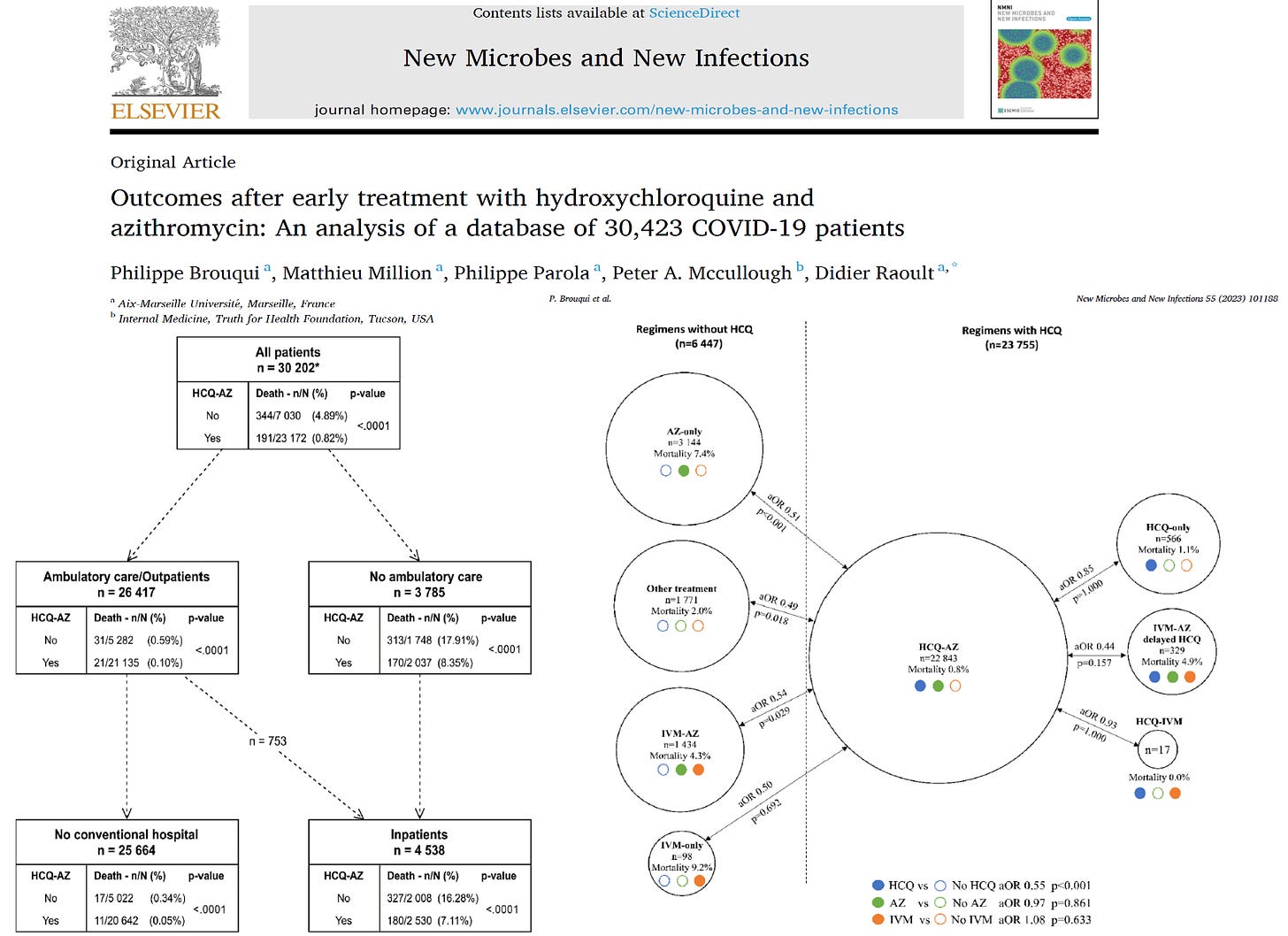
Outcomes after Early Treatment with Hydroxychloroquine and Azithromycin: An Analysis of 30,423 COVID-19 patients
By Peter A. McCullough, MD, MPH | Courageous Discourse | November 6, 2023
We perform prospective, randomized, double-blind, placebo-controlled trials to test drugs, vaccines, devices, and other products for safety and efficacy. Randomization is important since it handles: 1) selection bias, 2) all known and unknown confounders. Despite the hundreds of billions of dollars spent during the pandemic, we did not have an investment in large, multidrug prospective, randomized, placebo controlled trials or comparative studies to test the best drug regimens.
In the end, what patients care about is how they feel, function, and survive. When it came to COVID-19, whether randomized or not, if patients survived if they were in the optimally treated group. The only way to assess how a high-risk population fared in the pandemic is to report on a large sample of patients sick with COVID-19 with a large number of the outcome of of interest—death.
Brouqui et al reported from a French database of 30,423 COVID-19 patients of whom 535 succumbed to the illness. In great detail, the investigators report mortality according to ambulatory treatment received, hospitalization, and the course over the following six weeks.
An explosive discussion with ex-CDC scientist Norman Pieniazek
BY MARTIN NEIL, JONATHAN ENGLER, AND JESSICA HOCKETT | OCTOBER 30, 2023
Dr Norman Pieniazek is a molecular biologist, geneticist, epidemiologist with 147 publications in virology and parasitology. Before he retired, he spent 24 years working at the Center for Disease Control (CDC) in the USA. He has also spent time abroad including time working in Spain and Poland.
We met up with Norman for what was planned to be a short meeting to introduce ourselves and informally discuss common interests around covid. However, this turned into a two-hour long, wide-ranging and fascinating discussion that touched on a huge number of topics.
Early on in the meeting Norman made the wise suggestion that we record and share the discussion. So, he hit the record button on Skype and we started again. The video, accessible below, is approximately two hours long. Be aware that, given it wasn’t planned as an ‘interview’ or for broadcast, it is largely unstructured. However, for those short of time here is a synopsis of the discussion with a focus on what Norman said1:
- The bacterial pneumonia hypothesis suggests that early treatment – hydroxychloroquine, ivermectin and antibiotics address bacterial infection. Norman confirmed bacteria are everywhere in our bodies including in the lungs, creating an ever-present potentially hazardous predisposition that, given the right circumstances, might cause a deadly bacterial pneumonia infection.
- Well-understood remedies such as the stockpile of antibiotics, as recommended by Fauci, were cast aside in 2020. Bacterial infection can cause sepsis hence we need antibiotics. A Cytokine storm is caused by bacterial infection in the lungs, filling them with fluid; this lowers the oxygen level in the blood because of poor lung function.
- In-person diagnosis by a physician based on physical symptoms was largely replaced by the PCR test, and with the rise in tele-health visits, social distancing etc physicians stopped using stethoscopes to listen to a patient’s chest. This is an essential diagnostic tool to enable a doctor to audibly tell whether a patient has crossed the line into a bacterial infection which will then require antibiotics.
- Norman knew Donald Henderson who co-authored a classic work on how to best respond to a flu epidemic. Henderson and colleagues did not recommend any of the NPIs that were followed during covid because of the obvious severe health, social and economic costs. (As an aside this work was co-authored by Prof. Thomas Inglesby at John Hopkins who attended Event 201 and, oddly, recommended NPIs be used for covid – the very same ones he had rejected previously).
- Orthodox immunology was ignored – herd immunity is a fiction given there is a ‘soup’ of constantly mutating coronaviruses.
- Why didn’t scientists at the CDC question things early in 2020? Work from home restrictions meant that people at CDC couldn’t communicate and coordinate to overturn the madness being imposed from the ‘sixth floor’ top brass. You could not isolate CDC from the HHS (Health and Human Services) and it was HHS that were calling the shots.
- The Wuhan scientists were on a routine ‘fishing expedition’ for coronaviruses and unusual pneumonias. Why was this work being done in Wuhan? It is easier to do in China because it is legal and because there are lots of hospitals, in a concentrated area, where the population is in relatively poor health. Also, it is easier to get permission to perform a painful bronchial lavage procedure on patients to obtain pathogens in China; this is much harder to do in the USA. This procedure is done in the lower respiratory tract and guarantees higher quality samples than can be obtained using swabs, which really just measure the quality of the air that has entered your upper respiratory tract.
- To determine what pathogen is causing lower respiratory tract symptoms you should not use swabs and PCR. Why not? CDC acknowledges the inability of swabs to collect causative agents as reported by the EPIC study in these 2015 NEJM articles (one done on adults and one on children). Hence a positive result gained from a sample taken from the upper throat or the nose does not mean an infection is caused by the detected pathogen.


- In 2002-2004 SARS-COV was not subject to mass PCR testing, yet SARS-COV-2 was. PCR was used for SARS-COV but only on samples taken using bronchial lavage, but NOT from swab samples taken from the nose or upper throat.2
- Wu et al discovered WH-Human-1 using samples collected by bronchial lavage, and next generation sequencing of the collected genetic samples, and ultimately reported it in GenBank.
- Before reporting on GenBank they published a preprint identifying the genetic sequences3, which was appropriated and found its way into the hands of Corman and Drosten, who then decided to exploit it for personal gain (via commercial PCR testing), fabricating a story about validating it against SARS-1. It was subsequently renamed SARS-COV-2. (For a proposed timeline of events see here).
- Norman thinks SARS-COV-2 is simply a beta coronavirus (a cold), one of the many thousands of cold viruses that had remained undiscovered until 2020, but which have always been ever present in nature.
- SARS-COV-2 cannot be a novel virus created in a lab or by natural zoonotic mutation. It is simply novel to detection4. As soon as the EUA approved PCR tests started to be used the virus was simultaneously discovered in a number of disparate geographical regions. There was no evidence of sudden spread.
- In effect the results of any test are as much determined by the choice of test to apply as by the presence/absence of viruses. Norman says, “you will find whatever you want to find”. Hence people will be symptomless yet will have a lot of, whatever viruses happen to be around in their nose or throat.
- The established taxonomy of viruses is unusable simply because there are so many unknown viruses circulating in the wild.
- The mRNA vaccine technology ended in a ‘garbage heap’, because it is extremely toxic, and was rendered obsolete by protein subunit vaccines by 2019. So, the mRNA vaccines were doomed from the start. Subunit (protein-based) vaccines have been known since the late 1970s, but Moderna, Pfizer and BioNTech needed a way to realise a return on their vast investments in mRNA. Hence the pandemic.
- Novavax is a protein subunit vaccine, based on the spike protein, which was available in August 2020 but did not get approval from the FDA. Although it is protein based it will stay in the deltoid muscle injection site. It was however approved in Canada. It may not be very good for you (and ineffective against coronaviruses), but it is less dangerous than the mRNA vaccines.
- mRNA vaccines were found to be too dangerous for animals. Also, arguments that they are a safe basis for cancer drugs are based on lies. There is a competing technology called humanised monoclonal antibodies that cured President Carter from a melanoma that had migrated to his brain and there are now 500 versions of these drugs currently available.
- Norman was told that the patent on the flu vaccines, grown in eggs, expired in 2020. Hence there was little ROI in continuing with this technology.
- Viruses are in your respiratory tract and antibodies, responding to vaccines, are in your blood. These two things do not match well because the antibodies in the blood do not get into the lungs. The immune system ‘stays away’ from the complex respiratory system that deals with the thousands of pathogens we breathe in with every breath.
- Are serology studies a pointless exercise? Because of wide variation between individual’s antibody measurement only makes sense by studying change in any single individual over time.
- Testing for antibodies means nothing because antibodies in the blood cannot travel to the lungs to react.
- Testing for antigens is a cheaper and less sensitive version of the PCR test with the same limitation.
- Norman is very sceptical of a number of covid virus theories including those by Walter Chesnut and JJCoey’s infectious clone theory, though they weren’t discussed in any great detail and were probably not characterised fully (or maybe even fairly).
- The issue with ‘infectious clones’ is that ‘you do not know what to create’ because there are millions of sequences of coronavirus so there is no ‘clonality’ and each one has 30 thousand nucleotides and there are combinatorically infinite changes you could potentially need to consider when creating a coronavirus5. It therefore isn’t possible to know what to change, via Gain of Function (GoF), to make the virus behave in more dangerous ways.
- As part of the ‘partnership for peace’ programme in 1994 Norman hired two ex-Soviet bioweapons scientists and asked them ‘how come you worked for 20 years and didn’t create any new deadly viruses?’
- They can create thousands of virus combinations, but the problem is how to test these creations. There is no way to test the billions and billions of possible changes to a virus and identify which changes to the sequence are ‘bad’. You need the phenotype, and you cannot deduce the phenotype from the genotype. So how would GoF researchers – E.g., EcoHealth alliance – know exactly what to create?
- The claim that Saddam Hussian had biological weapons was groundless and this was confirmed to Norman by Donald Henderson who was involved at the time and who said it was not possible.
- Thus, GoF claims that changes to spike protein and furin cleavage sites make a virus more deadly are fiction. It isn’t possible and there is no proof they can produce deadly bioweapons. Those advocating this position and making these claims – EcoHealth alliance (Fauci, Baric and Duszak) should get fired by their bosses for producing “not a tiger but a kitty”.
- We discussed Gulf War syndrome. Norman said people imagine anthrax is dangerous, but the ex-Soviet bioweapons researchers said to attack New York with anthrax would need 20,000 Boeing 747s flying over the city, dropping millions of tons of anthrax spores from a low height then people spreading it with shovels. The only way to infect people with anthrax is by direct means via an oxygen line or a direct injection.
- Norman said the Tokyo gas attack was successful in Japan because the terrorist used sarin, a nerve agent. The biological agents used, botulinum and anthrax, fortunately failed.
- Within the CDC Fauci was called the ‘mean midget’ and during the AIDS epidemic he sunk Robert Gallo by inventing the story that Gallo had stolen the HIV virus from Luc Montagnier, thus destroying Gallo’s chances of being awarded the Nobel prize (he was also denied a patent).
- Fauci is “not stupid, he is mean”. Fauci wanted to get a Nobel prize, but he didn’t get a Nobel prize for AIDS, so he wanted it for the Wuhan virus. In January 2023 knowing that he wasn’t going to get the Nobel prize he “pulled the plug” and published this paper saying new types of vaccines are needed for respiratory infections, as an act of spite.
We learned a lot from Norman and are very grateful to him for giving us his valuable time. You will notice that we briefly discussed the vaccines, but you will be very pleased to hear that Norman has agreed to follow up with another meeting in early December to share his thoughts on this important topic (see here for a sneak peek)
You can access Norman’s other material on YouTube and Facebook (much of his material is in Polish and Norman speaks six languages!) His twitter handle is @normanpie.
1 Note that this synopsis is not a verbatim and true transcription of the conversation.
2 This document presents evidence PCR was used to collect samples, but no mass testing was undertaken.
3 Submitted (05-JAN-2020) Department of Zoonoses, National Institute of Communicable Disease Control and Prevention, Chinese Center for Disease Control and Prevention. The first submission to GenBank had two subsequent revisions.
4 The supposed ‘novel and deadly’ attributes of the virus are discussed extensively here.
5 See this paper. “Mammals are the reservoir hosts of the majority of emerging zoonoses (2, 3, 18). If we assume that all 5,486 described mammalian species (19) harbor an average of 58 viruses in the nine families of interest (as estimated here in P. giganteus) and that these viruses exhibit 100% host specificity, the total richness of mammalian viruses awaiting discovery exceeds ~320,000.”
Featured Video
Macgregor: We Haven’t Seen the Worst of the Iran War Yet
or go to
Aletho News Archives – Video-Images
New Book
Breast Cancer: Before You Consent
A new Unbekoming paperback
Lies are Unbekoming | September 18, 2026
Peter Gøtzsche reviewed every randomised mammography screening trial ever conducted for the Cochrane Collaboration. Cochrane’s headline is that, assuming a 15% mortality reduction, one woman in 2000 avoids dying of breast cancer over ten years. Ten are overdiagnosed and treated. Two hundred experience false alarms.
But that headline assumes the reduction. When Gøtzsche looked only at the trials with adequate randomisation — the higher-quality ones — the reduction disappeared. No effect on breast cancer mortality. No effect on all-cause mortality.
This is the Cochrane finding, published in the establishment’s own database of systematic reviews.
No woman being asked to consent to a mammogram this week knows it.
That is why the new Unbekoming paperback exists. … continue
Blog Roll
 Aletho News
- Iran Judiciary issues indictments against 159 US, Israeli officials for assassination of Leader, commanders
- Turkiye revokes Iranian bank license under US sanctions campaign
- US-Denmark Agreement on Greenland Is ‘PR Stunt’ Ahead of Midterms
- Araghchi: Military intervention cannot create security; coercion cannot bring peace
- Fraud Squared
- Breast Cancer: Before You Consent
- Iran’s Plan to Shut Down AI in the Persian Gulf
- Israel seeks ‘compensation’ from Washington over Saudi F-35 sale
- Saudi crown prince seeks dialogue with Ansarullah after Yemeni blows: Report
- Damascus rejects Saudi request for Syrian fighters to counter Yemen: Report
- If Americans Knew
- Inside Gaza’s death trap of collapsing, bombed-out buildings
- The everyday items Israel bans from Gaza every day
- Inside the siege, the ruined buildings of Gaza – Daily Update
- Debunking The Claim That Macklemore Has A “History Of Antisemitism”
- CPJ demands release of arrested Palestinian-US journalist near Bethlehem
- Robert Kraft: The Billionaire Friend of Netanyahu Pulling The Strings Behind the Macklemore/Ed Sheeran Blow Up
- Columbia Administered Fund Gives Big Money to Pro-Israel Groups
- Deportation Case of Palestinian Activist Salah Sarsour Tests First Amendment
- ‘We Will Not Forget’: Palestinians Mark 44 Years since Sabra and Shatila
- Why do we let Zionists decide what we can and can’t say?
- No Tricks Zone
- New Study: ‘Global Drought Shows No Detectable Recent Acceleration Under Climate Warming’
- Economic Masterminds: German Socialists Suggest Taxing Productivity Gains Stemming From Using AI
- The South China Sea Has Not Been Cooperating With The Climate Change Narrative
- Energy Crisis: Germany Enters Heating Season With Historically Low Gas Reserve Fill Levels
- New Study: The Antarctic Ice Sheet Gained Mass From 2020-2024 Due To Staggering Snow And Ice Accumulation
- Study: Ocean Heating Rates From Thousands Of Years Ago ‘Dwarf’ Modern Ocean Heating Rates
- Climate Extremists Target, Attack Large-Scale Power Grid Infrastructure In Germany!
- New Study: Antarctic Ice Melt Has Contributed Less Than 1 Centimeter To Sea Level Rise In The Last 30 Years
- Fear Of Debate: Alarmist German Climate Scientist Calls On Mainstream Media To Discredit Skeptic Voices
- End-Of-August Arctic Sea Ice Extent Hasn’t Fallen In 20 Years, Official Data Show!
 Aletho News