BDS leader Salah Khawaja ordered to 8 more days interrogation, blindfolded, denied access to lawyer
Samidoun Palestinian Prisoner Solidarity Network – November 10, 2016
Leading Palestinian BDS activist and organizer Salah Khawaja was ordered to an additional eight days of interrogation at a hearing at the Israeli military court in Petah Tikva on Wednesday, 9 November, where he was kept blindfolded throughout the hearing.
Khawaja, 45, the Secretary of the Boycott, Divestment and Sanctions National Committee (BNC) and a leader of the Palestinian Grassroots Anti-Apartheid Wall Campaign (Stop the Wall), was seized from his home on 26 October by Israeli occupation military forces. Since that time, he has been held under interrogation in Petah Tikva and barred from speaking with a lawyer.
His lawyer, Jehad Abu Raya, attended the military court hearing only to continue to be prohibited to speak with his client. Abu Raya noted that Khawaja “looked like he was emerging from a grave” and that he was blindfolded throughout the hearing. In 15 days, Israeli intelligence have conducted 27 rounds of “practically non-stop interrogation” with Salah, reported the Stop the Wall Campaign. In fact, Abu Raya noted that Khawaja has lost weight and is visibly sleep deprived and suffering the effects of over two weeks of ill-treatment and duress.
Front Line Defenders, Unadikum and Stop the Wall have issued calls for action in support of Khawaja and urging international attention to support this case of a Palestinian human rights defender targeted for his activism. … More
Misplacing priorities and freedom of expression
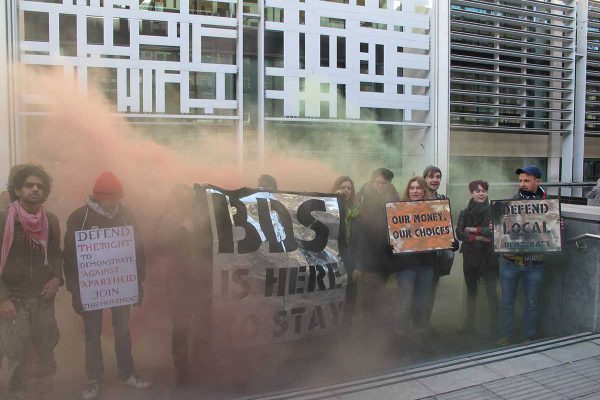
BDS supporters protest anti BDS activities in London
By Ramona Wadi | MEMO | November 3, 2016
It would be slightly premature to consider the statement by the EU Representative for Foreign Affairs and Security Policy, Federica Mogherini, regarding the right of EU citizens to boycott Israel as some sort of victory. At first glance, it might look as if activism has overcome a significant hurdle, given the Israeli government’s obsession with suffocating the Boycott, Divestment and Sanctions movement (BDS). A study of the brief statement actually suggests otherwise, and all in the name of freedom of expression.
Mogherini asserted that the EU “stands firm in protecting freedom of expression and freedom of association in line with the Charter of Fundamental Rights of the European Union”, even when such information or ideas “offend, shock or disturb the State or any sector of the population.” You just knew that there was a “but” coming: she made it equally clear that “the EU rejects the BDS campaign’s attempts to isolate Israel and is opposed to any boycott of Israel.” The EU official missed the point, of course; Israel isolates itself by its contempt for international laws and conventions, along with its brutal military occupation and colonisation of Palestine.
Commenting on Mogherini’s statement, BDS Europe Campaigns Officer Riya Hassan voiced the expectation that the EU should respect “its obligations under international law and its own principles and laws by, at the very least, imposing a military embargo upon Israel,” as well as a suspension of the EU-Israel Agreement signed in 1995. The latter stipulates regulations regarding political dialogue, economic cooperation, security and cooperation on social matters, based upon the premise in Article 2 of the agreement that all provisions “shall be based on respect for human rights and democratic principles.” Israel has no such respect; it is a colonial entity and the EU functions as a protector of colonialism. The entire agreement should thus be declared null and void, or amended according to each entity’s characteristics, without the need to drag pretentious terms such as democracy into the equation.
Through Mogherini’s recent statement we have a clear example of how the EU actually demeans human rights and freedom of expression by utilising the discourse meant to uphold them. The entire essence of the EU’s true intentions lies in its opposition to BDS. Hence, any concession given by the EU should not be misconstrued as support, or upholding the right to freedom of expression. It is merely a recurring political ploy that ridicules the very essence of freedom. At the same time, it is through these clauses that BDS has managed to retain ground. Notwithstanding the genuine efforts of the masses which have embarked upon collective and individual efforts to boycott Israel, the fragile compromise upon which the global boycott outlook rests may well become tarnished if it continues to laud statements blatantly supportive of Israel while grudgingly allowing dissent as proof of freedom of expression.
Hence, Mogherini’s statement is not welcome. It is a calculated contribution to the debate that places Israel’s interests above the legitimate demands and legal rights of the Palestinians. BDS should distance itself from the litany of symbolic gestures that have taken precedence over genuine, active support for the anti-colonial struggle unless, that is, the movement seeks to become just another actor that thrives upon Palestinian demands as the means for the entity’s survival. If the movement’s chartered course is in the slightest way intertwined with that of the EU, however insignificant it may seem on the surface, Palestine may well be destined to accumulate festering wounds; the objective — which is already compromised due to the two-state subjugation rhetoric — will in the meantime become ever more distant from the land and the indigenous people.
‘Saudi Sanctions against Hezbollah Have Failed to Weaken the Party’

Deputy chief of Hezbollah’s Executive Council Sheikh Nabil Qawook
Naharnet | October 29, 2016
Deputy chief of Hezbollah’s Executive Council Sheikh Nabil Qawuq stressed on Saturday that the Saudi sanctions against the party have failed to weaken it, the state-run National News Agency reported on Saturday.
“The political developments and field achievements confirm the failure of the Saudi sanctions against Hezbollah, especially since Saudi Arabia wanted to weaken Hezbollah in Lebanon which has only grown stronger at the political, popular and military levels inside Lebanon and regionally,” said Qawuq.
“By renewing sanctions and terrorism ranking against Hezbollah in Lebanon, Saudi Arabia is but reflecting an outrage, despair and disappointment in the face of the Resistance, because the Saudi penalties have changed nothing of Hezbollah’s stances in Syria,” his eminence went on to say.
“Regardless of the pressures, we will not leave our national duty to protect our people and our nation, and we will complete the battle against takfiri terrorism, which has no choice but to be defeated in Syria, and we have no choice but to win.” added Qawuq.
He concluded: “The next phase that Lebanon is approaching will emphasize the strength of the strategic alliance between Hezbollah and Amal movement. Those who were betting on discord and division between the two were disappointed.
“If it was not for the Army, People and Resistance equation which Lebanon renews adherence to at this stage, and without the sacrifices of the Lebanese army and the resistance that has protected Lebanon from being sacked by the ISIL and al-Nusra Front, the Lebanese would not have had the chance to elect a president.”
Greece’s Syriza Party playing double game on Palestine issue: Activist
Press TV – October 18, 2016
Greece’s ruling left-wing Syriza Party has called on the government to recognize the state of Palestine. Back in December, the parliament approved a non-binding resolution, urging the government to formally recognize the Palestinian statehood. If implemented, Greece would become the first European country to follow Sweden’s lead which officially recognized Palestine in 2014.
Talking to Press TV, Joe Catron, an activist with International Solidarity Movement, has described the announcement as “a tremendous victory” for Palestinians and solidarity activists who have made Palestine a popular issue in Greece.
But at the same time, he drew attention to the fact that this is only “a symbolic move” which comes on the heels of other steps taken by Syriza to boost its ties with Israel.
“Since Syriza took power, we have seen it sign [an] agreement with Israel which is comparable only to Israel’s existing agreement with the United States,” he said. “We have seen it move to increase its energy cooperation with Israel and [have] even seen Syriza prime minister refer in writing, during a visit to the occupied Palestinian Jerusalem al-Quds, to it [the city] as Israel’s historic capital.”
He further noted that Syriza is playing a double game over Palestine by trying to cement its ties with Tel Aviv on the one hand; while taking limited pro-Palestine steps on the other.
“I do not think that Israel is happy to see any steps taken internationally in solidarity with Palestine and the Palestinians, including this one. [But] I think they probably prefer it to any alternative that might include its isolation, for example Greece ending its energy ties. That is something that, I think, they would take more seriously,” Catron added.
According to the activist, it is up to Palestinians to decide whether such symbolic steps are worth celebrating or they are simply distractions from more concrete measures that might produce results.
Palestine Advocacy Project Publishes Ads in Major University Newspapers Condemning Israeli Leaders
IMEMC News & Agencies – October 14, 2016
 Palestine Advocacy Project, an NGO based in the Boston area, has launched a series of ads portraying prominent Israeli officials, such as Prime Minister Benjamin Netanyahu, and their disregard for the safety and well-being of Palestinians. These ads feature violent and bigoted direct quotations which highlight the contempt Israel’s US-backed leaders display for basic Palestinian human rights.
“If you do your own research, you’ll quickly find many more hateful quotes,” said Palestine Advocacy Project member Maggie Liu. “As a college student living on a politically-active campus, I know firsthand how little young people know about the reality of the situation. I hope these ads will bring some much-needed dialogue to campuses across the country.”
According to the PNN, nine universities across the United States, including Harvard, Boston University, Cornell, and University of California-Berkeley are publishing these ads in their newspapers. The ads quote a number of Israeli officials, such as Israeli deputy defense minister Rabbi Eli Ben Dahan, who asserted that Palestinians “are beasts, they are not human.” The ads all include a link to a webpage, with additional quotes from Israeli leaders.
“It is beyond disturbing that someone in a position of power can say these things and not even flinch,” noted Farida El Hefni, a University of Rochester student. “How are these politicians that are so quick to accuse people of being anti-Israel or anti-Semitic the same ones using racist language to describe an entire group of people?”
Palestine Advocacy Project created these ads in order to spark conversation among young Americans on university campuses across the United States. The ads present a side of the Israeli-Palestinian conflict that is seldom featured in the American mainstream media. The indisputable, direct quotes from prominent Israeli officials are provocative, and in many cases, explicitly racist.
Palestine Advocacy Project has spent the past two years exposing the hypocrisy surrounding the U.S.’s relationship with Israel, and challenging negative stereotypes of Palestinians. The “One Word” campaign, which was released in 2014, showcased the many forms of violence Palestinians are subjected to on a daily basis. More recently, PalAd brought the works of Palestinian Poet Laureate Mahmoud Darwish to public spaces. This latest campaign, which focuses on the violent rhetoric of the upper echelons of Israeli political leadership, will give the American public new information on why the oppression of Palestinians continues.
“The sooner people realize that this isn’t just about conflict over land and that there are people literally calling for the erasure of Palestinians,” continues El Hefni, “the sooner we can get somewhere.”
Israeli navy seizes Gaza-bound aid ship
MEMO | October 5, 2016
The Israeli navy has seized the Zaytouna-Oliva, a Gaza-bound aid ship, and is currently towing it towards the Israeli port city of Ashdod, according to the initiative’s organizers and reports in the Israeli media.
Sondos Ferwana, a media spokeswoman for the International Coalition for the Fourth Freedom Flotilla, told reporters on Wednesday evening that Israeli naval forces had “captured the ship”.
The Israeli military, for its part, confirmed the ship’s seizure in a statement.
“The Israeli Defense Forces managed to quickly seize the ship without causing any injuries among passengers,” the statement read.
According to the military, the crew of the Gaza-bound vessel had initially refused the navy’s orders to change course.
“This forced us to intervene and seize the ship before it violated the legal maritime closure imposed on the Gaza Strip,” the statement read.
According to reports on Israel’s Channel Two television station, the aid ship was intercepted — without resistance — some 80 kilometers off Gaza’s coast.
Ferwana, for her part, described the incident as “another act of Israeli piracy”, adding that all contact with the ship — which is carrying humanitarian aid and several female activists — had been lost.
“We don’t know the fate of the activists aboard,” she said.
Passengers on the Zaytouna-Oliva, which set sail from the Spanish city of Barcelona last month, include Irish Nobel Peace Prize laureate Mairead Maguire, Swedish and Algerian lawmakers, a South African Olympic athlete and a Malaysian doctor.
The all-female initiative seeks to break Israel’s decade-long blockade of the Gaza Strip and show solidarity with the women of Gaza.
Palestinian resistance movement Hamas, for its part, which has governed the Gaza Strip since 2007, condemned what it described “the Israeli occupation’s assault on the aid ship and its intimidation of the activists on board”.
In a statement, Hamas spokesman Fawzi Barhoum said the incident amounted to “an act of state terrorism” and another example of Israeli “aggression against the Palestinian people and those who show solidarity with the Palestinian cause”.
Barhoum went on to urge the international community to “put an end to Israel’s crimes”, stressing the need for immediate action “to lift the blockade and rescue the people of Gaza”.
In June of last year, Israeli forces intercepted the “Marianne” — which had been taking part in a similar initiative — and arrested all activists on board.
A similar Gaza-bound aid flotilla ended in tragedy in 2010 when the Mavi Marmara, a Turkish aid ship, was raided by Israeli commandos who killed 10 Turkish activists.
Since 2007, the Hamas-run Gaza Strip has groaned under a crippling Israeli/Egyptian blockade that has deprived its almost two million inhabitants of most basic commodities, including food, fuel, medicine and desperately-needed building materials.
In June, UN Secretary-General Ban Ki-moon described the blockade of Gaza as “collective punishment”, which, he asserted, “suffocates its people, stifles its economy and impedes reconstruction efforts”.
Irish bank closes Palestine solidarity group’s account
MEMO | October 4, 2016
The Bank of Ireland has been criticised after shutting the account of the Ireland Palestine Solidarity Campaign (IPSC), the latest in a string of similar moves by European banks.
IPSC has formally complained, following the closure of its account which it uses to lodge donations, and intends to take a case to the Financial Services Ombudsman.
Earlier this year, the Bank of Ireland requested information from IPSC about its funding and how funds were spent, in response to which, IPSC submitted its audited accounts.
According to IPSC, the Bank of Ireland has “failed to give a specific explanation of why it was closing the accounts.”
Kevin Squires, IPSC coordinator told TheJournal.ie : “Bank of Ireland’s silence speaks volumes. Honestly it’s hard to not view this as part of a wider campaign which has seen banks close accounts in the UK, Austria and France.”
“In the last year or so we have had €1,200 go to Palestine to pay for Palestinian scarves, which is a tiny amount. That’s trade with Palestine. It’s not like we’re sending money to people there.”
Vice-President of Sinn Fein and a Teachta Dala for Dublin Central, Mary Lou McDonald, said the decision was “outrageous”.
“The Ireland Palestine Solidarity Campaign are an established advocacy group that have spent years protesting against the treatment of the Palestinian people. To close their account citing that they associate with a ‘high risk country’… this is not only outrageous; this is insulting to the Palestinian people.”
“Bank of Ireland cannot stay silent on this matter,” she added.
The following is from a statement by the IPSC:
This denial of banking rights, the ensuing loss of income and the potential reputational damage to the IPSC comes in the context of similar seemingly coordinated attacks on Palestine solidarity organisations across Europe and the United States. Numerous bank accounts belonging to such organisations have been closed in France, Germany, Austria and the UK. It is difficult to escape the conclusion that this attack on the IPSC’s ability to bank – which is, in effect, the ability to function at all – is political in nature and forms part of this wider attack on organisations that advocate for peaceful action to secure Palestinian rights enshrined in international law.
Israel has boasted of conducting a global campaign of ‘lawfare’ – using legal and other punitive threats to silence and attack supporters of Palestinian rights. This attack on the IPSC It appears to be part of this campaign, a politically motivated measure to silence a human rights organsiation that campaigns for Boycott, Divestment and Sanctions (BDS) against Israel until it fulfils its obligations under international law – a campaign the Irish government views as an entirely “legitimate” means of protest “intended to pressure Israel into ending the occupation.”
Russian Envoy Stands Against Imposing Color Revolution on Venezuela
Sputnik – 03.10.2016
Russia is prepared to join efforts aimed at resolving Venezuela’s internal political standoff if necessary, Russian Ambassador to Venezuela Vladimir Zaemsky told Sputnik.
“We welcome efforts of various politicians to help reach a mutual understanding between the various political groups in Venezuela and we hope that such steps eventually would lead to a positive result. We are ready to join this if it is deemed necessary,” Zaemsky said.
Venezuela has been embroiled in a political crisis with opposition staging regular protests and launching a campaign to remove President Nicolas Maduro, blaming him for an economic crisis in Venezuela, a country suffering from shrinking GDP, shortages of goods and rising inflation. According to the ambassador, the political crisis cannot be settled without preventing the attempts of some of Venezuela’s neighbors, the West, global media and non-governmental organizations to interfere in the internal affairs of the country.
“Russia believes that the political resolution of Venezuela’s problems should be found by the Venezuelan people itself… It must meet constitutional norms and national laws. Destructive meddling from abroad is unacceptable, no one can impose ‘color [revolution] scenarios’ based on notorious radical tactics to destabilize the situation,” Zaemsky said.
Venezuela has been in a state of an economic emergency since January. Up to 96 percent of Venezuela’s budget depends on oil revenues amid the ongoing slump in oil prices. Venezuela’s opposition hopes to hold a recall referendum to remove Maduro from power.
In August, Maduro pledged to act much tougher than his Turkish counterpart Recep Tayyip Erdogan in case of the coup attempt in the country.
Israel calls on Norwegian theater to help remove fake BDS clip

© nationaltheatret beklager / YouTube
RT | September 26, 2016
Tel Aviv has urged the National Theatre of Norway to deny links to and remove a video in which a fake theater official called for a boycott of Israel and its HaBima Theater. The Norwegian theater denied its part but stopped short of criticizing the clip.
While the theater apparently had no role in producing the video, the Israeli Foreign Ministry demanded that it should “clearly and immediately repudiate” the clip, as well as take “necessary measures to have the video removed from every site.”
It went on to compare the video to “the works of the Reich Minister of Propaganda, Joseph Goebbels, or the Nazi filmmaker Leni Riefenstahl,” adding that it is “actively pursuing the matter with all involved parties.”
In response, the National Theater of Norway wrote in a statement published on its website that it was in no way part of making the video, and does not engage in boycotts.
“The article and video are not made by The National Theater of Norway – and do not represent The National Theater of Norway’s attitude – they are an expression of artistic freedom. The National Theater of Norway still has greater faith in collaboration with artists across national borders and from regimes we are critical to, than boycotts and silence,” it wrote.
Although the six-minute video claims to be from the National Theater of Norway, it was actually created by a group of actors from the art project “Monsters of Reality,” which is part of the 2016 International Ibsen Festival.
In the video, a person claiming to be a spokesperson for the theater lashes out against Israel and its occupation of Palestinian territories. She apologizes on behalf of the playhouse, for collaborating with Israel’s HaBima Theater between 2013 and 2015.
“This is a great day for the National Theater of Norway. It is the day when we publicly apologize for our shameful collaboration with HaBima, the national theater of Israel…” the spokesperson says.
She goes on to state that when the theatre agreed to collaborate with Israel, it did not know “what a powerful role HaBima and other Israeli art institutions play in normalizing the Israeli occupation,” calling Israeli art a “tool” for building an image of “a humanistic nation” instead of an “apartheid state.”
She claims the two theatres were collaborating as Israel “executed its horrific bombing over the Gaza strip,” and that the Norwegian one was unaware of HaBima’s alleged role because it did not do “one single piece of research…we didn’t bother to find out.”
“Five-hundred Palestinian children lost their lives while HaBima was busy entertaining Israeli soldiers,” she says.
In conclusion, the woman posing as spokesperson makes three promises on behalf of the theatre. The first is that it will fully support the Palestinian call for boycott, divestment, and sanctions (BDS) of Israel, and cancel its membership with the “politically irresponsible” European Theatre Union.
Next, the spokesperson claims the theatre will dedicate all means of production to “work with the situation in the Middle East” from 2017 to 2019. She even promises that the facility’s director will give 50 percent of her salary to Palestinian theatre in the West Bank and Gaza.
The Boycott, Divestment, Sanctions (BDS) movement works to “end international support for Israel’s oppression of Palestinians and pressure Israel to comply with international law,” according to the Palestinian BDS National Committee’s website.
READ MORE:
Featured Video
Trita Parsi: Israel Set a Trap for Total War in the Region
or go to
Aletho News Archives – Video-Images
Book Review
Why the War on Conspiracy Theories Is Bad Public Policy
By Kevin Barrett • Unz Review • February 1, 2019
 A Review of Conspiracy Theories and Other Dangerous Ideas by Cass Sunstein (based on an earlier paper co-authored with Adrian Vermeule); In Defense of Troublemakers: The Power of Dissent in Life and Business by Charlan Nemeth; and Conspiracy Theories and the People Who Believe Them, edited by Joseph E. Uscinski
On January 25 2018 YouTube unleashed the latest salvo in the war on conspiracy theories, saying “we’ll begin reducing recommendations of borderline content and content that could misinform users in harmful ways—such as videos promoting a phony miracle cure for a serious illness, claiming the earth is flat, or making blatantly false claims about historic events like 9/11.”
At first glance that sounds reasonable. Nobody wants YouTube or anyone else to recommend bad information. And almost everyone agrees that phony miracle cures, flat earthism, and blatantly false claims about 9/11 and other historical events are undesirable.
But if we stop and seriously consider those words, we notice a couple of problems. First, the word “recommend” is not just misleading but mendacious. YouTube obviously doesn’t really recommend anything. When it says it does, it is lying. … continue
Blog Roll
 Aletho News
- Trita Parsi: Israel Set a Trap for Total War in the Region
- Trump’s Iran war is on an Israeli leash
- Saudi oil boss issues global supply warning
- Riyadh Says Its Oil System Is Intact. The Numbers Say Otherwise.
- Trump and Netanyahu Want to “Finish the Job” on Iran
- US ‘one-sided dictation’ not Iran’s beliefs makes rational talks impossible: Baghaei
- Iran’s Next Strike May Not Explode. It Could Shut You Down /Col Doug Macgregor
- Iran: US political targets legitimate if assassinations return
- Iraq shuts key border crossing with Iran under US pressure: Report
- Undersea Internet cables could be targeted in retaliation for attacks on Iran: IRGC deputy chief
- If Americans Knew
- The Israel Lobby’s Changing Fortunes
- AIPAC has become such a political liability that it’s shifting to a more “nimble” approach to buying politicians
- At least 160 Israeli settler attacks in 2 weeks
- Will Gaza’s Ancient Christian Community Disappear Forever?
- Israel’s vision of regional security rests on keeping Arab states weak
- Heidi Levine recounts how Palestinian youths helped save her in settler attack
- DAILY UPDATE: Latest essential news on Palestine, Israel, & region
- Trump’s Intensifying Sabotage of the ICC, for Israel’s Sake
- Israeli military detain US and UK volunteers in West Bank including Democratic NY politician Brad Lander
- Americans at National Conservatism Conference held in Israel this year criticize Israel
- No Tricks Zone
- E-Cars Reduce CO2 Emissions By Only 41% Compared To Internal Combustion Engine Vehicles
- Predictions Made By Renowned Climate Professor Over Past Decades Have Been Proven To Be Poor
- New Study Suggests Large Regions Of The Pacific Ocean Have Been Cooling For The Last 80 Years
- Germany’s Green Energy Debacle: High Energy Costs Force Kahla Porzellan to Close After 182 Years!
- New Study: 50 Years Of The Most Aggressive ‘Net Zero’ Policies Can Only Affect The Global Climate By 0.03°C
- US September “Heat” Was No Record…Many Records Set Decades Ago
- Latest European Green Energy Debacle; Portugal’s Largest Flagship Solar Park Insolvent!
- Green Energy Debacle: German Expert Professor Fritz Vahrenholt Warns Of Severe Economic And Social Consequences
- Two More Paleo Reconstructions Affirm Meters-Higher Sea Levels Across Ireland, Brazil 7000-6000 Years Ago
- New Study: Earth And Venus Surface Warmth Largely Explained By Convection And Lapse Rate, Not CO2 Or Radiation

