This is what “lack of evidence” looks like when Jewish settlers shoot Palestinians

File photo IMEMC
By Yossi Gurvitz | Yesh Din | May 3, 2015
We see how seriously the prosecution takes its role when we realize it closed a file for lack of evidence — without so much as noticing the evidence.
The location was Qusra, a village in the Shiloh Valley; the date, September 16, 2011. Fathallah Mahmoud Muhammad Abu Rhoda went out with his three sons to pick figs. A short while after reaching their land, they noticed about 10 Israeli civilians standing around their water hole. The Palestinians demanded the Israelis leave the place; the interlopers refused. The residents of Qusra — a village that has already proven it can defend itself against marauders — began heading to the area. An argument ensued, and according to Abu Rhoda’s testimony to the police, three of the settlers (who were armed) opened fire on the Palestinians. One bullet hit Abu Rhoda in the thigh.
Of the three, two were armed with rifles and the other with a handgun. From the police testimony, we see that the handgun’s owner also sicked a dog on the Palestinians. The complainants managed to photograph some of their attackers, among them the handgun owner.
Four days after the incident, Abu Rhoda filed a complaint with the police. Almost three years later, on August 6, 2014, the prosecution informed us that it closed the case for lack of evidence. After a series of 14 phone calls, we managed to photocopy the case file on December 15, 2014 — more than four months after the case was closed. However, it was immediately apparent some of the material was missing. We continued requesting it until February 2015.
From the evidence we finally received, it turns out that there is more than enough evidence to indict the handgun owner, E. As previously mentioned, E. was identified by the Palestinians victims, and they even supplied the police with photos of him at the scene, which clearly show him holding a handgun in one hand and the dog in the other. The police picked up cartridges from the scene, and a ballistic fingerprinting – which took place on September 27, 2011 – found that one of the cartridges came from a 9mm Glock pistol (the others were fired from rifles.) E. was summoned for an investigation, invoked his right to remain silent, but admitted he owned a Glock. The gun was duly turned over to the police, which sent it to a ballistic fingerprinting. In February 2012 the police expert reached the conclusion that there is a match between the cartridges fired from E.’s handgun and the those that were examined on September 27.
In total, the following evidence was marshaled against E.:
A. He was identified and photographed by the complainants.
B. His handgun was identified as the one fired during the incident.
Despite the evidence, the police recommended that the case against E. be closed due to — get this — lack of evidence. The recommendation was accepted by the prosecution. Embarrassingly, the prosecution admitted this to us only in January 2015 — 10 months after it closed the case for lack of evidence. Only as a result of our request for more case files did the prosecution learn about the September 2011 memorandum, which identified the type of handgun owned by E. That is, when the prosecution decided to close the case for lack of evidence, it was lacking a major piece of evidence.
What about the two other shooters? I’m glad you asked. The police chased one of the suspects into the Esh Kodesh outpost, even so much as detaining him after he fled. However, despite the fact that the suspect fled arrest and refused to identify himself, there is no indication in the material we received from the police that any investigative action was taken against him. There is, for instance, no sign that he was even interrogated or gave testimony; he was detained, and immediately released.
The third suspect managed to flee in a vehicle and reach Esh Kodesh. The police identified the owner of the vehicle as well as another person who was with him in the car during the chase. But, lo and behold, the police neither bothered to interrogate them nor attempt to identify the third shooter.
This is how the police and the prosecution treat a violent incident, in which three Israeli civilians open fire on Palestinians who are on their own land. In a case that contains such clear forensic evidence, they managed, with extraordinary negligence, not to notice it. And in the other cases? They simply do not investigate.
In the beginning of March, our attorney Anu Deuel Lusky (briskly aided by Moriyah Shlomot) appealed the decision, asking the prosecution to bring E. to trial and conduct further investigations that would lead to the capture of the other two suspects. To quote the appeal:
“This appeal, in both its parts, raises a harsh and heavy feeling that both the police and the prosecution betrayed their duties as bodies entrusted with maintaining law and order. The current situation – in which the lives, bodies and property of Palestinians, considered protected persons by international law, can be harmed with impunity, both as a result of settler violence and as a result of law enforcement entities standing aside, not making the minimal effort to bring lawbreakers to justice – is intolerable, and undermines the rule of law.”
One wonders what is left of the rule of law after it has been so brazenly undermined.
Protest over Zionist Police Brutality Turns Violent in Tel Aviv
Al-Manar | May 4, 2015
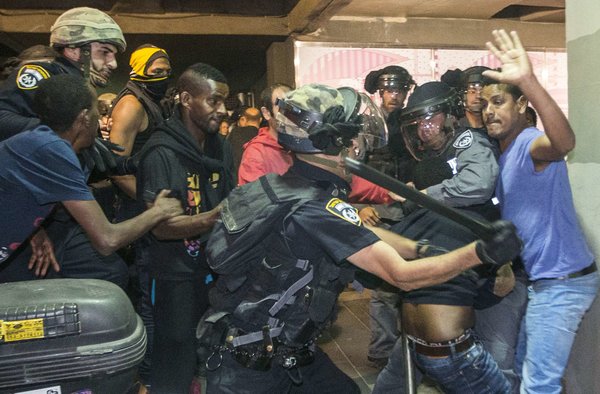
A protest in Tel Aviv over police mistreatment of Ethiopian Jews turned violent Sunday, resulting in 57 officers being injured, according to the Zionist police.
Most of those injuries were minor, according to police, but one officer was described to be “moderately injured.” Police say 12 protestors were injured. The extent of those injuries is not known, according to CNN.
The planned demonstration by the Ethiopian Jewish community — incensed over a video gone viral that shows a uniformed IOF soldier of Ethiopian descent being assaulted by police — had been peaceful for hours before things took a violent turn.
Authorities employed horses, water cannons and smoke to disperse the crowd in Rabin Square, where demonstrators had been chanting slogans such as “a violent cop should be in jail.”
Forty-three protesters were arrested, according to Israeli police spokeswoman Luba Samri.
The videotaped episode from April 26 was a tipping point for Ethiopian Jews, some 125,000 strong, who say they have long felt like second-class citizens since arriving in two waves of mass immigration in the 1980s and early 1990s.
Prime Minister Benjamin Netanyahu released a statement saying that “all claims will be looked into but there is no place for violence and such disturbances.” Netanyahu will meet with Pakada on Monday, as well as with leaders in the Ethiopian community, according to the statement.
Teen Faces Life for Breaking Windows While Cops who Murdered Freddie Gray Receive Far Less
By Jay Syrmopoulos | The Free Thought Project | May 2, 2015
Baltimore, Md. – In a telling indictment of the lack of justice in the U.S. justice system, 18-year-old Allen Bullock, who has no adult criminal record, faces the potential of life in prison. Under Maryland State Law, rioting carries a maximum penalty of life in prison. Meanwhile, the six officers charged in the death of Freddie face maximum sentences ranging from 20 to 60 years.
Bullock faces charges stemming from a single incident, as seen in an almost iconic photo smashing in a police car with a traffic cone. He turned himself in after being encouraged by his parents, according to The Guardian.
In addition to facing shorter sentences for far more serious crimes, the officers were also given bonds ranging from $250,000-$350,000 while Bullock’s bond was set at $500,000.
All six of the officers have posted bond and been released, while Bullock remains locked up; unable to afford the half a million dollar bond.
It seems patently absurd that a teenager is facing the potential of far more prison time for eight misdemeanor charges than any of the police officers, charged with assault, manslaughter, and second-degree murder.
What message does this send our children?
The state, as evidenced by the respective potential penalties, is telling us that Freddie Gray’s life is worth less than that of some windows on a cop car.
Does smashing a police cruiser’s windows with a traffic cone truly deserve a greater penalty than taking a young man’s life?
This is why you see people taking to the streets across the U.S. and standing in solidarity with the Baltimore protesters, as Americans are tired of being abused and having their rights violated by law enforcement.
Americans are fed up with being victimized by those who have been given great power by the state. All too often, those same individuals then use that power to cover for one another, refusing to cross the thin blue line, denying accountability, while systematically laying blame on those they victimize.
While it is heartening to see the indictments of these six Baltimore cops, the double standard is extremely apparent, as highlighted by the disparity in bond and penalty in the cases mentioned above.
The Hidden Tears of Punjab
By ANDRE VLTCHEK | CounterPunch | May 2, 2015
A lane, a narrow passage to Jallianwala Bagh Garden inside the old city of Amritsar, in the state of Punjab. It is a monument now, one of the testaments to madness and crimes committed by the British Empire during its colonial reign over Sub-Continent.
This is where, on April 13, 1919, thousands of people gathered, demanding release of two of their detained leaders, Dr. Satyapal and Dr. Saifuddin. It was right before the day of Baisakhi, the main Sikh festival, and the pilgrims came to the city, in multitudes, from all corners of Punjab.
The British Brigadier-General Reginald Dyer brought fifty Gurkha riflemen to a raised bank, and then ordered them to shoot at the crowd.
Bipan Chandra, an Indian historian, wrote in his iconic work, “India’s Struggle for Independence”:
“On the orders of Brigadier-General Reginald Dyer, the army fired on the crowd for ten minutes, directing their bullets largely towards the few open gates through which people were trying to run out. The figures released by the British government were 370 dead and 1200 wounded. Other sources place the number dead at well over 1000.”
While reading through the draft of this essay, my friend and comrade, renowned Canadian international lawyer Christopher Black, added:
“… At the investigation into the Amritsar massacre, General Dyer said his only regret was that he had not killed more people. He also used armoured cars to block the entrances and machine guns were also used on the crowd. After that the British made people in the streets crawl on the stomachs when they passed a British officer. Terrible, terrible things-and what the British did in Kenya in the 50’s is worse than what the Nazis did in Europe.”
Jallianwala Bagh is now a monument, a testament, a warning. There are bullet holes clearly marked in white, penetrating the walls of surrounding buildings. There is a well, where bodies of countless victims had fallen. Some people had chosen to jump, to escape the bullets.
There is a museum, containing historic documents: statements of defiance and spite from the officials of British Raj, as well as declarations of several maverick Indian figures, including Rabindranath Tagore, one of the greatest writers of India, who threw his knighthood back in the face of the British oppressors, after he learned about the massacre.
There are old black and white photos of Punjabi people tied to poles, their buttocks exposed, being flogged by shorts-wearing British soldiers, who were apparently enjoying their heinous acts.
There is also a statement of General Dyer himself. It is chilling, arrogant and unapologetic statement:
“I fired and continued to fire until the crowd dispersed, and I consider this is the least amount of firing which would produce the necessary moral and widespread effect it was my duty to produce if I was to justify my action. If more troops had been at hand the casualties would have been greater in proportion. It was no longer a question of merely dispersing the crowd, but one of producing a sufficient moral effect from a military point of view not only on those who were present, but more especially throughout the Punjab. There could be no question of undue severity.”
Not everyone in India is outraged by former crimes of the British Empire. Some want to forget and to “move on”, especially those closely linked to the establishment; to the new corporate and pro-Western India, where education is being privatized, mass media controlled by big business interests, and progressive ideologies buried under unsavory layers of greed.
At the grounds of Jallianwala Bagh, Anand P. Mishra, Professor at O. P. Jindal Global University, Haryana, spreads his arms:
“This happened almost 100 years ago and I don’t hold any grudges towards British, anymore.”
But when I approach Ms. Garima Sahata, a Punjabi student, she does not hide her feelings towards the British Empire and the West:
“I feel ager, thinking what they had done to our people. I think it is important for us to come here and to see the remnants of the massacre. I still feel angry towards the British people, even now… but in a different way… They are not killing us the same way, as they used to in the past, but they are killing us nevertheless.”
***
The British Empire was actually based on enforcing full submission and obedience on its local subjects, in all corners of the world; it was based on fear and terror, on disinformation, propaganda, supremacist concepts, and on shameless collaboration of the local “elites”. “Law and order” was maintained by using torture and extra-judiciary executions, “divide and rule” strategies, and by building countless prisons and concentration camps.
To kill 1,000 or more “niggers,” to borrow from the colorful, racist dictionary of Lloyd George, who was serving as British Prime Minister between 1916 and 1922, was never something that Western empires would feel ashamed of. For centuries, the British Kingdom was murdering merrily, all over Africa and the Middle East, as well as in the Punjab, Kerala, Gujarat, in fact all over the Sub-Continent. In London the acts of smashing unruly nations were considered as something “normal”, even praiseworthy. Commanders in charge of slaughtering thousands of people in the colonies were promoted, not demoted, and their statues have been decorating countless squares and government buildings.
The British Empire has been above the law. All rights to punish “locals” were reserved. But British citizens were almost never punished for their horrendous crimes committed in foreign lands.
When the Nazis grabbed power in Germany, they immediately began enjoying a dedicated following from the elites in the United Kingdom. It is because British colonialism and German Nazism were in essence not too different from each other.
Today’s Western Empire is clearly following its predecessor. Not much has changed. Technology improved, that is about all.
***
Standing at the monument of colonial carnage in Punjab, I recalled dozens of horrific crimes of the British Empire, committed all over the world:
I thought about those concentration camps in Africa, and about the stations where slaves who were first hunted down like animals were shackled and beaten, then put on boats and forced to undergo voyages to the “new world” – voyages that most of them never managed to survive. I thought about murder, torture, flogging, raping women and men, destruction of entire countries, tribes and families. It is all connected: colonialism, present-day riots in Baltimore, horrid ruins of Africa.
In Kenya, near Voi, I was shown a British prison for resistance cadres, which was surrounded by wilderness and dangerous animals. This is where the leaders of local rebellions were jailed, tortured and exterminated.
In Uganda, I was told stories about how British colonizers used to humiliate local people and break their pride: in the villages, they would hunt down the tallest and the strongest man; they would shackled him, beat him up, and then the British officer would rape him, sodomize him in public, so there would be no doubts left of who was in charge.
In the Middle East, people still remember those savage chemical bombings of the “locals”, the extermination of entire tribes. Winston Churchill made it clear, on several occasions: “I do not understand the squeamishness about the use of gas,” he told the House of Commons during an address in the autumn of 1937. “I am strongly in favour of using poisonous gas against uncivilised tribes.”
In Malaya, I was told, as the Japanese were approaching, British soldiers were chaining locals to the cannons, forcing them to fight and die.
The Brits triggered countless famines all over India, killing dozens of millions. To them, Indian people were not humans. When Churchill was begged to send food to Bengal that was ravished by famine in 1943, he replied that it was their own fault for “breeding like rabbits” and that the plague was “merrily” culling the population. At least 3 million died.
Wherever the British Empire, or any other European empire, grabbed control over the territory – in Africa, Caribbean, the Middle East, Asia, in Sub-Continent, Oceania – horror and brutality reigned.
***
V. Arun Kumar, MPhil in International Organization and researcher at Jawaharlal Nehru University, expressed his feelings regarding Partition, doubtlessly one more terrible result of the British “divide and rule” policy:
“India and Pakistan, two children born out of the same mother’s womb have today reached at a juncture where no mother would bear. From their birth and to more than sixty years down the history, India and Pakistan has gained the label of archenemies. These two countries have fought numerous wars over a narrow thread that divides them – which they call as border. State machinery on the both sides has constructed massive hatred-mongering propaganda programs, which ensure constant creation of fear psychosis in the minds of people against the other. Even when two countries are not in actual war, they are always in a state of war. A visit to Wagah border between India and Pakistan, one can see the mockery of peace, when soldiers on the both side perform a war like aggressive drill manoeuvre while opening the gates at the border. And the sea of people on both sides enthusiastically claps shouting abusive slogans on the other country- forgetting that they are abusing their own siblings.”
Beautifully said, and so true!
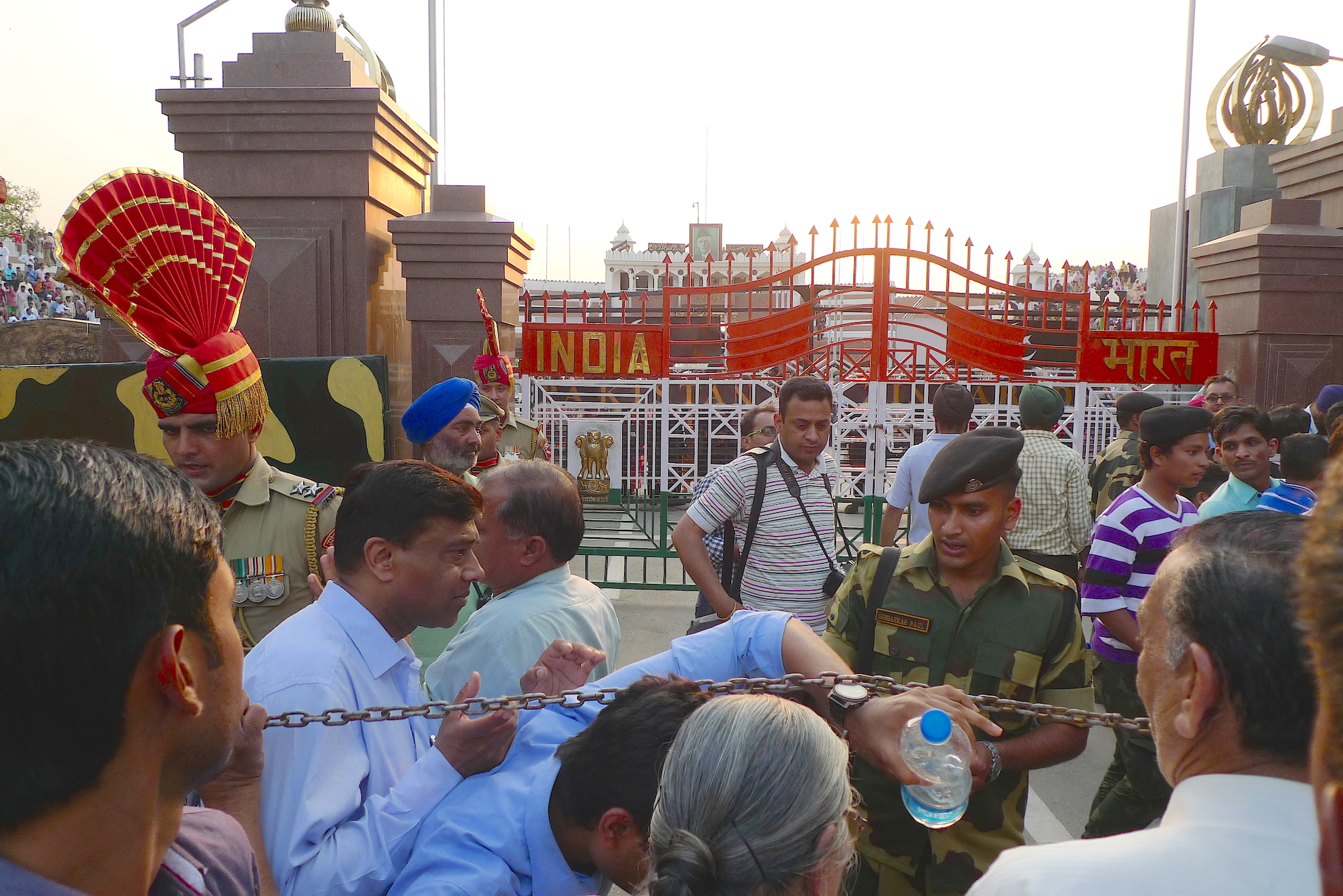
Only 30 kilometers from Amritsar, one of the most grotesque events on earth takes place: “Lowering of the Flag” on the Indian/Pakistani border. Here, what is often described as the perfectly choreographed expression of hate, takes place in front of thousands of visitors from both countries.
Wagah Border has even tribunes built to accommodate aggressive spectators. It goes everyday like this:
“Death to Pakistan!
Long Live India!”
“Death to India!
Long live Pakistan!”
“Hindustaaaaaaaaaaaaaaaaan Zindabad!!!!!!” They shout here, “Long Live India!!!!” and those endless spasms are immediately followed by barks glorifying India and insulting Pakistan. And vice versa.
Border guards, male and female, are then performing short marches, at a tremendously aggressive and fast pace, towards the border gate. The public, sick from the murderous heat and the fascist, nationalist idiocy, speeches and shouts, is roaring.
As I am made to sit on the pavement, right next to the border gate of Wagah, squeezed between two corpulent women wearing sweat-soaked saris, flies are buzzing all over my cameras. Here I feel hate being omnipresent: there is hate expressed by the Indian crowd towards Pakistan, hate of the border guards towards its own unruly crowd, even hate of the crowd towards me, a daring foreigner who came, most likely, to poke fun at this insane martial ceremony.
The issue is so explosive, that my friends from nearby Lahore conveniently “forgot” to supply me with their quote. Few people in New Delhi “forgot” as well.
***
Now, Punjab is split, because that old “divide and rule” scheme was applied here meticulously, as it was almost everywhere at the Sub-Continent.
The British never really left: they live in the minds of the Indian elites.
Punjab suffered terribly during the Partition, and later, too, from brutality of the Indian state. In fact, almost all of India is now suffering, unable to shake off those racist, religious and social prejudices.
Delhi behaves like a colonialist master in Kashmir (where it is committing one of the most brutal genocides on earth), the Northeast and in several other areas. Indian elites are almost as ruthless and barbaric as were the British colonizers; the faces changed, but the power system remained almost intact.
It goes without saying that the Indian elites, disciples and admirers of the British Raj, are treating their own people with similar spite and cruelty.
***
The seeds sown by the British Raj have been inherited by several successive states of the Sub-Continent. They are now growing, blooming into a tremendous toxic and murderous insanity. Instead of turning against the homicidal elites, the poor majority is yelling nationalist slogans.
Everything here is deeply connected: the colonial torture, the post-colonial genocides, the prostitution of the local elites, who are offering themselves to the Western rulers of the world, the over-militarization, the institutionalized spite for the poor and for the lower castes and classes.
Confusion is omnipresent. Words and terminology have lost their meanings. Dust, injustice, pain and insecurity are everywhere.
Anyone who claims that colonialism is dead is either a liar or a madman.
And if this – the direct result of colonialism – is “democracy”, then we should all, immediately, take a bus in the opposite direction!


Andre Vltchek is a philosopher, novelist, filmmaker and investigative journalist. He covered wars and conflicts in dozens of countries. His latest books are: “Exposing Lies Of The Empire” and “Fighting Against Western Imperialism”.
Man in Police Van With Freddie Gray Speaks Out: Freddie Gray did not Injure Himself
By Jay Syrmopoulos | The Free Thought Project | May 1, 2015
Baltimore, Md. – In a bombshell revelation, Donta Allen, the man that was in the police transport van at the same time as Freddie Gray, spoke out for the first time publicly and directly refuted information leaked by police.
Allen came forward after an internal investigative memo was leaked by police and subsequently published by the Washington Post on Wednesday. The document claimed that Allen had told police Gray “was intentionally trying to injure himself,” which according to Allen was an attempt to spin his words to make it seem as if Gray may have injured himself.
“They trying to make it seem like I told them that, you know what I mean, that Freddie Gray did that to himself,” Allen said. “Why the f*** would he do that to himself?”
Allen’s words are being intentionally distorted in an effort to exonerate the police of any culpability or wrongdoing while seemingly laying the blame on the victim.
When asked whether he heard Gray banging his head while in the van, Allen said,
“When I got in the van, I didn’t hear nothing. It was a smooth ride. We went straight to the police station. All I heard was a little banging for about four seconds. I just heard little banging, just little banging.”
Allen went on to say,
“I told homicide that I don’t work for the police. I did not tell the police nothing.”
This contradicts police assertions, as claimed in a search warrant affidavit, that Allen claimed Gray was “banging against the walls” of the van.
Allen claims that authorities are using him as a scapegoat to provide cover for their actions relating to the incident.
“They waited 30 to 35 minutes to get [Gray] some medical attention because they want to cover their ass,” Allen told WBAL-TV. “So now, since they can’t cover their ass on that, they’re trying to use me to cover their ass.”
Numerous law enforcement sources have told WJLA-TV that Gray suffered a “catastrophic injury” when he smashed his own back into the van and broke his neck. Additionally, a bolt in the van matched his head injury, according to the sources.
The autopsy of Gray showed no evidence that there were any self-inflicted wounds, and that the fatal spinal and neck injuries were consistent with the force and energy presented in a car accident.
What is clear is that the Baltimore Police Department thought they could use the police spin machine to lay the blame for Gray’s death somewhere other than themselves as a means of escaping accountability.
Human Rights Center: Seven Palestinians Killed in April; 375 Kidnapped
IMEMC News | May 1, 2015
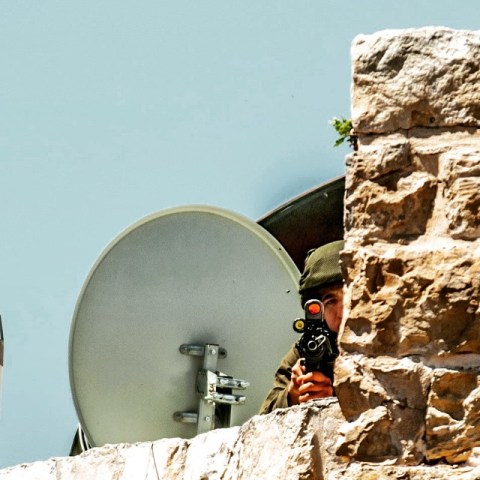
The Ahrar Center for Detainees’ Studies and Human Rights issued its monthly report on Israeli violations against the Palestinians during April of 2015, and said that seven Palestinians were killed, and 375 were injured.
The report documents Israeli violations against the Palestinians in the besieged Gaza Strip, the West Bank and occupied Jerusalem.
Head of the Ahrar Center Fuad al-Khoffash said occupied Jerusalem remains the most targeted district compared to other Palestinian districts in the occupied West Bank, especially since the soldiers and police conduct daily violations against the Palestinians, their homes and property.
Three Palestinians were killed in the last week of April, while at least 39 others, including four children have been injured.
Two other children were also wounded due to the explosion of a remnant object of the Israeli military, south of Qalqilia, in the northern part of the West Bank.
Two Palestinian civilians were killed in two separate incidents in Hebron and Jenin in the West Bank, while the third, who was a child, was killed at a military checkpoint in occupied Jerusalem.
In occupied Jerusalem also, 26 Palestinian civilians, including two paramedics, were wounded during protests that followed the killing of the child; 12 others, including three children, were wounded during other protests in the West Bank and the fourth child was wounded in the Gaza Strip.
Ahrar said the army kidnapped at least 19 Palestinian women, including legislator Khaleda Jarrar, and that most of the arrests took place in the courtyards of the al-Aqsa Mosque in occupied Jerusalem. It added that the army kidnapped at least 55 children, mainly in Jerusalem, followed Hebron and Bethlehem, during repeated Israeli military invasions and assaults.
In occupied Jerusalem, soldiers kidnapped at least 113 Palestinians (including the 55 children), 86 in the southern West Bank District of Hebron, 54 Palestinians in the northern West Bank district of Nablus, 40 in Bethlehem, 29 in Ramallah, 11 in Qalqilia, 4 in Tulkarem, and one in Salfit.
Palestinians Killed In April, As Documented And Reported By The IMEMC
On 27 April 2015, Israeli forces opened fire at 19-year-old civilian while he was in his farmland near the annexation wall in the west of Arqa village, west of Jenin. As a result, he sustained a bullet wound to the testicles due to which he suffered severe hemorrhage and died hours later.
On 25 April 2015, Israeli forces killed a 20-year-old Palestinian civilian crossing via an electronic gate at the entrance of the Ibrahimi mosque, south of the old city in Hebron, reportedly, after he stabbed an Israeli soldier at the said gate.
On April 24, soldiers shot and killed a young Palestinian, near the Zaim military roadblock, east of occupied Jerusalem.
On April 14, a fighter of the Al-Qassam Brigades, the armed wing of Hamas, died of serious complications resulting from his injury by an Israeli missile during the Israeli onslaught on Gaza eight months ago.
On April 10, Israeli soldiers shot and killed a young Palestinian man during the funeral ceremony of a former detainee, who was denied access to proper medical attention, while being held by Israel.
On April 8, another Palestinian was shot and killed allegedly after stabbing two soldiers, north of the central West Bank city of Ramallah.
Leaked Document Published by WaPo Suggesting Freddie Gray Killed Himself Disputed by Baltimore TV Reporter
By Carlos Miller | PINAC | April 30, 2015
More than two weeks after Baltimore police arrested Freddie Gray, they leaked a document to the Washington Post suggesting that the 25-year-old man killed himself, basing that speculation on statements from an unnamed inmate who was also in the van with Gray, but sitting handcuffed on the other side of the van, separated by a metal partition that does not allow visibility.
But the report was quickly disputed by investigative reporter Jayne Miller from WBAL-TV, who has been reporting on this story from the beginning.
And it is being doubted by hundreds of readers leaving comments on Peter Hermann’s article in the Washington Post, which stated the following.
A prisoner sharing a police transport van with Freddie Gray told investigators that he could hear Gray “banging against the walls” of the vehicle and believed that he “was intentionally trying to injure himself,” according to a police document obtained by The Washington Post.
The prisoner, who is currently in jail, was separated from Gray by a metal partition and could not see him. His statement is contained in an application for a search warrant, which is sealed by the court. The Post was given the document under the condition that the prisoner not be named because the person who provided it feared for the inmate’s safety.
The document, written by a Baltimore police investigator, offers the first glimpse of what might have happened inside the van. It is not clear whether any additional evidence backs up the prisoner’s version, which is just one piece of a much larger probe.
Miller was interviewed on MSNBC shortly after the article was posted, saying that her station was aware of this document, but never reported on it because it did not correlate with the timeline they had compiled. She also pointed out that Police Commissioner Anthony Batts had previously stated that Gray was already unresponsive when the second suspect was placed into the van.
But the story that Gray was responsible for his own death is something that has been making the rounds on social media, including from a Baltimore police detective named Avi Tasher who made the claim on Facebook last weekend, only to shut down his page after backlash from critics as we reported here.
Tasher, whose nickname within the department is Taser because he is so quick to use it on suspects, and who might be the “police investigator” described in the Washington Post’s story, stated the following on Facebook Saturday night:

Then there was Henry Mack III, both a Baltimore Ravens cheerleader as well as a Baltimore police cheerleader, who tweeted the following to the Baltimore Sun a few days earlier:

So it’s obvious police have been trying to push this narrative for a while, only for it to be ignored by the Baltimore media.
But somehow they got the Washington Post to bite.
The van driver stopped three times while transporting Gray to a booking center, the first to put him in leg irons. Batts said the officer driving the van described Gray as “irate.” The search warrant application says Gray “continued to be combative in the police wagon.”
The driver made a second stop, five minutes later, and asked an officer to help check on Gray. At that stop, police have said the van driver found Gray on the floor of the van and put him back on the seat, still without restraints. Police said Gray asked for medical help at that point.
The third stop was to put the other prisoner — a 38-year-old man accused of violating a protective order — into the van. The van was then driven six blocks to the Western District station. Gray was taken from there to a hospital, where he died April 19.
The prisoner, who is in jail, could not be reached for comment. No one answered the phone at his house, and an attorney was not listed in court records.
Batts has said officers violated policy by failing to properly restrain Gray. But the president of the Baltimore police union noted that the policy mandating seat belts took effect April 3 and was e-mailed to officers as part of a package of five policy changes on April 9, three days before Gray was arrested.
Gene Ryan, the police union president, said many officers aren’t reading the new policies – updated to meet new national standards – because they think they’re the same rules they already know, with only cosmetic changes. The updates are supposed to be read out during pre-shift meetings.
The previous policy was written in 1997, when the department used smaller, boxier wagons that officers called “ice cream trucks.” They originally had a metal bar that prisoners had to hold during the ride. Seat belts were added later, but the policy left their use discretionary.
There are many questions that arise from the claims by police, but here are just a few. I’m sure more will be asked in the comments section.
- If it it were true that Gray was responsible for his own death, then why not just say that from the beginning?
- Why haven’t doctors mentioned injuries consistent with “smashing his head into the wall repeatedly,” instead of just saying he died of a severed spine and crushed voice box, the latter which is more consistent with a knee to the neck?
- Wouldn’t those injuries be visible during an open-casket funeral?
- Did police intimidate or offer a deal to the inmate to write those words on the document?
Baltimore and the Human Right to Resistance: Rejecting the framework of the Oppressor
By Ajamu Baraka | Black Agenda Report | April 29, 2015
Anti-Black racism, always just beneath the surface of polite racial discourse in the U.S., has exploded in reaction to the resistance of black youth to another brutal murder by the agents of this racist, settler-colonialist state. With the resistance, the focus shifted from the brutal murder of Freddie Gray and the systematic state violence that historically has been deployed to control and contain the black population in the colonized urban zones of North America, to the forms of resistance by African Americans to the trauma of ongoing state violence.
The narrative being advanced by corporate media spokespeople gives the impression that the resistance has no rational basis. The impression being established is that this is just another manifestation of the irrationality of non-European people – in particular, Black people – and how they are prone to violence. This is the classic colonial projection employed by all white supremacist settler states, from the U.S., to South Africa and Israel.
The accompanying narrative is that any kind of resistance that does not fit the narrow definition of “non-violent” resistance is illegitimate violence and, therefore, counter-productive because – “violence doesn’t accomplish anything.” Not only does this position falsely equate resistance to oppression as being morally equivalent to the violence of the oppressor, it also attempts to erase the role of violence as being fundamental to the U.S. colonial project.
The history of colonial conquest saw the U.S. settler state shoot and murder its’ way across the land mass of what became the U.S. in the process of stealing indigenous land to expand the racist White republic from “sea to shining sea.” And the marginalization of the role of violence certainly does not reflect the values of the Obama administration that dutifully implements the bi-partisan dictates of the U.S. strategy of full spectrum dominance that privileges military power and oppressive violence to protect and advance U.S. global supremacy. The destruction of Libya; the re-invasion of Iraq; the civil war in Syria; Obama’s continued war in Afghanistan; the pathological assault by Israel on Palestinians in Gaza and the U.S. supported attack on Yemen by the Saudi dictatorship, are just a few of the horrific consequences of this criminal doctrine.
Race and oppressive violence has always been at the center of the racist colonial project that is the U.S. It is only when the oppressed resist — when we decide, like Malcolm X said, that we must fight for our human rights — that we are counseled to be like Dr. King, including by war mongers like Barack Obama. However, resistance to oppression is a right that the oppressed claim for themselves. It does not matter if it is sanctioned by the oppressor state, because that state has no legitimacy.
No rational person exalts violence and the loss of life. But violence is structured into the everyday institutional practices of all oppressive societies. It is the deliberate de-humanization of the person in order to turn them into a ‘thing’ — a process Dr. King called “thing-afication.” It is a necessary process for the oppressor in order to more effectively control and exploit. Resistance, informed by the conscious understanding of the equal humanity of all people, reverses this process of de-humanization. Struggle and resistance are the highest expressions of the collective demand for people-centered human rights – human rights defined and in the service of the people and not governments and middle-class lawyers.
That resistance may look chaotic at this point – spontaneous resistance almost always looks like that. But since the internal logic of neoliberal capital is incapable of resolving the contradiction that it created, expect more repression and more resistance that will eventually take a higher form of organization and permanence. In the meantime, we are watching to see who aligns with us or the racist state.
The contradictions of the colonial/capitalist system in its current expression of neoliberalism have obstructed the creation of decent, humane societies in which all people are valued and have democratic and human rights. What we are witnessing in the U.S. is a confirmation that neoliberal capitalism has created what Chris Hedges called “sacrificial zones” in which large numbers of black and Latino people have been confined and written off as disposable by the system. It is in those zones that we find the escalation of repressive violence by the militarized police forces. And it is in those zones where the people are deciding to fight back and take control of their communities and lives.
These are defining times for all those who give verbal support to anti-racist struggles and transformative politics. For many of our young white comrades, people of color and even some black ones who were too young to have lived through the last period of intensified struggle in the 1960s and ‘70s and have not understood the centrality of African American resistance to the historical social struggles in the U.S., it may be a little disconcerting to see the emergence of resistance that is not dependent on and validated by white folks or anyone else.”
The repression will continue, and so will the resistance. The fact that the resistance emerged in a so-called black city provides some complications, but those are rich and welcoming because they provide an opportunity to highlight one of the defining elements that will serve as a line of demarcation in the African American community – the issue of class. We are going to see a vicious ideological assault by the black middle class, probably led by their champion – Barack Obama – over the next few days. Yet the events over the last year are making it more difficult for these middle-class forces to distort and confuse the issue of their class collaboration with the white supremacist capitalist/colonialist patriarchy. The battle lines are being drawn; the only question that people must ask themselves is which side they’ll be on.
Israeli forces violently disperse al-Tur rally against road closure
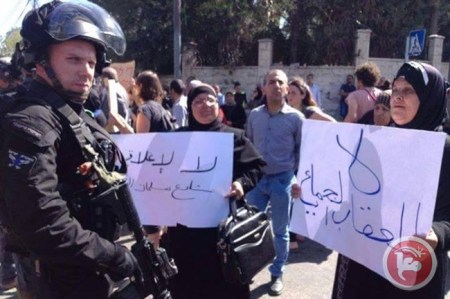
A protester holds a sign reading “No to collective punishment.” (MaanImages)
Ma’an – April 29, 2015
JERUSALEM – Israeli polices forces violently dispersed a Palestinian protest in the occupied East Jerusalem village of al-Tur on Wednesday, amid complaints that authorities’ closure of the village’s main road is a form of “collective punishment” against locals.
Sources told Ma’an that dozens of residents of the neighborhood on the Mount of Olives as well as foreign activists carried out a sit-in on al-Tur’s main street to protest Israeli authorities’ decision to shut down major thoroughfare Suleiman al-Farsi street with two concrete blocks.
The street was closed earlier this week when locals protested against the death of a 17-year-old boy from the area who was shot dead after a scuffle with a soldier at a nearby checkpoint.
Mufid Abu Ghannam, director of a local activist committee, told Ma’an that Israeli forces assaulted protesters on Wednesday and launched stun grenades at sit-in participants, injuring two people with shrapnel in their lower extremities.
Israeli forces also reportedly detained two Palestinian protesters, Amjad al-Shami and Youssef Khuweis.
Abu Ghannam said that even after protesters had dispersed, Israeli forces continued firing stun grenades at people in the area.
Israeli police spokesman Micky Rosenfeld confirmed the incident, saying that police used stun grenades against protesters after they blocked roads in what he called an “illegal demonstration” in which “stones were thrown at police officers who were at the scene.”
Rosenfeld denied any injuries in the incident.
The sit-in on the main street of al-Tur was held concurrently with rallies at five schools in the village, where students carried out sit-ins in school yards in protest against the closure of the village’s entrance.
Suleiman al-Farsi Street is considered the main entrance to the village, and local activists told Ma’an that the closure of the road negatively affected the ability of 3,000 local residents to live normally. The closure also prevents ambulances and fire trucks from reaching the village.
The thoroughfare is also the main road leading to the Suleiman al-Farsi mosque, the village cemetery, and two elementary schools where some 1,200 students attend.
The closure of the roads followed widespread protests against the killing of Muhammad Abu Ghannam on Saturday as he crossed the al-Zayyim checkpoint on foot resulted in widespread protests.
A soldier at the checkpoint reportedly insulted Abu Ghannam’s sister, leading to a scuffle, while Israeli authorities have alleged the boy pulled a knife on the soldier.
Israeli municipal authorities routinely close and block major roads leading into Palestinian neighborhoods of occupied East Jerusalem.
In addition to Al-Tur, another major road into the nearby town of al-Issawiya was also shut closed.
Abu Ghannam was one of three Palestinians shot dead by Israeli forces in the last week.
Although Palestinians in occupied East Jerusalem live within territory Israel has unilaterally annexed, they lack citizenship rights and are instead classified only as “residents” whose permits can be revoked if they move away from the city for more than a few years.
Jerusalem Palestinians face discrimination in all aspects of life including housing, employment, and services, and are unable to access services in the West Bank due to the construction of Israel’s separation wall.
Tensions have been running high in East Jerusalem since last summer when Jewish extremists raided the area and kidnapped and murdered a 16-year-old Palestinian boy, Muhammad Abu Khdeir.
Israeli forces have detained hundreds of Palestinians across East Jerusalem who have taken part in protests, especially against Israel’s summer assault on Gaza, including 600 alone in the two months after Abu Khdeir’s death.
Featured Video
BRITAIN’S WARNING: PREPARE FOR WAR
or go to
Aletho News Archives – Video-Images
From the Archives
British weapons and personnel doing much of the killing in Yemen
Press TV – June 18, 2019
A detailed report published by the Guardian newspaper has shown how Britain is massively contributing to Saudi Arabia’s devastating war on Yemen as it suggests that London is not only supplying the bombs that fall on Yemenis, but it provides the personnel and expertise that keep the war going.
The comprehensive report by Arron Merat published on Tuesday showed that Britain was doing much of the killing in Yemen as the country continues to provide Saudi Arabia with everything it needs to turn its southern impoverished neighbor into a graveyard.
“Every day Yemen is hit by British bombs – dropped by British planes that are flown by British-trained pilots and maintained and prepared inside Saudi Arabia by thousands of British contractors,” said Merat in the report. … continue
Blog Roll
 Aletho News
- Yemen denounces European Parliament’s ‘hypocritical’ push to blacklist Ansarullah
- Qalibaf: UAE’s UN bid aims to ‘clear the runway’ for ‘Greater Israel’, whitewash genocide
- Pakistan reopens Iran border after boosting security: Report
- Why are so many Brazilians voting for Flávio Bolsonaro?
- Democrats Put Anti-Russia Agenda Ahead of American Workers
- Elijah Magnier: Yemen’s Strikes Are Shattering Saudi Arabia’s Long-Term Strategy
- Pentagon designates Chinese cultural centers national security threat
- Israel Demolishes Home Of Lebanese Journalist Whose Viral Film Exposed Pager Attack
- Record Oil, Empty Tanks: The UAE’s Miracle Recovery
- Burnham tackles Britain’s poverty with aggression in Yemen
- If Americans Knew
- An error has occurred; the feed is probably down. Try again later.
- No Tricks Zone
- Sudden Stratospheric Warming, Powerful El Niño Combination May Lead To Extreme Europe Cold, Energy Crisis!
- Two New Studies Find Thwaites Glacier Melt Cannot Be Driven By Human Activity Or A Warming Ocean
- E-Cars Reduce CO2 Emissions By Only 41% Compared To Internal Combustion Engine Vehicles
- Predictions Made By Renowned Climate Professor Over Past Decades Have Been Proven To Be Poor
- New Study Suggests Large Regions Of The Pacific Ocean Have Been Cooling For The Last 80 Years
- Germany’s Green Energy Debacle: High Energy Costs Force Kahla Porzellan to Close After 182 Years!
- New Study: 50 Years Of The Most Aggressive ‘Net Zero’ Policies Can Only Affect The Global Climate By 0.03°C
- US September “Heat” Was No Record…Many Records Set Decades Ago
- Latest European Green Energy Debacle; Portugal’s Largest Flagship Solar Park Insolvent!
- Green Energy Debacle: German Expert Professor Fritz Vahrenholt Warns Of Severe Economic And Social Consequences

