Just below the illegal settlement of Kiryat Arba, situated on the the eastern outskirts of Al Khalil (Hebron) is the Palestinian area of ar-Ras.
A quick online search of the Israeli settlement of Kiryat Arba provides general knowledge on the founding history and how it has been subject to Palestinian resistance since 1981 but fails to inform the reader of the consequences for the indigenous Palestinians living nearby the relatively large (ca. 7000 inhabitants) settlement. Nor will one find written that such colonies are considered illegal by international law as confirmed by the International Court of Justice. Nor of the Ibrahimi Mosque massacre in 1994 which was committed against Palestinians by an Israeli settler from the same area.
Hebron residents regularly speak with the International Solidarity Movement about constant violent attacks by the settlers, land expropriation by Israeli policies, lack of freedom of movement and the requirement of special permits for car use, lack of running water, and demolitions.
Demolitions
In 2006, Palestinian landlord Fayiz Arajar began the construction of a large building intended to house a dozen shops and several families. The building is formidably situated, overlooking the olive grove of the ar-Ras area and the distant white houses of Al Khalil, flickering in the heat.
In 2007, as the project was nearly completed, Israeli settlers occupied the building. Subsequent to a high court decision to evict them, settlers from across the West Bank gathered in the house ready to defend their illegal takeover of the building. The eviction deadline was set to December 4, 2007 by the high court.
The week leading to the deadline was tense. Israeli settlers vandalized the Palestinian cemetery, burned Palestinian cars, and attacked Palestinian houses. The escalation in such attacks came due to the arrival of thousands of illegal settlers in support of the squatters. They succeeded in fighting the eviction force. Israeli authorities simply refrained from further attempts to remove them and, as seen before, allowed the story to twist from that of property theft to a question of security (of the settlers). In recent years, Israel has even decided to erect a military checkpoint for Palestinian pedestrians in the interest of ‘protecting’ the settlers.
Muhammed Al-Jabari ‘Abu Naim’ and his family live in a house about 100 metres from the occupied building. On May 28 of this year, they began to build an extra floor ontop of their house. The family of 15 members needed more space.
Settlers from a nearby recently occupied house repeatedly attacked the building project underway by Abu Naim. Subsequently, Abu Naim was banned by Israeli authorities from continuing construction.
With reference to the Oslo accords (Annex 1, article XII) Palestinians are not allowed to build within 50 metres of security roads. In Abu Naim’s case, a security road was announced with the construction of a new military checkpoint in the area. The legal value of Abu Naim’s construction permit was overruled although his house is far from the 50 meter no-construction zone. The land on which the house was built 14 years ago has belonged to the Al-Jabari family since before the Israeli occupation in 1967.
For now, the mid-construction upper floor is left as an empty shell without windows or doors. Israeli bulldozers are on stand by to demolish the entire house should Abu Naim continue construction.
Prevention and annexation of resources
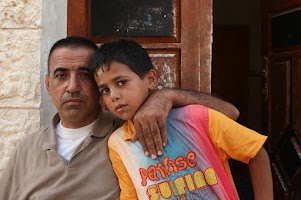 Across the olive grove and by Kiryat Arba’s barbed wire fence lives Kayid Dana and his brothers. Another stunning view embraces you from just outside their house, disrupted only by a looming Israeli watchtower. Most of the occupied West Bank is spotted with these grey towers. Watching from their windows, the ever present occupation, reminding Palestinians that privacy is a luxury that few, if any, enjoy.
The Dana family has been living on the same land for over 50 years. In 1958, the Israeli authorities repetitively offered them money to leave the house and make room for the growing illegal settlement. The family refused and nonetheless Israeli forces bulldozed half of their garden.
As of June 24, the Dana family has been without water. Israeli authorities prevented water trucks from entering the area to refill their water tanks. As a result, Kavid and his family are relegated to pump water from an unsanitary well outside their home. This is where they encounter the next problem: water is only available for a couple of hours each day. This is not enough to supply their 4 camels (100 liters/day) and the most basic household needs.
North of the Dana family home, through the olive groves, lives the Abdul Hay family (Abu Hossni). Their windows are fenced to prevent Israeli settlers from shattering the glass with the stones they throw. On December 4, the family was subject to a vicious attack that left 3 with dumdum (expanding bullet) wounds. Dumdum bullets are a type of live ammunition that enter the body, expand, and cause permanent injuries or death. Although dumdum bullets have been known to be used by Israeli settlers, they are illegal according to international law.
Jamal Abu Saifan, who lives in the area, captured the incident on his camera and explains how a lightly injured Israeli settler was choppered away 15 minutes after his injury, whereas the 3 Palestinians wounded by gunfire, one critically, waited 3 hours for an ambulance.
The ambulance attempting to reach them was stopped and denied entry to the area by Israeli forces.
Unfortunately, settler attacks are far from rare and have been occurring since Kiryat Arba was established in 1968. The purpose of these violent attacks, and the army violence and policies that accompany them, are not only to injure people and destroy their lands. That is only a strategic measure to reach an ultimate goal: the ethnic cleansing of Palestine.
The next step by Kiryat Arba is the construction of a new road which will divide the vital Palestinian olive groves down the middle. The road will be inaccessible to Palestinians, not only preventing Palestinians from tending to their trees on the other side, but annexing further land, expropriating an economic necessity, and making life more difficult for the indigenous Palestinians.
Despite the collection of circumstances to make life difficult, all the families in the area have made the choice to remain on their land despite the uncertainty and pressures of their everyday life under Israeli occupation.
July 28, 2012
Posted by aletho |
Ethnic Cleansing, Racism, Zionism, Subjugation - Torture | Hebron, International Solidarity Movement, Kiryat Arba, Palestine, West Bank, Zionism |
Leave a comment
Ynet reports (Hebrew) that the Shin Bet detained a 26 year-old Irish woman at Dublin airport when she arrived three hours prior to flight time (in order to go through the security check). She’d hoped to fly to Israel for a romantic reunion with her Israeli boyfriend, Alon, who she’d met in South America. It was to be her first visit to Israel.
When the Shin Bet security interrogators asked her why she was flying to Israel and she told them, they actually called her boyfriend in Israel to confirm this. They asked personal questions about the nature of their relationship. But that wasn’t enough.
At first, she was told she could board the flight, but without any personal electronic devices. Then, she was told she couldn’t bring any luggage at all. When offered this option, after the decidedly chilly reception she’d experienced from the Israeli security apparatus, she said: thanks, but no thanks. The distinct impression she got from her inquisitors was that the only reason she was treated this way is that she isn’t Jewish.
Keep in mind that her boyfriend is a former IDF officer who served his country and understood the need for security precautions.
During her trip to South America, she’d met many Israelis who told her about the bad rap that Israel got in the world media. They assured her that the real Israel was something else entirely.
The Shabak claims that it told the woman she could board the flight without her baggage and could send it separately via London. She denies they made this offer. They also claim that they couldn’t allow her luggage aboard because it required scanning by a special device which local airport security didn’t make available to them. I’d venture to say that if any Irish journalist picks up on this story and queries officials at Dublin airport they’ll find this is a crock. But the way the Shin Bet works, it only has to deflect criticism for a day or so for the embarrassing incident to be forgotten (or so they expect). That’s why they often don’t even make a pretence of having a credible story.
Alon’s girl still wants to reunite with him–anywhere but Israel. So think about this, if Alon and his girlfriend someday marry, where do you think they’ll live? Anywhere but Israel. But that won’t bother the racist thugs who control entry to the ‘Jewish homeland.’ They prefer their guests and betrothed to be Jewish. Non-Jews need not apply. The needs of the national security state trump love and romance.
There are two lessons to be learned from this story. First, don’t fly to Israel on an Israeli airline. Second, if I were Irish authorities I’d demand the head of whoever was responsible for this mess. In South Africa, when a flyer was abused racially, the authorities threatened to ban the airline from flying to South Africa. That got Israel’s attention.
Since I published this story, Maan reporter George Hale told me he received the exact same treatment. He was told on two separate occasions that he could only fly without luggage (that’s besides the regular strip searches). The Shin Bet official told him he could retrieve it “the next time you’re in Zurich.” That didn’t sit too well with George since it was everything he needed to practice his profession.
When he arrived at Ben Gurion he filed a complaint with the Press Office and the Shin Bet relented and returned his effects (which included all his electronic reporting gear). The Irish lass’ story is, unfortunately, not unique.
July 27, 2012
Posted by aletho |
Civil Liberties, Ethnic Cleansing, Racism, Zionism, Subjugation - Torture, Timeless or most popular | Dublin Airport, Israel, Shin Bet, South Africa, Tikun Olam (blog) |
Leave a comment
On the evening of July 18, over 30 Palestinians were detained in Tel Rumeida of Hebron after being accused of attacking an Israeli settler from the illegal settlement in the city. The attack allegedly took place after the settler went to swim in Abraham’s spring, which is on Palestinian land, but has a history of being used by settlers from the local colony.
A number of houses nearby to the spring were raided, along with the headquarters of Youth Against Settlements (YAS).
One of the Palestinians detained lives with his family in a house overlooking the spring. Their house was raided by soldiers and a young man was taken.
About 70 Israeli soldiers and 35 settlers gathered at the spring. The settlers insisted that the soldiers arrest the Palestinians, and internationals were barred from approaching the site by soldiers and border police.
Several Palestinians were detained near the spring, while three others were detained separately near the YAS headquarters. They were not accused of the attack, but nevertheless had their ID’s confiscated. The reason behind their detention is still unknown.
After several hours of being detained near the spring, a few Palestinians were released and others were taken to the police station for questioning. The remaining were released shortly after midnight, none of them being charged with the attack.
Earlier that day, Israeli settlers tried for the third time to build a wall of rocks around the spring which lies on Palestinian-owned land. Around 10 Israeli settlers were building, while 15 soldiers guarded them.
According to soldiers, the settlers had a permit but it was not possible to see it. The Palestinian owners of the land thus had no choice but to watch as settlers continued building, and teenagers from the illegal settlements swam in the water.
This incident is symptomatic of the settler mentality as they steadily try to build into Palestinian-owned land and increase the size of their colonies in the West Bank.
Palestinian residents of Tel Rumeida say that the settlers are hoping to encroach upon the spring and the surrounding land, and thus connect two settlements located in the area.
July 26, 2012
Posted by aletho |
Ethnic Cleansing, Racism, Zionism, Illegal Occupation, Subjugation - Torture | Hebron, Israel, Israeli settlement, Settler, Tel Rumeida, West Bank |
Leave a comment
“He was a documented gang member,” say the Anaheim police of Manuel Diaz, a 25 year old unarmed man they shot dead around 4:00 pm Sunday. They shot him in the buttocks as he ran, and as he stooped to his knees in someone’s yard they followed up by a bullet to the back of his head. Then they handcuffed their immobile quarry with a bloody face and a hole in his skull (as described by a 17 year old neighborhood resident), and searched his pockets before sending him to the hospital to die within three hours.
As I understand it, California law states: “Any person who actively participates in any criminal street gang with knowledge that its members engage in or have engaged in a pattern of criminal gang activity, and who willfully promotes,furthers, or assists in any felonious criminal conduct by members of that gang, shall be punished by imprisonment in a county jail for a period not to exceed one year, or by imprisonment in the state prison for 16 months, or two or three years.”
It does not say that gang membership in itself is illegal, or that documented gang members may be shot on sight.
According to the Associated Press, “The shooting sparked a melee in the neighborhood as some threw rocks and bottles at officers who were securing the scene for investigators to collect evidence.”
Evidence for a drug deal presumably. But his sister Lupe Diaz said on the day of his murder that Manuel had been “just hanging out with friends,” adding “There is no explanation. It’s not fair.” Neighbor Yesenia Rojas (34) who received a welt on her stomach after the police attacked her with a bean bag Sunday, calls him a “good person” and asks, “Why kill this man?” (She’s the woman with the stroller whose grandson was nearly attacked by the K-9 police dog in the now-famous video.)
Even if he was involved in a drug transaction, and even if he were known for such activity in the neighborhood, how could his murder not produce outrage?
A melee is a skirmish, brawl, free-for-all. Is that what happened? It’s not what the video shows. That’s not what the 22 photos posted on the Orange County Register site show.
The AP coverage continues: “Sgt. Bob Dunn, the department’s spokesman, said that as officers detained an instigator, the crowd advanced on officers so they fired bean bags and pepper balls at them.”
Yeah, like this?
I don’t see any attack on police. I see maybe a dozen woman and children approached by cops with rifles drawn and shooting bean bags and pepper spray (and maybe rubber bullets) at close range. One sobbing woman mentions seeing a person throw a water bottle at police before a police dog attacked her and her baby. Could it be that the cops angered at verbal and symbolic expressions of outrage “were provoked” to do what they clearly do in the video? And that that’s what produced statements of defiance? And after darkness set in, such symbolic actions as blocking a street with a dumpster filled with paper on fire?
The two officers involved have been placed on paid leave. You can bet your life they wouldn’t have been, had there not been a “melee” or two and a PR nightmare for the police department. Nor would the police department and the Orange County District Attorney’s Office have announced separate investigations of the incident, nor would Anaheim mayor Tom Tait be asking California’s attorney general to assist in that. These are minimal measures to contain the natural outrage.
A video of a police statement carried on the Orange County Register site tells us a lot of how the police view these things.
“About 4 pm this afternoon,” says the spokesman, in a pleasant upbeat voice, “uh, two of our officers were on patrol here in the 600 block of North Anna Drive in the center alley. They attempted to make contact with three subjects. Uh, during that contact the subjects fled, uh, a foot pursuit ensued. During that foot pursuit one of our officers encountered, uh, one of the males they had been chasing and an officer involved shooting occurred. Only one person was hit during that officer involved shooting. That was the person that we were chasing, a male. He was transported to the hospital and at this point I don’t know what his condition is. So at this point the investigation is ongoing. There were two additional, uh, male suspects in the alley at the time this foot pursuit began. Uh, at this point we will be conducting an investigation to try to identify who those males are. This is still a very active crime scene. Anyone that saw anything or witnessed this that has not spoken to police this is welcome call and remain anonymous the Anaheim Police Department…”
“Attempted to make contact with three subjects… ” What does that mean? Attempting to see what they were doing? Attempting to arrest them? Attempting to harass them? The language is so mundane and friendly sounding.
Why did they flee? A niece of Diaz, Daisy Gonzalez (16) told reporters that her her uncle probably ran from the two officers because, “He (doesn’t) like cops. He never liked them because all they do is harass and arrest anyone.” Is that not a very common feeling, particularly among Blacks and Latinos, in cities throughout the country? Isn’t the fear totally justifiable?
“A foot pursuit ensued.” Notice how the passive voice leaves agency out of it. Why not just say, “The two policemen chased him?” And why “an officer involved shooting occurred”? As though there were no real people involved here. Like the officer didn’t really do anything but was just “involved” by something fated to happen. Like for some reason a tree fell down. Why not be honest and say: “The officers chasing him shot him to death, from the back, as he ran?”
“He was transported to the hospital and at this point I don’t know what his condition is.” Why not mention that he’d been deliberately shot in the brain and was unlikely to survive? And why not mention that he was unarmed?
“This is still a very active crime scene.” Well yes, at least in the sense that, while no weapons have been found there, armed police continue to criminally harass people.
“Anyone that saw anything or witnessed this that has not spoken to police about this is welcome call and remain anonymous the Anaheim Police Department.” (Am I being to picky in noting that “that” ought to be “who” or “whom” when we are talking respectfully to people?) Feel welcome to fink, people, to help us get those who ran away successfully and who we want for reasons we don’t need to explain to you. Trust us, we know who’s good and bad.
The real crime here is obviously the murder of an unarmed young man charged with no crime, murdered for running terrified through a crowded neighborhood at 4:00 in the evening, in full view of the people. A crime compounded by a police attack on those people with rifles and a police dog. (I suspect the claim made Monday that the dog broke free from restraint and his trainer is mortified by what happened is more PR damage control. What was a police dog doing there in the first place?)
It was not (apparently) caught on tape, like the Rodney King beating. But the vicious assault on men, women and children just hanging out outside on a warm summer late afternoon, leaving welts, bites and scratches sending a few to the hospital should be equally infuriating. It’s just another statement of the impunity the police feel. However poorly paid (and they are); however closely they resemble the criminals they’re hired to hunt down and control, they are in the end the enforcers of a system which because it cannot satisfy human needs makes humans hard to control without guns and dogs, fear and repression.
On Tuesday City Hall was surrounded with five or six hundred protesters, facing off against 250 police who arrested 24 during seven hours of what AP calls “confrontations.” The protests were peaceful all afternoon—until the police moved in to arrest someone around 6:30 supposedly threatening them with a gun. But like Diaz on Saturday, he had no gun. As on Saturday, unwarranted police action led the crowd to pelt the police with rocks, the weapon of the weak, of the intifada.
Police spokesman Dunn explained that some of the rock throwers appeared to be outsiders “who were prone to violence and wanted to incite” violence. We’ve heard this before many times.
The angry people (according to AP, citing Dunn) “took over an intersection, and a splinter group walked to the scene of one police shooting and back, throwing rocks, vandalizing cars and throwing a Molotov cocktail that damaged a police car… Throughout the night, knots of protesters spread through downtown, setting fires in trash cans and smashing windows of businesses, including a Starbucks… There also were reports that a T-shirt store was looted… A gas station was shut down after reports that some protesters were seen filling canisters with gas. Police used pepper balls and beanbag rounds. Twenty adults and four minors were arrested…”
We need more than a melee, more than a riot. To end the routine abuses of the cops we need conditions that don’t require cops, at least not cops who are outsiders charged with earning their collar by training their guns on youth, occupiers comparable to foreign troops in Afghanistan and Iraq who drop bombs almost as sport. We need conditions that allow for community self-policing based on values of kindness and respect. We need to replace the hurling of water bottles with demands for revolution.
GARY LEUPP is Professor of History at Tufts University, and holds a secondary appointment in the Department of Religion. He is the author of Servants, Shophands and Laborers in in the Cities of Tokugawa Japan; Male Colors: The Construction of Homosexuality in Tokugawa Japan; and Interracial Intimacy in Japan: Western Men and Japanese Women, 1543-1900. He is a contributor to Hopeless: Barack Obama and the Politics of Illusion, (AK Press). He can be reached at: gary.leupp@tufts.edu
July 26, 2012
Posted by aletho |
Civil Liberties, Solidarity and Activism, Subjugation - Torture, Timeless or most popular | Anaheim California, Police, Police dog |
Leave a comment
In June, the UN Committee Against Torture (the Committee) released a list of issues it would like the Government of Israel to address when the Committee reviews Israel’s compliance with the Convention Against Torture (CAT) in 2013. Specific issues raised by the Committee relevant to the continued prosecution of Palestinian children in military courts include:
- What steps has the Government of Israel taken to audio-visually record interrogations conducted by the Israeli Security Agency (ISA) as a further means to prevent torture and ill-treatment? DCI-Palestine further recommends that this inquiry should be broadened to include interrogations conducted by the Israeli police, being the body most likely to interrogate Palestinian children from the West Bank.
- What steps has the Government of Israel taken to ensure that all detainees are promptly brought before a judge and have prompt access to a lawyer? Under military law, Palestinian children are not required to be brought before a judge for 8 days, and can be denied access to a lawyer for up to 90 days. By way of contrast, Israeli children, including those living in the settlements, must be brought before a judge within 24 hours and can be denied access to a lawyer for 48 hours.
- Please indicate how many Palestinian prisoners from the Occupied Palestinian Territory are held in detention facilities inside Israel? Transferring and detaining Palestinian prisoners out of occupied territory violates article 76 of the Fourth Geneva Convention and attracts personal criminal liability under articles 146 and 147 of the same convention.
- Please indicate the measures taken to ensure that the detention or imprisonment of a child is used as a measure of last resort, that solitary confinement is never used as a means of coercion or punishment and that all children receive appropriate education.
- Please also explain the regime applied to children under military detention, in particular if their interrogations are recorded and if their parents or other legal representatives can have access to them. DCI-Palestine recommends that all interrogations of children must be audio-visually recorded and parents must be entitled to accompany their children at all times, as is the right generally afforded to Israeli children. Further, children must be entitled to consult with a lawyer of their choice prior to their interrogation.
The full list of issues released by the Committee is available here.
July 25, 2012
Posted by aletho |
Civil Liberties, Subjugation - Torture | Fourth Geneva Convention, Israel, Palestinian prisoners in Israel, United Nations Convention Against Torture, West Bank |
Leave a comment
In a letter dated 29 June 2012, the UK Foreign Office responded to concerns raised by a group of UK lawyers about the forcible transfer of Palestinian children to prisons located inside Israel. The transfer of Palestinian prisoners (adults and children) to detention facilities inside Israel violates article 76 of the Fourth Geneva Convention for which personal criminal liability applies.
In the letter, the UK Foreign Office responded that:
“The British Government shares your concerns about the treatment of Palestinian children detained in Israeli prisons and we have a continual dialogue with the Israeli authorities on this question. […] The Government agrees that Israel has legal obligations as an Occupying Power with respect to the Occupied Palestinian Territories under applicable international law, including the Fourth Geneva Convention. […] We agree with you that Israel’s policy of detaining Palestinians within Israel is contrary to Article 76 of the Fourth Geneva Convention and that domestic law cannot be used as a justification for violations of international law.”
According to Israeli Prison Service figures released in June 2012, 85 percent of Palestinian prisoners, including children, were detained inside Israel. Given that this violation has continued for decades, questions need to be asked as to what additional steps the UK Government is considering to ensure that it complies with its own legal obligations under the Fourth Geneva Convention, as dialogue does not appear to be working when it comes to the forcible transfer of prisoners.
July 23, 2012
Posted by aletho |
Civil Liberties, Subjugation - Torture, Timeless or most popular | Foreign and Commonwealth Office, Fourth Geneva Convention, Government of the United Kingdom, Israel, Israel Prison Service, Palestinian prisoners in Israel, UK Foreign Office |
Leave a comment
While reading the text of Obama Statement on Shootings in Colorado, one line struck this writer as quite astounding:
“We may never understand what leads anybody to terrorize their fellow human beings like this. Such violence, such evil is senseless. It’s beyond reason.”
The President may have realized afterward that since he has been ordering the shooting of thousands in a half-dozen countries, the words “evil, senseless, beyond reason” could easily reflect back on himself. A later Obama statement on the massacre in a Colorado movie house did not contain the words “evil,” “senseless,” “violence beyond reason.”
In any case, history books, in some future, probably not too distant, day will deplore Obama’s pathetic 9/11 excuse for increasing and extending a ten-year-old military occupation war in dirt poor Afghanistan, killing, and killing easily, young and old Afghani, who are fighting invaders of their nation as they have always done. And perhaps one day independent investigative journalism will reveal whose instructions Obama was following from within that “financial element” that FDR confided “has owned the government since the days of Andrew Jackson.”1
Historians will denounce his shameful exceeding of his executive powers under the Constitution, to have assassinated even American citizens without trial, and ridicule the pack of lies he offered in sick defense of his frightening Hellfire and Predator drones murdering intentionally and collaterally while menacing all citizens in some of the most poverty-stricken populations on earth. Historians will judge his character by his once infamous joking about using a drone on his daughters boyfriends — “they’ll never know what hit them.”2
Very possibly, scholars will chronicle a time when Americans were no longer kept in ignorance by a commercial media blackout of the last year of Martin Luther King Jr.’s life, when King called his country “the greatest purveyor of violence in the world” and condemned US wars as all meant to maintain “unjust overseas predatory investments.”3 Such a time might well arrive in the racing era of instant world-wide personal communication while Barack Obama is still alive and prosecutable for crimes against humanity, or in his own words of 2012, “for violent, evil, senseless and beyond reason, terrorizing fellow human beings.” With the recording of his words, Obama would have difficulty pleading insanity.
July 23, 2012
Posted by aletho |
Civil Liberties, Militarism, Progressive Hypocrite, Subjugation - Torture, Timeless or most popular, War Crimes | Franklin D. Roosevelt, Martin Luther King Jr, Obama |
Leave a comment
Egyptian President Mohamed Morsi has ordered the release of 572 people detained by the Army since last year’s revolution.
Morsi, who took office last month as Egypt’s first elected civilian president, on Thursday ordered military courts to grant amnesty to the defendants, AFP reported.
The Egyptian president earlier set up a committee to examine the cases of civilians put on trial by the military. The committee says 11,879 Egyptians were detained by the military throughout out the uprising that ousted former dictator Hosni Mubarak. Out of them, 9,714 have since been released.
Human rights activists and bodies have unanimously called for the end of military trials of civilians.
“International law is crystal clear on this: No civilian, regardless of the crime, should be tried by a military court,” Sarah Leah Whitson, Middle East and North Africa director at Human Rights Watch (HRW), said this week.
“Military trials and arrests of civilians by the military have continued, despite the June 30 handover to civilian authority,” the HRW noted.
Sworn in on June 30, Morsi is locked in a power struggle with the powerful Supreme Council of the Armed Forces.
Last week, Egyptians thronged the iconic Tahrir Square in Cairo to express solidarity with Morsi over his decree to reconvene parliament.
The parliament, dominated by Muslim Brotherhood lawmakers, was dissolved in line with a ruling by the Supreme Constitutional Court, based on a decision by the military, prior to the presidential elections.
July 19, 2012
Posted by aletho |
Civil Liberties, Solidarity and Activism, Subjugation - Torture | Egypt, Morsi, President of Egypt, Supreme Council of the Armed Forces, Tahrir Square |
Leave a comment
Fifty Years of US Targeted ‘Kill Lists’: From the Phoenix Program to Predator Drones
By DOUG NOBLE | July 19, 2012
“A broad-gauged program of targeted assassination has now displaced counterinsurgency as the prevailing expression of the American way of war.” – Andrew Bacevich [1]
This spring the US drone killing program has come out of the closet. Attorney General Eric Holder publicly defended the drone killing of an American citizen [2], while Obama’s counter terrorism czar John Brennan publicly explained and justified the target killing program [3]. And a New York Times article by Jo Becker and Scott Shane chronicled Obama’s personal role in vetting a secret “Kill List.” [4]
This striking new transparency, the official acknowledgment for the first time of a broad-based US assassination and targeted killing program, has resulted from the unprecedented and controversial visibility of drone warfare. Drones now make news every day, and those of us who have been protesting their use for years have heightened their visibility in the public eye, forcing official acknowledgment and fostering worldwide scrutiny. This new scrutiny focuses not only on drone use but also, and perhaps more importantly, on the targeted killing itself – and the “kill lists” that make them possible.
This new exposure has set off a firestorm of reaction around the globe. Chris Woods of the Bureau of Investigative Journalism told Democracy Now! “The kill list got really heavy coverage … newspapers have all expressed significant concern about the existence of the kill list, the idea of this level of executive power.” [5] A Washington Post editorial noted that “No president has ever relied so extensively on the secret killing of individuals to advance the nation’s security goals.” [6] Becker and Shane of the Times pronounced Obama’s role “without precedent in presidential history, of personally overseeing the shadow war …” [7] And former president Jimmy Carter insisted, in a recent editorial in The New York Times, “We don’t know how many hundreds of innocent civilians have been killed in these [drone] attacks, each one approved by the highest authorities in Washington. This would have been unthinkable in previous times.” [8]
Really?
In fact, US assassination and targeted killing, with presidential approval, has been going on covertly for at least half a century. Ironically, all this drone killing now offers us a new opportunity: to pry open the Pandora’s box hiding long-held secrets of covert US assassination and targeted killing, and to expose them to the light of day. What we would find is that the only things new in the latest, more publicized revelations about kill lists and assassinations are the use of drones, the president’s hands-on approach in vetting targets, and the global scope of the drone killing.
Those of us in the Upstate Coalition to Ground the Drones, Code Pink and other groups protesting US drones for years have correctly focused on the use of drones as illegal, immoral and strategically counterproductive. We have abhorred the schizophrenic ease of remote killing, the uniquely frightening horror of a drone strike, and the unavoidable (even intentional) killing of countless civilian “terrorist suspects” in “signature strikes.” We have also warned of the proliferation of drones in countries around the globe and of their procurement by US police forces and border patrols, for surveillance and “non-lethal” targeting.
But drones are not the only, or even the most important, concern. It’s the targeted killing itself, past and present. In this article I start to unravel what the latest demands for transparency should lead us to investigate fully: the fifty year history of US assassination and targeted killing that has resulted, quite directly, in the present moment. Those who are mortified by the latest revelations of Obama’s kill list have much to learn from a more comprehensive, historical perspective on US killing around the globe. Who knows: Perhaps someone in Congress might even be prodded to do what Senators Fulbright and Church did in years past: hold hearings on this continuing execration taking place in our name. Until then, what follows is an introduction to this ongoing horror story.
Section 1 of this article briefly reviews the lethal history of the US Phoenix Program in Vietnam, the original source of subsequent US counter terrorist tactics and strategies. Section 2 revisits briefly the well-worn history of US kill lists and assassinations in Latin American countries, followed by the somewhat less-well-known history of US kill lists and assassinations in countries on other continents. Section 3 traces the direct legacy of Phoenix, even its explicit resurrection by the key architects of the US targeted killing programs in Iraq and Afghanistan, and in a growing number of “countries we are not at war with.”
One point of clarification and definition. It is well known that in recent history the US has orchestrated assassination attempts, both successful and unsuccessful, on major world leaders. Examples include: Lumumba under Eisenhower, Castro and Diem under Kennedy, Gaddhafi under Reagan, Saddam Hussein under Bush, and Allende under Nixon. [9] The term “assassination” is typically restricted to such killings of political leaders, and President Ford’s executive order banning assassination applies only to the assassination of foreign heads of state. [10] The focus of this article is different. Here we discuss the US-generated kill lists used over the last half century, under direct presidential authority, for the targeted killing of thousands of civilians suspected of being or harboring terrorists/ insurgents, from Vietnam to Guatemala, from Indonesia to Iraq, right up to the present day.
The Phoenix Program
The US Phoenix Program was a secret, large scale counter terrorist effort in Vietnam. Developed in 1967 by the CIA, the Phoenix Program, called Phung Hoang by the Vietnamese, aimed a concerted effort to “neutralize” the Vietcong Infrastructure (VCI) consisting of South Vietnamese civilians suspected of supporting North Vietnamese or Viet Cong soldiers. The euphemism “neutralize” meant to kill or detain indefinitely. Then CIA Director William Colby, while insisting in 1971 Congressional hearings that “the Phoenix program is not a program of assassination,” nonetheless conceded that Phoenix operations killed over 20,000 people between 1967 and 1972. [11]
Phoenix targeted civilians, not soldiers. Operations were carried out by “hunter-killer teams” consisting both of US Green Berets and Navy Seals and by South Vietnamese Provincial Reconnaissance Units (PRUs), units of mercenaries set up for assassination and “counter terror.” A Newsweek article in January 1970 described Phoenix as “a highly secret and unconventional operation that counters VC terror with terror of its own.” [12] Robert Kaiser of the Washington Post reported Phoenix being called “an instrument of mass political murder…sort of Vietnamese Murder Inc.,” designed to terrorize the civilian population into submission.” [13]
Until 1970 the computerized VCI blacklist was a unilateral American operation. After the devastating 1968 Tet offensive, South Vietnamese President Thieu declared: “The VCI must be eliminated…and will be defeated by the Phoenix program.” [14] Phoenix became a ruthless “bounty hunting” program to eliminate the opposition. [15] The US and South Vietnamese created a list of tens of thousands of suspects for assassination. These names were centralized and distributed to Phoenix coordinators. From 1965-68 U.S. and Saigon intelligence services maintained an active list of Viet Cong cadre marked for assassination. The program for 1969 called for “neutralizing” 1800 a month.
The VCI blacklist became corrupted by officers inserting their personal enemies’ names to get even. Due process was nonexistent. Names supplied by anonymous informers showed up on blacklists. [16] CIA Director Colby admitted in 1971 that the blacklists had been “inaccurate.” [17] Few senior VCI leaders were caught in the Phoenix net. Instead its victims were typically innocent civilians. A Pentagon-contract study found that, between 1970 and 1971, ninety-seven per cent of the Vietcong targeted by the Phoenix Program were of negligible importance. [18] By 1973, Phoenix generated 300,000 political prisoners in South Vietnam. Military operations such as My Lai used Phoenix intelligence; in fact, the My Lai massacre, hardly an isolated incident, was itself a Phoenix operation. [19]
Apologists have offered rationales for Phoenix that sound eerily similar to those used to defend current drone attacks. Phoenix was typically referred to as a “scalpel” replacing the “bludgeon” of search and destroy, aerial bombardment or artillery barrages. Alternatively, it was called a precision “rifle shot rather than a shotgun approach to target key political leaders … and activists in VCI.” [20] Military historian Dale Andrade explains, “Both SEALS and PRUs killed many VCI guerrillas – that was war. They also inevitably killed innocent civilians – that was regrettable….but [Phoenix] operations were much more discerning than the massive affairs launched by conventional …forces. That fact was often lost in the rhetoric of assassination and murder …”[21]
Phoenix was created, organized, and funded by the CIA. Quotas were set by Americans. Informers were paid with US funds. The national system of identifying suspects, the elaboration of numerical goals and their use as measures of merit, was designed and funded by Americans. One former US Phoenix soldier conceded, “It was “heinous,” far worse than the things attributed to it.” [22]
Kill Lists from Phoenix to Latin America
The US intelligence community formalized the lessons of the Phoenix Program in Vietnam by commissioning Project X, the Army’s top-secret program for transmitting Vietnam’s lessons to South America. [23] By the mid-1970s, the Project X materials were going to armies all over the world. These were textbooks for global counterinsurgency and terror warfare. These included a murder manual, “Psychological Operations in Guerrilla Warfare,” which openly instructed in the assassination of public officials, and was distributed to the Nicaraguan Contras. Another manual, “Human Resource Exploitation Training Manual,” was used widely in Honduran counterrorism efforts.
Use of the Project X material was temporarily suspended by Congress and the Carter administration for probable human rights violations, but the program was restored by the Reagan administration in 1982. By the mid-1980s, according to one detailed history, “counterguerrilla operations in Colombia and Central America would thus bear an eerie but explicable resemblance to South Vietnam.” [24]
What follows is a brief sketch of the widespread application of US-promulgated Phoenix-derived reigns of terror, kill lists, and death squads throughout Latin America and beyond. Much of this is familiar territory to many activists and scholars, and is merely the tip of the iceberg, but it merits review as a backdrop for the current context of kill lists and targeted assassination. [25]
US KILL LISTS AND ASSASSINATION IN LATIN AMERICA
The U.S. Army’s School of Americas (SOA), started in 1946, trained mass murderers and orchestrated coups in Peru, Panama, Argentina, Ecuador, Bolivia, Guatemala, El Salvador, and Mexico. The SOA trained more than 61,000 Latin American officers implicated in widespread slaughter of civilian populations across Latin America. From 1966-1976 the SOA trained hundreds of Latin American officers in Phoenix-derived methods. Between 1989-1991 the SOA issued almost 700 copies of Project X handbooks to at least ten Latin American countries, including Bolivia, Colombia, Peru, Venezuela, Guatemala, and Honduras. In 2001, SOA was renamed Western Hemisphere Institute for Security Cooperation (WHISC), but peace activists know it as School of Assassins. [26]
The CIA trained assassination groups such as Halcones in Mexico, the Mano Blanca in Guatemala, and the Escuadron de la Muerte in Brazil. In South America, in 1970-79, Operation Condor, the code-name for collection, exchange and storage of intelligence, was established among intelligence services in South America to eradicate Marxist activities. Operation Condor promoted joint operations including assassination against targets in member countries. In Central America, the CIA-supported death toll under the Reagan presidency alone exceeded 150,000. The CIA set up Ansesal and other networks of terror in El Salvador, Guatemala (Ansegat) and pre-Sandinista Nicaragua (Ansenic).
Honduran death squads were active through the 1980s, the most infamous of which was Battalion 3–16, which assassinated hundreds of people, including teachers, politicians, and union leaders. Battalion 316 received substantial CIA support and training, and at least 19 members graduated from the School of the Americas.
In Colombia, about 20,000 people were killed since 1986 and much of U.S. aid for counternarcotics was diverted to what Amnesty International labeled “one of the worst killing fields.” The US State Department also supported the Colombian army in creating a database of subversives, terrorists and drug dealers.
In Bolivia, Amnesty International reported that from 1966-68 between 3,000 and 8,000 people were killed by death squads. The CIA supplied names of U.S. and other foreign missionaries and progressive priests.
In Ecuador, the CIA maintained what was called the lynx list, aka the subversive control watch list of the most important left-wing activists to arrest. In Uruguay. Every CIA station maintained a subversive control watch list of most important left wing activists. From 1970-72 the CIA helped set up the Department of Information and Intelligence (DII), which served as a cover for death squads, and also co-ordinated meetings between Brazilian and Uruguayan death squads.
In Nicaragua, the US provided illegal funds to the Contras, and Marine intelligence helped maintain a list of civilians marked for assassination when Contra forces entered the country.
In Chile, 1970-73, CIA-created unions organized CIA-financed strikes leading to Allende’s overthrow and subsequent suicide. By late 1971 the CIA was involved in the preparation of lists of nearly 20,000 middle-level leaders of people’s organizations, scheduled to be assassinated after the Pinochet coup.
In Haiti, U.S. officials with CIA backgrounds in Phoenix-like program activities coordinated with the Ton-Ton Macoute, “Baby Doc” Duvalier’s private death squad, responsible for killing at least 3,000 people.
For over thirty years the US military and the CIA helped organize, train, and fund death squad activity in El Salvador. From 1980-93, at least 63,000 Salvadoran civilians were killed, mostly by the government directly supported by the U.S. The CIA routinely supplied ANSESAL, the security forces, and the general staff with electronic, photographic, and personal surveillance of suspected dissidents and Salvadorans abroad who were later assassinated by death squads. US militray involvement in El Salvador allowed “the lessons learned in Vietnam to be put into practice … assisting an allied country in counterinsurgency operations.” [27]
In Guatemala, as early as 1954, the U.S. Ambassador, after the CIA-orchestrated overthrow of the Arbenz government, gave to the new Armas government lists of radical opponents to be assassinated. Years later, throughout Guatemala’s 36-year civil war, Washington continuously to supported the Guatemalan military’s excesses against civilians, which killed 200,000 people.
US Assassination Programs Exported to Other Countries
In Indonesia, 1965-66, the US embassy and the CIA provided the Indonesian military with lists of the names of PKI militants, which were used by Suharto to crush the PKI regime. This resulted in “one of the worst episodes of mass murder of the twentieth century,” with estimates as high as one million deaths. [28]
In Thailand, in 1976, the new junta used CIA-trained forces to crush student demonstrators during coup; two right-wing terrorist squads suspected for assassinations tied directly to CIA operations.
In Iran, the CIA launched a coup installing the shah in power and helped establish the lethal secret police unit SAVAK. [29] The CIA and SAVAK then exchanged intelligence, including information and arrest lists on the communist Tudeh party. Years later, in 1983, the CIA gave the Khomeni government a list of USSR KGB agents and collaborators operating in Iran, which the Khomeni regime used to execute 200 suspects and close down the communist Tudeh party.
In the Philippines, in 1986, Reagan increased CIA involvement in Philippine counterinsurgency operations, carried out by more than 50 death squads. In 2001, before 9/11, the Bush administration sent a unit of SOF to the Philippines “to help train Philippine counter terrorist forces fighting against Muslim separatists” within groups like Abu Sayyaf. After 9/11 US-Filipino cooperation was stepped up and the ongoing separatist conflict was cast, to the benefit of both sides, as “the second front in the war on terror.”[30] In Feb, 2012, a US drone strike targeting leaders of Abu Sayyaf and other separatist groups killed 15 people, the first use of killer drones in Southeast Asia. [31]
A “global Phoenix Program”: drone targets worldwide
“A global Phoenix program … would provide a useful start point” for “a new strategic approach to the Global War on Terrorism.”
–David Kilcullen [32]
IRAQ
Despite the US-perpetrated counter terrorist slaughter in Latin America and elsewhere in the 1970s-1990s, the US Special Forces debacle in Mogadishu in 1993, popularized in the film Black Hawk Down, severely impacted US willingness to use Special Forces in counter terrorist missions for the next decade. But then, after 9/11, things changed drastically. On September 17, 2001, President Bush signed a secret Presidential finding authorizing the C.I.A. to create paramilitary teams to hunt, capture, detain, or kill designated terrorists almost anywhere in the world. The pressure from the White House, in particular from Vice-President Dick Cheney, was intense, and in the scramble, a search of the C.I.A.’s archives turned up – the Phoenix Program. [33]
In July , 2002, Defense Secretary Donald Rumsfeld sent an order for a plan to make sure that special forces could be authorized to use lethal force ‘in minutes and hours, not days and weeks.’” [34] Rumsfeld prompted Bush to authorize the military to “find and finish” terrorist targets. Here he was referring to “the F3EA targeting cycle” used in anti-infrastructure operations by Special Operations Forces. F3EA, an abbreviation of find, fix, finish, exploit, analyze, utilizes comprehensive intelligence to “find a target amidst civilian clutter and fix his exact location . . . . enabling surgical finish operations … to catch a fleeting target.” [35]
Lt General William (Jerry) Boykin, Delta commander in Mogadishu, deputy undersecretary for Defense for Intelligence and a key planner of the Special Forces offensive in Iraq, announced, “We’re going after these people. Killing or capturing them … doing what the Phoenix program was designed to do, without all the secrecy.” [36]
Back in 1963, the CIA had supplied lists of communists to the Baath party coup so that communists could be rounded up and eliminated. [37] Now, forty years later, it was the Baathists’ turn to be rounded up by Special Forces and CIA and executed. After the 2003 invasion of Iraq, the U.S. military notoriously developed a set of playing cards to help troops identify the most-wanted members of Saddam Hussein‘s government, mostly high-ranking Baath Party members. Less well-known was the secret targeted killing of thousands of Baathist civilians by US Special Forces.
Seymour Hersh wrote in 2003 that “The Bush Administration authorized a major escalation of the Special Forces covert war in Iraq. … Its highest priority [being] the neutralization of the Baathist insurgents, by capture or assassination. [38] A former C.I.A. station chief described the strategy: “The only way we can win is to go unconventional. We’re going to have to play their game. Guerrilla versus guerrilla. Terrorism versus terrorism. We’ve got to scare the Iraqis into submission.” [39] The US even hired thousands of contract killers previously responsible for US-sponsored extra-judicial killings and death squad activity in Latin America. The operation—called “preëmptive manhunting” by one Pentagon adviser—had, according to Hersh, “the potential to turn into another Phoenix Program.” [40]
Global Phoenix
In 2009, the Office of the Secretary of Defense sponsored a paper by the National Defense Research Institute entitled “The Phoenix Program and Contemporary Counterinsurgency.” The paper notes, “The persistent insurgencies in Iraq and Afghanistan have generated fresh interest among military officers, policymakers, and civilian analysts in the history of counterinsurgency. The Phoenix Program in Vietnam—the U.S. effort to improve intelligence coordination and operations aimed at identifying and dismantling the communist underground—is the subject of much renewed attention.” [41]
The paper continues, “As the United States and its allies shift their focus to Afghanistan and weigh counterinsurgency alternatives for that country, decisionmakers would be wise to consider how Phoenix-style approaches might serve to pry open Taliban and Al-Qaeda black boxes.” [42]
Two key architects of the current Phoenix-style global counterinsurgency efforts by the US are David Kilcullen and Michael Vickers. David Kilcullen has been counterinsurgency advisor to two former Middle East commanders, General Stanley McChrystal (formerly head of Special Operations) and General David Petraeus, now CIA Director. Michael G. Vickers, made famous in the book and film Charlie Wilson’s War about the CIA’s anti-Soviet Afghan campaign of the 1980s, is currently Under Secretary of Defense for Intelligence, wielding such vast authority over the US war on terror that, according to a Washington Post profile, Pentagon colleagues refer to as his “take-over-the-world-plan.” [43]
Kilcullen wrote in a much-quoted 2004 paper entitled “Countering Global Insurgency” that “Counterinsurgency campaigns in Afghanistan and Iraq have reawakened official and analytical interest in the Phoenix Program.” He proposed that “a global Phoenix program … would provide a useful start point” for “a new strategic approach to the Global War on Terrorism,” one which would focus on “interdicting links … between jihad theatres, denying sanctuary areas, … isolating Islamists from local populations and … disrupting inputs” from others. [44]
Vickers issued a Phoenix-style directive in December 2008 to “develop capabilities for extending U.S. reach into denied areas and uncertain environments by operating with and through indigenous foreign forces or by conducting low visibility operations.” “It’s not just the Middle East. It’s not just the developing world. It’s not just non-democratic countries – it’s a global problem. Threats can emanate from Denmark, the United Kingdom, you name it.” [45] According to a Washington Post profile, “the most critical aspect of Vicker’s plan targeting al-Qaeda-affiliated networks around the world involves US Special Forces working through foreign partners to uproot and fight terrorism.” [46] US military and Special Operations forces would “pay indigenous fighters and paramilitaries who work with them in gathering intelligence, hunting terrorists, fomenting guerrilla warfare or putting down an insurgency.” [47]
Pentagon colleagues have said of Vickers, “he tends to think like a gangster.” [48] Pentagon press secretary Geoff Morrell revealed that getting Bin Laden in Pakistan was Vicker’s “baby,” and “more than anyone else in the department, he drove the issue.” [49] 2011 New York Times Vickers summarizes his strategy this: “You make a deal with the devil to defeat another devil.”[50] “I just want to kill those guys.” [51] A 2011 Such is the megalomaniacal mission underlying the US global war on terror, its kill lists and worldwide program of targeted assassination.
Killer Drones Revisited
“Engaging in any assassination blurs the line between the good guys and the bad.” It is also “a proclamation of weakness and an admission of failure.”
–John Jacob Nutter, The CIA’s Black Ops [52]
The purpose of this article is to reframe the current attention on killer drones and Obama’s “kill list” within an historical perspective. The goal here is not to discourage the escalating protest against killer drones or against Obama’s targeted assassination program around the globe. As stated at the outset, the unprecedented visibility of these nefarious activities and of the outraged public response to them is precisely what is needed at this time. This heightened awareness also affords a perfect opportunity to revisit the extraordinary history of US assassination and targeted killing that has led directly and explicitly to these activities.
Focus on the drones alone will not be sufficient. For even the major counter terrorist mastermind David Kilcullen himself, an avid proponent of the global targeted killing program, has argued against the use of drones. In a 2009 New York Times editorial he argues that “The goal should be to isolate extremists from their communities; [they] must be defeated by indigenous forces…Drone strikes make this harder, not easier.” He adds, “The use of drones displays every characteristic of a tactic – or, more accurately, a piece of technology – substituting for a strategy, [with minimal understanding] of the tribal dynamics of the local population. This creates public outrage and a desire for revenge.” [53]
Scholar Maria Ryan, in a 2011 article entitled “War in Countries We Are Not at War With,” writes: “In 2006 the Pentagon announced that it had sent small teams of Special Operations troops to US embassies to gather intelligence on terrorism in Africa, South East Asia and South America…There is, then, a covert side to the Global War on Terrorism that is not visible and not currently knowable in the absence of whistleblowers, leaks, or things gone wrong.” [54]
The heightened public attention paid to drone killing might very well, in time, lead to some welcome success in curtailing their use. But too narrow a focus on the US deployment of Predator and Reaper drones might also distract us from other forms of Phoenix-derived targeted killing still being perpetrated globally – and covertly – by our Assassination Nation.
Doug Noble is an activist with Occupy Rochester NY and Rochester Against War.
NOTES
1 Andrew Bacevich, “Uncle Sam, Global Gangster” Feb 19, 2012 www.tomdispatch.com/dialogs/print/?id=175505
2 Eric Holder, speech at Northwestern University March 1, 2012
3 John Brennan, speech at Woodrow Wilson Center for Scholars, May 1, 2012
4 Jo Becker and Scott Shane New York Times 5/29/12 “Secret ‘Kill List’ Proves a Test of Obama’s Principles and Will”
5 Chris Woods, interview with Democracy Now! June 5, 2012 democracynow.org
6 Michael Gerson, “America’s Remote-controlled War on Terror,” The Washington Post May 3, 2012
9 John Jacob Nutter,The CIA’s Black Ops, Prometheus Books 2000, p152
10 Nutter,The CIA’s Black Ops, p.145
11 John Prados, Lost Crusader: The Secret Wars of CIA Director William Colby, Oxford University Press, 2003, p235ff
12 Douglas Valentine, The Phoenix Program. William Morrow & Co., 1990, p313
13 Valentine, p 315
14 Prados, p 224
15 Valentine, p309
16 Valentine, p13
17 Prados, p 235
18 Jane Mayer, The Black Sites: A Rare look inside the CIA’s Secret Interrogation Program,” The New Yorker August 13, 2007
19 Valentine, p13ff
20 Valentine, p346
21 Dale Andrade, Ashes to Ashes: The Phoenix Program and the Vietnam War. Lexington Books, 1990, p.175
22 Valentine, p 310
23 Alfred W. McCoy, A Question of Torture Metropolitan Books, 2006, p 86
24 McCoy, p 71
25 Unless otherwise noted, the following information comes from the comprehensive “CIA Death Squad Timeline” by Ralph McGehee, http://www.totse.com/en/politics/central_intelligence_agency/166983.html
26 Mary Turck, “School of Assassins,” Common Dreams Nov 18, 2003
27 Michael Smith, Killer Elite, St Martin’s Press, 2006, p 49
28 Prados, p 155-157
29 McCoy 74
30 Maria Ryan, “’War in Countries We Are Not at War With’: The War on Terror on the Periphery from Bush to Obama” International Politics, v.48 (2011)
31 Deadly Drone Strike on Muslims in the Southern Philippines March 5, 2012 www.brookings.edu/research/opinions/2012/03/05-drones-philippines-ahmed
32 David Kilcullen, “Countering Global Insurgency” Journal of Strategic Studies, 2004
33 Mayer, “Black Sites”
34 Smith, p230-232
35 William Rosenau & Austin Long, “The Phoenix Program and Contemporary Counterinsurgency,” National Defense Research Institute, RAND Corp, 2009
36 Smith, p 273
37 McGehee, “CIA Death Squad Timeline”
38 Seymour Hersh, “Moving Targets: Will the counter-insurgency plan in Iraq repeat the mistakes of Vietnam?” The New Yorker Dec. 15, 2003
39 Hersh, “Moving Targets”
40 Hersh, “Moving Targets”
41 Rosenau and Long
42 Rosenau and Long
43 Profile of Michael G. Vickers, Washington Post www.washingtonpost.com/politics/michael-g-vickers/gIQAm3DRAP_topic.html
44 Kilcullen, 2004
45 Ann Scott Tyson, “Sorry Charlie, This is Michael Vickers’s War,” Washington Post
Dec 28, 2007
46 Profile of Michael G. Vickers
47 Tyson, 2007
48 Elisabeth Bumiller, “Soldier, Thinker, Hunter, Spy: Drawing a Bead on Al Qaeda” New York Times, Sept 4, 2011
49 Bumiller
50 Bumiller
51 Bumiller
52 Nutter, p 149
53 David Kilcullen and Andrew McDonald Exum “Death from Above, Outrage Down Below.” New York Times May 17, 2009
54 Ryan, 2011
Source
July 19, 2012
Posted by aletho |
Civil Liberties, Subjugation - Torture, Timeless or most popular, War Crimes | Bureau of Investigative Journalism, Kill List, Obama, Phoenix Program, United States |
Leave a comment

Britain has admitted that Kenyan prisoners were tortured and sexually abused under the UK rule in Kenya, local media reported.
For the first time ever, British ministers were forced to issue a public confession admitting that atrocities were carried out ‘at the hands of the colonial administration’.
The admission came via a Whitehall lawyer addressing three elderly Kenyans who had gone to the High Court in London to demand damages and an apology.
Now in their 80s, one of them told the court how he had been brutally castrated in a British detention camp during the Mau Mau rebellion – Britain’s bloodiest colonial war.
If the trio win their case, it would open the door to up to 20,000 Kenyan survivors of the Mau Mau purge to sue Britain for millions of pounds, using no-win, no-fee lawyers.
The Foreign Office is contesting the case because it officially denies liability and maintains the Kenyans have left it too late to make claims.
Yesterday, each of the three claimants walked slowly to the witness stand to deliver their graphic testimony.
But before Guy Mansfield, the Foreign Office’s QC, cross-examined them, he said: “I wish to make it clear that the British government does not dispute that each of you suffered torture and other ill-treatment at the hands of the colonial administration.”
The Mau Mau uprising began in 1952 to end British colonial rule. Britain initially dismissed reports of unrest, but later declared a state of emergency – introducing the death penalty for Mau Mau members. The violence ended in 1956, but the state of emergency was only revoked in 1960.
July 18, 2012
Posted by aletho |
Civil Liberties, Subjugation - Torture, Timeless or most popular, War Crimes | Britain, British Empire, Kenya, Mau Mau Uprising, Whitehall |
Leave a comment

Muthu Muniraj, one of the Indian fishermen who survived a deadly attack by a US Navy ship in the Persian Gulf, lies in a hospital bed in Dubai on July 17, 2012.
The Indian fishermen who survived a deadly attack by a US Navy ship in the Persian Gulf say they received no warnings before a .50-caliber gun opened fire on their boat.
The incident occurred on Monday off the coast of the United Arab Emirates.
“We had no warning at all from the ship, we were speeding up to try and go around them and then suddenly we got fired at,” 28-year-old Muthu Muniraj told Reuters from a hospital in Dubai on Tuesday.
The Bahrain-based US Navy Fifth Fleet issued a statement on Monday saying that the USNS Rappahannock only attacked a small motor boat near the Dubai port of Jebel Ali, killing one and injuring three Indian fishermen, after they “ignored the warnings and came too close.”
The statement added that the US ship used a series of non-lethal, preplanned responses to warn the vessel’s operators to turn away from their “deliberate” approach before resorting to lethal force.
A spokesman of the US Navy Fifth Fleet, Lt. Greg Raelson, stated that an internal inquiry into the incident had not been completed and added that the fishing craft did not respond to the non-lethal measures taken by the US vessel. “That was when the security team fired rounds from the .50-caliber… Our ships have an inherent right to self-defense against lethal threats.”
“We know warning signs and sounds and there were none; it was very sudden. My friend was killed, he’s gone. I don’t understand what happened,” said Muniraj, whose legs were punctured by the rounds of the US ship’s .50-caliber gun.
Muthu Kannan, 35, said, “We were fishing and then on the way back they started shooting at us, so many shots, like a storm.” Kannan had a gunshot wound to the abdomen and a lower leg wired into place with metal rods.
“This is not the first time for us to go out in the boat and we all know what a warning is… All I can remember is a lot of shooting,” said 26-year-old Pandu Sanadhan.
Meanwhile, India has called for a full investigation.
On Tuesday, Indian Foreign Ministry spokesman Syed Akbaruddin said, “India’s ambassador in Abu Dhabi has requested UAE authorities to probe the circumstances of the tragic incident.”
Jebel Ali port, one of the largest ports in the Middle East, is the most frequently visited port by ships of the US Navy outside the United States.
Washington recently expanded its military presence in the Persian Gulf, sending an unspecified number of F-22 stealth fighters and warships to the region.
July 17, 2012
Posted by aletho |
Ethnic Cleansing, Racism, Zionism, Subjugation - Torture | Dubai, Jebel Ali, Persian Gulf, United Arab Emirates, United States Navy, USNS Rappahannock |
Leave a comment
Israel has a law that requires police and security officials to record their interrogations of suspects who are charged with crimes carrying a sentence of ten years or more. That sounds great, right? Just the way a democracy should work. But hold on. There’s a hole in the law big enough to drive a Mack truck through. Both the police and Shin Bet are exempt from this law as far as security detainees are concerned. In other words, in order to allow security personnel to use whatever means they wish, the Knesset permits them to have no recordings that might offer evidence of widely reported abuse and torture used against such prisoners.
The exemption was due to expire recently after it had initially been extended first for five years, then another four. But never fear, we won’t abandon our boys doing the dirty work on our behalf in the cells of Shabak. So the Knesset will extend the exemption for another three years, doing its duty on behalf of the secret police.
Here’s the reasoning (Hebrew) behind the exemption in all its fetid glory:
In the special circumstances of security investigations, which involve the fight against extremist, well-organized terror groups, documenting interrogations is liable to damage in a very real way the quality of security investigations, and thus the ability to deter terror threats.
Not a word about damaging the quality of Israeli democracy since it’s taken a back seat to security from almost day one of the existence of the State.
The Shin Bet chief of investigations, who was present at the Knesset deliberation, wove this nice fairy tale for the assembled solons:
Shin Bet investigations are overseen and documented from the beginning to the end [note he doesn’t say how they’re documented, in what form, etc.]. We’re not talking about damaging anyone’s human rights, but rather protecting our methods. The exemption is necessary so that our enemies don’t learn our investigative methods.
So get this, Shin Bet interrogations are the equivalent of work product and mustn’t be revealed because to do so would allow Israel’s enemies to learn how it ‘persuades’ prisoners to give it the information it demands. Presumably, that would enable terror groups to prepare their cadre for such interrogations in order to withstand them. Not a word about the possibility that such recordings would reveal the nasty quasi-criminal enterprise that the security agencies conduct on behalf of the State. Lest you think the previous sentence was hyperbolic, go back and read this post about a provoked prison riot which the prison security service put down with brutal force, ending with the murder of a prisoner who wasn’t even engaging in protest. Now, recall that the commander who oversaw this exercise wasn’t disciplined or even investigated. In fact, he was promoted for doing his job so well.
Israeli human rights NGOs dutifully raised their voices (Hebrew) in opposition. But they were drowned out by the swelling chorus of support for any and all methods used to beat confessions and information out of detainees. Here are some of their wise, but unheeded words:
The need for recording security interrogations is greater because of the need for certainty that a confession is valid and because of the critical importance of ensuring that the investigation was conducted properly, preventing the use of improper methods. Prisoner populations are the most likely to be exposed to the danger of degrading or inhumane conditions, including the use of physical or emotional violence up to and including outright torture. Recording interrogations can aid greatly in determining the credibility of complaints of improper acts. It can supply objective specific documentation regarding the conduct of an investigation, either supporting or refuting the charges of the detainees.
Like voices crying out in the wilderness. They speak but there is no one to hear. In fact, the existence of the NGOs, though an inconvenience for the authorities, allows them to tell the world: we are a democracy; look at how our NGOs freely criticize us; what more can you ask of us?
There are those who’ve questioned my contention here that security prisoners like Dirar Abusisi, Ameer Makhoul, Mustafa Dirani, and others have been tortured during their interrogations. They’ve done this despite the fact that defense lawyers have described in detail the sleep deprivation, loud noises, being tied to a chair for long periods, anal penetration, and worse. Now, I’ll throw it back in their face: if you’re confident there is no such abuse, protest the lack of documentation of the interrogations. If you don’t then you’re little more than a hypocrite because the video or audio tape would prove your claim. Without it, you have nothing, not a leg to stand on.
Any of you American’s out there reading this, don’t get any big ideas about how superior our legal system is to Israel’s (though given the horrid record of the Obama administration it’s hard to see how anyone would believe this). Remember the videotapes of brutal waterboarding by CIA inquisitors that were destroyed when word began to leak out that they existed? Remember Jose Rodriguez, the CIA officer who destroyed them, who wasn’t even investigated, let alone punished for obstruction of justice?
We are no better than Israel in this, which is what makes it all the more tragic.
July 17, 2012
Posted by aletho |
Civil Liberties, Deception, False Flag Terrorism, Subjugation - Torture, Timeless or most popular | Ameer Makhoul, Central Intelligence Agency, Israel, Knesset, Mustafa Dirani, Shin Bet, Tikun Olam (blog) |
Leave a comment
 Across the olive grove and by Kiryat Arba’s barbed wire fence lives Kayid Dana and his brothers. Another stunning view embraces you from just outside their house, disrupted only by a looming Israeli watchtower. Most of the occupied West Bank is spotted with these grey towers. Watching from their windows, the ever present occupation, reminding Palestinians that privacy is a luxury that few, if any, enjoy.
 Aletho News
