It’s no secret that most cities, counties, states and school districts in the U.S. are facing big deficits. What is less understood is the extent to which austerity cuts have become politicians’ bi-partisan response to the situation. The dramatic measures being implemented in Portland, Oregon are no exception.
By “austerity” is meant a bag of policies intent on “reforming,” that is, reducing spending by cutting jobs and public services, tearing up social contracts that workers have benefited from, and, in general, making workers and the poor do all the sacrificing to close budgetary imbalances. These austerity measures range from potential cuts to Social Security and Medicare to cuts on a local level that go after our schools, social services, parks, and infrastructure.
While this “sacrificing” is imposed on the vast majority of citizens, obscenely low tax rates for big business and the wealthy are being left in place as their profits swell and their dominance over the political system increases. To appreciate the scope of this trend, one need merely note The New York Times report that there are “nearly $1.1 trillion in annual deductions, credits and other tax breaks that flow disproportionately to the highest income Americans and that cost more, each year, than Medicare and Medicaid combined.”
The Case in Portland
Portland’s newly elected Democratic Mayor Charlie Hales has announced that there is a $25 – $40 million hole in the city’s budget. In response, he is demanding that all 27 city bureaus submit budget proposals with 10 percent cuts. This latest round follows several consecutive years of budget cuts.
The cuts already put into effect have resulted in lost jobs, underfunded services and a decline in Portland’s livability. While it is not clear yet how Hales will wield his cleaver, he is signaling that his cuts will be the deepest yet. The programs that he has already targeted — at-risk teen summer internships, job-training efforts and youth bus passes, among others — will have an immediate impact on great numbers of households, shifting the costs of these publicly funded programs onto the shoulders of families that can least take the burden.
The majority of Portland’s residents can ill afford the costs of trying to close the deficit without damaging the regional economy further. Portland’s unemployment rate is 7.9 percent. According to the Business Journal, 8.3 percent of Portland families live below the poverty level; for families with children the number is 12.9 percent, and 27.4 percent for single, divorced and separated women. If he gets his way, Mayor Hales’ austerity axe will continue to swing at the city’s most vulnerable citizens.
Portland’s top companies make hundreds of millions, if not billions, every year. In Oregon the share of total state income collected by the wealthiest 1 percent increased by 70 percent from 1979 to 2009. In contrast, during that same period, the bottom 80 percent of Oregonians saw their income decline.
In 2009 the highest effective state tax rate for corporations with profits over $10 million was less than 1 percent. For a middle income Oregon household, the average effective rate of payment was 4.1 percent.
If corporations paid the same rate of state and city income taxes that is expected of most citizens, there would be no deficit, no crisis, no need for cuts. Given the vast amount of untouched revenue tucked away in these corporate coffers, Hales’ call for public “sacrifice” to balance the city’s budget amounts to a shell game to distract people from asking, “Where is the money?”
Portland is not broke. The problem is that those with the money are being let off the hook.
Special Arrangements
In addition, Portland’s city budget is far from transparent. It is divided into a General Fund, which is where the so-called deficit is located, as well as Internal Service Funds (ISF). ISFs are unrestricted net assets of the city. They can be used for any purpose. The amount of money in this part of the budget has been steadily increasing. In 2010-2011, the ISF balance was $120.6 million.
But rather than using this money to benefit Portland’s working class communities, the City Council keeps it stashed away for pet projects to lure wealthy investors to the city. Since the ISF lacks transparency and accountability, it is difficult to determine how the money in these funds is used; we only know that it isn’t available when the tax paying public needs it.
Another way Portland’s politicians stash away huge sums to benefit big business is through the use of Urban Renewal (UR). UR requires that money be spent on development projects in a certain area. The revenue created by this development, including property taxes, remains locked up in the area for decades — from 20 to 50 years.
UR taxes in 2010-2011 amounted to $35 million for the city of Portland alone. These funds can only be spent in the UR areas from which they were collected. Consequently, while the posh UR area of Portland’s Pearl District enjoys more public funds than it needs, elsewhere in Portland school closures are looming, streets remain unpaved and infrastructure and park maintenance is done on the cheap, if at all.
Put simply, UR is a means of enriching developers and other corporate interests — like big contributors to politicians’ campaign funds — to the detriment of Portland’s working class communities. The fact that this model, which results in widening inequality, continues to be pursued by those advocating cuts to public programs could not make more clear where these politicians’ allegiances lie.
While Mayor Hales is blaming the city’s deficit on several factors, the math does not add up. When low corporate tax rates, the millions kept in shady city funds, and the revenue drain of development programs such as UR are taken into account, it becomes clear that Portland’s deficit hawks are manufacturing a crisis in order to continue arrangements where workers are left to pay for big business’ greed.
Our Priorities, Our Budget
In addition to the “I feel your pain” displays by Mayor Hales towards those affected by his cuts, he will also employ the tactic of divide and conquer. Those threatened by these cuts will be told the lie that raising revenue by taxing big business and the wealthy is off the table. “The pie is only so big,” promoters of the cuts moan, “you must decide your own priorities.” And in this way they hope to set different communities and unions against one another.
It should be clear, for reasons already discussed, how false this storyline is. While there is likely more than a little padding in upper management that can be cut, and plenty of taxes that remain uncollected, the truth is that a real solution to Portland’s deficit won’t emerge until these priorities are confronted and turned around.
What would a budget that prioritizes peoples’ needs look like? Rather than job cutting, it would fund job creation. Instead of slashing social programs, it would build a thriving and accountable public sector. And corporate interests would take second place behind the health of working class communities. A people’s budget could easily be funded if the 1 percent paid their fair share in taxes and were not given the driver’s seat in determining Portland’s development and political policies.
To change business as usual in Portland will require mobilizing an independent grassroots social force to oppose Hales’ cuts and the corporate interests behind them. It will take a unified Labor and community movement capable of expanding its goals towards winning a people’s budget.
The demands to unite such a movement must be those that the greatest numbers are willing to mobilize behind. “No Cuts! Tax the Rich!” would be a good place to start. While each union and community group has its own priorities, highlighting those which build the broadest unity in mass campaigns and rallies is the best way to bring these organizations’ specific concerns and struggles to the greatest number.
With his austerity cuts, Mayor Hales has issued a challenge to the grassroots. A unified fightback is necessary to meet it. With such a movement it will be possible to shift the political dialogue towards measures that serve the vast majority of citizens. Without it, Portland will be left with Hales’ cuts and worse.
At the same time, a big fight is gearing up as Oregon’s democratic governor has threatened cuts to public workers’ jobs and retirement benefits, on the tail of passing emergency legislation to lock in Nike’s absurdly low tax rate for 30 years. In building a citywide response, Labor and community groups will be strengthening their capacity to take on austerity at a statewide level as well.
Every city, county and statewide struggle against the corporate austerity attacks can set an example for and strengthen our ability to resist cuts to Medicare, Social Security and other socially needed federal programs. From this resistance a movement can develop with the ability not only to resist attacks — but to fight for and implement policies that benefit all working people.
Mark Vorpahl is a union steward, social justice activist and a writer for Workers Action and Occupy.com. He can be reached at Portland@workerscompass.org
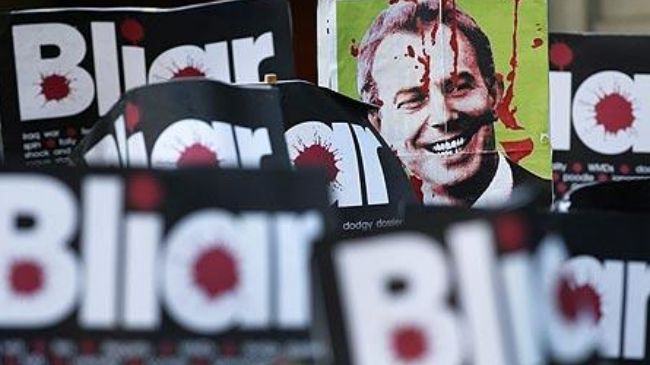
Former British Prime Minister Tony Blair, who is globally discredited for his war crimes, has tried to defend his decision to invade Iraq in 2003, claiming the country is a “safer place” after the execution of dictator Saddam Hussein.
In an interview on BBC2’s Newsnight marking the tenth anniversary of UK armed forces joining a US-led invasion of Iraq, he said despite the death toll among both British troops and Iraqi civilians being “very, very high”, the decision to wage a war against the Arab country was the right one.
He also conceded people are still “very abusive” to him years after the war on Iraq, adding that he had given up trying to “persuade people it was the right decision”.
Being asked if he minded being called a “liar” and “war criminal”, former leader of Britain’s Labour party said it did not matter whether the controversy about Iraq had “taken a toll on” him.
Moreover, he admitted that life in Iraq today was not what he had hoped for 10 years ago.
His comments come as hundreds of thousands were killed and injured in illegal interventions, and hundreds of thousands more were made refugees between 1997 and 2007, under Blair’s premiership.
Meanwhile, according to a recent Guardian/ICM poll a decade after the invasion of Iraq, the majority of Britons believe that the war “sold on a false prospectus delivered little but bloodshed.”
In 2003, the US and Britain invaded Iraq in blatant violation of international law and under the pretext of finding weapons of mass destruction (WMD) allegedly stockpiled by the former Iraqi ruler. However, no WMD were ever discovered in Iraq.
More than one million Iraqis were killed as a result of the invasion and subsequent occupation of the country, according to the California-based investigative organization Project Censored.
A new book by controversial American anthropologist Napoleon Chagnon has triggered a wave of protests among experts and Yanomami Indians:
Marshall Sahlins, ‘the world’s most respected anthropologist alive today’, has resigned from the US National Academy of Sciences in protest at Chagnon’s election to the Academy. Sahlins previously wrote a devastating critique of Chagnon’s work in the Washington Post.
Davi Kopenawa, a spokesman for Brazil’s Yanomami and President of the Yanomami association Hutukara, has spoken out about Chagnon’s work: ‘[Chagnon] said about us, ‘The Yanomami are savages!’ He teaches false things to young students. ‘Look, the Yanomami kill each other because of women.’ He keeps on saying this. But what do his leaders do? I believe that some years ago his leader waged a huge war – they killed thousands of children, they killed thousands of girls and boys. These big men killed almost everything. These are the fierce people, the true fierce people. They throw bombs, fire machine guns and finish off with the Earth. We don’t do this…’
A large group of anthropologists who have each worked with the Yanomami for many years have issued a statement challenging Chagnon’s assessment of the tribe as ‘fierce’ and ‘violent’. They describe the Yanomami as ‘generally peaceable.’
Survival International’s Director Stephen Corry has said, ’Chagnon’s work is frequently used by writers, such as Jared Diamond and Steven Pinker, who want to portray tribal peoples as ‘brutal savages’ – far more violent than ‘us’. But none of them acknowledge that his central findings about Yanomami ‘violence’ have long been discredited.’
Napoleon Chagnon’s autobiography ‘Noble Savages: My Life Among Two Dangerous Tribes – the Yanomamö and the Anthropologists’, has just been published. His 1968 book ‘Yanomamö: The Fierce People’ portrayed the Yanomami as ‘sly, aggressive and intimidating’, and claimed they ‘live in a state of chronic warfare’. It is still a standard work in undergraduate anthropology.
The Yanomami live in Brazil and Venezuela and are the largest relatively isolated tribe in South America. Their territory is protected by law, but illegal goldminers and ranchers continue to invade their land, destroying their forest and spreading diseases which in the 1980s killed one out of five Brazilian Yanomami.
Most recently, Chagnon’s work was cited in Jared Diamond’s highly controversial book ‘The World Until Yesterday’, in which he states that most tribal peoples, including the Yanomami, are ’trapped in cycles of violence and warfare’ and calls for the imposition of state control in order to bring them peace.
Survival International’s Director Stephen Corry said today, ‘The greatest tragedy in this story is that the real Yanomami have largely been written out of it, as the media have chosen to focus only on the salacious details of the debate that rages between anthropologists or on Chagnon’s disputed characterizations. In fact, Yanomamö: The Fierce People had disastrous repercussions both for the Yanomami and tribal peoples in general. There’s no doubt it’s been used against them and it has brought the 19th century myth of the ‘Brutal Savage’ back into mainstream thinking.’
Last month marked the 90th anniversary of the Rosewood Massacre in Florida and calls a similar Texas slaughter to mind.
The 1923 Rosewood Massacre saw six blacks and two whites killed. The 1910 Slocum Massacre in East Texas saw 8-22 blacks killed and no whites. The Rosewood Massacre is remembered as a national tragedy, even receiving Hollywood treatment; the Slocum Massacre has become a dirty Lone Star secret, remarkable more for the inattention it’s received than its remembrance.
Unlike most Texas and Anderson County communities in the early 20th century, the unincorporated town of Slocum—like Rosewood—was mostly African-American, with several black citizens considerably propertied, and a few owning stores, businesses, etc. This alone, in parts of the south, might have been enough to foment violence. But in the Slocum area, which included the small towns of Ioni Creek, Priscilla and Denison Springs, there were other issues.
When a white man reportedly tried to collect a disputed debt from a well-regarded black citizen, a confrontation occurred and hard feelings lingered. When a regional road construction foreman put an African-American in charge of some local road improvements, a prominent white citizen named Jim Spurger was infuriated and became a vociferous agitator.
Rumors began to spread, warning of threats against Anglo citizens and plans for race riots. White malcontents manipulated the local Anglo population and, on July 29th, white hysteria transmogrified into bloodshed.
Stoked and goaded by Spurger and others, hundreds of Anglo citizens from all over Anderson County converged on Slocum armed with pistols, shotguns and rifles. That morning, near Saddlers Creek, they fired on three African-Americans headed to feed their cattle, killing 18-year-old Cleveland Larkin and wounding 15-year-old Charlie Wilson. The third, 18-year-old Lusk Holly, escaped, only to be shot at again later in the day while he, his 23-year-old brother Alex and their friend William Foreman, were fleeing to Palestine. Alex was killed and Lusk was wounded. Foreman fled and disappeared. Lusk pretended to be dead so a group of 20 white men would not finish him off.
White mobs marched through the area shooting black folks at will. A 30-year-old African-American named John Hays was found dead in a roadway and 28-year-old Sam Baker was shot to death in front of his house. When three of the Baker’s relatives (Dick Wilson, Jeff Wilson and a 70-year-old man named Ben Dancer) attempted to sit up with his body the following night, they, too, were gunned down in cold blood. According to an August 1 report in the Galveston Daily News, bloodstains at the residence indicated they were shot while relaxing on the front porch and then dragged inside.
In addition to the Anderson County murders, which occurred near the county line, Will Burley was killed in Houston County.
According to the August 1 edition of the Newark Daily Advocate, the mobs traveled from house to house, shooting African-Americans who answered their calls and slaughtering more while they tended their fields.
Every early newspaper report (in the New York Times, Galveston Daily News, Fort Worth Star-Telegram, et al.) on the transpiring bloodshed in and around Slocum portrayed the African-Americans as armed insurrectionists that the local Anglo community was simply defending itself against. These accounts were gross mischaracterizations. When district judges in Palestine closed saloons and ordered local gun and ammunition stores to stop selling their wares on July 30, it was not to quell a Black uprising; it was to defuse what the Galveston Daily News called an indescribable, one-sided “reign of terror” characterized by “a fierce manhunt in the woods” and resulting in “riddled bodies found on lonesome roads.”
When reporters gathered on July 31, up to two dozen murders had been reported and more were suspected, but local authorities only had eight bodies. Once the carnage had begun, hundreds of African-American’s had fled to the surrounding piney woods and local marshes. By the time the Texas Rangers and state militia arrived, there was no way to estimate the number of African-American dead.
On August 1, a few Texas Rangers and other white men gathered up six of the African American bodies and buried them (wrapped in blankets and placed in a single large box) in a pit four miles south of Slocum. Farther north, Marsh Holly, owner of a Slocum store and father of Alex and Lusk, was found on a road just outside Palestine. He was terrified and begged the authorities in Palestine for help, requesting that he be locked up in jail for protection. He identified himself as the well-regarded black citizen involved in the promissory note dispute, but denied that the affair comprised a serious provocation.
After the first several murders, much of the African-American community had been in various stages of flight, but this didn’t stop the white mobs. They shot down blacks they discovered in the countryside, even if they were clearing out. Two bodies found near the town of Priscilla still had travel bundles of food and clothing at their sides.
Anderson County Sheriff William H. Black said it would be “difficult to find out just how many were killed” because they were “scattered all over the woods.” He also admitted that buzzards would find many of the victims first, if at all.
It’s reasonable to suspect that after the initial bloodlust had subsided, some of the transgressors returned to the murder scenes to remove the evidence of their crimes. Certainly with the arrival of the press—and after early attempts at spinning the news reports to portray the African-American victims as armed insurrectionists had failed—the guilty Anglo contingents engaged in damage control efforts. But Sheriff Black was inexorable and unflinching.
“Men were going about killing Negroes as fast as they could find them,” Black told the New York Times. “And, so far as I was able to ascertain, without any real cause.”
“These Negroes have done no wrong that I can discover,” Black continued. “I don’t know how many [whites] were in the mob, but there may have been 200 or 300. Some of them cut telephone wires. They hunted the Negroes down like sheep.”
According to the local law enforcement leaders on hand at the time, eight casualties was a conservative number. Sheriff Black and others insisted there were at least a dozen more and some reports suggest there may have been dozens more. Frank Austin, the president of the First State Bank of Frankston, reported the death of an African-American named Anderson Austin near Slocum, but it was never investigated. Abe Wilson—who Houston County Justice of the Peace Pence Singletary identified as the African-American who had been put in charge of the local road improvements—disappeared and was never heard from again. Some witnesses counted 22 casualties. Elkhart native F. M. Power said there were 30 “missing negroes.” Slocum-area resident Luther Hardeman claimed to have knowledge of 18 African-American casualties, and that’s the original number reported by the Galveston Daily News and the New York Times (on July 31), but the body count seemed to shrink as the massacre’s publicity grew. A reliable fatality count was impossible, especially with the perpetrators likely covering their tracks. And the deceased weren’t the only folks becoming scarce; the surviving African-Americans began to disappear as well.
It was one thing to return to your home or your daily routine after the odd murder or infrequent lynching of one of your friends, neighbors or relatives—black folks in the south were not unused to that. But a localized campaign of genocide, where the executioners surrounded you and cut phone lines to prevent you from getting help? That was not something Slocum-area African-Americans could easily relegate to a list of bygones.
If the proverbial water under the bridge was auburn with African-American blood, home was no longer a place to remain attached or return to. And with a large contingent of the black community running for their lives, some victims went unidentified and some disappearances went unreported.
The arrival of the Texas Rangers and the state militia stabilized the situation or at least made it safe enough for many of the remaining African-Americans to pack their belongings and leave without being fired on. The saloons in Anderson County were re-opened for business at noon on August 1.
When a Galveston Daily News correspondent visited Lusk Holly and Charlie Wilson on July 31st (two days before their Grand Jury testimony), they were both suffering from incredible levels of pain due to the gunshot wounds they had received. The correspondent reported that their injuries would be “relieved only by death unless medical attention is speedily afforded.” Wilson had a fractured thigh, damage to one ankle and “glancing wounds through his chest.” Holly had 8-10 pieces of buckshot in his lower left abdominal area and damage to one arm. Physicians had perfunctorily treated their wounds when they were first discovered two days prior, but not since.
Wilson told the Galveston Daily News correspondent that he had recognized two of the assailants during the first shooting on July 29. Holly said that after he had been wounded in the second shooting later in the day, a different group of white men had come upon him while he pretended to be dead. He said he recognized the voice of a prominent, local farmer named Jeff Wise, who deemed his apparent and his brother’s actual death “a shame” as he passed by.
In the weeks and months following what came to be known as the Slocum Massacre, the African-American population made a mass exodus, leaving homes, properties, businesses and personal connections to the land and the community.
And the whites who perpetrated the massacre as active participants or passive bystanders?
At the initial Grand Jury hearing, nearly every remaining Slocum resident was subpoenaed; some residents refused to testify and were arrested. The Grand Jury judge, B. H. Gardner, of Palestine, told the all-male, all-white jury that the massacre was “a disgrace, not only to the county, but to the state” and it was up to them to do their “full duty.”
According to the August 2 edition of the Palestine Daily Herald, Judge Gardner attempted to clarify the charges and the issues at hand, explaining various statutes to the jury. He said that even if there had been threats or conspiracies “on the part of any number of Negroes to do violence to white persons, it would not justify anybody to take the law into their own hands.”
“The law furnishes ample remedy,” Gardner continued. “There is no justification for shooting men in the back, waylaying or killing them in their houses.”
When the Grand Jury findings were reported on August 17, several hundred witnesses had been examined. Though eleven men were initially arrested, seven were finally indicted, but only six were named—and they were only accused in the murders of five of the identified victims. Defendants Reagon McKenzie, T. W. Bailey and Morgan Henry were released without being charged. Jim Spurger was indicted in two cases, B. J. Jenkins in four cases and Curtis Spurger, Steve Jenkins, Isom Garner and Andrew Kirkwood in three cases. The seventh indicted man was not arrested or named; only Kirkwood was immediately granted bail. No one was ever indicted for the deaths of John Hays or Alex Holly.
After the Grand Jury indictments came down, Judge Gardner decided to move the trial for the indicted, identified perpetrators of the Slocum Massacre to Harris County, distrusting the potential jury of peers the defendants might receive in Anderson County. The indictments received no interest in Harris County.
On May 4, 1911, Judge Ned R. Morris of Palestine petitioned the Travis County Court of Criminal Appeals to grant bail for the remaining defendants and it was granted. Eventually, all those charged were released and none of the indictments were ever prosecuted.
In the meanwhile, the personal holdings of many Slocum area Anglo citizens fortuitously increased.
The abandoned African-American properties were absorbed or repurposed as the now majority white population saw fit. The standard southern Anglo-centric world order was restored, and this order has endured, even to the present day.
According to recent demographic statistics, most of the communities around Slocum have an African-American population that ranges between 20-25%. Grapeland’s is 35%, Rusk’s is 30% and Palestine’s and Alto’s is 25%. Slocum’s African-American population is just under 7%.
Today, Slocum is still an unincorporated community and that’s probably wise. If there was an elected civic leader or assembly in Slocum, they might be asked to apologize for the massacre or explain why there are no placards acknowledging the event or the American citizens who were slaughtered there and covered up in unmarked graves in the woods and creek bottoms.
On April 24, 1929, a tornado rolled through Slocum, leveling the town, killing seven and injuring 20. Organizations from all over East Texas went to great lengths to raise money for the victims and help the town get back on its feet. Though the Slocum Massacre’s casualties were greater and its African-American community’s coerced migration was arguably just as landscape-altering, the twister overshadowed the localized genocide of 1910, and the event is largely forgotten today.
In the Rosewood Massacre, six blacks and two whites were killed and a special, governor-appointed grand jury found no one to prosecute. In the Slocum Massacre, at least eight blacks were killed and no whites were even injured and, though seven men were indicted by a grand jury, none were ever prosecuted. In both cases, thriving African-American populations vacated their own communities to survive a racially-motivated bloodbath.
In the Rosewood Victims v. the State of Florida decision in 1994, Florida became the first U.S. State to compensate the victims and the descendants of victims of racial violence and, ten years later, the site of Rosewood was designated a Florida Heritage Landmark.
In Texas, the Slocum Massacre—which was at least as heinous as the Rosewood Massacre—hasn’t even received a historical marker. And there have been no investigations to determine the toll of the carnage, the extent of the personal losses or the exact number of victims.
On March 30, 2011, after a February 27 story on the Slocum Massacre in the Fort Worth Star Telegram (by Tim Madigan), the 82nd Texas Legislature adopted House of Representatives Resolution 865 (filed by Reps. Marc Veasey and Lon Burnam), acknowledging the Slocum Massacre of 1910. It admitted that a mob comprised of hundreds of armed white men in the Slocum area went on a “bloody rampage” that resulted in eight and perhaps many more African-American deaths, forcing the black community there to abandon their homes and properties and flee. The resolution concluded with flowery language stating that “only by shining a light on previous injustices can we learn from them and move forward,” but the little-publicized gesture hardly accomplishes that.
In testimony presented at the bail hearing on May 10, 1911, defense witness Alvin Oliver criticized the “insolent manner and conduct” of the blacks in that part of Anderson County after the lynching of an African-American in neighboring Cherokee County a couple of years before and brazenly noted that things were different after the massacre.
“The Negroes down there are not disbehaving now,” Oliver observed.
And he was right.
There were hardly any left.
E.R. Bills is a writer from Ft Worth, Texas. His recent works appear in Fort Worth Weekly, South Texas Nation, Fort Worth Star-Telegram, Fort Worth Magazine, etc. He can be reached at: erbillsthinks@gmail.com.
History is commonly regarded as an attempt to produce a structured account of the past. It proclaims to tell us what really happened, but in most cases it fails to do that. Instead it is set to conceal our shame, to hide those various elements, events, incidents and occurrences in our past which we cannot cope with. History, therefore, can be regarded as a system of concealment. Accordingly, the role of the true historian is similar to that of the psychoanalyst: both aim to unveil the repressed. For the psychoanalyst, it is the unconscious mind. For the historian, it is our collective shame.
Yet, one may wonder, how many historians really engage in such a task? How many historians are courageous enough to open the Pandora Box? How many historians are brave enough to challenge Jewish History for real? How many historians dare to ask why Jews? Why do Jews suffer time after time? Is it really the Goyim who are inherently murderous, or is there something unsettling in Jewish culture or collectivism? But Jewish history is obviously far from being alone here: every people’s past is, in fact, as problematic. Can Palestinians really explain to themselves how is it that after more than a decade of struggle, they wake up to find out that their current capital has become a NGO haven largely funded by George Soros’ Open Society? Can the Brits once and for all look in the mirror and explain to themselves why, in their Imperial Wars Museum, they erected a Holocaust exhibition dedicated to the destruction of the Jews? Shouldn’t the Brits be slightly more courageous and look into one of the many Shoas they themselves inflicted on others? Clearly they have an impressive back catalogue to choose from.
The Guardian vs. Athens
The past is dangerous territory; it can induce inconvenient stories. This fact alone may explain why the true Historian is often presented as a public enemy. However, the Left has invented an academic method to tackle the issue. The ‘progressive’ historian functions to produce a ‘politically correct’, ‘inoffensive’ tale of the past. By means of zigzagging, it navigates its way, while paying its dues to the concealed and producing endless ad-hoc deviations that leave the ‘repressed’ untouched. The progressive subject is there to produce a ‘non- essentialist’ and ‘unoffending’ account of the past at the expense of the so-called ‘reactionary’. The Guardian is an emblem of such an approach, it would, for instance, ban any criticism of Jewish culture or Jewishness, yet it provides a televised platform for two rabid Zionist so they can discuss Arab culture and Islamism. The Guardian wouldn’t mind offending ‘Islamists’ or British ‘nationalists’ but it would be very careful not to hurt any Jewish sensitivities. Such version of politics or the past is impervious to truthfulness, coherence, consistency or integrity. In fact, the progressive discourse is far from being ‘the guardian of the truth’, it is actually set as ‘the guardian of the discourse’ and I am referring here to Left discourse in particular.
But surely there is an alternative to the ‘progressive’ attitude to the past. The true historian is actually a philosopher – an essentialist – a thinker who posits the question ‘what does it mean to be in the world and what does it take to live amongst others’? The true historian transcends beyond the singular, the particular and the personal. He or she is searching for the condition of the possibility of that which drives our past, present and future. The true historian dwells on Being and Time, he or she is searching for a humanist lesson and an ethical insight while looking into the poem, the art, the beauty, the reason but also into the fear. The true historian is an essentialist who digs out the concealed, for he or she knows that the repressed is the kernel of the truth.
Leo Strauss provides us with a very useful insight in that regard. Western civilization, he contends, oscillates between two intellectual and spiritual poles – Athens and Jerusalem. Athens — the birthplace of democracy, home for reason, philosophy, art and science. Jerusalem — the city of God where God’s law prevails. The philosopher, the true historian, or the essentialist, for that matter, is obviously the Athenian. The Jerusalemite, in that regard, is ‘the guardian of the discourse’, the one who keeps the gate, just to maintain law and order at the expense of ecstasies, poesis, beauty, reason and truth.
Spielberg vs. Tarantino
Hollywood provides us with an insight into this oscillation between Athens and Jerusalem: between the Jerusalemite ‘guardian of the discourse’ and the Athenian contender – the ‘essentialist’ public enemy. On the Left side of the map we find Steven Spielberg, the ‘progressive’ genius. On his Right we meet peosis itself, Quentin Tarantino, the ‘essentialist’.
Spielberg, provides us with the ultimate sanitized historical epic. The facts are cherry picked just to produce a pre meditated pseudo ethical tale that maintains the righteous discourse, law and order but, most importantly, the primacy of Jewish suffering (Schindler’s List and Munich). Spielberg brings to life a grand epic with a clear retrospective take on the past. Spielberg’s tactic is, in most cases, pretty simple. He would juxtapose a vivid transparent binary opposition: Nazis vs. Jews, Israelis vs. Palestinians , North vs. South, Righteousness vs. Slavery. Somehow, we always know, in advance who are the baddies and who are the goodies. We clearly know who to side with.
Binary opposition is indeed a safe route. It provides a clear distinction between the ‘Kosher’ and the ‘forbidden’. But Spielberg is far from being a banal mind. He also allows a highly calculated and carefully meditated oscillation. In a universalist gesture of courtesy he would let a single Nazi into the family of the kind. He would allow the odd Palestinian to be a victim. It can all happen as long as the main frame of the discourse remains intact. Spielberg is clearly an arch guardian of discourse – being a master of his art-form, he will certainly maintain your attention for at least 90 minutes of a historic cinematic cocktail made of factual mishmash. All you have to do is to follow the plot to the end. By then the pre-digested ethical message is safely replanted at the hub of your self-loving narcissistic universe.
Unlike Spielberg, Tarantino is not concerned with factuality; he may even repel historicity. Tarantino may as well believe that the notion of ‘the message’ or morality are over rated. Tarantino is an essentialist, he is interested in human nature, in Being and he seems to be fascinated in particular in vengeance and its universality. For the obvious reasons, his totally farfetched Inglorious Bastards throws light on present Israeli collective blood thirstiness as being detected at the time of Operation Cast lead. The fictional cinematic creation of a revengeful murderous WWII Jewish commando unit is there to throw the light on the devastating contemporary reality of Jewish lobbies’ lust for violence in their relentless push for a world war against Iran and beyond. But Inglorious Bastards may as well have a universal appeal because the Old Testament’s ‘eye for an eye’ has become the Anglo American political driving force in the aftermath of 9/11.
Abe’le vs. Django
What may seem a spiritual clash between Jerusalemite Spielberg and Athenian Tarantino is more than apparent in their recent works.
The history of slavery in America is indeed a problematic topic and, for obvious reasons, many aspects of this chapter are still kept deeply within the domain of the concealed. Once again Spielberg and Tarantino have produced distinctively different accounts of this chapter.
In his recent historical epic Lincoln, Spielberg, made Abraham Lincoln into a Neocon ‘moral interventionist’ who against all (political) odds, abolished slavery. I guess that Spielberg knows enough American history to gather that his cinematic account is a crude Zigzag attempt, for the anti slavery political campaign was a mere pretext for a bloody war driven by clear economical objectives.
As one may expect, Spielberg peppers his tale with more than a few genuine historical anecdotes. He is certainly paying the necessary dues just to keep the shame shoved deep under the carpet. His Lincoln is cherished as a morally driven hero of human brotherhood. And the entire plot carries all the symptoms of contemporary AIPAC lobby assault within the Capitol. Being one of the arch guardians of the discourse, Spielberg has successfully fulfilled his task. He added a substantial cinematic layer to ensure that America’s true shame remains deeply repressed or shall we say, untouched.
Needles to mention that Spielberg’s take on Lincoln has been cheered by the Jewish press. They called the president Avraham Lincoln Avinu (our father, Hebrew) in The Tablet Magazine. ‘Avraham’, according to the Tablet, is the definitive good Jew. “As imagined by Spielberg and Kushner, Lincoln’s Lincoln is the ultimate mensch. He is a skilled natural psychologist, an interpreter of dreams, and a man blessed with an extraordinarily clever and subtle legal mind.” In short, Spielberg’s Lincoln is Abe’le who combines the skills, the gift and the traits of Moses, Freud as well as Alan Dershowitz. However, some Jews complain about the film. “As an American Jewish historian, writes Lance J. Sussman, “I’m afraid I have to say I am somewhat disappointed with the latest Spielberg film. So much of it is so good, but it would have been even better if he had put at least one Jew in the movie, somewhere.”
I guess that Spielberg may find it hard to please the entire tribe. Quentin Tarantino, however, doesn’t even try. Tarantino is, in fact, doing the complete opposite. Through a phantasmic epic that confesses zero interest in any form of historicity or factuality whatsoever, he manages, in his latest masterpiece Django Unchained, to dig out the darkest secrets of Slavery. He scratches the concealed and judging by the reaction of another cinematic genius Spike Lee, he has clearly managed to get pretty deep.
By putting into play a stylistic spectacle within the Western genre Tarantino manages to dwell on every aspect we are advised to leave untouched. He deals with biological determinism, White supremacy and cruelty. But he also turns his lens onto slaves’ passivity, subservience and collaboration. The Athenian director builds here a set of Greek mythological God like characters; Django (Jamie Fox), is the unruly king of revenge and Schultz (Christoph Waltz) the German dentist turned bounty hunter is the master of wit, kindness and humanity with a giant wisdom tooth shining over his caravan. Calvin Candie (Leonardo DiCaprio) is the Hegelian (racist) Master and Stephen (Samuel L. Jackson) is the Hegelian Slave, emerging as the personification of social transformation. To a certain extent, the relationships between Candie and Stephen could be seen as one of the most profound yet subversive cinematic takes on Hegel’s master-slave dialectic.
In Hegel’s dialectic two self-consciousnesses are constituted via a process of mirroring. In Django Unchained, Stephen the slave, seems to convey the ultimate form of subservience, yet this is merely on the surface. In reality Stephen is way more sophisticated and observant than his master Candie. He is on his way up. It is hard to determine whether Stephen is a collaborator or if he really runs the entire show. And yet in Tarantino’s latest, Hegel’s dialectic is, somehow, compartmentalized. Django, once unchained, is clearly impervious to the Hegelian dialectic spiel. His incidental liberation induces in him a true spirit of relentless resilience. When it comes to it, he kills the Master, the Slave and everyone else who happens to be around, he bends every rule including the ‘rules of nature’ (biological determinism). By the time the epic is over, Django leaves behind a wreckage of the Candie’s plantation, the cinematic symbol of the dying old South and the ‘Master Slave Dialectic’. Yet, as Django rides on a horse towards the rising sun together with his free wife Broomhilda von Shaft (Kerry Washington), we are awakened to the far fetched cinematic fantasy. In reality, I mean the world out of the cinema, the Candie’s plantation would, in all likelihood, remain intact and Django would probably be chained up again. In practice, Tarantino cynically juxtaposes the dream (the cinematic reality) and reality (as we know it). By doing so he manages to illuminate the depth of misery that is entangled with the human condition and in Black reality in America in particular.
Tarantino is certainly not a ‘guardian of the discourse.’ Quite the opposite, he is the bitterest enemy of stagnation. As in his previous works, his latest spectacle is an essentialist assault on correctness and ‘self-love’. Tarantino indeed turns over many stones and unleashes many vipers into the room. Yet being a devout Athenian he doesn’t intend to produce a single answer or a moral lesson. He leaves us perplexed yet cheerful. For Tarantino, I guess, dilemma is the existential essence. Spielberg, on, the other hand, provides all the necessary answers. After all, within the ‘progressive’ politically-correct discourse, it is the answers that determine, in retrospective, what questions we are entitled to raise.
If Leo Strauss is correct and Western civilization should be seen as an oscillation between Athens and Jerusalem, truth must be said – we can really do with many more Athenians and their essentialist reflections. In short, we are in a desperate need of many more Tarantinos to counter Jerusalem and its ambassadors.
US Ambassador in Lebanon Maura Connelly’s convoy violated on Tuesday the antiquities in the southern city of Tyre, as it insisted to pass near the Roman Arc of Triumph, through a narrow, dirt road supported by an old stone wall.
The act could be considered a message from the embassy, that its staff and vehicles can enter anywhere without any considerations.
Connelly went to the region with the city’s mayor Hussein Dbouk, and the cars accompanying her followed her through the dirt road. However, one of the cars veered off the road and destroyed the stone wall.
The accident did not very much affect Connelly’s visit, it only caused a short delay to the program, as the group had to wait for a winch to arrive and pull the deviated vehicle off the road.
Through a secret program called the Counter Intelligence Program (COINTELPRO), there was a concerted effort to subvert the will of the people to avoid the rise “of a black Messiah” that would mobilize the African-American community into a meaningful political force.
This documentary establishes historical perspective on the measures initiated by J. Edgar Hoover and the FBI which aimed to discredit black political figures and forces of the late 1960′s and early 1970′s.
Combining declassified documents, interviews, rare footage and exhaustive research, it investigates the government’s role in the assassinations of Malcolm X, Fred Hampton, and Martin Luther King Jr. Were the murders the result of this concerted effort to avoid “a black Messiah”?
This marked the first time in history that public schools reported more than one million homeless children and youth.
Nationally, the total of homeless students increased 13% from the previous year (2009-2010). In 15 states, the increase was 20% or higher. Kentucky and Utah experienced a 47% jump, Michigan and West Virginia 38%, and Mississippi 35%.
The National Law Center on Homelessness & Poverty said the number of homeless children attending public schools has soared 57% since the beginning of the recession (2006-2007 school year).
From its very beginning, gun control — the attempt to regulate the possession of means of self-defense by the ordinary populace — has been closely associated with class rule and the class state.
In early modern England, regulation of firearm ownership was closely intertwined with the struggle by the landed classes and capitalist agriculture to restrict the laboring classes’ access to independent subsistence from the land. This included enclosure of common woodland, fen and waste — in which landless and land-poor peasants had previously hunted small game — for sheep pasturage or arable land. It also included exclusion of the common people from forests via the Game Laws and restriction of hunting to the gentry.
Under the slaveocracy of the American south, firearm ownership was prohibited by Black Codes that regulated free blacks. And after Emancipation, whenever the old landed gentry managed to successfully assert its power against the Reconstruction regime, former slaves were disarmed by house-to-house patrols, either under the Black Codes or by such irregular bodies as the Klan.
The same was true of the Civil Rights struggle a century later, after World War II. In areas where armed self-defense efforts by civil rights activists were widespread, they significantly improved the balance of power against the Klan and other racist vigilante movements. Numerous armed self-defense groups — e.g. the Deacons for Defense and Justice, whose members used rifles and shotguns to repel attacks by white vigilantes in Louisiana in the 1960s — helped equalize the correlation of forces between civil rights activists and racists in many small towns throughout the south.
Especially notable was Robert Williams, who in 1957 organized an armed defense of the Monroe, NC NAACP chapter president’s home against a Klan raid and sent the vigilantes fleeing for their lives. Williams’s book Negroes With Guns later inspired Huey Newton, a founder of the Black Panthers Party.
Speaking of the Black Panthers, no discussion of the origins of modern American gun control would be complete without recognizing their role in inspiring the modern right-wing gun control agenda.
Foreshadowing current groups like Copwatch and Cop Block, the Panthers in 1966 organized armed patrols of Oakland streets with rifles and shotguns, stopping to witness police interactions with local residents and provide information and offers of legal assistance when necessary.
In 1967 Republican state assemblyman Don Mulford of Oakland, a vocal enemy of the Berkeley Free Speech Movement and the Black Panthers, responded with a bill to prohibit publicly carrying firearms in California. The BPP’s Bobby Seale protested the bill by leading a Panther detachment, armed with .357 Magnums, 12-gauge shotguns and .45-caliber pistols, up the steps of the statehouse (“All right, brothers, we’re going inside”), through its doors, and into the public viewing area. There Seale read a statement denouncing Mulford’s bill as an attempt “at keeping the black people disarmed and powerless at the very same time that racist police agencies throughout the country are intensifying the terror and repression of black people,” and warning that “the time has come for black people to arm themselves against this terror before it is too late.”
Mulford’s gun control bill was signed into law three months later by Governor Ronald Reagan.
Irregular workers’ militias and armed defense formations played a significant role in labor history, both in the US and abroad. During the Copper Wars at the turn of the 20th century, the governors of several Rocky Mountain states instituted martial law — including door-to-door confiscation of firearms from workers’ homes and striker encampments. In some cases, as with the West Virginia Coal Wars and the Homestead strike, workers fought pitched battles against Pinkertons, state militia and sheriffs’ deputies.
In Spain it was largely owing to workers’ militias, organized under the auspices of the CNT trade union federation and the parties of the Left, that Franco’s July 1936 coup attempt failed. In the areas of southern and eastern Spain where Franco’s forces failed to carry the day, workers’ militias often played a decisive role. In some areas armed workers drove Franco’s troops back into their barracks after pitched battles and burned them alive inside.
From its beginnings the state has been an executive committee of the economic ruling class and an instrument of armed force by the owners of the means of production, enabling them to extract surplus labor from the rest of us. I can’t imagine why anyone would expect the state’s gun control policies to display any less of a class character than other areas of policy.
Regardless of the “liberal” or “progressive” rhetoric used to defend gun control, you can safely bet it will come down harder on the cottagers than on the gentry, harder on the workers than on the Pinkertons, and harder on the Black Panthers than on murdering cops.
Powerful firms like Goldman Sachs have made hundreds of millions of dollars in food future trades. Critics accuse them of profiting off starvation and market manipulation, while traders claim their profits are due to increasing consumption in China.
World food prices tracked by the UN Food and Agriculture Organization (FAO) have more than doubled in the past 10 years. The FAO’s Food Price Index, which baskets prices for five prime food commodities, peaked in 2008 and 2011, each time rising more than 50 percent from the previous year. The latest price spike was one of the key factors that triggered the series of uprisings in the Arab world resulting in the fall of several governments.
The year 2013 may see another price hike, following the worst draught in the US in 50 years and poor harvests in Russia and Ukraine. The UN has warned that the world may be approaching a major hunger crisis.
At the same time, the industry is bringing millions in profits to those who rushed to invest in food. Goldman Sachs made an estimated $400 million in 2012 from investing its clients’ money in a range of “soft commodities,” from wheat and maize to coffee and sugar, according to an analysis by the World Development Movement (WDM).
“While nearly a billion people go hungry, Goldman Sachs bankers are feeding their own bonuses by betting on the price of food. Financial speculation is fueling food price spikes and Goldman Sachs is the No, 1 culprit,” Christine Haigh of the WDM told the British newspaper The Independent.
The London-based organization – along with similar NGOs like Foodwatch, Oxfam, or Weed (World Economy, Ecology and Development) – have for years blamed financiers for inflating food prices, or for at least making the market dangerously volatile.
They argue that the amount of speculative money is too big in proportion to the physical inventories of the commodities. Deregulation in the late 1990s allowed financial institutions to bet on food prices, resulting in some $200 billion being poured into the market.
For example, hedge fund Armajaro virtually single-handedly sent the global price of cocoa to a 33-year high in July 2010 by buying around 15 percent of global cocoa stocks.
The overall effect of speculation on food prices is an issue of dispute. Influential analysts, such as US economist Paul Krugman, have argued that speculation is a marginal factor compared to rising demand from developing countries, as well as the expanding production of corn and maize for biofuels at the expense of foodstuffs.
Diagram from “The Food Crisis: Predictive validation of a quantitative model of food prics including speculators and ethanol conversion” By Marco Lagi,
A study by the New England Complex Systems Institute last year showed that the Food Price Index should only change if ethanol production had an impact. The study estimated that a 2008 ethanol price hike was largely due to speculation, while a 2011 spike was significantly fueled by investors.
Many financiers dismiss the accusations, and say they will continue bidding against food prices. On Saturday, Deutsche Bank Co-Chief Executive Juergen Fitsche told the Global Forum for Food and Agriculture that Germany’s biggest lender “will continue to offer financial instruments linked to agricultural products.”
“Agricultural futures markets bring numerous advantages to farmers and the food industry,” he said.
Others seem to be yielding to pressure. Last year, several German banks, including the second-largest Commerzbank, ceased to speculate on basic food prices for moral reasons.
The world’s 100 richest people earned a stunning total of $240 billion in 2012 – enough money to end extreme poverty worldwide four times over, Oxfam has revealed, adding that the global economic crisis is further enriching the super-rich.
“The richest 1 percent has increased its income by 60 percent in the last 20 years with the financial crisis accelerating rather than slowing the process,” while the income of the top 0.01 percent has seen even greater growth, a new Oxfam report said.
For example, the luxury goods market has seen double-digit growth every year since the crisis hit, the report stated. And while the world’s 100 richest people earned $240 billion last year, people in “extreme poverty” lived on less than $1.25 a day.
Oxfam is a leading international philanthropy organization. Its new report, ‘The Cost of Inequality: How Wealth and Income Extremes Hurt us All,’ argues that the extreme concentration of wealth actually hinders the world’s ability to reduce poverty.
The report was published before the World Economic Forum in Davos next week, and calls on world leaders to “end extreme wealth by 2025, and reverse the rapid increase in inequality seen in the majority of countries in the last 20 years.”
Oxfam’s report argues that extreme wealth is unethical, economically inefficient, politically corrosive, socially divisive and environmentally destructive.
The report proposes a new global deal to world leaders to curb extreme poverty to 1990s levels by:
– closing tax havens, yielding $189bn in additional tax revenues
– reversing regressive forms of taxation
– introducing a global minimum corporation tax rate
– boosting wages proportional to capital returns
– increasing investment in free public services
The problem is a global one, Oxfam said: “In the UK inequality is rapidly returning to levels not seen since the time of Charles Dickens. In China the top 10 percent now take home nearly 60 percent of the income. Chinese inequality levels are now similar to those in South Africa, which is now the most unequal country on Earth and significantly more [inequality] than at the end of apartheid.”
In the US, the richest 1 percent’s share of income has doubled since 1980 from 10 to 20 percent, according to the report. For the top 0.01 percent, their share of national income quadrupled, reaching levels never seen before.
“We can no longer pretend that the creation of wealth for a few will inevitably benefit the many – too often the reverse is true,” Executive Director of Oxfam International Jeremy Hobbs said.
Hobbs explained that concentration of wealth in the hands of the top few minimizes economic activity, making it harder for others to participate: “From tax havens to weak employment laws, the richest benefit from a global economic system which is rigged in their favor.”
The report highlights that even politics has become controlled by the super-wealthy, which leads to policies “benefitting the richest few and not the poor majority, even in democracies.”
“It is time our leaders reformed the system so that it works in the interests of the whole of humanity rather than a global elite,” the report said.
The four-day World Economic Forum will be held in Davos starting next Wednesday. World financial leaders will gather for an annual meeting that will focus on reviving the global economy, the eurozone crisis and the conflicts in Syria and Mali.
Thirty million. That’s the amount of tax dollars that could be diverted annually from New Hampshire’s coffers to private schools by the year 2022 if the state is allowed to implement its new Education Tax Credit Program. Under the tax credit program, in exchange for donations to “scholarship organizations,” New Hampshire businesses will receive tax credits equal to 85 percent of the amount they donate. The scholarship organizations, in turn, will use the funds to award scholarships to private school students, including those attending religious schools. In short, rather than paying their taxes to the state, businesses will instead be able to direct money owed to the state toward religious education.
By 2033, the total could grow as high as $300 million annually. Because the vast majority of that government aid would go to private religious schools, which are free to use the funds for religious discrimination and indoctrination, the ACLU and New Hampshire Civil Liberties Union, along with Americans United for the Separation of Church and State, filed a lawsuit today in state court seeking to halt implementation of the program.
In the first year alone, the Department of Revenue Administration is authorized to award up to $3.4 million in tax credits, and in subsequent years, the amount of taxes due to the state that can be diverted to private schools could increase by up to 25 percent annually. As public school students receive scholarships and enroll in private schools, public school districts – which have already faced substantial budget cuts throughout New Hampshire – will also suffer, losing state aid awarded on a per-pupil basis.
If the tax credit program sounds familiar to you, you’re not alone. Civil rights and public education advocates quickly recognized the New Hampshire scheme and similar proposals across the country for what they are: a new spin on the classic school voucher program, or back-door school vouchers. And not surprisingly, tax credit programs like New Hampshire’s have all the same defects as traditional voucher plans.
Most relevant to the lawsuit filed today, the New Hampshire tax credit program, like school vouchers, violates the strict separation of church and state mandated by the New Hampshire Constitution. The state constitution specifically provides that “no person shall ever be compelled to pay towards the support of the schools of any sect or denomination” and that “no money raised by taxation shall ever be granted or applied for the use of the schools or institutions of any religious sect or denomination.” Thus, whatever supporters decide to call government aid to private religious schools – vouchers, tax credits, or something else – the New Hampshire courts should need only one word to describe such schemes: unconstitutional.
Fifteen of the 9/11 “hijackers” from Saudi Arabia were CIA agents working for the United States government, which was seeking to destroy the Middle East for Israel and to double the American military budget, says Dr. Kevin Barrett, an American academic who has been studying the events of 9/11 since late 2003…. continue
This site is provided as a research and reference tool. Although we make every reasonable effort to ensure that the information and data provided at this site are useful, accurate, and current, we cannot guarantee that the information and data provided here will be error-free. By using this site, you assume all responsibility for and risk arising from your use of and reliance upon the contents of this site.
This site and the information available through it do not, and are not intended to constitute legal advice. Should you require legal advice, you should consult your own attorney.
Nothing within this site or linked to by this site constitutes investment advice or medical advice.
Materials accessible from or added to this site by third parties, such as comments posted, are strictly the responsibility of the third party who added such materials or made them accessible and we neither endorse nor undertake to control, monitor, edit or assume responsibility for any such third-party material.
The posting of stories, commentaries, reports, documents and links (embedded or otherwise) on this site does not in any way, shape or form, implied or otherwise, necessarily express or suggest endorsement or support of any of such posted material or parts therein.
The word “alleged” is deemed to occur before the word “fraud.” Since the rule of law still applies. To peasants, at least.
Fair Use
This site contains copyrighted material the use of which has not always been specifically authorized by the copyright owner. We are making such material available in our efforts to advance understanding of environmental, political, human rights, economic, democracy, scientific, and social justice issues, etc. We believe this constitutes a ‘fair use’ of any such copyrighted material as provided for in section 107 of the US Copyright Law. In accordance with Title 17 U.S.C. Section 107, the material on this site is distributed without profit to those who have expressed a prior interest in receiving the included information for research and educational purposes. For more info go to: http://www.law.cornell.edu/uscode/17/107.shtml. If you wish to use copyrighted material from this site for purposes of your own that go beyond ‘fair use’, you must obtain permission from the copyright owner.
DMCA Contact
This is information for anyone that wishes to challenge our “fair use” of copyrighted material.
If you are a legal copyright holder or a designated agent for such and you believe that content residing on or accessible through our website infringes a copyright and falls outside the boundaries of “Fair Use”, please send a notice of infringement by contacting atheonews@gmail.com.
We will respond and take necessary action immediately.
If notice is given of an alleged copyright violation we will act expeditiously to remove or disable access to the material(s) in question.
All 3rd party material posted on this website is copyright the respective owners / authors. Aletho News makes no claim of copyright on such material.
 Davi Kopenawa, Yanomami spokesperson and shaman, has spoken out against Napoleon Chagnon’s new book ‘Noble Savages’.
 Napoleon Chagnon’s view that the Yanomami are ‘sly, aggressive and intimidating’ and that they ‘live in a state of chronic warfare’ has been widely discredited.
 US Ambassador in Lebanon Maura Connelly’s convoy violated on Tuesday the antiquities in the southern city of Tyre, as it insisted to pass near the Roman Arc of Triumph, through a narrow, dirt road supported by an old stone wall.
 Aletho News
 Aletho News