Israel Is Boss
By Margaret Kimberley – 03/16/2010

The United States may invade and occupy Iraq, undermine elected presidents in Haiti and throw its weight around in numerous ways in numerous parts of the world. Yet there is one country it does not dare to confront. Of course, the nation in question is Israel.
Israel and its allies in the United States make certain that no president, no political party, no congressional leader nor any citizen who wishes to be in any way influential, will dare to step outside the lines of proscribed behavior and discourse. The American public, either because they are aware of the pro-Israel grip on power, or because they have swallowed the propaganda whole, remain cowed and silent.
Israel can do whatever it wants not only with the United States, but with other western nations as well. Mossad agents succeeded in murdering Hamas leader Mahmoud al-Mabouh in Dubai last month by using doctored British, Irish, French, Australian and German passports and credit cards issued to an Israeli-run bank located in South Dakota. None of the nations involved has uttered more than the slightest peep after having their sovereignty violated in such an obvious manner.
Just in case there was any doubt about who is in charge, Israel insulted Vice President Joseph Biden and the United States government when Biden made a recent visit to Jerusalem. Biden made the pro forma journey to go through the motions of requesting that the peace process continue. The Israelis could have nudged, winked and gone through the pretense of moving forward on a just peace process. Instead they announced that more Jewish housing will be constructed on Palestinian land, embarrassing the Vice President and his boss, who wanted to pretend to be even handed when they and the rest of American political leadership are anything but. The Obama administration, like every other presidential administration in the last sixty years, does what Israel wants it to do. There shouldn’t be any reason for Israel to yank the Americans’ chain so hard and so publicly, but why follow the rules of diplomatic niceties when doing otherwise has been so successful?
The only thing worse than the obvious slap in the face, is the phony outrage surrounding it. No one gets anywhere near a presidential nomination without first swearing obedience to the Zionists and their lobby. If Obama and Biden and Hillary Clinton were truly upset with the Israelis, it is only because they were so blatant in making them all look like chumps.
Just a few weeks before Obama was sworn into office, George W. Bush and Condoleezza Rice were the victims of an Israeli public beat down. Bush was literally pulled off a stage where he was about to give a speech and forced to take a phone call from then Israeli prime minister Ehud Olmert. Rice had worked on a Security Council resolution which merely called for a cease fire in Israel’s massacre of thousands of people in Gaza. Olmert bragged in a press conference, “I said, ‘I don’t care; I have to talk to him.’” Not content to tell the world that he ordered the American president to follow his orders, he took a swipe at Rice too. “He gave an order to the secretary of state, and she did not vote in favor of it — a resolution she cooked up, phrased, organized and maneuvered for. She was left pretty shamed, and abstained on a resolution she arranged.” It isn’t surprising that Israel would repeat the humiliation just a year later with a different president.
It doesn’t matter if David Axelrod goes on the Sunday morning news shows and fakes outrage about Israel’s settlements. It matters that Israel continues to steal Palestinian land and it matters that only those willing to go along with the crime are allowed to entertain any idea of having a role in United States foreign policy decisions.
Far from being angry at Israel, the United States government is actually becoming more and more like that nation. The Obama administration claims the right to carry out extra judicial assassinations just like their Middle East partner in crime. The temporary embarrassment and damage control pronouncements are not worthy of anyone’s attention.
The only lesson to learn from this sorry episode is that nothing new has taken place between the United States and Israel. All Americans are still made complicit in the joint criminality and earn the enmity of most of the world as a result. So don’t believe the hype. There is nothing to see here, just move along.
Margaret Kimberley’s Freedom Rider column appears weekly in BAR. Ms. Kimberley lives in New York City, and can be reached via e-Mail at Margaret.Kimberley(at)BlackAgandaReport.com.
Joe Biden’s Empty Desert
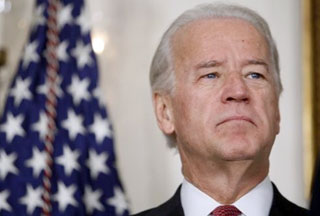
By BOUTHIANA SHAABAN | March 16, 2010
Vice President Biden’s speech in Israel on March 11 sounded like an official American statement, providing absolute support to all the crimes committed by Israel. Biden’s speech was full of anachronisms aimed at polishing the image of Zionism tarnished by the blood of civilians, particularly children. Biden was not hypocritical like most Western politicians. He was candid and transparent.
In his speech, Biden said: “I had said in a speech in the United States some years ago for which I got some criticism, if I am not a Jew, I would be a Zionist. And it got a lot of national publicity, how could I say that, until I was reminded by my father you need not be a Jew to be a Zionist”. I do not know why the Vice-President should feel proud about being a Zionist and what are the achievements of Zionism that make Biden want to belong to it. Is it the displacement of millions of Palestinians from their homeland, Palestine, the incarceration of millions of others in the big prison called Israel, where they are subjected daily to ethnic cleansing and where their children, women and elderly killed and imprisoned?
There are 321 children imprisoned by Israel with the only charge against them being throwing stones at armed Israeli settlers who attacked their homes and neighborhoods, insulted them and killed their families. The people of Gaza are still suffering hunger, disease and poverty after a war described by all investigators as a crime against international humanitarian law. Nevertheless, Israel prevented even the EU foreign policy commissioner and others from visiting Gaza so that they do not see the real face of Israeli Zionism.
Vice-President Biden sees Israel’s history as “a tale of remarkable accomplishment, on a perilous patch of desert with sparse natural resources”. When was Palestine an empty desert? Isn’t it the land of milk and honey which was coveted by invaders like the Romans, the Crusaders and the Zionists? Isn’t it the cradle of Jesus Christ, the prophets and messengers? Was it ever an empty desert, or rather part of ancient Arab civilizations from which the West learnt trade and mathematics, architecture and electricity, arts and literature? Wasn’t Jerusalem a place of pilgrimage for the followers of the three monotheistic religions for centuries? This is as if the Vice-President has not seen the olive trees, hundreds of years old, in Palestine, and as if he is ignorant of the arts and letters developed by Palestinians for centuries and taken back by the Crusaders who returned to a Europe fully swamped at the time by fanaticism and ignorance.
The Vice-President attacked all Arabs – without discrimination between the non-compliant and the moderates – for calling for the destruction of Israel, while “every day, Israel faces bravely threats no country should have to endure.” He adds that the US stands shoulder to shoulder in facing these threats. This is as if Biden does not know that the Arabs have made an initiative for a just and comprehensive peace; and he ignored Egypt and Jordan which made peace with Israel decades ago without this preventing the latter from attacking its neighbors. Biden has ignored the whole Arab reality as if it were “an empty desert”.
Biden thinks that his audience is stupid to the extent that they believe that what is between Israel and the Palestinians is simply a “difference of opinion”. What racism inhabits the minds of Zionists when they believe that Palestine is an “empty desert”? Does Biden think that five million Palestinians do not exist?
No doubt the American Vice-President has not read about the twelve year old child Hasan al-Muhtasib, who was put on trial by the Israelis, and while in court, he was given a red balloon by a lawyer to play with. He has not read about his Zionist friends running over Palestinian children with their cars on a daily basis. Maybe he supports the Zionists when they arrest sleeping children.
The only prisoner mentioned by the Vice-President was Gilad Shalit, while the eleven thousand Palestinian prisoners are part of the “empty desert” which Biden cannot see; and that is why their life and suffering has no value. He even decided that Hamas is responsible for the misery of the people of Gaza, while all investigations and international reports written by the Justice Richard Goldstone and the UN’s Richard Falk, accuse Israel of committing war crimes in Gaza and using internationally-banned weapons against unarmed civilians to kill Gaza’s inhabitants, destroy their schools and institutions over their heads and violate international law.
But on the other hand, if Biden is proud of his Zionism, although he is not Jewish, and goes against the facts of history and geography to justify his support for the crimes committed against unarmed civilians in Jerusalem, Nablus, Hebron and Gaza, where are the rulers of Arab and Muslim countries? Where is the sense of solidarity with their Muslim brethren and with al-Aqsa mosque? Have they left the whole issue to the children of Jerusalem?
Representatives of Arab countries squabble for hours over an expression in order not to upset Israel and its Zionist allies. They end up considering the confiscation of Arab land mere “settlement units”, ethnic cleansing against Palestinians as “demographic change”, the brutal attacks against unarmed Palestinians praying in al-Aqsa mosque and its sanctuary as “clashes”, and brutal Israeli attacks against unarmed women and children in their homes and neighborhoods as mere “confrontations”.
The Zionist perspective, which is essentially an annihilation of Arabs and their rights from existence, deserves an Arab stand in support of Palestinians who have been courageous fighters for the cause of freedom and justice. If building fifty thousand colonial settlement units in East Jerusalem does not deserve an assertive position by all Arabs and Muslims; if it does not deserve withdrawing ambassadors and changing history, what does?
Bouthaina Shaaban is Political and Media Advisor at the Syrian Presidency, and former Minister of Expatriates. She is also a writer and professor at Damascus University since 1985. She has been the spokesperson for Syria. She can be reached through nizar_kabibo@yahoo.com
NPR interviews two Israel lobbyists for story on settlement squabble
By Philip Weiss | March 16, 2010
The New Jersey Department of State has 19 agencies and divisions, only one of which is devoted to relations with a specific foreign country. Put on your thinking cap, now!
The agency is called, the New Jersey-Israel Commission, whose mission “is to foster economic, scientific, educational and cultural ties with the State of Israel, one of the Garden State’s most important trading partners.” The Commission chair is Daniel Kurtzer, a former ambassador to Israel, now a prof at Princeton.
When NPR’s Michele Kelemen did a story yesterday on the contretemps between the US and Israel, she interviewed Kurtzer as an expert, and also David Makovsky, of the Washington Institute for Near East Policy. Kurtzer said, “Israel did a really in-your-face move with the vice president in town and, I think, it needs to find a way to offset that by responding to what Secretary of State Hillary Clinton asked for..” Makovsky offered neocon cant: “We do recognize that terrorists exploit this issue, but even if we had progress on this issue, does anyone really believe that al-Qaida would disappear or sectarian differences in Iraq would disappear or Iran would not seek a nuclear weapon?”
I admit that Kurtzer has a broad resume and tends to be reasonable–he also told Keleman that the Israelis are hurting our interests in the region–but back to the lead, he is chairman of an agency that promotes trade with Israel. Should NPR have disclosed this fact? Especially at a time when Gen’l Petraeus is saying that the Arab world regards the US as incapable of being tough with Israel?
Also, just to get on my sociological hobbyhorse, Is it really fair that NPR is interviewing two American Jews on this subject? Are there any other Americans who have expert opinions? What about Steve Walt, who knows this issue backward and forward? Or Helena Cobban, who is as sharp as they come? Or Ali Abunimah, who has followed the peace process forever and is funny? They all have less personal identification with Israel than Kurtzer and Makovsky. Can Americans learn their views?
Israel Seals off West Bank for 48 Hours
Al-Manar | 12-03-2010
 Israeli Defense Minister Ehud Barak has ordered the army to seal off the West Bank for 48 hours until midnight on Saturday, an army spokesman said.
The action was taken “for security reasons” including a risk of attacks, the Israeli spokesman said Friday. The area was sealed off at midnight on Thursday.
Israeli occupation police have also said they would bar Muslim men under the age of 50 from prayers on Friday at occupied Jerusalem’s Al-Aqsa mosque compound, one of Islam’s holiest sites, fearing unrest.
The move infuriated worshipers, and the Jerusalem Center for Social and Economic Rights condemned the measures as a violation of privacy and freedom to worship. It expected the coming hours to see further restrictions on worshipers after confrontations took place between Palestinians and the Israeli occupation army near Al-Aqsa Mosque ahead of Friday’s prayer.
The moves come after violent clashes at the site during last week’s Muslim prayers when occupation army stormed the holy site and threatened the worshipers. They also come after fresh tensions over Israeli plans to build 1,600 homes for settlers in mostly Arab east Jerusalem.
Since the outbreak of the second Palestinian uprising in September 2000, Israel has usually sealed off the West Bank ahead of major holidays, saying the move is necessary to prevent attacks, but only rarely on other occasions. “The Israeli army will continue to operate in order to protect the citizens of Israel while maintaining the quality of life of the Palestinian population in the area,” the occupation military said in a statement.
The Dark Face of Jewish Nationalism

By Dr. Alan Sabrosky | March 10, 2010
Israeli prime minister Binyamin Netanyahu once remarked to a Likud gathering that “Israel is not like other countries.” Oddly enough for him, that time he was telling the truth, and nowhere is that more evident than with Jewish nationalism, whether or not one pins the “Zionist” label on it.
Nationalism in most countries and cultures can have both positive and negative aspects, unifying a people and sometimes leading them against their neighbors. Extremism can emerge, and often has, at least in part in almost every nationalist/independence movement I can recall (e.g., the French nationalist movement had The Terror, Kenya’s had the Mau Mau, etc.).
But whereas extremism in other nationalist movements is an aberration, extremism in Jewish nationalism is the norm, pitting Zionist Jews (secular or observant) against the goyim (everyone else), who are either possible predator or certain prey, if not both sequentially. This does not mean that all Jews or all Israelis feel and act this way, by any means. But it does mean that Israel today is what it cannot avoid being, and what it would be under any electable government (a point I’ll develop in another article).
The differences between Jewish nationalism (Zionism) and that of other countries and cultures here I think are fourfold:
1. Zionism is a real witches’ brew of xenophobia, racism, ultra-nationalism, and militarism that places it way outside of a “mere” nationalist context — for example, when I was in Ireland (both parts) I saw no indication whatsoever that the PIRAs or anyone else pressing for a united Ireland had a shred of design on shoving Protestants into camps or out of the country, although there may well have been a handful who thought that way — and goes far beyond the misery for others professed by the Nazis;
2. Zionism undermines civic loyalty among its adherents in other countries in a way that other nationalist movements (and even ultra-nationalist movements like Nazism) did not — e.g., a large majority of American Jews, including those who are not openly dual citizens, espouse a form of political bigamy called “dual loyalty” (to Israel & the US) that is every bit as dishonest as marital bigamy, attempts to finesse the precedence they give to Israel over the US (lots of Rahm Emanuels out there who served in the IDF but NOT in the US armed forces), and has absolutely no parallel in the sense of national or cultural identity espoused by any other definable ethnic or racial group in America — even the Nazi Bund in the US disappeared once Germany and the US went to war, with almost all of its members volunteering for the US armed forces;
3. The “enemy” of normal nationalist movements is the occupying power and perhaps its allies, and once independence is achieved, normal relations with the occupying power are truly the norm, but for Zionism almost everyone out there is an actual or potential enemy, differing only in proximity and placement on its very long list of enemies (which is now America’s target list); and
4. Almost all nationalist movements (including the irredentist and secessionist variants) intend to create an independent state from a population in place or to reunite a separated people (like the Sudeten Germans in the 1930s) — it is very rare for it to include the wholesale displacement of another indigenous population, which is far more common of successful colonialist movements as in the US — and perhaps a reason why most Americans wouldn’t care too much about what the Israelis are doing to the Palestinians even if they DID know about it, is because that is no different than what Europeans in North America did to the Indians/Native Americans here in a longer & more low-tech fashion.
The implications of this for Middle East peace prospects, and for other countries in thrall to their domestic Jewish lobbies or not, are chilling. The Book of Deuteronomy come to life in a state with a nuclear arsenal would be enough to give pause to anyone not bought or bribed into submission — which these days encompasses the US Government, given Israel’s affinity for throwing crap into the face of the Obama administration and Obama’s visible affinity for accepting it with a smile, Bibi Netanyahu’s own “Uncle Tom” come to Washington.
The late General Moshe Dayan, who — Zionist or not — remains an honored part of my own Pantheon of military heroes, allegedly observed that Israel’s security depended on its being viewed by others as a mad dog. He may have been correct. But he neglected to note that the preferred response of everyone else is to kill that mad dog before it can decide to go berserk and bite. It is an option worth considering.
Alan Sabrosky (Ph.D, University of Michigan) is a ten-year US Marine Corps veteran and a graduate of the US Army War College. He can be contacted at docbrosk@comcast.net
The Obama administration asked for the East Jerusalem fiasco
By Yossi Sarid | Haaretz | March 11, 2010
Don’t believe Benjamin Netanyahu for one moment when he says he “never knew.” The Jerusalem planning committee is only too aware of what the bosses want, and the government has decided to step up construction in greater Jerusalem. Dispossession and taking possession, kicking out and moving in – that’s what it’s all about.
Over the years, a streamlined and generously lubricated machine has evolved, one that makes it possible to take solace in the building of Jerusalem (in the phrase used to console mourners) and to take pride – but also to take cover – behind a facade of disingenuousness and disowning. Yesterday, it was convenient to disown.
No pretext is more dismal than “bad timing.” Ehud Barak immediately put out a press release about the “harmful timing of the publication.” As if there were a proper time for provocations. If the announcement of the 1,600 planned housing units had come before Joe Biden’s trip, they would have said it was aimed at sabotaging the visit, and if it happened after he left, they would have said Biden himself was in on the secret.
But with Barak, that willing slave-minister of Netanyahu’s, everything’s cool, but if only they had kept that call for bids confidential, if only they built apartments in some dark secluded hideaway, like the Western Wall tunnel.
Don’t believe for a moment that they never knew: The chaos works like clockwork. The detonation mechanism is activated remotely and a safety range is carefully observed. It will always be possible to make procedural claims – “it’s a technical matter” or “the political echelon wasn’t involved” or “the timing was purely coincidental” or “three years of deliberations happened to end now.” What judge hearing a case would accept “I didn’t know” as a mitigating circumstance?
This is one visit Joe Biden will not quickly forget. First he was compelled to sit through 25 minutes of an annoying speech in his honor by our president. Shimon Peres really believes that he is the destination for pilgrims from all over the world who drink in his musings and are intoxicated by his vision.
Later, Biden was given a certificate memorializing his mother, but the glass broke. Once again, Bibi didn’t pay attention, leaned on it and shattered it. No fear, his speeches have always diverted attention from such mishaps. And finally, to add a finishing touch of infuriating disgrace, the Haredi neighborhood Ramat Shlomo was dumped on the vice-presidential head.
Truth be told, the Obama administration just about asked for this slap. In Jerusalem, the lesson has been learned that the White House doesn’t fulfill its obligations – it just goes through the motions by issuing insincere rebukes. And now, they’ll begin the “proximity talks” – Orwellian for distance, which is greater than it’s been in 20 years.
If I were Rahm Emanuel, I wouldn’t advise Barack Obama to follow in his Veep’s footsteps and visit Israel soon. It’s safe to predict that on the day he’s addressing the Knesset, they’ll tell him work has begun on the Temple Mount. The first Temple was that of Solomon the Wise, the Second was that of Ezra the Scribe, and the Third of Netanyahu and Eli Yishai. Let the Temple be built, and the home of the nation will be laid waste.
Upset by U.S. Security, Pakistanis Return as Heroes
By JANE PERLEZ | New York Times | March 9, 2010
ISLAMABAD, Pakistan — A tour of the United States arranged by the State Department to improve ties to Pakistani legislators ended in a public relations fiasco when the members of the group refused to submit to extra airport screening in Washington, and they are now being hailed as heroes on their return home.
“People should be thankful, you made them so proud,” said Hamid Mir, the host of a popular national talk show, during an interview in his studio on Tuesday with four of the six politicians, who railed against the security precautions at Ronald Reagan National Airport.
Meetings with the Obama administration’s top policy makers on Pakistan, including the president’s special representative, Richard C. Holbrooke, and visits to the Pentagon and the National Security Council, did not allay the anger the politicians said they felt at being asked to submit to a secondary screening on Sunday before boarding a flight to New Orleans. They declined to be screened and did not board the flight.
Pakistan is one of 14 mostly Muslim countries whose citizens must go through increased checks before they fly into the United States, a procedure mandated by the Obama administration in the wake of the failed attempt by a Nigerian man to blow up an airliner flying from the Netherlands to Detroit on Dec. 25.
The inclusion of Pakistan on the list was broadly criticized as an insult to a country that the United States calls an ally.
The leader of the parliamentary group, Senator Abbas Khan Afridi, said in an interview on Tuesday that before they were to board the flight for New Orleans, he and his colleagues were selected from a crowd of passengers at the airport and asked to stand aside.
They were then asked to accept a full-body scan by a machine, he said. Such body-scanning units are in use at 19 airports across the United States, and more are being installed.
One of Mr. Afridi’s colleagues, Akhunzada Chitan, told Mr. Mir on his “Capital Talk” program, “Going through a body scan makes you naked, and in making you naked, they make the whole country naked.”
The lawmakers were chosen to visit the United States by the Political Section of the American Embassy. American officials are eager to reach out to political figures from the underdeveloped and isolated tribal areas where the Pakistani Army is now fighting to reclaim territory from the Taliban.
The United States Agency for International Development pledged two years ago to spend $750 million on various projects in the tribal areas, but residents there complain that they see more of the Taliban than American assistance.
In preparatory briefings for their trip, the politicians were advised that they might have to submit to extra body searches, just as randomly selected Americans must submit to secondary screening by the new machines, two officials from the American Embassy said.
The Pakistanis were specifically warned that the United States was not a “V.I.P. culture,” unlike Pakistan, where politicians are often exempted from unpalatable procedures that other people have to tolerate, the American officials said.
“We are disappointed that the group took offense at the security procedures thousands of Americans and visitors must endure at airports every day,” said Larry Schwartz, the senior communications adviser at the American Embassy in Islamabad. “No offense was intended. Indeed, they were warmly welcomed at high levels in Washington.”
The American Embassy in Islamabad has been endowed with an extra $37 million by Congress to spend on exchange programs intended to show skeptical Pakistanis that the United States is a real ally, a country that wants to help, not hinder, Pakistan.
The people-to-people exchanges between Pakistan and the United States, which include American lecturers and teachers of English coming to Pakistan, is now the most ambitious of such efforts run by the State Department around the globe, Mr. Schwartz said.
About 2,000 Pakistanis are expected to participate in the strengthened educational and cultural programs this year, he said. Indeed, a prime motivation of the protest against the screening procedures by the tribal area politicians appeared to be an effort to appeal to their home constituencies, many of whom regard the United States as an enemy.
“Our people were very disturbed we were going to America,” Mr. Afridi said. “We were under threat for going to the United States. We took the risk to see if America was interested in solving the problems.”
The State Department paid each of the participants $200 a day for accommodations and food during their stay in the United States.
If the American taxpayers wanted the money for the expenses refunded, he would be happy to do so, said Mr. Afridi, 40, who described himself as a major trader in cement, with businesses across Pakistan and in Afghanistan.
“We can pay back the $200 a day, no problem,” he said.
Then, he drove off in his brand-new Hummer — an example of his affection for American autos, he said — to appear on another television program to tell his story of standing up to the American authorities.
Pir Zubair Shah contributed reporting.
Peres to Biden: Expel Iran from UN
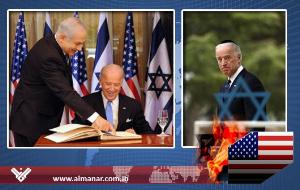
“There is absolutely no space between the United States and Israel when it comes to Israel’s security — none at all” – Joe Biden
Al-Manar TV – 09/03/2010
US Vice President Joe Biden began his round of talks with senior Israeli officials on Tuesday at the Israeli President’s Residence in occupied Jerusalem.
Biden told Israeli President Shimon Peres that the Iranian regime is isolated more than ever before, both domestically and internationally, claiming that the Iranian people are imposing what he called “moral sanctions” against it.
The Israeli president said imposing moral sanctions on Iran, including its expulsion from the UN, were no less important than taking economic measures. According to Peres, Iranian President Mahmoud Ahmadinejad cannot be a UN member and at the same time call for Israel’s annihilation and hang people in the streets.
Peres, who said Ahmadinejad was trying to delegitimize Israel and the US, said the West should surround Iran with anti-missile batteries.
The American vice president, who is the senior-most Obama administration official to visit the Zionist entity, said he hoped the Israel-Palestinian talks would help the sides overcome the mistrust between them, adding that he believed the points of agreement outnumber the disagreements.
Biden also signed Peres’ guest book. He wrote that the bond between the US and Israel is unshakable, adding that only a joint effort can lead to lasting peace.
The US vice president later met with Israeli Prime Minister Benjamin Netanyahu. Biden shook hands with the Israeli PM and signed his guest book as well. He wrote that Israel is lucky to have Netanyahu, and the US is lucky to have Israel as a friend. The two are slated to meet one-on-one with their entourages. After the meeting, they will issue a joint statement.
Later in the day Biden is scheduled to meet with Opposition leader Tzipi Livni. On Wednesday he is scheduled to meet with Mideast Quartet envoy Tony Blair, and then head to Ramallah for talks with Abbas and Palestinian Prime Minister Salam Fayyad. On Thursday the vice president will speak at Tel Aviv University.
The right kind of bigotry
By Glenn Greenwald | March 6, 2010

From the long-time Editor-in-Chief and owner of The New Republic, this morning:
There were moments–long moments–during the Iraq war when I had my doubts. Even deep doubts. Frankly, I couldn’t quite imagine any venture requiring trust with Arabs turning out especially well. This is, you will say, my prejudice. But some prejudices are built on real facts, and history generally proves me right. Go ahead, prove me wrong.
The point here is so obvious that it makes itself. In the bolded sentence, replace the word “Arabs” with “Jews” and ask yourself: how much time would elapse before the author of such a sentence would be vehemently scorned and shunned by all decent people, formally condemned by a litany of organizations, and have his livelihood placed in jeopardy? Or replace the word “Arabs” in that sentence with “Jews” or “blacks” or “Latinos” or even “whites” or virtually any other identifiable demographic group and ask yourself this: how many people would treat a magazine edited and owned by such a person as a remotely respectable or mainstream publication (notwithstanding the several decent journalists employed there)? Yet Marty Peretz spits out the most bigoted sentiments of this type — and he’s been doing this for years, as is well known — and very little happens, because, for multiple reasons, this specific type of hate-mongering remains basically permitted in American political discourse. The double standard at play here is as extreme and self-evident as it is pernicious, but it doesn’t matter. And we’ll all wait with bated breath for the next installment of The New Republic‘s righteous, accusatory attacks on the entirely fictitious manifestations of the one strain of bigotry that bothers them, because they’re such credible arbiters and opponents of prejudice.
Would the ‘NY Review of Books’ have printed an article on George Wallace in Alabama without talking to any black people?
By Philip Weiss | March 6, 2010
Josh Hammer has a pretty-good piece in the NY Review of Books about Avigdor Lieberman, called “I’m a Realist.” Any knowledge Americans get about this racist politician is to the good, but the piece is marred by the usual problem: American Jews are afraid to convey the blunt truths that leftwing Israeli Jews convey about their society, let alone what Palestinians say about that society. Israel comes off as a healthy democracy that is struggling with the devilishly charming Lieberman, who has a “controversial” belief in “transferral” of Palestinians, rather than as a society in crisis because of the continuing dispossession of minorities (as Bradley Burston would tell you, or Noam Sheizaf, or Mustafa Barghouti, or Ali Abunimah).
This limitation is typical of the New York Review of Books. The editors can’t give up on the ideals of Zionism, and so they publish Michael Walzer and Avishai Margalit, and keep Tony Judt in the back room, and refuse to review The Israel Lobby. The clearest indication of this bias in the NYRB’s Lieberman piece is the list of people Hammer quotes:
Lieberman
Yossi Beilin
Mikhail Philippov
Gideon Levy
One of Lieberman’s aides
Yair Tzaban
Alex Magidov
Danny Ayalon
Misha from Uzbekistan
Natasha from Siberia
Lily Gallili, reporter for Haaretz
Michal Kupinsky
There is not one Palestinian on the list. The only Palestinian even mentioned in the piece is Azmi Bishara. It doesn’t seem like Hammer tried to talk to him. So a racist politician rises, and a leftwing NY publication makes no effort to talk to the victims of the racism. Huh.
I admit it: I’m an ethnocentric Jew; and in Israel I recognize my tribe, and when I went to Israel and Palestine recently, I talked mostly to Jews. Still, I am stretching, I talked to Mustafa and Omar Barghouti and to Adnan Mahamid; it is essential for Jews to get out of their comfort zone; I try on this site to have Palestinian and other Asian voices. The New York Review of Books is sticking right in that Jewish comfort zone.
Tzipi Livni won’t be visiting the UK any time soon
By Paul Woodward | March 4, 2010
To hear it from the Israeli press you’d think that the British government can now makes changes to the law simply by having the prime minister write an op-ed.
Last December an arrest warrant was issued for former Israeli foreign minister, Tzipi Livni, when she was expected to arrive in Britain. According to Haaretz, she no longer needs to fear getting hand-cuffed for alleged war crimes — at least not on trips to the UK:
British Prime Minister Gordon Brown announced on Thursday plans to stop politically-motivated campaign groups from securing arrest warrants for visiting foreign officials. In a March 3 editorial in the Daily Telegraph, Brown wrote, “Britain will continue to take action to prosecute or extradite suspected war criminals – regardless of their status or power… But the process by which we take action must guarantee the best results. The only question for me is whether our purpose is best served by a process where an arrest warrant for the gravest crimes can be issued on the slightest of evidence.”
Under the current system, British magistrates are obliged to consider an arrest warrant case presented by any individual. Gordon Brown said he will instead propose that only one government department, the Crown Prosecution Service, evaluate the merits of any case brought under international law.
This move follows an uproar last December when Kadima party leader Tzipi Livni canceled a trip to London because a pro-Palestinian group secured an arrest warrant for alleged crimes committed in Gaza. A statement from Livni’s office praised the new changes proposed by Brown and said that “the British legal system has been abused by cynical elements in the United Kingdom.”
From London The Times presents a very different story:
Britain risks a showdown with Israel today when the Government signals it is in no hurry to ease the threat of arrest for visiting politicians and generals.
Ministers will announce a consultation on the principle of universal jurisdiction, under which private citizens can secure arrest warrants for offences such as war crimes committed abroad.
The Government had promised swift action when the Israeli opposition leader Tzipi Livni cancelled a trip to London last year after a magistrate issued a warrant for her arrest for alleged war crimes in Gaza when she was Foreign Minister.
The issue caused embarrassment for the Government, which promised to remedy the matter quickly. Today’s announcement, however, means that the issue will not be resolved until well after the election, expected in May. When The Times reported last month that a Cabinet split could delay the issue could be delayed for months, Ms Livni threatened to travel to Britain and “take the bullet” as the only way of shaming the Government into action.
After the disclosure that agents suspected of acting for Mossad, the Israeli intelligence service, used fake British passports to enter Dubai and kill a Hamas commander, however, the balance of diplomatic power has shifted.
The delay is a victory for Jack Straw, the Justice Secretary, who has argued that the legal point at stake is too important to rush.
Since the British government just voted in support of a UN General Assembly resolution calling on Israel to fully investigate allegations of war crimes committed during its war on Gaza, maybe they should quietly tell the Israelis that the proposed changes on universal jurisdiction aren’t going to happen if Israel keeps running away from the Goldstone report.
Europe’s Alliance with Israel
By David Cronin | March 4, 2010

Avigdor Lieberman meets Javier Solana
One of the pitfalls of specialising in European politics, as I have for the past 15 years, is that certain assumptions become hardwired in your brain. For a long time, my critical faculties shut down when I heard senior EU representatives speak of the Middle East. I happily accepted the official narrative that they were striving for a just resolution to the conflict between Israel and the Palestinians and that it would be foolish to park the so-called peace process in a “blood-soaked lay-by”, in the words of former EU commissioner Chris Patten.
Israel’s attacks on Lebanon in 2006 and on Gaza just over a year ago illustrated how naive and gullible I had been. In the first instance, Tony Blair blocked the EU from formally calling for a ceasefire because he wanted Israel to be given whatever space it perceived necessary to fight Hezbollah (Israel’s slaughter of Lebanese civilians in that 33-day war elicited no more than statements of “regret” from London).
It is true that the Union did urge a halt to the violence that Israel inflicted on Gaza’s 1.5 million inhabitants in late 2008 and early 2009. Yet by describing that attack as “disproportionate”, key EU representatives implicitly approved the Israeli version of events – that everything had been provoked by the missiles Hamas was firing on the southern Israeli towns of Ashkelon and Sderot. “Gaza was a crisis waiting to happen,” Marc Otte, the Union’s Middle East envoy, told me. “Do you think the Palestinians could continue to launch rockets on Israel without Israel reacting?”
Otte has resorted to a wilfully selective reading of recent history. Far from merely reacting to what Hamas had done, Israel had created the conditions that prompted Hamas to dust down its crude DIY weapons (no match, it must be said, for the cutting-edge killing machines in the Israeli arsenal). Until a few months earlier, Hamas had observed the cessation of hostilities between it and Israel that Egypt had brokered in June 2008. All that changed on 4 November that year, however. Because most of the world was preoccupied with how America was electing its first black president, Israel’s decision to break off the ceasefire with a raid on Gaza that killed six members of Hamas went largely unnoticed internationally. As a result, most mainstream press ignored how the rockets sent by Hamas into southern Israel were in retaliation for the November raid.
Even worse than its complicity in spreading Israeli falsehoods, the EU has failed to hold Israel to account for its war crimes. The investigation carried out by a UN-appointed team led by Richard Goldstone, a retired South African judge, into the conduct of Israel’s war on Gaza was as thorough as was possible under the circumstances (with Israeli officialdom refusing to cooperate). But when the 575-page it produced was discussed by the UN’s General Assembly in November 2009, 22 of the EU’s 27 countries refused to endorse it. A key finding that there was no “justifiable military objective” behind 10 of the 11 incidents it examined, in which civilians had been targeted by Israel, proved too unpalatable for most EU governments.

In December 2006 Ehud Olmert caused controversy when he was caught on camera instructing Italian PM Romao Prodi what to say in their joint press conference
While some headlines in 2009 conveyed the impression that there was friction between Israeli and European diplomats over everything from the status of Jerusalem to a Swedish tabloid story alleging that Israeli soldiers systematically ripped out the internal organs of Palestinian corpses, the reality is that Israel enjoys extremely cordial and profitable links with the EU. That reality was underscored by Javier Solana, making a farewell trip to Israel in the autumn, shortly before he stepped down as the EU’s foreign policy chief. “There is no country outside the European continent that has this type of relationship that Israel has with the European Union,” he said. “Israel, allow me to say, is a member of the European Union without being a member of the institutions. It’s a member of all the [EU’s] programmes, it participates in all the programmes.”
The most troubling aspect of this cooperation, in my view, is how Israeli arms companies have become eligible for EU funding. With Israel the main external participant in the Union’s “framework programme” for scientific research, the EU has become the second largest source of research grants for the country. Tel Aviv-based officials to whom I have spoken predict that Israel’s participation in the multi-annual programme, which went into operation in 2007, will be worth €500 million by the time it concludes in 2013.
The beneficiaries of these grants include Motorola Israel. Motorola is taking part in an EU-financed surveillance project known as iDetect4All, which uses sensors to detect intruders of buildings or resources of high economic value. The concept behind iDetect4All is similar to that behind a radar system that Motorola has installed in 47 Israeli settlements in the West Bank over the past five years. The Jerusalem Post has described that system as a “virtual fence” that uses thermal cameras to pinpoint people who are not authorised to enter the settlements.
Another recipient of EU grants is Israel Aerospace Industries, the manufacturer of warplanes used to terrorise Palestinian civilians. It is playing a lead role in the EU’s “Clean Sky” project, which aims to reduce aviation’s contribution to climate change by developing less polluting aircraft engines. Because IAI has been given carte blanche by the European Commission to apply for patents on any innovations realised during this project, it is entirely conceivable that planes used in the future bombardment of Palestine will have been developed with the unwitting help of the European taxpayer.
It is highly probable that Israel will be integrated even further into the Union in the near future. During 2008, the EU’s foreign ministers approved a plan to “upgrade” their relations with Israel through a “privileged partnership” that would enable Israel to become part of the Union’s single market for goods and services. Work on giving concrete effect to this upgrade has stalled since then because of the war on Gaza and unease in some European capitals at the hard-line rhetoric of Binyamin Netanyahu’s government. Nonetheless, some significant steps have been taken in the past few months. In November last, for example, an agreement on agricultural trade was finalised; under it, 80% of Israel’s fresh produce and 95% of its processed foods can be exported to the EU free of customs duties. A cooperation agreement between Europol, the EU’s police office, and Israel has also been reached (though still awaits a formal rubber-stamp from the Union’s governments). This is despite numerous reports from human rights organisations that detainees in Israel are routinely tortured and despite rules in force since 1998 that oblige Europol not to process data obtained by cruel methods.
One factor that has helped pave the way for all this cooperation is that a cottage industry of lobby groups dedicated to promoting Israel has started to flourish in Brussels. The American Jewish Committee, the European Jewish Congress and B’nai B’rith have all set up EU affairs offices over the past few years, while a cross-party alliance of MEPs (known as European Friends of Israel) was founded in 2006. These groups have responded to the widespread public revulsion at Israeli aggression by branding Israel’s critics, including left-wing Jews, as anti-Semites (an absurd claim, considering that most Palestinian solidarity activists abhor anti-Semitism). They have also contended that it is in Europe’s interest to bond with Israel because it is a prosperous economy, that has proven resilient in the face of global recession.
This well-oiled propaganda machine has helped convince policy-makers that Israel should be viewed as something akin to a Mediterranean Canada, a “normal” industrialised country with many similarities to Europe. But Israel is not a normal country; it is one that illegally occupies the land of another people.
The EU’s ever-deepening relationship with Israel cannot be divorced from the brutality meted out on daily basis to the Palestinians. The deeper that relationship gets, the more that Europe will be accommodating the oppression of Palestine. The EU cannot help solve the problems of the Middle East if it is making those problems worse.
• David Cronin’s book Europe’s Alliance with Israel: Aiding the Occupation will be published later this year by Pluto Press. This article originally appeared in the magazine ESharp! (www.esharp.eu)
Featured Video

The Truth About the Trump Shootings with Ken Silva
or go to
Aletho News Archives – Video-Images
From the Archives
Trans ‘milk’ as good as the real thing – NHS
RT | February 18, 2024
The drug-induced nipple secretions of trans women are as good as mothers’ breast milk for babies, the University of Sussex Hospitals NHS Trust claimed in a letter to campaigners made public in a report by British think tank the Policy Exchange on Sunday.
The healthcare trust’s medical director, Rachel James, argued that the off-label prescription drug cocktail men transitioning to female take in order to produce milk was “similar to the natural hormones which encourage lactation to develop when the baby is newly born.”
“The evidence which is available demonstrates that the milk is comparable to that produced following the birth of a baby,” James wrote in the letter, sent to Children of Transitioners last August.
Biological men who wish to lactate must first take hormones to grow milk glands and then take high doses of either domperidone or metoclopramide to stimulate milk production. Neither drug is approved for this use, though they are occasionally prescribed off-label to biological women who have trouble lactating.
However, domperidone’s own manufacturer, Janssen, warns patients the drug “may cause unwanted side effects affecting the heart in a breastfed baby” and “should be used during breastfeeding only if your physician considers this clearly necessary.” … continue
Blog Roll
 Aletho News
- How Real Is the Impact of Western Sanctions on Israel?
- France, You Are Guilty: How Paris Turned Western Sahara into the Maghreb’s Powder Keg
- 2025 Nature Paper Claiming Worsening Global Drought Gets RETRACTED …Heavily Flawed
- Your Milk Is Not the Problem
- The Truth About the Trump Shootings with Ken Silva
- ARE PATIENTS BEING PROPERLY INFORMED ABOUT OZEMPIC?
- US lawmaker blocks $2.8 billion weapons sale to Israel: Report
- Yemeni army claims responsibility for strikes on sensitive sites in Saudi capital, Aramco facilities in Yanbu
- Iran Judiciary issues indictments against 159 US, Israeli officials for assassination of Leader, commanders
- Turkiye revokes Iranian bank license under US sanctions campaign
- If Americans Knew
- Salah Sarsour’s Legal Team Says DHS Has Not Met Its Burden to Prove He Is Deportable
- An analysis of tax forms by The Intercept show Kraft’s charity and LLC have donated to Friends of the IDF and AIPAC’s super PAC.
- Israeli attacks kill four Palestinians in Gaza – Daily Update
- Inside Gaza’s death trap of collapsing, bombed-out buildings
- The everyday items Israel bans from Gaza every day
- Inside the siege, the ruined buildings of Gaza – Daily Update
- Debunking The Claim That Macklemore Has A “History Of Antisemitism”
- CPJ demands release of arrested Palestinian-US journalist near Bethlehem
- Robert Kraft: The Billionaire Friend of Netanyahu Pulling The Strings Behind the Macklemore/Ed Sheeran Blow Up
- Columbia Administered Fund Gives Big Money to Pro-Israel Groups
- No Tricks Zone
- 2025 Nature Paper Claiming Worsening Global Drought Gets RETRACTED …Heavily Flawed
- New Study: ‘Global Drought Shows No Detectable Recent Acceleration Under Climate Warming’
- Economic Masterminds: German Socialists Suggest Taxing Productivity Gains Stemming From Using AI
- The South China Sea Has Not Been Cooperating With The Climate Change Narrative
- Energy Crisis: Germany Enters Heating Season With Historically Low Gas Reserve Fill Levels
- New Study: The Antarctic Ice Sheet Gained Mass From 2020-2024 Due To Staggering Snow And Ice Accumulation
- Study: Ocean Heating Rates From Thousands Of Years Ago ‘Dwarf’ Modern Ocean Heating Rates
- Climate Extremists Target, Attack Large-Scale Power Grid Infrastructure In Germany!
- New Study: Antarctic Ice Melt Has Contributed Less Than 1 Centimeter To Sea Level Rise In The Last 30 Years
- Fear Of Debate: Alarmist German Climate Scientist Calls On Mainstream Media To Discredit Skeptic Voices
 Aletho News