Earlier this week, as US troops abandoned positions in northern Syria under the de facto control of local Kurdish forces amid the Turkish onslaught, Russian peacekeeping patrols quietly began operating in Manbij, northern Syria in a bid to prevent fighting between Turkish and Syrian Army forces.
The withdrawal of US troops from northern Syria signals a waning of ‘Pax Americana’ in the Middle East, and presents both “dangers” and “opportunities” for Israel in the region, former Israeli intelligence officials, diplomats and lawmakers have told The Times of Israel.
According to Amos Yadlin, former head of the Israeli military’s Military Intelligence Directorate, “All pairs of enemies in the Middle East enjoy reasonably good ties with Russia: Saudi Arabia and Iran, Israel and the Palestinians, the Kurds and the Turks, Israel and Iran, Egypt and Turkey, and so on.” Russia, Yadlin said, is not a Middle Eastern ‘hegemon’ in the traditional sense of the term, with Israel, Saudi Arabia, Turkey, Egypt sharing that title, in his view. Furthermore, he noted, Washington still has far greater forces in the Middle East than Moscow.
“The Russian success stems from their ability to use very few forces with determination and rules of engagement that only they can allow themselves, with a veto at the UN Security Council and a patriotic audience at home,” Yadlin said, without elaborating.
Former Israeli Ambassador to the US Michael Oren said he found the US disengagement in the Middle East much more concerning than Russia’s growing influence. “We have relied for the last 45 years on a Pax Americana that no longer exists. I am not saying that the US won’t come to our assistance, but we can’t be certain of it anymore,” he said. As for Russia, Oren suggested Israel should work to reach a ‘modus vivendi’ with Moscow. “It’s useless for us to pretend that Russia is going to be an ally, but we don’t have to make them enemies either,” he said.
However, Ksenia Svetlova, a former Israeli lawmaker from the Zionist Union Party, said Russia’s rise could have “very grave” implications for Tel Aviv. “We already have Russian air defence systems, the S-300, that cover the Syrian and Lebanese shores. As soon as the Russians think that it’s smart for them to operate these systems and to halt the Israeli attacks, Israel would no longer be able to deal with the extension of Iranian power in these countries,” she said, repeating Tel Aviv’s talking point about alleged growing ‘Iranian influence’ in Syria.
Russia initially deployed its air defences only at its airbase in Latakia, northwestern Syria. However, last October, following a friendly fire incident led to the loss of a Russian aircraft and the deaths of 15 Russian airmen, Moscow began deploying S-300s to Syria’s armed forces, complicating Tel Aviv’s campaign of airstrikes into Syria and leading to a reduction in its intensity.
According to Svetlova, Iran, another Israeli adversary, was also a Russian ‘strategic ally’, and “it’s not likely that Moscow will do anything to curb the Iranian influence in Syria and Lebanon.”
But Ofer Zalzberg, an analyst at the Belgium-based nonprofit International Crisis Group, believes Russia could help reduce tensions between Israel and other countries in the region. In his view, President Trump’s Syria exit would at least temporarily end “Israeli wishful thinking about the US resolving all problems militarily,” which could force Israel too to move away from military operations and turn to diplomacy and “some temporary de-facto power-sharing,” including agreements on Syria and Lebanon and perhaps even a “non-aggression pact” between Israel and Hezbollah.
The US withdrew about 1,000 troops from northeast Syria last week, thereby greenlighting a Turkish military operation Ankara says is aimed against Daesh (ISIS) terrorists and local Kurdish militants, whom Turkish authorities also classify as terrorists. Turkey’s operation brought it broad condemnation from its NATO allies, with the US slapping the country with sanctions. Late Thursday, US Vice President Mike Pence said he and Secretary of State Mike Pompeo had met with Turkish President Recep Tayyip Erdogan and agreed to a ceasefire in Syria.
Amid the Turkish operation, Damascus reached an agreement with Kurdish-led militia forces in northern Syria, allowing Syrian Army forces to advance into Kurdish-controlled areas to mount a joint defence of the Syrian-Turkish border area. This week, Russian peacekeepers began patrols in the city of Manbij in eastern Aleppo province, with the mission aimed at preventing fighting between Syrian and Turkish forces.
October 18, 2019
Posted by aletho |
Ethnic Cleansing, Racism, Zionism, Militarism, Timeless or most popular, Wars for Israel | Israel, Lebanon, Middle East, Syria |
Leave a comment
What everyone is most upset about with regard to Syria isn’t the bloodshed or anything having [to] do with human rights. It’s the decline in American control of the Middle East. This is 100% about US imperialism taking a hit. — Rania Khalek (@RaniaKhalek) October 14, 2019
A series of Donald Trump’s decisions, culminating in the decision to withdraw US troops from Syria, has set off a cascade of effects that are dramatically changing the geopolitics of the Middle East and the internal politics of the United States.
Two months ago, I wrote an article opposing the impeachment drive and stating that Donald Trump is not going to be removed from office by impeachment proceedings. I said: “Donald Trump will be removed from office one way: by an election.”
At that time, in the wake of the fizzling out of the Mueller Report and testimony on Russian “collusion,” the new smoking gun was “obstruction of justice.” “The evidence is overwhelming,” Jamie Raskin said, echoing more than 90 of his Democratic colleagues, “10 different episodes of presidential obstruction of justice.” Walls closing in.
Somehow, even after Mueller’s “very, very painful” testimony, the impeachment drive by the Democrats had intensified to the point that it was de rigueur for every major Democratic presidential candidate, and for anyone calling themselves “progressive,” to demand impeachment proceedings. Because “obstruction of justice.”
Of course, the Democrats were not going to create an irresistible political tide that would get enough Republican senators to vote to oust Trump with that “obstruction of justice” issue, and they knew it. The chance of that was effectively zero.
The odds on that are now changing significantly. What happened to change the impeachment calculus that might move enough Republicans?
The answer is nothing that’s in the Ukrainegate smokingburger, which replaced the obstruction-of-justice smokingburger, which replaced the Russiagate smokingburger. Interpretations of the Zelensky phone call are just that—interpretations. Stipulate the worst: Trump tried to wheedle some personal political benefit from a foreign leader. Shocked! Shocked! Are we?
Really? Does anybody think that, if we read through the transcripts of every conversation between US presidents and foreign leaders over the last fifty years, we wouldn’t find scores of such transactions? And, uh, Hunter Biden, not to mention the Clinton campaign and Foundation. The Republicans can bat that phone call away, and they will face no political groundswell among their voters, or even the general public, to take sides in a family feud among different corrupt factions of a corrupt political elite.
To say nothing of the most outrageous examples of using foreign leaders to political advantage. Richard Nixon conspired with the leaders of South Vietnam to prolong the Vietnam War, and LBJ knew it. Ronald Reagan conspired with the leaders of Iran to prolong the confinement of American hostages, and a bipartisan commission covered it up. But they weren’t presidents at the time? Really, that’s an argument for dismissing these cases? What do you think these guys did when they were presidents? No, Nancy, now that I’m president I cannot seek a political benefit from a foreign leader! And why were these cases ignored and actively covered up, except because they were considered—even if a little extreme—SOP in US politics?
The success of the Democrats’ impeachment drive depends on one thing: getting enough Republican senators to vote for conviction. No, nothing in the Trump-Zelensky phone call or anything like it is going to move Republicans to temper their defenses against the Democratic onslaught, let alone move enough of them in the Senate to vote to remove him from office.
If Republicans do stop defending him against that, it will be because they have become radically disaffected with him about something else.
That something else is real, though it probably will not be explicitly stated in impeachment charges. It’s the simmering bipartisan concern about Trump that has been brought to a boil by a recent series of events and decisions: his unreliability as a trigger-puller, his aversion to ordering big military attacks. This is certainly a damning fault in the eyes of most Republicans (as well as Democrats), a disqualifying failure or responsibility from the warden of the US empire. That’s the impeachable offense that could well get enough Republican votes to convict him.
During the 2016 campaign, Donald Trump expressed his opposition to wasteful foreign interventions clearly and repeatedly enough, and was skewered by the Democrats whenever he did, as they promoted lies and war and lies about war (specifically about Ukraine, as I noted) for their political benefit.
He also expressed his disdain for the obligatory nod to US sanctimony, when he responded to Joe Scarborough’s complaint about Putin killing people: “I think our country does plenty of killing also,” and when he pushed back on George Stephanopoulos regarding Ukraine: “The people of Crimea… would rather be with Russia than where they were.”
These kinds of thoughts are anathema to hawkish Republicans. They could only be ignored because they assumed: 1) he wasn’t going to win, 2) it was empty campaign rhetoric, and 3) as President, he would be boxed in and managed by the shepherds of the national-security state. Only one of those assumptions turned out to be entirely false, and it’s the uncertainty about how the other two are now playing out that might undermine his support among Senate Republicans.
In the last few months, Trump has made decisions either to reduce US military presence or explicitly not to take military action that was expected and planned. These were rhetorically and substantively anti-interventionist positions that are anathema to imperialist Republicans. The most consequent of these in the impeachment context are those regarding Iran, and, relatedly, Syria.
The dangerous fuse of Republican discontent with Trump was lit with Trump’s decision in June to call off the military strike on Iran, after Iran’s downing of a US drone. That event followed attacks on Norwegian and Japanese tankers in the Persian Gulf that the US government blamed on Iran. A narrative had been established for US politicians and media: Every nasty thing that happens in the Middle East is to be blamed on Iran. It’s a narrative with a specific target and a specific goal: to manufacture consent for a military attack on that target—Iran—when a good opportunity was either concocted or presented itself.
Iran’s acknowledged destruction of a valuable US military asset provided that opportunity. Trump’s decision—on the profound advice of Bolton, Pompeo, et. al.—to launch an attack on Iran was the inevitable next scene in the script. His decision, made a few hours later, to cancel the attack was something else again. It was a decision made “without consulting his vice president, secretary of state or national security adviser,” with “forces… already in motion… more than 10,000 sailors and airmen…. on the move,” and with “only 10 minutes to go.” Per the NYT, that decision “stunned,” ”flabbergasted,” and outraged his closest advisers and key Republican allies. It was an unprecedented deus ex machina, an impermissible interruption that, especially for Republicans, just doesn’t fit in the epic story of American “presidentialness.”
Leftish Trump opponents have not, I think, recognized what an extraordinary, important, and praiseworthy decision this was by Trump. Has there been a more positive decision of such consequence made by any president in the last thirty years?
Yes, it was the reversal of a prior, terrible decision of his. And, yes, it’s subject to reversal again because of his inconsistency and his many other terrible decisions regarding Iran and the region. But on its own, it stopped an onslaught of immense destruction. That it was a reversal of something he had set in motion only makes it more extraordinary as a presidential act.
Moreover, Trump was not alone in the process of re-thinking his decision. The Washington Post tells us that, from the get-go, the decision to strike Iran had “divided his top advisers, with senior Pentagon officials opposing the decision to strike and national security adviser John Bolton strongly supporting it.” And during those hours of reconsideration, as the NYT reports: “there continued to be pushback from Pentagon civilians and General Dunford.”
In other words, this wasn’t just a matter of peripatetic Trump; it was a matter of an ongoing tension between the fervently Zionist neocons, represented by the likes of Bolton and Pompeo, and the military realists, as represented by Chairman of the Joint Chiefs Dunford. Let’s not—as hawkish Republicans and Democrats certainly will try to—hide that tension in the tale of Trump’s personal inconsistency.
That tension defines something that Trump and every American president is inconsistent about. In the US context, that Trump changed his mind in the direction he did at the last minute is, again, extraordinary—one might even say “courageous.”
Sure, better not to have ordered the attack in the first place, but, in such circumstances, I’ll take reconsideration and second thoughts to sticking to one’s guns.
What we see here is that, for all his bluster, Trump knows when to be scared of a fight that will certainly hurt and not benefit the US, unlike the missionary (whether Zionist, Christian, or secular “humanitarian”) interventionists—including past presidents Obama and Bush, the man “progressive” impeachers would have president, Mike Pence, and every one of the present Democratic contenders, with the possible exception of Sanders or Gabbard. Certainly, in the same circumstances (having decided for the neocons, still getting pushback from the military), none of those Democrats, with the noted exceptions, would have made the re-consideration Trump did, and we would be at war with Iran now.
Anti-Trump lefties may not want to recognize how radical Trump’s decision to call off the Iran strike was, but senior Republicans sure do.
Sen. Lindsey Graham, a not unimportant player in the unfolding impeachment drama, said Trump’s decision to cancel the Iran strike “was clearly seen by the Iranian regime as a sign of weakness.” To which Trump responded, in tones matching Obama’s best anti-stupid-interventionist campaign rhetoric: “No Lindsey, it was a sign of strength that some people just don’t understand!” Republicans were likening Trump’s refusal to strike Iran over the drone downing to Obama not striking Syria over the chemical weapons “red line” pretext. Having Republicans and his own advisors see him as “all too reminiscent … of Mr. Obama” is not a look that will help Trump among imperialist Republican senators.
Indeed, that remark of Graham’s was made after Trump’s second dramatic failure to respond with military action—this time to the September 14th Houthi attack on Saudi oilfields, which was framed by neocon Pompeo as an “act of war” by Iran and, implicitly, against the United States. Even the liberal NYT accepted the framing that Trump “let down his Arab partners by failing to respond more forcefully to Iranian aggressions.” quoting one Gulf political scientist that: “Trump, in his response to Iran, is even worse than Obama.”
What’s important for the purposes of impeachment possibility, of course, is whether Trump’s Republican allies see it that way. And they do. Here’s Graham again: “This is literally an act of war and the goal should be to restore deterrence against Iranian aggression which has clearly been lost.” There it is: Trump “lost” deterrence against, is “losing” the Middle East to, Iran.
Former C.I.A. official Reuel Marc Gerecht echoes and amplifies the line to NYT reporters at the ultra-neocon Foundation for Defense of Democracies: “The president’s repeated failure to militarily respond to Iranian actions has been a serious mistake.”
It was a week after this putative “act of war” by Iran and non-military response by Trump, on September 23rd, that a group of “moderate” freshmen Democratic congresswomen who had “formed a bond over their national security background,” joined by two freshmen male colleagues, also military veterans, wrote a Washington Post (WaPo) op-ed that, as CNN puts it: “changed the dynamic for House Democrats, and indeed — the course of history.”
These women call themselves the “badasses,” a name that one of them, Chrissy Houlahan, says, “came organically from the group since we all had either served in the military or in the CIA.”
So, it was no squad of “progressives,” but a cohort of Democrats bound by national-security/intelligence “service” that “opened the floodgates,” and persuaded Nancy Pelosi to move with them “from hard no to hell yes on starting an impeachment inquiry.”
They say their position changed so suddenly and dramatically that week in September because, as CIA veterans and all, they were shocked, shocked that POTUS “may have used his position to pressure a foreign country into investigating a political opponent.” Reading their op-ed, you’ll find no hint that they share their colleague Gerecht’s concern about “the president’s repeated failure to militarily respond to Iranian actions.” No, no, these military and CIA badasses keep their “steadfast focus” on “health care [and] infrastructure.” Sure.
Now, making things worse for himself, Trump “Throws Middle East Policy Into Turmoil” by announcing a “withdrawal” of US troops from northeast Syria. This “touched off a broad rebuke by Republicans, including some of his staunchest allies,” whose response has been apoplectic: “some of the sharpest language they have leveled” against him. Here are the leaders of the Senate Republican caucus that will vote on any impeachment referral:
Liz Cheney: It’s a “catastrophic mistake that … threatens America’s national security”
Marco Rubio: Trump’s decision “is a grave mistake that will have severe consequences beyond Syria. It risks encouraging the Iranian regime [and]… will imperil other U.S. national security interests in the region.”
Lindsey Graham: “if he follows through with this, it’d be the biggest mistake of his presidency.” And: “This to me is an Obama-like decision” and “if President Trump continues to make such statements this will be a disaster worse than President Obama’s decision to leave Iraq.”
Their ostensible outrage is that Trump’s decision “betrays our Kurdish allies,” since it opens the way for a Turkish invasion to subdue Kurdish forces who aligned with the US. And the decision was impulsive, throwing “supporters, foreign leaders, military officers and his own aides off balance,” and does effectively greenlight what is an outrageous offensive by Turkey to steal Syrian territory and ethnically cleanse Kurdish areas.
But Turkey has already invaded Syria with US blessing, under the Obama administration, betraying the same Kurdish allies. As I wrote in a 2016 essay: “Vice-President Joe Biden stood beside Turkish President Erdogan and commanded the Kurds to back off and let Turkey have its way—to actually surrender territory they had won from ISIS to Turkey, and to the Free Syrian Army, Faylaq Al-Sham, Nour al-Din al-Zenki, and re-costumed-ISIS jihadis who follow in the wake of Turkish tanks.”
“We have made it absolutely clear to . . . the YPG that participated” in the taking of Manbij and other towns “that they must move back across the river,” Biden said. “They cannot, will not, and under no circumstances will get American support if they do not keep that commitment. Period.”
Tough love Joe, who at the time was trying to reassure Erdogan that the US was not complicit in the coup attempt against him. The US government was always going to accede to its NATO ally over its more-dispensable Kurdish “partners.”
My point above about the jihadis coming in Turkey’s wake is still quite relevant and undermines the whole “protection from ISIS” narrative. The US itself cheered ISIS on, as Obama’s Secretary of State John Kerry admitted. Turkey supported ISIS and trafficked ISIS soldiers, arms, and oil across its border with Syria throughout the conflict. That 2016 Turkish invasion made liberal use of jihadi proxies, including ISIS, which calmly turned territory over to Turkish-backed forces, with some ISIS fighters just changing their uniforms to join them.
In the current invasion, Erdogan is playing the same game. He explicitly says, for example, that “The Turkish army won’t enter Manbij. We’ll be content with providing assistance to Syrian opposition and tribal forces.” Erdogan wants to avoid a direct conflict with the Syrian Army (SAA) and its Russian allies, so those “forces”—now branded the “Syrian National Army” or the “Turkey-Supported Opposition” (TSO)—will be the ground-level fighters of Turkish attacks. They include the various jihadi factions within the Free Syrian Army (FSA) that the US created, any ISIS cadres who wish to join as the TSO deliberately releases them, and some angry Syrian Arabs who were thrown out of their homes by Kurd militias (who have been no angels in seeking to establish their ethno-state). You know, the kinds of “forces” that the US government and media insisted for years were “moderate rebels,” and are now acknowledging are ruthless killers who are executing captured Kurd fighters as well as civilian political leaders.
Incredible: US officials are now admitting “rebels” from the “Free Syrian Army” that are embedded with the Turkish army are intentionally freeing ISIS prisoners, while massacring civilians These are some of the “moderate rebels” the CIA armed and trained https://t.co/x5389IgVNx — Ben Norton (@BenjaminNorton) October 15, 2019
It’s the SAA and its allies that were the most effective at destroying ISIS and jihadi “forces” over the last eight years. For neither Turkey nor the US was ISIS ever anything other than a weapon against the Syrian government and a convenient pretext for “protective” intervention. And the Kurds were always more pawns than “partners.”
And the spectacle of countries/actors like the EU, the UAE, and Saudi Arabia, all of whom financed and armed an invasion of Syria by foreign jihadis for 8 years, now objecting to Turkey violating the “territorial sovereignty” of Syria demonstrates the death of irony.
Turkey is illegally extending its prior illegal invasion of Syria into sovereign Syrian territory that the US had illegally taken control of. Mark Sleboda puts it well: “Turkey is invading the US invasion of Syria.”
Neither Trump’s staunch Republican allies, nor his Democratic opponents, nor any of those countries give two hoots about the Kurds, let alone Syria’s “territorial integrity.” They are not upset and outraged at Trump because he opened the possibility of Turkey repressing the Kurds; they are upset and outraged because he made the Kurds finally see what fools they were to ally with the US and to turn instead to an alliance with the Syrian government. US politicians’ crocodile tears for the Syrian Kurds are really rage at losing their allegiance.
The Kurdish commander of the US-created Syrian Democratic Forces (SDF), Gen. Mazloum Kobani Abdi, is now saying: “if you’re not [protecting my people], I need to make a deal with Russia and the regime now and invite their planes to protect this region,” and writing in Foreign Policy that “The Russians and the Syrian regime have made proposals that could save the lives of millions of people who live under our protection.” He may also say: “We do not trust their promises,” but he knows very well that some kind of autonomy agreement with Damascus is preferable for Syrian Kurds to Turkish occupation and ethnic cleansing.
So, the SDF has formally “agreed to the deployment of the SAA” throughout the group’s ‘self-administration’ area (“to all areas starting East from Ain Dawar to Jarablus in the north”), calling on the SAA to do its “duty to protect the country’s borders and preserve Syrian sovereignty.”
As I write, the SAA and allied forces have already, often greeted with celebration, entered the towns of Ain Issa, Tel Tamer, Qamishli, Kobani, Raqqah, and Manbij—where they’ve taken over a US base.
As the NYT reports: “If Syrian government forces can reach the Turkish border to the north and the Iraqi border to the east, it would be a major breakthrough in Mr. Assad’s quest to re-establish his control over the whole country.”
The problem now isn’t that the Kurds no longer have any allies; it’s that the Americans don’t.
The Kurds have now recognized and joined the alliance that really is capable of preserving their own lives and Syria’s “territorial sovereignty”—which is precisely what the US, NATO/EU, Israel, the Gulf monarchies, and Turkey, have been trying to destroy for eight years.
This is what Trump’s McCain-Republican frenemies are pissed-off at. Led by Lindsey Graham, they’re pissed-off at Erdogan—not for killing Kurds, but for disrupting the game which used protection of the Kurds as a “humanitarian” alibi for dividing Syria and overthrowing its government.
The American troops that Trump moved out of the way were not protecting the Kurds from Turkey, they were protecting Turkey from itself—from Erdogan’s hubris in overplaying his hand and entering into what at best will be a quagmire of occupation and resistance from Syrian Kurds, and at worst a direct conflict with the Syrian army and its Russian ally, which Erdogan definitely does not want.
But most of all, those US troops were protecting the ongoing, long-term project of state-destruction in the region on behalf of Israel. The splitting off of a Kurdish area and the presence of US troops in it—under the pretext of a protective force, but really as a constant dagger pointed at Damascus and maintaining the threat of US-led regime change—were lynchpins of that project, which was supposed to culminate in a state-destroying military attack on Iran.
The McCain Republicans are pissed-off at Trump for completely upending—perhaps even finally ending!—that project.
The suite of decisions Trump has made, starting with the decision to cancel the strike on Iran, were accompanied by rhetoric that gets him into even more trouble, especially with those McCain Republicans.
“I campaigned on the fact that I was going to bring our soldiers home and bring them home as quickly as possible.”
“I held off this fight for almost 3 years, but it is time for us to get out of these ridiculous Endless Wars.”
[Regarding Turkey and Syria] “That has nothing to do with us,” he said. He said he could understand if Syria and Turkey want territory. “But what does that have to do with the United States of America if they’re fighting over Syria’s land?”
[Regarding whether his decision to pull back from Syria had opened the way for Russia and the Syrian government] “I wish them all a lot of luck. If Russia wants to get involved with Syria, that’s really up to them,” he added.
Responding to Lindsey Graham’s criticisms] “The people of South Carolina don’t want us to get into a war with Turkey, a NATO member, or with Syria.”
“Let them fight their own wars.”
“Ridiculous endless wars,” “Let them fight their own wars”—anathema for a serving president to say. Acceptable as campaign rhetoric, but never to be said for real by a president in office—especially a president attacked for his “repeated failure[s] to militarily respond” to designated enemies.
All of this marks a new and real danger for Trump in the impeachment process. When Graham, “usually one of the president’s most vocal backers,” warns that unless Trump reverses (!) his decision, it “will be the biggest mistake of his presidency,” that sounds a lot like a threat.
There’s another element that appears in all the neocon, McCain-Republican (as well as McCain-Democrat) objections, which can be seen, for example, in Lindsey Graham’s remark that Trump’s decision is: “a big win for Iran and Assad, a big win for ISIS.”
Note the logic here: Turkey disappears as the enemy, and ISIS gets added at the end for the scare factor, but it’s the “win” for Syria, which in his view also means a win for Iran, that’s the real problem. It always goes to Iran.
It’s crucial to understand all the implications that underlie and make sense of such a statement. After all, there’s no “win” for Syria in the Turkish invasion of its territory unless it results in the Kurds turning to Damascus and the SAA for their protection. If Graham’s professed interest in protecting the Kurds were real, that would be a good thing. But it also brings Syria closer to finally winning against the eight-year US-sponsored regime-change and state-destroying operation, which is Graham’s and the US’s real agenda, so it therefore becomes a bad thing. This discourse reveals that Graham, like the rest of his colleagues, is not worried about whether the Kurds will be protected from Turkey, but whether they will reconcile with Damascus.
And how can the Turkish invasion of Syria possibly be construed as a “win” for Iran, which has “warned its neighbor not to move forward with its military operation” and held unannounced military drills near its border with Turkey? Only if everything that’s happening in Syria is a function of a project directed against Iran. Only if Syria’s winning back the allegiance of the Kurds as well as its actual territorial integrity is a “loss” for the US in an offensive against Iran.
It always goes to Iran.
Graham is here expressing what’s actually behind the growing urgency of the neocon national-security apparatus to replace Donald Trump with Mike Pence—‘cause, you know, that is what impeaching and convicting Trump will do—and why it may adversely affect Trump’s chances with Republican senators.
One cannot understand what’s happening in Syria, or what’s happening in impeachment, or the relation between the two unless one understands the role of Israel in determining US policy and influencing US politics in general. US policy in the Middle East is completely incoherent until one understands the extent to which it’s Israeli policy.
One cannot complain that Trump’s Syria decision caused “chaos” without recognizing the chaos that US intervention throughout the Middle East since 2001—in Iraq, Libya, and Syria—has already caused, and was designed to cause, for the sake of Israel. Because, as Middle East Monitor reports: “the [former] chief of Israel’s military intelligence, General Aviv Kochav, has said that the chaos in the Arab world favours Israel and is something that he believes should continue.”
And one cannot understand what’s happened and happening in Syria, and what the US politicians really think is “wrong” with Trump’s decision, without placing it in the context of the US-Israeli strategy that was famously revealed by Wesley Clark (and studiously ignored by US media), to “take out seven countries… starting with Iraq and Syria and ending with Iran.”
Iran has always been the ultimate target. Syria was a stepping-stone, the part of what Israel saw as the “Tehran-Damascus-Hizbullah alliance” that became ripe for removing in 2011-2. This was made explicit in a State Department report, authored by James Rubin (Christine Amanpour’s husband), that appeared in a Hillary Clinton email chain: “The best way to help Israel deal with Iran’s growing nuclear capability is to help the people of Syria overthrow the regime of Bashar Assad.” Or, as high-ranking Israeli officials gleefully foresaw: “Syria’s fragmentation into provinces, … the formation of an Alawite district in the coastal region… a Sunni province … and … a Kurdish province in northern Syria.”
That Iran has been the ultimate target is also made clear in an exceptionally important and detailed NYT report, “The Secret History of the Push to Strike Iran” (published before the Syria decision), which I urge everyone to read. It chronicles how “Hawks in Israel and America have spent more than a decade agitating for war against the Islamic Republic’s nuclear program,” and asks “Will Trump finally deliver?” It details Benjamin Netanyahu’s obsessive “personal crusade” against Iran, and his attempts to cajole, browbeat, and bluff the US into attacking Iran for the Jewish state—to the point that the US ambassador to Israel thought: “Israel might consider it an advantage to strike in the final phase of the [2012] election,” believing it “could force the United States’ hand to be supportive or to come in behind Israel and assist. Because otherwise, President Obama could be accused of abandoning Israel in its moment of need.”
Israel used this “can’t refuse Israel” ideology to make sure the Obama administration “meticulously refined” “military plans for an Iran strike” that, if he didn’t use, would be a “loaded gun,” “inherited” by the next president.
But Trump hasn’t picked up that gun. Despite his embrace of so many aspects of Netanyahu’s agenda, Israelis now fear that “the American president in whom they had invested so much hope has gone wobbly.” Why? Because of his “last-minute decision to abort the attack in June,” which has “led to a concern among Iran hawks in both Israel and the United States: that the president ultimately might not have the resolve to confront the threat with military force.”
As Haaretz reports, in a more recent editorial “Netanyahu’s Iran Policy Has Collapsed”: “Trump’s putting up with the attack on Saudi Arabia and leaving the Kurds high and dry are warning signs to Israel, that it cannot count on Netanyahu’s friend in the White House.”
And the BBC: Netanyahu’s “signature Iran policy … was rocked by the president’s reluctance to flex US military muscle in response to an apparent Iranian attack on Saudi oil installations…. [which] evinces the utter collapse of the security doctrine that has been advanced by Netanyahu, [and] has been compounded by Mr. Trump’s decision to pull US troops out of north-eastern Syria.” Israel is now “facing the reality of an unpredictable and transactional president who has deep reservations about using US military might, is afraid of getting involved in another Middle East conflict.”
Those hawks in Israel and the United States may be giving up on Trump, but one would be a fool to think they are giving up. They’re just looking for another “friend in the White House”—and right quick. The election is too far away, and its results too unpredictable.
Trump is slithering filth and dangerously mercurial and random. But the recurring liberal bashing of him for non- and reduced military intervention and for not loving bad guys like the CIA and FBI and John McCain truly is knee-jerk. https://t.co/rQT2KOj1qg — vastleft (@vastleft) October 9, 2019
Leftists may be loath to acknowledge it, but, for whatever reasons he made it, Trump’s decision on Syria—the culmination of a series of non-interventionist decisions—has “marked a major turning point in Syria’s long war” and has, indeed, “upended decades” of imperialist and Zionist plans for the Middle East It deserves to be recognized and supported as such by all leftist anti-imperialists as much as it is recognized and denounced as such by the entire spectrum of US-imperialist politics and media. It’s a very good thing, a positive aspect of the Trump-effect I’ve written about previously.
We leftists can point out that Trump’s non-interventionist rhetoric, and even decisions, do not always translate into reality. All US troops have not yet been withdrawn from Syria. US troop presence in the Middle East increased by 14,000 since May. He just sent another 2,000 US troops to Saudi Arabia. His policies on Palestine, Venezuela, and even Iran are criminally aggressive, even if they have not yet involved a military attack. We know that he’s impulsive and changeable, and, most importantly, weak. Even if he has a sincere desire to end ridiculous, endless, and wasteful wars, it’s a shallow impulse, ungrounded in anything but self- and US-centered principle. That makes him weak, and it’s why he surrounds himself with neocon deep-state actors on whom he depends and who often ignore or actively oppose him—especially when it comes to his non-interventionist instincts. He is certainly as much of, if more erratic, an imperialist/American-exceptionalist and world bully as any US politician.
That’s the dangerous aspect of Trump’s incoherence that we leftists, for good reason, focus on. But his right-wing critics, and would-be and erstwhile neocon advisors like Bolton (“the whistleblower’s Deep Throat”?) see and fear the other side of his “unpredictable and transactional” character—his call for better relations with Russia, his desire for a deal with Kim Jong-Un, etc.
But most of all, and most importantly in relation to the Middle East and the sacred imperatives of Israel, they see that one big flashing yellow light that they despise: he’s reluctant to pull the trigger on a big attack on the principal enemy. They can maneuver around him, and push him largely where they want him to go, but when it comes to a decisive strike, he’s the commander-in-chief; he needs to give the order. In a series of what for them are crucial moments, Trump has shown himself to be unreliable for that. They want a commander-in-chief on whom they can rely to pull the trigger. Like Mike Pence.
And in this Syria decision they see, correctly, that, no matter how many troops and ships he is moving around the Middle East, Trump has effectively collapsed a longstanding imperialist and Zionist project for Syria and possibly Iran that neocon policy makers had no intention of giving up on. They may yet get him to reverse that or over-compensate for it with some worse aggression, but he seems to be “undeterred,” and “doubling down” on it, “despite vociferous pushback from congressional Republicans” and “top advisers.”
The Democrats need at least 20 Republican senators to convict Trump and throw him out of office. That is no longer impossible. Many McCain Republicans are now on record as seeing Trump’s policy decisions as a threat to “national security” and to fundamental US and “allied” interests, especially in the Middle East.
A “veteran political consultant,” cited by a conservative blogger, made it specific: “The price of Graham’s support… would be an eventual military strike on Iran.”
Impeachment and conviction are still unlikely. Perhaps because Trump will pay Graham’s price—in which case, watch the pressure dissipate. Or, in the better case, and the one Trump seems to be sticking with, precisely because ending ridiculous, wasteful wars and keeping campaign promises and “Let them fight their own wars” are very popular pitches with the Republican (and not only Republican!) electorate. That might well prevent too many Republican defections.
So, the Republican politicians who want to vote against Trump for his aversion to military strikes (and their allied media—watch how FOX and Breitbart coverage evolves) will have to go along with the Democrats and the media fronting other issues. They’ll have to subtly soften their defense of Trump against Ukrainegate charges, starting even during formal impeachment hearings in the House. Unlikely, but no longer impossible. Fundamental imperialist and Zionist policies are at stake.
Kid yourself not. No matter what the formal articles of impeachment say, if Donald Trump is removed from office by impeachment, if more than twenty Republican senators vote to convict him, it will not be because of Russiagate or Ukrainegate of Bidengate or any other ruse issues bleated about constantly in the media, but because he is just too “unpredictable and transactional” to be counted on to pull the trigger when it counts. 100%.
Left-socialist analysis from Jim Kavanagh, former college professor and New York City native and denizen.
October 18, 2019
Posted by aletho |
Militarism, Progressive Hypocrite, Timeless or most popular, Wars for Israel | CIA, Free Syrian Army, Middle East, Syria, Turkiye, United States, Zionism |
Leave a comment
In response to a statement during the Democratic primary debates by presidential candidate Andrew Yang that both Russia and the United States have engaged in election interference, liberal pundit Molly McKew tweeted, “I now retract any vaguely nice thing I ever said about Yang knowing technology things because he answered the question on Putin with moral equivalency and a Kremlin talking point.”
If you’re in the mood for some depressing amusement, just type the words “Kremlin talking point” without quotation marks into Twitter’s search engine and scroll through all the results which come up. Just keep on scrolling and observe how this label, “Kremlin talking point”, gets bleated by mainstream empire loyalists to dismiss subjects ranging from the rigging of Democratic primaries to criticism of US regime change wars to endless US warmongering to concerns about new cold war escalations to disliking John McCain to criticism of Nancy Pelosi. Any criticism of the status quo which cannot be labeled false or misleading gets labeled a “talking point” of Russia/Putin/the Kremlin by those who support and defend the status quo of US-centralized imperialist world hegemony.
Yang’s statement about US intervention in foreign elections is indisputably true, of course. Both alternative and mainstream media outlets have thoroughly documented the fact that the US government’s own data shows them to have interfered in scores of foreign elections, far more than any other nation on earth. This includes an interference in Russia’s elections in the nineties that was so brazen they made a Hollywood movie about it. Former CIA Director James Woolsey openly admitted on Fox News last year that the US still interferes in foreign elections to this very day.
These are not conspiracy theories. These are not even secrets. These are facts. But because they are inconvenient facts, they get labeled “Kremlin talking points” by those whose job it is to defend the status quo.
Hawaii Congresswoman Tulsi Gabbard was also branded with the accusation of voicing “Kremlin talking points” for remarks she made during last night’s debate. In her case those “talking points” consisted of the indisputable fact that the bloodshed in Syria can be blamed on US politicians from both parties, and the indisputable fact that the US has armed extremist militias in that nation with the goal of effecting regime change.
“Literally a Kremlin talking point, but whatever,” tweeted #Resistance pundit Leah McElrath in response to Gabbard’s debate comments.
“It is a fact that the Russian talking point for years has been that the United States arms al-Qaeda in Syria. Tulsi Gabbard just said it on national television,” tweeted journalist Scott Stedman.
“How odd to listen to Tulsi Gabbard mouthing Syrian and Russian talking points on the Democratic debate stage… sorry but no one thinks US troops withdrawn by Trump were there as part of a ‘regime change war’ by the US,” tweeted Susan Glasser of CNN and The New Yorker.
So the establishment narrative managers now have an official three-word debunk of any criticism of the establishment which employs them, which applies even when that criticism is fully based in facts and reality. Facts are a Kremlin talking point, and anyone who believes them is Russian. Facts are Russian. Truth is Russian. Skepticism is Russian. Asking questions is Russian. Dissent is Russian. Revolution is Russian.
So let’s all get Russian then, baby. Let’s all fill our heads with objectively true Kremlin talking points and Cossack dance our way to a fact-based relationship with reality. Get as Russian as possible. Get aggressively Russian. Get offensively Russian. Get so Russian it hurts. Get so Russian it curls Louise Mensch’s hair. If they are going to start telling us that truth is Russian, then the only appropriate thing to say in response is dasvidaniya.
October 17, 2019
Posted by aletho |
Mainstream Media, Warmongering, Progressive Hypocrite, Russophobia, Timeless or most popular | United States |
Leave a comment
By Paul Antonopoulos | October 17, 2019
Greek-U.S. relations have entered “a new era” with the U.S. Secretary of State stating earlier this month that he has “come to Greece to expand the partnership that’s already at the best level it has ever been.” He followed up this statement in a tweet, saying “A strong and prosperous Greece is good for the Greek people and good for America.”
Why? Well during Pompeo’s trip to Greece, he finalized a new deal with the newly-elected Prime Minister Kyriakos Mitsotakis for the U.S. to open 3 new military bases in the Aegean country, but most importantly, a naval presence in the port in Alexandroupolis. The port is strategically located close to the Turkish-controlled Dardanelles that connects the Aegean/Mediterranean Seas via also the Bosporus with the Black Sea, and therefore Russia. Therefore, Pompeo is ecstatic as Greece has now been firmly placed in the U.S. camp and has willingly become a NATO stronghold in the eastern Mediterranean.
It is likely that the U.S. is also ‘rewarding’ Greece for its continued and strengthening economic ties with Israel. The Greece-Cyprus-Israel pipeline, GRISCY, has likely pleased Washington, especially as all three states are anti-Turkish and it helps further secure Israel’s place in the region. Andrew Korybko argues that GRISCY is the U.S.’ key to containing multipolarity in the eastern Mediterranean. He continued to explain that the U.S. could try to thwart TurkStream’s possible expansion to Greece en route to Italy, continue cracking down on oligarchic holdings in Cyprus, and try to weaken the Russian-“Israeli” Strategic Partnership, as well as potentially cut off Moscow’s “Levantine Line” trade route between Crimea, Syria, the Sinai, and Eritrea in the event of a crisis.
With Turkish-Russian relations strengthening, the U.S. has turned to Greece as its Plan B to blockade the Russian Navy in the Black Sea as the Dardanelles spills open into the northern Aegean Sea, where there are thousands of islands, making it a naval labyrinth with limited manoeuvrability. With Greece having a respectable Navy and backed by a U.S. naval base, if ever Washington needed to illegally blockade the Dardanelles, it would be able to do so.
This is a major security concern for Moscow, leading the Russian Ambassador to the EU, Vladimir Chizhov, to warn Greece that the U.S. might abandon it just as it had recently done with the Kurds in Syria, correctly adding that the recent military base deal in Greece was a mistake.
“I think this is wrong, but this is my personal opinion. Of course, you need to ask the Greek side why they made such a decision. But I do not rule out the possibility that they did so amid tensions between the United States and Turkey. However, this does not mean that this decision is well weighed for the future,” he said.
However, a reason why Greece has done this should be simply known to Chizhov, with Athens on a daily basis reporting Turkish air violations in its territory, Turkey threatening to invade Cyprus as recently as August, and Turkish President Recep Tayyip Erdoğan delivering a speech last month in front of a map that had Greece’s eastern Aegean islands under Turkish control.
When quizzed about the Turkish invasion in northeastern Syria and the US decision to abandon the Kurds, Chizhov commented: “We had warned the Kurds that the Americans will abandon them. And here, […] I can personally warn the Greeks about it, that they will have the same fate as the Kurds.”
However, this is an unfair comparison considering Greece is a country with full state functions unlike the stateless Kurds. This prompted the Greek government’s national security adviser, Alexander Diakopoulos, to state a day later that “the U.S. bases will not remain in Greece forever. Nowadays, nothing lasts forever.”
Although what he says could be true if a truly anti-American government came to power, something that could be a possibility considering that only 36% of Greeks view the U.S. favourably according to 2018 Pew survey, it remains unlikely since every political party that has come into power turned out to be pro-U.S. despite some pre-election rhetoric.
Although the rhetoric by the Russian and Greek officials was friendly in nature, it does demonstrate that sides are being drawn, even if unwillingly in Moscow’s view, between Turkey and Greece and their relations with the Great Powers. Although Turkey is the most important member of the anti-Russian NATO alliance because of its critical strategic position, delicate and impressive diplomacy by Russian President Vladimir Putin has not only meant the strengthening of relations with his Black Sea neighbour, but has returned the question to whether Turkey will or should leave NATO.
Although both officials were disingenuous with their comments, it remains to be seen whether a war of words will erupt between the two Christian Orthodox countries, however it is unlikely in the short term. Although the current Greek government has not expressed any anti-Russian sentiment, Athens continues to pivot closer to Washington as U.S. officials claim they will protect Greek sovereignty.
Greece’s alliance with the U.S. is not anti-Russian in its view, but rather a guarantee of protection in case armed hostilities breakout with Turkey. However, Greece’s constant search for security because of Turkey’s escalated aggression in recent years has provided the perfect opportunity for the U.S. to exact revenge on Turkey for its purchase of the Russian S-400 system.
The Aegean is becoming increasingly volatile between Greece and Turkey, and the U.S. is leveraging these hostilities to its advantage in a double move to secure a Plan B in strangling the Russian Navy in the Black Sea if needed, and punishing Turkey for its increasing relations with Moscow. Therefore, Russia as the most sensible player has the potential influence to calm the situation between Turkey and Greece, and therefore also secure its sea passages.
With Greece being the original ancient Eurasian civilization and Russia being a giant Eurasian power, commonalities between the two countries can easily be made. Although U.S. military bases are here to stay in the foreseeable future, there is every potential that a new government can emerge in Athens that will expel all U.S. military presence in the country, as indirectly said by Diakopoulos. Therefore, Russia must be ready to take every opportunity that could be opened from this.
Paul Antonopoulos is a Research Fellow at the Center for Syncretic Studies.
October 17, 2019
Posted by aletho |
Economics, Militarism, Timeless or most popular | Greece, Russia, Turkiye, United States |
Leave a comment
Some thoughts in response to a query from a reporter.
I received the following questions today from a reporter, related to climate change and ‘timelines.’ These questions are good topics for discussion.
My answers are provided below:
From your perspective, have the early warnings about how hot the Earth is getting turned out to be accurate? Have they been adjusted higher or lower than expected?
Early predictions of warming were 0.2 to 0.3 degrees Centigrade per decade are too high relative actual observations. Further, blaming all of the recent warming on carbon dioxide emissions is incorrect, in my opinion. Solar indirect effects and multi-decadal oscillations of large scale ocean circulations have been effectively ignored in interpreting the causes of the recent warming.
What is the best figure that explains how we will know when things are really irrevocably bad? Is it the 2ºC limit, as some have reported?
‘Bad’ is a value judgment, and regions are affected differently by climate variations and change. Most of the so-called ‘bad effects’ of climate change relate to the natural variability of weather, and there is little to no evidence that extreme weather events have been worsening, against the large variations of natural climate variability.
The single adverse impact that is unambiguously associated with warming (whatever the cause) is sea level rise. Since 1900, global sea level has risen about 8 inches. There is substantial temporal and spatial variations of sea level rise, associated with large scale ocean circulation patterns, glacial rebound, weather and tides. Projections of sea level rise by 2100 beyond several feet require: implausible scenarios of the amount of carbon dioxide in the atmosphere, climate models that have implausibly high warming sensitivity to the amount of CO2 in the atmosphere, and invocation of scenarios of collapse of the West Antarctic ice sheet associated with speculative and poorly understood processes.
The 2C limit relates to expectations for long-term (many many centuries) melting of the Greenland and Antarctic ice sheets. The issue of the 2C limit is better described as ‘planetary diabetes’ rather than extinction or other dire characterizations. Another way of thinking about the so-called 2C limit is by analogous to a high-way speed limit. If the speed limit is 65 mph, exceeding that by 10 or even 20 mph is not guaranteed to cause a crash, but if you exceed the limit by a lot, your risk of a fatal crash certainly increases.
How do the actions (or inactions) of the Trump administration, such as withdrawing from the Paris climate agreement, affect that timeline? If Democrats win the government in 2020, would implementing the Green New Deal (if it even passed) be too little, too late?
The political actions of President Trump have essentially made no difference to this timeline. Most of the signatories to the Paris Agreement are falling far behind in their commitments (the U.S. has been doing relatively well in terms of its emissions cuts.) Any future success of the Green New Deal relies on both politics and technology. Overwhelming Democratic control of the U.S. government wouldn’t necessary help with the needed technology developments.
1.5 C
Larry Kummer has a post today Did the IPCC predict a climate apocalypse? No.
Excerpts from the IPCC Special Report on 1.5C, Summary for Policy makers.
B1. Climate models project robust differences in regional climate characteristics between present-day and global warming of 1.5°C, and between 1.5°C and 2°C. …
B1.1. Evidence from attributed changes in some climate and weather extremes for a global warming of about 0.5°C supports the assessment that an additional 0.5°C of warming compared to present is associated with further detectable changes in these extremes (medium confidence). …
B1.3. Risks from droughts and precipitation deficits are projected to be higher at 2°C compared to 1.5°C global warming in some regions (medium confidence). …
B2. By 2100, global mean sea level rise is projected to be around 0.1 metre lower {4″} with global warming of 1.5°C compared to 2°C (medium confidence). …
B2.1. Model-based projections of global mean sea level rise (relative to 1986-2005) suggest an indicative range of 0.26 to 0.77 m by 2100 for 1.5°C global warming, 0.1 m (0.04-0.16 m) {4″} less than for a global warming of 2°C (medium confidence). …
B3. On land, impacts on biodiversity and ecosystems, including species loss and extinction, are projected to be lower at 1.5°C of global warming compared to 2°C. …
B3.1. Of 105,000 species studied,9 6% of insects, 8% of plants and 4% of vertebrates are projected to lose over half of their climatically determined geographic range for global warming of 1.5°C, compared with 18% of insects, 16% of plants and 8% of vertebrates for global warming of 2°C (medium confidence). …
B3.2. Approximately 4% (interquartile range 2–7%) of the global terrestrial land area is projected to undergo a transformation of ecosystems from one type to another at 1ºC of global warming, compared with 13% (interquartile range 8–20%) at 2°C (medium confidence). …
B4. Limiting global warming to 1.5°C compared to 2ºC is projected to reduce increases in ocean temperature as well as associated increases in ocean acidity and decreases in ocean oxygen levels (high confidence). …
B4.1. There is high confidence that the probability of a sea-ice-free Arctic Ocean during summer is substantially lower at global warming of 1.5°C when compared to 2°C. With 1.5°C of global warming, one sea ice-free Arctic summer is projected per century. This likelihood is increased to at least one per decade with 2°C global warming. Effects of a temperature overshoot are reversible for Arctic sea ice cover on decadal time scales (high confidence). …
B4.4. Impacts of climate change in the ocean are increasing risks to fisheries and aquaculture via impacts on the physiology, survivorship, habitat, reproduction, disease incidence, and risk of invasive species (medium confidence) but are projected to be less at 1.5ºC of global warming than at 2ºC.
Larry Kummer’s comments:
“Most of the findings in the SPM of this Special Report are of two kinds. First, stating that the effects of 1.5°C warming are less than those of 2.0°C warming. Pretty obvious, but it means little unless we know the effects of 2°C warming. It seldom quantifies the difference in effects from that extra 0.5°C warming, which is the key information necessary to know when assessing the cost-benefit of limiting the coming warming.
Second, there are more specific findings – bad but not disastrous – given at a “medium” level of confidence. The IPCC uses five levels of confidence: very low, low, medium, high, and very high. “Medium” is a weak basis for extreme measures to restructure society and the global economy. Especially since it is human nature to overestimate confidence more often than to underestimate it.”
JC note: with regards to IPCC confidence definitions, see my previous post A crisis of overconfidence
“There is nothing in this Special Report justifying belief that the world will end, that the world will burn, or that humanity will go extinct. It has been misrepresented just as past reports have been (e.g., the 4th US National Climate Assessment). The disasters described the Climate Emergency and Extinction Rebellion activists are those of RCP8.5, the worst-case scenario in the IPCC’s Fifth Assessment report – or even beyond it. RCP8.5 is, as a worst-case scenario should be, a horrific but not apocalyptic future that is improbable or impossible.”
JC note: with regards to RCP8.5, see my previous post What’s the worst case? Emissions/concentrations scenarios
JC conclusion
Bottom line is that these timelines are meaningless. While we have confidence in the sign of the temperature change, we have no idea what its magnitude will turn out to be. Apart from uncertainties in emissions and the Earth’s carbon cycle, we are still facing a factor of 3 or more uncertainty in the sensitivity of the Earth’s climate to CO2, and we have no idea how natural climate variability (solar, volcanoes, ocean oscillations) will play out in the 21st century. And even if we did have significant confidence in the amount of global warming, we still don’t have much of a handle on how this will change extreme weather events. With regards to species and ecosystems, land use and exploitation is a far bigger issue.
Cleaner sources of energy have several different threads of justification, but thinking that sending CO2 emissions to zero by 2050 or whenever is going to improve the weather and the environment by 2100 is a pipe dream. If such reductions come at the expense of economic development, then vulnerability to extreme weather events will increase.
There is a reason that the so-called climate change problem has been referred to as a ‘wicked mess.’
October 16, 2019
Posted by aletho |
Science and Pseudo-Science, Timeless or most popular |
Leave a comment
this just came to my inbox:
Dear The Saker,
The American Jewish Congress opposes the U.S. decision to withdraw troops from Syria and strongly condemns Turkey’s actions in Syria against the Kurds. In addition to endangering a U.S. ally, the Kurds, it also poses a great threat to Israel and to the region’s stability overall. Israel shares a border with Syria and is affected by what happens within Syria.
Syria has become a hotbed of Hezbollah and Iranian activity, which poses a direct threat to Israel; as a result of this decision, Turkey, Iran and Hezbollah win while Israel loses. Ultimately, the impact of this decision may come to outweigh President Trump’s historic actions in support of Israel. Regional stability and the security of our allies must be paramount for U.S. policy in the Middle East.
Jack Rosen
President
American Jewish Congress

American Jewish Congress
745 5th Ave., 30th Floor
New York NY 10151 United States
October 16, 2019
Posted by aletho |
Ethnic Cleansing, Racism, Zionism, Illegal Occupation, Timeless or most popular, Wars for Israel | Israel, Syria, United States, Zionism |
Leave a comment
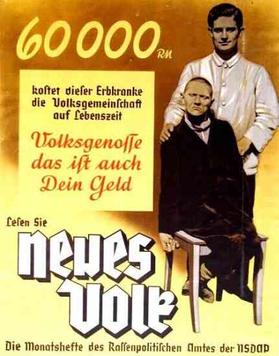
NS Euthanasia Propaganda Poster, around 1938. Credit: Wikimedia Commons
Abstract
I have been asked the question: Why do you think the German euthanasia program happened during World War II, but not the Holocaust? This article will show that the evidence for the German euthanasia program is overwhelming, while the evidence to support the Holocaust story is severely lacking.
Written Order
In August 1939, Hitler let it be known to his close associates that he approved any measure which could be seen as delivering handicapped patients from pain and suffering. Probably in the late autumn or winter of 1939, Hitler backdated a document to Sept. 1, 1939, that authorized the euthanasia program. The authorization states:[1]
“Reich Leader Bouhler and Dr. Med Brandt are charged with the responsibility of enlarging the powers of specific physicians, designated by name, so that patients who, on the basis of human judgment, are considered incurable, can be granted mercy death after the most careful assessment of their condition.”
Historians have acknowledged that no similar document of a plan by Germany to exterminate European Jewry has ever been found. In his well-known book on the Holocaust, French-Jewish historian Leon Poliakov states that “…the campaign to exterminate the Jews, as regards its conception as well as many other essential aspects, remains shrouded in darkness.” Poliakov adds that no documents of a plan for exterminating the Jews have ever been found because “perhaps none ever existed.”[2] British historian Ian Kershaw states that when the Soviet archives were opened in the early 1990s:[3]
“Predictably, a written order by Hitler for the ‘Final Solution’ was not found. The presumption that a single, explicit written order had ever been given had long been dismissed by most historians.”
The lack of a written order for the extermination of European Jewry led to Raul Hilberg’s famous explanation of how the Holocaust happened:[4]
“What began in 1941 was a process of destruction not planned in advance, not organized centrally by any agency. There was no blueprint and there was no budget for destructive measures. They were taken step by step, one step at a time. Thus came about not so much a plan being carried out, but an incredible meeting of minds, a consensus mind reading by a far-flung bureaucracy.”
On Jan. 16, 1985, under cross-examination at the first Ernst Zündel trial in Toronto, Raul Hilberg confirmed that he said these words.[5] Thus, Hilberg states that the so-called Holocaust was not carried out by a written order or plan, but rather by an incredible mind reading among far-flung German bureaucrats.
Defenders of the Holocaust story sometimes explain the absence of a written order to exterminate European Jewry by saying that the Nazis destroyed the evidence. However, an operation as big as the so-called Holocaust would have required written orders that would have been referred to in countless different ministerial bodies. It would have been impossible for all of these documents to have been completely destroyed at the end of the war. There would always have been carbon copies of the extermination order somewhere.[6]
Confessions of Defendants
The Doctors’ Trial at Nuremberg, which opened on Dec. 9, 1946 and ended on July 19, 1947, tried German doctors for their participation in the euthanasia program. Dr. Karl Brandt readily admitted his involvement in the euthanasia program, since too many records and affidavits directly linked him to the killing operation. Brandt argued that the only rationale for the euthanasia program had been to free handicapped and incurably ill patients from suffering. Brandt considered his involvement in the euthanasia program authorized by Hitler to be absolutely legal.[7]
By contrast, none of the defendants at the Nuremberg trials stated that they knew anything about a program to exterminate Jews during the war. Hermann Göring, Hans Frank, Ernst Kaltenbrunner, Albert Speer, Gen. Alfred Jodl, and the other Nuremberg defendants all denied knowing anything of an extermination program of European Jewry. While such testimony is often dismissed as lying, the categorical and consistent nature of their testimony, sometimes by men who assumed they would be hanged, suggests that they are telling the truth.[8]
Hermann Göring in particular had no reason to lie about his lack of knowledge of a plan by Germany to exterminate European Jewry. As the highest ranking surviving Nazi, Göring’s execution was certain. Göring told his wife Emmy to give up all hope that he would not be executed at Nuremberg.[9] Yet Göring repeatedly and emphatically denied any knowledge of the so-called Holocaust. Göring confided to American psychologist Dr. Gustave Gilbert in his jail cell at Nuremberg:[10]
“I wish I could have Himmler here – just for 10 minutes – to ask him what on earth he was up to out there.”
It is most unfortunate that Heinrich Himmler was a “suicide” while in British captivity. However, since Himmler was in a position to know the true story of the alleged Holocaust, it was not within the bounds of political possibility that Himmler live to testify at the Nuremberg trials.[11]
Discussion of Killing Methods
German doctors determined that carbon monoxide gas was the most painless and humane way to euthanize people. The use of carbon monoxide gas therefore became the standard technique to kill people in the adult euthanasia program, with the first killings probably beginning in January 1940. Dr. Karl Brandt, Albert Widmann, Dr. Leonardo Conti and others all stated that they determined carbon monoxide gas to be the most humane method of euthanizing adults.[12]
Dr. Karl Brandt wrote in his personal notebook:[13]
“Adolf Hitler asked me which method, based on current considerations and experiences, was the mildest, that is to say the safest, quickest and the most effective and painless one. I had to concede that this was death through the inhalation of carbon monoxide gas. He then said that this was also the most humane. I myself then took on board this position and put to one side my medical concerns for external reasons… I am convinced that the procedure with carbon monoxide was right.”
No such planning has been found regarding the use of homicidal gas chambers in German concentration camps. The Holocaust story claims that the first gassings occurred at Auschwitz using Zyklon B in September 1941. These gassings were allegedly done without any prior engineering considerations.[14] According to the officially accepted version of the Holocaust story, the SS at Auschwitz quickly built homicidal gas chambers that were capable of killing thousands of people out of ordinary buildings .[15]
This official version of the so-called Holocaust is pure nonsense. Homicidal gas chambers using Zyklon B cannot be built “on the fly” by SS men with no engineering background. This is shown by a comparison to the delousing chambers used in the German concentration camps. The German delousing chambers were patented by the German firm Degesch, involved extremely advanced engineering, and were carefully constructed to be gastight and safe for the operators.[16]
Feasibility of Killing Methods
Carbon-monoxide gas can be used to efficiently kill people in homicidal gas chambers. The dead bodies from the gassings can also be safely removed by personnel wearing only a gas mask. Richard von Hegener observed that patients in the euthanasia program would lose consciousness within two to three minutes of the gas entering the room. Within five minutes all of the patients had fallen into a “kind of sleep.” The gas was left running for half an hour before a physician, protected by a gas mask, entered the room, examined the bodies, and pronounced that all of the patients were dead.[17]
By contrast, Zyklon B cannot be safely used to kill large numbers of people in homicidal gas chambers. Dr. Robert Faurisson states in regard to Zyklon-B poisoning: “The corpse of a man who has just been killed by this powerful poison is itself a dangerous source of poisoning, and cannot be touched with bare hands. In order to enter the HCN-saturated chamber to remove the corpse, special gear is needed, as well as a gas mask with a special filter.”[18] The danger of touching someone killed with Zyklon-B gas is confirmed in the scientific literature.[19]
The alleged homicidal gas chambers at Auschwitz, Birkenau, and Majdanek could not have been used as homicidal gas chambers. The first scholar to make that observation was Dr. Robert Faurisson in the late 1970s.[20] He induced the American expert for execution technologies Fred Leuchter to come to similar conclusions in a 1988 study.[21] Leuchter’s research has since been revised, deepened and broadened by a number of subsequent technical studies coming to similar conclusions.[22]
The Diesel engines allegedly used at the Aktion Reinhardt camps of Treblinka, Belzec, and Sobibor also could not have been used to mass murder people as claimed either. The first to point this out was U.S. engineer Friedrich Paul Berg in a 1984 paper.[23] In a revised paper of 2000, Berg stated that for any Diesel arrangement to have been even marginally effective for mass murder, it would have required an exceptionally well-informed team of experts to know and do all that was necessary. Berg mentions that, even if someone had tried for a time to commit murder with Diesel exhaust, after a few tries it would have become apparent that something better was needed. Berg concludes that the evidence for Diesel gassings in the German concentration camps fails to meet the most basic standards that credible evidence must pass to satisfy reasonable people.[24]
After reading Berg’s 1984 paper, Walter Lüftl, a prominent Austrian engineer and at that time the president of Austria’s Association of Civil Engineers, confirmed in his own research paper that mass murder with Diesel-exhaust gasses is a sheer impossibility for reasons of time alone. Lüftl states in his report:[25]
“The laws of nature apply both to Nazis and anti-fascists. Nobody can be killed with diesel exhaust gas in the manner described [in the Holocaust literature].”
Public Knowledge
Public knowledge of the German euthanasia program was widespread in Germany. This public knowledge led to growing criticism from churches, the judiciary, and the state bureaucracy. Church leaders, and especially Bishop Clemens August Graf von Galen, made it internationally known that National-Socialist Germany was killing handicapped children and adults on an unprecedented scale. In a sermon on Aug. 3, 1941, Galen openly attacked the hypocrisy and the economic rationale for killing handicapped people. Instead of punishing Galen, Hitler ordered a stop to the euthanasia program on Aug. 24, 1941.[26]
By contrast, the German public was not aware of a program of extermination of European Jewry during the war. Nowhere in the archives, which contain mountains of intercepted cipher messages and the reports on bags of mail captured from enemy ships and from overrun enemy positions, is there the slightest evidence that a program of genocide against Jews was known by the German public.[27]
The German public became aware of the alleged genocide of European Jewry only when U.S. and British troops entered German concentration camps at the end of World War II. The horrific scenes of huge piles of dead bodies and emaciated and diseased surviving inmates were filmed and photographed for posterity by the U.S. Army Signal Corps. Films of the horrific scenes at the camps were made mandatory viewing for the vanquished populace of Germany, so that their national pride would be destroyed and replaced with feelings of collective guilt.
The tour of liberated concentration camps became a ritual in the occupied Germany of late April and early May. American officers forced local citizens and German POWs to view the camps. German civilians were paraded against their will in front of the sickening piles of dead bodies found in the German camps.[28]
What the general public was not told is that most of the inmates in these camps had died of typhus, typhoid, and other natural causes. None of the Allied autopsy reports shows that anyone died of poison gas. Also, contrary to publicized claims, no researcher has been able to document a German policy of extermination through starvation in the German camps. The virtual collapse of Germany’s food, transport, and public-health systems and the extreme overcrowding in the German camps at the end of the war led to the catastrophe the Allied troops encountered when they entered the camps.
Other Considerations
Defenders of the Holocaust story inevitably raise eyewitness testimony as proof that the genocide of European Jewry happened. However, as I discussed elsewhere, eyewitness testimony to the so-called Holocaust is notoriously unreliable.[29]
The large number of Jewish survivors at the end of World War II also makes impossible a program of genocide against European Jewry. Dr. Arthur Robert Butz states in regard to the large number of Jewish survivors: “The simplest valid reason for being skeptical about the extermination claim is also the simplest conceivable reason; at the end of the war they were still there.”[30] Norman Finkelstein, the author of The Holocaust Industry, quotes his mother as asking:[31]
“If everyone who claims to be a Holocaust survivor actually is one, who did Hitler kill?”
Defenders of the Holocaust story also inevitably quote speeches from Adolf Hitler, Joseph Goebbels, and Heinrich Himmler or writings from Hitler, Goebbels, and Hans Frank to prove that Germany had an extermination program of Jews during the war. In fact, Himmler’s Posen speech of Oct. 4, 1943 has been called “the best evidence” to prove the Holocaust happened.[32] Himmler states in this speech:[33]
“I am referring here to the evacuation of the Jews, to the extermination of the Jewish people… it’s in our program, elimination of the Jews, extermination.”
Most translations of Himmler’s Posen speech assume that the German word “ausrotten” means murder or extermination. David Irving, who is very fluent in the German language, testified at the second Ernst Zündel trial that this is an incorrect translation of the word “ausrotten”:[34]
“There is no doubt that in modern Germany the word ausrotten now means murder. But we have to look at the meaning of the word ausrotten in the 1930s and 1940s, as used by those who wrote or spoke these documents. In the mouth of Adolf Hitler, the word ausrotten is never once used to mean murder, and I’ve made a study of that particular semantic problem. You can find document after document which Hitler himself spoke or wrote where the word ausrotten cannot possibly mean murder.”
Since Hitler never used the word “ausrotten” to mean murder, and since Hitler and Himmler spoke the same language, there is no reason to believe that Himmler was speaking about the murder of the Jews in his Posen speech.
Other defenders of the Holocaust story assume that the Nazis used code words such as “special treatment” to hide their genocide of European Jewry.[35] This theory does not explain why the Nazis used explicit written orders for all of their other crimes. For example, Heinrich Himmler authorized in writing many illegal human medical experiments and executions in the German concentration camps. Adolf Hitler’s other crimes including the euthanasia program were all made in writing. It is absurd to think that only the genocide of European Jewry was hidden behind code words, while all other German war crimes were clearly stated in writing.
Conclusion
The German euthanasia program is a well-documented reality. Hitler authorized the euthanasia program in writing, the defendants at the Doctors’ Trial admitted their involvement in the program, the best method for killing victims was discussed among the participants in the program, the carbon-monoxide gas used in the German euthanasia program can safely and effectively kill people, and the euthanasia program was widely known by the German public. In fact, public opposition to the program was so strong in Germany that Hitler ordered the end of the first phase of the euthanasia program in August 1941.
By contrast, the genocide of European Jewry is not well documented. No order has ever been found authorizing the mass murder of Europe’s Jews. The German defendants at the main Nuremberg trial all stated they knew nothing about the so-called Holocaust. The Holocaust story absurdly states that the first gas chambers were built at Auschwitz using Zyklon B by SS personnel with no engineering experience. None of the alleged homicidal gas chambers at Auschwitz, Birkenau, and Majdanek or the claimed diesel gas chambers at the Aktion Reinhardt camps of Treblinka, Belzec, and Sobibor could possibly have been used for mass murder. The alleged genocide of Jews was also not known by the German public during the war. The eyewitness testimony to the so-called Holocaust has consistently proven to be extremely unreliable. Finally, the large number of Jewish survivors at the end of the war makes impossible a program of genocide against European Jewry.
In conclusion, while the German euthanasia program is a well-documented reality, the Holocaust story is a fraud. Dr. Arthur Robert Butz has aptly stated:[36]
“The ‘Holocaust’ is such a gigantic fraud that it is a cornucopia of absurdities.”
Notes
[1] Schmidt, Ulf, Karl Brandt: The Nazi Doctor, New York: Continuum Books, 2007, pp. 125, 132-133.
[2] Poliakov, Leon, Harvest of Hate, New York: Holocaust Library, 1979, p. 108.
[3] Kershaw, Ian, Hitler, the Germans, and the Final Solution, New Haven & London: Yale University Press, 2008, p. 96.
[4] De Wan, George, “The Holocaust in Perspective,” Newsday: Long Island, N.Y., Feb. 23, 1983, Part II, p. 3.
[5] See trial transcript, pp. 846-848. Also Kulaszka, Barbara (ed.), Did Six Million Really Die: Report of Evidence in the Canadian “False News” Trial of Ernst Zündel, Toronto: Samisdat Publishers Ltd., 1992, p. 24.
[6] Kulaszka, Barbara (ed.), op. cit. (note 5), p. 370.
[7] Schmidt, Ulf, op. cit. (note 1), pp. 354, 370f.
[8] Weber, Mark, “The Nuremburg Trials and the Holocaust,” The Journal of Historical Review, 12(2) (1992), pp. 197-199.
[9] Irving, David, Nuremberg: The Last Battle, London: Focal Point, 1996, p. 276.
[10] Irving, David, Göring: A Biography, London: GraftonBooks, 1991, p. 493.
[11] Butz, Arthur R., The Hoax of the Twentieth Century: The Case against the Presumed Extermination of European Jewry, 9th ed., Newport Beach, Cal.: Institute for Historical Review, 1993, p. 240.
[12] Schmidt, Ulf, op. cit. (note 1), pp. 138f.
[13] Ibid., p. 138.
[14] Longerich, Peter, Holocaust: The Nazi Persecution and Murder of the Jews, Oxford: Oxford University Press, 2010, p. 281. See also Wachsmann, Nikolaus, Kl: A History of the Nazi Concentration Camps, New York: Farrar, Straus and Giroux, 2015, pp. 267-269. In extreme detail: Mattogno, Carlo, Auschwitz: The First Gassing. Rumor and Reality, 2nd ed., Uckfield: Castle Hill Publishers, 2016.
[15] See Mattogno, Carlo, Debunking the Bunkers of Auschwitz: Black Propaganda versus History, 2nd ed., Uckfield: Castle Hill Publishers, 2016. Also idem, Auschwitz: Crematorium I and the Alleged Homicidal Gassings, 2nd ed., ibid., 2016;
[16] Berg, Friedrich P., “The German Delousing Chambers,” The Journal of Historical Review, 7(1) (1986), pp. 73-94; http://www.ihr.org/jhr/v07/v07p-73_Berg.html .
[17] Schmidt, Ulf, op. cit. (note 1), pp. 138f.
[18] Faurisson, Robert, “The U.S. Holocaust Memorial Museum: A Challenge,” The Journal of Historical Review, 13(4) (1993), pp. 14-17; http://www.ihr.org/jhr/v13/v13n4p14_Faurisson.html.
[19] Padmakumar, K., “Postmortem Examination Cases of Cyanide Poisoning: A Biological Hazard,” Journal of Indian Academy of Forensic Medicine, 32(1) (2010), pp. 80f.; http://medind.nic.in/jal/t10/i1/jalt10i1p80.pdf .
[20] In English: Faurisson, Robert, “The Gas Chambers of Auschwitz Appear to be Physically Inconceivable,” The Journal of Historical Review, 2(4) (1981), pp. 312-317; https://codoh.com/library/document/1995 .
[21] Leuchter, Fred A., and Robert Faurisson, Germar Rudolf, The Leuchter Reports: Critical Edition, 4th ed., Uckfield: Castle Hill Publishers, 2015.
[22] See in addition to the works by Mattogno mentioned in notes 14f. also: Mattogno, Carlo, The Real Case for Auschwitz: Robert van Pelt’s Evidence from the Irving Trial Critically Reviewed, Uckfield, Castle Hill Publishers, 2015; idem, and Franco Deana, The Cremation Furnaces of Auschwitz: A Technical and Historical Study, ibid.¸ 2015; Rudolf, Germar, The Chemistry of Auschwitz: The Technology and Toxicology of Zyklon B and the Gas Chambers, ibid., 2017; Graf, Jürgen, and Carlo Mattogno, Concentration Camp Majdanek: A Historical and Technical Study, 3rd ed., ibid., 2016.
[23] Berg, Friedrich Paul, “The Diesel Gas Chambers: Myth within a Myth,” The Journal of Historical Review, 5(1) (1984), pp. 15-46; https://codoh.com/library/document/982 .
[24] Berg, Friedrich Paul, “The Diesel Gas Chamber: Ideal for Torture—Absurd For Murder,” in Gauss, Ernst (ed.), Dissecting the Holocaust: The Growing Critique of Truth and Memory, Capshaw, AL: Theses and Dissertations Press, 2000, pp. 454f.
[25] Lüftl, Walter, “The Lüftl Report,” The Journal of Historical Review, 12(4) (1992), pp. 403-406, 419; https://codoh.com/library/document/2383 .
[26] Schmidt, Ulf, op. cit. (note 1), pp. 162f., 166f. See also Evans, Richard J., The Third Reich at War, 1939-1945, London: Penguin Books, 2008, pp. 99f.
[27] Irving, David, Nuremberg, op. cit. (note 9), p. 168.
[28] Abzug, Robert H., Inside the Vicious Heart: Americans and the Liberation of Nazi Concentration Camps, New York and Oxford: Oxford University Press, 1985, pp. 128-132.
[29] Wear, John, “Holocaust Eyewitnesses: Is the Testimony Reliable?,” The Barnes Review, 19(4) (2013), pp. 26-29; https://katana17.wordpress.com/2015/03/17/holocaust-eyewitnesses-is-the-testimony-reliable/ .
[30] Butz, Arthur R., op. cit. (note 11), p. 10.
[31] Interview with Norman Finkelstein, by Viktor Frölke, in Salon.com, “Shoah business,” Aug. 30, 2000. See also Finkelstein, Norman, The Holocaust Industry, New York: Verso, 2000, p. 81.
[32] https://codoh.com/library/document/891/ .
[33] http://www.yadvashem.org/odot_pdf/Microsoft%20Word%20-%204029.pdf .
[34] Kulaszka, Barbara (ed.), op. cit. (note 5), pp. 370f.
[35] For example, see http://holocaustcontroversies.blogspot.com/2006/06/gauleiter-arthur-greiser.html .
[36] Butz, Arthur R., “Some Thoughts on Pressac’s Opus,” The Journal of Historical Review, 13(3) (1993), pp. 23-37, here p. 23; https://codoh.com/library/document/2425/ .
October 16, 2019
Posted by aletho |
Timeless or most popular |
Leave a comment
Children learn what they live.
As family counselor Dorothy Law Nolte wisely observed, “If children live with criticism, they learn to condemn. If children live with hostility, they learn to fight. If children live with fear, they learn to be apprehensive.”
And if children live with terror, trauma and violence—forced to watch helplessly as their loved ones are executed by police officers who shoot first and ask questions later—will they in turn learn to terrorize, traumatize and inflict violence on the world around them?
I’m not willing to risk it. Are you?
It’s difficult enough raising a child in a world ravaged by war, disease, poverty and hate, but when you add the toxic stress of the police state into the mix, it becomes near impossible to protect children from the growing unease that some of the monsters of our age come dressed in government uniforms.
Case in point: in Hugo, Oklahoma, plain clothes police officers opened fire on a pickup truck parked in front of a food bank, heedless of the damage such a hail of bullets—26 shots were fired—could have on those in the vicinity. Three of the four children inside the parked vehicle were shot: a 4-year-old girl was shot in the head and ended up with a bullet in the brain; a 5-year-old boy received a skull fracture; and a 1-year-old girl had deep cuts on her face from gunfire or shattered window glass. Only the 2-year-old was spared any physical harm, although the terror will likely linger for a long time. “They are terrified to go anywhere or hear anything,” the family attorney said. “The two-year-old keeps asking about ‘Am I going to get shot again.’”
The reason for the use of such excessive force?
Police were searching for a suspect in a weeks-old robbery of a pizza parlor that netted $400.
This may be the worst use of excessive force on innocent children to date. Unfortunately, it is one of many in a steady stream of cases that speak to the need for police to de-escalate their tactics and stop resorting to excessive force when less lethal means are available to them.
For instance, in Cleveland, police shot and killed 12-year-old Tamir Rice who was seen playing on a playground with a pellet gun. Surveillance footage shows police shooting the boy two seconds after getting out of a moving patrol car.
In Detroit, 7-year-old Aiyana Jones was killed after a Detroit SWAT team launched a flash-bang grenade into her family’s apartment, broke through the door and opened fire, hitting the little girl who was asleep on the living room couch. The cops were in the wrong apartment.
In Georgia, Christopher Roupe, 17, was shot and killed after opening the door to a police officer. The officer, mistaking the remote control in Roupe’s hand for a gun, shot him in the chest.
These children are more than grim statistics on a police blotter. They are the heartbreaking casualties of the government’s endless, deadly wars on terror, on drugs, and on the American people themselves.
Then you have the growing number of incidents involving children who are forced to watch helplessly as trigger-happy police open fire on loved ones and community members alike.
In Texas, an 8-year-old boy watched as police—dispatched to do a welfare check on a home with its windows open—shot and killed his aunt through her bedroom window while she was playing video games with him.
In Minnesota, a 4-year-old girl watched from the backseat of a car as cops shot and killed her mother’s boyfriend, Philando Castile, a school cafeteria supervisor, during a routine traffic stop merely because Castile disclosed that he had a gun in his possession, for which he had a lawful conceal-and-carry permit. That’s all it took for police to shoot Castile four times as he was reaching for his license and registration.
A child doesn’t even have to be directly exposed to a police shooting to learn the police state’s lessons in compliance and terror, which are being meted out with every SWAT team raid, roadside strip search, and school drill.
Indeed, there can be no avoiding the hands-on lessons being taught in the schools about the role of police in our lives, ranging from active shooter drills and school-wide lockdowns to incidents in which children engaging in typically childlike behavior are suspended (for shooting an imaginary “arrow” at a fellow classmate), handcuffed (for being disruptive at school), arrested (for throwing water balloons as part of a school prank), and even tasered (for not obeying instructions).
What is particularly chilling is how effective these lessons in compliance are in indoctrinating young people to accept their role in the police state, either as criminals or prison guards.
If these exercises are intended to instill fear, paranoia and compliance into young people, clearly, our children are getting the message, but it’s not the message that was intended by those who fomented a revolution and wrote our founding documents. Their philosophy was that the police work for us, and “we the people” are the masters, and they are to be our servants.
Now that philosophy has been turned on its head.
Certainly, it’s getting harder by the day to insist that we live in a nation that values freedom and which is governed by the rule of law.
Yet unless something changes and soon, there will soon be nothing left to teach young people about freedom as we have known it beyond remembered stories of the “good old days.”
For starters, as I point out in my book Battlefield America: The War on the American People, it’s time to take a hard look at the greatest perpetrators of violence in our culture—the U.S. government and its agents—and do something about it: de-militarize the police, prohibit the Pentagon from distributing military weapons to domestic police agencies, train the police in de-escalation techniques, stop insulating police officers from charges of misconduct and wrongdoing, and require police to take precautionary steps before engaging in violence in the presence of young people.
We must stop the carnage.
Constitutional attorney and author John W. Whitehead is founder and president of The Rutherford Institute. His new book Battlefield America: The War on the American People is available at www.amazon.com. Whitehead can be contacted at johnw@rutherford.org.
October 15, 2019
Posted by aletho |
Civil Liberties, Timeless or most popular | Human rights, United States |
Leave a comment
Sam Husseini is a senior analyst with the Institute for Public Accuracy, independent journalist and contributor to The Nation and FAIR.
Slava Zilber: Sam, three years ago, you appeared on Talk Nation Radio with David Swanson and spoke about the case of the GCHQ whistleblower Katharine Gun. You pointed out that the people involved in the spying on the UN and the people authorizing the Iraq War were not held accountable:
“Virtually everybody who went along with the war, whether it is Kerry or Clinton, of course, the Bush administration themselves has falsified their own records in terms of why, what they did, when they did, why they did it, to the extent that they’ve been scrutinised at all.”
You also address it in a recent article. And recently, Joe Biden has been lying about his position on the Iraq War. How can such an important issue escape meaningful scrutiny?
Sam Husseini: Because the media and the political system uses constant distractions of other issues, of personalities, of punditry to distract from these core issues. The entire US establishment helped lie their way into the Iraq War. More than that, the Katharine Gun case, which is featured in a new movie, Official Secrets, shows how the US attempted to blackmail other members of the Security Council by spying on them to try to get a second UN Security Council resolution authorizing the Iraq War. It shows the length to which they wanted to go to make sure that they got their war, both the US and Britain and others.
So all of these diabolical efforts to launch an aggressive war haven’t been seriously held accountable to it. Biden is a very notable example. I mean, the entire political system is guilty, but he is incredibly important because he was head of the Senate Foreign Relations Committee in 2002, during the build-up of the Iraq War. It is not just that he voted wrong, as some people say. Even somebody like Bernie Sanders says it was the wrong vote. It was far worse than the wrong vote. Biden, in his hearings, prevented meaningful scrutiny and dissent and the basic facts from being highlighted in terms of the false case that was being put forward for war in 2002 and in 2003.
And he has continued to lie about his own record. Biden recently has said all kinds of things: That he was opposed to the war as soon as it started, which is totally false. He continued to back it. He even said at one point that he was always against it, which is utterly ridiculous. I mean, he always couched his criticism in bizarre ways basically agreeing with the war but saying that Bush had to do a better job of getting the UN on board. Well, as the Katharine Gun case shows, the Bush administration and the Blair government were going so far as to spy on other countries to blackmail them in order to get them on board. So saying that the US needed to do a better job of getting the UN on board is a way of saying that it should have been even more coercive than it was. His story is, in a sense, an indictment of the entire political system since before the Iraq War because he, in the 1990s, said all kinds of aggressive things about Iraq.
And it is also an indictment of the media. Do you see you a connection to what you describe in another FAIR article titled “Triumph of Conventional Wisdom: AP Expunges Iran/Contra Pardons from Barr’s Record”? Are they giving those lies a pass for the same reason they are doing this with the record of Attorney General William Barr?
It is funny that you mention that. Part of what I know about Barr is that Biden was a big backer of his.
The really notable thing about Barr’s record is that he was Attorney General for George H. W. Bush and when Iran/Contra pardons happened. This was a huge scandal during the Reagan/Bush years, and at the end of it, it was basically ended. As the prosecutor, L. Walsh, a straight-shooting Republican, said, it was a cover-up pardon. Bush pardoned Caspar Weinberger and others. And Barr basically approved all of that. And what’s remarkable about that is that just as Barr was rehabilitated by the media, so too was – Biden helped rehabilitate him as well.
Biden’s record closely parallels that of the major media. Very often, his claims dovetail very strongly with them. He is sort of the closest thing that the Democrats have to a John McCain: Somebody who constantly appeared on the Sunday morning talk shows and pulled together what the late great journalist Robert Parry called conventional wisdom. So a whole series of fabrications about the Iraq War, before and after it happened, were perpetrated by the major media as well as people like Joe Biden. And Biden was rehabilitating criminal, basically, figures like Barr who was Bush’s Attorney General and helped cover-up the Iran/Contra scandal and who now is Trump’s Attorney General and, I think, playing a major role in terms of ensuring that the Trump administration maintains an establishment orientation in terms of foreign policy as well as other things. I think that he is playing a very nefarious role, and he was largely rehabilitated by Biden. We have transcripts of Biden in the mid-1990s talking him up: “What a great guy! And we have disagreements, but I have a lot of respect for you” and so on and so forth. So Biden continuously helps resurrect figures like that and does other things to maintain a very militaristic orientation in terms of foreign policy.
I had to think about a recent incident: The talkshow host Ellen DeGeneres attended a game with former President G.W. Bush. Could you please talk about what her response to the criticism that followed and the reactions from, for example, Obama administration officials Samantha Power and David Axelrod indicate? Is it also this kind of cooperation that you have just described with Mr. Barr and Mr. Biden?
Yes, I think since the Bush administration there’s been an attempt to rehabilitate it and that has gone into overdrive during the Trump administration: That is the establishment media attempt to contrast the gentlemanly Bushes, both of them, the father and the son now, as fundamentally decent, earnest people who are trying to do the right thing in contrast to this crass baffoon Donald Trump. So you had literal Obama embrace of the Bushes since Bush leaving the White House and then his father’s funeral a year ago. Barr was brought on as Attorney General just after Bush the father’s funeral at the National Cathedral. And in the Trump years, you had a total Trumpwashing of Bush and other people in his administration, much of the former CIA officials some of whom actually were already Trumpwashed before Trump because Obama brought them into his administration. Obama brought in Brennan. Obama even brought in Gates. He kept the same so-called “Defense Secretary” that Bush had. So there is a longstanding cooperation between what are sometimes called liberal interventionists and sometimes called neocons. But they all fundamentally share the same neo-imperial, colonialist mindset in terms of how the US should deal with the rest of the world. And I think that does include certain people like Samantha Power. Her rationale around the Iraq War – sort of backing it without backing it or backing it and facilitating it while attempting to pretend that they had a critique of how Bush was doing it – is actually quite similar to Biden’s as I recall. I have not looked at her record recently but recalling that record, there is a serious interplay there. So it is interesting that you’ve mentioned her as well. But it’s all based on the same sort of falsifications for war.
But again, they started and they were articulated by the major media and by figures like Biden before the Iraq War itself. For example, the weapons inspections regime of the 1990s was ended because then-President Clinton bombed Iraq and withdrew the weapons inspectors. And then he had to figure what the heck you were going to do after that. The media and people like Joe Biden continually talked about: ‘Saddam Hussein kicked out the weapons inspectors’ and ‘When are we going to get them back in?’ The weapons inspections regime didn’t end because Saddam Hussein kicked out the weapons inspectors. It ended because the US government pulled them out in order to launch a bombing campaign which people might recall happened just as Clinton’s scheduled impeachment vote was supposed to happen in 1998. And you saw much the same thing happen in 2003. How did the Iraq War begin? It didn’t begin because Saddam Hussein was not cooperating with the weapons inspectors. He was totally cooperating with the weapons inspectors. He said over and over again, including on US shows like 60 Minutes, that he had no weapons of mass destruction. So how did the war begin? The war began with G. W. Bush saying: ‘This process has gone on long enough. You, Saddam Hussein, have 48 hours to get out of Bagdad with your sons.’ And then they put out a statement that even if he got out of Iraq in 48 hours with his sons, they would still start the bombing. And they told the UN to get the weapons inspectors out of the country so they wouldn’t bomb them. And then they started their shock and awe bombing campaign. That’s how the war started.
Some people claim that Biden is now becoming senile or something. And that’s why he hasn’t been able to articulate his position on Iraq. Hardly! He has been lying about his position on Iraq for years. In 2007, he was asked about his Iraq War vote, and he actually had the temerity to say: ‘Why didn’t Saddam Hussein say that he didn’t have the weapons!’ Of course, Saddam Hussein was saying that he didn’t have the weapons! But there he is: Biden pretending that it wasn’t known that Saddam Hussein was denying they had the weapons. And that’s also another lie that major media themselves perpetrated, including 60 Minutes itself. 60 Minutes had an interview with Saddam Hussein before the Iraq War in which he said ‘I don’t have any weapons of mass destruction.’ And then several years later, after the Iraq War, they did some so-called reporting about: ‘Why didn’t Saddam Hussein say that he didn’t have any weapons of mass destruction?’ So it’s the level of absurdity you have with the record of establishment media and establishment figures like Joe Biden. And there is a remarkable lack of scrutiny, especially when it most matters. One of Biden’s falsifications, when he had an interview with NPR, got a little bit of scrutiny. It wasn’t nearly enough, and sometimes the scrutiny actually helped build up other Iraq War lies. But none of the scrutiny in the major media happened right after the Democratic debates. He has lied about his Iraq War record during each of the Democratic debates. It is Sanders who I think needs to be far more forceful if he is to comport with the indicting facts in this case. But he at least brought it up. In his words: He led the effort against the Iraq War in the Senate, and Biden voted for it. That’s an understatement again. But at least he has brought it up, and that has compelled Biden to explain his position and lie about it in the process.
It is such a loser strategy as well because it’s quite similar to Kerry’s position. You remember Kerry looked ridiculous in 2004 because he was forced to explain his position then, and he was saying things like ‘I was for the war before I was against it’ and this kind of doubletalk. Biden, if anything, is even worse than that. So it’s factually vacuous and demented, and it is probably not going to galvanize voters and be a very poor strategy electorally.
You have been covering the Iraq War and the discourse about the Iraq War. Do you have the impression that invading another country and causing immense suffering is either considered irrelevant or treated just as something one disagrees with, especially from episodes like the one with Ms. DeGeneres, Samantha Power, and David Axelrod? Do you think it would have been different had there been an Iran/Contra trial with convictions and had the Obama administration prosecuted the people involved in torture? Would it have made a difference?
Yes, I think it would have made a difference. All of those things could have made some difference to try to have some kind of meaningful accountability in US law and political life, that people who engage in torture or launching war of aggression or other war crimes be held accountable for that. It would get those people out of public life, make them pay some measure of penalty for their own conduct, and become an example so that others don’t simply perpetuate as it is. We have some of the same figures coming back. There you have Elliott Abrams, and John Bolton, who committed criminal acts under the Bush administrations, come back under the Trump administration. In spite of its isolationist veneer, it has basically adopted a Bush type of foreign policy in many respects.
And I mean this ‘Let’s all get along even if we have disagreements!’ Well, you know, ok. So I fully expect Ellen DeGeneres to have somebody from ISIS on to talk about how she can have disagreements with him. But perhaps they can be fond of each other personally. Or pick the group of your choice that is totally distasteful or allegedly totally distasteful. I mean, in some ways, people allege the US has coordinated with groups like ISIS in terms of destabilizing Syria. But pick whatever group the US establishment most despises, and it’s not as if their members or leadership are humanized. I mean Hezbollah and Hamas are regarded as terrorist organizations even though they are political parties that do a lot of good for people. I have serious disagreements with them. And they do use violence, on a far smaller scale than the US and Israel and other states do. But it would be very refreshing if Ellen DeGeneres and other political talk show hosts took their word seriously, that they want to have a dialogue with people, even people they disagree with, and they still view them as human. So let’s have Nasrallah and the leader of Hamas on late-night talk shows. Well, I don’t think it is going to happen any time soon. It is just an exercise in making the criminality of the US establishment palatable to the public.
And it is interesting that in this case there was a fair amount of pushback. I think that’s partially because you still have some semblance in social media of evenhandedness of discourse, but I think that that has been pushed away gradually as Twitter and Facebook and other social media are tilting the playing field more and more, excluding voices, using opaque algorithms to marginalize some voices further and increase others. So the war against accountability and for meaningful dialogue about issues of war and peace – on many levels, that fight is happening.
Sam, are there cases where the question of whether one opposed the war in Iraq or supported it is being reduced to a talking point, for example, in 2016 against Hillary Clinton? How many people actually care about the human cost of that war to Americans and Iraqis?
I think a lot of US political system is trying to make the Iraq War an irrelevant thing in the distant past and the decision and the mechanisms used to launch the Iraq War. It is not a coincidence that Obama cast himself as an anti-war candidate. And he won. Trump cast himself as an anti-war candidate. And he won. I think there is a hunger in the American public for a different way to orient itself to the rest of the world. It’s a very difficult thing for the American public to sort out because it doesn’t get adequate information. Instead, it gets lies upon lies upon lies. But it is notable that the candidates that were brazenly part of the pro-war establishment have generally lost on the national stage. Now, Obama and in different ways, Trump were deceitful in casting themselves as anti-war. But I think it doesn’t change the fact that there is this underlying hunger. And there are serious opportunities because the wars continue and they continue to threaten to spiral further out of control, and they continue to have this devastating effect as most recently Turkey killing Kurds not only on its side of the border but dramatically escalating their killing of Kurds on the Syrian side of the border. And the colonial prerogatives are still the same: We can invade Iraq because we can invade Iraq. And now we can do all kinds of things in Syria because we can do all kind of things in Syria.
I think there is an attempt to reduce the Iraq War to a mere talking point. And it is facilitated in part because virtually nobody left in ruling circles got it right. Sanders did not get the Iraq War right. He bought some of the establishment lines. And I think it would do him some good to say: ‘Even I bought part of the establishment line!’ Sanders was not out there saying: ‘Iraq doesn’t have weapons of mass destruction.’ There were some people like Scott Ritter, who was saying that. I was saying there has been no evidence for saying that Iraq has weapons of mass destruction. But Sanders was not saying that. He was simply saying: ‘War is a bad idea. It is going to make things worse. It could compel Saddam Hussein to use his weapons of mass destruction.’ Sanders actually made that argument. Pelosi and others made even worse arguments even though they cast their votes against war. Some of them actually helped to facilitate war even though they technically cast their votes against it.
So the entire political system – right now, I feel the correct analogy is geology in the 17th century. Geology in the 17th century was a debate between people who thought that the earth was 5000 years old versus people who thought that the earth was maybe a hundred million years old. The correct answer – that the earth was over a billion years old – was off the charts. It wasn’t part of the mainstream discussion. And I think we have a similar thing right now with coming to grips with fundamental questions of US foreign policy like the Iraq War. The correct, empirically-driven answer is well outside the current acceptable discourse. And this leads to all kinds of perversities one of which is the rise of somebody like Trump who does say perverse truths at times and that grants him a measure of legitimacy because nobody who articulates those truths in a principled way is allowed to take part in a meaningful way in public discourse because of the constrictions of major media. So these are some of the problems that have to be overcome.
Do you see them being overcome? What can be done to change things?
There is a pat answer to that: Getting information out, doing what you can. And there are all kinds of good webpages and periodicals out there. And some people try to use social media as best they can. Your program is a very good example, as well.
But I think we need to get to concrete proposals. One proposal I wanted to start building for some time and perhaps some of your listeners can help is to build what would now be called a Wiki with the relevant lies and fabrications of the establishment figures: In very short concise format so there would be a go-to place for whatever establishment figure, whether it is Biden or Wolf Blitzer or Samantha Power, to in very concise form have a thing contríbuted to by many people doing research, but then distilled so it is not a mass of treaties. So it is literally about 500 words but linked to, with substantial documentation of their various fabrications, whether it is about Iraq WMDs or other issues that we might achieve a culture of accountability so that these people could be challenged when they speak at universities or elsewhere. You could have it as a PDF so that it can be printed out and then distributed at events where these individuals are speaking. It could be distilled into a graphic form that could proliferate over social media, for example. I think it is a matter of people who do have a commitment to relevant facts and to a fundamental humanity, driven by respect for things like opposing aggressive war to organise our efforts better so we can more effectively challenge and expose people who deceit on such a massive scale to do things that have caused such harm and will continue to cause more and more harm, potentially threatening nuclear war.
I’ve been doing work lately with the Institute for Public Accuracy about the Plowshares actions. They have had an action in Georgia with these religiously-driven activists to destroy nuclear weapons symbolically. And many of them have spent much of the last year and a half in jail. Now they are facing decades in prison, and their trial begins in a couple of weeks.
I wanted to be inspired by their dedication in terms of their actions: to try to have the same dedication for laying out the critical facts in a way that is irrefutable and solidly documented and working with others to do that so that the force of that is so great that it, in effect, winds its way into the mechanisms of war and the lies that feed them and causes them to come to a grinding halt.
Slava Zilber is the host of the political podcast “Conversations with Slava” and a guest contributor to The Canary.
October 14, 2019
Posted by aletho |
Mainstream Media, Warmongering, Militarism, Timeless or most popular | Iraq, Middle East, United States |
Leave a comment
In 1986, NASA’s James Hansen made some projections about how global warming was going to affect eight cities.
Mintzer distributed a chart showing a 1986 projection made by NASA climatologists of the likely impact of global warming on eight major U.S. cities in the year 2030.

Let’s see how he did.
Memphis, according to EPA statistics, would experience 145 days annually with temperatures surpassing 90 degrees, compared to 65 days now, and 42 days above 100 degrees, com-pared to four now.
Covington is the closest Tennessee USHCN station to Memphis. The frequency of 90 and 100 degree days has plummeted.

Denver, which almost never registers temperatures above 100 degrees, would do so on 16 days a year under the projection, and its 90-phis days would rise from 33 to 86.
Boulder is the closest USHCN station to Denver.There has been no trend over the past 65 years, and it almost never gets above 100 degrees.
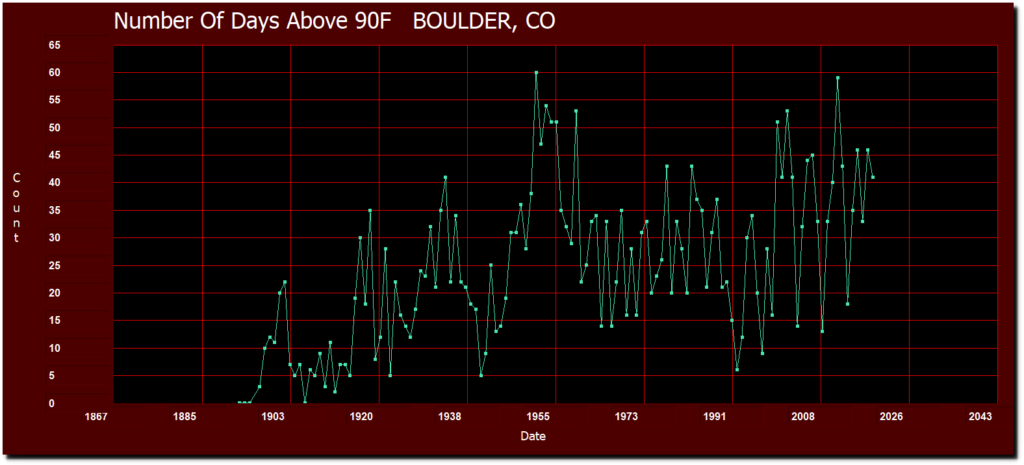
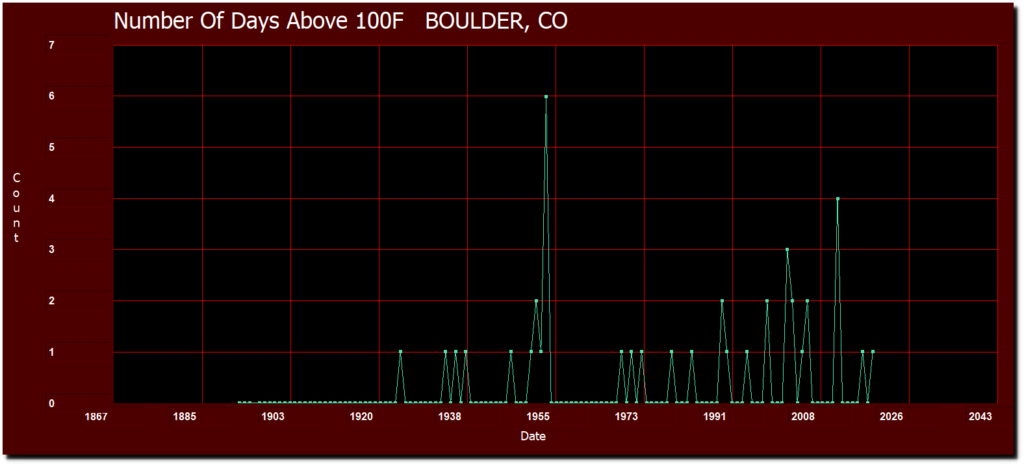
In Chicago, the number of over-90 days would jump from 16 to 56, while six days would see temperatures above 100 degrees, a rarity today.
Aurora is the closest USHCN station to Chicago, and the frequency of 90 and 100 degrees days has dropped sharply since the 1930s.
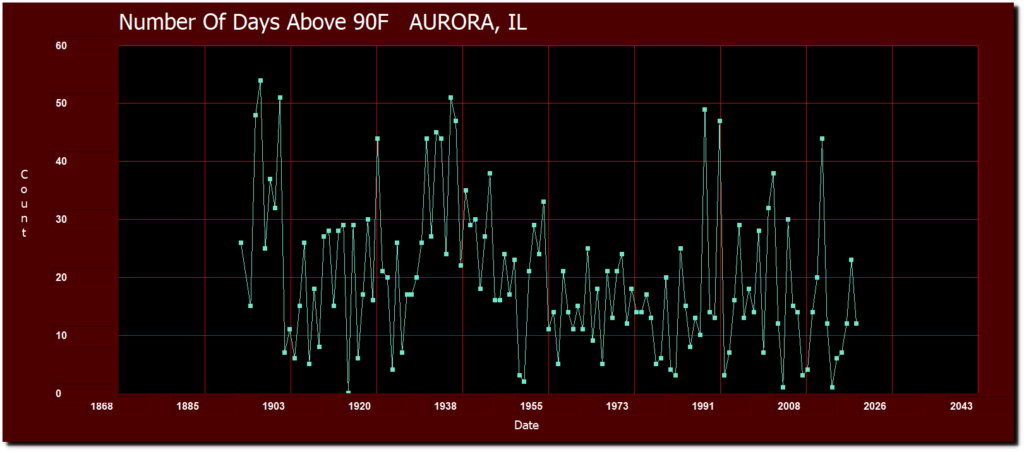
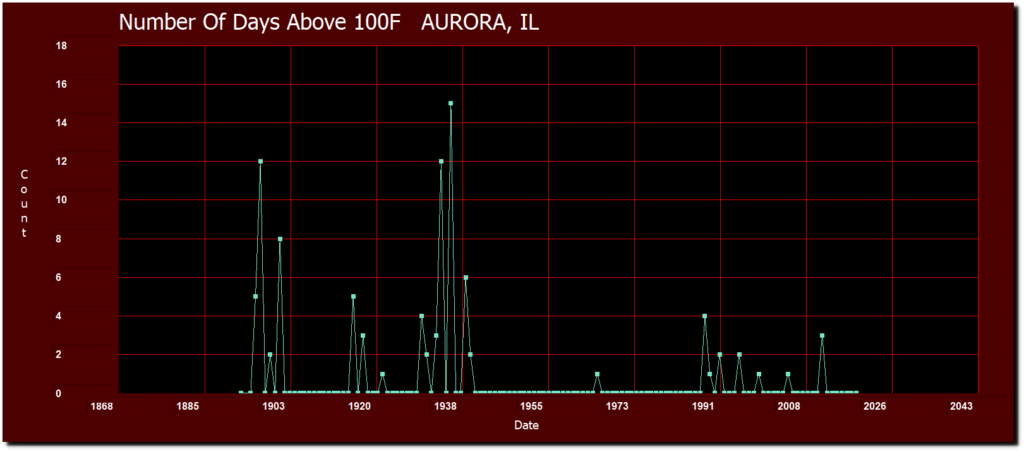
Dallas, which already gets 100 days over 90 degrees and 19 over 100, would see the first figure grow to 162 and the second to 78
Weatherford is the closest USHCN station to Dallas, and the number of 90 and 100 degree days has dropped sharply.
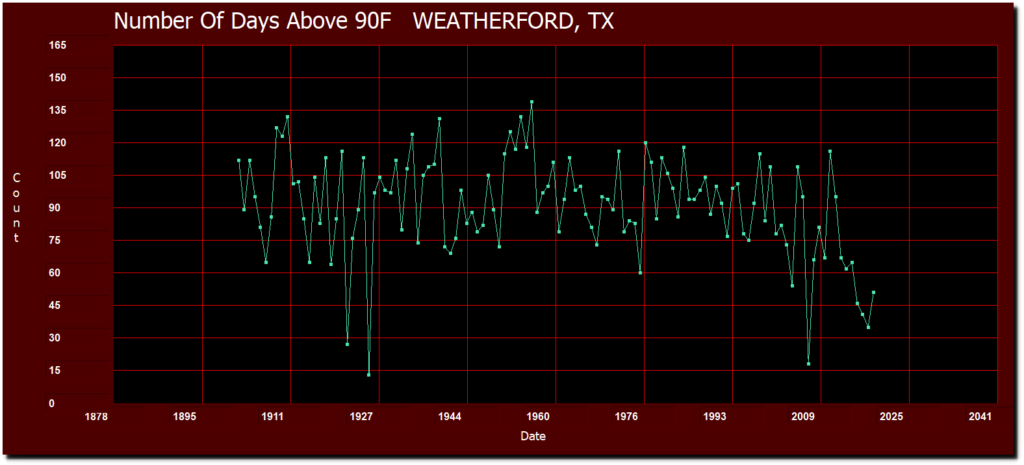
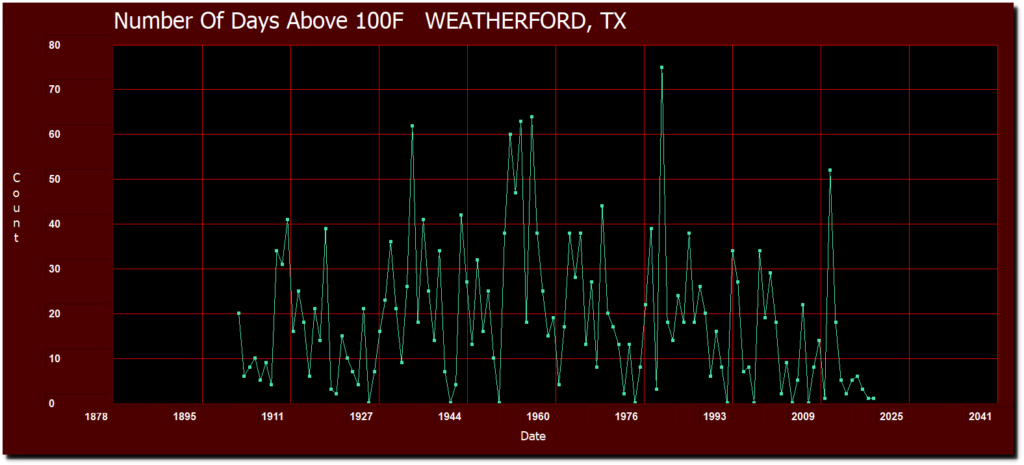
Los Angeles would see the number of 90-plus degree days move up from five to 27, while four days would register more than 100 degrees, compared to one day a year currently.
Downtown LA is much hotter than those numbers, so I assume he meant the airport. The closest USHCN station to LAX is Newport Beach, which shows no trend in hot days.
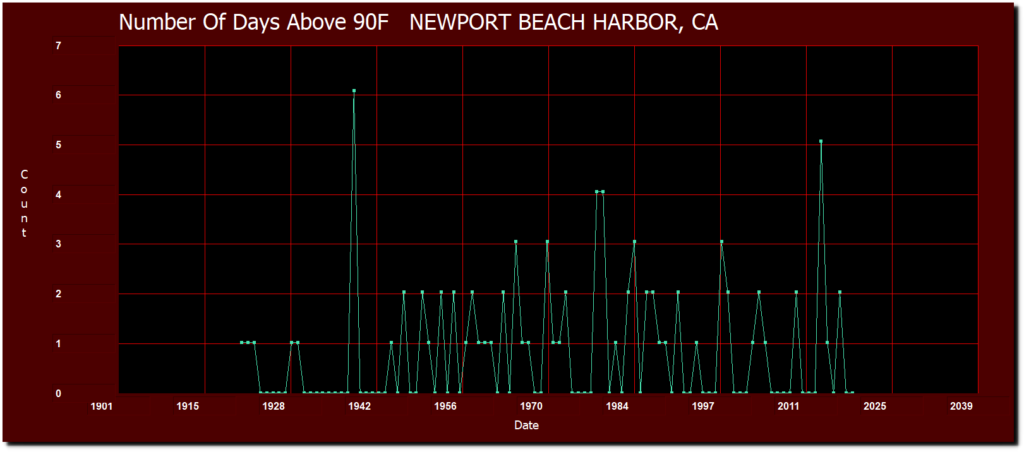

In New York, four days would exceed 100 degrees annually, while in most years no days are that hot now. The number of over-90 days would rise from 15 to 48.
The frequency of hot days at New York City has dropped sharply since Hansen made his forecasts in 1986.

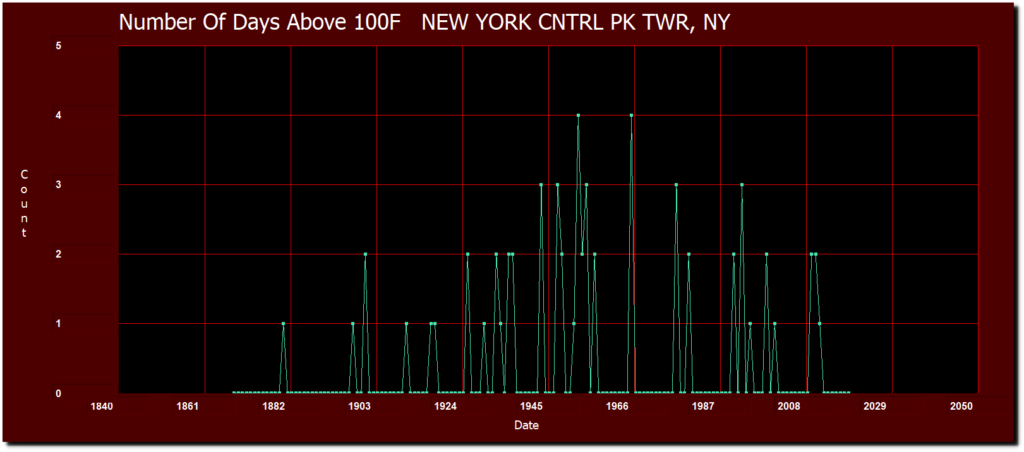
One hundred degree days in New York peaked in the 1950’s, so the Orwellian New York Times has tried to erase them.
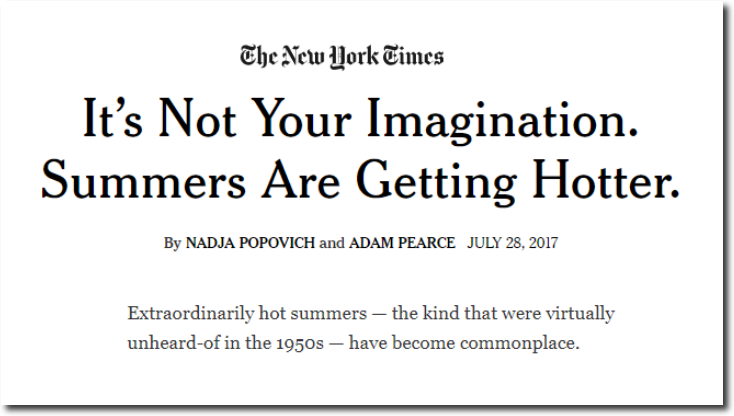
Omaha would see 86 days hotter than 90 degrees, compared to 37 today. Days over 100 degrees would jump from three per year today to 21 in 2030.
The closest USHCN station to Omaha is at Ashland, and the number of hot days has plummeted to record lows.
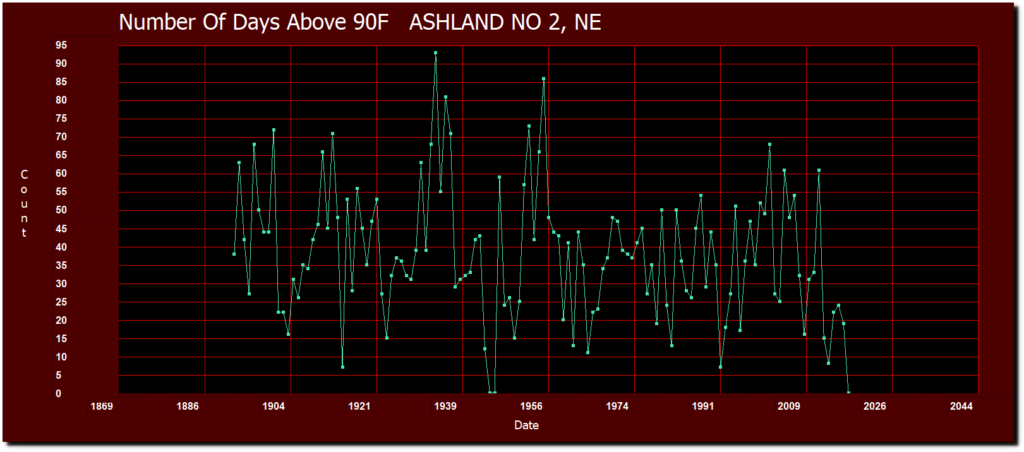
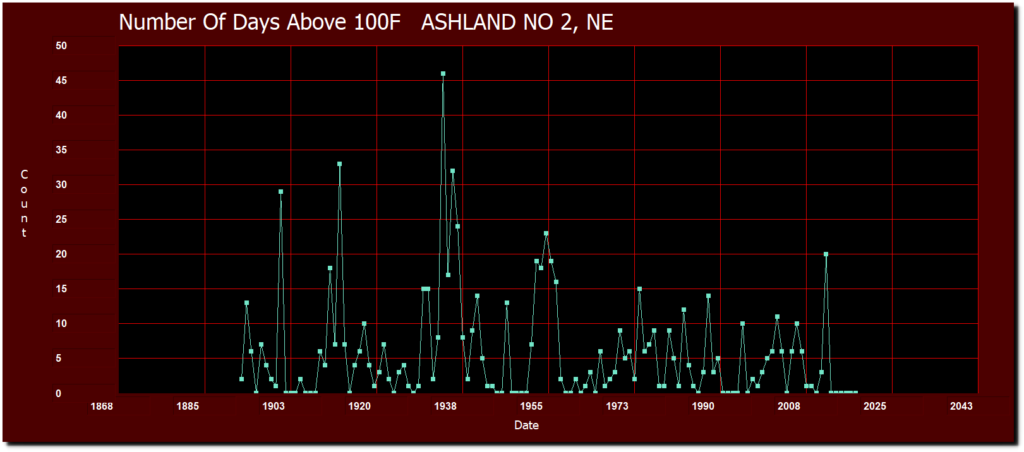
Washington. D C , the number of days above 90 degrees would rise from 36 to 87 per year, while over-100 days would jump from one annually today to 12 in 2030
Purcellville is the closest Virginia USHCN station to Washington D.C., and the number of hot days there has plummeted. I used to live across the river in Maryland, and never needed air conditioning.
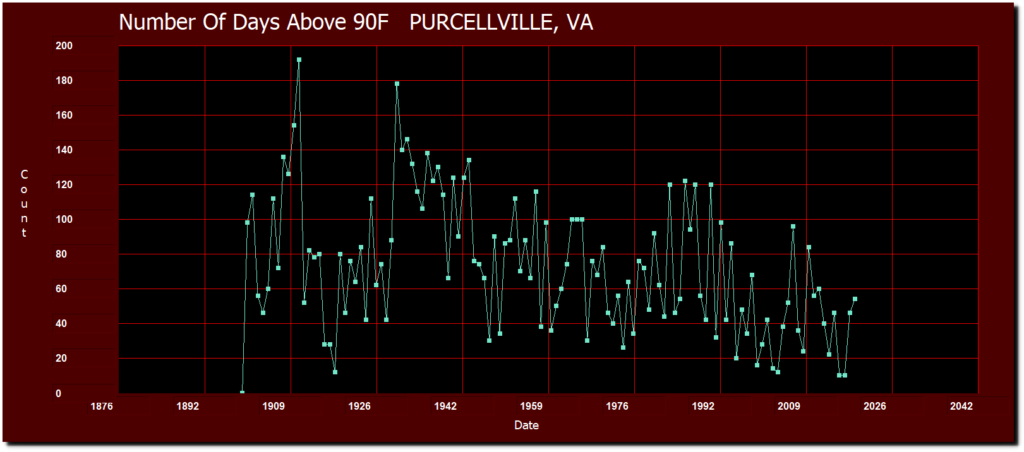

Hansen was wrong, because his CO2 climate model was based on superstition rather than science. But undaunted by their past failures, the New York Times continues to push the same nonsense.

The Union of Concerned Scientists has at least been clever enough to change over to “feels like 90 degrees”

In most professions there are consequences for being wrong, but not if you are employed by the climate religion – where facts simply don’t matter. There is no possible way for you to be wrong.
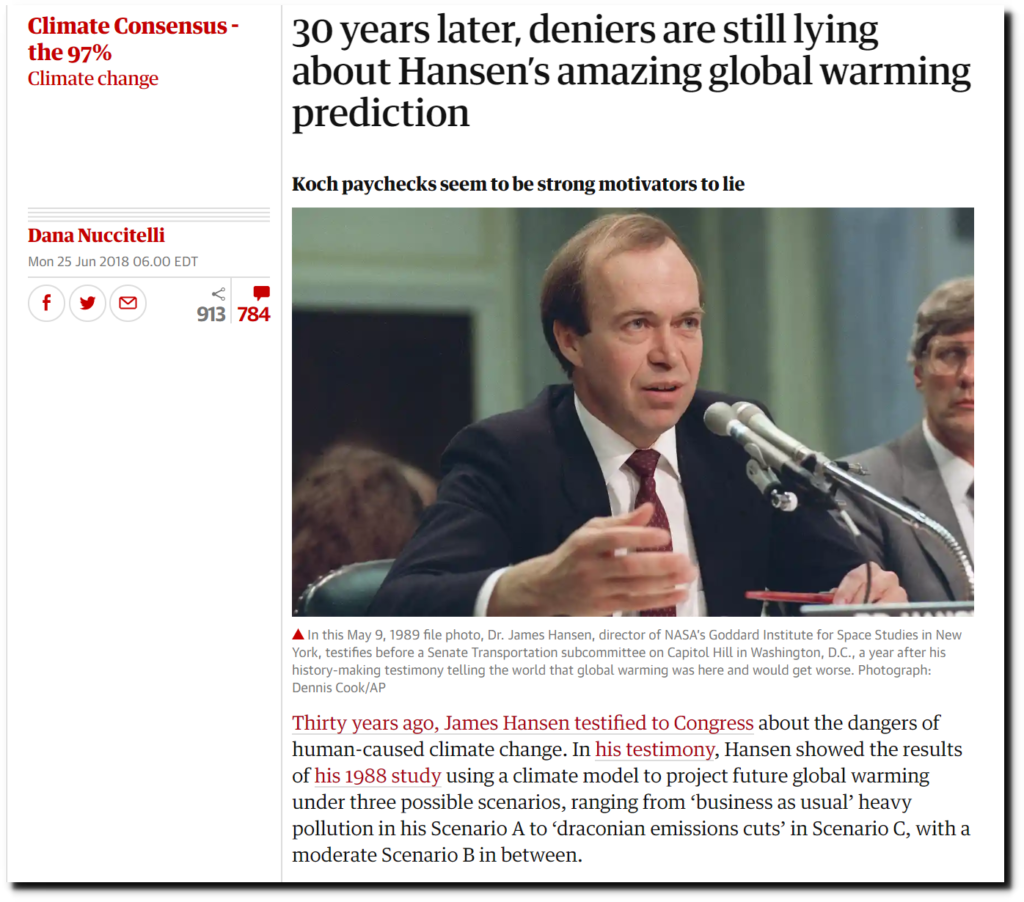
October 13, 2019
Posted by aletho |
Fake News, Mainstream Media, Warmongering, Science and Pseudo-Science, Timeless or most popular | NASA, New York Times |
Leave a comment
Establishment historians claim that U.S. President Franklin D. Roosevelt never wanted war and made every reasonable effort to prevent war. This article will show that contrary to what establishment historians claim, Franklin Roosevelt and his administration wanted war and made every effort to instigate World War II in Europe.
THE SECRET POLISH DOCUMENTS
The Germans seized a mass of documents from the Polish Ministry of Foreign Affairs when they invaded Warsaw in late September 1939. The documents were seized when a German SS brigade led by Freiherr von Kuensberg captured the center of Warsaw ahead of the regular German army. Von Kuensberg’s men took control of the Polish Foreign Ministry just as Ministry officials were in the process of burning incriminating documents. These documents clearly establish Roosevelt’s crucial role in planning and instigating World War II. They also reveal the forces behind President Roosevelt that pushed for war.[1]
Some of the secret Polish documents were first published in the United States as The German White Paper. Probably the most-revealing document in the collection is a secret report dated January 12, 1939 by Jerzy Potocki, the Polish ambassador to the United States. This report discusses the domestic situation in the United States. I quote (a translation of) Ambassador Potocki’s report in full:
There is a feeling now prevalent in the United States marked by growing hatred of Fascism, and above all of Chancellor Hitler and everything connected with National Socialism. Propaganda is mostly in the hands of the Jews who control almost 100% [of the] radio, film, daily and periodical press. Although this propaganda is extremely coarse and presents Germany as black as possible–above all religious persecution and concentration camps are exploited–this propaganda is nevertheless extremely effective since the public here is completely ignorant and knows nothing of the situation in Europe.
At the present moment most Americans regard Chancellor Hitler and National Socialism as the greatest evil and greatest peril threatening the world. The situation here provides an excellent platform for public speakers of all kinds, for emigrants from Germany and Czechoslovakia who with a great many words and with most various calumnies incite the public. They praise American liberty which they contrast with the totalitarian states.
It is interesting to note that in this extremely well-planned campaign which is conducted above all against National Socialism, Soviet Russia is almost completely eliminated. Soviet Russia, if mentioned at all, is mentioned in a friendly manner and things are presented in such a way that it would seem that the Soviet Union were cooperating with the bloc of democratic states. Thanks to the clever propaganda the sympathies of the American public are completely on the side of Red Spain.
This propaganda, this war psychosis is being artificially created. The American people are told that peace in Europe is hanging only by a thread and that war is inevitable. At the same time the American people are unequivocally told that in case of a world war, America also must take an active part in order to defend the slogans of liberty and democracy in the world. President Roosevelt was the first one to express hatred against Fascism. In doing so he was serving a double purpose; first he wanted to divert the attention of the American people from difficult and intricate domestic problems, especially from the problem of the struggle between capital and labor. Second, by creating a war psychosis and by spreading rumors concerning dangers threatening Europe, he wanted to induce the American people to accept an enormous armament program which far exceeds United States defense requirements.
Regarding the first point, it must be said that the internal situation on the labor market is growing worse constantly. The unemployed today already number 12 million. Federal and state expenditures are increasing daily. Only the huge sums, running into billions, which the treasury expends for emergency labor projects, are keeping a certain amount of peace in the country. Thus far only the usual strikes and local unrest have taken place. But how long this government aid can be kept up it is difficult to predict today. The excitement and indignation of public opinion, and the serious conflict between private enterprises and enormous trusts on the one hand, and with labor on the other, have made many enemies for Roosevelt and are causing him many sleepless nights.
As to point two, I can only say that President Roosevelt, as a clever player of politics and a connoisseur of American mentality, speedily steered public attention away from the domestic situation in order to fasten it on foreign policy. The way to achieve this was simple. One needed, on the one hand, to enhance the war menace overhanging the world on account of Chancellor Hitler, and, on the other hand, to create a specter by talking about the attack of the totalitarian states on the United States. The Munich pact came to President Roosevelt as a godsend. He described it as the capitulation of France and England to bellicose German militarism. As was said here: Hitler compelled Chamberlain at pistol-point. Hence, France and England had no choice and had to conclude a shameful peace.
The prevalent hatred against everything which is in any way connected with German National Socialism is further kindled by the brutal attitude against the Jews in Germany and by the émigré problem. In this action Jewish intellectuals participated; for instance, Bernard Baruch; the Governor of New York State, Lehman; the newly appointed judge of the Supreme Court, Felix Frankfurter; Secretary of the Treasury Morgenthau, and others who are personal friends of Roosevelt. They want the President to become the champion of human rights, freedom of religion and speech, and the man who in the future will punish trouble-mongers. These groups, people who want to pose as representatives of “Americanism” and “defenders of democracy” in the last analysis, are connected by unbreakable ties with international Jewry.
For this Jewish international, which above all is concerned with the interests of its race, to put the President of the United States at this “ideal” post of champion of human rights, was a clever move. In this manner they created a dangerous hotbed for hatred and hostility in this hemisphere and divided the world into two hostile camps. The entire issue is worked out in a mysterious manner. Roosevelt has been forcing the foundation for vitalizing American foreign policy, and simultaneously has been procuring enormous stocks for the coming war, for which the Jews are striving consciously. With regard to domestic policy, it is extremely convenient to divert public attention from anti-Semitism which is ever growing in the United States, by talking about the necessity of defending faith and individual liberty against the onslaught of Fascism.[2]
On January 16, 1939, Potocki reported to the Warsaw Foreign Ministry a conversation he had with American Ambassador to France William Bullitt. Bullitt was in Washington on a leave of absence from Paris. Potocki reported that Bullitt stated the main objectives of the Roosevelt administration were:
1. The vitalizing foreign policy, under the leadership of President Roosevelt, severely and unambiguously condemns totalitarian countries.
2. The United States preparation for war on sea, land and air which will be carried out at an accelerated speed and will consume the colossal sum of $1,250 million.
3. It is the decided opinion of the President that France and Britain must put [an] end to any sort of compromise with the totalitarian countries. They must not let themselves in for any discussions aiming at any kind of territorial changes.
4. They have the moral assurance that the United States will leave the policy of isolation and be prepared to intervene actively on the side of Britain and France in case of war. America is ready to place its whole wealth of money and raw materials at their disposal.”[3]
Juliusz (Jules) Łukasiewicz, the Polish ambassador to France, sent a top-secret report from Paris to the Polish Foreign Ministry at the beginning of February 1939. This report outlined the U.S. policy toward Europe as explained to him by William Bullitt:
A week ago, the Ambassador of the United States, W. Bullitt, returned to Paris after having spent three months holiday in America. Meanwhile, I had two conversations with him which enable me to inform Monsieur Minister on his views regarding the European situation and to give a survey of Washington’s policy….
The international situation is regarded by official quarters as extremely serious and being in danger of armed conflict. Competent quarters are of the opinion that if war should break out between Britain and France on the one hand and Germany and Italy on the other, and Britain and France should be defeated, the Germans would become dangerous to the realistic interests of the United States on the American continent. For this reason, one can foresee right from the beginning the participation of the United States in the war on the side of France and Britain, naturally after some time had elapsed after the beginning of the war. Ambassador Bullitt expressed this as follows: “Should war break out we shall certainly not take part in it at the beginning, but we shall end it.”[4]
On March 7, 1939, Ambassador Potocki sent another remarkably perceptive report on Roosevelt’s foreign policy to the Polish government. I quote Potocki’s report in full:
The foreign policy of the United States right now concerns not only the government, but the entire American public as well. The most important elements are the public statements of President Roosevelt. In almost every public speech he refers more or less explicitly to the necessity of activating foreign policy against the chaos of views and ideologies in Europe. These statements are picked up by the press and then cleverly filtered into the minds of average Americans in such a way as to strengthen their already formed opinions. The same theme is constantly repeated, namely, the danger of war in Europe and saving the democracies from inundation by enemy fascism. In all of these public statements there is normally only a single theme, that is, the danger from Nazism and Nazi Germany to world peace.
As a result of these speeches, the public is called upon to support rearmament and the spending of enormous sums for the navy and the air force. The unmistakable idea behind this is that in case of an armed conflict the United States cannot stay out but must take an active part in the maneuvers. As a result of the effective speeches of President Roosevelt, which are supported by the press, the American public is today being conscientiously manipulated to hate everything that smacks of totalitarianism and fascism. But it is interesting that the USSR is not included in all of this. The American public considers Russia more in the camp of the democratic states. This was also the case during the Spanish civil war when the so-called Loyalists were regarded as defenders of the democratic idea.
The State Department operates without attracting a great deal of attention, although it is known that Secretary of State [Cordell] Hull and President Roosevelt swear allegiance to the same ideas. However, Hull shows more reserve than Roosevelt, and he loves to make a distinction between Nazism and Chancellor Hitler on the one hand, and the German people on the other. He considers this form of dictatorial government a temporary “necessary evil.” In contrast, the State Department is unbelievably interested in the USSR and its internal situation and openly worries itself over its weaknesses and decline. The main reason for the United States interest in the Russians is the situation in the Far East. The current government would be glad to see the Red Army emerge as the victor in a conflict with Japan. That’s why the sympathies of the government are clearly on the side of China, which recently received considerable financial aid amounting to 25 million dollars.
Eager attention is given to all information from the diplomatic posts as well as to the special emissaries of the President who serve as ambassadors of the United States. The President frequently calls his representatives from abroad to Washington for personal exchanges of views and to give them special information and instructions. The arrival of the envoys and ambassadors is always shrouded in secrecy and very little surfaces in the press about the results of their visits. The State Department also takes care to avoid giving out any kind of information about the course of these interviews. The practical way in which the President makes foreign policy is most effective. He gives personal instructions to his representatives abroad, most of whom are his personal friends. In this way the United States is led down a dangerous path in world politics with the explicit intention of abandoning the comfortable policy of isolation. The President regards the foreign policy of his country as a means of satisfying his own personal ambition. He listens carefully and happily to his echo in the other capitals of the world. In domestic as well as foreign policy, the Congress of the United States is the only object that stands in the way of the President and his government in carrying out his decisions quickly and ambitiously. One hundred and fifty years ago, the Constitution of the United States gave the highest prerogatives to the American parliament which may criticize or reject the law of the White House.
The foreign policy of President Roosevelt has recently been the subject of intense discussion in the lower house and in the Senate, and this has caused excitement. The so-called Isolationists, of whom there are many in both houses, have come out strongly against the President. The representatives and the senators were especially upset over the remarks of the President, which were published in the press, in which he said that the borders of the United States lie on the Rhine. But President Roosevelt is a superb political player and understands completely the power of the American parliament. He has his own people there, and he knows how to withdraw from an uncomfortable situation at the right moment.
Very intelligently and cleverly he ties together the question of foreign policy with the issues of American rearmament. He particularly stresses the necessity of spending enormous sums in order to maintain a defensive peace. He says specifically that the United States is not arming in order to intervene or to go to the aid of England or France in case of war, but because of the need to show strength and military preparedness in case of an armed conflict in Europe. In his view this conflict is becoming ever more acute and is completely unavoidable.
Since the issue is presented this way, the houses of Congress have no cause to object. To the contrary, the houses accepted an armament program of more than 1 billion dollars. (The normal budget is 550 million, the emergency 552 million dollars). However, under the cloak of a rearmament policy, President Roosevelt continues to push forward his foreign policy, which unofficially shows the world that in case of war the United States will come out on the side of the democratic states with all military and financial power.
In conclusion it can be said that the technical and moral preparation of the American people for participation in a war–if one should break out in Europe–is proceeding rapidly. It appears that the United States will come to the aid of France and Great Britain with all its resources right from the beginning. However, I know the American public and the representatives and senators who all have the final word, and I am of the opinion that the possibility that America will enter the war as in 1917 is not great. That’s because the majority of the states in the mid-West and West, where the rural element predominates, want to avoid involvement in European disputes at all costs. They remember the declaration of the Versailles Treaty and the well-known phrase that the war was to save the world for democracy. Neither the Versailles Treaty nor that slogan have reconciled the United States to that war. For millions there remains only a bitter aftertaste because of unpaid billions which the European states still owe America.[5]
These secret Polish reports were written by top-level Polish ambassadors who were not necessarily friendly to Germany. However, they understood the realities of European politics far better than people who made foreign policy in the United States. The Polish ambassadors realized that behind all of their rhetoric about democracy and human rights, the Jewish leaders in the United States who agitated for war against Germany were deceptively advancing their own interests.
There is no question that the secret documents taken from the Polish Foreign Ministry in Warsaw are authentic. Charles C. Tansill considered the documents genuine and stated, “Some months ago I had a long conversation with M. Lipsky, the Polish ambassador in Berlin in the prewar years, and he assured me that the documents in the German White Paper are authentic.”[6]
William H. Chamberlain wrote , “I have been privately informed by an extremely reliable source that Potocki, now residing in South America, confirmed the accuracy of the documents, so far as he was concerned.”[7] Historian Harry Elmer Barnes also stated, “Both Professor Tansill and myself have independently established the thorough authenticity of these documents.”[8]
Edward Raczyński, the Polish ambassador to London from 1934 to 1945, confirmed in his diary the authenticity of the Polish documents. He wrote in his entry on June 20, 1940: “The Germans published in April a White Book containing documents from the archives of our Ministry of Foreign Affairs, consisting of reports from Potocki from Washington, Łukasiewicz in Paris and myself. I do not know where they found them, since we were told that the archives had been destroyed. The documents are certainly genuine, and the facsimiles show that for the most part the Germans got hold of the originals and not merely copies.”[9]
The official papers and memoirs of Juliusz Łukasiewicz published in 1970 in the book Diplomat in Paris 1936-1939 reconfirmed the authenticity of the Polish documents. Łukasiewicz was the Polish ambassador to Paris, who authored several of the secret Polish documents. The collection was edited by Wacław Jędrzejewicz, a former Polish diplomat and cabinet member. Jędrzejewicz considered the documents made public by the Germans absolutely genuine, and quoted from several of them.
Tyler G. Kent, who worked at the U.S. Embassy in London in 1939 and 1940, has also confirmed the authenticity of the secret Polish documents. Kent says that he saw copies of U.S. diplomatic messages in the files which corresponded to the Polish documents.[10]
The German Foreign Office published the Polish documents on March 29, 1940. The Reich Ministry of Propaganda released the documents to strengthen the case of the American isolationists and to prove the degree of America’s responsibility for the outbreak of war. In Berlin, journalists from around the world were permitted to examine the original documents themselves, along with a large number of other documents from the Polish Foreign Ministry. The release of the documents caused an international media sensation. American newspapers published lengthy excerpts from the documents and gave the story large front-page headline coverage.[11]
However, the impact of the released documents was far less than the German government had hoped for. Leading U.S. government officials emphatically denounced the documents as not being authentic. William Bullitt, who was especially incriminated by the documents, stated, “I have never made to anyone the statements attributed to me.” Secretary of State Cordell Hull denounced the documents: “I may say most emphatically that neither I nor any of my associates in the Department of State have ever heard of any such conversations as those alleged, nor do we give them the slightest credence. The statements alleged have not represented in any way at any time the thought or the policy of the American government.”[12] American newspapers stressed these high-level denials in reporting the release of the Polish documents.
These categorical denials by high-level U.S. government officials almost completely eliminated the effect of the secret Polish documents. The vast majority of the American people in 1940 trusted their elected political leaders to tell the truth. If the Polish documents were in fact authentic and genuine, this would mean that President Roosevelt and his representatives had lied to the American public, while the German government told the truth. In 1940, this was far more than the trusting American public could accept.
MORE EVIDENCE ROOSEVELT INSTIGATED WORLD WAR II
While the secret Polish documents alone indicate that Roosevelt was preparing the American public for war against Germany, a large amount of complementary evidence confirms the conspiracy reported by the Polish ambassadors. The diary of James V. Forrestal, the first U.S. secretary of defense, also reveals that Roosevelt and his administration helped start World War II. Forrestal’s entry on December 27, 1945 stated:
Played golf today with Joe Kennedy [Roosevelt’s Ambassador to Great Britain in the years immediately before the war]. I asked him about his conversations with Roosevelt and Neville Chamberlain from 1938 on. He said Chamberlain’s position in 1938 was that England had nothing with which to fight and that she could not risk going to war with Hitler. Kennedy’s view: That Hitler would have fought Russia without any later conflict with England if it had not been for Bullitt’s urging on Roosevelt in the summer of 1939 that the Germans must be faced down about Poland; neither the French nor the British would have made Poland a cause of war if it had not been for the constant needling from Washington. Bullitt, he said, kept telling Roosevelt that the Germans wouldn’t fight; Kennedy that they would, and that they would overrun Europe. Chamberlain, he says, stated that America and the world Jews had forced England into the war. In his telephone conversations with Roosevelt in the summer of 1939 the President kept telling him to put some iron up Chamberlain’s backside. Kennedy’s response always was that putting iron up his backside did no good unless the British had some iron with which to fight, and they did not….
What Kennedy told me in this conversation jibes substantially with the remarks Clarence Dillon had made to me already, to the general effect that Roosevelt had asked him in some manner to communicate privately with the British to the end that Chamberlain should have greater firmness in his dealings with Germany. Dillon told me that at Roosevelt’s request he had talked with Lord Lothian in the same general sense as Kennedy reported Roosevelt having urged him to do with Chamberlain. Lothian presumably was to communicate to Chamberlain the gist of his conversation with Dillon.
Looking backward there is undoubtedly foundation for Kennedy’s belief that Hitler’s attack could have been deflected to Russia….”[13]
Joseph Kennedy is known to have had a good memory, and it is highly likely that Kennedy’s statements to James Forrestal are accurate. Forrestal died on May 22, 1949 under suspicious circumstances when he fell from his hospital window.
Sir Ronald Lindsay, the British ambassador to Washington, confirmed Roosevelt’s secret policy to instigate war against Germany with the release of a confidential diplomatic report after the war. The report described a secret meeting on September 18, 1938 between Roosevelt and Ambassador Lindsay. Roosevelt said that if Britain and France were forced into a war against Germany, the United States would ultimately join the war. Roosevelt’s idea to start a war was for Britain and France to impose a blockade against Germany without actually declaring war. The important point was to call it a defensive war based on lofty humanitarian grounds and on the desire to wage hostilities with a minimum of suffering and the least possible loss of life and property. The blockade would provoke some kind of German military response, but would free Britain and France from having to declare war. Roosevelt believed he could then convince the American public to support war against Germany, including shipments of weapons to Britain and France, by insisting that the United States was still neutral in a non-declared conflict.[14]
President Roosevelt told Ambassador Lindsay that if news of their conversation was ever made public, it could mean Roosevelt’s impeachment. What Roosevelt proposed to Lindsay was in effect a scheme to violate the U.S. Constitution by illegally starting a war. For this and other reasons, Ambassador Lindsay stated that during his three years of service in Washington he developed little regard for America’s leaders.[15]
Ambassador Lindsay in a series of final reports also indicated that Roosevelt was delighted at the prospect of a new world war. Roosevelt promised Lindsay that he would delay German ships under false pretenses in a feigned search for arms. This would allow the German ships to be easily seized by the British under circumstances arranged with exactitude between the American and British authorities. Lindsay reported that Roosevelt “spoke in a tone of almost impish glee and though I may be wrong the whole business gave me the impression of resembling a school-boy prank.”
Ambassador Lindsay was personally perturbed that the president of the United States could be gay and joyful about a pending tragedy which seemed so destructive of the hopes of all mankind. It was unfortunate at this important juncture that the United States had a president whose emotions and ideas were regarded by a friendly British ambassador as being childish.[16]
Roosevelt’s desire to support France and England in a war against Germany is discussed in a letter from Verne Marshall, former editor of the Cedar Rapids Gazette, to Charles C. Tansill. The letter stated:
President Roosevelt wrote a note to William Bullitt [in the summer of 1939], then Ambassador to France, directing him to advise the French Government that if, in the event of a Nazi attack upon Poland, France and England did not go to Poland’s aid, those countries could expect no help from America if a general war developed. On the other hand, if France and England immediately declared war on Germany, they could expect “all aid” from the United States.
F.D.R.’s instructions to Bullitt were to send this word along to “Joe” and “Tony,” meaning Ambassadors Kennedy, in London, and Biddle, in Warsaw, respectively. F.D.R. wanted Daladier, Chamberlain and Josef Beck to know of these instructions to Bullitt. Bullitt merely sent his note from F.D.R. to Kennedy in the diplomatic pouch from Paris. Kennedy followed Bullitt’s idea and forwarded it to Biddle. When the Nazis grabbed Warsaw and Beck disappeared, they must have come into possession of the F.D.R. note. The man who wrote the report I sent you saw it in Berlin in October, 1939.[17]
William Phillips, the American ambassador to Italy, also stated in his postwar memoirs that the Roosevelt administration in late 1938 was committed to going to war on the side of Britain and France. Phillips wrote: “On this and many other occasions, I would have liked to have told him [Count Ciano, the Italian Foreign Minister] frankly that in the event of a European war, the United States would undoubtedly be involved on the side of the Allies. But in view of my official position, I could not properly make such a statement without instructions from Washington, and these I never received.”[18]
When Anthony Eden returned to England in December 1938, he carried with him an assurance from President Roosevelt that the United States would enter as soon as practicable a European war against Hitler if the occasion arose. This information was obtained by Senator William Borah of Idaho, who was contemplating how and when to give out this information, when he dropped dead in his bathroom. The story was confirmed to historian Harry Elmer Barnes by some of Senator Borah’s closest colleagues at the time.[19]
The American ambassador to Poland, Anthony Drexel Biddle, was an ideological colleague of President Roosevelt and a good friend of William Bullitt. Roosevelt used Biddle to influence the Polish government to refuse to enter into negotiations with Germany. Carl J. Burckhardt, the League of Nations High Commissioner to Danzig, reported in his postwar memoirs on a memorable conversation he had with Biddle. On December 2, 1938, Biddle told Burckhardt with remarkable satisfaction that the Poles were ready to wage war over Danzig. Biddle predicted that in April a new crisis would develop, and that moderate British and French leaders would be influenced by public opinion to support war. Biddle predicted a holy war against Germany would break out.[20]
Bernard Baruch, who was Roosevelt’s chief advisor, scoffed at a statement made on March 10, 1939 by Neville Chamberlain that “the outlook in international affairs is tranquil.” Baruch agreed passionately with Winston Churchill, who had told him: “War is coming very soon. We will be in it and you [the United States] will be in it.”[21]
Georges Bonnet, the French foreign minister in 1939, also confirmed the role of William Bullitt as Roosevelt’s agent in pushing France into war. In a letter to Hamilton Fish dated March 26, 1971, Bonnet wrote, “One thing is certain is that Bullitt in 1939 did everything he could to make France enter the war.”[22]
Dr. Edvard Beneš, the former president of Czechoslovakia, wrote in his memoirs that he had a lengthy secret conversation at Hyde Park with President Roosevelt on May 28, 1939. Roosevelt assured Beneš that the United States would actively intervene on the side of Great Britain and France against Germany in the anticipated European war.[23]
American newspaper columnist Karl von Wiegand, who was the chief European newspaper columnist of the International News Service, met with Ambassador William Bullitt at the U.S. embassy in Paris on April 25, 1939. More than four months before the outbreak of war, Bullitt told Wiegand: “War in Europe has been decided upon. Poland has the assurance of the support of Britain and France, and will yield to no demands from Germany. America will be in the war soon after Britain and France enter it.”[24] When Wiegand said that in the end Germany would be driven into the arms of Soviet Russia and Bolshevism, Ambassador Bullitt replied: “What of it. There will not be enough Germans left when the war is over to be worth Bolshevizing.”[25]
On March 14, 1939, Slovakia dissolved the state of Czechoslovakia by declaring itself an independent republic. Czechoslovakian President Emil Hácha signed a formal agreement the next day with Hitler establishing a German protectorate over Bohemia and Moravia, which constituted the Czech portion of the previous entity. The British government initially accepted the new situation, reasoning that Britain’s guarantee of Czechoslovakia given after Munich was rendered void by the internal collapse of that state. It soon became evident after the proclamation of the Protectorate of Bohemia-Moravia that the new regime enjoyed considerable popularity among the people living in it. Also, the danger of a war between the Czechs and the Slovaks had been averted.[26]
However, Bullitt’s response to the creation of the German protectorate over Bohemia and Moravia was highly unfavorable. Bullitt telephoned Roosevelt and, in an “almost hysterical” voice, Bullitt urged Roosevelt to make a dramatic denunciation of Germany and to immediately ask Congress to repeal the Neutrality Act.[27]
Washington journalists Drew Pearson and Robert S. Allen reported in their nationally syndicated column that on March 16, 1939, President Roosevelt “sent a virtual ultimatum to Chamberlain” demanding that the British government strongly oppose Germany. Pearson and Allen reported that “the President warned that Britain could expect no more support, moral or material through the sale of airplanes, if the Munich policy continued.”[28]
Responding to Roosevelt’s pressure, the next day Chamberlain ended Britain’s policy of cooperation with Germany when he made a speech at Birmingham bitterly denouncing Hitler. Chamberlain also announced the end of the British “appeasement” policy, stating that from now on Britain would oppose any further territorial moves by Hitler. Two weeks later the British government formally committed itself to war in case of German-Polish hostilities.
Roosevelt also attempted to arm Poland so that Poland would be more willing to go to war against Germany. Ambassador Bullitt reported from Paris in a confidential telegram to Washington on April 9, 1939, his conversation with Polish Ambassador Łukasiewicz. Bullitt told Łukasiewicz that although U.S. law prohibited direct financial aid to Poland, the Roosevelt administration might be able to supply warplanes to Poland indirectly through Britain. Bullitt stated: “The Polish ambassador asked me if it might not be possible for Poland to obtain financial help and airplanes from the United States. I replied that I believed the Johnson Act would forbid any loans from the United States to Poland, but added that it might be possible for England to purchase planes for cash in the United States and turn them over to Poland.”[29]
Bullitt also attempted to bypass the Neutrality Act and supply France with airplanes. A secret conference of Ambassador Bullitt with French Premier Daladier and the French minister of aviation, Guy La Chambre, discussed the procurement of airplanes from America for France. Bullitt, who was in frequent telephonic conversation with Roosevelt, suggested a means by which the Neutrality Act could be circumvented in the event of war. Bullitt’s suggestion was to set up assembly plants in Canada, apparently on the assumption that Canada would not be a formal belligerent in the war. Bullitt also arranged for a secret French mission to come to the United States and purchase airplanes in the winter of 1938-1939. The secret purchase of American airplanes by the French leaked out when a French aviator crashed on the West Coast.[30]
On August 23, 1939, Sir Horace Wilson, Chamberlain’s closest advisor, went to American Ambassador Joseph Kennedy with an urgent appeal from Chamberlain to President Roosevelt. Regretting that Britain had unequivocally obligated itself to Poland in case of war, Chamberlain now turned to Roosevelt as a last hope for peace. Kennedy telephoned the State Department and stated: “The British want one thing from us and one thing only, namely that we put pressure on the Poles. They felt that they could not, given their obligations, do anything of this sort but that we could.”
Presented with a possibility to save the peace in Europe, President Roosevelt rejected Chamberlain’s desperate plea out of hand. With Roosevelt’s rejection, Kennedy reported, British Prime Minister Chamberlain lost all hope. Chamberlain stated: “The futility of it all is the thing that is frightful. After all, we cannot save the Poles. We can merely carry on a war of revenge that will mean the destruction of all Europe.”[31]
Conclusion
U.S. President Franklin Roosevelt and his advisers played a crucial role in planning and instigating World War II. This is proven by the secret Polish documents as well as numerous statements from highly positioned, well-known and authoritative Allied leaders who corroborate the contents of the Polish documents.
ENDNOTES
[1] Weber, Mark, “President Roosevelt’s Campaign to Incite War in Europe: The Secret Polish Documents,” The Journal of Historical Review, Vol. 4, No. 2 , Summer 1983, pp. 136-137, 140.
[2] Count Jerzy Potocki to Polish Foreign Minister in Warsaw, The German White Paper: Full Text of the Polish Documents Issued by the Berlin Foreign Office; with a foreword by C. Hartley Grattan, New York: Howell, Soskin & Company, 1940, pp. 29-31.
[3] Ibid., pp. 32-33.
[4] Juliusz Lukasiewicz to Polish Foreign Minister in Warsaw, The German White Paper: Full Text of the Polish Documents Issued by the Berlin Foreign Office; with a foreword by C. Hartley Grattan, New York: Howell, Soskin & Company, 1940, pp. 43-44.
[5] Germany. Foreign Office Archive Commission. Roosevelts Weg in den Krieg: Geheimdokumente zur Kriegspolitik des Praesidenten der Vereinigten Staaten. Berlin: Deutscher Verlag, 1943. Translated into English by Weber, Mark, “President Roosevelt’s Campaign to Incite War in Europe: The Secret Polish Documents,” The Journal of Historical Review, Summer 1983, Vol. 4, No. 2 , pp. 150-152.
[6] Tansill, Charles C., “The United States and the Road to War in Europe,” in Barnes, Harry Elmer (ed.), Perpetual War for Perpetual Peace, Newport Beach, Cal.: Institute for Historical Review, 1993, p. 184 (footnote 292).
[7] Chamberlain, William Henry, America’s Second Crusade, Chicago: Regnery, 1950, p. 60 (footnote 14).
[8] Barnes, Harry Elmer, The Court Historians versus Revisionism, N.p.: privately printed, 1952, p. 10.
[9] Raczynski, Edward, In Allied London, London: Weidenfeld and Nicolson, 1963, p. 51.
[10] Weber, Mark, “President Roosevelt’s Campaign to Incite War in Europe: The Secret Polish Documents,” The Journal of Historical Review, Summer 1983, Vol. 4, No. 2 , p. 142.
[11] Ibid., pp. 137-139.
[12] New York Times, March 30, 1940, p. 1.
[13] Forrestal, James V., The Forrestal Diaries, edited by Walter Millis and E.S. Duffield, New York: Vanguard Press, 1951, pp. 121-122.
[14] Dispatch No. 349 of Sept. 30, 1938, by Sir Ronald Lindsay, Documents on British Foreign Policy, (ed.). Ernest L. Woodard, Third Series, Vol. VII, London, 1954, pp. 627-629. See also Lash, Joseph P., Roosevelt and Churchill 1939-1941, New York: Norton, 1976, pp. 25-27.
[15] Dallek, Robert, Franklin D. Roosevelt and American Foreign Policy 1932-1945, New York: Oxford University Press, 1979, pp. 31, 164-165.
[16] Hoggan, David L., The Forced War: When Peaceful Revision Failed, Costa Mesa, Cal.: Institute for Historical Review, 1989, pp. 518-519.
[17] Tansill, Charles C., “The United States and the Road to War in Europe,” in Barnes, Harry Elmer (ed.), Perpetual War for Perpetual Peace, Newport Beach, Cal.: Institute for Historical Review, 1993, p. 168.
[18] Phillips, William, Ventures in Diplomacy, North Beverly, Mass.: privately published, 1952, pp. 220-221.
[19] Barnes, Harry Elmer, Barnes against the Blackout, Costa Mesa, Cal.: Institute for Historical Review, 1991, p. 208.
[20] Burckhardt, Carl, Meine Danziger Mission 1937-1939, Munich: Callwey, 1960, p. 225.
[21] Sherwood, Robert E., Roosevelt and Hopkins, an Intimate History, New York: Harper & Brothers, 1948, p. 113.
[22] Fish, Hamilton, FDR The Other Side of the Coin: How We Were Tricked into World War II, New York: Vantage Press, 1976, p. 62.
[23] Beneš, Edvard, Memoirs of Dr. Edvard Beneš, London: George Allen & Unwin, 1954, pp. 79-80.
[24] “Von Wiegand Says-,” Chicago-Herald American, Oct. 8, 1944, p. 2.
[25] Chicago-Herald American, April 23, 1944, p. 18.
[26] Hoggan, David L., The Forced War: When Peaceful Revision Failed, Costa Mesa, Cal.: Institute for Historical Review, 1989, p. 250.
[27] Moffat, Jay P., The Moffat Papers 1919-1943, Cambridge, Mass.: Harvard University Press, 1956, p. 232.
[28] Pearson, Drew and Allen, Robert S., “Washington Daily Merry-Go-Round,” Washington Times-Herald, April 14, 1939, p. 16.
[29] U.S. Department of State, Foreign Relations of the United States (Diplomatic Papers), 1939, General, Vol. I, Washington: 1956, p. 122.
[30] Chamberlain, William Henry, America’s Second Crusade, Chicago: Regnery, 1950, pp. 101-102.
[31] Koskoff, David E., Joseph P. Kennedy: A Life and Times, Englewood Cliffs, N.J.: Prentice-Hall, 1974, p. 207; see also Taylor, A.J.P., The Origins of the Second World War, New York: Simon & Schuster, 2005, p. 272.

October 13, 2019
Posted by aletho |
Deception, Militarism, Timeless or most popular, War Crimes | United States |
Leave a comment