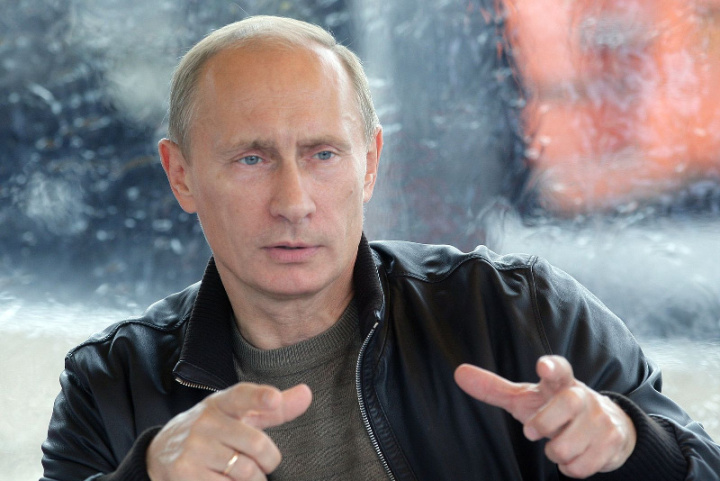
By John Chuckman | Aletho News | March 6, 2019
There is an immense amount of criticism of Putin, especially coming from America, most of it empty criticism which ignores realities and genuine analysis. For the more thoughtful, it represents only the stink and noise of propaganda, and not honest criticism in its true sense at all.
In politics, and especially in the direction of a country’s foreign affairs, there are certain behaviors, ideas, and attitudes which mark out a person as exceptional. I think there can be no doubt, Putin is just such a person, and I am very much inclined to say, the preeminent one of our time. Frankly, compared with Putin’s skills, Donald Trump comes off as a noisy circus act, a sideshow carnival barker, and not an appealing one. He has an outsized impact in the world only because he represents the most powerful country on earth and has embraced all the prejudices and desires of its power establishment, not because of the skillfulness of his actions or the insight of his mind. Obama made a better public impression, but if you analyze his actions, you see a man of immense and unwarranted ego, a very secretive and unethical man, and a man who held no worthy ideals he promoted. He was superficial in many things. And he was completely compliant to the power establishment, leaving no mark of his own to speak of.
Putin is a man who advocates cooperation among states, who argues against exceptionalism, who wants his country to have peace so that it can grow and advance, a man lacking any frightening or tyrannical ideologies, a man who invariably refers to other countries abroad, even when they are being uncooperative, in respectful terms as “our partners,” a man who knows how to prioritize, as in defense spending, a man with a keen eye for talent who has some other exceptional people assisting him – men of the caliber of Lavrov or Shoygu, a man who supports worthy international organizations like the UN, a man who only reluctantly uses force but uses it effectively when required, a highly restrained man in almost everything he does, a man who loves his country and culture but does not try foisting them off on everyone else as we see almost continuously from American presidents, a man with a keen eye for developing trends and patterns in the world, a man with an eye, too, for the main chance, a man whose decisions are made calmly and in light of lot of understanding. That’s quite a list.
The differences between recent American leaders, all truly mediocre, and Putin probably has something to do with the two counties’ relative situations over the last few decades. After all, if the support isn’t there for someone like Putin, you won’t get him. Russia’s huge Soviet empire collapsed in humiliation in 1991. The country was put through desperate straits, literally its own great depression with people begging or selling pathetic trinkets on the streets. And America made no real effort to assist. Indeed, quite the opposite, it kicked someone who was down and tried to shake all the loose change from his pockets. Out of Russia’s desperation came a man of remarkable skills, a rather obscure figure, but one who proved extremely popular and was obviously supported by enough powerful and important people to employ his skills for the county’s recovery and advance.
Putin showed no weakness or flinching when dealing with some of the extremely wealthy men who in fact became wealthy by stripping assets from the dying Soviet Union, men who then also used their wealth to challenge the country’s much-needed new leadership. He was, of course, excoriated by the United States, but to the best of my understanding, he did what was necessary for progress. The results are to be seen in a remarkably revitalized Russia. Everywhere, important projects are underway. New highways, new airports, major new bridges, new rail lines and subways, a new spaceport, new projects and cooperative efforts with a whole list of countries, new efforts in technology and science, and Russia has become the world’s largest exporter of wheat. Putin also has committed Russia to offering the world grain crops free of all GMOs and other contaminants, a very insightful effort to lock-in what have been growing premium markets for such products, even among Americans.
The military, which badly declined after the fall of the USSR, has been receiving new and remarkable weapons, the products of focused research efforts. New high-tech tanks, artillery, ships, and planes. In strategic weapons, Russia now produces several unprecedented ones, a great achievement which was done without spending unholy amounts of money, Russia’s military budget being less than a tenth that of the United States. Putin’s caution and pragmatism dictate that Russia’s first priority is to become as healthy as possibly, so it needs peace, for decades. Few Westerners appreciate the devastating impact of the USSR’s collapse, but even before that, the Soviet empire had its own slow debilitating impact. Russia’s economic system was not efficient and competitive. The effects of that accumulated over many years. The USSR always did maintain the ability to produce big engineering projects such as dams and space flight, but it was always sorely lacking in the small and refined things of life that an efficient economy automatically sees are provided.
The new strategic weapons are an unfortunate necessity, but the United States threatens Russia as perhaps never before with the expansion of NATO membership right to the Russian border, something breaking specific American promises of years back. And it has been running tanks all over Europe and then digging them in them right at the frontier just to make a point. It has deployed multiple-use covered missile launchers not far from the border which may as easily contain offensive intermediate-range ground-to-ground nuclear missiles as the defensive anti-missile missiles claimed to be their purpose. And it has torn up one of the most important nuclear-weapons treaties we had, the INF Treaty, pertaining to intermediate-range missiles. Intermediate-range nuclear missiles based in Europe give the United States the ability to strike Russia with little warning, their ten-minute flight path compares to a roughly thirty-minute flight path for an Intercontinental Ballistic Missile (ICBM) coming from America. These are extremely de-stabilizing, as are the counter-measures Russia felt it must take, Russian intermediate-range nuclear missile aimed at European centers. Everyone eventually recognized that, and that’s why the treaty was successfully completed. Europeans appreciated no longer becoming the immediate battlefield in a nuclear war.
But relations with the United States have now entered a new world, and it is not a brave one. America’s power establishment has assumed new goals and priorities, and in those, Russia is not viewed well, despite its new identity as a nation ready to participate and peacefully compete with everyone, a nation without the kind of extreme ideology communism was, a kind of secular religious faith. Despite its readiness to participate in all Western organizations, forums, and discussions, it is viewed with a new hostility by America. It is arbitrarily regarded as an opponent, as an ongoing threat. As I discuss below, America, too, has been kind of in a decline, and the response of its leadership to that fact involves flexing its muscles and extracting concessions and privileges and exerting a new dominance in the world, a response not based in economic competition and diplomatic leadership, a response carrying a great deal of danger.
And, very importantly, its response is one that involves not only bypassing international organizations, but, in many cases, working hard to bend them to its purposes. There are many examples, but America’s treatment of the UN has been foremost. It has in the recent past refused for considerable periods to pay its treaty-obliged dues until it saw changes it unilaterally demanded. It has dropped out of some important agencies completely, most notably UNESCO. In general, it has intimidated an international organization into better accommodating American priorities, including very much imperial ones opposed to what the UN is supposed to be about. And it has used this intimidation and non-cooperativeness to influence the nature of leadership at the UN, the last few Secretaries-General being timid on very important matters and ineffective in general. That’s just the way America likes them to be now. A harsh Neocon like Madeleine Albright won her government-service spurs at the UN by engineering the departure of an unwanted Secretary-General.
Promoting coups is not a new activity for the United States. There is a long postwar record, including Iran’s democratic government in the 1950s, Guatemala’s democratic government in the 1950s, and Chile’s democratic government in 1973. But the recent coup in Ukraine represented something rather new, a very provocative activity right on a major Russian border. It was also against an elected government and in a country which shares with Russia a history and culture going back more than a thousand years to the predecessor state of Kievan Rus. Yes, there are resentments in Ukraine from the Soviet era, and those are what the United States exploited, but the country was democratically governed. In any event, staging a coup in a large bordering country is a very serious provocation. You can just imagine the violent American reaction to one in Mexico or Canada.
The new, post-coup government in Ukraine also made many provocative and plainly untrue statements. The ineffective, and frequently ridiculous, President Poroshenko kept telling Europeans that Russian troops and armor were invading his country. Only his brave army was holding the hordes back. He was literally that silly at times. Of course, none of it was ever true. American spy satellites would quickly detect any Russian movement, and they never did. In an effort to put the wild claims into perspective, treating them with the contempt they deserved, Putin once said that if he wanted to, he could be in Kiev in two weeks. Undoubtedly true, too. Well, the statement was taken completely out of context, treated as a threat by America’s always-faithful-to-the-narrative press. Journalism in the service of government policy – all of it, from the most elevated newspapers and broadcasters to the humblest. And I think that nicely illustrates the absurdity of events in Ukraine and the way they have been used.
The United States paid for the coup in Ukraine. We even know how much money it spent, five billion dollars, thanks to the overheard words of one of America’s most unpleasant former diplomats, Victoria Nuland. The idea was to threaten Russia with the long Ukrainian border being put into genuinely hostile hands. Never mind that the government driven from office with gunfire in the streets from paid thugs was democratically elected. Never mind that many of the groups with which the United States cooperated in this effort were right-wing extremists, a few of them resembling outright Nazis, complete with armbands, symbols, and torchlight parades. And never mind that the government America installed was incompetent, not only sending Ukraine’s economy into a tailspin but promptly igniting a completely unnecessary civil war.
The large native, Russian-speaking population (roughly 30% of the country) is completely dominant in Eastern Ukraine and Crimea. Those two regions partly turned the tables by seceding from Ukraine with its government which early-on worked to suppress historic Russian-language rights and carried on a lot of activities to make those with any Russian associations feel very unwelcome. It’s a deliberately provocative environment, and, as we all know from our press, not a day goes by in Washington without anti-Russian rhetoric and unsupported charges. While Washington greatly failed in this effort, it nevertheless succeeded in generating instability and hostility along a major Russian border. It also gained talking points with which to pressure NATO into some new arrangements.
In the case of Crimea, it is important to remember that it has been Russian since the time of Catherine the Great. It only was in recent history that Crimea became part of Ukraine, and that happened with the stroke of a pen, an administrative adjustment during the days of the USSR, the very USSR the people now running Ukraine so despise, rejecting almost everything ever done, except for the administrative transfer of Crimea apparently. Just one of those little ironies of history. The people who live in Crimea speak Russian, and they did not welcome the new Ukrainian government’s heavy-handed, nationalist, anti-Russian drive around Ukrainian language and culture, necessarily a narrow, claustrophobic effort since the late USSR was a multi-national and multi-lingual state, and given Crimea’s much longer-term history as part of Russia. Even during Crimea’s recent past as part of Ukraine, Russia continued to maintain, under lease, its major naval base at Sevastopol on the Black Sea, so the connections with Russia have been continuous.
In virtually every newspaper story you read and in places like Wikipedia on the Internet, you will see the word “annexation” used to describe Crimea’s relationship with Russia. It simply is not an accurate description, but its constant use is a very good measure of America’s ability to saturate media with its desired version of events. The people of Crimea voted overwhelmingly to secede from an unfriendly new Ukraine, and they voted to petition Russia’s admitting them as part of the country. How can you call the results of free and open votes annexation? Well, only the same way you can tell the twice-elected President of Venezuela that he is not President and that another man, who did not even run in the election and administered the oath of office to himself, is the President. This is the kind of Alice-in-Wonderland stuff that comes as part of America’s new drive for dominance. It simply paints the roses red. What is claimed to have happened in Crimea provides the only support for charges of Russian aggression, the laying on of all kinds of sanctions, and running around all over Europe tearing up road surfaces with tanks. This is the atmosphere within which Putin must work, trying to maintain as many sound relationships with Europe as he can, and he actually has been quite successful. A number of prominent European politicians, especially retired ones who aren’t under the immediate pressures of politics and relations with America, have voiced support for Russia. Some have even visited Crimea by invitation and toured. And Russia’s major new gas pipeline into Europe, Nord Stream 2, proceeds despite constant American pressure against it. It is at this writing 70% complete. The Europeans cannot just abandon their long-term ally, the United States, even though I’m sure they understand the illusions and false claims of the current situation. The United States also retains considerable capacity to hurt Europe financially, so they rush into nothing, but I believe there can be no doubt that American words and actions have significantly weakened old and important relationships. No one likes being lied to, and they like even less having to pretend lies are truth.
Putin has been more cautious in the case of the secession of another Russian-speaking portion of Ukraine, an even larger one in population and in economic importance, the Eastern portion called Donbass. The people there declared two republics, Donetsk and Luhansk, and they petitioned to be admitted as part of Russia. But Russia does not officially recognize them although it has sent large volumes of aid as they were besieged by the new Ukrainian government. The government of Ukraine started a small civil war in the region. Russia supports the Minsk Accords, which it helped to write, accords to reunite the region with Ukraine but which require Ukraine to grant a degree of constitutional autonomy to the region. This is a reasonable approach to ending the conflict, but it is not easy to implement. It is not something looked favorably upon by Ukraine’s right-wing extremists who push the government hard, having even threatened it at times. The entire business has been mired in difficulties from the start. Ukraine displayed remarkable military incompetence in this civil war against a much smaller opponent. It tried to increase the size of its forces with conscription in the West of Ukraine, but the number of no-shows and run-aways grew embarrassingly large. And, of course, none of this even needed to happen had the new government’s policies been sensible and fair in the first place. But you got no pressure from the United States over fairness. It is merely content to have caused a lot of difficulties on Russia’s border. And there is the matter of the shoot-down of Malaysian Airlines’ Flight MH-17, which my study of the circumstances suggests unequivocally was an act by Ukraine, whether accidental or deliberate. The United States has pushed hard to have this blamed on Russia, so as to not discredit its installed Ukrainian government, but the facts, as we know them, simply do not support that conclusion. The United States has shamefully pressured a NATO member, Holland, not even a central party to the event, to conduct a long and tortoise-paced investigation of the crash. It has ignored key evidence, and all of its interim conclusions can readily be seen as couched in the kind of suggestive but inexact language criminal lawyers advise their clients to use in court. What we see in Ukraine, is government incompetence, almost uniformly in all its activities, and again there is no concern expressed by the United States about all the difficulties – economic, military, and social – its efforts have caused for the Ukrainian people.
Putin’s adroit handling of the coup in Ukraine, frustrating many of America’s aims without getting Russia involved in conflict, determined Washington to further stoke-up anti-Russian feeling in Europe. You must always remember that NATO does represent a vehicle for the peaceful American occupation of Europe, Europe being an important economic competitor and potentially a major world power. The obsolescence of the original arguments for NATO – the threat of the USSR and the massive Red Army, now both long passed into history – had the potential to see America eventually lose its occupying perch in Europe.
Russian-threat hype added force to recent efforts over the last decade and a half to have inconsequential new states admitted to NATO, some of them having the attraction of borders with Russia and lots of simmering old anti-Soviet hostilities. Certainly, countries like Estonia or Latvia bring neither military nor economic strength to the organization. Other small states, such as Slovenia or Slovakia or Montenegro just fill holes in the map of Europe, so NATO is a contiguous mass. The small states are in fact potentially a serious drag. But for America, they were attractive new members because they are so grateful about being asked “to play with the big boys.” Their votes as part of the organization effectively dilute the influence of the larger, older states, such as France or Germany, who sometimes disagree with the United States, and some of whom have been developing new relationships with modern Russia. The entire series of American activities in Europe after the disappearance of the USSR represents absolutely nothing constructive, indeed, quite the opposite.
As I mentioned, America, too, has been in a kind of decline, but absolutely nothing resembling what Russia experienced. America’s establishment has come to realize that over the last couple of decades it is in a relative decline. It went from producing, after WWII, about forty percent of what the world used to twenty-something percent, and all signs point to the trend continuing. America was waking-up from an extended fantasy – a period when fluffy notions like “the American Dream” were embraced as real, a period explained by the simple fact that, after the war, all of America’s serious competitors had been flattened. America was waking to a time when those competitors were coming back and a time when fierce new competitors were rising. The “Dream” part of the advertising slogan, “the American Dream,” became all too apparent.
During that period of unique prosperity and power following WWII, a good deal of America’s leadership became what people who have been given too much often tend to become, spoiled and corrupt, unable to make good decisions in many cases, indulging in god-like notions of the planet being run for their benefit, and always, steadily leaving behind their own people’s welfare for imperial concerns abroad. The entire ethic of the New Deal period evaporated, and by the 1990s, a Democratic President like Clinton could actually make a speech bragging about “ending welfare as we know it.”
The people who really run the country, its power establishment, fixed on a new strategy to address uncomfortable realities. That strategy involves using America’s still great military and financial power to dominate international affairs in a more obvious and palpable way than ever. Dominance became an openly-discussed theme, as it rarely was before, in the hope, over time, of squeezing concessions and advantages from others to regain or at least hold on to its global position. This is an openly aggressive posture that has been assumed. No more pretense of being a nice guy. And it was actively promoted by a new political faction in Washington, the Neocons, a group who share certain interests and see America’s use of power as serving those interests. They have been open advocates of using military force to get things you want, and they hold many important and influential posts. Perhaps their greatest common interest is the welfare of Israel, and they see an America perceived as aggressive best serving Israel’s security.
It is important to note that while Russia maintains excellent relations with Israel – Putin has been visited often by Israel’s Prime Minister – nevertheless, by virtue of its sheer size and geographical location and military power, Russia is seen as a barrier to America’s more unrestrained use of power. “Russia” is almost a dirty word for many of America’s Neocon faction and for many Israelis. Russia’s recent decisive assistance to Syria in fighting gangs of terrorists introduced and supported from outside was viewed about as negatively as is possible. That is a war Israel wanted President Assad to lose, and it secretly gave a great deal of assistance to the terrorists. It was hoping to secure a permanent hold on the Golan, grab even another slice of Syria as a buffer for its illegal residents in Golan, all while seeing one of the region’s leaders it most dislikes eliminated. It worked closely in the effort with Saudi Arabia’s murderous Crown Prince, and America oversaw and encouraged all aspects of a dirty war to topple a legitimate government which has remained fairly popular with its people despite years of agonizing conflict and endless dishonest American claims about such matters as chemical weapons. Assad is seen as a defender of the rights of Syria’s diverse religious groups, including its many Christians.
So, there is a built-in powerful negative towards Russia in Washington power circles for which there is no clear possible remedy or correction, and, indeed, no matter how reasonably Putin behaves, his country faces this opposition. For some American politicians, and very notably Hillary Clinton, this has proved a handy tool, Clinton long having been a close-to fanatical supporter of Israeli interests. The fact has earned her a great deal of campaign funding and other support over the years. Clinton’s ego also just could not take the fact that she lost the election to the leader of “the deplorables,” as she once called Trump’s supporters, so in dark claims of Russian interference, supported by absolutely no proof whatsoever, she protects her ego. And long before election day, Clinton had a hand in exploiting attitudes about Russia in another way. She is known to have paid, at least in part, for the fraudulent Steele Dossier commissioned from an ex-British spy. It was used to try to discredit Trump over Russian connections.
This dislike for Russia by the Neocons and other boosters of resurgent American power really is what is at the heart of America’s current Russophobia obsession, not any threatening actions by Russia. It becomes a kind of vicious circle with new accusations piled on all the time by various actors each with their own motives, and it is clearly quite dangerous.
So, these are the positions of the two countries today, Russia having risen quite impressively from the depths under a remarkably able leader, extremely popular and well-supported by powerful elements of its society, versus America, now in a much different kind of decline than what Russia experienced, led by an establishment group with rather less-than-honorable intentions and with a political system virtually designed to produce no real leaders who might interfere with establishment plans.
Putin is further supported from the outside by the rising colossus of China, one of the great miracle stories of our time. In the past, the two countries have not always been friends, and America, in the time of Nixon, actually worked at playing one off against the other. But that is no more. The American establishment’s intentions for China are too clear. It is virtually reneging on many old promises such as those around Taiwan being an integral part of China, it is treating China as an unwanted competitor, accusing it of every nefarious activity you can think of to impede its economic progress and demanding trade concessions as though China had been an unfair competitor rather than just a new, more successful one. America is now attacking in every way possible – from questioning motives and methods to trying to generate opposition by participants – China’s unprecedented and magnificent global enterprise, the Silk Road Project, a project dwarfing the great canals of the past and destined to bring new prosperity to all participants through trade. It hardly represents a positive attitude to oppose and impede it.
Putin is exactly the kind of man to quickly recognize and embrace a project like that. Russia is also rushing to help China greatly increase its supply of natural gas from Siberia’s immense reserves in order to decrease its dependence on coal. The first great new pipeline is almost finished.
So, Vladimir Putin and Xi Jinping, both highly intelligent leaders, have a great many weighty common interests in working together as never before. America’s new policies have been a driving force in bringing them together, and there is no reason to expect any diminution in that force. Recent American international behavior requires others to accept what Putin likes to call America’s “exceptionalism,” its position first and above all other nations, its self-granted privilege of not having to play by the same rules as everyone else – its status of “the indispensable nation” as one of America’s more arrogant diplomats put it not very long ago – and it requires that from two major, proud, and ancient societies which cannot possibly grant it.
America’s dependence on its gigantic military and security establishment represents a serious long-term weakness in many ways, even though it provides the very foundation of the American establishment’s new strategy for dominance. Empires, after all, while benefiting the privileged segments of a society, are a drag on most of their citizens, depriving them of many benefits, including the simple, important benefit of good and caring national government. America spends more than ten times as much as Russia on its military. China, compared to not many years ago, has increased its military spending greatly, but for a country with such a huge economy, second only to the United States and likely to overtake it before long, it still spends less than a quarter of what the United States does. And America does not even have the money to pay for its atrociously large military. It borrows the money, and who do you think pays the stream of interest payments for those massive borrowings? You’d be right if you said all of its ordinary, tax-paying citizens without privileges. They also are “on the hook” for the ultimate negative economic consequences of all this debt and borrowing.
Of course, from a world perspective, America’s military represents an ongoing threat to peace and security, much the opposite of what is claimed for it inside the United States. Great standing armies have always represented threats, and here is the greatest standing army in history. Many historical analyses hold them largely responsible for such terrible conflicts as WWI (a war whose outcome made WWII inevitable also). When such power is at hand, the temptation to use it is constant, and its very presence distorts all attitudes and decisions. Many of America’s own Founders understood that, but it has been forgotten by the contemporary American establishment in its relentless pursuit of empire and influence.
Security expenses are hard to compare, so much is secretive, but the United States with its 17 separate national security agencies and such a vast enterprise as the NSA’s new archipelago of facilities stuffed with hi-tech gear and supercomputers which spy on and record every American plus others would put any other country out of the competition. Again, the demands of the American establishment utterly compromise the interests of the country’s own citizens at large. Indeed, now in security matters, ordinary Americans have been pretty much reduced to a herd, each with an identifying tag stapled to his ear.
Russia’s democracy may be quite imperfect, but America’s – what it had of one, it never from the beginning identified itself actually as a democracy – has been transformed into plutocracy with an elaborate window-dressing simulation of democracy, an arrangement in which the state’s resources are committed to its privileged class and the advance of empire. And, as I’ve written many times, you can have a decent country or you can have an empire, but you cannot have both.
March 6, 2019
Posted by aletho |
Economics, Russophobia, Timeless or most popular | Russia, Ukraine, United States |
Leave a comment
DOWNLOAD THE ORIGINAL REPORT IN PDF
Introduction
A year ago, on 4 March 2018, Sergei and Yulia Skripal were reportedly poisoned with a nerve agent in Salisbury, Wiltshire. The UK government has accused the Russian state of being responsible for the poisoning. Russia has denied any involvement. The incident has caused major international repercussions, bringing Russia-UK and Russia-West relations to a new low. Yet details of what happened remain unclear.
The Russian Embassy pays tribute to all those who have helped and supported the two Russian nationals affected, first and foremost to first responders and medical staff. We also commend the efforts of journalists, bloggers and members of the public who have been working tirelessly to ensure that truth over what happened is established and disseminated, despite the extremely difficult media environment imposed by the British authorities.
Finally, we reiterate our sincere condolences over the tragic death of Dawn Sturgess who has become an innocent victim of political games. We join her loved ones in aspiring for the full circumstances of what happened to her and others involved to be established.
A. FACTS
I. Background: the Skripal family
For the reader’s convenience, it is useful to begin with some background information on the individuals involved.
Sergei Viktorovich Skripal, 67 years, was born in Kiev and grew up in the Kaliningrad Region. He completed his education at the Zhdanov Military Engineering School in Kaliningrad and the Moscow Military Engineering Academy.
Sergei Skripal was a career officer at the Military Intelligence Directorate (GRU), the intelligence branch of the Soviet Defence Ministry. For some time, he was the director of the GRU Department of Personnel.
In 1995 Sergei Skripal was recruited by the Secret Intelligence Service of the United Kingdom (MI6). In 2004 he was arrested, and in 2006 convicted for espionage by the Moscow Regional Military Court under Article 275 of the Russian Criminal Code (high treason in the form of espionage). Sergei Skripal was sentenced to 13 years in a high-security detention facility and was stripped of his military rank (colonel) and decorations.
On 9July 2010 Sergei Skripal was pardoned by the President of the Russian Federation Dmitry Medvedev and was freed along with three other individuals imprisoned for espionage in the framework of a swap for ten Russian citizens arrested in the United States.
After being pardoned, Mr Skripal moved to the United Kingdom and has resided in Salisbury, Wiltshire, while retaining his Russian citizenship. According to UK authorities, he has also obtained British citizenship.
Yulia Sergeyevna Skripal, 34 years, is a daughter of Sergei Skripal. Until March 2018, she lived in Moscow. In 2008 Yulia Skripal graduated from the Moscow State Humanities University.
In 2010 she moved to the United Kingdom with her father, but returned to Moscow five years later. She came to Salisbury to visit her father occasionally.
Sergei and Yulia Skripal’s living relatives include:
– Elena Yakovlevna Skripal, 90 years, Sergei’s mother and Yulia’s grandmother, and
– Victoria Valerievna Skripal, 46 years, daughter of Sergei’s deceased brother Valery and thus Sergei’s niece, Yulia’s cousin and Elena’s granddaughter.
Elena and Victoria reside together in Yaroslavl, a regional capital 250 km north-east of Moscow.
Media reports have mentioned more distant relatives living in “Siberia”. There is no detailed information about them or their interest in the case under consideration.
II. The 4 March incident and initial reaction
On 5 March at 11:09 the Salisbury District Hospital announced on Twitter: “[We are] currently dealing with a major incident involving a small number of casualties, with a multi-agency response”.
At 13:02 Wiltshire Police declared “a major incident after it is suspected that two people have been exposed to an unknown substance in Salisbury”. According to the Police, they had received a call at approx. 16:15 on 4 March “regarding concern for the welfare of a man and a woman” in The Maltings shopping centre in Salisbury. They added: “Both are currently in a critical condition. At this stage it is not yet clear if a crime has been committed […] We do not believe there is any risk to the wider public”.
Towards the evening, the Police said that the two victims were “a man aged in his 60s and a woman aged in her 30s”. ”The pair, who we believe are known to each other, did not have any visible injuries”. Several streets in central Salisbury, the Zizzi restaurant and the Bishop’s Mill pub were cordoned off.
The same evening, BBC reported that the male victim was Sergei Skripal. It was later reported that the female victim was his daughter Yulia.
On 6 March the investigation was transferred to the National Counter Terrorism Policing Network, yet no terrorist incident was declared. The Police also announced that “a small number of emergency services personnel, including some police officers and staff, were assessed immediately after the incident”.
The same day, the Russian Embassy in London sent a note verbale to the Foreign and Commonwealth Office, inviting an official comment from the government on the incident with Mr and Ms Skripal, any information on their condition and the circumstances that led them to being hospitalised. The Embassy also invited British authorities “to ensure maximum transparency of the investigation as a necessary condition of public trust in its outcomes”. The Embassy informed the FCO of the request it had received from Victoria Skripal to provide information on the condition of her relatives.
Later that day, UK Foreign Secretary Boris Johnson, while responding to an urgent question in the House of Commons, said: “Hon. Members will note the echoes of the death of Alexander Litvinenko in 2006. Although it would be wrong to prejudge the investigation, I can reassure the House that, should evidence emerge that implies state responsibility, Her Majesty’s Government will respond appropriately and robustly […] I say to governments around the world that no attempt to take innocent life on UK soil will go either unsanctioned or unpunished”. In a note verbale, the FCO advised the Russian Embassy that Mr Johnson’s statement sets out the government position sought in the Russian note.
The same day, Russian President’s Spokesman Dmitry Peskov said that Russia has no information on what had happened or possible causes of the “tragic situation”. He added that Russia had received no requests but was always open to cooperation.
On 7 March Metropolitan Police said: “Police are now in a position to confirm that their symptoms are a result of exposure to a nerve agent. Scientific tests by Government experts have identified the specific nerve agent used which will help identify the source but at this stage in a fast-paced investigation we will not comment further”. Judging by the Police requests to the public, the initial investigation focused on the Zizzi restaurant and the Bishop’s Mill pub as the potential places of poisoning.
On 8 March UK Home Secretary Amber Rudd gave a statement on the investigation into the Salisbury incident. She said that the victims “are understood to be Sergei and Yulia Skripal”. “Both remain unconscious, and in a critical but stable condition”. She also announced that a police officer (later identified at Detective Sergeant Nick Bailey) “has also fallen seriously ill […] his condition remains serious but stable, and he is conscious, talking and engaging”. She added that “samples from the victims have been tested by experts at the Defence Science and Technology Laboratory at Porton Down. […] Forensic analysis has revealed the presence of a nerve agent, and the incident is therefore being treated as attempted murder. […] I will not comment further on the nature of the nerve agent”. She also spoke against “the speculation around who was responsible” as the police should be allowed to carry on their investigation.
On 9 March Russia’s Foreign Minister Sergei Lavrov said: “If anyone is interested in Russia’s assistance in any investigation […] we will be prepared to consider such possibility, if we have the respective data. But to achieve that, you have to make contact in a professional manner through existing channels, rather than run to TV with baseless accusations”.
On 11 March the Foreign Office informed the Russian Embassy that “Yulia Skripal remains in a critical, but stable condition in intensive care after being exposed to a nerve agent. As Sergei Skripal is a British citizen we are unable to provide information on his condition to the Embassy”.
On 12 March the Russian Ambassador, Alexander Yakovenko, was summoned by Foreign Secretary Boris Johnson. The Foreign Secretary said that the nerve agent used against Mr and Ms Skripal had been identified as “A-234” and that, according to the UK assessment, it was highly likely that Russia was responsible for the attack. He invited Russia to respond, before the end of the next day, whether this was a direct act by the Russian State or acknowledge that the Russian government had lost control of this nerve agent. He also demanded Russia to provide full and complete disclosure of its chemical weapons programme to the Organisation for the Prohibition of Chemical Weapons (OPCW).
Later that day Prime Minister Theresa May made a statement in Parliament. She said: “It is now clear that Mr Skripal and his daughter were poisoned with a military-grade nerve agent of a type developed by Russia. It is part of a group of nerve agents known as Novichok. Based on the positive identification of this chemical agent by world-leading experts at the Defence Science and Technology Laboratory at Porton Down, our knowledge that Russia has previously produced this agent and would still be capable of doing so, Russia’s record of conducting state-sponsored assassinations and our assessment that Russia views some defectors as legitimate targets for assassinations, the Government have concluded that it is highly likely that Russia was responsible for the act against Sergei and Yulia Skripal. There are, therefore, only two plausible explanations for what happened in Salisbury on 4 March: either this was a direct act by the Russian state against our country; or the Russian Government lost control of their potentially catastrophically damaging nerve agent and allowed it to get into the hands of others. […] This action has happened against a backdrop of a well-established pattern of Russian state aggression”. She added: “Should there be no credible response, we will conclude that this action amounts to an unlawful use of force by the Russian state against the United Kingdom, and I will come back to this House to set out the full range of measures that we will take in response”.
On 13 March the Russian Embassy responded by a note verbale which said that “the Russian Federation was not involved in any way in the incident that took place in Salisbury on 4 March”. The Embassy added: “Given that the Foreign Secretary put forth quite serious accusations against Russia, the Embassy demands that samples of the chemical substance to which the British investigation is referring be provided to Russian experts for analysis within the framework of a joint investigation. Without that, all allegations by the British side are pointless. The Russian side also demands full information on the conduct of the investigation, given that one of the victims is a Russian national. […] In general, an impression is growing that the British Side is unwilling to cooperate with the Russian Side in investigating the crime. In case the British Side does not fulfil the above demands, the Russian Side will assume that the Salisbury incident is a blatant provocation by the British authorities aimed at discrediting Russia”.
The same day, Foreign Minister Lavrov said that rather than issuing a 24-hours ultimatum, the UK could have engaged Russia under the procedure of Artile IX of the Chemical Weapons Convention (CWC) which foresees a reply to be given within 10 days: “I assure you, if the Convention procedures are fulfilled, the Russian Federation will comply with its obligations and will reply to the request so made in the time prescribed”. He added that under those procedures, the requested party has the right to access to the substance in question in order to be able to analyze it. He stressed that Russia had immediately requested that possibility but that the UK had rejected the request.
On 14 March Ambassador Yakovenko was again summoned to the FCO. Director General for Consular and Security affairs Philip Barton handed over a note verbale and a list of 23 staff members of the Russian Embassy declared “persona non grata” by the British side, who were to leave the country by 21 March, and informed of the decision to reduce the Embassy’s military section to a single military attaché. He also pointed out that additional measures would be set out by the Prime Minister the same day.
In her statement to Parliament the Prime Minister said: “The Russian Government have provided no credible explanation that could suggest that they lost control of their nerve agent, no explanation as to how this agent came to be used in the United Kingdom, and no explanation as to why Russia has an undeclared chemical weapons programme in contravention of international law. Instead it has treated the use of a military-grade nerve agent in Europe with sarcasm, contempt and defiance.
There is no alternative conclusion other than that the Russian state was culpable for the attempted murder of Mr Skripal and his daughter, and for threatening the lives of other British citizens in Salisbury, including Detective Sergeant Nick Bailey. This represents an unlawful use of force by the Russian state against the United Kingdom”.
The following measures in response were announced by Mrs May:
– to expel 23 Russian diplomats “identified as undeclared intelligence officers”;
– to suspend all planned high-level contacts between the UK and Russia;
– to propose new legislative powers to harden defences against hostile state activity;
– to consider whether there is a need for new counter-espionage powers;
– to table an amendment to the Sanctions Bill to strengthen powers to impose sanctions in response to the violation of human rights;
– to make full use of existing powers to enhance efforts to monitor and track the intentions of those travelling to the UK;
– to freeze Russian State assets in case they may be used to threaten the life or property of UK nationals or residents;
– to deploy a range of tools from across the full breadth of the National Security apparatus in order to counter the threats of hostile state activity.
The same day, the Ministry of Foreign Affairs of the Russian Federation issued a statement saying: “The March 14 statement made by British Prime Minister Theresa May in Parliament on measures to “punish” Russia, under the false pretext of its alleged involvement in the poisoning of Sergei Skripal and his daughter, constitutes an unprecedented, flagrant provocation that undermines the foundations of normal dialogue between our countries. We believe it is absolutely unacceptable and unworthy of the British Government to seek to further seriously aggravate relations in pursuit of its unseemly political ends, having announced a whole series of hostile measures, including the expulsion of 23 Russian diplomats from the country. Instead of completing its own investigation and using established international formats and instruments, including within the framework of the Organisation for the Prohibition of Chemical Weapons – in which we were prepared to cooperate – the British Government opted for confrontation with Russia. Obviously, by investigating this incident in a unilateral, non-transparent way, the British Government is again seeking to launch a groundless anti-Russian campaign. Needless to say, our response measures will not be long in coming.”
Again on 14 March, Presidential Spokesman Dmitry Peskov confirmed that “Moscow has informed London through diplomatic channels that Russia was not involved in the Salisbury poisoning”. He added: “Moscow does not accept baseless accusations unsupported by any evidence, nor do we accept the language of ultimatums. We remain open for cooperation in investigating this crime, but unfortunately we do not see any mutual readiness of the British”.
Still on 14 March, at a UN Security Council briefing on the Salisbury incident, UK Chargé d’Affairs Jonathan Allen qualified the event as “an unlawful use of force – a violation of article two of the United Nations charter”. Russia replied by saying that the issue by no means falls within the mandate of the Security Council and that all discussions are pointless until the OPCW gives its assessment of the Salisbury incident.
On 16 March Foreign Minister Lavrov said: “Russia not only can do, but is doing more [on the Salisbury incident] than anyone, including the UK. […] We are awaiting an official request from the UK to launch CWC procedures. […] The fact that they are categorically refusing to send a formal request […] means that they realize that they have no formal ground to go along the legal path”. He said that if the UK doesn’t want to work in the CWC framework, it can also trigger application of the European Convention on Mutual Legal Assistance in Criminal Matters. “But the gist of the British rhetoric is that they are not obliged to prove anything to anyone”. Meanwhile, Russia, even hypothetically, would have no motive to commit such attacks on the eve of the presidential election and the FIFA World Cup. Yet the British government could have a motive to stage a provocation against Russia due to the difficult situation with Brexit and the desire to keep leading positions internationally. He added that, according to Western-published scientific papers, work on the substance that the UK calls “Novichok” is going on in the USA, the UK, the Czech Republic and Sweden.
On 17 March UK Ambassador UK to Russia Laurie Bristow was summoned to the Foreign Ministry, where he was handed a note stating that in response to the provocative actions of the British side and groundless accusations against the Russian Federation with regard to the incident in Salisbury the Russian side had taken the following decisions in response:
– 23 diplomatic staff of the UK Embassy in Moscow are declared “persona non grata” and are to leave Russia within a week.
– Taking into account the disparity in the number of the two countries’ consular missions, the Russian Federation recalls its agreement on the opening and operation of the Consulate General of the United Kingdom in St Petersburg.
– Due to the unregulated status of the British Council office in the Russian Federation, its activities are terminated.
– The British side is warned that in case of further unfriendly actions against Russia, the Russian side reserves the right to take further retaliatory measures.
III. Reaction of UK’s partners
On 15 March the leaders of France, Germany, the United States and the United Kingdom issued a joint statement sharing the British assessment that it was highly likely that Russia was responsible for the attack and that there is no plausible alternative explanation.
In the period between 12 and 28 March Theresa May made telephone calls with the US President Donald Trump (twice), German Chancellor Angela Merkel (twice), French President Emmanuel Macron (twice), Prime Ministers Justin Trudeau of Canada, Xavier Bettel of Luxembourg, Malcolm Turnbull of Australia, Paolo Gentiloni of Italy, Mateusz Morawiecki of Poland, and Shinzo Abe of Japan to discuss the Salisbury incident.
On 19 March the EU Foreign Affairs Council made a statement condemning the attack against Sergei and Yulia Skripal and expressing its unqualified solidarity with the UK and its support, including for the UK’s efforts to bring those responsible for this crime to justice.
On 22 March the European Council published its conclusions on the Salisbury incident agreeing with the United Kingdom government’s assessment that it is highly likely that the Russian Federation is responsible and that there is no plausible alternative explanation.
As a result, in total over 150 staff members of Russian diplomatic missions in 28 countries and the Mission to NATO have been expelled. Those countries are: Albania (2 diplomats expelled), Australia (2), Belgium (1), Canada (4), Croatia (1), Czech Republic (3), Denmark (2), Estonia (1), Finalnd (1), France (4), Germany (4), Georgia (1), Hungary (1), Ireland (1), Italy (2), Latvia (1), Lithuania (3), Macedonia (1), Moldova (3), Montenegro (1), Netherlands (2), Norway (1), Poland (4), Romania (1), Spain (2), Sweden (1), Ukraine (13), United States (60), as well as NATO (10). Six EU countries did not expel diplomats but recalled their ambassadors to Russia for consultations.
Russia reciprocated by a symmetrical expulsion of diplomats of the countries concerned and insisted that the total number of employees of UK missions in Russia be brought to the same size as that of Russian missions in the UK.
Comments made by high officials of the countries concerned include the following:
– Czech Republic President, Miloš Zeman, said in an interview on 29 March: “So far the UK has not presented any evidence. There are suspicions, but as you know, suspicions are not evidence. I understand the essence of the solidarity act, but I would like to see proof as well. […] Listen, what does ‘highly likely’ mean? I would like to have on my desk if not direct, at least indirect evidence”. Czech Deputy Foreign Minister Jakub Dürr has been quoted as saying: “When it comes to the UK position, we completely trust our British partner. You don’t doubt your friend, especially when the argument is supported by a phrase like ‘highly likely’”.
– Bulgaria’s Prime Minister, Boyko Borissov, said at a press conference on 30 March: “Bulgaria has shown full solidarity with the United Kingdom by voting at the European Council […] We are waiting for more evidence, if any exists, and for the moment we don’t believe we have to expel Russian diplomats”.
– Poland’s Deputy Foreign Minister, Bartosz Cichocki, was quoted by the Sunday Express on 8 April as saying: “In our case, the depth of the UK’s information wasn’t critical because we had been observing patterns of Russian behaviour and what happened in Salisbury fitted into that pattern”.
IV. Timeline of further events
On 19 March Russian President Vladimir Putin said: “I guess, any reasonable person has realised that this is complete absurd and nonsense. For anybody in Russia to allow themselves such actions on the eve of the presidential election and the football World Cup? This is unthinkable”. He added: “We are ready to cooperate. We said it at the very beginning. We are ready to participate in the necessary investigations, but this requires an interest from the other side, and that’s what we don’t see at this stage”.
On 19 – 23 March an OPCW technical team worked in Salisbury after having been invited by the UK in order to “independently verify” the UK’s assessment on the nature of the chemical agent.
On 22 March Detective Sergeant Nick Bailey was discharged from hospital.
On 28 March the Police announced that “at this point in our investigation, we believe the Skripals first came into contact with the nerve agent from their front door”.
On 29 March Dr Christine Blanshard, Medical Director for Salisbury District Hospital, said: “I’m pleased to be able to report an improvement in the condition of Yulia Skripal. She has responded well to treatment but continues to receive expert clinical care 24 hours a day”. The Hospital said Ms Skripal is no longer in a critical condition. Media reported that she had regained consciousness and was able to eat and talk.
On 31 March Russia formally proposed a joint investigation into the Salisbury incident.
On 3 April a formal request for legal assistance was sent to the Home Office from the General Prosecutor’s Office of the Russian Federation pursuant to a criminal investigation opened in Russia with regard to the attempted murder.
On 5 April in a telephone conversation with Victoria Skripal aired on Russian TV, Yulia Skripal said: “Everything is fine, everything is solvable, everybody is recovering, everybody is alive, [Sergei Skripal] is fine, he is currently sleeping”. The same day, Metropolitan Police published a statement on behalf of Ms Skripal in which she said: “I woke up over a week ago now and am glad to say my strength is growing daily”.
On 5 April Russia convened a UN Security Council meeting to resume discussion of the Salisbury incident. Russian Ambassador Vasily Nebenzya pointed out numerous questions left unanswered by the UK Government.
On 6 April the Hospital announced that Sergei Skripal had been “responding well to treatment, improving rapidly and is no longer in a critical condition”.
On 10 April Dr Christine Blanshard, Medical Director for Salisbury District Hospital announced Yulia Skripal’s discharge from hospital.
On 11 April a statement was published by Metropolitan Police on behalf of Ms Skripal, saying: “I have left my father in [the hospital’s] care, and he is still seriously ill. I too am still suffering with the effects of the nerve agent used against me”. She added, “I want to stress that no one speaks for me, or for my father, but ourselves. I thank my cousin Victoria for her concern for us, but ask that she does not visit me or try to contact me for the time being”. The Russian Embassy questioned the authenticity of the statement.
On 12 April OPCW published conclusions of its analysis within the framework of “technical assistance” to the UK.
On 13 April the UK published a letter of the same date by the National Security Adviser Mark Sedwill to NATO Secretary General Jens Stoltenberg. The letter purports to provide NATO allies with “further information regarding [UK’s] assessment that it is highly likely that the Russian state was responsible for the Salisbury attack”. The letter contains the following new allegations:
– Nerve agents known as “Novichoks” were developed in the Soviet Union in the 1980s. Russia’s CWC declaration did not report any work on these agents. “Russia further developed some Novichoks after ratifying the CWC. In the mid-2000s, President Putin was closely involved in the Russian chemical weapons programme”.
– “During the 2000s, Russia commenced a programme to test means of delivering chemical warfare agents […] including by application to door handles”. Small quantities of Novichoks were produced and stockpiled under the programme.
– In 2013 e-mail accounts of Yulia Skripal were “targeted by GRU cyber specialists”.
The Russian Embassy reacted by saying that the letter “is a further demonstration of the lack of any evidence of Russia’s involvement”. It referred to UK secret services’ “huge track record of misleading the government and the public, with disastrous consequences”, and asked the following questions to the allegations in Mr Sedwill’s letter:
– If the UK had information of Russia’s unlawful chemical weapons programme, why didn’t it raise the matter in 2017 when the OPCW certified the full destruction of Russia’s CW?
– If the UK had information of Russian experiments with applying CW to door handles, why did the police not focus on Mr Skripal’s door handle from the very beginning of the investigation?
– How could the UK possibly learn of GRU’s alleged interest towards Ms Skripal’s emails?
Upon UK’s initiative, a UN Security Council meeting to discuss the Salisbury incident took place on 18 April. Russian Ambassador Vasily Nebenzya stated: “we will not accept the results of any national or international investigations unless we have access to the whole body of information […] unless we are able to exercise our right to consular access to Russian citizens and, most importantly, without direct participation of Russian experts in all the actions […]”.
On 17 April the Department for Environment, Food and Rural Affairs of the UK announced a launch of decontamination of the nine allegedly contaminated sites in Salisbury “to bring them back into safe use for the people of the city and its visitors”. According to the statement, the decontamination will include “removal and incineration of potentially contaminated objects”. The Russian Embassy reacted by saying that the so-called decontamination is an element of the strategy aiming to destroy the important and valuable evidence.
On 1 May National Security Adviser Sir Mark Sedwill told the Commons Defence Committee that the British Police and intelligence agencies had failed so far to identify the individual or individuals who carried out the nerve agent attack in Salisbury.
On 8 May the Prime Minister’s official spokesman said: “The police have now released all the sites for decontamination, except for the Skripal house. Clean-up work is well under way and the priority is making the sites safe so they can be returned to use and Salisbury can get back to normal. The ongoing investigation is one of the largest and most complex ever undertaken by counter-terrorism policing. Over 250 officers from across the counter-terrorism policing network have been deployed, alongside over 160 officers from Wiltshire Police and a range of experts and partners. Officers continue to trawl through over 5,000 hours of CCTV and examine over 1,350 exhibits that have been seized. Around 500 witnesses have been identified and hundreds of statements have been taken.”
The Russian Embassy reacted by saying: “Despite huge efforts the police have been unable to support the official political version of the incident with facts and proof. The immense work of the police turns out to be meaningless when they are expected not to establish the truth, but to follow the artificial script written by the Conservative government days after the attack. The serious accusations put forward by the UK government still have no basis as there is no evidence of Russia’s involvement in the case, while the myth of the exclusively Russian origin of the chemical poison used has been totally dismantled. No suspects have been identified either.”
On 10 May Ambassador Alexander Yakovenko met with Director General, Consular and Security at the Foreign and Commonwealth Office, Philip Barton. The Ambassador stated that the whole range of circumstances around the Salisbury incident involving Sergei and Yulia Skripal compel Russia to qualify the situation as a forced detention or even abduction of the two Russian nationals. The Ambassador demanded that the United Kingdom comply with its obligations under the Vienna Convention on Consular Relations and the bilateral Consular Convention. Communication between a citizen and a consular officer is not only a right of the citizen, but also a right of the consular officer, i.e. the sending state. This is clearly stipulated by Article 36 of the bilateral Consular Convention.
On 18 May Sergei Skripal was discharged from hospital. Director of Nursing at Salisbury District Hospital Lorna Wilkinson said: “This is an important stage in his recovery, which will now take place away from the hospital.” A Met Police spokesman said: “This is a complex investigation and detectives continue to gather and piece together all the evidence to establish the full facts and circumstances behind this dreadful attack. In the interests of Sergei and Yulia’s safety, we will not be discussing any protective or security arrangements that are in place.”
President Putin said: “We wish him the best of health, we are really very happy. I have several considerations in this respect. First. I think if a combat-grade nerve agent had been used, as claimed by our British colleagues, the man would have died on the spot. A nerve agent is so powerful that a person dies instantly or within several seconds or minutes. Fortunately, he is alive, he got well, was released from hospital and I hope he will live a healthy and safe life. As to the investigation, on our part we offered every assistance in the investigation to our British partners on a number of occasions, and asked for access to this investigation. There has been no response so far. Our proposals remain in place.”
On 23 May Yulia Skripal gave a video address, published by Reuters. She requested to respect her privacy and expressed a willingness to eventually return to Russia. She expressed gratitude to the Russian Embassy in the UK, which had offered her assistance, but explained that “she doesn’t wish to avail herself of their services”.
On the same day the Embassy reacted by saying that “We are glad to have seen Yulia Skripal alive and well. However, the video shown only strengthens our concerns as to the conditions in which Yulia Skripal is being held. Obviously, Yulia was reading a pre-written text…. the text was a translation from English and had been initially written by a native English-speaker… With all respect for Yulia’s privacy and security, this video does not discharge the UK authorities from their obligations under Consular Conventions”.
On 25 May President Putin, speaking on the margins of the 22nd St Petersburg International Economic Forum, said: “As for this unpleasant event [Salisbury incident], we have spoken on this subject more than once. We said that the most objective explanation to what happened could be only provided as a result of a thorough, unbiased and joint – the latter is very important – investigation. We proposed working on it together from the very beginning, but as you know, the British side rejected our offer and investigated the incident alone. It is also a fact, as this was announced at the very beginning, that the victims were poisoned – if it was a poisoning – with a chemical warfare agent. I have spoken about this before, but I will say again that although I am not an expert on chemical warfare agents, I can imagine that the use of such agents should result in the almost instantaneous death of the victims.
Thank God, nothing like this happened in the case of the Skripals, and that Skripal himself and his daughter are alive, have been discharged from hospital and, as we have seen on television, his daughter looks quite well. Thank God, they are alive and healthy.
Therefore, I believe it would be wrong to say that it was a chemical warfare agent. If so, everything the British side has said can be called into question.
How can we settle this? We should either conduct a comprehensive and objective joint investigation, or stop talking about it because it will only worsen our relations”.a
On 28 June The British Medical Association (BMA) made a statement critisising the British government for the failure to establish adequate communication following the Salisbury incident. BMA deplored, in particular, “the delay of 12 days before advice on managing potential contact with an unknown toxic substance was produced to GPs; the failure to establish a dedicated poisons helpline and to register of all those who were possible contacts with the toxic substance”.
On 29 June Foreign Minister Lavrov in his interview with Channel 4 said: “…It is an act of crime. We from the very beginning suggested that we investigate this together, because it is our citizen. At least the daughter is our citizen. The father, I think, has dual citizenship, he is a Russian citizen and a British subject. From the very beginning we suggested a joint investigation. We asked so many questions, including the questions related to the Chemical Weapons Convention’s procedures. In response, we were told that the British side does not want to listen, because we have to tell them only one thing. “Did Putin order this or did Putin lose control over the people who did?”. That’s all that the British wanted to discuss. The inconsistencies in the situation with the Skripals are very troubling. We have never managed to get consular access to our citizen in violation of all international conventions on diplomatic and consular relations. We have never got any credible explanation why the cousin of Yulia Skripal has not been given visa, as she wants to visit the UK and see her cousin. And many other things related to the act itself…You know that the investigation continues. The Scotland Yard said that it would take a few more months. UK Foreign Secretary Boris Johnson recently mentioned that the place is being disinfected, four months after the incident. The policeman has become miraculously fine. The Skripals have become miraculously fine. People now talk about levelling the house where they lived, levelling the house of the policeman. It all looks like a consistent physical destruction of evidence, like the benches of the park that were removed immediately. And, of course, the video images where policemen or special forces in special attire go to take a look at this bench, while people without any protection are moving around. It looks very weird…”.
On 30 June Charlie Rowley, 45, and Dawn Sturgess, 44, were found unconscious at a house in Amesbury. The Met Police said counter terrorism officers were working with Wiltshire Police “given the recent events in Salisbury”.
On 3 July The Sun informed that “Scotland Yard believes that two-man hit team led Salisbury nerve agent attack on behalf of the Kremlin”.
On 4 July police declared a “major incident” after revealing that Mr Rowley and Ms Sturgess had been exposed to an “unknown substance”. The same evening Assistant Commissioner of the Met Police Neil Basu said Novichok was to blame following analysis at the defence research facility at Porton Down. He could not confirm whether the nerve agent came from the same batch used in Salisbury but added that the possibility was “clearly a line of inquiry”.
On 5 July Home Secretary Sajid Javid and Security Minister Ben Wallace claimed that Russia refuses to cooperate over the Salisbury poisoning and that after the Amesbury incident the Russian state must “come and tell us what happened in Salisbury to keep people safe”.
The Embassy reacted by saying: “All allegations of Russia’s involvement in the incidents in Salisbury and Amesbury are merely speculative and are not based on objective data of the investigation. As for the cooperation and information sharing, Russia has from the very outset proposed a joint investigation of the attempted murder of two Russian nationals. The proposal remains on the table…The UK authorities avoid any contact with the Russian side on this, or any other issues of concern. Moreover, London continues to blatantly violate its international obligations by refusing consular access to the Russian citizens, who remain isolated and are highly likely under duress by secrets service…”.
On 8 July Dawn Sturgess died in hospital.
On 10 July Charlie Rowley regained consciousness.
On 19 July the Press Association reported that the investigators believe to have identified the persons who poisoned Sergei and Yulia Skripal by cross-checking CCTV recordings with lists of people who entered and left the United Kingdom around that time.
The Security Minister Ben Wallace has given assessment to this report by writing in Twitter that it “belongs in the ill informed and wild speculation folder”.
On 20 July Charlie Rowley was discharged from hospital.
On 4 September the Met Police released pictures of a perfume bottle allegedly containing the chemical agent through which Ms Sturgess and Mr Rowley were poisoned.
On 5 September the Met Police declared it had identified two Russian citizens, Alexander Petrov and Ruslan Boshirov, as those responsible for the poisoning of Sergei and Yulia Skripal. Several stills from CCTV footage were published, showing Mr Petrov and Mr Boshirov in London and Salisbury. They included a picture dated 4 March at 11.58 a.m., allegedly shot in the vicinity of Mr Skripal’s house moments before the attack.
The same day Sue Hemming, Crown Prosecution Service Director of Legal Services, said: “Prosecutors from CPS Counter Terrorism Division have considered the evidence and have concluded there is sufficient evidence to provide a realistic prospect of conviction and it is clearly in the public interest to charge Alexander Petrov and Ruslan Boshirov, who are Russian nationals, with the following offences:
– Conspiracy to murder Sergei Skripal
– Attempted murder of Sergei Skripal, Yulia Skripal and Nick Bailey
– Use and possession of Novichok contrary to the Chemical Weapons Act
– Causing grievous bodily harm with intent to Yulia Skripal and Nick Bailey
We will not be applying to Russia for the extradition of these men as the Russian constitution does not permit extradition of its own nationals. Russia has made this clear following requests for extradition in other cases. Should this position change then an extradition request would be made.
We have, however, obtained a European Arrest Warrant which means that if either man travels to a country where an EAW is valid, they will be arrested and face extradition on these charges for which there is no statute of limitations.”
On 13 September Alexander Petrov and Ruslan Boshirov were interviewed by RT Chief Editor Margarita Simonyan. They confirmed visiting London and Salisbury between 2 and 4 March as tourists, and described the circumstances of their two trips to Salisbury on 3 and 4 March.
On 25 September, the Russian Embassy received a reply from the Home Office informing the Russian side of a refusal to fulfil the requests for legal assistance.
On 26 September, the investigative website Bellingcat announced that it has identified Ruslan Boshirov as “GRU Colonel Anatoliy Chepiga”. On 8 October, they said they have identified Alexander Petrov as
“Dr. Alexander Mishkin, Hero of Russia”.
On 22 November, the Police published three CCTV video clips, totaling 54 seconds, showing Petrov and Boshirov in Salisbury, at the same locations where they were earlier shown on still pictures.
On 21 January 2019, EU Council introduced sanctions against “GRU officer Anatoliy Chepiga (a.k.a. Ruslan Boshirov)”, “GRU Officer Alexander Mishkin (a.k.a. Alexander Petrov)”, as well as against Head of the GRU, Igor Kostyukov, and his First Deputy, Vladimir Alexeyev, the latter two being described as “responsible for the possession, transport and use in Salisbury during the weekend of 4 March 2018 of the toxic nerve agent “Novichok” by officers from the GRU.”
V. Summary of the official position of the British Government
The United Kingdom holds Russia responsible for the incident in Salisbury and considers it an unlawful use of force by the Russian state against the UK. According to British officials, Sergei and Yulia Skripal were poisoned in Salisbury with a military-grade nerve agent of a type developed by Russia.
The main arguments used by the UK to support its case were summarized by the then Foreign Secretary Boris Johnson in his article in the Sunday Times on 8 April, as follows:
“Our experts at Porton Down have identified the substance used against the Skripals as a “military grade” Novichok, a class of nerve agents developed by Russia.
In addition, the British government has information that within the last decade Russia has investigated ways of delivering nerve agents likely for assassination and as part of this programme has produced and stockpiled small quantities of Novichoks.
Moreover, Russia has an obvious motive for targeting Sergei Skripal. In the year that Skripal moved to Britain, President Putin made a televised threat that “traitors” would “kick the bucket” and “choke”.
The fate of Alexander Litvinenko, murdered in London in 2006, demonstrates the Kremlin’s willingness to kill someone in this country. The Russian Duma has actually passed a law that allows the assassination of “extremists” overseas.
Put the facts together and there is one conclusion: only the Russian state has the means, the motive and the record to carry out this crime”.
The UK interprets the Report of the OPCW Technical Secretariat as a confirmation of the results reached by the national investigation.
According to Prime Minister Theresa May, two Russian nationals Alexander Petrov and Ruslan Boshirov – names the police believe to be aliases – are treated as prime suspects for the attempted murder of Sergei and Yulia Skripal, and the subsequent poisoning of Dawn Sturgess and Charlie Rowley. On 5 September 2018 she stated in the House of Commons:
“Hard evidence has enabled the independent Crown Prosecution Service to conclude they have a sufficient basis on which to bring charges against these two men for the attack in Salisbury.
The same two men are now also the prime suspects in the case of Dawn Sturgess and Charlie Rowley too.
There is no other line of inquiry beyond this.
And the police have today formally linked the attack on the Skripals and the events in Amesbury – such that it now forms one investigation.
There are good reasons for doing so.
Our own analysis, together with yesterday’s report from the Organisation for the Prohibition of Chemical Weapons, has confirmed that the exact same chemical nerve agent was used in both cases.
There is no evidence to suggest that Dawn and Charlie may have been deliberately targeted, but rather were victims of the reckless disposal of this agent.”
B. COMMENTARY
VI. Inconsistencies in the British narrative
1. The Russian alleged “capability, motive and track record”
a) The British government claims having “information that within the last decade Russia has investigated ways of delivering nerve agents likely for assassination and as part of this programme has produced and stockpiled small quantities of Novichoks”.
Yet all production of chemical weapons in Russia stopped in 1992. The existing stockpiles, the largest in the world, were being destroyed for the following 25 years under strict control of the OPCW, of which the UK is an important member. In September 2017, the OPCW certified the full destruction of Russia’s chemical weapons. It is not clear why the UK did not raise this issue in 2017, if it had information of Russia producing military-grade chemical agents in contravention of its obligations. It is also not clear what kind of information Britain possesses and how it has come to the conclusion regarding the purpose of the alleged production.
In this context, it is worth to recall that in his interviews, Porton Down Chief Executive Gary Aitkenhead did not deny producting “Novichok” at his facility.
b) The UK has pointed at an “obvious motive” for Russia targeting Sergei Skripal. They have quoted President Putin who allegedly made a “threat” that “traitors” would “kick the bucket” and “choke”.
In fact, in the cited 2010 TV interview President (then Prime Minister) Putin actually directly denied the policy to assassinate traitors. Consider the transcript:
“Question: […] According to memoirs, leaders of various countries signed orders to assassinate enemies of the state abroad. […] Have you, as head of state, taken such decisions?
Answer: […] Russian special services do not use such methods. As regards traitors, they will kick the bucket themselves, I assure you. Take the recent case of treason […] How will he live with it? How will he look into his children’s eyes? Whatever thirty pieces of silver they may have received, they will choke on them, I assure you. To keep hiding for the rest of their lives, not to be able to see their loved ones – you know, whoever chooses such fate will regret about it”.
Further, Britain seems to imply that Mr Skripal was such a threat to Russia so as to be considered an obvious target. This is hard to reconcile with the fact that after having served a part of his sentence, Mr Skripal was pardoned and allowed to leave Russia for the UK where he has been living in peace for 8 years.
c) The UK refers to a “track record of state-sponsored assassinations”, citing notably the murder of Alexander Litvinenko in London in 2006. This allegedly “demonstrates the Kremlin’s willingness to kill someone in this country”.
In reality, what the murder of Alexander Litvinenko demonstrates is Whitehall’s willingness to classify key information and put forward serious accusations unsupported by facts. The same script is being played this time.
d) British officials claim that the Russian Duma has passed a law that allows the assassination of “extremists” overseas. This is an outright lie. There is no such law in Russia.
The closest Russia has is the 2006 law against terrorism that allows the President, with the agreement of the upper chamber of Parliament (a decision to be taken publicly), to send “formations of armed forces” to combat terrorists and their bases abroad. This is essentially the same procedure as the one prescribed by the Constitution for using troops beyond Russia’s national territory. As one clearly sees, this has nothing to do with targeted killing. Invoking this law as a “confirmation” of Russia’s policy reveals total lack of expertise, but also raises the question whether Mr Skripal has been engaged in any activities that the UK thinks Russia could conceivably consider as terrorist or extremist.
2. Origin of the nerve agent and its characteristics
– While Soviet scientists did work on new types of chemical poisons, the word “Novichok” was introduced in the West in mid-1990s to designate a series of new chemical agents developed there on the basis of information made available by Russian expat researchers. The British insistence to use the Russian word “Novichok” is an attempt to artificially link the substance to Russia.
Meanwhile, in a 2007 US-published handbook and a 2008 book by the defector chemist Vil Mirzayanov, detailed information on several dozen “Novichok”-type substances was published. Thereafter, this type of agents was described in numerous publications of US, Czech, Italian, Iranian, Indian researchers who, judging by their works, did actually synthesize them. Given the broad scientific literature, it is safe to say that any modern chemical laboratory is capable of synthesizing “Novichok”.
– Contrary to official statements, Mark Urban claims in his book “The Skripal Files: The Life and Near Death of a Russian Spy” that in the 1990s the UK obtained samples of certain types of chemical agents allegedly developed in the Soviet Union, including the one connected with the Salisbury incident, and the Porton Down secret laboratory got the chance to study it. This means that British chemical weapons experts could easily synthesize the agent in virtually any amounts.
– In an earlier interview with Deutsche Welle published on 20 March 2018 Foreign Secretary Boris Johnson claimed that Porton Down had assured him of the Russian origin of the nerve agent. But on 3 April Chief Executive of the Defence Science and Technology Laboratory at Porton Down Gary Aitkenhead stated that his laboratory had identified the substance as a “military-grade nerve agent but has not been able to identify its origin”. On 4 April 2018 the Foreign Office deleted a tweet of 22 March 2018 about “the Russian origin” of this substance.
– According to Vil Mirzayanov and Vladimir Uglev, the nerve agent allegedly used in Salisbury is very unstable and quickly degrades in contact with water. Its potency is reduced dramatically if washed down quickly enough. This is consistent with the advice given by Public Health England to residents of Salisbury to wash their clothes in a washing machine using regular detergent and wipe personal items with cleansing or baby wipes, and dispose of the wipes in an ordinary domestic waste bin in order to avoid contamination. However, other British officials (Met Police, DEFRA, Wiltshire local authorities) have claimed that the agent could remain stable and potent for a very long time and therefore aggressive caustic chemicals should be used for decontamination.
– Inconsistent approach to decontamination has included no known efforts to decontaminate the Salisbury District hospital, when compared to the complete sealing off of a number of public locations visited by the Skripals (Sergei Skripal’s house, “Zizzi” restaurant, The Bishop’s Mill pub, The Maltings shopping centre) and thorough cleansing of their personal belongings including Sergei Skripal’s car.
– It has never been explained how it was possible for the Skripals to lose consciousness simultaneously several hours after coming into contact with the nerve agent, despite them being persons of different age, gender and body constitution.
– It has never been explained why not a single person providing first aid and further medical assistance to the Skripals ever developed any signs or symptoms of nerve agent poisoning, even if the nature of the poisoning was not known for at least two days and thus no special precautions could be taken.
3. Day of the incident
The credibility of the British narrative is put into doubt by the numerous inconsistencies in the official information regarding how the events of
4 March unfolded. The police offers the following picture:
| 09:15 |
Sergei Skripal’s car is seen in the area of London Road, Churchill Way North and Wilton Road.
|
| 13:30 |
Sergei’s car is seen driven down Devizes Road, towards the town centre.
|
| 13:40 |
Sergei and Yulia arrive in Sainsbury’s upper level car park in the Maltings. At some time after this, the go to the Bishop’s Mill Pub.
|
| 14:20 |
They dine at Zizzi restaurant.
|
| 15:35 |
They leave Zizzi.
|
| 16:15 |
Emergency services arrive to find Sergei and Yulia extremely ill on a bench. |
As one can immediately see, the movements of the Skripals are known only to a limited extent. It is hard to explain the reluctance by the police to publish a clearer picture that would help alleviate the multiple doubts. Among the many omissions of information which is clearly available to the investigation, one may mention the following:
– While some movements are published with extreme accuracy (“arrived in Sainsbury’s upper level car park”), others are not. Notably, Mr Skripal’s car movements in the morning are only described as being “in the area of London Road, Churchill Way North and Wilton Road”. This description potentially encompasses a significant area, stretching for over 4 miles from Salisbury’s western to its northeastern outskirts, the latter point being at 5-miles’ drive from Porton Down. Further, it is unclear in which direction the car was moving and how much time this journey took.
– The obscure nature of the Skripals’ morning trip is accentuated by the alleged fact of their mobile phones being switched off for 4 hours. There has been no attempt either on the part of the investigation or the Skripals themselves to explain the unusual decision to switch off the phones, which precluded their itinerary from being established on the basis of GPS tracking or other phone-related technical data. There has also been no attempt to explain the absence of more precise CCTV data on this trip.
– It is thus not clear when the Skripals left home in the morning, what they did thereafter, and when/whether they returned home before heading to the city centre after 1 p.m.
– The prime suspects, Petrov and Boshirov, were filmed at 11:58 at a
7-minutes’ walking distance from Mr Skripal’s house, and thereafter at 13:05 in the town centre, at a 25-minutes’ walking distance from Mr Skripal’s house. It is hard to explain why no further details of their itinerary have been made public.
– It has never been announced whether there was a CCTV camera on Mr Skripal’s house. Given his background and status, for there not to be a camera looks inconceivable. Recordings from that camera would constitute the best and most convincing piece of evidence. Why does the UK not publish those?
– There is equally no information (either official or in the media) on any witnesses who may have seen the Skripals or the main suspects at any particular point around the time when the poisoning could theoretically take place. This is particularly striking with regard to the two suspects, as two strangers in a calm residential area would have certainly been seen and noted by locals.
– There has never been an attempt by the investigation to confirm or deny the account of the prime suspects on their movements in Salisbury. Notably, they have asserted that, during their 120-minutes stay, they sat in the park, drank coffee at a café and, most importantly, visited the cathedral. All of this would have taken place precisely over the period of time when, according to the police, they would be delivering the nerve agent to Mr Skripal’s door. It is hard to see why checking their assertion and informing the public accordingly should constitute a problem.
– It was revealed in January 2019 that the first person to help the Skripals after they lost consciousness was Colonel Alison McCourt, Chief Nursing Office of the Army, and her daugher Abigail. There has been no attempt to explain why this extraordinary coincidence had been kept secret for the previous ten months.
– Another coincidence to which no satisfactory explanation has been given is the presence, at Salisbury Hospital at the time of the Skripals’ being admitted, of staff trained to deal with nerve agent poisonings.
4. Other unexplained factual elements
– The UK has repeatedly denied an entry visa to Victoria Skripal. The motives have never been convincingly explained. Moreover, while Sergei and Yulia remained unconscious, a number of legal decisions were taken by British authorities on their behalf, fully ignoring the fact that the Skripals had relatives in Russia who should have been consulted as the next of kin.
– There have been conflicting reports on the fate of Sergei Skripal’s pet animals. No satisfactory explanation has ever been given to the fact that they were killed, reportedly at Porton Down, and that they had not been tested for nerve agent poisoning.
– The UK authorities have never announced how the prime suspects had received their visas and what information on the purposes of their visit was indicated on their visa application forms. This information would have been useful for ascertaining the credibility of the police’s and the prime suspects’ accounts of their trip.
5. Amesbury: Dawn Sturgess and Charlie Rowley
– The investigation has never announced where and under what circumstances Mr Rowley had found the perfume bottle allegedly containing the nerve agent. If one is to believe that the bottle was found in a charity bin, how has it been possible that nobody had found it over the several months, before Mr Rowley did?
– As the bottle found by Mr Rowley was sealed, there has been no clarity as to whether the investigation believes this to be the very bottle used against the Skripals, or a different one. If the latter is true, where is the first bottle and how has it been possible to declare Salisbury fully decontaminated if the first bottle has never been found?
– It is not entirely clear why Dawn Sturgess was cremated rather than buried. Did the authorities influence her family to force such a decision, so that no further examinations on her body could be ever performed?
VII. OPCW
The British authorities have ignored the requirements of Paragraph 2, Article IX of the Chemical Weapons Convention (CWC), which states that “States Parties should, whenever possible, first make every effort to clarify and resolve, through exchange of information and consultations among themselves, any matter which may cause doubt about compliance with this Convention, or which gives rise to concerns about a related matter which may be considered ambiguous”.
Instead, the British side, with reference to Paragraph 38 e, Article VIII of the Chemical Weapons Convention, requested the OPCW Technical Secretariat to “independently verify” their own conclusions concerning the incident in Salisbury. However, that Paragraph concerns solely the provision of technical assistance to States Parties in the implementation of their regular obligations under the Convention, first and foremost in terms of declaring and disposing of chemical weapons and control over other toxic chemicals. Cases of past application of that provision confirm that “technical assistance” is understood as assistance to states lacking skilled personnel, equipment or technologies to achieve the CWC goals and objectives. Therefore, Paragraph 38 e, Article VIII does not vest the OPCW Technical Secretariat with a mandate to conclude independent investigations, formulate its own conclusions, or “independently verify” the results of an investigation concluded by any state.
An OPCW team worked in Salisbury from 19 to 23 March. They collected blood samples from the Skripals and Det Sgt Bailey and environmental samples.
On 12 April 2018 the OPCW published conclusions on its investigation of the Salisbury incident. Although the OPCW did not publish the full version of the report, the UK claimed that the Organisation had confirmed the Skripals’ exposure to a “Novichok”-class agent.
Russian experts have identified numerous inconsistencies in the OPCW report. These include:
– The report contains no specific information on the level of acetylcholinesterase in the victims’ blood from the moment of their hospitalisation. This alone makes it impossible to convincingly conclude that they were exposed to a nerve agent on 4 March.
– The report does not contain enough information on the clinical picture or medical treatment, especially as regards the prescribed doses of antidotes, such as oximes.
– The report does not explain the victims’ transition from a lengthy unconscious condition to active consciousness within a short period of time, which does not correspond to the usual effect done by anticholinesterase chemical agents.
– One of the report’s conclusions was that the toxic chemical in samples taken was “of high purity”. This could not have been possible if samples were indeed taken more than two weeks after the poisoning.
This brief outline gives an idea of the problems identified by Russian experts. Their full conclusions cannot be made public at this stage due to the confidential nature of the OPCW report itself.
VIII. Media situation
The UK has, on numerous occasions, accused Russia of “obfuscation and lies” in the context of the Salisbury incident. Yet it is the UK’s own media policy with regard to this case that has been an example of secretiveness and lack of clarity. Tabloid “leaks” from “informed sources within security services” have become the primary way for informing the public of isolated elements of the case, without it being possible to verify them. Numerous requests by the Russian authorities to UK counterparts to confirm or deny one factual element or another, were repeatedly met with a refusal “to discuss media coverage of an ongoing investigation”.
An early example of the results of such approach are the numerous conflicting reports over the properties of the poison and how the Skripals came into contact with it. Several versions have been explored by the media before the door handle version became the official one. These include:
1. The Skripals might have been poisoned with a synthetic opioid substance fentanyl. Salisbury Journal, 5 March 2018
2. The poison might have been mixed with drinks or food either in “Zizzi” restaurant or in “The Mill” pub. The Sun, 6 March 2018
3. The poison could have been sprayed by the attackers on the street. The Sun, 6 March 2018
4. The Skripals were poisoned by a hybrid version of thallium. The Sun, 6 March 2018
5. The Skripals were poisoned by sarin slipped by Kremlin-linked assassins into Sergei Skripal’s present in Moscow. The Sun, 9 March 2018
6. The Skripals could have been poisoned by a bouquet of fresh flowers which they laid on the grave of Sergei Skripal’s late wife. Daily Mail, 10 March 2018
7. The poison was smeared on Sergei Skripal’s car door handle. Daily Mail, 13 March 2018
8. The nerve agent used in Salisbury would have a very limited lifetime in the UK. This is presumably why the street in Salisbury was being hosed down as a precaution. Daily Mail, 13 March 2018
9. The nerve agent was concealed in an item of clothing, a gift or cosmetics in Yulia Skripal’s baggage. Daily Telegraph, 15 March 2018
10. The nerve agent was delivered by a drone. Daily Star, 18 March 2018
11. The nerve agent was introduced to Sergei Skripal’s car ventilation system. Daily Mail, 19 March 2018
12. The nerve agent was brought to Britain in a bag with buckwheat, bay leaves and spices, by Yulia Skripal’s acquaintance, who was coming to London by another flight. The Sun, 1 April 2018
13. The nerve agent used to poison the Skripals was specially designed to take about four hours to kill them so the assassins could flee Britain. Daily Mail, 7 April 2018
14. The assassin failed to understand the gel nerve agent needed dry conditions to be fully potent as it dissolves in water. The Sun, 14 April 2018
Another example is the media information regarding actual or potential suspects. The respective reports include:
1. British security agencies have red-flagged an individual who arrived at Heathrow on the Aeroflot flight 2570 at 14.32 on March 3 and returned to Moscow several hours later, raising questions as to the purpose of such short visit. Daily Mail, 3 April 2018
2. The Russian national suspected of planning the attack on the Skripals is living undercover in Britain and leads a six-strong hit squad known as “The Cleaners”. They use false identities from an EU state. Sunday Mirror, 7 April 2018
3. Yulia Skripal’s fiancé Stepan Vikeev and his mother had a role in the Skripal poisoning. Mail on Sunday, 21 April 2018
4. Counter terror police have identified a Russian assassin believed to be connected to the Salisbury poisoning. He is a 54 year-old former FSB spy codenamed “Gordon” and is thought to use the cover name Mihails Savickis as well as two other aliases. Police fear he already left Britain and they may never have a chance to question him. Sunday People, 22 April 2018
5. Britain’s intelligence services have compiled a list of key suspects involved in the attack in Salisbury. Daily Mail, 22 April 2018
6. «Johnny Mercer: Quickly on Salisbury, Sir Mark, do you know who the individuals are who poisoned the Skripals? Sir Mark Sedwill: Not yet.» Sir Mark Sedwill’s oral evidence in the Commons Defence Committee, 1 May 2018
7. A third Russian agent implicated in the Salisbury nerve agent attack was Sergei Fedotov. He aborted his planned exit from the UK and may still be in the country. Daily Telegraph, 6 February 2019.
It is also worth noting that, according to the Sunday Times of 8 April 2018, the national security apparatus has “seized control” over the “media response” to the incident. There have been numerous reports of
“D notices” having been issued, prohibiting the media from reporting on aspects of the case.
IX. The Skripals’ current situation
The UK has repeatedly refused to disclose any information on Sergei and Yulia Skripals’ current whereabouts, status and health condition. The reason cited is the need to ensure their security.
The UK insists that the Skripals are free and that, notably, they enjoy freedom of movement and communication. Yet there are no known examples of Sergei’s interaction with the outside world ever since
4 March 2018, and such examples of Yulia’s contacts are limited to the following:
– The phone call to Victoria Skripal on 5 April, sounding as if Yulia had seized a moment to briefly speak to her cousin when not being watched or listened to. In that call, Yulia said that both she and her father were doing well, had no irreparable harm to their health, and also said to her cousin that “nobody will give you a visa, that’s the situation here”.
– The statement made by police on Yulia’s behalf on the same day, seeking to confirm that Yulia had woken up a week before.
– The statement made by police on Yulia’s behalf on 11 April, curiously claiming that “no one speaks for me” and asking Victoria not to visit.
– The video statement of 23 May, read from a prepared text which had been obviously pre-written in English by a native English speaker and thereafter translated into Russian.
Not only Victoria Skripal, but Elena Skripal, Sergei’s 90-year-old mother, have repeatedly complained over the lack of contact with either Sergei or Yulia. Elena Skripal notably said this in the BBC Panorama documentary aired on 22 November. On 19 February 2019, Russian media reported that Elena Skripal had applied to the police to have her son officially declared missing.
The UK’s assertions of the Skripals’ freedom of communication are thus not supported by facts.
X. Consular access
According to subparagraphs a, b, c, Paragraph 1, Article 36 of the 1963 Vienna Convention on Consular Relations, “consular officers shall be free to communicate with nationals of the sending State and to have access to them”.
Article 36 of the 1965 USSR-UK Consular Convention states that “a consular officer shall be entitled within the consular district to communicate with, interview and advise a national of the sending State and may render him every assistance including, where necessary, arranging for aid and advice in legal matters”.
In spite of this, Russian Embassy’s diplomats have not been granted consular access to Sergei and Yulia Skripal. It’s important to note that according to Article 30 of the 1965 Convention, “the term ‘national’ shall mean any person whom the sending State recognises as its national”. In this regard, the British citizenship of Sergei Skripal could not be considered as a ground to deny consular access.
A reference to an alleged refusal by the Russian citizens to avail themselves of diplomatic protection or consular assistance is unsustainable. A contact between a national and a consul is not only a right of the national, but also a right of the consul, i.e. the sending State. The underlying rationale is to exclude the possibility of a situation where a state abusing the rights of a foreigner would simply refer to that foreigner’s unwillingness to see a consul, so as to allow for further abuse of rights without any consular control.
Furthermore, the circumstances in which Yulia Skripal made her statement refusing consular visits cause doubt as to its voluntary nature.
As the Russian Embassy has explained more than once, it is not seeking to offer the Skripals its help and support if they don’t need or ask for it. Yet, given all the circumstances, it is important to hear their position on this matter from them personally and directly.
XI. Requests for legal assistance
On 29 March and 17 April 2018 the Office of the Prosecutor General of the Russian Federation requested legal assistance from the Crown Prosecution Service under the 1959 European Convention on Mutual Assistance in Criminal Matters within the framework of the investigation opened in Russia following the attempted murder. On 25 September 2018, the Embassy received a reply from the Home Office informing the Russian side of a refusal to fulfil those requests.
In refusing cooperation, the UK is referring to Article 2(b) of the 1959 Convention. According to that article, assistance may be refused if execution of the request is likely to prejudice the sovereignty, security, ordre public or other essential interests. The Home Office letter specified that the decision was taken at the highest political level.
Earlier, the British authorities had announced that they did not intend to pursue extradition of the “suspects” (“Boshirov and Petrov”) and made it clear that they were not interested in submitting their own requests for legal assistance, which could be provided by Russia by means of interrogation of certain persons, provision of access to documents, etc.
Such position of the British authorities does not allow to bring the investigation to its logical end in either the Russian or the British jurisdiction.
Thus, the British side has confirmed that from the very beginning the aims of its campaign around the poisoning of Sergei and Yulia Skripal lay exclusively in the field of politics and propaganda. It has nothing to do with an aspiration to establish the truth and bring those responsible to justice. The fact that the decision to refuse legal assistance has been made at the highest level is another evidence of political control being exercised over the investigation.
The refusal to fulfill the request of the Office of the Prosecutor General amounts to another violation by the UK of its obligations under international law.
XII. Summary of the official position of the Russian Government
1. Russia has nothing to do with the incident that took place in Salisbury on 4 March.
2. The UK authorities have made quite serious accusations against Russia without presenting any meaningful evidence. Subsequent events have shown that no evidence of Russian involvement exists. The only concrete fact that the UK is putting forward is the identification of the substance used as “Novichok”, “a nerve agent developed by Russia”.
3. The UK has never made clear what it means by saying “developed by Russia”. Neither Russia nor the Soviet Union have ever developed an agent named “Novichok”. Both the Porton Down laboratory and the OPCW have only identified the type of the substance, but not the country of origin.
4. Apart from that, the British initial “assessment” of Russia’s responsibility is based on unverifiable statements and artifical constructs. The forcefulness with which the government is pressing these constructs only further illustrates the lack of facts.
5. The UK has not complied with its obligations under consular conventions. Yulia Skripal is undisputedly a Russian citizen. Sergei Skripal, while being a UK citizen, has never forfeited Russian nationality. They have the right to contact with consular authorities, and consular authorities have the right to contact with her. Given all the circumstances, allegations of their unwillingness to receive consular assistance cannot be taken for granted and need to be verified.
6. The legal basis of British actions in the OPCW is doubtful. Instead of using the normal OPCW procedures whereby the UK could have engaged Russia directly or through the OPCW Executive Council (under Article IX CWC), the UK has chosen to cooperate bilaterally with the OPCW Technical Secretariat under an arrangement the details of which are unknown. In the OPCW, there is no such procedure as verification of a national analysis.
7. Analysis of all circumstances shows that UK authorities have embarked upon a policy of isolation of Mr and Ms Skripal from the public, concealment of important evidence and blocking an impartial and independent investigation. The situation around the Skripals looks increasingly like a forcible detention, and the whole incident raises more and more questions as to potential involvement of British secret services. If British authorities are interested in assuring the public that this is not the case, they must urgently provide tangible evidence.
8. The only evidence presented by the British authorities against Alexander Petrov and Ruslan Boshirov are CCTV recordings. These only confirm the fact of their visit to Salisbury and do not point at any wrongdoings. There are no witness testimonies or further CCTV recordings that would confirm that they indeed were in the vicinity of Sergei Skripal’s house, or refute their own account of their trips to Salisbury.
9. The UK could have made an official request for legal assistance. That assistance may have included Alexander Petrov and Ruslan Boshirov being interrogated in Russia, documents being provided, etc. However, the UK government has chosen not to pursue these options.
10. The UK’s refusal to pursue the available legal avenues precludes the case from running its natural course leading to prosecution of any individuals within either the British or the Russian jurisdiction. This further testifies to a deliberate choice to keep the case within the political and media domain.
11. The UK’s policy on the Salisbury incident has included multiple and serious violations of international law, including consular conventions, OPCW procedures, arrangements on mutual legal assistance, human rights obligations, standards of media freedom, as well as the universally recognized norms of diplomatic intercourse.
ANNEX
Diplomatic correspondence:
Russia’s requests and questions to the UK
Requests
Note Verbale of 6 March 2018:
1. To issue an official comment on the incident. Done.
2. To provide information concerning the health condition of Mr and Ms Skripal and on the circumstances that led them to being hospitalized. Partially fulfilled.
3. To take note of the request my Mr Skripal’s niece, Victoria Skripal, to be informed of their health condition. Ignored.
Note Verbale of 13 March 2018:
4. To provide samples of the chemical substance allegedly used. Denied.
5. To provide full information on the investigation. Ignored.
Note Verbale of 14 March 2018:
6. To enable consular access to Mr and Ms Skripal. Denied.
Note Verbale of 16 March 2018:
7. To provide a full medical report on the health condition of Ms Skripal. Ignored.
8. To provide up-to-date visual materials confirming that Ms Skripal is safe and well treated. Fulfilled by publishing Yulia Skripal’s video address of 23 May 2018.
Note Verbale of 31 March 2018:
9. To conduct a joint investigation of the Salisbury incident and to hold urgent consultations on this matter. Ignored.
Note Verbale of 2 April 2018:
10. To provide all necessary assistance to Victoria Skripal, including by issuing her a visa and allowing her access to her relatives. Denied.
Note Verbale of 3 April 2018:
11. To provide legal assistance to the Russian investigative authorities who have opened a case regarding attempted murder. Denied
Note Verbale of 5 April 2018:
12. To forward contact details of consular officials to Yulia Skripal. Allegedly fulfilled.
Letter of 6 April 2018:
13. To have a meeting between the Ambassador and the Foreign Secretary. Meeting declined.
Note Verbale of 9 April 2018:
14. To confirm or deny whether Mr and Ms Skripal are about to be resettled to a third country under new identities. Ignored.
15. To confirm or deny whether Mr Skripal’s house will be demolished. Ignored.
16. To confirm or deny whether the alleged RAF-intercepted message from Syria formed part of information on the basis of which the decision was taken to expel Russian diplomats. Ignored.
Note Verbale of 10 April 2018:
17. To provide urgent proof that all actions in relation to Yulia Skripal are being taken in strict observance of her free will. Ignored.
18. To clarify conflicting reports as to whether OPCW experts directly took biomedical samples from Mr and Ms Skripal. Partially answered by the FCO. OPCW confirms taking samples.
Note Verbale of 11 April 2018:
19. To explain how exactly the UK has complied with its obligations under consular conventions. Reply unsatisfactory.
20. To confirm or deny whether Yulia Skripal has been moved to a “secure location”, and to provide verifiable information on Mr and Ms Skripal’s whereabouts, their health and wishes. Reply unsatisfactory: “FCO does not comment on media coverage of
on-going investigations”.
Note Verbale of 12 April 2018:
21. To clarify in a transparent and convincing way Mr and Ms Skripal’s whereabouts and condition, with no possibility to verify the statement of the Metropolitan Police made on 11 April allegedly on behalf of Yulia Skripal. Ignored.
Note Verbale of 19 April 2018:
22. To provide an urgent medical examination of Yulia Skripal by Russian specialists. Partially answered by the FCO, conditioning such examination on Yulia Skripal’s agreement.
Note Verbale of 20 April 2018:
23. To refrain from actions which directly undermine spirit and letter of the Chemical Weapons Convention and lead to deterioration of our bilateral relations. The UK has confirmed taking note of the request.
Note Verbale of 23 April 2018:
24. To grant legal assistance in criminal case on attempted murder of Yulia Skripal to the Prosecutor General’s Office of the Russian Federation. Denied.
Note Verbale of 24 April 2018:
25. To refrain from exerting pressure against the Russian channel RT in accordance with UK’s international obligations within the framework of the UN, OSCE and the Council of Europe to protect and promote freedom of the media and freedom of expression. The UK has confirmed taking note of the request.
Note Verbale of 24 May 2018:
26. To satisfy immediately all Embassy’s legitimate requests, especially regarding consular access to Sergei and Yulia Skripal. Ignored.
Note Verbale of 31 May 2018:
27. To provide assistance in arranging a meeting between Embassy representatives and the medical staff involved in the treatment of Sergei and Yulia Skripal. Ignored.
Note Verbale of 21 June 2018:
28. To confirm or deny media reports claiming that Sergei Skripal’s and Nick Bailey’s houses and their possessions are expected to be bought by the Government, and to inform what will happen to them if this is the case. Ignored.
Note Verbale of 19 April 2018:
29. To remind the Metropolitan Police and the Home Office about the Prosecutor General’s Office’s pending requests for legal assistance. Legal assistance denied.
Note Verbale of 3 July 2018:
30. Reiterated request to clarify the details of the treatment received by Sergei and Yulia Skripal, to inform about their whereabouts, conditions in which they are held and the treatment they are receiving. Ignored.
31. To give answers to all questions and requests raised by the Embassy and to meet obligations under international law. Ignored.
Note Verbale of 4 July 2018:
32. To confirm or deny reports that the police identified a “two-man hit team that led the Salisbury nerve agent attack”. Ignored.
Note Verbale of 9 July 2018:
33. Reiterated proposal for a joint investigation into the Salisbury incident. Ignored.
34. Reiterated request to provide information on the ongoing investigation, treatment of the incident, present samples of the substance to which the British side is referring to. Ignored.
35. To ensure maximum transparency on the Amesbury incident. Ignored.
Note Verbale of 9 July 2018:
36. To provide assistance in arranging a meeting between Ambassador Alexander Yakovenko with the Home Secretary or the Minister of State for Security on the Salisbury incident. Ignored.
Note Verbale of 13 August 2018:
37. To facilitate requests from the Russian media for interviews with officials involved in the Salisbury investigation. Ignored.
Note Verbale of 30 August 2018:
38. Reiterated request for cooperation under Paragraph 2, Article IX of the Chemical Weapons Convention (CWC). Ignored.
Note Verbale of 22 November 2018:
39. Reiterated request to clarify the situation concerning Sergei and Yulia Skripal as the denial of access to any relevant information is a clear violation of international law. No official reply.
Note Verbale of 18 February 2019:
40. Reiterated the same request. Ignored.
41. To present official results of the investigation into the Salisbury and Amesbury incidents to the Russian side and the international community. Ignored.
Questions
Note Verbale of 22 March 2018:
1. What is Mr and Ms Skripal’s exact diagnosis and condition? Partially answered by Salisbury District Hospital.
2. What treatment are they receiving? Partially answered by Salisbury District Hospital.
3. Is that treatment the same as that provided to Sgt Nick Bailey? No information.
4. Why has the condition of Mr Bailey and Ms Skripal improved, while Mr Skripal remains in a critical condition? No information.
5. Did Mr Bailey, Mr Skripal and Ms Skripal receive antidotes? No official reply. According to Porton Down Chief Executive, no antidote exists against the substance used. Partially answered by Dr Christine Blanshard.
6. Which antidotes exactly were administered? See 5 above.
7. What information and medical effects led to the decision to administer antidotes? How had the medical staff identify which antidotes to use? See 5 above.
8. Why are there no photos/videos confirming that the Skripals are alive and at hospital? No information.
9. Did the Skripals agree on Salisbury CCTV footage to be shown on TV? No information.
10. If not, who gave the agreement on their behalf? No information.
11. Is that person also entitled to authorize the publication of photos/videos? No information.
12. Is that person also entitled to authorize consular access? No information.
13. What protection against chemical exposure is used by the medical staff? No information.
14. If consular access is impeded by the risk of exposure, can the same protection be used by a consular officer? No information.
Note Verbale of 26 March 2018:
15. Could the hastiness in administering antidotes aggravate the condition of Mr Bailey, Mr and Ms Skripal? See 5 above.
16. Where, how and by whom were blood samples collected from Mr and Ms Skripal? Reply received, with reference toOPCW report saying their experts took samples.
17. How was it documented? No information from the UK.
18. Who can certify that the data is credible? No information from the UK.
19. Was the chain of custody up to all the OPCW requirements when evidence was collected? No information from the UK. OPCW says chain of custody has been respected.
20. Which methods (spectral analysis and others) were used by the British side to identify, within such a remarkably short period of time, the type of the substance used? No information.
21. Had the British side possess a standard sample against which to test the substance? No information.
22. Where had that sample come from? No information.
23. How can the delayed action of the nerve agent be explained, given that it is a fast-acting substance by nature? No information.
24. The victims were allegedly poisoned in a pizzeria (in a car, at the airport, at home, according to other accounts). So what really happened? Police said the victims came into contact with the poison through the front door.
25. How do the hasty actions of the British authorities correlate with Scotland Yard’s official statements that “the investigation is highly likely to take weeks or even months” to arrive at conclusions? No information.
Note Verbale of 28 March 2018:
26. Why have the authorities ignored the fact that Mr Skripal’s niece has been enquiring of her uncle’s and cousin’s health? No information.
Note Verbale of 29 March 2018:
27. Is it true that Yulia Skripal has regained consciousness and can communicate, eat and drink? Reply received.
Note Verbale of 31 March 2018:
28. Why has Russia been denied consular access to the two Russian nationals, Sergei and Yulia Skripal, that have become crime victims in the British territory? Reply unsatisfactory.
29. What specific antidotes were administered to Mr and Ms Skripal, and in which form? How were those antidotes available for the medical staff on the site of the incident? See 5 above.
30. On what grounds has France been involved in technical cooperation with regard to the investigation of an incident in which Russian nationals had suffered? No information from the UK.
31. Has the United Kingdom informed the OPCW of France’s involvement in the investigation? No information from the UK.
32. How is France relevant to the incident with two Russian nationals in the UK? No information from the UK.
33. What British procedural rules allow a foreign state to be involved in a domestic investigation? No information from the UK.
34. What evidence has been passed to France for studying and/or for a French investigation? No information from the UK.
35. Were French experts present when biological material was taken from Mr and Ms Skripal? No information from the UK.
36. Have French experts studied biologial material taken from Mr and Ms Skripal, and at which laboratories? No information from the UK.
37. Does the UK possess the results of the French investigation? No information from the UK.
38. Have the results of the French investigation been passed to the OPCW Technical Secretariat? No information from the UK.
39. On the basis of which characteristics (“markers”) has it been ascertained that the substance used in Salisbury “originated from Russia”? No official reply. Porton Down Chief Executive confirmed that the experts did not make that conclusion.
40. Does the UK possess reference samples of the military-grade poisonous substance that British representatives identify as “Novichok”? No information.
41. Has the substance identified by British representatives as “Novichok” or analogous substances been researched, developed or produced in the UK? No information.
Note Verbale of 5 April 2018:
42. Were the animals of Mr Skripal (two cats and two guinea pigs) subject to chemical poisoning? What treatment are they receiving? According to public statements, the animals are dead. No information on chemical poisoning.
Note Verbale of 6April 2018:
43. Were the animals’ remains tested for a toxic substance, which would constitute useful evidence? No information.
44. Why have the animals been disposed of when they could have constituted an important piece of evidence? No information.
45. What immigration rules has Ms Victoria Skripal violated? No information.
46. What options are available to her should she wish to go ahead with her visit? Reply received: Victoria Skripal may submit a new visa application.
Note Verbale of 10April 2018:
47. What symptoms did Mr and Ms Skripal experience on admission to hospital and what treatment they have received? No reply from the FCO. Partially answered by Salisbury District Hospital.
Note Verbale of 16 April 2018:
48. Does the recently created Twitter account @SkripalYulia belong to Ms Yulia Skripal? If it does, is it the Metropolitan police or Ms Skripal herself who manages it? No information.
49. Have UK secret services monitored private correspondence of Ms Yulia Skripal, as suggested in Sir Mark Sedwill’s letter to NATO? No information.
Note Verbale of 20 April 2018:
50. Have Mr Vladimir Uglev, Mr Hamish de Bretton-Gordon or any other private individuals been provided with any data related to the investigation? Reply unsatisfactory: the FCO will not be commenting on media coverage of an ongoing investigation.
Note Verbale of 30 May 2018:
51. What exact treatment did Sergei and Yulia Skripal receive at the hospital? No reply from the FCO. Partially answered by Salisbury District Hospital.
52. What antidotes were administered, if any? No reply from the FCO. Partially answered by Salisbury District Hospital.
53. What “combinations of drugs” were used? No reply from the FCO. Partially answered by Salisbury District Hospital.
54. What assistance was provided by “international experts”, including those from the Porton Down chemical weapons laboratory? No reply.
55. What “new approaches to well-known treatments” were tried? How exactly did they contribute to the speed of the patients’ recovery that the medical staff could not entirely explain? No reply.
56. Why has there not been any clear explanation by the British side as to why decontamination of the hospital did not take place, although the sites visited by Sergei and Yulia Skripal on 4 March are undergoing a thorough chemical clean-up? No reply.
57. Why did the medical staff assume the role of legal representatives of Sergei and Yulia Skripal and insisted that international inspectors obtain a court order before they would be allowed to take blood samples from them, while the British side was well aware that they had relatives in Russia? No reply.
March 5, 2019
Posted by aletho |
Deception, False Flag Terrorism, Timeless or most popular | Russia, UK |
Leave a comment



 Aletho News

