Washington Intentionally ‘Overcharged’ Relations with Moscow for Strategic Advantage
Last week, we considered how the Bush and Obama administrations worked in tandem – wittingly or unwittingly, but I’m betting on the former – to move forward with the construction of a US missile defense system smack on Russia’s border following the attacks of 9/11 and Bush’s decision to scrap the ABM Treaty with Moscow.
That aggressive move will go down in the (non-American) history books as the primary reason for the return of Cold War-era atmosphere between Washington and Moscow. Currently, with the mainstream news cycle top-heavy with 24/7 ‘Russiagate’ baloney, many people have understandably forgotten that it was during the Obama administration when US-Russia relations really hit rock bottom. And it had nothing to do with Hillary Clinton’s home computer getting allegedly compromised by some Russia hackers.
The year is 2008; welcome to the international peace tour – although ‘farce tour’ would be much more accurate. Fatigued by 8 long years of Bush’s disastrous war on terror, with over 1 million dead, maimed or on the run, the world has just let out a collective sigh of relief as Barack Obama has been elected POTUS. Due to Obama’s velvety delivery, and the fact that he was not George W. Bush, he was able to provide the perfect smokescreen as far as Washington’s ulterior motives with regards to Russia were concerned; the devious double game America was playing required a snake-oil salesman of immeasurable skill and finesse.
Just months into his presidency, with ‘hope and change’ hanging in the air like so many helium balloons, Obama told a massive crowd in Prague that, “To reduce our warheads and stockpiles, we will negotiate a new Strategic Arms Reduction Treaty with the Russians this year. President Medvedev and I began this process in London, and will seek a new agreement by the end of this year that is legally binding and sufficiently bold (Applause!).”
It would take another 8 years for the world – or at least the awakened part – to come to grips with the fact that America’s ‘first Black president’ was just another smooth-talking, Wall Street-bought operator in sheep clothing. In the last year of the Obama reign, it has been conservatively estimated that some 26,000 bombs of various size and power were duly dropped against enemies in various nations. In other words, nearly three bombs every hour, 24 hours a day.
But more to the point, US-Russia relations on Obama’s watch experienced their deepest deterioration since the days of the US-Soviet standoff. In fact, with the benefit of hindsight, we can say that the 44th US president picked up almost seamlessly where Bush left off, and then some. Initially, however, it looked as though relations with Russia would improve as Obama announced he would “shelve” the Bush plan for ground-based interceptors in Poland and a related radar site in the Czech Republic. Then, the very same day, he performed a perfect flip-flop into the geopolitical pool, saying he would deploy a sea-based variety – which is every bit as lethal as the land version, as then Secretary of Defense Robert Gates admitted – instead of a land-locked one.
Following that announcement, Obama appeared intent on lulling Moscow into a false sense of security that the system was somehow less dangerous than the Bush model, or that the Americans would eventually agree and cooperate with them in the system. In March 2009, a curious thing happened at the same time relations between the two global nuclear powers were hitting the wall. A meeting – more of a photo opportunity than any significant summit – took place between then-US Secretary of State Hillary Clinton and Russian Foreign Minister Sergey Lavrov in Geneva. To the delight of the phalanx of photographers present, Clinton, in a symbolic gesture of “resetting relations” with Russia, produced a yellow box with a red button and the Russian word “peregruzka” printed on it.
“You got it wrong,” Lavrov said to general laughter. “It should be “perezagruzka” [reset],” he corrected somewhat pedantically. “This says ‘peregruzka,’ which means ‘overcharged.’”
Clinton gave a very interesting response, especially in light of where we are today in terms of the bilateral breakdown: “We won’t let you do that to us, I promise. We mean it and we look forward to it.”
As events would prove, the US State Department’s ‘mistaken’ use of the Russian word for ‘overcharged’ instead of ‘reset’ was far closer to the truth. After all, can anybody remember a time in recent history, aside from perhaps the Cuban Missile Crisis, when US-Russia relations were more “overcharged” than now? In hindsight, the much-hyped ‘reset’ was an elaborate ploy by the Obama administration to buy as much time as possible to get a strategic head start on the Russians.
It deserves mentioning that the fate of the New START Treaty (signed into force on April 8, 2010), the nuclear missile reduction treaty signed between Obama and then-Russian President Dmitry Medvedev, hung in the balance on mutual cooperation between the nuclear powers. Nevertheless, it became clear the Obama sweet talk was just a lot of candy-coated nothing.
What is truly audacious about the Obama administration’s moves is that it somehow believed Moscow would radically reduce its ballistic missile launch capabilities, as prescribed in the New START treaty, at the very same time the United States was building a mighty sword along the entire length of its Western border.
The Obama administration clearly underestimated Moscow, or overestimated Obama’s charm powers.
By the year 2011, after several years of failed negotiations to bring Russia onboard the system, Moscow’s patience was clearly over. During the G-8 Summit in France, Medvedev expressed frustration with the lack of progress on the missile defense system with the US.
“When we ask for the name of the countries that the shield is aimed at, we get silence,” he said. “When we ask if the country has missiles (that could target Europe), the answer is ‘no.’”
“Now who has those types of missiles (that the missile defense system could counter)?”
“We do,” Medvedev explained. “So we can only think that this system is being aimed against us.”
In fact, judging by the tremendous strides Russia has made in the realm of military technologies over a very short period, it is apparent the Kremlin understood from the outset that the ‘reset’ was an elaborate fraud, designed to cover the administration’s push to Russian border.
As I wrote last week on these pages: “In March, Putin stunned the world, and certainly Washington’s hawks, by announcing in the annual Address to the Federal Assembly the introduction of advanced weapons systems – including those with hypersonic capabilities – designed to overcome any missile defense system in the world.
These major developments by Russia, which Putin emphasized was accomplished “without the benefit” of Soviet-era expertise, has fueled the narrative that “Putin’s Russia” is an aggressive nation with “imperial ambitions,” when in reality its goal was to form a bilateral pact with the United States and other Western states almost two decades ago post 9/11.
As far as ‘Russiagate’, the endless probe into the Trump administration for its alleged collusion with Russia in the 2016 election, not a shred of incriminating evidence has ever been provided that would prove such a thing occurred. And when Putin offered to cooperate with Washington in determining exactly what happened, the offer was rebuffed.
In light of such a scenario, it is my opinion that the Democrats, fully aware – despite what the skewed media polls erringly told them – that Hillary Clinton stood no chance of beating the Republican Donald Trump in the 2016 presidential contest, set about crafting the narrative of ‘Russian collusion’ in order to not only delegitimize Trump’s presidency, possibly depriving him of a second term in 2020, but to begin the process of severely curtailing the work of ‘alternative media,’ which are in fact greatly responsible for not only Trump’s victory at the polls, but for exposing the dirt on Clinton’s corrupt campaign.
These alternative media sites have been duly linked to Russia in one way or another as a means of silencing them. Thus, it is not only Russia that has been victimized by the lunacy of Russiagate; every single person who stands for the freedom of speech has suffered a major setback one way or another.
Part I of this story is available here.
July 30, 2018
Posted by aletho |
Deception, Militarism, Timeless or most popular, War Crimes | Hillary Clinton, Obama, United States |
Leave a comment
Circumstantial evidence can be marshaled to establish that a level playing field was not available to Pakistan’s two mainstream political parties – the Pakistan Muslim League (Nawaz) and the Pakistan People’s Party – in the parliamentary poll on July 25.
But that alone cannot delegitimize the victory of the Pakistan Tehreek-e-Insaf party led by Imran Khan.
Khan likely benefited from the denial of a level playing field to Nawaz Sharif. But that is not the whole story. His mandate is authentic and he is no one’s creation. Khan astutely presented himself as the symbol of ‘change’ and his mandate reflects the Pakistani people’s craving for change.
In fact, the expectations of the people are high and Khan will be hard-pressed to fulfill them. The national program he outlined in his victory speech challenges entrenched interest groups, who will no doubt resist. Compromises may become necessary, even inevitable. If not, confrontation may ensue. The robust opposition will make the going very tough for Khan at every stage.
Three things must be said here. First, the rout of the ‘religious parties’ has been absolute. The astonishing part is that Pakistani voters displayed impeccable secular temper to reject any politician who sought to exploit religious sentiment.
Second, India did not figure as a topic during the election campaign. The focus was almost entirely on Pakistan’s political economy. Third, and most importantly, Khan managed to secure a fairly broad-based mandate, although Khyber-Pakhtunkhwa remains his citadel.
Role models
The good part is that Khan has a track record of some two decades in politics. Which is saying a lot because politics in Pakistan is not for the faint-hearted. Interestingly, Khan once mentioned as his four role models Malaysia’s Mahathir Mohamad, Turkey’s Recep Erdogan, Singapore’s late mentor Lee Kuan Yew and Brazil’s Luiz Inácio Lula da Silva, popularly known as Lula.
Doesn’t that say something about Khan? He would like to be seen as a forceful and decisive prime minister who is result-oriented – and, while being “populist,” a nation-builder and nationalist, too.
In the foreign policy arena, Khan appears to be more of an ‘Eurasianist’ rather than a ‘Westernist.’ Both China and Russia have shown high regard for him – probably anticipating a regional realignment under his leadership that is conducive to multi-polarity in regional and world politics. Considering that Pakistan is a major Muslim country, its strategic autonomy is of keen interest to China and Russia.
Khan’s ascendance may prove to be hugely consequential for regional security and stability. He has severely questioned the raison d’etre of the Afghan war and has called for an end to the Western military presence in the region. The US State Department statement on the Pakistan election has been noticeably critical, albeit sidestepping Khan himself.
Khan’s rise is a fortuitous happening for Tehran insofar as with Erdogan’s Turkey and Khan’s Pakistan, it gains strategic depth to counter the US’s containment strategy. Again, the China-Pakistan Economic Corridor will be put on fast track. On the whole, the prospects appear good for accelerating Pakistan’s Eurasian integration.
A sense of déjà vu
The big question is about Pakistan’s relations with India. Alas, Indian analysts see Khan’s rise with a sense of déjà vu. Of course, the reality on the ground is that the Pakistani army leadership will remain in the driving seat, and this is worrisome thought for Delhi. However, the flip side is that the army leadership and Khan are on the same page and Delhi at least knows who to dial if the need arises.
Delhi’s initial reaction altogether ignored Khan’s rise. Instead, the foreign ministry spokesman praised the Pakistani people’s “faith” in the democratic process. A sense of unease is palpable. But then, if Khan earned the nickname ‘Taliban Khan,’ it is for good reason. He also has a history of making inflammatory statements about Kashmir.
Khan’s ascendance comes at a time when the situation in the Indian state of Jammu and Kashmir remains critical. The probability is high that Khan will not let India off the hook. Pakistan has consistently argued that an enduring settlement in Afghanistan will not be realistic so long as the Kashmir issue remains unresolved.
Fundamentally, the Indian dilemma is that it has nothing to discuss with Pakistan about Kashmir. The Modi government vows to retake the territory under Pakistan’s control. On the other hand, as long as the people’s alienation in Jammu and Kashmir remains so widespread, Pakistan will take advantage of the situation to force India to come to the negotiating table.
Meanwhile, India is also heading for a crucial parliamentary poll early next year. In the backdrop of the Modi government’s waning popularity, the ruling BJP has pinned its hopes on polarizing Hindu votes. So keeping tensions with Pakistan in a state of animated suspension became the default position for the BJP.
How far Khan will acquiesce with this paradigm remains to be seen. The chances are he won’t. A troubled period lies ahead.
The Indian narrative so far has been that the late Benzair Bhutto and Nawaz Sharif, Pakistan’s two charismatic past prime ministers, could not really do much to improve relations with India due to the army’s corporate interest in perpetuating tensions with India.
However, a new predicament now arises for Delhi when the civilian and military leaderships in Pakistan get along well – having to choose between the devil and the deep blue sea.
July 30, 2018
Posted by aletho |
Timeless or most popular | Imran Khan, Pakistan |
Leave a comment
The anniversary of the August 12, 2017 Charlottesville protest is coming up. It was on this day, so the story goes, that the left confronted the right over the right’s support for a statue of civil war general Robert E. Lee and a woman was killed by a white nationalist driving his car into a crowd of Black Lives Matter, Antifa, and other protestors.
Because applications by “Unite the Right” for a return to Charlottesville were turned down, the protest this year is scheduled for Lafayette Park, across the street from the White House in Washington. The ANSWER coalition, representing the left in the US who are to the left of mainstream Democrats, has called for an all-day “mass action” against Unite the Right, under the slogan, “NO Nazis, NO KKK in D.C.”
Many of the events in our world today are not what they appear to be. “We create our own reality,” said a senior Bush administration official. After September 11, 2001, it’s not clear why anyone would believe the official story about any of the many political atrocities that have taken place in the world. But they do, because 99% of the news they read is controlled, and very little skeptical independent journalism is seen. Though some people may indeed have been beaten and injured in Charlottesville last year, the central action was probably staged.
Evidence of this is that alt right and leftist activists are said to have gotten off the same buses when they arrived in Charlottesville. The police were told to do absolutely nothing to stop Antifa from attacking white nationalists. Two different versions appeared of the Dodge Challenger which allegedly drove into the protest. The driver of the Challenger didn’t look like the same person who was later arrested. There was no blood visible at the site of the alleged homicide, where the alleged victim was supposedly mashed between two cars. One young man shown in the official video being flung up into the air by the speeding Challenger was seen in other footage hanging out comfortably afterward at the sidelines. He appeared to be a stunt man. There were examples overall of poor acting by apparent crisis actors.
Are we really being threatened by the Nazis and KKK or is this a factitious narrative in a greater drama called “Divide and Conquer”? When the KKK actually was active, half their members were FBI infiltrators. If the so-called neo-Nazis didn’t exist, organizations like the Anti Defamation League and Southern Poverty Law Center would have had to invent them. And perhaps they did. How are those in power going to divert us from their massive, worldwide crimes if they don’t have domestic populations occupied with scary villains? Nazis and Klansmen certainly fit the bill.
But there seems to be a lack of people willing to play the villain roles. A case in point was a rally against the right in Boston, also last August, in which an estimated 40,000 people came to shut down a conservative right speaking event at Boston Common which brought in twenty to thirty people, who ended up not even being conservatives. They carried signs saying “Stop Monsanto” and “Black Lives Do Matter” and featured an India-American speaker condemning corporate rule and supporting freedom of speech. Some of the participants were women dressed up in what looked like fairy costumes. Until the event was cut short, a constant roar of denunciation came from the massive surrounding protest. It was probably the most ridiculous demonstration in the history of liberal Boston.
It appears that the left is suffering from the same self-righteousness and delusion exhibited by the Democrats who have been howling about Russia. The Russia-is-our-enemy narrative was made up of whole cloth. It is a staged drama being pieced out to us week after week like episodes of a TV series. It is not based in reality. The Democrats have their Russians, the leftists have their Nazis. The more unlikely the narrative, the more authoritarian the narrator becomes, until he decides for us what speech is acceptable, and what speech should be actively attacked.
“Unite the Right” estimates that their event will bring 400 people to Lafayette Park on August 12. Why does ANSWER feel that this rally, even if it is what it claims to be, is something that calls for “mass action”? What about a mass action to stop to the provably dangerous people known to be active and holding actual power in other places in Washington D.C.? These people are threatening war with Iran, Russia, China, and North Korea all at the same time. They are the people who have been enabling Zionist genocide in Palestine, the people who destroyed Libya, the people who are encouraging Saudi Arabia’s decimation of Yemen, the people who funded ISIS in Syria, the people who invaded and destroyed Iraq, the people who have ravaged Afghanistan for 17 straight years, the people trying to destabilize Nicaragua and Venezuela, the people who let Puerto Rico hang out to dry, the people who organized the racist prison and judicial system.
Why has it fallen to the left to now be opponents of free speech, and to be diverted by a minuscule constituency on the right? If left leaders in groups like ANSWER are not indeed witting participants in a fictional script, this is more than pathetic. ANSWER has had nothing to say about who carried out 9-11. Why? This, the biggest of all the staged events in the century, has led to one war after another in a plan laid out by American neo-conservatives representing Israel. Year after year, the US has been funding and fighting wars against not its own but Israel’s enemies, killing, displacing, and immiserating millions of people. Is this really the time to be chasing FBI agents masquerading as Nazis around Lafayette Park?
Politics today are increasingly based on a fabric of lies which, once accepted, become the basis for further lies, so that we are no longer dealing in reality — we are many steps removed from reality, acting out a play in a theater of the absurd. The sooner we stop our consent for this absurdity, the sooner the monstrous play will end.
July 30, 2018
Posted by aletho |
Civil Liberties, Progressive Hypocrite, Timeless or most popular | United States |
Leave a comment
Since the June 12 Singapore Summit between US President Trump and North Korean leader Kim Jong Un, the US media has woven a misleading narrative that both past and post-summit North Korean actions indicate an intent to deceive the US about its willingness to denuclearize. The so-called intelligence that formed the basis of these stories was fed to reporters by individuals within the administration pushing their own agenda.
The Case of the Secret Uranium Enrichment Sites
In late June and early July, a series of press stories portrayed a North Korean policy of deceiving the United States by keeping what were said to be undeclared uranium enrichment sites secret from the United States. The stories were published just as Secretary of State Mike Pompeo was preparing for the first meetings with North Korean officials to begin implementing the Singapore Summit Declaration.
The first such story appeared on NBC News on June 29, which reported:
U.S. intelligence agencies believe that North Korea has increased its production of fuel for nuclear weapons at multiple secret sites in recent months—and that Kim Jong Un may try to hide those facilities as he seeks more concessions in nuclear talks with the Trump administration.
NBC News reporters quoted one official as saying, “There is absolutely unequivocal evidence that they are trying to deceive the U.S.” They further reported that the intelligence assessment “concludes that there is more than one secret site” for enrichment.
The story was highly problematic because it reported the alleged conclusion of the intelligence report as a fact, even though it admitted that NBC reporters had not seen or been briefed in detail on any part of the intelligence assessment in question, but had relied entirely on general statements by unnamed officials. Furthermore, none of the officials on whom they relied were identified as members of the intelligence community.
Significantly, the story did not indicate whether the assessment was endorsed by the entire US intelligence community or, as turned out to be the case, only one element of it. Normal journalistic practice would have made clear that NBC was passing on an unconfirmed conclusion the accuracy of which they were unable to verify. Instead, the NBC reporters played up the alleged conclusion as unambiguous evidence that US intelligence believed the North Koreans intended to deceive the United States by maintaining secret enrichment facilities under a future agreement with the United States.
The Washington Post published a report by national security and intelligence reporters Ellen Nakashima and Joby Warrick the day after the NBC story that paralleled its main thrust and cited the same unnamed intelligence sources that were cited in the NBC story. But the Post also revealed that the intelligence assessment in question had come from the Defense Intelligence Agency (DIA), which is generally recognized as an outlier within the intelligence community on most assessments of adversary capabilities and intentions. A former senior intelligence official with extensive experience dealing with DIA assessments explained in an interview with this writer that the DIA “would tend to put a worse-case spin” on any analysis of North Korean intentions.
That makes it all the more important to know whether the rest of the intelligence community agrees with the reported assessment of North Korean intentions. Nakashima and Warrick seemed to suggest that there is no doubt in the intelligence community that the North Koreans “have operated a secret underground enrichment site known as Kangsong,” and they linked to an earlier Post report on that alleged secret enrichment site published May 25.
That earlier Post story quoted a former senior US official as saying that intelligence agencies had “long suspected the existence of such a facility” and believed there were “probably” others as well. But a PowerPoint on the Kangsong issue by David Albright, the founder and CEO of the Institute for Science and International Security, makes it clear that US intelligence lacks hard evidence to support such suspicions. Albright, a former UN weapons inspector, revealed that the original allegation of the secret enrichment plant had come from a North Korean defector who said he had “worked near the site,” clearly implying that he had inferred the purpose of the site without having been inside it.
More importantly, according to Albright, “we have not located this site,” meaning that the US intelligence community still did not have a specific location for the suspected plant eight years after the defector was obviously asked to provide it. Albright further disclosed that some US intelligence analysts and senior officials of at least one foreign government have challenged the belief that the building in question was an enrichment site, because, “some aspects of the building are not consistent with a centrifuge plant.” And he recalled that other alleged covert enrichment facilities had been suggested to his organization, but that he viewed them as “less credible than the information about Kangsong.”
The intelligence community appears to have even less basis for claiming a secret North Korean nuclear site—much less multiple secret sites—today than it did when the US government charged that North Korea had a secret nuclear facility in mid-1998. That was when the Clinton administration informed congressional leaders and the South Korean government privately that US intelligence analysts were convinced that a site with tunnels carved into a mountain at Kumchang-ri was intended to house a new reactor and plutonium reprocessing center, based on satellite photographs and other intelligence.
After months of negotiations, the North finally agreed to US on-site inspections in June 1999 and again in May 2000. The result of those two inspections was that the US government was compelled to acknowledge that the purpose of the tunnel complex at Kumchang-ri had been to vent fumes from an underground uranium milling plant.
At least the intelligence community had identified a specific site in 1998 that it regarded with suspicion, which is not the case today. Nevertheless, a group of officials is promoting the idea that North Korea is planning to keep such sites secret under a negotiated agreement. The timing of the leaked intelligence assessment that prompted these stories suggested that someone in the Trump administration was seeking to sway the White House to adopt the tougher US stance in Pompeo’s trip to Pyongyang in early July. Albright appeared to be referring to that effort when he told the Post that intelligence assessment came just when “there’s a worry that the Trump administration may go soft, and accept a deal that focuses on Yongbyon and forgets about these other sites.”
National security adviser John Bolton had been reported as pushing for a hard line in diplomatic talks with North Korea that would threaten their viability. These reports raise the obvious possibility that the officials who conveyed the alleged intelligence conclusion were part of a political effort coordinated with him.
Hyping Yongbyon Improvements to Discredit Diplomacy
During the same time period as the reporting on alleged secret sites, NBC News, CNN and the Wall Street Journal all reported on North Korea making rapid upgrades to its nuclear weapons complex at Yongbyon and expanding its missile production program—all at the very moment when Trump and Kim were agreeing on denuclearization of the Korean Peninsula at their Singapore Summit.
In each case, the reports cited analyses of commercial satellite imagery from independent analysts, including contributors to 38 North. But they all employed a common device to create a false narrative about the negotiations with North Korea: by misrepresenting the diplomatic context in which the satellite images were collected, they drew political conclusions about North Korean strategy that were unwarranted.
The series of stories involved more than a mere misunderstanding of the raw information being reported. They all denigrated the idea of negotiating with North Korea on the grounds that it cannot be trusted. The NBC News and CNN stories on improvements at the Yongbyon Nuclear Scientific Research Center cited the analysis of satellite images published by 38 North on June 26. And they were all slanted to lead readers to conclude that the improvements in question signified a nefarious intention by North Korea to deceive the Trump administration.
The headline of the June 27 NBC News story asked, “If North Korea is denuclearizing, why is it expanding a nuclear research center?” And it warned that North Korea “continues to make improvements to a major nuclear facility, raising questions about President Donald Trump’s claim that Kim Jong Un has agreed to disarm, independent experts tell NBC News.”
CNN’s story about the same images declared that there were “troubling signs” that North Korea was making “improvements” or “upgrades” at a “rapid pace” to its nuclear facilities, some of which it said were carried out after the Trump-Kim summit. It cited one facility that had produced plutonium in the past that had been upgraded, despite Kim’s alleged promise to Trump to draw down his nuclear arsenal.
Both the NBC and CBS stories were misrepresenting the significance of the improvements described in the 38 North analysis. They either ignored or sought to discredit the carefully-worded caveat in that assessment, which cautioned that the continued work at the Yongbyon facility “should not be seen as having any relationship to North Korea’s pledge to denuclearize.”
The analysis was referring to the fact that the Singapore Summit’s joint statement did not commit North Korea to immediately halt its activities in their nuclear and missile programs and therefore the improvements at Yongbyon had no bearing on whether Pyongyang would agree to denuclearization. Indeed, during the negotiation of US-Soviet and US-Russian arms control agreements, both sides continued to build weapons until the agreement was completed. It should not have come as a surprise, therefore, that work at Yongbyon was continuing.
NBC News deliberately ignored these crucial contextual facts and instead selectively reported statements from other analysts dismissing the notion that North Korea would ever denuclearize and would continue to try to deceive the US about its true intentions.
On July 1, a few days after those stories appeared, the Wall Street Journal headlined, “New satellite imagery indicates Pyongyang is pushing ahead with weapons programs even as it pursues dialogue with Washington.” The lead paragraph called it a “major expansion of a key missile-manufacturing plant.”
The images of a North Korean solid-fuel missile manufacturing facility at Hamhung showed that new buildings had been added to the facility beginning in the early spring, after Kim Jong Un had called for more production of solid-fuel rocket engines and warhead tips last August. The exterior construction of some buildings was completed “around the time” of the Trump-Kim summit meeting, according to the analysts at the James Martin Center for Nonproliferation Studies at the Middlebury Institute of International Studies. The Center’s David Schmerler told the Journal, “The expansion of production infrastructure for North Korea’s solid missile infrastructure probably suggests that Kim Jong Un does not intend to abandon his nuclear and missile programs.”
The improvements in North Korea’s infrastructure for missile parts manufacturing documented by the Center for Nonproliferation Studies, which began well before the summit, are hardly evidence against North Korea’s willingness to negotiate a comprehensive agreement with the United States. Like any country dealing with a serious military threat from an adversary, North Korea is both hedging against the real possibility of talks failing and signaling that it is not unilaterally surrendering. The United States is doing the same thing, albeit in different ways.
Conclusion
Major media reporting on what is alleged to be intelligence and photographic evidence that North Korea intends to deceive the United States in negotiations on denuclearization has been extraordinarily misleading. It has blithely ignored serious issues surrounding the alleged intelligence conclusions and suggested that North Korea has demonstrated bad faith by failing to halt all nuclear and missile-related activities.
Recent stories do not reflect actual evidence of covert facilities, but rather deep suspicions of North Korean intentions within the intelligence community that have been fed to the media by individuals within the administration who are unhappy with the direction of the president’s North Korea policy following the Singapore Summit. And breathless reports on improvements in North Korean nuclear and missile facilities ignore the distinction between a summit statement and a final deal with North Korea. They have thus obscured the reality that the fate of the negotiations depends not only North Korean policy but on the willingness of the United States to make changes in its policy toward the DPRK and the Korean Peninsula that past administrations have all been reluctant to make.
These stories also underscore a broader problem with media coverage of the US-North Korean negotiations: a strong underlying bias toward the view that it is futile to negotiate with North Korea. The latest stories have constructed a dark narrative of North Korean deception that is not based on verified facts. If this narrative is not rebutted or corrected, it could shift public opinion—which has been overwhelmingly favorable to negotiations with North Korea—against such a policy.
July 28, 2018
Posted by aletho |
Fake News, Mainstream Media, Warmongering, Timeless or most popular | Korea, NBC News, United States |
Leave a comment
US plans to use space for military purposes may be as harmful to international security as the nuclear arms race was, Russia’s Foreign Ministry has warned, calling on the White House to “show common sense.”
US plans to develop persistent, space-based sensor architecture by the end of 2022 are yet another step towards what Washington calls “the US domination in space,” the Russian Foreign Ministry said in statement on Friday.
The comments came in response to the National Defense Authorization Act (NDAA) for Fiscal Year 2019, which was passed by the US House of Representatives on Thursday. Among other things, it envisions the deployment of special sensors as part of a space-based US missile defense system.
Moscow has slammed the American military space program as “adventurism” that may have “the most negative impact on the state of international security.”
“Russia prioritizes the use and exploration of space only for peaceful purposes” and “straight-thinking forces in all the countries support us in this,” the ministry said.
In recent years, Moscow was behind a series of initiatives aimed at preventing an arms race in space, including a draft Treaty on the Prevention of the Placement of Weapons in Outer Space and the Threat or Use of Force against Outer Space Objects (PPWT), proposed together with China in 2014.
Moscow called upon the Trump administration “to show common sense and don’t repeat the mistakes of the past” by giving up the steps that could damage the international security.
The NDAA is expected to be passed by the Senate next week. In addition to the space sensors, the document requires the Pentagon to develop a “space warfighting policy” by the end of March next year and come up with a report on the state of US space capabilities.
Boost-phase missile defense capability, using drones and “kinetic interceptors,” will also be part of research to be completed by the country’s military by December 2021.
In June, President Donald Trump ordered the creation of the US Space Force, saying that it’s going to be “something so important.”
July 27, 2018
Posted by aletho |
Militarism, Timeless or most popular | Russia, United States |
Leave a comment
In 2016, Lithuania told the European Court of Human Rights that the country wasn’t harboring a secret US Central Intelligence Agency prison where terrorist suspects were allegedly detained.
The United Nations Human Rights Committee (UNHRC) has urged Lithuanian authorities to fully investigate allegations that a secret CIA prison operated in the Baltic state.
“The UNHRC is concerned about the fact that the pre-trial investigation was not completed, no suspects were identified, and all information about the progress and results of this inquiry is classified,” the committee was cited by the Latvian news network Delfi as saying.
The UNHRC also called on Vilnius to investigate the possible complicity of government officials in human rights violations related to detainees’ treatment in the alleged secret CIA prison in Lithuania.
“The state must ensure that the perpetrators are convicted and if found guilty, punished with the appropriate sanctions; victims should be guaranteed access to effective legal protection,” the UNHRC pointed out.
In late June 2016, the European Court of Human Rights (ECHR) in Strasbourg held a public hearing in the lawsuit brought by Guantanamo Bay detainee Abu Zubaydah against Vilnius. Abu Zubaydah, who is accused of involvement in the 9/11 attacks, claimed that he was subjected to inhuman conditions and torture in a secret CIA prison in Lithuania.
The ECHR ruled that Lithuania should pay 130,000 euros to Abu Zubaydah, a decision that has yet to be appealed by Vilnius.
In November 2009, the Lithuanian parliamentary committee on National Security and Defense opened a probe into ABC News claims that Lithuania provided the US Central Intelligence Agency(CIA) with a building near the capital Vilnius to detain and possibly interrogate eight al-Qaeda members between 2004 and 2006.
The committee finally concluded that there were conditions for the existence of a secret CIA prison in Lithuania, adding that in 2005 and 2006 the CIA planes that landed in the country were not inspected by customs services.
The United States did not cooperate with the committee on the issue, which is why the question of whether al-Qaeda militants were ever transferred to Lithuania has yet to be clarified.
July 27, 2018
Posted by aletho |
Deception, Subjugation - Torture, Timeless or most popular, War Crimes | CIA, Human rights, Lithuania |
Leave a comment
The action is in the reaction
Now that a little over a week has passed since the much awaited Putin-Trump summit in Helsinki took place, I have had the time to read many of the reactions and comments it generated. I am coming to the paradoxical conclusion that this summit was both a non-event and a truly historical watershed moment. Let’s look at the event itself and then at its consequences.
The summit itself: a much-needed non-event
First, one has to welcome the fact that Putin and Trump spoke to each other, not so much because that fact by itself is great, but because it is an immensely dangerous situation when the leaders of the two military (and nuclear) superpowers do not talk to each other. Over the past couple of years, almost all contacts between Russian and US officials have been unilaterally severed, all by the US side, of course. The sole exception to this quasi-total silence was the ongoing contacts between Russian and US military and security/intelligence officials, which is a very good thing. However, this is also not enough because neither military nor security/intelligence officials are supposed to actually make policies and, therefore, when they are the only ones talking two things can happen: either a) these military and security/intelligence officials are severely limited in their authority to make decisions or b) military and security/intelligence officials are forced to take matters into their own hands and begin making policies in spite of their lack of authority to do so. Such a state of affairs is inherently dangerous (not to mention un-democratic). Still, the fact that the two Presidents and their advisers talked to each other is a much-needed development which hopefully will mark the return to a normal multi-level dialog between Russia and the US.
But besides the fact that talking is by definition good what else did the summit achieve?
Absolutely nothing. Nothing at all.
Oh sure, there were a number of general statements made about “positive discussions” and the like, and some vague references to various conflicts, but the truth is that nothing real and tangible was agreed upon. Furthermore, and this is, I believe, absolutely crucial, there never was any chance of this summit achieving anything. Why? Because the Russians have concluded a long time ago that the US officials are “non-agreement capable” (недоговороспособны). They are correct – the US has been non-agreement capable at least since Obama and Trump have only made things even worse: not only has the US now reneged on the Joint Comprehensive Plan of Action (illegally – since this plan was endorsed by the UNSC), but Trump has even pathetically backtracked on the most important statement he made during the summit when he retroactively changed his “President Putin says it’s not Russia. I don’t see any reason why it would be” into “I don’t see any reason why it wouldn’t be Russia” (so much for 5D chess!). If Trump can’t even stick to his own words, how could anybody expect the Russians to take anything he says seriously?! Besides, ever since the many western verbal promises of not moving NATO “one inch eastward” the Russians have known that western promises, assurances, and other guarantees are worthless, whether promised in a conversation or inked on paper. In truth, the Russians have been very blunt about their disgust with not only the western dishonesty but even about the basic lack of professionalism of their western counterparts, hence the comment by Putin about “it is difficult to have a dialogue with people who confuse Austria and Australia“. It is quite obvious that the Russians agreed to the summit while knowing full well that nothing would, or even could, come out of it. This is why they were already dumping US Treasuries even before meeting with Trump (a clear sign of how the Kremlin really feels about Trump and the US).
So why did they agree to the meeting?
Because they correctly evaluated the consequences of this meeting.
The consequences of the summit: a unanimity of hatred and chaos
This is the proverbial case where the real “action is in the reaction” and, in this case, the reaction of the Neocon run US deep-state and its propaganda machine (the US corporate media) was nothing short of total and abject hysterics. I could list an immense number of quotes, statements and declarations accusing Trump of being a wimp, a traitor, a sellout, a Putin agent and all the rest. But I found the most powerful illustration of that hate-filled hysteria in a collection of cartoons from the western corporate media posted by Colonel Cassad on this page:
https://colonelcassad.livejournal.com/4330355.html
I won’t repost them here, but please do take the time to look at them and see for yourself what kind of message they hammer in. The message is brought from different angles and in different ways, but the overall unifying theme is this: Trump is infinitely evil, he sold out the US to Putin-the-Devil, and everything the American people hold as sacred and most dear to their hearts is now in immense danger. I have always liked cartoons and the way they disrespect and ridicule the powers that be, but what we see today is not humor, or disrespect or even virulent criticism. What we see today is a hate campaign against both Trump and Russia the likes of which I think the world has never seen before: even in the early 20th century, including the pre-WWII years when there was plenty of hate thrown around, there never was such a unanimity of hatred as what we see today. Furthermore, what is attacked is not just “Trump the man” or “Trump the politician” but very much so “Trump the President”. Please compare the following two examples:
- The US wars after 9/11: many people had major reservations about the wars against Afghanistan, Iraq and the entire GWOT thing. But most Americans seemed to agree with the “we support our troops” slogan. The logic was something along the lines of “we don’t like these wars, but we do support our fighting men and women and the military institution as such”. Thus, while a specific policy was criticized, this criticism was never applied to the institutions which implement it: the US armed forces.
- Trump after Helsinki: keep in mind that Trump made no agreement of any kind with Putin, none. And yet that policy of not making any agreements with Putin was hysterically lambasted as a sellout. This begs the question: what kind of policy would meet with the approval of the US deep state? Trump punching Putin in the nose maybe? This is utterly ridiculous, yet unlike in the case of the GWOT wars, there is no differentiation made whatsoever between Trump’s policy towards Putin and Trump as the President of the United States. There is even talk of impeachment, treason and “high crimes & misdemeanors” or of the “KGB” (dissolved 27 years ago but nevermind that) having a hand in the election of the US President.
What Trump is facing today is not a barrage of criticism but a very real lynch mob! And what is really frightening is that almost nobody dares to denounce that hysterical lynch mob for what it is. There are a few exceptions, of course, even in the media (I think of Tucker Carlson), but these voices are completely drowned out by the hate-filled shrieks of the vast majority of US politicians and journalists. Even such supposed supporters of President Trump like Trey Gowdy who has fully thrown his weight behind the “Russia tried to attack us” nonsense. With friends like these…
What has been taking place after the summit is an Orwellian “two minutes of hatred” but now stretched well into a two weeks of hatred. And I see no signs that this lynch mob is calming down. In fact, as of this morning, the levels of hysteria are only increasing.
By the way, these are typical Neocon-style tactics: double-down, then double-down again, then issue statements which make it impossible for you to back down, then repeat it all as many times as needed. This strategy is useless against a powerful and principled enemy, but it works miracles with a weak and spineless foe like Trump. This is particularly true of US politicians and journalists who have long become the accomplices of the deep state (especially after the 9/11 false flag and its cover-up) and who now cannot back down under any circumstances or treat President Trump as a normal, regular, President. The anti-Trump rhetoric has gone way too far and the US has now reached what I believe is a point of no return.
The brewing constitutional crisis: the Neocons vs the “deplorables”
I believe that the US is facing what could be the worst crisis in its history: the lawfully elected President is being openly delegitimized and that, in turn, delegitimizes the electoral process which brought him to power and, of course, it also excoriates the “deplorables” who dared vote for him: the majority of the American people.
The process which is taking place before our eyes splits the people of the US into two main categories: first, the Neocons and those whom the US media has successfully brainwashed and, second, everybody else. That second group, by the way, is very diverse and it includes not only bona fide Trump supporters (many of whom have also been zombified in their own way), but also paleo-conservatives, libertarians, antiwar activists, (real) progressives and many other groups. I am also guessing that a lot of folks in the military are watching in horror as their armed forces and their country are being wrecked by the Neocons and their supporters. Basically, those who felt “I want my country back” and who hoped that Trump would make that happen are now horrified by what is taking place.
I believe that what we are seeing is a massive and deliberate attack by the Neocons and their deep state against the political system and the people of the United States. Congress, especially, is now guilty of engaging in a de-facto coup against the Executive on so many levels that they are hard to count (and many of them are probably hidden from the public eye) including repeated attempts to prevent Trump from exercising his constitutional powers such as, for example, deciding on foreign policy issues. A perfect example of this can be found in Nancy Pelosi’s official statement about a possible invitation from Trump to Putin:
“The notion that President Trump would invite a tyrant to Washington is beyond belief. Putin’s ongoing attacks on our elections and on Western democracies and his illegal actions in Crimea and the rest of Ukraine deserve the fierce, unanimous condemnation of the international community, not a VIP ticket to our nation’s capital. President Trump’s frightened fawning over Putin is an embarrassment and a grave threat to our democracy. An invitation to address a Joint Meeting of Congress should be bipartisan and Speaker Ryan must immediately make clear that there is not – and never will be – an invitation for a thug like Putin to address the United States Congress.”
Another example of the same can be found in the unanimous 98-0 resolution by the US Senate expressing Congress’s opposition to the US government allowing Russia to question US officials. Trump, of course, immediately caved in, even though he had originally declared “fantastic” the idea of actually abiding by the terms of an existing 1999 agreement on mutual assistance on criminal cases between the United States of America and Russia. The White House “spokesperson”, Sarah Sanders, did even better and stated: (emphasis added)
“It is a proposal that was made in sincerity by President Putin, but President Trump disagrees with it. Hopefully, President Putin will have the 12 identified Russians come to the United States to prove their innocence or guilt”
Talk about imperial megalomania! The US will not allow the Russians to interrogate anybody, but it wants Putin to extradite Russian citizens. Amazing…
As for Nancy Pelosi, her latest “tweet” today is anything but subtle. It reads:
Every single day, I find myself asking: what do the Russians have on @realDonaldTrump personally, financially, & politically? The answer to that question is that only thing that explains his behavior & his refusal to stand up to Putin. #ABetterDeal.
Pretty clear, no? “Trump is a traitor and we have to stop him”.
By now there is overwhelming evidence that a creeping Neocon coup has been in progress from the very first day of Trump’s presidency and that the Neocons are far from being satisfied with having broken Trump and taken over the de-facto power in the White House: they now apparently also want it de-jure too. The real question is this: are there any forces inside the US capable of stopping the Neocons from completely taking all the reins of power and, if yes, how could a patriotic reaction to this Neocon coup manifest itself? I honestly don’t know, but my feeling is that we might soon have a “President Pence” in the Oval Office. One way or another, a constitutional crisis is brewing.
What about the Russian interests in all this?
I have said it many times, Russia and the AngloZionist Empire (as opposed to the United States as a country) are at war, a war which is roughly 80% informational, 15% economic and only 5% “kinetic”. This is a very real war nonetheless and it is a war for survival simply because the Empire cannot allow any major country on the planet to be truly sovereign. Therefore, not only does the AngloZionist Empire represent an existential threat to Russia, Russia also represents an existential threat to the Empire. In this kind of conflict for survival there is no room for anything but a zero-sum game and whatever is good for Russia is bad for the US and vice-versa. The Russians, including Putin, never wanted this zero-sum game, it was imposed upon them by the AngloZionists, but now that they have been forced into it, they will play it as hard as they can. It is therefore only logical to conclude that the massive systemic crises in which the Neocons and their crazy policies have plunged the US are to the advantage of Russia. To be sure, the ideal scenario would be for Russia and the US (as opposed to the AngloZionst Empire) to work together on the very long list of issues where they share common interests. But since the Neocons have seized power and are sacrificing the US for the sake of their imperial designs, that is simply not going to happen, and the Russians understand that. Furthermore, since the US constitutes the largest power component of the AngloZionist Empire, anything weakening the US also thereby weakens the Empire and anything which weakens the Empire is beneficial for Russia (by the way, the logical corollary of this state of affairs is that the people of the US and the people of Russia have the same enemy – the Neocons – and that makes them de-facto allies).
It is not my purpose here to discuss when and how the Neocons came to power in the US, so I will just say that the delusional policies followed by the various US administrations since at least 1993 (and, even more so, since 2001) have been disastrous for the United States and could be characterized as one long never-ending case of imperial hubris (to use the title of Michael Scheuer’s excellent 2004 book). Here are some of the consequences of this:
- There is no longer such a thing as “US diplomacy” (long gone are the days of James Baker or even George Shultz!). All that the so-called “US diplomats” are doing is delivering ultimatums, threats, sanctions, human rights “scorecards”, lists of “terror-sponsoring countries”, etc. Even worse, any and all types of negotiations are now construed as signs of weakness or, worse, treason. The US politicians have convinced themselves that one should only negotiate with friends and allies, but the truth is that the US has no friends or allies – only colonies, protectorates, puppet regimes and other comprador-run vassal states. To them, the US gives orders, which is very different from negotiations which imply a search for a compromise between roughly equal parties.
- The US “intelligence community” has become a tool for petty political interests and competent analysts and foreign policy experts are clearly absent from the top levels of this community (Dmitri Orlov just wrote a good article about this issue here). The long string of lost wars and foreign policy disasters are a direct result of this lack of even basic expertise. What passes for “expertise” today is basically hate-filled hyperbole and warmongering hysterics, hence the inflation in the paranoid anti-Russian rhetoric.
- The US armed forces are only good at three things: wasting immense sums of money, destroying countries and alienating the rest of the planet. They are still the most expensive and bloated armed forces on the planet, but nobody fears them anymore (not even relatively small states, never mind Russia or China). In technological terms, the Russians (and to a somewhat lesser degree the Chinese) have found asymmetrical answers to all the key force planning programs of the Pentagon and the former US superiority in the air, on land and on the seas is now a thing of the past. As for the US nuclear triad, it is still capable of accomplishing its mission, but it is useless as an instrument of foreign policy or to fight Russia or China (unless suicide is contemplated).
[Sidebar: this inability of the US military to achieve desired political goals might explain why, at least so far, the US has apparently given up on the notion of a Reconquista of Syria or why the Ukronazis have not dared to attack the Donbass. Of course, this is too early to call and these zigs might be followed by many zags, especially in the context of the political crisis in the US, but it appears that in the cases of the DPRK, Iran, Syria and the Ukraine there is much barking, but not much biting coming from the supposed sole “hyperpower” on the planet]
- The US is now engaged in simultaneous conflicts not only with Iran or Russia but also with the EU and China. In fact, even relationships with vassal states such as Canada or France are now worse than ever before. Only the prostituted leaders of “new Europe”, to use Rumsfeld’s term, are still paying lip service to the notion of “American leadership”, and only if they get paid for it.
- The US “elites” and the various interest groups they represent have now clearly turned on each other which is a clear sign that the entire system is in a state of deep crisis: when things were going well, everybody could get what they wanted and no visible infighting was taking place.
- The Israel Lobby has now fully subordinated Congress, the White House, and the media to its narrow Likudnik agenda and, as a direct result of this, the US has lost all their positions in the Middle-East and the chorus of those with enough courage to denounce this Zionist Occupation Government is slowly but steadily growing (at least on the Internet). Even US Jews are getting fed up with the now openly Israeli apartheid state (see here or here).
- By withdrawing from a long list of important international treaties and bodies (TPP, Kyoto Protocol, START, ABM, JCPOA. UNESCO, UN Human Rights Council, etc.) the United States has completely isolated themselves from the rest of the planet. The ironic truth is that Russia has not been isolated in the least, but that the US has isolated itself from the rest of the planet.
In contrast, the Russians are capitalizing on every single US mistake – be it the carrier-centric navy, the unconditional support for Israel or the simultaneous trade wars with China and the EU. Much has been made of the recent revelation of new and revolutionary Russian weapon systems (see here and here) but there is much more to this than just the deployment of new military systems and technologies: Russia is benefiting from the lack of any real US foreign policies to advance her own interests in the Middle-East, of course, but also elsewhere. Let’s just take the very latest example of a US self-inflicted PR disaster – the following “tweet” by Trump: (CAPS in the original)
To Iranian President Rouhani: NEVER, EVER THREATEN THE UNITED STATES AGAIN OR YOU WILL SUFFER CONSEQUENCES THE LIKES OF WHICH FEW THROUGHOUT HISTORY HAVE EVER SUFFERED BEFORE. WE ARE NO LONGER A COUNTRY THAT WILL STAND FOR YOUR DEMENTED WORDS OF VIOLENCE & DEATH. BE CAUTIOUS!
This kind of infantile (does he not sound like a 6 year old?) and, frankly, rather demented attempt at scaring Iranians (of all people!) is guaranteed to have the exact opposite effect from the one presumably sought: the Iranian leaders might snicker in disgust, or have a good belly-laugh, but they are not going to be impressed. The so-called “allies” of the US will be embarrassed in the extreme to be “led” by such a primitive individual, even if they don’t say so in public. As for the Russians, they will happily explore all the possibilities offered to them by such illiterate and self-defeating behavior.
Conclusion one: a useful summit for Russia
As a direct consequence of the Helsinki summit, the infighting of the US ruling classes has dramatically intensified. Furthermore, faced with a barrage of hateful attacks Trump did what he always does: he tried to simultaneously appease his critics by caving in to their rhetoric while at the same time trying to appear “tough” – hence his latest “I am a tough guy with a big red button” antics against Iran (he did exactly the same thing towards the DPRK). We will probably never find out what exactly Trump and Putin discussed during their private meeting, but one thing is sure: the fact that Trump sat one-on-one with Putin without any “supervision” from his deep-state mentors was good enough to create a total panic in the US ruling class resulting in even more wailing about collusion, impeachment, high crimes & misdemeanors and even treason. Again, the goal is clear: Trump must be removed.
From the Russian point of view, it matters very little whether Trump is removed from office or not – the problem is not one of personalities, but one of the nature of the AngloZionist Empire. The Russians simply don’t have the means to bring down the Empire, but the infighting of the US elites does and, if not, then at the very least the current crisis will further weaken the US, hence the Russian willingness to participate in this summit even if by itself this summit brought absolutely no tangible results: the action was in the reaction.
Conclusion two: the Clinton gang’s actions can result in a real catastrophe for the US
Trump’s main goal in meeting with Putin was probably to find out whether there was a way to split up the Russian-Chinese strategic partnership and to back the Israeli demands for Syria. On the issue of China, Trump never had a chance since the US has really nothing to offer to Russia (whereas China and Russia are now locked into a vital symbiotic relationship). On Syria, the Russians and the Israelis are now negotiating the details of a deal which would give the Syrian government the control of the demarcation line with Israel (it is not a border in the legal sense) and Trump’s backing for Israel will make no difference. As for Iran, the Russians will not back the US agenda either for many reasons ranging from basic self-interest to respect for international law. So while Trump did the right thing in meeting with Putin, it was predictable at least under the current set of circumstances, that he would not walk away with tangible results.
For all his very real failings, Trump cannot be blamed for the current situation. The real culprits are the Clinton gang and the Democratic Party which, by their completely irresponsible behavior, are creating a very dangerous crisis for the United States: the Neocons and the Clinton gang are willing to say anything, no matter how destabilizing, to hurt Trump even if the US political system by itself is also put at risk. Furthermore, the Neocons have now completely flipped around the presumption of innocence – both externally (Russian “attack” on the US elections) and internally (Trump’s “collusion” with Putin). As for Trump, whatever his good intentions might have been, he is weak and cannot fight the entire US deep state by himself. The Neocons and the US deep state are now on a collision course with Russia and the people of the United States and while Russia does have the means to protect herself from the Empire, it is unclear to me who, or what could stop the Neocons from further damaging the US. Deep and systemic crises often result in new personalities entering the stage, but in the case of the US, it is now undeniable that the system cannot reform itself and that when a personality tries to reform it, the system strikes back with vicious power.
Depending on its context the word “catastrophe” can have any of the following meanings: any large and disastrous event of great significance, a disaster beyond expectations, a dramatic event that initiates the resolution of the plot or a type of bifurcation, where a system shifts between two stable states. In the context of the political situation in the United States, all these definitions apply. Whether for better or for worse, the most likely outcome of the current crisis will be some type of political regime change.
July 26, 2018
Posted by aletho |
Mainstream Media, Warmongering, Russophobia, Timeless or most popular, Wars for Israel | Middle East, Russia, United States |
Leave a comment
The United States and Israel have been threatening Iran for something like twenty years, using the pretext that it was developing a nuclear weapon initially, but also more recently declaring that Tehran has become a threat to the entire Middle East. Both contentions are essentially lies, concocted by an Israel and Saudi Arabia that would prefer to have Iran removed as a possible impediment to their own ambitions. And they would like the United States to do the removing.
Iran is the hottest of all hot spots in the American view, but the tendency of the White House to threaten first before engaging in negotiations has meant that most nations have come to see the United States as the greatest threat to peace worldwide. In a recent interview, Russian President Vladimir Putin observed how the U.S. believes it can intervene militarily anywhere in the world because it is “spreading democracy,” a justification that no one believes in any event as the results of recent crusades in Afghanistan, Syria and Libya have been less than encouraging. Putin commented that Washington should treat all other nations with respect and it will then get respect – and cooperation – in return.
The track record of the Trump White House is not encouraging. It has twice launched barrages of cruise missiles against targets in Syria based on fabricated or incomplete intelligence suggesting that the government in Damascus had used chemical weapons against its own people. It also uniquely added juvenile humiliation to the American diplomatic arsenal, with Trump describing North Korean leader Kim Jong-un as a “rocket man” before going off into a rhapsody about how the nuclear arsenal button accessible to Trump was “bigger and more powerful” than that available to Pyongyang.
In light of past developments, one might think that it could not possibly get any worse, but it just has. Trump went after the low hanging fruit offered by Iran with a tweet that was both idiotic and embarrassing. Iran has undeniably been the enemy of choice for the White House since May, when Trump made the decision to withdraw from the 2015 Joint Comprehensive Plan of Action (JCPOA) that created an intrusive inspection regime to monitor Iran’s compliance in nuclear non-proliferation. The move was applauded by the powerful Israel Lobby and by the governments of Saudi Arabia and Israel, both of which have their own agendas for the Middle East and would prefer to see an independent Iran bombed into submission by Washington. The rest of the world deplored the decision.
In the latest incident, Trump was tweeting in response to comments made Sunday by Iranian President Hassan Rouhani, who had told a meeting of Iranian diplomats that war between America and Iran would be a misfortune for everyone, saying “Mr. Trump, don’t play with the lion’s tail, this would only lead to regret. America should know that peace with Iran is the mother of all peace, and war with Iran is the mother of all wars.”
Trump responded explosively with a tweet all in capital letters, presumably to express his rage in visual terms, “NEVER, EVER THREATEN THE UNITED STATES AGAIN OR YOU WILL SUFFER CONSEQUENCES THE LIKES OF WHICH FEW THROUGHOUT HISTORY HAVE EVER SUFFERED BEFORE. WE ARE NO LONGER A COUNTRY THAT WILL STAND FOR YOUR DEMENTED WORDS OF VIOLENCE & DEATH. BE CAUTIOUS!”
President Trump’s warning that he would annihilate Iran missed the point that Rouhani was offering peace and urging that both sides work to avoid war. The Administration has already announced that it will reinstate existing sanctions on Iran and will be adding some onerous new ones as well. After November 4th, Washington will sanction any country that buys oil from Iran, markedly increasing the misery level for the Iranian people with the objective of either making their government surrender or rising up in rebellion against it.
Enough already. The immediate knee-jerk resort to threats of using overwhelming conventional military power or even nuclear weapons to resolve international disagreements is being played far too often by a president whose understanding of the world clearly has a manic-aggressive quality derived from a life spent selling and buying real estate in New York City. And the idiotic tweeting as well is beneath the dignity of the office Trump holds, the hallmark of an insecure school bully seeking attention. Donald Trump was elected at least in part to keep America out of wars, not to start several new ones, and it is past time that he stop the posturing and remember that.
July 26, 2018
Posted by aletho |
Militarism, Russophobia, Timeless or most popular | Israel, Middle East, Saudi Arabia, United States |
Leave a comment
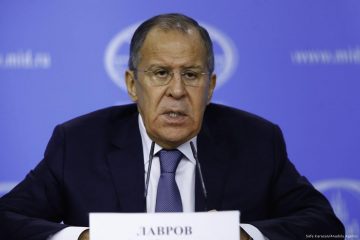 The Russian foreign ministry said a recent law passed by Israel which declares the country a state for all Jews “complicates the peace process” and “increases regional tension”.
Russian foreign ministry official, Artyom Kozhin, said unilateral steps do not serve peace, raise tension and greatly hamper efforts to launch the peace process.
“A just and guaranteed settlement of the Palestinian-Israeli conflict must be based on the principles of international law, relevant Security Council resolutions and the UN General Assembly, which provide to settle all final issues through negotiations,” he added.
Last Thursday, the Israeli Knesset passed the “nation state bill” into law which limits self-determination right to Jews only.
Read:
Israel is challenging the world – I am an Apartheid state, what are you going to do about it?
July 25, 2018
Posted by aletho |
Ethnic Cleansing, Racism, Zionism, Illegal Occupation, Timeless or most popular | Human rights, Israel, Palestine, Russia |
Leave a comment
UK Labour Party has called on the Conservative government to make clear whether the secret blacklists of civil servants, introduced by the cabinet of former Prime Minister Margaret Thatcher, are still in place, Shadow Lord President of the Council Jon Trickett said on Wednesday.
“How many civil servants were denied career progression because of a paranoia that ran to the top of the Thatcher government? Former and current civil servants must be deeply unsettled. The Cabinet Office must provide immediate and full transparency on whether spying on civil servants, in any form, continues to this day,” Trickett said, as quoted by The Guardian newspaper.
Earlier this week, the UK National Archives released papers showing that Thatcher’s government, together with MI5, the nation’s domestic intelligence agency, prepared a list of 1,420 civil servants, primarily leftists, who were regarded as potentially subversive. Persons from the list faced problems with career promotion.
He pointed out that civil servants had a right to know whether they were being monitored for their political beliefs.
The Guardian sent a request to the Cabinet Office concerning the blacklists, and the latter responded by saying the issue was a “historical matter.”
July 25, 2018
Posted by aletho |
Civil Liberties, Timeless or most popular | Human rights, MI5, UK |
Leave a comment

July 27, 2018 marks the 65th anniversary of the Armistice Agreement which brought about a ceasefire to the Korean War. The agreement was signed by North Korean General Nam Il representing both the Korean People’s Army (KPA) as well as the Chinese People’s Volunteer Army (PVA) and U.S. Army Lieutenant General Harrison, Jr. representing the United Nations Command (UNC).
While the purpose of the agreement was to “ensure a complete cessation of hostilities and of all acts of armed force in Korea until a final peaceful settlement is achieved,” the effect was an unending Korean War with decades of escalating military tension on the Korean Peninsula. And a number of arrangements made on July 27, 1953 have yet to be implemented. Most notably, the U.S. has failed to contribute a plan for withdrawing its troops within the timeframe that was discussed in Article IV of the agreement:
In order to ensure the peaceful settlement of the Korean question, the military Commanders of both sides hereby recommend to the governments of the countries concerned on both sides that, within three (3) months after the Armistice Agreement is signed and becomes effective, a political conference of a higher level of both sides be held by representatives appointed respectively to settle through negotiation the questions of the withdrawal of all foreign forces from Korea, the peaceful settlement of the Korean question, etc.
While all other foreign forces eventually withdrew, the U.S. military never left Korean soil. To this day, the U.S. has more than 28,500 of its troops stationed all over South Korea.
With the anniversary of the Armistice Agreement just around the corner, ZoominKorea spoke with Gregory Elich — member of the Solidarity Committee for Democracy and Peace in Korea and frequent contributor for ZoominKorea — about the significance of the armistice and the conditions necessary to establish permanent peace on the Korean Peninsula.
ZoominKorea: July 27 marks the 65th anniversary of North Korea (with China) and the U.S. (representing UN forces) signing the armistice to agree on a temporary ceasefire to the Korean War. Can you tell us more about the agreement — what was it supposed to do and what actually transpired following the signing?
Elich: The armistice was meant to be an interim measure to implement a ceasefire until a peace treaty would be signed. Technically speaking, then, the parties to the conflict remain at war. The armistice agreement stipulated that within three months the three sides would meet to negotiate the terms of a peaceful settlement of the war. That deadline was missed, but once the meeting did take place, the U.S. representatives were unwilling to discuss the subject of a peace treaty. Decades later, that remains the position of the United States.
On the rare occasions that U.S. media address the topic of a peace treaty, the general attitude is that the matter does not involve the United States, and dark motives are likely behind North Korea’s wish to sign a peace treaty that would formally end the Korean War.
However, the United States, along with China and North Korea, committed to negotiating a peace treaty when they signed the armistice agreement. That responsibility remains with the three parties, including the U.S. No one else can formally end the Korean War, nor can any single nation do so without the agreement of the others.
ZoominKorea: Although it is critical for the American public to understand that cooperation by the U.S. is necessary to ensure permanent peace in Korea, the cooperation between North and South Korea is also immensely important in establishing meaningful and lasting peace.
How do you see the April 27 Panmunjom Declaration playing a role in ending the Korean War?
Elich: The third section of the Panmunjom Declaration explicitly states that ending the “unnatural state of armistice” and establishing a peace regime should not be delayed. The declaration identifies this as a matter of urgent concern. So in a real way, the subject of a peace treaty is now on the South Korean agenda. That will make it more difficult for the United States to dismiss the issue.
Beyond that, the Panmunjom Declaration has enormous potential for the future of the Korean Peninsula, going far beyond the signing of a peace treaty. It is interesting to note that the first article specifies that the two Koreas will determine their destiny on their own accord. The unmistakable message is that only Koreans can choose their future, not the United States. In Kim Jong-Un’s eyes, that is the path the two Koreas should be following now. I am not sure the ever-cautious South Korean President Moon Jae-in is entirely on board with that perception, though, and he may feel that for the foreseeable future nothing can be done without the permission of the United States.
The declaration lays out specific measures to be taken to reduce tensions between the two Koreas and to build mutual trust. That comes as a welcome development after the damage done to relations by the two previous South Korean presidents. Of particular importance is the provision to implement the October 4, 2007 economic agreements between the two Koreas that former South Korean President Lee Myung-bak killed off. Those agreements hold great potential for the economic development of the entire peninsula. Unfortunately, no progress on those can be expected before the lifting of sanctions on North Korea.
ZoominKorea: North Korea has emphasized the importance of ending the Korean War, not only in its recent negotiations with South Korea and the U.S. but also for decades, since the Armistice Agreement. Progressive Koreans in the South and Overseas have also called for the end to the military conflict and signing of a peace treaty. To them, that is the priority.
To the majority of the Washington establishment and the U.S. media, however, denuclearization is the priority.
Indeed, there are many agreements to be made between signing the peace treaty and denuclearizing the Korean Peninsula — but what do you think is the most logical process for establishing peace in Korea?
Elich: In general, it makes logical sense for a peace treaty to be among the initial steps adopted in repairing relations. I see this mainly as cleaning up unfinished business from decades ago. There are complications, though.
As you point out, North Koreans and progressive Koreans in the South and abroad attach tremendous importance to the signing of a peace treaty. There is a good deal of hope that other benefits are inherent, such as an end to enmity and the withdrawal of U.S. forces from the peninsula. I don’t believe we can expect anything more from a peace treaty, in and of itself, beyond its symbolic value and the encouragement it gives to ongoing talks. After a peace treaty is signed, every other step to improve relations is a matter for further negotiation and determined struggle.
On its own, a peace treaty will not trigger a withdrawal of U.S. forces. After all, World War II ended 73 years ago, yet the U.S. military remains firmly ensconced in Germany, Japan, and Okinawa. There is no sign that the United States has any intention of ever departing.
Aside from North Korea, in the years since the Second World War the United States has officially been at peace with all of the nations it has sanctioned, threatened, subverted, bombed, and invaded. North Korea will need more solid security guarantees than a peace treaty if it is going to denuclearize.
U.S. policymakers envision expanding the role of U.S. Forces Korea (USFK) beyond the Korean Peninsula, and that will make it extremely difficult to dislodge troops from the Korean Peninsula.
Washington think tanks argue that USFK should shift from the so-called North Korea deterrence role to a regional contingency force. That is, the objective is for U.S. forces based in South Korea to be poised to intervene anywhere in Asia. This concept is in line with the Defense Department’s National Defense Strategy document, which calls for “increased strategic flexibility and freedom of action.” In the context of that policy, an improvement in U.S.-North Korean relations is irrelevant to regional plans for USFK.
There is the additional factor that USFK is a critical component in the overarching policy of encircling China and Russia, one which U.S. military planners are not going to relinquish willingly.
That does not mean the two Koreas should not pursue the withdrawal of USFK in talks with the United States. My point is that immediate removal of U.S. forces is improbable and the challenges should not be underestimated. At the very least, it will take a determined struggle to effect change. One of the main barriers that Korean progressives will have to overcome is that the U.S. military doesn’t care what citizens in any host country think about its forces. U.S. bases have been established abroad to serve imperial interests, not those of the host countries.
For the U.S. side, signing a peace treaty would make sense as a low-cost means of demonstrating goodwill and reciprocity to its interlocutors on the North Korean side. A peace treaty obligates the United States to nothing while giving North Korea something it fervently desires. That would only improve the atmosphere in talks and hasten progress toward a final agreement.
In the months ahead, if the Trump administration proves resistant to the idea of a peace treaty, then that would probably be an indication that think tank advisors are negatively influencing the U.S. negotiating strategy.
No matter what the Trump administration decides, a peace treaty may not be in the cards in the near term. A peace treaty would require approval by a two-thirds majority in the U.S. Senate before Trump could ratify it. In the current U.S. political environment, that seems like an insurmountable hurdle. Consequently, the reality is that while a peace treaty is a logical first step, it is far more likely to take place among the final stages. The completion of denuclearization may reduce the ferocity of Senate resistance to a level that would allow approval. The Trump administration may decide to postpone the signing until late in the process so as to avoid the awkwardness of Senate disapproval during negotiations with North Korea.
I see Korean reunification as a long-term goal that can only come about after U.S.-North Korean relations have substantially improved and South Korea is better able to act in its own best interests without seeking permission from the United States. Otherwise, American interference would present too high an obstacle.
ZoominKorea: What do you make of the U.S. media and its coverage of the negotiations in progress between the Trump administration and North Korea? Pundits as well as members of Congress (including members of the Democratic Party) have been vocal about criticizing Trump and his cabinet for the way they have been handling the negotiations with the North Korean leadership. Many have called out Trump for appeasing the North Koreans “too much.” What do you assess to be the motivation behind this? What kind of an impact could this have on the talks moving forward?
Elich: The Washington establishment is uneasy over President Trump’s erratic behavior. Indeed, one could even say there is open panic. There is concern over whether Trump can be consistently counted on to pay the expected fealty to the Washington consensus on foreign policy and prioritize the needs of large corporations and military contractors. The fear is that at some point Trump, through sheer misunderstanding and carelessness, may put at risk the entrenched “values” of aggressive militarism and global economic and political domination.
The hysterical cries of treason over Trump’s meeting with Russian President Vladimir Putin are another manifestation of that panic.
There are two immediate concerns. One is that normalizing relations with North Korea would lead to a growing demand among South Koreans for U.S. forces to leave the peninsula. The other is that without North Korea as an official enemy, the pretext for stationing troops in South Korea would vanish.
One does not have to search very long among Washington think tank documents to encounter warnings that signing a peace treaty would be a trap which would remove U.S. forces from the region so that North Korea could be free to attack the South. One wonders if these analysts genuinely believe this nonsense or if that is their way of dissuading the Trump administration from agreeing to a peace treaty.
In addition to these generalized concerns, military contractors, whose lobbyists are quite active on Capitol Hill, have specific worries. Over the last five-year period, South Korea ranks second behind Saudi Arabia in the value of arms purchased from the United States. For arms manufacturers, a peaceful resolution of tensions on the Korean Peninsula would be a disastrous development that would eventually cut into future profits. Investor jitteriness was displayed when the five largest U.S. military contractors lost $10 billion in stock market value on the day of the signing of the Panmunjom Declaration.
Vociferous complaints by Western media and politicians about the Singapore Summit and ongoing talks are intended to undermine the process and block any possibility of a diplomatic settlement.
ZoominKorea: While the U.S. media have been critical of the results of the Singapore Summit, many progressive Korean American and U.S.-based activists have welcomed this first major step to the peace process. Since more than a month has passed, how do you now assess the results of the summit?
Earlier this month, as a follow-up to the Singapore Summit, State Secretary Pompeo visited Pyongyang to further discuss the denuclearization deal. From North Korea’s perspective, the latest visit was somewhat of a setback because of the United States’ recapitulation of hardline demands for a denuclearization process similar to that of the Complete Verifiable Irreversible Denuclearization (CVID) approach that undermines the spirit of the Singapore Summit. Pompeo, on the other hand, claimed that the meeting was conducted in good faith and he had “made progress on almost all central matters.”
With the U.S. still unable to acknowledge that it is not doing enough to build trust with North Korea, how do you foresee the negotiations to move forward?
Elich: The first point I would like to make is the fact that talks are happening at all should be regarded as a victory. Eight years of the Obama administration refusing to negotiate, followed by Trump’s bluster and threats during the first year of his administration, have done nothing positive for the region or the international situation. During that time, Washington’s attitude was that pressure and threats “haven’t worked,” therefore more pressure and threats are needed. The rational conclusion that no progress can be made without dialogue was dismissed out of hand.
Chairman Kim Jong Un made a bold move to change the narrative this year, announcing a unilateral freeze on nuclear development and missile testing, while explicitly expressing his intention to denuclearize in the context of an agreement with the U.S. Then came the demolition of North Korea’s nuclear test site. North Korea’s peace drive prompted Washington to re-engage with North Korea. In a positive response, the U.S. implemented a temporary pause in military exercises on the Korean Peninsula as long as talks continue.
Contrary to what Western critics assert, the Singapore Summit was never intended to produce a detailed agreement. The meeting was a declaration of intent to negotiate a mutually beneficial deal. Given the hostile rhetoric that dominated relations and which continues to characterize U.S. media, the summit was an essential initial step in the direction of positive change.
The various shifts in the U.S. position seem to indicate that there is a dichotomy of views within the Trump administration concerning what avenue to follow in negotiations, and each side appears to be struggling to gain the upper hand.
The default position is the unworkable notion that diplomacy should consist of making endless demands on the other party while offering little or nothing in return. However, North Korea is not negotiating from a position of weakness. In its nearly complete nuclear weapons program it has something substantial to trade. It would be a mistake to imagine that North Korea would consider giving that up without receiving anything meaningful in return.
It is the job of the U.S. media to discipline U.S. negotiators and pressure them into rejecting normal diplomatic give-and-take and stick to the pattern of making demands for unilateral concessions. This pressure may explain Secretary of State Mike Pompeo’s recent assertions that sanctions will remain in place until after denuclearization is complete. Presumably, Pompeo’s recent statements are meant to reassure critics, who in any case will not be mollified by anything less than the total abandonment of diplomacy and a return to saber rattling.
It is true that the U.S. and North Korea have divergent concepts on how talks should proceed, with the U.S. expecting something along the lines of the Libyan model, where the other party must meet all U.S. demands in exchange for vague promises of future compensating measures. North Korea, quite reasonably, wants a measured, step-by-step approach, where both parties give each other something as they advance towards their ultimate goals.
It should also be pointed out that from the North Korean perspective denuclearization of the Korean Peninsula is not entirely a one-way road. It would also entail a commitment by the United States to no longer send nuclear-capable B-2 and B-52 bombers flying over the Korean Peninsula.
The main component in an agreement is a security guarantee to North Korea. Its nuclear deterrent, after all, was developed in response to the hostile policy of the U.S., as well as the vivid object lessons provided by the bombing of Yugoslavia and Libya, and the invasion of Iraq. It is difficult to imagine, though, what kind of security guarantee the United States can offer that could be trusted. A piece of paper is not going to do it. It may be that the Trump administration would be sincere in signing such a document. But the next U.S. administration may have no compunction in abandoning it. I assume that a reliable security guarantee will have to involve not only the U.S. but also Russia and China in some manner.
Despite all of the hindrances, once negotiations are seriously underway I see a real prospect of favorable results. I feel that at some point as U.S. negotiators meet with their North Korean counterparts it will become apparent that they have an opportunity to achieve their goals, but only by adopting a more even-handed approach. That realization should provide the impetus to adopt a more flexible manner. Whether or not that path is followed remains to be seen, as a more even-handed approach is sure to engender a determined backlash from the Washington establishment and U.S. media. My feeling is that the desire to achieve denuclearization will override the impact of political opposition, and there is a more than even chance of a diplomatic settlement.
Gregory Elich is on the Board of Directors of the Jasenovac Research Institute and a Korea Policy Institute associate. He is a member of the Solidarity Committee for Democracy and Peace in Korea, and a columnist for Voice of the People. He is the author of Strange Liberators: Militarism, Mayhem, and the Pursuit of Profit, and has two chapters in the anthology Killing Democracy: CIA and Pentagon Operations in the Post-Soviet Period, published in the Russian language. In 1999, he was a member of a team that visited Yugoslavia to investigate NATO war crimes.
July 24, 2018
Posted by aletho |
Mainstream Media, Warmongering, Militarism, Timeless or most popular | Korea, United States |
Leave a comment
Another Liberal broken promise. Before becoming prime minister, Justin Trudeau promised to re-engage with Iran. His government has failed to do so and is beginning to echo the warmongers in Washington and Tel Aviv.
“I would hope that Canada would be able to reopen its mission [in Tehran],” Trudeau told the CBC in June 2015. “I’m fairly certain that there are ways to re-engage [Iran],” he said.
Nearly three years into their mandate the Liberals haven’t restarted diplomatic relations with Iran. Nor has Trudeau removed that country from Canada’s state sponsor of terrorism list (Syria is the only other country on the list).
Numerous Canadian sanctions targeting Iran remain and Ottawa continues to present a yearly UN resolution critical of the human rights situation in Iran. Similarly, Liberal MPs participate in the annual “Iran Accountability Week” on Parliament Hill, which showcases individuals such as Mark Dubowitz, CEO of the Foundation for the Defense of Democracies, which helped kill the nuclear deal and is pushing harsh sanctions against any country doing business with Iran.
Dubowitz is a senior research fellow at the University of Toronto’s Munk School of Global Affairs. In 2015 Global Affairs Canada gave the Munk School’s Digital Public Square $9 million to expand an anti-Iranian initiative, which the Trudeau government appears to have maintained.
Trudeau has continued important components of the Stephen Harper government’s “low-level war against Iran”. One major exception had been on the rhetorical front, but that’s changing. In January foreign minister Chrystia Freeland put out a statement saying, “Canada is deeply troubled by the recent deaths and detentions of protesters in Iran” and two months ago tweeted, “Our government is committed to holding Iran to account for its violations of human and democratic rights.” Last month Liberal parliamentarians supported a Conservative MP’s private member’s motion that “strongly condemns the current regime in Iran for its ongoing sponsorship of terrorism around the world, including instigating violent attacks on the Gaza border.” In effect, the resolution makes Iran responsible for Israel killing Palestinians peacefully protesting the US Jerusalem embassy move, siege of Gaza and historic theft of their land. The motion also called on Canada to “immediately cease any and all negotiations or discussions with the Islamic Republic of Iran to restore diplomatic relations” and to make the highly provocative move of listing the Islamic Revolutionary Guard Corps as a terrorist entity.
The Liberals hardline on Iran coincides with Trump withdrawing from the “p5+1 nuclear deal” with Iran and re-imposing tough new sanctions. Now, Washington is threatening to sanction any country that buys Iranian oil. (If the US succeeds Tehran says it will seek to block oil shipments through the Strait of Hormuz.)
The US and Israel recently created a “working group” to foment internal protests in Iran. (Demonstrating once again the hypocrisy of US complaints about other countries interfering in its elections.) According to Axios, “Israel and the United States formed a joint working group a few months ago that is focused on internal efforts to encourage protests within Iran and pressure the country’s government.” In May the Washington Free Beacon reported on a three-page paper discussed by the US National Security Council to spark regime change in Iran.
Three weeks ago Trump’s personal lawyer, Rudy Giuliani, called for regime change at a National Council of Resistance of Iran conference in Paris. (Harper also spoke at an event led by the Mujahedin-e Khalq, a cultish group that was previously deemed to be a terrorist organization.) Previously Giuliani said, “we got a president who is tough, who does not listen to the people who are naysayers, and a president who is committed to regime change [in Iran].” (In “Follow The Money: Three Billionaires Paved Way For Trump’s Iran Deal Withdrawal” Eli Clifton describes the role of arch Zionist donors, notably casino magnate Sheldon Adelson, in shaping US Iran policy.)
In April Trump appointed John Bolton as his national security advisor. An important proponent of the 2003 invasion of Iraq, Bolton has called for bombing Iran, penning an op-ed in the New York Times headlined “To Stop Iran’s Bomb, Bomb Iran”.
By breaking his promise to restart diplomatic relations with Iran Trudeau has enabled US-Israeli hawks. In taking up their rhetoric the Liberal Party is further empowering those hurtling towards a major conflict. Shame.
July 24, 2018
Posted by aletho |
Mainstream Media, Warmongering, Timeless or most popular, Wars for Israel | Canada, Iran, Munk School of Global Affairs |
Leave a comment
 Aletho News
