Zionist Media: ‘Israel’ Involved in Assassination of Syrian Scientist Aziz Azbar

Al-Manar | August 6, 2018
Israeli media outlets reported Monday that the Zionist Mossad intelligence agencywas involved in the assassination of Syrian scientist Aziz Azbar, head of the Syrian Scientific Research and Studies Center, in the city of Masyaf in Hamah province on Saturday.
The Zionist media reports stressed that this operation comes in the context of the secret war on the axis-of-resistance to prevent it from developing its military capabilities, adding that Mossad has returned to play a direct role in eradicating ‘Israel’s’ enemies in several countries.
It is worth noting that Azbar, who holds a Ph.D. in atomic physics and a Ph.D. in liquid rocket fuel from France, was mourned on Monday in his hometown.
Marching for Peace: From Helmand to Hiroshima
By Maya Evans | Dissident Voice | August 5, 2018
I have just arrived in Hiroshima with a group of Japanese “Okinawa to Hiroshima peace walkers” who had spent nearly two months walking Japanese roads protesting U.S. militarism. While we were walking, an Afghan peace march that had set off in May was enduring 700km of Afghan roadsides, poorly shod, from Helmand province to Afghanistan’s capital of Kabul. Our march watched the progress of theirs with interest and awe. The unusual Afghan group had started off as 6 individuals, emerging out of a sit-in protest and hunger strike in the Helmand provincial capital Lashkar Gah, after a suicide attack there created dozens of casualties. As they started walking their numbers soon swelled to 50 plus as the group braved roadside bombs, fighting between warring parties and exhaustion from desert walking during the strict fast month of Ramadan.
The Afghan march, which is believed to be the first of its kind, is asking for a long-term ceasefire between warring parties and the withdrawal of foreign troops. One peace walker, named Abdullah Malik Hamdard, felt that he had nothing to lose by joining the march. He said: “Everybody thinks they will be killed soon, the situation for those alive is miserable. If you don’t die in the war, the poverty caused by the war may kill you, which is why I think the only option left for me is to join the peace convoy.”
The Japanese peace walkers marched to specifically halt the construction of a U.S. airfield and port with an ammunition depot in Henoko, Okinawa, which will be accomplished by landfilling Oura Bay, a habitat for the dugong and unique coral hundreds of years old, but many more lives are endangered. Kamoshita Shonin, a peace walk organizer who lives in Okinawa, says:
People in mainland Japan do not hear about the extensive bombings by the U.S. in the Middle East and Afghanistan, they are told that the bases are a deterrent against North Korea and China, but the bases are not about protecting us, they are about invading other countries. This is why I organised the walk.
Sadly, the two unconnected marches shared one tragic cause as motivation.
Recent U.S. war crimes in Afghanistan include the deliberate targeting of civilian wedding parties and funerals, incarceration without trial and torture in Bagram prison camp, the bombing of an MSF hospital in Kunduz, the dropping of the ‘Mother of all bombs’ in Nangarhar, illegal transportation of Afghans to secret black site prisons, Guantanamo Bay prison camp, and the extensive use of armed drones. Elsewhere the U.S. has completely destabilised the Middle East and Central Asia, according to The Physicians for Social Responsibility, in a report released in 2015, stated that the U.S. interventions in Iraq, Afghanistan and Pakistan alone killed close to 2 million, and that the figure was closer to 4 million when tallying up the deaths of civilians caused by the U.S. in other countries, such as Syria and Yemen.
The Japanese group intend to offer prayers of peace this Monday at Hiroshima ground zero, 73 years to the day after the U.S. dropped an atomic bomb on the city, instantly evaporating 140,000 lives, arguably one of the worst ‘single event’ war crimes committed in human history. Three days later the U.S. hit Nagasaki instantly killing 70,000. Four months after the bombing the total death toll had reached 280,000 as injuries and the impact of radiation doubled the number of fatalities.
Today Okinawa, long a target for discrimination by Japanese authorities, accommodates 33 U.S. military bases, occupying 20% of the land, housing some 30,000 plus U.S. Marines who carry out dangerous training exercises ranging from rope hangs suspended out of Osprey helicopters (often over built-up residential areas), to jungle trainings which run straight through villages, arrogantly using people’s gardens and farms as mock conflict zones. Of the 14,000 U.S. troops currently stationed in Afghanistan, many to most would have trained on Okinawa, and even flown out directly from the Japanese Island to U.S. bases such as Bagram.
Meanwhile in Afghanistan the walkers, who call themselves the ‘People’s Peace Movement’, are following up their heroic ordeal with protests outside various foreign embassies in Kabul. This week they are outside the Iranian Embassy demanding an end to Iranian interference in Afghan matters and their equipping armed militant groups in the country. It is lost on no-one in the region that the U.S., which cites such Iranian interference as its pretext for building up towards a U.S.-Iran war, is an incomparably more serious supplier of deadly arms and destabilizing force to the region. They have staged sit-in protests outside the U.S., Russian, Pakistani and U.K. embassies, as well as the U.N. offices in Kabul.
The head of their impromptu movement, Mohammad Iqbal Khyber, says the group have formed a committee comprised of elders and religious scholars. The assignment of the committee is to travel from Kabul to Taliban-controlled areas to negotiate peace.
The U.S. have yet to describe its long term or exit strategy for Afghanistan. Last December Vice President Mike Pence addressed U.S. troops in Bagram: “I say with confidence, because of all of you and all those that have gone before and our allies and partners, I believe victory is closer than ever before.”
But time spent walking doesn’t bring your destination closer when you don’t have a map. More recently U.K. ambassador for Afghanistan Sir Nicholas Kay, while speaking on how to resolve conflict in Afghanistan said: “I don’t have the answer.” There never was a military answer for Afghanistan. Seventeen years of ‘coming closer to victory’ in eliminating a developing nation’s domestic resistance is what is called “defeat,” but the longer the war goes on, the greater the defeat for Afghanistan’s people.
Historically the U.K. has been closely wedded to the U.S. in their ‘special relationship’, sinking British lives and money into every conflict the U.S. has initiated. This means the U.K. was complicit in dropping 2,911 weapons on Afghanistan in the first 6 months of 2018, and in President Trump’s greater-than-fourfold average increase on the number of bombs dropped daily by his warlike predecessors. Last month Prime Minister Theresa May increased the number of British troops serving in Afghanistan to more than 1,000, the biggest U.K. military commitment to Afghanistan since David Cameron withdrew all combat troops four years ago.
Unbelievably, current headlines read that after 17 years of fighting, the U.S. and Afghan Government are considering collaboration with the extremist Taliban in order to defeat ISKP, the local ‘franchise’ of Daesh.
Meanwhile UNAMA has released its mid-year assessment of the harm done to civilians. It found that more civilians were killed in the first six months of 2018 than in any year since 2009, when UNAMA started systematic monitoring. This was despite the Eid ul-Fitr ceasefire, which all parties to the conflict, apart from ISKP, honoured.
Every day in the first six months of 2018, an average of nine Afghan civilians, including two children, were killed in the conflict. An average of nineteen civilians, including five children, were injured every day.
This October Afghanistan will enter its 18th year of war with the U.S. and supporting NATO countries. Those young people now signing up to fight on all sides were in nappies when 9/11 took place. As the ‘war on terror’ generation comes of age, their status quo is perpetual war, a complete brainwashing that war is inevitable, which was the exact intention of warring decision makers who have become exceedingly rich of the spoils of war.
Optimistically there is also a generation who are saying “no more war, we want our lives back”, perhaps the silver lining of the Trump cloud is that people are finally starting to wake up and see the complete lack of wisdom behind the U.S. and its hostile foreign and domestic policies, while the people follow in the steps of non-violent peace makers such as Abdul Ghafoor Khan, the change is marching from the bottom up.

Okinawa to Hiroshima Peace Walk (Photo by Maya Evans)
Maya Evans coordinates Voices for Creative Nonviolence UK and has visited Afghanistan 9 times since 2011. She is a writer and a Councillor for her town in Hastings, England.
AngloZionist Attack Options Against Iran
The Saker • Unz Review • August 3, 2018
In the past few days, the Internet has been flooded with a frankly silly rumor about the US soliciting Australia’s assistance in preparing an attack on Iran. Needless to say, that report does not explain what capabilities Australia would possess which the US would lack, but never-mind that. Still, the report was picked up in too many places (see here, here and here ) to be ignored. In one of these reports, Eric Margolis has described what such a US attack could look like. It is worth quoting him in full:
Outline of a possible AngloZionist attack on Iran
The US and Israel will surely avoid a massive, costly land campaign again Iran, a vast, mountainous nation that was willing to suffer a million battle casualties in its eight-year war with Iraq that started in 1980. This gruesome war was instigated by the US, Britain, Kuwait and Saudi Arabia to overthrow Iran’s new popular Islamic government.
The Pentagon has planned a high-intensity air war against Iran that Israel and the Saudis might very well join. The plan calls for over 2,300 air strikes against Iranian strategic targets: airfields and naval bases, arms and petroleum, oil and lubricant depots, telecommunication nodes, radar, factories, military headquarters, ports, waterworks, airports, missile bases and units of the Revolutionary Guards.
Iran’s air defenses range from feeble to non-existent. Decades of US-led military and commercial embargos against Iran have left it as decrepit and enfeebled as was Iraq when the US invaded in 2003. The gun barrels of Iran’s 70’s vintage tanks are warped and can’t shoot straight, its old British and Soviet AA missiles are mostly unusable, and its ancient MiG and Chinese fighters ready for the museum, notably its antique US-built F-14 Tomcats, Chinese copies of obsolete MiG-21’s, and a handful of barely working F-4 Phantoms of Vietnam War vintage.
Air combat command is no better. Everything electronic that Iran has will be fried or blown up in the first hours of a US attack. Iran’s little navy will be sunk in the opening attacks. Its oil industry may be destroyed or partially preserved depending on US post-war plans for Iran.
The only way Tehran can riposte is by staging isolated commando attacks on US installations in the Mideast of no decisive value, and, of course, blocking the narrow Strait of Hormuz that carries two-thirds of Mideast oil exports. The US Navy, based nearby in Bahrain, has been practicing for decades to combat this threat.
There is a lot of interesting material in this description and I think that it is worth looking into it segment by segment.
First, I can only agree with Margolis that neither the US nor Israel want a ground war against Iran: the country is too big, the Iranians too well prepared and the size of the force needed for such a campaign way beyond what the Empire can currently muster.
Second, Margolis is absolutely correct when he says that Iran does not have the means to stop a determined AngloZionist (missiles and aircraft) attack. Iran does have some modern air-defense capabilities, and the attackers will sustain a number of losses, but at this point, the size disparity is so huge that the AngloZionists will achieve air superiority fairly soon and that will give them an opportunity to bomb whatever they want to bomb (more about that later).
Assessing Iranian air defenses is not just a matter of counting missiles and launchers, however, and there is much more to this. According to one Russian source Iran has 4 long range anti-aircraft missile S-300PMU-2 systems (with 48Н6Е2 Mach 6,6 interceptor missiles), 29 military anti-aircraft self-propelled missile complexes Tor-M1, some fairly advanced anti-aircraft missile complexes like the Bavar-373, a passive electronically scanned array radar (whose illumination and guidance system almost certainly includes modern Chinese electronics) and an impressive number of radar systems early warning radar of the Russian, Chinese and Iranian manufacture. This category includes systems like the high-potential long-range radar detection and target designation Najm-802 radar (has 5120 receiving and transmitting modules, operates in the decimeter S-range and is designed to detect ballistic targets and small elements of high-precision weapons), the Russian meter radar “Nebo-SVU” advanced early warning and control system with a fixed-array radar, as well as a meter range early warning radar of the type “Ghadir” . Most importantly, these radars are all integrated into the network-centric missile defense system of Iran. For example, the “Ghadir” radar is able to detect not only the tactical fighters of the USAF, the KSA and Israel, but also ballistic missiles immediately after launch (at a distance of about 1100 km). As a result, the presence of Iranian radio engineering units of multi-band radar detection facilities in the Western direction (the Persian Gulf) will allow the Iranians to prepare a flexible echeloned air defense to defend against high-intensity missile strikes. And yet, no matter how much the Iranians have improved their air defenses, the sheer number of of missiles (including the new advanced AGM-158 JASSM (Joint Air-to-Surface Standoff Missile) low observable standoff air-launched cruise missile delivered by B-1B bombers) means that the Iranian defenses will inevitably be overwhelmed by any massive attack.
I therefore also agree with Margolis that the Iranian oil industry cannot be protected from a determined US/Israeli attack. In fact, the entire Iranian infrastructure is vulnerable to attack.
Margolis’ final paragraph, however, makes it sound like Iran does not have credible retaliatory options and that I very much disagree with.
Example one: Iranian capabilities in the Strait of Hormuz
For one thing, the issue of the Strait of Hormuz is much more complicated than just “the US Navy has practiced for years to combat this threat“. The reality is that Iran has a very wide range of options to make shipping through this strait practically impossible. These options range from underwater mines, to fast craft attacks, to anti-shipping missiles, to coastal artillery strikes, etc.
Therein also lies a big danger: the Israelis and or the US could very easily organize a false flag attack on any ship in the Strait of Hormuz, then accuse Iran, there would be the usual “highly likely” buzzword from all the AngloZionst intelligence agencies and, voilà, the Empire would have a pretext to attack Iran.
In fact, the mere fact of issuing a threat to shipping through this narrow body of water might well deter insurances from providing coverage to any ships and that might stop the shipping all by itself. Should that not be enough, Iran can always lay even a limited amount of mines, and that will be enough (please keep in mind that while the USN could try to engage in mineclearing operations, to do so right off the coast of Iran would expose USN minesweepers to an extreme danger of attack).
Margolis does mention this issue when he writes:
While Iran may be able to interdict some oil exports from the Arab states and cause maritime insurance rates to skyrocket, it’s unlikely to be able to block the bulk of oil exports unless it attacks the main oil terminals in Saudi Arabia and the Gulf with ground troops. During the Iran-Iraq war, neither side was able to fully interdict the other’s oil exports.
However, I believe that grossly under-estimates the Iranian capabilities in this context. Let’s take one example, the Iranian submarine force.
The Iranian submarine force is a highly specialized one. According to the 2018 Edition of the IISS’s Military Balance, the Iranians currently have 21 submarines deployed:
- 3 Taregh-class diesel-electric submarine (Russian Kilo-class Project-877EKM)
- 1 Fateh-class coastal submarine
- 16 Ghadir-class midget submarines
- 1 Nahand-class midget submarine
When most people hear “diesel-electric,” they think of old diesel trucks, and are not impressed, especially when these are contrasted with putatively “advanced” nuclear attack submarines. This is, however, a very mistaken opinion because submarines can only to be assessed in the environment they are designed to operate in. Naval geography is typically roughly divided into three types: blue water (open ocean), green water (continental shelves) and brown water (coastal regions). Nuclear attack submarines are only superior in the blue water environment where autonomy, speed, diving depth, weapon storage capacity, advanced sonars, etc. are crucial. In comparison, while diesel-electric submarines are slower, need to resurface to recharge their batteries and are typically smaller and with fewer weapons onboard, they are also much better suited for green water operations. In shallow brown water, midget submarines reign, if only because nuclear attack submarines were never designed to operate in such an environment. Now take a quick look at the kind of environment the Strait of Hormuz constitutes:

Notice the interesting combination of very shallow and shallow depth typical of brown water and then the green water type of environment when going further into the Gulf of Oman and the Arabian Sea. With this in mind, let’s see what kind of submarine force Iran has acquired/developed:
For brown water operations (Persian Gulf and Strait of Hormuz) Iran has a relatively large and capable fleet of midget submarines. For green water operations (the Gulf of Oman and the Arabian Sea), Iran has three formidable Taregh/Kilo-class submarines (which are even capable of limited blue water operations, though with much less autonomy, speed, armament or sonar than a nuclear attack submarine). Just like “diesel-electric”, the term “midget” submarine makes it sound that we are talking about a toy or, at best, some primitive third world hack which, at best, could be used to smuggle drugs. In reality, however, the Iranian “midgets” can carry the same heavyweight torpedoes (533 mm) as the Kilos, only in smaller quantities. This also means that they can carry the same missiles and mines. In fact, I would argue that Iranian Ghadir-class “midget” submarines represent a much more formidable threat in the Persian Gulf than even the most advanced nuclear attack submarines could.
The US has stopped producing diesel-electric submarines many years ago because it believed that being a hegemonic power with a typical (aircraft carrier-centric) blue water navy it had no need for green or brown water capabilities. Other countries (such as Russia, Germany, Sweden and others) actively pursued a diesel-electric submarine program (including so-called “air-independent propulsion” – AIP – ones) because they correctly understood that these submarines are much cheaper while being also much better suited for coastal defensive operations. Ditching diesel-electric submarines was yet another major mistake by US force planners; see this article on this topic. The new Littoral Combat Ship (LCS) and the Zumwalt-class guided missile destroyer were supposed to partially palliate to this lack of green and brown capabilities, but both turned out to be a disaster

Ghadir-class submarine
The Russian Kilo-class submarines are some of the most silent yet heavily armed submarines ever built, and they could potentially represent a major threat to any US naval operations against Iran. However, we can be pretty sure that the USN tracks them 24/7 and that the Kilos would become a prime target (whether in port or at sea) at the very beginning of any AngloZionist attack. But would the USN also be capable of keeping track of the much smaller (and numerous) Iranian midget submarines? Your guess is as good as mine, but I personally very much doubt that, if only because these relatively small subs are very easy to hide. Just take a look at this photo of a Ghadir-class submarine and imagine how easy it would be to hide them or, alternatively, create decoy looking just like the real thing. Yet this midget submarine could sink any vessel in the Persian Gulf with a single torpedo.
While the US definitely has a lot of very capable reconnaissance and intelligence capabilities available to try to locate and then destroy these threats, we also know that the Iranians have had decades to prepare for this scenario and that they are truly masters at what is called maskirovka in Russian military terminology: a combination of camouflage, concealment, deception, and misdirection. In fact, the Iranians are the ones who trained Hezbollah in Lebanon in this art and we all know what happened to the Israelis when they confidently waltzed into southern Lebanon only to find out that for all their reconnaissance/intelligence capabilities they were unable to deal with even a relatively primitive (technologically speaking) Hezbollah missile capability. For all the patriotic flag-waving, the truth is that if the Iranians decide to block the Strait of Hormuz the only option left for the US will be to land a force on the Iranian shore and engage in a limited but still extremely dangerous offensive land-attack operation. At this point, whether this counter-attack is successful or not will be irrelevant, as there will be so much combat activity in this narrow bottleneck that nobody will even consider to bring ships through it.
I also believe that Margolis is wrong when he writes that all Iran could do would be to stage “isolated commando attacks on US installations in the Mideast of no decisive value“. One very real Iranian option would be to strike US targets (of which there are plenty in the Middle-East) with various missiles. Furthermore, Iran can also launch missiles at US allies (Israel or the KSA) and interests (Saudi oil fields).
Example two: Iranian missile capabilities
I would not trust everything the CSIS writes (they are a very biased source, to put it mildly), but on this page, they posted a pretty good summary of the current Iranian missile capability:

On the same page, CSIS also offers a more detailed list of current and developed Iranian missiles:
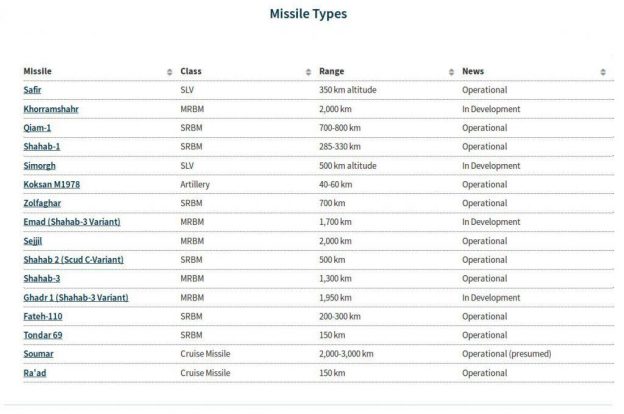
(You can also check on this Wikipedia page to compare with the CSIS info on Iranian missiles)
The big question is not whether Iran has capable missiles, but how many exactly are deployed. Nobody really knows this because the Iranians are deliberately being very vague, and for obvious and very good reasons. However, judging by the example of Hezbollah, we can be pretty sure that the Iranians also have these missiles in large enough numbers to represent a very credible deterrent capability. I would even argue that such a missile force not only represents a capable deterrent capability, but also a very useful war-fighting one. Can you imagine what would happen if US bases (especially airbases and naval facilities) in the region came under periodic Iranian missile attacks? Judging by the Israeli experience during the First Gulf War or, for that matter, the recent Saudi experience with the Houthi missiles, we can be pretty sure that the US Patriots will be useless to defend against Iranian missiles.
Oh sure, just like the US did during the First Gulf War, and the Israelis did in 2006, the AngloZionists will start a massive hunt for Iranian missile sites, but judging by all the recent wars, these hunts will not be successful enough and the Iranians will be able to sustain missile strikes for quite a long time. Just imagine what one missile strike, say, every 2-3 days on a US base in the region would do to operations or morale!
Reality check: the US is vulnerable throughout the entire Middle-East
Above I only listed two specific capabilities (subs and missiles), but the same type of analysis could be made with Iranian small speedboat swarms, electronic warfare capabilities or even cyber-warfare. But the most formidable asset the Iranians have is a very sophisticated and educated population which has had decades to prepare for an attack by the “Great Satan” and which have clearly developed an array of asymmetrical options to defend themselves and their country against the (probably inevitable) AngloZionist attack.
You have probably seen at least one map showing US military installations in the Middle-East (if not, see here, here or here). Truth be told, the fact that Iran is surrounded by US forces and bases presents a major threat to Iran. But the opposite is also true. All these US military facilities are targets, often very vulnerable ones. Furthermore, Iran can also use proxies/allies in the region to attack any of these targets. I highly recommend that you download this factsheet and read it while thinking of the potential of each listed facility to become the target of an Iranian attack.
The usual answer which I often hear to these arguments is that if the Iranians actually dared to use missiles or strike at the US bases in the region, the retaliation by the US would be absolutely terrible. However, according to Eric Margolis, the initial and main goal of a US-Israeli attack on Iran would be to “totally destroy Iran’s infrastructure, communications and transport (including oil) crippling this important nation of 80 million and taking it back to the pre-revolutionary era“. Now let me ask you this simple question: if Margolis is correct – and I personally believe that he is – then how would that outcome be different from the “absolutely terrible” retaliation supposedly planned by the US in case of Iranian counterattack? Put differently – if the Iranians realize that the AngloZionists want to lay waste to their country (say, like what the Israelis did to Lebanon in 2006), what further possible escalation would further deter them from counter-attacking with the means available to them?
To answer this question we need to look again at the real nature of the “Iranian problem” for the AngloZionists.
Real AngloZionist objectives for an attack on Iran
First and foremost, there is absolutely no evidence whatsoever that Iran has any kind of military nuclear program. The fact that the Israelis have for years been screaming about this urbi et orbi does not make it true. I would also add that common sense strongly suggests that the Iranians would have absolutely no logical reason to develop any kind of nuclear weapons. I don’t have the time and space to argue this point again (I have done so many times in the past), so I will simply refer to the US National Intelligence Estimate’s conclusion that Iran had “halted its nuclear weapons program” and leave it at that.
I don’t believe that the Iranians ever had a nuclear weapons program either, but that is irrelevant: even if they once had one, that would put them on par with many other countries which took some initial steps in the development of such a capability and then gave it up. The only point is that it is the official US position that there is no current military nuclear program in Iran.
The real problem of Iran is very simple. Iran is the only country in the world which is:
- Islamic and leads the struggle against the Saudi/Daesh/ISIS/al-Qaeda/etc. ideology of takfirism and the terrorism they promote
- Openly anti-Zionist and anti-Imperialist and combines conservative religious values with progressive social policies
- Successful politically, economically and militarily and thereby threatens the monopoly of power of Israel in the region
Any one of those features by itself would already constitute a grievous case of crimethink from the point of view of the Empire and would fully deserve a reaction of absolute hatred, fear and a grim determination to eliminate the government and people which dare to support it. No wonder that by combining all three Iran is so hated by the AngloZionists.
This entire canard about some Iranian nuclear program is just a pretext for a hate campaign and a possible attack on Iran. But in reality, the goals of the AngloZionists is not to disarm Iran, but exactly as Margolis says: to bomb this “disobedient” country and people “back to the pre-revolutionary era”.
Here is the key thing: the Iranians perfectly understand that. The obvious conclusion is this: if the purpose of an AngloZionist attack will be to bomb Iran back into the pre-revolutionary era, then why would the Iranians hold back and not offer the maximal resistance possible?
Because of the threat of a US nuclear retaliation?
US nuclear attack options – not much of an option in reality
Here again, we need to look at the context, not just assume that the use of nuclear weapons is some kind of magical panacea which immediately forces the enemy to give up the fight and to unconditionally surrender. This is far from being the truth.
First, nuclear weapons are only effective when used against a lucrative target. Just murdering civilians like what the US did in Japan does absolutely no good if your goal is to defeat your opponent’s armed forces. If anything, nuking your opponents “value” targets might only increase his determination to fight to the end. I have no doubt that, just as during the first Gulf War, the US has already made a typical list of targets it would want to strike in Iran: a mix of key government buildings and installations and a number of military units and facilities. However, in most cases, those could also be destroyed by conventional (non-nuclear) weapons. Furthermore, since the Iranians have had decades to prepare for this scenario (the US has always had Iran in its sights since the 1979 Revolution), you can be quite sure that all the peacetime facilities have been duplicated for wartime situations. Thus while many high-visibility targets will be destroyed, their wartime counterparts will immediately take over. One might think that nukes could be used to destroy deeply buried targets, and this is partially true, but some targets are buried too deep to be destroyed (even by a nuclear blast) while others are duplicated several times (say, for 1 peacetime military headquarters there would be 4, 5 or even 6 concealed and deeply buried ones). To go after each one of them would require using even more nukes and that begs the question of the political costs of such a campaign of nuclear strikes.
In political terms, the day the US uses a nuclear weapon against any enemy it will have committed political suicide from which the Hegemony will never recover. While a majority of Americans might consider that “might makes right” and “screw the UN”, for the rest of the world the first use of nuclear weapons (as opposed to a retaliatory counter-strike) is an unthinkable abomination and crime, especially for an illegal act of aggression (there is no way the UNSC will authorize a US attack on Iran). Even if the White House declares that it “had to” use nukes to “protect the world” against the “nuclear armed Ayatollah”, the vast majority of the planet will react with total outrage (especially after the Iraqi WMD canard!). Furthermore, any US nuclear strike will instantly turn the Iranians from villains into victims. Why would the US decide to pay such an exorbitant political price just to use nuclear weapons on targets which would not yield any substantial advantage for the US? Under normal circumstances, I would think that this kind of unprovoked use of nuclear weapons would be quite unthinkable and illogical. However, in the current political context in the US, there is one possibility which really frightens me.
Trump as the “disposable President” for the Neocons?
The Neocons hate Trump, but they also own him. The best example of this kind of “ownership” is the US decision to move its embassy to Jerusalem which was an incredibly stupid act, but one which the Israel Lobby demanded. The same goes for the US reneging on the Joint Comprehensive Plan of Action or, for that matter, the current stream of threats against Iran. It appears that the Neocons have a basic strategy which goes like this: “we hate Trump and everything he represents, but we also control him; let’s use him to do all the crazy stuff no sane US President would ever do, and then let’s use the fallout of these crazy decisions and blame it all on Trump; this way we get all that we want and we get to destroy Trump in the process only to replace him with one of “our guys” when the time is right“. Again, the real goal of an attack on Iran would be to bomb Iran back into a pre-revolutionary era and to punish the Iranian people for supporting the “wrong” regime thus daring to defy the AngloZionist Empire. The Neocons could use Trump as a “disposable President” who could be blamed for the ensuing chaos and political disaster while accomplishing one of the most important political objectives of Israel: laying waste to Iran. For the Neocons, this is a win-win situation: if things go well (however unlikely that is), they can take all the credit and still control Trump like a puppet, and if things don’t go well, Iran is in ruins, Trump is blamed for a stupid and crazy war, and the Clinton gang will be poised to come back to power.
The biggest loser in such a scenario would, of course, be the people of Iran. But the US military will not fare well either. For one thing, a plan to just “lay waste” to Iran has no viable exit strategy, especially not a short-term one, while the US military has no stomach for long conflicts (Afghanistan and Iraq are bad enough). Furthermore, once the US destroys most of what can be destroyed the initiative will be in the Iranians’ hands and time will be on their side. In 2006 the Israelis had to fold after 33 days only, how much time will the US need before having to declare victory and leave? If the war spreads to, say, Saudi Arabia, Iraq, and Syria, then will the US even have the option to just leave? What about the Israelis – what options will they have once missiles start hitting them (not only Iranian missiles but probably also Hezbollah missiles from Lebanon!)?
Former Mossad head Meir Dagan was fully correct when he stated that a military attack on Iran was “the stupidest thing I have ever heard”. Alas, the Neocons have never been too bright, and stupid stuff is what they mostly do. All we can hope for is that somebody in the US will find a way to stop them and avert another immoral, bloody, useless and potentially very dangerous war.
The Holocaust and its Deniers
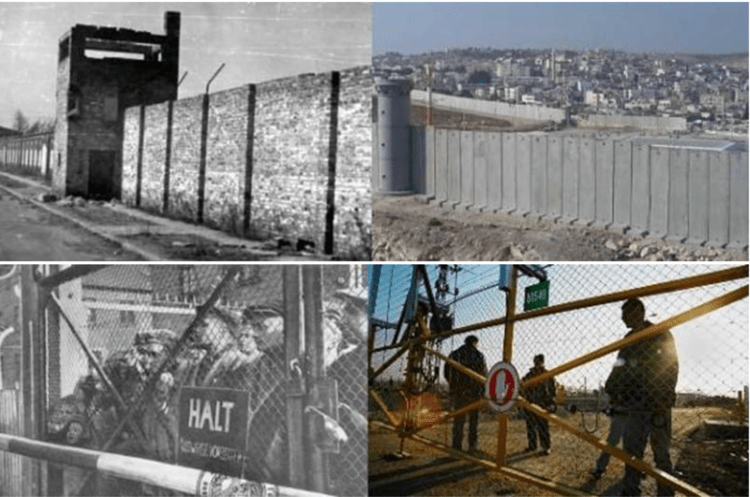
By Gilad Atzmon | August 2, 2018
In the aftermath of the Holocaust, some Jewish intellectuals and humanists expressed the thought that ‘after Auschwitz Jews have to locate themselves at the forefront of the battle for humanity and against all forms of oppression.’
This is a principled and heroic ideal, but the reality on the ground has been somewhat different. Just three years after the liberation of Auschwitz, the Jewish state ethnically cleansed the vast majority of indigenous Palestinians. Two years later, in 1950, Israel’s Knesset passed the Law of Return, a racist law that distinguishes between Jews who have the right to ‘return’ to someone else’s land and the hundreds of thousands of Palestinian refugees that were expelled by force from their villages and cities.
In the seven decades since, the Jewish State has committed every possible human rights abuse. It made Gaza into the biggest open-air prison in human history and has repeatedly dropped bombs on the most overpopulated place on earth. Recently the Jewish State deployed hundreds of snipers against unarmed Gazans who were protesting at the border. Israel killed dozens and wounded more than 13,000 Palestinians, the majority severely, with over 1,400 struck by three to five bullets.
If the Holocaust left Jews with a mission to fix the world, the Jewish State has done the opposite. Its crimes against humanity can be seen as a complete denial of the Holocaust’s message.
Some Jews who survived the Holocaust did dedicate their lives to a universal battle for a better world. Among these heroes was Hajo Meyer, a Dutch Auschwitz survivor who, for the obvious reasons, saw the similarities between his own suffering and the Palestinian plight.
In 2003 Meyer wrote The End of Judaism, accusing Israel of usurping the Holocaust to justify crimes against the Arabs. He participated in the 2011 “Never Again – For Anyone” tour. He correctly argued that Zionism predated fascism, and he also reiterated that Zionists and Fascists had a history of collaboration.
Meyer exemplified the Jewish post-Shoah humanist promise. After Auschwitz he located himself at the forefront of the fight against oppression. He fought Israel.
On Holocaust Memorial Day 2010, Meyer was invited to an event at the British Parliament which included MP Jeremy Corbyn. At the event Meyer compared Israeli racial policy to the Nuremberg laws. At the same event, Haidar Eid, a Palestinian academic from Gaza, pointed out that “the world was absolutely wrong to think that Nazism was defeated in 1945. Nazism has won because it has finally managed to Nazify the consciousness of its own victims.”
Eid didn’t ‘compare’ Zionism with Nazism, he described an ideological continuum between Nazi ideology and Israeli policy. He maintained that the racial discriminatory ideology of the Nazis was picked up by the Jewish state and has been rife in the Jewish State since then.
Yesterday MP Jeremy Corbyn was attacked by the Jewish lobby for being present at that meeting that explored these universal ethical positions. Our Labour candidate for prime minister anemically recalled that at the event in question views were expressed which he did not “accept or condone.” Corbyn even apologized “for the concerns and anxiety that this has caused.” I wonder why my preferred candidate has to express regret for being in the presence of a humanist exchange. I wonder why our next PM feels the need to disassociate himself from people who advocate ‘for the many, not the few.’
The message for the rest of us is devastating. The battle for a better world can’t be left to Corbyn alone. Needless to say, the Jewish State and its Lobby haven’t located themselves at the forefront of humanity. It is actually the Palestinians who have been pushed to the front of that frustrating struggle. Not to see that is to deny their holocaust.
Politics in bad faith: Alexandria Ocasio-Cortez campaigns in Michigan
By Andre Damon | WSWS | July 31, 2018
Alexandria Ocasio-Cortez, a member of the Democratic Socialists of America, visited Southeast Michigan this past weekend. Her primary victory last month over New York Congressman Joe Crowley has made her, virtually overnight, a leading spokesperson for the Democratic Party.
Ocasio-Cortez appeared at rallies in Detroit, Flint and Ypsilanti, as part of a statewide tour in support of Abdul El-Sayed, a former Detroit health department official running for governor of Michigan.

Ocasio-Cortez speaks at Wayne State University in Detroit
Ocasio-Cortez has been lionized in the press as the leader of a radical wave sweeping over the Democratic Party. Given the location of her events—including Detroit, the poorest large city in America, and Flint, which has been devastated by a lead water crisis—anyone taking her and the DSA’s pretenses to “socialism” seriously might have expected to hear bold proposals for tackling America’s rampant social inequality.
But when it came time for her to speak, what followed was a torrent of evasive and dishonest platitudes. She began her remarks at Wayne State University in Detroit:
My fingers are tingling right now because I know that this room is not just a rally, not just an audience, or even just a community; this is movement. Movement cannot be stopped, movement is like a wave; that energy cannot be contained, and Abdul, like many others, is just the crest, is just the foam at the tip of that wave. This is a movement so much bigger than just one person, there is no one person that is the future, there is a people that is the future.
To see such statements in print is to confirm the impression they produce on the listener: So much hot air.
America needs a “salt of the earth government,” Ocasio-Cortez went on, because, “We know that what is right in one place is what is right in all places.” And so on and so forth.
Like Barack Obama, whom she acknowledges as an inspiration, Ocasio-Cortez revels in seemingly profound motivational statements that are, upon the slightest examination, shown to be devoid of content. Her speeches are a variant of Obama’s slogan: “Yes we can.” She makes no effort to explain why Obama’s “Yes we can” was turned into eight years of “No we can’t.”
She continued, “The future of this nation and the future of this party is working class, the future of this party is working people, the future of this party is the marginalized, it is women, it is gender-extended people, it is people of color, it is the affirmation of justice, that is the future of this party.”
This invocation of the working class, mixed with appeals to other “identities,” is in bad faith, because the entire purpose of her campaign, and of the existence of the DSA, is to promote the Democratic Party, which, along with the Republicans, is a party of the corporate and financial oligarchy.
The Democrats are currently in the midst of a ferociously right-wing campaign centered on denunciations of Trump for “betraying” the country to Russia. In the midterm elections, the Democrats are fielding an unprecedented number of former members of the CIA and the military, which reflects their position as the preferred party of dominant sections of the military-intelligence apparatus.
Ocasio-Cortez’s inability to say anything genuinely oppositional, let alone radical, is bound up with her political role. She has quickly been absorbed into the Democratic Party establishment, and her rhetoric conforms to its politics. In promoting a right-wing party, her “left-wing” gloss is reduced to empty slogans.
Only a few sentences of her speech touched on actual policy. “The future of this party is improved and expanded Medicare for all,” she declared. For Abdul El-Sayed, “Medicare for all” means a statewide health care system paid for by workers from their own paychecks, one which his website boasts will exempt a substantial number of businesses from health care contributions.

Abdul El-Sayed
Such campaign promises are meaningless anyway. Obama declared himself a “proponent of a single payer universal health care program” in 2003, before going on to implement the “Affordable Care Act,” a reactionary attack on health care that shifts the burden from corporations and the state to workers by requiring individuals to purchase private insurance. This was cynically packaged as a major social “reform.”
Of particular note in the rallies to which Ocasio-Cortez spoke was the absence of any reference to foreign policy or the slightest hint of opposition to war. In fact, it was as if the rest of the world did not exist.
When a WSWS reporter asked the candidates at the post-rally press briefing in Detroit, “Do both of you support withdrawing all US troops from the Middle East and Africa?” El-Sayed gave an evasive non-answer: “We’ve got to make sure that we are focused on a foreign policy that articulates what we all can do when we come together around a more peaceful world.”
A staffer immediately attempted to conclude the briefing. When the reporter restated the question, “Ms. Ocasio-Cortez, are you anti-war? Do you support withdrawing all US troops from the Middle East?”
She replied, “I’m sorry, I’m here to support Abdul.”
The press conference immediately concluded, and the candidates were whisked away. (The next day, another WSWS reporter asked Ocasio-Cortez the same question at a rally in Ypsilanti, Michigan. She gave the same rehearsed answer.)
After the conclusion of the press conference, a WSWS reporter asked a high-level Ocasio-Cortez staffer, “What does she think the tax rate on the top income bracket should be?” He said he could not answer that question, because “She’s just focused on getting candidates with a similar program elected right now.”
In other words, Ocasio-Cortez can’t even commit to an explicit policy of raising taxes on the wealthiest section of society. In the spectrum of traditional American politics, this places her “democratic socialism” somewhere on the left wing of the 1960s-era Republican Party. Her inability to make any statement in opposition to war likewise put her to the right of both major Democratic nominees in the 1968 presidential primaries, who ran on an anti-war program.
The events make clear the political function of the Democratic Socialists of America. Far from creating a politically independent socialist movement, the DSA functions as an adjunct of the Democratic Party, providing candidates whose programs are largely indistinguishable from the rest of the party and are compatible with the agenda of the “CIA Democrats.”
The political role of Ocasio-Cortez and a slew of similar, DSA-backed candidates is to put a “left-wing,” “progressive,” youth-oriented, and multicultural gloss on a right-wing, pro-war party.
American Pravda: The Nature of Anti-Semitism
By Ron Unz • Unz Review • July 30, 2018
I recently published a couple of long essays, and although they primarily focused on other matters, the subject of anti-Semitism was a strong secondary theme. In that regard, I mentioned my shock at discovering a dozen or more years ago that several of the most self-evidently absurd elements of anti-Semitic lunacy, which I had always dismissed without consideration, were probably correct. It does seem likely that a significant number of traditionally-religious Jews did indeed occasionally commit the ritual murder of Christian children in order to use their blood in certain religious ceremonies, and also that powerful Jewish international bankers did play a large role in financing the establishment of Bolshevik Russia.
When one discovers that matters of such enormous moment not only apparently occurred but that they had been successfully excluded from nearly all of our histories and media coverage for most of the last one hundred years, the implications take some time to properly digest. If the most extreme “anti-Semitic canards” were probably true, then surely the whole notion of anti-Semitism warrants a careful reexamination.
All of us obtain our knowledge of the world by two different channels. Some things we discover from our own personal experiences and the direct evidence of our senses, but most information comes to us via external sources such as books and the media, and a crisis may develop when we discover that these two pathways are in sharp conflict. The official media of the old USSR used to endlessly trumpet the tremendous achievements of its collectivized agricultural system, but when citizens noticed that there was never any meat in their shops, “Pravda” became a watchword for “Lies” rather than “Truth.”
Now consider the notion of “anti-Semitism.” Google searches for that word and its close variants reveal over 24 million hits, and over the years I’m sure I’ve seen that term tens of thousands of times in my books and newspapers, and heard it endlessly reported in my electronic media and entertainment. But thinking it over, I’m not sure that I can ever recall a single real-life instance I’ve personally encountered, nor have I heard of almost any such cases from my friends or acquaintances. Indeed, the only persons I’ve ever come across making such claims were individuals who bore unmistakable signs of serious psychological imbalance. When the daily newspapers are brimming with lurid tales of hideous demons walking among us and attacking people on every street corner, but you yourself have never actually seen one, you may gradually grow suspicious.
Indeed, over the years some of my own research has uncovered a sharp contrast between image and reality. As recently as the late 1990s, leading mainstream media outlets such as The New York Times were still denouncing a top Ivy League school such as Princeton for the supposed anti-Semitism of its college admissions policy, but a few years ago when I carefully investigated that issue in quantitative terms for my lengthy Meritocracy analysis I was very surprised to reach a polar-opposite conclusion. According to the best available evidence, white Gentiles were over 90% less likely to be enrolled at Harvard and the other Ivies than were Jews of similar academic performance, a truly remarkable finding. If the situation had been reversed and Jews were 90% less likely to be found at Harvard than seemed warranted by their test scores, surely that fact would be endlessly cited as the absolute smoking-gun proof of horrendous anti-Semitism in present-day America.
It has also become apparent that a considerable fraction of what passes for “anti-Semitism” these days seems to stretch that term beyond all recognition. A few weeks ago an unknown 28-year-old Democratic Socialist named Alexandria Ocasio-Cortez scored a stunning upset primary victory over a top House Democrat in New York City, and naturally received a blizzard of media coverage as a result. However, when it came out that she had denounced the Israeli government for its recent massacre of over 140 unarmed Palestinian protesters in Gaza, cries of “anti-Semite” soon appeared, and according to Google there are now over 180,000 such hits combining her name and that harsh accusatory term. Similarly, just a few days ago the New York Times ran a major story reporting that all of Britain’s Jewish newspapers had issued an “unprecedented” denunciation of Jeremy Corbyn’s Labour Party, describing it as an “existential threat” to the Jewish community for the anti-Semitism it was fostering; but this apparently amounted to nothing more than its willingness to sharply criticize the Israeli government for its long mistreatment of the Palestinians.
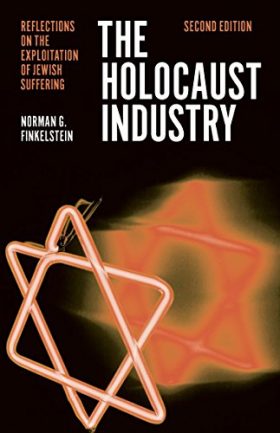
One plausible explanation of the strange contrast between media coverage and reality might be that anti-Semitism once did loom very large in real life, but dissipated many decades ago, while the organizations and activists focused on detecting and combating that pernicious problem have remained in place, generating public attention based on smaller and smaller issues, with the zealous Jewish activists of the Anti-Defamation League (ADL) representing a perfect example of this situation. As an even more striking illustration, the Second World War ended over seventy years ago, but what historian Norman Finkelstein has so aptly labeled “the Holocaust Industry” has grown ever larger and more entrenched in our academic and media worlds so that scarcely a day passes without one or more articles relating to that topic appearing in my major morning newspapers. Given this situation, a serious exploration of the true nature of anti-Semitism should probably avoid the mere media phantoms of today and focus on the past, when the condition might still have been widespread in daily life.
Many observers have pointed to the aftermath of the Second World War as marking a huge watershed in the public acceptability of anti-Semitism both in America and Europe, so perhaps a proper appraisal of that cultural phenomenon should focus on the years before that global conflict. However, the overwhelming role of Jews in the Bolshevik Revolution and other bloody Communist seizures of power quite naturally made them objects of considerable fear and hatred throughout the inter-war years, so the safest course might be to push that boundary back a little further and confine our attention to the period prior to the outbreak of the First World War. The pogroms in Czarist Russia, the Dreyfus Affair in France, and the lynching of Leo Frank in the American South come to mind as some of the most famous examples from that period.
In 1991 Cambridge University Press published The Jew Accused by Albert Lindemann, a noted scholar of European ideological movements, and his book focused on exactly that era and those sorts of incidents. Although the text is quite short, running less than 300 pages, Lindemann built his discussion upon a huge foundation of secondary literature, with his footnotes drawn from the 200 works included in his extensive bibliography. As far as I could tell, he seems a very scrupulous scholar, generally providing the multiple, often conflicting accounts of a given incident, and coming to his own conclusions with considerable hesitation.
This approach is certainly demonstrated in the first of his major cases, the notorious Dreyfus affair of late 19th century France, probably one of history’s most famous anti-Semitic incidents. Although he concludes that Captain Alfred Dreyfus was very likely innocent of the charge of espionage, he notes the seemingly strong evidence that initially led to his arrest and conviction and finds—contrary to myth-making by numerous later writers—absolutely no indications that his Jewish origins played any role whatsoever in his predicament.
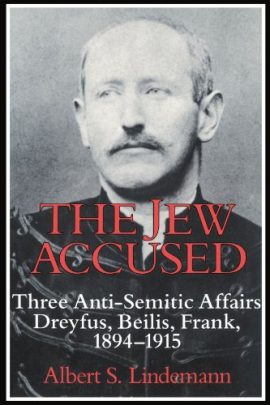
However, he does note some of the underlying social context to this fierce political battle. Although only one Frenchman in a thousand was Jewish, just a few years earlier a group of Jews had been the leading culprits behind several huge financial scandals that impoverished large numbers of small investors, and the swindlers afterward escaped any punishment by means of political influence and bribery. Given this history, much of the outrage of the anti-Dreyfusards probably arose from their fears that a Jewish military spy from a very wealthy family might be able to walk free using similar tactics, and the public claims that Dreyfus’s brother was offering enormous bribes to win his brother’s release certainly strengthened this concern.
Lindemann’s discussion of the 1913 Leo Frank Affair, in which a wealthy Northern Jew working in Atlanta was accused of sexually-assaulting and murdering a young girl, is even more interesting. Once again, he notes that contrary to the traditional narrative, there seems absolutely no hint that Frank’s Jewish background played any role in his arrest or conviction. Indeed, at his trial it was instead his very highly-paid defense attorneys who unsuccessfully sought to “play the race card” with the jurors by crudely attempting to deflect suspicion upon a local black worker by means of racially-charged invective.
Although Lindemann regards Frank as probably innocent, my own reading of the evidence he presents suggests the overwhelming likelihood of his guilt. Meanwhile, it seems undeniable that the outpouring of popular anger against Frank was produced by the vast ocean of outside Jewish money—at least $15 million or more in present-day dollars—that was committed to the legal efforts to save the life of someone widely regarded as a brutal murderer. There are strong suggestions that far more improper means were also employed, including bribery and influence-peddling, so that after Frank was convicted by a jury of his peers and thirteen separate legal appeals were denied, a governor with strong personal ties to the defense lawyers and Jewish interests chose to spare Frank’s life a few months before leaving office. Under these circumstances, the lynch-mob that hung Frank was viewed by the community as merely enforcing his official death sentence by extra-judicial means.
I also discovered that the leading figures in the anti-Frank movement had views far nuanced than I had expected. For example, populist writer Tom Watson had previously been a strong defender of Jewish anarchist Emma Goldman, while ferociously denouncing the Rockefellers, Morgans, and Goulds as the “true destroyers” of Jeffersonian democracy, so his outrage that Frank might escape punishment for murder seemed motivated by the extreme wealth of Frank’s family and his supporters rather than any pre-existing anti-Semitic sentiments.
The unmistakable conclusion of Lindemann’s analysis is that if the defendants in both the Dreyfus and Frank cases had not been Jewish, they would have suffered identical arrests and convictions, but lacking any wealthy and politically mobilized Jewish community to rally around them, they would have received their punishments, just or unjust, and immediately been forgotten. Instead, Theodor Herzl, the founding father of Zionism, later claimed that the massive anti-Semitism revealed by the Dreyfus Affair was the basis of his personal ideological awakening, while the Frank Affair led to the establishment of America’s Anti-Defamation League. And both these cases have entered our history books as among the most notorious examples of pre-World War I anti-Semitism.
Lindemann’s discussion of the often difficult relations between Russia’s restive Jewish minority and its huge Slavic majority is also quite interesting, and he provides numerous instances in which major incidents, supposedly demonstrating the enormously strong appeal of vicious anti-Semitism, were quite different than has been suggested by the legend. The famous Kishinev Pogrom of 1903 was obviously the result of severe ethnic tension in that city, but contrary to the regular accusations of later writers, there seems absolutely no evidence of high-level government involvement, and the widespread claims of 700 dead that so horrified the entire world were grossly exaggerated, with only 45 killed in the urban rioting. Chaim Weizman, the future president of Israel, later promoted the story that he himself and some other brave Jewish souls had personally defended their people with revolvers in hand even as they saw the mutilated bodies of 80 Jewish victims. This account was totally fictional since Weizman happened to have been be hundreds of miles away when the riots occurred.
Although a tendency to lie and exaggerate was hardly unique to the political partisans of Russian Jewry, the existence of a powerful international network of Jewish journalists and Jewish-influenced media outlets ensured that such concocted propaganda stories might receive enormous worldwide distribution, while the truth followed far behind, if at all.
For related reasons, international outrage was often focused on the legal confinement of most of Russia’s Jews to the “Pale of Settlement,” suggesting some sort of tight imprisonment; but that area was the traditional home of the Jewish population and encompassed a landmass almost as large as France and Spain combined. The growing impoverishment of Eastern European Jews during that era was often assumed to be a consequence of hostile government policy, but the obvious explanation was extraordinary Jewish fecundity, which far outstripped that of their Slavic fellow countrymen, and quickly led them to outgrow the available spots in any of their traditional “middleman” occupations, a situation worsened by their total disinclination to engage in agriculture or other primary-producer activities. Jewish communities expressed horror at the risk of losing their sons to the Czarist military draft, but this was simply the flip-side of the full Russian citizenship they had been granted, and no different from what was faced by their non-Jewish neighbors.
Certainly the Jews of Russia suffered greatly from widespread riots and mob attacks in the generation prior to World War I, and these did sometimes have substantial government encouragement, especially in the aftermath of the very heavy Jewish role in the 1905 Revolution. But we should keep in mind that a Jewish plotter had been implicated in the killing of Czar Alexander II, and Jewish assassins had also struck down several top Russian ministers and numerous other government officials. If the last decade or two had seen American Muslims assassinate a sitting U.S. President, various leading Cabinet members, and a host of our other elected and appointed officials, surely the position of Muslims in this country would have become a very uncomfortable one.
As Lindemann candidly describes the tension between Russia’s very rapidly growing Jewish population and its governing authorities, he cannot avoid mentioning the notorious Jewish reputation for bribery, corruption, and general dishonesty, with numerous figures of all political backgrounds noting that the remarkable Jewish propensity to commit perjury in the courtroom led to severe problems in the effective administration of justice. The eminent American sociologist E.A. Ross, writing in 1913, characterized the regular behavior of Eastern European Jews in very similar terms.
Lindemann also allocates a short chapter to discussing the 1911 Beilis Affair, in which a Ukrainian Jew was accused of the ritual murder of a young Gentile boy, an incident that generated a great deal of international attention and controversy. Based on the evidence presented, the defendant seems likely to have been innocent, although the obvious lies he repeatedly told police interrogators hardly helped foster that impression, and “the system worked” in that he was ultimately found innocent by the jurors at his trial. However, a few pages are also given to a much less well-known ritual murder case in late 19th century Hungary, in which the evidence of Jewish guilt seemed far stronger, though the author hardly accepted the possible reality of such an outlandish crime. Such reticence was quite understandable since the publication of Ariel Toaff’s remarkable volume on the subject was still a dozen years in the future.

Lindemann subsequently expanded his examination of historical anti-Semitism into a much broader treatment, Esau’s Tears, which appeared in 1997. In this volume, he added comparative studies of the social landscape in Germany, Britain, Italy, and several other European countries, and demonstrated that the relationship between Jews and non-Jews varied greatly across different locations and time periods. But although I found his analysis quite useful and interesting, the extraordinarily harsh attacks his text provoked from some outraged Jewish academics seemed even more intriguing.
For example, Judith Laikin Elkin opened her discussion in The American Historical Review by describing the book as a “545-page polemic” a strange characterization of a book so remarkably even-handed and factually-based in its scholarship. Writing in Commentary, Robert Wistrich was even harsher, stating that merely reading the book had been a painful experience for him, and his review seemed filled with spittle-flecked rage. Unless these individuals had somehow gotten copies of a different book, I found their attitudes simply astonishing.
I was not alone in such a reaction. Richard S. Levy of the University of Illinois, a noted scholar of anti-Semitism, expressed amazement at Wistrich’s seemingly irrational outburst, while Paul Gottfried, writing in Chronicles, mildly suggested that Lindemann had “touched raw nerves.” Indeed, Gottfried’s own evaluation quite reasonably criticized Lindemann for perhaps being a little too even-handed, sometimes presenting numerous conflicting analyzes without choosing between them. For those interested, a good discussion of the book by Alan Steinweis, a younger scholar specializing in the same topic, is conveniently available online.
The remarkable ferocity with which some Jewish writers attacked Lindemann’s meticulous attempt to provide an accurate history of anti-Semitism may carry more significance than merely an exchange of angry words in low-circulation academic publications. If our mainstream media shapes our reality, scholarly books and articles based upon them tend to set the contours of that media coverage. And the ability of a relatively small number of agitated and energetic Jews to police the acceptable boundaries of historical narratives may have enormous consequences for our larger society, deterring scholars from objectively reporting historical facts and preventing students from discovering them.
The undeniable truth is that for many centuries Jews usually constituted a wealthy and privileged segment of the population in nearly all the European countries in which they resided, and quite frequently they based their livelihood upon the heavy exploitation of a downtrodden peasantry. Even without any differences in ethnicity, language, or religion, such conditions almost invariably provoke hostility. The victory of Mao’s Communist forces in China was quickly followed by the brutal massacre of a million or more Han Chinese landlords by the Han Chinese poor peasants who regarded them as cruel oppressors, with William Hinton’s classic Fanshen describing the unfortunate history that unfolded in one particular village. When similar circumstances led to violent clashes in Eastern Europe between Slavs and Jews, does it really make logical sense to employ a specialized term such as “anti-Semitism” to describe that situation?

Furthermore, some of the material presented in Lindemann’s rather innocuous text might also lead to potentially threatening ideas. Consider, for example, the notorious Protocols of the Learned Elders of Zion, almost certainly fictional, but hugely popular and influential during the years following World War I and the Bolshevik Revolution. The fall of so many longstanding Gentile dynasties and their replacement by new regimes such as Soviet Russia and Weimar Germany, which were heavily dominated by their tiny Jewish minorities, quite naturally fed suspicions of a worldwide Jewish plot, as did the widely discussed role of Jewish international bankers in producing those political outcomes.
Over the decades, there has been much speculation about the possible inspiration for the Protocols, but although Lindemann makes absolutely no reference to that document, he does provide a very intriguing possible candidate. Jewish-born British Prime Minister Benjamin Disraeli certainly ranked as one of the most influential figures of the late 19th century, and in his novel Coningsby, he has the character representing Lord Lionel Rothschild boast about the existence of a vast and secret network of powerful international Jews, who stand near the head of almost every major nation, quietly controlling their governments from behind the scenes. If one of the world’s most politically well-connected Jews eagerly promoted such notions, was Henry Ford really so unreasonable in doing the same?
Lindemann also notes Disraeli’s focus on the extreme importance of race and racial origins, a central aspect of traditional Jewish religious doctrine. He reasonably suggests that this must surely have had a huge influence upon the rise of those political ideas, given that Disraeli’s public profile and stature were so much greater than the mere writers or activists whom our history books usually place at center stage. In fact, Houston Stewart Chamberlain, a leading racial theorist, actually cited Disraeli as a key source for his ideas. Jewish intellectuals such as Max Nordau and Cesare Lombroso are already widely recognized as leading figures in the rise of the racial science of that era, but Disraeli’s under-appreciated role may have actually been far greater. The deep Jewish roots of European racialist movements are hardly something that many present-day Jews would want widely known.

One of the harsh Jewish critics of Esau’s Tears denounced Cambridge University Press for even allowing the book to appear in print, and although that major work is easily available in English, there are numerous other cases where an important but discordant version of historical reality has been successfully blocked from publication. For decades most Americans would have ranked Nobel Laureate Alexander Solzhenitsyn as among the world’s greatest literary figures, and his Gulag Archipelago alone sold over 10 million copies. But his last work was a massive two-volume account of the tragic 200 years of shared history between Russians and Jews, and despite its 2002 release in Russian and numerous other world languages, there has yet to be an authorized English translation, though various partial editions have circulated on the Internet in samizdat form.

At one point, a full English version was briefly available for sale at Amazon.com and I purchased it. Glancing through a few sections, the work seemed quite even-handed and innocuous to me, but it seemed to provide a far more detailed and uncensored account than anything else previously available, which obviously was the problem. The Bolshevik Revolution resulted in the deaths of many tens of millions of people worldwide, and the overwhelming Jewish role in its leadership would become more difficult to erase from historical memory if Solzhenitsyn’s work were easily available. Also, his candid discussion of the economic and political behavior of Russian Jewry in pre-revolutionary times directly conflicted with the hagiography widely promoted by Hollywood and the popular media. Historian Yuri Slezkine’s award-winning 2004 book The Jewish Century provided many similar facts, but his treatment was far more cursory and his public stature not remotely the same.
Near the end of his life, Solzhenitsyn gave his political blessing to Russian President Vladimir Putin, and Russia’s leaders honored him upon his death, while his Gulag volumes are now enshrined as mandatory reading in the standard high school curriculum of today’s overwhelmingly Christian Russia. But even as his star rose again in his own homeland, it seems to have sharply fallen in our own country, and his trajectory may eventually relegate him to nearly un-person status.
A couple of years after the release of Solzhenitsyn’s controversial final book, an American writer named Anne Applebaum published a thick history bearing the same title Gulag, and her work received enormously favorable media coverage and won her a Pulitzer Prize; I have even heard claims that her book has been steadily replacing that earlier Gulag on many college reading lists. But although Jews constituted a huge fraction of the top leadership of the Soviet Gulag system during its early decades, as well as that of the dreaded NKVD which supplied the inmates, nearly her entire focus on her own ethnic group during Soviet times is that of victims rather than victimizers. And by a remarkable irony of fate, she shares a last name with one of the top Bolshevik leaders, Hirsch Apfelbaum, who concealed his own ethnic identity by calling himself Grigory Zinoviev.

The striking decline in Solzhenitsyn’s literary status in the West came just a decade or two after an even more precipitous collapse in the reputation of David Irving, and for much the same reason. Irving probably ranked as the most internationally successful British historian of the last one hundred years and a renowned scholar of World War II, but his extensive reliance on primary source documentary evidence posed an obvious threat to the official narrative promoted by Hollywood and wartime propaganda. When he published his magisterial Hitler’s War, this conflict between myth and reality came into the open, and an enormous wave of attacks and vilification was unleashed, gradually leading to his purge from respectability and eventually even his imprisonment.
Similarly, Israeli academic Ariel Toaff, son of the chief rabbi of Rome, was regarded as one of the world’s leading scholarly authorities on Medieval Jewry. But when he published his remarkable 2004 analysis suggesting the likely reality of the Jewish ritual murders of Christian children throughout history, the resulting media firestorm forced the cancellation of the book’s publication, and the work only survives in samizdat form, while there were even calls for his arrest and incarceration.
In other cases, pressure from the ADL and similar Jewish activist groups have led Amazon to completely eliminate entire categories of historical analysis and ban those publishers who produce such works, which drastically reduces their availability to the reading public.
All of these cases were the sort of high-profile examples which are well-known to anyone who pays attention to such matters. But surely there must have been many other incidents, involving far less prominent authors, which never received any significant media coverage, and also a vastly larger universe of cases in which writers have self-censored their texts in order to avoid such controversies. Over the decades, I have gradually discovered through sad experience that I must exercise extreme caution whenever I read anything relating to the subjects of Jews, Judaism, or Israel.

These important examples may help to explain the puzzling contrast between the behavior of Jews in the aggregate and Jews as individuals. Observers have noticed that even fairly small Jewish minorities may often have a major impact upon the far larger societies that host them. But on the other hand, in my experience at least, a large majority of individual Jews do not seem all that different in their personalities or behavior than their non-Jewish counterparts. So how does a community whose individual mean is not so unusual generate what seems to be such a striking difference in collective behavior? I think the answer may involve the existence of information choke-points, and the ability of relatively small numbers of particularly zealous and agitated Jews in influencing and controlling these.
We live our lives constantly immersed in media narratives, and these allow us to decide the rights and wrongs of a situation. The vast majority of people, Jew and Gentile alike, are far more likely to take strong action if they are convinced that their cause is a just one. This is obviously the basis for war-time propaganda.
Now suppose that a relatively small number of zealous Jewish partisans are known to always attack and denounce journalists or authors who accurately describe Jewish misbehavior. Over time, this ongoing campaign of intimidation may cause many important facts to be left on the cutting-room floor, or even gradually expel from mainstream respectability those writers who refuse to conform to such pressures. Meanwhile, similar small numbers of Jewish partisans frequently exaggerate the misdeeds committed against Jews, sometimes piling their exaggerations upon past exaggerations already produced by a previous round of such zealots.
Eventually, these two combined trends may take a complex and possibly very mixed historical record and transform it into a simple morality-play, with innocent Jews tremendously injured by vicious Jew-haters. And as this morality-play becomes established it deepens the subsequent intensity of other Jewish-activists, who redouble their demands that the media “stop vilifying Jews” and covering up the supposed evils inflicted upon them. An unfortunate circle of distortion following exaggeration following distortion can eventually produce a widely accepted historical account that bears little resemblance to the reality of what actually happened.
So as a result, the vast majority of quite ordinary Jews, who would normally behave in quite ordinary ways, are misled by this largely fictional history, and rather understandably become greatly outraged at all the horrible things that had been done to their suffering people, some of which are true and some of which are not, while remaining completely ignorant of the other side of the ledger.
Furthermore, this situation is exacerbated by the common tendency of Jews to “cluster” together, perhaps respresenting just one or two percent of the total population, but often constituting 20% or 40% or 60% of their immediate peer-group, especially in certain professions. Under such conditions, the ideas or emotional agitation of some Jews probably permeates others around them, often provoking additional waves of indignation.
As a rough analogy, a small quantity of uranium is relatively inert and harmless, and entirely so if distributed within low-density ore. But if a significant quantity of weapons-grade uranium is sufficiently compressed, then the neutrons released by fissioning atoms will quickly cause additional atoms to undergo fission, with the ultimate result of that critical chain-reaction being a nuclear explosion. In similar fashion, even a highly agitated Jew may have no negative impact, but if the collection of such agitated Jews becomes too numerous and clusters together too closely, they may work each other into a terrible frenzy, perhaps with disastrous consequences both for themselves and for their larger society. This is especially true if those agitated Jews begin to dominate certain key nodes of top-level control, such as the central political or media organs of a society.
Whereas most living organizations exist solely in physical reality, human beings also occupy an ideational space, with the interaction of human consciousness and perceived reality playing a major role in shaping behavior. Just as the pheromones released by mammals or insects can drastically affect the reactions of their family members or nest-mates, the ideas secreted by individuals or the media-emitters of a society can have an enormous impact upon their fellows.
A cohesive, organized group generally possesses huge advantages over a teeming mass of atomized individuals, just as a Macedonian Phalanx could easily defeat a vastly larger body of disorganized infantry. Many years ago, on some website somewhere I came across a very insightful comment regarding the obvious connection between “anti-Semitism” and “racism,” which our mainstream media organs identify as two of the world’s greatest evils. Under this analysis, “anti-Semitism” represents the tendency to criticize or resist Jewish social cohesion, while “racism” represents the attempt of white Gentiles to maintain a similar social cohesion of their own. To the extent that the ideological emanations from our centralized media organs serve to strengthen and protect Jewish cohesion while attacking and dissolving any similar cohesion on the part of their Gentile counterparts, the former will obviously gain enormous advantages in resource-competition against the latter.
Religion obviously constitutes an important unifying factor in human social groups and we cannot ignore the role of Judaism in this regard. Traditional Jewish religious doctrine seems to consider Jews as being in a state of permanent hostility with all non-Jews, and the use of dishonest propaganda is an almost inevitable aspect of such conflict. Furthermore, since Jews have invariably been a small political minority, maintaining such controversial tenets required the employment of a massive framework of subterfuge and dissimulation in order to conceal their nature from the larger society surrounding them. It has often been said that truth is the first casualty in war, and surely the cultural influences of over a thousand years of such intense religious hostility may continue to quietly influence the thinking of many modern Jews, even those who have largely abandoned their religious beliefs.
The notorious Jewish tendency to shamelessly lie or wildly exaggerate has sometimes had horrifying human consequences. I very recently discovered a fascinating passage in Peter Moreira’s 2014 book The Jew Who Defeated Hitler: Henry Morgenthau Jr., FDR, and How We Won the War, focused on the important political role of that powerful Secretary of the Treasury.
A turning point in Henry Morgenthau Jr.’s relationship with the Jewish community came in November 1942, when Rabbi Stephen Wise came to the corner office to tell the secretary what was happening in Europe. Morgenthau knew of the millions of deaths and the lampshades made from victims’ skin, and he asked Wise not to go into excessive details. But Wise went on to tell of the barbarity of the Nazis, how they were making soap out of Jewish flesh. Morgenthau, turning paler, implored him, “Please, Stephen, don’t give me the gory details.” Wise went on with his list of horrors and Morgenthau repeated his plea over and over again. Henrietta Klotz was afraid her boss would keel over. Morgenthau later said the meeting changed his life.
It is easy to imagine that Morgenthau’s gullible acceptance of such obviously ridiculous war-time atrocity stories played a major role when he later lent his name and support to remarkably brutal American occupation policies that probably led to the postwar deaths of many millions of innocent German civilians.
Related Reading:
Featured Video

The Search for Truth: Charlie Kirk’s Assassination One Year Later
or go to
Aletho News Archives – Video-Images
From the Archives
The 9/11 “Double-Cross” Conspiracy Theory
BY LAURENT GUYÉNOT • UNZ REVIEW • SEPTEMBER 6, 2022
Is it true that “9/11 was an inside job”? Yes, insofar as Israel is “inside” the U.S. But for the 9/11 truthers who have identified Israel as the main perpetrators, “9/11 was an inside job” is at best a half-truth, and at worst an integral part of the Zionist operation, like a secondary flag sewn as a lining under the false flag of Islamism. Victor Thorn (1963-2017) wrote in his book 9/11 made in Israel: The Plot Against America (2011): “In essence, the ‘9-11 truth movement’ was created prior to Sept. 11, 2001 as a means of suppressing news relating to Israeli complicity. . . . The slogan ‘9-11 was an inside job’ was quite possibly the greatest example of Israeli propaganda ever devised.” In milder terms, it is “controlled opposition”.
A genuine truth movement would have pointed to Israel as the prime suspect from the start. From day one, it was obvious who would benefit. … continue
Blog Roll
 Aletho News
- Hormuz and the Looming Economic Catastrophe
- Dhubab offensive, media blitz and the rapid unraveling of Saudi-backed coalition’s new gambit
- Putin Conveys to Trump Iran’s Vision on Possible Conflict Resolution – Kremlin
- The Search for Truth: Charlie Kirk’s Assassination One Year Later
- ‘Harsh reality’: Iran says France seeks monopoly on power and intimidation, not peace for all
- When Will This White House Madness End?
- Huckabee aide goes to ‘unusual lengths’ to portray ‘Israel’ positively
- Trump Announces Diesel Supply Deal With Putin Following Phone Call
- MEP blasts ‘Euro-Gestapo’ for lecturing Russia on democracy
- Syria May Send Troops to Saudi Arabia Amid War with Ansar Allah
- If Americans Knew
- Israeli forces kill another child in Gaza – Daily Update
- Gaza ceasefire exists in name only, say more than 100 organizations
- Nearly 2 Million in Gaza Need Urgent Shelter Assistance as Winter Looms: IOM Chief Warns
- Suppressing Palestinian resistance: US charity under fire for AI monitoring of Gaza classrooms
- Thousands Are Held in Israeli Torture Camps. This Is What Happens Inside
- Israel puts Gaza’s sick, injured, newborn in peril – Daily Update
- Report claimed Mark Levin used by Israeli government to influence Trump
- Over 2,000 Gazans have died awaiting medical evacuation amid Israel’s continued siege
- How a U.S. Diplomat Suppressed and Altered Reports Critical of Israel
- 5 Palestinians Die from Israeli Strikes in Gaza as Relentless Attacks Continue
- No Tricks Zone
- New Study: 50 Years Of The Most Aggressive ‘Net Zero’ Policies Can Only Affect The Global Climate By 0.03°C
- US September “Heat” Was No Record…Many Records Set Decades Ago
- Latest European Green Energy Debacle; Portugal’s Largest Flagship Solar Park Insolvent!
- Green Energy Debacle: German Expert Professor Fritz Vahrenholt Warns Of Severe Economic And Social Consequences
- Two More Paleo Reconstructions Affirm Meters-Higher Sea Levels Across Ireland, Brazil 7000-6000 Years Ago
- New Study: Earth And Venus Surface Warmth Largely Explained By Convection And Lapse Rate, Not CO2 Or Radiation
- 2025 Nature Paper Claiming Worsening Global Drought Gets RETRACTED …Heavily Flawed
- New Study: ‘Global Drought Shows No Detectable Recent Acceleration Under Climate Warming’
- Economic Masterminds: German Socialists Suggest Taxing Productivity Gains Stemming From Using AI
- The South China Sea Has Not Been Cooperating With The Climate Change Narrative

