What Would Help the Peace Process in Korea?
By David William Pear | American Herald Tribune | June 30, 2018
It looks like peace is breaking out in Korea. The Koreans themselves are moving fast to mend their nation. When paradigm shifts happen they often happen quickly. In just a little over a year the South Korean people demanded the ouster of the corrupt rightwing Park Geun-hye as their president, and a new election replaced her with the liberal human rights lawyer Moon Jae-in.
Moon brought in a new era with the overwhelming support of the South Korean people. Kim Jong-un of North Korea responded likewise. Since the beginning of this year the normalization of relations between the North and the South have been moving fast. U.S. diplomats cannot keep up with it. So let us look into the deep roots of the Korean War and what would help the peace process.
We can start by answering what caused the Korean War. The conventional wisdom is that the war was started by the Democratic People’s Republic of Korea (i.e. North Korea) on June 25, 1950 when it invaded the Republic of Korea (i.e. South Korea). But the conventional wisdom is wrong. It is like saying that the Vietnam War started when North Vietnam invaded South Vietnam; or asking when did the American Revolution start.
Scholars are coming around to recognizing that the Korean War was a civil war. Bruce Cumings in his book, “Korea’s Place in the Sun: A Modern History”, explains it this way:
“The Korean War did not begin on June 25, 1950, much special pleading and argument to the contrary. If it did not begin then, Kim iI Sung could not have ‘started’ it then, either, but only at some earlier point. As we search backward for that point, we slowly grope toward the truth that civil wars do not start: they come. They originate in multiple causes, with blame enough to go around for everyone—and blame enough to include Americans who thoughtlessly divided Korea and then reestablished the colonial government machinery and the Koreans who served it.”
The Korean War has its roots in the mid 1800’s. There was a scramble for colonies, subjugation and influence in East Asia. The driving force of colonialism was trade. It was a scramble for booty, cheap labor, and markets. The Industrial Revolution and the instability of capitalism caused an excess of production; requiring new markets, and the need for more raw materials to feed the machines. Capitalism must constantly expand trade or growth stops, and the system collapses.
Fortunes were made in trade with Asia: tea, silk, spices, tobacco, sugar, rum, porcelain, cotton, coal, timber, gold and opium. The big powers in Asia were England, France, Dutch, Czarist Russia and the United States of America. Japan got into the game after the U.S. forcefully opened it for trade with the black gunboats of Commodore Matthew Perry in 1854.
The Japanese were quick learners in the ways of Western imperialism. Theodore Roosevelt admired them greatly, and considered them to be a “superior” race of Asians. Racial stereotyping was then common and many Westerners considered Asians to be inferior heathens. It was not uncommon for Asians to view rightly foreigners and Christian missionaries as subversives, and wanted to keep them out.
In 1866 the U.S. armed merchant ship the General Sherman tried to force its way into a Korean port despite protests from Korea that it was not open for business. The Koreans attacked the ship, and when it got stuck on a sandbar they killed all the crew and burned the ship.
In 1871 the U.S. used the General Sherman incident as an excuse to launch an invasion of Korea with the aim of getting an apology and establishing trading relations. The U.S. invasion was a success, it taught the Koreans a lesson, but they still refused to establish trading relations.
Later, fearing subjugation by one colonial power or another, Korea decided to make a deal with what it thought would be the lesser evil, and entered into the Treaty of Peace, Amity, Commerce and Navigation with the U.S. in 1882. Koreans took some comfort that the U.S. was on the other side of the ocean, unlike Japan. In exchange for giving the U.S. unequal trading rights, the Koreans got a signed treaty of U.S. protection.
The U.S. broke its promise of protection and delivered Korea into the colonial hands of the Japanese with the Taft–Katsura agreement in 1905. Theodore Roosevelt made a secret pact with the Japanese during his mediation of the settlement of the Russo-Japanese War. The secret deal was that Japan got Korea, and the U.S. got a Japanese guarantee of non-interference with its colony in the Philippines. Theodore Roosevelt was awarded the Nobel Peace Prize, even though he secretly and cynically double crossed the Koreans.
After World War Two the U.S. denied Korea a chance for independence again. Instead of liberating Korea, the U.S. was responsible for the division of Korea at the 38th parallel. Russia agreed, and while the Russians ushered in a government of Korean freedom fighters in the North, the U.S. in the South put in place a puppet government of Koreans who had collaborated with the Japanese, and the hated right-wing Korean aristocrats known as Yangban.
In both the north and the south Koreans were ready for self-government. In anticipation of the defeat of the Japanese and liberation, they had set up the Korean People’s Republic with grassroots committees all over the country. The head of the KPR in the South was Yo Un-hyong. Yo was a popular left-leaning nationalist and land reformer. He was assassinated 2 years later by the U.S. backed rightwing puppet government of Syngman Rhee
Even though the Korean people had governed themselves for over a thousand years, the U.S. did not consider them ready for self-government. At the Yalta Conference in February 1945 Franklin Delano Roosevelt proposed that Korea be placed in a trusteeship. He said it would take 40 years before Korea would be ready for self-government.
When U.S. troops docked at the Port of Incheon Korea on September 8, 1945 Roosevelt was dead, and Harry Truman was president. Under Truman the ruse of a trusteeship was dropped. The spoils of war go to the victor and the U.S. set about establishing the southern half of Korea as if it was a new U.S. colony.
The Koreans did not even get to celebrate their first night of liberation in 1945. The U.S. military declared martial law and ordered a curfew for all Koreans. The Japanese colonial administrators were kept in place, and American and Japanese officers partied at the Chosen Hotel in Seoul for several drunken days.
The Japanese administrators, military and police simply put on U.S. Army Military Government (AMG) armbands, kept their rifles and patrolled the streets with fixed bayonets until 1946. Similar scenes were taking place in Vietnam and elsewhere in Asia “liberated” from the Japanese. It was the beginning of the renewal of the U.S. “special relationship” with Japan that Theodore Roosevelt had established in 1905.
The U.S. befriended the enemy Japan and turned on their former Korean allies who had been fighting the Japanese for over 12 years. The U.S. military occupation government commanded by General John R. Hodge would be the military occupation government for the next 3 years.
In 1946 the Japanese administering southern Korea were replaced mostly with Koreans who had collaborated with the Japanese, and the yangban kept their lands. The U.S. feared that communism would take hold in liberated countries. It was the communists who had put up the biggest armed resistance in Asia against the Japanese during World War Two. The U.S. no longer needed or wanted them.
The scene in northern Korea was quite different. The Korean People’s Republic and their grassroots committees took over the government functions. The Japanese war criminals, collaborators, and yangban fled south where the U.S. welcomed them with open arms.
Within 3 years the Russians had pulled out all of their armed forces. The Russians had their own devastated country to rebuild, and they were more concerned about Eastern Europe, which was the historical invasion route to Russia.
The U.S.’s own intelligence had identified the desires of the Korean people. They wanted independence, self-government and land reform. Those were the antithesis of what the U.S. wanted for the Korean people. It was the U.S. that was scrambling all over the world to stem the tidal wave of anti-colonialism.
Kim il Sung was a national patriotic hero that had been fighting Japanese colonialism since the early 1930’s. If the U.S. had not blocked nationwide elections in Korea, he or another leftist reformer would have overwhelmingly won a fair election.
In the Moscow Conference of December, 1945 the U.S. and Russia agreed that Korea would be independent within 5 years after nationwide elections and that all foreign troops would withdraw. Russia kept its end of the bargain. The U.S. broke its promise.
Instead the U.S. rigged an election in the South, in which the Communist Party and leftist were not allowed to participate. Later the U.S. would use the same trick in South Vietnam, in order to keep that country divided too. Like Kim il Sung in Korea, Ho Chi Minh was a national hero and would have won in a fair nationwide election in Vietnam.
Turn to 1950. Military clashes had been a regular occurrence along Korea’s 38th parallel for 2 years, many of them initiated by the South. The 38th parallel was not recognized as an international border by either the U.S. puppet government in South Korea or the anti-colonial government in North Korea.
Korea was one country, and each side claimed to be the legitimate government of all of Korea. Therefore, the Korean War was not a war of aggression. There was no invasion of Korea by Koreans. The invaders were the U.S. which was subjugating the South, and backed a little-known transplant named Syngman Rhee, who had lived in the U.S. for forty years.
The Rhee dictatorship went on an anti-communist witch hunt that killed, imprisoned, tortured and disappeared hundreds of thousands of patriotic left-leaning Koreans in the South. Repressive dictatorships continued the persecution of dissidents for the next 40 years.
No one knows exactly what happened on the night of June 25, 1950; both sides said that the other side started the clash. The scenario that has become official U.S. legend raised many questions, most notably by the investigative journalist I. F. Stone in his book “The Hidden History of the Korean War (1950-1951)”.
For Kim il Sung and his compatriots the Korean War was an anti-colonial war. First he fought against the Japanese, just as Vietnam was fighting then against the French and their puppet government. To Kim il Sung, South Korea was a colonial puppet government of the US. The U.S. can be seen as the aggressor in both Vietnam and Korea.
The legal fig leaf of U.S. subjugation and the establishment of a puppet government in South Korea was a U.S. dominated United Nations-backed rigged election in the South. Communists were not allowed to participate so they boycotted it.
For the next 40 years South Korea was ruled by U.S. backed dictators Syngman Rhee, Park Chung-hee, Chun Doo-hwan and Roh Tae-woo. If one wants to know who controls a country, then look at who controls the country’s military. South Korea’s military is still today under the wartime command of the US military.
Korea and Vietnam have many similarities. Both were invaded by colonial powers in the 1800’s. Would any historian today write something like: The Vietnam War started when the North Vietnamese attacked their French colonial occupiers? Would anybody say that The Vietnam War started in 1957 when Ho Chi Minh’s forces crossed the 17th parallel? South Vietnam, as was South Korea was ruled by a puppet government of the US.
Ho Chi Minh was a freedom fighter just as Kim il Sung was against the Japanese during World War Two. Both were fighting colonialism. The Vietnam War and the Korean War were wars against U.S. occupiers that had replaced colonial rule.
Neither North Korea nor South Korea recognized the 38th parallel as a border. As General MacArthur said when his armed forces crossed the 38th parallel on October 9, 1950, it was just an imaginary line. MacArthur’s UN mandate was originally to repel the North Korean forces from South Korea. But MacArthur argued that the 38th parallel had no meaning and he ordered his army into one of the worst disasters in U.S. military history.
The Chinese had repeatedly warned that they would intervene if MacArthur crossed the 38th parallel. Had MacArthur heeded that warning it may have saved millions of lives, including tens of thousands of American lives.
When MacArthur’s forces reached the Yalu River separating Korea and China there were 300,000 Chinese volunteers and Koreans waiting in ambush. MacArthur’s forces had to run a bloody gauntlet at the Chosen Reservoir as they retreated back across the 38th parallel. The U.S. forces suffered over 15,000 casualties in that single battle.

*(Retreat from the Battle of the Chosen Reservoir)
The reunification of Vietnam, like Korea, was agreed to be settled by nationwide elections. As in Korea, the U.S. staged a phony election in South Vietnam and established the government of the Republic of Vietnam, under the puppet president Ngo Dinh Diem. Just as in Korea, the U.S. knew that if there were fair elections in Vietnam, then the Communist Party would win. So like in Korea, the U.S. staged a phony election in the south in which communists were not permitted to participate.
Article V, item 60 of the Korean Armistice Agreement of 1953 recommended that within 3 months a conference would be held by all sides of the Korean War. All sides were to “settle through negotiation the question of the withdrawal of all foreign forces from Korea, the peaceful settlement of the Korean question, etc. [sic]”.
The conference on Korea was held at the same Geneva Conference of 1954 that temporarily divided Vietnam. Nationwide elections in Vietnam were agreed to be held in 1956. No further agreement was reached on the “peaceful settlement of the Korean question”.
It was the US invasion of Korea in 1871, and Theodore Roosevelt’s betrayal that resulted in Korea being subjugated by Japan in 1905, and annexed in 1910. The U.S. caused much of the suffering, death and destruction of Korea for over a century, and a never ending war.
We cannot turn the clock back to March 1, 1919 when Woodrow Wilson made his 14 points speech that colonial people have a right to self-determination. Nor can we turn it back to 1948, and the promised independence for Korea.
What would help the peace process now in Korea is for the U.S. to get out of the way. All U.S. armed forces should be withdrawn from Korea, as they were supposed to have been in 1948. The US should stop bullying Koreans, stop meddling in the internal affairs of Korea, and let the Korean people settle their own destiny.
***
Reference and suggested reading
“Patriots, Traitors and Empires: The Story of Korea’s Struggle for Freedom”, by Stephen Gowans.
“Reflections on the Roots of U.S. Involvement in Korea”, by Chang Soon.
“Korea’s Place in the Sun: A Modern History”, by Bruce Cumings.
“The Hidden History of the Korean War (1950-1951)”, by I.F. Stone.
***
David William Pear may be contacted at dwpear521@gmail.com
Blair and Brown Governments Gory with Torture
By Craig Murray | June 29, 2018
Even I was taken aback by the sheer scale of British active involvement in extraordinary rendition revealed by yesterday’s report of the parliamentary Intelligence and Security Committee. Dominic Grieve and the committee deserve congratulations for their honesty, integrity and above all persistence. It is plain from the report that 10 Downing Street did everything possible to handicap the work of the committee. Most crucially they were allowed only to interview extremely senior civil servants and not allowed to interview those actively engaged in the torture and rendition programme.
Theresa May specifically and deliberately ruled out the Committee from questioning any official who might be placed at risk of criminal proceedings – see para 11 of the report. The determination of the government to protect those who were complicit in torture tells us much more about their future intentions than any fake apology.
In fact it is impossible to read paras 9 to 14 without being astonished at the sheer audacity of Theresa May’s attempts to obstruct the inquiry. They were allowed to interview only 4 out of 23 requested witnesses, and those were not allowed “to talk about the specifics of the operations in which they were involved nor fill in any gaps in the timeline”. If the UK had a genuinely free media, this executive obstruction of the Inquiry would be the lead story. Instead it is not mentioned in any corporate or state media, despite the committee report containing a firm protest:
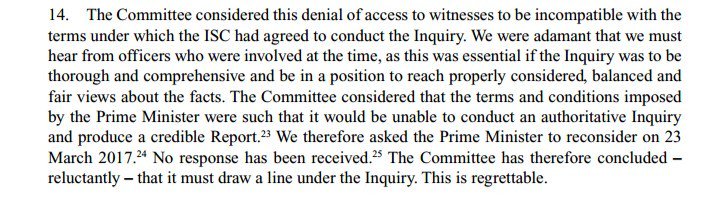
It is worth reflecting that the Tory government has acted time and time again to protect New Labour’s Tony Blair, David Miliband, Jack Straw and Gordon Brown from any punishment for their complicity in torture, and indeed to limit the information on it available to the public. The truth is that the Tories and New Labour (which includes the vast majority of current Labour MPs) are all a part of the same elite interest group, and when under pressure they stick together as a class against the people.
Despite being hamstrung by government, the Committee managed through exhaustive research of classified documents to pull together evidence of British involvement in extraordinary rendition and mistreatment of detainees on a massive scale. The Committee found 596 individual documented incidents of the security services obtaining “intelligence” from detainee interrogations involving torture or severe mistreatment, ranging from 2 incidents of direct involvement, “13 to 15” of actually being in the room, through those where the US or other authorities admitted to the torture, to those where the detainee told the officer they had been tortured. They found three instances where the UK had paid for rendition flights.
My own evidence to the Committee focused on the over-arching policy framework, and specifically the fact that Jack Straw and Richard Dearlove had agreed a deliberate and considered policy of obtaining intelligence through torture. The report includes disappointingly little of my evidence, as the Committee has taken a very narrow view of its remit to oversee the intelligence agencies. This is the only part of my evidence included:
130. This was not unique to the Agencies. Their sponsoring Departments appear to have adopted the same approach. We heard evidence from a former FCO official, Craig Murray, who suggested that “there was a deliberate policy of not committing the discussion on receipt of intelligence through torture to paper in the Foreign Office”.
In July 2004, when he was Ambassador to Tashkent, he raised concerns about the use of Uzbek intelligence derived from torture in a formal exchange of telegrams with the FCO. Mr Murray drew our attention to FCO documents from the same time, which we have seen, one of which referred to “meetings to look at conditions of receipt of intelligence as a general issue”. He told us that the meetings “specifically discuss[ed] the receipt of intelligence under torture from Uzbekistan” and “were absolutely key to the formation of policy on extraordinary rendition and intelligence”.
Mr Murray told us that, when he had given evidence to the Foreign Affairs Select Committee about this, they sought the documents from the FCO which replied that the “meetings were informal meetings and were not minuted ”. He went on to say:
“the idea that you have regular meetings convened at director level, convened by the Director of Security and Intelligence, where you are discussing the receipt of intelligence from torture, and you do not minute those meetings is an impossibility, unless an actual decision or instruction not to minute the meetings has been given.… Were it not for me and my bloody-mindedness, … you would never know those meetings had happened. Nobody would ever know those meetings had happened.”131. We note that we have not seen the minutes of these meetings either: this causes us great concern. Policy discussions on such an important issue should have been minuted. We support
Mr Murray’s own conclusion that were it not for his actions these matters may never have come to light.
Jack Straw to this day denies knowledge and involvement and famously told Parliament that the whole story about rendition and torture was a “conspiracy theory”.
Unless we all start to believe in conspiracy theories and that the officials are lying, that I am lying, that behind this there is some kind of secret state which is in league with some dark forces in the United States, and also let me say, we believe that Secretary Rice is lying, there simply is no truth in the claims that the United Kingdom has been involved in rendition full stop, because we have not been, and so what on earth a judicial inquiry would start to do I have no idea. I do not think it would be justified.”
In fact I strongly recommend you to read the whole Hansard transcript, from Q21 to Q51, in which Jack Straw carries out the most sustained bravura performance of lying to parliament in modern history. The ISC report makes plain he was repeatedly involved in direct authorisations of rendition operations, while denying to parliament the very existence of such operations.
For over a decade now the British government, be it Red Tory or Blue Tory, has been refusing calls for a proper public inquiry into its collusion with torture. The ISC report was meant to stand in place of such an Inquiry, but all it has done is reveal that there is a huge amount of complicity in torture, much more than we had realised, which the ISC itself states it was precluded from properly investigating because of government restrictions on its operations. It also concluded in a separate report on current issues, that it is unable to state categorically that these practices have stopped.
The Blair and Brown governments were deeply immersed in torture, a practice that increased hatred of the UK in the Muslim world and thus increased the threat of terrorism. Their ministers repeatedly lied about it, including to parliament. The British state has since repeatedly acted to ensure impunity for those involved, from Blair and Straw down to individual security service officers, who are not to be held responsible for their criminal complicity. This impunity of agents of the state is a complete guarantee that these evil practices will continue.
Bellingcat & Atlantic Council join to award exploited Syrian child & American Mass Murderer
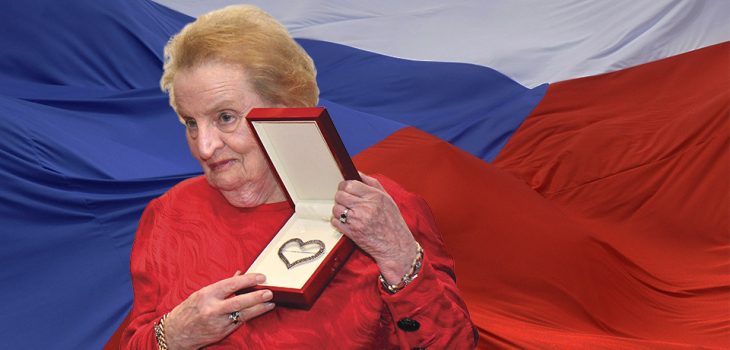
MICHAL CIZEK/AFP/Getty Images
By Eva Bartlett | RT | June 28, 2018
Just when we thought the over-used Bana al-Abed story was in the war propaganda dustbin, the wonder-child theme has again been re-hashed, this time by the Atlantic Council.
The so-called “think tank” recently highlighted the nine-year old at a conference that also included former US secretary of state Madeleine Albright.
Bana, the child presented to the world in late 2016 as tweeting from eastern Aleppo about wanting peace, Russia being bad, Assad being bad, etcetera, became colonial media’s darling, the perfect cover for war propaganda. We are told that Bana al-Abed has written a memoir. She has attended galas, met the Turkish president, and hobnobbed with movie stars and UN officials. Now, the girl has been trotted out on stage to receive an award from the Atlantic Council.
Critical-thinkers aren’t fooled by the Bana story. As I wrote earlier:
Critiques on Amazon reveal that thinking people aren’t buying brand Bana, in spite of her UN appearance and rehearsed speech about children dying from bombs and hunger (which the United Nations retweeted, as all good neutral and credible institutions might).
That her father was a member of a terrorist organization in Aleppo and worked in a Sharia Court has been documented, as has her family’s close proximity to numerous terrorist headquarters in their area of Aleppo alone.
But still, her official story is dragged on, endlessly.
Last April, after the world declared, with zero evidence, that Syria had used a toxic chemical on civilians in Douma, when Syrians testified to the contrary, Western leaders and corporate media labeled giving their testimony as a “masquerade,” “obscene.” They ignored the words of 11-year-old Hassan Diab from Douma. They ignored numerous reports of independent journalists whose reporting from Douma corroborate the testimonies. These people, corporate media tell us, are not to be believed.
Yet, as I wrote earlier, “Corporate media and Western leaders had no issues with the credibility of Bana, who was living surrounded by 25 terrorist cells in her district alone.”
What is the Atlantic Council?
Is the Atlantic Council some benevolent organization handing out awards to do-gooding people?
No. It’s a Washington DC-based think tank, which promulgates lies and propaganda to further imperialist wars and weapons sales, among other things. One of its Syria “experts” is none other than Bellingcat’s Eliot Higgins, who recently took to social media to tell people to suck his “big balls,” making him more of a laughing stock than this backgrounder on the man with no qualifications to his title.
Some of the Atlantic Council’s funders include: the US State Department, oil and weapons manufacturing companies, banks, NATO, various nations’ ministries of defence, and the US Air Force, Army, Marine Corps and Navy.
Even just based on funding alone, and ignoring their pro-NATO policy papers, the Atlantic Council clearly exists to further the interests of those involved in weapons manufacturing, wars, and oil.
‘Banging’: Bellingcat’s interview with Bana
In her interview with Bellingcat, Bana seems more natural than in her early 2017 “save, save the children of Syria” interview (her reply to what kind of food she liked). This time, she can answer basic ‘how are you’ questions. Her replies are met with “cool, cool, cool,” and “banging,” by Bellingcat’s Nick Waters.
After the chit-chat, Bana begins what is clearly a scripted soliloquy, staring forward, possibly concentrating on repeating what is likely being transmitted to her ear, speaking about children and war, destroyed schools, and of course not ever mentioning the terrorists who surrounded her home and occupied schools as headquarters, nor that her own father was a terrorist.
It is a transparently unauthentic recitation, with Bana continually pausing mid-sentence, presumably to hear the rest of what she is told to say. After two and a half minutes of this cringeworthy monologue, she breaks into song, singing “We shall overcome.”
When later receiving her Atlantic Council “Freedom Award,” she gives another rehearsed speech, again halting mid-sentence throughout her five minutes of talking.
These theatrical performances, hosted and encouraged by the Atlantic Council and Bellingcat, epitomize the depth that the NATO alliance is willing to stoop to, grasping desperately at legitimacy in their transparent war propaganda.
It was not only a shameful, but an embarrassing, fail for the Atlantic Council. As of two days later, there isn’t a single positive comment on the Youtube video of her interview. To the contrary, comments speak of child abuse, war propaganda, and that the girl is likely being fed her lines by an earpiece.
On the Atlantic Council’s Youtube channel, comments are disabled for Bana’s award speech.
Failed Sherlocks accuse a non-bot of being a troll
The DFRLab is a project of the Atlantic Council, ostensibly to identify those prolific (Russian) bots and trolls out there.
On June 22, Atlantic Council CEO and President Fred Kempe tweeted:
“Checking in at the 360 / OS #DigitalSherlocks! The @DFRLab team is working together with activists and journalists from all around the world to enhance our ability to identify trolls in the web spreading disinformation and fake news that pollute our open societies.”
The second photo in the tweet identifies three Twitter accounts as possible “trolls”: @Malinka1102, @ian56789, and @bowhunter_va.
One of the accused, @Malinka1102, tweeted about her preference for privacy and not being subjected to witch-hunts and harassment.
Having myself been a target of endless harassment and smear campaigns, I can appreciate her concerns, some of which are also included in a book by Phil Butler’s book.
In fact, a new article by Ben Nimmo—who previously targeted @ian56789 as a “Russian bot” (an accusation revealed to be baseless when Ian gave a live Sky News interview, revealing himself to be a concerned British man)—now targets a number of twitter profiles as “trolls”, including yours truly.
So basically, people who challenge the State Department, sorry, Atlantic Council, Human Rights Watch, and all the other arms of the US and UK governments on their war propaganda are not thinking people with consciences, they are just “trolls”. That’s what DFRLab wants you to believe.
Atlantic Council awards its own war propaganda
On awarding Bana al-Abed, the Atlantic Council tweeted about her humanizing the “Syrian civil war.”
Oh, the irony. The exploited child’s Twitter account has called for World War Three, has whitewashed Al-Qaeda and indeed Bana’s own father Ghassan, a terrorist with the Safwa Brigade.
The irony of also awarding Madeleine Albright — known for her lack of remorse over the 500,000 Iraqi children who died as a result of sanctions — was not lost on people.
Every new Bana production mocks the children in Syria who are actually starving — like those in Ghouta when under terrorist rule, those when under terrorist rule in eastern Aleppo, in Madaya, in al-Waer — and who are being maimed or murdered by terrorist bombings.
The Atlantic Council and Bellingcat are guilty of war propaganda. As @ian56789 wrote to me in a message:
“The members of the Atlantic Council and DFRLab should be indicted as accomplices to War Crimes, for providing actual material support to al-Qaeda terrorists, and for Treason (actively supporting official enemies of the US & UK). They should be spending the rest of their lives in jail and fined every penny they’ve got.”
And those abusing and exploiting Bana al-Abed in their ongoing war propaganda should join them.
Eva Bartlett is a freelance journalist and rights activist with extensive experience in the Gaza Strip and Syria. Her writings can be found on her blog, In Gaza.
The Myth of Barack Obama as the Great and Noble Nobel Global Statesman
By Martin SIEFF | Strategic Culture Foundation | 27.06.2018
It is no coincidence that the Sword, Sorcery and Dragons Fantasy Games of Thrones – filmed in large part on location in my native Northern Ireland – has entranced the American viewing public over the past decade: For the early 21st century has seen US policymakers and opinion-shapers plunging ever deeper into one fantasy after another. But even Game of Thrones pales in incredibility and absurdity next to the fantasy still believed by most Americans — That Barack Obama was a wise and responsible, peace-loving statesman.
In truth, Obama, casually and with evident self-satisfaction, unleashed series of catastrophic foreign national security policies that sent the world careening to the brink of nuclear war and inflicted needless suffering on scores of millions of people. No Game of Thrones villain ever did anything like that damage.
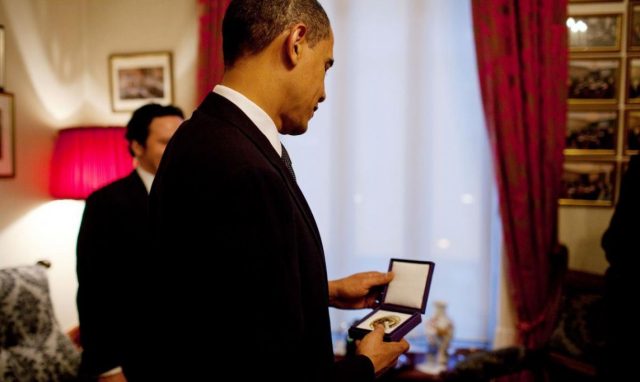
I have no doubt that the ludicrous award of the 2009 Nobel Peace Prize to Obama will go down in history as the most ridiculous such award in the entire history of the institution.
What in reality was Obama’s record as President of the United States?
He authorized a totally unnecessary and strategically meaningless $1 trillion nuclear build up over the coming generation that will play a major role in bankrupting the United States. It was also a move guaranteed to set off a ruinous global thermonuclear arms race with Russia, China and other powers who understandably fear being made defenseless before a succession of ever more unilateral and unpredictable US leaders.
Obama claimed to be deeply concerned about nuclear nonproliferation and hosted a Nuclear Safety Summit in Washington whose only real achievement was to feed his already enormous and delusional appreciation of his own self-worth.
However, as analyst Rebecca Heinrichs of the conservative Hudson Institute in Washington concluded, “If one actually looks at the risks of nuclear war as well as the likelihood of proliferation at the start of the President’s term compared to now, the Obama’s nonproliferation record earns a failing grade.”
In 2011, Obama a fecklessly allowed his warmongering, hyper-aggressive secretary of state Hillary Clinton to arrange with Britain and France the use of NATO air power to destroy the state of Libya by giving tactical support and protection to rebels against veteran leader Muammar Gaddafi.
Gaddafi’s previous decade of consistent cooperation with the US and its allies in the struggle against extreme Islamist terror and his monitored compliance with demands to scrap Libya’s nascent nuclear [program] were all for naught. Obama and Clinton’s reckless and even clownish policies ensured the complete disintegration of Libya, creating an infernal anarchy in which Islamist terror groups could thrive and metastasize throughout sub-Saharan Africa.
Far from encouraging nations to scrap their nuclear programs as Gaddafi in fact had done, Obama’s childish approval of the destruction of Libya sent precisely the opposite message to nations around the world: “Scrap your nuclear deterrents and there will be nothing to stop the United States from destroying you whenever its leaders feel like it.”
It was the same story in Syria where Obama and Clinton eagerly approved the flow of half a billion dollars a year to such groups including, incredibly the Nusrah Front, the Syrian franchise of al-Qaeda, heirs to the conspirators who [are said to have] killed nearly 3,000 Americans on September 11, 2001.
Obama’s utter ignorance and his clueless ignorance of diplomacy and the conduct of international relations was memorably exposed in his casual approval of the absurd and clownish Michael McFaul as US ambassador to Moscow.
The idea that an accredited ambassador could pass his days in sending out public abusive Twitter messages insulting the head of the state to which he was accredited was ludicrous even if that state was Mauritius, Lichtenstein or Tahiti let alone one of the world’s two thermonuclear superpowers.
McFaul openly worked overtime to give aid and encouragement to domestic opposition to the undermine the legitimate government of Russia: His activities would have provoked calls for full-scale war from the US Congress had any Russian envoy to Washington, DC presumed to act in such a way. None of this bothered Obama for a second.
Even worse was to follow: In 2014, US Assistant Secretary of State Victoria Nuland, the wife of leading neocon ideologue Robert Kagan and also the favored subordinate of Hillary Clinton when she was secretary of state openly paraded in the streets of Kiev, handing out cookies to violent protestors as they overthrew with mob riots and terror the constitutionally democratically elected government of a European nation of 45 million people. Obama fully – albeit, as usual, passively approved.
East-West relations were reduced to a state of chaos and distrust unseen in 52 years since the Cuban Missile Crisis. Obama does not appear to have noticed or even been concerned.
Obama was not totally ignorant and uninterested in international relations. During his casual and ill-attended, poorly documented student years at Columbia University in New York City, he attended only one course in international relations. It was given by none other than Zbigniew Brzezinski, former National Security Adviser to President Jimmy Carter.
Brzezinski was a descendant of the displaced minor Polish aristocracy who through his long career consistently fought to lock the United States into a set policies designed to weaken, disintegrate and encircle Russia with hostile powers and alliances. He was a major foreign policy influence on US Presidents Ronald Reagan, Bill Clinton and George W. Bush.
Brzezinski was Obama’s personal guide and guru to what little the 44th US president dimly grasped of strategic orientation and world affairs. Obama’s near-total ignorance of non-American history and diplomacy gave Brzezinski full scope to manipulate him into accepting all his own most virulent anti-Russian prejudices.
Thanks to Obama, superpower diplomatic relations collapsed to their most parlous state in the entire Nuclear Age. When Obama took office in January 2009, the Doomsday Clock of The Bulletin of the Atomic Scientists journal was set at two minutes to midnight and the journal soberly warned: “The world stands at the brink of a second nuclear age.”
Yet after eight years in power, when Obama left the White House in January 2017, as ignorant, complacent and filled with unearned self-regard as when he came to Washington, the Doomsday Clock stood at three minutes to midnight – two minutes closer than when he had taken office.
We do not need to wait to know the Verdict of History on Barack Obama’s eight years as a global statesman. That verdict is in and it is damning: The Nobel committee should rescind his 2009 Peace Prize. Perhaps it can be given instead to a harmless fantasy TV show like Game of Thrones.
American Pravda: the JFK Assassination, Part II – Who Did It?
By Ron Unz • Unz Review • June 25, 2018
A strong dam may hold back an immense quantity of water, but once it breaks the resulting flood may sweep aside everything in its path. I had spent nearly my entire life never doubting that a lone gunman named Lee Harvey Oswald killed President John F. Kennedy nor that a different lone gunman took the life of his younger brother Robert a few years later. Once I came to accept that these were merely fairy tales widely disbelieved by many of the same political elites who publicly maintained them, I began considering other aspects of this important history, the most obvious being who was behind the conspiracy and what were their motives.
On these questions, the passage of a half-century and the deaths, natural or otherwise, of nearly all the contemporary witnesses drastically reduces any hope of coming to a firm conclusion. At best, we can evaluate possibilities and plausibilities rather than high likelihoods let alone near certainties. And given the total absence of any hard evidence, our exploration of the origins of the assassination must necessarily rely upon cautious speculation.
From such a considerable distance in time, a bird’s-eye view may be a reasonable starting point, allowing us to focus on the few elements of the apparent conspiracy that seem reasonably well established. The most basic of these is the background of the individuals who appear to have been associated with the assassination, and the recent books by David Talbot and James W. Douglass effectively summarize much of the evidence accumulated over the decades by an army of diligent assassination researchers. Most of the apparent conspirators seem to have had strong ties to organized crime, the CIA, or various anti-Castro activist groups, with considerable overlap across these categories. Oswald himself certainly fit this same profile although he was very likely the mere “patsy” that he claimed to be, as did Jack Ruby, the man who quickly silenced him and whose ties to the criminal underworld were long and extensive.
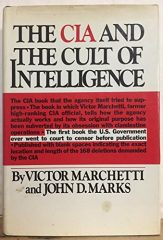
An unusual chain of events provided some of the strongest evidence of CIA involvement. Victor Marchetti, a career CIA officer, had risen to become Special Assistant to the Deputy Director, a position of some importance, before resigning in 1969 over policy differences. Although he fought a long battle with government censors over his book, The CIA and the Cult of Intelligence, he retained close ties with many former agency colleagues.
During the 1970s, the revelations of the Senate Church Committee and the House Select Committee on Assassinations had subjected the CIA to a great deal of negative public scrutiny, and there were growing suspicions of possible CIA links to JFK’s assassination. In 1978 longtime CIA Counter-intelligence chief James Angleton and a colleague provided Marchetti with an explosive leak, stating that the agency might be planning to admit a connection to the assassination, which had involved three shooters, but place the blame upon E. Howard Hunt, a former CIA officer who had become notorious during Watergate, and scapegoat him as a rogue agent, along with a few other equally tarnished colleagues. Marchetti published the resulting story in The Spotlight, a weekly national tabloid newspaper operated by Liberty Lobby, a rightwing populist organization based in DC. Although almost totally shunned by the mainstream media, The Spotlight was then at the peak of its influence, having almost 400,000 subscribers, as large a readership as the combined total of The New Republic, The Nation, and National Review.
Marchetti’s article suggested that Hunt had actually been in Dallas during the assassination, resulting in a libel lawsuit with potential damages large enough to bankrupt the publication. Longtime JFK assassination researcher Mark Lane became aware of the situation and volunteered his services to Liberty Lobby, hoping to use the legal proceedings, including the discovery process and subpoena power, as a means of securing additional evidence on the assassination, and after various court rulings and appeals, the case finally came to trial in 1985.
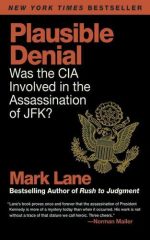
As Lane recounted in his 1991 bestseller, Plausible Denial, his strategy generally proved quite successful, not only allowing him to win the jury verdict against Hunt, but also eliciting sworn testimony from a former CIA operative of her personal involvement in the conspiracy along with the names of several other participants, though she claimed that her role had been strictly peripheral. And although Hunt continued for decades to totally deny any connection with the assassination, near the end of his life he made a series of video-taped interviews in which he admitted that he had indeed been involved in the JFK assassination and named several of the other conspirators, while also maintaining that his own role had been merely peripheral. Hunt’s explosive death-bed confession was recounted in a major 2007 Rolling Stone article and also heavily analyzed in Talbot’s books, especially his second one, but otherwise largely ignored by the media.
Many of these same apparent conspirators, drawn from the same loose alliance of groups, had previously been involved in the various U.S. government-backed attempts to assassinate Castro or overthrow his Communist government, and they had developed a bitter hostility towards President Kennedy for what they considered his betrayal during the Bay of Pigs fiasco and afterward. Therefore, there is a natural tendency to regard such animosity as the central factor behind the assassination, a perspective generally followed by Talbot, Douglass, and numerous other writers. They conclude that Kennedy died at the hands of harder-line anti-Communists, outraged over his perceived weakness regarding Cuba, Russia, and Vietnam, sentiments that were certainly widespread within right-wing political circles at the height of the Cold War.
While this framework for the assassination is certainly possible, it is far from certain. One may easily imagine that most of the lower-level participants in the Dallas events were driven by such considerations but that the central figures who organized the plot and set matters into motion had different motives. So long as all the conspirators were agreed on Kennedy’s elimination, there was no need for an absolute uniformity of motive. Indeed, men who had long been involved in organized crime or clandestine intelligence operations were surely experienced in operational secrecy, and many of them may not have expected to know the identities, let alone the precise motives, of the men at the very top of the remarkable operation they were undertaking.
We must also sharply distinguish between the involvement of particular individuals and the involvement of an organization as an organization. For example, CIA Director John McCone was a Kennedy loyalist who had been appointed to clean house a couple of years before the assassination, and he surely was innocent of his patron’s death. On the other hand, the very considerable evidence that numerous individual CIA intelligence officers and operatives participated in the action has naturally raised suspicions that some among their highest-ranking superiors were involved as well, perhaps even as the principal organizers of the conspiracy.
These reasonable speculations may have been magnified by elements of personal bias. Many of the prominent authors who have investigated the JFK assassination in recent years have been staunch liberals, and may have allowed their ideology to cloud their judgment. They often seek to locate the organizers of Kennedy’s elimination among those rightwing figures whom they most dislike, even when the case is far from entirely plausible.
But consider the supposed motives of hard-line anti-Communists near the top of the national security hierarchy who supposedly may have organized Kennedy’s elimination because he backed away from a full military solution in the Bay of Pigs and Cuban Missile Crisis incidents. Were they really so absolutely sure that a President Johnson would be such an enormous improvement as to risk their lives and public standing to organize a full conspiracy to assassinate an American president?
A new presidential election was less than a year away, and Kennedy’s shifting stance on Civil Rights seemed likely to cost him nearly all the Southern states that had provided his margin of electoral victory in 1960. A series of public declarations or embarrassing leaks might have helped remove him from office by traditional political means, possibly replacing him with a Cold War hard-liner such as Barry Goldwater or some other Republican. Would the militarists or business tycoons often implicated by liberal JFK researchers have really been so desperate as to not wait those extra few months and see what happened?
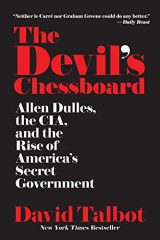
Based on extremely circumstantial evidence, Talbot’s 2015 book The Devil’s Chessboard, something of a sequel to Brothers, suggests that former longtime CIA Director Allan Dulles may have been the likely mastermind, with his motive being a mixture of his extreme Cold Warrior views and his personal anger at his 1961 dismissal from his position.
While his involvement is certainly possible, obvious questions arise. Dulles was a seventy-year-old retiree, with a very long and distinguished career of public service and a brother who had served as Eisenhower’s secretary of state. He had just published The Cult of Intelligence, which was receiving very favorable treatment in the establishment media, and he was embarked on a major book tour. Would he really have risked everything—including his family’s reputation in the history books—to organize the murder of America’s duly-elected president, an unprecedented act utterly different in nature than trying to unseat a Guatemalan leader on behalf of supposed American national interests? Surely, using his extensive media and intelligence contacts to leak embarrassing disclosures about JFK’s notorious sexual escapades during the forthcoming presidential campaign would have been be a much safer means of attempting to achieve an equivalent result. And the same is true for J. Edgar Hoover and many of the other powerful Washington figures who hated Kennedy for similar reasons.
On the other hand, it is very easy to imagine that such individuals had some awareness of the emerging plot or may even have facilitated it or participated to a limited extent. And once it succeeded, and their personal enemy had been replaced, they surely would have been extremely willing to assist in the cover-up and protect the reputation of the new regime, a role that Dulles may have played as the most influential member of the Warren Commission. But such activities are different than acting as the central organizer of a presidential assassination.
Just as with the hard-line national security establishment, many organized crime leaders had grown outraged over the actions of the Kennedy Administration. During the late 1950s, Robert Kennedy had intensely targeted the mob for prosecution as chief counsel to the Senate Labor Rackets Committee. But during the 1960 election, family patriarch Joseph Kennedy used his own longstanding mafia connections to enlist their support for his older son’s presidential campaign, and by all accounts the votes stolen by the corrupt mob-dominated political machines in Chicago and elsewhere helped put JFK in the White House, along with Robert Kennedy as his Attorney General. Frank Sinatra, an enthusiastic Kennedy supporter, had also helped facilitate this arrangement by using his influence with skeptical mob leaders.
However, instead of repaying such crucial election support with political favors, Attorney General Robert Kennedy, perhaps ignorant of any bargain, soon unleashed an all-out war against organized crime, far more serious than anything previously mounted at the federal level, and the crime bosses regarded this as a back-stabbing betrayal by the new administration. Once Joseph Kennedy was felled by an incapacitating stroke in late 1961, they also lost any hope that he would use his influence to enforce the deals he had struck the previous year. FBI wiretaps reveal that mafia leader Sam Giancana decided to have Sinatra killed for his role in this failed bargain, only sparing the singer’s life when he considered how much he personally loved the voice of one of the most famous Italian-Americans of the 20th century.
These organized crime leaders and some of their close associates such as Teamster boss Jimmy Hoffa certainly developed a bitter hatred toward the Kennedys, and this has naturally led some authors to point to the mafia as the likely organizers of the assassination, but I find this quite unlikely. For many decades, American crime bosses had had a complex and varied relationship with political figures, who might sometimes be their allies and at other times their persecutors, and surely there must have been many betrayals over the years. However, I am not aware of a single case in which any even moderately prominent political figure on the national stage was ever targeted for assassination, and it seems quite unlikely that the sole exception would be a popular president, whom they would have likely regarded as being completely out of their league. On the other hand, if individuals who ranked high in Kennedy’s own DC political sphere set in motion a plot to eliminate him, they might have found it easy to enlist the enthusiastic cooperation of various mafia leaders.
Furthermore, the strong evidence that many CIA operatives were involved in the conspiracy very much suggests that they were recruited and organized by some figure high in their own hierarchy of the intelligence or political worlds rather than the less likely possibility that they were brought in solely by leaders of the parallel domain of organized crime. And while crime bosses might possibly have organized the assassination itself, they surely had no means of orchestrated the subsequent cover-up by the Warren Commission, nor would there have been any willingness by America’s political leadership to protect mafia leaders from investigation and proper punishment for such a heinous act.
If a husband or wife is found murdered, with no obvious suspect or motive at hand, the normal response of the police is to carefully investigate the surviving spouse, and quite often this suspicion proves correct. Similarly, if you read in your newspapers that in some obscure Third World country two bitterly hostile leaders, both having unpronounceable names, had been sharing supreme political power until one was suddenly struck down in a mysterious assassination by unknown conspirators, your thoughts would certainly move in an obvious direction. Most Americans in the early 1960s did not perceive their own country’s politics in such a light, but perhaps they were mistaken. As a total newcomer to the enormous, hidden world of JFK conspiracy analysis, I was immediately surprised by the mere sliver of suspicion directed towards Vice President Lyndon B. Johnson, the slain leader’s immediate successor and the most obvious beneficiary.
The two Talbot books and the one by Douglass, totaling some 1500 pages, devote merely a few paragraphs to any suspicions of Johnson’s involvement. Talbot’s first book reports that immediately after the assassination, the vice president had expressed a frantic concern to his personal aides that a military coup might be in progress or a world war breaking out, and suggests that these few casual words demonstrate his obvious innocence, although a more cynical observer might wonder if those remarks had been uttered for exactly that reason. Talbot’s second book actually quotes an apparent low-level conspirator as claiming that Johnson had personally signed off on the plot and admits that Hunt believed the same thing, but treats such unsubstantiated accusations with considerable skepticism, before adding a single sentence acknowledging that Johnson may indeed have been a passive supporter or even an accomplice. Douglass and Peter Dale Scott, author of the influential 1993 book Deep Politics and the Death of JFK, apparently seem never to have even entertained the possibility.
Ideological considerations are probably an important reason for such remarkable reticence. Although liberals had grown to revile LBJ by the late 1960s for his escalation of the unpopular Vietnam War, over the decades those sentiments have faded, while warm memories of his passage of the landmark Civil Rights legislation and his creation of the Great Society programs have elevated his stature in that ideological camp. Furthermore, such legislation had long been blockaded in Congress and only became law because of the 1964 Democratic Congressional landslide following JFK’s martyrdom, and it might be difficult for liberals to admit that their fondest dreams were only realized by an act of political parricide.
Kennedy and Johnson may have been intensively hostile personal rivals, but there seem to have been few deep ideological differences between the two men, and most of the leading figures in JFK’s government continued to serve under his successor, surely another source of enormous embarrassment to any ardent liberals who came to suspect that the former had been murdered by a conspiracy involving the latter. Talbot, Douglass, and many other left-leaning advocates for an assassination conspiracy prefer to point the finger of blame towards far more congenial villains such as hard-line, anti-Communist Cold Warriors and right-wing elements, notably including top CIA officials, such as former director Allan Dulles.
An additional factor helping to explain the extreme unwillingness of Talbot, Douglass, and others to consider Johnson as an obvious suspect may be the realities of the book publishing industry. By the 2000s, JFK assassination conspiracies had long become passé and were treated with disdain in mainstream circles. Talbot’s strong reputation, his 150 original interviews, and the quality of his manuscript broke that barrier, and attracted The Free Press as his very respectable publisher, while later drawing a strongly positive review by a leading academic scholar in the New York Times Sunday Book Review and an hour long television segment broadcast on C-Span Booknotes. But if he had devoted any space to voicing suspicions that our 35th president had been murdered by our 36th, surely the weight of that extra element of “outrageous conspiracy theory” would have ensured that his book sank without a trace.
However, if we cast off these distorting ideological blinders and the practical considerations of American publishing, the prima facie case for Johnson’s involvement seems quite compelling.
Consider a very simple point. If a president is struck down by an unknown group of conspirators, his successor would normally have had the strongest possible incentive to track them down lest he might become their next victim. Yet Johnson did nothing, appointing the Warren Commission that covered up the entire matter, laying the blame upon an erratic “lone gunman” conveniently dead. This would seem remarkably odd behavior for an innocent LBJ. This conclusion does not demand that Johnson was the mastermind, nor even an active participant, but it raises a very strong suspicion that he at least had had some awareness of the plot, and enjoyed a good personal relationship with some of the principals.
A similar conclusion is supported by a converse analysis. If the plot succeeded and Johnson became president, the conspirators must surely have felt reasonably confident that they would be protected rather than tracked down and punished as traitors by the new president. Even a fully successful assassination would entail enormous risks unless the organizers believed that Johnson would do exactly what he did, and the only means of ensuring this would be to sound him out about the plan, at least in some vague manner, and obtain his passive acquiesce.
Based on these considerations, it seems extremely difficult to believe that any JFK assassination conspiracy took place entirely without Johnson’s foreknowledge, or that he was not a central figure in the subsequent cover-up.
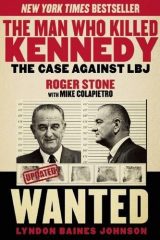
But the specific details of Johnson’s career and his political situation in late 1963 greatly strengthen these entirely generic arguments. A very useful corrective to the “See No Evil” approach to Johnson from liberal JFK writers is Roger Stone’s The Man Who Killed Kennedy: The Case Against LBJ, published in 2013. Stone, a longtime Republican political operative who got his start under Richard Nixon, presents a powerful case that Johnson was the sort of individual who might easily have lent his hand to political murder, and also that he had strong reasons to do so.
Among other things, Stone gathers together an enormous wealth of persuasive information regarding Johnson’s decades of extremely corrupt and criminal practices in Texas, including fairly plausible claims that these may have included several murders. In one bizarre 1961 incident that strangely foreshadows the Warren Commission’s “lone gunman” finding, a federal government inspector investigating a major Texas corruption scheme involving a close LBJ ally was found dead, shot five times in the chest and abdomen by a rifle, but the death was officially ruled a “suicide” by the local authorities, and that conclusion was reported with a straight face in the pages of the Washington Post.
Certainly one remarkable aspect of Johnson’s career is that he was born dirt-poor, held low-paying government jobs throughout his entire life, yet took the oath of office as the wealthiest president in modern American history, having accumulated a personal fortune of over $100 million in present-day dollars, with the financial payoffs from his corporate benefactors having been laundered through his wife’s business. This odd anomaly is so little remembered these days that a prominent political journalist expressed total disbelief when I mentioned it to him a decade ago.
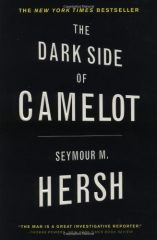
Stone also effectively sketches out the very difficult political situation Johnson faced in late 1963. He had originally entered the 1960 presidential race as one of the most powerful Democrats in the country and the obvious front-runner for his party’s nomination, certainly compared to the much younger Kennedy, whom he greatly outranked in political stature and also somewhat despised. His defeat, involving a great deal of underhanded dealings on both sides, came as a huge personal blow. The means by which he somehow managed to get himself placed on the ticket are not entirely clear, but both Stone and Seymour Hersh in The Dark Side of Camelot strongly suggest that personal blackmail was a greater factor than geographical ticket-balancing. In any event, Kennedy’s paper-thin 1960 victory would have been far more difficult without Texas narrowly falling into the Democratic column, and election fraud there by Johnson’s powerful political machine seems almost certainly to have been an important factor.
Under such circumstances, Johnson naturally expected to play a major role in the new administration, and he even issued grandiose demands for a huge political portfolio, but instead he found himself immediately sidelined and treated with complete disdain, soon becoming a forlorn figure with no authority or influence. As time went by, the Kennedys made plans to get rid of him, and just a few days before the assassination, they were already discussing whom to place on the reelection ticket in his stead. Much of Johnson’s long record of extreme corruption both in Texas and in DC was coming to light following the fall of Bobby Baker, his key political henchman, and with strong Kennedy encouragement, Life Magazine was preparing a huge expose of his sordid and often criminal history, laying the basis for his prosecution and perhaps a lengthy prison sentence. By mid-November 1963, Johnson seemed a desperate political figure at the absolute end of his rope, but a week later he was the president of the United States, and all those swirling scandals were suddenly forgotten. Stone even claims that the huge block of magazine space reserved for the Johnson expose was instead filled by the JFK assassination story.
Aside from effectively documenting Johnson’s sordid personal history and the looming destruction he faced at the hands of the Kennedys in late 1963, Stone also adds numerous fascinating pieces of personal testimony, which may or may not be reliable. According to him, as his mentor Nixon was watching the scene at the Dallas police station where Jack Ruby shot Oswald, Nixon immediately turned as white as a ghost, explaining that he had personally known the gunman under his birth-name of Rubenstein. While working on a House Committee in 1947, Nixon had been advised by a close ally and prominent mob-lawyer to hire Ruby as an investigator, being told that “he was one of Lyndon Johnson’s boys.” Stone also claims that Nixon once emphasized that although he had long sought the presidency, unlike Johnson “I wasn’t willing to kill for it.” He further reports that Vietnam Ambassador Henry Cabot Lodge and numerous other prominent political figures in DC were absolutely convinced of Johnson’s direct involvement in the assassination.
Stone has spent more than a half-century as a ruthless political operative, a position that provided him with unique personal access to individuals who participated in the great events of the past, but one that also carries the less than totally candid reputation of that profession, and individuals must carefully weigh these conflicting factors against each other. Personally, I tend to credit most of the eyewitness stories he provides. But even readers who remain entirely skeptical should find useful the large collection of secondary source references to the sordid details of LBJ’s history that the book provides.
Finally, a seemingly unrelated historical incident had originally raised my own suspicions of Johnson’s involvement.
Just prior to the outbreak of the Six Day War in 1967, Johnson had dispatched the U.S.S. Liberty, our most advanced intelligence-gathering ship, to remain offshore in international waters and closely monitor the military situation. There have been published claims that he had granted Israel a green-light for its preemptive attack, but fearful of risking a nuclear confrontation with the Soviet patrons of Syria and Egypt, had strictly circumscribed the limits of the military operation, sending the Liberty to keep an eye on developments and perhaps also to “show Israel who was boss.”
Whether or not this reconstruction is correct, the Israelis soon launched an all-out attack on the nearly defenseless ship despite the large American flag it was flying, deploying attack jets and torpedo boats to sink the vessel during an assault that lasted several hours, while machine-gunning the lifeboats to ensure that there would be no survivors. The first stage of the attack had targeted the main communications antenna, and its destruction together with heavy Israeli jamming, prevented any communications with other U.S. naval forces in the region.
Despite these very difficult conditions, a member of the crew heroically managed to jerry-rig a replacement antenna during the attempt, and by trying numerous different frequencies, was able to evade the jamming and contact the U.S. Sixth Fleet, informing them of the desperate situation. Yet although carrier jets were twice dispatched to rescue the Liberty and drive off the attackers, each time they were recalled, apparently upon direct orders from the highest authorities of the U.S. government. Once the Israelis learned that word of the situation had reached other U.S. forces, they soon discontinued their attack, and the heavily-damaged Liberty eventually limped into port, with over 200 dead and wounded sailors and NSA signal operators, representing the greatest loss of American servicemen in any naval incident since World War II.
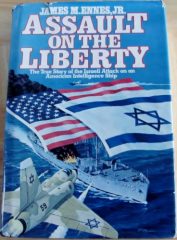
Although numerous medals were issued to the survivors, word of the incident was totally suppressed by a complete blanket of secrecy, and in an unprecedented step, even a Congressional Medal of Honor was awarded only in a private ceremony. The survivors were also harshly threatened with immediate court martial if they discussed what had transpired with the press or anyone else. Despite the overwhelming evidence that the attack had been intentional, a naval court of inquiry presided over by Admiral John S. McCain, Jr., father of the current senator, whitewashed the incident as a tragic accident, and a complete media blackout suppressed the facts. The true story only began to come out years later, when James M. Ennes, Jr., a Liberty survivor, risked severe legal consequences and published Assault on the Liberty in 1979 .
As it happened, NSA intercepts of Israeli communications between the attacking jets and Tel Aviv, translated from the Hebrew, fully confirmed that the attack had been entirely deliberate, and since many of the dead and wounded were NSA employees, the suppression of these facts greatly rankled their colleagues. My old friend Bill Odom, the three-star general who ran the NSA for Ronald Reagan, later shrewdly circumvented the restrictions of his political masters by making those incriminating intercepts part of the standard curriculum of the Sigint training program required for all intelligence officers.
In 2007 an unusual set of circumstances finally broke the thirty year blackout in the mainstream media. Real estate investor Sam Zell, a Jewish billionaire extremely devoted to Israel, had orchestrated a leveraged-buyout of the Tribune Company, parent of the Los Angeles Times and the Chicago Tribune, investing merely a sliver of his own money, with the bulk of the financing coming from the pension funds of the company he was acquiring. Widely heralded as “the grave dancer” for his shrewd financial investments, Zell publicly boasted that the deal gave him nearly all of the upside potential of the company, while he bore relatively little of the risk. Such an approach proved wise since the complex deal quickly collapsed into bankruptcy, and although Zell emerged almost unscathed, the editors and journalists lost decades of their accumulated pension dollars, while massive layoffs soon devastated the newsrooms of what had been two of the country’s largest and most prestigious newspapers. Perhaps coincidentally, just as this business turmoil hit in late 2007, the Tribune ran a massive 5,500 word story on the Liberty attack, representing the first and only time such a comprehensive account of the true facts has ever appeared in the mainstream media.
By all accounts, Johnson was an individual of towering personal ego, and when I read the article, I was struck by the extent of his astonishing subservience to the Jewish state. The influence of campaign donations and favorable media coverage seemed completely insufficient to explain his reaction to an incident that had cost the lives of so many American servicemen. I began to wonder if Israel might have played an extraordinarily powerful political trump-card, thereby showing LBJ “who was really boss,” and once I discovered the reality of the JFK assassination conspiracy a year or two later, I suspected I knew what that trump-card might have been. Over the years, I had become quite friendly with the late Alexander Cockburn, and the next time we had lunch I outlined my ideas. Although he had always casually dismissed JFK conspiracy theories as total nonsense, he found my hypothesis quite intriguing.
Regardless of such speculation, the strange circumstances of the Liberty incident certainly demonstrated the exceptionally close relationship between President Johnson and the government of Israel, as well as the willingness of the mainstream media to spend decades hiding events of the most remarkable nature if they might tread on particular toes.
These important considerations should be kept in mind as we begin exploring the most explosive yet under-reported theory of the JFK assassination. Almost twenty-five years ago the late Michael Collins Piper published Final Judgment presenting a very large body of circumstantial evidence that Israel and its Mossad secret intelligence service, together with their American collaborators, probably played a central role in the conspiracy.
For decades following the 1963 assassination, virtually no suspicions had ever been directed towards Israel, and as a consequence none of the hundreds or thousands of assassination conspiracy books that appeared during the 1960s, 1970s, and 1980s had hinted at any role for the Mossad, though nearly every other possible culprit, ranging from the Vatican to the Illuminati, came under scrutiny. Kennedy had received over 80% of the Jewish vote in his 1960 election, American Jews featured very prominently in his White House, and he was greatly lionized by Jewish media figures, celebrities, and intellectuals ranging from New York City to Hollywood to the Ivy League. Moreover, individuals with a Jewish background such as Mark Lane and Edward Epstein had been among the leading early proponents of an assassination conspiracy, with their controversial theories championed by influential Jewish cultural celebrities such as Mort Sahl and Norman Mailer. Given that the Kennedy Administration was widely perceived as pro-Israel, there seemed no possible motive for any Mossad involvement, and bizarre, totally unsubstantiated accusations of such a monumental nature directed against the Jewish state were hardly likely to gain much traction in an overwhelmingly pro-Israel publishing industry.

However, in the early 1990s highly-regarded journalists and researchers began exposing the circumstances surrounding the development of Israel’s nuclear weapons arsenal. Seymour Hersh’s 1991 book The Samson Option: Israel’s Nuclear Arsenal and American Foreign Policy described the extreme efforts of the Kennedy Administration to force Israel to allow international inspections of its allegedly non-military nuclear reactor at Dimona, and thereby prevent its use in producing nuclear weapons. Dangerous Liaisons: The Inside Story of the U.S.-Israeli Covert Relationship by Andrew and Leslie Cockburn appeared in the same year, and covered similar ground.
Although entirely hidden from public awareness at the time, the early 1960s political conflict between the American and Israeli governments over nuclear weapons development had represented a top foreign policy priority of the Kennedy Administration, which had made nuclear non-proliferation one of its central international initiatives. It is notable that John McCone, Kennedy’s choice as CIA Director, had previously served on the Atomic Energy Commission under Eisenhower, being the individual who leaked the fact that Israel was building a nuclear reactor to produce plutonium.
The pressure and financial aid threats secretly applied to Israel by the Kennedy Administration eventually became so severe that they led to the resignation of Israel’s founding Prime Minister David Ben-Gurion in June 1963. But all these efforts were almost entirely halted or reversed once Kennedy was replaced by Johnson in November of that same year. Piper notes that Stephen Green’s 1984 book Taking Sides: America’s Secret Relations With a Militant Israel had previously documented that U.S. Middle East Policy completely reversed itself following Kennedy’s assassination, but this important finding had attracted little attention at the time.
Skeptics of a plausible institutional basis for a JFK assassination conspiracy have often noted the extreme continuity in both foreign and domestic policies between the Kennedy and Johnson Administrations, arguing that this casts severe doubt on any such possible motive. Although this analysis seems largely correct, America’s behavior towards Israel and its nuclear weapons program stands as a very notable exception to this pattern.
An additional major area of concern for Israeli officials may have involved the efforts of the Kennedy Administration to sharply restrict the activities of pro-Israel political lobbies. During his 1960 presidential campaign, Kennedy had met in New York City with a group of wealthy Israel advocates, led by financier Abraham Feinberg, and they had offered enormous financial support in exchange for a controlling influence in Middle Eastern policy. Kennedy managed to fob them off with vague assurances, but he considered the incident so troubling that the next morning he sought out journalist Charles Bartlett, one of his closest friends, and expressed his outrage that American foreign policy might fall under the control of partisans of a foreign power, promising that if he became president, he would rectify that situation. And indeed, once he had installed his brother Robert as Attorney General, the latter initiated a major legal effort to force pro-Israel groups to register themselves as foreign agents, which would have drastically reduced their power and influence. But after JFK’s death, this project was quickly abandoned, and as part of the settlement, the leading pro-Israel lobby merely agreed to reconstitute itself as AIPAC.
Final Judgment went through a number of a reprintings following its original 1994 appearance, and by the sixth edition released in 2004, had grown to over 650 pages, including numerous long appendices and over 1100 footnotes, the overwhelming majority of these referencing fully mainstream sources. The body of the text was merely serviceable in organization and polish, reflecting the total boycott by all publishers, mainstream or alternative, but I found the contents themselves remarkable and generally quite compelling. Despite the most extreme blackout by all media outlets, the book sold more than 40,000 copies over the years, making it something of an underground bestseller, and surely bringing it to the attention of everyone in the JFK assassination research community, though apparently almost none of them were willing to mention its existence. I suspect these other writers realized that even any mere acknowledgement of the existence of the book, if only to ridicule or dismiss it, might prove fatal to their media and publishing career. Piper himself died in 2015, aged 54, suffering from the health problems and heavy-drinking often associated with grim poverty, and other journalists may have been reluctant to risk that same dismal fate.
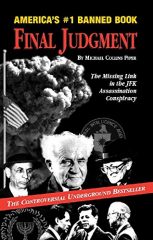
As an example of this strange situation, the bibliography of Talbot’s 2005 book contains almost 140 entries, some rather obscure, but has no space for Final Judgment, nor does his very comprehensive index include any entry for “Jews” or “Israel.” Indeed, at one point he very delicately characterizes Sen. Robert Kennedy’s entirely Jewish senior staff by stating “There was not a Catholic among them.” His 2015 sequel is equally circumspect, and although the index does contain numerous entries pertaining to Jews, all these references are in regards to World War II and the Nazis, including his discussion of the alleged Nazi ties of Allen Dulles, his principal bête noire. Stone’s book, while fearlessly convicting President Lyndon Johnson of the JFK assassination, also strangely excludes “Jews” and “Israel” from the long index and Final Judgment from the bibliography, and Douglass’s book follows this same pattern.
Furthermore, the extreme concerns that the Piper Hypothesis seems to have provoked among JFK assassination researchers may explain a strange anomaly. Although Mark Lane was himself of Jewish origins and left-wing roots, after his victory for Liberty Lobby in the Hunt libel trial, he spent many years associated with that organization in a legal capacity, and apparently became quite friendly with Piper, one of its leading writers. According to Piper, Lane told him that Final Judgment made “a solid case” for a major Mossad role in the assassination, and he viewed the theory as fully complementary to his own focus on CIA involvement. I suspect that concerns about these associations may explain why Lane was almost completely airbrushed out of the Douglass and 2007 Talbot books, and discussed in the second Talbot book only when his work was absolutely essential to Talbot’s analysis. By contrast, New York Times staff writers are hardly likely to be as versed in the lesser-known aspects of the JFK assassination research community, and being ignorant of this hidden controversy, they gave Lane the long and glowing obituary that his career fully warranted.
When weighing the possible suspects for a given crime, considering their past pattern of behavior is often a helpful approach. As discussed above, I can think of no historical example in which organized crime initiated a serious assassination attempt against any American political figure even moderately prominent on the national stage. And despite a few suspicions here and there, the same applies to the CIA.
By contrast, the Israeli Mossad and the Zionist groups that preceded the establishment of the Jewish state seem to have a very long track record of assassinations, including those of high-ranking political figures who might normally be regarded as inviolate. Lord Moyne, the British Minister of State for the Middle East, was assassinated in 1944 and Count Folke Bernattote, the UN Peace Negotiator sent to help resolve the first Arab-Israel war suffered the same fate in September 1948. Not even an American president was entirely free of such risks, and Piper notes that the memoirs of Harry Truman’s daughter Bess reveal that Zionist militants had tried to assassinate her father using a letter laced with toxic chemicals in 1947 when they believed he was dragging his heels in supporting Israel, although that failed attempt was never made public. The Zionist faction responsible for all of these incidents was led by Yitzhak Shamir, who later became a leader of Mossad and director of its assassination program during the 1960s, before eventually becoming Prime Minister of Israel in 1986.
If the claims in the 1990s tell-all bestsellers of Mossad defector Victor Ostrovsky can be credited, Israel even considered the assassination of President George H.W. Bush in 1992 for his threats to cut off financial aid to Israel during a conflict over West Bank settlement policies, and I have been informed that the Bush Administration took those reports seriously at the time. And although I have not yet read it, the recent, widely-praised book Rise and Kill First: The Secret History of Israel’s Targeted Assassinations by journalist Ronen Bergman suggests that no other country in the world may have so regularly employed assassination as a standard tool of state policy.
There are other notable elements that tend to support the Piper Hypothesis. Once we accept the existence of a JFK assassination conspiracy, the one individual who is virtually certain to have been a participant was Jack Ruby, and his organized crime ties were almost entirely to the huge but rarely-mentioned Jewish wing of that enterprise, presided over by Meyer Lansky, an extremely fervent supporter of Israel. Ruby himself had particularly strong ties with Lansky lieutenant Mickey Cohen, who dominated the Los Angeles underworld and had been personally involved in gun-running to Israel prior to the 1948 war. Indeed, according to Dallas rabbi Hillel Silverman, Ruby had privately explained his killing of Oswald by saying “I did it for the Jewish people.”
An intriguing aspect to Oliver Stone’s landmark JFK film should also be mentioned. Arnon Milchan, the wealthy Hollywood producer who backed the project, was not only an Israeli citizen, but had also reportedly played a central role in the enormous espionage project to divert American technology and materials to Israel’s nuclear weapons project, the exact undertaking that the Kennedy Administration had made such efforts to block, even sometimes being described as “the Israeli James Bond.” And although the film ran a full three hours in length, JFK scrupulously avoided presenting any of the details that Piper later regarded as initial clues to an Israeli dimension, instead seeming to finger America’s fanatic home-grown anti-Communist movement and the Cold War leadership of the military-industrial complex as the guilty parties.
Summarizing over 300,000 words of Piper’s history and analysis in just a few paragraphs is obviously an impossible undertaking, but the above discussion provides a reasonable taste of the enormous mass of circumstantial evidence mustered in favor of the Piper Hypothesis.
In many respects, JFK Assassination Studies has become its own academic discipline, and my credentials are quite limited. I have read perhaps a dozen books in the subject, and have also tried to approach the issues with the clean slate and fresh eyes of an outsider, but any serious expert would surely have digested scores or even hundreds of the volumes in the field. While the overall analysis of Final Judgment struck me as quite persuasive, a good fraction of the names and references were unfamiliar, and I simply do not have the background to assess their credibility, nor whether the description of the material presented is accurate.
Under normal circumstances, I would turn to the reviews or critiques produced by other authors, and comparing them against Piper’s arguments, decide which argument seemed the stronger. But although Final Judgment was published a quarter-century ago, the near-absolute blanket of silence surrounding the Piper Hypothesis, especially from the more influential and credible researchers, renders this impossible.
However, Piper’s inability to secure any regular publisher and the widespread efforts to smother his theory out of existence, have had an ironic consequence. Since the book went out of print years ago, I had a relatively easy time securing the rights to include it in my collection of controversial HTML Books, and I have now done so, thereby allowing everyone on the Internet to conveniently read the entire text and decide for themselves, while easily checking the multitude of references or searching for particular words or phrases.
The Missing Link in the JFK Assassination Conspiracy
Michael Collins Piper • 2005 • 310,000 Words
This edition actually incorporates several much shorter works, originally published separately. One of these, consisting of an extended Q&A, describes the genesis of the idea and answers numerous questions surrounding it, and for some readers may represent a better starting point.
Questions, Answers & Reflections About the Crime of the Century
Michael Collins Piper • 2005 • 48,000 Words
There are also numerous extended Piper interviews or presentations easily available on YouTube, and when I watched two or three of them a couple of years ago, I thought he effectively summarized many of his main arguments, but I cannot remember which ones they were.
The Kennedy assassination surely ranks as one of the most dramatic and heavily reported events of the twentieth century, yet the overwhelming evidence that our president died at the hands of a conspiracy rather than an eccentric “lone gunman” was almost entirely suppressed by our mainstream media during the decades that followed, with endless ridicule and opprobrium heaped on many of the stubborn truth-tellers. Indeed, the very term “conspiracy theory” soon became a standard slur aimed against all those who sharply questioned establishmentarian narratives, and there is strong evidence that such pejorative use was deliberately promoted by government agencies concerned that so much of the American citizenry was growing skeptical of the implausible cover story presented by the Warren Commission. But despite all these efforts, this period may mark the inflection point at which public trust in our national media began its precipitous decline. Once an individual concludes that the media lied about something as enormous as the JFK assassination, he naturally begins to wonder what other lies may be out there.
Although I now consider the case for an assassination conspiracy overwhelming, I think that the passage of so many decades has removed any real hope of reaching a firm conclusion about the identities of the main organizers or their motives. Those who disagree with this negative assessment are free to continue sifting the enormous mountain of complex historical evidence and debating their conclusions with others having similar interests.
However, among the cast of major suspects, I think that the most likely participant by far was Lyndon Johnson, based on any reasonable assessment of means, motive, and opportunity, as well as the enormous role he obviously must have played in facilitating the subsequent Warren Commission cover-up. Yet although such an obvious suspect must surely have been immediately apparent to any observer, Johnson seems to have received only a rather thin slice of the attention that books regularly directed to other, far less plausible suspects. So the clear dishonesty of the mainstream media in avoiding any recognition of a conspiracy seems matched by a second layer of dishonesty in the alternative media, which has done its best to avoid recognizing the most likely perpetrator.
And the third layer of media dishonesty is the the most extreme of all. A quarter century ago, Final Judgment provided an enormous mass of circumstantial evidence suggesting a major, even dominant, role for the Israeli Mossad in organizing the elimination of both our 33rd president and also his younger brother, a scenario that seems second in likelihood only to that of Johnson’s involvement. Yet Piper’s hundreds of thousands of words of analysis have seemingly vanished into the ether, with very few of the major conspiracy researchers even willing to admit their awareness of a shocking book that sold over 40,000 copies, almost entirely by underground word-of-mouth.
So although committed partisans can continue endless, largely fruitless debates over “Who Killed JFK,” I think that the one firm conclusion we can draw from the remarkable history of this pivotal event of the twentieth century is that all of us have lived for many decades within the synthetic reality of “Our American Pravda.”
Related Reading:
- American Pravda: The JFK Assassination, Part I – What Happened?
- Final Judgment by Michael Collins Piper
- Did Israel Kill the Kennedys? by Laurent Guyénot
- Our American Pravda
Joining Some Dots on the Skripal Case: Part 6 – Tying up the Loose Ends
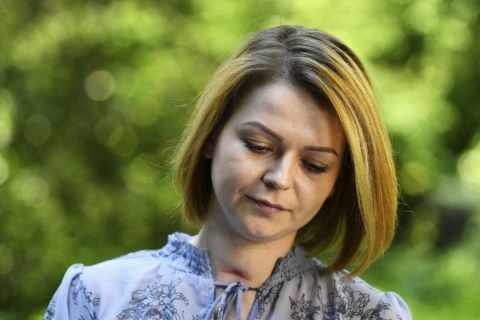
By Rob Slane | The Blog Mire | June 23, 2018
Over the last five pieces (Part 1, Part 2, Part 3, Part 4, Part 5) I have, slowly but surely, advanced a theory of what happened in the Skripal case. I must confess to having done so with a fair amount of unease. I don’t want to believe that my Government has been stating a case that is false. I don’t want to believe that the public have been lied to. I don’t want to have to think that there has been a lot of effort made to present an explanation that hides the truth.
And yet, given the fact that the Government story contains self-evident fallacies, and cannot be made to add up, I don’t think that there’s much alternative than to be hugely sceptical about their claims. I stated the two main fallacies in Part 1, which are the claims that three people were poisoned by the nerve agent A-234, which is 5-8 times more toxic than VX, and that because A-234 was developed in the Soviet Union, the Russian State is responsible for what happened. The first claim cannot be true, because the three people are alive and well and have suffered no irreparable damage. The second claim is palpably untrue, because A-234 has been synthesised in a number of countries.
Yet this is only the tip of the iceberg of the absurdities and anomalies. I don’t intend to go through all of them, but would simply point anyone who does believe the official story to concentrate on three words: The Door Handle. This was apparently where the poison was poured, so allow me to pose five questions about this claim to those who believe it to be true:
- During the “clean-up” operation, there were lots of military chaps wearing HazMat suits, which are designed to protect against exposure to toxic chemicals. How, then, did the assassin apparently manage to pour this same lethal, military grade nerve agent on a door handle, without wearing a HazMat suit?
- On the other hand, if he or she was wearing a HazMat suit when performing the operation, wouldn’t someone in Christie Miller Road have noticed and found it – shall we say – a bit odd?
- If the poison was administered to the door handle, how exactly did both Sergei and Yulia Skripal manage to touch it (people don’t normally both touch the door handle if they go in the house together), and how did they manage to get exactly the right quantities on their skin so that they collapsed at exactly the same time, some four hours later?
- The door handle theory only reared its head some three weeks after the poisoning, at which point the substance was said to have been still present in a “highly pure” form. During this three weeks, many people went in and out of Mr Skripal’s house using the front door. How did they manage to do so without using the door handle, or if they did, how did they manage not to succumb to poisoning?
- Part of the Government’s alleged evidence pointing at the high likelihood of Russian involvement in the case, is an FSB instruction manual showing – amongst other things – how to assassinate someone by pouring Novichok on a door handle. Suspending our disbelief on this claim for a moment (and admittedly that is hard), did the Government have the manual when they made their accusations against the Russian Government on 12th and 14th March, and if so, why did the door handle theory not surface for more than a week after this?
Of course, a few moments consideration about the door handle theory will show that – like the rest of the official story – it is simply wrong. And because it is so plainly wrong, that is why we can safely say that the real explanation lies elsewhere.
Nevertheless, I am aware that in advancing another explanation, there are likely to be many holes in it too. Whilst much of what I have said throughout this series has been based on facts and eyewitness statements, the theory I have advanced from those facts and witness statements remains unproven. And so I would ask that where I have got things wrong, you would forgive me, and where things don’t make sense, you would point them out.
Having said that, what I want to do in this final piece is to tie up a few loose ends and – most particularly – attempt to demonstrate how the theory I have advanced explains some of the other anomalies in the case in a far more cogent and rational way than does the official story. So here goes.
The Deafening Silence of Sergei Skripal
One of the least talked about points in the official story, yet one that really is very important, is that if it were a true account, Mr Skripal would almost certainly have no more clue about who poisoned him than the average person in the street. If it were true that an unknown assassin, appointed by the Russian Government, poured military-grade nerve agent onto his front door on 4th March, before fleeing back to the Motherland, Mr Skripal and his daughter, Yulia, would be as much in the dark as to who did it as you or I.
Now, if that were the case, two things would naturally follow. The first is that Mr Skripal would almost certainly be inclined to believe the version of events given to him by the Metropolitan Police. Think about it. He wakes up one morning in a strange hospital bed, and has absolutely no clue why he is there or what happened to him. Then a kindly policeman comes and explains that he was the target of an assassination attempt using a lethal nerve agent, and that the British Government believes that it was ordered by the Russian Government. What is he going to believe? Fairly obvious I would think. At least he would have no reason to disbelieve them.
The second thing that would naturally follow is that, as soon as he was able, he would want to release a statement, either on paper, or in an interview, where he not only pledges his support for the Metropolitan Police and their ongoing investigation, and no doubt hints at involvement of the Russian State, but also – and this is crucial – where he also gives the public some information about what actually happened to him on 4th March: where he went, when he first started to feel ill, and what he last remembers.
Again, think about it. If you were in his shoes, wouldn’t you want to catch the people who did it? And wouldn’t you assume that the more information you could give to the public, perhaps even clearing up some of the anomalies (such as the reason for the agitation in Zizzis), the more chance there would be that someone’s memory might be jogged and vital information given to the police?
Of course you would. And yet so far, Mr Skripal has released no such statement. Why?
It isn’t that he is physically or mentally incapacitated. We know from Yulia Skripal’s brief call to her cousin on April 5th (which almost certainly wasn’t “meant” to happen), that Sergei was by that time fine. In response to Viktoria’s question about her father, she said this:
“Everything is ok. He is resting now, having a nap. Everyone’s health is fine, there are no irreparable things. I will be discharged soon. Everything is ok.”
That was nearly three months ago, and yet the Sergei Skripal who was fine on 5th April, having suffered no irreparable damage from apparently being poisoned by the world’s most deadly nerve agent, and who was discharged on 18th May, still has not spoken.
I put it that the theory I have advanced (see Part 5 in particular), suggests an obvious reason for his silence. Were he in the dark about the identity of those who poisoned him, as the official story implies, his silence would be inexplicable. Don’t you want to catch the perpetrators of this crime upon you and your daughter, Sergei?
Yet, if we assume that actually he knows exactly who poisoned him and why they poisoned him – as would be the case according to the theory I have advanced – then his silence is very easily explained. He cannot be allowed to be interviewed about what happened, because he would blow the whole wretched business clean out of the water. He cannot be allowed to make an open statement, with the press there to ask free questions, because it would come out that he had been meeting someone at the bench in The Maltings, and that this someone whom he met was the person who poisoned him.
In addition, his (highly likely) authorship of the Trump Dossier would be revealed. And if this were to happen, not only would it be seen that the foundation upon which the whole Trump/Russia collusion hoax was based was made of straw, but it would become clear that the interference in the 2016 US Presidential election was never really about Russian interference to get Trump elected; but rather about British interference to stop Trump getting elected.
The deafening silence of Mr Skripal is therefore strong evidence of a number of things:
- That the Government story, in which he was the unsuspecting victim of a Kremlin plot, is without foundation.
- That he well knows who his poisoners were and why they poisoned him.
- That he cannot be allowed to speak freely because if he was, a scandal of monumental proportions would be revealed.
The Deafening Silence of Yulia Skripal
Deafening silence of Yulia? What am I talking about? She has released a number of statements through the Metropolitan Police, and in the statement (not interview) she made to Reuters. So what do I mean?
Many have pointed out a number of remarkable things about her Reuters statement. For one, she looked remarkably well. For another, the language of the statement she read was highly suggestive that it was first written in English – not by her – and then translated into Russian (statements like “I do not wish to avail myself of their services” don’t normally trip off the tongue of native English speakers, let alone those who speak it as a second language).
But for me the most remarkable thing about all of her statements are not what they do say, but rather what they don’t say. As with Sergei’s silence, Yulia has nothing whatsoever to say about the day of the poisoning. Isn’t that odd? She notes that she and her father survived an “attempted assassination”. She notes that a nerve agent was used to do it. But she says nothing about her and her father’s movements that day. Nothing about what they did and where they went. Nothing about when they first succumbed to the effects of the poisoning. Nothing to suggest that her father’s agitation in Zizzis may have been caused by poisoning.
In short, she says nothing whatsoever about the poisoning itself. Zero. Diddly squat. Zilch. Nada. Nothing. Why?
As with Sergei’s non-statements, this doesn’t compute. If you happened to wake up in a hospital to be told that you had been the victim of a nerve agent poisoning, you would almost certainly want to tell people as much as possible about your movements up to the point of the poisoning. Wouldn’t you? Of course. Especially if not only you had been poisoned, but also your dad. You’d at least want to sound a bit more interested in actually catching the perpetrators than Yulia, who didn’t so much as mention it, and instead sounded like she just wanted to move on and forget it ever happened.
Once again, this total silence on something so crucial just doesn’t fit at all with the official story. That narrative suggests that Sergei and Yulia were innocent victims of a Kremlin-hired assassin. That narrative suggests they don’t know who that Kremlin-hired assassin was. But it also suggests that they of all people have a huge interest in giving details of what happened to them that day. And yet there is silence.
Does it fit better with the theory I have proposed? You bet it does. If what I have suggested is anywhere close to the truth, just like Sergei, Yulia cannot be allowed the freedom to give a proper interview where any question is allowed. She cannot be given consular access by the Russian Embassy. Why not? Because she knows what her dad was up to; she knows why he was meeting people at a park bench on Sunday 4th March; and she knows that the two of them were poisoned by the people who they were meeting.
Why did she agree to an interview? No doubt she realises what a difficult and vulnerable position she is in. Despite claims to the contrary, she clearly has no contact with her family back in Russia, or indeed any contact with the outside world. She was almost certainly pressured into making a statement, and yet — as Tony Kevin convincingly argues here — it has many signs of being a compromise statement. And so she agreed to making a fairly nebulous statement — one which is almost inconceivable from the point of view of the official narrative, but which fits perfectly with the narrative I have advanced.
The Deafening Silence of Nick Bailey
One final deafening silence that doesn’t exactly do wonders for the official narrative, is the silence of Detective Sergeant Nick Bailey. He has always been a big puzzle in this case, for a number of reasons. It was first said that he was poisoned at The Maltings. However, the problem with this explanation is that there was absolutely no reason for him to have been there. The case was treated by Salisbury District Hospital as a case of Fentanyl poisoning. Why would a member of the Criminal Intelligence Department (CID) be called to a bench to an apparent opioid overdose?
It was then said by none other than Lord Ian Blair that DS Bailey was actually poisoned at Mr Skripal’s house. But again, the same question arises. Why would a member of CID be sent to the home of a person in a what looked like a case of opioid poisoning?
The story then swung backwards and forwards a number of times between a poisoning at the Maltings and a poisoning at Mr Skripal’s house. These anomalies are very important, but even more important is that they could have been put straight by DS Bailey himself. If the official story was correct, not only would it have been super easy to have verified where DS Bailey was poisoned, but he himself could have testified to it. And yet like the Skripals, there has been nothing!
Given the absurd changes to this particular part of the story – and it is perhaps the easiest of all parts to verify – my assumption is that he was poisoned at neither The Maltings or Mr Skripal’s house. Instead, just as I wrote in Part 5 that I believe it likely the Skripals were poisoned by an incapacitating nerve agent in the red bag that was then seen next to the bench, I think it highly likely that DS Bailey was poisoned from the same source.
But where? The red bag was removed from the scene by a police officer and placed in an evidence bag. Why would this have been done? Because the pair on the bench were suspected of overdosing on an opioid, and the bag would naturally be removed by police so that its contents could be examined. And whereas I think it unlikely that someone from CID would be called to the scene of a drug overdose, it seems quite likely that they might receive and handle evidence taken from such a scene. Therefore my guess – and I stress that it is only a guess – is that DS Bailey was the man who received the bag, and whilst looking inside to see its contents, was poisoned by the same incapacitating agent as the Skripals (possibly something like 3-Quinuclidinyl Benzilate (BZ), but definitely not A-234).
Again, if the official story were true, what would prevent DS Bailey from giving a brief statement or interview, confirming exactly what happened to him? But if the red bag theory is close to the mark, then it becomes plainly obvious why this hasn’t yet happened.
Smokes and Mirrors
Which actually brings me on to the penultimate point I want to make in this piece, and indeed in this 6-part series. Everything in the official story, no matter how absurd, seems designed to point our attention away from the most probable source, place and type of poisoning: The red bag, at the bench, and an incapacitating nerve agent. And it does so because if our attention is focused on them, then a very different story begins to emerge. Which cannot be allowed to happen.
As stated above, claims about A-234 being used just don’t add up. Neither the time delay, nor the symptoms, nor the recovery of the Skripals with no irreparable damage match up to what this deadly, military grade, high purity, lethal nerve agent that is so much more toxic than VX, is meant to do. What the claim does, however, is points our attention away from what is far more likely – an incapacitating agent administered to the Skripals between 3:45 and 4:00pm on 4th March.
As stated above, claims about the door handle just don’t add up. Neither the fact that both Sergei and Yulia were poisoned, nor the fact that others went in and out of the house before the door handle theory was put forward and didn’t succumb, nor the fact that the substance on it apparently remained of “high purity” weeks later – none of these things make any sense. What the claim does, however, is directs our thoughts away from what is far more likely – that the substance used to poison the Skripals was administered at the bench, and probably via the red bag.
The apparent motive put forward in the official narrative doesn’t add up either. There is a general agreement among countries that you do not target spies who have been part of a swap. Why? Because if you do, you can kiss goodbye to ever getting any other spies swapped in the future. It’s called shooting yourself in the foot big time! But what this frankly risible explanation for the apparent motive behind the poisoning does, however, is to point our attention away from what Mr Skripal was really up to. And as I set out in Part 4, this was very likely something to do with authoring the Trump Dossier.
Nothing about the official story makes sense. None of it adds up. It is riddled with holes. But I would submit that the only thing that does make sense about it, is that the parts that go to make up the sum are all desperate attempts to divert attention. They are smokes and mirrors, designed to stop us from considering some of the more obvious aspects of the case, and some of the more startling aspects of the case – Mr Skripal’s involvement with MI6; his likely involvement in or authorship of the Trump Dossier; the likelihood that he was due to meet people at the bench in The Maltings; the probability that this is why he was agitated and in a hurry in Zizzis; the likelihood that he knows who poisoned him and why.
And of course the reason that these things are not supposed to be considered is that if – and I acknowledge it is a big if – the alternative explanation I have advanced is true, and if it became generally known, then it would cause just about the biggest political crisis in British political history.
And Finally…
Having said that, I have to say that I don’t believe it at all likely that the British Government knew about any of this before it occurred. I get the impression that the intelligence agencies on both sides of the Atlantic are a law unto themselves, and I think it likely that some of their number wanted to send Mr Skripal a message, one which would look like an opioid overdose, one which he would recover from reasonably quickly, and one which would be forgotten very soon.
However, I don’t think that the poisoning of DS Bailey was meant to happen, but when it did, it set off a series of events that quickly got out of control. I don’t think the identity of Sergei Skripal as a Russian involved in a spy swap was ever meant to make it into the press, but it did and very soon what looked like some kind of opioid poisoning quickly became an international spy saga.
The British Government’s reckless and extraordinarily quick reaction to the case was, apart from being a travesty of the rule of law, one of the biggest clues that the official narrative was not true. If it were true, they could have took their time, acted calmly, and let the investigation run its course. Instead, what we got was a lawless, irrational and absurd response. It all smacked of a panicked reaction, and whilst it made no sense in terms of the story they sold us, it makes perfect sense if the truth was that they were desperate to prevent news getting out about who Skripal really was, what he had been up to, and how the poisoning might well be connected with that work. And indeed the D-notices they slapped on the reporting of that stuff, and of Mr Skripal’s connections to Christopher Steele and Pablo Miller, are further evidence that it is so.
And so they very quickly decided to turn attention away from the big clues of the case, by invoking the scary sounding “Novichok” and pinning the blame – without any evidence – on the Russian State. To this date, they have given us no evidence to back up their claim, much less a suspect, but have unwittingly given us a bunch of absurdities that can be blown out of the water through the use of simple reason and logic.
They should have remembered this:
“Do not be deceived: God is not mocked, for whatever one sows, that will he also reap” (Galatians 6:7)
But I have a feeling they don’t believe it applies to them. I have a feeling that it does.
And so there’s my case. As I say, there are bound to be a good many holes and no doubt many errors and inconsistencies in it. Please do forgive me for those. As for the rest of it — Make of it what you will.
I hope to leave this case for now and write about other stuff. But I will of course return to it if there are any new and interesting developments.
Featured Video
The Search for Truth: Charlie Kirk’s Assassination One Year Later
or go to
Aletho News Archives – Video-Images
From the Archives
The 9/11 “Double-Cross” Conspiracy Theory
BY LAURENT GUYÉNOT • UNZ REVIEW • SEPTEMBER 6, 2022
Is it true that “9/11 was an inside job”? Yes, insofar as Israel is “inside” the U.S. But for the 9/11 truthers who have identified Israel as the main perpetrators, “9/11 was an inside job” is at best a half-truth, and at worst an integral part of the Zionist operation, like a secondary flag sewn as a lining under the false flag of Islamism. Victor Thorn (1963-2017) wrote in his book 9/11 made in Israel: The Plot Against America (2011): “In essence, the ‘9-11 truth movement’ was created prior to Sept. 11, 2001 as a means of suppressing news relating to Israeli complicity. . . . The slogan ‘9-11 was an inside job’ was quite possibly the greatest example of Israeli propaganda ever devised.” In milder terms, it is “controlled opposition”.
A genuine truth movement would have pointed to Israel as the prime suspect from the start. From day one, it was obvious who would benefit. … continue
Blog Roll
 Aletho News
- Europe’s mounting social chaos… chickens coming home to roost for proxy war against Russia
- US-Russia Diesel Deal Becomes Massive Defeat for Ukraine
- Hormuz and the Looming Economic Catastrophe
- Dhubab offensive, media blitz and the rapid unraveling of Saudi-backed coalition’s new gambit
- Putin Conveys to Trump Iran’s Vision on Possible Conflict Resolution – Kremlin
- The Search for Truth: Charlie Kirk’s Assassination One Year Later
- ‘Harsh reality’: Iran says France seeks monopoly on power and intimidation, not peace for all
- When Will This White House Madness End?
- Huckabee aide goes to ‘unusual lengths’ to portray ‘Israel’ positively
- Trump Announces Diesel Supply Deal With Putin Following Phone Call
- If Americans Knew
- Israeli forces kill another child in Gaza – Daily Update
- Gaza ceasefire exists in name only, say more than 100 organizations
- Nearly 2 Million in Gaza Need Urgent Shelter Assistance as Winter Looms: IOM Chief Warns
- Suppressing Palestinian resistance: US charity under fire for AI monitoring of Gaza classrooms
- Thousands Are Held in Israeli Torture Camps. This Is What Happens Inside
- Israel puts Gaza’s sick, injured, newborn in peril – Daily Update
- Report claimed Mark Levin used by Israeli government to influence Trump
- Over 2,000 Gazans have died awaiting medical evacuation amid Israel’s continued siege
- How a U.S. Diplomat Suppressed and Altered Reports Critical of Israel
- 5 Palestinians Die from Israeli Strikes in Gaza as Relentless Attacks Continue
- No Tricks Zone
- New Study: 50 Years Of The Most Aggressive ‘Net Zero’ Policies Can Only Affect The Global Climate By 0.03°C
- US September “Heat” Was No Record…Many Records Set Decades Ago
- Latest European Green Energy Debacle; Portugal’s Largest Flagship Solar Park Insolvent!
- Green Energy Debacle: German Expert Professor Fritz Vahrenholt Warns Of Severe Economic And Social Consequences
- Two More Paleo Reconstructions Affirm Meters-Higher Sea Levels Across Ireland, Brazil 7000-6000 Years Ago
- New Study: Earth And Venus Surface Warmth Largely Explained By Convection And Lapse Rate, Not CO2 Or Radiation
- 2025 Nature Paper Claiming Worsening Global Drought Gets RETRACTED …Heavily Flawed
- New Study: ‘Global Drought Shows No Detectable Recent Acceleration Under Climate Warming’
- Economic Masterminds: German Socialists Suggest Taxing Productivity Gains Stemming From Using AI
- The South China Sea Has Not Been Cooperating With The Climate Change Narrative

