On March 23, 2011, at the very start of what we now call the ‘Syrian conflict,’ two young men – Sa’er Yahya Merhej and Habeel Anis Dayoub – were gunned down in the southern Syrian city of Daraa.
Merhej and Dayoub were neither civilians, nor were they in opposition to the government of Syrian President Bashar al-Assad. They were two regular soldiers in the ranks of the Syrian Arab Army (SAA).
Shot by unknown gunmen, Merhej and Dayoub were the first of eighty-eight soldiers killed throughout Syria in the first month of this conflict– in Daraa, Latakia, Douma, Banyas, Homs, Moadamiyah, Idlib, Harasta, Suweida, Talkalakh and the suburbs of Damascus.
According to the UN’s Independent International Commission of Inquiry on Syria, the combined death toll for Syrian government forces was 2,569 by March 2012, the first year of the conflict. At that time, the UN’s total casualty count for all victims of political violence in Syria was 5,000.
These numbers paint an entirely different picture of events in Syria. This was decidedly not the conflict we were reading about in our headlines – if anything, the ‘parity’ in deaths on both sides even suggests that the government used ‘proportionate’ force in thwarting the violence.
But Merhej and Dayoub’s deaths were ignored. Not a single Western media headline told their story – or that of the other dead soldiers. These deaths simply didn’t line up with the Western ‘narrative’ of the Arab uprisings and did not conform to the policy objectives of Western governments.
For American policymakers, the “Arab Spring” provided a unique opportunity to unseat the governments of adversary states in the Middle East. Syria, the most important Arab member of the Iran-led ‘Resistance Axis,’ was target number one.
To create regime-change in Syria, the themes of the “Arab Spring” needed to be employed opportunistically – and so Syrians needed to die.
The “dictator” simply had to “kill his own people” – and the rest would follow.
How words kill
Four key narratives were spun ad nauseam in every mainstream Western media outlet, beginning in March 2011 and gaining steam in the coming months.
– The Dictator is killing his “own people.”
– The protests are “peaceful.”
– The opposition is “unarmed.”
– This is a “popular revolution.”
Pro-Western governments in Tunisia and Egypt had just been ousted in rapid succession in the previous two months – and so the ‘framework’ of Arab Spring-style, grass roots-powered regime-change existed in the regional psyche. These four carefully framed ‘narratives’ that had gained meaning in Tunisia and Egypt, were now prepped and loaded to delegitimize and undermine any government at which they were lobbed.
But to employ them to their full potential in Syria, Syrians had to take to the streets in significant numbers and civilians had to die at the hands of brutal security forces. The rest could be spun into a “revolution” via the vast array of foreign and regional media outlets committed to this “Arab Spring” discourse.
Protests, however, did not kick off in Syria the way they had in Tunisia and Egypt. In those first few months, we saw gatherings that mostly numbered in the hundreds – sometimes in the thousands – to express varied degrees of political discontent. Most of these gatherings followed a pattern of incitement from Wahhabi-influenced mosques during Friday’s prayers, or after local killings that would move angry crowds to congregate at public funerals.
A member of a prominent Daraa family explained to me that there was some confusion over who was killing people in his city – the government or “hidden parties.” He explains that, at the time, Daraa’s citizens were of two minds: “One was that the regime is shooting more people to stop them and warn them to finish their protests and stop gathering. The other opinion was that hidden militias want this to continue, because if there are no funerals, there is no reason for people to gather.”
With the benefit of hindsight, let’s look at these Syria narratives five years into the conflict:
We know now that several thousand Syrian security forces were killed in the first year, beginning March 23, 2011. We therefore also know that the opposition was “armed” from the start of the conflict. We have visual evidence of gunmen entering Syria across the Lebanese border in April and May 2011. We know from the testimonies of impartial observers that gunmen were targeting civilians in acts of terrorism and that “protests” were not all “peaceful”.
The Arab League mission conducted a month-long investigation inside Syria in late 2011 and reported:
“In Homs, Idlib and Hama, the observer mission witnessed acts of violence being committed against government forces and civilians that resulted in several deaths and injuries. Examples of those acts include the bombing of a civilian bus, killing eight persons and injuring others, including women and children, and the bombing of a train carrying diesel oil. In another incident in Homs, a police bus was blown up, killing two police officers. A fuel pipeline and some small bridges were also bombed.”
Longtime Syrian resident and Dutch priest Father Frans van der Lugt, who was killed in Homs in April 2014, wrote in January 2012:
“From the start the protest movements were not purely peaceful. From the start I saw armed demonstrators marching along in the protests, who began to shoot at the police first. Very often the violence of the security forces has been a reaction to the brutal violence of the armed rebels.”
A few months earlier, in September 2011, he had observed:
“From the start there has been the problem of the armed groups, which are also part of the opposition… The opposition on the street is much stronger than any other opposition. And this opposition is armed and frequently employs brutality and violence, only in order then to blame the government.”
Furthermore, we also now know that whatever Syria was, it was no “popular revolution.” The Syrian army has remained intact, even after blanket media coverage of mass defections. Hundreds of thousands of Syrians continued to march in unreported demonstrations in support of the president. The state’s institutions and government and business elite have largely remained loyal to Assad. Minority groups – Alawites, Christians, Kurds, Druze, Shia, and the Baath Party, which is majority Sunni – did not join the opposition against the government. And the major urban areas and population centers remain under the state’s umbrella, with few exceptions.
A genuine “revolution,” after all, does not have operation rooms in Jordan and Turkey. Nor is a “popular” revolution financed, armed and assisted by Qatar, Saudi Arabia, the US, UK and France.
Sowing “Narratives” for geopolitical gain
The 2010 US military’s Special Forces Unconventional Warfare manual states:
“The intent of US [Unconventional Warfare] UW efforts is to exploit a hostile power’s political, military, economic, and psychological vulnerabilities by developing and sustaining resistance forces to accomplish US strategic objectives… For the foreseeable future, US forces will predominantly engage in irregular warfare (IW) operations.”
A secret 2006 US State Department cable reveals that Assad’s government was in a stronger position domestically and regionally than in recent years, and suggests ways to weaken it: “The following provides our summary of potential vulnerabilities and possible means to exploit them…” This is followed by a list of “vulnerabilities” – political, economic, ethnic, sectarian, military, psychological – and recommended “actions” on how to “exploit” them.
This is important. US unconventional warfare doctrine posits that populations of adversary states usually have active minorities that respectively oppose and support their government, but for a “resistance movement” to succeed, it must sway the perceptions of the large “uncommitted middle population” to turn on their leaders. Says the manual (and I borrow liberally here from a previous article of mine):
To turn the “uncommitted middle population” into supporting insurgency, UW recommends the “creation of atmosphere of wider discontent through propaganda and political and psychological efforts to discredit the government.”
As conflict escalates, so should the “intensification of propaganda; psychological preparation of the population for rebellion.”
First, there should be local and national “agitation” – the organization of boycotts, strikes, and other efforts to suggest public discontent. Then, the “infiltration of foreign organizers and advisors and foreign propaganda, material, money, weapons and equipment.”
The next level of operations would be to establish “national front organizations [i.e. the Syrian National Council] and liberation movements [i.e. the Free Syrian Army]” that would move larger segments of the population toward accepting “increased political violence and sabotage” – and encourage the mentoring of “individuals or groups that conduct acts of sabotage in urban centers.”
I wrote about foreign-backed irregular warfare strategies being employed in Syria one year into the crisis – when the overwhelming media narratives were still all about the “dictator killing his own people,” protests being “peaceful,” the opposition mostly “unarmed,” the “revolution wildly “popular,” and thousands of “civilians” being targeted exclusively by state security forces.
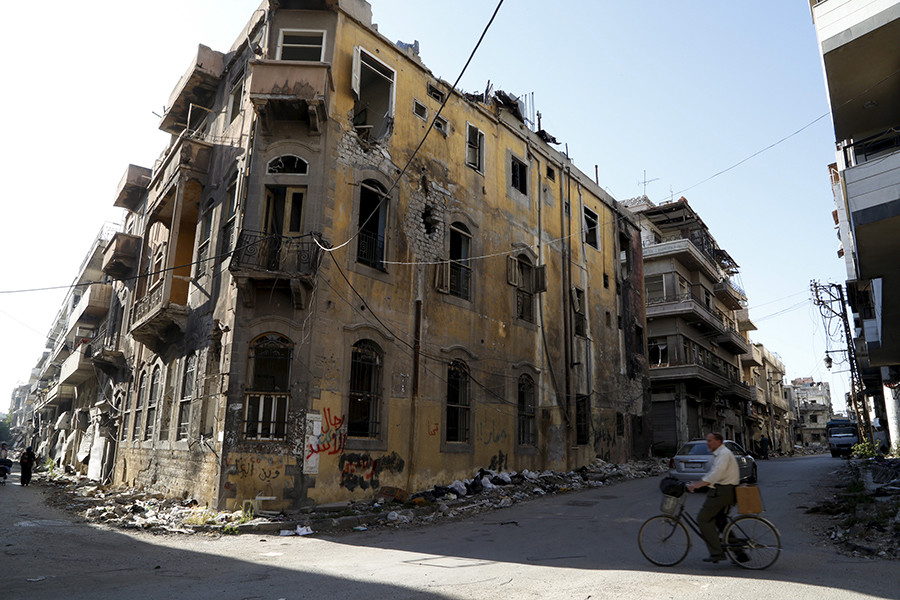
Were these narratives all manufactured? Were the images we saw all staged? Or was it only necessary to fabricate some things – because the “perception” of the vast middle population, once shaped, would create its own natural momentum toward regime change?
And what do we, in the region, do with this startling new information about how wars are conducted against us – using our own populations as foot soldiers for foreign agendas?
Create our own “game”
Two can play at this narratives game.
The first lesson learned is that ideas and objectives can be crafted, framed finessed and employed to great efficacy.
The second take-away is that we need to establish more independent media and information distribution channels to disseminate our own value propositions far and wide.
Western governments can rely on a ridiculously sycophantic army of Western and regional journalists to blast us with their propaganda day and night. We don’t need to match them in numbers or outlets – we can also employ strategies to deter their disinformation campaigns. Western journalists who repeatedly publish false, inaccurate and harmful information that endanger lives must be barred from the region.
These are not journalists – I prefer to call them media combatants – and they do not deserve the liberties accorded to actual media professionals. If these Western journalists had, in the first year of the Syrian conflict, questioned the premises of any of the four narratives listed above, would 250,000-plus Syrians be dead today? Would Syria be destroyed and 12 million Syrians made homeless? Would ISIS even exist?
Free speech? No thank you – not if we have to die for someone else’s national security objectives.
Syria changed the world. It brought the Russians and Chinese (BRICS) into the fray and changed the global order from a unipolar one to a multilateral one – overnight. And it created common cause between a group of key states in the region that now form the backbone of a rising ‘Security Arc’ from the Levant to the Persian Gulf. We now have immense opportunities to re-craft the world and the Middle East in our own vision. New borders? We will draw them from inside the region. Terrorists? We will defeat them ourselves. NGOs? We will create our own, with our own nationals and our own agendas. Pipelines? We will decide where they are laid.
But let’s start building those new narratives before the ‘Other’ comes in to fill the void.
A word of caution. The worst thing we can do is to waste our time rejecting foreign narratives. That just makes us the ‘rejectionists’ in their game. And it gives their game life. What we need to do is create our own game – a rich vocabulary of homegrown narratives – one that defines ourselves, our history and aspirations, based on our own political, economic and social realities. Let the ‘Other’ reject our version, let them become the ‘rejectionists’ in our game… and give it life.
Sharmine Narwani is a commentator and analyst of Middle East geopolitics. She is a former senior associate at St. Antony’s College, Oxford University and has a master’s degree in International Relations from Columbia University. You can follow her on Twitter at @snarwani
May 9, 2016
Posted by aletho |
Deception, Mainstream Media, Warmongering, Timeless or most popular, War Crimes | France, Qatar, Saudi Arabia, Syria, UK, Unconventional Warfare, United States |
Leave a comment

A recent conversation on security and peace between former security personnel of Saudi Arabia and Israel respectively, two weeks before Al Nakba commemoration shows that the attitude of the past on Palestine remains after 68 years.
Al Nakba is a series of events that led to the ethnic cleansing of Palestine and the Palestinians on May 15th, 1948. This is a day to remember the displacement and dispossession of 750,000 Palestinian people into refugee camps in neighboring countries; generations of whom continue to reside in these camps, others are scattered across the world in diaspora and many more internally displaced.
As the Palestinians across the world are on the verge of commemorating these events that happen to continue today in a process that is a form of incremental genocide, the Washington Institute for Near East Policy (WINEP) has recently engaged two former security personnel of Saudi Arabia and Israel respectively in a conversation related to security and peace in the Middle East. Setting aside that the said institute is a think tank that was founded by pro-Israel political figures, it is no surprise for Palestinians that an institution of this kind hosts such a choice for a duo to discuss the two topics of peace and security when both entities are serious human rights violators as well as exporters of terrorism and war; especially in the direct or indirect connection to Palestine and the Palestinians.
First and foremost, the timing of the said conversation between the two representatives of the security apparatuses of both entities reminds us that understanding the historical context is truly important for understanding the contemporary circumstances. As the events and planning took place leading up to the execution of the Nakba of 1948, there was an annulled agreement that took place prior known as the Faisal-Weizmann Agreement of 1919. This was an agreement that was signed at the Paris Peace Conference between Emir Faisal of Hejaz and Chaim Weizmann who was leader of the World Zionist Organization eventually leading to him becoming the first President of Israel. This agreement is significant in the fact that it reminds the Palestinians about the enabling and co-conspiring of the Arabs in the region and the role they played against the interests of the Palestinians; an example of which is the following:
Dr. Weizmann argued that Palestine was designed to solve “a world-wide problem” and therefore “the rights which the Jewish people has been adjudged in Palestine do not depend on the consent, and cannot be subjected to the will of the majority of its present inhabitants.” He maintained that “the Balfour Declaration and the Mandate have definitely lifted Palestine out of the context of the Middle East and linked it up with the world-wide Jewish community and the world-wide Jewish problem.” Thus the Zionists refused to let the British grant the Palestine Arabs any role in setting immigration quotas or in influencing other aspects of the development of the Jewish national home. Weizmann’s contempt for the first Arab delegation to London was apparent in his one discussion with them at the Colonial Office, in which he adopted the attitude “of a conqueror handing to beaten foes the terms of peace.”
Today’s Saudi Arabia’s role in relation to the nature of its engagement with the State of Israel, represents the same co-conspiring agenda and essence of the Faisal-Weizmann agreement under the guise of peace and security- in pursuit of self interest and Zionist led terror against the Palestinians. For example, during the latest military campaign against the Gaza Strip by the State of Israel known as Operation Protective Edge- Prime Minister Netanyahu emphasised the fact that “renewed relations” were built as a result of Saudi Arabia along with other Gulf countries engaging in security cooperation to quell the Palestinian resistance during those events.
Furthermore, the rise of the Islamic State and their reign of terror in the region has unsettling connections with these two entities. The Islamic State’s rise and political patterns in the region are leaning towards the affirmation of the Faisal-Weizmann Agreement given that this group’s reign of terror has not targeted any of these entities and have the same enemies that are “branches of the same tree”. Moreover, the group wants to abolish the Sykes-Picot Agreement which in many ways has been historically perceived as having been in the way and the obstacle of the Faisal-Weizmann Agreement. Most importantly, aside from the damage and destruction the Islamic State has done to the Palestinians both in Iraq and Syria, the Islamic State is attempting to exploit the Palestinian cause which also serves the Saudi-Israeli security interests.
And yet, with all this historical context at hand, including the horrendous human rights records of both Saudi Arabia and Israel along with an already outrageous military expenditure towards the State of Israel by the United States- the United States is granting Israel the largest military aid package in history, while simultaneously, Saudi Arabia is receiving a 15 billion dollar military arms package deal from Canada.
In Jeff Halper’s new book “War against the People” he sharply states: “In an endless war on terror, we are all doomed to become Palestinians.” The Washington Institute for Near East Policy is a political entity that enables this doom. It is an institute with residues of the pro-Israel lobby that played a pivotal role in dragging the United States into founding the global war on terror that has produced more global insecurity, the rise of the Islamic State and a push for war against Iran with no end in sight- all whilst simultaneously continuing the memoricide and erasure campaign against Palestine and the Palestinians through a nostalgic revivalism of what was embedded within the Faisal-Weizmann Agreement- demonstrated through this latest discussion between the Saudi-Israeli security personnel. This is what Palestine is trying to show the world. This is part in parcel of the Nakba in continuum.
May 8, 2016
Posted by aletho |
Ethnic Cleansing, Racism, Zionism, Timeless or most popular | Faisal-Weizmann Agreement, Human rights, Israel, Palestine, Saudi Arabia, WINEP |
Leave a comment
A document in the American Archives, reporting the widespread famine and spread of epidemic disease in Iran, estimates the number of the deceased due to the WWI famine to be about 8-10 million.
One of the little-known chapters of history was the widespread famine in Iran during World War I, caused by the British presence in Iran. After the Russian Revolution of 1917, Britain became the main foreign power in Iran and this famine or–more accurately–‘genocide’ was committed by the British. The document in the American Archives, reporting the widespread famine and spread of epidemic disease in Iran, estimates the number of the deceased due to the famine to be about 8-10 million during 1917-19 (1), making this the greatest genocide of the 20th century and Iran the biggest victim of World War I (2).
It should be noted that Iran had been one of the main suppliers of food grains to the British forces stationed in the empire’s South Asian colonies. Although bad harvests during these two years made the situation worse, it was by no means the main reason why the Great Famine occurred. Prof. Gholi Majd of Princeton University writes in his book, The Great Famine and Genocide in Persia, that American documents show that the British prevented imports of wheat and other food grains into Iran from Mesopotamia, Asia, and also the USA, and that ships loaded with wheat were not allowed to unload at the port of Bushehr in the Persian Gulf. Professor Majd argues that Great Britain intentionally created genocide conditions to destroy Iran, and to effectively control the country for its own purposes. Major Donohoe describes Iran of that time as a “land of desolation and death” (3). But this event soon became the subject of a British cover up.
Britain has a long record of its several attempts to conceal history and rewrite it in their own favor. The pages are filled with conspiracies that were covered up by the British government to hide its involvement in different episodes that would tarnish the country’s image. One of the clear examples is the “Jameson Raid”; a failed coup against Paul Kruger’s government in South Africa. This raid was planned and executed directly by the British government of Joseph Chamberlain under the orders of Queen Victoria (4) (5). In 2002, Sir Graham Bower’s memoirs were published in South Africa, revealing these involvements that had been covered up for more than a century, focusing attention on Bower as a scapegoat for the incident (6).
The records that were destroyed to cover up British crimes around the globe, or were kept in secret Foreign Office archives, so as to, not only protect the United Kingdom’s reputation, but also to shield the government from litigation, are indicative of the attempts made by the British to evade the consequences of their crimes. The papers at Hanslope Park also include the reports on the “elimination” of the colonial authority’s enemies in 1950s Malaya; records that show ministers in London knew of the torture and murder of Mau Mau insurgents in Kenya and roasting them alive (7). These records may include those related to Iran’s Great Famine. Why were these records that cover the darkest secrets of the British Empire destroyed or kept secret? Simply because they might ‘embarrass’ Her Majesty’s government (8).
A famine occurred in Ireland from 1845 until 1852 which killed one fourth of the Irish population. This famine was caused by British policies and faced a large cover up attempt by the British government and crown to blame it on ‘potatoes’ (9). The famine, even today, is famous in the world as the “potato famine” when, in reality, it was a result of a planned food shortage and thus a deliberate genocide by the British government (10).
The true face of this famine as a genocide has been proven by historian Tim Pat Coogan in his book The Famine Plot: England’s Role in Ireland’s Greatest Tragedy published by Palgrave MacMillan (11). A ceremony was planned to take place in the US to unveil Coogan’s book in America, but he was denied a visa by the American embassy in Dublin (12).
Therefore it becomes obvious that Britain’s role in Iran’s Great famine, which killed nearly half of Iran’s population, was not unprecedented. The documents published by the British government overlook the genocide, and consequently, the tragedy underwent an attempted cover-up by the British government. The Foreign Office “handbook on Iran” of 1919 mentioned nothing related to the Great Famine.
Julian Bharier, a scholar who studied Iran’s population, built his “backward projection” estimation of Iran’s population (13) based on reports from this “handbook” and, as a result, ignored the effect of the Great Famine on Iran’s population in 1917. Bharier’s estimations were used by some authors to deny the occurrence of the Great Famine or to underestimate its impacts.
By ignoring Iran’s Great Famine in his estimations, Bharier’s work faces four scientific deficiencies. Bharier does not consider the loss of population caused by the famine in his calculations; he needs to ‘adjust’ the figure of the official census in 1956 from 18.97 million to 20.37 million, and this is despite the fact that he uses the 1956 census as his primary building block for his “backward projection” model. He also ignores the official growth rates and uses his personal assumptions in this regard, which is far lower than other estimates. Finally, although Bharier frequently cites Amani’s estimates (14), in the end Bharier’s findings contradict those of Amani; notably Bharier’s population estimate for 1911 is 12.19 million while Amani put this figure at 10.94 million.
Despite deficiencies in the population estimates offered by Bharier for the period of the Famine and its earlier period, his article offers useful data for the post-Famine period; this is because these figures are generated from 1956 backward. That is to say, numbers generated from 1956 to 1919 are thus credible because they do not include the period of famine. Moreover, this portion of Bharier’s data is also true to that of the American Legation. For example, Caldwell and Sykes estimate the 1919 population at 10 million, which is comparative to Bharier’s figure of 11 million.
Gholi Majd was not the first author to refute Bharier’s figures for this period. Gad G. Gilbar, in his 1976 article on demographic developments during the second half of the 19th century and the first decade of the 20th century, also considers Bharier’s estimates inaccurate for the period.
In an apparently biased review of Majd’s work, Willem Floor confirms Bharier’s model (15), despite its apparent deficiencies, and takes a mocking tone toward the well- documented work of Gholi Majd to undermine the devastation caused by the British-instigated famine in Iran, to the point of total denial of the existence of such a genocide. Floor also offers inaccurate or untrue information to oppose the fact that the British deprived Iranians from honey and caviar in the north, as he argues caviar was haram (religiously prohibited), while no such fatwa has ever existed in Shia jurisprudence and all available decrees assert that caviar is halal or permissible under the Islamic law. There was a rumor made up by Russians at the time, saying that Caviar was haram and Britain made full use of this rumor.
Another criticism made by Floor was to question why Majd’s work does not use British archival sources. A more important question is why Majd should have used these sources when they totally ignore the occurrence of the famine in Iran. The fact that Majd used mainly US sources seems to be reasonable on the grounds that the US was neutral toward the state of affairs in Iran at the time, and made efforts to help by feeding them (16).
*Sadegh Abbasi is a Junior M.A. student at Tehran University. As a student in history he has also worked as a contributor to different Iranian news agencies.
References
1. Majd, Mohammad Gholi. The Great Famine & Genocide in Iran: 1917-1919. Lanham : University Press of America, 2013. p.71: https://books.google.com/books?id=5WgSAAAAQBAJ&pg=PA71&lpg.
2. Sniegoski, Stephen J. Iran as a Twentieth Century Victim: 1900 Through the Aftermath of World War II. mycatbirdseat.com. [Online] 11 10, 2013. [Cited: 10 12, 2015.] http://mycatbirdseat.com/2013/11/iran-twentieth-century-victim-1900-aftermath-world-war-ii/.
3. Donohoe, Major M. H. With The Persian Expedition. London : Edward Arnold, 1919. p. 76.
4. Nelson, Michael and Briggs, Asa. Queen Victoria and the Discovery of the Riviera. London : Tauris Parke Paperbacks, 2007. p. 97: https://books.google.com/books?id=6ISE-ZEBfy4C&pg=PA97&lpg.
5. Bower, Graham. Sir Graham Bower’s Secret History of the Jameson Raid and the South African Crisis, 1895-1902. Cape Town : Van Riebeeck Society, 2002. p. xii: https://books.google.fr/books?id=VFYFZKRBXz0C&pg=PR23&lpg.
6. Ibid. p. xvii.
7. Cobain, Ian, Bowcott, Owen and Norton-Taylor, Richard. Britain destroyed records of colonial crimes . The Guardian. [Online] 03 17, 2012. [Cited: 10 10, 2015.] http://www.theguardian.com/uk/2012/apr/18/britain-destroyed-records-colonial-crimes.
8. Walton, Calder. Empire of Secrets: British Intelligence, the Cold War, and the Twilight of Empire. New York : The Overlook Press, 2013. p. 15: https://books.google.fr/books?id=f2cjCQAAQBAJ&pg=PT15&lpg.
9. Warfield, Brian. History Corner: The Great Irish Famine. wolfetonesofficialsite.com. [Online] [Cited: 10 12, 2015.] http://www.wolfetonesofficialsite.com/famine.htm.
10. Britain’s Cover Up. irishholocaust.org. [Online] [Cited: 10 12, 2015.] http://www.irishholocaust.org/britain’scoverup.
11. Coogan, Tim Pat. The Famine Plot: England’s Role in Ireland’s Greatest Tragedy. New York : Palgrave Macmillan, 2012.
12. O’Dowd, Niall. Proving the Irish Famine was genocide by the British. IrishCentral. [Online] 08 06, 2015. [Cited: 10 12, 2015.] http://www.irishcentral.com/news/proving-the-irish-famine-was-genocide-by-the-british-tim-pat-coogan-moves-famine-history-unto-a-new-plane-181984471-238161151.html.
13. Bharier, Julien. A Note on the Population of Iran, 1900-1966 . Population Studies. 1968, Vol. 22, 2.
14. Amani, Mehdi. La population de l’Iran. Population (French Edition). 1972, Vol. 27, 3: http://www.jstor.org/stable/1529398.
15. Floor, Willem. Reviewed Work: The Great Famine and Genocide in Persia, 1917-1919 by Mohammad Gholi Majd . Iranian Studies. Iran Facing the New Century, 2005, Vol. 38, 1.
16. Fecitt, Harry. Other Theatres of War. westernfrontassociation.com. [Online] 09 29, 2013. [Cited: 10 12, 2015.] http://www.westernfrontassociation.com/the-great-war/great-war-on-land/other-war-theatres/3305-dunsterforce-part-1.html.
Related:
Iran as a Twentieth Century Victim: 1900 Through the Aftermath of World War II
May 8, 2016
Posted by aletho |
Book Review, Deception, Timeless or most popular, War Crimes | Human rights, Iran, UK |
Leave a comment

US Ambassador to Hungary, Coleen Bell
If anyone wants a short course on what’s wrong with US diplomacy look no further than US Ambassador to Hungary Coleen Bell’s speech Friday to the Foreign Affairs Committee of the Hungarian Parliament. In typical diplo-speak there was plenty of flowery language about shared values, fish swimming together in the same water (?), sappy poetics like “together, out of that winter, we would force the spring,” and talk of together being “part of the world’s greatest military and political alliance.”
But make no mistake: Inside Ambassador Bell’s velvet glove is an iron fist, poised to strike should Washington’s annoyingly independent-minded Fidesz-led government step out of line on the big issues. And by “big” issues it should be understood that the US means the issues it considers in the interests of its own foreign policy, not those in Hungary’s interest.
Message to Hungary: do as we say or you will be sorry.
Ambassador Bell’s previous job was as a television soap opera producer, but raising more than two million dollars for the election of Barack Obama “earned” her the position of top US diplomat in Hungary.
The former television producer does know how to deliver her lines, though. She lectured the Hungarians about Syria, explaining to them that ISIS and Assad are both equally evil and both equally to blame for the disaster that is Syria.
ISIS has flourished in Syria, she told the Hungarians, because it “exploits the chaos of civil war in Syria, a conflict that has now claimed more than 250,000 lives.” But she does not mention that it was US backing for “regime change” in Syria — beginning at least in 2006, as we learn from a critical Wikileaks-released US Embassy Damascus memo — that created that very chaos she blames for the rise of ISIS.
In fact it is propaganda to call what is happening in Syria a “civil war,” as the forces battling the Syrian government are all sponsored by foreign powers like Saudi Arabia, Turkey, and the US. It is a proxy war against the Syrian government, not a civil war.
She then tells the Hungarians ISIS will never be defeated in Syria until Assad is overthrown:
[W]e know we won’t be able to defeat Daesh in Syria unless we also deal with the civil war and particularly with Assad. Because as long as Assad is there, he remains the most powerful magnet for foreign fighters and recruits to Daesh.
Does she assume Hungarians are so stupid that they believe that by attacking and beating ISIS back nearly to Raqqa (with Russian assistance), the Syrian government of Assad is actually benefitting ISIS? Attacking ISIS means Assad is on the side of ISIS?
“Since February, the cessation of hostilities reduced the violence in Syria, allowing millions of Syrian civilians to take the first steps toward reclaiming a normal life,” says the Ambassador, without even mentioning what brought the ceasefire about in the first place: Russian participation along with the Syrian army in the decimation of al-Qaeda and ISIS positions in northwest and central Syria. In fact it is absolutely bizarre that in the world of Ambassador Bell (and the State Department hacks who drafted her speech), the Russian intervention against al-Qaeda and ISIS simply never took place or was too inconsequential to mention.
Is any Hungarian so ill-informed that he would believe such nonsense?
Bell used the tragedy in Syria to pressure Hungary on the (largely American-made) refugee crisis. Hungary’s firebrand prime minister, Viktor Orban, has, along with several of his central European counterparts, stood up to Brussels’ (and Washington’s) demands that Hungary take in tens of thousands of migrants who heeded German Chancellor Angela Merkel’s call to come to Europe and enjoy lots of free stuff.
Last month Orban told Hungarian Radio that if he accepts the EU migrant resettlement plan, “it would be determined not in Hungary but in Brussels who we have to live together with, and how the ethnic composition of the country will look in future.” He has rejected such a notion.
“Every sovereign nation has the right and an obligation to protect its borders,” Bell told the Hungarian Parliament, “But every nation, as a part of the international community, also has a fundamental obligation to help refugee populations seeking safety.”
Translation: your sovereignty is not determined by you, but rather by us. It is a practice articulated by Orwell in 1984 whereby a person can think two completely contradictory thoughts at the same time seemingly without any mental conflict.
But here is where the iron fist inside Bell’s velvet glove glints in the sun. She pointedly condemned the Hungarian government position by praising those in Hungary who hold the opposite view, i.e. the Hungarian opposition:
We commend the humanitarian spirit of Hungarian leaders, law enforcement and military personnel, and ordinary citizens who are responding to this crisis with generosity and compassion.
Then she gives Hungary Washington’s marching orders:
We continue to stress that any solution to these migration challenges should focus on saving and protecting lives, ensuring the human rights of all migrants are respected, and promoting orderly and humane migration policies. That includes the support of all Member State governments for the refugee agreement forged between the EU and Turkey.
Translation: Hungary must support the EU agreement with Turkey which would see tens of thousands of migrants settled in EU member countries, including Hungary itself. The problem is that the Hungarian parliament explicitly rejected Brussels’ forced migrant settlement plans for Hungary and plans to hold a nationwide referendum on the subject. Bell is saying here that Hungary’s elected representatives and even the Hungarian voter must be ignored and Brussels’ dictate obeyed.
When it comes to Russia, Ambassador Bell also has some instructions for Budapest: Moscow is your enemy and don’t you forget it.
She told Hungarian parliamentarians:
As many Hungarians have reminded me, you need no introduction to the nature of Russian aggression. Your response has always been to show resolve. Our best weapons, in fact, are resolve and solidarity.
Weapons? Quite a loaded word.
Orban has been seen in Washington as insufficiently enthused about sanctions on Russia, which hurt Hungarian trade and business interests. Ambassador Bell makes it clear that Hungary must adhere to US demands of Russia, even if they are completely incoherent:
As the United States and Hungary have both stated many times, Russia has a simple choice: fully implement Minsk or continue to face sanctions. Russia must withdraw weapons and troops from the Donbas; Russia must ensure that all Ukrainian hostages are returned; Russia must allow full humanitarian access to occupied territories; Russia must support free, fair, and internationally-monitored elections in the Donbas under Ukrainian law; and most important, Russia must restore Ukraine’s sovereignty.
That last point should be taken to mean that Russia must ignore the will of the people of Crimea who voted in overwhelming numbers to re-join Russia after just 25 years as part of independent Ukraine.
Not to worry, Ambassador Bell is confident that Budapest will do everything Washington tells it to do:
More than this, Hungary is equal to the great challenges of our times, and the United States is counting on you.
To stiffen their spine, US Ambassador Bell reminds the Hungarians that they are part of “our global order” and touts the great examples set by the US, including:
Our system of international economic, political, and social norms and institutions have kept the peace and fostered prosperity for decades. Whether it is international law, environmental protection, trade regulations, anticorruption laws, child labor laws, human rights safeguards, the nonproliferation regime, public health systems, international financial institutions, UN peacekeeping, or a robust civil society – these norms and institutions give life and stability to our global order.
In the era of NSA spying on innocent Americans, Guantanamo, CIA torture, weapons sales to the world’s worst dictators (Saudi Arabia for one), destruction of the environment by the US war machine, “regime change” operations that violate the sovereignty of other states, and outright aggression in opposition to US and international law (Libya, etc.), Bell’s suggestion that “our global order” is the pinnacle of civilization should get a laugh out of most Hungarians. In fact, from Libya to Syria to Ukriane to Pakistan and Afghanistan, the US interventionist attempt to forge a global order with blood and bullets will go down in history along with the authoritarianisms of the 20th century as one of humanity’s darkest chapters.
Here is the short version of Ambassador Bell to Budapest: “to be our partner means you do what we say whether or not it is in your interest.”
Funny, that was Moscow’s message to Budapest from 1948 to 1989.
May 7, 2016
Posted by aletho |
Civil Liberties, Mainstream Media, Warmongering, Timeless or most popular, War Crimes | Coleen Bell, European Union, Hungary, Russia, Syria, Ukraine, United States |
Leave a comment
I can think of no better way to reveal the brainwashing of my fellow Americans, than to reveal it through my hometown newspaper. The Post Courier is a Pulitzer Prize winning publication in Charleston, SC. The newspaper has for generations carried local and world news to the people of the “low-country”, where I grew up. But South Carolina’s most powerful print media is also the policy arm of the American elite. Here is my view on what’s wrong with America’s press.
I am forced to write this, you know? The war on truth has come to this. As fair people, and as caring Americans, sooner or later a choice has to be made in between desperately held tradition and belief, and the hard, cold facts of life. For my part, I grew up agnostic to elitism, or maybe I should say “naïve” as to its ravaging teeth. But then, Charleston has a melancholy effect, its mix of charm and wealth being so striking, and yet so brutal. Oh, but I speak metaphorically. I am sorry, the subject here is power, and how the powerful wield it. I am here to tell you about one city newspaper, one that I believe bends the opinion of its readership. The Post and Courier is one of America’s oldest daily newspapers, with origins dating back the founder, Aaron Smith Willington, who is said to have rowed out into Charleston harbor to meet ships from New York and abroad, in order to get “the news” before his competitors.
Reading and Adjunct Newspaper Uses
My grandfather used to sit on the porch and read every scrap of the Post and Courier. Then at night, on cool nights in autumn, he used the newspaper as kindling, for a coal burning stove in his humble home near the railroad tracks. Reading a book review at the Post and Courier online this morning, I find myself wondering if the paper would even catch fire these days. The need for, or necessity of, reviewing THE NEW TSAR: The Rise and Reign of Vladimir Putin by Steven Lee Myers, at this late date, it’s questionable, comical, and a bit deceitful, when it comes right down to it. May 1, 2016, and a College of Charleston (my Alma mater) instructor gets space in the Post and Courier for reviewing a book published almost two and one half years ago? To be fair here, I’ll give Oksana Ingle, adjunct instructor of Russian language and literature at the College of Charleston credit for her writing style, and for seeming somewhat impartial too. But the gist of the “Putin” piece is:
“Despite Myers’ tendency to bog the reader down in too much detail sometimes, this book is a thorough, truthful story of Putin’s “Rise and Reign”, the professor notes.
Dr. Ingle seems like a nice lady, smart, professional, like all the professors I recall from the college. If not for the departure outside literature and language in this review, I’d surmise the publishers of the Post and Courier might have lured her to do this piece. The professor departs though, from journalistic review into State Department-ish regurgitation, of the “Dr. Evil Vladimir Putin” technique for propagandizing. But the “lure” of the Post and Courier, as the only print media game in town, it’s always there for professors, and for plumbers. I’ll avoid being contrite here, and move on to the Post and Courier’s political sway toward war mongers and international investors.
Agenda. If you are looking for the “cause” for anything, finding out “why” is usually not so hard. The agenda of the Post and Courier (past and present) is found in the power of policy, as formulated by the press. This is not news; it has been going on at this newspaper since way before I was a kid roaming King Street to find a toy, a movie, or a snow cone. In Vietnam, for instance, the Post and Courier leaned to the “hawkish” side of the war, toward the low-country industries that profited from the war, and benefited the city and the elite investors of the south as a whole. I recall the conversations at the tables of the Charleston Yacht Club, and being chastised for interrupting grownups talking about General Westmoreland, in the dining room of the Charleston Country Club. From Market Street’s classy restaurants, to kids playing on the Civil War cannons at White Point Gardens, we were all little hawks back then, in 1965 at least. But I can take the reader back far past Vietnam, deep down into deep south society, and even into the immense power leveraging US policy these days. The Post and Courier ownership coincides a bit, with my own family history, and ideas and tales of southern legends. In this story you are reading we have the Post and Courier newspaper, the College of Charleston, US policy, Vladimir Putin, and allegations of propaganda. “My, oh my”, my mother Delilah would shake her head and say. Well, let’s see why Vladimir Putin the evil genius is so negatively revealed in this newspaper.
Will the South “Rise Again”?
Arthur Middleton Manigault was a French man who was a French Huguenot born in La Rochelle, France and settled in Charleston. His mother was the [ ] South Carolina’s Lt. Governor, Charles Drayton, and the granddaughter of the second president of the First Continental Congress. His great uncle, Arthur Middleton, signed the Declaration of Independence. Manigault was a hero of the Confederate States of America, a Civil War and Palmetto Guards, and later Brigadier General after the famous “Atlanta Campiagn” that saw the south burning down (figuratively and literally). Arthur’s grandfather, Peter Manigault, was the richest man in the colonies before the revolution. To preserve your time, the context here is that the Post and Courier is owned by the Manigault family now. Bought back in 1896, the newspaper and its other enterprises have been in this family for generations. Today, Pierre Manigault runs the family operations.
Like his father, and his father’s father, the new Manigault is a member of everything in Charleston society that matters. He is Chairman of the Santee River Focus Area Task Force and a board member of the Historic Charleston Foundation, the Middleton Place Foundation, Magnolia Cemetery, and the National Steeplechase Foundation. He is also a past board member of the Lowcountry Open Land Trust, the Gibbes Museum, the Preservation Society of Charleston, the Historic Rice Fields Association, the Palmetto Conservation Foundation, and the International Crane Foundation, and he is on the College of Charleston’s Library Steering Committee, just to name a few. “Old money”, this is the term used to identify who really runs things in America, and the Manigault family has always been in “the thick” of controlling. To find quick and easy evidence of anyone’s ties to policy, all one has to do it look at what I call, the “mutual admiration society” or organizations in place for one purpose – to laud one another over mutually interesting greatness. I assure you, there are plenty of these in Charleston. The “Free Enterprise Foundation’s Annual Ethics and Civic Responsibility Awards Luncheon”, it is a prime example.
When Post and Courier boss Pierre Manigualt received his ethical tea party award in 2010, the key speaker was Ayn Rand Institute Executive Director Yaron Brook. For anyone who’s studied Ayn Rand disciples in the past, this alone brands Manigault as a henchman of the New World Order (NWO). If rampant, radical capitalism were the goal of, let’s say the Rockefellers or Rothschilds, then Ayn Rand institute would be the kneeling chapel for praying to the god of money. The institute not only awards excellence in money grubbing and mind control over college students, Arline Mann, Managing Director and Associate General Counsel of the Board of Goldman, Sachs & Company is the Co-Chair of the Ayn Rand Institute. I would go through and profile all the attendees and speakers at this luncheon, but the list of sponsors suffices, they include: BB&T, Piggly Wiggly Carolina Company, The Bank of South Carolina, LS3P, College of Charleston Foundation, College of Charleston School of Business, MUSC, Trident Technical College, The InterTech Group, SCRA, and Wachovia Bank. The Free Enterprise Foundation was established in 2002 at the Citadel, the south’s and one of the nation’s oldest military academies. Its mission is stated on the now idle Facebook page, the websites of the foundation are gone now.
“The Free Enterprise Foundation is dedicated to fostering a greater understanding of free enterprise, American Exceptionalism and personal finance in schools, academia, and the community.”
Now I could dig a lot deeper into just how “exceptional” Charleston’s old money is, but when I found familiar names mentioned alongside Manigualt and others, “my chickens came home to roost”, as Mom always used to say. The names of Manigault, Ted Turner’s son, Robert Edward Turner (Teddy), and Maybank Industries’ business development boss Braton Riley, son of longtime Charleston Mayor Joseph P. Riley Jr., conjoined over unpaid bills of a society called; the “South Carolina Maritime Foundation”. Ironically, this non-profit had to sell a wonderful wooden tall ship known as the Spirit of South Carolina. Indeed, the spirit of South Carolina I was enthralled with is bankrupt, for overreaching America’s charter in foreign waters too. This piece about Maybank people in the Republic of Georgia provides context at the Citadel, in the Charleston aristocracy, and to war mongers in the halls of power in Columbia, SC, as well as Washington DC. Some old redneck chums of mine, hunting buddies, used to holler at the top of their lungs; “The South’s gonna rise agin”. Accompanied by a customary Rebel Yell, most of us southerners were proud of our revolutionary heritage, and a bit sad the South got “whupped” back in 1865. As I type this though, it’s apparent only the poor people in the South lost anything, for the aristocrats never sunk. This is a cumbersome segue though, into another personal story. The point is, Charleston’s elite have a lot to answer for in my book.
Waking Up With the Fleas
Associations. My Mom always used to say; “Bird of a feather, flock together”. In another bit of cruel irony here, I mentioned my own ties to this Charleston “exceptionalism” from the start of this story. Mom was married to John Drayton Ford, a relative of the Middletons and Manigaults etc. So my childhood access into Charleston society provides clarity here. Also interesting perhaps, Pierce Butler was another Constitutional signer, from South Carolina. But be not misled, our family usually swept floors and carried on domestic chores for the likes of the Manigaults. I am proud of the “balance” in my upbringing, you see. Dad’s people helped found the United States, and Grandpa ran a steam engine for Atlantic Coastline Railroad too. Mom’s associations reach from Seabrook Island to the top of the People’s Building in Charleston, and she picked cotton in the deep, deep south as a child too. She taught us all about the “unfair game” powerful people often make. So fear of them is not really in our DNA.
I am admonished by my partner to reconcile that the Post and Courier’s owners could be guilty of absolutely nothing. My opinion is, they are among the most guilty of all though. My Dad would have called “jading” a newspaper something like “the bastardization of the US Constitution”, and maybe he would have said the Manigualts have accomplished this so far. Going from being a family that helped found a nation based on freedom, the rule of law, and country supposedly against all forms of oppression, to propagandizing academia and the public!!! Well, in the Charleston I grew up in one might as well be accused of Satan worship and the dark crafts. But then manipulation was used back then too. After all, we did go to war in Korea, Vietnam, and other places willingly. I just wonder how willing we would have been if we had known the truth? And there it is….
Believe What You Want: Just Not in Charleston
A sampling of Post and Courier headlines includes;
Putin’s 2015 risks pay off — for now, Putin’s aggression unchecked
Throngs protest Putin
Stand together against Putin
Putin overplays his hand
Putin is set to bring back serfdom
Putin to sign bill barring Americans from adopting Russian children
Putin proves that conquest is not obsolete, Putin’s chance to push peace
A step-by-step guide on how to stop Putin, Putin’s poisonous record, U.S.
Western Europe set the table for Putin’s aggression
Warn Putin: Hands off Baltic States
Putin needs serious scrutiny
…
What’s my rub against the Post and Courier ? People in the low-country, they cannot believe a damn thing the paper prints, that’s what. It there is no dissenting view, if a two year old book can be reviewed with a “truth assessment” instead of a literary view, then a view of truth is impossible. If 1000 articles naming a world leader as the anti-Christ prevail, and all agents of an entity align with one “message”, then the community is “convinced” more than it is informed.
Phil Butler, is a policy investigator and analyst, a political scientist and expert on Eastern Europe.
May 7, 2016
Posted by aletho |
Deception, Mainstream Media, Warmongering, Timeless or most popular | Russia, South Carolina, United States |
Leave a comment
Founding political myths provide reassuring points of reference but they do not provide the full, or even, real reason on why major historical moments occurred. As is popularly known the American Revolution was triggered specifically by the Boston Tea Party in defiance of the British Parliament’s Tea Act of 1773. Yet in a recent article in the New York Review of Books, historian Professor Steve Pincus argues it was a series of economic policies, enforced by the British parliament from the 1760’s onward that made no small contribution to the colonialist’s rebellion against King George’s tyranny.
Recently in the United Kingdom a commemoration was held to mark hundred years since the Gallipoli expedition during World War One. The British Empire had intended to defeat the Ottoman Empire’s forces by sailing through the straits of Dardanelles and then move on to occupy Istanbul for the latter then to be parceled out to its ally, Imperial Russia.
The ‘Asia Minor Agreement’ between the Entente Powers of the British Empire, France and Imperial Russia divided the Ottoman Empire among themselves but after the Russian revolution (and the subsequent withdrawal of Russia from the war) this agreement became popularly known as Sykes-Picot. The British Empire’s failure to breach the Ottoman Empire’s positions at Dardanelles compelled it to fish around amongst the latter’s suzerainty in search of disgruntled groups who would be tricked into executing Great Britain’s dirty work of defeating the Ottomans and breaking up their Empire. Hence we today have the legend of the “Arab Revolt” as championed and jointly led by the British agent T.E.Lawrence aka “Lawrence of Arabia”.
Similarly when one attempts to ascertain the origins of the United States and the Saudi Arabian decades old alliance, the meeting held between President Franklin D. Roosevelt and the Kingdom’s founder, Abd al-Aziz Ibn Saud on board the USS Quincy on 14th February 1945 at Bitter Lake in the Suez Canal is widely regarded as the symbolic starting point. Hitherto, Ibn Saud had been the British Empire’s most reliable and favoured ally or desert stooge.
Since capturing Riyadh, what is now Saudi Arabia’s capital, with British weapons in 1902 Ibn Saud had dutifully and faithfully done the Empire’s bidding. Whether it was attacking the Ottoman’s Empire’s representatives in the Arabian desert or dispatching the recalcitrant Hussain Ibn Ali from the Hijaz, (the western part of today’s Saudi Arabia) in the mid-1920’s after he had refused to accept the Britain’s Zionist colonial project in Palestine; the Empire knew it had a loyal servant in Ibn Saud.
But with the Empire’s resources stretched during World War II, some British diplomats as early as 1941 were attempting to encourage American involvement in Saudi Arabia. The Empire believed it could no longer afford to subsidise Ibn Saud as well as soundly account for its own domestic and other imperial undertakings. According to two British biographers of the Saudi clan, David Holden and Richard Johns, British diplomats “had attempted in the dark days of 1941 to interest the United States Government in taking on some of their financial burden in Saudi Arabia” to no avail.[1]
Two academic studies by Dr. Barry Rubin also confirm it was the British who made the initial approaches to the United States. In the summer of 1941 the Minister-Counsellor in the British embassy in the United States, Neville Butler was attempting to encourage the State Department’s head of Near East Affairs, Wallace Murray to purchase more oil from Saudi Arabia. In a meeting in late July 1941, Butler suggested to Murray that it was “most important” that Ibn Saud knew he had friends in the United States to which he can rely on for assistance.[2]
Several weeks later on August 21st the Americans rebuffed British approaches to subsidise Ibn Saud. Yet this did not stop the British from trying to work out a way of enticing the Americans to take some responsibility in the Middle East. The British remained adamant that the Americans should and must be involved in the Arab World, as the “Foreign Office was trying to work out some division of economic opportunity and political responsibility to avoid being overwhelmed by the United States.”[3]
In other words, for the British, the issue was how to financially cut the Americans into the Middle East. As such, if the Americans were to be appropriately cut in, they would, it was thought, inevitably burden more imperial responsibility for policing the Middle East without threatening other British interests.
But why choose Ibn Saud? Why didn’t the British stealthily offer Iran, Iraq or any other oil wells which the British had carved countries out from i.e. Kuwait, Bahrain, Qatar, etc?
It appears that Saudi Arabia was the nation chosen by British imperialists to ingratiate the Americans with largely because the British clearly felt that they had enough oil in Iran and Iraq to satisfy their needs and therefore could afford to portion out Saudi Arabia to the Americans. More so, with the Empire’s oil needs met in Iran and Iraq there was no need to develop Saudi Arabian oil fields. This was noted by American officials who reported that the British “blessed with ample oil supplies from Iran and Iraq” had no interest in developing Saudi reserves.[4]
Furthermore, In Rubin’s book on American-British rivalry in the early 1940’s in the Middle East he observed that:
“The British, far from seeking to exclude American interests from the region, were attempting to work out a method for providing America with some responsibilities in the Middle East in order to make it a reliable partner in helping to shore up existing British interests.”[5] This responsibility ultimately culminated in transmuting Ibn Saud from a British puppet into an American puppet.
In other words if existing British interests were to be given a second American guard in the region then the Americans too needed something real or “ample” to defend. As Butler argued “Americans are not likely to accept responsibilities in the Middle East unless they first have increasing material interests there.”[6] The historian John Keay states that the “the British were to be seen simply as inviting US collaboration in the face of a new global peril.”[7] The peril was later identified as communism.
After the Americans acquiesced in accepting British invitations to embrace and subsidise Ibn Saud with a lend-lease package other narratives began to be concocted to explain the new geo-political alliance between the USA and Saudi Arabia. One narrative recently advocated by the BBC’s legendry Adam Curtis in his documentary on the meeting at Bitter Lake, is that a quid pro quo was agreed between Roosevelt and Ibn Saud, whereby the former would provide military security in exchange for ‘controlling’ the latter’s oil. But the U.S. oil needs have always largely been met by trade with western hemisphere nations.
Another narrative peddled mainly by British historians bestowed Ibn Saud with the vision, foresight and indeed the ability of reading the desert runes in that he “sensed a coming change in the regional balance of power”[8] or Ibn Saud possessed the “familiar bedouin eye to the main chance which dictated a prompt accommodation to the new facts of life”[9] and this therefore was why he struck a deal with the United States rather than the British Empire. Obviously, Ibn Saud’s sublime intuitions dovetailed neatly with British strategies.
When Roosevelt finally met Ibn Saud in 1945 at Great Bitter Lake it was on the back of almost four years of diplomatic shenanigans between British and American diplomats. When a British diplomat did complain in 1945 of the United States usurping the UK’s long established alliance with Ibn Saud he was rebuffed by central government because “London ‘was glad to see the Americans with a substantial stake in the Middle East.’”[10]
The meeting at Bitter Lake has now come to symbolise the founding of the American and Saudi Arabian geo-political relationship when it most likely represented the ceremonial handover and makeover of a pliable British stooge into an ever more pliable American stooge. In many respects the meeting can also be seen as a belated, decades-old, addendum to the Sykes-Picot carve up: American power was allowed to wiggle into the Middle East alongside the British with its own piece of Saudi booty.
[1] David Holden and Richard Johns, “The House of Saud” (London : Pan Books, 1982), pg.127
[2] Barry Rubin, “Anglo American Relations in Saudi Arabia, 1941-1945”, Journal of Contemporary History, Vol. 14 (1979), pg.254
[3] ibid., pg.255-6
[4] ibid., pg.262
[5] Barry Rubin, “The Great Powers in the Middle East 1941-1947” (London: Frank Cass, 1980), pg. 38-39.
[6] ibid., pg. 39
[7] John Keay, “Sowing the Wind: The mismanagement of the Middle East 1900-1960” (London: John Murray, 2003) pg. 334
[8] Lawrence James, “Churchill and Empire: Portrait of an Imperialist” (London: Pheonix, 2013) pg.326
[9] Holden & Johns, op., cit. Pg. 135
[10] Rubin, “The Great Powers in the Middle East 1941-1947”, op., cit., pg. 64
May 7, 2016
Posted by aletho |
Ethnic Cleansing, Racism, Zionism, Militarism, Timeless or most popular | BBC, Saudi Arabia, UK, United States |
Leave a comment
Review of Dr Abu Sitta’s Mapping My Return: A Palestinian Memoir
I spent the rest of my life on a long, winding journey of return, a journey that has taken me to dozens of counties over decades of travel, and turned my black hair to silver. But like a boomerang, I knew the end destination, and that the only way to it was the road of return I had decided to take.
— Salman Abu Sitta
The spirit of Dr Abu Sitta’s Mapping My Return: A Palestinian Memoir mirrors precisely the dynamic quintessence and will of its creator – in a word – sumoud – a compelling steadfastness to his homeland Palestine and to the right of return of every Palestinian.
It is the determined will of people that counts. It must of course be accompanied by vigorous planning and action. An iron will does not bend in the face of obstacles or challenges, failures or disappointments. These challenges only sharpen it. Its ultimate reward is to enforce justice, to return home.
Abu Sitta’s personal experiences, great intellect, moral substance and totality of purpose confer authoritative soundness to his part in Palestine’s modern history. The Palestinian narrative is rare and future readings, such as Ilan Pappe’s definitive history outlining Israel’s systematic strategies and crimes of the Nakba, The Ethnic Cleansing of Palestine, now, thanks to Abu Sitta, will be imbued with the flesh and breath of Palestinian truth and rights.
 Opening the door of the memoir, we step into and see, through the eyes of the 10 year old Salman, his birth place, the village of Ma’in in the Beersheba district as yet pristine and undefiled by the Zionist scourge and anguished loss. We witness the prosperity of the land abundant in maize, barley, date palms, figs, grapes, almonds, apricots, melons, cactus fruit and wheat harvested, gleaned, and threshed by families and poor itinerant workers. It is a generous land that feeds well its people and their livestock of camels, horses, cows, oxen, sheep, and goats.
We join in the robust vitality of Palestinian village life: the flirting, courting, marriage customs, the rituals, like the blessing of wells, defined by religion, superstitions and omens, children’s games and school lessons, and listen to the men gathered in the shigg sharing ‘anecdotes, news, future plans, hopes and fears’ and listen to the poetic recitation of family histories by storytellers ‘who are the real source of our history’.
Abu Sitta’s memoir is rich in this tradition. It chronicles his family’s illustrious lineage of the Tarabin, ‘the largest, wealthiest, strongest tribe in southern Palestine’ that extends into Egypt as far as Cairo. The Tarabin is the tribal tree from which the Abu Sitta sheiks branched since the 16th century from Darshan I to Abu Sitta’s father, Hussein. The Abu Sitta bloodline of belonging to and defending their precious land begat landowners and warriors with a history of Arab resistance to invaders.
Resistance to foreign invaders is oxygen to Abu Sitta’s father Sheik Hussein, a self-educated man who was ‘chief judge at the tribal court in Beersheba’. He became a key player in the Palestinian national movement ensuring no land was sold to Jews and spurned collaboration with the British.
Cousin Abdullah was leader of the southern front of Palestinian 1936-39 revolt blowing up railways, cutting telephone wires and ambushing British convoys. In 1938, he, allied with Abd al-Halim al-Joulani of al-Khalil, liberated Beersheba, ‘an area equal to half of Palestine’ from British control for a year. He also resisted the zionists from 1947-56.
Abu Sitta details the fateful impact of the arrival of European colonialism. Its imperial machinations to control Palestine, he clarifies, were predetermined by decades of covert British, German and Zionist intelligence gathering culminating in the Sykes-Picot betrayal and the ‘legally void, morally wicked and politically mischievous’ Balfour Declaration that opened the immigration floodgates of Jews bent on Palestine’s annihilation.
Abu Sitta documents the post WWII departure of the British that shamefully abandoned the meagrely armed Palestinians to the well armed terrorist Haganah, Irgun and Stern militias. With cousins, Abdullah, Hamed and brother Ibrahim at the front line of defense, Abu Sitta details the tragi-heroic resistance of villagers in the Beersheba district doomed to join the surviving hoards of terrified Palestinians fleeing massacres such as Burayr, Tantura, Deir Yassin, and death from 670 ethnically cleansed villages.
At 11 years of age, young Salman, like his contemporary Naji Al-Ali and hundreds of thousands of children, becomes Handala* incarnate destined to wander the paths most travelled to the wretched camps of the dispossessed. The Abu Sittas set up tents in Gaza alongside fellow ‘uprooted people, robbed of their land, but not of their identity and least of all family cohesion. Groups maintained their social structures, complete with the village mukhtars and sub-mukhtars’. Here, Sheikh Hussein, despite losing everything, was determined to maintain university costs for his four sons.
After 1948, the refugee template, with its trials and triumphs, of itinerant study, employment and residence was cast. Abu Sitta himself studied in Egypt, UK and Canada as well as set up business in Kuwait, Iraq, Yemen, Canada , and the UK.
Page upon page is packed with firsthand personal and historic facts, figures, key players, letters, and Palestinian endeavours ‘to fight the occupier’; the formation of the General Union of Palestinian Students, the Palestinian National Council and the Palestinian Liberation Organisation, Palestinian Lawyers Syndicate, Hajj Amin al-Husseini, General Ahmed Fouad Sadek, Gamal And al-Nasser, Kamel al-Sharif, Ismail Shammour, Jawaharlal Nehru, Che Guevara, Edward Said, Khalil al-Wazir and Arafat with his ‘calamitous concessions’ peaking with the infamous Oslo Accords.
In the 60s the Royal Geographical Society library was the starting point of Abu Sitta’s journey of sleuthing maps and literature on Palestine before the Zionists savagely rent it to pieces ‘to wipe Palestine from memory.’ Then came the challenge, over decades, of meticulously making Palestine whole again.
Dr Abu Sitta is no dreamer. He is a pragmatic visionary whose unwavering yearning for home has morphed into the Palestinian Land Society, his literal pièce de résistance, that has created the phenomenal Atlas of Palestine, 1917-1966 and meticulous plans for the inevitable return.
We plan for the reconstruction of destroyed Palestinian villages. Our plans are derived from a massive database…. We are creating a file for every village, its house plans before 1948, its features and characteristics, its economies and its status of education… Young architects are now working on the reconstruction of these destroyed villages to be built in the same locations with the same beautiful old features, but with modern amenities.
Fahrenheit 451 is the burning point of paper, and at the end of (Ray) Bradbury’s book of the same name, hope, for a society that was culturally reduced to ashes by the systematic burning of books, lies in a group of intellectual renegade exiles who are individually responsible for memorising and preserving one book each and become its living version.
Dr Abu Sitta’s life is an Opus Magnus preserving the integrity of the land of Palestine, past, present and future in preparation for the certain return of all its stranded children. The outstanding feature of the memoir is its invitation to ‘meet’ a distinguished colossus of Palestinian sumoud.
* Handala is the eternal child; the eternal 10-year-old refugee child conceived in the Nakba fragmented childhood of the late Palestinian cartoonist Naji Al-Ali. In Palestine, Handala is loved and cherished as a symbol of righteous steadfast resistance.
The book will be launched in London on May 20th.
Dr. Vacy Vlazna is Coordinator of Justice for Palestine Matters. She was Human Rights Advisor to the GAM team in the second round of the Aceh peace talks, Helsinki, February 2005 and then withdrew on principle. Vacy was coordinator of the East Timor Justice Lobby as well as serving in East Timor with UNAMET and UNTAET from 1999-2001.
May 7, 2016
Posted by aletho |
Book Review, Ethnic Cleansing, Racism, Zionism, Solidarity and Activism, Timeless or most popular | Palestine, Zionism |
Leave a comment
Unsatisfied with only ousting Brazil’s President by leaking NSA surveillance to the country’s judiciary, Washington now seeks to break the back of Venezuela by fracturing the powerful Petrocaribe energy alliance.
On Monday, the US began a two-day energy summit in Washington, attended by several Caribbean countries, in an attempt to undermine the Petrocaribe oil alliance between Venezuela and Caribbean nations, in what some see as a bid to break the back of the Venezuelan government of Nicolas Maduro.
The energy summit comes on the heels of a proposed recall referendum against the Venezuelan leader, who was elected following the death of Hugo Chavez. The Maduro government faces flagging public opinion due to economic disruption brought about by dwindling oil prices, now at $35 per barrel.
The Venezuelan economy relies on oil revenues for some 95% of its income. Regional agreements set forth under the Chavez regime allow for Latin American and Caribbean countries to pool resources in markets where they possess a competitive advantage.
With oil prices nearing decade lows, the Venezuelan economy and its populace continue to be ravaged by deep poverty and over 1000% inflation. Dire conditions in the country are a consequence of policies that long pre-date the Maduro government, and have been exacerbated by Western market manipulation and Saudi Arabia’s push to bankrupt competitor countries by artificially deflating oil prices below profitable levels.
In a Wednesday interview with Loud & Clear’s Brian Becker, Francisco Dominguez of the Venezuela Solidarity Campaign explained that this is not the first time that the White House has attempted to fracture the Petrocaribe oil alliance. In 2015, Vice President Joe Biden created a fracas by attempting to meet secretly with Caribbean leaders to woo them away from the alliance. The Vice President and the State Department initially denied the meeting before retracting that position.
Dominguez speculated that this week’s energy in summit in Washington revolved around US imperialistic hopes to replace Maduro with an opposition leader more favorable to American oil companies. “I think this whole thing has more to do with the overall policy of the United States seeking to oust the government of Venezuela once and for all,” said Dominguez.
US relations with the Latin American country have long been strained, both under Maduro and under his predecessor, Hugo Chavez. Many remember the late-President Chavez stating before the United Nations that he smelt sulfur, a reference to the Christian devil, after walking past then-President George W. Bush. The Chavez regime opposed the Bush administration’s penchant for regime change and US intervention in oil rich countries.
Yet, Dominguez believes that the Venezuelan people have more to fear from Washington Democrats than from a Republican Party led by presumptive nominee Donald Trump. He suggested that this week’s round of meetings was sparked by a positive general election outlook on the side of Democrats, who expect a Clinton presidency that will mirror the policies of Obama.
“It looks good for the Democrats against the Republicans so now they want to take a tougher policy against Venezuela,” said Dominguez.
Dominguez asserts that it remains unlikely that Caribbean states will abandon the Petrocaribe alliance, providing as it does for impoverished countries with stable oil supplies preferential conditions and favorable prices for 25 years. He suggests that at least 13 Caribbean nations have benefited from an arrangement that also contributes to regional unity.
But the Washington-supported opposition in Venezuela includes among their grievances the Petrocaribe energy alliance, which has become increasingly expensive for the country to maintain as oil prices have dropped. The White House is seen to be aiming to fabricate the fear among Caribbean states that Venezuela will not maintain their commitment to Petrocaribe, in a bid to force the smaller nations to accept an arrangement with the United States.
Some see the effort to fracture the Petrocaribe alliance as an attempt by Washington to strike a fatal blow at Chavez’s legacy. The controversial former leader established a number of regional political bodies in an effort to strengthen Latin America against Western corporate interests.
Dominguez recalls that the string of coalitions established by Chavez saw to it that each regional country contributed what they had into a broader pool, expanding the fortunes of all Latin American and Caribbean countries.
“In the case of Venezuela it was oil, in the case of Brazil it was industrial goods, Argentina provided agricultural goods, and Cuba supplied the doctors,” said Dominguez. “Chavez was very successful, if you look at the regional political map.”
That legacy now rests in the hands of the embattled Maduro government, likely facing a recall election following a review of referendum signatures. The opposition will need some 7.5 million votes to oust Maduro, equal to the amount of votes he won when elected. The outcome of the referendum remains unpredictable, and to date the opposition remains divided.
May 6, 2016
Posted by aletho |
Economics, Progressive Hypocrite, Timeless or most popular | Cuba, Latin America, Obama, PetroCaribe, United States, Venezuela |
Leave a comment
The Gulf monarchies are the main facilitators of Britain’s support for sectarian death squads in the Middle East. This should be no surprise because Britain brought them to power precisely because of their sectarianism.
“What we want is not a united Arabia: but a weak and disunited Arabia split up into little principalities so far as possible under our suzerainty, but incapable of coordinated action against us” – so claimed a memorandum written by the Foreign Department of the British Government of India in 1915.
A more succinct summary of British policy towards the Arab world – both then and now – would be hard to find.
As we outlined in the first piece in this series, Britain’s weapon of choice in its attempt to destroy the independent regional powers of West Asia and North Africa in recent years has been its sponsorship of violent sectarianism. Its support for racist death squads in Libya not only achieved the destruction of the Libyan state, but also brought terrorism to every country in the region from Egypt, Tunisia and Algeria to Chad, Nigeria and Cameroon; whilst its training and equipping of death squads in Syria has been directly responsible for the rise of ISIS.
These forces, by setting Sunni against Shia, Muslim against Christian, and Arab against Black, are helping to bring about precisely that “weak and disunited Arabia” that the British officials in India dreamed of one hundred years ago.
Alongside the direct support and recruitment provided by British intelligence and the British government, one of the main conduits for arms and fighters has been the gulf monarchies: Qatar and Saudi Arabia in particular. That the Gulf States should play this role should, of course, be no surprise – as they were very largely the creations of the same British Government of India that wrote that memo in the first place.
In 1857, British colonial rule of India was challenged as never before, as what started as a mutiny rapidly spread across the country to become a mass insurgency, the first war of Indian independence. One of the reasons it was so potent is that Hindus and Muslims had joined forces – leading to what became the biggest anti-colonial uprising of the nineteenth century. Britain learned the lessons – and began to cultivate sectarian divisions more assiduously than ever before.
As Mark Curtis notes in Secret Affairs: “After 1857 the British promoted communalism, creating separate electorates and job and educational reservations for Muslims. ‘Divide et imperia [divide and rule]’ was the old Roman motto, declared William Elphinstone, the early nineteenth-century governor of Bombay, ‘and it should be ours’. This view pervaded and became a cornerstone of British rule in India”.
Curtis quotes one document after another to demonstrate just how pervasive this view became: one Secretary of State advising the governor general that “we have maintained our power in India by playing off one part against the other and we must continue to do so. Do all you can, therefore, to prevent all having a common feeling”; another informing the Viceroy that “this division of religious feeling is greatly to our advantage”; a senior civil servant writing that “the truth plainly is that the existence side by side of these hostile creeds is one of the strong points in our political position in India. The better clashes of Mohammedans are already a source to us of strength and not of weakness”, and so on, ad nauseam. Yet, Curtis notes, it was not in India but in the Middle East that this divide and rule strategy “reached its apogee”.
The British Government of India began cultivating alliances with family clans in the Arabian peninsula from around the late eighteenth century, formalizing these relationships through official treaties over the course of the next hundred and fifty years. Even before the discovery of oil, the region was deemed strategically important as part of the land route from India, as well for its surrounding sea routes, and the Indian government took steps to ensure that it be placed firmly under British control.
By the nineteenth century, Britain was already the pre-eminent naval power in the region, and had become powerful enough to make or break the fortunes of those to whom it lent (or withdrew) its ‘protection’. So it is interesting to note that those families which Britain did choose to turn into ruling classes of the new states that were being carved out – the Al Saud, the Al Thani, the Al Khalifa and others – all seemed to have two things in common: a history of regular warring with their neighbours; and an, at best, shaky control of the territories they claimed to rule. These factors were not coincidental – for what they produced was a dependence on British protection that effectively turned them into little more than vassals of Empire.
The al-Khalifa clan, for example, today’s rulers of Bahrain, originally hailed from Umm Qasr in Iraq, from where they were expelled by the Ottomans due to their regular attacks on trade caravans. They first seized control of Bahrain in 1783 after Persian rule began to crumble, but lost control two decades later falling out with the Wahhabis with whom they were briefly allied. It was only after signing a treaty with the British in 1820 that their rule was consolidated. This treaty, and the others that followed, effectively placed foreign policy in the hands of the British in exchange for Britain propping up the al Khalifa’s rule of the country – an arrangement that has continued, to all intents and purposes, right up to the present day.
Being effectively an alien force in the country, the al Khalifa were permanently at risk from the population they sought to rule, especially given their persecution of the Shia majority. This made British protection that much more important, and increased British leverage accordingly; whenever any particular Khalifa emir began to act too independently, the British would simply replace them.
Lieutenant Colonel Trevor, the Deputy Political Agent in Bahrain after the First World War, put it bluntly when, after receiving a series of demands from the new crown prince he noted that “The Shaikh forgets that he and his father were made Shaikhs by the British government.” Shortly afterwards, the British sent warships to the gulf to force the Shaikh to sign an agreement ceding all powers to his other son – a British protégé.
Formal independence was granted in 1971, but given that power was being handed over to the same family that had ruled Bahrain on Britain’s behalf for the past century and a half, this changed little. The most notable difference was perhaps the flags on the foreign warships at the country’s naval base, which changed from British to US.
Fast forward to the present day, and it is clear that the essence of the 1820 treaty – al Khalifa rule propped up by Western armaments, with foreign policy in the hands of the West – is still very much in place. Whilst David Cameron was proclaiming democracy (a euphemism for state collapse) for Libya and Syria, he was in Bahrain selling weapons to the Khalifas to suppress their own ‘Arab Spring’; whilst three years later the US fifth fleet would be firing hellfire missiles into Syria from its Bahraini base.
But British support for the al Khalifas has never been absolute; rather they built up the al-Thani clan as a ‘counterweight’ to the Khalifa in order to guarantee their continued dependence on the British. Up until 1867, Qatar had been essentially a semi-autonomous province of Bahrain, its government effectively ‘sub-contracted’ to the Al Thanis. In that year, however, a war between the Al Thanis and the Al Khalifas broke out; Britain intervened on the side of the Al Thanis, carving out Qatar out as a separate political entity and recognising the Al Thanis as its rulers. The border between the two countries was left devilishly ambiguous, and remained a running sore in Qatari-Bahraini relations right up until 2001; a “weak and disunited Arabia” indeed.
Further agreements were signed with the Al Thanis in 1935, offering them protection against internal and external threats in exchange for oil concessions. Qatar too gained formal independence in 1971, but the deep links forged during the period of the protectorate remain; indeed both the Emirs that have ruled since then were educated at Sandhurst Military Academy, with the current Sheikh educated at elite English private school Sherborne before that.
The relationship between Britain and the ruling families of Bahrain and Qatar continues to follow that same basic principle forged centuries ago, and now also extended to the US: whilst the ruling families act as regional agents of Western imperial policy, their rule is maintained by Western weaponry. Nothing illustrates this more clearly than the events of the so-called ‘Arab Spring’. The protests breaking out across the Arab world in early 2011 soon spread to Bahrain, where angry crowds demanded an end to the monarchy’s policies of discrimination and exclusion against the Shia majority. Cameron’s immediate response was to head to the region to sell the embattled regime the weapons it needed to crush the movement. The following year, the country’s interior minister, Rashid bin Abdulla al-Khalifa, visited the Foreign Office to gather “lessons learnt from our experience in Northern Ireland”, according to a British government statement. This experience was particularly relevant; the problem faced by the British in the North of Ireland was, after all, broadly analogous to that faced by the Bahraini monarchy: how to maintain an oppressive sectarian rule and crush movements calling for equality. The sight of British APCs in the street shooting down demonstrators, now common in the Bahraini capital, will be familiar to Belfast’s nationalist communities; and so too will the latest human rights reports coming out of Bahrain describing “detainees being beaten, deprived of sleep, burned with cigarettes, sexually assaulted, subjected to electric shocks and burnt with an iron”, all common practices in British army barracks in 1970s Ireland. Britain’s Bahraini students are quick learners. The US Fifth Fleet, based in Bahrain and used to fire missiles into Syria and Libya, is in safe hands.
Qatar, meanwhile, was a lynchpin in not only the militarization of the ‘Arab Spring’ and its capture by violent sectarian forces, but also its ideological whitewashing. The Al Jazeera TV channel was established by the Qatari government in 1996, effecting to what amounted to a ‘brown-facing’ of the BBC Arabic channel, which was closed down the same year before transferring a large chunk of its staff to the ‘new’ station. Al Jazeera built its credibility across the region – and, indeed, the world – with its critical coverage of Western and Israeli attacks on Iraq and Gaza. But in 2011 it would use this credibility to serve as NATO’s propagandist-in-chief, amplifying and disseminating every lie it could get its hands on – from African mercenaries, to mass rape, to ‘bombing his own people’, to ‘impending massacre’ – in order to demonize Gaddafi and sell the case for war. It would be a war in which Qatar would play a major role.
In the early days of the West’s attack on Libya, anti-Gaddafi rebel forces (led by the Libyan Islamic Fighting Group, Al Qaeda’s Libyan franchise), even with NATO air support, proved spectacularly ineffective at capturing and holding territory from the Libyan government. For the first few months, most of the towns they ‘captured’ thanks to NATO incineration of government soldiers would simply be retaken by the Libyan army days later. But NATO countries were wary of risking a domestic political backlash by openly committing too many of their own troops or resources to tip the balance. The solution found was to let Qatar and the Gulf states carry out its dirty work. They played a leading role in training and equipping rebel fighters, allowing NATO to be pretending to observe the arms embargo to which UN resolutions committed them. As the Royal United Services Institute noted, “the UAE established a Special Forces presences in the Zawiyah district and started to supply rebel forces in that area with equipment and provisions by air. Qatar also assumed a very large role; it established training facilities in both Benghazi, and, particularly the Nafusa Mountains on May 9 and acted as a supply route and conduit for French weapons and ammunition supplies to the rebels (notably in June), including by establishing an airstrip at Zintan.” They added that, “Western special forces could have confidence in the training roles undertaken by Qatar and the UAE, because the special forces in those countries have in turn been trained by the UK and France over many years”.
In addition to this major training and arming role, Qatari jets also joined NATO in pounding Libya, and the country issued $100million of loans to the rebel groups. But most important was the Qatari ground invasion of Tripoli.
As Horace Campbell has documented in his book ‘Global NATO and the Catastrophic Failure in Libya’, by the summer of 2011, NATO were nearing a crisis-point: the 60-day period in which the US president could engage in hostilities without Congressional support was over, and the UN mandate for military intervention was to expire in September. Calls were growing within the AU and the UN for a negotiated settlement, and rivalry between militias continued to dog the rebels’ progress. NATO needed to take Tripoli quickly if their regime change operation was not to be stalled in its tracks.
So in mid-August, NATO massively stepped up its bombing of Tripoli. Checkpoints, manned by citizens pledged to defend the capital were repeatedly targeted, and Obama sent the last two training drones left in the US to the Libyan front-line. That paved the way for what Campbell called “NATO’s triple assault – by air, land and sea”; not a ‘people’s uprising’ but rather a ground invasion to crush the people who had risen to defend their city. Troops were shipped in and disguised as ‘rebel fighters’, with, according to Le Figaro, five thousand Qatari troops chief amongst them. It was they who, finally, captured Tripoli for NATO, installing Abdul Hakim Bel Haj, now suspected leader of ISIS in Libya, as the new military chief of the conquered city.
Bahrain and Qatar are just two examples of the enduring alliances that the British government has cultivated over centuries as it groomed handpicked ruling families for their anointed role as agents of imperial policy. In exchange for a British guarantee of their absolute power domestically, they have provided military bases and have acted as willing agents for those tasks their patron was either unwilling or unable to carry out itself. Today, that means acting as an ‘arms-length’ distributor of both BBC propaganda and British violence, in far more ways than have been possible to articulate here (Qatar’s role in managing the various Muslim Brotherhood offshoots that have been destabilizing Syria, Egypt and elsewhere, for example, would need a full article in its own right). But even more significant than the British alliance with the al Khalifas and al Thanis is that which was established with the al-Saud family, the subject of our next piece. For it is this relationship, forged during the slow decline of the Ottoman Empire, that ultimately created a new multinational fighting force of fighters in the 1980s – the ‘database’ – that has been doing Britain’s bidding in Bosnia, Kosovo, Afghanistan, Libya and Syria ever since.
This is Part Two of Sukant Chandan and Dan Glazebrook’s series on British collusion with sectarian violence.
Read Part One here.
Dan Glazebrook is a freelance political writer. His first book “Divide and Ruin: The West’s Imperial Strategy in an Age of Crisis” was published by Liberation Media in October 2013. It featured a collection of articles written from 2009 onwards examining the links between economic collapse, the rise of the BRICS, war on Libya and Syria and ‘austerity’. He is currently researching a book on US-British use of sectarian death squads against independent states and movements from Northern Ireland and Central America in the 1970s and 80s to the Middle East and Africa today.
May 6, 2016
Posted by aletho |
Illegal Occupation, Timeless or most popular, War Crimes | Bahrain, ISIS, Libya, Qatar, Sandhurst Military Academy, Saudi Arabia, Sherborne, Syria, UK |
Leave a comment

© Sputnik/ Ramil Sitdikov
The Kremlin could one day regret any US detachment from the South China Sea, American geopolitical analyst Tim Daiss insists. Are Washington’s efforts truly aimed at maintaining the freedom of navigation in the region or is it part of Obama’s plan to write the rules and call the shots in the Asia Pacific region?
Russia’s opposition to internationalizing the South China Sea dispute and the US deployment of the Terminal High-Altitude Area Defense (THAAD) system in South Korea has promted deep concerns among American geopolitical analysts.
Moscow’s support for Beijing has put the US plan to pressure China into making concessions on the maritime dispute in the South China Sea at risk. On the other hand, India’s decision to side with China on the issue has caught Western observers by surprise.
“China and Russia have agreed on the need to limit US influence in the Asia Pacific Region. On Friday, following bilateral talks in Beijing Russia’s foreign minister Sergey Lavrov and his Chinese counterpart Wang Yi expressed opposition to the US deployment of an anti-missile system in South Korea and also said that non-claimants should not take sides in the dispute over maritime territorial claims in the South China Sea,” American geopolitical analyst Tim Daiss wrote in his Op-Ed for Forbes.
Russian Foreign Minister Lavrov has repeatedly stated that the South China Sea dispute should be resolved by the parties directly concerned, while outside powers should refrain from interfering.
A joint communiqué of the 14th Meeting of the Foreign Ministers of the Russian Federation, the Republic of India and the People’s Republic of China singed on April 18, 2016, reads:
“Russia, India and China are committed to maintaining a legal order for the seas and oceans based on the principles of international law, as reflected notably in the UN Convention on the Law of Sea (UNCLOS). All related disputes should be addressed through negotiations and agreements between the parties concerned. In this regard the Ministers called for full respect of all provisions of UNCLOS, as well as the Declaration on the Conduct of Parties in the South China Sea (DOC) and the Guidelines for the implementation of the DOC.”

South China Sea claims map (© Photo: Wikipedia/Voice of America)
The statement coincided with reports that Beijing is seeking Moscow’s support over the South China Sea court battle with the Philippines in the Hague.
Nearly three years ago, the Philippines, backed by America, filed a lawsuit against China in the Hague International Tribunal Court. In October 2015 the Permanent Court of Arbitration in The Hague confirmed that it would hold a hearing on the matter. The hearing is expected to take place in May or June 2016.
“China is lobbying Russia for support in opposing international court proceedings launched by the Philippines over the disputed South China Sea,” South China Morning Post reported April 20.
Beijing has reason to believe that Moscow can provide it with juridical assistance to solve the problem, Alexander Shpunt of Russia’s Regnum media outlet suggested.
Shpunt called attention to the fact that on April 20 Moscow won the Yukos case in the District Court in the Hague; a Dutch court overturned an award of $50 billion to former shareholders of the now defunct Yukos oil company that Russia had been ordered to pay by the Permanent Court of Arbitration in 2014.
The journalist continued that Lavrov’s notion about “outside parties” in the South China Sea dispute is a direct reference to the Permanent Court of Arbitration in the Hague that will soon hold hearing on the Philippines’ complaint against China.
This is the issue of utmost importance for Beijing that Moscow has outplayed the Permanent Court of Arbitration, Shpunt emphasized.
However, according to Daiss, Beijing is the major troublemaker in the region that plans to outwit its “much smaller Asian neighbors.”
“Who knows what the future holds geopoliticaly?” he wrote, adding that “the Kremlin could one day regret any US detachment from the South China Sea.”
Like many other Western observers Daiss remained silent about the fact that China’s Asian neighbors are also involved in controversial building activities in the South China Sea region, while, for example, Taiwan’s constructions in the Spratlys are located outside any claimed Taiwanese exclusive economic zone.”Of the six countries claiming an interest in the Spratlys, only Brunei has failed to construct structures, mostly on stilts, on more than 40 of these islets and reefs. Yet the western media again focuses exclusively on [China’s] ‘aggressive’ reclamation and building activities,” Australian lawyer James O’Neill wrote in his article for New Eastern Outlook.
What lies at the root of this double-standard approach? And is Washington really “trying to keep the sea lanes open in the name of freedom of navigation for any and all countries” as Daiss claims?
Apparently, US President Barack Obama’s latest Op-Ed in the Washington Post could shed some light on the matter.
“Today, some of our greatest economic opportunities abroad are in the Asia-Pacific region, which is on its way to becoming the most populous and lucrative market on the planet,” Obama wrote.
“Of course, China’s greatest economic opportunities also lie in its own neighborhood, which is why China is not wasting any time,” he noted referring to Beijing’s New Silk Road initiative.
“Instead, America should write the rules. America should call the shots. Other countries should play by the rules that America and our partners set, and not the other way around,” Obama stressed.
Given this, it becomes clear that what Washington is truly interested in is not the freedom of navigation “for any and all countries,” but its dominance in the region.
Read more:
All for One: How Russia, China, India Will Solve South China Sea Dispute
‘They Said No’: China Denies US Aircraft Carrier Entry to Hong Kong
What is Really Going on Behind the Curtains in South China Sea?
May 5, 2016
Posted by aletho |
Economics, Timeless or most popular | China, Russia, South China Sea, Spratlys, United States |
Leave a comment
Critics of American foreign policy love to point out instances where our policy reeks of hypocrisy. No current issue in international affairs affords a better illustration of our inconsistent sanctimoniousness than the dispute over competing claims to insular territories (whether to call them “islands” or “rocks” is of great significance, as we shall see) in the South China Sea.
Symptomatic of our hypocrisy on this issue, we protest Chinese “aggressive” actions in the area by sailing the Seventh Fleet through the territorial waters of atolls turned into landing-strips to demonstrate our commitment to protecting freedom of navigation. Yet we refuse to sign the UN’s Convention on the Law of the Sea (UNCLOS), the international effort to formalize the rules governing freedom of navigation on the high seas. The convention, which has been around since 1982, has been ratified by over 160 UN member states, including China, but not by the U.S. of A.
Opponents of the UNCLOS, like Senators Portman and Ayotte, contend that the convention infringes on US sovereignty, in particular with regard to its provision for international arbitration of disputes (keep that in mind when the Permanent Court of Arbitration rules on a suit brought by the Philippines over China’s claims in the South China Sea). But I believe the main reason for our unwillingness to ratify the UNCLOS lies elsewhere.
The convention makes a distinction between “islands”, which can support human habitation, and “rocks”, which cannot. The territorial waters around either type of sea-bound outcrop can be claimed up to 12-miles out, but a 200-mile Exclusive Economic Zone (EEZ) can only be claimed around an island, not a rock.
We have a number of possessions in the Pacific, formally called US Minor Outlying Islands, around which we claim EEZs. Here’s a map showing them:
Most of these possessions were acquired in the late 19th century under the Guano Islands Act of 1856. There was a gold rush, so to speak, for guano deposits at the time as the phosphate-rich bird poop was much sought after as a fertilizer. The act authorized any American captain who stumbled on an uninhabited, unclaimed island covered in guano to claim it in the name of the United States. Under the act dozens of islands came into America’s possession, most of which we gave up once an island had been stripped clean, literally. Currently, none of our outlying islands have permanent residents.
As can be seen, the EEZs around these outlying “islands” cover a sizeable area. In fact, the projection used causes the EEZs in the South Pacific to look smaller than they actually are compared to zones in more northern latitudes. Just one of the equatorial EEZs, that around the Howland and Baker Islands, is larger than the EEZ off the California coast.
Under UNCLOS, many of these “islands” would be deemed mere rocks, not entitled to EEZs. The same is probably true of some of the “islands” in the Aleutian Islands chain. Hence, ratification of the Convention on the Law of the Sea would result in a significant diminution of our Exclusive Economic Zones, something our world-beaters are not likely to agree to readily.
Despite the rocky grounds for many of our own claims, we pooh-pooh Chinese claims based on similar grounds. I recently heard a former Deputy Under Secretary of Defense, Kathleen Hicks, belittle China’s claim to the Scarborough Shoal because it is almost underwater at high tide (see this video at the 2:55:26 minute mark); yet we claim not only the territorial waters but also an EEZ around a reef in the Hawaiian Islands chain, Maro Reef, which is entirely submerged, even at LOW tide.
As mentioned previously, the Philippines has taken China to court over its claims in the South China Sea. The court in question, the Permanent Court of Arbitration, is often referred to in the press as a “UN tribunal” to give it greater cachet, but, in fact, it is not part of the UN, being a body created in 1899 when imperialism ruled the waves. No wonder China refuses to participate in the proceedings (a Palestinian in an Israeli court stands a better chance) and will no doubt ignore an adverse ruling. If so, you can count on our media howling about China flaunting the rule of law, how outraged the “the international community” (read “NATO”) is, and the like.
Perhaps some courageous, soon-to-be-unemployed journalist will be brave enough to point out that when Nicaragua took us before the International Court of Justice – an actual UN body – over our mining of their harbors and other offenses, we refused to participate in the proceedings, claiming the court did not have jurisdiction. When the court ruled against us, we blocked enforcement of the ruling through our veto in the Security Council. Embarrassingly, in light of current posturing, one of the charges levelled against us was interrupting peaceful maritime commerce – this by the self-proclaimed protector of freedom of navigation in the western Pacific.
To the uninformed (read “Kathleen Hicks”), it will seem obvious to whom sovereignty over the Scarborough Shoal belongs. Just look at how close they are to the Philippines and how far from China.
Ms. Hicks has probably never heard of Navassa Island, another Guano Islands Act possession of ours (see the map of US EEZs above). It lies far from our shores but just off the coast of Haiti, which also claims it. We’ve shown no willingness to give up the former El Dorado of avian defecation simply based on geography.
Similarly, when bemoaning how far China’s nine-dash-line delineating its claims in the South China Sea (shown as a solid red line above) extends from the Chinese mainland, we should consider what a line encompassing our own far-flung possessions would look like. Our line, like China’s, would reflect past naval exploits, not proximity to ours or someone else’s coast, and our line would extend much farther from our mainland than China’s does from theirs.
Adopting a conveniently faulty memory, we call for peaceful resolution of the disputes and require all disputants (read “China”) to refrain from aggressive actions, like populating disputed territories, but in 1935 we secretly started placing settlers on Howland, Baker, and Jarvis Islands, former Guano Islands Act possessions long forgotten and by then of lapsed and uncertain ownership. After a year of surreptitious colonizing, President Roosevelt revealed the sneaky scheme and proclaimed the islands American territory. That sort of behavior would not be condoned under the Convention on the Law of the Sea, another reason our wily buccaneers will not sign it.
Ken Meyercord can be reached at: kiaskfm@verizon.net.
May 5, 2016
Posted by aletho |
Economics, Timeless or most popular | United States |
Leave a comment
Prologue: In 2004 I wrote Brazil and Lula: Year Zero (Edifurb: Blumenau, Sao Paolo 2005), in which I presented my analysis of the Lula-Workers Party (PT) regime in Brazil undergoing a Grand Transformation with the first stage represented by the PT’s incorporation into a government apparatus led by of bankers and exporters (the agro-mineral elite).
Two years earlier, my colleague, Henry Veltmeyer, and I had published Cardoso’s Brazil: A Land for Sale (Rowman and Littlefield, Lanham MD 2003) where we described how President Cardoso had sold off the major public resources, banks, petroleum and iron resources to foreign capital for rock bottom prices. The 2002 election of President Lula DaSilva of the Workers’ Party did not reverse Cardoso’s sell-out. Indeed, Lula accepted his predecessor’s neo-liberal policies – embellished them – and set about forging an alliance between the Workers’ Party and the economic elites, replacing Cardoso’s Party! For the next few years, we were attacked by the Left academic and pundit world for having dared to advance such a critique on their ‘worker president’! The consequences of what we had described as the PT’s pact with the Right are clear to everyone today: Brazil is enmeshed in swindles, scandals and coups.
Introduction
“The nature of the multitude is to arrive rapidly and depart swiftly”.
For more than a decade, left-wing parties, accompanied by working class trade unions and landless rural social movements, dominated Brazil, the largest country in Latin America. Their political leaders were repeatedly elected; their trade union and rural social officials secured concessions from the state; the political process followed legal procedures adjudicating its agenda with the opposition business, banking and professional parties.
We were told the days of coups and revolutions were passed. Electoral processes, honest vote counts and mutual recognition of political legitimacy precluded any violent, dismissal and ouster of the established Left political leadership.
The Rise and Fall of the Political Left
The dominance of the Left is now only a memory! Its parties are in full retreat. Its leaders are scorned, insulted and prosecuted by their former political allies. The business allies of the past are now at their throats. Those politicians, who secured government positions in return for loyalty and votes, have fled clamoring for ‘impeachment’ and claiming deceit… while seeking new sources of patronage and plunder.
The great left political leaders, who had once bragged of 53 million voters, who were hailed in the international press for their command of a huge mass base while accommodating the interest of modern trade and business, are now condemned by the capitalist media as the cause of the current economic calamity.
The popular heroes of yesterday, who shared wealth and status with their rivals in the business elite, are now ostracized and facing show-trials for corruption.
The Trade Union and Rural Workers’ Leaders
Veteran trade union and rural leaders came to the Presidential Palace to celebrate the electoral successes of the ‘worker president’.
Once blushing with flattery, these mass leaders are now dismayed that the fiesta has ended and the music has stopped, while the workers and peasants are ordered to pay for the broken dishes and start the cleanup…
The mass popular organizations are now without allies in Congress; their voices are shut out of the bourgeois media; the domestic economy has been abandoned by the market; and the masses are in the streets clamoring for retribution against the politicians betrayal. Now trade union and peasant leaders appeal for resistance and a return to class struggle; but their followers are in retreat!
Toward an Understanding of a Historical Defeat
The rise and fall of the Left is a historical reversal, which requires a systematic analysis of a disastrous strategy. The left’s defeat cannot simply be dismissed as a betrayal by treacherous allies, corrupt party officials or plots concocted by billionaires and the US Embassy, leading up to a coup via a clearly phony impeachment process. The real question to ask is: Why did the Left allow such treachery and betrayal, culminating in a legislative ‘coup d’état’, to develop unopposed leading to reversal and rout of the Left? How could a huge multi-million-person voting machine, a vast and experienced trade union apparatus and a militant rural social movement fall defeated without even a struggle?
The Strategy of the Left
The Left parties deliberately adopted a short-term strategy of accommodation with the right, in part to avoid long-term, large-scale strategic confrontations with the defeated economic elite. For their part, the parties of the Right and their US advisors patiently chose to accept the Left’s compromises and offers of cooperation, in order to prepare for a strategic offensive when the Left’s mass of support had declined.
The Left parties embraced poorly thought-out ’short-cuts’ to governance. They occupied government posts while cutting cozy deals with all the major power brokers of the Right.
The Left signed ‘austerity’ agreements with the IMF to restrain budgets and accept debt obligations. Members of notorious rightwing and opportunistic political parties were brought into the cabinet, assigned strategic congressional leadership positions and placed on senior presidential advisory panels in exchange for their votes to approve loans, credits and regional development projects.
The Left negotiated deals with business elites, offering them generous subsidies and high profits, while restraining workers’ demands for structural changes. They viewed this accommodation as an exchange for economic growth, wage increases and trade union recognition as a legitimate power sharer.
The Left dismissed the grassroots demands for social transformation and they opposed any popular campaign to prosecute the financial elites for money laundering and white-collar crimes. Instead, they favored incremental increases in wages, poverty funds, pensions and consumer credit.
The Left ignored the reality that such arrangements with the business elites were only a temporary truce rather than a permanent, strategic alliance.
The trade unions followed the lead of the Left political leadership. They directed their mass organizations to accept negotiations based on periodic wage increases, more funds for trade union education and subsidies for new union building complexes. The trade union leaders discouraged strikes, repressed demands for public ownership and prevented any investigation into mining, banking and agro-business corruption, tax evasions and bribery. Even the well-documented wave of assassinations of landless worker activists and the naked land grabs of ‘protected’ Indian territories went unpunished.
The business elite realized they faced a potential radical mass movement, which was under the control of an elected ‘Left’ government. They were ‘delighted’ that this Left government was so willing to accommodate capitalist demands. They cautiously decided that short-term rewards and well-placed bribes would help prepare the ground for their restoration to power and reversal of the left’s concessions.
The Left rural social movements retained their radical socialist rhetoric and mass membership, but their leadership followed the Left parties in government.
In exchange for subsidies to set-up and expand community-based rural organizations and training schools for farmworkers, the social movements mobilized their mass activists to ‘turn-out the vote’ for the Left parties’ President and Congress people.
The rural movement leaders justified their accommodation with the Left- business alliance describing the Left regime as a ‘field of contention’, where they could press for radical changes. After more than a dozen years of successful mass struggle, the radical rural movement chose to ally with the Left party apparatus! Only when the ‘Left President’ was impeached did the rural workers’ leader call for the return to class struggle!
The Left’s Short Term Gains and Long Term Losses
The political leaders on the left, as well as trade union and rural movement leaders, all believed they had a winning strategy. They claimed their mostly superficial ‘gains’ were ‘evidence’ of their success. These included:
(1) Their governance for over four administrations where they increased or maintained the left’s voting majority.
(2) ‘Pragmatic’ political alliances with parties across the spectrum – won through various forms of bribery – as a formula for winning Congressional approval for major development contracts.
(3) Their funding of opposition allies, which attracted ‘respectability’ and enriched both Left politicians and their electoral campaigns.
(4) The decrease in social tension achieved by recruiting business opponents and gaining support among sectors of the capitalist class.
The Left political leaders’ strategy of accommodation depended on the economic success of the mineral-oil-agriculture export elites. This ignored the business sector’s fundamental policy of cutting social and productive investments whenever markets, profits and economic opportunities declined.
When the Left regime’s public subsidies for the export industry declined following the collapse of the global commodity market, the entire capitalist elite coalesced into a virulent Rightwing opposition.
When the previous political accommodation with capital, held together by corruption and questionable subsidies became the target, the Right launched their strategic offensive.
The fact that business, banking, media and agro-mineral elites were able to join forces so quickly and launch their attack on the Left shows how they had flourished for a decade during the commodity boom.
The entire façade of a ‘broad progressive coalition’ disappeared: The trade union and rural movement structures, linked to the Left political leaders, were incapable of mobilizing their mass base and countering the insurgent Right. For over ten years, the Left regime had cut all its political deals in Congress, in the corridors of elite power, while ignoring ‘class struggle’.
This was a ‘Left’ regime, wholly dependent on market conditions and business allies. It was unable to defend any strategic ground when the Right regained its power base.
The Left regime had retained an intact and fully functioning right administrative and judicial apparatus, composed of courts and judges, the prosecutors and investigators all aligned with the Right opposition. They were ready to undermine the regime’s congressional majority by opening ‘corruption’ investigations targeting the Left. Meanwhile, the business elite managed to intensify the consequences of the economic recession and insist that ‘recovery’ meant austerity against the poor.
The Right purchased its street crowds and mobilized its party allies, including the center, the fascists, the neo-militarists, the agro-business elite and the imperial and local financial press. From Sao Paulo to New York to London they were poised to forcibly oust the elected Left President from power and jail its leaders.
Conclusion
The Left believed in the myth of democratic capitalism. They had faith that their negotiations with the business elites would increase social welfare. They operated on a platform of gradual accommodation of class interests leading to multi-class alliances and strategic conciliation between business and labor.
The historical lesson has proven otherwise – again. Business and the capitalist elite make clear, tactical short-term agreements in order to prepare a strategic counter-offensive. Their patient long-term strategy was to mobilize their class allies and overturn the electoral process – at the ripe moment.
The Left parties depended on achieving a series of ’strategic understandings with the capitalist class’ where both would benefit at a time of peak global demand for Brazil’s commodities, instead of expanding their popular mandate by transforming the economy and domestic market.
The Left behaved as if favorable world market conditions would last forever. They lost their chance to use their 53 million-voter strength and radically change the organization and ownership of Brazil’s strategic economic sectors!
In this way, the Left imitated the Right, choosing to share its power bases through accommodation with their business-partners. These were amateurs at the bourgeois power game, who found themselves entrapped in corruption and crisis! How shocking!
It was so much easier for the Left politicians to get campaign funding through the usual practice of business payola than to campaign from door to door, factory to factory, village to village, fighting repression, elite media boycotts and armed vigilantes.
In the end, their ‘power base’ dissolved and their capitalist ‘partners’ and political ‘allies’ abandoned them: the Left President was impeached.
Victorious capital and empire neatly ended this charade of ‘market democracy’. The retreating Left parties begged for a reprieve via parliamentary vote and ended with a decisive defeat… bleating their last whimper as the door slammed shut…
Capitalists have never and will never recognize weak popular opposition. The capitalist political elite will always choose power and wealth over social democracy. The Left, in retreat, isolated and expelled from the corridors of power, now face retribution from the most corrupt and treacherous of their ‘former allies’.
They usher in a lost generation.
May 4, 2016
Posted by aletho |
Economics, Solidarity and Activism, Timeless or most popular | Brazil, Latin America |
Leave a comment

 Butchered by “Healthcare” is Robert Yoho’s plain-spoken account of how American medicine stopped being a profession and became an industry. 341 pages. Over a thousand references. Thirty-eight chapters.


