Two Smooth Faces of Evil
By Craig Murray | April 12, 2016
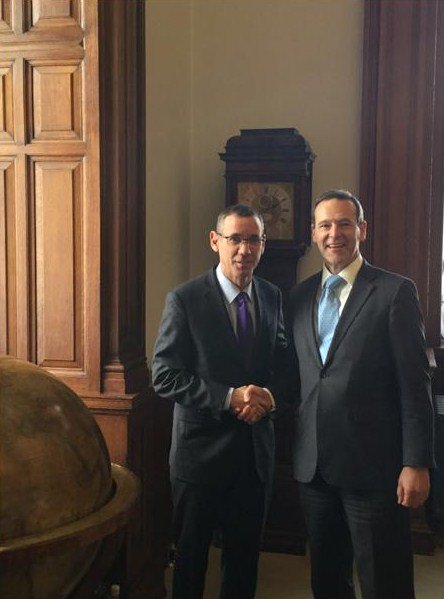
Many of you will recognise one of the faces in this photograph, Mark Regev. He is Israel’s new Ambassador to London and of course was the Israeli government spokesman who justified the massacre of more than 600 women and children in Gaza, and the murder of peace activists aboard the Mavi Marmara.
The other face of evil is Simon McDonald, head of the UK Diplomatic Service. You probably now think I am indulging in hyperbole. But no, I am not.
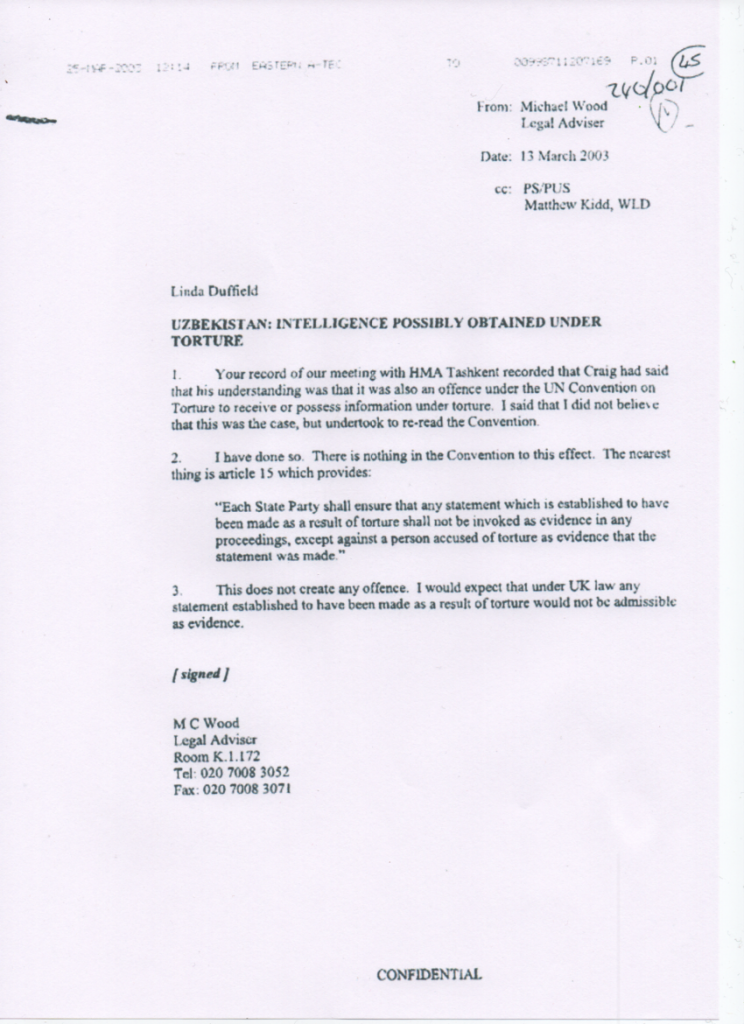
Simon McDonald was the Foreign Secretary Jack Straw’s Private Secretary at the time of the implementation of the British government’s extraordinary rendition and intelligence from torture programmes. When I became the only member of the UK’s senior civil service to make formal objection to these programmes, it was Simon McDonald who managed Jack Straw’s response in continuing to use torture.
I have indisputable documentary evidence of this, plain despite redactions by the British government censors (redactions which primarily remove all references to the CIA).
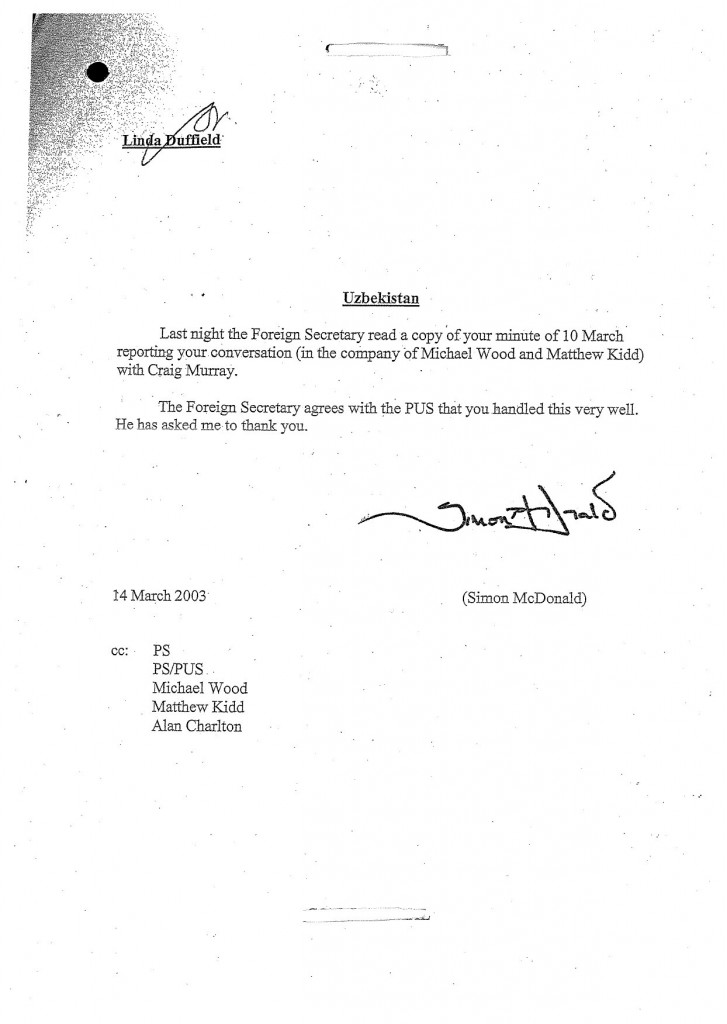
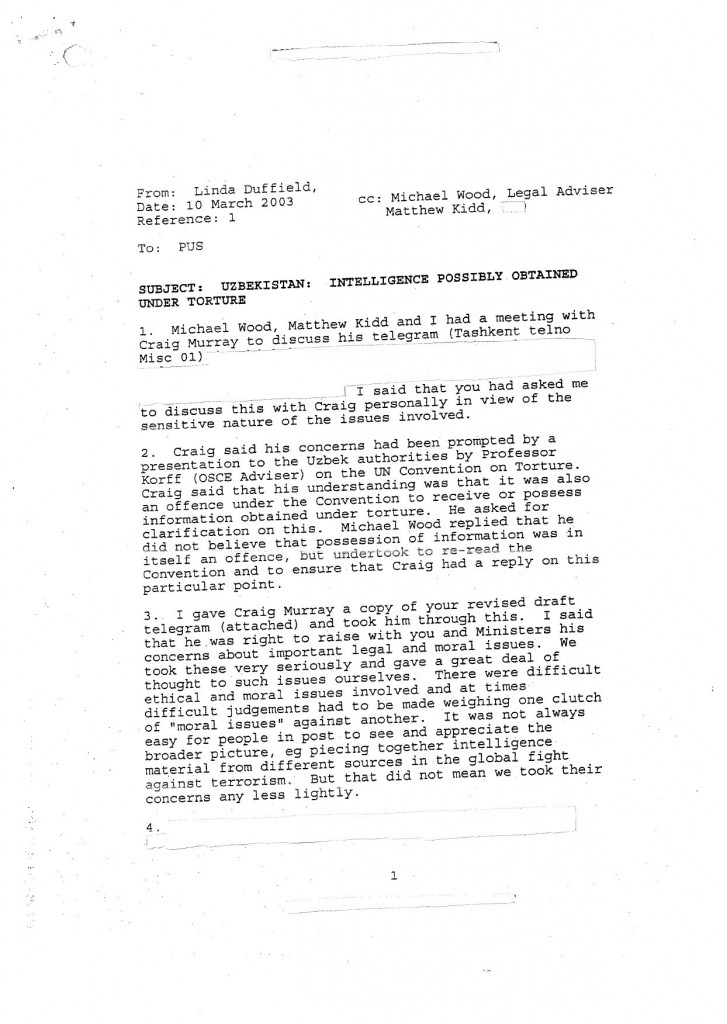
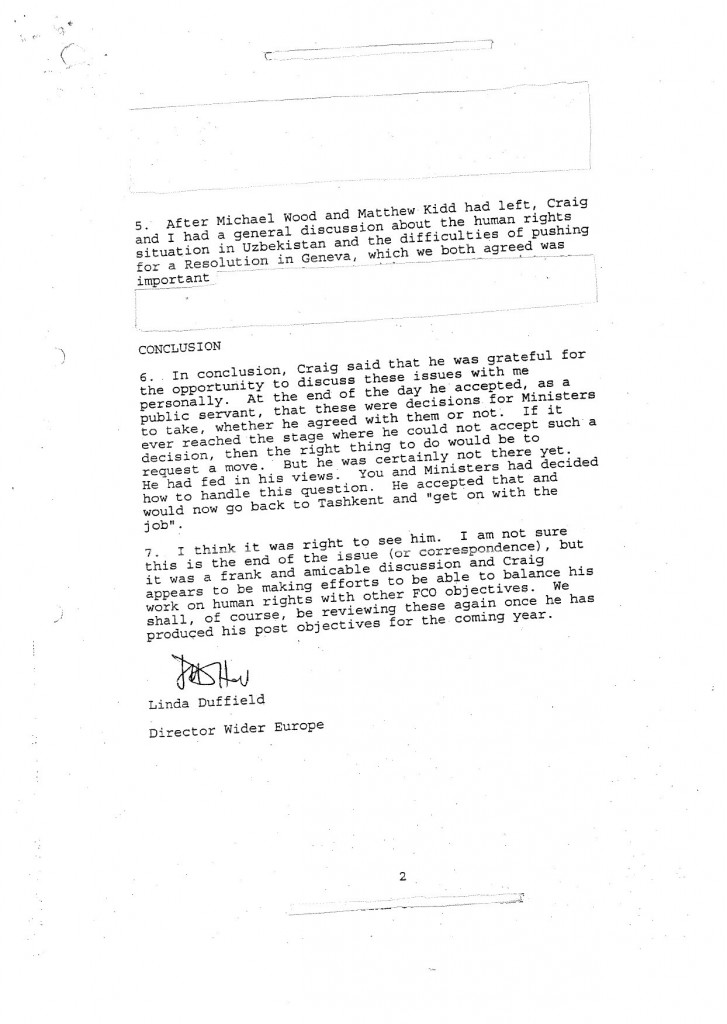
It is put to me frequently that people like McDonald, who were merely implementing a policy of torture, are not evil. That of course is the age old “only doing my job” defence. As somebody who was sacked for refusing to go along with torture, I think I have walked the walk and can describe him as evil. It is also worth noting that, while McDonald meets all new Ambassadors to London, he went far further with Regev than with anybody else. He tweeted out their photo with the message “Happy to see Mark Regev newly arrived Israeli Ambassador, an old friend from Tel Aviv ten years ago.”
Ten years ago, when they were friends in Tel Aviv, was of course the year in which Israel invaded Lebanon and Mark Regev was the chief Israeli spokesman justifying that attack, with its mass civilian casualties. Regev also defended the bombing by Israel of a United Nations observation post.
It is hardly surprising McDonald and Regev became friends at this time, as Gordon Brown’s government were doing everything possible behind the scenes to assist the Israeli invasion. As I wrote at that time
I have just watched on television sixty bodies being buried in a mass grave in Tyre, victims of Israeli bombing. At the same time I saw the odious Kim Howells, Foreign Office minister, arguing that a ceasefire would not solve the problem.
British diplomats at the UK Mission to the United Nations in New York – people I know personally – are putting massive effort into working against a ceasefire. They have the ultimate weapon that they and the US can veto any resolution at the Security Council, but are bending their backs into heading the subject off the agenda.
I hope they are proud of their succesful efforts. For every hour they prevent a ceasefire, on average two more Lebanese children are dying. Israel claims now to have killed 100 Hizbollah fighters. Even if true, that means they are killing two children to every fighter.
McDonald and Regev. Torture meets child-killing. Don’t they make a lovely couple?
Would a Clinton Win Mean More Wars?
By Robert Parry | Consortium News | April 10, 2016
The Democratic Party establishment seems determined to drag Hillary Clinton’s listless campaign across the finish line of her race with Bernie Sanders and then count on Republican divisions to give her a path to the White House. But – if she gets there – the world should hold its breath.
If Clinton becomes President, she will be surrounded by a neocon-dominated American foreign policy establishment that will press her to resume its “regime change” strategies in the Middle East and escalate its new and dangerous Cold War against Russia.
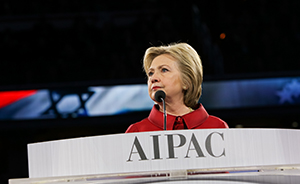
Hillary Clinton (Photo credit: AIPAC)
If Bashar al-Assad is still president of Syria, there will be demands that she finally go for the knock-out blow; there will pressure, too, for her to ratchet up sanctions on Iran pushing Tehran toward renouncing the nuclear agreement; there are already calls for deploying more U.S. troops on Russia’s border and integrating Ukraine into the NATO military structure.
President Clinton-45 would hear the clever talking points justifying these moves, the swaggering tough-guy/gal rhetoric, and the tear-jerking propaganda about evil enemies throwing babies off incubators, giving Viagra to soldiers to rape more women, and committing horrific crimes (some real but many imagined) against defenseless innocents.
Does anyone think that Hillary Clinton has the wisdom to resist these siren songs of confrontation and war, even if she were inclined to?
President Barack Obama, who – for all his faults – has a much deeper and subtler intellect than Hillary Clinton, found himself so battered by these pressures from the militaristic Washington “playbook” that he whined about his predicament to The Atlantic’s Jeffrey Goldberg, himself a neocon war hawk.
The Washington foreign policy establishment is now so profoundly in the hands of the neocons and their “liberal interventionist” sidekicks that the sitting President presumably couldn’t find anyone but a neocon to give those interviews to, even as he complained about how the U.S. capital is in the hands of warmongers.
Given this neocon domination of U.S. foreign policy – especially in the State Department bureaucracy, the major media and the big think tanks – Clinton will be buffeted by hawkish demands and plans both from outside of her administration and from within.
Already key neocons, such as the Brookings Institution’s Robert Kagan, are signaling that they expect to have substantial influence over Clinton’s foreign policy. Kagan, who has repackaged himself as a “liberal interventionist,” threw his support to Clinton, who put him on a State Department advisory board.
There is also talk in Washington that Kagan’s neocon wife, Assistant Secretary of State for European Affairs Victoria Nuland, another Clinton favorite and the architect of the “regime change” in Ukraine, would be in line for a top foreign policy job in a Clinton-45 administration.
Neocons Back in Charge
So, Clinton’s election could mean that some of the most dangerous people in American foreign policy would be whispering their schemes for war and more war directly into her ear – and her record shows that she is very susceptible to such guidance.
At every turn, as a U.S. senator and as Secretary of State, Clinton has opted for “regime change” solutions – from the Iraq invasion in 2003 to the Honduras coup in 2009 to the Libyan air war in 2011 to the Syria civil war since 2011 – or she has advocated for the escalation of conflicts, such as in Afghanistan and with Iran, rather than engaging in reasonable give-and-take negotiations.
Though her backers tout her experience as Secretary of State, the reality was that she repeatedly disdained genuine diplomacy and was constantly hectoring President Obama into adopting the most violent and confrontational options.
He sometimes did (the Afghan “surge,” the Libyan war, the Iran nuclear stand-off) but he sometimes didn’t (reversing the Afghan escalation, finally negotiating a nuclear deal with Iran after Clinton left, rejecting a direct U.S. military assault on the Syrian government, and working at times with the Russians on Iran and Syria).
In other words, Obama acted as a register or brake restraining Clinton’s hawkishness. With Clinton as the President, however, she would have no such restraints. One could expect her to endorse many if not all the harebrained neocon schemes, much as President George W. Bush did when his neocon advisers exploited his fear and fury over 9/11 to guide him into their “regime change” agenda for the Middle East.
The neocons have never given up their dreams of overthrowing Mideast governments that Israel has put on its enemies list. Iraq was only the first. To follow were Syria and Iran with the idea that by installing pro-Israeli leaders in those countries, Israel’s close-in enemies – Lebanon’s Hezbollah, Hamas and other Palestinian militant groups – could be isolated and crushed.
After Bush’s Iraq invasion in 2003, Washington’s neocons were joking about whether Iran or Syria should come next, with the punch line: “Real men go to Tehran!” But the Iraq War wasn’t the “cakewalk” that the neocons had predicted. Instead of throwing flowers at the U.S. troops, Iraqis planted IEDs.
As it turned out, a lot of “real men” and “real women” – as well as “real children” – died in Iraq, including nearly 4,500 American soldiers and hundreds of thousands of Iraqis.
So the neocon timetable took a hit but, in their view, only because of Bush’s incompetent follow-through on Iraq. If not for the botched occupation, the neocons felt they could have continued rolling up other troublesome regimes, one after another.
Professionally, the neocons also escaped the Iraq disaster largely unscathed, continuing to dominate Washington’s think tanks and the op-ed pages of major American news outlets such as The Washington Post and The New York Times. Barely missing a beat, they set about planning for the longer haul.
An Obama Mistake
Although they lost the White House in 2008, the neocons caught a break when President-elect Obama opted for a Lincoln-esque “team of rivals” on foreign policy. Instead of reaching out to Washington’s marginalized (and aging) foreign policy “realists,” Obama looked to the roster of the neocon-dominated establishment.
Obama recruited his hawkish Democratic rival, Sen. Hillary Clinton, to be Secretary of State and kept Bush’s Defense Secretary Robert Gates. Obama also left in place most of Bush’s military high command, including neocon favorite, General David Petraeus.
Obama’s naïve management strategy let the neocons and their “liberal interventionist” pals consolidate their bureaucratic control of Washington’s foreign policy bureaucracy, even though the President favored a more “realist” approach that would use America’s power more judiciously — and he was less enthralled to Israel’s right-wing government.
The behind-the-scenes neocon influence became especially pronounced at Clinton’s State Department where she tapped the likes of Nuland, a neocon ideologue and an adviser to Vice President Dick Cheney, to become the department’s spokesperson and put her on track to become Assistant Secretary of State for European Affairs (although the appointment wasn’t finalized until after Clinton left in 2013).
The neocon/liberal-hawk bias is now so strong inside the State Department that officials I know who have gone there reemerge as kind of “pod people” spouting arrogant talking points in support of U.S. intervention all over the world. By contrast, I find the CIA and the Pentagon to be places of relative realism and restraint.
Perhaps the best example of this “pod people” phenomenon was Sen. John Kerry, who replaced Clinton as Secretary of State and suddenly became the mouthpiece for the bureaucracy’s most extreme war-like rhetoric.
For instance, Kerry advocated a retaliatory bombing campaign against Syria’s military in August 2013, ignoring the intelligence community’s doubts about whether President Bashar al-Assad’s regime was responsible for a sarin-gas attack outside Damascus.
Instead of listening to the intelligence analysts, Kerry fell in line behind the neocon-driven “group think” pinning the blame on Assad, the perfect excuse for implementing the neocons’ long-delayed Syrian “regime change.” The neocons didn’t care what the facts were — and Kerry fell in line. [See Consortiumnews.com’s “What’s the Matter with John Kerry?”]
But Obama didn’t fall in line. He listened when Director of National Intelligence James Clapper told him that there was no “slam dunk” evidence implicating the Syrian military. (Ultimately, the evidence would point to a provocation carried out by Islamic extremists trying to trick the U.S. military into intervening in the war on their side.)
Obama also got help from Russian President Vladimir Putin who persuaded President Assad to surrender all his chemical weapons (while Assad still denied any role in the sarin-gas attack). Putin’s assistance infuriated the neocons who soon recognized that the Obama-Putin cooperation was a profound threat to their “regime change” enterprise.
Targeting Ukraine
Some of the smarter neocons quickly identified Ukraine as a potential wedge that could be driven between Obama and Putin. Carl Gershman, president of the National Endowment for Democracy, called Ukraine “the biggest prize” and a potential first step toward driving Putin from power in Russia.
It fell to Assistant Secretary of State Nuland to shepherd the Ukraine operation to fulfillment as she plotted with U.S. Ambassador to Ukraine Geoffrey Pyatt how to remove Ukraine’s pro-Russian President Viktor Yanukovych. Nuland and Pyatt were caught in an intercepted phone call discussing who should take over.
“Yats is the guy,” Nuland said referring to Arseniy Yatsenyuk who indeed would become the new prime minister. Nuland and Pyatt then exchanged ideas how to “glue this thing” and how to “midwife this thing.” This “thing” became the bloody Feb. 22, 2014 coup ousting elected President Yanukovych and touching off a civil war between Ukrainian “nationalists” from the west and Ukraine’s ethnic Russians in the east.
As the “nationalists,” some of them openly neo-Nazis, inflicted atrocities on ethnic Russians, Crimea voted by 96 percent to leave Ukraine and rejoin Russia. Resistance to the new Kiev regime also arose in the eastern Donbas region.
To the State Department – and the mainstream U.S. news media – this conflict was all explained as “Russian aggression” against Ukraine and a “Russian invasion” of Crimea (although Russian troops were already in Crimea as part of the Sevastopol naval base agreement). But All the Important People agreed that the Crimean referendum was a “sham” (although many polls have since confirmed the results).
When citizen Clinton weighed in on the Ukraine crisis, she compared Russian President Putin to Hitler.
So, today the neocon/liberal-hawk Washington “playbook” – as Obama would call it – calls for massing more and more U.S. troops and NATO weapons systems on Russia’s border to deter Putin’s “aggression.”
These tough guys and gals also vow to ignore Russia’s warnings against what it views as military threats to its existence. Apparently “real, real men” go to Moscow (perhaps riding a nuclear bomb like the famous seen from “Dr. Strangelove.”).
Ian Joseph Brzezinski, a State Department official under President George W. Bush and now a foreign policy expert for the Atlantic Council, a NATO think tank, has co-authored an article urging NATO to incorporate Ukrainian army units into its expansion of military operations along Russia’s border.
“High-level Ukrainian national security officials have urged the international community to be bolder in its response to Russia’s provocative military actions,” wrote Brzezinski (son of old Cold Warrior Zbigniew Brzezinski) and Ukrainian co-author Markian Bilynskyj.
“The deployment of a battle tested, Ukrainian infantry company or larger unit to reinforce the defense of NATO territory in Central Europe would be a positive contribution to the Alliance force posture in the region.”
Following the Playbook
This kind of tough-talking jargon is what the next President, whoever he or she is, can expect from Official Washington. From Obama’s interview in The Atlantic, it’s clear that he feels surrounded and embattled by these warmongering forces but takes some pride in resisting – from time to time – the Washington “playbook.”
But how would President Hillary Clinton respond? When she appeared before the American Israel Public Affairs Committee on March 21 – at a moment when it appeared she had all but nailed down the Democratic nomination – Clinton showed what you might call her true colors, fawning over how loyal she would be to Israel and promising to take the very cozy relationship between the U.S. and Israel “to the next level.”
By reviewing Clinton’s public record, one could reasonably conclude that she is herself a neocon, both in her devotion to Israel and her proclivity toward “regime change” solutions. She also follows the neocon lead in demonizing any foreign leader who gets in their way. But even if she isn’t a full-fledged neocon, she often bends to their demands.
The one possible deviation from this pattern is Clinton’s personal friendship with longtime adviser Sidney Blumenthal, who was an early critic of the neoconservatives as they emerged as a powerful force during the Reagan administration. Blumenthal and his son Max have also dared criticize Israel’s abusive treatment of the Palestinians.
However, the Israel Lobby appears to be taking no chances that Sidney Blumenthal’s voice might be heard during a Clinton-45 administration. Last month, a pro-Zionist group, The World Values Network, bought a full-page ad in The New York Times to attack Blumenthal and his son and declared that “Hillary Clinton must disavow her anti-Israel advisors.”
Though Clinton might not publicly disassociate herself from Sidney Blumenthal, the preemptive strike pushed him further toward the margins and helped clear the path for the Kagan/Nuland faction to rush to the center of Clinton’s foreign policy.
Indeed, Clinton’s primary focus if she gets elected is likely to be ensuring that she gets reelected. As a traditional politician, she would think that the way to achieve reelection is to stay on the good side of the Israeli leadership. Along those lines, she promised AIPAC that, as President, she would immediately invite Prime Minister Benjamin Netanyahu to the White House.
So, what would happen if Clinton takes the U.S.-Israeli relationship “to the next level”? Presumably that would mean taking a super-hard line against Iran over last year’s nuclear deal. Yet, already Iran is questioning whether its acceptance of extraordinary constraints on its nuclear program was worth it, given the U.S. unwillingness to grant meaningful relief on economic sanctions.
A belligerent Clinton approach – decrying Iran’s behavior and imposing new sanctions – would strengthen Iran’s hard-line faction internally and might well lead to Iran renouncing the agreement on the grounds of American bad faith. That, of course, would please the neocons and Netanyahu by putting the “bomb-bomb-bomb Iran” option back in play.
A Stunning Reversal
Clinton may have viewed her AIPAC speech as the beginning of her long-awaited “pivot to the center,” but afterwards she suffered a string of primary and caucus defeats at the hands of Sen. Bernie Sanders, most by landslide margins.
Besides those stunning defeats, Clinton’s campaign clearly has an “enthusiasm gap.” Sanders, the 74-year-old “democratic socialist” from Vermont, draws huge and excited crowds and wins younger voters by staggering percentages. Meanwhile, Clinton confronts polls showing high negatives and extraordinary public distrust.
If she gets the Democratic nomination, she may have little choice but to engage in a fiercely negative campaign since — faced with the lack of voter enthusiasm — her best chance of winning is to so demonize her Republican opponent that Democrats and independents will be driven to the polls out of fear of what the crazy GOP madman might do.
Right now, many Clinton supporters see her as the “safe” — not exciting — choice, a politician whose long résumé gives them comfort that she must know what’s she’s doing. African-American voters, who have been her most loyal constituency, apparently feel more comfortable with someone they’ve known (who has also served in the Obama administration) than Sanders who is unknown to many and is seen as someone whose ambitious programs appear less practical than Clinton’s small-bore ideas.
But a look behind Clinton’s résumé, especially her reliance on “regime change” and other interventionist schemes in the Middle East and Eastern Europe, might give all peace-loving voters pause. [See Consortiumnews.com’s “Is Hillary Clinton ‘Qualified’?”]
Savvy neocons, like Robert Kagan, have long understood that Clinton could be their Trojan Horse, pulled into the White House by Democratic voters. Kagan told The New York Times, “I feel comfortable with her on foreign policy. If she pursues a policy which we think she will pursue it’s something that might have been called neocon, but clearly her supporters are not going to call it that; they are going to call it something else.”
The same Times article noted that Clinton “remains the vessel into which many interventionists are pouring their hopes.” However, if she is that “vessel” carrying a neocon foreign policy back into the White House, this “safe” choice might prove dangerous to America and the world.
Investigative reporter Robert Parry broke many of the Iran-Contra stories for The Associated Press and Newsweek in the 1980s. You can buy his latest book, America’s Stolen Narrative, either in print here or as an e-book (from Amazon and barnesandnoble.com).
The CIA and the Media: 50 Historical Facts the World Needs to Know
By James Tracy | Memory Hole Blog | August 26, 2015
Since the end of World War Two the Central Intelligence Agency has been a major force in US and foreign news media, exerting considerable influence over what the public sees, hears and reads on a regular basis. CIA publicists and journalists alike will assert they have few, if any, relationships, yet the seldom acknowledged history of their intimate collaboration indicates a far different story–indeed, one that media historians are reluctant to examine.
 When seriously practiced, the journalistic profession involves gathering information concerning individuals, locales, events, and issues. In theory such information informs people about their world, thereby strengthening “democracy.” This is exactly the reason why news organizations and individual journalists are tapped as assets by intelligence agencies and, as the experiences of German journalist Udo Ulfkotte (entry 47 below) suggest, this practice is at least as widespread today as it was at the height of the Cold War.
Consider the coverups of election fraud in 2000 and 2004, the events of September 11, 2001, the invasions Afghanistan and Iraq, the destabilization of Syria, and the creation of “ISIS.” These are among the most significant events in recent world history, and yet they are also those much of the American public is wholly ignorant of. In an era where information and communication technologies are ubiquitous, prompting many to harbor the illusion of being well-informed, one must ask why this condition persists.
Further, why do prominent US journalists routinely fail to question other deep events that shape America’s tragic history over the past half century, such as the political assassinations of the 1960s, or the central role played by the CIA in international drug trafficking?
Popular and academic commentators have suggested various reasons for the almost universal failure of mainstream journalism in these areas, including newsroom sociology, advertising pressure, monopoly ownership, news organizations’ heavy reliance on “official” sources, and journalists’ simple quest for career advancement. There is also, no doubt, the influence of professional public relations maneuvers. Yet such a broad conspiracy of silence suggests another province of deception examined far too infrequently—specifically the CIA and similar intelligence agencies’ continued involvement in the news media to mold thought and opinion in ways scarcely imagined by the lay public.
The following historical and contemporary facts–by no means exhaustive–provides a glimpse of the power such entities possess to influence, if not determine, popular memory and what respectable institutions deem to be the historical record.
- The CIA’s Operation MOCKINGBIRD is a long-recognised keystone among researchers pointing to the Agency’s clear interest in and relationship to major US news media. MOCKINGBIRD grew out of the CIA’s forerunner, the Office for Strategic Services (OSS, 1942-47), which during World War Two had established a network of journalists and psychological warfare experts operating primarily in the European theatre.
- Many of the relationships forged under OSS auspices were carried over into the postwar era through a State Department-run organization called the Office of Policy Coordination (OPC) overseen by OSS staffer Frank Wisner.
- The OPC “became the fastest-growing unit within the nascent CIA,” historian Lisa Pease observes, “rising in personnel from 302 in 1949 to 2,812 in 1952, along with 3,142 overseas contract personnel. In the same period, the budget rose from $4.7 million to $82 million.” Lisa Pease, “The Media and the Assassination,” in James DiEugenio and Lisa Pease, The Assassinations: Probe Magazine on JFK, MLK, RFK and Malcolm X, Port Townsend, WA, 2003, 300.
- Like many career CIA officers, eventual CIA Director/Director of Central Intelligence (DCI) Richard Helms was recruited out of the press corps by his own supervisor at the United Press International’s Berlin Bureau to join in the OSS’s fledgling “black propaganda” program. “‘[Y]ou’re a natural,” Helms’ boss remarked. Richard Helms, A Look Over My Shoulder: A Life in the Central Intelligence Agency, New York: Random House, 2003, 30-31.
- Wisner tapped Marshall Plan funds to pay for his division’s early exploits, money his branch referred to as “candy.” “We couldn’t spend it all,” CIA agent Gilbert Greenway recalls. “I remember once meeting with Wisner and the comptroller. My God, I said, how can we spend that? There were no limits, and nobody had to account for it. It was amazing.” Frances Stonor Saunders, The Cultural Cold War: The CIA and the World of Arts and Letters, New York: The New Press, 2000, 105.
- When the OPC was merged with the Office of Special Operations in 1948 to create the CIA, OPC’s media assets were likewise absorbed.
- Wisner maintained the top secret “Propaganda Assets Inventory,” better known as “Wisner’s Wurlitzer”—a virtual rolodex of over 800 news and information entities prepared to play whatever tune Wisner chose. “The network included journalists, columnists, book publishers, editors, entire organizations such as Radio Free Europe, and stringers across multiple news organizations.” Pease, “The Media and the Assassination,” 300.
- A few years after Wisner’s operation was up-and-running he “’owned’ respected members of the New York Times, Newsweek, CBS, and other communication vehicles, plus stringers, four to six hundred in all, according to a CIA analyst. Each one was a separate ‘operation,’” investigative journalist Deborah Davis notes, “requiring a code name, a field supervisor, and a field office, at an annual cost of tens or hundreds of thousands of dollars—there has never been an accurate accounting.” Deborah Davis, Katharine the Great: Katharine Graham and the Washington Post, Second Edition, Bethesda MD: National Press Inc, 1987, 139.
- Psychological operations in the form of journalism were perceived as necessary to influence and direct mass opinion, as well as elite perspectives. “[T]he President of the United States, the Secretary of State, Congressmen and even the Director of the CIA himself will read, believe, and be impressed by a report from Cy Sulzberger, Arnaud de Borchgrave, or Stewart Alsop when they don’t even bother to read a CIA report on the same subject,” noted CIA agent Miles Copeland. Cited in Pease, “The Media and the Assassination,” 301.
- By the mid-to-late 1950s, Darrell Garwood points out, the Agency sought to limit criticism directed against covert activity and bypass congressional oversight or potential judicial interference by “infiltrat[ing] the groves of academia, the missionary corps, the editorial boards of influential journal and book publishers, and any other quarters where public attitudes could be effectively influenced.” Darrell Garwood, Under Cover: Thirty-Five Years of CIA Deception, New York: Grove Press, 1985, 250.
- The CIA frequently intercedes in editorial decision-making. For example, when the Agency proceeded to wage an overthrow of the Arbenz regime in Guatemala in 1954, Allen and John Foster Dulles, President Eisenhower’s CIA Director and Secretary of State respectively, called upon New York Times publisher Arthur Hays Sulzberger to reassign reporter Sydney Gruson from Guatemala to Mexico City. Sulzberger thus placed Gruson in Mexico City with the rationale that some repercussions from the revolution might be felt in Mexico. Pease, “The Media and the Assassination,” 302.
- Since the early 1950s the CIA “has secretly bankrolled numerous foreign press services, periodicals and newspapers—both English and foreign language—which provided excellent cover for CIA operatives,” Carl Bernstein reported in 1977. “One such publication was the Rome Daily American, forty percent of which was owned by the CIA until the 1970s.” Carl Bernstein, “The CIA and the Media,” Rolling Stone, October 20, 1977.
- The CIA exercised informal liaisons with news media executives, in contrast to its relationships with salaried reporters and stringers, “who were much more subject to direction from the Agency” according to Bernstein. “A few executives—Arthur Hays Sulzberger of the New York Times among them—signed secrecy agreements. But such formal understandings were rare: relationships between Agency officials and media executives were usually social—’The P and Q Street axis in Georgetown,’ said one source. ‘You don’t tell William Paley to sign a piece of paper saying he won’t fink.’” Director of CBS William Paley’s personal “friendship with CIA Director Dulles is now known to have been one of the most influential and significant in the communications industry,” author Debora Davis explains. “He provided cover for CIA agents, supplied out-takes of news film, permitted the debriefing of reporters, and in many ways set the standard for the cooperation between the CIA and major broadcast companies which lasted until the mid-1970s.” Deborah Davis, Katharine the Great: Katharine Graham and the Washington Post, Second Edition, Bethesda MD: National Press Inc, 1987, 175.
- “The Agency’s relationship with the Times was by far its most valuable among newspapers, according to CIA officials,” Bernstein points out in his key 1977 article. “From 1950 to 1966, about ten CIA employees were provided Times cover under arrangements approved by the newspaper’s late publisher, Arthur Hays Sulzberger. The cover arrangements were part of a general Times policy—set by Sulzberger—to provide assistance to the CIA whenever possible.” In addition, Sulzberger was a close friend of CIA Director Allen Dulles. “’At that level of contact it was the mighty talking to the mighty,’ said a high‑level CIA official who was present at some of the discussions. ‘There was an agreement in principle that, yes indeed, we would help each other. The question of cover came up on several occasions. It was agreed that the actual arrangements would be handled by subordinates…. The mighty didn’t want to know the specifics; they wanted plausible deniability.’” Bernstein, “The CIA and the Media.”
- CBS’s Paley worked reciprocally with the CIA, allowing the Agency to utilize network resources and personnel. “It was a form of assistance that a number of wealthy persons are now generally known to have rendered the CIA through their private interests,” veteran broadcast journalist Daniel Schorr wrote in 1977. “It suggested to me, however, that a relationship of confidence and trust had existed between him and the agency.” Schorr points to “clues indicating that CBS had been infiltrated.” For example, “A news editor remembered the CIA officer who used to come to the radio control room in New York in the early morning, and, with the permission of persons unknown, listened to CBS correspondents around the world recording their ‘spots’ for the ‘World News Roundup’ and discussing events with the editor on duty. Sam Jaffe claimed that when he applied in 1955 for a job with CBS, a CIA officer told him that he would be hired–which he subsequently was. He was told that he would be sent to Moscow–which he subsequently was; he was assigned in 1960 to cover the trial of U-2 pilot Francis Gary Powers. [Richard] Salant told me,” Schorr continues, “that when he first became president of CBS News in 1961, a CIA case officer called saying he wanted to continue the ‘long standing relationship known to Paley and [CBS president Frank] Stanton, but Salant was told by Stanton there was no obligation that he knew of” (276). Schorr, Daniel. Clearing the Air, Boston: Houghton Mifflin, 1977, 277, 276.
- National Enquirer publisher Gene Pope Jr. worked briefly on the CIA’s Italy desk in the early 1950s and maintained close ties with the Agency thereafter. Pope refrained from publishing dozens of stories with “details of CIA kidnappings and murders, enough stuff for a year’s worth of headlines” in order to “collect chits, IOUs,” Pope’s son writes. “He figured he’d never know when he might need them, and those IOUs would come in handy when he got to 20 million circulation. When that happened, he’d have the voice to be almost his own branch of government and would need the cover.” Paul David Pope, The Deeds of My Fathers: How My Grandfather and Father Built New York and Created the Tabloid World of Today, New York: Phillip Turner/Rowman & Littlefield, 2010, 309, 310.
- One explosive story Pope’s National Enquirer‘s refrained from publishing in the late 1970s centered on excerpts from a long-sought after diary of President Kennedy’s lover, Mary Pinchot Meyer, who was murdered on October 12, 1964. “The reporters who wrote the story were even able to place James Jesus Angleton, the CIA’s head of counterintelligence operations, at the scene.” Another potential story drew on “documents proving that [Howard] Hughes and the CIA had been connected for years and that the CIA was giving Hughes money to secretly fund, with campaign donations, twenty-seven congressmen and senators who sat on sub-committees critical to the agency. There are also fifty-three international companies named and sourced as CIA fronts .. and even a list of reporters for mainstream media organizations who were playing ball with the agency.” Pope, The Deeds of My Fathers, 309.
- Angleton, who oversaw the Agency counterintelligence branch for 25 years, “ran a completely independent group entirely separate cadre of journalist‑operatives who performed sensitive and frequently dangerous assignments; little is known about this group for the simple reason that Angleton deliberately kept only the vaguest of files.” Bernstein, “The CIA and the Media.”
- The CIA conducted a “formal training program” during the 1950s for the sole purpose of instructing its agents to function as newsmen. “Intelligence officers were ‘taught to make noises like reporters,’ explained a high CIA official, and were then placed in major news organizations with help from management. These were the guys who went through the ranks and were told ‘You’re going to he a journalist,’” the CIA official said.” The Agency’s preference, however, was to engage journalists who were already established in the industry. Bernstein, “The CIA and the Media.”
- Newspaper columnists and broadcast journalists with household names have been known to maintain close ties with the Agency. “There are perhaps a dozen well known columnists and broadcast commentators whose relationships with the CIA go far beyond those normally maintained between reporters and their sources,” Bernstein maintains. “They are referred to at the Agency as ‘known assets’ and can be counted on to perform a variety of undercover tasks; they are considered receptive to the Agency’s point of view on various subjects.” Bernstein, “The CIA and the Media.”
- Frank Wisner, Allen Dulles, and Washington Post publisher Phillip Graham were close associates, and the Post developed into one of the most influential news organs in the United States due to its ties with the CIA. The Post managers’ “individual relations with intelligence had in fact been the reason the Post Company had grown as fast as it did after the war,” Davis observes. “[T]heir secrets were its corporate secrets, beginning with MOCKINGBIRD. Phillip Graham’s commitment to intelligence had given his friends Frank Wisner an interest in helping to make the Washington Post the dominant news vehicle in Washington, which they had done by assisting with its two most crucial acquisitions, the Times-Herald and WTOP radio and television stations.” Davis, Katharine the Great: Katharine Graham and the Washington Post, 172.
- In the wake of World War One the Woodrow Wilson administration placed journalist and author Walter Lippmann in charge of recruiting agents for the Inquiry, a first-of-its-kind ultra-secret civilian intelligence organization whose role involved ascertaining information to prepare Wilson for the peace negotiations, as well as identify foreign natural resources for Wall Street speculators and oil companies. The activities of this organization served as a prototype for the function eventually performed by the CIA, namely “planning, collecting, digesting, and editing the raw data,” notes historian Servando Gonzalez. “This roughly corresponds to the CIA’s intelligence cycle: planning and direction, collection, processing, production and analysis, and dissemination.” Most Inquiry members would later become members of the Council on Foreign Relations. Lippmann would go on to become the Washington Post’s best known columnists. Servando Gonzalez, Psychological Warfare and the New World Order: The Secret War Against the American People, Oakland, CA: Spooks Books, 2010, 50.
- The two most prominent US newsweeklies, Time and Newsweek, kept close ties with the CIA. “Agency files contain written agreements with former foreign correspondents and stringers for both the weekly newsmagazines,” according to Carl Bernstein. “Allen Dulles often interceded with his good friend, the late Henry Luce, founder of Time and Life magazines, who readily allowed certain members of his staff to work for the Agency and agreed to provide jobs and credentials for other CIA operatives who lacked journalistic experience.” Bernstein, “The CIA and the Media.”
- In his autobiography former CIA officer E. Howard Hunt quotes Bernstein’s “The CIA and the Media” article at length. “I know nothing to contradict this report,” Hunt declares, suggesting the investigative journalist of Watergate fame didn’t go far enough. “Bernstein further identified some of the country’s top media executives as being valuable assets to the agency … But the list of organizations that cooperated with the agency was a veritable ‘Who’s Who’ of the media industry, including ABC, NBC, the Associated Press, UPI, Reuters, Hearst Newspapers, Scripps-Howard, Newsweek magazine, and others.” E. Howard Hunt, American Spy: My Secret History in the CIA, Watergate, and Beyond, Hoboken NJ: John Wiley & Sons, 2007, 150.
- When the first major exposé of the CIA emerged in 1964 with the publication of The Invisible Government by journalists David Wise and Thomas B. Ross, the CIA considered purchasing the entire printing to keep the book from the public, yet in the end judged against it. “To an extent that is only beginning to be perceived, this shadow government is shaping the lives of 190,000,000 Americans” authors Wise and Ross write in the book’s preamble. “Major decisions involving peace and war are taking place out of public view. An informed citizen might come to suspect that the foreign policy of the United States often works publicly in one direction and secretly through the Invisible Government in just the opposite direction.”Lisa Pease, “When the CIA’s Empire Struck Back,” Consortiumnews.com, February 6, 2014.
- Agency infiltration of the news media shaped public perception of deep events and undergirded the official explanations of such events. For example, the Warren Commission’s report on President John F. Kennedy’s assassination was met with almost unanimous approval by US media outlets. “I have never seen an official report greeted with such universal praise as that accorded the Warren Commission’s findings when they were made public on September 24, 1964,” recalls investigative reporter Fred Cook. “All the major television networks devoted special programs and analyses to the report; the next day the newspapers ran long columns detailing its findings, accompanied by special news analyses and editorials. The verdict was unanimous. The report answered all questions, left no room for doubt. Lee Harvey Oswald, alone and unaided, had assassinated the president of the United States.” Fred J. Cook, Maverick: Fifty Years of Investigative Reporting, G.P. Putnam’s Sons, 1984, 276.
- In late 1966 the New York Times began an inquiry on the numerous questions surrounding President Kennedy’s assassination that were not satisfactorily dealt with by the Warren Commission. “It was never completed,” author Jerry Policoff observes, “nor would the New York Times ever again question the findings of the Warren Commission.” When the story was being developed the lead reporter at the Times‘ Houston bureau “said that he and others came up with ‘a lot of unanswered questions’ that the Times didn’t bother to pursue. ‘I’d be off on a good lead and then somebody’d call me off and send me out to California on another story or something. We never really detached anyone for this. We weren’t really serious.’” Jerry Policoff, “The Media and the Murder of John Kennedy,” in Peter Dale Scott, Paul L. Hoch and Russell Stetler, eds., The Assassinations: Dallas and Beyond, New York: Vintage, 1976, 265.
- When New Orleans District Attorney Jim Garrison embarked on an investigation of the JFK assassination in 1966 centering on Lee Harvey Oswald’s presence in New Orleans in the months leading up to November, 22, 1963, “he was cross-whipped with two hurricane blasts, one from Washington and one from New York,” historian James DiEugenio explains. The first, of course, was from the government, specifically the Central Intelligence Agency, the FBI, and to a lesser extent, the White House. The blast from New York was from the major mainstream media e.g. Time-Life and NBC. Those two communication giants were instrumental in making Garrison into a lightening rod for ridicule and criticism. This orchestrated campaign … was successful in diverting attention from what Garrison was uncovering by creating controversy about the DA himself.” DiEugenio, Preface, in William Davy, Let Justice Be Done: New Light on the Jim Garrison Investigation, Reston VA: Jordan Publishing, 1999.
- The CIA and other US intelligence agencies used the news media to sabotage Garrison’s 1966-69 independent investigation of the Kennedy assassination. Garrison presided over the only law enforcement agency with subpoena power to seriously delve into the intricate details surrounding JFK’s murder. One of Garrison’s key witnesses, Gordon Novel, fled New Orleans to avoid testifying before the Grand Jury assembled by Garrison. According to DiEugenio, CIA Director Allen “Dulles and the Agency would begin to connect the fugitive from New Orleans with over a dozen CIA friendly journalists who—in a blatant attempt to destroy Garrison’s reputation—would proceed to write up the most outrageous stories imaginable about the DA.” James DiEugenio, Destiny Betrayed: JFK, Cuba, and The Garrison Case, Second Edition, New York: SkyHorse Publishing, 2012, 235.
- CIA officer Victor Marchetti recounted to author William Davy that in 1967 while attending staff meetings as an assistant to then-CIA Director Richard Helms, “Helms expressed great concerns over [former OSS officer, CIA operative and primary suspect in Jim Garrison’s investigation Clay] Shaw’s predicament, asking his staff, ‘Are we giving them all the help we can down there?’” William Davy, Let Justice Be Done: New Light on the Jim Garrison Investigation, Reston VA: Jordan Publishing, 1999.
- The pejorative dimensions of the term “conspiracy theory” were introduced into the Western lexicon by CIA “media assets,” as evidenced in the design laid out by Document 1035-960 Concerning Criticism of the Warren Report, an Agency communiqué issued in early 1967 to Agency bureaus throughout the world at a time when attorney Mark Lane’s Rush to Judgment was atop bestseller lists and New Orleans DA Garrison’s investigation of the Kennedy assassination began to gain traction.
- Time had close relations with the CIA stemming from the friendship of the magazine’s publisher Henry Luce and Eisenhower CIA chief Allen Dulles. When former newsman Richard Helms was appointed DCI in 1966 he “began to cultivate the press,” prompting journalists toward conclusions that placed the Agency in a positive light. As Time Washington correspondent Hugh Sidney recollects, “‘[w]ith [John] McCone and [Richard] Helms, we had a set-up when the magazine was doing something on the CIA, we went to them and put it before them … We were never misled.’ Similarly, when Newsweek decided in the fall of 1971 to do a cover story on Richard Helms and ‘The New Espionage,’ the magazine, according to a Newsweek staffer, went directly to the agency for much of the information. And the article … generally reflected the line that Helms was trying so hard to sell: that since the latter 1960s … the focus of attention and prestige within CIA’ had switched from the Clandestine Services to the analysis of intelligence, and that ‘the vast majority of recruits are bound for’ the Intelligence Directorate.” Victor Marchetti and John D. Marks, The CIA and the Cult of Intelligence, New York: Alfred A. Knopf, 1974, 362-363.
- In 1970 Jim Garrison wrote and published the semi-autobiographical A Heritage of Stone, a work that examines how the New Orleans DA “discovered that the CIA operated within the borders of the United States, and how it took the CIA six months to reply to the Warren Commission’s question of whether Oswald and [Jack] Ruby had been with the Agency,” Garrison biographer and Temple University humanities professor Joan Mellen observes. “In response to A Heritage of Stone, the CIA rounded up its media assets” and the book was panned by reviewers writing for the New York Times, the Los Angeles Times, the Washington Post, the Chicago Sun Times, and Life magazine. “John Leonard’s New York Times review went through a metamorphosis,” Mellen explains. “The original last paragraph challenged the Warren Report: ‘Something stinks about this whole affair,’ Leonard wrote. ‘Why were Kennedy’s neck organs not examined at Bethesda for evidence of a frontal shot? Why was his body whisked away to Washington before the legally required Texas inquest? Why?’ This paragraph evaporated in later editions of the Times. A third of a column gone, the review then ended: ‘Frankly I prefer to believe that the Warren Commission did a poor job, rather than a dishonest one. I like to think that Garrison invents monsters to explain incompetence.’” Joan Mellen, A Farewell to Justice: Jim Garrison, JFK’s Assassination, and the Case That Should Have Changed History, Washington DC: Potomac Books, 2005, 323, 324.
- CIA Deputy Director for Plans Cord Meyer Jr. appealed to Harper & Row president emeritus Cass Canfield Sr. over the book publisher’s pending release of Alfred McCoy’s The Politics of Heroin in Southeast Asia, based on the author’s fieldwork and Yale PhD dissertation wherein he examined the CIA’s explicit role in the opium trade. “Claiming my book was a threat to national security,” McCoy recalls, “the CIA official had asked Harper & Row to suppress it. To his credit, Mr. Canfield had refused. But he had agreed to review the manuscript prior to publication.” Alfred W. McCoy, The Politics of Heroin: CIA Complicity in the Global Drug Trade, Chicago Review Press, 2003, xx.
- Publication of The Secret Team, a book by US Air Force Colonel and Pentagon-CIA liaison L. Fletcher Prouty recounting the author’s firsthand knowledge of CIA black operations and espionage, was met with a wide scale censorship campaign in 1972. “The campaign to kill the book was nationwide and world-wide,” Prouty notes. “It was removed from the Library of Congress and from college libraries as letters I received attested all too frequently … I was a writer whose book had been cancelled by a major publisher [Prentice Hall] and a major paperback publisher [Ballantine Books] under the persuasive hand of the CIA.” L. Fletcher Prouty, The Secret Team: The CIA and Its Allies in Control of the United States and the World, New York: SkyHorse Publishing, 2008, xii, xv.
- During the Pike Committee hearings in 1975 Congressman Otis Pike asked DCI William Colby, “Do you have any people paid by the CIA who are working for television networks?” Colby responded, “This, I think, gets into the kind of details, Mr. Chairman, that I’d like to get into in executive session.” Once the chamber was cleared Colby admitted that in 1975 specifically “the CIA was using ‘media cover’ for eleven agents, many fewer than in the heyday of the cloak-and-pencil operations, but no amount of questioning would persuade him to talk about the publishers and network chieftains who had cooperated at the top.” Schorr, Clearing the Air, 275.
- “There is quite an incredible spread of relationships,” former CIA intelligence officer William Bader informed a US Senate Intelligence Committee investigating the CIA’s infiltration of the nation’s journalistic outlets. “You don’t need to manipulate Time magazine, for example, because there are Agency people at the management level.” Bernstein, “The CIA and the Media.”
- In 1985 film historian and professor Joseph McBride came across a November 29, 1963 memorandum from J. Edgar Hoover, titled, “Assassination of President John F. Kennedy,” wherein the FBI director stated that his agency provided two individuals with briefings, one of whom was “Mr. George Bush of the Central Intelligence Agency.” ” When McBride queried the CIA with the memo a “PR man was tersely formal and opaque: ‘I can neither confirm nor deny.’ It was the standard response the agency gave when it dealt with its sources and methods,” journalist Russ Baker notes. When McBride published a story in The Nation, “The Man Who Wasn’t There, ‘George Bush,’ C.I.A. Operative,” the CIA came forward with a statement that the George Bush referenced in the FBI record “apparently” referenced a George William Bush, who filled a perfunctory night shift position at CIA headquarters that “would have been the appropriate place to receive such a report.” McBride tracked down George William Bush to confirm he was only employed briefly as a “probationary civil servant” who had “never received interagency briefings.” Shortly thereafter The Nation ran a second story by McBride wherein “the author provided evidence that the Central Intelligence Agency had foisted a lie on the American people … As with McBride’s previous story, this disclosure was greeted with the equivalent of a collective media yawn.” Since the episode researchers have found documents linking George H. W. Bush to the CIA as early as 1953. Russ Baker, Family of Secrets: The Bush Dynasty, America’s Invisible Government, and the Hidden History of the Last Fifty Years, New York: Bloomsbury Press, 2009, 7-12.
- Operation Gladio, the well-documented collaboration between Western spy agencies, including the CIA, and NATO involving coordinated terrorist shootings and bombings of civilian targets throughout Europe from the late 1960s through the 1980s, has been effectively expunged from major mainstream news outlets. A LexisNexis Academic search conducted in 2012 for “Operation Gladio” retrieved 31 articles in English language news media—most appearing in British newspapers. Only four articles discussing Gladio ever appeared in US publications—three in the New York Times and one brief mention in the Tampa Bay Times. With the exception of a 2009 BBC documentary, no network or cable news broadcast has ever referenced the state-sponsored terror operation. Almost all of the articles referencing Gladio appeared in 1990 when Italian Prime Minister Giulio Andreotti publicly admitted Italy’s participation in the process. The New York Times downplayed any US involvement, misleadingly designating Gladio “an Italian creation” in a story buried on page A16. In reality, former CIA director William Colby revealed in his memoirs that covert paramilitaries were a significant agency undertaking set up after World War II, including “the smallest possible coterie of the most reliable people, in Washington [and] NATO.” James F. Tracy, “False Flag Terror and Conspiracies of Silence,” Global Research, August 10, 2012.
- Days before the April 19, 1995 bombing of the Alfred P. Murrah Federal Building in Oklahoma City DCI William Colby confided to his friend, Nebraska State Senator John DeCamp his personal concerns over the Militia and Patriot movement within the United States, then surging in popularity due to the use of the alternative media of that era–books, periodicals, cassette tapes, and radio broadcasts. “I watched as the Anti-War movement rendered it impossible for this country to conduct or win the Vietnam War,” Colby remarked. “I tell you, dear friend, that the Militia and Patriot movement in which, as an attorney, you have become one of the centerpieces, is far more significant and far more dangerous for American than the Anti-War movement ever was, if it is not intelligently dealt with. And I really mean this.” David Hoffman, The Oklahoma City Bombing and the Politics of Terror, Venice CA: Feral House, 1998, 367.
- Shortly after the appearance of journalist Gary Webb’s “Dark Alliance” series in the San Jose Mercury News chronicling the Agency’s involvement in drug trafficking, the CIA’s public affairs division embarked on a campaign to counter what it termed “a genuine public relations crisis for the Agency.” Webb was merely reporting to a large audience what had already been well documented by scholars such as Alfred McCoy and Peter Dale Scott, and the 1989 Kerry Committee Report on Iran-Contra—that the CIA had long been involved in the illegal transnational drug trade. Such findings were upheld in 1999 in a study by the CIA inspector general. Nevertheless, beginning shortly after Webb’s series ran, “CIA media spokesmen would remind reporters seeking comment that this series represented no real news,” a CIA internal organ noted, “in that similar charges were made in the 1980s and were investigated by the Congress and were found to be without substance. Reporters were encouraged to read the “Dark Alliance’ series closely and with a critical eye to what allegations could actually be backed with evidence.” http://www.foia.cia.gov/sites/default/files/DOC_0001372115.pdf
- On December 10, 2004 investigative journalist Gary Webb died of two .38 caliber gunshot wounds to the head. The coroner ruled the death a suicide. “Gary Webb was MURDERED,” concluded FBI senior special agent Ted Gunderson in 2005. “He (Webb) resisted the first shot [to the head that exited via jaw] so he was shot again with the second shot going into the head [brain].” Gunderson regards the theory that Webb could have managed to shoot himself twice as “impossible!” Charlene Fassa, “Gary Webb: More Pieces in the Suicided Puzzle,” Rense.com, December 11, 2005.
- The most revered journalists who receive “exclusive” information and access to the corridors of power are typically the most subservient to officialdom and often have intelligence ties. Those granted such access understand that they must likewise uphold government-sanctioned narratives. For example, the New York Times’ Tom Wicker reported on November 22, 1963 that President John F. Kennedy “was hit by a bullet in the throat, just below the Adam’s apple.” Yet his account went to press before the official story of a single assassin shooting from the rear became established. Wicker was chastised through “lost access, complaints to editors and publishers, social penalties, leaks to competitors, a variety of responses no one wants.” Barrie Zwicker, Towers of Deception: The Media Coverup of 9/11, Gabrioloa Island, BC: New Society Publishers, 2006, 169-170.
- The CIA actively promotes a desirable public image of its history and function by advising the production of Hollywood vehicles, such as Argo and Zero Dark Thirty. The Agency retains “entertainment industry liaison officers” on its staff that “plant positive images about itself (in other words, propaganda) through our most popular forms of entertainment,” Tom Hayden explains in the LA Review of Books. “So natural has the CIA–entertainment connection become that few question its legal or moral ramifications. This is a government agency like no other; the truth of its operations is not subject to public examination. When the CIA’s hidden persuaders influence a Hollywood movie, it is using a popular medium to spin as favorable an image of itself as possible, or at least, prevent an unfavorable one from taking hold.” Tom Hayden, “Review of The CIA in Hollywood: How the Agency Shapes Film and Television by Tricia Jenkins,” LA Review of Books, February 24, 2013,
- Former CIA case officer Robert David Steele states that CIA manipulation of news media is “worse” in the 2010s than in the late 1970s when Bernstein wrote “The CIA and the Media.” “The sad thing is that the CIA is very able to manipulate [the media] and it has financial arrangements with media, with Congress, with all others. But the other half of that coin is that the media is lazy.” James Tracy interview with Robert David Steele, August 2, 2014,
- A well-known fact is that broadcast journalist Anderson Cooper interned for the CIA while attending Yale as an undergraduate in the late 1980s. According to Wikipedia Cooper’s great uncle, William Henry Vanderbilt III, was an Executive Officer of the Special Operations Branch of the OSS under the spy organization’s founder William “Wild Bill” Donovan. While Wikipedia is an often dubious source, Vanderbilt’s OSS involvement would be in keeping with the OSS/CIA reputation of taking on highly affluent personnel for overseas derring-do. William Henry Vanderbilt III, Wikipedia.
- Veteran German journalist Udo Ulfkotte, author of the 2014 book Gekaufte Journalisten (Bought Journalists) revealed how under the threat of job termination he was routinely compelled to publish articles written by intelligence agents using his byline. “I ended up publishing articles under my own name written by agents of the CIA and other intelligence services, especially the German secret service,” Ulfkotte explained in a recent interview with Russia Today. “German Journo: European Media Writing Pro-US Stories Under CIA Pressure,” RT, October 18, 2014.
- In 1999 the CIA established In-Q-Tel, a venture capital firm seeking to “identify and invest in companies developing cutting-edge information technologies that serve United States national security interests.” The firm has exercised financial relationships with internet platforms Americans use on a routine basis, including Google and Facebook. “If you want to keep up with Silicon Valley, you need to become part of Silicon Valley,” says Jim Rickards, an adviser to the U.S. intelligence community familiar with In-Q-Tel’s activities. “The best way to do that is have a budget because when you have a checkbook, everyone comes to you.” At one point IQT “catered largely to the needs of the CIA.” Today, however, “the firm supports many of the 17 agencies within the U.S. intelligence community, including the National Geospatial-Intelligence Agency (NGA), the Defense Intelligence Agency (DIA) and the Department of Homeland Security Science and Technology Directorate.” Matt Egan, “In-Q-Tel: A Glimpse Inside the CIA’s Venture Capital Arm,” FoxBusiness.com, June 14, 2013.
- At a 2012 conference held by In-Q-Tel CIA Director David Patraeus declared that the rapidly-developing “internet of things” and “smart home” will provide the CIA with the ability to spy on any US citizen should they become a “person of interest’ to the spy community,” Wired magazine reports. “‘Transformational’ is an overused word, but I do believe it properly applies to these technologies,’ Patraeus enthused, ‘particularly to their effect on clandestine tradecraft’ … ‘Items of interest will be located, identified, monitored, and remotely controlled through technologies such as radio-frequency identification, sensor networks, tiny embedded servers, and energy harvesters — all connected to the next-generation internet using abundant, low-cost, and high-power computing,” Patraeus said, “the latter now going to cloud computing, in many areas greater and greater supercomputing, and, ultimately, heading to quantum computing.” Spencer Ackerman, “CIA Chief: We’ll Spy on You Through Your Dishwasher,” Wired, March 15, 2012.
- In the summer of 2014 a $600 million computing cloud developed by Amazon Web Services for the CIA began servicing all 17 federal agencies comprising the intelligence community. “If the technology plays out as officials envision,” The Atlantic reports, “it will usher in a new era of cooperation and coordination, allowing agencies to share information and services much more easily and avoid the kind of intelligence gaps that preceded the Sept. 11, 2001, terrorist attacks.” “The Details About the CIA’s Deal With Amazon,” The Atlantic, July 17, 2014.
Palestinians mark 68th anniversary of Deir Yassin massacre
Ma’an – April 9, 2016
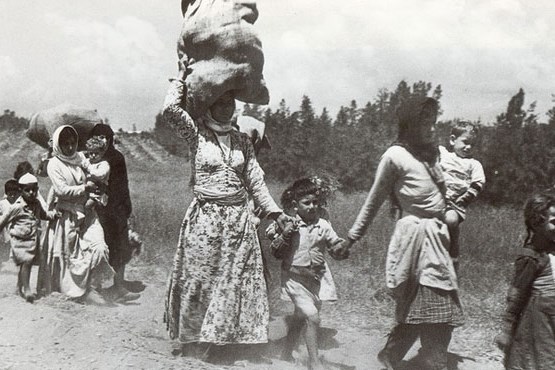
Palestinians on Saturday marked the 68th anniversary of the massacre of more than 100 Palestinians civilians carried out by Zionist paramilitary groups in the village of Deir Yassin in 1948 prior to the establishment of Israel.
Deir Yassin has long been a symbol of Israeli violence for Palestinians because of the particularly gruesome nature of the slaughter, which targeted men, women, children, and the elderly in the small village west of Jerusalem.
The number of victims is generally believed to be around 107, though figures given at the time reached up to 254, out of a village that numbered around 600 at the time.
The Deir Yassin massacre was led by the Irgun group, whose head was future Israeli Prime Minister Menachem Begin, with support from other paramilitary groups Haganah and Lehi whose primary aim was to push Palestinians out through force.
Records of the massacre describe Palestinian homes blown up with residents inside, and families shot down as they attempted to flee.
The massacre came in spite of Deir Yassin resident’s efforts to maintain positive relations with new Jewish neighbors, including the signing of pact that was approved by Haganah, a main Zionist paramilitary organization during the British Mandate of Palestine.
An Israeli psychiatric hospital now lies on the ruins of Deir Yassin, the remainder of which was reportedly bulldozed in the 1980s to make way for Jewish housing and incorporated as a neighborhood of Jerusalem. Streets of the neighborhood hold names of Irgun militiamen who carried out the massacre.
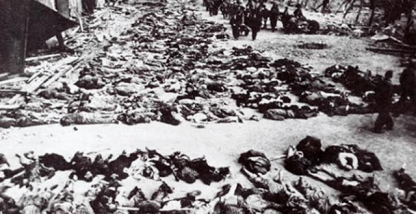
The massacre was one of the first in what would become a long line of attacks on countless Palestinian villages, part of a broader strategy called Plan Dalet by Zionist groups to strike fear into local Palestinians in hopes that the ensuing terror would lead to an Arab exodus, to ensure only Jews were left in the “Jewish state.”
Thus the attack on Deir Yassin took place a month before the UN Partition Plan was expected to be carried out, and was part of reasons later given by neighboring Arab states for their intervention in Palestine.
The combination of forced expulsion and flight that the massacres — what would later become known among Palestinians as the Nakba, or catastrophe — precipitated left around 750,000 Palestinians as refugees abroad. Today their descendants number more than five million, and their right to return to Palestine is a central political demand.
The anniversary of the deadly razing of the village comes as modern day Palestinians in occupied East Jerusalem and the West Bank continue to fight for their livelihood in the face of illegal Israeli settlement expansion, widespread detention campaigns, extrajudicial executions by Israeli forces, and a surge in housing demolitions — most recently leaving 124 Palestinians homeless in a single day.
Featured Video
Iran’s Next Strike May Not Explode. It Could Shut You Down
or go to
Aletho News Archives – Video-Images
Book Review
New paperback: Butchered by “Healthcare”
Lies are Unbekoming | October 20, 2026
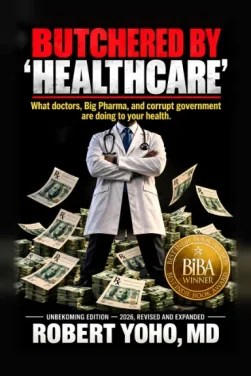 Butchered by “Healthcare” is Robert Yoho’s plain-spoken account of how American medicine stopped being a profession and became an industry. 341 pages. Over a thousand references. Thirty-eight chapters.
“Screening Tests Are Useless”, on tests that find diseases that would never have hurt you. “The FDA Protects the Big Drug Companies”, on an agency funded by the companies it regulates. “The Journals’ Sins Are the Editors’ Sins”, on ghostwritten studies and captured peer review. “Opioids and ‘Pain Management’”, on how a generation was prescribed its way into addiction. “Prozac and Relatives” and “Antipsychotics Are Disastrous”, on what psychiatry does to adults and children. “Surgery: Money Before Patients”. “Failed Cancer Treatments”. “Futile CPR and Overprescribing”. “Billing Scams & Specialty Warfare”. “Hospitals Are Sharks”. Each with a Patient Tips section at the end on how to survive it.
If you have ever walked out of a doctor’s office with a prescription you didn’t ask for, or watched a parent put through a treatment that made them worse, this is the book you want on your shelf before the next appointment. … Full review
Butchered by “Healthcare” is available on Lulu now.
Blog Roll
 Aletho News
- Iran’s Next Strike May Not Explode. It Could Shut You Down /Col Doug Macgregor
- Iran: US political targets legitimate if assassinations return
- Iraq shuts key border crossing with Iran under US pressure: Report
- Undersea Internet cables could be targeted in retaliation for attacks on Iran: IRGC deputy chief
- EU sending ‘biased’ observers to interfere in Serbian election – president
- White House envoy declares kinetic action against Yemen ‘fruitless’
- Ukraine deployed thousands of microdrones in Iraqi Kurdistan: Tasnim
- Iran calls for emergency UNSC meeting over Trump’s ‘brazen’ bomb talk, Israeli threats
- Iranian sources reveal details of Russia-China Hormuz proposal
- Plan for more US-Israel integration puts our military tech at risk
- If Americans Knew
- Americans at National Conservatism Conference held in Israel this year criticize Israel
- Christiane Amanpour exits CNN with a legacy shaped by the debate over Israel
- Israel’s war on Iran is the final move in a decades-old strategy
- Israel Denies Entry to French Journalist, U.S. Researcher Amid Rise in Entry Denials
- Gaza’s hospitals are running out of life-saving fuel – Daily Update
- Mysterious bot accounts reportedly spread fake ‘man on the street’ videos for Michigan Senate candidate
- Israeli Defense Minister Katz Says Over 60 Lebanon Villages Have Been Destroyed
- Why Is Israel Running TV Ads in Iowa Ahead of the Midterms?
- Hind Rajab’s Alleged Killer Is in the United States. HRF Demands His Arrest.
- US Officials Face Fresh Pressure After Another American ‘Brutalized’ by Israeli Settlers in West Bank
- No Tricks Zone
- E-Cars Reduce CO2 Emissions By Only 41% Compared To Internal Combustion Engine Vehicles
- Predictions Made By Renowned Climate Professor Over Past Decades Have Been Proven To Be Poor
- New Study Suggests Large Regions Of The Pacific Ocean Have Been Cooling For The Last 80 Years
- Germany’s Green Energy Debacle: High Energy Costs Force Kahla Porzellan to Close After 182 Years!
- New Study: 50 Years Of The Most Aggressive ‘Net Zero’ Policies Can Only Affect The Global Climate By 0.03°C
- US September “Heat” Was No Record…Many Records Set Decades Ago
- Latest European Green Energy Debacle; Portugal’s Largest Flagship Solar Park Insolvent!
- Green Energy Debacle: German Expert Professor Fritz Vahrenholt Warns Of Severe Economic And Social Consequences
- Two More Paleo Reconstructions Affirm Meters-Higher Sea Levels Across Ireland, Brazil 7000-6000 Years Ago
- New Study: Earth And Venus Surface Warmth Largely Explained By Convection And Lapse Rate, Not CO2 Or Radiation

