By Sherwood Ross | Aletho News | December 24, 2014
President Obama’s “gift” to Americans this holiday season is to renege on his 2009 pledge “to seek the peace and security of a world without nuclear weapons.”
He is upgrading the lethality level of an atomic arsenal already so deadly it can destroy all life on Earth. Then he’ll send Mr. and Mrs. America the bill, estimated by one Federal study at $1-trillion, to pay for the deadly upgrades he wants, rather than the peaceful improvements Americans need.
“The stated goal of the program is to increase the ‘reliability’ of US nuclear forces,” writes Theodore Postol in the Dec. 29 issue of The Nation. “But a close analysis reveals a technically sophisticated effort to ready US nuclear forces for a direct confrontation with Russia.”
Author Postol, a former adviser to the Chief of Naval Operations, slams this modernization as “a reckless policy that directly undermines our safety and national security.”
He writes, “No rational actor would take steps to start a nuclear war. But the modernization effort significantly increases the chances of an accident during an unpredicted, and unpredictable crisis—one that could escalate beyond anyone’s capacity to imagine.”
Why, Postol wants to know, does the White House aim to overhaul “the entire US nuclear-weapons arsenal, with a particular focus on improving the fusing systems and accuracy of long-range land- and sea-based ballistic-missile warheads and on increasing the killing power of other nuclear warheads.”
And, he says, the scale and character of these weapons’ effects are so large and so deadly that any notion of using them in a controlled or limited way “is completely disconnected from reality.” Postol’s article is appropriately titled, “Striving for Armageddon: How the Obama Administration Learned to Stop Worrying and Love the Bomb.”
Today’s nuclear bombs are vastly more deadly than those the U.S. used to scourge Japan at the end of World War Two. But Postol writes that improving the reliability of fuses on the ballistic-missile warheads disguises the fact the fuses “have been modified to increase the killing power of the warheads.”
What’s more, “Painstaking efforts have also gone into improving their delivery accuracy” and when the results of these combined activities are summarized for Russian political leaders, “it is not hard to understand their alarm.” Postol asserts that it is the U.S. that has pushed the Russians to a higher state of alert.
He reminds, “There is a long history of accidents during the Cold War that brought the United States treacherously close to disaster.” In one major false alert, a training tape loaded into a computer “made it appear to US launch officers that a full-scale Soviet attack was under way.”
And he believes the Russians have good reason to be worried. “With a fully modernized arsenal, the formerly ‘less capable’ nuclear warheads will be able to destroy Russian silo-based ICBMs with confidence. This would free up higher-yield nuclear warheads for other war-fighting tasks, enabling the US military to inflict greater damage on Russian command centers, fixed military facilities and civilian industrial infrastructures.”
Despite Mr. Obama’s recognition that peace depends on nuclear disarmament, Postol says, “the US is making those nightmare scenarios more likely by rebuilding the stockpile of atomic warheads as if they were just another form of conventional weapon.” They aren’t.
When Russia was communist and occupying much of Eastern Europe, U.S. leaders claimed they had to be armed to the teeth. Now that the Russians have scrapped the failed Bolshevik system, have become largely capitalist, and have withdrawn from Eastern Europe, President Obama is ratcheting up the same old tensions. Only now the game he is playing is much more dangerous than ever.
Sherwood Ross, a national public relations consultant from Miami, formerly worked for wire services, major dailies and civil rights organizations. He is both an award-winning journalist and award-winning poet. Reach him at sherwoodross10@gmail.com
“GAO says FBI’s investigation of anthrax attacks was flawed”:
“The FBI used flawed scientific methods to investigate the 2001 anthrax attacks that killed five people and sickened 17 others, federal auditors said Friday in a report sure to fuel skepticism over the FBI’s conclusion that Army biodefense researcher Bruce Ivins was the sole perpetrator.”
Yes, having absolutely no evidence would ‘be sure to fuel skepticism’ over the frame-up of Ivins.
Footnote:
“Ivins died in July 2008 of an apparently intentional Tylenol overdose as the Justice Department prepared to indict him.”
Steven Hatfill was the first patsy the FBI picked, and when he fought back too successfully, they settled on Ivins, whose personal weaknesses made it too difficult for him to challenge the lies. As we’ve seen with the recent FBI blame on North Korea for the Sony hacking case, the FBI is nothing more than a lie factory.
From the same time period (fall of 2001), a possible murder that many have wondered about:
Graeme MacQueen’s new book, The 2001 Anthrax Deception, reveals stunning links between the 9/11 attacks and the anthrax attacks that immediately followed. The book also reviews some of the interesting actions taken by alleged hijacker leader, Mohamed Atta, in the years preceding 9/11. These actions suggest that Atta was trying to leave the people he encountered with memories that would support the official myth. In the few years before JFK’s assassination, Lee Harvey Oswald engaged in similar attention-seeking actions. Considering this leads to the discovery that Oswald and Atta had a lot in common.
The legend of Mohamed Atta describes a man who seemed to be everywhere at once. In just the two years before 9/11, Atta reportedly lived and/or plotted in Germany, The Netherlands, The Philippines, Czechoslovakia, Afghanistan (via Turkey and Pakistan), Oklahoma, Las Vegas, Spain, and numerous locations in Florida. Oswald also traveled extensively in the years before the JFK assassination—back and forth from California to Japan, to New Orleans, Dallas, and Fort Worth, to Mexico City, and to Minsk and Moscow.
Atta was involved in many notable events in a short period before 9/11. Among other things, he annoyed airport employees, was bitten by a dog, consumed alcohol and cocaine, lived with an exotic dancer, and killed a cat and her litter of kittens. He got pulled over for driving without a license, got drunk and swore at a waiter, and abandoned a plane on the runway. In some of these cases Atta interacted with police and the risk for police interactions was there in almost every case.
Some of Atta’s reported actions suggest that he was trying to leave clues. One such incident, occurring around April of 2000, involved his attempt to seek a U.S. government loan to help him purchase and modify a crop dusting plane for large-scale chemical use. In his one-hour encounter with Johnell Bryant, a federal employee from whom he was seeking the loan, Atta talked about security at the World Trade Center and buildings in Washington. He went on to talk about his connection to Al Qaeda and his admiration for Osama bin Laden. The most vivid memory Bryant had of Atta was his extremely dilated pupils—a symptom of drug abuse.
In his interaction with Bryant, Atta made a big deal about a picture of Washington D.C. in her office. Bryant said that Atta acted like he wanted that picture very badly. Johnell said that Atta’s “emotions kept going up and down, up and down” and he became agitated when she would not sell him the picture or give him the $650,000 loan to buy the plane and equip it with the large chemical tank. To emphasize his displeasure and heighten the experience, Atta suggested that he might cut her throat. Those are certainly not the actions of someone trying to keep a highly secret terrorist plot from being discovered.
Atta’s antics continued until the day before 9/11, when he made an inexplicable last-minute trip to Portland, Maine, leaving with only 75 minutes to catch the flight that he allegedly had carefully planned to hijack in Boston. He conveniently left the most incriminating evidence possible in his luggage.
Like Atta, Lee Harvey Oswald was busy making himself visible before he allegedly assassinated the President of the United States. His activities in that regard are described well in James Douglass’ book, JFK and the Unspeakable. In fact, reports about Oswald suggest that, like Atta, he was too busy to have been only one person. Whoever it was, the person posing as Oswald made a number of attempts to draw attention his way.
Oswald’s strange behavior in the summer of 1963 provided evidence that he was trying to be noticed. In New Orleans, he engaged in pro-Castro activities by pretending to be the head of the local chapter of the Fair Play for Cuba Committee—but he was its only member. This appears to have been a superficial attempt to support what would become the official line that communists were behind the JFK assassination.
Oswald went to Mexico City in the fall of 1963. During this visit he allegedly made phone calls and visits to both the Cuban and Soviet embassies. He is also reported to have written a letter to a known KGB agent who specialized in assassinations. The CIA monitored such communications closely and it is interesting to consider that 9/11 investigation leader Porter Goss was a CIA operative in Mexico City that same year. In any case, whether true or not, Oswald’s reported actions there indicate that he was working to provide a more recent history for himself as a communist operative or supporter.
Another such incident occurred in the last week of September 1963, when strangers visited Silvia Odio, a 26-year-old Cuban immigrant, in her Dallas apartment. They told Silvia that they were members of an anti-Castro group that her parents were involved in. Sylvia was suspicious, but the visitors said they had come to introduce her to an American named Leon Oswald, who accompanied them. A couple of days later, Sylvia got a phone call from one of them who asked, “What do you think of the American? He’s great but kinda nuts. He told us we don’t have any guts, you Cubans, because President Kennedy should have been assassinated right after the Bay of Pigs.”
Sylvia was disturbed by the visit and the call, and she wrote to her father in prison who wrote back that he knew none of the visitors. When Sylvia heard of President Kennedy’s assassination on the radio—before any mention of Oswald had been made—she was convinced that “Leon Oswald” did it and she reported it to authorities. The FBI interviewed Sylvia in December 1963. Although her testimony was not included in the Warren Report, the incident was clearly meant to connect Oswald to the assassination plot.
Apart from their world travels and attempts to be noticed, Atta and Oswald had other important things in common. For one, both of them appeared to be above the law. That is, they both committed crimes and yet they were not held accountable.
There are reasons to believe that Oswald might have been subjected to CIA mind-control experiments using LSD in the late 1950s. In any case, in 1959 he defected to the Soviet Union. At the U.S. Embassy in Moscow, he reportedly told officials that he planned to give radar secrets to the Soviets. That, of course, would have been treason. Oswald lived in the Soviet Union for three years and married a young Russian woman. In June 1962, he was not only allowed to return to the United States, the U.S. government loaned him money to return, never prosecuted him, and claimed to have never even debriefed him.
Although Mohamed Atta ‘s pre-9/11 crimes were not so dramatic, he enjoyed the same unbelievable luck with regard to lack of prosecution or interrogation. In 1995, Atta was investigated by German authorities for drug-related offenses yet was never charged. There is evidence that Atta continued to use drugs, as was suspected of Oswald. Atta’s stripper girlfriend, Amanda Keller, said that he “had massive supplies of cocaine” which he restocked whenever needed at one of the flight schools he frequented in Florida. Keller said that during the time she dated him, she saw Atta do cocaine on multiple occasions.
Atta should have also been wanted for abandoning a stalled aircraft on a busy runway at Miami International Airport, in December 2000. Although the Federal Aviation Administration threatened to investigate the matter and hold him accountable, the whole thing was mysteriously dropped.
Three months before 9/11, a warrant was issued for Atta’s arrest in Florida. Having been stopped earlier by Florida police and cited for not having a driver’s license, the warrant was issued because Atta failed to show up at court for the hearing. Yet not only was he not arrested, Atta spent the next few months flying all over the U.S. using his real name without being stopped or questioned. He was pulled over again in July—this time for speeding—in Delray Beach, Florida. Instead of being arrested on the outstanding warrant (supposedly still not entered in the computer system more than a month later,) Atta was simply given a warning.
If the Delray Beach police had checked his immigration status, they would have found that Atta’s visa had expired—another crime. A month after that, Atta’s rental car was queried by police in Broward County, Florida. The existing arrest warrant still did not generate interest, despite the fact that Atta had rented the car in his own name. When Atta bought his flight ticket for 9/11, the outstanding arrest warrant was still in effect and his visa had been expired for over two months. It turned out that violating visa regulations was common for many of the alleged hijackers, yet it never caused them problems.
People have often wondered if Oswald was a CIA employee. Whether or not that was true, or can be proven, several of Oswald’s associates were CIA employees. For example, Oswald’s “best friend” in Dallas, George DeMohrenschild, admitted that he was connected to the Dallas office of the CIA. Another close friend of Oswald and his wife was Ruth Paine, in whose house much of the incriminating evidence was found. Paine’s sister worked for the CIA and Oswald’s wife later said that Paine was sympathizing (or associated) with the CIA.
Similarly, Mohamed Atta had associations with people linked to the CIA. For example, Luai Sakra, an informant for the CIA, was reportedly in contact with Atta before 9/11. Sakra’s lawyer later said that his client admitted to helping the alleged hijackers. Moreover, it is known that the CIA made efforts to recruit another of Atta’s friends. This was Mamoun Darkazanli, who along with Atta was a member of the Hamburg Al-Qaeda cell.
By early 2000, Atta was under CIA surveillance. At the time, he began contacting flight schools in the United States. This included communicating with and visiting airports in Oklahoma. Those activities led Atta to the same locations as persons of 9/11 interest such as University of Oklahoma president David Boren and Stratesec CEO Wirt D. Walker, whose company provided security for facilities related to 9/11.
The man who trained Zacarias Moussaoui, the sole person convicted of crimes related to 9/11, now occupies the same airport hangar as Walker’s companies did in the years before and after 9/11. Coincidentally, while Atta and Marwan Alshehhi were learning to fly at Huffmann Aviation in Venice, Florida, “A CIA front company called Air Caribe was also operating out of the very same hangar at Venice airport.” The southwest Florida area near Venice, where Atta and the alleged hijackers spent so much time, was home to a long history of CIA and drug trafficking operations.
Lee Harvey Oswald and Mohamed Atta had much in common. They both traveled extensively in the time leading up to their respective crimes and both sought attention in ways that would implicate them in those crimes. They were both suspected of using illicit drugs. They both seemed to be protected by authorities when they might have been prosecuted before accomplishing their tasks, and they were both associated with CIA-linked entities. Officially the biggest difference between them is that one was part of a conspiracy and one was not, but the evidence indicates that they were both operating within wider deceptions controlled by powerful people.
President Barack Obama announced on December 17th that the United States would begin normalizing relations with Cuba. Both governments agreed to a prisoner swap: Cuba released imprisoned USAID contractor Alan Gross and a US intelligence operative, while the United States released three Cuban intelligence agents arrested in the 1990s while spying on militant Cuban exile groups. The countries will begin talks with the goal of opening embassies, Obama will ease travel and financial restrictions for American citizens, and Cuba will release a group of detainees that the US has designated political prisoners. The US trade embargo remains in place, and requires Congressional action to repeal.
“U.S. to Restore Full Relations With Cuba, Erasing a Last Trace of Cold War Hostility,” the New York Times proclaimed. The notion that the US embargo is a Cold War relic that has outlived its usefulness has long been a common assertion among American critics of Cuba policy. Democratic Senators, the editor ofThe Nation, progressive NGOs, and even Forbescolumnists and the Cato Institute have framed the conflict in these terms.
US-Cuban relations have undoubtedly been shaped by the Cold War, but the narrative of Cold War conflict between the two countries is a historically dubious rendering, obfuscating a long record of US intervention in Cuba and the rest of Latin America.
The United States immediately recognized Fidel Castro’s revolutionary government when it took power in January 1959. We all know that the amity didn’t last long, but US telling often misconstrues how the United States and Cuba became enemies.
In May 1959, Castro unveiled the revolution’s land reform program, which called for breaking up holdings larger than 1,000 acres and distributing them to small farmers. It also specified that only Cubans would be allowed to own land, and promised compensation for confiscated territory.
In an era of worldwide land reform this was hardly radical, but US officials perceived the move as a threat to the vast property owned by American companies in Cuba. According to historian Richard Gott, a June 1959 meeting of the National Security Council concluded that Castro couldn’t be allowed to stay in power. By October, the CIA had drafted a program that “authorized us to support elements in Cuba opposed to the Castro government, while making Castro’s downfall seem to be the result of his own mistakes.” The Eisenhower administration began plotting with Cuban exiles in Florida.
Cuba had no diplomatic relations with the Soviet Union at this point, and wouldn’t until May 1960. In July 1960, hoping to deal an economic blow to the Cuban Revolution, Eisenhower declined to purchase 700,000 tons of Cuban sugar. The Soviet Union offered to buy it. In August, Cuba nationalized all American property on the island; the US embargo began in November.
US-Cuban relations declined further, to put it mildly, when US-trained Cuban exiles invaded the Bay of Pigs in 1961. In 1962, Castro asked the USSR for support that would guarantee that any US attack “would mean a war not only with Cuba.” According to Gott’s telling, he envisioned a military defense pact; the Soviets suggested nuclear missiles. The decision was made that summer, and the world narrowly avoided nuclear war in October.
In the United States, events like the Bay of Pigs invasion are typically portrayed as reactions to Cuban instigation, but the chronology belies this framing. In fact, the causality runs in almost exactly the opposite direction: US hostility wasn’t a response to Cuba’s Communist ties; Cuba’s Communist ties were a response to US hostility.
That hostility didn’t start in 1959, either. In his book “Cuba in the American Imagination,” historian Louis A. Pérez Jr. argues that from the early years of US history, American leaders saw themselves as the rightful stewards of Cuban territory, and their understandings of Cuba formed an ethos that has shaped policy toward the island ever since. Pérez quotes US Secretary of State John Quincy Adams, who in 1823 called Cuba a “natural appendage” of the United States. Adams went on to claim:
There are laws of political as well as of physical gravitation; and if an apple, severed by the tempest from its native tree, cannot choose but fall to the ground, Cuba, forcibly disjoined from its own unnatural connexion with Spain, and incapable of self-support, can gravitate only towards the North American Union, which, by the same law of nature, cannot cast her off from its bosom.
The US saw its chance to bring that apple to its bosom during the war for Cuban independence in 1898, when Cuban rebels were beginning to gain the upper hand against Spanish troops. The United States declared war on Spain and quickly crushed the fading colonial power. The emerging superpower then claimed Cuba for itself, forcing the infamous Platt Amendment into Cuba’s new constitution. The law gave the US the right to intervene militarily in Cuban affairs, control the nation’s finances, and approve or veto its treaties with other countries.
In 1906, the Chicago Tribune wrote, “The possession of Cuba has been the dream of American statesmen ever since our government was organized. […] We have as righteous a claim to it as the people who are now occupying it.” Leonard Wood, the general who governed the island under US occupation, said that the United States “must always control the destinies of Cuba.”
And for a while, it did. By 1923, American troops had been dispatched on three separate occasions to quell rebellions. Havana became a haven for American mob bosses and a Vegas-like den of sin for American tourists. A former ambassador to Cuba told Congress in 1960 that “The United States, until the advent of Castro, was so overwhelmingly influential in Cuba that … the American Ambassador was the second most important man in Cuba; sometimes even more important than the President.”
Castro and his revolutionaries considered themselves responsible for ending the humiliation of such a hollow independence. The land reform that so riled the United States seemed a fitting way to start making Cuban sovereignty real. According to Pérez, as Castro began to introduce other redistributive policies, American officials were mystified, incapable of understanding the Cuban leader’s public grievances about US neocolonialism. How could they have understood? Pérez writes:
Americans rarely engaged the Cuban reality on its own terms or as a condition possessed of an internal logic, or Cubans as a people possessed of an interior history or as a nation possessed of an inner-directed destiny. It has always been thus between the United States and Cuba.
The “Cold War” rhetoric obscures this long history of domination and frustrated independence. (It also underhandedly implies that the pain inflicted upon the Cuban people—by US invasion, support for counterrevolutionary insurgents, and the continuing trade embargo—was permissible in a Cold War context.)
More importantly, the Cold War framing ignores the fact that we’ve never needed the Cold War to justify overthrowing governments, in Cuba or elsewhere. We’re doing fine without it: Our government has at least tacitly supported coups in Venezuela in 2002, Haiti in 2004, and Honduras in 2009.
It remains to be seen exactly how Obama’s announcement this week will impact the long fight between US and Cuba. Is Obama conceding defeat in the long effort to dismantle the Cuban Revolution though, or merely searching for more effective means? One Cuba expert on Democracy Now! on Thursday speculated whether the President is “buying into the idea if we flood more money into Cuba, maybe we’ll be able to subvert the fundamental values of the revolution.” US officials have also said that USAID “democracy promotion” efforts to undermine the Cuban government will continue. But even as the two nations remain rivals, Obama’s normalization of relations might finally be an acknowledgement of that “inner-directed destiny” that we have denied Cubans for so long.
Chris Lewis is a freelance journalist based in Michigan. He studied at the University of Havana as an exchange student.
In the clearest indication of the growing dangers threatening Al-Aqsa Mosque, in an opinion piece published on Saturday, Haaretz discussed a group of rabbis who met to discuss the scheme for the establishment of the Third Temple on the ruins of the mosque. The newspaper published a photograph of a number of rabbis and engineers studying a map of Al-Aqsa Mosque.In a piece written by Professor Ronnie Ellenblum entitled “Bells are ringing for the ultra-Orthodox and Secular” [hebrew], the paper discussed the future of Al-Aqsa Mosque which Jews refer to as the Temple Mount.
Although the paper did not identify the rabbis who appeared in the picture, one of them has been identified as Rabbi Yisrael Ariel, president of the Temple Institute, a religious authority that is considered the most enthusiastic about destroying Al-Aqsa Mosque and establishing a temple on its ruins.
The research also involved Rabbi Yehuda Etzion, who was responsible for implementing the Hebron University massacre which left 15 students dead or wounded, and was also responsible for implementing three assassination attempts against elected mayors in the West Bank, one of which injured the then Mayor of Nablus Bassam Shakaa, leaving him permanently disabled.
Israeli Prime Minister Benjamin Netanyahu had pledged to the king of Jordan not to take any steps that would change the status quo at Al-Aqsa Mosque.
Miri Regev, MK for the Likud party led by Netanyahu, announced that she will not allow the continuation of the status quo Al-Aqsa, stressing that the next Knesset will issue a number of laws that will promote Jewish sovereignty over it.
Israeli Channel 10 quoted Regev saying on Thursday that the consecration of Jewish sovereignty in Al-Aqsa Mosque is the most important embodiment of the political, religious and cultural sovereignty of “the Jewish people on their land”.
The channel noted that this view is supported by the ministers of economy and housing, Naftali Bennett and Uri Ariel, Chairman of the Foreign Affairs and Defence Committee Ze’ev Elkin, the head of the coalition bloc in parliament, Danny Levin.
A cell phone video, pulled off of Ismaaiyl Brinsley’s Facebook page prior to it being deactivated, showed an interaction between law enforcement and Brinsley taken a little over a year ago.
In the video an officer claims the dog signaled for drugs on Brinsley’s bag. But there was nothing remarkable that could be pinpointed as the dog even signaling. After the officer claimed the dog signaled, Brinsley refused to let him search his bag.
“The dog is indicating on your bag here. So that gives us probable cause to search the bag.”
Brinsley questions the officer as to the dog having not signaled on his bag saying,
“He didn’t bark or anything.”
To which the officer responds,
“Have you been to dog K-9 training school? If you haven’t been you probably don’t know how my dog indicates.”
Brinsley replies,
“You brought the dog over here twice. It left the first time after it sniffed the bag you brought it back over.”
The officer confirms he brought the dog over twice, then tells Brinsley,
“Listen sir. I’m asking you a simple question would you like to do it on the bus or go outside.”
The officer then attempts to force Brinsley to quit filming the encounter, telling him,
“While I’m doing that and conducting police business your not gonna film me so you can turn your camera off.
Brinsley then tell the cop,
“This is public,”
referring to the established right to film an officer engaged in the carrying out of his official duties, to which the cop responds,
“No sir not while I’m conducting a police investigation.”
The cop can then be seen forcing him to quit filming the encounter, claiming illegally that he must stop.
Perhaps this gives even a slight glimpse of insight into the mindset of the killer as recent events have transpired.
Jay Syrmopoulos is an investigative journalist, freethinker, researcher, and ardent opponent of authoritarianism. He is currently a graduate student at University of Denver pursuing a masters in Global Affairs. Jay’s work has previously been published on BenSwann.com and WeAreChange.org. You can follow him on Twitter @sirmetropolis, on Facebook at Sir Metropolis and now on tsu.
Ernesto “Che” Guevara, Minister of Industries of Cuba, addresses the General Assembly on Dec. 11, 1964. UN Photo/TC
UNITED NATIONS, – When the politically-charismatic Ernesto Che Guevera, once second-in-command to Cuban leader Fidel Castro, was at the United Nations to address the General Assembly sessions back in 1964, the U.N. headquarters came under attack – literally.
The speech by the Argentine-born Marxist revolutionary was momentarily drowned by the sound of an explosion.
The anti-Castro forces in the United States, backed by the Central Intelligence Agency (CIA), had mounted an insidious campaign to stop Che Guevera from speaking.
A 3.5-inch bazooka was fired at the 39-storey glass house by the East River while a CIA-inspired anti-Castro, anti-Che Guevara vociferous demonstration was taking place outside the U.N. building on New York’s First Avenue and 42nd street.
But the rocket launcher – which was apparently not as sophisticated as today’s shoulder-fired missiles and rocket-propelled grenades – missed its target, rattled windows, and fell into the river about 200 yards from the building.
One newspaper report described it as “one of the wildest episodes since the United Nations moved into its East River headquarters in 1952.”
With the United States resuming full diplomatic relations with Cuba on Wednesday – after a 53-year hiatus – will there be a significant change in its attitude towards the politically-ostracised Caribbean nation in the world body?
The United States has routinely led or co-sponsored scores of U.N. resolutions critical of human rights violations in Cuba and consistently voted against every single General Assembly resolution calling on Washington to lift the economic embargo on Havana imposed in 1960.
At the last General Assembly vote in October 2014, an overwhelming majority – 188 out of 193 members – voted to end the embargo, for the 23rd consecutive year.
As in most previous years, the only two countries to vote against the resolution were the United States and Israel.
And three other countries that have traditionally voted with the United States – Palau, Micronesia and the Marshall Islands – abstained on the vote this year.
After the vote, and as if anticipating a change in the political horizon, Cuban Foreign Minister Bruno Rodriguez invited the United States to establish “mutually respectful relations.”
“We can try to find a solution to our differences through respectful diplomacy. We can live and deal with each other in a civilised way despite our difference,” he added.
Asked about the historic U.S.-Cuba agreement, U.N. Secretary-General Ban Ki-moon said he had been informed in advance of the announcement by the U.S. government.
“This news is very positive. And I’d like to thank President Barack Obama of the United States and Cuban President Raul Castro for taking this very important step towards normalising relations,” Ban said.
“As much of the membership of the United Nations has repeatedly emphasised, through General Assembly resolutions during the last many, many years, it is time Cuba and the United States normalise their bilateral relations,” Ban told reporters Wednesday.
“The United Nations stands ready to help both countries to cultivate their good neighbourly relations,” he declared.
As longtime U.N. staffers would recall, the failed 1964 attack on the U.N. building took place when Che Guevera launched a blistering attack on U.S. foreign policy and denounced a proposed de-nuclearisation pact for the Western hemisphere, as he addressed delegates.
It was one of the first known politically motivated terrorist attacks on the United Nations.
After his Assembly speech, Che Guevera was asked about the attack aimed at him. “The explosion has given the whole thing more flavour,” he joked, as he chomped on his Cuban cigar.
When he was told by a reporter that the New York City police had nabbed a woman, described as an anti-Castro Cuban exile, who had pulled out a hunting knife and jumped over the wall, intending to kill him, Che Guevera said: “It is better to be killed by a woman with a knife than by a man with a gun.”
Before dawn on December 20, 1989, U.S. forces descended on Panama City and unleashed one of the most violent, destructive terror attacks of the century. U.S. soldiers killed more people than were killed on 9/11. They systematically burned apartment buildings and shot people indiscriminately in the streets. Dead bodies were piled on top of each other; many were burned before identification. The aggression was condemned internationally, but the message was clear: the United States military was free to do whatever it wanted, whenever it wanted, and they would not be bound by ethics or laws.
The invasion and ensuing occupation produced gruesome scenes: “People burning to death in the incinerated dwellings, leaping from windows, running in panic through the streets, cut down in cross fire, crushed by tanks, human fragments everywhere,” writes William Blum. [1]
Years later the New York Times interviewed a survivor of the invasion, Sayira Marín, whose “hands still tremble” when she remembers the destruction of her neighborhood.
“I take pills to calm down,” Marín told the paper. “It has gotten worse in recent days. There are nights when I jump out of bed screaming. Sometimes I have dreams of murder. Ugly things.”
In the spring of 1989, a wave of revolutions had swept across the Eastern bloc. In November, the Berlin Wall fell. The Cold War was over. No country was even a fraction as powerful as the United States. Rather than ushering in an era of peace and demilitarization, U.S. military planners intensified their expansion of global hegemony. They were pathological about preventing any rival to their complete military and economic domination.
U.S. government officials needed to put the world on notice. At the same time, President George H.W. Bush’s needed to shed his image as a “wimp.” So they did what any schoolyard bully would: pick out the smallest, weakest target you can find and beat him to a bloody pulp. The victim is irrelevant; the point is the impression you make on the people around you.
Panama was an easy target because the U.S. already had a large military force in 18 bases around the country. Until 1979, the occupied Panama Canal Zone had been sovereign territory of the United States. The Panama Canal was scheduled to be turned over to Panama partially in 1990 and fully in 2000. The U.S. military would be able to crush a hapless opponent and ensure control over a vital strategic asset.
Washington began disseminating propaganda about “human rights abuses” and drug trafficking by President Manuel Noriega. Most of the allegations were true, and they had all been willingly supported by the U.S. government while Noriega was a CIA asset receiving more than $100,000 per year. But when Noriega was less than enthusiastic about helping the CIA and their terrorist Contra army wage war against the civilian population in Nicaragua, things changed.
“It’s all quite predictable, as study after study shows,” Noam Chomsky writes. “A brutal tyrant crosses the line from admirable friend to ‘villain’ and ‘scum’ when he commits the crime of independence.”
Some of the worst human rights abuses in the world from the early 1960s to 1980s did originate in Panama – from the U.S. instructors and training manuals at the U.S.’s infamous School of the Americas (nicknamed the School of the Assassins), located in Panama until 1984. It was at the SOA where the U.S. military trained the murderers of the six Jesuit scholars and many other members of dictatorships, death squads and paramilitary forces from all over Latin America.
The documentary The Panama Deception demonstrates how the media uncritically adopted U.S. government propaganda, echoing accusations of human rights violations and drug trafficking while ignoring international law and the prohibition against the use of force in the UN Charter. The Academy Award-winning film exposed what the corporate media refused to: the lies and distortions, the hypocrisy, the dead bodies, the survivors’ harrowing tales, and the complete impunity of the U.S. military to suppress the truth.
The propaganda started with the concoction of a pretext for the invasion. The U.S. military had been sending aggressive patrols into the Panama City streets, trying to elicit a response.
“Provocations against the Panamanian people by United States military troops were very frequent in Panama,” said Sabrina Virgo, National Labor Organizer, who was in Panama before the invasion. She said the provocations were intended “to create an international incident… have United States troops just hassle the Panamanian people until an incident resulted. And from that incident the United States could then say they were going into Panama for the protection of American life, which is exactly what happened. [2]
After a group of Marines on patrol ran a roadblock and were fired on by Panamanian troops, one U.S. soldier was killed. The group, nicknamed the “Hard Chargers,” was known for their provocative actions against Panamanian troops. Four days later, the invasion began. [3]
Targeting Civilians and Journalists
Elizabeth Montgomery, narrating The Panama Deception, says: “It soon became clear that the objectives were not limited only to military targets. According to witnesses, many of the surrounding residential neighborhoods were deliberately attacked and destroyed.” [4]
Witnesses recounted U.S. soldiers setting residential buildings on fire. Video footage shows the charred remains of rows of housing complexes in El Chorillo, one of the city’s poorest neighborhoods.
“The North Americans began burning down El Chorillo at about 6:30 in the morning. They would throw a small device into a house and it would catch on fire,” recounted an anonymous witness in the film. “They would burn a house, and then move to another and begin the process all over again. They burned from one street to the next. They coordinated the burning through walkie-talkies.” [5]
People were crushed by tanks, captured Panamanians were executed on the street, and bodies were piled together and burned. Survivors were reportedly hired to fill mass graves for $6 per body.
Spanish photographer Juantxu Rodríguez of El País was shot and killed by an American soldier. Journalist Maruja Torres recounted the incident in the Spanish newspaper the next day.
“’Get back!’ the U.S. soldier yelled from his painted face brandishing his weapon. We identified ourselves as journalists, guests at the Marriot,” she wrote. “’We just want to pick up our things.’ He didn’t pay attention. The hotel, like all of them, had been taken over by U.S. troops. Those young marines were on the verge of hysteria. There was not a single Panamanian around, just defenseless journalists. Juantxu ran out running toward the hotel taking photos, the rest of us took shelter behind the cars. Juantxu didn’t return.”
While the professed aim of the operation was to capture Noriega, there is ample evidence that destroying the Panamanian Defense Forces and terrifying the local population into submission were at least equally important goals.
American officials had been told the precise location of Noriega three hours after the operation began – before the killing in El Chorillo – by a European diplomat. The diplomat told the Los Angeles Times he was “100% certain” of Noriega’s location “but when I called, SouthCom (the U.S. Southern military command) said it had other priorities.”
No one knows the exact number of people who were killed during the invasion of Panama. The best estimates are at least 2,000 to 3,000 Panamanians, but this may be a conservative figure, according to a Central American Human Rights Commission (COEDHUCA) report.
The report stated that “most of these deaths could have been prevented had the US troops taken appropriate measures to ensure the lives of civilians and had obeyed the international legal norms of warfare.”
The CODEHUCA report documented massively “disproportionate use of military force,” “indiscriminate and intentional attacks against civilians” and destruction of poor, densely-populated neighborhoods such as El Chorillo and San Miguelito. This gratuitous, systematic violence could not conceivably be connected to the professed military mission.
When asked at a news conference whether it was worth sending people to die (Americans, of course, not thousands of Panamanians) to capture Noriega, President George H.W. Bush replied: “Every human life is precious. And yet I have to answer, yes, it has been worth it.”
‘Flagrant Violation of International Law’
Several days later, the United Nations Security Council passed a resolution condemning the invasion. But the United States – joined by allies Great Britain and France – vetoed it. American and European officials argued the invasion was justified and should be praised for removing Noriega from power. Other countries saw a dangerous precedent.
“The Soviet Union and third world council members argued that the invasion must be condemned because it breaks the ban on the use of force set down in the United Nations Charter,” wrote the New York Times.
After this, on December 29, the General Assembly voted 75 to 20 with 40 abstentions in a resolution calling the intervention in Panama a “flagrant violation of international law and of the independence, sovereignty and territorial integrity of the States.”
The Organization of American States passed a similar resolution by a margin of 20-1. In explaining the U.S.’s lone vote against the measure, a State Department spokesperson said: “We are disappointed that the OAS missed a historic opportunity to get beyond its traditional narrow concern over ‘nonintervention.’”
In the ensuing occupation, CODEHUCA claimed that “the US has not respected fundamental legal and human rights” in Panama. The violations occurred on a “massive scale” and included “illegal detentions of citizens, unconstitutional property searches, illegal lay-offs of public and private employees, and … tight control of the Panamanian media.”
Despite the international outrage, Bush enjoyed a political boost from the aggression. His poll numbers shot to record highs not seen “since Presidents Kennedy and Dwight D. Eisenhower.” The President had authorized crimes against the peace and war crimes. Rather than being held accountable, he benefitted. So did the Pentagon and defense contractors who desperately needed a new raison d’ etre after the fall of Communism.
No longer able to use the fear-mongering Cold War rationales it had for the last 40 years, Washington found a new propaganda tool to justify its aggressive military interventions and occupations. Washington was able to appropriate human rights language to create the contradictory, fictional notion of “humanitarian intervention.”
“Washington was desperate for new ideological weapons to justify – both at home and abroad – its global strategies,” writes James Peck. “A new humanitarian ethos legitimizing massive interventions – including war – emerged in the 1990s only after Washington had been pushing such an approach for some time.” [6]
The stage was set for the even more horrific invasion of Iraq the following summer. Operation Gothic Serpent in Somalia, the NATO bombing of Serbia, Iraq (again), and the Bush and Obama interventions in Afghanistan, Iraq (a third time), Pakistan, Libya, Somalia (again), Yemen, Iraq (a fourth time) and Syria would follow.
The invasion of Panama caused unthinkable devastation to the people of Panama. Because of the U.S. military’s obstruction, the full extent of the death and destruction will never be known. The damage done to the legitimacy of international law compounded the devastation exponentially.
Indisputably, the U.S. invasion was aggression against a sovereign nation. Aggressive war was defined in the Nuremberg Trials as the “supreme international crime,” different from other crimes (like genocide or terrorism) in that it contains “the accumulated evil of the whole.” People convicted of waging aggressive war were sentenced to death by hanging.
Twenty five years later, the man who ordered the invasion of Panama, George H.W. Bush, enjoys a luxurious retirement at his Houston and Kennebunkport estates. He is considered by mainstream U.S. pundits to be a foreign policy moderate.
Works Cited
[1] Blum, William. Killing Hope: U.S. Military and C.I.A. Interventions Since World War II – Updated Through 2003. Common Courage Press, 2008.
It has been more than three months since Israel halted its latest massacre in the Gaza Strip. The destruction wrought by Israel’s onslaught was nothing short of apocalyptic. “The destruction which I have seen coming here is beyond description”, said the UN Secretary General during his visit to Gaza. In a similar vein, the president of the International Committee of the Red Cross, Peter Maurer, stated, “I’ve never seen such massive destruction ever before.”
While many of the world’s crimes remain unknown and unacknowledged, the systematic and deliberate nature of Israel’s atrocities against the Palestinians are both carefully documented and, by now, starting to enter the mainstream. Although the lofty rhetoric of the Israel Defense Force would have it that its most important mission is “saving human lives, both Israeli and Palestinian”, the human rights record and military doctrine of the Israeli army are too well-established for such slogans to be taken seriously.
According to UN figures, 2,192 Palestinians, including 1,523 civilians and 519 children, were killed during this summer’s operation. By the time the ceasefire was announced, there were “110,000 internally displaced persons living in emergency shelter and with host families. The UN estimated that about 18,000 housing units were destroyed or rendered uninhabitable, leaving approximately 108,000 people homeless. A further 37,650 housing units were damaged.”
There is little doubt about the reason for this colossal death and destruction. The UN fact finding mission, headed by Richard Goldstone, concluded, that the Israeli offensive in 2008-2009 (Cast Lead) was “a deliberately disproportionate attack designed to punish, humiliate and terrorize a civilian population”. According to the mission, Israel’s military doctrine involved the “application of disproportionate force and the causing of great damage and destruction to civilian property and infrastructure, and suffering to civilian populations.”
Significantly, the mission placed primary responsibility for the commission of these crimes, not on the individual soldiers that carried them out, but instead, on the political and military leadership of Israel. And as Israel, yet again in July-August 2014, in Operation Protective Edge, wielded its sledgehammer on the civilian population of Gaza, there’s no doubt that the mission’s conclusion is applicable this time around as well.
Indeed, UN Human Rights Chief Navi Pillay condemned Israel for its, as she put it, apparently deliberate violations of international law. Pillay referred to the findings of the previous UN mission of inquiry and noted, that “[t]he same pattern of attacks is occurring now on homes, schools, hospitals, UN premises.”
Although the death and destruction has ended for now, similar crimes are likely to continue, unless Israel’s impunity is properly challenged. As the Goldstone report noted, referring to crimes on both sides, “long-standing impunity has been a key factor in the perpetuation of violence in the region and in the reoccurrence of violations, as well as in the erosion of confidence among Palestinians and many Israelis concerning prospects for justice and a peaceful solution to the conflict”.
With an abundance of evidence of Israeli war crimes, the issue of criminal accountability for the Israeli leadership comes down to the political will of the international community to enforce the law.
Universal jurisdiction – a path towards accountability?
The prospects for the prosecution of Israel’s leadership in the International Criminal Court (ICC), however, appear bleak. The US is likely to veto any UN Security Council action on the matter. In addition, the Palestinian Authority is under pressure from the US and its allies not to invoke the jurisdiction of the ICC in order to prosecute crimes committed on Palestinian territory. The ICC’s prosecutor’s office has also been pressured not to open the case. However, even if the ICC fails to act, this need not be a nail in the coffin for efforts to pursue war crimes charges against the Israeli political and military leadership.
Many individual states have adopted the principle of universal jurisdiction and thus enabled their national courts to investigate and prosecute persons suspected of committing serious crimes regardless of their nationality, or where the crime was committed. This means that national authorities can step in to prosecute serious human rights violations anywhere in the world.
There are important precedents of how universal jurisdiction has been put into practice in the past. One of the major cases was against Chile’s former dictator Augusto Pinochet (1915-2006). In October 1998, a Spanish judge, Baltazar Garsón, issued an international arrest warrant for Pinochet for his responsibility for human rights violations during his years in office. Within a week, Pinochet was arrested in London.
In 2008, ten years after the indictment of Pinochet, a case against Alfredo Cristiani, the former president of El Salvador, and members of his military, was brought before a Spanish court. They were charged with the murder of six priests and human rights workers, their housekeeper and her daughter in El Salvador in 1989. The assassinations were carried out by the Atlacatl Battalion, a US-trained elite unit of the Salvadoran army.
Eventually, 20 Salvadoran soldiers were indicted for the murders.
There are other cases, including charges of genocide against Guatemalan strongman Rios Montt – also a US-ally, who president Ronald Reagan commended as “a man of great personal integrity and commitment”, and who, Reagan assured, wants to “improve the quality of life for all Guatemalans and to promote social justice.” Montt’s commitment to social justice was on display when his security and paramilitary forces slaughtered 166,000 Maya indians during the country’s 36-year-long civil war.
Israel has not remained immune from this practice either. In 2009, an arrest warrant for Israel’s former foreign minister Tzipi Livni was issued in London. Livni was acting foreign minister during Cast Lead in which Israeli forces killed roughly 1,400 Palestinians, including more than 400 children.
During Cast Lead, Livni boasted, that “Israel demonstrated real hooliganism during the course of the recent operation, which I demanded”. She also praised the army for “going wild” in Gaza. The British authorities, however, obstructed her arrest by granting her diplomatic immunity during her visit to the UK in 2011.
As Israel, during this summer, for the third time in five years, committed a massacre in Gaza, prompting worldwide condemnation, and with public opinion in Europe critical of Israel’s actions, it’s time for EU member states to heed the recommendation of the Goldstone report, and open “criminal investigations in national courts, using universal jurisdiction, where there is sufficient evidence of the commission of grave breaches of the Geneva Conventions of 1949. Where so warranted following investigation, alleged perpetrators should be arrested and prosecuted in accordance with internationally recognized standards of justice.”
We, the leadership of the Islamic Resistance Movement Hamas, welcome the decision of the General Court of the European Union to remove Hamas from the European Union’s terrorist list and we consider this to be a step in the right direction and a means of making right a position that was wrong. This past position was not based on objective facts. In addition to this, it was in violation of and contradictory to international law as well as legal and humanitarian norms that guarantee the right of nations to resist occupation. It would be in the European Union’s best interest to align itself with international law and with legal and humanitarian norms and to refrain from violating these laws under the misguided pressure of Israel and its exploitation of the international community.
In this regard I urge the leaders and governments in the EU states to accept and cooperate with the decision of the Court and to take measures to make a brave political decision to remove Hamas from the European Union’s terrorist list in coordination with the Court’s decision and with the values of justice and law, as well as out of respect of the people’s will and their rights. I also urge the leaders and governments in EU states to avoid stalling or wasting time by taking measures or making appeals attempting to circumvent international law and objective facts.
I also hope that all international forces, including the United States, take the initiative and right the wrong that has been made in the past, which, as everyone knows, is a result of Israeli pressure and not a result of the facts on the ground.
I would like to remind everyone that throughout its long history since its inception 27 years ago, Hamas has, and continues to confine its legitimate resistance and struggle to Palestine and exercises this against the Israeli occupation. This is a natural right for the movement and for all nations under foreign occupation and it is in accordance with our religious and international laws, just as the other nations in the East and the West resisted their occupying forces.
We believe that this step by the General Court of the European Union, along with the initiatives made last week by a number of EU states and the Swedish government to recognise a Palestinian state and the rights of the Palestinian people, are all considered important steps that must be followed through in the context of setting the record straight and making the historical mistake against the Palestinian people right again.
The Palestinian people, as well as other people who have suffered and continue to suffer from unjust occupation, are looking forward to the day, in the near future, when the international community and the global superpowers will call things by their true name and explicitly expose the true terrorist forces, countries, and parties that exercise real terrorism against humanity. Such parties work together to commit acts of terrorism in its ugliest forms, in the name of the state, before the eyes and ears of the world without any accountability or deterrence, starting with Israeli terrorism.
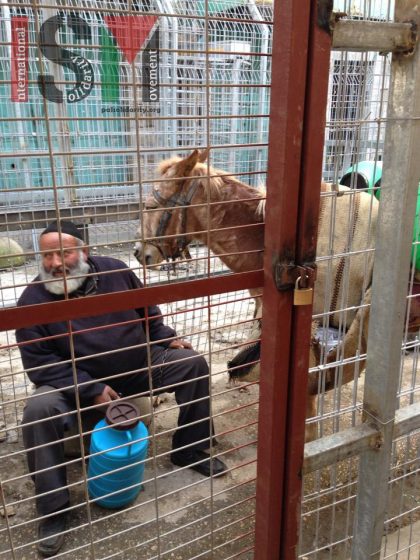
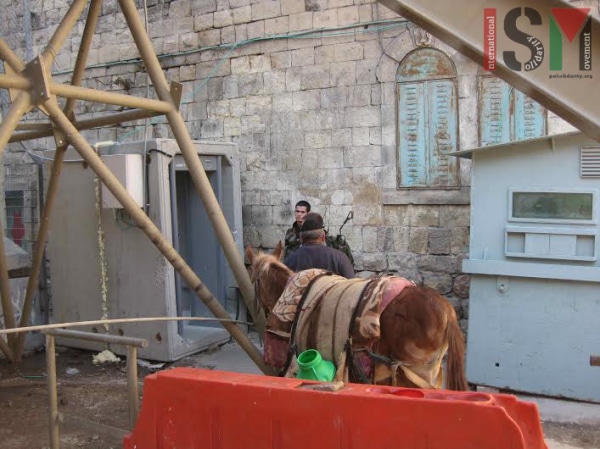
Hebron, Occupied Palestine – Mohammad Saleh, a sixty-six-year-old Palestinian resident of Tel Rumeida, al-Khalil (Hebron), waited with his mule outside Shuhada checkpoint for nine hours over the course of two days. He spent four hours waiting before being allowed through on Monday (15/12/14) evening.
He then spent five hours Tuesday (16/12/14) attempting to cross in the opposite direction before eventually turning back, after being denied repeatedly by Israeli forces claiming that donkeys, mules, horses, and carts are not permitted to pass through the checkpoint.
Shuhada checkpoint serves as the only clear passage between the H2 (Israeli-controlled) neighbourhood of Tel Rumeida and the H1 (Palestinian Authority-administered) neighbourhood of Bab Al-Zawiye, a route many Palestinians must traverse regularly in the course of their work and daily routines.
Mohammad arrived at the Bab Al-Zawiye side of the checkpoint at 13:40 on Mondayafternoon, his mule laden with empty milk jugs and saddlebags packed with various provisions. Israeli forces refused to let him through, claiming no animals were allowed past the checkpoint – a claim no one, including other international organisations at the scene as well as the Palestinian District Coordination Office for al-Khalil, had ever heard before.
Mohammad explained that he had been allowed pass the checkpoint on Monday morning, with the promise that he would be let back through later in the day. When he returned, he found a new shift of soldiers and no one willing let him pass. The soldier manning the checkpoint claimed he needed permission from his commander to open the gate, which would allow Mohammad to pass with his mule.
An ISM volunteer at the scene later received a call explaining that the Israeli military’s new rule stated that horses, donkeys and mules were not permitted to pass through the checkpoint. No one, however, was able to explain why Mohammad had been allowed through that morning, but denied on his way home. “Look at my ID,” he told the soldier at one point, “I’m in your computer. I go through here all the time.”
He stayed waiting, sitting beside his mule on the cold concrete base of the fence, even as the afternoon turned into evening. The sky grew dark, though the lights from the checkpoint still illuminated the fences,
turnstiles, and barbed wire. Even the soldier seemed concerned, telling him to please go home, as it was cold and late and staying would not help him. But Mohammad had already made it clear he would not leave. About ten minutes later the soldier finally opened the gate, saying it was the “last time” that he would be allowed through. Although Mohammad heard the soldier’s message, it was clear he would not heed it. He intended to continue to resist, no matter what anyone told him.
Sure enough, the following morning he was once again standing outside the checkpoint, this time on the Tel Rumeida side, with full milk jugs tied to the back of his patient mule. The soldiers presented multiple reasons from denying him passage, from a prohibition on taking anything through the checkpoint too large to be carried through the turnstile, to the new rule against allowing donkeys, horses and mules through. ISM volunteers attempted to find a solution, offering to carry the milk jugs around the checkpoint and meet Mohammad and his mule on the other side. The Israeli soldiers manning the checkpoint rejected all suggestions.
“Is the donkey the problem or the milk the problem?” One ISM activist eventually inquired.
“The donkey’s the problem,” a soldier replied.
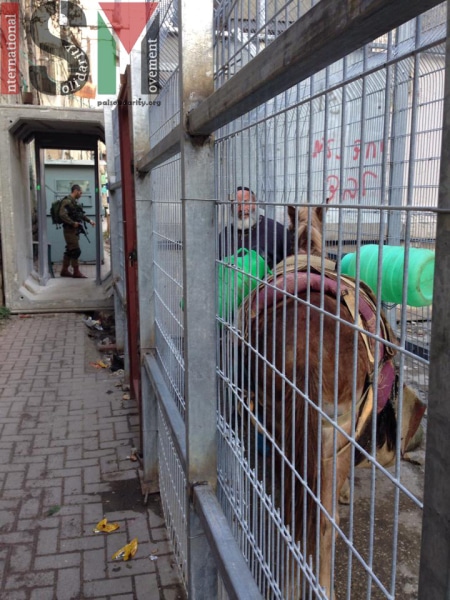
The animal could have easily passed through the metal detector; only last night ISM activists had witnessed the ludicrous sight of Mohammad’s mule strolling through the concrete structure, empty milk jugs banging against the corners of the gateway. The turnstile served as the only obstacle to the his passage – an obstacle the soldier could easily remove by opening the gate on the other side of the metal detector and letting the mule pass around the turnstile and into Bab Al-Zawiye.
After five hours of waiting, Mohammad’s comment seemed by far the most accurate. “The soldiers are the problem,” he had responded in Arabic.
Barring donkeys, mules, and horses and carts is only the latest in a string of frustrating, humiliating regulations imposed on the people living near the checkpoint, who must pass through to work, study, and shop for essentials such as fresh food. Just a few days earlier a group of elderly Palestinians, ill people, young children, and teachers at a local school had also been forced to wait, some for up to three hours, before being allowed through.
When Israeli forces shut down the checkpoint after it was burnt nearly a month ago , barring most people from passing through for over three weeks, the Palestinians were forced to adapt. Local people know ways around the checkpoint; several paths lead through local families’ yards and over the walls and rubble between Tel Rumeida and Bab Al-Zawiye. These “rabbit runs,” however, are entirely unsuited to traveling through with a mule – as well as for anyone sick, elderly, or carrying large heavy objects.
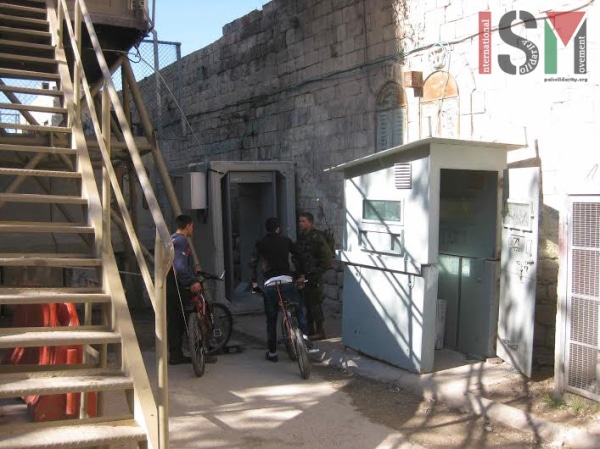
Since the attempted burning of the checkpoint, the Israeli military rebuilt it larger and with more obstacles for anyone traveling through. One side now has a metal detector, and both sides are equipped with vertical metal turnstiles which are a major impediment to anyone trying to move through with large baggage. Soldiers continue to use the burning of the checkpoint to justify collective punishment imposed on the entire Palestinian population – young and old, men and women, healthy and ill – who live or work near the Shuhada checkpoint.
Any Palestinian might be stopped while attempting pass through. Even with the checkpoint officially open, far too many are. Soldiers regularly search bags and make people remove their belts and empty their pockets before being allowed through. These everyday humiliations accompany frequent ID checks and detentions, serving as an inescapable reminder of the illegal Israeli occupation. Soldiers present at checkpoints routinely cite newly imposed rules and orders from superior officers as reasons for denying people passage, but whether someone passes easily through a checkpoint or must wait for hours often seems to be determined by nothing more than the soldiers’ caprice.
Many Palestinians must pass through Shuhada checkpoint multiple times in a day, carrying items as diverse as fresh vegetables, tubs of oil, and gas for cooking and heating their homes. During the hours ISM volunteers stood waiting with Mohammed, they witnessed multiple people struggle with the cumbersome design of the rebuilt checkpoint. One woman was carrying too many grocery bags to be able to fit into the turnstile. Someone on the other side of the turnstile had to reach a hand between the metal bars and move one bag through, returning it to the woman once she had passed. Another Palestinian, this time a young boy, needed the help of multiple passers-by over several minutes to figure out how to get two tubs of oil and a metal trolley through the turnstiles. Soldiers denied passage outright to boys who wanted to walk through the checkpoint with their bicycles.
At one point on Monday night, a group of off-duty soldiers ran up Shuhada street and stopped near the checkpoint to rest, stretching and laughing, their easy freedom of movement a stark contrast to experiences of Palestinians struggling through Shuhada checkpoint. Almost all of Shuhada street has been closed off to Palestinians, reserved instead for the settlers and soldiers occupying H2. Even Palestinians who manage to get through the checkpoint must pursue long, circuitous routes between the surrounding areas of al-Khalil. Many, especially the elderly or disabled, are effectively barred from traveling to significant portions of the city their families have lived in for generations.
“I want to resist,” Mohammad told the ISM activists the first day they waited with him. He made sure the man translating said it twice, to make sure the ISM volunteers understood. “I want to resist,” he said, after over three long hours of waiting to be allowed through.
By Tim Kirby | Strategic Culture Foundation | November 14, 2026
Did Vladimir Putin just wake up one day on the wrong side of the bed and decide to invade Ukraine in February of 2022 or is there a lot more to this single decision that has been reshaping the 21st century geopolitical landscape?
Obviously, from the way that I just posed the question you can see that I am on the side that views the causes for the war in Ukraine to be very deep, long-term, historical and consciously nefarious, and most importantly, not from within the halls of the Kremlin. So it was a pleasure to take a look at the book “Boiling Point, How America Brought War to Ukraine” by author Stephen Kinzer, who like myself, also believes that the real reasons behind military conflicts around the world are not what CNN and the BBC have been telling you. The main thesis of this book was stated clearly by its creator; the war “may have been illegal, but it was definitely not unprovoked.” … continue
This site is provided as a research and reference tool. Although we make every reasonable effort to ensure that the information and data provided at this site are useful, accurate, and current, we cannot guarantee that the information and data provided here will be error-free. By using this site, you assume all responsibility for and risk arising from your use of and reliance upon the contents of this site.
This site and the information available through it do not, and are not intended to constitute legal advice. Should you require legal advice, you should consult your own attorney.
Nothing within this site or linked to by this site constitutes investment advice or medical advice.
Materials accessible from or added to this site by third parties, such as comments posted, are strictly the responsibility of the third party who added such materials or made them accessible and we neither endorse nor undertake to control, monitor, edit or assume responsibility for any such third-party material.
The posting of stories, commentaries, reports, documents and links (embedded or otherwise) on this site does not in any way, shape or form, implied or otherwise, necessarily express or suggest endorsement or support of any of such posted material or parts therein.
The word “alleged” is deemed to occur before the word “fraud.” Since the rule of law still applies. To peasants, at least.
Fair Use
This site contains copyrighted material the use of which has not always been specifically authorized by the copyright owner. We are making such material available in our efforts to advance understanding of environmental, political, human rights, economic, democracy, scientific, and social justice issues, etc. We believe this constitutes a ‘fair use’ of any such copyrighted material as provided for in section 107 of the US Copyright Law. In accordance with Title 17 U.S.C. Section 107, the material on this site is distributed without profit to those who have expressed a prior interest in receiving the included information for research and educational purposes. For more info go to: http://www.law.cornell.edu/uscode/17/107.shtml. If you wish to use copyrighted material from this site for purposes of your own that go beyond ‘fair use’, you must obtain permission from the copyright owner.
DMCA Contact
This is information for anyone that wishes to challenge our “fair use” of copyrighted material.
If you are a legal copyright holder or a designated agent for such and you believe that content residing on or accessible through our website infringes a copyright and falls outside the boundaries of “Fair Use”, please send a notice of infringement by contacting atheonews@gmail.com.
We will respond and take necessary action immediately.
If notice is given of an alleged copyright violation we will act expeditiously to remove or disable access to the material(s) in question.
All 3rd party material posted on this website is copyright the respective owners / authors. Aletho News makes no claim of copyright on such material.



 Aletho News

