Chávez in The Americas: Increasing Autonomy in Latin America and the Caribbean
By Stephanie Pearce, NACLA
This article originally appeared in the Summer 2013 edition “Chavismo After Chávez: What Was Created? What Remains?”
Countries in the “developing world” have, since the end of formal colonialism, seen their ability to act autonomously systematically constrained by a variety of factors. These include, but are not limited to, macroeconomic policy conditions attached to World Bank and IMF loans, poor terms of trade with the Global North, lack of effective agency in international organizations, and the actions of multinational corporations operating in their territory.
Venezuela’s regionally oriented foreign policy during the Chávez era counteracted each of these dynamics, and in doing so opened up autonomous policy space for other states in Latin America and the Caribbean. The concrete achievements of a number of mechanisms, including counter-trading and credit provision within the PetroCaribe framework, and the recent establishment of a virtual regional currency, the SUCRE, all played a part in this process.
The first crucial action undertaken by Hugo Chávez as Venezuelan President in protecting regional economies was to vociferously oppose the proposed Free Trade Area of the Americas (FTAA) at the third summit of the Americas, held in Quebec in 2000. The proposal represented the perfect consolidation of U.S. economic power, and was designed, in the words of General Colin Powell, to “guarantee control for North American businesses…over the entire hemisphere.”1 After Chávez voiced concerns, the Mercosur countries followed suit, stopping the FTAA conclusively at the subsequent Mar del Plata summit in 2005. If the FTAA had gone ahead, it would have resulted in the substantial economic subordination of Latin America to U.S. corporate interests. Agricultural sectors in particular would have suffered from an influx of low-cost subsidized U.S. products. In addition, areas of the public sphere that had previously avoided commoditization or privatization would have been fair game for trans-national corporations. Under the FTAA, Amanothep Zambrano, ALBA Executive Secretary, told me last August that states would not have been able to “lead any aspect of economic policy, and therefore their political capacity to solve social problems” would have been heavily constrained.
Their shared opposition to these proposals encouraged Cuba and Venezuela to form an alternative regional integration framework, the Bolivarian Alliance for the Peoples of Our America (ALBA) in 2004. This quickly matured from a bilateral socio-centric cooperation agreement to a nascent regional bloc, or alliance, with the addition of Bolivia in 2006. Bolivia’s newly elected president, Evo Morales, brought with him the idea of a “Peoples Trade Treaty” (TCP), which extended the ALBA’s self-identified principles of solidarity, complementarity between economies, and respect for sovereignty, into a 23-point agreement that systematically opposed the tenets of orthodox free trade agreements. The TCP opened the possibility of pursuing economic policies outside of the market fundamentalist approach of the neoliberal era, for example by stating that people’s right to access healthcare should be prioritized above protecting pharmaceuticals’ corporate profitability. In the following three years, membership of the ALBA-TCP grew to nine countries encompassing much of Central and South America as well as the Caribbean.
During this time, the Venezuelan government also constructed PetroCaribe, a framework designed to facilitate the supply of its oil products to neighboring Caribbean states under preferential conditions, which at the time of writing had 18 members. Through these two channels the Venezuelan government has opened up autonomous policy space in the region, to some extent overcoming the constraints identified above. Venezuela has, largely through ALBA and PetroCaribe, become an important source of funding in the region. Oil supply agreements, signed between Venezuela and several members of both frameworks, permit countries to defer payment on set portions of their oil bill and use the capital obtained for government spending. Crucially this capital is obtained without the macroeconomic conditionality and policy prescriptions associated with World Bank or IMF loans. PetroCaribe agreements, for example, state that “member nations of the group are allowed to defer payment of 60% of their oil bills to Venezuela for 25 years, at 1% interest, in addition to a 90-day grace period on all payments, and a two year initial grace period on the credit facility.”2
This credit facility offers an alternative to IFI loans, while maintaining small Caribbean nations’ ability for autonomous decision making, which is considered critical in the post-colonial context. Specifically, credit provision has enabled Jamaica and Antigua to delay recourse to IMF loans, and put them in a better negotiating position so, I was told in August 2011 by Norman Girvan, former Secretary General of the Association of Caribbean States, “they were able to make an easier deal.” Venezuela, under the current administration, has also purchased billions of dollars’ worth of bonds issued by the Argentine government, enabling the country’s early exit from all of its IMF debts and associated policy prescriptions.
As a result of this mechanism, PetroCaribe funding to the Caribbean now exceeds both EU and U.S. aid by a wide margin, with only remittances from the Caribbean diaspora exceeding it in funding to the signatory states.3 For Dominica, Venezuela is now the “single largest creditor…surpassing traditional sources of credit such as regional development banks and the IMF.” Venezuela is owed 27.7% of the country’s total debt, which grew 12.6% in 2011 alone, to $8.8 billion.4 Such figures inevitably raise concerns that the agreement is increasing debt levels in the region and developing dependence on Venezuelan largesse. Barbados’s Prime Minister, Owen Arthur, has stated that his country would not join because he “would not permit the present generation of Barbadians to consume oil now to be paid for by succeeding generations of Barbadians.”5 However, the deferred portion of the bill does not constitute debt in the orthodox sense, as it is kept by the Caribbean partners and can be spent as capital towards any project deemed socio-productive, or saved to accrue interest to offset the bill, as has been the case in Guyana. The domestic opposition sees the PetroCaribe scheme as Chávez “giving away” oil irresponsibly. However, the amount is relatively small and sustainable. Supply to PetroCaribe members, including Cuba, peaked in 2009 at an average of 196.4 thousand barrels daily, which constituted only 7% of total Venezuelan oil exports that year, and operates under market prices in accordance with Venezuela’s OPEC membership.6
Due to a high level of dependence on imports, Venezuela has also been uniquely able to position itself as a regional alternative to North American and European markets. This dynamic has, again, been apparent within both ALBA-TCP and PetroCaribe. In 2008, the PetroCaribe framework was augmented with a “compensatory exchange mechanism” via which oil bills from Venezuela could be offset by the export of domestically produced goods and services. The Venezuelan market is particularly important for Caribbean countries who suffer from poor terms of trade with the North due to dependence on primary commodity exports, the continued use of tariff and non-tariff barriers by developed nations, and the erosion of colonial trade preferences. For example, up to 90% of Guyanese rice exports per annum were going to EU countries when, in 2000, the Overseas Territories (OCT) loophole was closed, resulting, I was told by the Guyanese Ambassador to Venezuela, in a “50-60%” drop in prices. When the compensation mechanism was announced, the then-president of Guyana, Jagdeo Bharrat, actively sought a better deal with Venezuela through the PetroCaribe framework. The resultant export of both rice and unprocessed paddy has seen Venezuela become the single largest importer of Guyanese rice, replacing Portugal.7
In the case of ALBA countries, a strategic reorientation towards intra-regional trade, and particularly export to Venezuela, has reduced dependence on the United States and subsequently its ability to constrain autonomous action. For example, when Bolivia expelled the U.S. ambassador in 2008 following his alleged involvement in separatist actions in the Santa Cruz Department, Washington retaliated by excluding Bolivia from the Andean Trade Promotion and Drug Eradication Agreement (ATPDEA). Bolivia lost its U.S. tariff advantages, which was a particularly painful blow to its textile industry. Chávez immediately offered them a market under “the same or better conditions” that Bolivia had enjoyed with the United States. As a result, says the Bolivian Ambassador to Venezuela, in 2010 Venezuela “imported almost 50 million dollars in textiles alone, or nearly double that which [Bolivia] used to export to the USA” annually.
The purchase agreement was supported by initiatives by both governments to facilitate small and medium sized businesses’ entry into the regional market. A fund was established in the Bank of ALBA to provide short-term interest-free credit to Venezuelan importers in order to purchase Bolivian textiles, paired with a fund in the Bolivian national development bank to provide small textile producers credit to purchase raw materials. This agreement therefore not only minimized the impact that U.S. market sanctions could have over autonomous decision making by the Bolivian government, but also created direct relations between regional producers and consumers.
These patterns are part of a wider renewed focus on South-South trade, both within the region and with extra-hemispheric partners. However, the United States remains the region’s single most important trading partner. The objective is not to be “anti-American,” rather to reduce the U.S. ability to exert controlling influence over its Latin American and Caribbean neighbors by creating alternatives to the dollar in international trade. One way in which this was achieved was through the PetroCaribe mechanism and similar counter-purchase agreements with other regional allies. As direct non-market transactions, they circumvented the use of the dollar, thereby avoiding its automatic privileging in international trade, and avoiding the transaction costs associated with its use.
This concept was extended by the ALBA’s virtual common currency, the Unified Regional System for Economic Compensation (SUCRE). The SUCRE is essentially a series of clearing accounts between Cuba, Bolivia, Venezuela, and Ecuador that allow the countries to trade freely without transaction costs. Accounts are balanced every six months with one hard currency transfer. The value of trade conducted via the SUCRE in its first year of operations, 2010, was just over $8 million. It grew exponentially, to almost 100 times that the following year ($172,905,344).8 Though the SUCRE’s value was originally set against the dollar ($1 to XSU1.25), and it is typically used as the convertible currency to make balancing payments, in the long term the intention is to no longer use the dollar at all. The direct and deliberate countering of U.S. economic hegemony that the SUCRE represents has been of particular importance to Ecuador, whose macroeconomic policy options have been constrained by a prior administration’s decision to dollarize the economy in 2001. In fact, the mechanism was largely designed by Ecuadoran economists, and of the $170 million traded in 2011, $140 million was for Venezuelan purchases from Ecuador (mainly tuna).9
As we have seen, Chávez’s time in office saw an unequivocal reassertion of the state as economic actor throughout the region. This dynamic was particularly felt in the crucial energy sector. In Venezuela, governmental control of the state oil industry was consolidated, while both Bolivia and Argentina nationalized hydrocarbons with investment and technical assistance from Petroleos de Venezuela (PDVSA), via agreements with YPFB and Enarsa, state owned gas and oil companies in Bolivia and Argentina respectively. Even in centrist or center-right Caribbean nations, Venezuelan investment has enabled state-owned oil companies and agencies to supply oil products directly to their population, “to effectively intervene in their markets to minimize retail prices” in the energy sector which had previously been “dominated by foreign companies.”10
Where state energy companies or agencies did not exist prior to PetroCaribe, they have been formed to facilitate the direct import of oil products from PDVSA. These can take the form of joint ventures with the PDVSA subsidiary PDV Caribe. Venezuelan credit and grants have also been used to fund improvements in energy infrastructure; that is namely the capacity of the member countries to store and refine oil, and in turn to generate and distribute energy. Central to this scheme has been investment in the Cienfuegos refinery in Cuba and at the Kingston refinery which now almost exclusively refines Venezuelan crude. The refinery is run by Petrojam Ltd, a mixed state enterprise in which Jamaica Oil Company owns a 51% stake and PDV Caribe 49%. This reassertion of state control over energy resources is seen as a fundamental facet of PetroCaribe’s “new oil geopolitics…at the services of our peoples not at the service of imperialism and big capital.”11
The right and power of multinationals to dictate domestic policy has been systematically undermined, both through a reassertion of the state as economic actor and in the tenets of the TCP which we briefly touched on earlier. This offers a stark contrast to the World Trade Organization’s policies such as Trade Related Intellectual Property Rights (TRIPs), which consistently privilege corporate interests, and/or offer beneficial “loopholes” for developed nations. This has been possible through the creation of new regional forums in Latin America and the Caribbean, in which members’ interests are not subordinate to those of more powerful nations. For example, in the TCP, economic asymmetries between members are recognised and therefore tariff reductions do not have to be reciprocal, disregarding the “most favored nation” principle. In addition, ALBA has no supranationality; it is best described as a framework for cooperation rather than an integration body in the orthodox sense. All programs and agreements are optional, flexible, and voluntary, thereby protecting the national autonomy of members.
Though statist in its organization, ALBA facilitates continual dialogue through presidential and ministerial summits, which have also been attended by international observers. Non-member countries are also represented in the council for social movements, whose proponents include groups such as the Brazilian Landless Workers’ Movement. ALBA proved to be the first in a series of new regional spaces, catalysed by massive rejection of the FTAA proposal—a rejection led by Chávez—and culminating in the formation of the Community of Latin American and Caribbean States (CELAC), which was put together as an alternative to the Organization of American States (OAS), and includes all the countries of the Americas except the United States and Canada. In this way, lessened economic dependence has resulted in increased diplomatic autonomy from the United States.
There are those who argue that Venezuelan projects in the region created new constraints, replaced one set of dependencies with another. But this is not the case. Though he was a catalyst for and investor in regional development, Chávez avoided constructing a position of power or privilege for Venezuela. This is evident in the lack of conditionality attached to credit mechanisms and the fact that the controlling stake of each mixed state enterprise was maintained by the partner country. Though oil wealth put Chávez in a unique position to invest in regional projects, these were not unilaterally devised or constructed; the TCP came from Bolivia, SUCRE is an Ecuadoran concept, and of course ALBA social programs were exported from Cuba. However, these ideas were made a reality by the capacity for rapid implementation that oil largesse afforded. Such apparently altruistic actions led many to question Chávez’s motives. It is important to point out that these frameworks and counter-purchase agreements have also helped reduce Venezuela’s dependence on the United States as a market and refining destination for oil. The volume of Venezuelan oil exported to the United States decreased from 1,500,000 barrels per day in 2008, to 1,166,000 bpd in 2011, a drop of 334,000 barrels per day. This can, in part, be attributed to the diversification of markets in Latin America (190 bpd to PetroCaribe, plus supply agreements with Argentina among others). This is in addition to securing crucial imports without financial outlay, specifically agricultural commodities, which are often then provided to the Venezuelan population at low cost through state owned agencies such as the supermarket chain Mercal.
***
Under the last ten years of Hugo Chávez’s Presidency, Venezuela’s foreign policies resulted in an opening up of autonomous policy space in Latin America and the Caribbean. What was begun in 2004 with the rejection of the proposed FTAA continued into the post-crisis conjuncture, when Chávez was instrumental in creating a new regional financial architecture to limit the power exerted by Washington-based IFIs. PetroCaribe credit provided funds for capital expenditure, without imposing macroeconomic conditionality. In addition, guaranteed oil supplies allowed the small and energy dependent nations that made up its membership to move beyond reactive policies and look to longer term socio-productive investment.
Venezuela’s concurrent strategy of sourcing imports from the region offered primary-commodity-dependent economies some opportunity to diversify their markets and baskets, with better terms of trade than offered by the United States or ex-colonial metropoles in Europe. Chávez also took the bite out of attempted control via market sanctions, as was clearly demonstrated in the Bolivian example.
These regional imports often took the form of non-market exchanges and counter-purchase agreements within PetroCaribe, ALBA, and beyond. Combined, they arguably represented a strategic de-linking from international trade and finance systems, specifically from the U.S. dollar. As such, these frameworks have lessened both the dependence on, and influence of, the United States in the region, protecting countries’ ability to act autonomously and not follow the dictates of Washington. Chávez effectively undermined U.S. economic power by offering alternatives to the hegemony of the dollar, with the SUCRE in particular offering a concerted challenge. Lessened economic dependence in turn allowed for greater diplomatic autonomy from Washington, demonstrated in its strategic exclusion from the newly formed CELAC. The various new regional initiatives provide space to build development strategies and devise economic policies, beyond the constraints of “market-friendly” logic. This allows for a reassertion of the state as an economic actor and service provider, within a culture of regional cooperation. Though the Venezuelan state is not operating outside of capitalism per se, from the initial rejection of the proposed Free Trade Area of the Americas in 2001 the Chávez government demonstrated that there are alternatives beyond the policy prescriptions of the neoliberal era, and what’s more, facilitated their use throughout the region to mutually beneficial ends.
1. Colin Powell cited in Katharine Ainger, “Trading Away the Americas,” New Internationalist, Issue 351, November 1, 2002, available at newint.org
2. “Venezuela: Two Countries Hold Out Against Cheap Loans and Barters,” Countertrade & Offset, 26:15 (2008)7
3. Sir Ronald Sanders, “The Chavez Effect: A life belt for the Caribbean,” Kaieteur news online, July 27, 2008, available at kaieteurnewsonline.com
4. Andrés Rojas Jiménez “Deuda dominicana con PDVSA aumentó durante 201,” El Nacional, February 16, 2012, available at elnacional.com
5. Wendell Mottley, Trinidad and Tobago’s Industrial Policy 1959-2008 Kingston. (Randle, 2008) 157.
6. This data, and all data not otherwise cited, elaborated from PDVSA annual reports, 2009-2011.
7. Guyana Rice Development Board, “Guyana Rice Development Board Annual Report 2010,” 2011.
8. Consejo Monetario Regional del SUCRE, “SUCRE Informe de Gestión 2011,” 2012.
9. Ibid
10. Curtis Williams, “Venezuela Urged to Fast-track Petrocaribe Initiative,” Oil and Gas Journal, 102 (2004):26.
11. Hugo Chávez Frías, Petrocaribe, Towards A New Order in Our America, (Colecciones Discursos, Ministerio de Poder Popular para Comunicación.)
Stephanie Pearce is a doctoral candidate at the School of Politics & International Relations, Queen Mary College, University of London. Her research focuses on the role of countertrade in Venezuela’s “Bolivarian Revolution.”
Read the rest of NACLA’s Summer 2013 issue: “Chavismo After Chávez: What Was Created? What Remains?”

Invasions of the Mind Snatchers
By Nebojsa Malic | Ron Paul Institute | February 19, 2014
 Many empires have risen and fallen over the course of recorded history. All were created by force. Yet all have tried to legitimize that force, by passing laws and seeking to establish some sort of order that would outlive their military supremacy. Some have been more successful at this than others. The Atlantic Empire, on the other hand, is the only example in history of an imperial enterprise destroying its own laws, undermining its own legitimacy in pursuit of power.
Atlantist politicians invoke “democracy” almost as a totem, a sacred idea whose veneration magically bestows legitimacy upon governments and peoples. Thus framed, the totem does not bear closer scrutiny, and even defies definition. It is whatever the Empire says it is.
In actuality, democracy is just one political decision-making process. Politics, like chess or football, is a stand-in for war, designed to ritualize conflict so as to prevent bloodshed. As long as everyone abides by the rules, and accepts the restrictions of the system, that is all fine and good. Democracy has been described as “civil war with ballots instead of bullets.” Once someone decides to cheat, or even rewrite the rules to “I win, you lose,” the ballots lose their meaning. And bullets are the only thing left.
Or are they? Though the Atlantic Empire has not hesitated to use brute force to impose its will (e.g. the 1999 “Kosovo War”), such interventions have always been risky, costly and complicated. In 1999, for example, it took 78 days for the combined might of NATO to win a negotiated armistice with the outnumbered and outgunned Yugoslavia, allowing the Empire to occupy the province of Kosovo, but not the country entire. So the Atlantists turned to other means.
A student organization, “Otpor,” was taken over and turned into a revolutionary force. With millions of dollars in US taxpayer funding, promotional materials, “training” by the National Endowment for Democracy and other government instructors in nearby Hungary, these “activists” ran a media campaign against the Yugoslav president Slobodan Milosevic.
Meanwhile, the U.S. government rounded up some 18 opposition parties, wrote their program, and handpicked the front-man for the presidential elections of September 2000: a mild-mannered translator of the Federalist Papers who was never supposed to have any actual power. That would be reserved for the real leader of the “Democratic Opposition of Serbia” (DOS), whose popular support ran in single digits.
The government was caught between “Otpor” and DOS, appealing to the citizenry not to elect foreign agents. When the results of the election showed that DOS did not win, but may have won enough votes to force a runoff, “Otpor” activists and militia personally loyal to the DOS leader started a riot, burning the ballots at the National Assembly building. When the military and the police refused to intervene, president Milosevic resigned. It later emerged that the head of Yugoslavia’s state security had been a CIA informant for almost a decade, as were several high-ranking generals.
If this scenario sounds familiar, that’s because it is. Having been successfully tested in Serbia, the model was then applied elsewhere: 2003 in Georgia (“Rose Revolution”), 2004 in Ukraine (“Orange Revolution”), 2005 in Kyrgizstan (“Tulip Revolution”) and Lebanon (“Cedar Revolution”). The “Jeans Revolution” in Belarus (2006) failed, as did the “Green Revolution” in Iran (2009) and the “White Revolution” in Russia (2012). In all cases, the supposedly popular revolt followed a pattern straight out of the playbook used in Serbia – even to the clenched-fist symbol used by the “student activists” supposedly organizing the protests.
In early 2011, a series of revolts erupted in North Africa, bearing all the hallmarks of the astroturf “color revolutions”: governments were toppled in Tunisia and Egypt. Fringe protests in Libya and Syria escalated into all-out civil war. Meanwhile, a genuine popular protest in Bahrain was crushed by force; Bahrain is a major U.S. fleet base and a client-state of Saudi Arabia.
In every case, the Western media narrative has been the same: young people everywhere demanding “democracy” and overthrowing the evil regimes oppressing them. And if there is any fault to be found in Washington on EU capitals, it is for “standing idly by” and “not helping enough.”
In mid-2011, some European filmmakers made a documentary called “The Revolution Business”, daring to notice the common thread in the supposedly spontaneous outpourings of street riots demanding democracy throughout the world. They spent a lot of time with Srdja Popovic, former Otpor leader that went on to become a professional revolutionary. Otpor having folded years ago into Serbia’s ruling Democratic Party, Popovic now runs an outfit called CANVAS (Center for Applied NonViolent Action and Strategies), lecturing all over the world and training activists in dozens of countries to replicate the Serbian coup. In that mission he is helped by an instruction booklet written by Gene Sharp, a scholar from Boston.
The tactics and techniques of the revolutionaries have been described in some detail, both in Sharp’s book and by outside observers (such as John Laughland). Suffice to say they are all about exploiting the genuine public sentiment — real discontent where it exists, manufactured where it does not — and using the tricks from their toolbox to nudge it in the desired direction.
They always target the young, known for the excess of zeal and shortage of forethought. Who doesn’t want freedom and democracy – which they envision as the hedonist lifestyle seen on American films and TV. And here are all these “consultants”, teaching them for “free”. Even those who dislike and mistrust the Empire find it hard to argue against such gifts without seeming unduly paranoid.
Between the anvil of internal rebellion and the hammer of the Imperial media and diplomatic assault, the “oppressive regime” usually loses its nerve and folds. The “good democrats” installed in power soon start ruling in the interest of the Empire, and the activists realize the “training and consultation” they received weren’t free after all. The Empire always collects its debts.
Yet the revolutionaries rarely revolt after finding out they’ve been used thus. Even if they somehow overcame the crushingly demoralizing effect of finding out they were the agents of their own subjugation, that very fact destroys their credibility at home. Having supped from the cannibal pot, they are marked forever.
Then there are some who enjoy the taste, and become willing agents of the Empire. Popovic is proud of his revolution-exporting adventures. He gladly points out that the Otpor logo — a stenciled fist — has been used by local franchises from Ukraine to Venezuela. On several occasions, the backdrop to Popovic is an Otpor poster, showing the fist and the motto, “Because I love Serbia.” It is a particularly vicious lie: in the Serbia the Empire had Otpor create, only those who hate it prosper.
Popovic does try to obscure his Imperial connections, claiming that CANVAS is an entirely private organization, funded with Serbian money. Why, then, is its name an English acronym? And where did they get the money, in a country first systematically impoverished by a decade of UN sanctions, then bombed to rubble, and finally looted by the Empire’s “democrats”? So looted, in fact, that rummaging through garbage is close to becoming a major branch of agriculture…
And that is the other thing no one dares mention about the “color revolutions”: the governments they put into power are inevitably lackeys of the Empire, imposing horrifyingly destructive policies at home. Even when the people try to vote them out, the Empire simply bribes the winning politicians into switching sides, as it has done in Serbia in 2008 and 2012. Recent events in Ukraine, following the government’s rejection of an economic suicide offer from the EU, demonstrate that the Empire has become more desperate and less scrupulous about denying reality when doing so suits its interests. The legitimately elected government in Kiev has been demonized as “abolishing democracy,” while the violent protesters – representing fringe leaders micro-managed by U.S. and German diplomats – are extolled as authentic democrats and patriots.
Tracing the pattern of astroturfed “revolutions” over the past decade and a half, one cannot help but notice that they are suffering from diminishing marginal returns. In Serbia, a threat of violence and a lot of smoke and mirrors were sufficient to topple the government that successfully defended against conventional warfare. Eleven years later in Libya, it actually took an open military intervention (“kinetic military action” in Pentagonese) to make the rebels win, while the Syrian rebels are steadily losing the war despite all the aid and propaganda in their favor.
Another pernicious consequence of CANVAS in the governments the Empire decides to dislike is that any legitimate protest against genuinely repressive governments becomes that much less likely. Having seen country after country devastated by “color revolutions”, ruining the future of millions for the sake of a handful of quislings, people around the world are that much more reluctant to take politics into the streets. And with the ballot box increasingly discredited by Empire-backed “democrats” who refused to accept democracy if and when they lose, elections may soon become discredited as well. Leaving what, exactly, as a civilized form of conflict-resolution?
The Empire claims to champion democracy, but the end result of its actions is the exact opposite. There is no world order at work here, new or otherwise. Just chaos.
Violent Protests in Venezuela Fit a Pattern
By Dan Beeton | CEPR | February 19, 2014
Venezuela’s latest round of violent protests appears to fit a pattern, and represents the tug-and-pull nature of the country’s divided opposition. Several times over the past 15 years since the late, former president Hugo Chávez took office in 1999, the political opposition has launched violent protests aimed at forcing the current president out of office. Most notably, such protests were a part of the April 2002 coup that temporarily deposed Chávez, and then accompanied the 2002/2003 oil strike. In February of 2004, a particularly radical sector of the opposition unleashed the “Guarimba”: violent riots by small groups who paralyzed much of the east of Caracas for several days with the declared goal of creating a state of chaos. As CEPR Co-Director Mark Weisbrot has explained, then – as now – the strategy is clear: a sector of the opposition seeks to overturn the results of democratic elections. An important difference this time of course is that Venezuela has its first post-Chávez president, and a key part of the opposition’s strategy overall has been to depict Nicolás Maduro as a pale imitation of his predecessor and a president ill-equipped to deal with the country’s problems (many of which are exaggerated in the Venezuelan private media, which is still largely opposition-owned, as well as the international media).
Following Maduro’s electoral victory in April last year (with much of the opposition crying “fraud” despite there being no reasonable doubts about the validity of the results), the opposition looked to the December municipal elections as a referendum on Maduro’s government, vowing to defeat governing party PSUV and allied candidates. The outcome, which left the pro-Maduro parties with a 10 point margin of victory, was a stunning defeat for the opposition, and this time they did not even bother claiming the elections were rigged. According to the opposition’s own pre-election analysis, support for Maduro had apparently grown over the months preceding the election. As we have pointed out, this may be due in part to the large reduction in poverty in 2012 and other economic and social gains that preceded the more recent economic problems.
Defeated at the polls, the anti-democratic faction of the opposition prepared for a new attempt at destabilizing the elected government, and promoted relatively small, but often violent student protests in early February. They then called for a massive protest on February 12, Venezuela’s Youth Day in the center of Caracas. The demonstrations have been accompanied by a social media campaign that has spread misinformation in an attempt to depict the Maduro administration as a violent dictatorship instead of a popular elected government. Images of police violence from other countries and past protests – some several years old – have been presented on social media as having occurred in recent days in Venezuela. A YouTube video that has been watched by almost 2 million viewers presents a one-sided portrayal of the situation and falsely states that the Venezuelan government controls all radio and television in the country, among other distortions. Similar disinformation occurred in April 2002 and in other past incidents in Venezuela, most notably when manipulated video footage was used to provide political justification for the coup d’etat.
While some in Washington foreign policy circles may attempt to portray the leaders of this new wave of protests as persecuted pro-democracy heroes, they in fact have histories of supporting anti-democratic and unconstitutional efforts to oust the government. Both Leopoldo López and Maria Corina Machado supported the 2002 coup; in López’s case he participated in it by supervising the arrest of then-Minister of Justice and the Interior Ramón Rodríguez Chacín, when López was mayor of Chacao. Police dragged Rodríguez Chacín out of the building where he had sought refuge into an angry mob, who physically attacked him. Corina Machado notably was present when the coup government of Pedro Carmona was sworn in, and signed the infamous “Carmona decree” dissolving the congress, the constitution and the Supreme Court. The Christian Science Monitor reported yesterday:
the opposition has a touchy protest history in Venezuela. Early on in former President Hugo Chavez’s administration, the opposition was consistently on the streets calling for an end to his presidency. In 2002, they organized a coup that briefly unseated the president. Though the opposition leadership is not calling for a coup, the reputation the group made for itself barely a decade ago may be haunting it as it vocally pushes back against Maduro’s administration.
Venezuela’s opposition receives funding from U.S. “democracy promotion” groups including the National Endowment for Democracy (NED) and core grantees such as the International Republican Institute (IRI) and the National Democratic Institute (NDI). The NED, which the Washington Post noted was set up to conduct activities “much of” which “[t]he CIA used to fund covertly” has made a number of grants directed at empowering youth and students in Venezuela in recent years, and USAID has also given money to IRI, NDI and other groups for Venezuela programs. These organizations have a history of destabilizing elected governments and working to unify and strengthen political opposition to left-wing parties and governments. IRI notably played a key role in destabilizing Haiti ahead of the 2004 coup there, and also has engaged in activities aimed at weakening Brazil’s governing Workers’ Party, to name a few. In Venezuela, they funded groups involved in the 2002 coup, and IRI spokespersons infamously praised the coup after it happened.
The Haiti example is instructive. The parallels are numerous: notably, a key part of the strategy was to exaggerate and fabricate killings and other human rights abuses, which were blamed on the elected government (while truly horrific atrocities committed by the armed wing of the opposition were generally ignored). Researchers – including some from the U.N. — have since debunked the most widely-circulated accounts of rights violations, but of course the democratically-elected president (Jean-Bertrand Aristide) had long since been forced from office by then.
The U.S.-funded destabilization of Haiti in the early 2000s also offers lessons as to the endgame of this strategy. As the New York Times reported and as scholars such as Peter Hallward and Jeb Sprague have documented, the IRI counseled its Haitian partners not to accept any compromises from the Aristide government (which made many concessions, including agreeing to a power-sharing arrangement), but to continue to press further.
But the Maduro government is of course in a much stronger position than Haiti’s government ten years ago. A key factor is that while Aristide was relatively isolated politically, Latin American governments, through UNASUR and MERCOSUR, have condemned the violent protests and the opposition’s calls for Maduro to leave office and have expressed support for the Venezuelan government. In this case, when the Obama administration continues to signal that it sides with the violent protests, it is an outlier in the region.
Nuclear Weapons: Hope at Last
By Jim McCluskey | Dissident Voice | February 19, 2014
The US, the UK, Russia, China and France are rebuilding or upgrading their arsenals of nuclear weapons. The other four nuclear states too are ‘improving’ their arsenals. As we discuss the statistics and strategies of ‘nuclear arsenals’ and ‘nuclear deterrence’ it can be hard to keep in mind the reality underlying the abstract discussions. The nine nuclear states have over 10,000 nuclear weapons in their stockpiles. This is enough to wipe out the entire population of the planet many times over together with all other life forms. Is this sane? Has the human race lost its senses? A single United States thermonuclear warhead, designated W88, has an estimated ‘yield’ of 475 kilotons. The ‘yield’ is the destructive power expressed in tons of TNT equivalent. The W88 is over 30 times more destructive than the bomb which wiped out Hiroshima. A single W88 could completely destroy London, Moscow or New York. Each bomb on a major city would kill millions of people; women, children, babies, old people, everyone. The suffering would be indescribable and for many would go on for months and years before death. No emergency services could begin to cope There would be no relief. What sort of people would do such a thing? What kind of human would threaten such an atrocity?
The US government has 5 nuclear submarines on patrol at all times carrying 1000 times the destructive power of the Hiroshima bomb. Is it possible to imagine the degree of paranoia represented by such a standing threat? The UK government has started to spend one hundred billion pounds on rebuilding its Trident fleet of nuclear submarines, each one with the capacity to incinerate over 40 million people. This is being done at a time when many citizens are suffering from inadequate defences against flooding and when the social services are being radically cut back.
The situation is being rendered even more insanely dangerous by the US and Russia which keep 1,800 weapons on high alert atop long-range ballistic missiles that are ready to launch 5 to 15 minutes after receiving an order!
It is ironic that the worst offenders are the five permanent members of the Security’ Council of the United Nations. They have had 69 years to get rid of their nuclear weapons while all that the citizens of the world hear from them are windy speeches around purported good intentions which never come to fruition.
Citizens of the world have simultaneously become aware that the nuclear states do not intend to get rid of their nuclear weapons and that their existence imposes a permanent and intolerable threat to us all. The existence of nuclear weapons means they could be used by accident, by misunderstanding or by malicious intent. How can we ever be sure that some deranged psychopath will not gain power in one of the nuclear states and deceive him/herself into believing that it is in their best interests to make a first strike? How can we ever be sure that some terrorist organisations will not hack into the electronic control systems and carry out the launching themselves? And we now know that even a small nuclear exchange could be a lethal threat to everyone on the planet. In a limited nuclear war between India and Pakistan 20 million people would die from the nuclear blasts, fires, and radioactive fallout. And the fallout would have global consequences that would kill millions of people, disrupt climate patterns, and threaten global agricultural collapse.
Furthermore decent people round the globe know that the existence of nuclear weapons is a brooding evil which undermines the moral integrity of humankind. As the great moral leader Desmond Tutu wrote “Nuclear weapons are an obscenity. They are the very antithesis of humanity”…
The only remedy is an enforced world ban on the existence of nuclear weapons. The other weapons of mass destruction have already been banned. It is the turn of the last and most destructive of them all.
And finally there is hope. The huge burgeoning of awareness in the citizens of the world is bearing fruit.
There are 9 nuclear states and there are 183 non-nuclear states. The security of the non-nuclear states is threatened by the irresponsible and self-focused behaviour of the 9 others. But these 9 are outnumbered by 20 to one. The non-nuclear majority which do not feel the need for a lethal ‘security’ crutch have decided to take the initiative. And rather than focus on the numbers and ‘yields’ of the weapons it was wisely decided to concentrate on the effects on humanity of the use of nuclear weapons. The next logical development, as the nuclear states continue to deny their obligations to shed their arsenals, is for the non-nuclear states to proceed independently to enact a treaty outlawing these weapons internationally. By focusing attention on the humanitarian consequences of their use they are well on their way to doing so.
The first International Conference on the Humanitarian Impact of Nuclear Weapons was held in 2013. Humanity owes a great debt to Norway for this initiative.
This ground-breaking and historic conference was attended by delegates from 127 countries and 70 nongovernmental organizations. The nuclear states were invited but declined to attend. It is not easy to face up to the implications of these arsenals especially if you bear the primary responsibility. India and Pakistan sent observers.
After hearing presentations from a wide range of experts on the various effects of nuclear weapon detonations the conference concluded that “it is unlikely that any state or international body could address the immediate humanitarian emergency caused by a nuclear weapon detonation in an adequate manner and provide sufficient assistance to those affected.” Conference members also agreed that the effects of a nuclear weapon detonation will not be constrained by national borders but will produce significant negative regional and global effects.
Mexico offered to host a follow-up meeting to this conference and such is the vital importance of this approach that other states declared their intention to organise additional events on this subject.
The Second Conference on the Humanitarian Impact of Nuclear Weapons was held in Nayarit, Mexico, on 13 and 14 February 2014. It included delegations representing 146 States, the United Nations, the International Committee of the Red Cross, the Red Cross and Red Crescent movement and civil society organizations.
The powerful summary statement of the conference Chair pointed out that the broad participation of states and civil society reflected the burgeoning awareness that this issue is of the utmost importance to all the peoples of the world. Due to “…proliferation, the vulnerability of nuclear command and control networks to cyber-attacks and to human error and potential access to nuclear weapons by non-state actors, in particularly terrorist groups” the risks are “growing globally”. The risks of “accidental, mistaken, unauthorised or intentional use is growing significantly due to more countries holding weapons on higher levels of combat readiness”. As awareness of the humanitarian impact grows hearts and minds are being changed worldwide. These weapons must be outlawed. “In the past, weapons have been eliminated after they have been outlawed. We believe this is the path to achieve a world without nuclear weapons”. He called for a “legally binding instrument” and declared that the “time has come to initiate a diplomatic process conducive to this goal. Our belief is that this process should comprise a specific time frame, the definition of the most appropriate fora, and a clear and substantive framework, making the humanitarian impact of nuclear weapons the essence of disarmament efforts. It is time to take action.”
The Third Conference on the Humanitarian Impact of Nuclear Weapons will be held in Austria later this year. The movement for an international ban is unstoppable.
The International Campaign Against Nuclear Weapons (ICAN) is a coalition of over 350 organisations in 90 countries. Ray Acheson, in his closing statement on behalf of ICAN to the Second Conference included the words: “The claim by some states that they continue to need these weapons to deter their adversaries has been exposed by the evidence presented at this conference and in Oslo as a reckless and unsanctionable gamble with our future.”
He went on to explain that the use against cities of less than one percent of existing weapons would put billions of lives in jeopardy and have a long lasting detrimental effect on both the planet’s climate and agriculture. He insisted that we must act to get rid of them or they will be used by accident, misunderstanding or malicious intent. Getting rid of them will take courageous leadership by states but such leadership will have the support of civil society. He concluded: “It is time to change the status quo. It is time we ban nuclear weapons.”
So with these and other major forces at work there is an unstoppable movement towards banning these Armageddon machines. The nuclear states have become a sorry sight. Frozen in a realm of outdated thinking which was always inhuman; their leaders frightened and paranoid and prepared to put the survival of humanity in jeopardy simply in order to feel important and powerful as they strut, uncomprehending, on the world stage.
Their brief and nightmarish ascendancy is over. The world has moved on.
~
Jim McCluskey is the author of The Nuclear Threat.
Related article

Ex-US soldier guilty of rape, murder found hanged in prison
Al-Akhbar | February 19, 2014
A former US soldier, sentenced to life imprisonment for the 2006 rape and murder of a 14-year-old Iraqi girl as well as the murder of her parents and six-year-old sister, has been found hanged in his cell.
According to American media reports, prison officials said the death of Steven Dale Green, found hanging in his Arizona cell last week, was currently being investigated as an act of suicide.
Green, 28, was convicted in 2009 for the rape and murder of 14-year-old Abeer Qassim Hamza al-Janabi and the deaths of her father, mother and six-year-old sister in Mahmudiya, more than 30 kilometers south of Baghdad.
He was sentenced to life in prison after a federal jury in Kentucky could not decide whether he should be given the death penalty.
Prosecutors portrayed Green as the ringleader of five soldiers that plotted to invade the home of the family of four in order to rape the girl. They had later bragged about the crime to their peers in the army.
The four other soldiers were taken to military courts. Three of the soldiers pleaded guilty in the attack and the fourth was convicted. They received sentences ranging from five to 100 years.
Green, on the other hand, was tried as a civilian because he was arrested after he was discharged from the army.
The right of return is for individuals to decide, not for Abbas to concede
By Ibrahim Hewitt | MEMO | February 19, 2014
Yet again, we hear that President Mahmoud Abbas has more or less conceded the lawful right for Palestinian refugees to return to their homeland. Last year he told Israelis that although he would like to visit his birthplace in Safed, which is now in Israel, he did not expect to live there. Now he has told a group of Israelis visiting Ramallah that he has no wish to “drown the Jewish character” of Israel with returning refugees. This is an astonishing thing for him to say because its implications are so serious.
For a start, let us make it clear that the right to return is an individual right so it is not within the Palestinian Authority leader’s power to concede it on behalf of anyone other than himself. It may be that he was well aware of that when he signalled his own reluctance to return to Safed but his latest statement is worrying for the millions of refugees festering in squalid UN-run camps around the region.
One journalist said that Abbas’s comments “seemed to signal a significant concession on the so-called right of return – the Palestinian demand that several million descendants of 700,000 refugees expelled during Israel’s 1948 war of independence be allowed to go back to their homes.” For the benefit of the Daily Telegraph’s Robert Tait, it should be remembered that the right to return is not a “Palestinian demand”, it is enshrined in UN General Assembly Resolution 194 dated 11 December 1948: “… refugees wishing to return to their homes and live at peace with their neighbours should be permitted to do so at the earliest practicable date…” Israel’s membership in the UN was conditional inter alia on it implementing this resolution, something which, of course, it has never done.
Israel’s unilateral “Declaration of Independence” of 1948 is clear that it was established as “the Jewish State in Palestine”. Among other things, the founding document insists that Israel “will loyally uphold the principles of the United Nations Charter”, among which is a commitment to implement resolutions; Israel has ignored more UN resolutions than it has ever implemented.
This “Jewish State” was recognised implicitly by the Palestine Liberation Organisation (PLO) in 1993 when the former “terrorist” group came in from the cold and recognised Israel’s “right to exist”. That being the case, it must be asked why Benjamin Netanyahu is insisting on Palestinian recognition of the “Jewish character” of Israel as a pre-condition for a peace agreement.
Experience shows that Israel is an expansionist state; it has never declared its borders and has grown exponentially ever since it was created. Indeed, even by then it had morphed itself from the “national home for the Jewish people” in Palestine mentioned in the infamous Balfour Declaration of 1917 to a “Jewish State” by 1948. The land it occupied by the 1949 armistice was greater in area than the allocation of the UN Partition Plan of 1947; this was increased yet again when Israel launched the Six-Day War in 1967 and occupied all of historic Palestine. While not occupying the Gaza Strip physically since 2005, Israel controls its borders, territorial waters and air space; it is an occupation legally and in all but name. As the “negotiations” (a euphemism for Palestinian concessions) drag on for 20 years and counting, Israel creates more facts on the ground, grabbing ever more land for its illegal settlements, settler-only roads, military zones and “nature reserves”. I think that it is fair to say that Israel’s leaders have no intention whatsoever of giving up any land upon which Jews are now living as they push to create “Eretz Israel”, the Greater Israel that is Zionism’s dream.
Recognition of the “Jewish character” of Israel will give it the green light to complete the ethnic cleansing started in 1948, with the 20 per cent of non-Jewish Israeli citizens being “transferred” to the rump statelet of Palestine that may or may not come into being; ideally, from a Zionist perspective, the transfer won’t end there and life will be made so miserable for Palestinians in the West Bank that they will cross into what many Israelis already call the state of Palestine; the rest of us know this as the Hashemite Kingdom of Jordan. This is the “alternative homeland” scenario dreaded by Palestinians who have no wish to leave their historic homeland.
Israel will cite “security” concerns in order to get its way, though, and willing dupes like US Secretary of State John Kerry, ever-ready to do the pro-Israel Lobby’s bidding, will put pressure on the Palestinian Authority to concede even more than it has already. This includes agreement to a strong Israeli military presence in the Jordan Valley, so that an “independent state of Palestine” will be nothing of the sort; it will have an army of occupation on its territory from Day One.
Once Israel is cleared of the “demographic time-bomb” of its Palestinian citizens it can claim, with hand on heart, that it is indeed both Jewish and democratic in nature. Fear of being an obvious apartheid state with a democratic façade is genuine; Jewish students in America are already being coached about how to defend the case for declaring a Jewish state while basically disenfranchising 1-in-5 of Israel’s citizens and implementing a raft of discriminatory laws.
That is why Mahmoud Abbas needs to wake from his stupor and understand that while he is free to give up his own right of return, he has no right whatsoever to concede that right for all Palestinian refugees. Israel and its Western backers will, of course, continue to ignore the UN resolutions in any case and so won’t mind that the legal niceties are chewed up and spat out as long as what Israel wants, Israel gets. But that will never produce a just and lasting peace in the region. Maybe that doesn’t bother the military-industrial complex upon which Israel is so reliant; it certainly won’t bother the neoconservatives running America. Their plans for the Middle East don’t include a state of Palestine; they want to see US-Israeli hegemony at any cost.
More than anything else, Abbas’s ill-advised statements demonstrate the ridiculous nature of the whole peace process, which is producing neither peace nor much of a process at the moment. The one-state solution is being talked about in all sorts of circles these days, as more and more people realise and accept that two-states are a non-starter. If the message can get through to Mahmoud Abbas and his cronies in Ramallah on board the Palestinian Authority gravy train, maybe peace will have a chance after all.
Related articles
Are Palestinians Allowed to Resist? Part II
By Dina Jadallah-Taschler | Palestine Chronicle | February 28, 2009
There is an abundance of discourse over the means and methods that are pursued and/or justified by the Palestinians in their quest for independence and liberation. In the first part of this essay, I presented the legal, historical, and current context that forms the root of their current predicament. In this segment, I want to address the pros and cons of pursuing an exclusively non-armed struggle both by looking at the uniqueness of Palestinian circumstances and also by comparing it with the Indian National Liberation Movement, which is usually presented in Western narratives as almost exclusively non-violent, and successful, for having (ostensibly) been so.
A Brief History of Palestinian Non-Violent Resistance
Palestinians are continuously asked to not resist. The truth is that whether they resist violently or non-violently, Israeli violence continues unabated. Perhaps the scale, ugliness and the immediacy of the trauma are exaggerated in a massacre like we recently saw in Gaza, but the reality of purposeful eradication persists.
Examples of Palestinian non-violent resistance have existed since the very start of Jewish immigration into Palestine, but were never enough to attain freedom. Ultimately it is an imperative but frequently unstated precondition, that Palestinians accept a permanent subjugated and defeated status, preferably outside of their historic lands. It is otherwise known as the Yigal Allon Plan (1967), a policy actively pursued by even the “Dove” Shimon Peres and entailing the expulsion of Palestinians. The Allon plan formed the basis of Israel’s settlements/colonization. Frequently unacknowledged in mainstream Western coverage is that only after acceptance of defeat and eradication can Israel’s violence (aka “retaliation”) against Palestinians stop.
Unwilling to accept that, and choosing a policy of “sumoud”/steadfastness on the land, Palestinians pursue(d) non-violent resistance as a complimentary and grassroots approach against the occupation. Here are just a few examples of Palestinian non-violent resistance to Israeli aggression: in 1902, villages of al-Shajara, Misha, and Melhamiyya peacefully protested against the takeover of 7000 hectares of agricultural land by the first Zionist settlers; in 1936, Palestinians held a six-month industrial strike protesting the British Mandate’s refusal to grant them self-determination; in 1986, Hannah Siniora and Mubarak ‘Awad (who advocates the power of non-violence and is a self-described disciple of Gandhi; recently deported by Israel) drew a list of civic disobedience activities heavily reliant on boycotting Israeli products and economic self-sufficiency, helping launch the 1987-93 First Intifada; in 1993, the signing of the Oslo Accords and the pursuit of the “settlement” path; and currently, the holding of protests in the villages of Jayyous, Budrus, Bil’in, Ni’lin and Umm Salamonah against the apartheid wall (1: See here). Today, the tradition of non-violence is still practiced and promoted by some secular and independent Palestinian political leaders, like the Palestinian National Initiative led by Mustafa Barghouti. And even Hamas, often presented as the ultimate terrorist organization, upheld a six month ceasefire with Israel but was still subjected to a non-lifting of the suffocating siege of Gaza. (The ceasefire ended on November 4, 2008 when Israel conducted a targeted assassination that killed six Hamas members.)
Needless to say, these facts are rarely, if ever covered in mainstream accounts. Instead the focus is consistently on “terror” and “Israel’s right to defend itself,” ignoring the cumulative suffering of the occupation. As for Israel’s response, it consistently uses overwhelming force, including tear gas, rubber bullets, live ammunition, etc. against protesters and justifies this as “self-defense,” even when protecting illegal settlement colonies.
Which raises the question of the efficacy of non-violent resistance as the sole or primary means of achieving national liberation. While each national liberation struggle is unique, there are certain conditions and methods that may translate across people. One thing that many have in common is that non-violent resistance was not pursued exclusively. This was true of the African National Congress’ anti-apartheid Boycott and Divestment Movement in South Africa, which accompanied armed struggle. It was also true of the struggle for national liberation from British rule in India, a fact usually unmentioned in Western press, which tends to focus on Mahatma Gandhi’s satyagraha / non-violent path to resistance. In doing so, there is a grave disservice done to explaining how Indian independence came to be. There is also a convenient decontextualization of the struggle. And I use “convenient” intentionally, because Gandhi’s model is often held up (by Israel and the West) as the best and “most civilized” one that ought to be emulated by the oppressed Palestinians.
Gandhi in Context: Was the Indian National Liberation Struggle Entirely Non-Violent? The name Gandhi and non-violent resistance (satyagraha) are almost synonymous in most people’s minds. Satyagraha’s aim is not just to defeat the opponent, but aims to convert the adversary as well. And yet there are important nuances and definite progression in Gandhi’s approach to war and colonialism. On the subject of whether it is better to be a coward or to resist violently, he said: “I do believe that, where there is only a choice between cowardice and violence, I would advise violence… I would rather have India resort to arms in order to defend her honour than that she should, in a cowardly manner, become or remain a helpless witness to her own dishonour…” (2: Eds. R. K. Rabhu & U. R. Rao, “Between Cowardice and Violence,” The Mind of Mahatma Gandhi, Ahemadabad, India, 1967, p. 3) He also said: “Though violence is not lawful, when it is offered in self-defence or for the defence of the defenseless, it is an act of bravery far better than cowardly submission. The latter befits neither man nor woman. Under violence, there are many stages and varieties of bravery. Every man must judge this for himself. No other person can or has the right. (3: Ibid, pp. 369-70) Applied to the Palestinian context, this would indicate that Palestinians have the duty to fight back against their own annihilation. However, he would have probably qualified that by saying that non-violence could cause the same changes with lower loss in life.
Historically, too Gandhi’s attitudes to war evolved. While still in South Africa, and in reaction to the Bambatha (Zulu) Rebellion of 1906 against a new British poll-tax, to which Britain responded by declaring a war, Gandhi encouraged the British to recruit Indians. He wanted to advance Indian claims as full citizens of the Empire. He also encouraged Indians to join the war through his columns in Indian Opinion.
Gandhi’s statecraft and thought did not happen in a vacuum. Likewise, India’s independence was not the work of only one man or one concept or one strategy. In fact, India’s nationalist feelings pre-existed Gandhi and the Congress Party, and evidence of it can be found as early as 1857. The first group to call for complete independence was the uncompromisingly secular Ghadar Party, organized in 1913 by Indian immigrants in California. (3: See here) The party actively pursued violent resistance and revolution (rejecting caste as well) and predictably, their actions were labeled as “terrorism” by Britain. Operating mainly in the first two decades of the 20th Century, the Ghadarites were successful in recruiting Indian soldiers in the British Army (in Hong Kong, Singapore, Rangoon, and Basra) and urging them to revolt.
As for Gandhi, once in India, he progressed to advocating non-violent resistance as a “weapon.” His political views on Indian independence evolved as well. Consider that at the age of 45, Gandhi still held some esteem for the British empire, calling it a “spiritual foundation,” in contrast to the views of most Indian revolutionaries. (4: See here) It wasn’t until after the Amritsar Massacre of civilians by British troops in the Punjab, that Gandhi advocated complete self-government maturing into independence (swaraj). In the intervening years there was a constant push and pull between Gandhi’s satyagraha policy and other political personalities and groups pursuing independence — not always non-violently.
A massive wave of revolutionary unrest swept India in 1919. British violent retaliation was unable to quell it. For example, there were more than 200 strikes in the first six months of 1920 alone. And yet in 1921, when Muslim leader Hasrat Mohani wrote a resolution asking for complete independence, Gandhi led the opposition against it and secured its rejection. Likewise, he supported Britain in WWI by trying to recruit Indians for the war effort. He himself volunteered twice for it, in present-day Iraq and in France, reasoning that he “owed” this to the empire in return for military protection. (5: Ibid) This led to deep divisions within the Congress party and also caused a dramatic drop in the popularity of Congress. Young revolutionaries like Rash Behari Bose, Shaheed Bhagat Singh, and revolutionary groups like the Workers and Peasant Party (Kirti Kisan Party) and militant unions like the Bombay textile workers were frequently at odds with Congress. Armed revolutionary groups that emerged in this period included the Hindustan Republican Army and the Hindustan Socialist Republican Army in northern India, as well as the “Revolt Groups” in Bengal (e.g. Chittagong group led by Surya Sen). Working class and union resistance continued throughout the 1930s. Eventually, it was in response to this revolutionary tide, that the Congress Party became less conservative and more supportive of the more militant attitude. As for Gandhi, he returned to advocating non-violent struggle and launched the salt satyagraha (1930-31) and the boycott campaigns. He has been criticized by some for not taking advantage of this revolutionary tide, thereby delaying independence.
Even at the time of World War II, Gandhi prevaricated on non-violence: first offering “non-violent moral support” to the British effort, and only later rescinding that decision when members of the Congress Party objected to the inclusion of India in the war effort without her consultation. In 1939-40, strikes and uprisings in the countryside swelled dramatically. Afterwards, the Congress party was compelled by grassroots pressure to launch the Quit India movement in August of 1942. It is important to note that this period in the struggle was one of extreme violence, mass arrests, and so forth. And yet, Quit India’s success in contributing to independence is controversial. Those arguing that it failed say that it fizzled out after five months (largely due to the army’s loyalty) and didn’t topple the Raj or bring it to the negotiating table for independence. In contrast, those who see it as a success, focus on how it sapped colonial energy and resources and on its success at mobilizing masses of people.(5: See here) Importantly, it inspired the final phase of the fight for independence, which witnessed increasingly militant peasant uprisings, sometimes joined by some of the landlords.
By the end of the war, Britain was indicating that power would be transferred to Indians. Aware that they couldn’t hold on any longer, they instead focused on partitioning India – bringing to mind Israel’s recent attempts to divide Gaza from the West Bank. In the meantime, Congress’ adherence to a policy of non-violence was entirely dependent on the British soldiers – as opposed to the armed Muslim League – and were unable to prevent partition. Thus, Congress’ inherent conservatism with regards to armed struggle hindered its goal of keeping India intact. They failed to build on numerous past instances of Hindu-Muslim cooperation against British colonialism. (Not all members of the Muslim league supported Muslim self-determination: Communist leader Ghaffar Ali opposed it vociferously.)
As is evident from the history recounted above, the agreeable and reasonable- sounding frame of the superiority of peaceful resistance sets up a false dichotomy. Presenting satyagraha as the exemplary approach to liberation is deceptive mainly because India’s independence was not achieved through non-violence alone. Moreover, its historical context and enemy are do not translate well across time and location. Finally, while inspirational and useful on many levels, it is not sufficient as sole guide or solution to achieving Palestinian liberation.
Options for Palestinian Resistance
Fundamentally, all theories of national liberation emanate from the ethical and legal principle that a people have the right to be free from alien occupation and exploitation. Resistance is their inalienable right. Insistence on non-violent resistance can sometimes be counterproductive – as happened with Gandhi’s insistence on it when confronting partition. Relying solely on non-violence subordinates the fundamental moral and ethical goal of independence to all sorts of conditionalities in order to achieve it in the “right” way.
All events so far indicate that non-violent resistance has been of modest benefit to Palestinians, with the important exceptions of tarnishing Israel’s image and moral claims. One could argue that Israel pursued the (sham) Oslo peace process precisely because the First Intifada rendered the population ungovernable. Unfortunately for the Palestinians, the Fateh leadership of the PLO squandered those achievements and marginalized popular input. Since then, pursuit of “settlement” and “negotiation” in the absence of a concomitant armed struggle has produced regressive and contradictory effects. Why is that?
One reason is the nature of the adversary. Zionist and Israeli ideology and statecraft are fundamentally violent, involving ethnic cleansing and relying first and foremost on war as an instrument in achieving Greater (Eretz) Israel. Unlike Great Britain, which had developed a liberal democratic tradition when Indians were struggling for their independence, Israel is essentially a highly militarized, ethnically-based and legally privileged society. It made no difference whatsoever how the Palestinians resisted, whether violently or not. As happened in other Western colonial historical experiences, like the US, Australia, or apartheid South Africa, the settlers use overwhelming force to convince the native populations of their ultimate defeat.
A second important difference is that after World War II, England could no longer hold onto its colonies. This is in sharp contrast to the US-superpower-backed-Israel, which maintains a pronounced military superiority over all its neighbors.
A third difference is that ever since the Jewish Land Agency started buying Palestinian lands from absentee landowners, and continuing after its war-time conquest of land, Israel stipulated that Palestinians cannot lease or be employed on purchased land. As a result, Palestinians are less important to the Israeli economy than India was to Britain. Their marginalization and de-development are intentional and serve to facilitate Israeli expropriation of valuable water, land, and other resources. Moreover, Israel receives significant financial and military “aid” from the United States which also reduces its need to integrate economically with its neighbors. The lack of economic dependency makes non-violent resistance much less effective as a weapon in fighting the occupation. Any economic levers the Palestinians may have had were further diminished (intentionally) via their PA leadership’s dependency on and distribution of foreign “aid.” This had the double effects of corrupting and ensuring the cooptation and cooperation of the leadership, as well as minimizing the size and role of an educated middle class that could lead the struggle – as was the case in India.
A fourth difference is the lack of a charismatic leader like Gandhi. Which brings us right back to the first reason, the nature of the opponent. Israel has a long history of assassinating and / or deporting any potential leader who is incorruptible or charismatic or effective. (6: For a partial list of Palestinian leaders assassinated by Mossad, see here.)
In the final analysis, non-violence is still a worthy means of resistance. Significantly, it enhances growing international perceptions of the brutality of the occupation and builds on the legal consensus and framework of the legitimacy of Palestinian rights, as recurrently affirmed through UN General Assembly annual resolutions and the most recent ruling against the apartheid wall at the International Court of Justice. Non-violent resistance, by being more accessible to ordinary people, additionally creates more sustainable and widespread networks of resistance. At a minimum, it establishes a network of interdependence for the newly liberated society to build on.
But it is not enough. And arguably, it has never been enough, especially in the absence of a more just as opposed to legalistic international relations.
– Dina Jadallah-Taschler is an Arab-American of Palestinian and Egyptian descent, a political science graduate, an artist and a writer. Contact her at: dina.jadallah.taschler@gmail.com.
Related articles
Qatar World Cup toll: ‘Hundreds’ of Indian migrant workers dead in two years
RT | February 17, 2014
More than 450 Indian migrant workers in Qatar have died in the last two years, media revealed on Monday. Another upcoming report will show that 400 Nepalese have lost their lives scrambling to get the Gulf state ready for the 2022 World cup.
At least 237 Indian migrants lost their lives in Qatar in 2012 and another 218 in 2013 up to December 5, AFP reported on Monday, citing figures received via a Right to Information request filed at the Indian embassy in Qatar.
On average, 20 Indian migrants die per month in Qatar. August last year was the most deadly month on record, with 27 fatalities being reported.
The Indian embassy did not provide information regarding the causes of death or where they occurred. It also declined to disclose any correspondence between the diplomatic mission and the Indian government regarding the treatment of its nationals in the Gulf state.
Meanwhile, figures set to be released later this week say that 400 Nepalese workers have died at building sites since construction for the World Cup 2022 got underway in 2010, the Guardian reports. The Guardian did not state when the deaths occurred, but said that the Pravasi Nepali Co-ordination Committee, a respected human rights organization, which reached its figure using official sources in Doha, would release more information in the coming days.
There were 500,000 Indians estimated to be in Qatar at the end of 2012 – roughly 26 percent of Qatar’s population. Nepalese workers comprise approximately 20 percent of Qatar’s migrant workforce and 16 percent of the total population. The total death toll stemming from the country’s World Cup scramble could in fact be higher, as other migrant groups are also present in the country.
As of January 2012, Bangladeshis, Pakistanis and Sri Lankans together accounted for 14 percent of the emirate’s population, according to US State Department figures.
On February 11, Qatar issued detailed guidelines intended to protect the country’s massive expatriate community from exploitation and stem the intensified international criticism on its human rights record.
Activists, however, believe the number of dead could swell to 4,000 by the time the 2022 World Cup kicks off.
On Thursday, FIFA said there was little it could do to alleviate the slave labor conditions migrants are toiling under in the country.
According to German paper Die Welt, however, a source identified as a “senior FIFA employee” said moving the World Cup to another country is “a serious option” despite public claims to the contrary. Last July, Theo Zwanziger, a current member of FIFA’s executive committee, said the decision to award Qatar the 2022 event was a “blatant mistake.”
In September, The United Nations condemned Qatar for failing to comply with an international convention banning the use of forced labor.
Related articles
Canada grants new identity, passport to Mossad assassin
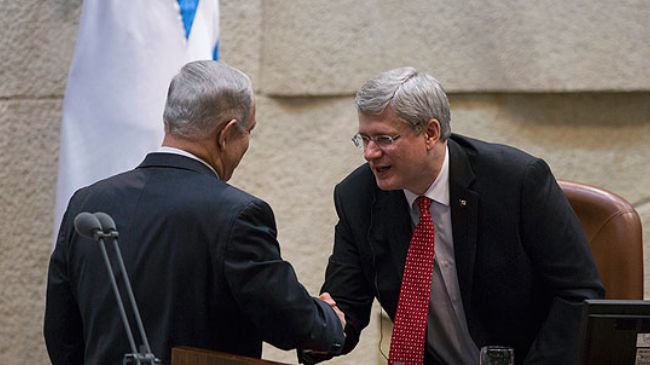
Press TV – February 16, 2014
The Canadian government has granted a new identity and passport to an agent of the Israeli spying service Mossad who had been involved in an assassination plot in 2010.
The Mossad agent, whose identity was not revealed, received the new identity and passport after his participation in the assassination of Hamas leader Mahmoud al-Mabhouh in Dubai in 2010, Canadian news agency QMI quoted Arian Azarbar, a businessman, as saying.
“The girl who was in charge of that file at Passport Canada… told me about it,” Azarbar said.
Al-Mabhouh was killed in his hotel room by a team of ten assassins carrying European passports.
“The Canadian government has said we had nothing to do with this, but it is a lie,” Azarbar added.
Azarbar has also provided the QMI agency with the name of the Israeli spy and the location of his residence in Canada. The agency, however, has declined to disclose the information, saying it would “endanger the safety and security” of the Mossad agent.
Alexis Pavelich, the spokesman for Canada’s Immigration Ministry, has refused to talk about the passport issue.
Back in 1997, Jordan arrested two Mossad agents carrying fake Canadian passports following a life attempt on Hamas leader Khaled Mashal.
Canada is closely allied to the Israeli regime.
Canada was one of the few countries that opposed the successful Palestinian bid in November 2012 to upgrade its status at the United Nations from “non-member observer entity” to “non-member observer state.”
In October 2011, Canada also opposed the Palestinian effort to win membership within the United Nations Educational, Scientific and Cultural Organization (UNESCO).
Are Palestinians Allowed to Resist? Part I
Part I: Palestinian Resistance in Context, Between Non-Violent and Armed Struggle
By Dina Jadallah-Taschler | Palestine Chronicle | February 26, 2009
The issue of Palestinian resistance, in terms of its permissibility and types, is a highly inflammatory question for most Western observers. Mainstream media discourse frequently boils down to criticisms and condemnations of its “violence” or alternatively, asserts its impotence in the face of Israeli military might and Western opposition. It might therefore be helpful to place it in historical and current context and to comparatively evaluate it against that other famous struggle for independence, Indian national liberation. India’s struggle, given the prominent role of Gandhi’s satyagraha’s role, is usually synonymous in Western discourse with non-violent resistance.
This first part in the essay deals with legal and historical issues that define Palestinians’ struggle for independence, then describes their repercussions on the current status of the occupation. In the second and final part, I will present examples from the history of Palestinian unarmed struggle and then compare it with the Indian one. I will argue that the agreeable and reasonable sounding frame of the superiority of peaceful resistance sets up a false dichotomy. Presenting satyagraha as the exemplary approach to liberation is deceptive on two levels. First, India’s independence was not achieved through non-violence alone. And second, while inspirational and useful on many levels, it is not sufficient as sole guide or solution to achieving Palestinian liberation.
The Prevailing Western Mainstream Media Perspective on Palestinian Resistance Today
Language and the framing of issues is always the privilege of the strong. This applies to international and legal attitudes concerning national liberation movements. At the height of their occurrence in the 1960s and 1970s, there was an international consensus on the necessity and legal right of oppressed people living under colonial and / or racist states to resist their status by any means available to them, including armed conflict. However, since the 1980s, there has been a shift away from focusing on ultimate legitimate goals of national liberation to a discussion of methods. Concomitantly, there was an interjection of a growing set of rules of military engagement that the international community wanted to apply to even non-state actors who were fighting for their independence. Israel, being a colonial and ethnically-based state and seeking to curb the use of armed struggle against itself, is in the camp that marks as “aggression” and “terroristic” any and all active resistance to its occupation of Palestinian land. Thus in terms of language and its function in rationalizing or justifying events, there is a sharp contrast between descriptions of “armed conflict” depending on which side of the aisle one is on: on the one hand, “national liberation movements” and “freedom fighters” and on the other, “terrorists” and “pre-emptive strikes.”
The justice of the initial demands for independence is frequently obscured by the legalistic focus on the means of inducing change. Moreover, international institutions, like the Security Council or the General Assembly of the United Nations or the International Court of Justice did not develop the means (or the will — in the case of the Palestinians) to enforce the legitimate claims of colonized peoples, or to punish states, like Israel, that place themselves above the application of basic legal and ethical principles. In a sense, this shift in focus is a regression to more imperial / colonial attitudes of the past.
It is a frustrating endeavor to peel away obscurantist assumptions and pervasive and intentional misdirection to arrive at the truth. Keeping in mind that Gandhi defined satyagraha as to hold on to the truth, the most basic reality for the Palestinians is that they are dispossessed, displaced, occupied, oppressed and most recently, massacred in Gaza. But most Western media coverage ignores some basic background facts that constitute the basis of the problem and which I will review briefly below. Ignoring the root causes renders incomprehensible to the casual observer Palestinians’ resistance, thereby facilitating their designation as stereotypical “terrorists.”
Historical Background of Palestinian Plight
Palestinian dispossession started under the British Mandate, which “got” Palestine from the dismantled Ottoman Empire after World War I. The Balfour Declaration (1917) established a national “home” for the Jews in Palestine and disregarded the wishes of the “non-Jewish communities.” While the latter was the overwhelming majority, and despite promises of “non-prejudice” to their “rights,” they were considered not significant enough to warrant that the colonizer ask their opinion about the “giving” of their homeland to an imported ethnic and religious group. In addition, British troops had not even set foot in Palestine yet. Thus Britain contradicted the legal maxim nemo dat quod non habet, meaning no one can give that which he has not. But being a superpower at the time, ordinary laws did not apply to itself. And the “promise” in the Balfour Declaration was incorporated into the Mandate by the League of Nations, which promptly validated this gift, even though the League did not possess Palestine either. The League also overlooked its inconvenient commitment to the right of self- determination for peoples originally inhabiting a land.1
Zionist actions to actively dispossess and remove Palestinians from their lands, exemplified in Plan Dalet, led to the ethnic cleansing of 750,000 people and created a majority Jewish area just in time for the declaration of the Israeli state in 1948. The dispossession both preceded and was concurrent with the war. The Palestinians’ legal right of return was reaffirmed more than one hundred times by the United Nations. But Israel placed itself above international law and passed The Prevention of Infiltration/Offenses and Jurisdiction Law in the Knesset in 1954. The defining of who is an “infiltrator” is instructive in explaining the violence and injustice done to the Palestinians, who were denied their legal right to return: the third definition for “infiltrator” in the law is a “Palestinian citizen or a Palestinian resident without nationality or citizenship or whose nationality or citizenship was doubtful and who, during the said period left his ordinary place of residence in an area which became a part of Israel for a place outside Israel.”2 Later in 1967, the Israeli state expanded again and encompassed the rest of natural Palestine. The reason that there is an occupation in the new territory is simple. The Zionist enterprise, all proclamations to democracy not-withstanding, could not incorporate/digest the newly acquired territories without reducing the majority Jewish composition, thereby exposing the non-democratic, ethnocentric and racist premise of the state.
Evaluation of Losses and Achievements
The facts are simple enough. And yet that is not at all how current media narratives present the struggle. It is never referred to as one for liberation and freedom. Resistance to the oppressive occupation and to the expansionist and dispossessing Israeli state is never presented as a right, despite the self-evident moral and legal principle, that as the (occupying) aggressor, Israel cannot justify violence against resistance to its own initial aggression.3 And yet, in this last massacre, Gazans who are starving, imprisoned, mostly refugees from the original displacement that happened with Israel’s creation, and who have qualitatively modest (but technologically improving — distance/reach) weapons, are the ones being blamed for “starting” or inviting the attack on themselves. This is objectionable on several levels. Fundamentally, the framing of the story that equates Palestinian resistance with the fourth strongest army in the world is inherently deceptive. Additionally, it blames the victim for resisting annihilation.
But once again, because it is the strong who determine what is legal and what is not, the Palestinian struggle for national liberation and their resistance against their oppressors are illegal by definition and are presented as “terrorism.” The right of self-defense has been appropriated by the dominant, occupying, aggressing side and simultaneously denied to its victims. It is becoming increasingly apparent to the resisting Palestinians that this excessive use of legality is simply a means to preserve pre-existing power asymmetries that will perpetuate their oppression. It is ultimately aimed at their extinction as a people. It is the root cause of their resistance: for they refuse a peace built on injustice, no matter how much misinformation is produced disguise the facts.
The Oslo Peace Process must be evaluated from this perspective. It was started more than 15 years ago but has led to no tangible benefits for the Palestinians. On the contrary, it has led to their increasing dispossession and subjugation. It co-opted the PLO leadership and made the Palestinian Authority into a police arm of and chief appeaser/concessor to Israel, the occupier. The Process has served as legal cover for continued oppression. It is no different from the NATO announcement to “protect” Israel, or the Rice-Livni Accords, or the United Nations Resolutions that are never enforced.
All these entities and agreements give a cover of multilateralism and legality to what is essentially aggressive expansionism and intentional dispossession. Similarly, Israel’s “withdrawal” from Gaza in 2005, narratively presented in mainstream media with so much angst for the trauma of the occupier, does not remove the initial aggression of the original and consistently brutal occupation. Even when one allows for the prison that is Gaza to be considered “unoccupied,” the fact remains that Palestinians are one people and that the West Bank and East Jerusalem continue to be occupied. This is even acknowledged in the Oslo Accords, which defines them as “a single territorial unit.”
Moreover, Israeli expansionism continues, and even accelerates, in the shadow of the peace process and of the headline- grabbing events in Gaza. Just in the last week, Israel has announced the annexation of extensive areas of Palestinian-owned land, where the villagers have been non-violently protesting the apartheid wall. For three days the Israeli army invaded the village of Jayyous declaring it a “Closed Military Area” and arbitrarily arrested 65 Palestinians: “The Israeli wall confiscated about 600 dunums of lands and 8,600 dunums were isolated behind the wall, where the town’s area is 12,500 dunums,” leading to the loss of thousands of jobs lost as a result of the wall and the isolation of agricultural land.4 Similarly, on 1/26/2009, the Israeli High Court approved the complete destruction of the village of Tana, east of Nablus, in order to expand the settlement colony of Makhurah.5 In addition, an expansion to the Effrat settlement colony near Bethlehem was also announced, swallowing an additional 170 hectares of “state land.”6 All this is happening in the West Bank, ostensibly the co-operating segment under the dictatorial and oppressive control of the Palestinian Authority. And it is definitely not conducive to economic independence, let alone the mirage of prosperity that was promised to come with the pursuit of a negotiated and non-violent “settlement.”
The argument is frequently made that Hamas is a “terrorist organization” because it targets civilians. But that is a question that is both not for the militarily strong to ask and also ignores completely Israel’s far greater and more consistent targeting of civilians. In this last attack on Gaza, despite an earnest and far reaching hasbara/propaganda effort by Israel to change perceptions, the extent of the destruction was too blatant to repress. Any fair assessment of damage to civilians will plainly see the disproportionate suffering of the weaker party. It also must account for the slow strangulation and eradication of Palestinians even when there is no “war.” The means of destruction are so entrenched and persistent so as to become too banal for Western media to report on. The “targeted assassinations” that inevitably kill civilians, the ever-growing “settlements” / colonies, the land expropriations, the apartheid “separation” Wall, the roadblocks, the economic blockade and de-development, and so forth have effectively ended any hope of a two state solution. In fact, the Palestinians’ pursuit of the peaceful route of “settlement” through the peace process, recently “negotiated” at Annapolis, has resulted in a 20% increase in settlement expansion in the West Bank and a 36% settlement expansion in East Jerusalem, just in the last sixteen months.6
The Oslo Peace Process has essentially reached a dead end. Remember that it was launched after the First Intifada proved that a militarily powerful actor could not defeat Palestinian grassroots resistance. Hence, Israel’s resort to “settlement” and its reliance on the native enforcer, in the form of the Palestinian Authority. But that too failed. The endless peace process has been unable to accomplish the main (colonialist/racist) goal that gave it life: namely, to convince the Palestinians that they are defeated and are rightfully untermenschen in the legally still border-less Zionist state.
Taken to its ultimate logical and counter-intuitive conclusion, this will eventually (and in fact has already started to) call into question the viability of a Zionist Israel in the long term. Increasingly, Israel’s own success in oppressing its Other has left it with two equally non-palatable options: either transition into an equal society or dismantle the colonialist enterprise. Its current choice of apartheid separation and oppression is demographically, morally, ethically, and in time, technologically unstable and unacceptable going forward.
1) For an extensive discussion of this topic, see, Musa E. Mazzawi, Palestine and the Law: Guidelines for the Resolution of the Arab-Israeli Conflict, Garnet & Ithaca Press, 1997: pp. 21-23.
2) Ibid, p. 178.
3) For a broader discussion of this issue, see Michael Mandel, “Israel’s Unjust War on Gaza: Self-Defense Against Peace,” Counterpunch, 2/5/2009.
4) ”Israeli forces seize 65 youths in Jayyus in third day of mass arrest,” Maan News Agency, February 18, 2009. Also, for a broader perspective (Arabic), visit here.
5) Tiny URL
6) TINY URL
Dina Jadallah-Taschler is an Arab-American of Palestinian and Egyptian descent, a political science graduate and is also an artist. She can be reached at: Dina.Jadallah.Taschler@gmail.com or visit Dina’s website.
Le Parisien uncovers French lie on 1960 nuke test
Press TV – February 16, 2014
A report says France covered up the extent of the nuclear fallout from its first atomic bomb test in North Africa.
The report published by the French daily Le Parisien was based on a recently declassified military map regarding the fallout from the detonation of the Gerbouise Bleue bomb in the Algerian desert in 1960.
The map revealed that radioactive particles reached the Italian island of Sicily and the southern Spanish coast on the 13th day after the blast.
Lawyer Fatima Benbraham, who represents dozens of cases in Algeria, said the map shows that Algeria and practically the whole Saharan region was contaminated following the atomic test.
The documents were declassified last year following a ten-year legal battle, in which the French government fought long and hard to prevent the documents from becoming public, according to Bruno Barrillot, a member of the pressure group Observatoire des Armaments.
The pressure group along with others battled through court to have the documents released in a bid to bring compensation to people whose health has been allegedly affected by the radioactive fallout.
Human rights activists say civilians were not warned of the danger of the 17 blasts that took place in North Africa in 1960-66.
France admitted in 2009 that a small-populated area has been affected by the fallout.
Barrillot said he hopes the newly declassified maps would force the administration of French President Francois Hollande to admit that more people could have been affected by the fallout.
“They did not do these tests under the Eiffel Tower,” said Barrillot. “No, they went far away from France and then lied about the true impact.”
France conducted a total of 210 tests in Algeria and then in French Polynesia in the Pacific Ocean from 1960 to 1996.
Scrutinizing the Israeli role in 2001 anthrax attacks
By Brandon Martinez | February 16, 2014
In late September 2001, a couple of weeks after 9/11, the United States was struck with what the Bush regime dubbed a “second wave” of terrorism. Letters laced with deadly anthrax spores arrived in the mailboxes of prominent media figures and two American senators. Five people were killed and 17 others were infected.
A concerted effort was made by the Bush regime and the mainstream US media to present the anthrax attacks as the work of the same people who perpetrated 9/11. They were, in a sense, correct, but the people behind 9/11 and the subsequent anthrax fiasco were not members of al-Qaeda or adherents of the Islamic faith.
A very clear and discernible pattern of propaganda was foisted upon the American public following 9/11. Zionists from Israel and the US took a leading role in assigning responsibility for the biggest attack on American soil since Pearl Harbour. Unsurprisingly, the Zionists immediately pointed fingers at all of their Middle Eastern rivals and adversaries, from resistance groups like Hamas and Hezbollah to countries such as Iraq, Iran and Syria.
Israel’s enemies were being portrayed as America’s enemies too. Together, said the Zionists, Israel and America can defeat “the forces of darkness.” Israel’s crude campaign of innuendo and Orwellian projection manifested within a few hours of the 9/11 attacks. Israeli politicians Ariel Sharon, Benjamin Netanyahu, Ehud Barak and Shimon Peres all made public statements calling on the US and other Western powers to initiate a global “war on terrorism,” a term coined by Likudniks in the 1980s.
Israel’s army intelligence service Aman and the former Mossad chief Rafi Eitan trumpeted brazen disinformation shortly following 9/11, alleging Iraqi involvement in the attacks. In August of 2001 the Mossad delivered a propagandistic “warning” to the CIA alleging al-Qaeda and Iraq were working together and were plotting terror attacks on major US landmarks. The neoconservatives, who are for all intents and purposes emissaries of the Israeli regime in the US, went straight to work in the op-ed pages of the Washington Post, the New York Times and other Zionist-controlled media outlets, attempting to portray Arabs and Muslims generally as the sponsors of 9/11 and the source of all terrorism in the world.
The same pattern of Zionist deception is apparent with the anthrax attacks. Israel’s partisans immediately mobilized a propaganda initiative to link Iraq and al-Qaeda to the anthrax mailings.
On various occasions [former US] president George W. Bush and vice president Dick Cheney told reporters that al-Qaeda was likely involved in the lethal mailings. The docile mainstream media unquestioningly repeated this unfounded assertion. A stunning piece of disinformation appeared in an Oct. 27, 2001, report in the London Times, alleging that an Iraqi official met with 9/11 patsy Mohamed Atta in the Czech Republic in April 2001. The report went on to suggest that during the rendezvous the Iraqi official gave Atta a flask of anthrax. The origin of this dubious claim was noted in the article: Israeli security sources. The chief of Czech foreign intelligence, Frantisek Bublan, later revealed that this supposed meeting never took place and was nothing more than a propaganda invention of interested parties. “Promoting a so-called ‘Prague connection’ between Atta and [the Iraqi official] al-Ani might have been a ploy by U.S. policymakers seeking justifications for a new military action against…Saddam Hussein,” Bublan told the Prague Post.
When the Iraq/al-Qaeda propaganda narrative fell apart, the FBI targeted two… within the US bio-weapons establishment: scientists Steven Hatfill and Bruce Ivins. The FBI began harassing Hatfill and publicly called him a “person of interest” in the anthrax investigation.
Hatfill vehemently denied the charges and was eventually exonerated. He later sued the FBI and other US government agencies, winning a settlement of more than $5 million in damages. Like Hatfill, Ivins was an unlikely suspect for the anthrax attacks as well.
There was no evidence tying Ivins to the anthrax letters and he had no conceivable motive. The FBI launched an intense campaign of innuendo against Ivins in an effort to convict him in the court of public opinion. Ivins allegedly committed suicide while in a Maryland hospital just before he was set to be indicted and stand trial. How convenient.
Ivins worked at a US bio-weapons facility called USAMRIID in Fort Detrick, Maryland. This is where the FBI claims the anthrax used in the attacks originated. Since there is no evidence that Ivins was involved in the anthrax mailings, there is likewise no reason to believe the FBI’s claim that the anthrax spores used in the letters originated from that facility.
Another curious event took place during the anthrax affair that garnered little attention from the mainstream press for obvious reasons. An Arab-American scientist who worked at the same Fort Detrick facility as Ivins was the victim of an attempted frame-up. Shortly before the first known victim of the anthrax attacks was confirmed, an anonymous letter was mailed to the FBI that attempted to implicate Dr. Ayaad Assaad as a “potential biological terrorist.” The author of the letter claimed to have worked with Assaad previously and alleged that Assaad had a vendetta against the US government, urging the FBI to stop him. The letter prompted the FBI to investigate Assaad. The FBI questioned him in early October 2001 and quickly cleared him of any involvement with the anthrax attacks.
Strangely, the FBI seemed uninterested in finding out who sent the anonymous letter implicating Assaad, even though the contents and timing of the letter were amazingly conspicuous, coming just prior to a real bio-terrorist attack. Assaad suspected the letter-writer was involved in the anthrax mailings and opined that his Arab background made him the “perfect scapegoat.”
One possible source of the frame-up letter was a man named Dr. Philip Zack, a microbiologist and Lieutenant Colonel in the US Army. Zack worked at USAMRIID alongside Assaad in the early 1990s. Zack and other employees at the lab formed a clique called the “camel club” to bully Arab co-workers, particularly Assaad. One day in April 1991 Assaad found a poem in his mailbox written by Zack and other members of the “camel club” which mocked his Arabic heritage. Zack and several of his fellow anti-Arab racists voluntarily left the facility when Assaad informed his superiors of the harassment campaign.
In 1992, anthrax spores, Ebola virus and other deadly pathogens went missing from the Fort Detrick facility. An internal investigation discovered that someone was entering the lab late at night to conduct unauthorized research involving anthrax. The inquiry also revealed that Dr. Philip Zack made an unauthorized visit to the lab on Jan. 23, 1992, at a time when he was no longer working at the facility. Despite Zack’s suspicious past behaviour and harassment of Assaad, the FBI made no effort to pursue him as a suspect in the 2001 anthrax investigation.
A very revealing aspect of the whole affair was the fact that the anthrax-tainted letters were made to look like a Muslim who was angry at Israel and the United States authored them. “Death to Israel, Death to America, Allah is Great,” the letters read. Whoever was actually behind the anthrax mailings was evidently attempting to lead authorities to believe a Muslim or group of Muslims was responsible.
So where did the anthrax used in the 2001 attacks come from? Researcher Robert Pate posited a plausible theory in an essay entitled, “The Anthrax Mystery: Solved” In the paper, Pate suggests Israel is the most likely culprit. According to Pate’s research, Israel had the means, motive and opportunity to secure anthrax spores and deliver them to her targets without being detected. Pate demonstrates that Israel has had a sophisticated chemical and biological weapons program since its inception in 1948. Israel has produced biological agents including anthrax at the Israel Institute of Biological Research (IIBR) in Ness Ziona, located a few miles southeast of Tel Aviv.
“With the help of Jewish scientists from the former Soviet Union,” Pate opines, “Israel’s bio-weapons research has probably surpassed that of all other nations. The Soviet Union’s bio-weapons program had 32,000 scientists and staff working in 40 different research and production facilities. Two thousand of these scientists worked exclusively on the Soviet anthrax program. A significant number of these scientists may have immigrated to Israel and become employed in her bio-weapons programs.”
Pate cites a research paper by Dr. Avner Cohen titled “Israel and Chemical/Biological Weapons: History, Deterrence, and Arms Control” which outlines Israel’s biological and chemical weapons capabilities. Anthrax is certainly in Israel’s biological arsenal. In the paper, Cohen also describes how Zionist militants poisoned Palestinian water supplies with deadly pathogens during the 1948 ‘Nakba,’ wherein Zionist gangs completely destroyed and depopulated more than 500 Arab villages in order to birth… [Israel entity] . Historical examples of Zionist biological warfare noted by Pate, in addition to Israel’s penchant for false flag terrorism against its “allies” such as the Lavon Affair and USS Liberty attack, lead him to believe that Israel was willing and able to commit a biological attack in the US – a classic false flag operation to frame her enemies for political gain.
“A motive for the anthrax attacks would be to blame Arab terrorists or a ‘rogue nation’ for this atrocity and to help launch the United States into war against Israel’s enemies,” writes Pate. “[Israel’s motive] in launching the anthrax attacks would be to bring America into war against Iraq and to remove that country as a potential threat to…[Israel].” As noted earlier, Israeli intelligence contrived a false story to implicate Muslims where they claimed to have observed a meeting between an Iraqi official and alleged al-Qaeda ringleader Mohamed Atta in the Czech Republic in which an exchange of anthrax is said to have occurred. If Israel had nothing to do with the anthrax attacks, then why did they propagate lies with the intent to implicate Iraq and al-Qaeda? American authorities admit that no Muslim or Arab was involved in the anthrax mailings, so who else but Israel and corrupted Americans in the Bush administration could have been behind this obvious false flag?
It can be said without doubt that some members of the Bush administration had foreknowledge of the anthrax attacks. Press reports revealed that White House officials including Bush and Cheney went on a steady regimen of the drug known as Cipro, a powerful antibiotic effective against anthrax infection, weeks before the anthrax-trained letters were first discovered.
The theory that Israel and its accomplices in the Bush administration launched a biological false flag operation as a “second phase” of the overarching 9/11 deception is well within the realm of possibilities regarding 2001’s anthrax attacks in the US. It is certainly far more plausible than the FBI’s flimsy and still-unproven case against Bruce Ivins who conveniently died before any evidence could be aired in the courts.
But it would be foolish to place any hope on President Obama — a committed servant of the Israeli-American empire — to launch a new, independent investigation into any of these troubling matters.
Related articles
Featured Video

Genocide-linked firm handles Britons’ NHS data
or go to
Aletho News Archives – Video-Images
Book Review
How the U.S. Navy Sold the Vietnam War
By Gareth Porter | TruthDig | March 27, 2019
Dr. Tom Dooley, whose best-selling book “Deliver Us From Evil” helped create a favorable climate of opinion for U.S. intervention in South Vietnam, has long been linked to legendary CIA officer Edward G. Lansdale and his black operations in Vietnam between 1954 and 1955. But the real story about Dooley’s influential book, which has finally emerged from more recent scholarly research, is that it was engineered by an official of the U.S. Navy’s Pacific Command, Capt. William Lederer.
Lederer is best known as the co-author, with Eugene Burdick, of the 1958 novel “The Ugly American,” which was turned into a 1963 movie starring Marlon Brando. Far more important, however, is the fact that from 1951 through 1957 Capt. Lederer was on the staff of the commander in chief of the U.S. Pacific Fleet (CINCPAC), Adm. Felix Stump. … continue
Blog Roll
 Aletho News
- The 10 Disease Renamings That Rescued the Vaccine
- NATO cancels 2027 leaders’ summit
- IAEA’s politicized use of safeguards undermines its impartiality: Russian envoy
- UK must be ready to strike Russian Arctic – ex-PM
- Fico’s Two Red Lines: Russian Energy and the Next Ukraine Loan
- Thousands rally for banned NATO-skeptic presidential candidate
- Ukraine Settlement and New European Security Architecture Must Go Hand in Hand – Kremlin
- Book review: Boiling Point, How America Brought War to Ukraine
- Israel Revives The ‘Iranian Assassination Threat Against Trump’ Deception In A Desperate Bid To Restart The War
- US rewrites history to dodge blame for illegal war on Iran: Foreign Ministry spokesperson
- If Americans Knew
- No, Christians did not invent Zionism
- Hakeem Jeffries & Chuck Schumer: Conduits for Israel Lobby Dark Money
- DAILY UPDATE: Latest essential news on Palestine, Israel, & region
- Aid organizations in Gaza are pulling back, leaving hundreds of thousands of Palestinians without food
- 1.4 Million People in Gaza Live in Tents. Winter Storms Can Be a Death Sentence.
- Israel Used a U.S.-Made Missile to Kill Six at Gaza’s Nasser Hospital
- Congress Might Sneakily Use Lame Duck to Deeply Intertwine the U.S. and Israeli Militaries
- DAILY UPDATE: Latest essential news on Palestine, Israel, & region
- 9-month-old baby dies from severe cold in Gaza, 1st cold-related death this winter: Health Ministry
- Israel Kills over 12, Injures Many Across Gaza
- No Tricks Zone
- New Study: Barents Sea Temperatures Were Warmer And Sea Ice Less Extensive In The 1700s Than Today
- German Authorities Start Initiative To Evaluate Public Register For Climate “Disinformation” Spreaders!
- Zonal Asymmetry of Temperature Change in the Antarctic Circumpolar Current
- New Study: The Net Fossil Fuel Contribution To Rising Atmospheric CO2 Has Been Zero For 500 Years
- Germany’s Green Energy Transition Becoming Increasingly Expensive…Another 6 Trillion Euros!
- Sudden Stratospheric Warming, Powerful El Niño Combination May Lead To Extreme Europe Cold, Energy Crisis!
- Two New Studies Find Thwaites Glacier Melt Cannot Be Driven By Human Activity Or A Warming Ocean
- E-Cars Reduce CO2 Emissions By Only 41% Compared To Internal Combustion Engine Vehicles
- Predictions Made By Renowned Climate Professor Over Past Decades Have Been Proven To Be Poor
- New Study Suggests Large Regions Of The Pacific Ocean Have Been Cooling For The Last 80 Years

