The 12 Strongest Arguments That Douma Was A False Flag
By Caitlyn Johnstone | December 20, 2019
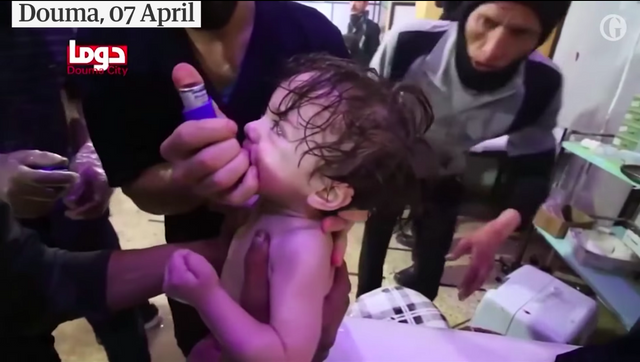
There have been many US military interventions that were based on lies. This is not a conspiracy theory. It is not some kooky blogger’s opinion. It is an extensively documented and indisputable fact.
Nothing has ever been done to address this extensively documented and indisputable fact. No laws were ever changed. No war crimes tribunals were ever held. No policies or procedures were ever revised. No one was ever even fired. No changes were implemented to prevent the Iraq deception from happening again, and, when it happened again, no changes were implemented to prevent the Libya deception from happening again.
When you make a mistake, you take measures afterward to ensure that you never make the same mistake again. When you do something on purpose, and you intend on doing it again, you do not take any such measures.
There is a large and growing body of evidence that we have been lied to about Syria to an extent and to a level of sophistication that may be historically unprecedented. One particular aspect of the US-centralized empire’s military involvement in that nation, the 2018 airstrikes by the US/UK/France alliance and the alleged chemical weapons incident which preceded it, has been subject to intense scrutiny ever since it took place. And with good reason: there are many pieces of evidence indicating that the Douma incident was staged to falsely implicate the Syrian government.
I don’t claim to know exactly who would have been involved in such a staging and to what extent. It is technically possible, as the UK’s Admiral Lord West speculated at the time, that it was perpetrated independently by the vicious al-Qaeda-linked Jaysh al-Islam forces who’d been occupying Douma, a last-ditch attempt to provoke a western military response that might save them from the brink of defeat at the hands of the surging Syrian Arab Army. Jaysh al-Islam has an established record of deliberately massacring civilians, and of using civilians as military leverage by locking them in cages on rooftops in strategic Douma locations to prevent airstrikes. The narrative management operation known as the White Helmets would also have been involved to some extent, and it’s very possible that Saudi Arabia, who backs Jaysh al-Islam, was involved as well.
Any number of other allied intelligence agencies could have also been involved to some degree (perhaps with the more expanded goal of ensuring continued US military commitment in Syria during an administration that is vocally opposed to it), and it’s unknown if anyone involved would have had direct contact with any part of any US government agency regarding any of this. All we know for sure is that there’s a growing mountain of evidence that the Syrian government was not involved, and that this raises extremely important questions about (A) who really killed those civilians in Douma and (B) how seriously any future demands for military action should be taken from the US power alliance.
That mountain of evidence includes the following 12 items. Taken individually they are reason enough to be skeptical of the narratives that are being promoted by a government with a known history of using lies, propaganda and false flags to advance preexisting military agendas. Taken together, and looked at with intellectual honesty, they are enough to obliterate anyone’s trust in what we’ve been told about Douma.
1. A leaked OPCW Engineering Assessment concluded that the gas cylinders on the scene were manually placed there.
The Organisation for the Prohibition of Chemical Weapons (OPCW) is a purportedly neutral and international watchdog group dedicated to eliminating the use of chemical weapons around the world. In May of this year, a leaked internal OPCW document labeled “Engineering Assessment of Two Cylinders Observed at the Douma Incident” was published by the Working Group on Syria, Propaganda and Media. The Engineering Assessment was signed by a South African ballistics expert named Ian Henderson, whose name is seen listed in expert leadership positions on OPCW documents from as far back as 1998 and as recently as 2018, and its authenticity was quickly confirmed by the OPCW in a statement sent to multiple journalists that it was “conducting an internal investigation about the unauthorised release of the document in question.”
Henderson ran some experiments and found no scientifically grounded theory for how the cylinders could possibly have been dropped vertically from the air while being found in the condition and locations that they were found in, concluding instead that they were manually placed on the scene. This is a huge difference, since the Assad coalition was the only side with aircraft and Jaysh al-Islam were the only forces on the ground.
“The dimensions, characteristics and appearance of the cylinders, and the surrounding scene of the incidents, were inconsistent with what would have been expected in the case of either cylinder being delivered from an aircraft,” Henderson wrote. “In each case the alternative hypothesis produced the only plausible explanation for observations at the scene.”
“In summary, observations at the scene of the two locations, together with subsequent analysis, suggest that there is a higher probability that both cylinders were manually placed at those two locations rather than being delivered from aircraft,” Henderson concludes.
This is unsurprising, since the hypothetical physics of the empire’s airdrop narrative make no sense to anyone with any understanding of how material objects move. To get a simple explanation of this, watch the breakdown in this three-minute animation. For a more in-depth look, check out this long Twitter thread by Climate Audit’s Stephen McIntyre.
The existence of Henderson’s report was kept secret from the public by the OPCW, which might make more sense after we get through #2 on this list.
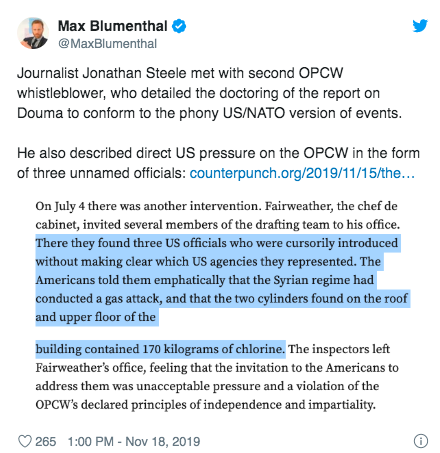
2. US officials reportedly pressured the OPCW to find evidence of Assad’s guilt.
https://twitter.com/MaxBlumenthal/status/1196246809070444545?s=20
In addition to whoever leaked the Henderson report in May, a second whistleblower going by the pseudonym of “Alex” emerged in October to give a presentation before the whistleblower’s advocacy group Courage Foundation exposing far more plot holes in the official Douma narrative. This same whistleblower also spoke with award-winning British journalist Jonathan Steele, who published a bombshell report on Alex’s revelations in CounterPunch last month.
Among the most stunning revelations in Steele’s article was Alex’s report that US officials attempted to pressure OPCW inspectors during the Organisation’s drafting of its Interim Report on their Douma investigation in July 2018, and that this intercession was facilitated by an OPCW official named Bob Fairweather.
“On July 4 there was another intervention,” Steele writes. “Fairweather, the chef de cabinet, invited several members of the drafting team to his office. There they found three US officials who were cursorily introduced without making clear which US agencies they represented. The Americans told them emphatically that the Syrian regime had conducted a gas attack, and that the two cylinders found on the roof and upper floor of the building contained 170 kilograms of chlorine. The inspectors left Fairweather’s office, feeling that the invitation to the Americans to address them was unacceptable pressure and a violation of the OPCW’s declared principles of independence and impartiality.”
It’s unknown what forces were at play that enabled the US government to insert itself into into an ostensibly impartial OPCW investigation with the help of an OPCW official, but it wouldn’t be the first time the US government leveraged the Organisation into facilitating preexisting regime change agendas against a disobedient Middle Eastern nation. In 2002 Mother Jones reported that the US government, spearheaded by John Bolton, had used the threat of withdrawing its disproportionately high percentage of funding from the Organisation if it didn’t oust its then-Director General Jose Bustani. The popular Bustani, who’d previously been unanimously re-elected to his position, had been hurting the case for war with his successful negotiations with Saddam Hussein’s Iraq. In March 2018, after Bolton was selected as Trump’s National Security Advisor, The Intercept revealed that the campaign to remove Bustani had also included Bolton personally threatening his children.
Bolton was operating at the highest levels of the Trump White House throughout the entire duration of the OPCW’s Douma investigation. He was Trump’s National Security Advisor from April 9, 2018 to September 10, 2019. The OPCW’s Fact-Finding mission didn’t arrive in Syria until April 14 2018 and didn’t begin its investigation in Douma until several days after that, with its final report being released in March of 2019.
3. Levels of chlorinated organic chemicals didn’t indicate any chlorine gas attack took place.
“The main point is that chlorine gas degrades rapidly in the air,” Jonathan Steele told Tucker Carlson last month detailing what was told to him by Alex. “So coming in two weeks later, you wouldn’t find anything. What you would find is that the gas contaminates or affects other chemicals in the natural environment. So-called chlorinated organic chemicals [COCs]. The difficulty is they exist anyway in the natural environment and water. So the crucial thing is the levels: were there higher levels of chlorinated organic chemicals found after the alleged gas attack than there would have been in the normal environment?”
“When they got back to the Netherlands, to The Hague where the OPCW has its headquarters, samples were sent off to designated laboratories, then there was a weird silence developed,” Steele continued. “Nobody told the inspectors what the results of the analysis was. It was only by chance that the inspector found out through accident earlier the results would come in and there were no differences at all. There were no higher levels of chlorinated organic chemicals in the areas where the alleged attack had happened where there is some suspicious cylinders had been found by opposition activists. So it didn’t seem possible that there could have been a gas attack because the levels were just the same as in the natural environment.”
“[Alex] got sight of the results which indicated that the levels of COCs were much lower than what would be expected in environmental samples,” Steele reported in CounterPunch. “They were comparable to and even lower than those given in the World Health Organisation’s guidelines on recommended permitted levels of trichlorophenol and other COCs in drinking water. The redacted version of the report made no mention of the findings.”
“Had they been included, the public would have seen that the levels of COCs found were no higher than you would expect in any household environment”, Alex told Steele.
This inconvenient fact was omitted from both the OPCW’s Interim Report in July 2018 and its Final Report in March 2019.
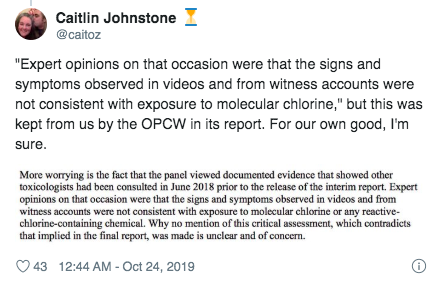
4. Many signs and symptoms of alleged chlorine gas poisoning weren’t consistent with chlorine gas poisoning.
https://twitter.com/caitoz/status/1187001753192919041?s=20
The OPCW’s Final Report on Douma in March 2019 assures us that the team found “reasonable grounds that the use of a toxic chemical as a weapon took place. This toxic chemical contained reactive chlorine. The toxic chemical was likely molecular chlorine.” A leaked internal OPCW email, featuring an inspector voicing objections to the aforementioned Bob Fairweather over vital information being omitted from the developing Interim Report on Douma, contradicts this assurance, saying observed symptoms weren’t consistent with chlorine gas poisoning.
“In this case the confidence in the identity of chlorine or any choking agent is drawn into question precisely because of the inconsistency with the reported and observed symptoms,” the email reads. “The inconsistency was not only noted by the FFM [Fact-Finding Mission] team but strongly noted by three toxicologists with expertise in exposure to CW [Chemical Weapons] agents.”
So the OPCW’s investigative team as well as three toxicologists said what was observed didn’t match chlorine gas poisoning symptoms. This information was, of course, hidden from us by the OPCW.
A leaked first draft of the Interim Report on Douma, before OPCW officials started cutting out chunks which didn’t suit the US narrative, gives more detail. Here are some excerpts (emphases mine):
“Some of the signs and symptoms described by witnesses and noted in photos and video recordings taken by witnesses, of the alleged victims are not consistent with exposure to chlorine-containing choking or blood agents such as chlorine gas, phosgene or cyanogen chloride. Specifically, the rapid onset of heavy buccal and nasal frothing in many victims, as well as the colour of the secretions, is not indicative of intoxication from such chemicals.”
“The large number of decedents in the one location (allegedly 40 to 45), most of whom were seen in videos and photos strewn on the floor of the apartments away from open windows, and within a few meters of an escape to un-poisoned or less toxic air, is at odds with intoxication by chlorine-based choking or blood agents, even at high concentrations.”
“The inconsistency between the presence of a putative chlorine-containing toxic chocking or blood agent on the one hand and the testimonies of alleged witnesses and symptoms observed from video footage and photographs, on the other, cannot be rationalised. The team considered two possible explanations for the incongruity:
a. The victims were exposed to another highly toxic chemical agent that gave rise to the symptoms observed and has so far gone undetected.
b. The fatalities resulted from a non-chemical-related incident.”
5. A doctor in Douma told journalist Robert Fisk that there was no gas poisoning.
Shortly after the Douma incident a video was circulated online and redistributed on news media around the world featuring people being hosed down with water in a hospital and an infant receiving a respiratory treatment. A doctor who worked in the hospital Assim Rahaibani gave the following account to journalist Robert Fisk days after the incident, saying those in the video were actually just suffering from hypoxia due to dust inhaled after a conventional bombing:
“I was with my family in the basement of my home three hundred metres from here on the night but all the doctors know what happened. There was a lot of shelling [by government forces] and aircraft were always over Douma at night – but on this night, there was wind and huge dust clouds began to come into the basements and cellars where people lived. People began to arrive here suffering from hypoxia, oxygen loss. Then someone at the door, a ‘White Helmet’, shouted ‘Gas!’, and a panic began. People started throwing water over each other. Yes, the video was filmed here, it is genuine, but what you see are people suffering from hypoxia – not gas poisoning.”
Lest anyone accuse Fisk of having any special loyalties to the Syrian government, in this same report he says it “is indeed a ruthless dictatorship.”
6. A BBC reporter said he has proof that the hospital scene was staged.
https://twitter.com/Dalatrm/status/1095677403198906369?s=20
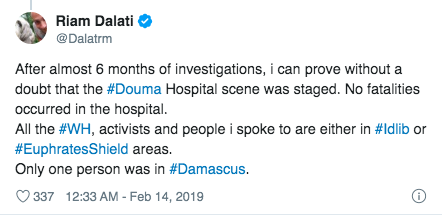
The BBC, another establishment that can hardly be accused of Assad loyalism, saw its Syria producer Riam Dalati claiming earlier this year that he had proof beyond a doubt the aforementioned hospital scene was staged. While holding to the establishment line that the attack did happen, Dalati expressed uncertainty as to what if any chemical would have been used and said “everything else around the attack was manufactured for maximum effect.” Emphases mine:
“The ATTACK DID HAPPEN, Sarin wasn’t used, but we’ll have to wait for OPCW to prove Chlorine or otherwise,” Dalati tweeted. However, everything else around the attack was manufactured for maximum effect. After almost 6 months of investigations, i can prove without a doubt that the Douma Hospital scene was staged.”
“No fatalities occurred in the hospital,” Dalati continued. “All the White Helmets, activists and people i spoke to are either in Idlib or Euphrates Shield areas. Only one person was in Damascus. Russia and at least one NATO country knew about what happened in the hospital. Documents were sent. However, no one knew what really happened at the flats apart from activists manipulating the scene there. This is why Russia focused solely on discrediting the hospital scene.”
In other words, Russia knew that these “activists” were staging the scene for the news media, and understandably focused on discrediting their work.
“I can tell you that Jaysh al-Islam ruled Douma with an iron fist,” Dalati added. “They coopted activists, doctors and humanitarians with fear and intimidation.”
Dalati set his account to private for an extended period after these extremely controversial statements got him a flood of attention, but the thread is up on Twitter as of this writing (here’s an archive in case they vanish again).
7. More evidence the Douma scene was knowingly staged for media.
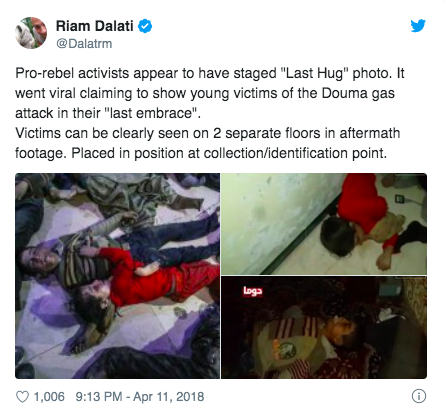
https://twitter.com/Dalatrm/status/984011488938643456?s=20
Riam Dalati also tweeted evidence after the attack that people had staged the corpses of two children to make it appear as though they died hugging each other for the purpose of emotional manipulation. If you’ve got a strong stomach (seriously think hard about whether this is something you want in your head before diving in), Stephen McIntyre also compiled some disturbing proof of dead infants being physically placed on top of other corpses in between video shoots of the Douma incident’s aftermath.
Whoever was positioning these bodies for the cameras clearly had a goal of generating an emotional response from the outside world. Which would be precisely the goal of staging a false chemical weapons attack.
8. Witness testimony at The Hague.
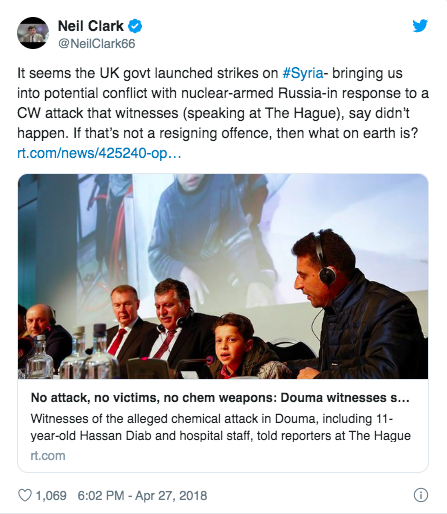
https://twitter.com/NeilClark66/status/989761664680521728?s=20
Seventeen Syrian civilians, including medical personnel and some of the “victims” seen in the aforementioned hospital footage, spoke at the OPCW headquarters in The Hague saying that no chemical weapons attack took place. RT reports:
“There were people unknown to us who were filming the emergency care, they were filming the chaos taking place inside, and were filming people being doused with water. The instruments they used to douse them with water were originally used to clean the floors actually,” Ahmad Kashoi, an administrator of the emergency ward, recalled. “That happened for about an hour, we provided help to them and sent them home. No one has died. No one suffered from chemical exposure.”
The briefing was boycotted by the US and 16 of its allies and was smeared as an unconscionable Russian hoax by media outlets ranging from Sky News to Al Jazeera to The Guardian to The Intercept, apparently for no other reason than that what these Syrians were saying didn’t match the unsubstantiated claims being promoted by the political/media class of the US-centralized empire. If you want to just listen to what the Syrians themselves say and make up your own mind, RT has an English translation video here:
9. The first OPCW Director General finds the glaring irregularities and omissions from the OPCW’s Douma report “very disturbing”.
After the aforementioned Courage Foundation presentation given by Alex this past October, the aforementioned former OPCW Director General Jose Bustani (the one whose kids John Bolton threatened) had this to say:“The convincing evidence of irregular behaviour in the OPCW investigation of the alleged Douma chemical attack confirms doubts and suspicions I already had. I could make no sense of what I was reading in the international press. Even official reports of investigations seemed incoherent at best. The picture is certainly clearer now, although very disturbing”
“I have always expected the OPCW to be a true paradigm of multilateralism. My hope is that the concerns expressed publicly by the Panel, in its joint consensus statement, will catalyse a process by which the Organisation can be resurrected to become the independent and non-discriminatory body it used to be.”
10. This OAN reporter literally just walking around asking people in Douma what they saw.
11. MIT Professor Emeritus Theodore Postol speaking about the plot holes and irregularities in scientific protocol with the Douma investigation.
12. Common sense: Assad stood nothing to gain from launching a chemical attack, while Jaysh al-Islam fighters stood everything to gain by faking one.
This is the initial reason why critical thinkers were so skeptical of the establishment Douma narrative: from the very beginning, it made no sense at all.Click this hyperlink to read a BBC article dated five days before the Douma incident, describing how the Syrian government “appears poised to regain control” of the town and how Jaysh al-Islam fighters were already evacuating. The battle was won. Assad would have stood absolutely nothing to gain from tempting a retaliation from western powers (which could have been far more severe than it ended up being) all to drop a couple of cylinders of chlorine gas, which incidentally is a highly ineffective weapon that ordinarily takes a very long time to kill.
Jaysh al-Islam (and whoever else they may have been working with), on the other hand, would have stood everything to gain by murdering a few of the civilians they had been holding captive in the town they’d invaded in the hopes that western forces would become their airforce for a bit and hold off the Syrian Arab Army from reclaiming Douma.
“Why would Assad use chemical weapons at this time? He’s won the war,” Major General Jonathan Shaw told The Mail on Sunday at the time. “That’s not just my opinion, it is shared by senior commanders in the US military. There is no rationale behind Assad’s involvement whatsoever. He’s convinced the rebels to leave occupied areas in buses. He’s gained their territory. So why would he be bothering gassing them?”
“The jihadists and the various opposition groups who’ve been fighting against Assad have much greater motivation to launch a chemical weapons attack and make it look like Assad was responsible,” the ex-SAS and Parachute Regiment commander added. “Their motivation being that they want to keep the Americans involved in the war – following Trump saying the US was going to leave Syria for other people to sort out.”
Admiral Lord West made similar comments on the BBC around the same time, prompting BBC host Annita McVeigh to flip into frantic narrative management mode suggesting that he’s “muddying the waters” during an “information war with Russia”.
“President Assad is in the process of winning this civil war, and he was about to take over Douma, all that area,” West said. “He’d had a long, long, long slog slowly capturing that area of the city, and there just before he goes in and takes it all over, apparently he decides to have a chemical attack. It just doesn’t ring true. It seems extraordinary, because clearly he would know that there’s likely to be a response from the allies. What benefit is there for his military? Most of the rebel fighters, this disparate group of Islamists, had withdrawn, there were a few women and children left around. What benefit was there militarily in doing what he did? I find that extraordinary.”
“Whereas we know that in the past some of the Islamo groups have used chemicals, and of course there’d be huge benefit in them labeling an attack as coming from Assad, because they would guess quite rightly that there would be a response from the US as there was last time, and possibly from the UK and France,” West added.
“If I were advising some of the Islamist groups, many of whom are worse than Daesh,” West said, “I would say look, we’ve got to wait until there’s another attack by Assad’s forces, particularly if they’ve got a helicopter overhead or something like that and they’re dropping barrel bombs, and we set off some chlorine. Because we’ll get the next attack from the allies. And there’s no doubt that if we believe he’s done a chemical attack we should do that. And those attacks will get bigger, and it’s the only way they’ve got, actually, of stopping the inevitable victory of Assad.”
These are not Assad sympathizers or Kremlin assets saying this. These are not a bunch of hippie dippie anti-imperialists. These are lifelong military men, thinking in military terms, describing what they were seeing. And what they were seeing is the thing that a false flag is.
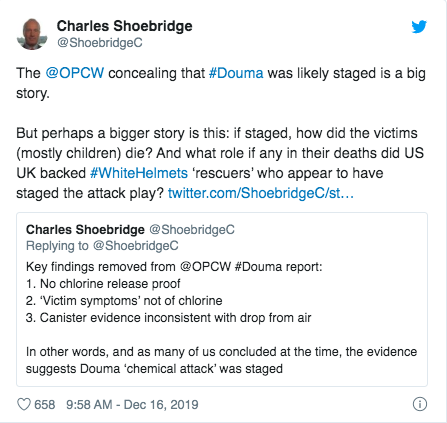
https://twitter.com/ShoebridgeC/status/1206347865729183746?s=20
And now here we are. The US is still illegally occupying Syria in spite of Trump’s repeated verbiage about getting out, and those children are still dead.
This isn’t just some idle philosophical question. People died. A massive war crime occurred and the more minutes tick by before a legitimate investigation is launched–with full transparency and accountability this time–the less available evidence there will be. Which is why establishment narrative managers on Syria go full dead-weight when asked if they support a full criminal investigation into what happened. They don’t actually believe it will go their way, and rightly so.
Meanwhile the illegal occupation of Syria drags on, perhaps until Trump can be replaced with a more compliant puppet, and we’re all basically just sitting around waiting to be deceived again.
This cannot continue. This must not continue.
BBC Director-General Calls for Media Critics to Be Purged From Social Media
By Alan Macleod | MintPress News | December 18, 2019
In the face of a mountain of condemnation over how it provided a key role in helping Boris Johnson win last week’s UK general elections, BBC Director-General Baron Hall of Birkenhead has called for the corporation’s critics to be purged from the internet.
“The conspiracy theories that abound are frustrating… some of the abuse… is sickening. It shouldn’t happen. And I think it’s something social media platforms really need to do more about” he complained. Other BBC employees, who refused to name themselves, also expressed their exasperation to The Guardian over what they called “ludicrous Twitter storms” over “minor errors” in their reporting making it “really tough” working for the corporation.
The BBC is by far the most influential news outlet in the United Kingdom. According to the Media Reform Coalition, its channels account for around 75 percent of all TV news by market share and the company controls over half of the nation’s radio audience. BBC.co.uk is also the number one most visited British media website.
At no point did anyone quoted in the Guardian article accept that the BBC’s coverage of the recent election was anything other than exemplary, a common sentiment among top BBC employees. Veteran news anchor Huw Edwards, for example, described the idea that the organization was biased against Labour as “risible.”
Baron Hall singled out the criticism of BBC Political Editor Laura Kuenssberg – herself a descendant of the German aristocracy – as particularly unpleasant. “Elections always put the BBC’s impartiality in the spotlight. Social media offers a megaphone to those who want to attack us and makes this pressure greater than ever,” he said.
Yet Kuenssberg has been carrying out a sustained, non-stop attack on Labour since Jeremy Corbyn was elected its leader in 2015. A report from the BBC’s own trust concluded that she was so biased that she breached company regulations, an extraordinary finding from the corporation’s own foundation.
Kuenssberg also flouted strict election laws to reveal, while voting was still open, that postal ballots showed an enormous conservative majority was looming, thereby influencing the election. The UK Electoral Commission is currently investigating her. She also reported fake news in the run-up to the election, claiming that a Labour activist had punched a Conservative advisor visiting a hospital. What makes this particularly insidious is that this was part of a coordinated Tory propaganda campaign to divert attention away from the viral news that a four-year-old child had been pictured being treated on the floor of the underfunded and overcrowded hospital, sleeping, while hooked up to machines, on a pile of old coats rather than a bed. The Conservative government is currently in the process of privatizing the National Health Service.
Biased Broadcasting Corporation
Few of the BBC’s 300 million users are aware that the corporation’s genesis lay in helping the Tory government crush the 1926 general strike that threatened to bring about a socialist revolution to the UK. According to media historian Tom Mills, the BBC became a “vital instrument of propaganda for a government determined to break the strike.” putting out non-stop state propaganda and banning the Labour Party from the airwaves. As the strike was broken, the BBC reported on the “nation’s happy escape.” Its Director-General at the time said that the BBC had “saved” the UK and that if Louis the Sixteenth had had a national broadcaster, the French Revolution would never have happened.
During the 1980s, the BBC put out round-the-clock propaganda for Conservative Prime Minister Margaret Thatcher in her war against the miners’ strike, doctoring footage to make it seem like miners had attacked the police, when, in fact, it had been the other way around. The failure of the miners’ strike led to the complete re-organization of the UK along neoliberal lines and the end of centuries of industrialization and increases in living standards.
More recently, the BBC proved crucial in propagandizing the public during the Iraq War and the Scottish independence referendum. The BBC’s bias has also spurred a rich tradition of academic critique. Yet those same academics are now facing suspension from social media if Baron Hall gets his way.
A Chilling Blow for Free Speech
The purging of dissent of the corporate state is something MintPress News has covered in depth. While few progressives shed tears at the news that a number of media giants like YouTube, Facebook, Spotify and Pinterest all took the seemingly coordinated decision to ban notorious radio show host and Infowars founder Alex Jones from their platforms, the precedent that it set was immediately used to silence more genuine independent voices. Facebook shut down the pages of Occupy London, the Black Agenda Report and Venezuelanalysis. Others, such as Venezuelan President Nicolas Maduro and the Ron Paul Institute’s Daniel McAdams were banned from Twitter for trivial reasons.
Furthermore, media giants have, under the guise of fighting hate speech and fake news, attempted to tighten the corporate grip over the means of communication by changing their algorithms to promote official sources like CNN, Fox News and the BBC and demoting, de-ranking or simply deleting alternative media such as MintPress News. As a result, alternative media have seen their traffic, and therefore their influence and income plummet.
Studies have shown that a majority of the world’s population does not trust the media. One survey found that around three-quarters of Americans believe mainstream media intentionally prints false or highly misleading stories for financial or political gain. Yet even as mainstream bias is becoming more evident, those same outlets are calling for the silencing of any criticism of them, good faith or otherwise.
What an upside-down world we live in where an affable pacifist vegetarian like Jeremy Corbyn was turned into a bloodthirsty tyrannical terrorist and where those calling loudest for top-down censorship of speech are precisely journalists working for the West’s most prestigious media outlets.
Alan MacLeod is a MintPress Staff Writer as well as an academic and writer for Fairness and Accuracy in Reporting. His book, Bad News From Venezuela: Twenty Years of Fake News and Misreporting was published in April.
Seoul shows ‘preemptive strike’ with F-35s & boasts of ‘glorious victory’ over Pyongyang in propaganda video
RT | December 14, 2019
The South Korean Air Force has put out an incendiary video simulating a preemptive attack on its northern neighbor using a high-tech arsenal of US-supplied weapons. Pyongyang is unlikely to receive the clip in holiday spirits.
The promotional video depicts computer generated F-35 fighters and other jets launching strikes on North Korean positions, clearly marked with bright red stars – in case there was any mystery about who the message was intended for.
Published earlier this week, the four-minute video begins with a US-made Global Hawk spy drone detecting enemy activity, at one point showing what appears to be a North Korean Hwasong-14 ICBM platform just before it’s blown apart in a dramatic explosion. A narrator speaking in Korean then pledges the “glory of victory is promised under any circumstances,” according to JTBC, a South Korean TV network.
The provocative clip was released on the heels of the latest North Korean rocket engine test late last week, which some have speculated could be its first step toward developing a long-range ballistic missile capability. While insisting its weapons are purely for self-defense, Pyongyang has steadily ramped up such tests as denuclearization talks with the US falter and a year-end deadline set by North Korea to revive negotiations fast approaches.
Earlier this month, North Korean Vice Minister of Foreign Affairs Ri Thae Song placed the ball squarely in Washington’s court, stating it is now “entirely up to the US what Christmas gift it will select” from the Hermit Kingdom, though failed to specify what “gifts” the country may have on offer.
Seoul inked a deal with Washington in 2014 to buy several dozen F-35A stealth fighters to the tune of $6.8 billion, and is currently on track to operate a total of 40 of the aircraft by 2021. Another deal was struck the same year for 30 RQ-4 Global Hawk surveillance drones, another American system. Such arms sales are regarded by Pyongyang as acts of hostility, a conclusion which regular US-South Korean war games – rehearsing a full-scale invasion of the North – have done nothing to dissuade.
Greece Mandates Electronic Payments
Corbett • 12/12/2019
Welcome back to New World Next Week – the video series from Corbett Report and Media Monarchy that covers some of the most important developments in open source intelligence news. This week:
Watch this video on BitChute / Minds.com / YouTube or Download the mp4
Story #1: NIST Publishes New FAQ on Its Refusal to Release Key Building 7 Data
FAQs – NIST WTC 7 Investigation
#PropagandaWatch: When is the News Not the News?
Story #2: Greeks Set to Face Heavy Fines If They Don’t Spend 30% of Their Income Electronically
The Plan to Turn Your Car into Virtual ATM
BMW Adding Android Auto To Its Infotainment System
Story #3: Two Pigs Engineered With Monkey Cells Born, Died In China
China Gene-Edited Baby Experiment “May Have Created Unintended Mutations”
China Raises Ethical Concern By Recreating Faces Using DNA Samples
You can help support our independent and non-commercial work by visiting http://CorbettReport.com/Support & http://MediaMonarchy.com/Join. Thank You.
The interview with President al-Assad that Italian Rai News 24 refrained from broadcasting

SANA- December 9، 2019
Damascus – President Bashar al-Assad said that Syria is going to come out of the war stronger and the future of Syria is promising and the situation is much better, pointing out to the achievements of the Syrian Arab army in the war against terrorism.
The President, in an interview given to Italian Rai News 24 TV on November 26,2019 and was expected to be broadcast on December 2nd and the Italian TV refrained from broadcasting it for non-understandable reasons, added that Europe was the main player in creating chaos in Syria and the problem of refugees in it was because of its direct support to terrorism along with the US, Turkey and many other countries.
President al-Assad stressed that since the beginning of the narrative regarding the chemical weapons, Syria has affirmed it didn’t use them.
The President affirmed that what the OPCW organization did was to fake and falsify the report about using chemical weapons, just because the Americans wanted them to do so. So, fortunately, this report proved that everything we said during the last few years, since 2013, is correct.
Following is the full text of the interview;
Question 1: Mr. President, thanks for having us here. Let us know please, what’s the situation in Syria now, what’s the situation on the ground, what is happening in the country?
President Assad: If we want to talk about Syrian society: the situation is much, much better, as we learned so many lessons from this war and I think the future of Syria is promising; we are going to come out of this war stronger.
Talking about the situation on the ground: The Syrian Army has been advancing for the last few years and has liberated many areas from the terrorists, there still remains Idleb where you have al-Nusra that’s being supported by the Turks, and you have the northern part of Syria where the Turks have invaded our territory last month.
So, regarding the political situation, you can say it’s becoming much more complicated, because you have many more players that are involved in the Syrian conflict in order to make it drag on and to turn it into a war of attrition.
Question 2: When you speak about liberating, we know that there is a military vision on that, but the point is: how is the situation now for the people that decided to be back in society? The process of reconciliation, now at what point? Is it working or not?
President Assad: Actually, the methodology that we adopted when we wanted to create let’s say, a good atmosphere – we called it reconciliation, for the people to live together, and for those people who lived outside the control of government areas to go back to the order of law and institutions. It was to give amnesty to anyone, who gives up his armament and obey the law. The situation is not complicated regarding this issue, if you have the chance to visit any area, you’ll see that life is getting back to normal.
The problem wasn’t people fighting with each other; it wasn’t like the Western narrative may have tried to show – as Syrians fighting with each other, or as they call it a “civil war,” which is misleading. The situation was terrorists taking control of areas, and implementing their rules. When you don’t have those terrorists, people will go back to their normal life and live with each other. There was no sectarian war, there was no ethnic war, there was no political war; it was terrorists supported by outside powers, they have money and armaments, and they occupy those areas.
Question 3: Aren’t you afraid that this kind of ideology that took place and, you know, was the basis of everyday life for people for so many years, in some ways can stay in the society and sooner or later will be back?
President Assad: This is one of the main challenges that we’ve been facing. What you’re asking about is very correct. You have two problems. Those areas that were out of the control of government were ruled by two things: chaos, because there is no law, so people – especially the younger generation – know nothing about the state and law and institutions.
The second thing, which is deeply rooted in the minds, is the ideology, the dark ideology, the Wahabi ideology – ISIS or al-Nusra or Ahrar al-Cham, or whatever kind of these Islamist terrorist extremist ideologies.
Now we have started dealing with this reality, because when you liberate an area you have to solve this problem otherwise what’s the meaning of liberating? The first part of the solution is religious, because this ideology is a religious ideology, and the Syrian religious clerics, or let’s say the religious institution in Syria, is making a very strong effort in this regard, and they have succeeded; they succeeded at helping those people understanding the real religion, not the religion that they’ve been taught by al-Nusra or ISIS or other factions.
Question 4: So basically, clerics and mosques are part of this reconciliation process?
President Assad: This is the most important part. The second part is the schools. In schools, you have teachers, you have education, and you have the national curriculum, and this curriculum is very important to change the minds of those young generations. Third, you have the culture, you have the role of arts, intellectuals, and so on. In some areas, it’s still difficult to play that role, so it was much easier for us to start with the religion, second with the schools.
Question 5: Mr. President, let me just go back to politics for an instant. You mentioned Turkey, okay? Russia has been your best ally these years, it’s not a secret, but now Russia is compromising with Turkey on some areas that are part of Syrian area, so how do you assess this?
President Assad: To understand the Russian role, we have to understand the Russian principles. For Russia, they believe that international law – and international order based on that law – is in the interest of Russia and in the interest of everybody in the world. So, for them, by supporting Syria they are supporting international law; this is one point. Secondly, being against the terrorists is in the interest of the Russian people and the rest of the world.
So, being with Turkey and making this compromise doesn’t mean they support the Turkish invasion; rather they wanted to play a role in order to convince the Turks that you have to leave Syria. They are not supporting the Turks, they don’t say “this is a good reality, we accept it and Syria must accept it.” No, they don’t. But because of the American negative role and the Western negative role regarding Turkey and the Kurds, the Russians stepped in, in order to balance that role, to make the situation… I wouldn’t say better, but less bad if you want to be more precise. So, in the meantime, that’s their role. In the future, their position is very clear: Syrian integrity and Syrian sovereignty. Syrian integrity and sovereignty are in contradiction with the Turkish invasion, that is very obvious and clear.
Question 6: So, you’re telling me that the Russians could compromise, but Syria is not going to compromise with Turkey. I mean, the relation is still quite tense.
President Assad No, even the Russians didn’t make a compromise regarding the sovereignty. No, they deal with reality. Now, you have a bad reality, you have to be involved to make some… I wouldn’t say compromise because it’s not a final solution. It could be a compromise regarding the short-term situation, but in the long-term or the mid-term, Turkey should leave. There is no question about it.
Question 7: And in the long-term, any plan of discussions between you and Mr. Erdogan?
President Assad: I wouldn’t feel proud if I have to someday. I would feel disgusted to deal with those kinds of opportunistic Islamists, not Muslims, Islamists – it’s another term, it’s a political term. But again, I always say: my job is not to be happy with what I’m doing or not happy or whatever. It’s not about my feelings, it’s about the interests of Syria, so wherever our interests go, I will go.
Question 8: In this moment, when Europe looks at Syria, apart from the considerations about the country, there are two major issues: one is refugees, and the other one is the Jihadists or foreign fighters coming back to Europe. How do you see these European worries?
President Assad: We have to start with a simple question: who created this problem? Why do you have refugees in Europe? It’s a simple question: because of terrorism that’s being supported by Europe – and of course the United States and Turkey and others – but Europe was the main player in creating chaos in Syria. So, what goes around comes around.
Question 9: Why do you say it was the main player?
President Assad: Because they publicly supported, the EU supported the terrorists in Syria from day one, week one or from the very beginning. They blamed the Syrian government, and some regimes like the French regime sent armaments, they said – one of their officials – I think their Minister of Foreign Affairs, maybe Fabius said “we send.” They sent armaments; they created this chaos. That’s why a lot of people find it difficult to stay in Syria; millions of people couldn’t live here so they had to get out of Syria.
Question 10: In this moment, in the region, there are turmoil, and there is a certain chaos. One of the other allies of Syria is Iran, and the situation there is getting complicated. Does it have any reflection on the situation in Syria?
President Assad: Definitely, whenever you have chaos, it’s going to be bad for everyone, it’s going to have side-effects and repercussions, especially when there is external interference. If it’s spontaneous, if you talk about demonstrations and people asking for reform or for a better situation economically or any other rights, that’s positive. But when it’s for vandalism and destroying and killing and interfering from outside powers, then no – it’s definitely nothing but negative, nothing but bad, and a danger on everyone in this region.
Question 11: Are you worried about what’s happening in Lebanon, which is really the real neighbor?
President Assad: Yes, in the same way. Of course, Lebanon would affect Syria more than any other country because it is our direct neighbor. But again, if it’s spontaneous and it’s about reform and getting rid of the sectarian political system, that would be good for Lebanon. Again, that depends on the awareness of the Lebanese people in order not to allow anyone from the outside to try to manipulate the spontaneous movement or demonstrations in Lebanon.
Question 12: Let’s go back to what is happening in Syria. In June, Pope Francis wrote you a letter asking you to pay attention and to respect the population, especially in Idleb where the situation is still very tense, because there is fighting there, and when it comes even to the way prisoners are treated in jails. Did you answer him, and what did you answer?
President Assad: The letter of the Pope was about his worry for civilians in Syria and I had the impression that maybe the picture in the Vatican is not complete. That’s to be expected, since the mainstream narrative in the West is about this “bad government” killing the “good people;” as you see and hear in the same media – every bullet of the Syrian Army and every bomb only kills civilians and only hospitals! they don’t kill terrorists as they target those civilians! which is not correct.
So, I responded with a letter explaining to the Pope the reality in Syria – as we are the most, or the first to be concerned about civilian lives, because you cannot liberate an area while the people are against you. You cannot talk about liberation while the civilians are against you or the society. The most crucial part in liberating any area militarily is to have the support of the public in that area or in the region in general. That has been clear for the last nine years and that’s against our interests.
Question 13: But that kind of call, in some ways, made you also think again about the importance of protecting civilians and people of your country.
President Assad: No, this is something we think about every day, not only as morals, principles and values but as interests. As I just mentioned, without this support – without public support, you cannot achieve anything… you cannot advance politically, militarily, economically and in every aspect. We couldn’t withstand this war for nine years without the public support and you cannot have public support while you’re killing civilians. This is an equation, this is a self-evident equation, nobody can refute it. So, that’s why I said, regardless of this letter, this is our concern.
But again, the Vatican is a state, and we think that the role of any state – if they worry about those civilians, is to go to the main reason. The main reason is the Western role in supporting the terrorists, and it is the sanctions on the Syrian people that have made the situation much worse – and this is another reason for the refugees that you have in Europe now. You don’t want refugees but at the same time you create the situation or the atmosphere that will tell them “go outside Syria, somewhere else,” and of course they will go to Europe. So, this state, or any state, should deal with the reasons and we hope the Vatican can play that role within Europe and around the world; to convince many states that you should stop meddling in the Syrian issue, stop breaching international law. That’s enough, we only need people to follow international law. The civilians will be safe, the order will be back, everything will be fine. Nothing else.
Question 14: Mr. President, you’ve been accused several times of using chemical weapons, and this has been the instrument of many decisions and a key point, the red line, for many decisions. One year ago, more than one year ago, there has been the Douma event that has been considered another red line. After that, there has been bombings, and it could it have been even worse, but something stopped. These days, through WikiLeaks, it’s coming out that something wrong in the report could have taken place. So, nobody yet is be able to say what has happened, but something wrong in reporting what has happened could have taken place.
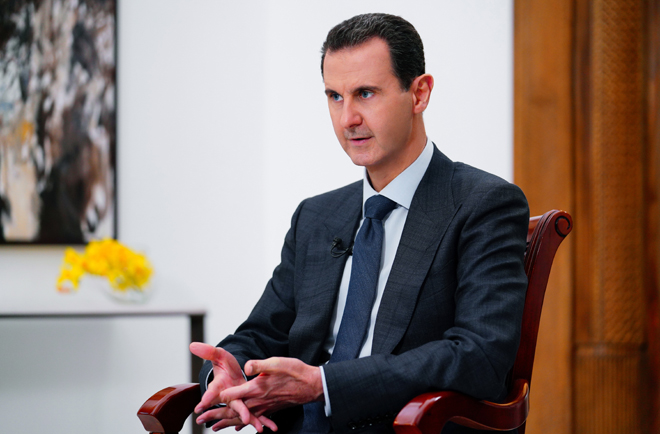 President Assad: We have always – since the beginning of this narrative regarding the chemical weapons – we have said that we didn’t use it; we cannot use it, it’s impossible to be used in our situation for many reasons, let’s say – logistical reasons.
Intervention: Give me one.
President Assad: One reason, a very simple one: when you’re advancing, why would you use chemical weapons?! We are advancing, why do we need to use it?! We are in a very good situation so why use it, especially in 2018? This is one reason.
Second, very concrete evidence that refutes this narrative: when you use chemical weapons – this is a weapon of mass destruction, you talk about thousands of dead or at least hundreds. That never happened, never – you only have these videos of staged chemical weapons attacks. In the recent report that you’ve mentioned, there’s a mismatch between what we saw in the video and what they saw as technicians or as experts. The amount of chlorine that they’ve been talking about: first of all, chlorine is not a mass destruction material, second, the amount that they found is the same amount that you can have in your house, it exists in many households and used maybe for cleaning and whatever. The same amount exactly. That’s what the OPCW organisation did – they faked and falsified the report, just because the Americans wanted them to do so. So, fortunately, this report proved that everything we said during the last few years, since 2013, is correct. We were right, they were wrong. This is proof, this is concrete proof regarding this issue. So, again, the OPCW is biased, is being politicized and is being immoral, and those organisations that should work in parallel with the United Nations to create more stability around the world – they’ve been used as American arms and Western arms to create more chaos.
Question 15: Mr. President, after nine years of war, you are speaking about the mistakes of the others. I would like you to speak about your own mistakes, if any. Is there something you would have done in a different way, and which is the lesson learned that can help your country?
President Assad: Definitely, for when you talk about doing anything, you always find mistakes; this is human nature. But when you talk about political practice, you have two things: you have strategies or big decisions, and you have tactics – or in this context, the implementation. So, our strategic decisions or main decisions were to stand against terrorism, to make reconciliation and to stand against the external meddling in our affairs. Today, after nine years, we still adopt the same policy; we are more adherent to this policy. If we thought it was wrong, we would have changed it; actually no, we don’t think there is anything wrong in this policy. We did our mission; we implemented the constitution by protecting the people.
Now, if you talk about mistakes in implementation, of course you have so many mistakes. I think if you want to talk about the mistakes regarding this war, we shouldn’t talk about the decisions taken during the war because the war – or part of it, is a result of something before.
Two things we faced during this war: the first one was extremism. The extremism started in this region in the late 60s and accelerated in the 80s, especially the Wahabi ideology. If you want to talk about mistakes in dealing with this issue: then yes, I will say we were very tolerant of something very dangerous. This is a big mistake we committed over decades; I’m talking about different governments, including myself before this war.
The second one, when you have people who are ready to revolt against the order, to destroy public properties, to commit vandalism and so on, they work against their country, they are ready to go and work for foreign powers – foreign intelligence, they ask for external military interference against their country. So, this is another question: how did we have those? If you ask me how, I would tell you that before the war we had more than 50,000 outlaws that weren’t captured by the police for example; for those outlaws, their natural enemy is the government because they don’t want to go to prison.
Question 16: And how about also the economic situation? Because part of it – I don’t know if it was a big or small part of it – but part of it has also been the discontent and the problems of population in certain areas in which economy was not working. Is it a lesson learned somewhere?
President Assad: It could be a factor, but definitely not a main factor. Some people talk about the four years of drought that pushed the people to leave their land in the rural areas to go to the city… it could be a problem, but this is not the main problem. They talked about the liberal policy… we didn’t have a liberal policy, we’re still socialist, we still have a public sector – a very big public sector in government. You cannot talk about liberal policy while you have a big public sector. We had growth, good growth.
Of course, in the implementation of our policy, again, you have mistakes. How can you create equal opportunities between people? Between rural areas and between the cities? When you open up the economy, the cities will benefit more, that will create more immigration from rural areas to the cities… these are factors, that could play some role, but this is not the issue. In the rural areas where you have more poverty, the money of the Qataris played a more actual role than in the cities, that’s natural. You pay them in half an hour what they get in one week; that’s very good for them.
Question 17: We are almost there, but there are two more questions that I want to ask you. One is about reconstruction, and reconstruction is going to be very costly. How can you imagine to afford this reconstruction, who could be your allies in reconstruction?
President Assad: We don’t have a big problem with that. Talking that Syria has no money… no, actually Syrians have a lot of money; the Syrian people around the world have a lot of money, and they want to come and build their country. Because when you talk about building the country, it is not giving money to the people, it’s about getting benefit – it’s a business. So, many people, not only Syrians, want to do business in Syria. So, talking about where you can have funds for this reconstruction, we already have, but the problem is that these sanctions prevent those businessmen or companies from coming and working in Syria. In spite of that, we started and in spite of that, some foreign companies have started finding ways to evade these sanctions and we have started planning. It’s going to be slow, without the sanctions we wouldn’t have a problem with funding.
Question 18: Ending on a very personal note, Mr. President; do you feel like a survivor?
President Assad: If you want to talk about a national war like this, where nearly every city has been harmed by terrorism or external bombardment and other things, then you can talk about all the Syrians as survivors. I think this is human nature: to be a survivor.
Intervention: And you yourself?
President Assad: I’m a part of those Syrians. I cannot be disconnected from them; I have the same feeling. Again, it’s not about being a strong person who is a survivor. If you don’t have this atmosphere, this society, or this incubator to survive, you cannot survive. It’s collective; it’s not a single person, it’s not a one-man show.
Journalist: Thank you very much, Mr. President.
President Assad: Thank you.
The Douma Hoax: Anatomy of a False Flag
Corbett • 12/07/2019
As whistleblowers and documents continue to destroy the narrative surrounding the alleged chemical weapons attack in Douma, Syria last year, it is becoming increasingly apparent that this false flag event has been exposed. This week on The Corbett Report podcast, James goes through the remarkable timeline of the Douma hoax and breaks the spell that the propagandists have sought to cast on the public.
For those with limited bandwidth, CLICK HERE to download a smaller, lower file size version of this episode.
For those interested in audio quality, CLICK HERE for the highest-quality version of this episode (WARNING: very large download).
Watch this video on BitChute / Minds.com / YouTube or Download the mp4
SHOW NOTES
Colin Powell’s Presentation to the UN Security Council On Iraq’s WMD Program
Cutting through media propaganda on the battle for Syria’s Eastern Ghouta
Syria crisis: Saudi Arabia to spend millions to train Jaysh al-Islam terrorists
Young children treated in suspected chemical attack in Douma, Syria
Trump blames “animal Assad” for atrocity
United States Assessment of the Assad Regime’s Chemical Weapons Use
U.S. and allies warn Syria of more missile strikes if chemical attacks used again
Statement by President Trump on Syria
The search for truth in the rubble of Douma – and one doctor’s doubts over the chemical attack
OPCW interim report (July 2018)
BBC producer: Footage of 2018 Douma chemical attack fabricated
OPCW final report (March 2019)
Leaked OPCW Report Raises New Questions About 2018 Chemical Attack in Douma, Syria
OPCW internal communique on leak
The OPCW and Douma: Chemical Weapons Watchdog Accused of Evidence-Tampering by Its Own Inspectors
PETER HITCHENS: My secret meeting with mole at the heart of The Great Poison Gas Scandal
Chemical weapons watchdog OPCW defends Syria report as whistleblower claims bias
7 (Bellingcat) Emails And Reading Comprehension: OPCW Douma Coverage Misses Crucial Facts
Narrative Managers Faceplant In Hilarious OPCW Scandal Spin Job
Fox News interview with Tucker Carlson
Bellingcat or Guard Dog for the Establishment?
Douma Videos and Photos analysis by Steven McItnyre
How the OPCW’s investigation of the Douma incident was nobbled
BBC’s One Planet falsely claims that polar bears hunting whales from shore is an unprecedented effect of climate change
By Susan Crockford | Polar Bear Science | November 30, 2019
Polar bears leaping on the backs of belugas off Seal River, in western Hudson Bay, is being falsely promoted by the BBC’s new “Seven Worlds: One Planet” TV special as an unprecedented effect of climate change.
More specifically, the Daily Mail (30 November 2019) this morning quoted the documentary, narrated by Sir David Attenborough, as saying:
‘This extraordinary behaviour has only been recorded here, in this remote corner of North America, and only in the last few years.’
Poppycock. More climate change hyperbole from Attenborough’s seemingly never-ending litany of nonsense that’s easily refuted. There is scientific literature documenting such behaviour in Canada’s far north in the 1980s, which I included in the blog post I wrote about this phenomenon a few months ago (after National Geographic published a similar scare-story), which I have reposted below.
And from the sounds of it, there was no mention in the BBC special that freeze-up along western Hudson Bay was early again this year: for the third year in a row. So if the footage was filmed any time since 2017, the claim of accelerating sea ice loss in this region and bears on land for longer than ever is pure fantasy. PS. Fat bears are not ‘starving’.
Reposted from May 6, 2019
This time National Geographic’s ‘Hostile Planet’ series laughably claims a fat polar bear that’s caught a beluga calf off the coast of Western Hudson Bay has been saved from starvation! The message: here is a prime example of climate change pushing a species to its limit. This is nonsense, of course: polar bears hunting beluga whales from rocks has nothing to do with climate change or desperately hungry bears. More importantly, there is a much better video of the action that is both more informative and truthful.
See both below and decide which you’d prefer your kids or grandkids to watch.
National Geographic footage with focus on climate change
First, here is the polar bear sequence from the ‘Hostile Planet’ series, which it has clearly released for distribution to the media:
Applying standard media hyperbole, Rolling Stone Magazine rephrased this to read “See a Starving Polar Bear Hunt for Beluga Whales” as if viewers can’t see the rolls of fat on this bear with their own eyes. Says Rolling Stone, 6 May 2019 [links in the original, my bold]:
“Some scientists fear a third of the polar bears in the world may be gone by 2030 due to climate change and how it will affect future sea conditions. To show how the species is struggling to survive as they search for food, National Geographic captured a moment where a starving polar bear hunts a pod of beluga whales in open water in Canada’s Hudson Bay. Featured in Hostile Planet‘s finale on Monday, it’s a chilling a reminder of how the Arctic predators are desperate to find prey to meet their needs.
The six-part nature docuseries, hosted and narrated by Bear Grylls, zooms in on the world’s most extreme habitats to reveal the animal kingdom’s most dramatic stories of survival on our changing planet.
The Hostile Planet series finale airs tonight at 9pmET/PT on National Geographic.”
Wildlife guides on the ground
However, we know from reports from guides at the Seal River Heritage Lodge that polar bears hunting beluga from rocks were observed in late summer (August/September) 2017 at the mouth of the Seal River, which is north of Churchill on Western Hudson Bay (see map below). This was the same summer a litter of triplet cubs were spotted in the area, discussed in the same report.

A photo of a Seal River polar bear hunting beluga from a rock, late summer 2017:

CBC nature film footage
As the video below, from CBC’s “The Wild Canadian Year: Summer” narrated by David Suzuki of “The Nature of Things” (uploaded 8 December 2018 to Youtube). I’m no fan of Sukuki’s stance on climate change but am happy to report it does not enter the narrative here, at least in the polar bear clip (I haven’t listened to the rest).
The polar bear hunting beluga sequence starts at 36:50 with the catch at about 42:00.
Clearly, dozens of bears have learned this hunting strategy – probably after watching one local individual give it a try. Polar bear cubs learn hunting skills by watching their mothers, so they are primed to learn a new skill by watching other adults do it. These bears are very smart and learn quickly.
This new hunting strategy had nothing to do with being ‘desperate’ for food, since the bears shown in this video are in excellent condition, as were most bears that summer. Fall freeze-up came early in 2017 (and again in 2018), so they had a shorter wait than usual before they could hunt seals from the ice again.
However, polar bears hunting beluga whale calves in open water is not unheard-of behaviour that has only emerged recently due to climate change: researchers in the 1980s saw bears in the Canadian Arctic hunt beluga calves close to the shore of Somerset Island in a similar if not identical manner (ironically, this is the same island where NG’s equally misleading ‘starving’ polar bear was filmed in 2017). In one case, rather than a rock, a big male bear in 1985 used an isolated pan of ice as a platform from which to leap onto beluga calves swimming in the water (Smith and Sjare 1990:100).
References
Smith, T.G. and Sjare, B. 1990. Predation of belugas and narwhals by polar bears in nearshore areas of the Canadian High Arctic. Arctic 43(2):99-102. DOI: https://doi.org/10.14430/arctic1597
Featured Video
Integrity Initiative: UK-funded network framed dissent as Russian disinformation for years
or go to
Aletho News Archives – Video-Images
From the Archives
Why Saudi Ties to 9/11 Mean U.S. Ties to 9/11
By Kevin Ryan | Dig Within | September 27, 2015
Media interest in Saudi Arabian connections to the crimes of 9/11 has centered on calls for the release of the 28 missing pages from the Joint Congressional Inquiry’s report. However, those calls focus on the question of hijacker financing and omit the most interesting links between the 9/11 attacks and Saudi Arabia—links that implicate powerful people in the United States. Here are twenty examples. … continue
Blog Roll
 Aletho News
- Neria Leiter Was A Legitimate Military Target
- Integrity Initiative: UK-funded network framed dissent as Russian disinformation for years
- ‘We don’t seek permission to defend our country’: Snippets from President Pezeshkian’s UNGA address
- NATO chief wants Europeans to fight American wars [for Israel]
- German chemicals giant reveals details of downsizing
- Refaat Al-Areer Was The Canary In The Coal Mine In Israel’s War On The Truth
- Israeli election committee bars candidate from Knesset race over Gaza war opposition
- French-Lebanese man files war crimes complaint over Israeli attacks
- Mahan Air Flight Lands in China Despite US Threat against Iranian Airlines
- US eyes $10bn fund to rebuild war-battered Gulf infrastructure
- If Americans Knew
- An error has occurred; the feed is probably down. Try again later.
- No Tricks Zone
- New Study: Earth And Venus Surface Warmth Largely Explained By Convection And Lapse Rate, Not CO2 Or Radiation
- 2025 Nature Paper Claiming Worsening Global Drought Gets RETRACTED …Heavily Flawed
- New Study: ‘Global Drought Shows No Detectable Recent Acceleration Under Climate Warming’
- Economic Masterminds: German Socialists Suggest Taxing Productivity Gains Stemming From Using AI
- The South China Sea Has Not Been Cooperating With The Climate Change Narrative
- Energy Crisis: Germany Enters Heating Season With Historically Low Gas Reserve Fill Levels
- New Study: The Antarctic Ice Sheet Gained Mass From 2020-2024 Due To Staggering Snow And Ice Accumulation
- Study: Ocean Heating Rates From Thousands Of Years Ago ‘Dwarf’ Modern Ocean Heating Rates
- Climate Extremists Target, Attack Large-Scale Power Grid Infrastructure In Germany!
- New Study: Antarctic Ice Melt Has Contributed Less Than 1 Centimeter To Sea Level Rise In The Last 30 Years

