Remembering Muhammad al-Durrah
International Solidarity Movement | September 30, 2015
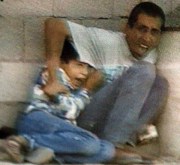 … Filmed by Talal Abu Rahma, a Palestinian cameraman freelancing for France 2, Jamal al-Durrah and his 12-year-old son Muhammad are seen, backs pressed against the wall, Jamal’s arm shielding his young son whose mouth is oval with what must have been a paralyzing fear. And then the shots.
When the cloud of dust cleared, the boy is on his side, draped over his father’s lap.
Throughout an enduing four and a half year widespread Palestinian resistance, with all of its gut wrenching failures, and with the solace and strengths of solidarity en masse coming from both the history before the second intifada and the aftermath in its wake, the slaughter of Muhammad al-Durrah continues to be a defining moment. A young boy viewed guilty through the eyes of the Israeli military due only to the origin of his birth.
In the investigation to follow, an Israeli-initiated tug of war of blame across the grave of and over Muhammad’s murder ensued. Where initially the Israeli government took blame and expressed public relational regret with an apology, that space soon became occupied with denials, accusations and disturbing tales of Palestinian’s faking the boy’s death. If only Palestinians weren’t so busy mourning the actual mass murders of their children in order to be able to spontaneously arrange for the staged murder of one, a second intifada might not have been necessary, nor a third or a fourth for that matter.
Without politicizing the end of a human life, in a 67 year crime drenched in politics; fifteen years ago today a terrified little boy was shot to death while he hid beside his father. And the world should remember his name.
Warning graphic content! Raw footage of Mohammed ad-Durrah’s final moments of his life:
How To Solve The European Migrant/Refugee Crisis – 5 Simple Steps
Storm Clouds Gathering | September 25, 2015
The refugee crisis in Europe could be easily solved. The problem is that the real solution would not suit the the political establishment of the United States or Western Europe. We’ve distilled what needs to be done down to 5 simple steps.
- Stop funding and arming rebel groups attempting to overthrow the Syrian government. It’s well established that these weapons have been ending up in the hands of ISIS and its affiliates. This has caused nothing but chaos and destruction. Money being funneled into these shady operations should be immediately redirected to an intensive reconstruction effort.
- Pressure Turkey and Jordan to cut off ISIS supply routes, and impose sanctions on any country facilitating the sale of oil from IS territory or allowing funds or materials to reach them. No army can function if their supply chain is broken. It’s not an accident these routes start at the Turkish and Jordanian borders.
- Support the Syrian government. An entire year of U.S. airstrikes in Syria have utterly failed to destroy or even significantly weaken ISIS. Of course this is because the real strategy isn’t to bring ISIS down, but rather to contain them and allow them to weaken Assad gradually. If Washington really wanted to stop this group, they would take a hint from Russia and provide the Syrian government with weapons, training and logistical support to enable them to push ISIS back. This means Washington and its allies would have to officially abandon all plans for a forced regime change. They might not like Assad, but the majority of the citizens of Syria support him. In fact he has more support within his country than Obama or the U.S. congress have in America. And at various intervals he’s had more support than Congress and Obama combined. Any government installed after a U.S. backed regime change will be viewed as a puppet government, and will therefore lack the legitimacy needed to stabilize the region. If you need evidence of this, just look at Afghanistan or Iraq.
- Provide direct assistance to rebuild housing, infrastructure and businesses destroyed by the conflict. In the short term temporary refugee camps should be set up in areas outside of the conflict zone, and food and medical supplies shipped in on a regular basis. Yes this will cost money, but so has the five year regime change push that created the problem in the first place.
- Return the refugees to these stabilized regions. It is in no one’s interest to flood Europe with masses of unemployed refugees. Doing so will only lead to heightened tensions and will strengthen xenophobic movements. These people don’t need to be transplanted into the ghettos of Europe, they need their homes back.
Unprovoked, Israeli Soldiers Attack AFP Journalists in West Bank
Sputnik – 26.09.2015
While covering a demonstration in the West Bank, two journalists with Agence France-Presse were attacked by Israeli soldiers, who then proceeded to destroy their equipment.
Andrea Bernardi and Abbas Momani were near the village of Beit Furik on Friday. On assignment for AFP, the two journalists were reporting on a protest that followed the funeral of a Palestinian man shot by Israeli security forces.
In covering the events, Bernardi and Momani were themselves attacked by Israeli soldiers.
“They had passed the first checkpoint of the border police with their press cards without problem,” AFP bureau chief Thomas Cox told the Guardian. “Andrea paused to check his camera setting and as he was doing so a soldier immediately arrived and told him to stop filming and pushed his camera.”
“He then took the camera and smashed it.”
Video of the incident shows the journalists walking away, only to be chased down by another soldier who destroys more of the pair’s equipment.
According to Cox, Bernardi later went back to recover his camera, and things escalated from there.
“At this point a soldier jumped on him and put a pistol on his face and attacked him.”
“It was crazy,” Bernardi told the Guardian. “When we arrived at the border police checkpoint we showed our documents. There was no problem. They were being nice.”
“We passed the first line of soldiers loading teargas. I heard screaming and a soldier started pushing and shouting ‘what the f*ck are you doing’ in English. I then [realized] he was loading this gun and I thought ‘what the…’ and we started walking back.”
Bernardi notes that if either he or Momani had been guilty of some crime that they would have been arrested, but that never happened.
“After we got back to the car I saw a piece of the camera and wanted to take a picture of it because I was worried they would accuse me of doing something wrong,” he said. “That’s when a soldier pointed a pistol in my face and pulled me down.”
AFP has announced its intention to file a formal complaint. … Full article
Washington State Cops Who Killed Unarmed Mexican Man Return to Work
© Family Photo
Sputnik | 24.09.2015
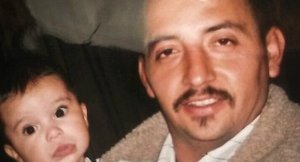
In February, the Pasco police made global headlines after three officers were caught on camera firing 17 bullets at an unarmed man in the back as he ran away from them with his hands in the air.
Now, after the officers received seven months of paid administrative leave for the shooting of Mexican national Antonio Zambrano-Montes, who was 35, they have been cleared of any wrongdoing. Two of the officers will be reportedly returning to work effective “immediately,” while the third, Ryan Flanagan, has parted ways with the department for unknown reasons.
The incident took place on February 10, when police were called to an intersection because of a man allegedly throwing rocks at vehicles. The department claims that Zambrano-Montes, who has a history of mental illness, ran after hitting two of the officers with rocks, Fusion reported.
Zambrano-Montes was the fourth person killed by officers in the department in less than a year.
A video of the incident, filmed by Dario Infante Zuniga, 21, went massively viral, collecting over 1,600,000 views within nine days. It has now been viewed over two million times.
Approximately one week after the shooting, the Pasco Police Department announced that they had launched a “full investigation into their victim” — instead of the officers who shot him.
Ken Lattin, a spokesperson for the Kennewick Police Department, stated in February that he was trying to piece together what Zambrano-Montes was doing “hours, days, and weeks leading up to this incident.”
“It’s curious that when you ask them about the past of some of the officers, they say that information is not pertinent to the investigation,” Felix Vargas, chair of Consejo Latino, a local organization of Hispanic-owned businesses, said after a briefing, Fusion reported.
“But somehow what Zambrano was doing weeks before this incident is vital information.”
While activists and commentators have expressed remorse, anger, and sadness over the lack of charges and the officers returning to their duties, many have noted that it was to be expected, as the cops were never really the ones under investigation.
Tactical retreat: NATO for the first time criticizes Ukraine’s government
German Economic News | 22.09.15
New sounds are being heard at NATO: for the first time, NATO criticizes not the arch-enemy Russia, but the Government in Kiev, which is funded by the EU, telling them to adhere to the Minsk agreements.
Whether Kiev can be trusted to adhere to anything, is another question: The country’s extreme right have imposed a blockade of Crimea [contrary to Minsk] — without the government obstructing them at all.
NATO Secretary General Jens Stoltenberg has called upon Ukraine to implement the peace plan for the war zone in Donbass. “It is extremely important that Ukraine continue to implement all aspects of the Minsk agreements,” he said on Tuesday in Kiev. No other solution to the conflict exists. Stoltenberg was attending a meeting of the Ukrainian Security Council, the first NATO chief to do so. He then signed an agreement on a planned NATO representative in Kiev.
Ukraine’s President Petro Poroshenko confirmed plans for a referendum on a possible NATO membership for the former Soviet republic. “De jure we are not a member of NATO, but de facto we are more than just partners,” stressed Poroshenko.
Since early September in eastern Ukraine, a ceasefire between government forces and the rebels is holding reasonably well. In fact, that is why the OSCE is concerned that the Donbass civilian population could be exposed to extreme cold during the winter, without being able to protect themselves. The water system has been destroyed virtually throughout the region, many areas are mined. The OSCE called on Ukraine a few days ago to withdraw their army, so that the residents in rebel-controlled areas with the worst damage can do at least makeshift repairs.
There is disagreement, however, over [two aspects of the Mink agreement] a desired weapons withdrawal from the front, as well as local elections according to Ukrainian law in the breakaway regions. The rebels showed a willingness to compromise, possibly to postpone their planned October 18 and November 1 elections till the end of February. In the Belarusian capital Minsk, the Ukraine Contact Group wanted to discuss on Tuesday the peace plan.
Already former Federal Foreign Minister Frank-Walter Steinmeier had shown himself to be unusually confident that the war in Ukraine can be contained for the time being. Americans and Russians seem to have reached initial agreement, to co-operate in Syria. And neither of the two great powers can win much right now in Ukraine. Furthermore, EU taxpayers have taken on the financing of Ukraine, providing breathing-room for the conflict there between the U.S. and Russia.
The NATO communication is a tactical measure, as shown, above all, by the announcement that a NATO Embassy will be established in Ukraine. Furthermore, the United States have just started the deployment of new nuclear weapons in Germany, which is regarded by the Russians as a provocation. The Bundestag had expressly rejected this development some time ago. But German Chancellor Angela Merkel considers it right — thus also needlessly complicating a possible mediating role for Germany in the Ukrainian conflict.
The biggest unknown, however, in the short term, is the unstable political situation within Ukraine. A few days ago a senior right-wing extremist was killed in an explosion. The right-wing extremists are plotting revenge. The civil war might shift to the Western Ukraine.
The regional power of the right-wing is also likely to escalate the conflict with Russia again: Right-wing extremists, whom the government of Ukraine allows to move freely even in the war-zone, refuse to comply with Ukrainian law, and have blocked the highways connecting Crimea to the East of Ukraine. This blockade, which is supported by anti-Crimean Tatars outside of Crimea, could cause supply problems before winter (see the video at the beginning of the article [It’s in English!]).
Translation by Eric Zuesse
Investigative historian Eric Zuesse is the author, most recently, of They’re Not Even Close: The Democratic vs. Republican Economic Records, 1910-2010, and of CHRIST’S VENTRILOQUISTS: The Event that Created Christianity.
Around 200 masked men storm Kharkov city hall in Eastern Ukraine
© slava.mavrichev / Facebook
RT – September 23, 2015
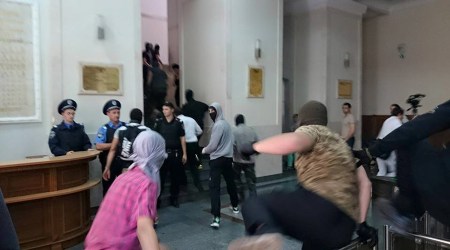
At least 200 people wearing camouflage and masks stormed the local administration building in the city of Kharkov, eastern Ukraine, local media said. The perpetrators are alleged to be members of the radical Azov battalion.
The masked men reportedly clashed with police and security forces at the city’s administration building. Those who have entered the building have also reportedly used tear gas, the Ukrainian 112 channel is saying.
The masked activists were seen holding flags with the insignia of the radical Azov Battalion, which is accused of committing numerous human rights violations in Eastern Ukraine, according to international watchdogs.
“There have been several small clashes between police and people in balaclavas. A few minutes ago somebody let off tear gas. The entrance to the city council is surrounded by a tight police cordon,” a journalist at the scene, from the 112 channel reported.
Earlier, at least 50 people wearing camouflage and balaclavas had taken part in a protest in front of the residence of the local politician, Mikhail Dobkin, who represents the ‘Opposition Bloc’ political party, which wants to find a peaceful solution to the current crisis in Ukraine. The masked men had not set out any demands. However, they were reported to have stated their aim was to “to throw Dobkin out of the city and not to let Kernes become Kharkov’s mayor,” according to the 112 channel.
Gennady Kernes has been the mayor of Kharkov since March 2010. Before the coup in Ukraine, he had been a strong supporter of President Viktor Yanokovich. However, he subsequently switched sides and has backed the new Ukrainian government in order to keep his position.
‘West crying for refugees with one eye, aiming gun with the other’ – Assad (FULL INTERVIEW)
RT | September 16, 2015
In a rare interview with Russian media outlets, RT among them, Syrian leader Bashar Assad spoke about global and domestic terrorism threats, the need for a united front against jihadism, Western propaganda about the refugee crisis and ways to bring peace to his war-torn nation.
Question 1:Mr. President, thank you from the Russian media, from RT, from Rossiyskaya Gazeta, Channel 1, Russia 24, RIA Novosti, and NTV channel, for giving us all the opportunity to talk to you during this very critical phase of the crisis in Syria, where there are many questions that need to be addressed on where exactly the political process to achieve peace in Syria is heading, what’s the latest developments on the fight against ISIL, and the status of the Russian and Syrian partnership, and of course the enormous exodus of Syrian refugees that has been dominating headlines in Europe.
Now, the crisis in Syria is entering its fifth year. You have defied all predictions by Western leaders that you would be ousted imminently, and continue to serve today as the President of the Syrian Arab Republic. Now, there has been a lot of speculation recently caused by reports that officials from your government met with officials from your adversary Saudi Arabia that caused speculation that the political process in Syria has entered a new phase, but then statements from Saudi Arabia that continue to insist on your departure suggest that in fact very little has changed despite the grave threat that groups like ISIL pose far beyond Syria’s borders.
So, what is your position on the political process? How do you feel about power sharing and working with those groups in the opposition that continue to say publically that there can be no political solution in Syria unless that includes your immediate departure? Have they sent you any signal that they are willing to team up with you and your government? In addition to that, since the beginning of the crisis in Syria, many of those groups were calling to you to carry out reforms and political change. But is such change even possible now under the current circumstances with the war and the ongoing spread of terror in Syria?
President Assad: Let me first divide this question. It’s a multi question in one question. The first part regarding the political process, since the beginning of the crisis we adopted the dialogue approach, and there were many rounds of dialogue between Syrians in Syria, in Moscow, and in Geneva. Actually, the only step that has been made or achieved was in Moscow 2, not in Geneva, not in Moscow 1, and actually it’s a partial step, it’s not a full step, and that’s natural because it’s a big crisis. You cannot achieve solutions in a few hours or a few days. It’s a step forward, and we are waiting for Moscow 3. I think we need to continue the dialogue between the Syrian entities, political entities or political currents, in parallel with fighting terrorism in order to achieve or reach a consensus about the future of Syria. So, that’s what we have to continue.
If I jump to the last part, because it’s related to this one, is it possible to achieve anything taking into consideration the prevalence of terrorism in Syria and in Iraq and in the region in general? We have to continue dialogue in order to reach the consensus as I said, but if you want to implement anything real, it’s impossible to do anything while you have people being killed, bloodletting hasn’t stopped, people feel insecure. Let’s say we sit together as Syrian political parties or powers and achieve a consensus regarding something in politics, in economy, in education, in health, in everything. How can we implement it if the priority of every single Syrian citizen is to be secure? So, we can achieve consensus, but we cannot implement unless we defeat the terrorism in Syria. We have to defeat terrorism, not only ISIS.
I’m talking about terrorism, because you have many organizations, mainly ISIS and al-Nusra that were announced as terrorist groups by the Security Council. So, this is regarding the political process. Sharing power, of course we already shared it with some part of the opposition that accepted to share it with us. A few years ago they joined the government. Although sharing power is related to the constitution, to the elections, mainly parliamentary elections, and of course representation of the Syrian people by those powers. But in spite of that, because of the crisis, we said let’s share it now, let’s do something, a step forward, no matter how effective.
Regarding the refugee crisis, I will say now that Western dealing in the Western propaganda recently, mainly during the last week, regardless of the accusation that those refugees are fleeing the Syrian government, but they call it regime, of course. Actually, it’s like the West now is crying for the refugees with one eye and aiming at them with a machinegun with the second one, because actually those refugees left Syria because of the terrorism, mainly because of the terrorists and because of the killing, and second because of the results of terrorism. When you have terrorism, and you have the destruction of the infrastructure, you won’t have the basic needs of living, so many people leave because of the terrorism and because they want to earn their living somewhere in this world.
So, the West is crying for them, and the West is supporting terrorists since the beginning of the crisis when it said that this was a peaceful uprising, when they said later it’s moderate opposition, and now they say there is terrorism like al-Nusra and ISIS, but because of the Syrian state or the Syrian regime or the Syrian president. So, as long as they follow this propaganda, they will have more refugees. So, it’s not about that Europe didn’t accept them or embrace them as refugees, it’s about not dealing with the cause. If you are worried about them, stop supporting terrorists. That’s what we think regarding the crisis. This is the core of the whole issue of refugees.
President Assad: As you know, we are at war with terrorism, and this terrorism is supported by foreign powers. It means that we are in a state of complete war. I believe that any society and any patriotic individuals, and any parties which truly belong to the people should unite when there is a war against an enemy; whether that enemy is in the form of domestic terrorism or foreign terrorism. If we ask any Syrian today about what they want, the first thing they would say is: we want security and safety for every person and every family.
So we, as political forces, whether inside or outside the government, should unite around what the Syrian people want. That means we should first unite against terrorism. That is logical and self-evident. That’s why I say that we have to unite now as political forces, or government, or as armed groups which fought against the government, in order to fight terrorism. This has actually happened.
There are forces fighting terrorism now alongside the Syrian state, which had previously fought against the Syrian state. We have made progress in this regard, but I would like to take this opportunity to call on all forces to unite against terrorism, because it is the way to achieve the political objectives which we, as Syrians, want through dialogue and political action.
Intervention: Concerning the Moscow-3 and Geneva-3 conferences; in your opinion, are there good prospects for them?
President Assad: The importance of Moscow-3 lies in the fact that it paves the way to Geneva-3, because the international sponsorship in Geneva was not neutral, while the Russian sponsorship is. It is not biased, and is based on international law and Security Council resolutions. Second, there are substantial differences around the ‘transitional body’ item in Geneva. Moscow-3 is required to solve these problems between the different Syrian parties; and when we reach Geneva-3, it is ensured that there is a Syrian consensus which would enable it to succeed. We believe that it is difficult for Geneva-3 to succeed unless Moscow-3 does. That’s why we support holding this round of negotiations in Moscow after preparations for the success of this round have been completed, particularly by the Russian officials.
Question 3: I would like to continue with the issue of international cooperation in order to solve the Syrian crisis. It’s clear that Iran, since solving the nuclear issue, will play a more active role in regional affairs. How would you evaluate recent Iranian initiatives on reaching a settlement for the situation in Syria? And, in general, what is the importance of Tehran’s support for you? Is there military support? And, if so, what form does it take?
President Assad: At present, there is no Iranian initiative. There are ideas or principles for an Iranian initiative based primarily on Syria’s sovereignty, the decisions of the Syrian people and on fighting terrorism. The relationship between Syria and Iran is an old one. It is over three-and-a-half decades old. There is an alliance based on a great degree of trust. That’s why we believe that the Iranian role is important. Iran supports Syria and the Syrian people. It stands with the Syrian state politically, economically and militarily. When we say militarily, it doesn’t mean – as claimed by some in the Western media – that Iran has sent an army or armed forces to Syria. That is not true. It sends us military equipment, and of course there is an exchange of military experts between Syria and Iran. This has always been the case, and it is natural for this cooperation to grow between the two countries in a state of war. Yes, Iranian support has been essential to support Syria in its steadfastness in this difficult and ferocious war.
Question 4: Concerning regional factors and proponents, you recently talked about security coordination with Cairo in fighting terrorism, and that you are in the same battle line in this regard. How is your relationship with Cairo today given that it hosts some opposition groups? Do you have a direct relationship, or perhaps through the Russian mediator, particularly in light of the strategic relations between Russia and Egypt. President Sisi has become a welcome guest in Moscow today.
President Assad: Relations between Syria and Egypt have not ceased to exist even over the past few years, and even when the president was Mohammed Morsi, who is a member of the terrorist Muslim Brotherhood organisation. Egyptian institutions insisted on maintaining a certain element of this relationship. First, because the Egyptian people are fully aware of what is happening in Syria, and second because the battle we are fighting is practically against the same enemy. This has now become clearer to everyone. Terrorism has spread in Libya, Egypt, Yemen, Syria, Iraq, in other Arab countries, and in some Muslim countries like Afghanistan, Pakistan and others. That’s why I can say that there is joint vision between us and the Egyptians; but our relationship exists now on a security level. There are no political relations. I mean, there are no contacts between the Syrian Foreign Ministry and the Egyptian Foreign Ministry, for instance. Contacts are done on a security level only. We understand the pressures that might be applied on Egypt or on both Syria and Egypt so that they don’t have a strong relationship. This relationship does not go, of course, through Moscow. As I said, this relationship has never ceased to exist, but we feel comfortable about improving relations between Russia and Egypt. At the same time, there is a good, strong and historical relation between Moscow and Damascus, so it is natural for Russia to feel comfortable for any positive development in relations between Syria and Egypt.
Question 5: Mr. President, allow me to go back to the question of fighting terrorism. How do you look at the idea of creating a region free of ISIS terrorists in the north of the country on the border with Turkey? In that context, what do you say about the indirect cooperation between the West and terrorist organizations like the al-Nusra Front and other extremist groups? And with whom are you willing to cooperate and fight against ISIS terrorists?
President Assad: To say that the border with Turkey should be free of terrorism means that terrorism is allowed in other regions. That is unacceptable. Terrorism should be eradicated everywhere; and we have been calling for three decades for an international coalition to fight terrorism. But as for Western cooperation with the al-Nusra Front, this is reality, because we know that Turkey supports al-Nusra and ISIS by providing them with arms, money and terrorist volunteers. And it is well-known that Turkey has close relations with the West. Erdogan and Davutoglu cannot make a single move without coordinating first with the United States and other Western countries. Al-Nusra and ISIS operate with such a force in the region under Western cover, because Western states have always believed that terrorism is a card they can pull from their pocket and use from time to time. Now, they want to use al-Nusra just against ISIS, maybe because ISIS is out of control one way or another. But that doesn’t mean they want to eradicate ISIS. Had they wanted to do so, they would have been able to do that. For us, ISIS, al-Nusra, and all similar organizations which carry weapons and kill civilians are extremist organizations.
But who we conduct dialogue with is a very important question. From the start we said that we engage in dialogue with any party, if that dialogue leads to degrading terrorism and consequently achieve stability. This naturally includes the political powers, but there are also armed groups with whom we conducted dialogue and reached agreement in troubled areas which have become quiet now. In other areas, these armed groups joined the Syrian Army and are fighting by its side, and some of their members became martyrs. So we talk to everyone except organizations I mentioned like ISIS, al-Nusra, and other similar ones for the simple reason that these organizations base their doctrine on terrorism. They are ideological organizations and are not simply opposed to the state, as is the case with a number of armed groups. Their doctrine is based on terrorism, and consequently dialogue with such organizations cannot lead to any real result. We should fight and eradicate them completely and talking to them is absolutely futile.
Intervention: When talking about regional partners, with whom are you prepared to cooperate in fighting terrorism?
President Assad: Certainly with friendly countries, particularly Russia and Iran. Also we are cooperating with Iraq because it faces the same type of terrorism. As for other countries, we have no veto on any country provided that it has the will to fight terrorism and not as they are doing in what is called “the international coalition” led by the United States. In fact, since this coalition started to operate, ISIS has been expanding. In other words, the coalition has failed and has no real impact on the ground. At the same time, countries like Turkey, Qatar, Saudi Arabia, and Western countries which provide cover for terrorism like France, the United States, or others, cannot fight terrorism. You cannot be with and against terrorism at the same time. But if these countries decide to change their policies and realize that terrorism is like a scorpion, if you put it in your pocket, it will sting you. If that happens, we have no objection to cooperating with all these countries, provided it is a real and not a fake coalition to fight terrorism.
Question 6: What is the Syrian army’s current condition? They’ve been fighting for over four years. Are they exhausted by the war, or become stronger as a result of engagement in military operations? And are there reserve forces to support them? I also have another important question: you said a large number of former adversaries have moved to your side and are fighting within the ranks of government forces. How many? And what is the extent of their help in the fight against extremist groups?
President Assad: Of course, war is bad. And any war is destructive, any war weakens any society and any army, no matter how strong or rich a country is. But things cannot be assessed this way. War is supposed to unite society against the enemy. The army becomes the most-important symbol for any society when there is aggression against the country. Society embraces the army, and provides it with all the necessary support, including human resources, volunteers, conscripts, in order to defend the homeland. At the same time, war provides a great deal of expertise to any armed forces practically and militarily. So, there are always positive and negative aspects. We cannot say that the army becomes weaker or stronger. But in return, this social embrace and support for the army provides it with volunteers. So, in answer to your question ‘are there reserves?’… yes, certainly, for without such reserves, the army wouldn’t have been able to stand for four-and-a-half years in a very tough war, particularly since the enemy we fight today has an unlimited supply of people. We have terrorist fighters from over 80 or 90 countries today, so our enemy is enjoying enormous support in various countries, from where people come here to fight alongside the terrorists. As for the army, it’s almost exclusively made of Syrians. So, we have reserve forces, and this is what enables us to carry on. There is also determination. We have reserves not only in terms of human power, but in will as well. We are more determined than ever before to fight and defend our country against terrorists. This is what led some fighters who used to fight against the state at the beginning for varying reasons, discovered they were wrong and decided to join the state. Now they are fighting battles along with the army, and some have actually joined as regular soldiers. Some have kept their weapons, but they are fighting in groups alongside the armed forces in different parts of Syria.
Question 7: Mr. President, Russia has been fighting terrorism for 20 years, and we have seen its different manifestations. It now seems you are fighting it head on. In general, the world is witnessing a new form of terrorism. In the regions occupied by ISIS, they are setting up courts and administrations, and there are reports that it intends to mint its own currency. They are constructing what looks like a state. This in itself might attract new supporters from different countries. Can you explain to us whom are you fighting? Is it a large group of terrorists or is it a new state which intends to radically redraw regional and global borders? What is ISIS today?
President Assad: Of course, the terrorist ISIS groups tried to give the semblance of a state, as you said, in order to attract more volunteers who live on the dreams of the past: that there was an Islamic state acting for the sake of religion. That ideal is unreal. It is deceptive. But no state can suddenly bring a new form to any society. The state should be the product of its society. It should be the natural evolution of that society, to express it. In the end, a state should be a projection of its society. You cannot bring about a state which has a different form and implant it in a society. Here we ask the question: does ISIS, or what they call ‘Islamic State’, have any semblance to Syrian society? Certainly not.
Of course we have terrorist groups, but they are not an expression of society. In Russia, you have terrorist groups today, but they do not project Russian society, nor do they have any semblance to the open and diverse Russian society. That’s why if they tried to mint a currency or have stamps or passports, or have all these forms which indicate the existence of a state, it doesn’t mean they actually exist as a state; first because they are different from the people and, second, because people in those regions flee towards the real state, the Syrian state, the national state. Sometimes they fight them too. A very small minority believes these lies. They are certainly not a state, they are a terrorist group. But if we want to ask about who they are, let’s speak frankly: They are the third phase of the political or ideological poisons produced by the West, aimed at achieving political objectives. The first phase was the Muslim Brotherhood at the turn of the last century. The second phase was al-Qaeda in Afghanistan in order to fight the Soviet Union. And the third phase is ISIS, the al-Nusra Front and these groups. Who are ISIS? And who are these groups? They are simply extremist products of the West.
Question 8: Mr. President, at the beginning of the Syrian crisis, the Kurdish issue started to be discussed more often. Previously, Damascus was severely criticized because of its position towards the Kurdish minority. But now, practically, in some areas, Kurdish formations are your allies in the fight against ISIS. Do you have a specific position towards who the Kurds are to you and who you are to them?
President Assad: First, you cannot say there was a certain state policy concerning the Kurds. A state cannot discriminate between members of its population; otherwise, it creates division in the country. If we had been discriminating between different components of society, the majority of these components wouldn’t have supported the state now, and the country would have disintegrated from the very beginning. For us, the Kurds are part of the Syrian fabric. They are not foreigners – they live in this region like the Arabs, Circassians, Armenians and many other ethnicities and sects who’ve been living in Syria for many centuries. It’s not known when some of them came to this region. Without these groups, there wouldn’t have been a homogenous Syria. So, are they our allies today? No, they are patriotic people. But on the other hand, you cannot put all the Kurds in one category. Like any other Syrian component, there are different currents among them. They belong to different parties. There are those on the left and those on the right. There are tribes, and there are different groups. So, it is not objective to talk about the Kurds as one mass.
There are certain Kurdish demands expressed by some parties, but there are no Kurdish demands for the Kurds. There are Kurds who are integrated fully into society; and I would like to stress that they are not allies at this stage, as some people would like to show. I would like to stress that they are not just allies at this stage, as some suggest. There are many fallen Kurdish soldiers who fought with the army, which means they are an integral part of society. But there are parties which had certain demands, and we addressed some at the beginning of the crisis. There are other demands which have nothing to do with the state, and which the state cannot address. There are things which would relate to the entire population, to the constitution, and the people should endorse these demands before a decision can be taken by the state. In any case, anything proposed should be in the national framework. That’s why I say that we are with the Kurds, and with other components, all of us in alliance to fight terrorism.
This is what I talked about a while ago: that we should unite in order to fight ISIS. After we defeat ISIS, al-Nusra and the terrorists, the Kurdish demands expressed by certain parties can be discussed nationally. There’s no problem with that, we do not have a veto on any demand as long as it is within the framework of Syria’s unity and the unity of the Syrian people and territory, fighting terrorism, Syrian diversity, and the freedom of this diversity in its ethnic, national, sectarian, and religious sense.
Question 9: Mr. President, you partially answered this question, but I would like a more-precise answer, because some Kurdish forces in Syria call for amending the constitution. For instance, setting up a local administration and moving towards autonomy in the north. These statements are becoming more frequent now that the Kurds are fighting ISIS with a certain degree of success. Do you agree with such statements that the Kurds can bet on some kind of gratitude? Is it up for discussion?
President Assad: When we defend our country, we do not ask people to thank us. It is our natural duty to defend our country. If they deserve thanks, then every Syrian citizen defending their country deserves as much. But I believe that defending one’s country is a duty, and when you carry out your duty, you don’t need thanks. But what you have said is related to the Syrian constitution. Today, if you want to change the existing structure in your country, in Russia for instance, let’s say to redraw the borders of the republics, or give one republic powers different to those given to other republics – this has nothing to do with the president or the government. This has to do with the constitution.
The president does not own the constitution and the government does not own the constitution. Only the people own the constitution, and consequently changing the constitution means national dialogue. For us, we don’t have a problem with any demand. As a state, we do not have any objection to these issues as long as they do not infringe upon Syria’s unity and diversity and the freedom of its citizens.
But if there are certain groups or sections in Syria which have certain demands, these demands should be in the national framework, and in dialogue with the Syrian political forces. When the Syrian people agree on taking steps of this kind, which have to do with federalism, autonomy, decentralization or changing the whole political system, this needs to be agreed upon by the Syrian people, and consequently amending the constitution. This is why these groups need to convince the Syrian people of their proposals. In that respect, they are not in dialogue with the state, but rather with the people. When the Syrian people decide to move in a certain direction, and to approve a certain step, we will naturally approve it.
Question 10: Now, the U.S.-led coalition has been carrying out airstrikes on Syrian territory for about one year on the same areas that the Syrian Air Force is also striking ISIL targets, yet there hasn’t been a single incident of the U.S.-led coalition and the Syrian Air Force activity clashing with one another. Is there any direct or indirect coordination between your government and the U.S. coalition in the fight against ISIL?
President Assad: You’d be surprised if I say no. I can tell you that my answer will be not realistic, to say now, while we are fighting the same, let’s say enemy, while we’re attacking the same target in the same area without any coordination and at the same time without any conflict. And actually this is strange, but this is reality. There’s not a single coordination or contact between the Syrian government and the United States government or between the Syrian army and the U.S. army. This is because they cannot confess, they cannot accept the reality that we are the only power fighting ISIS on the ground. For them, maybe, if they deal or cooperate with the Syrian Army, this is like a recognition of our effectiveness in fighting ISIS. This is part of the willful blindness of the U.S. administration, unfortunately.
Question 11: So not event indirectly though, for example the Kurds? Because we know the U.S. is working with the Kurds, and the Kurds have some contacts with the Syrian government. So, not even any indirect coordination?
President Assad: Not even any third party, including the Iraqis, because before they started the attacks, they let us know through the Iraqis. Since then, not a single message or contact through any other party.
Question 12: OK, so just a little bit further than that. You’ve lived in the West, and you, at one time, moved in some of those circles with some Western leaders that since the beginning of the crisis have been backing armed groups who are fighting to see you overthrown. How do you feel about one day working again with those very same Western leaders, perhaps shaking hands with them? Would you ever be able to trust them again?
President Assad: First, it’s not a personal relation; it’s a relation between states, and when you talk about relation between states, you don’t talk about trust; you talk about mechanism. So, trust is a very personal thing you cannot depend on in political relations between, let’s say, people. I mean, you are responsible for, for example in Syria, for 23 million, and let’s say in another country for tens of millions. You cannot put the fate of those tens of millions or maybe hundreds of millions on the trust of a single person, or two persons in two countries. So, there must be a mechanism. When you have a mechanism, you can talk about trust in a different way, not a personal way. This is first.
Second, the main mission of any politician, or any government, president, prime minister, it doesn’t matter, is to work for the interest of his people and the interest of his country. If any meeting or any handshaking with anyone in the world will bring benefit to the Syrian people, I have to do it, whether I like it or not. So, it’s not about me, I accept it or I like it or whatever; it’s about what the added value of this step that you’re going to take. So yes, we are ready whenever there’s the interest of the Syrians. I will do it, whatever it is.
Question 13: Regarding alliances in the fight against terrorism and ISIS, President Putin called for a regional alliance to fight the so-called ‘Islamic State’; and the recent visits of Arab officials to Moscow fall into that context, but Syrian Foreign Minister Walid al-Moallem said that would need a miracle. We are talking here about security coordination, as described by Damascus, with the governments of Jordan, Turkey and Saudi Arabia. How do you envisage that alliance? Will it achieve any results, in your opinion? You said that any relationship is based on interests, so are you willing to coordinate with these countries, and what is the truth behind the meetings held between Syrian, and maybe Saudi, officials as reported by the media?
President Assad: As for fighting terrorism, this is a big and comprehensive issue which includes cultural and economic aspects. It obviously has security and military aspects as well. In terms of prevention, all the other aspects are more important than the security and military ones, but today, in the reality we now live in terms of fighting terrorism, we are not facing terrorist groups, we are facing terrorist armies equipped with light, medium and heavy weaponry. They have billions of dollars to recruit volunteers. The military and security aspects should be given priority at this stage. So, we think this alliance should act in different areas, but to fight on the ground first. Naturally, this alliance should consist of states which believe in fighting terrorism and believe that their natural position should be against terrorism.
In the current state of affairs, the person supporting terrorism cannot be the same person fighting terrorism. This is what these states are doing now. Saudi Arabia, Turkey and Jordan, who pretend to be part of a coalition against terrorism in northern Syria, actually support terrorism in the south, the north and the north-west, virtually in the same regions in which they are supposed to be fighting terrorism. Once again I say that, within the framework of public interest, if these states decide to go back to the right position, to return to their senses and fight terrorism, naturally we will accept and cooperate with them and with others. We do not have a veto and we do not stick to the past. Politics change all the time. It might change from bad to good, and the ally might become an adversary, and the adversary an ally. This is normal. When they fight against terrorism, we will cooperate with them.
Question 14: Mr. President, there is a huge wave of refugees, largely from Syria, going to Europe. Some say these people are practically lost to Syria. They are deeply unhappy with the Syrian authorities because they haven’t been able to protect them and they’ve had to leave their homes. How do you view those people? Do you see them as part of the Syrian electorate in the future? Do you expect them to return? And the second question has to do with the European sense of guilt about the displacement happening now. Do you think that Europe should feel guilty?
President Assad: Any person who leaves Syria constitutes a loss to the homeland, to be sure, regardless of the position or capabilities of that person. This, of course, does not include terrorists. It includes all citizens in general with the exception of terrorists. So, yes, there is a great loss as a result of emigration. You raised a question on elections. Last year, we had a presidential election in Syria, and there were many refugees in different countries, particularly in Lebanon. According to Western propaganda, they had fled the state, the oppression of the state and the killing of the state, and they are supposed to be enemies of the state. But the surprise for Westerners was that most of them voted for the president who is supposed to be killing them. That was a great blow to Western propaganda. Of course, voting has certain conditions. There should be an embassy, and to have the custodianship of the Syrian state in the voting process. That depends on relations between the states. Many countries have severed relations with Syria and closed Syrian embassies, and consequently Syrian citizens cannot vote in those countries. They have to go to other countries where ballot boxes are installed, and that did happen last year.
As for Europe, of course it’s guilty. Today, Europe is trying to say that Europe feels guilty because it hasn’t given money or hasn’t allowed these people to immigrate legally, and that’s why they came across the sea and drowned. We are sad for every innocent victim, but is the victim who drowns in the sea dearer to us than the victim killed in Syria? Are they dearer than innocent people whose heads are cut off by terrorists? Can you feel sad for a child’s death in the sea and not for thousands of children who have been killed by the terrorists in Syria? And also for men, women, and the elderly? These European double standards are no longer acceptable. They have been flagrantly exposed. It doesn’t make sense to feel sad for the death of certain people and not for deaths of others. The principles are the same. So Europe is responsible because it supported terrorism, as I said a short while ago, and is still supporting terrorism and providing cover for them. It still calls them ‘moderate’ and categorizes them into groups, even though all these groups in Syria are extremists.
Question 15: If you don’t mind, I would like to go back to the question about Syria’s political future. Mr. President, your opponents, whether fighting against the authorities with weapons or your political opponents, still insist that one of the most-important conditions for peace is your departure from political life and as president. What do you think about that – as president and as a Syrian citizen? Are you theoretically prepared for that if you feel it’s necessary?
President Assad: In addition to what you say, Western propaganda has, from the very beginning, been about the cause of the problem being the president. Why? Because they want to portray the whole problem in Syria lies in one individual; and consequently the natural reaction for many people is that, if the problem lies in one individual, that individual should not be more important than the entire homeland. So let that individual go and things will be alright. That’s how they oversimplify things in the West. What’s happening in Syria, in this regard, is similar to what happened in your case. Notice what happened in the Western media since the coup in Ukraine. What happened? President Putin was transformed from a friend of the West to a foe and, yet again, he was characterized as a tsar. He is portrayed as a dictator suppressing opposition in Russia, and that he came to power through undemocratic means, despite the fact that he was elected in democratic elections, and the West itself acknowledged that the elections were democratic. Now, it is no longer democratic. This is Western propaganda. They say that if the president went things will get better. What does that mean, practically? For the West, it means that as long as you are there, we will continue to support terrorism, because the Western principle followed now in Syria and Russia and other countries is changing presidents, changing states, or what they call bringing regimes down. Why? Because they do not accept partners and do not accept independent states. What is their problem with Russia? What is their problem with Syria? What is their problem with Iran? They are all independent countries. They want a certain individual to go and be replaced by someone who acts in their interests and not in the interest of his country. For us, the president comes through the people and through elections and, if he goes, he goes through the people. He doesn’t go as a result of an American decision, a Security Council decision, the Geneva conference or the Geneva communiqué. If the people want him to stay, he should stay; and if the people reject him, he should leave immediately. This is the principle according to which I look at this issue.
Question 16: Military operations have been ongoing for more than four years. It’s likely that you analyze things and review matters often. In your opinion, was there a crucial juncture when you realized war was unavoidable? And who initiated that war machinery? The influence of Washington or your Middle East neighbours? Or were there mistakes on your part? Are there things you regret? And if you had the opportunity to go back, would you change them?
President Assad: In every state, there are mistakes, and mistakes might be made every day, but these mistakes do not constitute a crucial juncture because they are always there. So what is it that makes these mistakes suddenly lead to the situation we are living in Syria today? It doesn’t make sense. You might be surprised if I tell that the crucial juncture in what happened in Syria is something that many people wouldn’t even think of. It was the Iraq war in 2003, when the United States invaded Iraq. We were strongly opposed to that invasion, because we knew that things were moving in the direction of dividing societies and creating unrest. And we are Iraq’s neighbours. At that time, we saw that the war would turn Iraq into a sectarian country; into a society divided against itself. To the west of Syria there is another sectarian country – Lebanon. We are in the middle. We knew well that we would be affected. Consequently, the beginning of the Syrian crisis, or what happened in the beginning, was the natural result of that war and the sectarian situation in Iraq, part of which moved to Syria, and it was easy for them to incite some Syrian groups on sectarian grounds.
The second point, which might be less crucial, is that when the West adopted terrorism officially in Afghanistan in the early 1980s and called terrorists at that time ‘freedom fighters’, and then in 2006 when Islamic State appeared in Iraq under American sponsorship and they didn’t fight it. All these things together created the conditions for the unrest with Western support and Gulf money, particularly form Qatar and Saudi Arabia, and with Turkish logistic support, particularly since President Erdogan belongs intellectually to the Muslim Brotherhood. Consequently, he believes that, if the situation changed in Syria, Egypt, and Iraq, it means the creation of a new sultanate; not an Ottoman sultanate this time, but a sultanate for the Brotherhood extending from the Atlantic to the Mediterranean and ruled by Erdogan. All these factors together brought things to what we have today. Once again, I say that there were mistakes, and mistakes always create gaps and weak points, but they are not sufficient to cause that alone, and they do not justify what happened. And if these gaps and weak points are the cause, why didn’t they lead to revolutions in the Gulf states – particularly in Saudi Arabia which doesn’t know anything about democracy? The answer is self-evident, I believe.
Mr. President, thank you for giving us the time and for your detailed answers to our questions.
Featured Video
Death Spikes & Rising Cancer In Our Youth Explained
or go to
Aletho News Archives – Video-Images
From the Archives
Politicians lie
By Mazin Qumsiyeh | Popular Resistance | August 18, 2013
There is no way to say this truth nicely: Politicians lie. That includes Japanese, American, Egyptian, Israeli, and Palestinian politicians! Is there something more common sense than that? Yet, so many citizens around the world believe their own politicians or wistfully acknowledge lies but think it is part of the job needed to run things. They believe even when politicians contradict themselves blatantly. This phenomenon is rather remarkable. It is a dissonance and disconnect from reality that many seem oblivious to. It is very dangerous because it can lead to accepting rationales for going to war. These can be deadly wars that lead to millions of lives lost as happened in what was called World War 1 and WW2. Even when incredible and declassified evidence abound, politicians continue to lie and old mythologies refuse to die. Here are just a few of the countless lies told to us over the past few decades… continue
Blog Roll
 Aletho News
- From Unipolar Universalism to Multipolar Civilizational Distinctiveness
- RSF military group defects, joins Sudanese army: State media
- Ireland goalkeeper refuses to play ‘Israel’ as squad weighs boycott
- China pushes back against US on Cuba, Iran
- Ukrainian Soldiers, Potential Mercenaries: Have Gun, Will Travel!
- Burnham’s UN debut… A masterclass in British disinformation
- Iran flights continue despite US aviation sanctions
- Global Tipping Points Lead the World Into a State of Entropy
- The day-after at the White House: USA and Xi Jinping
- The Geopolitical Balance in the Red Sea: The UAE Being Displaced by New Players
- If Americans Knew
- Deconstructing Netanyahu’s pants-on-fire UN rant – Daily Update
- Trump betrayed voters with his campaign lies and prioritized a foreign country once he took office
- Netanyahu calls Israel’s war in Gaza ‘opposite of genocide’ in UN speech to near-empty hall
- Settler Kidnappings: Torture, Sexual Abuse and Terrorisation of Palestinian Abductees as Israel Deepens Annexation of West Bank
- Gaza winter nears as 162,000 tents become unusable, raising fears of humanitarian crisis
- Netanyahu says, “It’s the opposite of genocide”; UN says Gaza economy is world’s ‘most severe crisis on record’ – Daily Update
- Israel’s US-Backed Assault on Gaza Has Created the ‘World’s Most Severe Economic Crisis on Record’: UN
- ‘Protecting U.S. Citizens’… From Israel
- ‘This is where I live now, the back of a truck’: a day in the life of a grandmother in Gaza
- In UN Speech, Iran’s President Displays Pictures of Children Killed by US, Brings Attention to Israel’s Nuclear Arsenal
- No Tricks Zone
- New Study: Earth And Venus Surface Warmth Largely Explained By Convection And Lapse Rate, Not CO2 Or Radiation
- 2025 Nature Paper Claiming Worsening Global Drought Gets RETRACTED …Heavily Flawed
- New Study: ‘Global Drought Shows No Detectable Recent Acceleration Under Climate Warming’
- Economic Masterminds: German Socialists Suggest Taxing Productivity Gains Stemming From Using AI
- The South China Sea Has Not Been Cooperating With The Climate Change Narrative
- Energy Crisis: Germany Enters Heating Season With Historically Low Gas Reserve Fill Levels
- New Study: The Antarctic Ice Sheet Gained Mass From 2020-2024 Due To Staggering Snow And Ice Accumulation
- Study: Ocean Heating Rates From Thousands Of Years Ago ‘Dwarf’ Modern Ocean Heating Rates
- Climate Extremists Target, Attack Large-Scale Power Grid Infrastructure In Germany!
- New Study: Antarctic Ice Melt Has Contributed Less Than 1 Centimeter To Sea Level Rise In The Last 30 Years

