Stingray Warrentless Wiretap by Chicago Police on Activists
The Chicago Police were listening to an activist’s phone call(s) to learn about their “movements” in the city.
US ‘ridiculous’ line on Egypt? Jen Psaki caught on hot mic
RT | December 5, 2014
US State Department spokesperson Jen Psaki has been caught on a hot mic calling one of her prepared statements about the acquittal of Egypt’s ex-leader Hosni Mubarak “ridiculous.”
During a press briefing on Monday, AP journalist Matt Lee asked Psaki to comment on an Egyptian court’s decision to acquit former President Hosni Mubarak of murder.
The State Department spokesperson attempted to dodge the question with a convoluted platitude.
“Generally, we continue to believe that upholding impartial standards of accountability will advance the political consensus on which Egypt’s long-term stability and economic growth depends,” she said on camera.
Reporters, including Lee, did not find that satisfying, but Psaki evaded their questions, saying she would not comment further.
“What does that mean?” a flummoxed voice can be heard asking.
“Wow. I don’t understand that at all,” the bemused Lee pushes. “What you said says nothing. It’s like saying ‘We support the right of people to breathe.’ That’s great, but if you can’t breathe.”
As the conference comes to an end and the lights dim, Psaki — seemingly unaware that her microphone is still on — suddenly goes off script.
“That Egypt line is ridiculous,” she can be heard saying, as Lee guffaws.
CNC reports that Lee also grilled State Department spokesperson Marie Harf on US reaction to the Mubarak trial the next day. Harf reportedly stuck to her talking points and refused to comment on the issue. When Matt Lee expressed frustration, she commiserated—kind of—saying, “I share your pain.”
The US, which supplies Egypt with over one billion dollars in aid annually, has largely steered clear of criticizing Egyptian policy. Mubarak’s acquittal last month prompted hundreds of demonstrators to take to Tahrir Square, the site of the 2011 revolution that led to his ousting. Mubarak had been charged with the killing of 239 protesters during the uprising against him.
Ireland takes UK to human rights court over Hooded Men case
RT | December 4, 2014
The Irish government has asked the ECHR to reexamine the 1978 verdict of the Hooded Men Case. The Northern Irishmen involved seek justice after a new set of previously classified documents point to torture by the UK government in the high-profile case.
The case in question involves torture allegations brought by 14 suspects who said they were subjected to suffering during their detention without trial in 1971 at the Ballykelly British Army Base in County Londonderry.
Liam Shannon, one of the protagonists in the Hooded Men Case, told RT’s ‘In the Now’ that his nightmare began on August 9, 1971, when “hundreds of Catholic men” were arrested by the British Army and taken to detention centers all over Belfast, Northern Ireland, at the height of the troubles there.
From hundreds, Shannon says, 14 people were selected for “in-depth interrogation.”
“That took the form of the use of five techniques. ‘Wall standing’ in the stress position, ‘hooding’, white noise, sleep deprivation, food deprivation and continued beatings,” Shannon told RT host Anissa Naouai.
After the men were released, they brought a legal challenge to the European Court, which in 1978 ruled that the evidence against UK authorities did not constitute torture, but instead was ‘inhuman and degrading treatment’. This judgment is now being challenged.
“We never expected that a government would torture its own citizens and that’s exactly what happened,” Shannon says, as he recalled his pain from his detention. “We were hooded from the word go. We were put into helicopters and told that we were hundreds of feet in the air, and thrown out just to find that we were 3 or 4 feet off the ground.”
Calling it a “very frightening experience,” he said ‘hooding’ continued for seven days straight as the “hoods were never taken off except during interrogation,” when he was repeatedly beaten.
“We were kept hooded, we were beaten. If we couldn’t stand against the wall for any longer… and if you attempted to get off the wall you were severely beaten and put back open again,” Shannon recalls.
All men in the case, Shannon says, suffered psychologically as well as physically from the confinement.
“I actually contracted Crohn’s disease afterwards when I was released from prison, which left me very, very ill for quite some time and left me having to take strong medication for a long time. We also all have sleepless nights, nightmares, cold sweats… everything else that goes along with it.”
A statement by the Irish Foreign Minister Charles Flanagan on Tuesday announced the request by Dublin for the European court to revise its judgment. He said that the government had taken seriously the material in the RTÉ documentary ‘The Torture Files’ in June this year.
“On the basis of the new material uncovered, it will be contended that the ill-treatment suffered by the Hooded Men should be recognized as torture,” Flanagan said. […]
RT’s ‘In the Now’ managed to get a hold of Paul O’Conner from the Pat Finucane Centre (PFC), a human rights advocacy and lobbying entity in Northern Ireland which helped initiate RTE’s documentary.
He told RT that PFC’s research in the British National Archives in London led to “literally thousands of documents” that prove UK government was complicit in torturing the hooded men.
“These documents show that the British government has misled the court. They withheld evidence, they withheld witnesses. They have lied to the court. And with that evidence, we went to Irish State television,” O’Conner said.
Now as victims await the torture recognition verdict, Shannon says all they want is justice.
“It will make a massive difference. It will be some justification for all the years and it will be some benefit psychologically for us. We have to remember that three of our number have since died premature deaths. Their loved ones, their families – it will make a massive difference to them, because they know what happened to their loved ones. Their loved ones were tortured to death,” Shannon told RT.
At the same time O’Conner stressed that torture conclusion by the ECHR will change a number of things. First of all, he says it will prompt a police investigation into the allegations of torture.
“That has not happened and yet we know from the documents which have emerged that senior government ministers were named as having ordered the torture, namely Lord Carrington, then Secretary of State for Defence , in the 1970s,” O’Conner told Naouai.
And most importantly, O’Conner claims the 1978 verdict will cease to be used as a precedent to justify the torture of own citizens.
“This very case has been quoted by the Israeli supreme court in cases involving torture of Palestinians. And in the infamous torture memos that were provided to George Bush in the lead up to Iraq War, the memos which led to the establishing of the Guantanamo Bay, they quote this judgment extensively,” O’Conner says.
No Indictment for NYPD Cop Killing Man in Chokehold in Viral Video
By Carlos Miller | PINAC | December 3, 2014
Just over a week after a Missouri grand jury found no probable cause against a Ferguson cop who shot a teen to death, a New York grand jury found no probable cause against the NYPD cop who choked a man to death in a video that went viral in August.
Eric Garner, 43, died after being confronted by undercover cops who accused him of selling untaxed cigarettes.
A protest is scheduled tonight at Rockefeller Center at a time when the nation is already experiencing protests throughout the country after a grand jury failed to indict Ferguson police officer Darren Wilson in the shooting death of Michael Brown, an 18-year-old teenager.
The one difference is that the Garner case was captured on video, leaving little room for speculation as to what took place. In fact, chokeholds have been banned by the NYPD since 1993 because too many suspects died in custody.
But evidently, it was not enough to convince the grand jury there was enough probable cause to charge NYPD officer Danny Pantaleo, who was seen smiling and waving at a camera in the minutes after he killed Garner as you can see in the video below that also shows paramedics ordering Garner’s lifeless body to stand up without making any attempts to revive him.
Garner’s death was ruled a homicide by the medical examiner’s office two weeks after the incident. The decision comes two days after President Obama announced he would seek funding to supply 50,000 body cams to police officers throughout the United States to hold them accountable.
But as we can see here, even with video evidence, it is nearly impossible to charge a cop for killing unarmed citizens.
The man who recorded the incident, Ramsey Orta, was arrested on weapons charges shortly after the video went viral in what many believe was in retaliation. […]
A few weeks after the incident, the New York police union held a press conference explaining that if you don’t comply, you will die. That video is below.
UPDATE: Justice Department to open civil rights investigation in Eric Garner case
Illegal settlement agriculture in the Jordan Valley – The case of Carmel Agrexco
Alhaqhr | December 1, 2014
Illegal settlement agriculture in the Jordan Valley – The case of Carmel Agrexco
Virtual Field Visit: Illegal quarrying in the West Bank – The case of Hanson
Texas Cop Places Woman in Chokehold for Video Recording
UPDATE: Texas Cop Loses Job for Chokehold on Woman, 2nd Cop Disciplined for Ordering Footage Deleted
By Carlos Miller | PINAC | November 30, 2014
A Texas cop placed a woman in a chokehold because she was video recording some type of police activity in the parking lot of what appears to be a fast food restaurant after she refused to provide identification.
It started when Corpus Christi Sergeant J.E. Lockhart stormed up to Lanessa Espinosa, who was standing a good distance away from the investigation, accusing her of interfering – after a nearby cop from another agency accused her of being a “jailhouse lawyer.”
“There is a probable cause for us to be out here,” Lockhart said. “I want to know who you are, so I’m requesting your ID. You fail to ID, I’m going to take you into jail. And that’s law.”
“What’s my charge?
“You’re not being charged with anything.”
“Then I don’t have to show you my ID, sir.”
“You’re involved in an investigation. You want to interfere with an investigation, you’re going to jail for interfering with a police officer in performance of his investigation. Do you understand that? DO YOU UNDERSTAND THAT?”
Espinosa understood that Lockhart was out of line, so she said she was in fear for her safety and took a step back, which was when another cop placed her in a chokehold.
Espinosa turned the camera on herself as she was getting chokehold by the cop from the other agency, whose agency has not been determined because Corpus Christi runs into four counties and I haven’t been able to make the patch out.
That cop then turned her over to Lockhard, who handcuffed her.
Espinosa has not responded for comment from PINAC over the incident, but public records show she was not arrested.
UPDATE:
The video of a Texas woman getting placed in a chokehold and handcuffed for refusing to provide her identification ended up going viral where it was covered by a local television news station at the top of the news hour Monday night.
However, KIII-TV reporter Bill Churchwell finished the segment by providing misinformation about the law when it comes identifying yourself to police, informing viewers that citizens are required to identify themselves whether or not they have been lawfully arrested.
Nothing could be further from the truth.
The Texas Failure to Identify law makes it a crime for people to refuse to identify themselves if they have been lawfully arrested or if the person provides false information if they have been lawfully detained.
However, when news anchor Joe Gazin asked Churchwell about this law, the reporter stated the following:
“Well that is required whether you are a witness or involved in an incident, you are required to tell officers who you are,” Churchwell said.
Churchwell is most likely getting his information from police without bothering to look at the actual statute, which is a big mistake because we all know police are clueless about the laws they are supposed to enforce.
But that is the norm for mainstream media reporters who don’t want to risk questioning their local police department and therefore lose access to the daily information that enables them to report the news without putting in much effort.
However, it didn’t take long for a viewer to set the record straight on KIII-TV’s Facebook page about the law.

Blogger ExCop-LawStudent, a former Texas cop turned law student, also elaborated about the law on his blog.
In the video, a police officer with an unknown police department† claims that Lanessa Espinosa is a “jailhouse lawyer” because she actually knows what the law says. She pointed out that she did not have to identify herself unless she was “being charged.” At that point Corpus Christi Senior Officer‡ J.E. Lockhart comes up and demands ID and tells her that he will arrest her if she doesn’t provide ID.
The problem is that § 38.02, Texas Penal Code, does not authorize an arrest for failure to ID on a mere detention unless the person provides a fictitious name. We’ve covered that several times, here, here, here, here (also in Corpus), here, here, here, and here.
There are several things wrong with the video. First, the officer from the unknown department is choking Espinosa with an arm-bar choke hold. If you look at the video at 1:12, you’ll see the officer’s forearm cutting directly over Espinosa’s adam’s apple in the same manner that killed Eric Garner in New York. The arm-bar choke hold is almost universally viewed as deadly force, and completely inappropriate here when the crime is at best, a misdemeanor under the officer’s mistaken idea of the law.
Second, it is a false arrest. Even more so, it is an arrest because she is exercising her right not to provide identification when he knows (or should have known) that the arrest is unlawful, and that he intentionally denied her of her freedom when he knew (or should have known) that his conduct was unlawful. Folks, that the definition of Official Oppression, § 39.03, Texas Penal Code, and is a Class A misdemeanor.††
Some states have what are called “stop and identify” laws, which requires citizens to identify themselves if they have been detained, but Texas is not one of those states, which is why it only requires a citizen to identify themselves if they’ve been arrested.
There is no state where citizens are legally required to provide identification merely because a cop demands it unless the cop has detained you because he had a reasonable suspicion that you committed a crime.
That doesn’t mean cops won’t demand your identification because they do it all the time, many times under intimidating threats of arrest, which is why we must remain recording in these situations.
And if a cop tells you he has the right to ask you for your identification, tell him you have the right not to provide that identification. … Full article
Zionist Attorney-General Refuses to Answer Questions About “Anti-Terrorism” Laws
By Joshua Blakeney | Non-Aligned Media | November 27, 2014
 Recently Israel’s department for her colonies of Australia and Canada dispatched new “anti-terror” legislation which will make it illegal for Australian and Canadian subjects of the Israeli Empire to “condone” so called “terrorism”.
In the above video Australia’s Zionist Attorney-General, George Brandis, can be viewed enabling such farcical anti-free-speech laws to be foisted upon the people of Australia without oversight, by refusing to answer critical questions from senators about the controversial legislation.
That Canada and Australia are governed out of the same colonial office in Tel Aviv was suggested when it was revealed that Prime Ministers John Howard and Stephen Harper had been given the same pro-Iraq-war script to read in 2003 (see below).
Israeli soldiers protect Jewish settlers attacking Palestinian village
Yesh Din | November 20, 2014
Israeli occupation forces did nothing to stop Jewish settlers from attacking Palestinian villagers, according to videos released by the Yesh Din rights group, showing soldiers pointing guns at Palestinians while Israelis are throwing stones from behind the soldiers.
The soldiers appear to be protecting the masked and armed Jewish settlers from Yitzhar during their attack on Palestinians in the village of Urif in the West Bank on Tuesday.
“IDF soldiers have the obligation, based on international law and High Court of Justice rulings, to protect Palestinian residents from violence, and IDF soldiers have the authority to detain suspects, including Israeli suspects, until the police arrive,” Yesh Din said in a statement.
“The disturbing video footage demands vigorous investigation and the immediate prosecution of the soldiers involved. An examination must also be carried out of whether the soldiers’ commanders bear liability for the conduct of their subordinates,” attorney Emily Schaeffer Omer-Man, legal advisor to Yesh Din’s said.
Featured Video
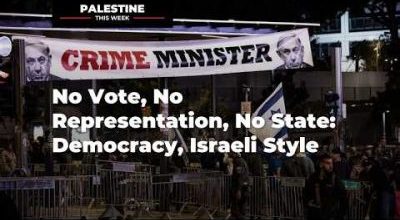
No Vote, No Representation, No State: Democracy, Israeli Style
or go to
Aletho News Archives – Video-Images
From the Archives
Sanctions, War and the Policy of Dual Containment
By SASAN FAYAZMANESH | March 17, 2008
It is now nearly three decades since the Unites States adopted the policy of dual containment of Iran and Iraq. While much has been written about the containment of Iraq, there has been very little in-depth analysis of this policy when it comes to Iran. In a book that is going to be released on March 31, 2008, entitled The United States and Iran: Sanctions, Wars and the Policy of Dual Containment (Routledge), I attempt to address this shortcoming by investigating when and why the US policy of containment of Iran came about, how it evolved, and where it stands today.[1] To the extent that Israel has been involved in US policy making, the study will also include the role that Israel has played in the containment of Iran. Also, since the fate of Iran has been inextricably linked to that of Iraq, occasionally the investigation will overlap with the containment of Iraq.
The policy of dual containment of Iran and Iraq originated during the Carter Administration, but it was not until the Clinton Administration that the expression “dual containment” became popular. … continue
Blog Roll
 Aletho News
- No Vote, No Representation, No State: Democracy, Israeli Style
- Zionist Bought Senate Blocks Information About American Citizens Killed By Israel
- While Gaza dominates the UN, these are the people keeping it alive
- New Report: “Scholasticide and Genocide in Gaza: Assessment, Testimonies and Legal Analysis”
- ‘THAAD Delusion’: Iran war exposes US missile shield limits – The Atlantic
- Moscow issues warning to NATO over Russian exclave
- Yes, the Iran war has destroyed Trump’s presidency
- The fallacy of US delusions about Iran’s economic collapse
- Hezbollah denies Syria cell link, warns of Israeli plan to sow discord
- The legacy of US sanctions, war, and occupation in Iraq
- If Americans Knew
- Mamdani releases plan to combat antisemitism and hate crimes in New York City
- Iran’s Revolutionary Guards Publish Letter to the American People
- DMFI launches $1 million ad campaign supporting Virginia’s Elaine Luria
- US Senate blocks resolution seeking report on Americans killed by Israel
- Israeli Attacks Kill Ten Palestinians in Gaza
- Massacre at Minab: The School That Became a Grave
- Israeli media: The IDF Shows It Doesn’t Turn a Blind Eye; It Actively Emboldens Settler Havoc
- As settlers ravage West Bank, Israeli forces kill 10 in Gaza – Daily Update
- New Report: “Scholasticide and Genocide in Gaza: Assessment, Testimonies and Legal Analysis”
- Ex-Biden officials are desperate for a Gaza scapegoat
- No Tricks Zone
- Green Energy Debacle: German Expert Professor Fritz Vahrenholt Warns Of Severe Economic And Social Consequences
- Two More Paleo Reconstructions Affirm Meters-Higher Sea Levels Across Ireland, Brazil 7000-6000 Years Ago
- New Study: Earth And Venus Surface Warmth Largely Explained By Convection And Lapse Rate, Not CO2 Or Radiation
- 2025 Nature Paper Claiming Worsening Global Drought Gets RETRACTED …Heavily Flawed
- New Study: ‘Global Drought Shows No Detectable Recent Acceleration Under Climate Warming’
- Economic Masterminds: German Socialists Suggest Taxing Productivity Gains Stemming From Using AI
- The South China Sea Has Not Been Cooperating With The Climate Change Narrative
- Energy Crisis: Germany Enters Heating Season With Historically Low Gas Reserve Fill Levels
- New Study: The Antarctic Ice Sheet Gained Mass From 2020-2024 Due To Staggering Snow And Ice Accumulation
- Study: Ocean Heating Rates From Thousands Of Years Ago ‘Dwarf’ Modern Ocean Heating Rates

