Agreement signed for democratic rights in Honduras
By Felipe Stuart Cournoyer and John Riddell | SOA Watch | May 25, 2011
On May 22, Honduran president Porfirio Lobo Sosa and former president José Manuel Zelaya Rosales signed an agreement ‘For National Reconciliation and the Consolidation of the Democratic System in the Republic of Honduras.’ Lobo was elected in November 2009 in a rigged vote organized by the regime installed through the June 28, 2009 military coup that overthrew Zelaya. The majority of Latin American and Caribbean nations refused to recognize the legitimacy of the Lobo government, despite the strong support it received from the United States and Canada.
The present agreement, finalized in Cartagena, Colombia, also bears the signatures of Colombian President Juan Manuel Santos and Venezuelan Foreign Minister Nicolás Maduro (on behalf of President Hugo Rafael Chávez Frías) as witnesses.
This agreement opens the door to significant changes in the Central American political landscape and to the re-entry of Honduras into the Organization of American States (OAS) and SICA (Central American Integration System).
An earlier article, “Freedom for Joaquín Pérez Becerra!” discussed the context that led Colombia and Venezuelan presidents to join in sponsoring this initiative.
The Resistance welcomes the agreement
In a May 23 statement, the Political Committee of the National Front for People’s Resistance (FNRP), the main organization coordinating popular resistance to the coup inside Honduras, noted that “this agreement for international mediation enables us to put an end to our exile [and] reinforce our process for the refoundation of Honduras.” It issued a “call to all members of the resistance inside and outside Honduras to unite in a great mobilization to greet and welcome our leader and the General Coordinator of the FNRP, José Manuel Zelaya Rosales, at 11 a.m., May 28, 2011, at the International Airport.” The statement noted that the agreement complied with the four conditions set by the FNRP.
The FNRP also expressed “thanks for the process of international mediation” carried out by the Venezuelan and Colombian presidents.
Terms of the accord
By the terms of the Cartagena agreement, the signatories commit themselves to:
- Guarantee the return to Honduras in security and liberty of Zelaya and all others exiled as a result of the crisis. (Over 200 other exiled leaders of the resistance are also now able to return under the terms of the agreement.)
- Assure conditions in which the FNRP can gain recognition as a legal political party.
- Reaffirm the constitutional right to initiate plebiscites, particularly with respect to the FNRP project of convening a National Constituent Assembly. (It was President Zelaya’s move to hold a non-binding plebiscite on calling a Constituent Assembly that the organizers of the 2009 coup cited to justify their action.)
- Create a Secretariat of Justice and Human Rights to secure human rights in Honduras and invite the UN Human Rights Commission to establish an office in Honduras.
- Constitute a Monitoring (Verification) Commission, consisting initially of the Colombian and Venezuelan presidencies, to help assure the successful implementation of the agreement.
U.S. disruption attempt
Notably absent from discussions leading to the Cartagena Agreement was the United States, which has long been the arbiter of Honduran politics. Washington kept silent on the Cartagena mediation process, while in fact attempting to torpedo it.
Alexander Main, an analyst for the Center for Economic and Policy Research, noted on May 19 that when, as part of the mediation process, Honduran courts dropped charges against Zelaya, the U.S. State Department issued an “exuberant statement” the following day calling for the suspension of Honduras from the Organization of American States (OAS) to be “immediately lifted” – a move that would have cut short the Cartagena mediation process. This suspension, enacted in protest against the coup, was one of the factors driving the illegitimate Honduran regime to seek mediation. (See “What Now for a Post-Coup Honduras“)
“For good measure,” Main says, “the [U.S.] statement noted that ‘since his inauguration, President Lobo has moved swiftly to pursue national reconciliation, strengthen governance, stabilize the economy, and improve human rights conditions.’”
In fact, according to the Committee of Family Members of Disappeared Detainees in Honduras (COFADEH), politically motivated killings have taken the lives of 34 members of the resistance and 10 journalists since Lobo took office. No killers have been prosecuted either for these crimes or for the 300 killings by state security forces since the coup.
Showdown at the OAS
The U.S. canvassed energetically among Central and South American countries subject to its influence for support for immediate reinstatement of Honduras – prior to the conclusion of the mediation process. “In mid-May these divisions came to a head when a diplomatic tussle took place at the OAS,” Main reports.
In Main’s opinion, “the U.S. is not prepared to accept a political mediation in Honduras in which it doesn’t play a leading role. The U.S. has traditionally been deeply involved in the internal affairs of Honduras,” and “the country continues to be of great strategic importance to the U.S.”
The OAS Secretary General, José Miguel Insulza, called a meeting of the OAS Permanent Council that was to consider readmitting the de facto Honduran regime. According to a reliable source at the OAS, Main reports, several Latin American countries, apparently including Colombia, demanded cancellation of the meeting on the grounds that it was “premature.” Within hours, the meeting was cancelled.
The failure of this U.S.-inspired maneuver opened the road for the signing of the Cartagena agreement nine days later.
Regional sovereignty
The Cartagena agreement, and the process that facilitated it, marks an important victory for the Honduran resistance. More broadly, it reinforces the process of Indo-Latin American and Caribbean efforts to shape their own national and regional policies free from imperialist domination. (See “Honduras se reintegra al CA-4.”) It developed outside the OAS framework, and will help to strengthen and consolidate the new Community of Latin American and Caribbean States (CELAC) that will meet this coming July in Caracas, Venezuela, under the joint chairmanship of that country and Chile.
The Cartagena accord’s impact in Central America was immediate and far reaching. Lobo and Zelaya flew from Cartagena to Managua the same day of the signing ceremony for a special meeting of the SICA (Central American Integration System) at which Honduras was welcomed back by three other Central American presidents – Daniel Ortega (Nicaragua), Mauricio Funes (El Salvador), and Alvaro Colom (Guatemala). At the meeting Ortega announced the re-establishment of diplomatic relations between Nicaragua and Honduras.
In a joint statement, the four presidents called on the OAS to re-admit Honduras, and new agreements were also announced regarding a Customs Union of the four countries. These measures mark a defeat for those forces in Central America inimical to the regional integration process, including the Costa Rican government and its hostile campaign to isolate Sandinista Nicaragua diplomatically and economically.
Need for continued solidarity
Whether the Honduran government will fully carry out the Cartagena agreement remains to be seen. In particular, the coup has produced an entrenched pattern of systematic repression and unrestrained operation of death squads in Honduras. Experiences in other countries, including Colombia, show that such right-wing repression can run rampant, with under-the-table support from security forces, despite formal statements of government disapproval.
The establishment of the Colombia-Venezuela monitoring commission will be vital to keeping the pressure on the Lobo government. Friends of Honduran democracy in North America will need to do some monitoring as well, as an expression of continued solidarity with the Honduran people.
Report from The Real News Network:
Further reading:
Toni Solo, “Varieties of Imperial Decline: Another Setback for the U.S. in Latin America,” May 23, 2011
Meeting senseless aggression face-to-face
NABI SALEH 13-5-2011
By Gershon Baskin | The Jerusalem Post | 25 May 2011
For months I have been hearing about disproportionate use of force by the army against weekly demonstrations in Nabi Saleh – a small pastoral Palestinian village northwest of Ramallah. Last week, I watched several YouTube videos filmed by activists in the village, providing vivid visual images of the forceful arrests of protesters by the army. I was disturbed because all of the clips showed how the demonstrations ended; none showed how they began. I was convinced that there must have been stone-throwing by the shabab in the village which provoked the violent army responses. So I decided I had to see for myself.
When I contacted the Israeli activists who regularly participate in the Nabi Saleh demonstrations, I was warned that it was dangerous… continue
‘Bahraini government hits social networkers’
PressTVGlobalNews on May 15, 2011
President of Bahrain’s Center for Human Rights Nabeel Rajab says the Bahraini regime has dismissed people from their jobs for sending information of the government’s harsh crackdown on protesters via social networks.
An interview with President of Bahrain’s Center for Human Rights, Nabeel Rajab
Pro-Israel support for Syrian protests exposed on RT’s Crosstalk
By Maidhc Ó Cathail | The Passionate Attachment | May 14, 2011
With Barada TV, the anti-Assad satellite channel referred to by Soraya Sepahpour-Ulrich, all roads lead to Israel.
According to an April 18 Washington Post report, the State Department’s Middle East Partnership Initiative (MEPI) has funneled up to $6 million to Syrian opposition groups such as Barada TV since 2006. MEPI is supervised by Tamara Wittes, a longtime pro-Israel advocate of democratic reform in the Middle East and author of Freedom’s Unsteady March: America’s Role in Building Arab Democracy. The Deputy Assistant Secretary for Near Eastern Affairs (NEA), where she coordinates democracy and human rights policy for the NEA Bureau, is a former director of the Saban Center’s Middle East Democracy and Development (MEDD) Project. As to the nature of MEDD’s concern for the Middle East, a New Yorker profile of Haim Saban is revealing:
His greatest concern, [Saban] says, is to protect Israel, by strengthening the United States-Israel relationship. At a conference last fall in Israel, Saban described his formula. His ‘three ways to be influential in American politics,’ he said, were: make donations to political parties, establish think tanks, and control media outlets.”
Asked to comment on the Post’s allegations, Wittes responded:
“There are a lot of organizations in Syria and other countries that are seeking changes from their government. That’s an agenda that we believe in and we’re going to support.”
According to the Post, the money was funneled through an LA-based non-profit, the Democracy Council. Jim Prince, the founder and president of the Democracy Council, is also an advisor to CyberDissidents.org, which was launched in 2008 by the Jerusalem-based Adelson Institute for Strategic Studies “to research and focus attention on the online activities of democracy advocates and dissidents in the Middle East, in the hope of empowering them at home and raising awareness of their plight abroad.”
Dissidents who put their faith in such improbable champions of their freedom would do well to remember the words of Sheldon Adelson, the Las Vegas casino mogul whose $4.5 million grant set up the institute in 2007. Referring to a conversation he had with Iranian dissident Amir Abbas Fakhravar at a neoconservative 2007 Prague conference on “Democracy and Security,” the Likudnik casino magnate reportedly said, “I like Fakhravar because he says that, if we attack, the Iranian people will be ecstatic.” But when another Iranian pro-democracy activist disputed that assumption, Adelson candidly responded:
“I really don’t care what happens to Iran. I am for Israel.”
Libyan Rebels Inspired by Globalization
By Tony Cartalucci – BLN – May 13, 2011
As NATO gloats over another assassination attempt against Colonel Moammar Qaddafi, resulting in the death of several workers, but again missing the embattled Libyan leader, the Libyan rebels are being lent ever increasing support from their long-time backers in the West.
British Foreign Secretary William Hague announced the approval of more “non-lethal” aid to the rebels including uniforms, bullet-proof vests, and communication gear. The UK also invited the rebels to open up a mission in London – an easy task as most of the opposition’s leadership have already lived in London and Washington for years. In fact the very call for the Libyan rebels’ February 17th “Day of Rage” was made by the NCLO out of London. Days later, Ibrahim Sahad, a co-founder of the NCLO and NFSL, would call for an international military intervention sitting directly in front of the White House.
Ibrahim Sahad of the National Front for the Salvation of Libya set the rhetorical groundwork for the US/UK/French military intervention in Libya. To this day his claims remain either unverified or in fact, verified lies.
….
Added to the mix of air strikes and “non-lethal” military aid, the West is also sending in “security contractor” firms to negotiate deals with the rebels in Benghazi. Of course “security contractors” in reality are armed mercenaries. One such firm, Secopex of France, was negotiating with rebels in Benghazi when the head of the firm, Pierre Marziali according to the New York Times, was shot in the stomach and later died. Secopex had done work in Somalia and boasts on its website that one of its specialties is the “training of national armies.”
While the governments leading this imperial adventure into Libya attempt to cling to the last vestiges of their legitimacy by denying recent attacks on Qaddafi’s family were assassination attempts, and while they claim ground troops are not part of the equation, Secopex’s presence in Benghazi is evidence that tacit support for a secret war has already been given. By claiming buildings, not people are the targets, and mercenaries from private companies, not soldiers define the current operations in Libya, the US, UK, and France make a mockery out of the supposed moral high-ground they claim to be fighting this war from.
Globalist Inspired Rebel Leader
According to US-educated Mahmoud Gibril Elwarfally, interim prime minister of the contrived “Libyan Transitional National Council,” in a May 12, 2011 talk before the Brookings Institution, “what’s taking place is a natural product of the globalizational process that started in the mid-80′s.”
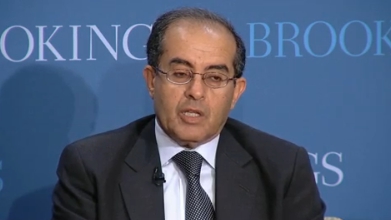
Mahmoud Elwarfally, self-proclaimed leader of the Libyan “Transitional National Council” speaks before the corporate-financier funded Brookings Institution, moderated by former CIA analyst Kenneth Pollack. Elwarfally maintains that the rebellion against Qaddafi was a natural product of the “globalizational process.”He still claims the rebellion is “peaceful.”
….
Elwarfally talks about a “new global cultural paradigm,” “new global values,” common values, shared by many “young people.” These young people, he says, are calling for human dignity, democracy, and inclusion at all levels of national government, repeating verbatim statements coming from geopolitical meddler Zbigniew Brzezinski and the myriad of US-funded NGOs that promote these “new global values.”
Deriding 30 years of documented history showing that the current armed uprising is but the latest campaign in a long war of foreign-funded armed sedition against Qaddafi, and recent admissions by rebel leaders themselves of having direct ties to Al Qaeda, Elwarfally claims such accusations are merely “Qaddafi projecting fears” onto the Libyan people and the world abroad. Elwarfally, rewriting history in mid-sentence, claims that armed struggle was forced upon them – despite 30 years of history saying otherwise. He proposes that current fighting is merely defensive and that the rebel is still peaceful. When asked about comments he made just minutes before regarding “marching on Tripoli,” Elwarfally maintains it was merely rhetorical.
Libya 2025
When asked by an audience member what Libya will look like in 2025, it turns out conveniently he was part of a study by Libya professors and “Libyan practitioners” in 2007-2008 titled “Libya: Vision 2025.” Not surprisingly, this project was conducted with input from the IMF and involved Libya’s placement within the “global scene.” Elwarfally laments that Libya’s oil reserves are limited and that the solution is a transition to a service economy. He also claims Vision 2025′s conclusion included an education shift, turning Libya into “a lake” to develop the skills of Africans to serve the needs of the European Union.
Surely Africans are eager to once again be in the service of wealthy Europeans, who at one point owned tremendous swaths of their continent, some tycoons naming entire nations after themselves in the ultimate expression of imperial megalomania. Elwarfally, a man educated in Pittsburgh, and apparently a lifelong fan of globalization, stuns us with his frank comments and his disturbing vision for the future of not only Libya, but the role it will play in directing Africa’s efforts and resources into the American and European corporate-financier interests. It is almost as disturbing as his breathtaking mis-characterization of the men who fight under him in what is most certainly not a “peaceful” rebellion.
Elwarfally concludes his talk by mentioning the “diminishing of the sense of the state” in Libya, due, he claims to a lack of “institutions” and “rule of law.” Kenneth Pollack, former CIA analyst and National Security Council member, chimes in declaring he hopes Elwarfally’s globalist dream becomes a reality even before 2025. Pollack, of course, is one of several contributors to the “Which Path to Persia?” report, within which open talk of funding terrorists, foreign-funded street protests, augmented with forms of US military support is made in regards to overthrowing Iran’s government. Quite obviously Pollack’s stratagems articulated in this treacherous report have already been applied to Iran as well as Libya, Syria, Egypt, Tunisia, and beyond.
If there was any doubt in the minds of those watching the “Arab Spring” unfold, doubts that haven’t been laid to rest by open admissions by the US that it was a plot of their own design, Mahmoud Gibril Elwarfally of the Libyan “Transitional National Committee” himself declares fealty to the globalist agenda and his commitment to propagating the interdependency and exploitation of the developing world by the global corporate-financier oligarchy. When similar calls for “democracy” and “dignity” are made by similar revolutions now festering in Eastern Europe along Russia’s border, and throughout China’s “String of Pearls” in South and Southeast Asia, remember Elwarfally’s words spoken before the globalist Brookings Institution.
Download the entire audio file from Brookings Institution here.
Featured Video
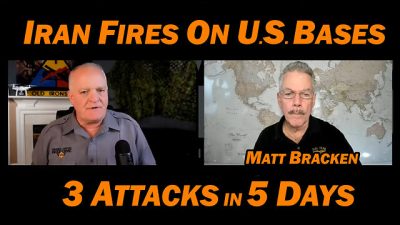
How Many More Gulf States Get Dragged Into Trump’s Iran War?
or go to
Aletho News Archives – Video-Images
Book Excerpt
How CIA used Ukraine as a platform for covert war against Russia
By Stephen KINZER | Responsible Statecraft | November 17, 2026
The following is an excerpt from Stephen Kinzer’s new book: Boiling Point: How America Brought War to Ukraine (Henry Holt and Company, November 2026)
Huddled beside an airstrip in southern Germany, a handful of anti-Communist warriors prepared to fire the first shots of the Cold War. A CIA officer from the Munich Operations Base was in charge. The Hungarian crewmen he had recruited stood nearby in flight suits. With them were two Ukrainian exiles who had volunteered to parachute into their homeland. They were code-named Apostle 1 and Apostle 2. Each carried forged identity papers, a miniature radio transmitter, a pistol, a machine gun, hand grenades, a purse full of gold coins, and a poison pill to be taken in case of capture. An unmarked C-47 transport plane was waiting.
The CIA officer overseeing this operation, a twenty-six-year-old Yale graduate named Stephen Tanner, watched the plane take off and disappear into the night. It flew over East Germany and Poland, then crossed into Soviet airspace. As it approached the Ukrainian city of Lviv, a cargo bay swung open. The two Ukrainians jumped into the darkness. Their mission was to link up with partisan fighters, seize territory, and establish a clandestine base through which the CIA could send them weapons.
That flight, on September 5, 1949, was the first American act of covert war in Ukraine. … continue
Blog Roll
 Aletho News
- In Europe, Anxiety Is Mounting—EU Unity Is Cracking at Every Seam
- How CIA used Ukraine as a platform for covert war against Russia
- European Commission proposes new loan for Kiev
- How Many More Gulf States Get Dragged Into Trump’s Iran War? | Matt Bracken
- US-Iran escalation: The side effects and benefits of low intensity war
- Lebanon on the Brink: How Washington and Tel Aviv Turned the “Peace Process” into an Instrument of Pressure
- Before Laundering The Iran Dirty Bomb Hoax, Jake Tapper Was Israel’s Chief Propagandist For Genocide.
- Minuteman III Test at APEC Opening Aimed to Show US Remains a Dangerous Power – Ex-Pentagon Analyst
- Estonia’s border closure is collective punishment of ethnic Russians
- US Plan to Toughen Restrictions on Chip Exports to China After Nvidia Scandal – Reports
- If Americans Knew
- Fracture, Expel, Humiliate
- Eight Palestinians including two children killed in past 2 days
- Bl00d.Money wants you to know who is cashing in on Israel’s genocide in Gaza
- Key Hegseth adviser Norm Coleman’s many remunerative conflicts of interest
- Who’s Paying For Hakeem Jeffries’ Rise To Power?
- ‘I admire you’: Transcript of Biden’s final call with Netanyahu clashes with his memoir – exclusive
- Israel is Attacking Wikipedia
- Montana Citizens opposed official’s Israel-funded trip to Israel
- DAILY UPDATE: Latest essential news on Palestine, Israel, & region
- Israeli settlers kill Palestinian grandmother in Jericho pogrom
- No Tricks Zone
- Argentina’s Perito Moreno Glacier Joins Antarctica and Arctic In Defying Doomsday Melt Claims
- New Study: Barents Sea Temperatures Were Warmer And Sea Ice Less Extensive In The 1700s Than Today
- German Authorities Start Initiative To Evaluate Public Register For Climate “Disinformation” Spreaders!
- Zonal Asymmetry of Temperature Change in the Antarctic Circumpolar Current
- New Study: The Net Fossil Fuel Contribution To Rising Atmospheric CO2 Has Been Zero For 500 Years
- Germany’s Green Energy Transition Becoming Increasingly Expensive…Another 6 Trillion Euros!
- Sudden Stratospheric Warming, Powerful El Niño Combination May Lead To Extreme Europe Cold, Energy Crisis!
- Two New Studies Find Thwaites Glacier Melt Cannot Be Driven By Human Activity Or A Warming Ocean
- E-Cars Reduce CO2 Emissions By Only 41% Compared To Internal Combustion Engine Vehicles
- Predictions Made By Renowned Climate Professor Over Past Decades Have Been Proven To Be Poor

