
“No sanctimonious language… can erase the disgrace or hide the facts: the destruction of Khan al-Ahmar means the forcible transfer of protected persons,
and forcible transfer is a war crime.”
[If Americans Knew notes: Twelve Palestinian communities in an area near Jerusalem are at risk of expulsion. These villages have been living for years without basic health, education, and welfare services, and without proper electricity or sewage systems. They are under constant surveillance for “illegal” construction—structures built without a permit from the Israeli government (permits are impossible to obtain in this region). These structures, many built of necessity to house growing families, are then quickly demolished by Israel’s Civil Administration.
Israel makes life almost unbearable for these Palestinians. Demolishing homes is just the beginning: grazing and farming land is confiscated, making it harder and harder for the residents to feed themselves and make a living; roads are nearly impassable; settlers and Israeli authorities harass them daily.
This is taking place not in Israel, but in the West Bank, on Palestinian land under full control of Israel.
One community that is at risk of imminent expulsion is Khan al-Ahmar. The Bedouin tribe has already been expelled twice since the 1950s.]
Israeli rights group B’Tselem said, on Monday afternoon, that Israeli government is to commit war crimes against Palestinian villagers in Khan al-Ahmar.
B’Tselem Executive Director Hagai el-Ad said, according to Days of Palestine: “Following the state’s response submitted earlier today to the [Israeli] High Court of Justice, that the state was asking the court to authorize a war crime.”
He explained: “No sanctimonious language about a ‘planning, proprietary and realistic’ alternate, or ‘time to prepare’ can erase the disgrace or hide the facts: the destruction of Khan al-Ahmar means the forcible transfer of protected persons, and forcible transfer is a war crime.”
El-Ad added: “Those responsible for it will bear personal criminal liability – exactly as B’Tselem stated two weeks ago, in a letter addressed to the prime minister, defence minister, justice minister, chief of staff and the head of the Civil Administration.”
According to updated data, Khan al-Ahmar community, which lives on land Israel has earmarked for settlement expansion in the area, is home to 32 families numbering 173 persons, including 92 minors.
It has a mosque and a school, which was established in 2009 and serves more than 150 children between the ages of six and fifteen – some of them from neighbouring communities.
Khan al-Ahmar is located around the illegal Israeli settlement of Ma’aleh Adumim, in the occupied Palestinian West Bank.
The Israeli occupation considers it strategic for building and expanding illegal settlements and establishing a territorial link between Ma’aleh Adumim and Jerusalem.
More background on Khan al-Ahmar and the other communities can be found here.
September 27, 2017
Posted by aletho |
Ethnic Cleansing, Racism, Zionism, Timeless or most popular, War Crimes | Israel, Israeli settlement, Jerusalem, Palestine, Zionism |
Leave a comment
As the Syrian conflict gradually winds down it is becoming easier to identify the winners and the losers. At a global level the conflict is seen widely as a big win for Russia, and by extension a loss for the United States.
However, despite their significant differences, Russia and the US have established an uneasy accommodation in Syria, as demonstrated by a succession of local ceasefire deals. The same logic applies to Turkey and Iran, two major regional powers which are setting aside their differences to focus on the bigger picture in post-conflict Syria.
However, there is one clear loser in the conflict which is unable to reach an accommodation with its regional foes: Israel. The Zionist state has failed to achieve its core objective, namely to weaken the Syrian state by what it deems to be a sufficient degree.
On the contrary, the Syrian government is increasingly strident and confident of its victory. By extension, the so-called “Axis of Resistance” – the regional alliance led by Iran – has had a shot in the arm, as evidenced by Lebanese Hezbollah’s growing regional clout.
This outcome has increased tensions significantly between Hezbollah and Israel, as demonstrated by frequent Israeli air strikes on alleged Hezbollah-related targets inside Syria. These strikes are a harbinger of what may be just around the corner, namely a major war initiated by Israel to redress the balance of power.
Unlike some Western powers, Israel did not want Syrian President Bashar Al-Assad to be overthrown, just sufficiently battered and permanently embattled. As part of this policy Israel has extended significant support to some Syrian rebel groups, particularly in Quneitra province close to the Israeli-occupied Golan Heights.
This support, though, does not necessarily constitute sympathy for the rebels’ ultimate aim, notably the overthrow of Assad, if not the Syrian government in its entirety. Israel does not trust Syrian rebels and its attitude toward the president is informed by the old adage of better the devil you know than the devil you don’t know.
At the strategic level, Israel has made two major miscalculations. First and foremost, it failed to anticipate Russia’s forceful entry into the war in late September 2015. The Russian air force rolled back rebel gains and the wider Russian presence in Syria signalled a firm determination to maintain the political status quo. This placed Israel at a disadvantage in so far as it enabled the Syrian government to go on the offensive against its armed enemies.
Second, Israel underestimated the extent of Iran’s ability to influence the outcome of the conflict. This miscalculation centres on capability as opposed to motivation, as the Israelis were under no illusions that Iran is committed wholeheartedly to the current regime in Damascus. Israeli intelligence and defence chiefs also underestimated Iran’s military and intelligence prowess, particularly the latter’s ability to mastermind a highly effective multinational paramilitary force in Syria dominated by Shia Afghani fighters.
Whilst Iran’s human losses in Syria are considerable, in terms of what has been at stake – namely its ability to project decisive influence in the Levant region – these losses are more than tolerable. Furthermore, the blood spilt in Syria means that Iran is more than ever determined to safeguard its investment by keeping a substantial military force in the country on a long-term basis. This outcome is simply intolerable for the Israelis.
In the past 35 years, beginning with the Israeli invasion of Lebanon in June 1982, the cycle of conflict between the Zionist state and the pro-Iranian Hezbollah has undergone several distinct phases, marked by short periods of sharp escalation and a much longer period of uneasy peace. The former has occurred roughly every ten years, as demonstrated by the sixteen-day Grapes of Wrath operation in April 1996 and the longer and more intense war of summer 2006.
Israel is understood widely to have lost the 2006 war, at least in terms of asymmetric warfare, an outcome that has had a decisive influence in containing Israeli aggression towards Lebanon. Nevertheless, it is worth remembering that the conflict between Israel and Hezbollah goes beyond the region and has a truly global dimension. Both sides spy on each other around the world, a fierce intelligence war that occasionally escalates into the assassination of Hezbollah commanders and alleged bombings in retaliation.
In terms of the next major conflict, there are two factors that weigh heavily on Israeli strategists. First is the psychological requirement to exorcise the ghosts of 2006 and restore – albeit partially – Israel’s image of military invincibility. Second, there is a growing realisation that Israel’s containment strategy is failing to stem Hezbollah’s military capability, which reportedly includes an arsenal of 120,000 rockets.
Whilst unable to influence the course of the Syrian conflict at a strategic level, at tactical and operational levels Israel has conducted dozens of air strikes against alleged Hezbollah targets in Syria – and occasionally against purely Syrian targets – with the declared goal of preventing the transfer of sensitive weapons systems to the Lebanese militant group.
There is a growing acknowledgement by prominent Israeli analysts that these strikes have failed to achieve their objective, namely to contain Hezbollah’s growing military clout. This failure is used by these analysts to push the warped idea that in the next war Israel has to raise the stakes significantly by declaring war on Lebanon, as opposed to just Hezbollah. This strategy necessitates the wholesale destruction of Lebanese infrastructure.
There are now growing signs that a conflict may break out sooner than expected, with the Israelis carefully preparing a Western audience for a major war. The trigger for this war could come in any shape or form, with the repeated Israeli violations of Syrian sovereignty – in the form of air strikes – likely to elicit a credible response from either Hezbollah or Syria at some point. In this arena – as in other conflict arenas involving the Zionist state – it is the Israelis who control the provocation game.
The next war is likely to prove more devastating than the last, even if it is not longer, as Israel will mobilise all its resources to compensate for its loss in the Syrian conflict and, by extension, to change the balance of power with its most potent enemies. As it struggles to adapt to the end of the Syrian conflict, others must get ready to pay the price.
Read: Israel’s new occupation zone in Syria
September 26, 2017
Posted by aletho |
Ethnic Cleansing, Racism, Zionism, Timeless or most popular, War Crimes | Hezbollah, Iran, Israel, Lebanon, Syria, Zionism |
Leave a comment
On Monday, with a commemorative tree-planting and ceremonial ribbon-cutting, Israeli and US officials inaugurated the ‘first permanent American military base’ at the IDF’s Air Defense School, not far from a US military radar installation in the Negev Desert. American and Israeli flags flew side by side as high-ranking military officers and soldiers from both countries participated at the opening ceremony.
In his speech, Maj. Gen. John Gronski, deputy commander of US Army National Guard in Europe, said “The United States and Israel have long planned together, exercised together and trained together. And now, with the opening of this site, these crucial interactions will happen every day.” (US military forces are routinely based in Israel, for joint exercises, cooperation with the IDF, and to operate some US facilities in the country.)
Brig. Gen. Tzvika Haimovitch, head of the IAF’s Aerial Defense Command, told reporters: “We established an American base in the State of Israel, in the Israel Defense Forces, for the first time, with an American flag. A permanent base.” He lauded the opening of the facility for allowing “us to improve our defense, in discovery and in interception and in preparedness,” saying the permanent presence of a US facility on Israeli soil sends a “message to the region and our surroundings that our partnership with our friend the United States is important.”
However, despite the solemn and celebratory talk at the opening ceremony on Monday, things came down with a bump on Tuesday when the American military contradicted the claim made by the Israel Defense Forces that the United States had established its first base in Israel.
“The new buildings on the existing Israeli Air Force Base are not a US military base,” said Meghan Henderson, deputy director of EUCOM’s Media Operations Division. “The buildings will function as a living facility for US service members, who are currently working at the Israeli base.” An Israeli army official confirmed that the Americans had contacted the IDF and requested the change in terminology. The message was passed along, and all mentions on its website of a “US military base” were quickly changed to read “US military facility.”
‘Base’, it seems, is an inappropriate word because it carries with it a number of legal distinctions and can only be applied to facilities of a certain size.
Of course, the word ‘base’ has many different meanings totally unrelated to army camps. The adjective means ‘immoral’ or ‘not having moral principles or rules.’ Ironically it seems sum up the governments of both Israel and the US.
Michael Dickinson can be contacted at michaelyabanji@gmail.com.
September 26, 2017
Posted by aletho |
Ethnic Cleansing, Racism, Zionism, Timeless or most popular, War Crimes | Israel, Palestine, United States |
Leave a comment
The preliminary investigation into the death of Russian Lieutenant-General Asapov near Syrian Deir ez-Zor has shown data leaks to Daesh, a source in the Syrian security forces told Sputnik.
“The results of a preliminary investigation into the death of general Asapov in Deir ez-Zor evidences a leak of information on his location to the side that carried out the attack,” the source said.
Lieutenant-General Valery Asapov died on Sunday after sustaining a “fatal injury” in a Daesh shelling near Deir ez-Zor, according to the Russian Defense Ministry.
Asapov was a member of the group of Russian military advisers providing Syrian commanders with assistance during the operation aimed at the liberation of the city of Deir ez-Zor.
Commenting on the incident, Russian Deputy Foreign Minister Sergei Ryabkov on Monday that the death of Asapov is the price that Russia paid for the “duplicity” of the United States in actions aimed at resolving the crisis in the region.
Meanwhile, the Russian Defense Ministry circulated an aerial footage of the areas where Daesh militants were stationed near Deir ez-Zor, clearly showing US special forces’ military vehicles at strongholds previously fortified by terrorists.
September 26, 2017
Posted by aletho |
Deception, War Crimes | Russia, Syria, United States |
Leave a comment
Ukraine’s Defense Ministry has sacked chief military psychiatrist Oleh Druz, who told lawmakers that 93% of veterans from the conflict in the country’s east need treatment for mental health issues. Radio Sputnik contributor Vladimir Filippov says Druz’s remarks, and Kiev’s reaction, are a testament to the senselessness of the country’s civil war.
Last week, Ukrainian Defense Minister Stepan Poltorak dismissed Colonel Oleh Druz, the head of the psychiatry clinic of the Main Military Clinical Hospital “in connection with the unsatisfactory fulfillment of his official duties.” The dismissal followed remarks by the top military psychiatrist at a round table of parliamentary committees, where Druz revealed that over 90% of the veterans of Kiev’s military operation in Donbass require mental help and pose a potential danger to society.
Commenting on the scandal, Radio Sputnik contributor Vladimir Filippov said that Druz’s real problem was that he decided to tell the truth.
The journalist recalled that according to Kiev’s own official statistics, “nine out of ten participants of the fighting in the Donbass have medical and social problems, while a third are diagnosed with post-traumatic stress disorder. Experts say a state-run program of support for vets is needed, but for now this is something done mainly on a voluntary basis.”
In his remarks before lawmakers, Druz warned that veterans’ disorders include heightened levels of aggression, decreased ability to return to civilian work, the development and exacerbation of chronic diseases, growing rates of alcoholism and drug addiction, shortened life expectancy, and increased suicide rates. Statistics reveal that 63 veterans took their own lives in 2016 alone.
In light of these horrifying figures, Filippov suggested that Kiev’s reaction was highly “original.”
“They simply dismissed the chief psychiatrist. Why? Probably because he said too much. Someone might think that among the [Donbass vets] are completely mentally unstable people. In fact, to shoot one’s fellow citizens is already beyond the realm of a normal worldview. And if one kills unarmed civilians, children and the elderly, what kinds of mental state can one speak of?”
According to the analyst, the hard truth is that Ukraine’s authorities couldn’t care less about its vets, with the government allocating precious little money for them, most of its defense funds either stolen outright or allocated to weapons purchases.
Filippov suggested that as far as Kiev is concerned, the only problem posed by the vets is the political danger they pose to the government – “to their soft chairs and their wealth. They have no plans to share with the veterans, hence the need to drive their problems deep out of sight and out of mind. No one needs them. They are cannon fodder, spent material.”
“That’s why Poltorak got so anxious,” the analyst stressed. “Because the 93% figure is a military secret – top-secret information! Capable of undermining the military capability of the regime,” Filippov concluded.
September 25, 2017
Posted by aletho |
Timeless or most popular, War Crimes | Ukraine |
Leave a comment
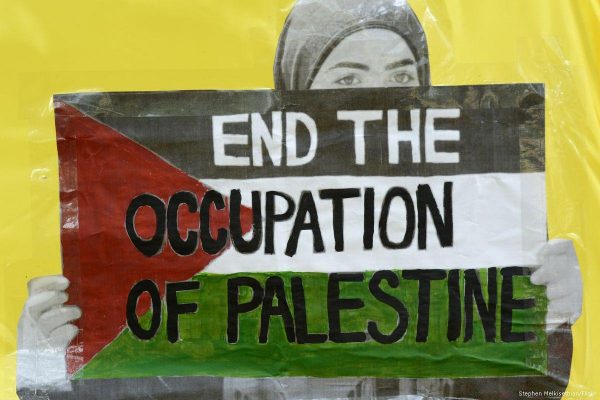
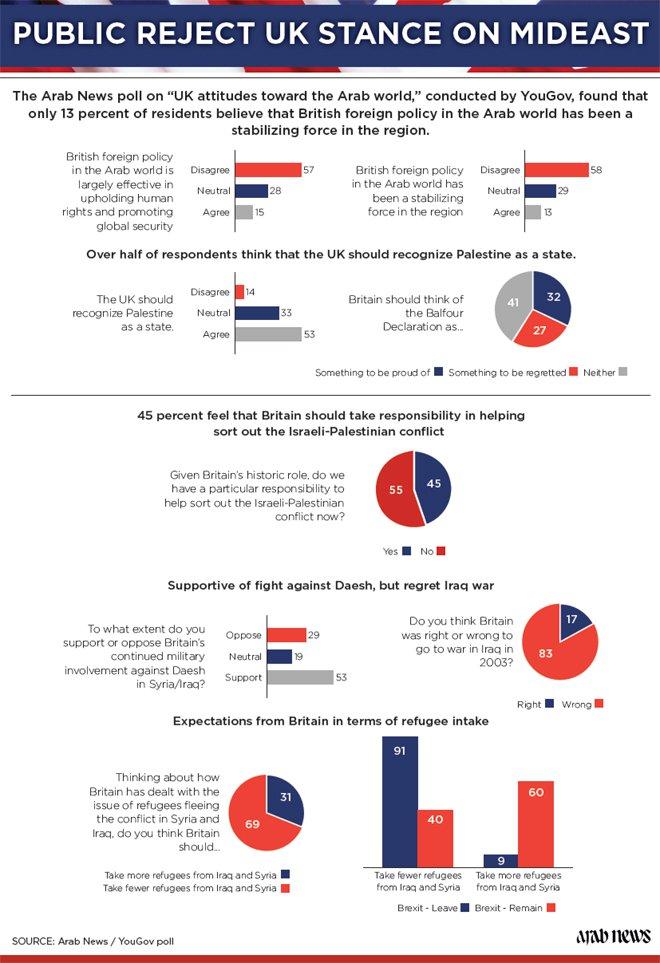
A majority of the British public believe the UK should recognise Palestine as a state, according to the results of a new YouGov poll published Monday.
53 percent of respondents said they agree with such a step, as opposed to just 14 percent who disagreed (33 percent said they were ‘neutral’).
Responding to the poll, Manuel Hassassian, Palestinian ambassador to the UK, said public opinion has been shifting. “I have been here for 11 years and have noticed dramatic changes in the British public’s views on Palestine”, he said.
“That only 14 percent say they wouldn’t want the Palestinian state to receive recognition is an indication of the Palestinian cause worldwide being accepted”, he added.
The poll also addressed views amongst the British public towards the Balfour Declaration, whose centenary will be marked in November.
According to the poll, opinion is deeply divided over the Balfour Declaration: 32 percent of Brits think it is something to be proud of, while 27 percent consider it “something to be regretted” (and 41 percent selected ‘Neither’).
The poll also revealed a partisan divide, with a striking plurality (32 percent) of those who voted Labour in the last election viewing the Balfour Declaration as something to be regretted. Among Conservative voters, on the other hand, 40 percent view the historical document with pride, and only 21 percent with regret.
The poll also asked whether, “given Britain’s historic role”, the country has “a particular responsibility to help sort out the Israeli-Palestinian conflict now”, to which 55 percent responded ‘No’, and 45 percent answered ‘Yes’.
September 25, 2017
Posted by aletho |
Ethnic Cleansing, Racism, Zionism, Illegal Occupation, War Crimes | Middle East, Palestine, UK, Zionism |
Leave a comment
One of the most hyped “events” of American television, “The Vietnam War,” has started on the PBS network. The directors are Ken Burns and Lynn Novick. Acclaimed for his documentaries on the Civil War, the Great Depression and the history of jazz, Burns says of his Vietnam films, “They will inspire our country to begin to talk and think about the Vietnam War in an entirely new way.”

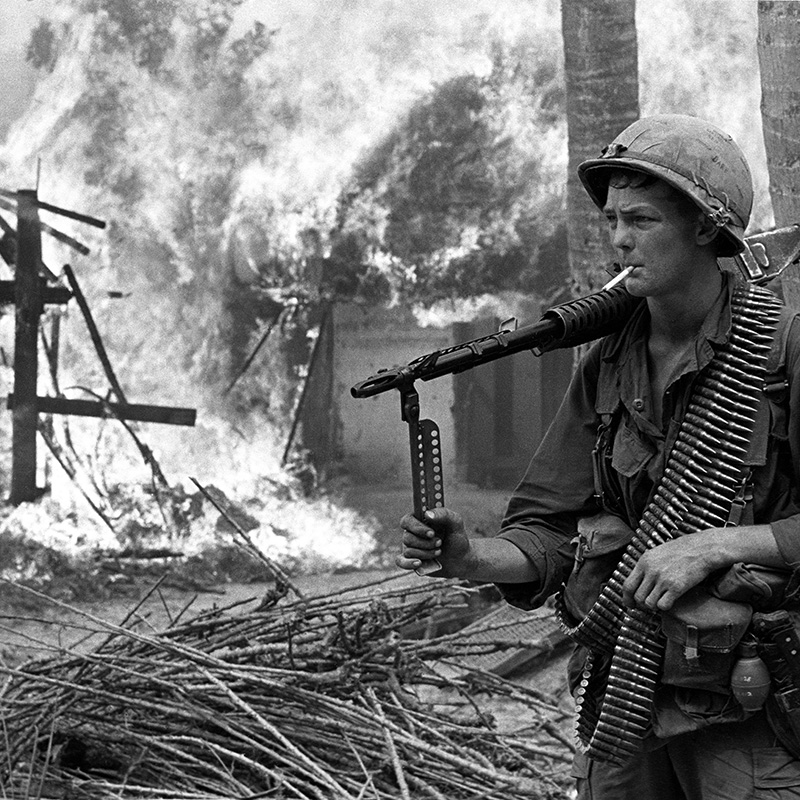
An American soldier walks by a burning Vietnamese home
(From the PBS’ series, “The Vietnam War.”)
In a society often bereft of historical memory and in thrall to the propaganda of its “exceptionalism,” Burns’s “entirely new” Vietnam War is presented as an “epic, historic work.” Its lavish advertising campaign promotes its biggest backer, Bank of America, which in 1971 was burned down by students in Santa Barbara, California, as a symbol of the hated war in Vietnam.
Burns says he is grateful to “the entire Bank of America family” which “has long supported our country’s veterans.” Bank of America was a corporate prop to an invasion that killed perhaps as many as four million Vietnamese and ravaged and poisoned a once bountiful land. More than 58,000 American soldiers were killed, and around the same number are estimated to have taken their own lives.
I watched the first episode in New York. It leaves you in no doubt of its intentions right from the start. The narrator says the war “was begun in good faith by decent people out of fateful misunderstandings, American overconfidence and Cold War misunderstandings.”
The dishonesty of this statement is not surprising. The cynical fabrication of “false flags” that led to the invasion of Vietnam is a matter of record – the Gulf of Tonkin “incident” in 1964, which Burns promotes as true, was just one. The lies litter a multitude of official documents, notably the Pentagon Papers, which the great whistleblower Daniel Ellsberg released in 1971.
There was no good faith. The faith was rotten and cancerous. For me – as it must be for many Americans – it is difficult to watch the film’s jumble of “red peril” maps, unexplained interviewees, ineptly cut archive and maudlin American battlefield sequences. In the series’ press release in Britain — the BBC will show it — there is no mention of Vietnamese dead, only Americans.
“We are all searching for some meaning in this terrible tragedy,” Novick is quoted as saying. How very post-modern.
All this will be familiar to those who have observed how the American media and popular culture behemoth has revised and served up the great crime of the second half of the Twentieth Century: from “The Green Berets” and “The Deer Hunter” to “Rambo” and, in so doing, has legitimized subsequent wars of aggression. The revisionism never stops and the blood never dries. The invader is pitied and purged of guilt, while “searching for some meaning in this terrible tragedy.” Cue Bob Dylan: “Oh, where have you been, my blue-eyed son?”
What ‘Decency’ and ‘Good Faith’?
I thought about the “decency” and “good faith” when recalling my own first experiences as a young reporter in Vietnam: watching hypnotically as the skin fell off napalmed peasant children like old parchment, and the ladders of bombs that left trees petrified and festooned with human flesh. General William Westmoreland, the American commander, referred to people as “termites.”
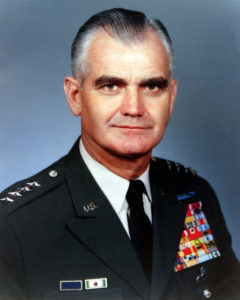
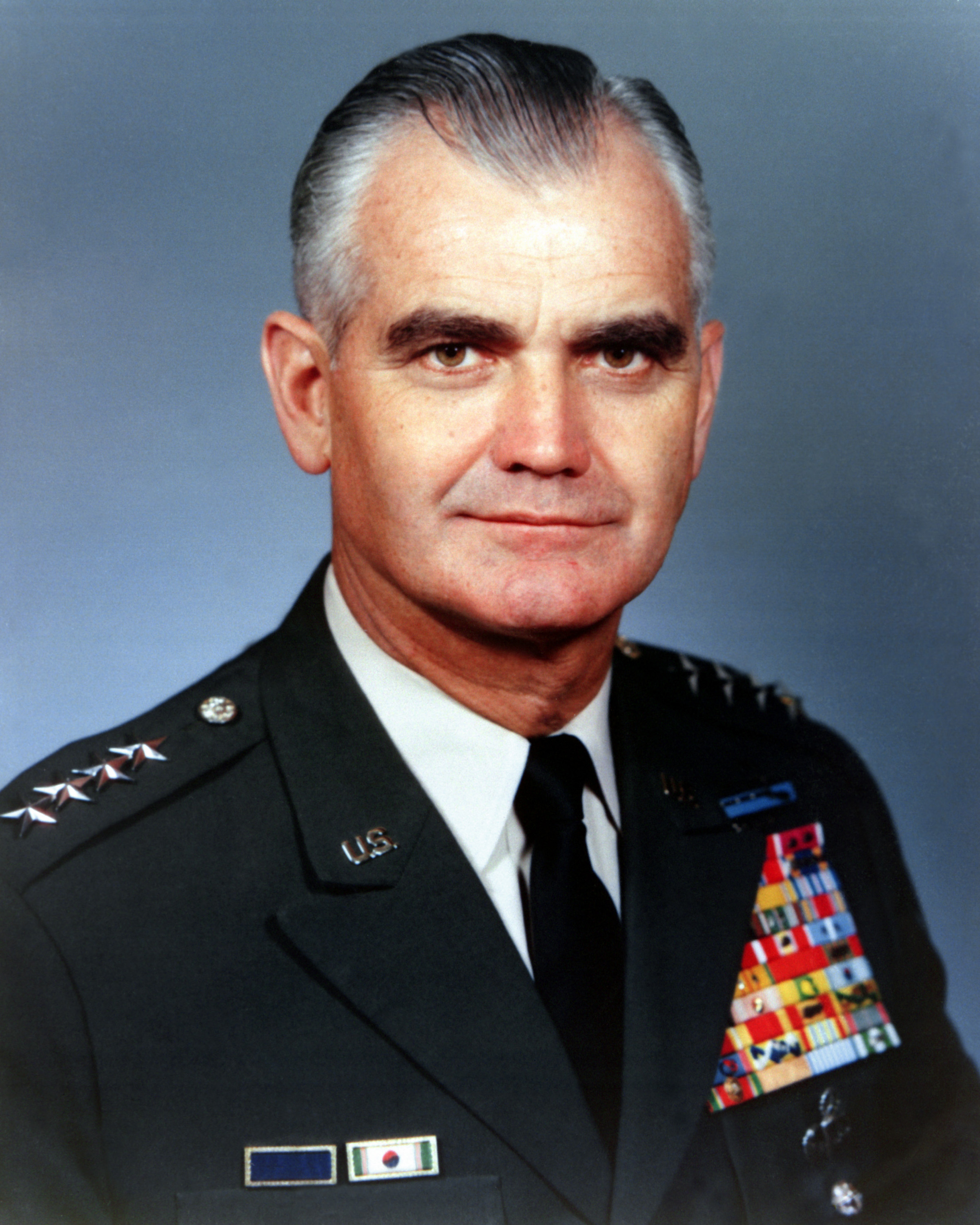
General William C. Westmoreland. (Wikipedia)
In the early 1970s, I went to Quang Ngai province, where in the village of My Lai, between 347 and 500 men, women and infants were murdered by American troops (Burns prefers “killings”). At the time, this was presented as an aberration: an “American tragedy” (Newsweek). In this one province, it was estimated that 50,000 people had been slaughtered during the era of American “free fire zones.” Mass homicide. This was not news.
To the north, in Quang Tri province, more bombs were dropped than in all of Germany during the Second World War. Since 1975, unexploded ordnance has caused more than 40,000 deaths in mostly “South Vietnam,” the country America claimed to “save” and, with France, conceived as a singularly imperial ruse.
The “meaning” of the Vietnam War is no different from the meaning of the genocidal campaign against the Native Americans, the colonial massacres in the Philippines, the atomic bombings of Japan, the leveling of every city in North Korea. The aim was described by Colonel Edward Lansdale, the famous CIA man on whom Graham Greene based his central character in The Quiet American.
Quoting Robert Taber’s The War of the Flea, Lansdale said, “There is only one means of defeating an insurgent people who will not surrender, and that is extermination. There is only one way to control a territory that harbours resistance, and that is to turn it into a desert.”
Nothing has changed. When Donald Trump addressed the United Nations on Sept. 19 – a body established to spare humanity the “scourge of war” – he declared he was “ready, willing and able” to “totally destroy” North Korea and its 25 million people. His audience gasped, but Trump’s language was not unusual. His rival for the presidency, Hillary Clinton, had boasted she was prepared to “totally obliterate” Iran, a nation of more than 80 million people. This is the American Way; only the euphemisms are missing now.
Returning to the U.S., I am struck by the silence and the absence of an opposition – on the streets, in journalism and the arts, as if dissent once tolerated in the “mainstream” has regressed to a dissidence: a metaphoric underground.
Missing What Trump Means
There is plenty of sound and fury at Trump the odious one, the “fascist,” but almost none at Trump as the symptom and caricature of an enduring system of conquest and extremism. Where are the ghosts of the great anti-war demonstrations that took over Washington in the 1970s? Where is the equivalent of the Freeze Movement that filled the streets of Manhattan in the 1980s, demanding that President Reagan withdraw battlefield nuclear weapons from Europe?
The sheer energy and moral persistence of these great movements largely succeeded; by 1987 Reagan had negotiated with Mikhail Gorbachev an Intermediate-Range Nuclear Forces Treaty (INF) that effectively ended the Cold War.
Today, according to secret NATO documents obtained by the German newspaper, Suddeutsche Zetung, this vital treaty is likely to be abandoned as “nuclear targeting planning is increased.” The German Foreign Minister Sigmar Gabriel has warned against “repeating the worst mistakes of the Cold War. … All the good treaties on disarmament and arms control from Gorbachev and Reagan are in acute peril. Europe is threatened again with becoming a military training ground for nuclear weapons. We must raise our voice against this.”
But not in America. The thousands who turned out for Sen. Bernie Sanders’s “revolution” in last year’s presidential campaign are collectively mute on these dangers. That most of America’s violence across the world has been perpetrated not by Republicans, or mutants like Trump, but by liberal Democrats, remains a taboo.
Barack Obama provided the apotheosis, with seven simultaneous wars, a presidential record, including the destruction of Libya as a modern state. Obama’s overthrow of Ukraine’s elected government has had the desired effect: the massing of American-led NATO forces on Russia’s western borderland through which the Nazis invaded in 1941.
Obama’s “pivot to Asia” in 2011 signaled the transfer of the majority of America’s naval and air forces to Asia and the Pacific for no purpose other than to confront and provoke China. The Nobel Peace Laureate’s worldwide campaign of assassinations is arguably the most extensive campaign of terrorism since 9/11.
What is known in the U.S. as “the Left” has effectively allied with the darkest recesses of institutional power, notably the Pentagon and the CIA, to prevent a peace deal between Trump and Vladimir Putin and to reinstate Russia as an enemy, on the basis of no evidence of its alleged interference in the 2016 presidential election.
The true scandal is the insidious assumption of power by sinister war-making vested interests for which no American voted. The rapid ascendancy of the Pentagon and the surveillance agencies under Obama represented an historic shift of power in Washington. Daniel Ellsberg rightly called it a coup. The three generals running Trump are its witness.
All of this fails to penetrate those “liberal brains pickled in the formaldehyde of identity politics,” as Luciana Bohne noted memorably. Commodified and market-tested, “diversity” is the new liberal brand, not the class people serve regardless of their gender and skin color: not the responsibility of all to stop a barbaric war to end all wars.
“How did it fucking come to this?” says Michael Moore in his Broadway show, Terms of My Surrender, a vaudeville for the disaffected set against a backdrop of Trump as Big Brother.
I admired Moore’s film, Roger & Me, about the economic and social devastation of his hometown of Flint, Michigan, and Sicko, his investigation into the corruption of healthcare in America.

Filmmaker Michael Moore
The night I saw his show, his happy-clappy audience cheered his reassurance that “we are the majority!” and calls to “impeach Trump, a liar and a fascist!” His message seemed to be that had you held your nose and voted for Hillary Clinton, life would be predictable again.
He may be right. Instead of merely abusing the world, as Trump does, Clinton, the Great Obliterator, might have attacked Iran and lobbed missiles at Putin, whom she likened to Hitler: a particular profanity given the 27 million Russians who died in Hitler’s invasion.
“Listen up,” said Moore, “putting aside what our governments do, Americans are really loved by the world!”
There was a silence.
September 22, 2017
Posted by aletho |
Deception, Mainstream Media, Warmongering, Timeless or most popular, War Crimes | United States, Vietnam War |
Leave a comment
Russia’s Foreign Minister Sergei Lavrov has condemned the U.S. for threatening the option of military intervention in Venezuela.
Addressing the United Nations General Assembly in New York, Lavrov criticized the illegitimate application of “unilateral sanctions” by certain Western countries, in reference to the restrictions imposed by the U.S. against Iran, Cuba and Venezuela.
Lavrov said it is unacceptable to instigate unrest and launch military threats in order to ‘democratize’ Venezuela, as are actions aimed at undermining the country’s legitimate authorities.
He insisted that in any internal conflict, the international community must urge all parties to commit to reconciliation.
“The policies of the West are based on the principle of ‘who is not with us, is against us,” said the Russian foreign minister, referring to the threats made by the U.S. President Donald Trump.
He also made reference to Cuba and said the blockade should be lifted, “Almost all UN member states have called for the immediate lifting of the economic, financial and commercial blockade imposed on Havana for several decades.”
On the subject of North Korea, Lavrov said he did not support Pyongyang’s position but he objected to the “military hysteria” which could lead to “disaster.”
He urged the UN to consider the roadmap for talks with the North put forward by Russia and China to defuse the crisis on the Korean peninsula by diplomatic and peaceful means.
Both Moscow and Beijing are proposing the suspension of Washington’s joint military maneuvers with South Korea but the White House has rejected the plan.
Lavrov also condemned U.S. unilateral sanctions on Iran – he said they would undermine the nuclear deal with Tehran
“Using unilateral sanctions … is illegitimate and undermines the collective nature of international efforts. Everyone is witnessing with alarm today the newer and newer restrictions by the U.S. against Iran.”
“They threaten the implementation of the Joint Comprehensive Plan of Action,” he added, referring to the 2015 international accord between Iran and six world powers.
Trump has suggested he is leaning towards withdrawing from the deal, but several international allies are trying to dissuade him.
September 21, 2017
Posted by aletho |
Militarism, Timeless or most popular, War Crimes | Russia, Sanctions against Iran, United States, Venezuela |
Leave a comment
“As a responsible nuclear weapons state, our republic will not use a nuclear weapon unless its sovereignty is encroached upon by an aggressive hostile force with nuclear weapons. The DPRK will faithfully fulfill its obligation for non-proliferation and strive for global denuclearization.” – Kim Jong Un, May 8, 2016
Attention: António Guterres, Secretary-General of the United Nations
Sir,
I am writing in regard to a speech given by US President Donald Trump to the United Nations General Assembly (UNGA) earlier this week, in particular the following excerpt:
“The United States has great strength and patience, but if it is forced to defend itself or its allies, we will have no choice but to totally destroy North Korea.”
As Secretary-General you are sworn to uphold the principles enshrined in the United Nations charter.
Article 1:
[The Purposes of the United Nations are:] [1.] To maintain international peace and security, and to that end: to take effective collective measures for the prevention and removal of threats to the peace, and for the suppression of acts of aggression or other breaches of the peace, and to bring about by peaceful means, and in conformity with the principles of justice and international law, adjustment or settlement of international disputes or situations which might lead to a breach of the peace.
Article 2, paragraph 4:
All Members shall refrain in their international relations from the THREAT or use of force against the territorial integrity or political independence of any state, or in any other manner inconsistent with the Purposes of the United Nations.
Article 33:
The parties to any dispute, the continuance of which is likely to endanger the maintenance of international peace and security, shall, first of all, seek a solution by negotiation, enquiry, mediation, conciliation, arbitration, judicial settlement, resort to regional agencies or arrangements, or other peaceful means of their own choice.
[Emphasis in bold and capitals added]
I refer you to a statement made by President Kim of the Democratic People’s Republic of Korea (DPRK) on July 4th:
“[T]he DPRK would neither put its nukes and ballistic rockets on the table of negotiations in any case nor flinch even an inch from the road of bolstering the nuclear force chosen by itself unless the U.S. hostile policy and nuclear threat to the DPRK are definitely terminated.”
[Emphasis added]
As Mr. Kim’s statement clearly demonstrates a road forward for negotiation, as well as the perfectly reasonable pre-condition that hostile statements, actions and overall policy towards his nation cease, and given further that the US party is well aware of this position, Mr. Trump’s statement at the United Nations is in clear violation of the principles of the UN charter. I further add that the DPRK has ample cause for fear of the capabilities and will of the United States after the complete destruction of Pyongyang in the early 1950s.
I am writing therefore to inquire as to the date upon which you will hold an emergency meeting of the United Nations Security Council to discuss punitive sanctions upon the United States for the reckless and illegal statement of its highest representative. For context, I invite you to imagine the international response to, say, Russian President Vladimir Putin making an identical statement with regard to the United Kingdom. [We would have no choice but to destroy it if we perceive a threat]. Given recent tragic history, of which you will surely be aware, ‘threats’ can easily be invented via unnamed intelligence sources, amplified globally in major media organs, then later justified as ‘intelligence failures’ down the road once the damage is done.
Failure to censure the United States for this threat of force against a nation which – as all do – has the right to defend itself from clearly stated intentions of attack will only increase the suspicion held by many world citizens that the United Nations is powerless to impede or control powerful nations.
Faithfully,
Simon Wood
Twitter: @simonwood11
September 21, 2017
Posted by aletho |
Militarism, Timeless or most popular, War Crimes | Donald Trump, United Nations, United States |
Leave a comment

Photo by Raymond Depardon | CC BY 2.0
For Mark Bowden, author of Hué 1968, the pivotal battle of the War in Vietnam did not follow the script most Americans were used to scanning in their newspapers or visualizing on the evening news. The war Americans followed at home was like a humongous hunting expedition. U.S. forces seemed engaged in an endless chase over a lush boondocks inhabited by peasants and dotted with rice paddies or trailing the rugged forested highlands in search of the Viet Cong, a cunning and elusive enemy whose tactics were hit and run, not stand and fight.
When an atypical fixed battle developed, it was typically well-removed from the population centers that hugged the coastline off the South China Sea. Vietnam was, after all, a guerrilla war, or more broadly understood, a people’s war fought to reunite a nation, artificially divided into North and South by fiat of the United States in the service of geopolitical brinksmanship. Accused of fermenting the southern insurgency, North Vietnam was mercilessly bombed, but spared the carnage of a ground war. Not so the south where, by whatever foul means, the idea was “to isolate the population from the Viet Cong,” notwithstanding that, as Mark Bowden readily concedes, “in most instances they were one in the same.” The resistance was popular and widespread, and its idea was to drive the American invader out, and overthrow a despised ruling clique of Vietnamese compradors which survived only because the invader had committed hundreds of thousands of its own troops and billions of its taxpayers’ dollars to sustain it.
Americans were consistently assured that bit by bit the tumultuous countryside was being pacified, and the guerillas attrited, both politically and as a fighting force. In late 1967 Americans were told they were winning the war. When Tet – the Luna New Year – dawned on January 31, 1968, that illusion was irreparably shattered. The vastly superior forces of the United States and its southern catspaw, the Army of the Republic of Vietnam (ARVN), were caught virtually flat footed when thousands of regular troops of the People’s Army of North Vietnam seemingly materialized from thin air, and in coordination with local units of the southern resistance, launched up and down the length and breath of South Vietnam what was quickly branded the Tet Offensive. The most stunning blow for Americans, war managers and citizens alike, was an assault on the South Vietnamese capital of Saigon taken right to the walls of the American Embassy.
For several weeks thereafter, media attention in the U.S. and throughout the world focused primarily on the shock of Saigon’s vulnerability, overplaying its significance. A thousand kilometers north, at first scarcely noticed, even by the Commander of U.S. forces, General William Westmoreland, a battle had commenced that would become the “longest and bloodiest” of the war, not waged over the – till then – familiar rural topography, but house to house, street by street, culminating in one of the most intense chapters of urban warfare in the annals of American military history. Observers today might liken it to a more recent urban free-for-all entangling American troops in Fallujah, Iraq. Or, better yet, recall a U.S. military fiasco in downtown Mogadishu that Mark Bowden had crafted into an earlier best seller. To the extent comparisons hold, the Battle of Hue was like Black Hawk Down on steroids.
Hue 1968 is a comprehensive account of that battle written in the page-turning style of popular narrative non-fiction. The author has assembled a cast of eyewitnesses who participated in the action, Vietnamese and Americans, and the battle unfolds in recollections mined from their 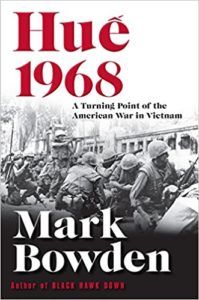 interviews, and, for the departed, from other primary sources at his disposal, such as lengthy wartime correspondences. Bowden has properly set the strategic stage for his action in the context of the war’s two most relevant contemporaneous developments. There was the very fact of Tet, simultaneous attacks with varying degrees of effectiveness on virtually every population center and military base in the South. The Year of the Monkey came in like Armageddon, catching General Westmoreland, for one, completely off guard even though he later claimed he knew those crafty commies were planning something.
To draw attention away from their true intentions, the North Vietnamese had executed a feint, keeping a remote Marine encampment under heavy bombardment at Khe Sanh near the border with Laos, and just below the Demilitarized Zone (DMZ). Taking the bait, and just two weeks before Tet, Westmoreland weakened his coastal enclaves by detaching troops to reinforce the beleaguered camp. The American general believed he was luring the North Vietnamese into a repeat of the battle of Dien Bien Phu, which in 1954 brought French colonial control of Vietnam to an end but inadvertently opened the door to an American invasion. This time, Westmoreland fantasized, “he was determined to prevent history from repeating itself.” That battle never developed, and several months later, Khe Sanh was abandoned by the Americans.
Westmoreland’s obsession with Khe Sanh apparently prevented him from fully grasping that Hue, South Vietnam’s third largest city, and former Imperial capital, had fallen to the Liberation Front in less than twenty-four hours. This pattern of disbelief was moreover pervasive up and down the American chain of command. At Phu Bai, a Marine base less than fifteen miles south of Hue, the commanding general, with improbable symmetry named Forster LaHue, repeatedly ignored reports on the size of the force his counterattack would face, and insisted that, instead of thousands, their number couldn’t possibly exceed more than a few hundred. Could a force as large as the one being reported enter and occupy the entire city that quickly and virtually undetected? Through some of his most original reporting Bowden reconstructs exactly how that occurred.
Shifting the action in his account from one adversary to the other, Bowden begins with the attack, describing how four regiments totaling roughly four thousand uniformed NVA soldiers managed to infiltrate the border between North and South Vietnam, rendezvous with local guerrillas in a force of equal size, and ultimately bivouac on the outskirts of Hue. “It was the kind of troop movement,” comments Bowden, “that could remain secret only if the citizenry supported it, or didn’t care enough to sound the alarm.”
Certainly in Hue there were many Catholics who, in general, were partisans of the Saigon regime, not to mention a contingent of elite ARVN soldiers stationed there, who would have sounded the alarm if they’d been aware of any imminent threat. On another side was a strong current of anti-Americanism among the Buddhists and the student body at Vietnam’s prestigious Hue University, who two years earlier had combined and rioted against the repressive South Vietnamese government, and burned the library of the United States Information Service. But by early 1968, Hue was being little frequented by the war’s violence, and hopes were stoked that the city’s rich stock of architectural treasures, not least the palace of Vietnam’s last royal dynasty, might avoid destruction. Compared with the rest of the country, life in Hue was reasonably good, and reasonably safe. A degree of political complacency had set into what remained a functional commercial entrepot where trade and traffic on Hue’s iconic Perfume River remained brisk.
Even though a majority of Hue’s population of 140,000 could not be considered pillars of the revolution, an underground resistance network was well-entrenched in the city and highly motivated. And Bowden, having tracked down a small cast of survivors, gives us affecting sketches of, among others, the Village Girl who guided the troops through the darkness and pointed them toward their targets; the VC commander who stood up to the hero of Dien Bien Phu, General Vo Nguyen Giap, and revised the battle plan; the college boy who worked with his fisherman landlord to smuggle arms into the city by sampan; the Buddhist poet turned what we would call ‘information officer,’ and Bowden – who holds many conventional opinions– calls “propagandist;” but my favorite was the balsy little guy who was given the task to create a giant new flag for the victors to raise once they’d taken the city.
The flag detail merits a special nod to illustrate the contrast between the high tech m.o. of the Empire’s war machine, and the endless improvisation of those in the Front who used gumption, imagination and stealth to their advantage in the face of overwhelming fire power from air, land and sea. The task to create a flag to be seen, not as “an invasion or occupation, but rather as a liberation,” fell to Sargent Cao Van Sen, an old war horse who’d fought with the Viet Minh against the French, joined the northern Army, and was then ordered back to his native Hue to organize among the Viet Cong. The idea of the flag, Bowden says “was to recognize real political differences between North and South,” with a design that represented, not only the liberation forces, but also “the intelligentsia and the city’s religious factions – Buddhists and Catholics.” Hanoi’s political objective at that stage was transitional, “to establish a neutral, independent South Vietnam,” leaving reunification to future negotiations.” Sgt. Sen’s job was to line up the material, a sewing machine and a seamstress to produce a single flag, which, when completed, required two men to carry it. After being “run up the 123-foot flagpole… that stood just outside the royal palace before the Citadel’s southern wall… it was visible all over Hue” when the city’s denizens awoke January 31st on the first morning of Tet.
Metropolitan Hue spread over both sides of the Perfume River, and the Front’s objective was to occupy the zone on the south bank called the Triangle, and, on the north, the Citadel, an “enormous fortress that enclosed nearly two square miles… its walls twenty-six feet high and impenetrably thick,” and enclosing the neighborhoods of Hue’s most affluent residents. Primary targets, included the air strip inside the Citadel, the province headquarters, the treasury, the post office, the prison, the radio station and “the sole American base, the [Military Assistance Command, Vietnam] MACV compound.”
The Commander of the Front, General Dang Kinh watched from high ground to the west, anxiously awaiting the assault to begin. Finally, “throughout the city arose the sound of gunfire… scattered at first, and then as if touched off by a fuse, it rose rapidly to a din.” By the time the shooting stopped, the attacking force, having “suffered only a few casualties, had dealt Hue’s defenders a crushing surprise blow.” The only major targets not overrun were a fortified redoubt occupied by the 1st ARVN Division inside the Citadel, and the MACV compound on the opposite side of the river, both heavily under siege.
Notwithstanding the loud cheerleading from Hanoi for Tet to unleash a “popular uprising,” it was General Kinh’s opinion, according to Bowden, that no such uprising would occur, not even in subdued and occupied Hue, given the certainty of an overpowering American counter-attack. Kinh knew his forces “could take the city, but… not hold it for long. Achievable goals… were to destroy the ARVN division, and… round up… those who represented the Saigon regime… who were marked for arrest and punishment.”
The subsequent executions of many of these Saigon officials is thematic in Bowden’s text, an overly eager retailing of the ex post facto justification among the war’s apologists for the American decision to rescue their allies by destroying their city. More informed observers might counter that for an American writer of Bowden’s stature to lay charges of mass murder at the Vietnamese resistance– in this instance taking blood retaliation on enemies considered legitimate military targets – demonstrates a highly hometown cast of mind, and a failure to do the math on the infinitely less selective assassination orgy of the U.S. Phoenix Program, not to mention the war’s vastly unbalanced human death toll perpetrated upon the Vietnamese population by the invader.
Kinh’s prediction proved correct. And much of what Bowden encapsulates in Hue 1968 is devoted to a ground level view on just how the city was retaken. Bowden fully examines first January 31st, the day Hue fell, from a variety of vantage points including civilians and combatants on both sides, then moves the battle forward in week long blocks until the Front, faced with annihilation, is forced to withdraw. Had the U.S. command acted more swiftly, the lives of many marines might have been spared, but the city faced devastation in every scenario as long as the occupiers remained. The initial counter-thrust came from the nearby Marine base at Phu Bai when General LaHue, still doubting his adversary’s vast numerical superiority, initially dispatched so few marines that, on one of few occasions during the war, the U.S. was seriously out-gunned. When a marine captain already in Hue called for air and artillery strikes to dislodge the entrenched enemy, General LaHue told him “rather strikingly that he was overreacting.“ LaHue “saw no reason on earth why the more than four hundred men in the [MACV] compound, reinforced with well over three hundred U.S. marines,” assorted tanks and heavy weaponized vehicles, “should not be able to flatten anything between them and the fucking Citadel.” Bowden aptly titles this episode An Idiotic Mission.
Three hundred men represented one understrength marine battalion, but only a single unit, Alpha Company of the 1st Battalion of the 1st Marine Division was dispatched at first to test the enemy strength. This proved a disaster, and the best account of the action on the ground I’ve found was not Bowden’s, but in Vietnam-Perkasie, a memoir by W.D. (Bill) Ehrhart. When Alpha Company left Phu Bai just as the sun was coming up, Bill Ehrhart was given the option of staying behind. He was short, meaning only a few days remained on what had already been a harrowing thirteen month tour. But since the unit was just going to check things out, and were told they’d be back by evening, Bill threw caution to the wind.
Alpha Company, moving to relieve the assault on the MACV compound passed a gas station on the city outskirts, and then, Ehrhart writes, “all hell broke loose… The shock of the ambush caught the whole column completely by surprise… We knew the compound lay straight up the road… seven blocks ahead… We fought our way up the [first] block. And the one after that. All day long we inched up the street. Casualties were appalling. Wounded and dead Marines lay everywhere.” Ehrhart, wounded in action, was in the thick of it the whole time. His memoir is a compelling, heart wrenching read.
From there Bowden covers the fighting chapter and verse. And if battle action is your genre, it’s a read that’s hair raising enough to fix your attention. The killing went on for 26 days, and by the end, 80% of the city lay in rubble. Bowden devotes a last chapter to Hue’s human toll. “Two-hundred and fifty American marines and soldiers were killed, and 1,554 wounded… The Front’s losses are estimated at between 2,400 and 5000…. A conservative guess at those executed would be two thousand… [which] brings us to a combined civilian death toll of about eight thousand… not an exact figure, but to the degree it’s off, it’s off by being too low.”
That the civilian death toll was enormous, cannot be doubted, and is by most accounts I’ve read over the years attributed to the terrible pounding the city took from naval off-shore guns, and from American and ARVN air power and artillery intent on expelling the Front whatever the human cost. As for “those executed,” it appears as if Bowden may have that figure “off” by a factor of ten. Writing in The New York Times in October 1972, Richard Barnet, a former State Department official and co-founder of the Institute for Policy Studies, quotes what the Hué Police Chief told a correspondent of The Times of London in March 1968 just days after the battle. The Chief, “Doan Cong Lap estimated the total number of executions at 200.“ Moreover, “the local Catholic priest reported that none of his clergy or parishioners were harmed by the N.L.F. [National Liberation Front],” who had been given instructions to be on their best behavior. Even if these two eyewitnesses under-counted the reprisal deaths, it’s still unlikely that Bowden’s figure holds water, given his reliance on official U.S. sources.
Richard Barnet took up this topic at a time when voices in the Nixon administration were claiming that mass executions at Hué were proof there would be a bloodbath if the U.S. withdrew and the communists came to power. When questioned on this in Hanoi, Premier Pham Van Dong retorted, “There is nothing in recent Vietnamese history to suggest that a government bent on killing hundreds of thousands of people in South Vietnam can keep peace.” In any case the bloodbath was us. As Barnet dryly quipped, “In the Orwellian age, the daily saturation bombings of Indochina are defended as missions of mercy.”
Mark Bowden seems to bend over backwards throughout this voluminous and valuable book to provide a two-sided perspective on a particularly tragic moment in the Vietnam War. But there’s something distastefully familiar in his throwaway rhetoric of the Cold War bias that got us into Vietnam in the first place. Bowden demonstrates how truth is betrayed by the words he chooses, for example, that “antiwar activists in the States romanticized Ho Chi Minh, and his cause, emphasizing his nationalist character… [but] Hanoi was Communist, authoritarian to the core… ruthless and doctrinaire.” Yet even this phobic reflex to honor the thought police in the mainstream where he prospers doesn’t cause Bowden to ignore that it was the Stalinists who hoped to come to power though the ballot box and the Americans who made war to prevent that.
By consensus in the school of conventional wisdom the Tet Offensive of 1968 was the turning point of the Vietnam War, after which the American war aim was not to win, but how to get out. Mark Bowden makes an excellent case that the fulcrum of that turning point was the Battle of Hue. But what if there was no turning point? In Vietnam the protracted war to expel a powerful foreign invader had its roots in millennia past; the American invasion was just another bump in the road.
Michael Uhl is the author of Vietnam Awakening.
September 20, 2017
Posted by aletho |
Book Review, Illegal Occupation, Timeless or most popular, War Crimes | United States, Vietnam War |
Leave a comment
Late this morning, outraged emails started pouring in. My correspondents reported “getting sick” and having their “heart ache”. The cause of all that? They had just watched Trump’s speech at the UN. I sighed and decided to watch the full speech for myself. Yeah, it was painful.
You can read the full (rush, not official) text here or watch the video here. Most of it is so vapid that I won’t even bother posting the full thing. But there are a few interesting moments including these:
“We will be spending almost $700 billion on our military and defense. Our military will soon be the strongest it has ever been”
This short sentence contains the key to unlock the reason behind the fact that while the US military is extremely good at killing people in large numbers, it is also extremely bad at winning wars. Like most Americans, Trump is under the illusion that spending a lot of money “buys” you a better military. This is completely false, of course. If spending money was the key to a competent military force, the US armed forces would have already conquered the entire planet many times over. In reality, they have not won anything meaningful since the war in the Pacific.
Having surrounded himself with “Mad Dog” kind of “experts” on warfare, Trump is now reusing that old mantra about how money buys you victory and this is something extremely important. This kind of magical thinking signals to the countries most threatened by the US that the Americans are unable to engage in a basic “lessons learned” kind of exercise, that history teaches them nothing and that, just like all this predecessors, Trump conflates handing out money to the Military Industrial Complex with preparing for war. Frankly, this is good news: let the Americans spend themselves into bankruptcy, let them further neglect their military and let them continue to believe that this kind of magical thinking will bring them to victory.
[Sidebar: for the record, I have met and studied with plenty of excellent, well-educated, honorable, courageous and patriotic American officers and the kind of money-centered hubris I describe above is in no way directed at them, if only because they know even much better than I how bad the situation really is. There are plenty of highly-educated officers in the US armed forces who understand history and who know that money brings corruption, not victory. But they are mostly kept at ranks no higher than Colonel and you will often find them in military teaching institutions and academies. Having studied with them and become good friends with many of them, I feel sorry for them and I know that if they had the means to stop this insanity they would]
America does more than speak for the values expressed in the United Nations charter. Our citizens have paid the ultimate price to defend our freedom and the freedom of many nations represented in this great hall. America’s devotion is measured on the battlefields where our young men and women have fought and sacrificed alongside of our allies. From the beaches of Europe to the deserts of the Middle East to the jungles of Asia, it is an eternal credit to the American character that even after we and our allies emerge victorious from the bloodiest war in history, we did not seek territorial expansion or attempt to oppose and impose our way of life on others.
The only question here is whom exactly Trump’s speech-writers are aiming that nonsense at? Do they really think that there is anybody out there who sincerely believes this? If the target audience are US middle schools then, yes, okay. But does anybody believe that US middle school students listen to UN speeches?! Okay, maybe senile folks also believe that, I sure know a few who will swallow it up and ask for more, but why speak to that audience from a UN podium? Is it not embarrassing when such nonsense is greeted in total silence instead of a standing ovation from all the putatively grateful countries out there who are so deeply grateful for all these altruistic and heroic sacrifices. My only explanation for why this kind of nonsensical drivel was included in this speech is that it has become part of the ritual of typical American “patriotic liturgy”: big hyperbolic sentences which mean nothing, which nobody takes seriously or even listens to, but who have to be included “because they have to”. This reminds me of the obligatory Lenin quote in any and all Soviet speeches and statements, they also were basically filtered out by any thinking person, everybody knew that, but that’s how things went on then. It is really sad, and scary, to see how much the US of the 2017 looks like the Soviet Union of the 1980s.
The United States has great strength and patience, but if it is forced to defend itself or its allies, we will have no choice but to totally destroy North Korea.
Wow! Now that is a sentence which could only be written by a person utterly unaware of the impact it will have on the intended audience (in theory, all of mankind, this is the UN, after all). Totally destroy North Korea. I wonder how this will be received in South Korea and Japan. No, I don’t mean by the puppet regimes in Seoul and Tokyo, but by the people. Will they simply dismiss it as hot air or will they be horrified. I bet for the former reaction. It is much more psychologically comfortable to dismiss it all under the heading “nah, that’s crazy shit, they don’t mean it and they sure as hell ain’t gonna do it” rather than think for just a few minutes about the implications and consequences of such a threat. And let me be clear here: the United States most definitely do have the means to totally destroy North Korea. For one thing, they already did so during the Korean war, and they can easily repeated that today. That does not mean that they can win a war against the DPRK. There is a huge difference between laying waste to a country and winning a war against it (see Israel vs Hezbollah). The only way to meaningfully win a war against the DPRK is to invade it, and that the Americans cannot do, not even close. In contrast, the DPRK probably has the means to invade at least the northern part of South Korea, including Seoul. At the very least, they can totally destroy it. Along with much of Japan. I wonder if the US decided to one day “protect” South Korean and Japan by “totally destroying North Korea”, will they be totally shocked when they realize that the South Koreans and the Japanese will turn out not to be grateful for such a “protection”?
Last month I announced a new strategy for victory in the fight against this evil in Afghanistan. From now on, our security interests will dictate the length and scope of military operation, not arbitrary benchmarks and timetables set up by politicians. I have also totally changed the rules of engagement in our fight against the Taliban and other terrorist groups.
What we see here is undeniable evidence that far from being “real warriors” or “strategists” the military gang around Trump (Mattis, McMaster, Kelly, etc.) are either primitive grunts or folks who owe their rank to political protection. Why do I say that? Because none of what Trump describes as a “strategy for victory” is, in fact, a strategy. In fact, the US has not had anything remotely resembling a strategy in Afghanistan for years already. If it wasn’t so sad, it would be laughable, really. What we really see here is the total absence of any strategy and, again, a total reliance on magical thinking. Ask yourself a basic question: have you ever heard from any Trump administration or any US General anything which would suggest to you that these guys have i) a clear goal in mind ii) an understanding of what it would take to achieve this goal and iii) a timeframe to achieve this goal and iv) an exit strategy once this goal is achieved? No? Well, that is not your fault, you did not miss anything. They really don’t have it. The amazing reality is that they don’t even have a goal defined. How one achieves “victory” when no goal is even defined is anybody’s guess.
[Sidebar: without going into a lengthy discussion of Afghanistan, I would say that the only chance to get anything done, any viable result at all, is to negotiate a deal with all the parties that matter: the various Afghan factions, of course, but also with the Taliban, Pakistan, Iran and even Russia. Pakistan and Iran have a de-facto veto power over any outcome for Afghanistan. This may not be what the US would want, but this is the reality. Denying reality is just not a smart approach to these issues, especially if “victory” is the goal]
In Syria and Iraq, we have made big gains toward lasting defeat of ISIS. In fact, our country has achieved more against ISIS in the last eight months than it has in many, many years combined. The actions of the criminal regime of Bashar al-Assad, including the use of chemical weapons against his own citizens, even innocent children, shock the conscience of every decent person. No society could be safe if banned chemical weapons are allowed to spread. That is why the United States carried out a missile strike on the airbase that launched the attack.
When I heard these words I felt embarrassed for Trump. First, it is absolutely pathetic that Trump has to claim as his success the victories which the Syrians, the Russians, the Iranians and Hezbollah have achieved against the Wahabi-crazies of Daesh/al-Qaeda/al-Nusra/etc, especially since the latter are a pure creation of the US CIA! The truth is that it was the Americans who created this Wahabi monster and that they aided, protected, financed, trained and armed it through all these years. The US also viciously opposed all the countries which were serious about fighting this Wahabi abomination. And now that a tiny Russian contingent has achieved infinitely better results that all the power of the mighty CENTCOM backed by the Israeli and Saudi allies of the US in the region, The Donald comes out and declares victory?! Pathetic is not strong enough a word to describe this mind-bogglingly counter-factual statement. And then, just to make things worse, The Donald *proudly* mentions the failed attack against a Syrian air force base which had nothing to do with a false flag fake chemical attack. Wow! For any other political leader recalling such an event would be a burning embarrassment, but for The Donald it is something he proudly mentions. The hubris, ignorance and stupidity of it all leaves me in total awe…
Next The Donald went on a long rant about how bad Maduro and Venezuela were, which was terrible, but at least predictable, but then he suddenly decided to share this outright bizarre insight of his:
The problem in Venezuela is not that socialism has been poorly implemented, but that socialism has been faithfully implemented. From the Soviet Union to Cuba to Venezuela, wherever true socialism or communism has been adopted, it has delivered anguish and devastation and failure.
Since when did Trump become an expert on political science and world history anyway? Who does he think he is lecturing? Yet another US middle school classroom?! Does he not realize that a good number of the countries represented at the UN consider themselves Socialist?! Furthermore, while I don’t necessarily disagree with the notion that Socialist and Communist ideas have often been a disaster in the 20th century, Socialism in the 21st century is an entirely different beast and the jury is still very much out on this issue, especially when considering the social, political, economic, ecological, psychological and even spiritual disaster Capitalism is now proving to be for much of the planet. Being the President of a country as dysfunctional as the US, Trump would be well-advised to tone down his arrogant pontifications about Socialism and maybe even open a book and read about it.
I won’t even bother discussing the comprehensively counter-factual nonsense Trump has spewed about Iran and Hezbollah, we all know who Trump’s puppet-masters are nowadays so we know what to expect. Instead, I will conclude with this pearl from The Donald:
In remembering the great victory that led to this body’s founding, we must never forget that those heroes who fought against evil, also fought for the nations that they love. Patriotism led the Poles to die to save Poland, the French to fight for a free France, and the Brits to stand strong for Britain.
Echoing the nonsense he spoke while in Poland, Trump is now clearly fully endorsing that fairytale that “The West” (in which Trump now hilariously includes Poland!) has defeated Hitler and saved the world. The truth is that the Nazis were defeated by the Soviets and that all the efforts of the Poles, French, Brits and even Americans were but a minor (20% max) sideshow to the “real event” (Those who still might believe in this nonsense can simply read this). Yet again, that the Americans would feel the need to appropriate for themselves somebody else’s victory is, yet again, a clear sign of weakness. Do they expect the rest of the planet to buy into this nonsense? Probably not. My guess is that all they want is to send a clear messages to the Comprador elites running most countries that this is the “official ideology of the AngloZionist Empire” and if they want to remain in power they better toe the line even if nobody takes this stuff seriously. Yup, back to a 1980s Soviet kind of attitude towards propaganda: nobody cares what everybody else really thinks as long as everybody continues to pretend to believe the official propaganda.
[Sidebar: When my wife and I watched this pathetic speech we starting laughing about the fact that Trump was so obscenely bad that we (almost) begin to miss Obama. This is a standing joke in our family because when Obama came to power we (almost) began to miss Dubya. The reason why this is a joke is that when Dubya came to power we decided that there is no way anybody could possibly be worse than him. Oh boy where we wrong! Right now I am still not at the point were I would be missing Obama (that is asking for a lot from me!), but I will unapologetically admit that I am missing Dubya. I do. I really do. Maybe not the people around Dubya, he is the one who truly let the Neocon “crazies in the basement” creep out and occupy the Situation Room, but at least Dubya seemed to realize how utterly incompetent he was. Furthermore, Dubya was a heck of a lot dumber than Obama (in this context being stupid is a mitigating factor) and he sure did not have the truly galactic arrogance of Trump (intelligence-wise they are probably on par)].
In conclusion, what I take away from this speech is a sense of relief for the rest of the planet and a sense of real worry for the US. Ever since the Neocons overthrew Trump and made him what is colloquially referred to as their “bitch” the US foreign policy has come to a virtual standstill. Sure, the Americans talk a lot, but at least they are doing nothing. That paralysis, which is a direct consequence of the internal infighting, is a blessing for the rest of the planet because it allows everybody else to get things done. Because, and make no mistake here, if the US cannot get anything constructive done any more, they retain a huge capability to disrupt, subvert, create chaos and the like. But for as long as the US remains paralyzed this destructive potential remains mostly unused (and no matter how bad things look now, Hillary as President would have been infinitely worse!). However, the US themselves are now the prime victim of a decapitated Presidency and a vindictive and generally out of control Neocon effort to prevent true American patriots to “get their country back” (as they say) and finally overthrow the regime in Washington DC. Step by step the US is getting closer to a civil war and there is no hope in sight, at least for the time being. It appears that for the foreseeable future Trump will continue to focus his energy on beating Obama for the status of “worst President in US history” while the Neocons will continue to focus their energy on trying to impeach Trump, and maybe even trigger a civil war. The rest of us living here are in for some very tough times ahead. As they say in Florida when a hurricane comes barreling down on you “hunker down!”.
September 20, 2017
Posted by aletho |
Deception, Militarism, Timeless or most popular, War Crimes | Afghanistan, North Korea, United States, Zionism |
Leave a comment
Are Ken Burns and Lynn Novick “Telling Stories” About the Central Events Used to Legitimize the US Attack Against Vietnam?
This past spring I attended an advance screening of excerpts of Ken Burns and Lynn Novick’s documentary about the US War against Vietnam at Harvard, with these two in attendance, along with some Kennedy School “national security” types, who had evidently been recruited as “consultants.” (I was happy to see Peter Davis, the director of the truly commendable “Hearts and Minds” in the audience, and had a chance to say “hello.” Peter is himself a Harvard grad, is now writing novels and, happily, was acknowledged by Mr. Burns.)
I was astonished to hear the Narrator in one of these excerpts refer to “retaliation for the Gulf of Tonkin.” I was doubly astonished when I heard Burns use the exact same phrasing — “retaliation for the Gulf of Tonkin” — during a discussion and Q&A which followed the screening (and even in a somewhat different context. [It must have been on his mind.])
What could he possibly mean?
“Retaliation” for Gulf of Tonkin?
Sut Jhally has done remarkable work with the Media Education Foundation (MEF) in Western Mass on the uses of the term “retaliation.” MEF have produced at least one excellent DVD where they analyze how every attack by Israel on Palestinians is invariably framed as “retaliation.” Of course, this is often, in fact, NOT the case. But if you “believe” that some entity (a person; a government; a “nation”; a “people…”) are “retaliating” (for an alleged attack) — rather than initiating attacks — then almost anything the “retaliator” does is justified, no?
Framing the US attack on North Vietnam as “retaliation” in this PBS documentary purporting to tell truths about this horrific war is a fundamental and very serious flaw, one which must raise the question of why, after all these years, and when the truth about the Gulf of Tonkin “incidents” has also been known for years, Ken Burns and Lynn Novick would engage in this kind of (albeit strangely belated) pro-war propaganda?
Burns and Novick are noted for specializing in the delivery of emotion-laden “stories.” Are they to be allowed to turn actually important, fundamental facts about the US war into a “story,” as well? The emotional stories in this PBS series are tied together with a NARRATIVE of the History of the War in Vietnam. It is in this NARRATIVE that we should discern and judge whether Burns and Novick and PBS are actually revealing helpful truths for facing “our” history — and the history of this war —or not.
Three days after the “second” of two supposed “incidents” in the Gulf of Tonkin, the LBJ administration secured an overwhelming rubber stamp in Congress for the infamous “Gulf of Tonkin Resolution,” which would be used forever more as the fig-leaf for justifying continued US military intervention in Vietnam, as supposedly constitutionally and politically “legitimate,” with all the attendant violence, massive destruction, and death.
Isn’t this little bit of “history” rather important? Isn’t it rather important to get this right?
Just three weeks after these alleged “incidents,” I. F. Stone had already reported much of the real story in his famous I. F. Stone’s Weekly, based seemingly entirely on just the well-informed remarks of Senator Wayne Morse on the floor of the U.S. Senate.
Wayne Morse, of Oregon, was one of only two senators to vote against the Gulf of Tonkin Resolution; the other was, of course, Ernest Gruening, of Alaska.
The US Central Intelligence Agency had been coordinating “covert” attacks against the shoreline of North Vietnam for months (OPLAN 34-A). Finally, in early August of 1964, a mid-level NV naval officer may have been responsible for ordering NV patrol boats to chase the USS Maddox out into international waters, as a result of it’s believed role in supporting these attacks (which was actually the case; the Maddox had an unusual and special NSA surveillance unit on board, and was also engaged in what were labeled “DeSoto Patrols,” moving into and out of territorial waters claimed by the Government of North Vietnam.) Among other things, these US attacks were designed to test and gain information about North Vietnamese radar and air defenses.
Because of the advanced surveillance by the NSA unit aboard the Maddox, they knew the patrol boats were approaching “at high speed” well ahead of time. The three PT boats were almost entirely destroyed, and the Maddox may have sustained “one bullet hole” during the incident. [Extensive National Security Archive materials may be found here.]
Two days later, a “second attack” supposedly occurred, this time including the USS Turner Joy, as well.
However, there was no second “attack.”
A relatively recent article published by the US Naval Institute reported the following:
Analysis of the Evidence
Historians have long suspected that the second attack in the Gulf of Tonkin never occurred and that the resolution was based on faulty evidence. But no declassified information had suggested that McNamara, Johnson, or anyone else in the decision-making process had intentionally misinterpreted the intelligence concerning the 4 August incident. More than 40 years after the events, that all changed with the release of the nearly 200 documents related to the Gulf of Tonkin incident and transcripts from the Johnson Library.
These new documents and tapes reveal what historians could not prove: There was not a second attack on U.S. Navy ships in the Tonkin Gulf in early August 1964. Furthermore, the evidence suggests a disturbing and deliberate attempt by Secretary of Defense McNamara to distort the evidence and mislead Congress.
[See: https://www.usni.org ]
I.F. Stone was actually onto this story years before some historians were able to use belatedly and reluctantly released classified documents to confirm the lies, deceptions and misrepresentations. [See: I. F. Stone’s Weekly, following further “testimony” from McNamara in 1968.]
Turbulent water may have been either misinterpreted — or misconstrued — as a North Vienamese PT boat torpedo launch. Among others, James Stockade, later an Admiral and eventually Ross Perot’s running mate for President, was flying missions over the Maddox and reported seeing no evidence of any alleged “attack.” [See an oft-sited NSA study by Robert J. Hanyok.]
Finally, John Prados produced a useful article on the 40th Anniversary of The Gulf of Tonkin “incidents” for the National Security Archive in 2004.
Naturally, if you’re interested in telling “stories,” you may not focus too carefully on the facts of the history and the context in which these “stories” are situated.
But shouldn’t you want to get something as important as what did or didn’t happen in The Gulf of Tonkin right?
September 19, 2017
Posted by aletho |
Deception, Fake News, Mainstream Media, Warmongering, Timeless or most popular, War Crimes | PBS, United States |
Leave a comment

 Aletho News
