How ‘Regime Change’ Wars Led to Korea Crisis
By Robert Parry | Consortium News | September 4, 2017
It is a popular meme in the U.S. media to say that North Korean leader Kim Jong Un is “crazy” as he undertakes to develop a nuclear bomb and a missile capacity to deliver it, but he is actually working from a cold logic dictated by the U.S. government’s aggressive wars and lack of integrity.
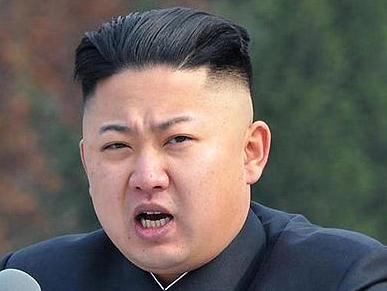
North Korean leader Kim Jong Un
Indeed, the current North Korea crisis, which could end up killing millions of people, can be viewed as a follow-on disaster to President George W. Bush’s Iraq War and President Barack Obama’s Libyan intervention. Those wars came after the leaders of Iraq and Libya had dismantled their dangerous weapons programs, leaving their countries virtually powerless when the U.S. government chose to invade.
In both cases, the U.S. government also exploited its power over global information to spread lies about the targeted regimes as justification for the invasions — and the world community failed to do anything to block the U.S. aggressions.
And, on a grim personal note, the two leaders, Saddam Hussein and Muammar Gaddafi, were then brutally murdered, Hussein by hanging and Gaddafi by a mob that first sodomized him with a knife.
So, the neoconservatives who promoted the Iraq invasion supposedly to protect the world from Iraq’s alleged WMDs — and the liberal interventionists who pushed the Libya invasion based on false humanitarian claims — may now share in the horrific possibility that millions of people in North Korea, South Korea, Japan and maybe elsewhere could die from real WMDs launched by North Korea and/or by the United States.
Washington foreign policy “experts” who fault President Trump’s erratic and bellicose approach toward this crisis may want to look in the mirror and consider how they contributed to the mess by ignoring the predictable consequences from the Iraq and Libya invasions.
Yes, I know, at the time it was so exciting to celebrate the Bush Doctrine of preemptive wars even over a “one percent” suspicion that a “rogue state” like Iraq might share WMDs with terrorists — or the Clinton Doctrine hailed by Secretary of State Hillary Clinton’s acolytes enamored by her application of “smart power” to achieve “regime change” in Libya.
However, as we now know, both wars were built upon lies. Iraq did not possess WMD stockpiles as the Bush administration claimed, and Libya was not engaged in mass murder of civilians in rebellious areas in the eastern part of the country as the Obama administration claimed.
Post-invasion investigations knocked down Bush’s WMD myth in Iraq, and a British parliamentary inquiry concluded that Western governments misrepresented the situation in eastern Libya where Gaddafi forces were targeting armed rebels but not indiscriminately killing civilians.
But those belated fact-finding missions were no comfort to either Saddam Hussein or Muammar Gaddafi, nor to their countries, which have seen mass slaughters resulting from the U.S.-sponsored invasions and today amount to failed states.
There also has been virtually no accountability for the war crimes committed by the Bush and Obama administrations. Bush and Obama both ended up serving two terms as President. None of Bush’s senior advisers were punished – and Hillary Clinton received the 2016 Democratic Party’s nomination for President.
As for the U.S. mainstream media, which behaved as boosters for both invasions, pretty much all of the journalistic war advocates have continued on with their glorious careers. To excuse their unprofessional behavior, some even have pushed revisionist lies, such as the popular but false claim that Saddam Hussein was to blame because he pretended that he did have WMDs – when the truth is that his government submitted a detailed 12,000-page report to the United Nations in December 2002 describing how the WMDs had been destroyed (though that accurate account was widely mocked and ultimately ignored).
Pervasive Dishonesty
The dishonesty that now pervades the U.S. government and the U.S. mainstream media represents another contributing factor to the North Korean crisis. What sensible person anywhere on the planet would trust U.S. assurances? Who would believe what the U.S. government says, except, of course, the U.S. mainstream media?
Remember also that North Korea’s nuclear program had largely been mothballed before George W. Bush delivered his “axis of evil” speech in January 2002, which linked Iran and Iraq – then bitter enemies – with North Korea. After that, North Korea withdrew from earlier agreements on limiting its nuclear development and began serious work on a bomb.
Yet, while North Korea moved toward a form of mutual assured destruction, Iraq and Libya chose a different path.
In Iraq, to head off a threatened U.S.-led invasion, Hussein’s government sought to convince the international community that it had lived up to its commitments regarding the destruction of its WMD arsenal and programs. Besides the detailed declaration, Iraq gave U.N. weapons inspectors wide latitude to search on the ground.
But Bush cut short the inspection efforts in March 2003 and launched his “shock and awe” invasion, which led to the collapse of Hussein’s regime and the dictator’s eventual capture and hanging.
Gaddafi’s Gestures
In Libya, Gaddafi also sought to cooperate with international demands regarding WMDs. In late 2003, he announced that his country would eliminate its unconventional weapons programs, including a nascent nuclear project.
Gaddafi also sought to get Libya out from under economic sanctions by taking responsibility for the 1988 bombing of Pan Am 103 over Scotland, although he and his government continued to deny carrying out the terror attack that killed 270 people.
But these efforts to normalize Libya’s relations with the West failed to protect him or his country. In 2011 when Islamic militants staged an uprising around Benghazi, Gaddafi moved to crush it, and Secretary of State Clinton eagerly joined with some European countries in seeking military intervention to destroy Gaddafi’s regime.
The United Nations Security Council approved a plan for the humanitarian protection of civilians in and around Benghazi, but the Obama administration and its European allies exploited that opening to mount a full-scale “regime change” war.
Prominent news personalities, such as MSNBC’s Andrea Mitchell, cheered on the war with the claim that Gaddafi had American “blood on his hands” over the Pan Am 103 case because he had accepted responsibility. The fact that his government continued to deny actual guilt – and the international conviction of Libyan Abdelbaset al-Megrahi was a judicial travesty – was ignored. Almost no one in the West dared question the longtime groupthink of Libyan guilt.
By October 2011, Gaddafi had fled Tripoli and was captured by rebels in Sirte. He was tortured, sodomized with a knife and then executed. Clinton, whose aides felt she should claim credit for Gaddafi’s overthrow as part of a Clinton Doctrine, celebrated his murder with a laugh and a quip, “We came; we saw; he died.”
But Gaddafi’s warnings about Islamist terrorists in Benghazi came back to haunt Clinton when on Sept. 11, 2012, militants attacked the U.S. consulate and CIA station there, killing Ambassador Christopher Stevens and three other Americans.
The obsessive Republican investigation into the Benghazi attack failed to demonstrate many of the lurid claims about Clinton’s negligence, but it did surface the fact that she had used a private server for her official State Department emails, which, in turn, led to an FBI investigation which severely damaged her 2016 presidential run.
Lessons Learned
Meanwhile, back in North Korea, the young dictator Kim Jong Un was taking all this history in. According to numerous sources, he concluded that his and North Korea’s only safeguard would be a viable nuclear deterrent to stave off another U.S.-sponsored “regime change” war — with him meeting a similar fate as was dealt to Hussein and Gaddafi.
Since then, Kim and his advisers have made clear that the surrender of North Korea’s small nuclear arsenal is off the table. They make the understandable point that the United States has shown bad faith in other cases in which leaders have given up their WMDs in compliance with international demands and then saw their countries invaded and faced grisly executions themselves.
Now, the world faces a predicament in which an inexperienced and intemperate President Trump confronts a crisis that his two predecessors helped to create and make worse. Trump has threatened “fire and fury” like the world has never seen, suggesting a nuclear strike on North Korea, which, in turn, has vowed to retaliate.
Millions of people on the Korean peninsula and Japan – and possibly elsewhere – could die in such a conflagration. The world’s economy could be severely shaken, given Japan’s and South Korea’s industrial might and the size of their consumer markets.
If such a horror does come to pass, the U.S. government and the U.S. mainstream media will surely revert to their standard explanation that Kim was simply “crazy” and brought this destruction on himself. Trump’s liberal critics also might attack Trump for bungling the diplomacy.
But the truth is that many of Washington’s elite policymakers – both on the Republican and Democratic sides – will share in the blame. And so too should the U.S. mainstream media.
Investigative reporter Robert Parry broke many of the Iran-Contra stories for The Associated Press and Newsweek in the 1980s.
Raqqa: A hellhole created by the regime-changers of the West

© Morukc Umnaber / Global Look Press
By Neil Clark | RT | September 2, 2017
As Jan Egeland, the UN humanitarian adviser on Syria, has stated, if there’s a worse place to be in the world at the moment than the Syrian city of Raqqa, then it’s hard to imagine.
This week, the UN estimated that the battle to capture the de facto ISIS capital is costing the lives of 27 civilians a day.
It’s not just the almost non-stop aerial bombardment and shelling from the mainly Kurdish Syrian Democratic Forces that the 25,000 or so citizens in ISIS-held parts of the city have to endure. “Access to safe drinking water, food and other basic services is at an all-time low with many residents relying on food they had stored up earlier to survive,” says UN public information officer David Swanson.
Both ISIS snipers and the US-led coalition have been targeting people trying to flee from the Middle Eastern hellhole. The UN notes that coalition forces have even been attacking boats on the Euphrates River, described as “one of the remaining escape routes for civilians.”
We can only imagine the headlines if Russia was doing all this. But because it’s the US and its allies, the international reaction has been muted to say the least. It’s revealing to compare the “humanitarian” concern voiced by pro-war Western politicians and mainstream media outlets when Russia began its military operations in Syria in September 2015, with the lack of concern over what’s been happening in Raqqa.
The claim that Russia was fighting terrorists was widely ridiculed. The US and its allies issued a statement saying that Russia’s actions, which included a strike on a ISIS training camp near Raqqa, would “only fuel more extremism and radicalization.”
On October 2, 2015, the claim made by then-US President Barack Obama that Russian strikes would only “strengthen ISIS” made Western news headlines.
Accusations that Russia was committing war crimes also received prominent coverage.
But when the US-led coalition bombs ISIS, the reporting from mainstream outlets is different. Then, the operation is presented much more positively, with little or no talk about how it will “strengthen” the enemy or “fuel more extremism and radicalization.” There is also little or no talk of war crimes.
A meticulously-researched Alert from Media Lens earlier this summer compared the coverage of the sieges of Aleppo and Mosul.
“When Russian and Syrian forces were bombarding ‘rebel’-held East Aleppo last year, newspapers and television screens were full of anguished reporting about the plight of civilians killed, injured, trapped, traumatised or desperately fleeing…
By contrast, there was little of this evident in media coverage as the Iraqi city of Mosul, with a population of around one million, was being pulverised by the US-led ‘coalition’ from 2015; particularly since the massive assault launched last October to ‘liberate’ the city from ISIS, with ‘victory’ declared a few days ago.”
As I noted here in an earlier Op Edge, it was deemed a ‘Thought Crime’ by Imperial Truth Enforcers to actually refer to the recapture of eastern Aleppo by Syrian government forces as a ‘liberation.’ Pro-war Labour MP John Woodcock even went so far as to call the left-wing Morning Star newspaper “traitorous scum” for daring to defy the gatekeepers and use the ‘L’ word.
But of course, if it’s the US and its allies doing the bombing, then using the word ’liberation’ is de rigueur, regardless of how much death and destruction the ‘liberation’ causes.
There have been no calls from ‘Inside the Bastille’ Western politicians or media pundits for people to protest outside US embassies about the number of civilians killed by coalition airstrikes in Raqqa – as there were over Aleppo. And absolutely no likening of coalition actions to those of the Nazis.
It’s worth noting, too, that while the US and its allies repeatedly called for a “humanitarian pause” in the fighting for Aleppo, they’ve rejected the UN calls for one in Raqqa. “Going slower only delays the liberation and subsequently costs more civilians their lives,” US Colonel Joe Scrocca, director of public affairs for combined Joint Task Force-Operation Inherent Resolve, told Middle East Eye.
What makes the double standards even more outrageous is that without the warmongering actions of the US and its allies in the Middle East, there would be no ISIS/ISIL in the first place. The ‘Coalition’ is fighting in Raqqa a monster that – like Frankenstein in Mary Shelley’s famous novel – they helped to create. The terrorist organization known by the names of ‘Islamic State,’ ‘ISIS/ISIL,’ or ‘Daesh,’ grew out of the chaos that Bush and Blair’s illegal invasion of Iraq had unleashed. As Patrick Cockburn, author of the book ‘The Rise of Islamic State,’ puts it, “ISIS is the child of war.”
Furthermore, the spread of IS to Syria was actually welcomed by the US and its allies as a way of weakening the secular Ba’athist government in Damascus, which Western neocons were desperate to see toppled because of its friendly links with Iran and Russia.
“If the situation unravels there is the possibility of establishing a declared or undeclared Salafist principality in eastern Syria, and this is exactly what the supporting powers to the opposition want, in order to isolate the Syrian regime, which is considered the strategic depth of the Shia expansion (Iraq and Iran),” – declared a secret US intelligence report, which was declassified in 2015.
In 2016, a leaked tape conversation between US Secretary of State John Kerry and anti-government Syrian activists revealed how the US was pleased to see Islamic State gain territory. “The reason Russia came in is because ISIL was getting stronger,” Kerry admits, flatly contradicting the claims made publicly by the State Department in October 2015 that Russia wasn’t targeting ISIS/ISIL.
“Daesh was threatening the possibility of going to Damascus and so forth,” Kerry went on. “We were watching. We saw that Daesh was growing in strength, and we thought Assad was threatened. We thought, however, we could probably manage. You know, that Assad might then negotiate,” he said.
The US and its allies didn’t just watch with pleasure as ISIS expanded – they aided the process. They did this not only by giving money and weaponry to ‘moderate rebels’ who then – surprise, surprise – defected to Abu Bakr al-Baghdadi’s head-chopping outfit, but by targeting forces that were opposed to Islamic State. Israel, for instance, has bombed Syria on countless occasions in the last few years, but each time its attacks have been against those fighting ISIS. “An aspect of the conflict in Syria that has not received the attention it undoubtedly deserves, has been the role of the Israeli Air Force (IAF) in acting as the de facto air force of Daesh [ISIS] and sundry other Salafi-jihadi and rebel groups fighting in the country,” notes John Wight.
We must not forget too that if Washington’s Endless War Lobby had got their way in August 2013, and the US and its allies launched a full-scale military assault on the Syrian government – then Islamic State and its affiliates would probably now be in charge of the entire country. Yet the failure to bomb Assad four years ago is still openly regarded as a tragedy by Western regime-change hawks.
Of course, the key role that the US and its coalition have played in the rise – and expansion – of the forces they are now bombing, is never mentioned in the mainstream reporting of the ‘Battle for Raqqa.’ We’re meant to believe that ISIS fighters appeared – like Mr. Benn’s shopkeeper “as if by magic” – and took control of Syria’s seventh largest city by complete accident. And, we’re certainly not meant to ask questions such as “From where did these terrorists obtain their weapons?” or, “Under what legal authority do the US and its allies carry out air strikes in Syria?”
My 1987 Lonely Planet Guide to Jordan and Syria, says of Raqqa: “There’s really nothing to do or see but it can be a good base from which to visit Lake Assad and the walled city of Rasafah, 30km to the south.”
The city is most definitely not a “good base” for tourists today.
One person who did manage to get out of “the worst place on Earth” earlier this year told RT’s Ruptly news agency: “The streets are full of dead bodies. The schools were targeted, the bridges, and mosques. The [dead] people are lying on the streets; some people were dragged by cars… Dogs were eating the [dead] bodies for there was no one to pick them up.”
The bombed-out ruins of Raqqa and the rotting corpses lying on its streets are a testament to a ‘liberal interventionist’ neo-con foreign policy, in all its bloodstained, hypocritical, ‘humanitarian’ glory.
Neil Clark is a journalist, writer, broadcaster and blogger. He has written for many newspapers and magazines in the UK and other countries including The Guardian, Morning Star, Daily and Sunday Express, Mail on Sunday, Daily Mail, Daily Telegraph, New Statesman, The Spectator, The Week, and The American Conservative. He is a regular pundit on RT and has also appeared on BBC TV and radio, Sky News, Press TV and the Voice of Russia. He is the co-founder of the Campaign For Public Ownership @PublicOwnership. His award winning blog can be found at http://www.neilclark66.blogspot.com. He tweets on politics and world affairs @NeilClark66
How Media Obscure US/Saudi Responsibility for Killing Yemeni Civilians
By Ben Norton | FAIR | August 31, 2107
A coalition of Saudi Arabia, the United States, the United Kingdom and the United Arab Emirates, with minor support from several other Middle Eastern nations, has relentlessly bombed Yemen since March 2015. This August, the coalition ramped up the ferocity of its airstrikes, killing dozens of civilians.
On August 23, the US/Saudi coalition bombed a hotel near Yemen’s capital Sanaa, killing 41 people, 33 of whom—80 percent—were civilians, according to the United Nations.
Then on August 25, the coalition bombed homes in Sanaa, massacring a dozen civilians, including eight members of the same family.
Major Western media outlets have, however, obscured the responsibility Saudi Arabia, and its US and European supporters, bear for launching these airstrikes.
There are no other parties presently bombing Yemen, so media cannot feign ignorance as to who is responsible for the attacks. But reports on the bloody US/Saudi coalition airstrikes were nonetheless rife with ambiguous and downright misleading language.

It seems worth mentioning that the airstrike was
supported by the same government that supports NPR.
“Dozens of People Killed as Airstrike Hits Hotel Near Yemen’s Capital,” wrote NPR (8/23/17), in a masterwork of euphemism. Apparently dozens of Yemenis mysteriously died of unknown causes at the exact moment a generic, unaffiliated airstrike hit the hotel. NPR only indirectly mentioned, in the story’s fifth paragraph, that the “Saudi-led coalition” was “blamed” for the attack.
AFP‘s news wire (8/23/17), which was republished by Yahoo, the Daily Mail and Breitbart, used the headline “Air Raids on Outskirts of Yemen Capital Kill ‘at least 30,’” again obscuring who was responsible for those air raids. France 24 (8/23/17) ran the wire with the headline “Air Raids on Yemen Capital Kill Dozens.”
The BBC (8/23/17) wrote, “Yemen War: Air Strike on Hotel Outside Sanaa ‘Leaves 30 Dead.’” “Dozens Killed in Airstrike on Yemeni Hotel,” the Guardian headline (8/23/17) read.
The London-based Middle East Eye (8/23/17) was just as ambiguous, with “Yemen Air Attack Destroys Hotel, Killing at Least 35 People,” as was Qatar-owned Al Jazeera (8/23/17), with “Air Raid in Yemen Kills at Least 35 people” and the Turkish TRT World (8/24/17), which wrote, “At Least 60 people Killed in Airstrikes on Hotel in Yemen.”
Whose airstrike was it? What party was responsible? This remains unknown to those who only glanced at the headlines—that is to say, to most readers.
The 29-month war has killed thousands of Yemeni civilians, with tens of thousands more injured and millions facing famine. And the United Nations has repeatedly reported that the US/Saudi coalition is responsible for a majority of the civilian casualties.
Even when Saudi Arabia’s guilt is acknowledged by media, the crucial role of the US is typically ignored (FAIR.org, 8/31/15, 10/14/16, 2/27/17). Readers miss out on crucial context that is needed to understand the war, and their governments’ contributions to it: Saudi Arabia is flying US-made planes, full of fuel provided by the US Air Force, dropping US- and UK-made bombs, with intelligence and assistance from American and British military officials.
Non-Yemeni ‘Yemeni Airstrikes’

Neither the headline nor the accompanying story mention who conducted
the airstrike—though the photo caption refers to the “Saudi-led airstrike.”
Two days later, reports were just as obfuscatory, and even used the term “Yemeni airstrike,” to refer to an airstrike that was carried out by non-Yemenis.
“Yemen Airstrike Kills 12, Including Six Children: Rescuers,” Reuters reported on August 25. This brief two-paragraph wire did not once mention the US/Saudi coalition was responsible.
“After Yemeni Airstrike, Little Girl Is Family’s Only Survivor,” the international news agency wrote the next day (8/26/17). This Reuters piece noted that the “Saudi-led coalition” was “blamed,” though even that language seems designed to deflect; blamers can be wrong, after all.
Major newspapers were similarly misleading. “Young Yemeni Girl Is Sole Survivor After Airstrike Topples Her Home,” the New York Times (8/26/17) reported. The lead provided no further information: “An airstrike toppled their apartment building.” In fact, it was not until the seventh paragraph, after three large photos, that the Times finally conceded, “A Saudi Arabia–led coalition took responsibility for the airstrike a day after the attack, citing a ‘technical mistake.’” The Times did not once mention American or British support for the coalition.
Al Jazeera (8/25/17) likewise used the headline “Children Among Dead in Latest Attack on Yemen Civilians.” And TRT World (8/26/17) reported, “Yemen Airstrike Kills 12, Including Six Children.”
Even when Saudi Arabia admitted responsibility for killing Yemeni civilians, media watered down the language. “Saudi-Led Force Admits Strike in Yemen’s Capital Hit Civilians,” Reuters (8/26/17) headlined its news wire. Note the airstrike hit civilians, not killed them.
The attack was also reduced to a mere “mistake.” Larger context was not provided: namely that more than one-third of US/Saudi coalition airstrikes have hit civilian areas, and that there is a growing body of evidence that the coalition has intentionally targeted civilian infrastructure in Yemen.
Not all media were equally misleading; some were more forthright. AP‘s news wire (8/23/17), which was republished by the Chicago Tribune, New York Daily News, Houston Chronicle and San Francisco Chronicle, used a headline that told readers who was responsible for the deadly attack: “Saudi-Led Airstrikes Hit Yemen Hotel, Killing at Least 41.”
The Washington Post was similarly direct, with its reports “Saudi-Led Coalition Airstrike Kills Dozens in Yemen Ahead of Major Rally” (8/23/17) and “Saudi-Led Airstrikes Kill 14 Civilians in Yemen’s Capital” (8/25/17).
The Art of Obfuscation
To justify this ambiguity in reporting, media might claim it is sometimes not immediately clear who launched the airstrikes. But, again, there are no other parties flying warplanes in Yemen.
Yemeni Houthi-Saleh forces, who govern the north of the country and roughly 80 percent of the population, have not been bombing their country. Moreover, the US/Saudi coalition has imposed an air blockade on the impoverished country since March 2015 (another significant fact that is rarely reported by corporate media).
In Syria, where numerous rival countries have been launching airstrikes, it is understandable that media may sometimes have to exercise caution before apportioning blame. But this is not the case with Yemen.
In the 29-month war in Yemen, there is one party that has been responsible for thousands of air raids: the Saudi air force, as part of a coalition with the US, the UK and the UAE.
Yet Yemen is not an isolated case of this ambiguity. Media frequently obfuscate and downplay the culpability for bombing when the US and its allies are responsible.
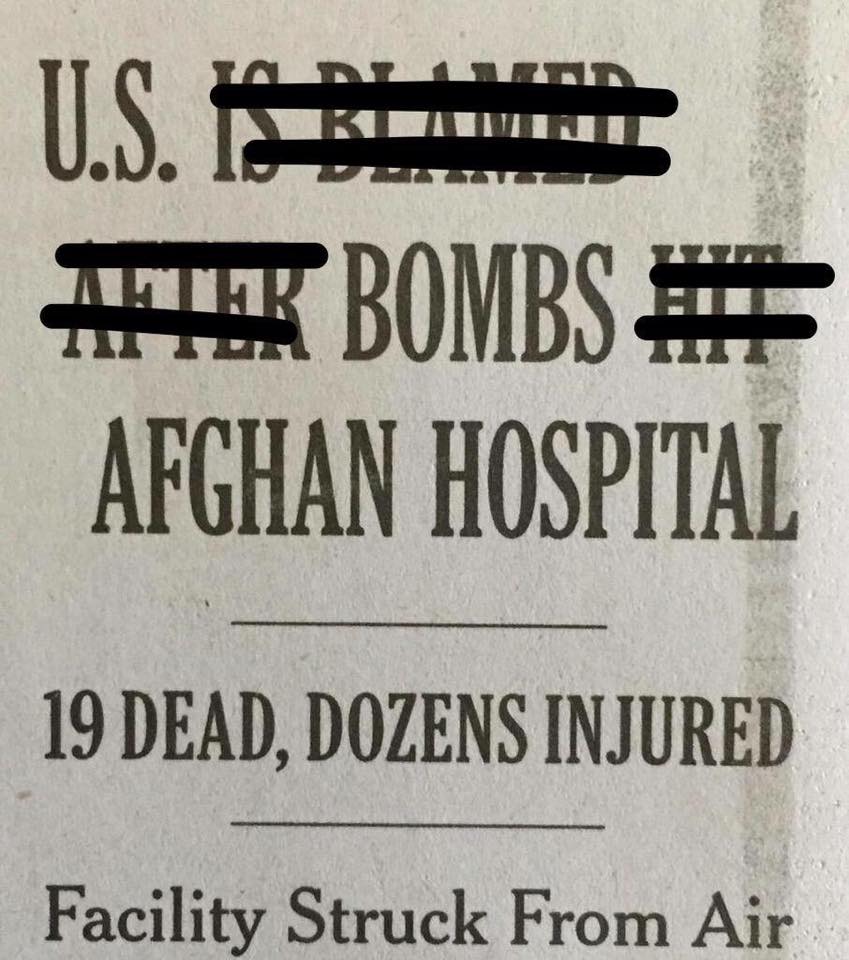
NYT headline (10/3/15) improved by Twitter user @OneKade
When the US bombed a hospital in Kunduz, Afghanistan, in October 2015, killing dozens of civilians, media scrambled to craft almost laughable euphemisms. FAIR (10/5/15) documented at the time how news outlets used circuitous headlines like “US Is Blamed After Bombs Hit Afghan Hospital.” Also seen in the August 23 NPR report cited above, this brand of misleading, ambiguous rhetoric is the “officer-involved shooting” of war reporting.
On the other hand, the responsibility of US enemies for killing civilians is rarely if ever obscured.
It is instructive to compare Western media coverage of Yemen to that of Syria, where attacks are “Assad bombing” (Fox News, 2/15/17), “Assad airstrikes” (Breitbart, 4/28/16), “Assad regime airstrikes” (Times of Israel, 10/16/12; Australian, 8/18/15), “regime airstrikes” (NBC, 8/19/16) or “regime bombing” (Daily Caller, 8/17/15).
Media have even written of a “pro-Assad drone” that was “displaying hostile intent,” and thus just had to be shot down by the US (Guardian, 6/20/17; Independent, 6/20/17; The Hill, 6/20/17), as if the robot were personally a fan of the Syrian leader.
The phrases “Salman bombing,” “Salman airstrikes” or “Saudi regime airstrikes” are, however, nowhere to be found in reports on Yemen.
Downplaying the Key US Role
Media calling US/Saudi coalition attacks “Yemeni airstrikes” is at best misleading, and at worst flat-out false. Yet this language also has a political effect: It obscures the character of the war. This framing is part of the “civil war” trope media have propagated for two-and-a-half years.
When Yemen is discussed, it is virtually always through the lens of a “civil war.” As FAIR (7/25/17) has detailed before, this exceedingly widespread myth, which has permeated media discourse, denies the extent to which the conflict is actually a foreign war on Yemen, led by Saudi Arabia, the UAE and their US and European sponsors.
Even the term “Saudi-led” coalition is misleading. The New York Times editorial board (8/17/16) acknowledged, in a little-noted editorial on Yemen, “Experts say the coalition would be grounded if Washington withheld its support.”
That is to say, if the US wanted the war in Yemen to end, it would end overnight. The “Saudi-led” coalition is only led by Saudi Arabia in name.
Surprisingly, in the midst of intensified coalition attacks, the New York Times published another rare editorial on Yemen on August 25. In the piece, dramatically titled “The Slaughter of Children in Yemen,” the editorial board forcefully warned of exactly what critics have been saying for 29 months:
The Saudi coalition—and its American enablers, who provide military equipment, aerial refueling and targeting—simply cannot be allowed to continue killing civilians and destroying what little is left of Yemen. That is why it is imperative to publicly identify the unconscionable slaughter of innocents for what it is, and to hope that this will shame Saudi Arabia and its American backers to search for a humane end to Yemen’s hell.
Reporters at the Times and elsewhere should heed this call to demonstrate journalistic responsibility by clearly conveying their governments’ responsibility for the slaughter in Yemen—not just in editorials, but in news articles, every time.
‘400,000 deaths in Syria civil war directly attributed to US & allies’
By Dan Glazebrook | RT | September 1, 2017
African and Asian leaders are denied by the West to have any military means against an insurgency in their countries, while the US and its allies have absolute impunity when they want to take on a population anywhere in the world, says political analyst Dan Glazebrook.
The US-led coalition against Islamic State has confirmed another 61 civilian deaths are likely to have been caused by its air and artillery strikes in Iraq and Syria. That brings the total number of civilians it has acknowledged killing since the conflict began to 685.
Dan Glazebrook: I think it’s also likely to be a gross underestimate because we found out in 2012, for example, that all military-age males killed in US airstrikes are not classified by the US military as civilians, they’re automatically excluded from those statistics. So if I was walking down the street in Iraq, unarmed, and I was directly and intentionally blown to pieces by a US airstrike, that would not be recorded as a civilian death. Now, I don’t know if they still use this criterion currently, but what we certainly do know is that the monitoring group Airwars suggested almost 1,500 people may have been killed in US coalition bombings in Iraq and Syria in March of this year alone, including the terrible strike on a residential block in Mosul that is thought to have killed around 200 people. So these statistics are certainly likely to be a gross underestimate.
There are a couple of other points I’d like to make about this as well. This narrow focus on civilians we must recognize is deeply ideological because it serves to whitewash the true scale of the slaughter taking place in Iraq and Syria right now. Why should a 16-year-old boy, pressed into service by ISIS and then blown to pieces by the US before even firing a shot, why should his life be considered so unworthy, so meaningless, as not to be recorded in any kind of statistic because he’s, “not a civilian”? This use of the term and focus on civilians is actually a means of placing all soldiers, all militants, in the same category of subhuman and implies they deserve to be killed. More than that, not only do they deserve to be killed, but their lives are so meaningless and unworthy, they don’t even deserve to be recognized in any kind of balance sheet as to the costs of this war.
And a third point I’d like to make is that in 2011, Syria was at peace until, in that year, the US, Britain, and France sponsored a violent sectarian insurgency, an insurgency in Syria that eventually morphed into ISIS and spilled over into Iraq. So I would actually go further than this and I would attribute all 400,000 deaths in the Syrian civil war directly to the US, France, Britain and their allies.
RT:What would you make of comments made by US Defense Secretary James Mattis that Americans are the good guys and locals know the difference. Is there a difference between good bombs and bad bombs?
DG: No, of course, there isn’t, and what’s absolutely clear is their recklessness, which was actually bad enough under Obama but has increased under Trump. The recklessness with which the US is pursuing its foreign policy goals – and Britain and its allies in the coalition, I should add – have got complete impunity and complete disregard for the lives of those living in places like Mosul and Raqqa and it really shows the racism which is inherent in what’s going on here. Leaders of African and Asian states are denied by the West to have any kind of military means against an insurgency that happens within their borders. And yet when the US and its allies decide they want to take on a population anywhere in the world, they have absolute impunity to do so. So in 2011 Gaddafi was trying to put down a proto-ISIS rebellion in Benghazi and was labeled by the West as a bloody genocidal dictator and so on and was eventually subjected to torture and lynching by those states. When the US decides it wants to carpet-bomb Mosul or Raqqa thousands of miles from its shores, it can do so with complete recklessness and impunity and disregard for the populations living there.
Dan Glazebrook is a freelance political writer who has written for RT, Counterpunch, Z magazine, the Morning Star, the Guardian, the New Statesman, the Independent and Middle East Eye, amongst others. His first book “Divide and Ruin: The West’s Imperial Strategy in an Age of Crisis” was published by Liberation Media in October 2013. It featured a collection of articles written from 2009 onwards examining the links between economic collapse, the rise of the BRICS, war on Libya and Syria and ‘austerity’. He is currently researching a book on US-British use of sectarian death squads against independent states and movements from Northern Ireland and Central America in the 1970s and 80s to the Middle East and Africa today.
Lavrov to Israel: No One Is Going to Attack You. Relax
Russia Insider | August 30, 2017
Probably nobody was surprised when a senior Israeli official on Monday “warned the Russian government that if Iran continues to extend its reach in Syria, Israel will bomb Syrian President Bashar Assad’s palace in Damascus.”
Strong words. But Moscow doesn’t seem particularly impressed.
Russian Foreign Minister Sergey Lavrov stressed that his government has “no information” about anyone planning an attack on Israel—and reminded all relevant parties that bombing sovereign nations for no reason whatsoever is a violation of international law.
Via TASS :
Moscow has no information about anyone preparing an attack on Israel, Russian Foreign Minister Sergey Lavrov said following his talks with the emir of Qatar on Wednesday.
“We don’t have any information about anyone preparing an attack on Israel,” the Russian top diplomat said commenting on media reports stating that Iran plans to deploy high-precision missiles, capable of hitting Israel, to Syria and Lebanon.
While speaking about the nature of cooperation between Iran and Syria, the Russian foreign minister stressed that “if they [Iran and Syria] cooperate in any field without violating the foundations of international law, then no one should question their cooperation.”
“If anyone in the Middle East or in other parts of the world plans to violate international law by infringing on the sovereignty and territorial integrity of other states, including the countries of the Middle East and North Africa, it is reprehensible,” Lavrov added.
NATO attack on Serbian state TV wiped from record

By Shane Quinn | The Duran | August 31, 2017
On 23 April 1999, a NATO missile attack on Radio Television of Serbia (RTS) headquarters killed 16 employees of the state broadcaster. The forgotten war crime occurred during the Kosovo War (March 1998-June 1999), and was part of NATO’s aerial campaign alongside the US-backed Kosovo Liberation army, in opposition to the Federal Republic of Yugoslavia.
In the aftermath of the attack there were no great public campaigns launched for the 16 murdered journalists and employees, no outpouring of emotion for those killed, no calls for solidarity and togetherness in the face of aggression. On the contrary the West justified this grievous blow against freedom of expression, praised it even.
Tony Blair, Britain’s then Prime Minister, welcomed the killings when speaking at NATO’s 50th anniversary summit in Washington. Blair said the missile attack was “entirely justified… in damaging and attacking all these targets”, and that those murdered were part of the “apparatus of dictatorship and power of [Slobodan] Milosevic”.
Blair felt that, “the responsibility for every single part of this action lies with the man [Milosevic] who has engaged in this policy of ethnic cleansing and must be stopped”. Apparently Milosevic “must be stopped” by wiping out state journalists or what Blair describes as an “apparatus of dictatorship”.
According to one of the main leaders of the Western world, Milosevic must bear full responsibility for a NATO fighter plane firing a US-made missile on a state broadcasting service’s headquarters. Perhaps we shouldn’t be too surprised by Blair’s visions of justice, particularly when examining his key role in the deaths of hundreds of thousands of Iraqis in the following decade.
Blair was not alone in praising this violation of international law. His Secretary of State for International development, Clare Short, said afterwards that, “the propaganda machine is prolonging the war and it’s a legitimate target”. Short is a Labour Party member and her official title today is The Right Honourable Clare Short. Defending these killings was neither right nor honourable one can assume.
NATO themselves commended the deliberate attack afterwards. NATO’s military spokesperson Air Commodore David Wilby declared RTS, “a legitimate target which filled the airways with hate and with lies over the years”. This followed on from a number of other NATO attacks on radio and television outlets in the country.
In the build up to the 2003 Iraq invasion, Cardiff University revealed that the BBC adopted the most pro-war stance of any British network. The official reasons for invading Iraq were based entirely on lies and misinformation. In this case was the BBC “the propaganda machine”, had it become “a legitimate target” too?
Pentagon spokesperson Kenneth Bacon also legitimised the war crime saying that, “Serb TV is as much a part of Milosevic’s murder machine as his military is”. Not to be outdone, the respected US diplomat and magazine editor Richard Holbrooke described the bombing of RTS as, “an enormously important and, I think, positive development”.
In the build up to the Iraq invasion American networks like Fox News were styling the illegal intervention as “Operation Iraqi Freedom”, with its correspondents and news anchors compelled to repeat that phrase. In addition a permanent American flag was fluttering in the top corner of the screen, and during the invasion itself the banner “war on terrorism” was unfurled.
Did this make Fox News and others like it, “a legitimate target which filled the airways with hate and lies”? Judging by the standards of Western elites, one would have to suggest so.
Meanwhile, a single person was charged for the attack on RTS: Dragoljub Milanovic, the Serbian network’s general manager, who received a 10-year jail term for failing to evacuate the building in time. Yet the International Criminal Tribunal for the former Yugoslavia concluded that NATO’s bombing of RTS was not a crime, noting that deaths were “unfortunately high, they do not appear to be clearly disproportionate”. Clearly disproportionate to the overall number of civilian deaths inflicted by NATO perhaps.
However, in January 2015 the Western reaction was somewhat different when 12 journalists from the Charlie Hebdo satirical newspaper were murdered by Islamic extremists – along with four Jewish men killed at a kosher supermarket shortly afterwards.
The British Prime Minister on this occasion, David Cameron, did not justify the killing of journalists and said, “We stand absolutely united with the French people against terrorism and against this threat to our values – free speech, the rule of law, democracy”. Cameron went on, “we should never give up the values we believe in… a free press, in freedom of expression, in the right of people to write and say what they believe”.
About two weeks later Blair, now a Middle East peace envoy, said of the thinking behind the Charlie Hebdo attacks, “this extremism is not natural, it’s taught and it’s learned and you have to un-teach it in the school systems”. Blair seems further unaware of his own role in creating “this extremism” by playing the junior partner role in invading Iraq, a crucial factor in the rise of ISIS.
In the aftermath of the Charlie Hebdo attacks, millions marched to honour the dead with the slogan “I am Charlie” becoming famous. When the Serbian journalists and employees were killed just over 15 years before, there was no international motto of “I am RTS”.
New York civil rights lawyer Floyd Abrams described the Charlie Hebdo shootings as, “the most threatening assault on journalism in living memory”. The perception of “living memory” appears to be a remarkably short one.
Dirar Abu Sisi once again ordered to six months in isolation
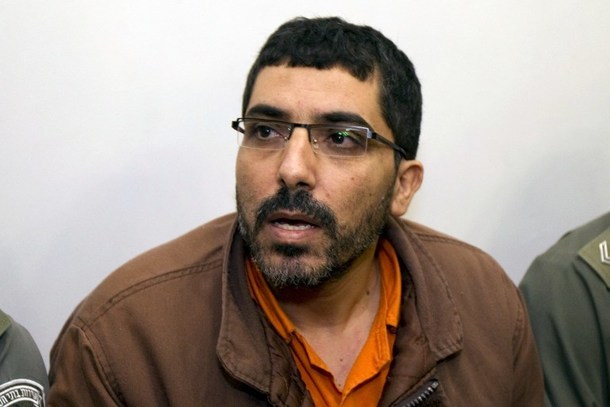
Gazan engineer Dirar Abu Sisi, AFP PHOTO / JACK GUEZ
Samidoun Palestinian Prisoner Solidarity Network – August 26, 2017
Imprisoned Palestinian engineer kidnapped from Ukraine, Dirar Abu Sisi, had his isolation extended for another six months by the Israeli occupation on 26 August. Abu Sisi’s health has recently deteriorated and he is suffering from severe pain in his lower back; he has been held in long-term solitary confinement repeatedly since he was abducted from a train by Israeli intelligence forces.
Abu Sis, 47, i is an engineer from Gaza who was abducted from the Ukraine on 19 February 2011 by the Mossad. He is married (to a Ukrainian citizen), the father of six children, and holds a graduate degree in electrical engineering. He was the deputy engineer of Gaza’s power plant. From Gaza, Veronika Abu Sisi, his wife, has continually advocated for his release and an end to his isolation.
“We won’t give up until Dirar Abu Sisi is released,” Veronika Abu Sisi said in 2013. “They steal our land, they put us in jail, but we have the right to live here. This is our home. I just hope my husband will be back soon with me and our children.” The family has six children. Abu Sisi is now serving a 21-year sentence on charges of participating in the Palestinian resistance in Gaza and continues to be subject repeatedly to solitary confinement and isolation.
Ten civilians killed in US-backed raid in Somalia: Official
Press TV – August 25, 2017
Ten civilians have been killed in a US-backed raid on a farm in southern Somalia, according to the deputy governor of Lower Shabelle region.
The raid on Barire village early Friday led to the deaths of three children aged 8 to 10 and a woman among others, Ali Nur Mohamed told reporters in the capital, Mogadishu.
“These local farmers were attacked by foreign troops while looking after their crops,” Mohamed said. “The troops could have arrested them because they were unarmed but instead shot them one by one mercilessly.”
Somalia’s information ministry, which initially said members of al-Qaeda-linked extremist group al-Shabab were among the dead, confirmed there were “civilian casualties” too.
The US Africa Command issued a statement Friday, confirming it had supported an operation against al-Shabab militants.
“We are aware of the civilian casualty allegations near Barire, Somalia. We take any allegations of civilian casualties seriously, and per standard, we are conducting an assessment into the situation to determine the facts on the ground,” said the statement.
This is a clear indication of growing US military involvement in the Horn of Africa nation after President Donald Trump ordered that operations against the extremist group be expanded, approving more aggressive airstrikes in the country.
Somalia has been the scene of deadly clashes between government forces and al-Shabab militants since 2006.
The Takfiri militant group was forced out of the capital by African Union troops in 2011 but still controls parts of the countryside and carries out attacks against government, military and civilian targets seemingly at will in Mogadishu and regional towns.
The extremist group is just one of the challenges facing the new Somali government, which is still struggling to expand its authority beyond the capital and other selected areas.
The Possible Education of Donald Trump
By Robert Parry | Consortium News | August 25, 2017
Despite the chaos and ugliness of the past seven months, President Trump has finally begun to turn U.S. foreign policy away from the neoconservative approach of endless war against an ever-expanding roster of enemies.
This change has occurred largely behind the scenes and has been obscured by Trump’s own bellicose language, such as his vow to “win” in Afghanistan, and his occasional lashing out with violence, such as his lethal Tomahawk missile strike on a Syrian airfield.
Some Trump advisers also have downplayed the current shift because it may fuel the Democrats’ obsession with Russia-gate as a much-desired excuse to impeach Trump. Every peaceful move that Trump makes is called a sop to Russia and thus an excuse to reprise the dubious allegations about Russia somehow helping to elect him.
Yet, despite these external obstacles and Trump’s own erratic behavior, he has remained open to unconventional alternatives to what President Obama once criticized as the Washington “playbook,” i.e. favoring military solutions to international problems.
In this sense, Trump’s shallow understanding of the world has been a partial benefit in that he is not locked into the usual Washington groupthinks – and he personally despises the prominent politicians and news executives who have sought to neuter him since his election. But his ignorance also prevents him from seeing how global crises often intersect and thus stops him from developing a cohesive or coherent doctrine.
Though little noted, arguably the most important foreign policy decision of Trump’s presidency was his termination of the CIA’s covert support for Syrian rebels and his cooperation with Russian President Vladimir Putin to expand partial ceasefire zones in Syria.
By these actions, Trump has contributed to a sharp drop-off in the Syrian bloodshed. It now appears that the relatively secular Syrian government of President Bashar al-Assad is regaining control and that some Syrian refugees are returning to their homes. Syria is starting the difficult job of rebuilding shattered cities, such as Aleppo.
But Trump’s aversion to any new military adventures in Syria is being tested again by Israeli Prime Minister Benjamin Netanyahu, who is threatening to attack Iranian and Hezbollah forces inside Syria.
Last week, according to Israeli press reports, a high-level delegation led by Mossad chief Yossi Cohen carried Netanyahu’s threat to the U.S. government. The Israeli leader surely has raised the same point directly in phone calls with Trump.
Tiring of Bibi
I was told that Trump, who appears to be growing weary of Netanyahu’s frequent demands and threats, flatly objected to an Israeli attack and brushed aside Israel’s alarm by noting that Netanyahu’s policies in supporting the rebels in Syria contributed to Israel’s current predicament by drawing in Iran and Hezbollah.
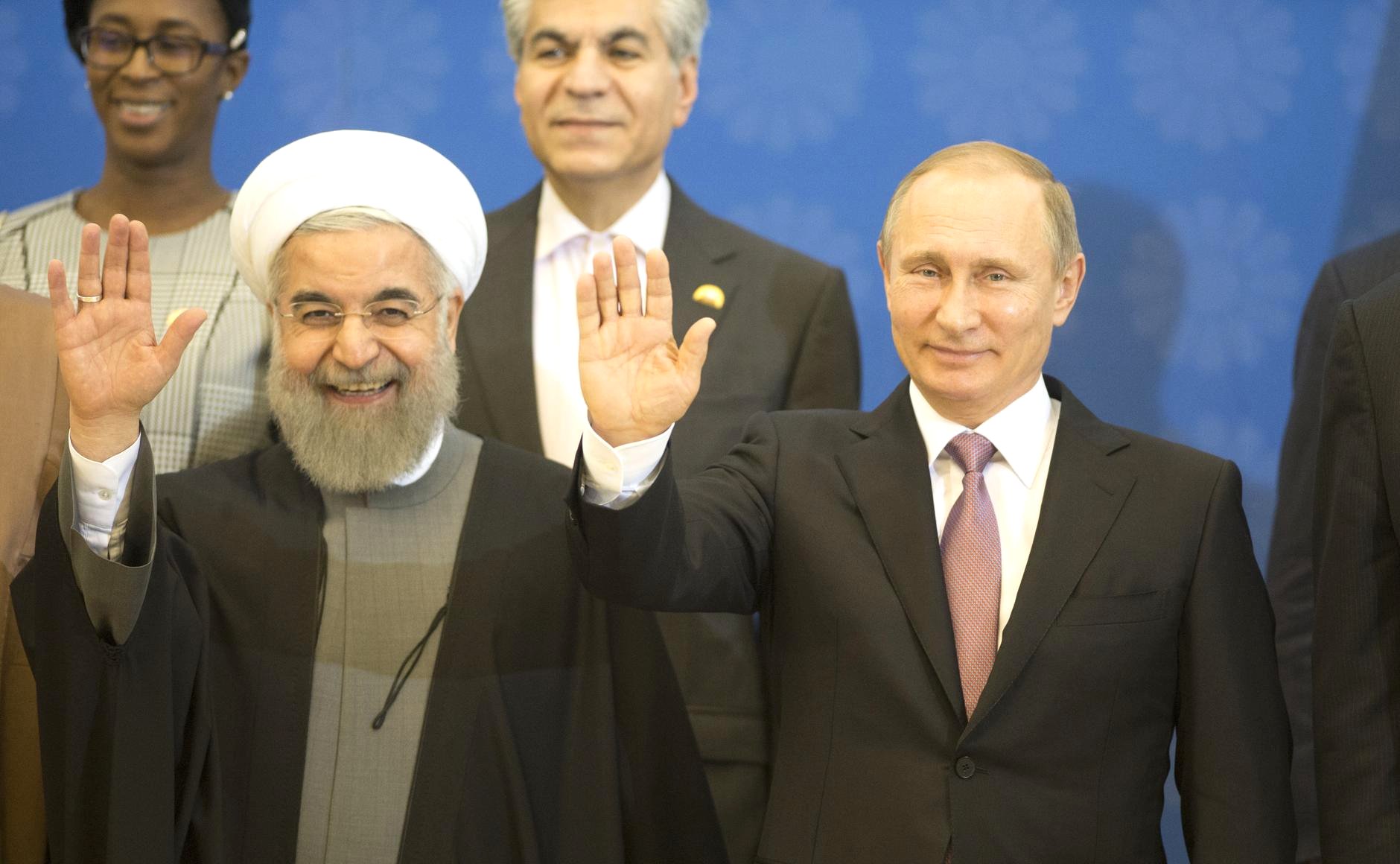
This week, Netanyahu personally traveled to Sochi, Russia, to confront Putin with the same blunt warning about Israel’s intention to attack targets inside Syria if Iran does not remove its forces.
A source familiar with the meeting told me that Putin responded with a sarcastic “good luck!” and that the Russians thought the swaggering Netanyahu appeared “unhinged.”
Still, a major Israeli attack on Iranian positions inside Syria would test Trump’s political toughness, since he would come under enormous pressure from Congress and the mainstream news media to intervene on Israel’s behalf. Indeed, realistically, Netanyahu must be counting on his ability to drag Trump into the conflict since Israel could not alone handle a potential Russian counterstrike.
But Netanyahu may be on somewhat thin ice since Trump apparently blames Israel’s top American supporters, the neocons, for much of his political troubles. They opposed him in the Republican primaries, tilted toward Hillary Clinton in the general election, and have pushed the Russia-gate affair to weaken him.
President Obama faced similar political pressures to fall in line behind Israel’s regional interests. That’s why Obama authorized the covert CIA program in Syria and other aid to the rebels though he was never an enthusiastic supporter – and also grew sick and tired of Netanyahu’s endless hectoring.
Obama acquiesced to the demands of Official Washington’s neocons and his own administration’s hawks – the likes of Secretary of State Hillary Clinton, CIA Director David Petraeus, his successor John Brennan, and United Nations Ambassador Samantha Power.
The Syrian conflict was part of a broader strategy favored by Washington’s neocons to overthrow or cripple regimes that were deemed troublesome to Israel. Originally, the neocons had envisioned removing the Assad dynasty soon after the invasion of Iraq in 2003, with Iran also on the “regime change” menu. But the disastrous Iraq War threw off the neocons’ timetable.
‘Regime Change’ Chaos
The Democratic Party’s liberal interventionists, who are closely allied with the Republican neocons, also tossed in Libya with the overthrow and murder of Libyan leader Muammar Gaddafi in 2011. Then, weapons from Gaddafi’s stockpiles were shipped to Syria where they strengthened rebel fighters allied with Al Qaeda’s Nusra Front and other Islamist groups.
Faced with this troubling reality – that the U.S.-backed “moderate rebels” were operating side by side with Al Qaeda’s Syrian affiliate and its allies – Washington’s neocons/liberal-hawks responded with sophisticated propaganda and devised clever talking points to justify what amounted to indirect assistance to terrorists.
The “regime change” advocates portrayed a black-and-white situation in Syria with Assad’s side wearing the black hats and various anti-Assad “activists” wearing the white hats (or literally White Helmets). The State Department and a complicit mainstream media disseminated horror stories about Assad and – when the reality about Al Qaeda’s role could no longer be hidden – that was spun in the rebels’ favor, too, by labeling Assad “a magnet for terrorists” (or later in cahoots with the Islamic State). For years, such arguments were much beloved in Official Washington.
But the human consequences of the Syrian conflict and other U.S.-driven “regime change” wars were horrific, spreading death and destruction across the already volatile Middle East and driving desperate refugees into Europe, where their presence provoked political instability.
By fall 2015, rebel advances in Syria – aided by a supply of powerful U.S. anti-tank missiles – forced Russia’s hand with Putin accepting Assad’s invitation to deploy Russian air power in support of the Syrian army and Iranian and Hezbollah militias. The course of the war soon turned to Assad’s advantage.
It’s unclear what Hillary Clinton might have done if she had won the White House in November 2016. Along with much of the U.S. foreign policy establishment, she called repeatedly for imposing a “no-fly zone” in Syria to stop operations by the Syrian air force and Russia, a move that could have escalated the conflict into World War III.
But Trump – lacking Official Washington’s “sophistication” – couldn’t understand how eliminating Assad, who was leading the fight against the terrorist groups, would contribute to their eventual defeat. Trump also looked at the failure of similar arguments in Iraq and Libya, where “regime change” produced more chaos and generated more terrorism.
Pandering to Saudis/Israelis
However, in the early days of his presidency, the unsophisticated Trump lurched from one Middle East approach to another, initially following his son-in-law Jared Kushner’s grandiose thinking about recruiting Saudi Arabia to an “outside-in” strategy to settle the Israel-Palestine conflict, i.e., enlisting the Saudis to pressure the Palestinians into, more or less, letting Israel dictate a solution.
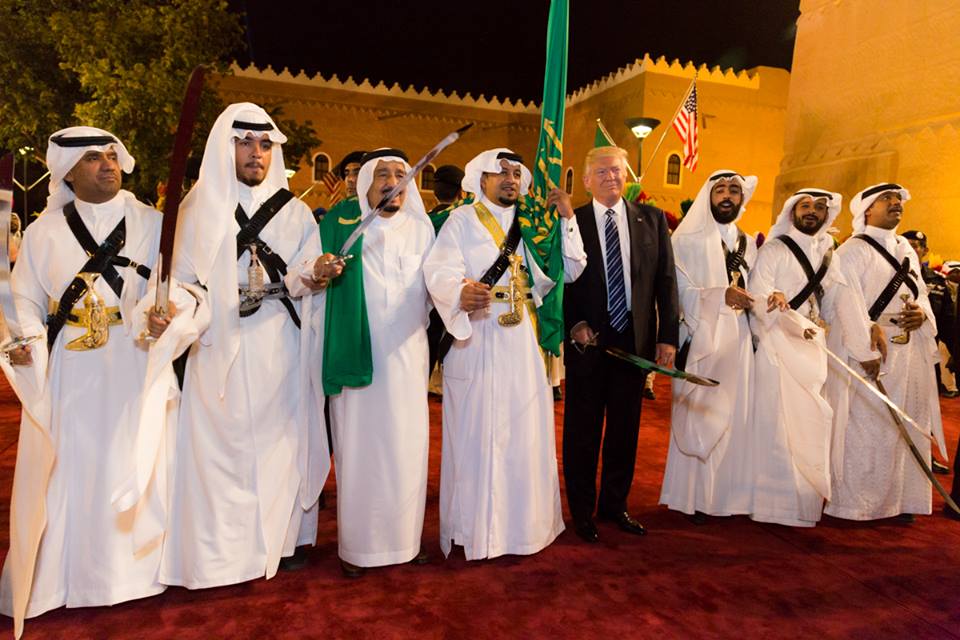
Kushner’s “outside-in” scheme was symbolically acted out with Trump making his first overseas visit to Saudi Arabia and then to Israel in May. But I’m told that Trump eventually cooled to Kushner’s thinking and has come to see the Israeli-Saudi tandem as part of the region’s troubles, especially what he views as Saudi Arabia’s longstanding support for Al Qaeda and other terror groups.
Perhaps most significantly in that regard, Trump in July quietly abandoned the CIA’s covert war in Syria. In the U.S., some “regime change” advocates have complained about this “betrayal” of the rebel cause and some Democrats have tried to link Trump’s decision to their faltering Russia-gate “scandal,” i.e., by claiming that Trump was rewarding Putin for alleged election help.
But the bottom line is that Trump’s policy has contributed to the Syrian slaughter abating and the prospect of a victory by Al Qaeda and/or its Islamic State spinoff fading.
So, there has been a gradual education of Donald Trump, interrupted occasionally by his volatile temper and his succumbing to political pressure, such as when he rushed to judgment on April 4 and blamed the Syrian government for a chemical incident in the remote Al Qaeda-controlled village of Khan Sheikhoun.
Despite strong doubts in the U.S. intelligence community about Syria’s guilt – some evidence suggested one more staged “atrocity” by the rebels and their supporters – Trump on April 6 ordered 59 Tomahawk missiles fired at a Syrian air base, reportedly killing several soldiers and some civilians, including four children.
Trump boasted about his decision, contrasting it with Obama’s alleged wimpiness. And, naturally, Official Washington and the U.S. mainstream media not only accepted the claim of Syrian government guilt but praised Trump for pulling the trigger. Later, Hillary Clinton said if she were president, she would have been inclined to go further militarily by intervening with her “no-fly zone.”
As reckless and brutal as Trump’s missile strike was, it did provide him some cover for his July 7 meeting with Putin at the G-20 summit in Germany, which focused heavily on Syria, and also for his decision to pull the plug on the CIA’s covert war.
Saudi-backed Terror
I’m told Trump also has returned to his pre-election attitude about Saudi Arabia as a leading supporter of terror groups and a key provocateur in the region’s disorders, particularly because of its rivalry with Iran, a factor in both the Syrian and Yemeni wars.
(Official White House Photo by Shealah Craighead)
Though Trump has recited Washington’s bipartisan (and benighted) mantra about Iran being the principal sponsor of terrorism, he appears to be moving toward a more honest view, recognizing the falsity of the neocon-driven propaganda about Iran.
Trump’s new coolness toward Saudi Arabia may have contributed to the recent warming of relations between the Sunnis of Saudi Arabia and the Shiites of Iran, a sectarian conflict dating back 1,400 years. In a surprising move announced this week, the two countries plan an exchange of diplomatic visits.
Even in areas where Trump has engaged in reckless rhetoric, such as his “fire and fury” warning to North Korea, his behind-the-scenes policy appears more open to compromise and even accommodation. In the past week or so, the tensions with North Korea have eased amid backchannel outreach that may include the provision of food as an incentive for Pyongyang to halt its missile development and even open political talks with South Korea, according to a source close to these developments.
On Afghanistan, too, Trump may be playing a double game, giving a hawkish speech on Monday seeming to endorse an open-ended commitment to the near-16-year-old conflict, while quietly signaling a willingness to negotiate a political settlement with the Taliban.
One alternative might be to accept a coalition government, involving the Taliban, with a U.S. withdrawal to a military base near enough to launch counterterrorism strikes if Al Qaeda or other international terror groups again locate in Afghanistan [likely an air base from which to threaten Iran – Aletho News ].
Many of Trump’s latest foreign policy initiatives reflect former White House strategist Steve Bannon’s hostility toward neoconservative interventionism. Secretary of State Rex Tillerson, the former Exxon-Mobil chief executive, also shares a more pragmatic approach to foreign affairs than some of his more ideological predecessors.
Albeit still in their infancy, these policies represent a new realism in U.S. foreign policy that, in many ways, paralleled what President Obama favored but was often unwilling or unable to see through to its logical conclusions, given his fear of Netanyahu and the power of the neocons and their liberal-hawk allies.
Still, some of Obama’s most important decisions – not to launch a major military strike against Syria in August 2013 and to negotiate an agreement with Iran to constrain its nuclear program in 2013-15 – followed a similar path away from war, thus drawing condemnation from the Israeli-Saudi tandem and American neocons.
As a Republican who rose politically by pandering to the GOP “base” and its hatred of Obama, Trump rhetorically attacked Obama on both Syria and Iran, but may now be shifting toward similar positions. Gradually, Trump has come to recognize that the neocons and his other political enemies are trying to hobble and humiliate him – and ultimately to remove him from office.
The question is whether Trump’s instinct for survival finally will lead him to policies that blunt his enemies’ strategies or will cause him to succumb to their demands.
Investigative reporter Robert Parry broke many of the Iran-Contra stories for The Associated Press and Newsweek in the 1980s.
US, Saudi Ask Syria Opposition to Accept Assad’s Political Role: Report
Al-Manar | August 25, 2017
US and Saudi diplomats have reportedly been urging the armed Syrian opposition to come to terms with President Bashar al-Assad’s role in Syria’s future, a report said, indicating to the major policy U-turn in the western stance from the Syrian crisis.
In an article published on Thursday, the Associated Press said the Syrian army holds the upper hand on the battlefield against militant groups, pointing to the major shift in the strategies of Western and regional supporters of Syrian opposition groups and militants with regard to the developments in Syria.
“Western and regional rebel patrons, currently more focused on advancing their own interests rather than accomplishing regime change in Damascus, are shifting their alliances and have ceased calls on Assad to step down,” the report said.
Former US ambassador to Syria, Robert Ford, who is widely considered as Washington’s civil war engineer in different parts of the world and a key instigator of the Syrian conflict in 2011, has ruled out the likelihood of Assad’s removal, saying, “There is no conceivable military alignment that is going to be able to remove him.”
“Everyone, including the US, has recognized that Assad is staying,” said Ford, who is currently a fellow at the Middle East Institute in Washington, D.C.
According to an interlocutor, who mediates between the opposition and state capitals and requested anonymity, Saudi Foreign Minister Adel al-Jubeir told the opposition it was time to formulate “a new vision.”
“He did not explicitly say Bashar [Assad] is going to stay, but if you read between the lines, if you say there needs to be a new vision, what is the most contentious issue out there? It is whether Bashar stays,” said the interlocutor, according to the article.
Featured Video
Daniel Davis: Trump’s New Iran Land Blockade Is a Dangerous Fantasy
or go to
Aletho News Archives – Video-Images
New Book
The Vaccine Mafia: Pfizer’s Former Chief Toxicologist Proves How Toxic Substances Were Unlawfully Sold to Us as a Solution for COVID-19
By Helmut Sterz
Former Pfizer chief toxicologist Helmut Sterz presents a critical examination of the development, approval, and global rollout of mRNA COVID-19 vaccines—particularly those produced by Pfizer/BioNTech. The Vaccine Mafia details the failure of pharmaceutical companies, regulatory authorities, politicians, and international organizations to follow established scientific and ethical standards during the pandemic. Drawing on the author’s decades of experience in pharmaceutical toxicology, Sterz reveals the many ways the vaccines’ inadequate or omitted preclinical safety testing put the world’s population at risk.
Sterz demonstrates how “emergency” approvals allowed manufacturers to bypass long-standing international guidelines governing toxicity testing, especially with regard to reproductive and cancer risks. They also allowed governments and health authorities to ignore or conceal evidence of serious adverse effects that occurred, including myocarditis, reproductive harm, and other long-term health risks.
Blog Roll
 Aletho News
- The ‘Gaza Treatment’: How Media Headlines Obscure Who is Bombing Yemen
- Ro Khanna urges Democrats to strip Israel ‘integration’ provision from defense bill
- Why Iran designated British MI6, Royal Navy, and RAF as hostile, terrorist organizations
- Armenian opposition politician dies in custody
- US still trying to recycle failed hypersonic missile programs
- France’s ‘Cold War’: Paris blames Tehran for supermarket fridge hacks
- Psywar no more? 77th Brigade’s sudden death
- Ukraine Already Carved Up… Before Talks Begin? /Prof. Richard Sakwa
- The vindication of Marjorie Taylor Greene
- Nearly 80% of Britons consider Israel a threat to world peace and security: Survey
- If Americans Knew
- An error has occurred; the feed is probably down. Try again later.
- No Tricks Zone
- German Authorities Start Initiative To Evaluate Public Register For Climate “Disinformation” Spreaders!
- Zonal Asymmetry of Temperature Change in the Antarctic Circumpolar Current
- New Study: The Net Fossil Fuel Contribution To Rising Atmospheric CO2 Has Been Zero For 500 Years
- Germany’s Green Energy Transition Becoming Increasingly Expensive…Another 6 Trillion Euros!
- Sudden Stratospheric Warming, Powerful El Niño Combination May Lead To Extreme Europe Cold, Energy Crisis!
- Two New Studies Find Thwaites Glacier Melt Cannot Be Driven By Human Activity Or A Warming Ocean
- E-Cars Reduce CO2 Emissions By Only 41% Compared To Internal Combustion Engine Vehicles
- Predictions Made By Renowned Climate Professor Over Past Decades Have Been Proven To Be Poor
- New Study Suggests Large Regions Of The Pacific Ocean Have Been Cooling For The Last 80 Years
- Germany’s Green Energy Debacle: High Energy Costs Force Kahla Porzellan to Close After 182 Years!

