Netanyahu to meet Putin amid Syrian army advances
Press TV | August 20, 2017
Israeli Prime Minister Benjamin Netanyahu is about to meet Russian President Vladimir Putin in Sochi on Wednesday in the face of the Syrian army advances against militants, including those backed by Tel Aviv.
In a statement released on Saturday, Netanyahu’s office said the two sides would “discuss the latest developments in the region” during their meeting in the Black Sea resort.
The main issues that are expected to be raised at the meeting include Israel’s worries about a ceasefire agreement in Syria and a foothold which Tel Aviv thinks Iran is finding in the Arab country.
Last week, the Israeli premier claimed that Iran was increasing its presence in Syria as the Daesh terrorist group was being driven out of the country.
“I’ll give you a summary in one sentence—ISIS (Daesh) going out, Iran coming in,” Netanyahu said, summarizing a briefing with Yossi Cohen, the head of Israel’s Mossad spy agency.
Later this week, an Israeli military delegation, headed by Cohen, will visit Washington for talks with senior White House and American officials.
Over the past few months, Daesh has retreated from much of the areas under its control amid sweeping gains made by Syrian army soldiers and allied fighters against the terror outfit.
Bouthaina Shaaban, political and media adviser to Syrian President Bashar al-Assad, said on Friday that the war on Syria had reached its “penultimate stage” as foreign powers that backed militant groups were changing their policies.
Iran has been providing advisory support to the Syrian military in its counter-terrorism operations.
On the contrary, Israel has been regularly attacking positions held by pro-Damascus forces in Syria, claiming that the attacks are retaliatory. Syria says the Israeli raids are meant to shore up the Takfiri terrorists.
There are also reports that Israel has been providing medical treatment to the extremists wounded in Syria and supplying arms to them.
Back in June, United Nations UN Secretary General Antonio Guterres warned that the growing interactions between Israeli armed forces and Syria militants could lead to escalation.
A Venezuelan Tanker Is Stranded Off The Louisiana Coast
By Tyler Durden | Zero Hedge | August 17, 2017
A tanker loaded with 1 million barrels of Venezuelan heavy crude has been stranded for over a month off the coast of Louisiana, not because it can’t sail but as a result of Venezuela’s imploding economy, and its inability to obtain a bank letter of credit to deliver its expensive cargo. It’s the latest sign of the financial troubles plaguing state-run oil company PDVSA in the aftermath of the latest US sanctions against the Maduro regime, and evidence that banks are slashing exposure to Venezuela across the board as the Latin American nation spirals into chaos.
As Reuters reports, following the recently imposed US sanctions, a large number of banks have closed accounts linked to officials of the OPEC member and have refused to provide correspondent bank services or trade in government bonds. The stranded tanker is one direct casualty of this escalation.
The tanker Karvounis, a Suezmax carrying Venezuelan diluted crude oil, has been anchored at South West Pass off the coast of Louisiana for about a month, according to Marinetraffic data.
For the past 30 days, PBF Energy, the intended recipient of the cargo, has been trying unsuccessfully to find a bank willing to provide a letter of credit to discharge the oil, according to two trading and shipping sources.
The tanker was loaded with oil in late June at the Caribbean island of St. Eustatius where PDVSA rents storage tanks, and has been waiting for authorization to discharge since early July, according to Reuters. It is here that the delivery process was halted as crude sellers request letters of credit from customers that guarantee payment within 30 days after a cargo is delivered.
While the documents must be issued by a bank and received before the parties agree to discharge, this time this is impossible as the correspondent bank has decided to avoid interacting with PDVSA and running afoul of the latest US sanctions. It was not immediately clear which banks have denied letters of credit and if other U.S. refiners are affected.
In an ironic coincidence, these days the state energy company of Venezuela, PDVSA, is almost as much Venezuelan as it is Russian and Chinese. Chinese and Russian entities currently take about 40% of all PDVSA’s exports as repayment for over $60 billion in loans to Venezuela and the company in the last decade, as we reported last year and as Reuters recently updated. This has left U.S. refiners among the few remaining cash buyers. Meanwhile, as a result of these ongoing historical barter deals exchanging oil for refined products and loans, PDVSA’s cash flow has collapsed even as the company’s creditors resort to increasingly more aggressive measures to collect: just this April, a Russian state company took a Venezuelan oil tanker hostage in hopes of recouping $30 million in unpaid debt.
The first indication that the financial noose is tightening on the Caracas regime came earlier this month when Credit Suisse barred operations involving certain Venezuelan bonds and is now requiring that business with President Nicolas Maduro’s government and related entities undergo a reputation risk review. In a while publicized move, this past May Goldman Sachs purchased $2.8 billion of Venezuelan debt bonds at steep discount, a move criticized by the Venezuelan opposition and other banks.
While PDVSA owns the cargo, the actual tanker was chartered by Trafigura:
Since last year, the trading firm has been marketing an increasing volume of Venezuelan oil received from companies such as Russia’s Rosneft, which lift and then resell PDVSA’s barrels to monetize credits extended to Venezuela, according to traders and PDVSA’s internal documents.
Some barrels are offered on the open market, others are supplied to typical PDVSA’s customers including U.S refiners.
Meanwhile, even before this latest sanctions-induced L/C crisis, Venezuela’s oil exports to the US were already in freefall: PDVSA and its JVs exported only 638,325bpd to the US in July, more than a fifth, or 22% less, than the same month of 2016, according to Reuters Trade Flows data.
As for the recipient, PBF received just three cargoes for a total of 1.58 million barrels last month, the lowest figure since February. Other U.S. refineries such as Phillips 66 did not receive any cargo. The US refiner and PDVSA have a long-term supply agreement for Venezuelan oil signed in 2015 when PBF bought the 189,000-bpd Chalmette refinery from PDVSA and ExxonMobil Corp.
Earlier in the month, PBF’s Chalmette refinery received half a million barrels of Venezuelan crude on the tanker Ridgebury Sally B. This second delivery got stuck on tanker Karvounis.
It is likely that soon virtually all Venezuelan cargos bound for the US will share a similar “stranded” fate as one bank after another cease providing L/C backstops to the Venezuelan company, ultimately suffocating Maduro’s regime which is in dire need of dollars to keep the army on its side and prevent a revolution. As for how high the price of oil rises as Venezuela’s oil production is slowly taken offline, it remains to be seen. Three weeks ago, Barclays calculated that a “sharper and longer disruption” to Venezuela oil production could raise oil prices by at least $5-7/barrell. Such a disruption appears to now be forming.
‘More wars in the pipeline: Bannon exit bodes ill for US aggression opponents’
RT | August 19, 2017
With the firing of anti-globalist Steve Bannon, neo-conservatives and hawks may take complete control of US foreign policy, says investigative journalist Rick Sterling, adding that it’s not a good sign when hawkish Senator John McCain is smiling.
US President Donald Trump’s chief strategist, Steve Bannon – viewed as a key figure in Team Trump – has left the White House.
After the firing, Bannon, 63, resumed his role as head of conservative website Breitbart News, and announced that he was “going to war” for Trump.
“If there’s any confusion out there, let me clear it up: I’m leaving the White House and going to war for Trump against his opponents – on Capitol Hill, in the media, and in corporate America,” he told Bloomberg News Friday.
The departure is just the latest in a series of shake-ups since Trump took office.
What will Bannon’s firing mean for the Trump administration and how it could affect policymaking? RT discussed with investigative journalist Rick Sterling.
“Bannon was an anti-globalist strongly opposed by hawkish senators like John McCain… While liberals and neo-conservatives may be cheering, it may bode ill for those who oppose US aggression and think the US should not be the world’s policeman,” he said.
The now-former White House chief strategist was in favor of a trade war with China and “ratcheting up economic contention,” but he was against conflict with North Korea, Sterling said.
Just a couple of days before his exit, Bannon said in an interview that there is no military solution to the North Korean problem. The comment was rebuffed by both Secretary of State Rex Tillerson and Defense Secretary Jim Mattis.
Bannon’s stance was also in “sharp contrast with National Security Advisor H.R. McMaster, who said that North Korea poses a direct military threat,” Sterling said. “The very dangerous thing right now is that neo-conservatives and the hawks take complete control of US foreign policy… we are going to see a lot more war coming down the pipeline.”
The Democratic National Committee (DNC) reacted to the decision by saying in a statement: “there is one less white supremacist in the White House.”
Commenting on the matter, Sterling opined that “they’ve manipulated the situation where Breitbart and Steve Bannon were allied with right-wing nationalist forces within the US.”
Ironically, he went on to say, “these forces are much more resistant to US wars of aggression.”
“So, we’ve got key issues coming up now. In the coming period, we’re going to have decisions on whether the US is going to escalate the troop involvement and the intervention in Afghanistan; we’ve got the situation with North Korea; the situation with Syria is coming to a head. Steve Bannon, as an anti-globalist, was arguing against the US escalating military intervention and now the situation seems to be controlled by the generals in the White House, and it’s not a good sign when hawkish Senator John McCain is smiling and very happy,” Sterling said.
Lebanon army discovers US-made weapons cache left by Nusra terrorists

This Photo purportedly shows a discovered weapons cache left behind by Takfiri Jabhat Fateh al-Sham militants in northeastern Lebanon.
Press TV – August 19, 2017
The Lebanese army has discovered a weapons cache left behind by defeated militants from the Jabhat Fateh al-Sham terror group, formerly known as al-Nusra Front, in the northeast of the country.
The Lebanese National News Agency (NNA), citing an unnamed official from Lebanon’s General Directorate of General Security, reported on Friday that a patrol of the intelligence agency had found an ammunition and missile cache in Wadi Hamid Valley east of the border town of Arsal, without providing further details.
However, Reuters quoted an unnamed security source as saying on Friday that the cache contained at least a surface-to air missile (SAM) and a number of US-made TOW anti-tank missiles as well as plenty of other types of shells and rockets.
The following photos of the cache were provided by the security source.


On July 29, commanders of Lebanon’s Hezbollah resistance movement said the group had successfully concluded a week-long military offensive against al-Nusra on the outskirts of Arsal and the adjacent town of Flita in Syria, seizing land in the rugged, mountainous area and killing about 150 terrorists.
In August 2014, the al-Nusra and Daesh Takfiri terrorist groups overran Lebanon’s northeastern border town of Arsal, killing a number of Lebanese forces. They took 30 soldiers hostage, most of whom have been released.
Since then, Hezbollah and the Lebanese military have been defending Lebanon on the country’s northeastern border.
Friday’s development come as the Lebanese army has been targeting Daesh hideouts along the Syrian border over the past several days, regaining more areas from the terror group. It also comes after Syria accused the US and the UK of supplying chemical weapons to terrorists in the country.
Korea and Venezuela: Flip Sides of the Same Coin
By Jacob G. Hornberger | Future of Freedom Foundation | August 14, 2017
By suggesting that he might order a U.S. regime-change invasion of Venezuela, President Trump has inadvertently shown why North Korea has been desperately trying to develop nuclear weapons — to serve as a deterrent or defense against one of the U.S. national-security state storied regime-change operations. In fact, I wouldn’t be surprised to see Venezuela and, for that matter, other Third World countries who stand up to the U.S. Empire, also seeking to put their hands on nuclear weapons. What better way to deter a U.S. regime-change operation against them?
Think back to the Cuban Missile Crisis. The U.S. national-security establishment had initiated a military invasion of the Cuba at the Bay of Pigs, had exhorted President Kennedy to bomb Cuba during that invasion, and then had recommended that the president implement a fraudulent pretext (i.e., Operation Northwoods) for a full-scale military invasion of Cuba.
That’s why Cuba, which had never initiated any acts of aggression against the United States, wanted Soviet nuclear missiles installed in Cuba. Cuba’s leader Fidel Castro knew that there was no way that Cuba could defeat the United States in a regular, conventional war. Everyone knows that the military establishment in the United States is so large and so powerful that it can easily smash any Third World nation, including Cuba, North Korea, Iraq, Afghanistan, and Venezuela.
Castro’s strategy worked. The Soviet nuclear missiles installed in Cuba drove Kennedy to reject the Pentagon’s and CIA’s vehement exhortations to bomb and invade Cuba. The way the Pentagon and the CIA saw the situation was that Kennedy now had his justification for effecting a violent regime-change operation in Cuba. The way Kennedy saw the situation was that a violent regime-change operation through bombing and invasion could easily result in all-out nuclear war between the United States and Russia.
It turned out that Kennedy was right. What the Pentagon and the CIA didn’t realize at the time is that Soviet commanders on the ground in Cuba had fully armed tactical nuclear weapons at their disposal and the battlefield authority to use them in the event of a U.S. bombing or invasion of the island. If Kennedy had complied with the dictates of the Pentagon and the CIA, it is a virtual certainty that the result would have been all-out nuclear war between the Soviet Union and the United States. To his ever-lasting credit, Kennedy struck a deal in which he vowed that the United States would cease and desist from invading Cuba in return for the Soviet Union’s withdrawal of its nuclear missiles from Cuba.
The point is this: If the Pentagon and the CIA had not been trying to get regime-change in Cuba, Cuba would never have felt the need to get those Soviet missiles. It was the Pentagon’s and CIA’s commitment to regime change in Cuba that gave us hte the Cuban Missile Crisis.
Equally important, the resolution of the crisis showed that if an independent, recalcitrant Third World regime wants to protect itself from a U.S. national-security-state regime-change operation, the best thing it can do is secure nuclear weapons. Thus, the current crisis over North Korea’s quest to get nuclear weapons to deter a U.S. regime-change operation is rooted in how Cuba deterred the U.S. national security establishment’s regime-change efforts in 1962.
Americans would be wise to regime change operations in North Korea and Venezuela in the context of the U.S. government’s overall foreign policy of military empire and interventionism.
Recall, first of all, that the U.S. government has a long history of interventionism in Latin America, where it has brought nothing but death, destruction, suffering, misery, and tyranny. Nicaragua, Guatemala, Chile, Brazil, Panama, and Grenada come to mind.
In fact, the situation in Chile that resulted in U.S. intervention was quite similar to today’s situation in Venezuela. In Chile, a socialist was democratically elected and began adopting socialist policies, which caused economic chaos and crisis. The CIA and Pentagon intentionally and secretly did everything they could to makes matters worse. U.S. officials even engaged in bribery, kidnapping, and assassination in Chile. They incited and encouraged a coup that succeeded in ousting the democratically elected socialist and replaced by a “pro-capitalist” military general, whose forces proceeded to round up, kidnap, torture, rape, or execute tens of thousands of people, including the murder of two Americans, all with the support and complicity of the Pentagon and the CIA.
Haven’t we seen the same types of results with the U.S. regime-change operations in Iraq, Afghanistan, Libya, Yemen, Syria, and elsewhere? Death, destruction, and chaos, not to mention a gigantic refugee crisis for Europe.
And look at what the pro-empire, interventionist system has done to the American people. Constant, never-ending crises and chaos, with North Korea being just the latest example. Out of control federal spending and debt that are threatening the nation with financial bankruptcy and economic and monetary crises. Totalitarian-like powers being exercised by the president and his national-security establishment, including assassination, torture, and indefinite detention. Weird, bizarre random acts of violence that reflect the same lack of regard for the sanctity of human life that U.S. officials display in faraway countries.
None of this is necessary. It’s entirely possible for Americans to live normal, healthy, free lives. All it takes is a change of direction — one away from empire and interventionism and toward a limited-government republic and non-interventionism in the affairs of other nations. That’s the way to achieve a free, prosperous, harmonious, and friendly society.
Pentagon Denies Sending Chemical Agents to Syrian Opposition Groups
Sputnik – August 16, 2017
The Pentagon said Wednesday it had never sent chemical agents to so-called Syrian opposition groups after Damascus accused the United States of supplying terrorists with toxic agents.
US military assistance to vetted Syrian opposition forces is limited to those fighting against the Daesh terrorist group (banned in Russia) and has never included chemical agents, Pentagon spokesman Eric Pahon told Sputnik on Wednesday.
The statement comes after Syrian Deputy Foreign Minister Faisal Mekdad accused US and UK-based companies of supplying toxic agents to terrorists, adding that CS and CN substances, allegedly produced by NonLethal Technologies and Chemring Defence, were found in Aleppo and Damascus.
“Department of Defense assistance to Vetted Syrian Opposition groups is limited to those groups fighting ISIS [Daesh]. That assistance does NOT now, nor has it ever, included chemical agents like you describe,” Pahon said.
Russian Foreign Ministry spokeswoman Maria Zakharova said the fact that the United States and the United Kingdom could have supplied toxic agents to militants in Syria is “beyond understanding.” The Organization for the Prohibition of Chemical Weapons said in June that its fact-finding mission confirmed that man-made chemical sarin, a gas used as a chemical weapon, was used in an attack on Khan Shaikhoun in Idlib in early April, but did not determine who was responsible.
The US-backed militias blamed the use of chemical weapons on the Syrian government, despite Syrian President Assad told Sputnik following the attack in April that there was no chemical weapons in Idlib.
Media hyping North Korea threat to sell the public on another war
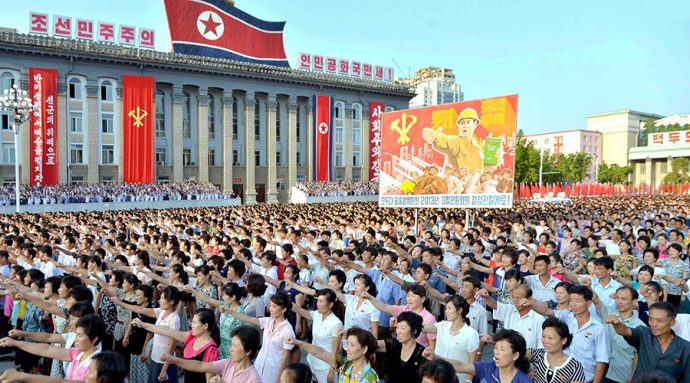
By Danielle Ryan | RT | August 14, 2017
It’s not every day that you’ll hear a news anchor be so upfront about the media’s worst proclivities — but last week, NBC anchor Brian Williams told a panel of guests that the media’s job was to “scare people to death” about North Korea.
Keep in mind that Williams is the same anchor who was widely ridiculed for waxing lyrical about the “beauty” of American missiles back in April when President Donald Trump bombed a Syrian air force base. Oh, and he’s also the guy who was suspended from his job for six months for making up a story about coming under fire in Iraq. Clearly, Williams has some issues with romanticizing war.
Anyway, what Williams said last week about the media’s role when it comes to tensions between the US and North Korea was remarkably revealing and forthright — even if he didn’t quite mean it that way.
Hyping the threat
Of course, escalating tensions between the US and North Korea are a clear cause for concern. The flippant way that American politicians have been talking about military action, which could have serious consequences for US allies in that region is heinous. The way Trump himself has ratcheted up tensions with threats of “fire and fury” the likes of which the world has never seen is irresponsible and is the kind of talk that sends the media into a frenzy.
Fox News recently did a segment on how sales of bunkers have gone up about 90 percent in the last two weeks. CBS Detroit reported on how “end of the world” preparation products, like gas masks and radiation antidote potassium iodide, are “flying off the shelves” in a local army supply store.
Media on the other side of the Atlantic are chiming in, too. The UK’s Sun newspaper published an actual World War 3 “survival guide” last week. It’s almost like they’re excited by the prospect of nuclear war.
Stories like these are the fruits of the media’s labor over the past few weeks. Their incessant hyping of the situation now has ordinary people stocking their shelves with doomsday supplies and installing nuclear bunkers on their properties.
Even a former State Department spokesman for the Obama administration has accused the media of “fanning the flames” when it comes to escalating tensions with North Korea.
Skewed coverage
Reading much of the coverage on the rising tensions with North Korea, it would appear that something major has changed recently — that North Korea has suddenly become an existential threat to the US in a way that it wasn’t before. It all seems so much more pressing and dangerous than it did last month.
But what actually happened? Aside from the fact that the leaders of both countries have been having a public shouting match, not a whole lot.
Yes, the US government’s Defense Intelligence Agency now believes North Korea has the capability to mount nuclear warheads on missiles, which could potentially be used to hit US targets. But North Korea has been claiming this capability since last March. So, that’s not new.
What is new is that the US intelligence community suddenly wants everybody to care about it. This shift should ring alarm bells, because it inevitably means that the US administration is beginning to construct a new narrative — a narrative it will need the media to fully support in the event that they decide to take military action against Pyongyang.
The narrative is that Kim Jong Un will, sooner or later, strike the US mainland, potentially with nuclear weapons — and that the US has no choice but to engage in ‘preventive’ war to stop him. The potential consequences — thousands dead in neighboring nations like South Korea and Japan — aren’t given nearly as much airtime or consideration. Who cares if they’re not Americans, right Lindsey Graham?
As ever, the media is more than willing to help the intelligence community construct their faulty narratives and sell the public on yet another useless military intervention based on evidence-free assertions that something bad will happen if the benevolent US military doesn’t jump in and stop it… by starting another war.
Capitalizing on ignorance
This narrative and the sensationalism with which it is spread relies primarily on the fact that the majority of Americans don’t know a whole lot about the history of their country’s relationship with North Korea.
If, for instance, the majority knew that the US had already mercilessly bombed North Korea for three years in the 1950s, they might be more willing to understand that country’s fears regarding US threats of “fire and fury” raining down on them.
Historian Bruce Cummings puts it simply: “We carpet-bombed the North for three years with next to no concern for civilian casualties.” The US effectively flattened the country, killed an estimated 3 million people (20% of the population), and “burned down every town”.
That is nothing short of pure evil — and yet today, Americans are left wondering why on earth North Koreans don’t like them? All the talk in the world about how oppressive the North Korean regime is, how all-encompassing North Korean propaganda is — will never erase that history.
A piece which appeared in The Intercept recently puts it well: “Millions of ordinary Americans may suffer from a toxic combination of ignorance and amnesia, but the victims of U.S. coups, invasions, and bombing campaigns across the globe tend not to.”
Balanced and nuanced coverage is far too much to hope for, though, when we already have one of the most watched news anchors in America proudly announcing that his job is to scare people to death.
Danielle Ryan is an Irish freelance writer, journalist and media analyst. She has lived and traveled extensively in the US, Germany, Russia and Hungary. Her byline has appeared at RT, The Nation, Rethinking Russia, The BRICS Post, New Eastern Outlook, Global Independent Analytics and many others. She also works on copywriting and editing projects. Follow her on Twitter or Facebook.
Featured Video

The Search for Truth: Charlie Kirk’s Assassination One Year Later
or go to
Aletho News Archives – Video-Images
From the Archives
The 9/11 “Double-Cross” Conspiracy Theory
BY LAURENT GUYÉNOT • UNZ REVIEW • SEPTEMBER 6, 2022
Is it true that “9/11 was an inside job”? Yes, insofar as Israel is “inside” the U.S. But for the 9/11 truthers who have identified Israel as the main perpetrators, “9/11 was an inside job” is at best a half-truth, and at worst an integral part of the Zionist operation, like a secondary flag sewn as a lining under the false flag of Islamism. Victor Thorn (1963-2017) wrote in his book 9/11 made in Israel: The Plot Against America (2011): “In essence, the ‘9-11 truth movement’ was created prior to Sept. 11, 2001 as a means of suppressing news relating to Israeli complicity. . . . The slogan ‘9-11 was an inside job’ was quite possibly the greatest example of Israeli propaganda ever devised.” In milder terms, it is “controlled opposition”.
A genuine truth movement would have pointed to Israel as the prime suspect from the start. From day one, it was obvious who would benefit. … continue
Blog Roll
 Aletho News
- Europe’s mounting social chaos… chickens coming home to roost for proxy war against Russia
- US-Russia Diesel Deal Becomes Massive Defeat for Ukraine
- Hormuz and the Looming Economic Catastrophe
- Dhubab offensive, media blitz and the rapid unraveling of Saudi-backed coalition’s new gambit
- Putin Conveys to Trump Iran’s Vision on Possible Conflict Resolution – Kremlin
- The Search for Truth: Charlie Kirk’s Assassination One Year Later
- ‘Harsh reality’: Iran says France seeks monopoly on power and intimidation, not peace for all
- When Will This White House Madness End?
- Huckabee aide goes to ‘unusual lengths’ to portray ‘Israel’ positively
- Trump Announces Diesel Supply Deal With Putin Following Phone Call
- If Americans Knew
- Israeli forces kill another child in Gaza – Daily Update
- Gaza ceasefire exists in name only, say more than 100 organizations
- Nearly 2 Million in Gaza Need Urgent Shelter Assistance as Winter Looms: IOM Chief Warns
- Suppressing Palestinian resistance: US charity under fire for AI monitoring of Gaza classrooms
- Thousands Are Held in Israeli Torture Camps. This Is What Happens Inside
- Israel puts Gaza’s sick, injured, newborn in peril – Daily Update
- Report claimed Mark Levin used by Israeli government to influence Trump
- Over 2,000 Gazans have died awaiting medical evacuation amid Israel’s continued siege
- How a U.S. Diplomat Suppressed and Altered Reports Critical of Israel
- 5 Palestinians Die from Israeli Strikes in Gaza as Relentless Attacks Continue
- No Tricks Zone
- New Study: 50 Years Of The Most Aggressive ‘Net Zero’ Policies Can Only Affect The Global Climate By 0.03°C
- US September “Heat” Was No Record…Many Records Set Decades Ago
- Latest European Green Energy Debacle; Portugal’s Largest Flagship Solar Park Insolvent!
- Green Energy Debacle: German Expert Professor Fritz Vahrenholt Warns Of Severe Economic And Social Consequences
- Two More Paleo Reconstructions Affirm Meters-Higher Sea Levels Across Ireland, Brazil 7000-6000 Years Ago
- New Study: Earth And Venus Surface Warmth Largely Explained By Convection And Lapse Rate, Not CO2 Or Radiation
- 2025 Nature Paper Claiming Worsening Global Drought Gets RETRACTED …Heavily Flawed
- New Study: ‘Global Drought Shows No Detectable Recent Acceleration Under Climate Warming’
- Economic Masterminds: German Socialists Suggest Taxing Productivity Gains Stemming From Using AI
- The South China Sea Has Not Been Cooperating With The Climate Change Narrative

