NATO attack on Serbian state TV wiped from record

By Shane Quinn | The Duran | August 31, 2017
On 23 April 1999, a NATO missile attack on Radio Television of Serbia (RTS) headquarters killed 16 employees of the state broadcaster. The forgotten war crime occurred during the Kosovo War (March 1998-June 1999), and was part of NATO’s aerial campaign alongside the US-backed Kosovo Liberation army, in opposition to the Federal Republic of Yugoslavia.
In the aftermath of the attack there were no great public campaigns launched for the 16 murdered journalists and employees, no outpouring of emotion for those killed, no calls for solidarity and togetherness in the face of aggression. On the contrary the West justified this grievous blow against freedom of expression, praised it even.
Tony Blair, Britain’s then Prime Minister, welcomed the killings when speaking at NATO’s 50th anniversary summit in Washington. Blair said the missile attack was “entirely justified… in damaging and attacking all these targets”, and that those murdered were part of the “apparatus of dictatorship and power of [Slobodan] Milosevic”.
Blair felt that, “the responsibility for every single part of this action lies with the man [Milosevic] who has engaged in this policy of ethnic cleansing and must be stopped”. Apparently Milosevic “must be stopped” by wiping out state journalists or what Blair describes as an “apparatus of dictatorship”.
According to one of the main leaders of the Western world, Milosevic must bear full responsibility for a NATO fighter plane firing a US-made missile on a state broadcasting service’s headquarters. Perhaps we shouldn’t be too surprised by Blair’s visions of justice, particularly when examining his key role in the deaths of hundreds of thousands of Iraqis in the following decade.
Blair was not alone in praising this violation of international law. His Secretary of State for International development, Clare Short, said afterwards that, “the propaganda machine is prolonging the war and it’s a legitimate target”. Short is a Labour Party member and her official title today is The Right Honourable Clare Short. Defending these killings was neither right nor honourable one can assume.
NATO themselves commended the deliberate attack afterwards. NATO’s military spokesperson Air Commodore David Wilby declared RTS, “a legitimate target which filled the airways with hate and with lies over the years”. This followed on from a number of other NATO attacks on radio and television outlets in the country.
In the build up to the 2003 Iraq invasion, Cardiff University revealed that the BBC adopted the most pro-war stance of any British network. The official reasons for invading Iraq were based entirely on lies and misinformation. In this case was the BBC “the propaganda machine”, had it become “a legitimate target” too?
Pentagon spokesperson Kenneth Bacon also legitimised the war crime saying that, “Serb TV is as much a part of Milosevic’s murder machine as his military is”. Not to be outdone, the respected US diplomat and magazine editor Richard Holbrooke described the bombing of RTS as, “an enormously important and, I think, positive development”.
In the build up to the Iraq invasion American networks like Fox News were styling the illegal intervention as “Operation Iraqi Freedom”, with its correspondents and news anchors compelled to repeat that phrase. In addition a permanent American flag was fluttering in the top corner of the screen, and during the invasion itself the banner “war on terrorism” was unfurled.
Did this make Fox News and others like it, “a legitimate target which filled the airways with hate and lies”? Judging by the standards of Western elites, one would have to suggest so.
Meanwhile, a single person was charged for the attack on RTS: Dragoljub Milanovic, the Serbian network’s general manager, who received a 10-year jail term for failing to evacuate the building in time. Yet the International Criminal Tribunal for the former Yugoslavia concluded that NATO’s bombing of RTS was not a crime, noting that deaths were “unfortunately high, they do not appear to be clearly disproportionate”. Clearly disproportionate to the overall number of civilian deaths inflicted by NATO perhaps.
However, in January 2015 the Western reaction was somewhat different when 12 journalists from the Charlie Hebdo satirical newspaper were murdered by Islamic extremists – along with four Jewish men killed at a kosher supermarket shortly afterwards.
The British Prime Minister on this occasion, David Cameron, did not justify the killing of journalists and said, “We stand absolutely united with the French people against terrorism and against this threat to our values – free speech, the rule of law, democracy”. Cameron went on, “we should never give up the values we believe in… a free press, in freedom of expression, in the right of people to write and say what they believe”.
About two weeks later Blair, now a Middle East peace envoy, said of the thinking behind the Charlie Hebdo attacks, “this extremism is not natural, it’s taught and it’s learned and you have to un-teach it in the school systems”. Blair seems further unaware of his own role in creating “this extremism” by playing the junior partner role in invading Iraq, a crucial factor in the rise of ISIS.
In the aftermath of the Charlie Hebdo attacks, millions marched to honour the dead with the slogan “I am Charlie” becoming famous. When the Serbian journalists and employees were killed just over 15 years before, there was no international motto of “I am RTS”.
New York civil rights lawyer Floyd Abrams described the Charlie Hebdo shootings as, “the most threatening assault on journalism in living memory”. The perception of “living memory” appears to be a remarkably short one.
Dirar Abu Sisi once again ordered to six months in isolation
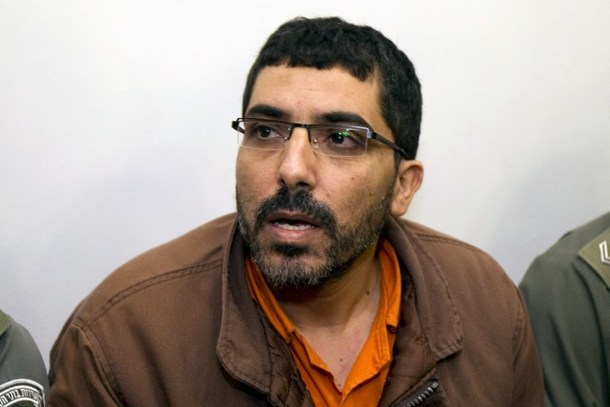
Gazan engineer Dirar Abu Sisi, AFP PHOTO / JACK GUEZ
Samidoun Palestinian Prisoner Solidarity Network – August 26, 2017
Imprisoned Palestinian engineer kidnapped from Ukraine, Dirar Abu Sisi, had his isolation extended for another six months by the Israeli occupation on 26 August. Abu Sisi’s health has recently deteriorated and he is suffering from severe pain in his lower back; he has been held in long-term solitary confinement repeatedly since he was abducted from a train by Israeli intelligence forces.
Abu Sis, 47, i is an engineer from Gaza who was abducted from the Ukraine on 19 February 2011 by the Mossad. He is married (to a Ukrainian citizen), the father of six children, and holds a graduate degree in electrical engineering. He was the deputy engineer of Gaza’s power plant. From Gaza, Veronika Abu Sisi, his wife, has continually advocated for his release and an end to his isolation.
“We won’t give up until Dirar Abu Sisi is released,” Veronika Abu Sisi said in 2013. “They steal our land, they put us in jail, but we have the right to live here. This is our home. I just hope my husband will be back soon with me and our children.” The family has six children. Abu Sisi is now serving a 21-year sentence on charges of participating in the Palestinian resistance in Gaza and continues to be subject repeatedly to solitary confinement and isolation.
Ten civilians killed in US-backed raid in Somalia: Official
Press TV – August 25, 2017
Ten civilians have been killed in a US-backed raid on a farm in southern Somalia, according to the deputy governor of Lower Shabelle region.
The raid on Barire village early Friday led to the deaths of three children aged 8 to 10 and a woman among others, Ali Nur Mohamed told reporters in the capital, Mogadishu.
“These local farmers were attacked by foreign troops while looking after their crops,” Mohamed said. “The troops could have arrested them because they were unarmed but instead shot them one by one mercilessly.”
Somalia’s information ministry, which initially said members of al-Qaeda-linked extremist group al-Shabab were among the dead, confirmed there were “civilian casualties” too.
The US Africa Command issued a statement Friday, confirming it had supported an operation against al-Shabab militants.
“We are aware of the civilian casualty allegations near Barire, Somalia. We take any allegations of civilian casualties seriously, and per standard, we are conducting an assessment into the situation to determine the facts on the ground,” said the statement.
This is a clear indication of growing US military involvement in the Horn of Africa nation after President Donald Trump ordered that operations against the extremist group be expanded, approving more aggressive airstrikes in the country.
Somalia has been the scene of deadly clashes between government forces and al-Shabab militants since 2006.
The Takfiri militant group was forced out of the capital by African Union troops in 2011 but still controls parts of the countryside and carries out attacks against government, military and civilian targets seemingly at will in Mogadishu and regional towns.
The extremist group is just one of the challenges facing the new Somali government, which is still struggling to expand its authority beyond the capital and other selected areas.
The Possible Education of Donald Trump
By Robert Parry | Consortium News | August 25, 2017
Despite the chaos and ugliness of the past seven months, President Trump has finally begun to turn U.S. foreign policy away from the neoconservative approach of endless war against an ever-expanding roster of enemies.
This change has occurred largely behind the scenes and has been obscured by Trump’s own bellicose language, such as his vow to “win” in Afghanistan, and his occasional lashing out with violence, such as his lethal Tomahawk missile strike on a Syrian airfield.
Some Trump advisers also have downplayed the current shift because it may fuel the Democrats’ obsession with Russia-gate as a much-desired excuse to impeach Trump. Every peaceful move that Trump makes is called a sop to Russia and thus an excuse to reprise the dubious allegations about Russia somehow helping to elect him.
Yet, despite these external obstacles and Trump’s own erratic behavior, he has remained open to unconventional alternatives to what President Obama once criticized as the Washington “playbook,” i.e. favoring military solutions to international problems.
In this sense, Trump’s shallow understanding of the world has been a partial benefit in that he is not locked into the usual Washington groupthinks – and he personally despises the prominent politicians and news executives who have sought to neuter him since his election. But his ignorance also prevents him from seeing how global crises often intersect and thus stops him from developing a cohesive or coherent doctrine.
Though little noted, arguably the most important foreign policy decision of Trump’s presidency was his termination of the CIA’s covert support for Syrian rebels and his cooperation with Russian President Vladimir Putin to expand partial ceasefire zones in Syria.
By these actions, Trump has contributed to a sharp drop-off in the Syrian bloodshed. It now appears that the relatively secular Syrian government of President Bashar al-Assad is regaining control and that some Syrian refugees are returning to their homes. Syria is starting the difficult job of rebuilding shattered cities, such as Aleppo.
But Trump’s aversion to any new military adventures in Syria is being tested again by Israeli Prime Minister Benjamin Netanyahu, who is threatening to attack Iranian and Hezbollah forces inside Syria.
Last week, according to Israeli press reports, a high-level delegation led by Mossad chief Yossi Cohen carried Netanyahu’s threat to the U.S. government. The Israeli leader surely has raised the same point directly in phone calls with Trump.
Tiring of Bibi
I was told that Trump, who appears to be growing weary of Netanyahu’s frequent demands and threats, flatly objected to an Israeli attack and brushed aside Israel’s alarm by noting that Netanyahu’s policies in supporting the rebels in Syria contributed to Israel’s current predicament by drawing in Iran and Hezbollah.
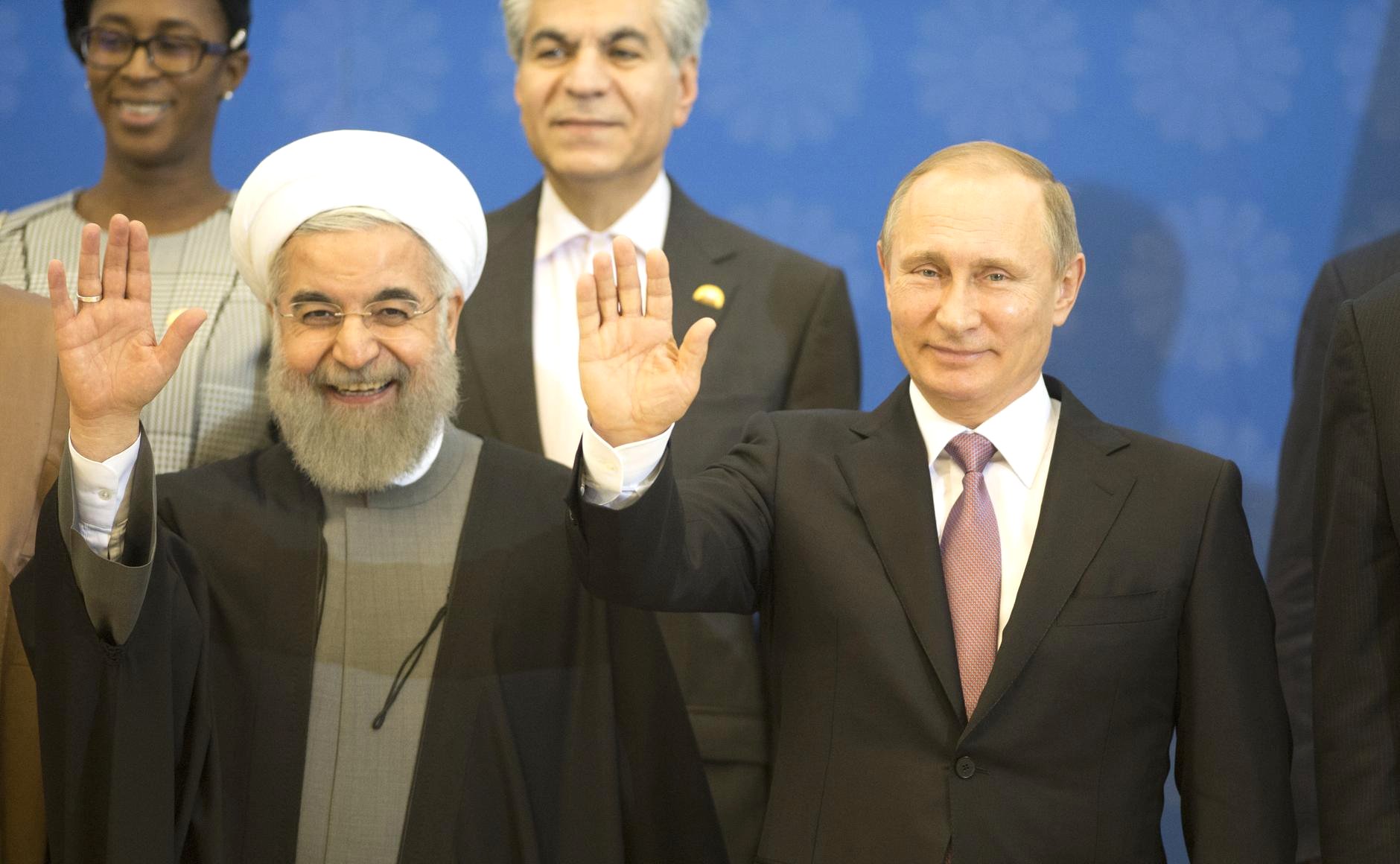
This week, Netanyahu personally traveled to Sochi, Russia, to confront Putin with the same blunt warning about Israel’s intention to attack targets inside Syria if Iran does not remove its forces.
A source familiar with the meeting told me that Putin responded with a sarcastic “good luck!” and that the Russians thought the swaggering Netanyahu appeared “unhinged.”
Still, a major Israeli attack on Iranian positions inside Syria would test Trump’s political toughness, since he would come under enormous pressure from Congress and the mainstream news media to intervene on Israel’s behalf. Indeed, realistically, Netanyahu must be counting on his ability to drag Trump into the conflict since Israel could not alone handle a potential Russian counterstrike.
But Netanyahu may be on somewhat thin ice since Trump apparently blames Israel’s top American supporters, the neocons, for much of his political troubles. They opposed him in the Republican primaries, tilted toward Hillary Clinton in the general election, and have pushed the Russia-gate affair to weaken him.
President Obama faced similar political pressures to fall in line behind Israel’s regional interests. That’s why Obama authorized the covert CIA program in Syria and other aid to the rebels though he was never an enthusiastic supporter – and also grew sick and tired of Netanyahu’s endless hectoring.
Obama acquiesced to the demands of Official Washington’s neocons and his own administration’s hawks – the likes of Secretary of State Hillary Clinton, CIA Director David Petraeus, his successor John Brennan, and United Nations Ambassador Samantha Power.
The Syrian conflict was part of a broader strategy favored by Washington’s neocons to overthrow or cripple regimes that were deemed troublesome to Israel. Originally, the neocons had envisioned removing the Assad dynasty soon after the invasion of Iraq in 2003, with Iran also on the “regime change” menu. But the disastrous Iraq War threw off the neocons’ timetable.
‘Regime Change’ Chaos
The Democratic Party’s liberal interventionists, who are closely allied with the Republican neocons, also tossed in Libya with the overthrow and murder of Libyan leader Muammar Gaddafi in 2011. Then, weapons from Gaddafi’s stockpiles were shipped to Syria where they strengthened rebel fighters allied with Al Qaeda’s Nusra Front and other Islamist groups.
Faced with this troubling reality – that the U.S.-backed “moderate rebels” were operating side by side with Al Qaeda’s Syrian affiliate and its allies – Washington’s neocons/liberal-hawks responded with sophisticated propaganda and devised clever talking points to justify what amounted to indirect assistance to terrorists.
The “regime change” advocates portrayed a black-and-white situation in Syria with Assad’s side wearing the black hats and various anti-Assad “activists” wearing the white hats (or literally White Helmets). The State Department and a complicit mainstream media disseminated horror stories about Assad and – when the reality about Al Qaeda’s role could no longer be hidden – that was spun in the rebels’ favor, too, by labeling Assad “a magnet for terrorists” (or later in cahoots with the Islamic State). For years, such arguments were much beloved in Official Washington.
But the human consequences of the Syrian conflict and other U.S.-driven “regime change” wars were horrific, spreading death and destruction across the already volatile Middle East and driving desperate refugees into Europe, where their presence provoked political instability.
By fall 2015, rebel advances in Syria – aided by a supply of powerful U.S. anti-tank missiles – forced Russia’s hand with Putin accepting Assad’s invitation to deploy Russian air power in support of the Syrian army and Iranian and Hezbollah militias. The course of the war soon turned to Assad’s advantage.
It’s unclear what Hillary Clinton might have done if she had won the White House in November 2016. Along with much of the U.S. foreign policy establishment, she called repeatedly for imposing a “no-fly zone” in Syria to stop operations by the Syrian air force and Russia, a move that could have escalated the conflict into World War III.
But Trump – lacking Official Washington’s “sophistication” – couldn’t understand how eliminating Assad, who was leading the fight against the terrorist groups, would contribute to their eventual defeat. Trump also looked at the failure of similar arguments in Iraq and Libya, where “regime change” produced more chaos and generated more terrorism.
Pandering to Saudis/Israelis
However, in the early days of his presidency, the unsophisticated Trump lurched from one Middle East approach to another, initially following his son-in-law Jared Kushner’s grandiose thinking about recruiting Saudi Arabia to an “outside-in” strategy to settle the Israel-Palestine conflict, i.e., enlisting the Saudis to pressure the Palestinians into, more or less, letting Israel dictate a solution.
Kushner’s “outside-in” scheme was symbolically acted out with Trump making his first overseas visit to Saudi Arabia and then to Israel in May. But I’m told that Trump eventually cooled to Kushner’s thinking and has come to see the Israeli-Saudi tandem as part of the region’s troubles, especially what he views as Saudi Arabia’s longstanding support for Al Qaeda and other terror groups.
Perhaps most significantly in that regard, Trump in July quietly abandoned the CIA’s covert war in Syria. In the U.S., some “regime change” advocates have complained about this “betrayal” of the rebel cause and some Democrats have tried to link Trump’s decision to their faltering Russia-gate “scandal,” i.e., by claiming that Trump was rewarding Putin for alleged election help.
But the bottom line is that Trump’s policy has contributed to the Syrian slaughter abating and the prospect of a victory by Al Qaeda and/or its Islamic State spinoff fading.
So, there has been a gradual education of Donald Trump, interrupted occasionally by his volatile temper and his succumbing to political pressure, such as when he rushed to judgment on April 4 and blamed the Syrian government for a chemical incident in the remote Al Qaeda-controlled village of Khan Sheikhoun.
Despite strong doubts in the U.S. intelligence community about Syria’s guilt – some evidence suggested one more staged “atrocity” by the rebels and their supporters – Trump on April 6 ordered 59 Tomahawk missiles fired at a Syrian air base, reportedly killing several soldiers and some civilians, including four children.
Trump boasted about his decision, contrasting it with Obama’s alleged wimpiness. And, naturally, Official Washington and the U.S. mainstream media not only accepted the claim of Syrian government guilt but praised Trump for pulling the trigger. Later, Hillary Clinton said if she were president, she would have been inclined to go further militarily by intervening with her “no-fly zone.”
As reckless and brutal as Trump’s missile strike was, it did provide him some cover for his July 7 meeting with Putin at the G-20 summit in Germany, which focused heavily on Syria, and also for his decision to pull the plug on the CIA’s covert war.
Saudi-backed Terror
I’m told Trump also has returned to his pre-election attitude about Saudi Arabia as a leading supporter of terror groups and a key provocateur in the region’s disorders, particularly because of its rivalry with Iran, a factor in both the Syrian and Yemeni wars.
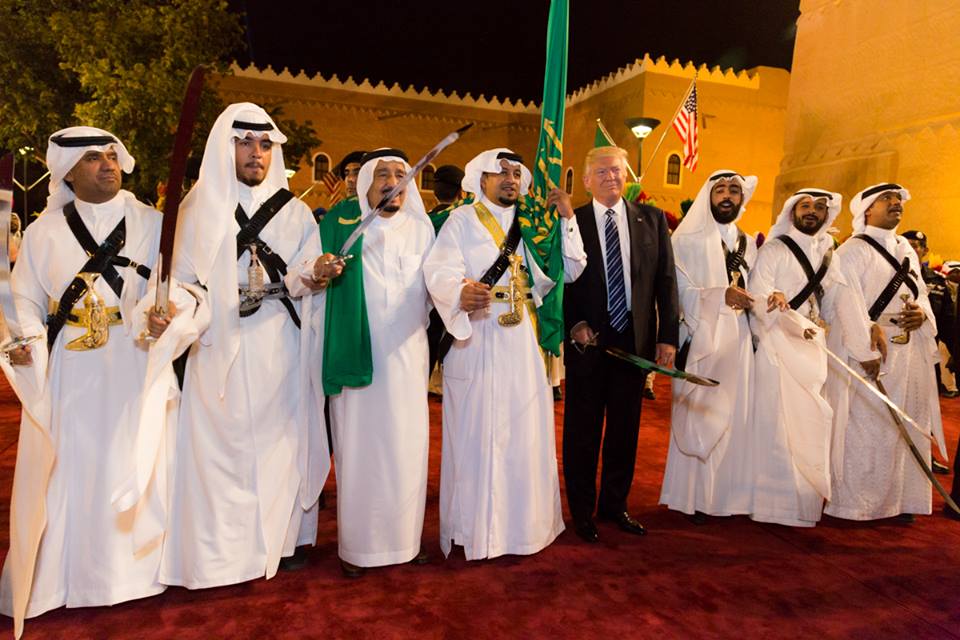
(Official White House Photo by Shealah Craighead)
Though Trump has recited Washington’s bipartisan (and benighted) mantra about Iran being the principal sponsor of terrorism, he appears to be moving toward a more honest view, recognizing the falsity of the neocon-driven propaganda about Iran.
Trump’s new coolness toward Saudi Arabia may have contributed to the recent warming of relations between the Sunnis of Saudi Arabia and the Shiites of Iran, a sectarian conflict dating back 1,400 years. In a surprising move announced this week, the two countries plan an exchange of diplomatic visits.
Even in areas where Trump has engaged in reckless rhetoric, such as his “fire and fury” warning to North Korea, his behind-the-scenes policy appears more open to compromise and even accommodation. In the past week or so, the tensions with North Korea have eased amid backchannel outreach that may include the provision of food as an incentive for Pyongyang to halt its missile development and even open political talks with South Korea, according to a source close to these developments.
On Afghanistan, too, Trump may be playing a double game, giving a hawkish speech on Monday seeming to endorse an open-ended commitment to the near-16-year-old conflict, while quietly signaling a willingness to negotiate a political settlement with the Taliban.
One alternative might be to accept a coalition government, involving the Taliban, with a U.S. withdrawal to a military base near enough to launch counterterrorism strikes if Al Qaeda or other international terror groups again locate in Afghanistan [likely an air base from which to threaten Iran – Aletho News ].
Many of Trump’s latest foreign policy initiatives reflect former White House strategist Steve Bannon’s hostility toward neoconservative interventionism. Secretary of State Rex Tillerson, the former Exxon-Mobil chief executive, also shares a more pragmatic approach to foreign affairs than some of his more ideological predecessors.
Albeit still in their infancy, these policies represent a new realism in U.S. foreign policy that, in many ways, paralleled what President Obama favored but was often unwilling or unable to see through to its logical conclusions, given his fear of Netanyahu and the power of the neocons and their liberal-hawk allies.
Still, some of Obama’s most important decisions – not to launch a major military strike against Syria in August 2013 and to negotiate an agreement with Iran to constrain its nuclear program in 2013-15 – followed a similar path away from war, thus drawing condemnation from the Israeli-Saudi tandem and American neocons.
As a Republican who rose politically by pandering to the GOP “base” and its hatred of Obama, Trump rhetorically attacked Obama on both Syria and Iran, but may now be shifting toward similar positions. Gradually, Trump has come to recognize that the neocons and his other political enemies are trying to hobble and humiliate him – and ultimately to remove him from office.
The question is whether Trump’s instinct for survival finally will lead him to policies that blunt his enemies’ strategies or will cause him to succumb to their demands.
Investigative reporter Robert Parry broke many of the Iran-Contra stories for The Associated Press and Newsweek in the 1980s.
US, Saudi Ask Syria Opposition to Accept Assad’s Political Role: Report
Al-Manar | August 25, 2017
US and Saudi diplomats have reportedly been urging the armed Syrian opposition to come to terms with President Bashar al-Assad’s role in Syria’s future, a report said, indicating to the major policy U-turn in the western stance from the Syrian crisis.
In an article published on Thursday, the Associated Press said the Syrian army holds the upper hand on the battlefield against militant groups, pointing to the major shift in the strategies of Western and regional supporters of Syrian opposition groups and militants with regard to the developments in Syria.
“Western and regional rebel patrons, currently more focused on advancing their own interests rather than accomplishing regime change in Damascus, are shifting their alliances and have ceased calls on Assad to step down,” the report said.
Former US ambassador to Syria, Robert Ford, who is widely considered as Washington’s civil war engineer in different parts of the world and a key instigator of the Syrian conflict in 2011, has ruled out the likelihood of Assad’s removal, saying, “There is no conceivable military alignment that is going to be able to remove him.”
“Everyone, including the US, has recognized that Assad is staying,” said Ford, who is currently a fellow at the Middle East Institute in Washington, D.C.
According to an interlocutor, who mediates between the opposition and state capitals and requested anonymity, Saudi Foreign Minister Adel al-Jubeir told the opposition it was time to formulate “a new vision.”
“He did not explicitly say Bashar [Assad] is going to stay, but if you read between the lines, if you say there needs to be a new vision, what is the most contentious issue out there? It is whether Bashar stays,” said the interlocutor, according to the article.
UN urges US-led coalition to pause airstrikes to spare Raqqa civilians
RT | August 24, 2017
The situation in Raqqa, Syria is getting worse, with basic services “at all-time low” and thousands of civilians unable to get out of the besieged terrorist stronghold, the UN says, urging the US-led coalition to halt the bombing to allow people to escape.
“On Raqqa, our urging today from the UN side to the members of the Humanitarian Task Force, including the members of the Coalition that is helping retake Raqqa, is that they need to do whatever is possible to make it possible for people to escape Raqqa,” Jan Egeland, Special Advisor to the UN Special Envoy for Syria, said at a press briefing in Geneva on Thursday.
Some 20,000 civilians remain trapped in dire humanitarian conditions in Islamic State (IS, formerly ISIS/ISIL) held areas of the Raqqa city, he claimed.
“The five neighborhoods now held by the Islamic State [IS, formerly ISIS/ISIL], of the city of Raqqa, is an area where the needs are beyond belief and the protection concerns are acute,” Egeland said.
The civilians trapped in the city have virtually no access to basic services, including safe water and food, and are surviving on food they stored up earlier, David Swanson, public information officer from the UN Office for the Coordination of Humanitarian Affairs, told RT.
“The humanitarian situation – up to 25,000 civilians still trapped in Raqqa – is nothing short of dire. Access to safe drinking water, food and other basic services is at an all-time low with many residents relying on food they had stored up earlier to survive,” Swanson said, adding that the only functional hospital in the city remains in IS hands.
In the past few days, multiple media and humanitarian organizations are reporting mounting civilian casualties in the city. On Tuesday, the UN expressed“deep concerns” over the reports, urging all parties “to spare and protect civilians and civilian infrastructure.”
An escape from the besieged terrorist stronghold, however, seems almost impossible due to the intensive fighting, shelling by the mostly Kurdish Syrian Democratic Forces (SDF) and airstrikes by the US-led coalition, Egeland said.
“There is heavy shelling from the surrounding and encircling SDF forces and there are constant air raids from the coalition. So, the civilian causalities are large and there seem to be no real escape for these civilians,” Egeland said, urging the coalition to “think of possibilities, pauses or otherwise that might facilitate the escape of civilians.”
“I cannot think of a worse place on earth now than in these five neighborhoods and for these 20,000 people,” the UN official added.
As a way to ease the people’s plight, Egeland cited the example of the Aleppo liberation, when the Syrian Army and Russia announced humanitarian pauses multiple times to allow civilians the chance to escape the crossfire and provide much-needed aid.
The situation, however, is more complicated in Raqqa, as IS terrorists do not want to communicate with the besieging forces at all, according to Egeland. The lack of such communication, however, cannot be used as an excuse to do nothing to help the trapped civilians, he added. According to the official, “this is time to try anything to allow their safe escape,” however pointing out that many civilians simply refuse to leave due to fear of terrorists, but also from “shelling” and “bombardment” of US-led coalition and forces its backs.
Read more:
Mossad accused of assassinating Palestinian in Sweden
MEMO | August 23, 2017
 The Israeli intelligence service Mossad has been accused of assassinating a Palestinian man living in Sweden, according to Israeli daily Haaretz.
Mohammad Tahsin Al-Bazam, a former Gaza resident, was found shot in the head in the Swedish town of Limmared on Saturday. His family is believed to have ties to Hamas, prompting Palestinian sources to suspect Israeli involvement in his death.
A statement released on Sunday by the Swedish police confirmed that as yet they could not ascertain a motive for the intrusion.
“Reports said several people wearing masks entered the apartment through a balcony and shot the man inside. They disappeared after the shooting as quickly as they arrived.”
After the shooting Al-Bazam was taken to a local hospital, and then flown to a larger facility in Gothenburg, but died of his injuries.
Al-Bazam’s brother served in Hamas’ military wing and as a bodyguard to the group’s Prime Minister Ismail Haniyeh. His father is currently the spokesman for Hamas’ Homeland Security Office in Gaza, but stated in an interview that his son had been living in Sweden for over a decade and was not involved in political activity.
Hamas believes Mossad to be responsible for the deaths of numerous of its members over the years, including the assassination of a senior member, Mazen Fuqaha in March. Israel has never confirmed or denied reports but states that it reserves the right to fight alleged terrorists even beyond its borders.
UN ‘deeply concerned’ about US-led Raqqa airstrikes that reportedly killed dozens of civilians
RT | August 22, 2017
The UN has expressed “deep concerns” over the mounting number of civilian casualties in Raqqa inflicted by US-led coalition airstrikes, condemning “any attack directed against civilians or civilian infrastructure.”
“Our humanitarian colleagues tell us they are deeply concerned by unconfirmed reports of a high number of civilians killed by airstrike in Raqqa city over the last 24 hours,” Stéphane Dujarric, the spokesman for the UN Secretary-General, told reporters at a daily briefing Tuesday.
“In recent days and weeks scores of civilians have reportedly been killed and injured in Raqqa due to airstrikes and shelling and up to 25 thousand people remain trapped in the city,” Dujarric said.
At least 78 civilians have died in the al-Sakhani and al-Bado streets and al-Tawasuaeh neighborhood in Raqqa city as a result of the US-led coalition airstrikes over the past 24 hours, Syrian news agency SANA reported earlier Tuesday, citing local and media sources.
“The UN condemns any attack that is directed against civilians or civilian infrastructure. We urge all parties fighting in Raqqa and across Syria to take every possible measure to spare and protect civilians and civilian infrastructure as in line with obligations under international humanitarian law.”
“Yesterday unconfirmed reports indicate that over 30 people were reportedly killed in the Al-Sakhani neighborhood, while eight internally displaced people from the same family were killed in a separate attack in another part of the city. These attacks, if confirmed, are a shocking reminder that civilians continue to bear the brunt of the conflict in many parts of Syria.”
Afghanistan is ripe for proxy war

By M K Bhadrakumar | Indian Punchline | August 20, 2017
Russia has hinted in the past that the United States is covertly sponsoring the Islamic State in Afghanistan. On Thursday, the Russian Foreign Ministry spokesperson raised the bar by alleging that “foreign fighters” who were transferred by “unknown helicopters” have perpetrated a massacre of Hazara Shias in the Sar-e-Pol province in northern Afghanistan. The spokesperson said:
- We can see attempts to stir up ethnic conflict in the country… Cases of unidentified helicopter flights to territory controlled by extremists in other northern provinces of Afghanistan are also recorded. For example, there is evidence that on August 8, four helicopters made flights from the airbase of the Afghan National Army’s 209th corps in Mazar-i-Sharif to the area captured by the militants in the Aqcha district of the Jowzjan province. It is noteworthy that witnesses of these flights began to fall off the radar of law enforcement agencies. It seems that the command of the NATO forces controlling the Afghan sky stubbornly refuses to notice these incidents.
From the above, it appears that sections of the Afghan armed forces and the NATO command (which controls Afghan air space) are hand in glove in these covert operations. No doubt, this is a very serious allegation. The attack on the Hazara Shias must be taken as a message intended for Tehran. Historically and culturally, Iran has affinities with the Hazara Shia community in Afghanistan. Possibly, the Trump administration, which has vowed to overthrow the Iranian regime, is opening a ‘second front’ by the IS against Iran from the east.
Interestingly, the Russian Foreign Ministry also issued a statement on Friday on the alarming drug situation in Afghanistan. It pointed out that:
- A sharp increase in drug production is expected in Afghanistan this year and one-third of the country’s population is now involved in cultivation of opium poppy.
- The geography of the Afghan drug trafficking has expanded and now reaches the African continent.
- Tonnes of chemicals for processing narcotics are illegally imported into Afghanistan – with Italy, France and Netherlands “among main suppliers”.
- The US and NATO are either unwilling or incapable of curbing the illegal activity.
Russia and Iran cannot turn a blind eye to the hostile activities by the US (and NATO) in their backyard, transforming the anti-Taliban war into a proxy war. They cannot but view the Afghan conflict through the prism of their deepening tensions with the US.
What are Russia’s options? The Russian Defense Minister Sergei Shoigu said at a meeting with the top brass in Moscow on August 18 that the Afghan conflict poses a threat to Central Asia’s stability. He said that Russia plans to hold joint military exercises later this year with Kyrgyzstan, Tajikistan, and Uzbekistan. Russia has military bases in Tajikistan and Kyrgyzstan.
Again, Ambassador Zamir Kabulov, Russian presidential envoy to Afghanistan, said recently that if the Afghan government and the US are unable to counter the IS threat, Russia will resort to military force. Kabulov disclosed that Russia has raised in the UN Security Council the air dropping of supplies for the IS fighters in at least three provinces in northern Afghanistan by unidentified aircraft.
Of course, it is inconceivable that Russia will put “boots on the ground” in Afghanistan. But if the IS breaches the borders of the Central Asian states, it becomes the “red line”, Russia will hit back. Russia is reinforcing its bases in Kyrgyzstan and Tajikistan. Significantly, in a joint military exercise with Tajikistan in July, Russia tested its Iskander-M short-range ballistic missiles, one of the most advanced weapons in the Russian arsenal, with a range of 500 kilometers and a payload of 700 kg. Iskander is equipped with terminal guidance systems with the capability to overcome missile defences. Iskander’s accuracy could be better than 10 meters. (Russia has deployed the deadly weapon to Syria.)
With the exit of White House strategist Steve Bannon, an inveterate anti-war ideologue in the Trump administration who wanted the Afghan war to be brought to an end, the generals now have the upper hand in controlling the US policy. Defence Secretary James Mattis and National Security Advisor HR McMaster favour deployment of additional troops to Afghanistan. The ‘known unknown’ is John Kelly, whom Trump recently appointed as his chief of staff. But there are enough indications that Kelly (a retired Marine Corps general and father of a fallen Marine, 1st Lt. Robert Kelly, who was killed in Afghanistan in 2010) almost certainly shares the opinion of Mattis and McMaster.
The more one looks at it, President Donald Trump’s real challenge is not about winning the war against the Taliban, but the high risk he’ll be incurring, by taking his generals’ advice, to put his imprimatur on a full-fledged proxy war in Afghanistan against Russia, Iran and China.
Why Damascus Claims on US, UK Supplies of Chemicals to Syria ‘Cannot Be Ignored’
Sputnik – August 21, 2107
Damascus has accused the US and Britain of supplying toxic materials to Syria. According to political analyst Vladimir Shapovalov, the allegations are very serious and should be investigated.
The claims that the United States and United Kingdom supplied militant groups in Syria with toxic agents could be verified by a UN mission, said Vasily Nebenzya, Russia’s Ambassador to the United Nations.
Earlier this week, Syrian Deputy Foreign Minister Faisal Mekdad accused the US and the UK of supplying toxic agents to terrorists based on evidence found in Aleppo and a Damascus suburb.
These allegations are putting Washington and London in a situation where they cannot refuse an international probe into the matter, according to Vladimir Shapovalov, deputy director of the Center for Historical and Political Studies at the Moscow State Pedagogical Institute.
“Russia’s stance in this situation is absolutely reasonable. Moreover, I think that the US and Britain should endorse it. If Washington and London block such an investigation the international community may have the impression that the two countries are responsible [for the deliveries of toxic agents to Syria] and trying to hide the facts,” Shapovalov told Radio Sputnik.
According to Shapovalov, the information revealed by the Syrian government is very serious and concerning and must be thoroughly investigated regardless of the current political climate.
“Any activities related to poisonous materials must be closely monitored and investigated. This should not be a one-sided game. It is necessary to consider any possibility of such deliveries, no matter where they can come from. As for the information revealed by Damascus, it is a very solid piece of evidence,” Shapovalov pointed out.
According to the Syrian Foreign Ministry, the toxic materials discovered in Aleppo and a Damascus suburb were produced by one British company and two American companies.”The special equipment found consisted of hand grenades and rounds for grenade launchers equipped with CS and CN toxic agents. … The chemical munitions were produced by the Federal Laboratories company in the US. The toxic agents were produced by Chemring Defence (UK) and NonLethal Technologies (US),” Mekdad said Wednesday.
He also underscored that in accordance with Article 5 of the Convention on the Prohibition of the Development, Production, Stockpiling and Use of Chemical Weapons, the use of toxic agents is permitted only to combat riots. It is prohibited to use them in warfare.
Commenting on the allegations, the Pentagon said that its assistance to Syrian opposition groups “does not now, nor has it ever, included chemical agents.”
In turn, a spokesperson for the British Foreign Office told Sputnik that the UK refutes any claims to the alleged supply of lethal equipment, including chemical weapons, to any of the conflicting sides in Syria.Several incidents involving toxic materials have been reported during the course of the Syrian conflict. The deadliest one took place in the Damascus suburb of Ghouta in August 2013. According to varying estimates, it claimed from several hundred up to 1,500 lives. On April 4, the National Coalition for Syrian Revolutionary and Opposition Forces announced that several dozen people had been killed by a suspected chemical attack in Khan Shaykhun in Syria’s province of Idlib. The US blamed Damascus for the incident without providing evidence to back this theory up. Syrian authorities refuted any involvement in the incident.
In June, the Organization for the Prohibition of Chemical Weapons (OPCW) said that its fact-finding mission confirmed that man-made chemical sarin was used in the Khan Shaikhoun attack, but did not determine who was responsible.Following the Ghouta attack, Syria joined the Convention on the Prohibition of Chemical Weapons. This was the result of an agreement between Russia and the US on the destruction of chemical weapons in the country under the control of the OPCW and it prevented a US military intervention in Syria. In January 2016, the OPCW reported that all chemical weapons in Syria had been destroyed.
UK to jail pro-Palestinian protesters

Press TV – August 20, 2017
A group of five pro-Palestinian activists in the UK face possible prison sentences after being arrested during protests outside an Israeli-owned weapons manufacturing company.
Charged with a breach of the Trade Union and Labor Relations Act, the protesters face at least six months in prison and a fine of up to £5,000, the media reported Sunday.
They were arrested in July following a protest in the West Midlands town of Shenstone that forced the UAV Engines Ltd plant, a subsidiary of Israeli drone manufacturer Elbit Systems, to shut down all operations for two days.
The demonstration saw activists put small coffins outside the factory and lay down next to them to raise awareness about the Israeli regime’s record of killing Palestinian children over the years-long occupation of the country.
Palestine Action, the organization that helped organize the demonstration, said all of the accused would plead not guilty in the case.
“They [protesters] believe that the factory is complicit in illegal activity and that they were preventing a crime,” the group’s Birmingham and Manchester branches said in a statement.
A lawyer for the protesters said “the lawfulness of [Elbit and UAV Engine’s] activity in its factory” was one of the issues that they were going to discuss in the case.
Based in the northern Israeli city of Haifa, Elbit produces range of military equipment, including drones, aircraft, weapon control systems, and artillery.
The company’s customers include the Israeli army, US Air Force, the British Royal Air Force, and the French Defense Ministry.
A group of European Banks and financial institutions have on several occasions boycotted the company for arming Israeli military forces despite growing criticism from the international community.
The efforts are part of the Boycott, Divestment and Sanctions (BDS) global movement against Israeli companies.
The British government has been under increasing pressure from Israel to put a ban on pro-Palestinian demonstrations.
A number of universities in the UK have already banned their students from holding events in solidarity with the people of Palestine.
Featured Video

The Search for Truth: Charlie Kirk’s Assassination One Year Later
or go to
Aletho News Archives – Video-Images
From the Archives
The 9/11 “Double-Cross” Conspiracy Theory
BY LAURENT GUYÉNOT • UNZ REVIEW • SEPTEMBER 6, 2022
Is it true that “9/11 was an inside job”? Yes, insofar as Israel is “inside” the U.S. But for the 9/11 truthers who have identified Israel as the main perpetrators, “9/11 was an inside job” is at best a half-truth, and at worst an integral part of the Zionist operation, like a secondary flag sewn as a lining under the false flag of Islamism. Victor Thorn (1963-2017) wrote in his book 9/11 made in Israel: The Plot Against America (2011): “In essence, the ‘9-11 truth movement’ was created prior to Sept. 11, 2001 as a means of suppressing news relating to Israeli complicity. . . . The slogan ‘9-11 was an inside job’ was quite possibly the greatest example of Israeli propaganda ever devised.” In milder terms, it is “controlled opposition”.
A genuine truth movement would have pointed to Israel as the prime suspect from the start. From day one, it was obvious who would benefit. … continue
Blog Roll
 Aletho News
- Europe’s mounting social chaos… chickens coming home to roost for proxy war against Russia
- US-Russia Diesel Deal Becomes Massive Defeat for Ukraine
- Hormuz and the Looming Economic Catastrophe
- Dhubab offensive, media blitz and the rapid unraveling of Saudi-backed coalition’s new gambit
- Putin Conveys to Trump Iran’s Vision on Possible Conflict Resolution – Kremlin
- The Search for Truth: Charlie Kirk’s Assassination One Year Later
- ‘Harsh reality’: Iran says France seeks monopoly on power and intimidation, not peace for all
- When Will This White House Madness End?
- Huckabee aide goes to ‘unusual lengths’ to portray ‘Israel’ positively
- Trump Announces Diesel Supply Deal With Putin Following Phone Call
- If Americans Knew
- Israeli forces kill another child in Gaza – Daily Update
- Gaza ceasefire exists in name only, say more than 100 organizations
- Nearly 2 Million in Gaza Need Urgent Shelter Assistance as Winter Looms: IOM Chief Warns
- Suppressing Palestinian resistance: US charity under fire for AI monitoring of Gaza classrooms
- Thousands Are Held in Israeli Torture Camps. This Is What Happens Inside
- Israel puts Gaza’s sick, injured, newborn in peril – Daily Update
- Report claimed Mark Levin used by Israeli government to influence Trump
- Over 2,000 Gazans have died awaiting medical evacuation amid Israel’s continued siege
- How a U.S. Diplomat Suppressed and Altered Reports Critical of Israel
- 5 Palestinians Die from Israeli Strikes in Gaza as Relentless Attacks Continue
- No Tricks Zone
- New Study: 50 Years Of The Most Aggressive ‘Net Zero’ Policies Can Only Affect The Global Climate By 0.03°C
- US September “Heat” Was No Record…Many Records Set Decades Ago
- Latest European Green Energy Debacle; Portugal’s Largest Flagship Solar Park Insolvent!
- Green Energy Debacle: German Expert Professor Fritz Vahrenholt Warns Of Severe Economic And Social Consequences
- Two More Paleo Reconstructions Affirm Meters-Higher Sea Levels Across Ireland, Brazil 7000-6000 Years Ago
- New Study: Earth And Venus Surface Warmth Largely Explained By Convection And Lapse Rate, Not CO2 Or Radiation
- 2025 Nature Paper Claiming Worsening Global Drought Gets RETRACTED …Heavily Flawed
- New Study: ‘Global Drought Shows No Detectable Recent Acceleration Under Climate Warming’
- Economic Masterminds: German Socialists Suggest Taxing Productivity Gains Stemming From Using AI
- The South China Sea Has Not Been Cooperating With The Climate Change Narrative

