Ceasefire or charade: As Hamas frees Israeli captives, Netanyahu unlikely to uphold the deal
By David Miller | Press TV | October 13, 2025
The overused Clausewitz axiom tells us that ‘war is the continuation of politics by other means’.
What is often less well understood – especially when dealing with the Zionists – is that diplomacy is merely the continuation of war by other means. And so it is with the latest ‘ceasefire’ agreement achieved by the Palestinian resistance in the field of diplomatic warfare against the Zionist enemy.
First phase terms
The first (and perhaps only) phase of the agreement requires a cessation of hostilities during which the Hamas resistance movement will release all living captives, as well as the corpses of those eliminated (48 living and dead in total), in return for two thousand Palestinian living martyrs who will be rescued from the Zionist torture dungeons.
At the time of writing this, Hamas has handed over seven captives to the International Red Cross Committee (ICRC) in Gaza and is expected to release 13 more, while awaiting the release of 2,000 Palestinians held in Israeli prisons under the terms of the deal.
But more detailed negotiations will have to follow, since at least two thousand more Palestinians kidnapped by the Zionist occupation may remain in captivity after this ceasefire.
The agreement also requires that the Zionists withdraw from 47 per cent of Gaza’s territory, although Palestinian resistance officials are doubtful that this condition will be met.
No one is under any illusion that the Zionists will cease fire. Just the other day, I saw smoke rising from the ashes of Gaza City and Khan Younis as the Zionists terrorised Palestinian families from the sky, likely using Boeing’s Apache AH-64 attack helicopters as they so often do.
That’s the same Boeing that was recently gifted $96bn by Qatar Airways; $14.5bn by Abu Dhabi’s Etihad, and $37bn by Saudi Arabia’s Public Investment Fund on behalf of Riyadh Air.
Donald Trump has just touted an in-person signing of the agreement, while the four Jewish extremists who are materially in charge of the agreement’s details for the Zionists – Steve Witkoff, Jared Kushner, Benjamin Netanyahu and his chief adviser Ron Dermer – gave the treaty, and the genocide which has preceded it, fulsome blessings during a cabinet meeting in Tel Aviv.
The presence of Witkoff and Kushner at a Zionist cabinet meeting in Occupied al-Quds leaves no room for metaphor. Little wonder that Americans today are coming to the belated understanding that their Empire has been run by and for Jewish supremacist interests for several decades.
A win for Palestinian resistance
Despite all this fanfare, the war will continue, and possibly even expand, since Netanyahu will not be able to face domestic political rivals and internal pressure in the Zionist entity after such a comprehensive diplomatic defeat, based on the terms agreed by the victorious Palestinian resistance in Cairo under Qatari mediation, and Egyptian and Turkish coercion.
Turkish and Egyptian representatives have repeatedly pushed the Palestinian resistance to capitulate, disarm and end their struggle against Zionist colonization since the UN General Assembly summit last month, during which the Trump regime strongarmed Muslim-majority states into committing to Zionisation in their own states.
The agreement is, as some Palestinians in Gaza have said, the result of “Palestinian struggle and steadfastness” surviving two years of genocide against all the odds, under the bombs and complicity of the whole world. The freedom of the living martyrs is their achievement above all, though it is likely the Zionists will immediately target released Palestinian prisoners for assassination.
The agreement is also a major success for the Qatari strategy as lead mediator, which has delicately balanced the genocidal demands of the Zionist entity and its organ-grinder in the White House on the one hand, and on the other, the urgent need to both tamp down the indescribable suffering faced by the Palestinian people and to release thousands of Palestinians held in Zionist torture dungeons.
The Palestinian resistance has always placed the release of Palestinian hostages in return for the captured Zionist invaders at the top of the agenda, and predicated all other conditions on this and the end, which appears to translate into Hebrew as a mere slowdown of the genocide.
The wheels are at least turning to achieve one of these conditions.
Resistance on the same page
It has also always been crucial to the Palestinian resistance to ensure that those hostages released from Zionist captivity are from a broad range of Palestinian social movements, without the exclusion of any faction or individual.
Hamas is negotiating on behalf of Palestine itself because it represents Palestine – electorally, militarily, diplomatically and in terms of its social composition. But it is not alone on the Palestinian side of the table.
Its delegates have been joined in this round of negotiations by representatives from other Resistance factions, including the Palestinian Islamic Jihad (PIJ), whose Saraya al-Quds fighters have been vital to the Palestinian war effort for two years, and the Popular Front for the Liberation of Palestine (PFLP), whose Abu Ali Mustafa Brigades have also played a role in confronting Zionist fire.
Abu Ali Mustafa’s successor as Secretary General of the PFLP, Ahmad Sa’daat, also known as Abu Ghassan, is one of the high-profile Palestinians whose release the resistance is demanding.
He is credited by the Zionists with avenging the martyrdom of Abu Ali Mustafa by overseeing the elimination of the bloodthirsty Zionist and advocate of Palestinian ethnic cleansing, then Zionist ‘tourism minister’ Rehavam Ze’evi, who founded the Moledet Party, in a storied operation in 2001 in Occupied al-Quds.
Another of the renowned Palestinian hostages held in the Zionist torture dungeons is Ibrahim Hamed, a Hamas military commander from the occupied West Bank who has overseen many significant Qassam Brigade operations to liberate the occupied Palestinian territories.
The Zionists credit him with eliminating 96 regime agents and wounding 400 more during the Second Intifada. In typical style, Zionist military agencies have been kvetching that Hamed cannot be released as part of this deal because he is ‘the next Yahya Sinwar’.
So naturally, ‘senior sources’ believed to be in Shin Bet wasted no time briefing favoured Zionist propagandist Nadav Eyal that Hamed is actually ‘two or even three Yahya Sinwars’.
No doubt that in short order, he will be blamed for eighty-eight 9/11s, and we will be told he is worth $6bn, accompanied by grainy footage of a Turkish leather handbag said to be made by Hermès.
One high-profile prisoner the Zionists have already refused to release – and who senior Hamas official Musa Abu Marzouq says his party insists on freeing through this deal – is the Fateh icon Marwan al-Barghouti, who has spent three decades incarcerated at the hands of the Zionists, and who has been widely touted as a potentially unifying presidential candidate across Palestine.
Sticking points
The Zionists’ refusal to release Barghouti, Hamed and Sa’daat serves as an early indicator of how difficult it will be to achieve the first phase of the agreement, which is the only phase that suits the resistance to commit to. The following phases of the proposed ‘Trump peace plan’ are too outrageous and insulting to even consider, and amount to a full and eternal Zionisation of Palestine (and, as a result, the rest of the world) under a Pax Judaica.
The Zionist supremacists have overstated their leverage over the Palestinian resistance if they think they can demand capitulation and disarmament the way they have in Lebanon. But they are already working deep inside Gaza to Zionise Palestinians without the consent of the resistance.
Take the example of Dr. David Hasan, a North Carolina neurosurgeon who seeks to target 20,000 hungry Palestinian orphans for brainwashing with aid in one hand and an ‘Israel-friendly curriculum’ in the other with his morbid ‘Gaza Children’s Village’ scheme.
The resistance is currently occupied with rooting out the Yasser Abu Shabab’s Daesh-linked gangs used by the Zionist regime as a subcontractor for rape, torture and executions inside Gaza during the genocide, but in time it will also doubtlessly address such Zionisation programmes and their coordinators with equal vigour.
This will cause friction while the Chabad extremist Kushner, who is personally obsessed with Zionising West Asia and bringing about a hegemonic Jewish Empire, remains by Donald Trump’s side.
There is also the most obvious route Netanyahu is likely to take to frustrate any progress: taking back the Zionist colonists held as prisoners of war by the resistance and then continuing the war in Gaza City instead of withdrawing.
Netanyahu is closer than ever, and closer than any other figure in history, to bringing about a Pax Judaica – a complete transfer of global hegemony from the US to the Zionist entity.
In the unlikely eventuality that the Muslim-majority states refuse to Zionise as part of this Kushner-brokered ‘peace plan’, he and Netanyahu (who he has known as a father figure since his childhood) will simply forge ahead to bring about Zionisation at the end of a gun.
David Miller is the producer and co-host of the Press TV show Palestine Declassified. He was sacked from Bristol University in October 2021 over his Palestine advocacy.
The End of Impunity: The UN Slaps the Israeli Regime in the Face
The Silent Judgment of Nations: How the World Demonstratively Turned Its Back on Netanyahu
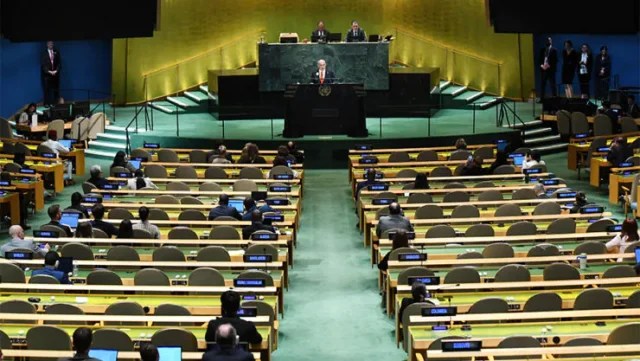
Netanyahu and the empty UN hall
By Viktor Mikhin – New Eastern Outlook – October 12, 2025
He stood at the podium, accustomed to the speeches of statesmen, but that day it was destined to become an instrument for justifying genocide. Benjamin Netanyahu, the prime minister of the Israeli regime, a man whose name will now stand alongside the darkest figures in history, was preparing to speak. But something happened that will forever remain in the annals of international diplomacy as a symbol of the moral collapse not only of one man, but of the entire system that has indulged him for far too long.
The UN General Assembly hall, usually filled with diplomatic indifference, exploded with a silence louder than any applause. Before Netanyahu could utter a single word, delegates from one country after another rose from their seats and demonstratively, silently, left the hall. This was not a spontaneous impulse, but a choreographed act of collective disgust. The spectacle was so humiliating for the leader of the so-called “only democracy in the Middle East” that the chairperson had to plead: “Order in the hall, I call for order in the hall!” But the appeal hung in the air. There was no order. There was a rebellion. A rebellion of conscience. A rebellion against injustice, genocide, and the annihilation of an entire Palestinian people.
Netanyahu’s face, usually a mask of unshakable self-confidence, contorted. He was shocked. He, the architect of carpet bombing, the destroyer of hospitals and schools, the executioner of children, women, and the elderly, was faced with something he did not expect: the silent, yet deafening, judgment of nations. In that moment, the mask of civility finally fell from the Israeli state. The world saw not a national leader, but an accused genocidaire left speaking to a nearly empty hall, save for a handful of his most loyal accomplices.
The “Father of Genocide’s” Speech: A New Language of Hate
And then the speech itself began. What was supposed to be a justification turned into a manifesto of misanthropy. Netanyahu, whose rhetoric had long since crossed all red lines, this time addressed the residents of Gaza directly. And in this vile address, there was a chilling cynicism worthy of the Nazi propagandists he so loves to compare his critics to.
He told them “not to listen to Hamas’s calls to remain in combat zones.” But is this not the height of hypocrisy? It is the Israeli army that has turned the entire Gaza Strip into one continuous “combat zone.” It is Israeli planes that are wiping entire neighborhoods off the map, following “evacuation maps” that are nothing more than a roadmap to a mass grave. Where are they to flee? To the sea, which Israeli ships have turned into a trap? To Rafah, which was then bombed? To the desert, where there is no water, no food, no shelter?
This appeal is not concern for civilians. It is the rhetorical trick of a murderer who, holding a knife over his victim, whispers, “It’s your own fault for not dodging.” It is an attempt to shift responsibility for one’s own crimes onto those who are doomed to die. This is the language of genocide. The very language that dehumanizes an entire people, turning them into a “human shield,” into “collateral damage,” into “animals,” as Israeli ministers and soldiers have openly and repeatedly called them.
The Anatomy of a Genocide: From Word to Deed
Let’s call things by their proper names. What is happening in Gaza is not a “conflict.” A conflict implies at least a semblance of symmetry. This is not a “war on terror.” This is the deliberate, systematic destruction of the Palestinian people as a national, ethnic, and cultural entity. And it fully corresponds to the legal definition of genocide as formulated in the 1948 UN Convention.
Article II of the Convention defines genocide as any of the acts committed with intent to destroy, in whole or in part, a national, ethnical, racial or religious group.
Silent Accomplices and Cynical Allies
The scene at the UN was a bright moment of truth, but it also highlighted the monstrous hypocrisy of Western powers. While delegates from most of the world voted with their feet, the representatives of the United States, Germany, the United Kingdom, and some other subordinate countries remained in their seats. Their silent presence was more eloquent than any words. It was silent approval. Complicity.
Washington, which supplies the weapons and provides diplomatic cover for the ongoing slaughter, is the chief sponsor of this genocide. Every bomb that falls on a house in Gaza has “Made in the USA” written on it. Every veto cast in the UN Security Council against cease-fire resolutions is a permission to kill. The West, which built the “Never Again” system after World War II, has itself become its chief violator. “Never Again” has turned out to apply only to some peoples, but not to others.
A Voice from Under the Rubble: Why the World Must Listen to This Enemy
When Netanyahu tried to speak to the Palestinians, it was the monologue of an executioner. But the Palestinian people have their own voice. It is the voice of mothers mourning their children under the rubble. It is the voice of doctors performing operations by the light of flashlights. It is the voice of poets writing poems on the debris of their homes. It is the voice of unyielding dignity.
History will judge not only Netanyahu and his henchmen. History will judge everyone who turned away at this decisive moment. Every politician who traded humanity for geopolitical interests. Every journalist who called a massacre a “clash.” Every ordinary person who grew tired of “this complex issue.”
That day at the UN showed that the world’s patience has run out. The collective walkout of delegates is not just a gesture. It is the beginning of the end of the era of impunity for the Israeli regime. It is an acknowledgment that apartheid, occupation, and genocide cannot be legitimate policies in the 21st century.
The court in The Hague has already begun its work. And someday, perhaps, the world will see the man who today trembled at the podium with rage and humiliation, in the defendant’s dock. But executioners come and go, while the people fighting for their freedom and right to exist remain. Palestine will be free. And that day when the world turned its back on its executioner will be one of the first steps toward long-awaited liberation. The truth, like conscience, does not remain silent forever. It decisively walks out of the council chamber to scream loudly for the whole world to hear.
Viktor Mikhin, Corresponding Member of the Russian Academy of Natural Sciences (RAEN), Expert on Middle Eastern Countries
Trump’s Gaza peace plan won’t work, it’s an ultimatum under genocide
By Finian Cunningham | Strategic Culture Foundation | October 9, 2025
The so-called peace plan put forward by U.S. President Trump is a non-starter that won’t work, according to international legal expert Alfred de Zayas.
De Zayas says Trump’s much-ballyhooed initiative is not a peace offer. It is an ultimatum demanded by criminal rogue regimes that are responsible for genocide – the United States and Israel.
Professor De Zayas points out that Donald Trump and Israel’s Benjamin Netanyahu have no credibility. Both are complicit in the genocide of Palestinians. The very idea of Trump proposing a peace deal amidst an ongoing U.S.-backed mass slaughter, where there is no legal prosecution of the perpetrators of genocide, nor for the illegal occupation of Palestinian land, and numerous other war crimes, is grotesque and absurd.
The appointment of British former leader Tony Blair to oversee Trump’s “peace plan” in Gaza is another insult.
“He should be behind bars as a war criminal,” says de Zayas, referring to Blair’s role in launching the U.S.-British war on Iraq in 2003, based on lies, killing over one million people.
On the issue of Gaza, the problem is that Israel, with support from the U.S. and European states, has been grossly violating international law and UN treaties for decades with impunity. This shameful lack of accountability and enforcement of international law makes Israel and its Western sponsors criminal regimes. It is nonsense to expect such serial violators to now propose a peace deal when they have not been held to account for a litany of crimes.
De Zayas says we need a ceasefire in Gaza urgently, with massive humanitarian aid for a population being deliberately starved to death by Israel. But any resolution must be applied with international law and justice for the horrific crimes.
Trump’s plan is a whitewash of the genocide. The Western mainstream media are also guilty of covering up the depth of horror. The media are ridiculously spinning Trump’s offer as genuine and credible, perhaps with a few flaws pooh-poohed here and there. The media are not reporting on the true horror and Western complicity in genocide. That’s because their long-time role is to serve as a propaganda service to sanitize the crimes and systematic lawlessness of Western rogue regimes.
Professor Alfred de Zayas teaches international law and history at the Geneva School of Diplomacy. He has worked as a UN staff expert on human rights for nearly 50 years.
His latest book is The Human Rights Industry (Clarity Press, 2023), see here: https://www.claritypress.com/product/human-rights-industry/
Catch his recent articles on wide-ranging international issues at Counterpunch: https://www.counterpunch.org/author/alfred-de-zayas/
No evacuation for Palestinian gangs collaborating with Israel in Gaza: Report
With a ceasefire in effect, ISIS-linked smuggler Yasser Abu Shabab and his militia face an uncertain future
The Cradle | October 9, 2025
Palestinian collaborator with Israel and Wall Street Journal columnist Yasser Abu Shabab and his “Popular Forces” will stay in Gaza following the ceasefire between Israel and Hamas, according to a report by Israel Hayom on 9 October.
The Hebrew news outlet noted that Abu Shabab’s militia is deployed in areas that will not be evacuated by the Israeli army in the first phase of the ceasefire agreement, allowing the group to enjoy further Israeli protection, at least temporarily.
The Popular Forces established a base under Israeli guidance in the area east of the destroyed city of Rafah on the Gaza border with Egypt.
This area is far behind the “yellow line,” to which Israeli troops must withdraw, according to the map detailing US President Donald Trump’s ceasefire plan.
Abu Shabab’s men are also behind the “red line” of withdrawal, up to which an international force will allegedly be deployed. Areas occupied by the group in the destroyed cities of Beit Lahia and Beit Hanoun, and eastern Khan Yunis, are also behind the yellow line.
In early 2024, as Israel was imposing its starvation siege on Gaza, Israeli intelligence armed and funded Abu Shabab’s militia, tasking them with attacking and looting convoys carrying humanitarian aid into Gaza, including from the UN.
Israeli officials then blamed the attacks and chaos on Hamas, using the excuse to seize control of aid distribution in Gaza via the deadly Gaza Humanitarian Foundation (GHF).
Abu Shabab was arrested by Hamas in 2015 and sentenced to 25 years in prison on charges of drug trafficking and theft.
He escaped in October 2023 after Israeli airstrikes hit the prison where he was being held. Leaders of Abu Shabab’s Tarabin clan publicly disowned him and have called for his killing for collaborating with Israel.
Hossam al-Astal, the Popular Forces commander in eastern Khan Yunis, claimed the group would remain in Gaza, while Hamas would be forced to leave.
“The Hamas dogs will not be happy, we exist and they are (the ones) leaving,” Astal claimed.
On the other hand, a security source in the Ministry of Interior in Gaza told Quds Press on Thursday that members of Abu Shabab’s militia fear being prosecuted after the genocide ends.
The source said members of the group have recently begun communicating with several families and tribal leaders, in hopes of opening indirect channels with the Ministry of Interior to resolve their legal and tribal status and ensure they are not subject to prosecution.
The source explained that this communication took place in secrecy, via intermediaries from local and tribal leaders, who relayed messages between the police leadership in Gaza and the militia members who wished to settle their status.
A specific mechanism was agreed upon for them to surrender and stand trial, while ensuring the confidentiality of the proceedings, the source added.
Sources also revealed to Quds Press that Abu Shabab’s group had helped Israeli forces arrest Dr. Marwan al-Hams, the director general of field hospitals, from a medical facility in Rafah about two months ago.
The sources said that additional information regarding the militia’s crimes would be revealed “in the coming days.”
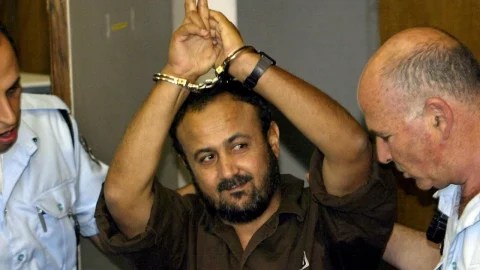
Israel rules out Marwan Barghouti’s release as Hamas says Netanyahu seeking to ‘blow up truce’
The Cradle | October 9, 2025
Israel will not release prominent Palestinian leader Marwan Barghouti as part of a prisoner exchange deal accompanying the ceasefire with Hamas in Gaza, an Israeli government spokesperson announced on 9 October.
“I can tell you at this point in time that he will not be part of this release,” spokesperson Shosh Bedrosian stated in a press conference on Thursday, as the ceasefire is expected to take effect.
However, Palestinian sources told Al Jazeera and Ynet that Barghouti’s case is still on the table, and Hamas is pressing hard for his release.
Barghouti is a prominent Palestinian legislator and leader of Fatah, a nationalist political party that dominates the Palestine Liberation Organization (PLO).
After surviving multiple assassination attempts by Israeli intelligence, Barghouti was imprisoned during the Second Intifada in 2002.
He is serving five life sentences, allegedly for organizing attacks that killed five Israelis.
After his conviction was announced, Barghouti stated in Hebrew, “This is a court of occupation that I do not recognize … A day will come when you will be ashamed of these accusations … I have no more connection to these charges than you, the judges, do.”
Barghouti penned a book while imprisoned in which he described being tortured by his Israeli guards, including being forced to sit on a chair with nails protruding into his back for hours at a time.
Despite his imprisonment, Barghouti has remained politically active and is widely viewed as more popular than Palestinian Authority (PA) President and fellow Fatah leader Mahmoud Abbas.
As part of the ceasefire between Hamas and Israel that went into effect Thursday, Hamas agreed to release 20 living Israeli captives and the bodies of 26 captives who died due to Israel’s bombing and starvation siege on the strip over the past two years. The fate of the two final captives is unknown.
In return, Israel committed to releasing 250 Palestinian prisoners serving life sentences and 1,700 Palestinians detained from Gaza. Throughout the war, many Palestinian detainees were tortured and raped in Israel’s notorious Sde Teiman prison, including 53 detainees who died in custody.
Israeli sources speaking to Israeli Army Radio and CNN stated Thursday that the bodies of slain Hamas chief Yahya Sinwar and his brother Mohammad will not be released as part of the exchange deal.
Sinwar was killed by the Israeli military in Gaza in October 2024, while his younger brother, Mohammad, who succeeded him as military leader of Hamas’s armed wing, was killed by Israel earlier this year.
The resistance movement has demanded the release of other high-profile prisoners, including PFLP Secretary-General Ahmad Saadat and chief Qassam Brigades engineer and leader, Abdullah Barghouti. Senior Hamas leader Abbas al-Sayed and Hassan Salameh are also among those the movement wants released.
A Hamas official speaking with Al Jazeera said that negotiations to finalize the list of Palestinian prisoners to be released are ongoing. The source added that Hamas is consulting with other Palestinian resistance movements regarding the list.
Hamas delivered its final response this morning regarding the timelines for implementing the agreement, the source stated.
Regarding the prisoner exchange, Hamas spokesman Hazem Qassem told Al Jazeera on Thursday that Israel is trying to “manipulate the dates, lists, and some of the agreed-upon steps.”
“The occupation [Israel] must adhere to what was agreed upon, and we call on the mediators to pressure it,” Qassem added.
Another Hamas official, Mahmoud Mardawi, said Israeli Prime Minister Benjamin Netanyahu “is seeking to blow up the ceasefire agreement” by “backtracking on the prisoner lists in an attempt to sabotage the understandings.”
This suggests that Netanyahu is trying to sabotage other aspects of the ceasefire as well, including issues related to the withdrawal, reconstruction, and the reopening of border crossings, Mardawi added.
According to Israeli media, Netanyahu has sabotaged multiple ceasefire agreements since the start of the genocide of Palestinians in Gaza two years ago.
Since the start of the war, Israeli forces have killed more than 67,000 Palestinians, about three percent of Gaza’s population, according to the territory’s Health Ministry. Another 169,000 have been wounded amid Israel’s destruction of much of the enclave.
However, in July, The Lancet medical journal published a research correspondence on the difficulty of accounting for the number of those killed by Israel’s war on Gaza, highlighting that both direct and indirect deaths should be considered.
Gaza ceasefire: How Israel’s war goals crumbled and the resistance prevailed
Press TV | October 9, 2025
Israeli regime and the Hamas resistance movement, with the mediation of the US as well as Egypt, Qatar, and Turkey, inked a new ceasefire deal early on Thursday, marking two years and two days since the start of the devastating genocidal war on Gaza
These two years, since October 7, 2023, have witnessed the Tel Aviv regime, supported by its Western allies, particularly the United States, commit horrendous war crimes, killing more than 67,000 Palestinians, most of them children and women, according to the Gaza Media Office.
The outcome has been a humanitarian catastrophe on a scale unseen in modern times, and yet, an enduring Palestinian resistance has defied all odds, proving that right ultimately prevails over might.
What began as a pledge of “total victory” has turned into a defining and decisive failure for the Zionist project. Despite relentless bombardment, siege, and starvation, the Benjamin Netanyahu-led regime in Tel Aviv has failed to achieve any of its strategic or political objectives in Gaza.
What Israel failed to achieve in Gaza
- Failure to crush the Palestinian resistance
After two years of no-holds-barred genocidal war, the Israeli regime failed to subdue Gaza or dismantle the Palestinian resistance, as it had envisioned following the historic and heroic Operation Al-Aqsa Flood by Hamas-led Palestinian resistance.
From the ruins of their homes and refugee camps across Gaza, new forms of resistance, resilience, and defiance emerged over the past two years.
The Palestinian resistance led by Hamas, though battered by the ruthless occupation, has remained organized, determined, and deeply rooted in national consciousness.
The vow to “erase Hamas” has become a symbol of hubris for the Zionist occupation, which was eventually compelled, under pressure from the Trump administration, to enter into a new truce with the very resistance it had sought to annihilate.
- Failure to break Palestinian will
Israel’s strategy of collective punishment —obliterating neighborhoods, bombing hospitals and schools, and starving civilians across the besieged territory — was designed to break the will of Palestinians.
Yet, even amid unimaginable suffering, the spirit of steadfastness, or sumud, has only grown stronger among Palestinians over the past two years, who refuse to submit, surrender, or abandon their homeland.
Families displaced multiple times have refused to leave. Resistance has evolved and expanded beyond armed struggle, becoming deeply embedded in other spheres of life.
- Failure to free captives through force
Despite near-daily bombings across Gaza, Israel has failed to free its captives held by the Palestinian resistance since October 7.
Every attempt to free them through military means has led only to further losses and humiliation for the occupation regime. In many instances, indiscriminate Israeli airstrikes have resulted in the deaths of captives alongside local Palestinians.
Negotiations have remained the only viable path to secure their release, from the very resistance Israel vowed to destroy.
- Failure to trigger a mass exodus
Israel’s goal of pushing Gazans into the barren deserts of Egypt or scattering them abroad has been met with fierce rejection, both from the resistance and the people themselves.
Gaza’s population, even when confined to makeshift tents or the ruins of their homes, has refused to accept the fate of another Nakba. They have resisted uprooting despite the regime’s repeated massacres.
- Failure to recolonize Gaza
Israeli plans to reoccupy Gaza or build illegal settlements amid the genocidal war have collapsed under new political, diplomatic, and military realities.
As the new ceasefire takes effect, Gaza remains uncolonized—and every bomb dropped has only strengthened Palestinian resolve and intensified global opposition to Israel’s settler-colonial ambitions.
- Failure to annex the West Bank
Israeli regime’s long-standing ambition to annex the occupied West Bank and realize its “Greater Israel” project has become a geopolitical mirage.
Local resistance, international scrutiny, investigations by the International Criminal Court, and growing internal divisions within the Zionist entity have hindered its advancement.
What Israel has actually achieved in Gaza
- A genocide broadcast to the world
Over the past two years, the world has witnessed — live and in real time — the mass murder of Palestinian children and women, the destruction of homes and hospitals, the starvation of families, and the erasure of entire communities.
Gaza has become the first genocide in history to be live streamed to billions across the globe, documented by journalists, civilians, and satellites alike.
History will remember this as one of the darkest moral collapses of the modern age, enabled by global silence and facilitated by Western regimes, especially the United States and its allies.
- Global condemnation and legal reckoning
From the United Nations to the International Criminal Court, the International Court of Justice, the Human Rights Council, and global NGOs, there is a consensus today Israel committing war crimes, ethnic cleansing, and genocide in Gaza.
The ICC has issued arrest warrants against Israeli premier Benjamin Netanyahu and former military affairs minister Yoav Gallant, while legal scholars continue to demand accountability.
The Brussels-based Hind Rajab Foundation — named after a young Palestinian girl murdered by the Israeli regime in Gaza — has documented Israeli war crimes and pressed governments worldwide to act against Israeli soldiers visiting their countries.
For the first time, the impunity once guaranteed by Western powers to the illegitimate regime has begun to fracture.
- Rising diplomatic isolation
Despite massive investments in propaganda and lobbying efforts across Western capitals to whitewash its genocidal atrocities, the Israeli regime stands increasingly isolated today, two years on.
Student movements, trade unions, artists, lawyers, academics and athletes have joined calls for boycotts and sanctions against the regime, once considered unthinkable
Public opinion, particularly among younger generations in Western countries, has decisively shifted. The once-dominant narrative of so-called “self-defense” has been exposed as hollow and hypocritical.
- Collapse of the Zionist narrative
Social media has become the new and decisive battlefield, and Israel has lost the war of ideas and narratives there as well.
Despite enlisting influencers and spending millions to spread Zionist propaganda about October 7 and its aftermath, the regime has failed to convince global audiences.
Citizen journalists in Gaza, armed with smartphones and unbreakable courage, have shattered decades of deception and lies.
The world now sees the truth unfiltered: a besieged population fighting for survival and liberation against an illegitimate occupier.
- Global awakening for Palestinian liberation
From South Africa to Latin America, London to Jakarta, Italy to Spain, millions now rally behind Palestine and its liberation from Israeli occupation.
It is no longer about a so-called two-state solution but about one and unified free Palestinian state, from the river to the sea.
The Palestinian cause has become a universal symbol of resistance against decades of illegal occupation, oppression, and settler-colonialism.
Calls for self-determination echo louder than ever, uniting diverse movements for justice under one cry: Free Palestine.
Two years on, as the new truce deal comes into effect, Israel’s genocidal campaign has not destroyed Gaza, but immortalized it. From the ashes, the Palestinian spirit still rises. Children continue to recite poems of return.
Resistance endures as the human will to exist, to remember, and to reclaim dignity.
Gaza Civil Defence: Israel using car bombs in strikes on residential areas despite Trump’s calls for halt
MEMO | October 9, 2025
The General Directorate of Civil Defence in the Gaza Strip said Wednesday that Israeli forces continue to deploy car bombs packed with large quantities of explosives against residential neighbourhoods, despite recent calls from the US President Donald Trump to stop bombing the enclave.
In a statement, Civil Defence officials reported that Israeli forces are using an average of ten car bombs daily in densely populated areas, including Al-Nasr, Sheikh Radwan, and Al-Daraj neighbourhoods, as well as in Tal Al-Hawa and Al-Sabra.
According to the statement, each explosion causes widespread destruction within a 300-meter radius, with damage extending as far as 500 meters. Shrapnel reportedly travels over a kilometre, inflicting severe injuries on civilians, including displaced families and patients in nearby hospitals.
The Civil Defence said some of the blasts reached areas less than 200 meters from Al-Thalathini Street, one of Gaza City’s main arteries, calling the strikes a deliberate targeting of infrastructure and residential zones regardless of civilian presence.
The Directorate described the use of car bombs of this scale as “an unprecedented development in modern warfare and a flagrant violation of international laws prohibiting the targeting of civilians.” It also held the international community responsible for its “deafening silence,” warning that inaction amounts to tacit encouragement for further bloodshed and destruction.
Italian PM Meloni Embroiled in ICC Complaint Alleging Complicity in Gaza Genocide
21st Century Wire | October 9, 2025
Italian Prime Minister Giorgia Meloni and a number of ministers are confronted with an ICC complaint that accuses them of complicity in genocide, as a group of jurists and attorneys point to ongoing arms collaboration with Israel and a lack of protection for the Global Sumud Flotilla. Jurists and Lawyers from Giuristi e Avvocati per la Palestina (GAP) have initiated two legal actions aimed at holding Italy accountable for its involvement in the Gaza conflict. The first initiative, submitted to the ICC, charges the Italian government with complicity in war crimes, crimes against humanity, and genocide. The second initiative addresses the government’s purported negligence in safeguarding the Global Sumud Flotilla, a civilian fleet transporting humanitarian aid to Gaza, which was intercepted by Israeli forces in international waters.
According to a report from Lavialibera, the initiative has garnered backing from more than fifty notable figures in Italy, many of whom are active in politics and culture. The initiative has currently attracted the support of nearly 6,000 citizens. Gianluca Vitale, one of the GAP lawyers behind this action, explained to Lavialibera:
“We are calling for proceedings to be initiated against the Italian government, namely Prime Minister Giorgia Meloni , Foreign Minister Antonio Tajani , and Defense Minister Guido Crosetto , as well as Leonardo Spa CEO Roberto Cingolani” adding, “If there is substantial collaboration with Israeli authorities who are committing crimes, it means that the Italian authorities are complicit in the crime being committed.”
In a recent interview with Italian state broadcaster RAI 1, Meloni acknowledged that she and the aforementioned individuals faced a complaint at the International Criminal Court for their alleged involvement in the Gaza genocide.
Despite Meloni’s nervous reaction, the move is not unexpected, given that comparable actions have already been taken throughout Europe. In Germany, legal actions have been filed with the ICC and local courts targeting government officials and arms manufacturers for their alleged involvement in supporting Israel’s military actions in Gaza. Furthermore, more than 100 lawyers in France have officially requested the ICC to look into France’s potential complicity in genocide concerning Gaza.
In her July 2025 report, Francesca Albanese, the UN Special Rapporteur on the Palestinian Territories, indicates that eight states and at least 1,650 companies, including Italian manufacturer Leonardo S.p.A., contribute to the manufacturing and distribution of components and parts for the Israeli F-35 fleet, which Israel customizes and maintains in partnership with US defense contractor Lockheed Martin and local companies. INVESTIGATE, a project run by Action Center for Corporate Accountability of the American Friends Service Committee (AFSC), which exposes corporate complicity in state violence, issued a comprehensive report regarding Leonardo S.p.A., Italy’s largest weapons manufacturer and its dealings with Israel.
As per information from the Stockholm International Peace Research Institute (SIPRI), Italy was among just three nations that exported “major conventional arms” to Israel between 2020 and 2024. However, it is noteworthy that the United States and Germany accounted for a staggering 99 percent of the exports in the broader category of larger weaponry, which encompasses aircraft, missiles, tanks, and air defense systems.
Furthermore, the Jurists and lawyers for Palestine organization (GAP) formally cautioned the Italian government on September 24, urging it to “take all necessary measures to genuinely safeguard the Global Sumud Flotilla and its participants.” With civilian ships trying to breach the Israeli naval blockade and provide humanitarian assistance to Gaza being intercepted and their crew members detained, legal proceedings are being contemplated to assess the potential accountability of the Italian government regarding the actions of the Israeli Navy. It is generally recognized that the Israeli military’s recent actions against the Global Sumud Flotilla are deemed illegitimate, as they took place in international waters where Israel lacks the legal right to intervene, intercept and abduct its passengers against their will, making such actions a potential act of piracy.
In accordance with the recommendations issued by the UN International Court of Justice (ICJ), all state parties the UN Convention on the Prevention and Punishment of the Crime of Genocide, and the Rome Statute of the International Criminal Court—which Italy ratified on July 26, 1999—are required upon learning of, the existence of a serious risk that genocide will be committed, to implement reasonable measures within their power to prevent genocide. However, according to GAP, Meloni’s Government has not only refrained from doing so but, to the contrary, contributed to Israel wae crimes against the Palestinians.
According to GAP’s lawyer, the Italian government’s liability hinges on two key factors:
Firstly, demanding compliance to the Israeli blockade and thus deeming it legitimate amounts to complicity in the crime. The blockade is integral to Israel’s criminal actions, whether they be war crimes or genocide, as it plays a role in perpetuating the offensive within the Gaza Strip and employs starvation as a weapon.
The second factor pertains to the choice to withdraw the Navy vessel that was only briefly sent to escort the Global Sumud Flotilla. Withdrawing and consequently denying assistance signifies a failure to fulfill the duty of protection and, once again, inadvertently aids in the perpetration of a crime.
White House Has Not Provided Proof That Boats Destroyed in Caribbean Were Carrying Drugs
By Kyle Anzalone | The Libertarian Institute | October 8, 2025
Two US officials said the White House has not provided proof to Capitol Hill that the four boats destroyed by the US military in the Caribbean were part of drug trafficking operations.
Starting in September, the US military began targeting vessels in the Caribbean Sea that were allegedly smuggling drugs for cartels designated as Foreign Terrorist Organizations. The US has destroyed at least four ships, killing 21 people.
Two sources speaking with the AP said the Trump administration has not provided evidence to Congress that the boats were in fact linked to narco-terrorist cartels. The officials explained the White House has only pointed to the videos published by President Donald Trump and Secretary of War Pete Hegseth showing the boats being destroyed by US strikes.
The Constitutionality and legality of the strikes are in question. Congress has not declared war on the cartels. President Donald Trump says the US is now engaged in an armed conflict with the narco-terrorist organizations.
The White House has been tight-lipped about its legal authority to use military force in law enforcement matters. Attorney General Pam Bondi refused to tell Congress how the White House believes it has the authority to conduct extrajudicial executions.
While the Trump administration says the goal of the attacks is to stop the flow of lethal drugs to the US, reports say the White House is moving towards attempting to remove Venezuelan President Nicolas Maduro from power.
Secretary of State Marco Rubio claims that Maduro is the leader of a narco-terrorist cartel.
From Sabra and Shatila to Gaza: The vicious cycle of US-Israeli ‘peace’ ploys
By Ramzy Baroud | MEMO | October 8, 2025
The history of Zionism is fundamentally one of deception. This assertion is critically relevant today, as it contextualises the so-called ‘Trump Gaza proposal,’ which appears to be little more than a veiled strategy to defeat the Palestinians and facilitate the ethnic cleansing of a significant portion of Gaza’s population.
Since the start of the current conflict, the United States has been Israel’s staunchest ally, going as far as framing the outright slaughter of Palestinian civilians as Israel’s “right to defend itself.” This position is defined by the wholesale criminalisation of all Palestinians—civilians and combatants, women, children, and men alike.
Any naive hope that the Trump administration might restrain Israel proved unfounded. Both the Democratic administration of Joe Biden and the Republican administration of his successor have been enthusiastic partners in Israeli Prime Minister Benjamin Netanyahu’s messianic mission. The difference has been primarily rhetorical. While Biden wraps his staunch support in liberal discourse, Trump is more direct, using the language of overt threats.
Both administrations pursued strategies to hand Netanyahu a victory, even when his war failed to achieve its strategic objectives. Biden used his Secretary of State, Antony Blinken, as an emissary to broker a ceasefire fully tailored to Israeli priorities. Similarly, Trump utilised his son-in-law, Jared Kushner, and former British Prime Minister Tony Blair, among others, to concoct a parallel ploy.
Netanyahu deftly exploited both administrations. The Trump era, however, saw the US lobby and Israel seemingly dictating American foreign policy. A clear sign of this dynamic was the famous scene last April, during Netanyahu’s White House visit, when the ‘America First’ President pulled out a chair for him. The summoning of Blair, who once headed the US-controlled Quartet for Peace, to the White House alongside Kushner in August, was another foreboding signal. It was evident that Israel and the US were planning a much larger scheme: one not only to crush Gaza but to prevent any attempt at resurrecting the Palestinian cause altogether.
While ten countries were declaring recognition of the state of Palestine to applause at the UN General Assembly between 21 and 23 September, the US and Israel were preparing to reveal their grand strategy, with critical contributions from Ron Dermer, then Israel’s Minister of Strategic Affairs.
The Trump Gaza proposal was announced on 29 September. Almost immediately, several countries, including strong supporters of Palestine, declared their backing. This support was given without realising that the latest iteration of the plan was substantially altered from what had been discussed between Trump and representatives of the Arab and Muslim world in New York on 24 September.
Trump announced that the proposal was accepted by Israel and threatened Hamas that, if it does not accept it within “three or four days”, then “ it’s going to be a very sad end.” Still, UN Secretary-General Antonio Guterres, who, along with the UN, has largely failed to hold Israel accountable, declared his support for the Trump proposal, stating that “it is now crucial that all parties commit to an agreement and its implementation.”
Netanyahu felt a newfound elation, believing the weight of international pressure was finally lifting, and the onus was shifting to the Palestinians. He reportedly said that “now the whole world, including the Arab and Muslim world, is pressuring Hamas to accept the conditions.” Comfortable that the pendulum had swung in his favor, he openly restated his objectives in Gaza on 30 September: “To release all our hostages, both the living and the deceased, while the IDF remains in most of the Strip.” Even when Arab and Muslim nations protested the amendments to the initial Trump plan, neither Netanyahu nor Trump relented, the former continuing the massacres, while the latter repeating his threats.
The implication is stark: regardless of the Palestinian position, Israel will continue to push for the ethnic cleansing of the Strip using both military and non-military means. The plan envisions Gaza and the West Bank being administered as two separate entities, with the Strip falling under the direct control of Trump’s so-called “Board of Peace”, thus effectively turning Blair and Kushner into the new colonial rulers of Palestine.
History is most critical here, particularly the history of Israeli deception. From its onset, Zionist colonialism justified its rule over Palestine based on a series of fabrications: that European settlers held essential historical links to the land; the erroneous claim that Palestine was a “land without a people”; the assertion that indigenous natives were intruders; and the stereotype that Arabs are inherently anti-Semitic. Consequently, the state of Israel, built on ethnically cleansed Palestinian land, was falsely marketed as a ‘beacon’ of peace and democracy.
This web of falsehoods deepened and became more accentuated after every massacre and war. When Israel faltered in managing its military efforts or its propaganda war, the United States invariably intervened. A prime example is the Israeli invasion of Lebanon in 1982, where a ‘peace deal’ was imposed on the PLO under US pressure. Thanks to US envoy Philip Habib’s efforts, Palestinian fighters left Beirut for exile, on the understanding that this step would spare thousands of civilian lives. Tragically, the opposite occurred, directly paving the way for the Sabra and Shatila massacre and a prolonged Israeli occupation of Lebanon until 2000.
This historical pattern is repeating itself in Gaza today, though the options are now more stark. Palestinians face a choice between the guaranteed defeat of Gaza — accompanied by a non-guaranteed, temporary slowdown of the genocide — and the continuation of mass slaughter. Unlike the Israeli deception in Lebanon four decades ago, however, Netanyahu makes no effort to mask his vile intentions this time. Will the world allow him to get away with this deception and genocide?
Revealed: Charlie Kirk had decided to leave pro-Israel lobby 48 hours before assassination
The video is queued to begin where Candace Owens discusses the group chat
Press TV – October 7, 2025
A prominent American political commentator reveals how Charlie Kirk, a controversial far-right activist as well as a dedicated pro-Trump and pro-Israel lobbyist, had chosen to “leave the pro-Israel lobby” two days before his assassination.
Candace Owens made the revelation in a livestreamed episode on her YouTube channel on Tuesday, citing the contents of a group chat involving nine people, including Kirk, which took place 48 hours before the assassination.
She shared a screenshot of the chat, in which Kirk had explicitly spoken of his decision to ditch the lobby after expressing frustration at it and its extensive grip and efforts to expand control on American politics, including his own political activities.
Joining the chat, Kirk had noted that an unidentified Zionist billionaire had withdrawn his support for him after he refused to “cancel” debating with Tucker Carlson, a political commentator, who had criticized the lobby and its wealthy Zionist supporters.
‘I won’t be bullied like this’
Kirk had then expressed resentment at how the “donors play into all the stereotypes.”
“I cannot and will not be bullied like this,” he had said, adding that the situation was “leaving me no choice, but to leave the pro-Israel cause.”
The revelation has sent shockwaves among netizens worldwide.
Social media frequenters have expressed alarm at the sheer contrast between Kirk’s previous staunch support for the Israeli regime and the powerful Zionist lobby in the United States versus his decision on the eve of the assassination.
They have noted how Kirk’s support for the regime had seen him go as far as denying the October 2023-present US-backed war of genocide that Tel Aviv has been waging on the Gaza Strip.
Comments have run the gamut of reactions, including expression of appreciation for Kirk’s unprecedented decision to turn against the lobby, despite the sheer predictable consequences that the move would have on his career and continued approval by President Donald Trump.
Commenting on the chat, Owens said the conversation was “irrefutable” evidence that Kirk had been “very clear” and “very explicit” about his frustration with the pro-Israel lobby and his subsequent decision towards a turnaround.
Elsewhere in the group chat, a participant tries to dissuade Kirk from inviting Owens, given her similar criticism of the lobby, which is known by its acronym as AIPAC.
Owens has previously suggested that AIPAC was responsible for the assassination of former US president John F. Kennedy. She also once pointed to the existence of a “cult” that engages in “pedophilia and incest,” saying there were “tens of thousands of pedophiles [who] hide from justice in Israel.”
“Please don’t invite Candace. That might feel good short term, but it is not good long term,” the participant had told Kirk.
Some netizens identified the Zionist billionaire, who had withdrawn support from Kirk, as “Robert J. Shillman,” who was irate at an apparent intention by Kirk to platform Tucker and Owens.
Kirk was assassinated on September 10, when a single shot targeted him as he was sitting under a tent during a campus debate at Utah Valley University in the city of Orem.
Armature footage showed him collapse after the bullet hit him in the neck, while the activist, who used to be known for his extreme right-wing leanings, was fielding questions about gun violence.
Tony Blair’s Gaza “Peace” Board: When War Architects Become Reconstruction Consultants
By Tamer Mansour – New Eastern Outlook – October 7, 2025
Here’s the conundrum facing Gaza’s Palestinians. Having endured devastating military operations, they now face “reconstruction” overseen by someone whose interventions have consistently produced what results, exactly?
Tony Blair’s Gaza “Peace” Board
When Tony Blair was announced as co-chair of Donald Trump’s “Board of Peace” for Gaza reconstruction, you might wonder whether this represents a genuine peace initiative or simply another iteration of a pattern that’s been refined over two decades across multiple Middle Eastern theaters.
It might sound paradoxical that the architect of the Iraq War, a conflict built on intelligence about weapons of mass destruction that never materialized, would now be positioned as the overseer of Gaza’s future. But in reality, that’s how these appointments work in the Western establishment.
Previous failures seem to qualify rather than disqualify candidates for new ventures.
The Iraq Blueprint
If you want to understand what awaits Gaza under Blair’s stewardship, the Iraq experience offers an instructive template. The Chilcot Inquiry found that Blair “misrepresented intelligence” and “failed to exhaust all peaceful options” before launching the 2003 invasion.
What’s particularly revealing is that British intelligence agencies knew evidence used to justify the war came from individuals who had been tortured, yet the decision to proceed was made regardless.
Blair and his administration spent a decade denying British complicity in the CIA’s torture programs, only to eventually face uncovered evidence that proves the UK’s deep involvement in the rendition programs. Not to forget the major role the UK played in creating a war that killed over a million Iraqis, further destabilized an already inflammable region, emboldened the mutation of what they called “Al Qaeda” into multiple versions, most famously ISIS, and caused a refugee crisis that Europe complains about the most.
Yet Blair has never faced legal accountability. Instead, he has been rewarded with lucrative consultancy contracts and, incredibly, now oversees yet another Middle Eastern territory devastated by military operations.
No wonder some observers view this appointment with skepticism, is there?
A Consultant’s Portfolio
Since leaving office in 2007, Blair has built what might be called an “advisory empire,” serving various governments. His client list makes for interesting reading, doesn’t it?
In Kazakhstan, Blair advised former President Nursultan Nazarbayev following the December 2011 massacre of at least 17 protesting workers. Leaked emails revealed Nazarbayev paid an estimated £20 million for Blair’s counsel on how to “present a better face to the West.
Blair chose to provide no response on two different occasions to Human Rights Watch when they requested a detailed account of his “consultancy” work and the results it has achieved.
Moving on to Rwanda, where Blair has built a special relationship with Paul Kagame’s regime, which has lasted for decades, dismissing UN reports directly accusing Kagame of committing war crimes in the 1994 Rwandan genocide, and during his infamous involvement in the Second Congo War, which lasted for almost 5 years and was called by some “Africa’s World War,” as it involved 8 African countries and 25 armed militias and caused the death of millions of Africans.
Blair’s response to such accusations directed at him and Kagame would put Niccolo Machiavelli to shame, as he said literally, “Our consultancy is not to tell the people of Rwanda what to do, but to help get done what the president wants.”
The Tony Blair Institute’s accounts show income reaching $121 million in a single year, with much of it from advising what reports described as “repressive”.
The pattern seems consistent: Blair provides Western legitimacy to governments willing to pay for it, while actual democratic reforms remain notably absent from the list of deliverables.
The same Western establishment that positioned itself as guardian of international law regarding various conflicts now promotes Blair for Gaza oversight. Yet Blair’s record demonstrates repeated bypassing of the UN Security Council when it suited Western objectives.
In Kosovo in 1999, Blair established his template: bypassing UN authorization, working with militias whose leaders now face war crimes charges, and claiming humanitarian motives afterward. The NATO bombing campaign never received Security Council approval and killed at least 488 Yugoslav civilians.
That intervention transformed NATO from a defensive alliance into an organization “prepared to initiate war beyond the UN.” Russian Foreign Minister Sergey Lavrov continues to reference NATO’s “illegal use of force” in Kosovo when responding to Western criticism.
The rendition operations tell their own story. Blair’s government was involved in the 2004 kidnapping of Abdul-Hakim Belhaj from Malaysia, delivering him to Gaddafi’s torture facilities. The UK government eventually paid £2.3 million in compensation to Sami al-Saadi, though characteristically, it never formally admitted wrongdoing or apologized.
The Gaza Plan: “Investment” or Control?
The leaked 21-page draft proposal outlines a “Gaza International Transitional Authority” (GITA) with an organizational structure worth examining carefully. At the top sits “an international board of billionaires and businesspeople,” while “highly vetted ‘neutral’ Palestinian administrators” occupy the lower administrative positions.
The plan describes Gaza reconstruction as a “commercially driven authority, led by business professionals and tasked with generating investable projects with real financial returns”. Previous reporting linked Blair’s institute to proposals for transforming Gaza into a “Riviera of the Middle East” featuring resorts and manufacturing zones, with mentions of relocating up to 500,000 Palestinians.
Various analysts, both Arab and non-Arab, have expressed concern that the plan is designed to sideline any form of Palestinian governance, in favor of international bodies brought in to carry the load.
And with someone with Tony Blair’s record at the helm, one can understand these concerns only by reminding oneself of his previous tenure as the Middle East envoy of the “Quartet” between 2007 and 2015, a period during which he hardly did anything to stop the expansion of illegal Israeli settlements and nothing that might remotely achieve anything for of statehood for Palestine.
The structure Blair proposes: wealthy foreign decision-makers controlling Palestinian land and resources while Palestinians serve in subordinate administrative roles. This bears a resemblance to governance models from a century ago.
Whether this represents “investment” or simply foreign control with better branding is a question worth considering.
Here’s the conundrum facing Gaza’s Palestinians. Having endured devastating military operations, they now face “reconstruction” overseen by someone whose interventions have consistently produced what results, exactly?
If they accept the Blair plan, they get foreign control disguised as investment, with Palestinians in subordinate roles while “billionaires and businesspeople” make strategic decisions. If they reject it, they risk being portrayed as obstacles to peace and reconstruction, potentially losing access to funding and international support.
The Accountability Gap
Despite the Chilcot Inquiry findings about Britain’s role in the Iraq War, despite compensation paid to rendition victims, and despite documented intelligence manipulation, Blair has never faced legal consequences. Instead, he’s built a consulting empire worth hundreds of millions and has now been appointed to oversee Gaza’s future.
The British government has paid millions in compensation to torture victims without formally admitting responsibility. Blair himself has declined to comment on specifics regarding what he knew about torture programs and when.
This pattern raises questions about international accountability mechanisms. If the architect of the Iraq War faces no consequences, what message does that send about international law?
If involvement in rendition operations results in consultancy opportunities rather than prosecution, what does that suggest about deterrence?
The Accountability Question: The double standard regarding UN authority is worth examining.
The Destruction/Reconstruction Façade
But the pattern seems difficult to ignore. Now I think it’s logical to pose these questions, regardless of political affiliations or personal opinions about the various conflicts discussed here:
- What exactly is Blair bringing to Gaza that couldn’t be provided by someone without his particular history?
- Who benefits from his appointment to this role?
- Does the international community have mechanisms for accountability, or do Western leaders operate under different rules?
Gaza’s Palestinians deserve better than to have their future determined by someone whose previous interventions left trails of destruction across multiple continents. Whether they’ll get better is another question entirely. The pattern has been consistent: promise reform, deliver foreign control, profit from reconstruction contracts, and move on before accountability arrives, or do not respond to it at all.
There’s no particular reason to expect Gaza will be different, unless something fundamental changes about how the international system operates instead of it trying to convince anybody with such a destruction/reconstruction façade, or what one might comfortably call “investment imperialism,” that is being imposed by genocidal force on Gaza.
But for this change to happen, “We the People” worldwide need to wake up and realize who should be in control.
Tamer Mansour is an Egyptian Independent Writer & Researcher.
Featured Video

“Historic Russia”: The Land Putin Will Not Give Back
or go to
Aletho News Archives – Video-Images
From the Archive
How Ukraine Tortured and Slaughtered Donbass
By Kit Klarenberg | Al Mayadeen | July 11, 2024
Almost immediately after the proxy war erupted, ISIS-tier footage of the torture and murder of Russians in Ukrainian custody emerged.
On July 6th, the New York Times published an astonishing investigation: In Ukraine, Killings of Surrendering Russians Divide an American-Led Unit. The article documents in grim detail how Chosen Company, an international volunteer battalion for Kiev, routinely executes Russian prisoners of war. It is the very first mainstream admission that this practice – a brazen breach of the Geneva Conventions, and a grave war crime – is widespread among Ukraine’s fighters, both foreign and homegrown. … continue
Blog Roll
 Aletho News
- Record Oil, Empty Tanks: The UAE’s Miracle Recovery
- Burnham tackles Britain’s poverty with aggression in Yemen
- Peace in Ukraine: the easy way – or the hard way
- Trump & the Rrrrussians
- US taxpayer money laundered back through Ukraine – Musk
- Before COVID, an NIH lab chief proposed making a SARS-like bat virus more infectious
- Gates, Bourla on Trial in Netherlands Accused of ‘Great Reset’ Scheme at Vaccine Injury Hearing
- BRITAIN’S WARNING: PREPARE FOR WAR
- “Historic Russia”: The Land Putin Will Not Give Back
- How the Cambridge Analytica scandal still haunts Mark Zuckerberg
- If Americans Knew
- An error has occurred; the feed is probably down. Try again later.
- No Tricks Zone
- Two New Studies Find Thwaites Glacier Melt Cannot Be Driven By Human Activity Or A Warming Ocean
- E-Cars Reduce CO2 Emissions By Only 41% Compared To Internal Combustion Engine Vehicles
- Predictions Made By Renowned Climate Professor Over Past Decades Have Been Proven To Be Poor
- New Study Suggests Large Regions Of The Pacific Ocean Have Been Cooling For The Last 80 Years
- Germany’s Green Energy Debacle: High Energy Costs Force Kahla Porzellan to Close After 182 Years!
- New Study: 50 Years Of The Most Aggressive ‘Net Zero’ Policies Can Only Affect The Global Climate By 0.03°C
- US September “Heat” Was No Record…Many Records Set Decades Ago
- Latest European Green Energy Debacle; Portugal’s Largest Flagship Solar Park Insolvent!
- Green Energy Debacle: German Expert Professor Fritz Vahrenholt Warns Of Severe Economic And Social Consequences
- Two More Paleo Reconstructions Affirm Meters-Higher Sea Levels Across Ireland, Brazil 7000-6000 Years Ago

