Saudi Arabia top buyer of UK arms in 5 years: Report
Press TV – January 7, 2016
The UK has licensed the sales of over eight billion dollars of military hardware to Saudi Arabia since British Prime Minister David Cameron took office in May 2010.
According to the latest figures released by the Campaign Against Arms Trade (CAAT) NGO, since Cameron was elected almost six years ago, Britain has also sold arms to 24 of the 27 states on its own list of “countries of humanitarian concern,” The Independent reported on Wednesday.
Apart from Riyadh’s ongoing purchase of the 72 Eurofighter Typhoon jets, which are worth over six billion dollars at completion, major licenses worth over two billion dollars including Hawk fighter jets, bombs, guns and tear gas were sold to Saudi Arabia during the said period.
Based on the figures released by CAAT, the Saudis have access to twice the number of British-made warplanes than the Royal Air force has.
CAAT spokesperson Andrew Smith noted that the amount of arms sales to countries on the list, especially Saudi Arabia, shows that “human rights are playing second fiddle to company profits.”
He went on to say that the income from arms sales “is being put over the rights of people being executed and tortured. It’s completely inconsistent to condemn these regimes while signing off on billion-pound arms deals.”
“Two-thirds of UK arms exports go to the Middle East, and that’s unlikely to change. We know that Saudi Arabia is arming a number of groups in and around Syria, but we’ve no idea what weapons are being sent there. Once a weapon enters a war zone there’s no such thing as arms control,” Smith added.
Cameron has been under pressure to halt arms sales to Saudi Arabia which faces massive criticism from the international community for launching an unabated war against impoverished Yemen, its growing number of beheading and other forms of execution, cracking down on political dissidents and the most recent atrocity of the mass execution of Shia cleric Sheikh Nimr al-Nimr and 46 other people.
In October last year, during an interview with the UK’s Channel 4, Cameron suggested that London’s “relationship” with the Saudi Arabia supersedes its human rights record.
Iran censures ‘deliberate’ Saudi raid on mission in Sana’a
Press TV – January 7, 2016
Iran has roundly condemned a “deliberate” air raid by Saudi warplanes on its embassy in the Yemeni capital, Sana’a, which injured a number of security forces guarding the diplomatic mission.
Iranian Foreign Ministry spokesman Hossein Jaberi Ansari said Thursday the Saudi attack on Tehran’s embassy is a “violation of all conventions and international regulations” in protecting diplomatic missions under all circumstances.
Late on Wednesday, Saudi fighter jets, which have been engaged in a bombing campaign against Yemen since March 2015, targeted Iran’s embassy in Sana’a, damaging the mission’s building and wounding the security forces guarding the place.
The Saudi military has said it will launch an investigation into the issue.
Jaberi Ansari further said the Islamic Republic holds the Saudi regime responsible for the damage caused by the airstrike, emphasizing, “It is clear that Tehran reserves the right to follow up on this issue.”
This is not the first time that Saudi warplanes target the Iranian mission in the Yemeni capital.
Last June, Iran sent a letter to the UN Security Council to inform the 15-nation body that Riyadh’s air forces had pounded areas near Tehran’s embassy in the Yemeni capital twice during a period of two months.
The Iranian diplomatic mission’s compound suffered severe damage during the bombings on May 25, 2015, which was followed a similar attack on April 20 the same year.
The latest developments come as tensions have been running high between Tehran and Riyadh after Saudi Arabia decided to break off diplomatic relations with Iran, which strongly criticized the kingdom’s execution on January 2 of prominent opposition cleric Sheikh Nimr al-Nimr.
Sheikh Nimr’s killing came despite international calls on Riyadh to revoke the death sentence handed down in 2014 to the prominent religious figure, sparking angry anti-Saudi protest rallies in several countries around the world, including Iran.
When the news of Sheikh Nimr’s death broke out, angry Iranian protesters held demonstrations in front of the Saudi embassy in Tehran and its consulate in the northeastern city of Mashhad on January 2, censuring the Al Saud regime for the crime.
During the demonstrations, some people mounted the walls of the consulate in Mashhad, while incendiary devices were hurled at the embassy in Tehran.
Some 50 people were detained over the transgression, with senior Iranian officials, including President Hassan Rouhani, criticizing the violence and vowing a firm response to any violations of law.
However, Riyadh severed diplomatic relations with Tehran after the incident.
President Rouhani has said Riyadh’s move to cut diplomatic relations with Tehran was aimed at covering up the failure of its regional policies and undermining peace in the region.
CrossTalk: Saudi’s World
January 6, 2016
Saudi Arabia’s foreign and domestic policies are becoming much more aggressive, even deadly.
What is driving Riyadh’s agendas? The Saudis appear to desire a greater and more independent role in the Middle East. Where does the Kingdom’s most powerful backer – Washington – stand? And what about fighting the Islamic State?
CrossTalking with Alex Vatanka, Pete Hoekstra, and Mohammad Marandi.
Canadian media is ignoring evidence of 1948 Israeli massacres
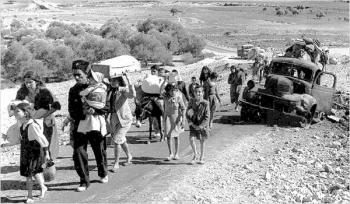
By Dan Freeman-Maloy | Rabble | January 6, 2016
The better part of a decade ago, I described the Toronto Star‘s Mitch Potter as “a canary in the mineshaft of liberal Canadian racism.” A piece on 1948 Palestine published in a recent edition of The Star shows the canary very close to asphyxiating.
Since Potter insists he was within his rights to describe Palestinian fighters in Gaza as “lemming-like,” he’ll surely forgive the metaphor.
The article, entitled “The Toronto man who saved Nazareth,” celebrates the heritage of Ben Dunkelman, the most prominent Canadian to travel to 1948 Palestine to support the Zionist war effort. In more than 2500 words spread across The Star‘s “Insight” section, Potter and his editors transform this Canadian’s role in occupying Palestinian communities into fodder for patriotism. “What he did was bring his hard-earned Canadian military professionalism to help organize a chaotic fighting force and help set down the rules of engagement,” the Star quotes one of a number of friendly sources as explaining. “And that included saying, ‘No, we will not expel civilians.'”
The record of this “gentle giant of a man,” as Potter introduces Dunkelman, is well documented. The son of the founder of Ontario retail giant Tip Top Tailors and a veteran of the Queen’s Own Rifles of Canada, Dunkelman was not an obscure figure. In Canada, he was an eminent member of the country’s community of patriotic respectables. In Palestine, he was a participant in the mass expulsion of Palestinians from the Galilee, commanding troops who repeatedly massacred civilians.
Dunkelman’s record of Canadian patriotism and Zionist colonization has long made for a popular sell. He has been happily remembered as “a Canadian and Israeli war hero,” as The Globe and Mail once described him. His basic character should be apparent to anyone who picks up his autobiography, Dual Allegiance.
Potter’s article for The Star pines over lost pages of this book without conveying to readers its utterly thuggish tone. The first five pages, to give you a sense, move from a description of a fight Dunkelman picked with a Palestinian (“Kneeling astride him, I began hitting him again and again, until his body went limp”) to boyhood reminiscences that feature a young Dunkelman in Toronto, soon to enroll in Upper Canada College, “waving a little Union Jack.” A lovely patriotic tale.
In Palestine, Dunkelman did not stop at beating Palestinians with his fists. In the summer and autumn of 1948, he served as commander of the Seventh (Armoured) Brigade of the newly established Israel Defence Forces (IDF). This is a representative sample of how Potter now presents this history to The Star‘s readership: “Named to lead Israel’s 7th Brigade in the final phase of the 1948 war, Dunkelman pushed methodically — and almost bloodlessly — through the Galilee with a series of nighttime flanking movements, eventually ending at the Litani River in Lebanon. He quite literally shaped borders, delivering territory Israel might not otherwise hold today.”
“Bloodlessly”?
One of the Seventh Brigade’s “nighttime flanking movements,” on October 29-30, 1948, brought the Palestinian village of Safsaf under Dunkelman’s command. A Palestinian woman from Safsaf, Umm Shahadah al-Salih, described what happened the next morning. Villagers were ordered to assemble in file around two houses to the north of the village.
“As we lined up, a few Jewish soldiers ordered four girls to accompany them to carry water for the soldiers. Instead, they took them to our empty houses and raped them. About 70 of our men were blindfolded and shot to death, one after the other, in front of us. The soldiers took their bodies and threw them on the cement covering of the village’s spring and dumped sand on them.”
If Potter’s editors can cough up subway fare to Yonge and Bloor, he can read this and other accounts for free at the local library, in Nafez Nazzal’s The Palestinian Exodus from Galilee, 1948. The Seventh Brigade’s trail of death, destruction and mass displacement of Palestinians from the Galilee into Lebanon is detailed authoritatively by Nazzal.
But right, this is a Canadian discussion of Palestine. Surely, Palestinians can’t be trusted! Unfortunately for Potter and The Star, more than mistrust of Palestinian testimony would be needed to make their whitewashing of these massacres halfway credible. In 1978, the year that Nazzal’s study was published, Israel began declassifying documents on these events. The Israeli record tells much the same story.
Israel Galili had been chief of staff of the Haganah, the main precursor to the IDF. In a declassified November 11, 1948 briefing cited by Israeli historian Benny Morris, Galili described the conduct of Dunkelman’s men in Safsaf. He spoke of the fate of “52 men tied with a rope and dropped into a well and shot,” and of three cases of rape, including of a 14-year-old girl. He also described large-scale killing of civilians by the Seventh Brigade in the villages of Saliha, Jish, and Sa’sa’. In Sa’sa’, Galili said, Dunkelman’s troops committed “mass murder” and then forced all remaining survivors out: “The whole village was expelled.”
Palestinian witnesses recount the most horrifying details. One survivor of the occupation of Safsaf recalled the stabbing of a pregnant woman with a bayonet. The witness lived out his life in the Ayn Al-Hilweh refugee camp in Lebanon; his testimony was kept alive by his nephew and cited in Ilan Pappé’s The Ethnic Cleansing of Palestine. In his memoirs, Dunkelman admits to authorizing looting by his forces, but predictably does not discuss most abuses. He does, however, proudly relate how one of his units set a landmark in the summer of 1948 with “the first bayonet charge ever mounted by the Israeli Army.” Facing an Arab position in the central Galilee, the company commander “ordered his men to fix bayonets; then, yelling like banshees, they rushed the Arab positions. When the astonished Arabs saw what was coming up the hill at them, they kicked off their boots and fled in terror.”
We don’t know much about specific atrocities with bayonets. We do know that Operation Hiram, during which Dunkelman’s troops carried out severe atrocities, helped push Palestinians out of the Upper Galilee en masse. On October 31, Dunkelman received an order from the IDF’s northern command spelling out this objective: “The inhabitants should be assisted to leave the conquered areas,” Dunkelman was instructed.
Here massacres by Dunkelman’s troops played their part. “What happened at Safsaf and Jish no doubt reached the villagers of Ras al Ahmar, ‘Alma, Deishum and al Malikiya hours before the Seventh Brigade’s columns,” writes Morris. “These villages, apart from ‘Alma, seem to have been completely or largely empty when the IDF arrived.” A week and a half into November 1948, an IDF intelligence report observed that “more than 50,000 new refugees” had crossed the border into Lebanon as a result of Operation Hiram.
Dunkelman — cue Potter’s praise — did not order expulsions in every Palestinian community that his forces occupied. He specifically opposed the (widespread) expulsion of Palestinian Christians by Israeli forces. When in July 1948 his troops occupied one of the main Christian centres in Palestine, the city of Nazareth, he spared it the harsher treatment he accorded to predominantly Muslim villages in its vicinity.
Potter is effusive with praise! He laments to The Star‘s readership that Dunkelman “won no medals for refusing to molest civilians” in Nazareth, but takes the opportunity to trumpet Canadian civility: “Transpose that morality to the modern era and imagine how the U.S. military interrogations at Abu Ghraib might have played out with a Dunkelman in command.” If those held at gunpoint were Muslims? Should we really follow this thread? “In many of the Palestinian oral histories that have now come to the fore,” observes Ilan Pappé, “few brigade names appear. However, Brigade Seven is mentioned again and again, together with such adjectives as ‘terrorist’ and ‘barbarous.'”
Israel has not declassified enough documentation for us to know for certain whether Dunkelman ordered his troops to massacre Palestinian civilians in line with instructions from higher-level IDF officers, took the initiative himself, or left the details to lower levels of command. But there is no record of him taking any action to discipline the culprits. By all accepted standards, he is therefore among them. Only the best liberal patriots want to award war criminals prizes for each possible war crime they didn’t commit.
Introducing a co-edited volume entitled Nakba: Palestine, 1948, and the Claims of Memory, Lila Abu-Lughod and Ahmad Sa’di explore the challenges of asserting Palestinian memory “under the conditions of its silencing by the thundering story of Zionism.” Engaging with 1948 as a landmark of enduring trauma, both individual and collective, may not be simple. But one can imagine an alternate universe in which Canadian journalists made a respectable effort. In which some attempt was made to look to the kind of work assembled by Abu-Lughod and Sa’di, to consider the recorded memories of those who lives were uprooted by Dunkelman’s troops, to bring their experiences into this history.
Instead, The Star basks in patriotic self-satisfaction and ignores the evidence.
This is not just a question of professional standards, or of historical accuracy. As Abu-Lughod and Sa’di argue, “the Nakba is not over yet.” It was Israel’s current defence minister, Moshe Ya’alon, who described Israel’s twenty-first-century assaults on Palestinians as “the second half of 1948.” How this war is represented abroad can affect its continuation into the present. I haven’t paid much attention to Potter’s work since his distortions of Israel’s 2006 assaults on Gaza and Lebanon. But it seems he’s decided to whitewash past and present attacks on the Palestinians in much the same spirit.
People in Canada need to demand better. In the coming period, we will have to face the fact that the end of the Harper years did not spell an end to Canadian support for Israel’s perpetual warfare against the Palestinian people. The liberal patriotic impulse is to bury this problem in comforting myths: to pretend that even in its support for Israel, Canadian liberalism shines. This requires nothing less than falsification of the record. An open discussion of the realities of Palestine will raise troubling questions about local burdens of responsibility. If this is what drives so many opinion-makers to avoid it, it is also what makes it urgent.
Dan Freeman-Maloy is an activist and writer based in Montreal. For a more detailed review of the record of Western recruits in 1948 Palestine, see this article of his from the Journal of Palestine Studies.
Israeli official calls for occupying Damascus
MEMO – January 4, 2016
A senior Israeli official called on Saturday night for the occupation of the Syrian capital Damascus based on the teachings of the Jewish holy book the Torah, Felesteen newspaper reported.
During a TV show on the Israel’s Channel 2, Deputy Speaker of the Israeli Knesset Bezalel Smotrich said that Israeli borders are beyond the current borders and Jerusalem’s borders reach Damascus based on the Torah.
Smotrich, member of the extremist Israeli party Jewish Home, suggested that Israel temporarily accept the current borders, which include the Golan Heights and the occupied West Bank, stressing that it has to work to achieve what was dictated by the Torah.
Meanwhile, the MK reiterated that the extremist Israeli settlers who burnt the home of the Palestinian Dawabsheh family were not terrorists. He said such acts are only considered a kind of terror when they are carried out by the “enemies of the Jewish people who are Arabs”.
He also called for the settlers’ leaders to control all the lands of the occupied West Bank, considering it Israeli land.
In addition, he stressed that anyone who does not accept Israeli sovereignty over the West Bank “must be expelled from this land,” adding that there are 20 Arab countries which can be their destination.
He went on to stress the importance of building a Jewish temple in place of Al-Aqsa Mosque.
UN monitor on Palestine quits over Israel’s entry denial
Press TV – January 4, 2016
The United Nations expert on the human rights situation in the occupied Palestinian territories has resigned, complaining that the Tel Aviv regime continues to deny him access to the areas he is tasked with monitoring.
In a Monday statement, the UN said Makarim Wibisono submitted his resignation to President of the Human Rights Council Joachim Rucker earlier in the day.
It said Wibisono, who will effectively quit his job as of March 31, had “expressed deep regret that, throughout his mandate, Israel failed to grant him access to the Occupied Palestinian Territory.”
Wibisono has been in charge of monitoring rights violations in the occupied East al-Quds (Jerusalem), the occupied West Bank and the Gaza Strip. The Israeli regime has time and again prevented the UN official from visiting the areas.
In June 2015, Israel denied Wibisono access to the Gaza Strip, where he was to investigate the aftermath of Tel Aviv’s 2014 war that killed over 2,200 Palestinians in the blockaded coastal enclave. The regime said at the time that the mandate handed to the UN official’s team was “anti-Israel,” and that it was exclusively focused on cases of Israeli rights violations.
Last November, Wibisono, and the expert on summary executions, Christof Heyns, slammed Israel for using excessive force and carrying out summary executions against Palestinians amid a surge in tensions in the occupied territories, where Palestinians have held almost daily anti-Israel protests since early October.
The latest wave of tensions was triggered by Israel’s imposition in August of restrictions on the entry of Palestinian worshipers into the al-Aqsa Mosque compound in East al-Quds.
The restrictions have enraged Palestinians, who are also angry at increasing violence by Israeli settlers frequently storming the al-Aqsa Mosque, a place highly revered by the Muslims across the world.
The Palestinian protesters also say Israel has a covert plan for changing the status quo of the al-Aqsa Mosque.
At least 144 Palestinians have been killed since the violence erupted in various towns of West Bank and Gaza. Some of 25 Israelis have also died during the same period.
Saudi execution aimed at provoking regional bloodbath
By Finian Cunningham | RT | January 4, 2016
The furious reaction across the Middle East to the Saudi execution of a prominent Shiite cleric strongly suggests that the killing is a deliberate provocation by the ruling House of Saud.
That provocation would appear to be aimed at inflaming sectarian tensions and fomenting conflict in various regional countries – already near flashpoint – in order to further Saudi geopolitical interests. Central to those interests is, as always, the bitter rivalry with the region’s Shiite powerhouse, Iran.
Following the announcement at the weekend by the Saudi Interior Ministry that Shiite cleric Sheikh Nimr al-Nimr had been executed, along with 46 other prisoners, there was predictable outrage from across the region, especially among countries where there is a large Shiite following, such as Iran, Iraq, Lebanon and Bahrain. Iran denounced the radical Sunni Saudi rulers as “criminal” and accused them of carrying out an act that is “the depth of imprudence and irresponsibility.”
Iran’s Supreme Leader, Ayatollah Khamenei, compared the House of Saud with Daesh, the extremist terror group (also known as Islamic State, and previously ISIS/ISIL). Of note is the way that the kingdom executes opponents by beheading according to a similar stringent interpretation of Islamic Sharia law known as Wahhabism – shared by both the Saudi regime and the cadres of Daesh.
Former Iraqi Prime Minster Nouri al-Maliki said that the imposition of capital punishment would lead to the downfall of the Saudi rulers, with other Iraqi politicians saying that it would “open the gates of hell” across the volatile and religiously fraught region.
The United States and European Union also responded with alarm at the execution of al-Nimr, both warning of deepening sectarian tensions being exacerbated by the Saudi death penalty.
Sheikh al-Nimr was executed on Saturday, along with 46 other prisoners in what is believed to have been the biggest mass execution in Saudi Arabia for over three decades. The death sentences were carried out in 12 prison locations by decapitation or firing squad, according to reports. Most of those sentenced were alleged members of the Al-Qaeda terror group, who had been accused of carrying out deadly attacks against Western interests in Saudi Arabia between 2003 and 2006.
Nimr al-Nimr was among four Shiite activists who were executed at the weekend. They were convicted on several charges of subversion and terrorism in trials that were dismissed by international rights groups as a travesty of judicial process. Sheikh al-Nimr was arrested in 2012 and accused of inciting violent protests, but supporters point out that the respected cleric always publicly endorsed peaceful protest. One of his best-known statements was: “The power of the word is mightier than the roar of bullets.”
In October, al-Nimr lost a judicial appeal against his death sentence. There then followed several international appeals for clemency. The Iranian government in particular issued several statements calling for the cleric’s life to be spared.
The widely seen miscarriage of justice against al-Nimr and the chilling determination to carry out his execution in spite of appeals for clemency is what makes the case so incendiary.
Lebanese Shiite resistance movement Hezbollah condemned Saudi Arabia’s conduct as “an assassination,” while Iran’s Revolutionary Guards Corps vowed that the Saudi rulers would meet with “harsh vengeance.”
In Yemen, where Saudi Arabia and a coalition of other Sunni Arab states have been carrying out airstrikes for the past nine months, the mainly Shiite Houthi rebels also condemned the execution of al-Nimr and promised retribution for his death. At the weekend, it was reported that 24 Saudi troops were killed in a Houthi rocket attack on the Saudi border province of Jizan. It is not clear if the attack preceded the announced execution of al-Nimr.
The Saudi regime has previously accused Iran and Hezbollah of fueling the Houthi rebellion in Yemen. Tehran has rejected claims of militarily supporting the insurgents. But it would be a fair assumption that Iran and Hezbollah will henceforth step up military intervention in Yemen as a way of striking back at the Saudis.
The same response is envisaged for Iranian and Hezbollah involvement in Syria, where the Saudis have bankrolled and armed various anti-government militia, primarily so-called radical Islamist groups with a shared Wahhabi fundamentalist ideology. These groups include Jaish al Islam (Army of Islam), whose leader Zahran Alloush was killed in a Syrian airstrike near Damascus on December 25. The Saudi regime publicly rebuked the killing of Alloush, saying that it jeopardized the forthcoming UN-sponsored peace talks in Geneva on Syria.
The House of Saud, led by King Salman, is known to be not in favor of the Geneva talks, which Washington and Moscow have both endorsed. The Saudis are dismayed by the seeming compromise made by Washington towards the Russian position, which is that the political future of Syria must be decided by the Syrian people through elections. The erstwhile demand by Washington that Syria’s President Bashar Assad must stand down as a precondition for peace talks has been abandoned – leaving the Saudis, Turkey and the extremist militia groups in Syria as the only parties persisting with the call for Assad to go.
It is perhaps significant that Turkish President Recep Tayyip Erdogan held a “strategic summit” with Saudi King Salman in Riyadh only days before the execution of Nimr al-Nimr.
Russia’s military intervention in Syria, from the end of September, has been a resounding success in terms of stabilizing the Syrian government of Bashar Assad. Even the Obama administration has recently acknowledged the strategic success for Russian President Vladimir Putin in Syria.
That military success can also be attributed to Iran and Hezbollah, as well as to Iraq, which have all contributed to the gains made by the Syrian Arab Army on the ground.
The biggest loser is the axis for covert regime change in Syria, led by Washington, London and Paris, together with their regional allies in Saudi Arabia, Qatar and Turkey. While Washington and the other Western powers have the nous to switch tactics from backing a covert insurgency to belatedly trying a political process for eventual regime change in Syria, it would appear that the Saudis and Turks are still committed to the covert war agenda.
In that way, the Russian-backed military alliance in Syria is a particularly damaging broadside to Saudi Arabia and Turkey.
From the Saudi point of view, one way of trying to salvage their losses in Syria and ongoing setbacks in Yemen would be to blow up the region with an explosion in sectarian conflicts. For many people, of course, such a gambit is insane. But if the House of Saud can provoke a firestorm between Sunnis and Shiites, that would in turn polarize relations between Washington and Moscow, leading to a wider war across the region.
Having lost in their Machiavellian schemes for regime change in Syria, the House of Saud seems to want to inflict a plague of chaos and bloodshed on everyone else’s house.
The execution of renowned Shia cleric Nimr al-Nimr is such a gratuitous barbaric killing, one is left with the conclusion: the unadulterated madness of the slaying betrays an altogether pathological calculation aimed at inciting mayhem in the region.
Saudi Arabia is on such a losing streak over Syria, Yemen, Iraq, Lebanon and elsewhere that its autocratic rulers probably figure that they don’t have much else to lose by going for broke – and thus provoking a regional bloodbath.
Israel military launches artillery into Lebanon
Press TV – January 4, 2016
The Israeli military has fired a number of artillery rounds into Lebanon amid a pledge by the Lebanese resistance movement, Hezbollah, that it will not leave unanswered Israel’s assassination of its high-ranking member Samir Qantar.
On Sunday, Israeli forces shelled the Lebanese border fence for the fourth consecutive day. The Israeli military feared that Hezbollah forces might take advantage of the stormy weather and the poor visibility to launch a strike.
The Israeli shelling comes two weeks after Qantar was killed during the Israeli raid that targeted his home in the southern Syrian city of Jaramana, located 10 kilometers (6.2 miles) southeast of the Syrian capital, Damascus, early on December 20, 2015.
Following Qantar’s death, Hezbollah Secretary General Sayyed Hassan Nasrallah said, “We reserve the right to respond to this assassination at the time and place of our choosing. Those of us in Hezbollah will exercise that right.”
“We have no doubt or question that Israel is the one which assassinated Samir Qantar, its planes fired precise missiles on an apartment (he was in),” Nasrallah noted.
Senior Hezbollah official Hashem Safieddine also said that Tel Aviv will be held accountable for Qantar’s death.
“If the Israelis think by killing Samir Qantar they have closed an account then they are very mistaken because they know and will come to know that they have instead opened several more,” Safieddine added.
Israel launched two wars on Lebanon in 2000 and 2006. About 1,200 Lebanese, most of them civilians, lost their lives during the 33-day war in the summer of 2006.
On both occasions, Hezbollah fighters gave befitting responses to the Tel Aviv regime’s acts of aggression, forcing Israeli military to retreat without achieving any of its objectives.
The Tel Aviv regime has resorted to an intelligence and psychological campaign against Hezbollah to compensate for its fiascos in the two wars on Lebanon.
Israel violates Lebanon’s airspace on an almost daily basis through sending reconnaissance drones, claiming the flights serve surveillance purposes.
‘Saudis seek Muslim division by Nimr execution’
Press TV – January 3, 2016
Press TV has conducted an interview with political analyst Ibrahim Mousavi to talk about the Al Saud regime in Saudi Arabia’s execution of Shia cleric Sheikh Nimr Baqir al-Nimr.
Below is a rough transcription of that interview:
Press TV: Let’s start with one of the main points of [secretary general of Lebanon’s resistance movement Hezbollah] Seyyed Hassan Nasrallah’s speech which basically he is talking about how all Muslims should be diligent and not to basically play the game that the Saudis have initiated, trying to ignite division in the Muslim community and that everyone must remain united.
Mousavi: Indeed this is a very important message at this juncture of history and this sensitive moment when Seyyed Nasrallah talks we hear the voice of reason, we hear the voice of wisdom, we hear the voice of responsibility. Those who are responsible for the Ummah, for the nation, for the people, they should be very aware of what they say, when they say it, and to who they say. The message that should be sent is that this unjust ruling of the Saudi dynasty, those supporters of Takfiri groups, the oppression against the Saudis whether Shia Muslims or non-Shia Muslims—and we know very well that when we talk about the Saudis who are outside the country—you go to Europe, you see how many have applied for political asylum. So we are talking here about a national crisis that is taking place when the Saudi rulers are oppressing their own people.
They are trying at the same time to say that this is a conflict between the Shias and the Sunnis. The execution of Sheikh Nimr Baqir al-Nimr and the execution of every single Yemeni individual regardless of his age, regardless of his belonging on the factional and conventional level, tells you that this is a kind of attack against humanity.
That’s why it is very important to highlight the direction of the message. The message that we should not be misled by what they are trying to do. They are trying to sow the seeds of discord and sedition among the people, among the Arabs, among the Muslims. We should not be in any way under the pressure or under the impact of the Saudi propaganda.
Press TV: And Mr. Mousavi, another point, basically that Seyed Hasan Nasrallah also talked about the desperation of the Saudi regime and that with the spilling of the blood of Sheikh Nimr al-Nimr and other innocent people, it is the beginning of the end of the Saudi regime. Your perspective on that point sir.
Mousavi: This is again, a very clear point and a very evident point. We know very well that when you are strong enough you can handle your problems and go through. When a kingdom, when a dynasty that has tens and hundreds of billions of dollars that they spend in order to annihilate Yemen and the civilization in Yemen and the Yemeni people. When they have all these F-16s that are being supplied to them by the Americans. Why would they go and execute Sheikh Nimr if they are afraid of the voice of one man when they wage wars against their neighbors? When they go and invade Bahrain against the will of the Bahraini people, trying to support the regime of Al Khalifa? When they go and send booby-trapped cars to Iraq? When they interfere in here and there. When they try to topple the authorized and legitimate government in Syria by supporting Takfiri groups?
This all tells you that when they go to these wars and try to execute a man who had always been preaching for change, for political rights, via peaceful means, via political means, this tells you that they are very weak. And yes indeed this is a very important indicative, this is very important and evident reason that proves that they are very weak and they are accumulating more and more mistakes that is going to bring their end in a more hasty way than expected.
Court Acquits Turkish Suspects Involved in Sarin Gas Supply to Syria
Fars News Agency – January 1, 2015
A Turkish court in Adana acquitted five Turkish suspects accused of procuring chemicals used in production of sarin gas, Zaman reported.
In May 2013, media reported that Turkish special service officers arrested members of Syrian opposition group who were in possession of two kilograms of sarin, Sputnik reported.
Moscow conducted a thorough investigation of the incident and expressed hope that Turkey would provide information regarding the detention of the militants. However, two months later, all detainees were released pending trial.
Later on when the court established that the materials they were trying to obtain could in fact be used to produce sarin, a warrant for the arrest was issued.
The case sparked political controversy when the deputy of the Turkish opposition Republican People’s Party (CHP) Eren Erdem said in an interview with RT that Turkey knew about ISIL-bound shipments of deadly sarin gas passing through its territory.
Eren Erdem was accused of treason by Ankara’s top prosecutor and criminal investigation was opened against him.
But after addressing the parliament and saying that the Turkish president had started a smear campaign against him, Erdem went even further by accusing the Turkish authorities of complicity, stating that the government pressured the prosecutor of the case into toning down the accusations and ending the trial rapidly.
The prosecutor of the case involving the five Turkish suspects recently denied Erdem’s accusations in a statement, saying the Turkish suspects were released because they were not found to be in possession of the materials used for sarin production, while rejecting the idea that the justice minister pressured him into bringing the case to a close immediately.
Two CHP deputies said that the Turkish government was out to get Eren Erdem and had launched a lynching campaign against the deputy.
Republican People’s Party (CHP) deputy Ali Şeker stated that Turkish authorities must answer questions in connection with the incident.
Featured Video

Why Hamas Really Attacked Israel on Oct. 7
or go to
Aletho News Archives – Video-Images
From the Archives
Israel: Strategic Ally or Liability?
By Stephen Sniegoski | My Catbird Seat | June 12, 2010
The claim that Israel serves as a valuable ally for the United States is made by both pro-Zionists and much of the anti-war and anti-Zionist Left that is influenced by Noam Chomsky. As a result of the Gaza flotilla massacre, which has caused a world-wide uproar against Israel, the value of Israel to the United States is being publicly questioned in more mainstream foreign policy forums. … continue
Blog Roll
 Aletho News
- Why Hamas Really Attacked Israel on Oct. 7
- Declassified UK exposes British man who fought for ‘Israel’ in Gaza
- West’s death cult in a theater near you
- How the Yandex ‘Russian bots’ lie fell apart
- Burnham’s ‘Russia did Brexit’ ruse crumbles
- Estonia making movies and games to encourage war against Russia
- Four in five new UK jobs taken by foreigners – report
- Here’s what Trump’s latest U-turn really means for Russia and Ukraine
- The Houthis Are Not an Iranian Proxy
- Europe’s Energy Hypocrisy, Russian LNG Profits and US Dependence
- If Americans Knew
- Activists Abused By Israel Return to New Freedom Flotilla Mission
- 60 Minutes won’t tell the full truth about Israeli settler violence
- Nearly 50,000 women, girls killed or severely injured in Gaza since October 2023: UN Women
- ADL is working with AI companies to suppress alleged ‘antisemitism’
- Israeli occupation forces using social media surveillance unit to target hundreds of Palestinians in the West Bank
- Israel’s New – and Terrifying – Security Doctrine
- Israeli Attacks Kill Five in Gaza, Including a four-year-old and a woman
- Air Force Major Who Called for Trump’s Impeachment Held in Solitary Confinement
- It’s a Genocide, I’m Into It’: Seinfeld Mocks Protest over Palestinian Children Killed
- Universities fire dozens amid pressure from Zionist billionaires
- No Tricks Zone
- New Study Suggests Large Regions Of The Pacific Ocean Have Been Cooling For The Last 80 Years
- Germany’s Green Energy Debacle: High Energy Costs Force Kahla Porzellan to Close After 182 Years!
- New Study: 50 Years Of The Most Aggressive ‘Net Zero’ Policies Can Only Affect The Global Climate By 0.03°C
- US September “Heat” Was No Record…Many Records Set Decades Ago
- Latest European Green Energy Debacle; Portugal’s Largest Flagship Solar Park Insolvent!
- Green Energy Debacle: German Expert Professor Fritz Vahrenholt Warns Of Severe Economic And Social Consequences
- Two More Paleo Reconstructions Affirm Meters-Higher Sea Levels Across Ireland, Brazil 7000-6000 Years Ago
- New Study: Earth And Venus Surface Warmth Largely Explained By Convection And Lapse Rate, Not CO2 Or Radiation
- 2025 Nature Paper Claiming Worsening Global Drought Gets RETRACTED …Heavily Flawed
- New Study: ‘Global Drought Shows No Detectable Recent Acceleration Under Climate Warming’

