Western governments, their Middle Eastern allies, and many major media outlets have much in common with Lewis Carroll’s Humpty Dumpty.
“When I use a word,” Humpty Dumpty said, in a scornful tone, “it means just what I choose it to mean – neither more nor less.”
Similarly, in the lexicon of western powers and their regional partners, the meaning of words such as moderation, legitimacy, human rights, democracy, extremism, terrorism, and fundamentalism are about as consistent as a chameleon’s color.
In Ukraine, the United States and its allies supported and facilitated the overthrow of a democratically elected president, immediately recognizing the successor regime as “legitimate.”
Many dead in ‘air strike on north Yemen refugee camp’
But, in Yemen – despite Abd Rabbuh Mansour Hadi having been the sole candidate in the February 2012 presidential election, despite his term as transitional president having expired after two years, despite his lack of popular support, despite his having resigned in January, despite his having fled his capital and later his country – the US and its allies consider Hadi the “legitimate” president.
Question of legitimacy
When Hadi invited foreign powers to bomb his country’s flimsy infrastructure and military, they rushed to do so.
US logistical and intelligence support may help explain why the Saudi Kingdom chose America’s favorite “shock and awe” tactics for its war against Yemen. Netanyahu also supports air strikes against Yemen’s armed forces and fragile infrastructure; perhaps Saudi leaders should have asked him why the Israeli regime’s multiple barbaric onslaughts against much smaller areas like Gaza and South Lebanon all ended in failure and humiliation.
Sadly, history is repeating itself like a rogue merry-go-round. The same countries that, as US Vice President Joe Biden admits, helped destroy much of Libya, Syria, and Iraq are now fighting on the same side as al-Qaeda of the Arabian Peninsula (AQAP).
Is it really a good idea to strengthen al-Qaeda’s most dangerous branch alongside Bab El Mandab, the narrow waterway linking the Red Sea with the Gulf of Aden – especially as Somalia has no effective central government and al-Qaeda affiliates like al-Shabab are on the other side of the strait?
Cronyism, poverty, injustice, corruption, and decades of foreign domination drove Hadi’s overthrow. Ceaseless attempts to deny this and depict the Yemeni situation as a sectarian conflict reflect a worn-out strategy. This strategy has shaped the creation of the Taliban, ISIL, Boko Haram, al-Qaeda in the Islamic Maghreb, al-Qaeda, Ansar al-Sharia, and Jundullah, among others.
It has caused pain and devastation across North Africa, where there are no Shia Muslims – or “majus” and “Safavids,” to use the derogatory terminology of the tens of well-funded sectarian and ethnocentric extremist television channels.
Iranian proxies?
Describing the Houthis or Ansarullah as Iranian proxies insults their millions of followers and allies across Yemen, including southerners who well remember past devastation inflicted upon them by the same forces. It is an obvious attempt to push a non-sectarian country towards sectarianism, even though this policy has already failed in Syria.
It is difficult to imagine how these air strikes across Yemen – killing significant numbers of innocent civilians, including women and children huddled in refugee camps – will make the “coalition” look like liberators.
That none of these pilots flew anywhere near Palestine during the Israeli regime’s 2014 onslaught against Gaza has not escaped notice, either.
Iranians have also noticed that the Saudi-led Operation Decisive Storm coincides with the most sensitive phase of negotiations between the Islamic Republic of Iran and the P5+1 in Lausanne, Switzerland. It has been clear for some time that the Israeli and Saudi regimes want to prevent a successful outcome in these talks.
Regardless of the ultimate outcome, Yemen’s tormentors should remember what happened along the Saudi-Yemeni border in 2009 when Ansarullah was a much smaller, more isolated, and less experienced military force. Purchasing Pakistani or Egyptian troops will not solve the problem; both of those regimes are floundering, barely able to contain their own extremists.
Appreciation for Iran among Iraqis, Syrians, Bahrainis, Omanis, and Yemenis is rooted in Iran’s independence, participatory Islamist governance (Western claims to the contrary notwithstanding), civilization, tolerance, and rejection of sectarian ideology.
While stale accusations will undoubtedly continue to be leveled at Iran, this aggression is not about the Islamic Republic’s alleged regional domination, it is about silencing the aspirations of the Yemeni people.
Those who spread civil war, extremism, and war should ponder the final words of Lady Macbeth: “Here’s the smell of the blood still. All the perfumes of Arabia will not sweeten this little hand.”
April 5, 2015
Posted by aletho |
Deception, Militarism, War Crimes | Iran, Saudi Arabia, United States, Yemen |
Leave a comment
The
Wall Street Journal has published Judith Miller’s
defense of her Iraq War writings, in which she specifically denies responsibility for helping lead America into that war. There are others far more qualified than I am to pick apart what she’s written in the
Journal (and what will appear in Miller’s book
The Story, from which the
Journal piece is excerpted). I’ll limit myself to this:
Another widespread fallacy is that such neoconservatives as Richard Perle and Paul Wolfowitz strong-armed an inexperienced president into taking the country to war. President Bush, as he himself famously asserted, was the “decider.” One could argue, however, that Hans Blix, the former chief of the international weapons inspectors, bears some responsibility. Though he personally opposed an invasion, Mr. Blix told the U.N. in January 2003 that despite America’s ultimatum, Saddam was still not complying fully with his U.N. pledges. In February, he said “many proscribed weapons and items,” including 1,000 tons of chemical agent, were still “not accounted for.”
Did Blix say in January 2003 that Iraq wasn’t fully compliant? Yes, he did. You can read the January 27, 2003, report here. Though please note that Blix says that Iraq was largely cooperative with regard to process:
Iraq has on the whole cooperated rather well so far with UNMOVIC in this field. The most important point to make is that access has been provided to all sites we have wanted to inspect and with one exception it has been prompt. We have further had great help in building up the infrastructure of our office in Baghdad and the field office in Mosul. Arrangements and services for our plane and our helicopters have been good. The environment has been workable.
Our inspections have included universities, military bases, presidential sites and private residences. Inspections have also taken place on Fridays, the Muslim day of rest, on Christmas day and New Years day. These inspections have been conducted in the same manner as all other inspections.
But yes, there was some resistance by Iraq up to that point. Blix said so. However, a few days later, he made it abundantly clear, in an interview published in The New York Times, that nothing he’d seen at the time justified war:
Mr. Blix said he continued to endorse disarmament through peaceful means. “I think it would be terrible if this comes to an end by armed force, and I wish for this process of disarmament through the peaceful avenue of inspections,” he said.
And he specifically rebutted a large number of allegations advanced by the Bush administration:
Mr. Blix took issue with what he said were Secretary of State Colin L. Powell’s claims that the inspectors had found that Iraqi officials were hiding and moving illicit materials within and outside of Iraq to prevent their discovery. He said that the inspectors had reported no such incidents.
Similarly, he said, he had not seen convincing evidence that Iraq was sending weapons scientists to Syria, Jordan or any other country to prevent them from being interviewed. Nor had he any reason to believe, as President Bush charged in his State of the Union speech, that Iraqi agents were posing as scientists.
He further disputed the Bush administration’s allegations that his inspection agency might have been penetrated by Iraqi agents, and that sensitive information might have been leaked to Baghdad, compromising the inspections.
Finally, he said, he had seen no persuasive indications of Iraqi ties to Al Qaeda, which Mr. Bush also mentioned in his speech. “There are other states where there appear to be stronger links,” such as Afghanistan, Mr. Blix said, noting that he had no intelligence reports on this issue.
It’s good that Miller is at least honest enough to acknowledge Blix’s opposition to war, given his debunking of administration claims and his belief that persistence in pursuing inspections was a better path to disarmament.
(Did I mention that Miller was the lead author of the Times interview story?)
In his February report, Blix did say that “many proscribed weapons and items are not accounted for.” But let’s put that quote in context (emphasis added):
How much, if any, is left of Iraq’s weapons of mass destruction and related proscribed items and programmes? So far, UNMOVIC has not found any such weapons, only a small number of empty chemical munitions, which should have been declared and destroyed. Another matter — and one of great significance — is that many proscribed weapons and items are not accounted for. To take an example, a document, which Iraq provided, suggested to us that some 1,000 tonnes of chemical agent were “unaccounted for”. One must not jump to the conclusion that they exist. However, that possibility is also not excluded.
Blix’s February report suggested that Iraq was cooperative and the process as working well:
Since we arrived in Iraq, we have conducted more than 400 inspections covering more than 300 sites. All inspections were performed without notice, and access was almost always provided promptly. In no case have we seen convincing evidence that the Iraqi side knew in advance that the inspectors were coming.
The inspections have taken place throughout Iraq at industrial sites, ammunition depots, research centres, universities, presidential sites, mobile laboratories, private houses, missile production facilities, military camps and agricultural sites…..
Through the inspections conducted so far, we have obtained a good knowledge of the industrial and scientific landscape of Iraq, as well as of its missile capability….
More than 200 chemical and more than 100 biological samples have been collected at different sites. Three-quarters of these have been screened using our own analytical laboratory capabilities at the Baghdad Centre (BOMVIC). The results to date have been consistent with Iraq’s declarations.
We have now commenced the process of destroying approximately 50 litres of mustard gas declared by Iraq that was being kept under UNMOVIC seal at the Muthanna site. One-third of the quantity has already been destroyed. The laboratory quantity of thiodiglycol, a mustard gas precursor, which we found at another site, has also been destroyed.
Blix made clear that the process required more time. He wasn’t going to get more time, however. The bombing started less than a week later. It wasn’t his idea. It wasn’t his fault.
April 5, 2015
Posted by aletho |
Deception, Mainstream Media, Warmongering, Timeless or most popular, War Crimes | Hans Blix, Iraq, Judy Miller, New York Times |
Leave a comment
The New York Times recently published an editorial lamenting the “shameful impunity of the Islamic State” and encouraging the United Nations Security Council to refer the group’s crimes to the International Criminal Court (I.C.C.). The editorial, titled “The Crimes of Terrorists” (4/2/2015), should more accurately be titled “The Crimes of the U.S. and Its Allies Should Go Unpunished.”
In the last several months alone, the Times has repeatedly failed to condemn crimes by the U.S. government and its allies in Yemen, Iraq, Syria and the Palestinian territories.
When the Times writes that “the Islamic State’s campaign of religious and cultural cleansing has shocked the world and terrified the peoples of Iraq and Syria who don’t fit into the group’s fanatical vision of a neo-Islamist caliphate” and that the Security Council should address the “shameful impunity of the Islamic State, and refer the group to the I.C.C.,” they are stating the obvious.
That crimes should be punished is beyond dispute. Condemning the crimes of official enemies of the United States does not take particular moral or political courage. Whether it was the Soviet Union during the Cold War, the Taliban after 9/11, or Iraq before the 2003 invasion, a media organization would be hard pressed to find a less controversial editorial position.
What would take courage is opposition to the criminal actions of the U.S. government and governments or groups it is aligned with. This is something the Times has failed to do for decades. You don’t have to go back in time to find multiple examples.
Just two days before the editorial on the Islamic State, the Times published another editorial titled “Saudi Arabia’s Ominous Reach Into Yemen” (3/3/2015). The Times does not condone the Saudi-led bombing campaign, stating: “Rather than bombing, Saudi Arabia should be using its power and influence to begin diplomatic negotiations, which offer the best hope of a durable solution.” They note the pitfalls of the Saudi military invention by claiming it “threatens to turn what has been a civil war between competing branches of Islam into a wider regional struggle involving Iran. It could also destroy any hope of stability in Yemen.”
But the strongest position the Times can muster is to encourage President Obama to push for a “political solution.” They fail to mention that the Saudi military intervention is itself a crime, no different than the crimes of the Islamic State they would oppose two days later with such vigor. Bombing a sovereign nation is indisputably a violation of Article 2 of the United Nations Charter: “All members shall refrain in their international relations from the threat or use of force against the territorial integrity or political independence of any state.”
Violation of the prohibition against the use of force in the UN Charter amounts to the crime of aggression, which was defined in the Nuremberg Trials as “not only an international crime; it is the supreme international crime, differing only from other crimes in that it contains within itself the accumulated evil of the whole” (italics added).
On the same day the Times published its editorial, Amnesty International reported: “There is growing evidence that the Saudi Arabian-led military coalition is failing to take precautions to prevent civilian deaths amid ongoing airstrikes around Yemen.” They reported that “at least six civilians, including four children, were among 14 people who burned to death in further airstrikes.”
The Guardian reported that it had obtained images from a humanitarian worker in Yemen that “showed gruesome scenes – charred bodies immolated by the blast, mangled corpses in plastic bags, and wounded childred being treated,” The humanitarian worker “said he saw scattered limbs littering the area nearby.”
Yet the Times does not even mention these Saudi crimes (backed by the U.S. government), much less demand accountability. They do not claim that Saudi Arabia enjoys “shameful impunity” they way they do for the Islamic State.
Neither does the Times condemn Israeli crimes against Palestinians, especially last summer’s slaughter in Gaza, euphemistically called “Operation Protective Edge” by the Israeli government. In a New York Times editorial titled “Keeping Palestinian Hopes Alive” (3/24/2015) the editorial board calls for a two-state political solution to the conflict in order to avoid Palestinians seeking justice in the I.C.C.
The call for a two-state solution is disingenuous and hollow. With more than 500,000 Israeli settlers now squatting on stolen land in the West Bank, there is no practical way to implement such a plan. Furthermore, this nominal “solution” has been the U.S.-Israeli policy for more than 20 years since the Oslo Accords and has led nowhere. A call for a two-state solution is nothing more than an appeal to continue the status quo indefinitely while using different language.
The Times states that “a clear Security Council statement in favor of a two-state solution would be an important benchmark. If the United States and other major powers quickly show commitment to that approach, they might be able to keep Palestinians from pressing a complaint against Israel in the International Criminal Court.” This, the editorial board claims, “would poison relations even more and alienate many Americans.”
Even if a two-state solution were feasible, why would implementation of such a plan preclude justice in a court of law for the nearly 2,200 Palestinians, including more than 500 children, who were killed, most of whom were civilians?
Human rights organizations have found extensive evidence of war crimes and reckless disregard for human life by the Israeli military in Gaza during the 50-day war.
Amnesty International reported on “extensive, wanton and unjustified” targeting of civilian infrastructure including multi-story buildings by Israel in Gaza.
“Both the facts on the ground and statements made by Israeli military spokespeople at the time indicate that the attacks were a collective punishment against the people of Gaza and were designed to destroy their already precarious livelihoods,” states Philip Luther, Director of the Middle East and North Africa Programme. Collective punishment is a war crime under the Geneva Conventions.
In a report on Israeli attacks against inhabited homes, Amnesty International found that “whole families were killed or injured by these targeted strikes.” The report focuses on eight cases “in which targeted Israeli attacks resulted in the deaths of at least 111 people, of whom at least 104 were civilians, including entire families and 62 children, and destroyed civilian homes.”
Amnesty recommended, “given Israel’s long-standing failure to investigate and prosecute alleged war crimes … that the international community should ensure that possible crimes under international law, including war crimes, committed during Operation Protective Edge” should be pursued in court in states exercising universal jurisdiction or through the I.C.C.
This is the opposite of the position taken by the Times. When it comes to official enemies, the Times righteously claims that their crimes have “shocked the world” and “terrified” the local population. But when it comes to the U.S. and its allies, the Times believes that equivalent crimes should be swept under the rug.
The New York Times has had a long-standing record of this type of hypocritical logic. As the NYTimes Examiner noted last year in an article titled “The New York Times Excorciates ‘Aggression’: The Washington Exception” (3/5/2014):
Over the last quarter century the New York Times’ Editorial board has made editorial decisions that illustrate a peculiar pattern. Times readers could otherwise overlook the pattern in everyday reading. However, when viewed through a wider historical lens, the pattern lays bare biased reporting that should concern readers.
In five editorial pieces, spanning a period from December 1989 to March 2014, and encompassing nearly 3,000 words, the Times’ Editorial board has weighed in on cross-border military actions. The selectivity of their language shows a political bias in favor of upholding what they believe is best for Washington’s interests and therefore, under the guise of ‘objectivity,’ report expectedly in opposition to Washington’s adversaries.
Indeed, in editorials on Panama (“Why the Invasion Was Justified”) (12/21/1989), Yugoslavia (“Air Campaign Against Yugoslavia”) (3/25/1999), and Iraq (“The War Begins”) (3/20/2003), the Times stood firmly behind American use of military force.
Despite the fact that each of these military attacks were clear cases of aggression, the “supreme international crime,” the Times never once broached the idea that the U.S. government should face repercussions for their many severe violations of international law.
Even in their most ambivalent stance, on Iraq, they stated that “even those who sharply disagree with the logic behind this war are likely to end up feeling reassured, almost against their will, by the successful projection of American power.”
There is the hypocrisy laid bare. For the Times editorial board, as for much of the American public, blind worship of American power is more important than their professed concern for the rule of law. That concern is reserved only for those who do not enjoy the support of the U.S. government, and who can thereby be excoriated for their crimes relentlessly.
April 5, 2015
Posted by aletho |
Mainstream Media, Warmongering, Militarism, Timeless or most popular, War Crimes | New York Times, Saudi Arabia, United States |
Leave a comment
A family of nine has been killed in an airstrike on a Yemeni village near Sanaa, residents report. Five others have been wounded, while several others remained trapped under rubble, according to Yemeni media.
The strike, which on Friday evening hit the Okash village – just a few miles away from a military base outside the capital – killed two men, a woman, and six children, Reuters reported, citing residents.
The state news agency Saba posted a picture on its website showing three children lying next to each other with pieces of paper with the date April 3, 2015 written on them. However, the authenticity of photo has not yet been verified.
A Saudi-led military coalition began launching airstrikes against Yemen’s Houthi rebels last week. The operation intends to bring ousted President Abd Rabbuh Mansur Hadi back into power and prevent the Houthi militants and backers of Hadi’s predecessor Ali Abdullah Saleh from gaining full control of the country.
In Aden, a southern port city which has seen the fiercest clashes in the country, medics say that fighting has left at least 185 people dead and more than 1200 wounded since the violence sharply escalated last week. Aden had been one of the loyalists’ few remaining footholds in the country, where Hadi had been holing up after being forced out of the capital by the Houthis in February. Hadi fled the country for Riyadh last week.
The head of Aden’s health department Al-Khader Lassouar told AFP that three-quarters of the casualties were civilians, adding that the actual death toll is likely much higher as the Houthis and their allies do not take their causalities to public hospitals.
Lassouar also called for international aid organizations and Arab States to provide emergency medical supplies to Aden’s hospitals.
“Medicine stocks are exhausted and hospitals can no longer cope with the increasing number of victims,” he said.
International Committee of the Red Cross (ICRC) representative Sitara Jabeen told RT that the organization is making breakthroughs in negotiations for a 24 hour in order to get aid into the country.
“We are now waiting for a formal greenlights. We hope that by tomorrow we will be able to send our supplies and our personnel to Yemen,” she said Saturday. She emphasized that the organization was talking to all parties in the conflict.
Earlier, the ICRC released a statement calling for an immediate 24-hour humanitarian pause in hostilities.
“All air, land and sea routes must be opened without delay for at least 24 hours to enable help to reach people cut off after more than a week of intense air strikes and fierce ground fighting nationwide,” the ICRC said in a statement on Saturday.
Three shipments of aid and medical staff from the ICRC had been blocked for several days because of both the Saudi-led aerial bombardment as well as intense clashes on the ground between Yemen’s rivaling factions.
Several boats and planes containing over 48 tons of medical supplies are awaiting security clearance to leave for Yemen. A four-person surgical team is also on stand-by in Djibouti waiting to be dispatched to Aden by boat.
April 4, 2015
Posted by aletho |
War Crimes | Human rights, Middle East, Saudi Arabia, Violence, Yemen |
Leave a comment
To be a freier is anathema to Israelis. The Yiddish word is translated loosely as “sucker”, which doesn’t really do justice to its broader and more significant connotations. “Don’t be a freier” is practically the 11th commandment in Israel and the fear of actually being one plays into every aspect of life. This includes politics, where such an accusation could damage a politician’s public image badly.
Benjamin Netanyahu beat the Labour Party’s Shimon Peres in the 1996 election largely because Peres was seen as a freier; a pushover, someone who cedes ground, plays by the rules and allows others to get the better of him. Netanyahu’s latest victory was also very much down to his own uncompromising image as a bit of a political brawler; someone who will never concede from a position of strength; someone who in the eyes of Israeli voters is not a sucker.
“Liberal Zionists” are freiers in the eyes of many Israelis because they want to end Israel’s occupation, an end to settlements and the emergence of a free and sovereign Palestinian state. Liberal Zionists are also “suckers” in another way; they have been deceived into thinking that Zionism and liberalism can be reconciled.
Their dream has been dashed. The extremely illiberal manner in which Netanyahu secured his latest election victory – which included calling on right-wing Israelis to get out and vote because Arab voters were coming out in droves – has prompted much soul-searching amongst liberal Jews.
Jonathan Freedland, the Guardian‘s executive editor and an ardent liberal Zionist, is disturbed that “Netanyahu sank into the moral gutter and there will be consequences“. J Street, an American liberal Jewish advocacy group, held a plenary session during its annual conference on the future of liberal Zionism. A visibly irritated prominent liberal Zionist, Peter Beinart, author of the “Crises of Zionism”, bleated over Netanyahu’s victory and declared his support for “any campaign” against Israel’s occupation that was “non-violent” but which must “recognise Israel’s right to exist”.
What unites liberal Zionists is the belief – or at least the hope – that Israel can reconcile and balance being a Jewish and a democratic state, serving both as the realisation of Jewish national self-determination and as a modern liberal state that guarantees equality to all citizens regardless of their religion or ethnic heritage. This liberal Zionist dream looks more like a fantasy than a realistic political aspiration for a number of reasons.
For a start, in what is supposed to be land earmarked for a Palestinian state, Israel presides over an apartheid system that has been the cause of much embarrassment to liberal Zionists like Beinart and Freedland. Within Israel itself there are more than 50 laws that discriminate against non-Jews in all areas of life, including their rights to political participation and access to land, education, state services and resources, and the criminal justice system.
Being a liberal Zionist was always going to be a tough act to pull off; now it has become near enough impossible. The intrinsic contradiction between wanting social justice and equity whilst simultaneously supporting a militaristic and apartheid state of Israel (and a “Jewish State” at that) produces what psychologists call cognitive dissonance; the discomfort experienced by an individual who holds two or more contradictory beliefs, ideas or values at the same time.
It was in many ways an odd synthesis to start off with purely because liberalism at its core is about inclusion and universal rights and principals. Zionism, on the other hand, has always been about exclusion and Jewish exceptionalism.
Nevertheless, it was in many ways a necessary synthesis no matter how oxymoronic it seems. For Diaspora Jews, the majority of whom are liberal and support Israel, it was an ideological construct that functioned as a bridging concept between two irreconcilable ideologies: Zionism and liberalism.
As such, it has enabled liberal Jews to operate as pillars of support for the state of Israel and as apologists for its inherent illiberalism. Their loyalty is in the name of an idealistic Israel; a mythical Israel; an Israel that never really existed; a Jewish democratic country that can balance its dual identities. It’s a position that has contributed to the kind of arrogance and chutzpah that makes Israeli politicians believe that they can get away with anything.
In persisting with their arguments that they support what is in the “best interests of Israel”, while also policing the boundaries of “legitimate” and “illegitimate” criticisms of their mythical Israel, liberal Zionists have placed themselves in an unsustainable contradictory position. Therein they are forced to compromise on the central principals of liberalism, such as human rights, the rule of law and justice.
To avoid having to confront this reality liberal Zionists cling to some central illusions. They have constructed an artificial dichotomy between the State of Israel and the illegal Jewish settlements built on occupied Palestinian territory; they pretend that the state and the settlements – which undermine their narrative of a democratic Israel – are somehow disconnected, or can be. Zionists like Peter Beinart typify this when they suggest renaming the West Bank “undemocratic Israel” to distinguish it from the territory occupied in 1948, which is “democratic” Israel.
In reality, one cannot, in any serious way, separate Israel from its settlement enterprise, simply because the colonial outposts are central to Israeli state policy and not some breach of international law orchestrated by feral Jewish settlers.
Liberal Zionists have also called the bluff of Israeli politicians who have been paying lip service to a two-state solution. Their faith in a future post-occupation, post-settlements and post-apartheid democratic Israel is nought but a utopian dream.
They talk about an always just around the corner, yet really non-existent, two-state solution, which has provided Israel with infinite flexibility to expand and, above all, given it an alibi for its core colonial policy to occupy as much Palestinian land as possible. If liberal Zionists fear the spectre of a future apartheid Israeli state if the two-state solution is killed off – which would explain their shrilling response to Netanyahu’s electoral promise not to permit the creation of a Palestinian state – they ought to challenge Israel for what it is now and not make apologies for it based on an illusory Utopian future.
It has become obvious that liberal Zionists shy away from talking about Israel’s original sin, when the founders of the state started an act of ethnic cleansing of the indigenous Palestinian population which is ongoing to this day. Almost 750,000 Palestinians were killed or driven from their homes to make way for the foundation of the state of Israel which had to have a majority Jewish population. While over five million Palestinians are still refugees and stateless, liberal Zionists would rather close this embarrassing chapter of Israel’s bloody history and not face the difficult questions about the human rights being denied to Palestinians, including the refugees’ right to return to their land, which is guaranteed under international law.
Some liberal Zionists do admit that Israel’s past sins create a tolerable tension, but this does not reduce their support for the state, or call its existence into question. What concerns them most is Israel’s survival as a “Jewish democracy” no matter what the circumstances were around the state’s foundation.
In reconciling Israel’s past with their liberal principals they’ve resorted to all kinds of sophistry, including devising verbal crutches to prevent their liberal principals being overwhelmed by illiberal ethnic loyalty. For example, a vague notion of conflicting rights has been used to undermine Palestinian human rights, such as the legitimate right of Israel to be a Jewish state and the legitimate right of Palestinians to return and be compensated for their forceful expulsion.
Liberals who are normally devoted to the rule of law and human rights are quick to compromise this key tenet of liberalism when they put on a Zionist hat and make a spurious trade-off between the legitimate rights of Palestinian refugees and the desire of Israel to be a Jewish state. They forget, despite their liberalism, that Jewish self-determination cannot trump Palestinian human rights.
The “liberal” prefix for Zionism has been used to dilute the true essence of the latter as an ethno-religious colonial project. According to the French Jewish historian Maxime Rodinson, the Zionist project began as, “A Colonial-Settler State, wanting to create a purely Jewish or predominantly Jewish state in Arab Palestine in the 20th century.” Born out of illiberal values and principals it could not “help but lead to a colonial-type situation and the development of a racist state of mind, and in the final analysis, to a military confrontation.” Liberal Zionism is, therefore, politically and morally bankrupt.
With no end in sight to Israel’s decades-long occupation, liberal Zionists need to consider the fact that it is – along with on-going land theft and ethnic cleansing – at odds with liberal principles as well as the essence of Zionism; occupation is not some reactionary by-product of a state under siege.
Far from being Utopian, Israel’s reality is that it is a state that treats international laws and conventions with contempt, whilst using Judaism and Jewish history for its own colonial objectives. Liberal Zionists need to decide which is more valuable, liberal democracy or a Jewish majority state. They can’t have both.
April 4, 2015
Posted by aletho |
Ethnic Cleansing, Racism, Zionism, Illegal Occupation, Timeless or most popular, War Crimes | Human rights, Israel, Palestine, Zionism |
Leave a comment
US Republican Senator Tom Cotton, known for his close links to a neoconservative group, says he will leave no stone unturned in order to sabotage a final nuclear agreement between the P5+1 and Iran.
The P5+1 group – the US, Britain, France, China, Russia and Germany – reached an outline of a potentially historic agreement with Iran this week over Tehran’s civilian nuclear work that would lift all international sanctions imposed against the Islamic Republic in exchange for certain steps Tehran will take with regard to its nuclear program.
“I’m going to do everything I can to stop these terms from becoming a final deal,” Cotton told CNN on Friday, criticizing President Barack Obama for pursuing a diplomatic agreement with Iran.
According to reports, Cotton received one million dollars from the Emergency Committee for Israel, a neoconservative group associated with Israel lobby, just before the last US election. The group was founded in mid-2010 by William [Bill] Kristol, a US neoconservative political analyst.
He said the Republican-dominated Congress could frustrate the Obama administration’s efforts to strike a comprehensive agreement with Iran by June 30 by preventing the removal of Congress-mandated sanctions, imposing new sanctions and pushing for legislation allowing lawmakers to review any nuclear accord reached with the Islamic Republic.
At the end of eight days of intense nuclear negotiations in the Swiss city of Lausanne on Thursday, Iran and the P5+1 states issued a joint statement, saying that no Iranian nuclear facility will be shut down and that Iran will continue with its nuclear activities in all its nuclear facilities including Natanz, Fordow, Isfahan and Arak.
“It was not a framework [understanding], it was just a detailed list of American concessions that is going to put Iran on the path to a nuclear weapon, whether they followed the terms… or they violate the terms,” Cotton said.
“Iran may not accept them in the first place because Iran has continued to string along our negotiators,” added the freshman senator from Arkansas.
Cotton suggested that instead of making a deal with Iran, the United States should take military action against the Islamic Republic to halt its nuclear activities.
“The alternative to this deal is a better deal with continued pressure through the credible threat of military force and more sanctions, and, if necessary, having to take military action,” he said.
“There are grave reservations about the path the president is taking us down, on both sides of the aisle.”
In a bizarre move last month, a group of 47 Republican senators sent an open letter to Iran’s leaders, warning that whatever agreement reached with the Obama administration would be a “mere executive agreement” and that Congress could ultimately walk away from any deal with Tehran upon review.
The White House has denounced the GOP letter as an “unprecedented” and “calculated” attempt to interfere with the Iran nuclear talks.
Tom Cotton claimed that he had drafted the letter. However, independent analysts say the letter was actually written by William Kristol, his financier.
April 4, 2015
Posted by aletho |
Militarism, War Crimes, Wars for Israel | Bill Kristol, Emergency Committee for Israel, Tom Cotton, United States, Zionism |
Leave a comment
About Those Chlorine Gas Attacks in Syria
With allegations of chlorine gas attacks in Syria on March 16, some humanitarian groups have called for a “No Fly Zone” over part of Syria. I believe this is reckless and dangerous and will explain why.
Part 1 of this article was published on March 31. It documented the campaign by Avaaz and others for a “No Fly Zone” in Syria and contrasted the promises with the consequences in Libya.
Part 2 examines the allegations of chlorine gas attacks in Syria, what various organizations are doing and saying and where major violations of international law are occurring.
Humanitarians Pushing for Intervention
We have a strange situation where “human rights” groups are demanding foreign intervention in Syria via a “No Fly Zone” while military leaders are expressing caution saying “hold on…do you realize that’s an act of war?” The humanitarian interventionists may feel righteous in their cause, but they should be held accountable when it leads to disaster and tragedy as we saw in Libya.
After decades of wars and occupation based on deception, exaggeration and outright lies, it’s past time to demand proof of accusations and to be skeptical regarding any call for military action.
What is the Evidence from Syria?
Syrian rebels and supporters have repeatedly accused the Syrian military of using chemical weapons, often with the accompanying demand for foreign intervention. The Syrian government has consistently denied the accusations.
A major push for a foreign attack on Syria followed the highly publicized incidents in Ghouta in outer Damascus on August 21, 2013. Many humanitarian groups such as Human Rights Watch (HRW) joined or led in accusing the Syrian government of being responsible and calling for “action.” A military attack was averted by the Syrian government agreeing to remove its existing chemical weapons and manufacturing facilities.
Opposition supporters like Kenan Rahmani predicted that the Syrian government would not comply with the agreement. But it did. On October 1, 2014, the Organization for Prohibition of Chemical Weapons (OPCW) announced that the elimination of prohibited chemical weapons and facilities in Syria had been successfully completed. It was a remarkable achievement and the Nobel Peace Prize was awarded to the Organization for the Prohibition of Chemical Weapons (OPCW). Syria received little credit.
During 2014, as the Syrian government was working to successfully implement the agreement to dispose of banned chemical weapons, new unverified accusations emerged that the Syrian military was using barrel bombs containing poisonous chlorine gas. The accusations prompted renewed demands from governments actively supporting the armed opposition. The Syrian government removed all prohibited chemicals and facilities but now is accused of using a chemical which is not on the prohibited list.
According to its report, in May 2014, an OPCW team tried to investigate at the site of alleged chlorine gas attacks. The Syrian government gave the OPCW team passage to the rebel controlled area but the convoy was attacked by a rebel faction. None of the team members was injured but that stopped their on-site investigation. Instead, the OPCW worked with the well-funded opposition-supporting Violations Documentation Center to arrange interviews with numerous people from three villages. The interviews were conducted outside Syria, probably in Turkey. They gathered photographs, videos and other evidence and expressed “high confidence that chlorine had been used as a weapon in Syria” in three villages. They did not ascribe responsibility.
More recently there was an alleged chlorine gas attack on March 16, 2015 with six deaths including three children. The Avaaz petition and campaign sprung from this alleged incident.
Along with these accusations, there has been a steady drumbeat from various organizations that the Syrian government is committing war crimes. For example, Physicians for Human Rights (PHR) issued a press release on May 14 with the title “New Map Shows Government Forces Deliberately Attacking Syria’s Medical System.”
Are the Accusations Objective or Biased?
Following are some of the major organizations reporting or making accusations regarding the conflict in Syria:
Organization for the Prohibition of Chemical Weapons (OPCW) – This is the official intergovernmental organization tasked with promoting adherence to the Chemical Weapons Convention. It has been responsible for removal of chemical weapons from Syria. It was then tasked with investigating allegations about use of chlorine gas as a weapon. While OPCW seeks to be highly professional and nonpartisan, there are questions of potential conflict of interest and bias as follows:
* The director general of OPCW, Ahmet Uzumcu, is the appointee of Turkey, a country which actively supports the Syrian opposition and has pushed for a No Fly Zone. Given that Uzumcu is a political appointee of a state directly involved in the conflict, he has a potential conflict of interest: he might advance his own career and please the Turkish government by making the Syrian government look bad.
* The interviews with villagers were done with OPCW “working closely” with the partisan “Violations Documentation Center.” How did OPCW verify the integrity of the witnesses?
* According to OPCW report, NATO’s CBRN Task Force (Chemical-Biological-Radioactive-Nuclear) collected data “in the field following reported attacks” and supplied this to OPCW. What exactly was the NATO task force doing in the rebel controlled territory?
* The official report of the OPCW notes that in the UN Security Council “Some doubts and questions were also raised in regard to the procedures and methods (of the Fact Finding Mission).”
AVAAZ – Avaaz is clearly biased and was involved in the Syria conflict from early on. They were supplying satellite phones and otherwise aiding and promoting local activists from early on. Is that a good thing? Not necessarily; their claims and actions in Syria have been controversial and criticized.
WHITE HELMETS / SYRIAN CIVIL DEFENCE – This is a new organization, highly publicized as civilian rescue workers in Syria. Their video and reports have influenced Avaaz and other humanitarian groups. Avaaz refers to the White Helmets as “Syria’s respected and non-partisan civil protection force.”
In reality the White Helmets is a project created by the UK and USA. Training of civilians in Turkey has been overseen by former British military officer and current contractor, James Le Mesurier. Promotion of the program is done by “The Syria Campaign” supported by the foundation of billionaire Ayman Asfari. The White Helmets is clearly a public relations project which has received glowing publicity from HuffPo to Nicholas Kristof at the NYT. White Helmets have been heavily promoted by the U.S. Institute of Peace (U.S.IP) whose leader began the press conference by declaring “U.S.IP has been working for the Syrian Revolution from the beginning”.
Apart from the PR work, White Helmets work in areas of Aleppo and Idlib controlled by Nusra (Al Queda). The video from a medical clinic on March 16 starts with a White Helmets logo. The next video of same date and place continues with the Nusra logo.
US and UK tax dollars pay for a program which has an appealing rescue component and is then used to market and promote the USA and UK policy of regime change in Syria in de facto alliance with Nusra.
The fake “independence and neutrality” of White Helmets is shown by their active promotion of a No Fly Zone.
MEDECINS SANS FRONTIERS (MSF) and other humanitarian groups no longer have staff in Syria. They rely on witnesses and videos provided by rebels. In a war zone it is difficult to ascertain when someone is speaking out of fear or intimidation or for payment. Witnesses in rebel-controlled territory may claim that helicopters dropped bombs with chlorine. But what if the witnesses are lying? The possibility for manipulation and deceit is huge.
PHYSICIANS FOR HUMAN RIGHTS (PHR) is also active reporting on the Syria conflict. They make bold but sometimes inaccurate assertions. They recently claimed that “people in Homs are facing serious health consequences as the medical system collapses, with only three doctors available.” This is inaccurate. I personally visited Homs one year ago and drove around the city for hours. Since the rebels departed the Old City last May it is being rebuilt and nearly all the city continues normally except for periodic terrorist car bombs.
A recent PHR press release is headlined “New Map shows Government Forces Deliberately Attacking Syria’s Medical System.” It looks slick and impressive but is inaccurate. For example, one of the most dramatic attacks on a Syrian hospital was the suicide bombing of Al Kindi Hospital in Aleppo. Yet the PHR map shows the attack having been carried out by “government forces.” Readers are encouraged to look at the 3 minute rebel video of the suicide attack which leaves no doubt who was responsible.
SUMMARY. Statements/documentation from the Syrian government and supporters tend to be dismissed or ignored; statements/video from opposition witnesses and activists tend to be accepted uncritically. That is bias.
WHO BENEFITS?
The starting point for many criminal investigations is who has a motive? Who benefits from an action or event?
In order to prevail, the Syrian opposition needs foreign intervention. In order to prevail, the Syrian government needs to prevent foreign intervention.
Who benefited from from use of sarin gas that would cross Obama’s ‘red line’? The answer was always obvious. This received surprisingly little consideration as the US Government and humanitarian groups like Human Rights Watch argued that the Syrian Government was culpable without even considering who had motive.
Since that time, in-depth analysis of the August 2013 chemical attack in Ghouta increasingly points to the use of sarin gas by the rebels not the Syrian government. The “vector analysis” advanced by HRW has been discounted. The US and other countries almost began an international attack on the basis of false claims and analysis.
Similarly, who benefits from the use of chlorine gas that would violate the new UN Security Resolution? To ask the question is to answer it. Clearly it is the opposition rebels who benefit when the Syrian government is charged with using chlorine gas bombs. Clearly they are the ones who seek foreign intervention or imposition of a No Fly Zone.
A War of Aggression Against Syria
Supporters of intervention sometimes claim Syria has been “abandoned” by the international community. On the contrary, the Syrian conflict has continued primarily BECAUSE of foreign involvement.
The unholy alliance of Qatar, Saudi Arabia, Turkey, USA, France and Britain (with silent partner Israel) have supplied, trained, provided weapons and salaries for Syrian and international fighters seeking to topple the government. They openly called themselves, with Orwellian chutzpah, the “Friends of Syria” as they divide the tasks of supplying the rebels and consider who should be the “legitimate political representatives”.
The crime has not been the absence of international effort; it has been the absence of enforcement of international law. The US and allies are doing to Syria what the US did to Nicaragua in the 1980’s. As the International Court at the Hague said in its decision on June 27, 1986:
… the United States of America, by training, arming, equipping, financing and supplying the “contra” forces or otherwise encouraging, supporting and aiding military and paramilitary activities in and against Nicaragua, has acted, against the Republic of Nicaragua, in breach of its obligation under customary international law not to intervene in the affairs of another State.
The Nicaraguan Foreign Minister at that time was Father Miguel D’Escoto. He served as president of the United Nations General Assembly in the year 2008-2009. When recently asked his opinion on what is happening in Syria he responded:
“What the U.S. government is doing in Syria is tantamount to a war of aggression, which, according to the Nuremberg Tribunal, is the worst possible crime a State can commit against another State.”
The conflict in Syria continues primarily because foreign powers continue to “arm, equip, finance and supply” the equivalent of the Contras. Imposing a No Fly Zone in Syria would not make anyone safer; it would dramatically expand the war and lead to vastly more, not fewer deaths.
Those who genuinely want peace in Syria need to press for ENDING foreign intervention in Syria via proxy armies and ENCOURAGING reconciliation and negotiations without preconditions.
The humanitarians pushing for intervention in Syria are not R2P (responsible to protect). They are R4W (responsible for war).
Rick Sterling is a founding member of Syria Solidarity Movement. He can be reached at rsterling1@gmail.com
April 3, 2015
Posted by aletho |
Deception, Mainstream Media, Warmongering, War Crimes | Avaaz, France, HRW, Human Rights Watch, Israel, MEDECINS SANS FRONTIERS, Physicians for Human Rights, Qatar, Saudi Arabia, Syria, Turkiye, United States |
Leave a comment
Reprieve | April 2, 2015
Reuters has today reported that Lithuanian prosecutors have reopened an investigation into secret CIA prisons – or ‘black sites’ – which the country hosted as part of the US Agency’s rendition and torture programme. Lithuania had closed a previous probe into the matter in 2011. The re-opening of the investigation follows the submission by international legal charity Reprieve of a dossier to Lithuanian prosecutors in January this year, which detailed evidence of CIA black sites hosted by the country.
Commenting, Reprieve legal director, Kat Craig said: “While this is a small step in the right direction, it remains the case that Lithuania has for years dragged its feet when it comes to investigating CIA torture sites on its soil.
“Now that the US Senate has clearly established that the CIA did indeed hold prisoners in the country, the Lithuanian Government’s 2011 conclusion that there was ‘nothing to see here’ is even more difficult to understand. Lithuania must publish the findings and conclusions of its previous investigation in full, in order to explain how it managed to get things so wrong in the past.”
April 2, 2015
Posted by aletho |
Deception, Subjugation - Torture, Timeless or most popular, War Crimes | Central Intelligence Agency, CIA, Lithuania, United States |
Leave a comment
Soldiers will be safe from the “persistent human rights claims” that have dogged the British military for years because the Conservatives will “rip up” human rights legislation if they win the general election, two top Tories have pledged.
Defence Secretary Michael Fallon called for an end to what he called the “abuse” of the Human Rights Act to bring about costly inquiries into the conduct of British soldiers during wartime operations in Iraq and Afghanistan.
He warned that legal claims such as those emerging from the Iraq War had undermined the military’s work and had cost the taxpayer millions of pounds.
Fallon told the Daily Mail : “This abuse has got to stop and the next Tory government will limit the reach of human rights cases to the UK so our forces overseas are not subject to persistent human rights claims.”
Justice Secretary Chris Grayling MP added his voice on Tuesday, telling the Mail: ‘We can’t go on with a situation where our boys are hamstrung by human rights laws … I made it clear last year that I want to rip up Labour’s Human Rights Act and that it is only the Conservatives who will make real changes to the human rights framework to restore some common sense.”
The pledge reflects a broader Tory commitment to remove the UK from the European Convention on Human Rights (ECHR) and instead develop a British Bill of Rights in its place.
It is said this would then govern the actions of UK troops on operations and take proper account of the pressures faced by service personnel in wartime if legal cases arise.
The MP’s comments come in the wake of a study by a right-wing think tank released on Monday
It argued that Britain must scrap the European Convention on Human Rights (ECHR) in times of warfare because British soldiers cannot fight under the restraints of “judicial imperialism.”
Offering enemy combatants the right to sue the British government and expecting soldiers on the battlefield to operate with the same level of caution as police patrolling London streets will render future foreign combat operations unworkable, the report by Policy Exchange said.
The British military establishment has been dogged by inquiries into allegations of human rights abuses on the battlefield perpetrated by UK forces.
Although the Al Sweady investigation into allegations of murder and mutilation of Iraqis by British troops in 2004 found the majority of accusations “completely baseless” in December last year, there are still cases pending.
Last month, the High Court ruled that grieving families of Iraqis gunned down by British soldiers in Iraq may sue Britain’s Ministry of Defence (MoD) for violating international law.
The milestone ruling could pave the way for over 1,200 claims, brought by Iraqi families.
British law firm Public Interest Lawyers (PIL), which specializes in judicial review cases relating to human rights violations, would represent the claimants.
April 2, 2015
Posted by aletho |
Deception, Militarism, War Crimes | Afghanistan, Army, Court, Crime, Human rights, Iraq, Law, Military, UK, Violence, War |
Leave a comment
US President Barack Obama has lifted an arms freeze on Egypt imposed following the 2013 military ouster of the first democratically elected government.
During a Tuesday phone conversation with his Egyptian counterpart Abdel Fattah el-Sisi, the US president announced that he would allow 12 F-16 aircraft, 20 Harpoon missiles, and 125 M1A1 tank kits to be delivered to Cairo.
Obama also said he would continue his support for $1.3 billion in annual military assistance.
“The president explained that these and other steps will help refine our military assistance relationship so that it is better positioned to address the shared challenges to US and Egyptian interests in an unstable region, consistent with the longstanding strategic partnership between our two countries,” the White House said in a statement.
The aid, which will start in fiscal year 2018, consists of four parts: counterterrorism, border security, Sinai security, and maritime security.
“In this way, we will ensure that US funding is being used to promote shared objectives in the region, including a secure and stable Egypt and the defeat of terrorist organizations,” said US National Security Council Spokeswoman Bernadette Meehan in a statement.
The announcement comes at a time that Egypt has engaged in an aggression on Yemen led by Saudi Arabia.
Cairo has even said that it may send ground troops to the impoverished country to back Saudi warplanes’ air raids.
However, Rep. Mac Thornberry (R-Texas), chairman of the House Armed Services Committee, described the move as “the right thing to do”, saying, “We encourage the government of Egypt to continue its democratic process. But Egypt is also a strong regional ally. Maintaining that relationship must be a priority for the US.”
On July 3, 2013, then army chief Abdel Fattah el-Sisi announced that President Mohamed Morsi was no longer in office.
Morsi is currently in custody along with several other members of his Muslim Brotherhood party.
April 1, 2015
Posted by aletho |
Militarism, Progressive Hypocrite, War Crimes | Egypt, Obama, United States |
Leave a comment
Sixteenth Anniversary of the War Against Yugoslavia: Surdulica
The North Atlantic Treaty Organization (NATO) proclaims its “commitment to maintaining international peace and security.” Mainstream media rarely, if ever, look beyond Western self-justifications and bland assurances of moral superiority, and little thought is given to what NATO’s wars of aggression might look like to those on the receiving end.
During the first two weeks of August, 1999, I was a member of a delegation travelling throughout Yugoslavia, documenting NATO war crimes. One of our stops was at Surdulica, a small town which then had a population of about 13,000. We initially met with management of Zastava Pes, an automotive electrical parts factory that had at one time employed about 500 workers. In better days, annual exports from the plant amounted to $8 million. Western-imposed sanctions had stopped export contracts and prevented the import of materials, forcing a 70 percent reduction in the workforce and a decline in the local economy.
Staff at Zastava Pes told us that bombs and missiles had routinely rained down upon their town.
We were first taken to a sanatorium, located atop a heavily wooded hill overlooking the town. The sanatorium consisted of a Lung Disease Hospital, which also housed refugees, and a second building that served as a retirement home.
Shortly after midnight on the morning of May 31, 1999, NATO planes launched four missiles at the sanatorium complex, killing at least 19 people. It was not possible to ascertain the precise number of victims because numerous body parts could not be matched to the 19 bodies. Another 38 people were wounded. We were told that the force of the explosions had been so powerful that body parts were thrown as far as one kilometer away. Following the attack, body parts were hanging in the trees, and blood dripped from the branches. By the time of our visit, the area had largely been cleaned up, but we could still see torn clothing scattered high among the branches of the tall trees.
Although only one missile struck the nursing home, it caused enormous damage. We walked around to the back, on the building’s southwestern side. A section of the second floor had collapsed, and the entire side of the building was extensively damaged, with mounds of rubble at the base of the building. On the northeast side of the complex, the building that housed refugees and patients bore a gaping hole in its façade, from which a river of rubble had poured like blood from a wound. We clambered up the mound of rubble and made our way into the building. Debris littered the hallways and in several rooms we found scorched mattresses, clothes and damaged personal belongings jumbled together in disarray. Bricks and chunks of concrete were strewn among the rubble, and a loaf of bread rested against a child’s shirt. In another room, teenage magazines and a child’s textbook were mixed among the wreckage. In the center of the room was a child’s teddy bear.

Rear of nursing home in Surdulica. Photo: Gregory Elich.
According to the on-site investigation report of June 3, it took three days to dig the bodies from the rubble. The yard outside the Special Lung Hospital “was covered with parts of human bodies, torn heads, arms and hands as well as bodies partly covered with rubble material, dust, broken bricks” and debris from the building. “A torn-off head of a man, approximately 70-years-old, was found outdoors. North from this head, there was another body covered with debris and a torn arm.” Three bodies were a short distance away, including one with a partially damaged head. “Brain tissue…could be seen on some parts of the building ruins,” the report continued.
As refugees from Croatia, nineteen-year-old Milena Malobabich, her mother, and two brothers stayed in the sanatorium. The entire family was killed in the attack. During the air raid, panic-stricken, Milena ran from the building, clutching a notebook in which she had written poetry. The examiner of Milena’s body noted: “The brain tissue is completely missing, and there is only dust and sand in the cranial cavity.” Blood had flowed from behind the right ear. Milena’s ribs were crushed, and her abdomen and left leg were lacerated. Her notebook was found near her body; on one page she had written in large letters, “I love you, Dejane!” The brain that composed poetry and cherished a man named Dejane was scattered in pieces throughout the yard.
We next visited a residential neighborhood that was completely wiped out by NATO missiles. As we had seen in other towns, a remarkable reconstruction effort was underway. Responsibility for national reconstruction was assigned to the Directorate for National Recovery, which was formed just ten days into the war. An energetic program was soon launched, and destroyed neighborhoods were cleared of debris and construction of new homes began even as NATO continued its attacks.
By the time of our visit, every trace of rubble had been removed from this neighborhood, and the earth smoothed over. A bulldozer and grader were parked nearby, and construction of two new homes had begun. Surviving residents approached and talked to us, showing us photographs they had taken in the immediate aftermath of the bombing. The level of destruction shown in the photographs was appalling, a jumbled riot of debris where several homes once stood.
We visited a second neighborhood obliterated by NATO missiles. Here too, reconstruction was underway. Smashed automobiles and partially roofless homes bordering the area were the only physical reminders of the tragedy.
In the first neighborhood, a man named Dragan told us that the homes were hit as a result of errant missiles. “They were trying to hit the water supply plant nearby, with two missiles.” Another survivor, Zoran Savich told us that sirens sounded every day, and the town was bombed on multiple occasions. Four months had passed since his neighborhood had been hit, but Dragan’s son was still so terrified that he fled into the basement every time he heard the sound of an airplane overhead. Quite a long distance away was another of NATO’s targets, an army barracks that was abandoned during the war. I climbed atop a large mound of dirt to view the barracks from afar, and saw that it too was damaged. NATO sprayed its bombs and missiles liberally around Surdulica. The destruction of an empty barracks was of doubtful military utility. The targeting of a water supply plant was cruel, but there were no words to adequately characterize the destruction of entire neighborhoods, as we had repeatedly witnessed in our travels. By the end of the war, NATO had destroyed about fifty homes in Surdulica and damaged around 600 more.
One of the bombed homes belonged to Radica Rastich. In a deposition, her neighbor Borica Novkovich recalled, “The sound was like a huge blow on the head. Everything turned over and rolled down the hill. Radica was screaming, screaming, when we came to help her. She was taken from the house all twisted and bent over. She was shaking and shaking; her hands were pressed tight over her ears.” Another survivor, Perica Jovanovich, stated, “I’ll never forget the strange voice of the bomb. When the plane is flying and drops the bomb the noise changes. It’s awful. It’s like the static on the radio but so loud, and then there is this awful crash and pressure and everything moves and boils up.”
It was a clear day on April 27 when the first neighborhood was bombed. On Jovan Jovanovich Zmaj Street, children were happily playing outside when NATO warplanes made their approach. Hearing the wail of air raid sirens, the children ran into the home of Aleksandar Milich, where they took refuge in the strongest basement in the neighborhood. It was not long before two NATO missiles sailed into that very house. The sound of the blast was deafening, and smoke and dust filled the air. Every home in the area was destroyed, and survivors were screaming as they struggled to escape from under the rubble.
Stojanche Petkovich reported that after hearing the first explosion, he rushed into the Milich home. He was in the upper cellar and about to descend into the lower cellar when the next missile hit the house, hurling him against a wall. “I covered my mouth with my hand to prevent the dust to enter, because there was a cloud of smoke and dust in there. When I recovered a bit after the second explosion, I called out to those from the second basement, but no one answered me. I could see that the ceiling in that part of the basement had collapsed.” Moments later, Petkovich heard blocks falling and looked up to see “the ceiling above my head coming down on me. The concrete ceiling was now down, pinning my right lower leg. I was watching the other end of the ceiling also coming down on me, and I saw the iron bars in it stretching. Then everything stopped.” It took two hours to pull Petkovich out, the lone survivor from the Milich home. Blood was spattered all around where the cellar had once been, and the smell of burning flesh filled the air. Every victim was decapitated and dismembered. “Bits of them were all over the road,” one man was reported as saying. “We found the head of a child in a garden and many limbs in the mud.”
When 65-year-old Vojislav Milich heard the air raid sirens that day, he ran to his home. He was about 100 meters away when he saw the two missiles exploding on his home. “When the smoke vanished, I saw just ruins of my house. It had been razed to the ground, completely torn down. I presumed that all of the members of my family and all of the people from the neighborhood got killed, which unfortunately proved to be true.”
The morning after the attack, I read the news on a Yugoslav internet site. There was a photograph of the back of an ambulance, its doors thrown open. Inside were piled chunks of shapeless human flesh, still smoking – remains of the eleven victims, the youngest of whom was only four years old.
Four hours after the attack, the British Ministry of Defense announced that it had been a good day for NATO.
Gregory Elich is on the Board of Directors of the Jasenovac Research Institute and the Advisory Board of the Korea Policy Institute. He is a columnist for Voice of the People, and one of the co-authors of Killing Democracy: CIA and Pentagon Operations in the Post-Soviet Period, published in the Russian language.
March 31, 2015
Posted by aletho |
Timeless or most popular, War Crimes | NATO |
Leave a comment
Zionist colonisers destroy the tools for self-sufficiency of Palestinians in Gaza
Gaza, Occupied Palestine – Months after the last massive Israeli aggression against the Gaza Strip, thanks to the social and independent media, everyone has read news and seen pictures of the attacks from the Zionist regime against residential buildings, United Nations shelter-schools, hospitals, ambulances, mosques, churches and thousands of family homes.
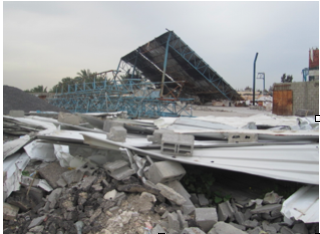
However, little has been said about the almost complete destruction of Gaza’s industry and economy. As the Israeli Minister of Interior Eli Yishai said, the objective of the last operation was to “send Gaza back to the Middle Ages, destroying all of its infrastructure.” One of the more terrible blows committed towards this end has been the total destruction of the Beit Hanoun industrial area.
 There were around 50 factories in Beit Hanoun, from which only three have been able to resume work seven months after the end of the assault.
 The factories in this industrial area provided work for 25% to 30% of Gaza’s population. Among the destroyed factories are those for paper, construction materials, clothing, medical equipment, plastic products, food and livestock products.
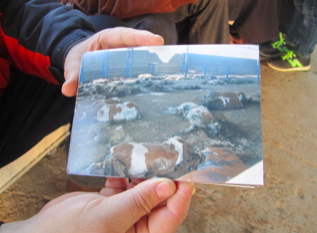
 The agricultural industry has also been wounded by Israel’s summer attacks on Gaza. The owner of the Afanah Company showed us the pictures of his 800 cows killed by Israeli attacks during the last war on Gaza. Each cow was going to feed 7 families during the Eid holiday. Besides losing all his cows, Israel also destroyed the four fridges of the company, which contained 400 tons of meat.
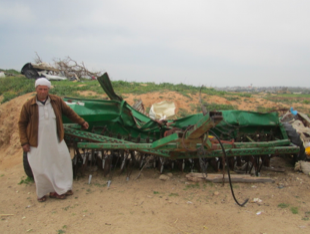
Abu Fakhri Abu Ghais, from Beit Hanoun, explained how during the last massacre Israel killed his 17 sheep, and all his sons’ sheep, they destroyed all his farming equipment, worth over 15,000 US dollars. Israeli forces also destroyed the pumps for extracting the groundwater and the 20 tons of reserve of wheat seeds that Abu Fakhri had stored for the current year. The occupation also demolished the cabling that brought electricity to his village, Abu Safiya. He and his family now live in a tent without water or electricity, as his home was also destroyed.
 He and his family now live in a tent without water or electricity, as his home was also destroyed. Given the blockade imposed by Israel on the Gaza Strip, the struggling government of Hamas informed him that they don’t know when they’ll be able to restore the power supply, as they do not have available wire that is long enough.
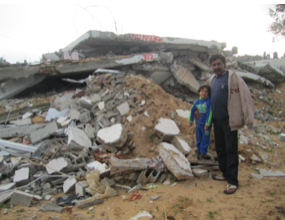
In a Bedouin village located at the North of Beit Lahia, Hassan Sharadkha invited the author and his companions for a cup of tea in the wood cabin that he has built next to the rubble of his home. He showed us the pictures of everything he lost during the last summer at the hands of the Zionist occupation forces: 32 dunums of fruit and olive trees, 27 sheep and their stable, 2 cows, a 200 chicken farm, a horse, the water pump and the car he had just bought.
His older son, an electric engineer, was made unemployed because the solar panel company he worked for has also been bombed.
 Ninety per cent of the Palestinian farmers in Gaza live in similar or worse circumstances.
 These attacks – against factories, farms, farming equipment and homes – were not by chance or accidental. These attacks demonstrate once again that the target of the genocidal Israeli colonialism is the Palestinian people itself, and that the war that Israel has been waging the last 66 years, under cover of Europe and the US, is against a nation, Palestine, that they seek to wipe off the map.
March 31, 2015
Posted by aletho |
Economics, Ethnic Cleansing, Racism, Zionism, Timeless or most popular, War Crimes | Gaza, Israel, Palestine, Zionism |
Leave a comment