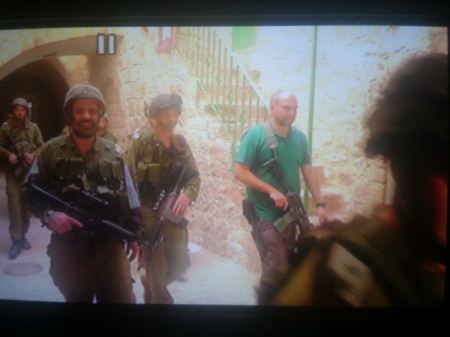
Sunday evening a number of fanatic Israeli settlers attacked the funeral of a Palestinian, killed by the Israeli army in al-Biereh, near the central West Bank city of Ramallah, wounding one Palestinian.
The Palestinians were participating in the funeral procession of resident Mohammad at-Tareefi, 30, in Jabal at-Tawil neighborhood, when settlers of the Psagot illegitimate settlement opened fire on them, wounding one resident.
Several minutes later, dozens of soldiers arrived at the scene, and fired live ammunition at the residents, and several homes, in al-Biereh.
The Israeli military attack pushed dozens of residents to advance towards Psagot settlements, and hurl stones at it.
The soldiers chased the residents in Dahiat Jabal at-Tawil and al-Jinan area, while firing dozens of rounds of live ammunition, gas bombs, concussion grenades, and rubber-coated metal bullets.
The funeral procession started in front of the Palestine Medical Center in Ramallah, heading towards the home of the slain Palestinian in Betunia, before advancing towards the Jamal Abdul-Nasser Mosque in al-Biereh city.
At-Tareefy was shot by a live round in his chest during Sunday dawn clashes with Israeli soldiers invading Ramallah.
Israel’s military offensive in different parts of the occupied West Bank started ten days ago, following the disappearance of three Israeli settlers from Gush Etzion settlement, near Bethlehem.
Although Israel said Hamas is behind the “abduction”, Hamas denied the claim.
The ongoing Israeli military invasion led to the abduction of more than 400 Palestinians, many of them are children, and the soldiers invaded and searched more than 1000 areas in the West Bank.
The army alleged uncovering dozens of tunnels under Palestinian homes in the West Bank, and that the soldiers “located underground labs used for the production of explosives”.
The army said Israel had no prior information about the alleged labs and tunnels, but uncovered them during the extensive searches of homes and property.
In a Sunday report by the Palestinian Center for Human Rights, the center said Israeli soldiers shot and killed four Palestinians in the last ten days. Two of them were killed Sunday.
At least 38 Palestinians have been kidnapped by the Israeli army on Sunday, in different parts of the occupied West Bank.
The army also shot and wounded dozens of Palestinians in the ongoing offensive.
June 23, 2014
Posted by aletho |
Ethnic Cleansing, Racism, Zionism, Subjugation - Torture, War Crimes | Israeli settlement, Palestine, West Bank, Zionism |
Leave a comment
As the lockdown on Hebron enters its tenth day, the atmosphere in the city is tense and restless, with people living under a state of erratic checkpoints and military closure for the past week. On the streets of the city, there is only talk of what will happen if the three missing Israeli settlers are not found, or the mystery around their disappearance is not resolved. Every day since their disappearance Israel has imposed ever-increasing restrictions on the West Bank, but residents of Hebron, near the original location of the teens’ disappearance, are feeling the brunt of the crackdown.
The road through Halhul to Hebron is usually a simple route to negotiate, but now the streets of Halhul are besieged with Israeli soldiers, jeeps, and checkpoints making travel through the small city arduous. Halhul is within the Hebron governorate and like the majority of cities and towns in Hebron, the past week has been filled with a series of difficulties and tragedies. Residents face the daily reality of being locked down— restricted to their small area, unable to travel due to imposed Israeli military restrictions, as well as having armed soldiers positioned outside on throughways, often in great numbers. Houses are repeatedly and unpredictably raided, leaving homes in a state of chaos.
“There are so many soldiers and army jeeps here now, it feels like a thousand are here in Halhul” Mohammed Rabah, a resident of the city told Middle East Monitor. “The soldiers are breaking houses down, raiding them at night, arresting people and kicking people out because they are searching for the three settlers. It has become a very bad situation.”
Over 300 Palestinians in the West Bank have been detained so far this week by Israel, almost all during these night raids. While the majority of those arrested have an affiliation to Hamas, Hamas has denied responsibility for the missing Israeli teens. However three small groups in the occupied West Bank have claimed responsibility, Ahrar al-Khalil, the Islamic State of Iraq in the Levant (ISIL), and Al-Aqsa Martyrs Brigades.
On Friday, these now regular night raids, clashes and arrests in the Hebron area resulted in the death of a 14 year old boy who was shot in the chest by the Israeli forces in the early morning. By the afternoon, clashes were already occurring in Hebron’s city centre, as young men faced off against Israeli forces near the entrance to the illegal Israeli settlement situated in the along Shuhada Street.
During the demonstration, a 23-year-old Palestinian man was shot in the ankle by Israeli forces after four hours of clashes, with what his friends and fellow demonstrators said was a live round. Four young men quickly dragged him out of the line of fire and carried him to a car that screeched up to the protest after realizing someone had been shot.
“The bullet is lodged in his ankle for sure,” One of the protestors who helped carry the young man to the car told MEMO. “We are throwing rocks, and they are shooting bullets. Where else in the world is like this?”
A ten-year-old boy was also arrested during the protest.
According to protestors and bystanders, this demonstration was more intense than any they’d experienced before, as the recent Israeli crackdown on the city in search for the three missing Israeli settlers continues.
Previously the Israeli government had announced that the Israeli forces were permitted to use “all measures” to help find the missing settlers. MEMO contacted the Ministry of Defense several times for further comment on what all measures may involve, but the Ministry declined to return these phone calls or emails.
Earlier this week Israeli human rights NGO B’Tselem released a press release urging the Israeli government and Israeli forces “to refrain from meting out collective punishment on the local population,” while carrying out their hunt for the missing Israelis.
With the demonstration in the background and speaking to MEMO under terms of anonymity, many of the young men at the protest spoke of increasing aggressive actions by the army and their belief that they had to respond to it.
While clashes continued into the late afternoon, the streets of Hebron’s city centre were deserted, an increasingly common site. Stores were closed and tourist spots were desolate. The Ministry of Tourism’s information office in the heart of the souk didn’t bother opening for business.
“Two weeks ago, it was very good with tourists who came to Hebron, but because of the problems with the Israeli here, there isn’t anything,” Shadi Sider, who runs a tour group and souvenir shop in Hebron said. “There isn’t work here in Hebron now, the work is just enough to take food in the house—no work, no food.”
The head of the Palestinian businessmen forum in Hebron, Mohammad Nafeth al-Herbawi, said the district of Hebron is losing $10 million a day during the siege on the area. While laborers are facing up to $2 million in losses, according to Ma’an News Agency.
While Sider is one of those who is severely impacted by the lack of business prospects during the siege, he says the problems he faces at home are more worrying. Sider’s home, positioned beside Shuhada Street where an illegal Israeli settlement is situated, is surrounded by illegal settlers. His house has been raided, and his roof annexed a number of times throughout the past week. Due to the proximity of the settlement to his home, Sider is rather used to living life surrounded by soldiers, but this week has been more punishing.
“Thereares more soldiers than there has ever been before. The soldiers come here in my house, and they go on my roof to see, to guard, to make problems,” Sider said. “For the last week since the kidnappings it has been much worse, there are so many soldiers here.”
While Israel’s increased military presence focused on Hebron during the beginning of the search for the missing settlers, it is quickly expanding. Houses have been raided and people arrested through the greater West Bank, and injuries from Israeli forces have been reported in almost every district. Already five Palestinians have been shot dead since the search began including the 14 year old in Dura, a 22 year old in Qalandiya refugee camp, a 20 year old in Ramallah’s al-Jalazun refugee camp, and last night a 35 year old in Nablus and a 30 year old in Ramallah’s city center.
June 22, 2014
Posted by aletho |
Ethnic Cleansing, Racism, Zionism, Subjugation - Torture, War Crimes | Hebron, Human rights, Israeli settlement, Palestine, West Bank |
Leave a comment
The historiography of the atomic bomb can be roughly categorized into three camps: traditionalists, revisionists, and middle-ground “consensus” historians. [1] Traditionalists, also referred to as orthodox[2] historians and post-revisionists, studying the atomic bomb generally accept the view posited by the Truman administration and articulated most clearly in Henry Stimson’s 1947 Harper’s Magazine article.[3] In short, this argument assumes that the use of the atomic bombs against Japan was justifiable on military grounds in order to prevent a costly invasion of the Japanese home islands. Often attached to such analysis is the notion that insofar as the atomic bombs ended the war prior to an invasion and saved hundreds of thousands or millions of lives, the use of the atomic bombs was also a morally sound decision. There tends to be a remarkable level of homogeneity amongst the traditionalist arguments. Whereas they may emphasize certain facts or aspects of the debate, they tend to present strikingly similar arguments, with a few exceptions.
The revisionists, in contrast, tend to be far more heterogeneous. Revisionist historians are unconvinced by the official narrative, and tend to emphasize the alternatives to the atomic bomb not pursued by the Truman administration. Furthermore, most revisionists accept, on some level, the “atomic diplomacy” thesis articulated first by Gar Alperovitz in 1965. To one degree or another revisionists argue that the Truman administration purposefully chose not to pursue alternatives to ending the war and that post-war diplomatic concerns vis-à-vis the Soviet Union were germane to, and in some historian’s view dictated, the use of the atomic bombs.
The third camp, the consensus historians, are those who J. Samuel Walker refers to as having “reached a broad, though hardly unanimous, consensus on some key issues surrounding the use of the bomb.”[4] These include the fact that Truman and his advisers were aware of alternatives that seemed likely to end the war, that invasion would likely not have been necessary, and that the atomic bomb did not save hundreds of thousands or millions of lives. What distinguishes them from the traditionalists is the argument that the atomic bombs were not a military necessity. On the other hand, their rejection or hesitancy to incorporate atomic diplomacy into their analysis differentiates them from the revisionists.
Given the nature of the three camps, the organizational framework I have utilized includes three sections. The first section will deal with the debate between traditionalists and revisionists. It will focus on questions of atomic diplomacy, the Potsdam Conference, unconditional surrender, Soviet entry into the war, projected casualty figures, and certain key figures in the Truman administration, the Soviet Union, and Japan. The second section will examine the points of disagreement within the revisionist camp. Although revisionists all challenge the orthodox position, they are significantly less homogenous than the latter. The third section of the essay will explore the consensus historians and their disagreements with both the traditionalists and the revisionists. Given the level of unanimity amongst the traditionalist historians, it is unnecessary to dedicate a section exploring differences between them because with rare exceptions, which will be noted when appropriate, there is remarkably little disagreement. The essay will conclude with a brief analysis of the authors, such as Robert Newman and Paul Boyer, who have extended their chronological framework significantly beyond the actual use of the atomic bombs.
The Traditionalists vs. the Revisionists
The five monographs within the traditionalist camp that will be analyzed here are Robert James Maddox’sWeapons for Victory: The Hiroshima Decision (2004)[5], Robert P. Newman’sTruman and the Hiroshima Cult (1995), Richard B. Frank’s Downfall: The End of the Imperial Japanese Empire (1999), Paul D. Walker’sTruman’s Dilemma: Invasion or the Bomb (2003), and Wilson D. Miscamble’s The Most Controversial Decision: Truman, the Atomic Bombs, and the Defeat of Japan (2011). On the other side of the debate are four revisionist historians, including Gar Alperovitz’s The Decision to Use the Atomic Bomb and the Architecture of an American Myth (1995)[6], Martin J. Sherwin’s A World Destroyed: Hiroshima and Its Legacies (2003),[7] Ronald Takaki’s Hiroshima: Why America Dropped the Atomic Bomb (1995), and Tsuyoshi Hasegawa’s Racing the Enemy: Stalin, Truman, and the Surrender of Japan (2005). The positions of the traditionalists and the revisionists regarding atomic diplomacy, the Potsdam Conference, Japanese surrender, the unconditional surrender policy, Soviet entry into the war, projected casualty figures, and key individuals[8] involved in the decision to use the bomb and Japanese surrender are fundamentally at odds.
The question of atomic diplomacy is what creates the fundamental divide between the two camps. Although there is great variation between revisionist and traditionalist positions on unconditional surrender, the role and race and racism, and other factors, most questions tend to be subsumed within and intricately bound up with atomic diplomacy. Since the revisionists first posited this thesis, it is appropriate to adumbrate their arguments. Objecting to the official narrative that “Truman simply had no choice except to use the atomic bomb,” Alperovitz argues that Truman, significantly influenced by James Byrnes, used the bomb as a form of “atomic diplomacy” to pursue post-war U.S. interests in both Europe and Asia. In essence, Alperovitz argues that the U.S. government “generally understood” that “Japan was defeated and preparing to surrender before the bomb was used.” [9] According to Alperovitz there was a “quite general” notion amongst U.S. officials at Potsdam that the bomb would strengthen U.S. diplomacy vis-à-vis the Soviet Union. It was during this time that “a conscious decision not to encourage Soviet participation in the war” was undertaken. Attempts “to delay the Red Army’s attack to the extent feasible” were meant to “limit Soviet political influence in Asia.”[10] For Alperovitz atomic diplomacy is the crucial element in explaining the use of the bomb.
Martin Sherwin supplements Alperovitz’s atomic diplomacy thesis by extending the importance of such diplomatic concerns backwards into the Roosevelt administration. Sherwin posits that the policies of the Roosevelt administration suggest “that the diplomatic value of the bomb began to shape his atomic energy policies as early as 1943.”[11] Although Sherwin cites Roosevelt’s elusive decision making process and sudden death as inhibitors to fully understanding his policy, he posits that Roosevelt “consistently opposed international control and acted in accordance with Churchill’s monopolistic, anti-Soviet views.”[12] Ronald Takaki, despite emphasizing the role of race and racism in the decision, also concedes that atomic diplomacy was indeed a factor. He notes the “incredible pressure” on Manhattan project scientists to complete the bombs prior to the Potsdam conference. Similarly, he explains how Truman purposefully postponed the conference to coincide with the bomb tests. Takaki maintains that two “schools of thought” dominated the thinking of U.S. officials, including the “quid-pro-quo” strategy, articulated by people like Henry Stimson,[13] and the “monopoly” strategy a la James Byrnes. [14] In Tsuyoshi Hasegawa’s view, the Potsdam Proclamation was not a warning to Japan, but an attempt to justify the use of the bomb.
Hasegawa’s argument aligns with Alperovitz’s as well. He maintains that a “race” began at Potsdam between the United States and the Soviet Union when the Soviets set August 15 as their projected state of entry into the war. This “gave American policymakers a definite deadline to work for.” [15] Thus, the timing of the Potsdam Proclamation was “integrally connected with the schedule for deployment of the atomic bombs.”[16] The Truman administration desired to end the war via the atomic bombs in order to avoid Soviet entry and maintain hegemony in the Pacific in the post-war world. Therefore, the Truman-Byrnes commitment to unconditional surrender and the Potsdam declaration was simply a prelude to the use of the atomic bombs. Byrnes position was essentially: “if we insisted on unconditional surrender, we could justify dropping of the atomic bomb.”[17] Concerned about the post-war political consequences of Soviet participation in the war, U.S. planners sought to bring about Japan’s surrender before the Soviets could join. At best, Soviet participation in the war was an “insurance policy” in case the atomic tests failed.[18]
Thus, the revisionist position is quite clear. Officials in the United States were deeply concerned about post-war hegemony, particularly in the Pacific but in Europe as well, and saw the use of the atomic bomb against Japan as a way to contain the Soviet Union. Subsequently, any and all alternatives that could have ended the war, albeit not in time to prevent Soviet entry, were disregarded and not pursued. This conclusion is often premised on the fact that Japan was already defeated and near surrender. Alperovitz argues that “Japan was defeated and preparing to surrender before the atomic bomb was used. Though the question of timing was in dispute, it is also certain that this was generally understood in the U.S. government at the time.” [19] Hasegawa contends that the “Soviet entry into the war played a greater role than the atomic bombs in inducing Japan to surrender” and, as such, the Japanese would have quickly surrendered upon Soviet entry even without the use of the atomic bombs.
It is on these grounds that the traditionalists most vehemently challenge the revisionists. Robert James Maddox challenged what he saw as “blatant revisionist distortions” in order to construct his argument that the single-most decisive factor in forcing the Japanese to surrender and preventing a costly land invasion of Japan was the use of the atomic bombs. Whereas Alperovitz maintained that the casualty figures for a land invasion were inflated as post-war justifications by the Truman administration, Maddox suggests that the half-a-million figure “cited by Truman, and even higher ones, were circulated within the upper echelons of government.”[20] For Maddox bombs were utilized out of military necessity because the Japanese would not have surrendered without the atomic destruction of Hiroshima and Nagasaki. Indeed, according to Maddox the “very idea of surrender was alien to the Japanese samurai tradition.”[21] Furthermore, ULTRA intercepts suggest surrender prior to an invasion was not even a serious option, let alone inevitable. Richard Frank goes even further, arguing that the conclusions the revisionist reach regarding the MAGIC are erroneous because they ignore the fact that Japanese peace feelers were completely “want of official sanction.” [22] Thus, the “thesis that Japan was actively seeking to surrender in 1945, and that American policy makers knew this primarily from code breaking,” is rejected by the traditionalists.[23]
Robert Newman concurs with this analysis, adding that most “Hiroshima cultists,”[24] including Gar Alperovitz, P. M. S. Blackett, Paul Boyer, the Smithsonian exhibit authors, and others who “swallow this conclusion of the [United States Strategic Bombing Survey][25] whole” are incorrect because the study itself was extremely flawed. [26] Information in the survey was purposefully distorted to support conclusions already arrived at a priori by Paul Nitze, and the testimony of most high-ranking Japanese officials “overwhelmingly indicated that Japan was not about to surrender before the bomb.”[27] Thus, the “Truman bashers”[28] are incorrect to argue that the bomb changed no minds. In fact, according to Newman it “created a situation in which the peace party and the emperor could prevail.” [29] Wilson Miscamble also views himself as “exploding permanently the myth of a Japan ready to surrender,” a “myth” perpetuated by the United States Strategic Bombing Survey of 1946. [30]
Richard Frank furthers this argument by explaining that Japan’s “fundamental policy,” based on the Ketsu-Go defense plan, was a national resistance program intended to bloody the invading enemy enough to force political negotiations and ipso facto avoid unconditional surrender. Frank relies heavily upon the document produced by the Big Six entitled “The Fundamental Policy to Be Followed Henceforth in the Conduct of the War,” which argued Japan “must fight to the finish and choose extinction before surrender.”[31] In essence, Japan was “effectively locked on course for a fight to the last man, woman, and child.”[32] Furthermore, Frank continues this theme, arguing that the goal was to “severely bloody the invaders” to the point of achieving political goals. Ultra documents, according to Frank, did much to “unmask their carefully wrought plans.”[33] The forces on Kyushu far exceeded the 350,000 number given to Truman. Indeed, by November 1 Japanese strength would be 680,000, much closer to the 1:1 ration of American to Japanese soldiers that U.S. leaders desperately wanted to avoid. Paul Walker takes this argument to its logical extreme. He argues that due the 35 percent casualty rate of the Iwo Jima and Okinawa battles, as well as the “fanaticism of the Japanese military and their updated code of Bushido,” casualties would have ranged from around 250,000 in the invasion of Kyushu alone, to over one million with the invasion of both Kyushu and Honshu.[34] Miscamble maintains that “retrospective castigations” like William D. Leahy’s memoirs in 1950, which denounced the atomic bomb as a “modern type of barbarism not worthy of Christian man,” can be dismissed since “no military officials counseled the president against using the weapons prior to Hiroshima.”[35] Maddox concurs, explaining that despite the retroactive denunciations of the atomic bomb by top-ranking military officials, no military officials seriously attempted to guide Truman away from using the bomb prior to its deployment. The fact that the bomb was utilized out of military necessity dismisses the “gravest charge against Truman,” namely that the atomic bomb was deployed “primary as a diplomatic weapon to intimidate the Soviet Union.”[36]
The question of Soviet entry into the war preoccupies an important space in the discourse as well. Tsuyoshi Hasegawa maintains that “Soviet entry into the war played a greater role than the atomic bombs in inducing Japan to surrender.”[37] Interestingly, Maddox claims the Soviets invaded Manchuria not to be “a good ally” but rather “to get in on the kill,”[38] an analysis Hasegawa would largely share. However, where the revisionists and the traditionalists differ, is that most traditionalists seriously downplay the role of Soviet entry into the war. In Frank’s narrative, “Soviet intervention was a significant but not decisive reason for Japan’s surrender… reinforcing but not fundamental.”[39] Miscamble maintains that revisionist historians who emphasize Soviet entry in the war “distort history by overemphasizing” its importance.[40] According to Miscamble, Hasegawa’s claim that Truman was disappointed at the Soviet entry into the war “are not substantiated by the historical evidence.” [41] Paul Walker points out that when the emperor finally surrendered on August 15, 1945, the Russian invasion was not mentioned as a cause of surrender. Hasegawa counters this point by citing “another historic document” written by Sakomizu’s [42] assistant and sanctioned by the emperor that was not issued until August 17. This re-script explained that if Japan continued fighting after the entrance of the Soviet Union into the war it would endanger “the very foundation of the empire’s existence,” [43] reinforcing Hasegawa’s claim that Soviet intervention was key.
Perhaps the most creative defense of the use of the atomic bomb from the traditionalist camp is the moral one. One of the primary objectives of Wilson Miscamble is to “confront the question regarding the morality of the atomic bomb.”[44] Miscamble suggests that for Byrnes and Truman “moral complexity or future diplomatic implications failed to complicate their straight forward thinking.” If the atomic bomb “might save American lives” then it must be used, and this “remained, throughout, the essential motivation that guided the decision.” [45] Whereas revisionists argue that Japan was defeated, he makes a stark distinction between defeat and surrender, explaining that the U.S. would have eventually won the war by “continued obliteration bombing of Japanese cities and infrastructure, a choking blockade, the terrible invasions… [and these] would have meant significantly greater Allied casualties and much higher Japanese civilian and military casualties.”[46] Likewise, the abrupt end to the war also brought an end to Japanese brutality in other parts of Asia. Furthermore, “indiscriminate bombing had become the norm for the Anglo-American forces well before 1945,” indicating that any “moral Rubicon” had already been crossed prior to Hiroshima.[47] Thus, the bomb was the “lesser of the evils available,” and subsequently Miscamble pleas that in “future anniversaries of the dropping of the atomic bomb… one might hope for less moralizing condemnation of Truman’s decision… Perhaps there might even be some empathy for the man who felt required to make the decision and who carried the burden of it.”[48]
Robert Newman makes a slightly less sophisticated moral defense, proclaiming that neither “Hiroshima cultists nor professional moralists had even considered the possibility that Hiroshima and Nagasaki were legitimate retribution for the millions of deaths caused by Japan’s fourteen-year rampage through China and the Pacific,”[49] an idea he apparently entertains. Newman suggests that the atomic bombs were moral actions taken in order to prevent greater evil. According to him the general arguments against Truman’s choice to use the bomb come in four general varieties: first, atomic bombs are intrinsically evil and should not be used; second, their use violated the principle of noncombatant immunity; third, the bombs were used on invalid motives, including retribution, revenge, and reprisal; and fourth, no specific warning was given. To the first, Newman responds that “the case for immorality of today’s overkill arsenals and war fighting doctrines is strong,” but “to apply the same case retrospectively to 1945, however, is senseless.”[50] To the second, Newman quotes Bamba Nobuya to suggest that the “Marxist interpretation of imperialistic war,” namely that “the ‘people’ should have been innocent,” is incorrect. The Japanese population did not just passively support imperialism, “on the contrary, most people competed to get front seats on the fascist bandwagon.” [51] Thus, they were not noncombatants and to attack them was legitimate. To the third point Newman maintains that because the Japanese were involved in developing atomic weapons as well, even though U.S. leaders were not aware of this at the time, it retroactively justifies the decision. Since “upwards of 250,000 people… would have died each month the Japanese Empire struggled in its death throes beyond July 1945,” and since the bomb had the ability to end the war early, it could not have been used for the wrong reasons.[52] To the last point, he responds that the shock value of the bomb was decisive in ending the war, and thus it would have been ineffective and prolonged the war to issue the warning.
Finally, the issue of culture and its relationship to policies of surrender are intricately bound up in the traditionalist narrative. For Paul Walker, a key element of the war was the “barbarism, savageness, and race hatred” of “an oriental enemy with a brutal heritage.” [53] According to Walker, the Japanese in World War II “believed they were fighting in the proud traditions of their samurai ancestors.”[54] This ideological reliance upon “a version of Bushido” meant that military schools taught “a perverted cult of death” which made “young Japanese men expendable numbers for the military’s reckless and costly adventures.” [55] Tracing Japanese history from the Forty Seven Ronin to the Meiji Restoration and beyond, Walker paints a picture of uniform brutality and aggression. This culminates in the period from 1894 to 1945, where “Japan was involved in almost constant warfare with her neighbors.”[56] Since being a prisoner of war was “completely unacceptable, considered dishonorable or shameful, and contrary to the samurai code,” the Japanese were essentially automatons that fought to the death. In contrast with U.S. imperialism, where “Filipinos had a positive image of America” and U.S. intervention in Vietnam “sorted itself out,”[57] Japanese imperialism was infinitely more brutal, according to Walker. This notion that the Japanese were imbued with fanaticism and the ideology of Bushido, which permeated their consciousness for centuries, is an important part of Walker’s thesis because it attempts to reinforce the notion that the toll of casualties would be great in a U.S. invasion of Japan. Miscamble suggests a similar theme, explaining that the “the twisted neo-samurai … geared up with true banzai spirit to engage the whole population in a kind of national kamikaze campaign.” [58] Maddox is slightly less crude, suggesting that that the “very idea of surrender was alien to the Japanese samurai tradition.”[59]
Thus, within the traditionalist camp one finds a remarkable degree of unanimity. While some authors, such as Miscamble and Newman, focus on the moral argument, others, such as Maddox, implore the military aspect. Others still emphasize the “savage” culture of the “Oriental enemy” a la Paul Walker. Yet, all of the traditionalists tend to converge in their main analysis. There is little disagreement among them on any vital issues. In one way this greatly distinguishes them from the revisionist camp, which presents a quite heterogeneous and diverse array of analyses.
The Revisionist Camp
The traditionalists and revisionists part ways on the fundamental divide of atomic diplomacy. Within the traditionalist camp arguments are largely convergent, whereas within the revisionists camp the nuances are far more pronounced. All tend to agree that some level of atomic diplomacy was in play. Most, however, disagree on a variety of other issues. Gar Alperovitz and Martin Sherwin heavily emphasize the role of atomic diplomacy. In contrast, Takaki suggests race and racism as primary variables. Hasegawa maintains that an “international” perspective is vital, and criticizes past revisionists for heavily focusing on leaders in Washington. As Gar Alperovitz is the first and quintessential revisionist, much of the internal discussion amongst revisionists is characterized by correcting, expanding, or challenging certain assumptions Alperovitz has made.
The first distinction of analysis can be seen in the characterization of the Roosevelt and the Truman administration. Alperovitz imbues individual political actors, particularly Harry Truman and his adviser James Byrnes, with immense agency over the use of the bomb. He warns against “analyses which assert that a combination of factors-political, military, racial, and financial-produced the decision.”[60] He also makes the case against “momentum theories,” which may have “an odd feeling of seeming plausibility about them,” but which go against the evidence that top U.S. military officials were against the bombing.[61] Throughout his work it is stressed that individual political actors were absolutely fundamental in the decision, and that no sort of “momentum theory” is capable of capturing the dynamics of the top-level discussions that led to the final decision. Alperovitz emphasizes the importance of the Truman-Byrnes relationship, implicitly suggesting that the outcome may have been different with Roosevelt in office.
Martin Sherwin articulates a somewhat distinct argument that draws a strong line of continuity between the Roosevelt and Truman administrations. For Sherwin, an “analysis of the policies [Roosevelt] chose… suggests that the diplomatic value of the bomb began to shape his atomic energy policies as early as 1943.”[62] Although Sherwin cites Roosevelt’s elusive decision making process and sudden death as inhibitors to fully understanding his policy, he posits that Roosevelt “consistently opposed international control and acted in accordance with Churchill’s monopolistic, anti-Soviet views.”[63] He concludes that Roosevelt’s commitment to amicable postwar relations with the Soviets has “often been exaggerated,” and that “his prescriptions for the diplomatic role of the atomic bomb… reveal a carefully guarded skepticism regarding the Grand Alliance’s prospects for surviving the war intact.”[64] Thus, Sherwin argues that Truman did not “inherit the question” of whether to employ the bomb as a means of atomic diplomacy, but he “inherited the answer” since by 1943 the diplomatic value of the bomb had already begun to shape atomic energy policies. The decision to use the bomb, and its diplomatic implications, were prescribed by Roosevelt. Truman’s decisions were more or less technical, revolving around how specifically to use the bomb. Where Alperovitz has attempted to present a break or disconnect between what he perceives as Roosevelt’s uncertain and wavering atomic policies, Sherwin presents a forceful analysis suggesting strong continuity between the two administrations.
A second point of contention amongst revisionists is the role of race and racism in the decision to use the bomb. Here Alperovitz argues that while “it is certainly possible” that racism amongst U.S. officials played a role in the decision to drop the bomb, “it is all but impossible to find specific evidence that racism was an important factor.”[65] In contrast, while Takaki adopts Alperovitz’s notion of atomic diplomacy, he drastically parts with him on the issue of race. Takaki’s primary focus is understanding the decision within the trajectory of US racism. [66] In this regard, it seems his argument is best encapsulated when he declares, borrowing from John Dower, that “in this ‘war without mercy,’ Truman made the deadly mushroom cloud of ‘Manhattan’ appear over Japan in order to destroy an enemy he regarded as ‘a beast’.”[67] Takaki explicates upon the “racialization of the Pacific War,” positioning it within the historic context of racism and US expansionism. After briefly addressing Japanese notions of racial superiority, Takaki attempts to place Truman’s decision to use the atomic bombs within the “sociological imagination” of anti-Japanese racism in US society. In doing so, he links the war in the Pacific to earlier periods of conquest. His analysis focuses on the complex processes by which the US idea of democracy was intricately bound up with westward expansion and slavery, all institutions saturated with racialized notions of superiority. Citing the Chinese Exclusion Act, “Yellow Peril” hysteria, the American Federation of Labor anti-Japanese agitation, and the Asiatic Exclusion League, Takaki draws a long line of continuity culminating in the internment of Japanese Americans and the atomic bombing of Hiroshima and Nagasaki. For Takaki, notions of racial superiority and anti-Asian racism were key variables in the “sociological imagination” which facilitated the bombing of hundreds of thousands of civilians. It is in this context of a society deeply permeated with both institutional and individual racism that Truman’s actions must be analyzed. Takaki analyzes Truman’s biography, emphasizing the implicit notions of racial superiority deeply embedded in him and his family of ex-slave owners. Takaki outlines Truman’s broadly anti-Asian sentiments, such as in 1911 when he explained that he “does hate Chinese and Japs” and that the “yellow men [ought to be] in Asia.” [68] By 1945, Truman referred to the “Japs” as “savages, ruthless, merciless and fanatic.” Thus, the “sociological imagination” was a highly racialized one that helped rationalize the slaughter of innocent Japanese civilians in the minds of men like Truman.
Tsuyoshi Hasegawa also takes Alperovitz to task on more than one occasion. Throughout Racing the Enemy he points out that he views his work as a corrective to the mistakes of revisionist historians. As he explains, the “sharp division between revisionist and orthodox historians in the Unites States” has failed to address the crucial international dimension because “the main point of contention is over American perceptions of Soviet intentions” that “depict Soviet actions as a sideshow and assign to Moscow a secondary role at best.”[69] Furthermore, although Hasegawa is certainly not an orthodox historian, he is mildly critical of the revisionists who have preceded him: “Although much of what revisionist historians argue is faulty and based on tendentious use of sources, they nonetheless deserve credit for raising an important moral issue that challenges the standard American narrative of Hiroshima and Nagasaki.”[70] Thus, Hasegawa strengthens the revisionist narrative by correcting some of the errors and increasing the attention to the international dynamic at work.
Alperovitz in large part bases his argument on the conclusions of the 1946 United States Strategic Bombing Survey which argued that Japan “would likely have surrender in 1945 without atomic bombing, without a Soviet declaration of war, and without an American invasion.” [71] In contrast with Alperovitz and most other revisionist historians who uncritically accept the United States Strategic Bombing Survey’s conclusion, Hasegawa maintains that “defeat and surrender are not synonymous,” and Paul Nitze’s “conclusion was repeatedly contradicted by the evidence in the Survey itself.”[72] He largely accepts the critique of the USSBS findings put forward by Barton Bernstein. Instead, he argues that “even without the atomic bombs, the war most likely would have ended shortly after Soviet entry into the war-before November 1.”[73] Strangely, Hasegawa tends to overemphasize his departure from Alperovitz on this point, or he must have simply overlooked Alperovitz contention that, even had the atomic bomb not been used, it is “almost a certainty that the Japanese would have capitulated upon the entry of Russia into the war.”[74]
On a number of other points Hasegawa and Alperovitz certainly do disagree, however. Whereas Alperovitz characterizes the Sino-Soviet negotiations between Stalin and the Nationalists as a U.S. ploy to prolong Russian entry in the war, Hasegawa responds that in the Sino-Soviet negotiations, the “interests of Truman, Stalin, and Chiang Kai-shek all converged: the successful conclusion of a Sino-Soviet treaty could make everyone happy.” [75] Hasegawa does not view the difficult negotiating by the Chinese as a concocted plot by the U.S. to keep the Soviets out of the war. “Revisionist historians are wrong,” Hasegawa explains, “in asserting that Harriman’s actions were meant to pressure Soong to resist Stalin’s demand in order to prevent Soviet entry into the war against Japan.”[76] Likewise, throughout his work Hasegawa repeatedly attempts to re-characterize Byrnes as someone not nearly as bent on geopolitical conflict with the Soviet Union as other revisionist historians have made him out to be. For instance, in response to the Soviet Kurils Operation as part of August Storm, Hasegawa argues that Byrnes, “though often regarded by revisionist historians as an ardent advocate for a tough stance against the Soviet Union… favored a conciliatory position on this issue.”[77] Thus, the internecine differences amongst the revisionists exist. They are not nearly as pronounced or as heated as the differences between the traditionalists and the revisionists, but significantly more obvious than any real disagreement amongst traditionalist scholars.
Consensus Historians vs. The Traditionalists and the Revisionists
Between the traditionalist and revisionist historians lay a murky “middle ground” that encompasses a group of scholars who posit quite different arguments regarding the atomic bomb but tend to share in common a notion that alternatives existed. These “consensus” historians, as J. Samuel Walker refers to them, [78] in some way suggest that Truman and his advisers were aware of alternatives that seemed likely to end the war. The “consensus” historians reject the traditionalist argument that the atomic bombs were a military necessity and at the same time greatly distance themselves from the atomic diplomacy thesis. Samuel Walker’sPrompt and Utter Destruction: Truman and the Use of the Atomic Bombs Against Japan (1997), Dennis Wainstock’sThe Decision to Drop the Atomic Bomb: Hiroshima and Nagasaki (1996), and Sean L. Malloy’s Atomic Tragedy: Henry L. Stimson and the Decision to Use the Bomb Against Japan (2008) form the core of this “consensus” or middle ground camp.
Dennis Wainstock argues that the policy of unconditional surrender was a “policy of revenge, and it hurt America’s national self-interest.” [79] He continues, suggesting that had the United States given Japan conditional surrender terms, including retention of the emperor, Japan would have surrendered significantly earlier than it did. This means that neither the atomic bombs nor Soviet intervention would have been required. By prolonging the war in Europe and East Asia the policy of unconditional surrender expanded Soviet power in both areas, thereby harming U.S. interests. The dropping of the atomic bomb only “hastened the surrender of an already defeated enemy.” [80] Wainstock does not neatly align with either the traditionalist or revisionist camp. First, he aligns his critique of unconditional surrender within “U.S. national interests.” His emphasis is that unconditional surrender unnecessarily prolonged the war, and Truman’s commitment to it subsequently harmed U.S. interests since the prolonged war eventually allowed the Soviet Union to enter the arena and exercise increased influence in East Asia. This “policy of revenge [unconditional surrender]… hurt America’s national self-interest” because it “prolonged the war… and helped to expand Soviet power.”[81]
It is in this way that Wainstock differs sharply from all of the traditionalists who, in one way or another defend the policy of unconditional surrender. Whereas Paul Walker, Richard Frank, and Wilson Miscamble tend to be generally supportive of the unconditional surrender policy, James Maddox, in a rather reserved way, argues that “there is no way of telling whether the doctrine prolonged the war in any way.” [82] Robert Newman is Wainstock’s primary adversary in this regard, however. Newman argues two main points: first, Truman “had no good reason” to believe that permitting retention of the emperor would have led to early capitulation and, second, the “Potsdam Declaration defined surrender in a fashion acceptable to the Japanese peace forces.”[83] To “those who insist that unconditional surrender was a purely punitive stance,” he proclaims that the “leaders of the Japanese peace party… saw in the Potsdam terms an acceptable alternative to the destruction Japan would otherwise sustain.”[84] The reason that Truman eventually accepted the condition that the emperor be retained was, according to Newman, because “peace was too tantalizing to resist.” [85] In the end, however, Newman is sure that retaining the emperor, “what Hiroshima cultists insist was a viable alternative for Truman to end the war early… was really no alternative at all.”[86] Furthermore, the conditions outlined at Potsdam were not unconditional surrender, and the Japanese knew it. Thus, for Newman the entire thesis constructed by Wainstock rests on dubious grounds.
Regarding his differences with the revisionists, Wainstock concedes that “perhaps Truman’s decision to drop the bombs was an attempt to both impress the Soviets… and to end the war before the Soviets entered and seize the Far Eastern territories.”[87] Even if this were true, however, it was totally counterproductive since in the end it prolonged the war and allowed Soviet entry, something that could have been prevented by altering the policy. This brief commentary is all the space that Wainstock provides for the atomic diplomacy thesis. In other words, despite accepting that atomic diplomacy may have played some minor role, Wainstock contends that a blind policy of unconditional surrender was of prime importance in the decision. This is where his greatest disagreement comes to the fore with the revisionists, and in particular Hasegawa. Hasegawa contends that even if Truman had “accepted a provision in the Potsdam declaration allowing the Japanese to retain a constitutional monarchy,” it would “not have immediately led to Japan’s surrender.”[88] It is doubtful, Hasegawa maintains, “that Japan would have capitulated before the atomic bomb was dropped on Hiroshima and the Soviet Union entered the war.”[89] Thus, whereas the policy of unconditional surrender is the fundamental variable for Wainstock, it is significantly less so for Hasegawa. Wainstock significantly minimizes the significance of atomic diplomacy and inflates the importance of the unconditional surrender policy.
Sean Malloy, like Takaki, attempts to analyze the decision to use the atomic bomb through the “lens of biography.” [90] Malloy attempts to approach “the use of the bomb through a conceptual framework he calls the “context of use,” positioning the use of the bomb as a “compound product of a series of choices” rather than “the result of single decision.” [91] Malloy makes the argument that Stimson, as secretary of war, unintentionally “presided over a set of policies that accelerated the budding nuclear arms race with the Soviet Union,”[92] despite his “deep concern with limiting the effects of war on civilians and fostering trust between nations as the foundation of the peace that followed.” [93] In essence, realpolitik dominated Stimson’s approach to the atomic bomb and undermined his moral commitments.
One example of this is Stimson’s oversight of the 1945 Stassfurt operation intended to secure Anglo-American hegemony over uranium supplies. By the time of Strassfurt, when the U.S. moved in to seize the largest known stock of uranium in Europe, they “did as so as part of a one-sided nuclear arms race” in which, “by 1945, the Soviet Union was already America’s primary nuclear rival.”[94] Thus, while Stimson is the tragic hero with a fatal flaw, James Byrnes is his foil, presented as the bad apple in the administration who desires conflict with the Soviet Union. Malloy’s key argument, then, is that “by his own actions during World War II, the secretary of war had helped to set in motion exactly the kind of destructive international competition in armaments that he had spent much of his long public career attempting to avoid.” [95] The almost capricious nature of his rapidly changing positions, and the tenuous justifications which frequently accompanied them, indicates that Stimson’s moral convictions were more often than not drown out for the sake of political expediency. Malloy’s conception of the atomic bomb as a “tragedy” is the principle departure from the traditionalists who tend to glorify the use of the bomb and celebrate it for ending the war and saving lives.
Malloy’s differences with the revisionist camp are rather nuanced, but significant. Once again, his conception of the bombs as a “tragedy,” rather than a calculated diplomatic initiative, separates him from the revisionists. Second, he makes the argument that the secretary of war “was in a unique position to shape many of the decisions about the use of the bomb.”[96] This is in direct contradistinction to other historians, such as Alperovitz, who emphasize the agency of actors such as James Byrnes at Stimson’s expense. Second, Malloy attempts to put forward a sort of “momentum theory” that Alperovitz considers “seemingly plausible” but in reality historically bankrupt. During the various decisions that led to the atomic bombing, the morals and convictions of officials were often sublimated for political expediency. For Malloy, this was particularly true of Stimson. In this way, a sort of “momentum theory” is employed by Malloy to mitigate the pernicious intent of certain actors and explain away the “failures” of their decisions. Thus, the atomic bombs were not intentionally used as diplomatic tools by most of the Truman administration, but policy “failures” as individuals were swept up in events. Further modifying the arguments of Alperovitz and Hasegawa, Malloy argues that “American domestic politics” were a primary reason that Truman “failed at Potsdam” to use the “two potentially useful, if imperfect, diplomatic levers… in an effort to end the war.” [97] Furthermore, whereas Hasegawa presents Soviet entry as vital, Mallow suggests that “neither the public threat of Soviet entry nor the lure of allowing the Japanese to retain the emperor after the war were diplomatic panaceas.” [98] Thus, Malloy’s differences with the revisionists are perceptible.
A slightly different approach is apparent in J. Samuel Walker’s book. He sets out to answer two interrelated questions: was the bomb “necessary at all” and, “if so, what exactly did it accomplish?”[99] By the conclusion of the book, Walker asserts that the answer to the first question “seems to be yes and no. Yes, it was necessary to end the war as quickly as possible. No, it was not necessary to prevent an invasion of Japan.”[100] Addressing the second question, he maintains that the bomb “shortened the war and saved the lives of a relatively small but far from inconsequential number of Americans.”[101] By situating his thesis within these parameters, S. Walker avoids having to take a position regarding the morality of the atomic bombings and instead focuses on rather narrow notions of “military necessity.” He presents a variegated list of reasons Truman dropped the bomb: “(1) the commitment to ending the war successfully at the earliest possible moment; (2) the need to justify the effort and expense of building the atomic bombs; (3) the hope of achieving diplomatic gains in the growing rivalry with the Soviet Union; (4) the lack of incentives not to use atomic weapons; and (5) hatred of the Japanese and a desire for vengeance.”[102]
Walker’s differences with the traditionalists are quite clear: Walker suggests three rectifications to the popular narrative, a narrative the traditionalists largely accept: first, “there were other options available for ending the war… without the bomb and without an invasion”; second, due to Japan’s enervated capacity for war, Truman and his advisers did not regard invasion as inevitable; last, even if invasion was necessary to end the war, military planners “projected the number of American lives lost at far fewer than the hundreds of thousands that Truman and his advisers claimed after the war.”[103] Furthermore, Walker relies on the USSBS, a point of divergence between himself and both the traditionalists and Hasegawa, to conclude “the war would probably have ended before an American invasion of Kyushu became necessary.” [104] Walker essentially dismisses the entire traditionalist approach, with the caveat that Truman was indeed concerned with saving as many American lives as possible.
It is important to note that he is rather critical of the revisionist approach as well. First and foremost, Walker specifically outlines what Alperovitz disparages as an analysis asserting “that a combination of factors-political, military, racial, financial-produced the decision.” Alperovitz’s criticism of such an approach is that it “is easy to assemble fragments of evidence” that suggest such an analysis, but jumping from these “fragments to an explanatory conclusion about decision-making at the very top of the U.S. government is suspect.”[105] Thus, Walker’s “five fundamental considerations” are a significant departure from Alperovitz. More significantly, Walker actually considers the entire atomic diplomacy thesis as a sideshow. For instance, he maintains that “Truman did not drop the bomb primarily to intimidate the Soviets.” It was at best an ancillary consideration, a “bonus.”[106]
Thus, the “consensus” historians, largely agree that potential alternatives existed, that invasion may not have been necessary, and that the atomic bombs were probably not responsible for saving hundreds of thousands of lives. In other words, they were not a military necessity. At the same time, the atomic bombs were not deployed primarily as diplomatic mechanisms. Even if they eventually came to fulfill this role, it was either the unintentional result of “momentum” or a tertiary variable barely perceptible vis-à-vis other considerations.
Conclusion: The Myth, the Cult, Nuclearism, and Nuclear Consciousness
In the post-war era, the debate and discussion over the bomb has been of tremendous importance. Both the traditionalist and revisionist camps have plotted the trajectory of the discourse surrounding Hiroshima and Nagasaki in different ways. Gar Alperovitz has suggested that officials promulgated propaganda in a top-down manner in order to manufacture an “American myth” surrounding the use of the atomic bombs. Robert J. Lifton’s preface to Martin Sherwin’s A World Destroyed laments the emergence of “nuclearism,” the ideology that the atomic bomb is a “deity” capable of both “destroying the world” and “capable of ruling and protecting the world, even of keeping the world going.”[107] In contrast, Robert Newman denounces Alperovitz and other revisionists as “Hiroshima cultists,” “Truman bashers,” and a host of other pejoratives for creating a “cult” that worships at the altar of Hiroshima. Lastly, Paul Boyer, in his book By the Bomb’s Early Light: American Thought and Culture at the Dawn of the Atomic Age (1994), suggests that a sort of “nuclear consciousness” has infused itself in the perceptions and ideology of Americans in the post-war era.[108] In fact, “nuclear reality” so deeply pervades our “consciousness that it is hard to imagine what existence would have been like without it.” [109] In these various ways authors have interpreted the post-war world after the atomic bomb.
In the second part of his book, Alperovitz explores the creation of the mythology surrounding the ostensibly “inevitable” use of the bomb. He maintains that three decisions, including the rejection to provide enough time for Japan to surrender, the choice to not offer the Japanese emperor assurances, and the explicit decision not to test a Russian entry into the war, “set the terms of reference for the bomb’s subsequent seemingly ‘inevitable’ use… [and] so tightly framed the remaining issues as to make it all but impossible thereafter to oppose the bombings.” [110] This “framing of the bomb,” alongside the top-down campaign of disinformation immediately after the war, were key factors that facilitated the permeation of American consciousness with the “inevitability” narrative.
Stimson, Truman, Byrnes, and Groves were key figures in this top-down propaganda campaign. Despite what Alperovitz argues was an ancillary role in the actual decision to drop the bomb, Stimson did play a vital role in propagating the official discourse, citing Stimson’s 1947 Harper’s article which was presented as “a mere recital of the facts.” Stimson posited a rigid dichotomy later picked up by traditionalist historians: either a costly invasion or use of the bomb was required to end the war. As Alperovitz explains, the article was an “extraordinary success,” with the New York Times, the Washington Post, Reader’s Digest, the Bulletin of Atomic Scientists, and an indeterminate number of other media outlets “decidedly uncritical and, indeed, often effusive in praise.”[111] Truman’s argument that “the dropping of the bombs stopped the war” and “saved millions of lives” was the main line of thought he propagated continuously after the war. He maintains that the “over a million” figure” became the essential source for a myth which has been repeated with only occasional challenge for much of the last half century” despite modern scholarship demonstrating “the estimate to be without any serious foundation in the documents of that period.” [112] Byrnes systematically distorted and revised the past by shrouding himself in secrecy and meticulously managing his personal writings. Groves’ role as “an expert public relations artist and news ‘spin’ master” also comes to light when he devised a strategy whereby U.S. officials would “saturate” the “huge market hungry for information with officially approved material from the only authoritative source available.”[113] In Japan itself a Civil Censorship Division of the Occupation had some 8,700 staffers engaged in examining thousands of newspapers, magazines, textbooks, motion pictures, and even private mail to ensure they did not stray too far from the official discourse.[114] The most pernicious form of censorship was also the most ubiquitous; namely, government classification. Thus, as Alperovitz argues, “the ‘normal’ functioning of government… is even more effective than the occasional excesses which make the headlines.”[115] In these ways the historical narrative from beginning to end was “managed” by U.S. officials.
Part of Martin Sherwin’s work is intended to combat the legacy of nuclearism. In a world where humans have “infused [the atomic bomb] with a constellation of awe and mystery. That constellation has included tendencies to embrace the bomb, to become fiercely dependent upon it, indeed, to render it something close to a deity.”[116] The “willful embrace of the cruelest weapon ever created is the essence” of nuclearism.[117] Suggesting a line of continuity with Paul Boyer, A World Destroyed suggests that an “idealistic aura of peacemaking was inseparable from the bomb’s lure of ultimate technology and ultimate power-all of which became part of the transcendent technology of nuclearism.”[118] Hence, “the bizarre emphasis on the bomb’s ostensible function of ‘saving lives’ rather than destroying them, of rendering the world peaceful rather than bringing to it a specter of annihilation.” [119] This “bizarre emphasis” has been the plaything of traditionalist scholars for decades.
In sharp contrast with Alperovitz and Sherwin, Robert P. Newman’s thesis in Truman and the Hiroshima Cult is the paradigmatic post-revisionist account of the atomic bomb and its aftermath. In it he argues that a “cult,” with attendant cultists, has arisen around Truman and the Hiroshima decision. These “Hiroshima cultists” argue, in a variety of forms, that Japan was on the verge of surrender, that the “unconditional surrender” formula unnecessarily prolonged the war, and that Truman’s decision to drop the bomb was driven either by racism towards the Japanese or diplomatic concerns vis-à-vis the Soviets, or some combination thereof. Newman vehemently rejects what he refers to as the “Japanese-as-victim cult,” suggesting that any and all of the above suggestions are fundamentally incorrect. Newman proclaims that neither “Hiroshima cultists nor professional moralists had even considered the possibility that Hiroshima and Nagasaki were legitimate retribution for the millions of deaths caused by Japan’s fourteen-year rampage through China and the Pacific.”[120]
Newman traces the development and growth of what he maliciously and interchangeably refers to as the “Japan-as-Victim myth” or “Hiroshima cult.” He begins by explaining how in the immediate aftermath of the war “the whole world viewed Japan as villainous.” [121] After 1948, however, things began to change, in both Japan and the United States. In 1949 John Hersey’s Hiroshima was published, which Newman credits with having the opposite but equally powerful impact that Anne Frank’s diary had on Germany. Where Anne Frank’s diary forced Germany to come to terms with its atrocities, Hiroshima shielded Japan from having to do so, and helped begin the “Japan-as-Victim” myth. Furthermore, in 1951 P. M. S. Blackett published Fear, War, and the Bomb, which argued that the bomb was not the last act of the Second World War but the first act of the Cold War. Finally, in 1954 when the U.S. tested the new H-bomb and the crew of a tuna trawler were affected by radioactive fallout, the “five most important Japanese newspapers took a common position: this was the third atomic bombing.” [122]
Despite all this, however, in 1964 a public opinion poll suggested that 49 percent of the Japanese public viewed the United States as their “favorite foreign country.” By 1973, after the U.S. atrocities in Vietnam and use of Japan to accomplish them, this “popularity” had dropped to 18 percent. [123] By the late sixties people were questioning earlier U.S. military endeavors, notably the dropping of the atomic bombs, as a reflection of the changing political tide and anti-Vietnam war sentiment. By 1989, the “majority opinion even among Japanese scholars” was accepting of both the Blackett thesis and racism as primary factors in the dropping of the atomic bomb. In the United States, the gradual buildup of anti-nuclear activism, starting with The Bulletin of the Atomic Scientists in the late 1940s to the “Scientists’ Declaration on Nuclear Power” in 1975, had a major impact on retroactive views of the bombings. Thus, “accurate charges” of postwar “overkill… seemed to legitimate chargers of overkill levied at the Hiroshima and Nagasaki bombs.”[124] Furthermore, many “who became disillusioned with the American terror bombing in Vietnam became converts to the Hiroshima guilt trip.”[125] Newman also cites Ian Buruma’s The Wages of Guilt, which explores the myriad of factors for why a “Japan-as-Victim” cult developed but no comparably “cult” developed around Germany. The key factor as Newman sees it, however, was Vietnam. Without it, “the Japanese-as-victims cult in the United States would still be puny.”[126] Newman’s work is a vicious attack on the legacy of revisionists like Gar Alperovitz and Martin Sherwin.
Paul Boyer’s study, By the Bomb’s Early Light: American Thought and Culture at the Dawn of the Atomic Age, addresses the “unsettling new cultural factor” of the atomic bomb that had been introduced in immediate post-war period from 1945 to 1950. [127] His contention is that the bomb “had transformed not only military strategy and international relations, but the fundamental ground of culture and consciousness” in the United States.[128] These five formative years shaped how Americans first “confronted the bomb, struggled against it, and absorbed it into the fabric of the culture.” [129] In short, Boyer maintains that the 1945 to 1946 period was a time of “obsessive post-Hiroshima awareness of the horror of the atomic bomb,” while in the period from 1947 to 1950 and after there was a “diminished cultural attention and uneasy acquiescence” as the “dread destroyer of 1945 had become the shield of the Republic by 1950.”[130] In essence, Sherwin’s “transcendent technology of nuclearism” permeated what Boyer calls America’s “nuclear consciousness.” This “nuclear consciousness” was infused into the very core of American ideology in the post-war era and so deeply pervades American “consciousness that it is hard to imagine what existence would have been like without it.”[131] Hiroshima and Nagasaki, Boyer argues, “stand as signposts marking both a gash in the living flesh of our historical consciousness and a turning point in our ethical history.” [132]
From 1945 to 1946 an “intense discourse” had surrounded the atomic bomb, where after 1947 this “diminished to scattered murmurs and faint echoes” and by 1950 “America’s nuclear culture… would appear as a gray and largely deserted landscape.”[133] Around this time the Atomic Energy Commission began a full throttle propaganda campaign to associate atomic energy with health, happiness, and prosperity. This campaign drew in scientists, educators, radio personalities, health workers, and others, directly reaching some four million Americans and indirectly affecting many more. A “policy of deep secrecy about atomic-bomb research and stockpiling,” alongside the “pervasive official practice… of playing down the bomb’s dangers” continued to condition the American public.[134] In this context, and with the ensuing Cold War schism that dominated international relations, the “civil defense” paradigm displaced the “international control” slogan dominant during 1945-6. This multifaceted propaganda campaign was so successful that by 1950 Americans had overwhelmingly, if not unanimously, embraced the atomic bomb. The mid-1950s saw a resurgence of debate over the atomic bomb and then a re-decline after 1963. He argues that the illusion of diminished risk, the loss of immediacy, the promise of a world transformed by atomic energy, the complexity and comfort of deterrence theory, and the importance of the Vietnam War led to the decline of atomic prominence. Interestingly, whereas Newman positions the Vietnam War as the central feature in establishing the “Hiroshima cult,” Boyer contends that the Vietnam War actually lessened discussion and debate over the atomic bomb.
Although Boyer aligns neatly with revisionist historians, he does refocus the chronological lens. Where other historians have drawn a line of continuity between the development of the bomb and its use, or between the Roosevelt and Truman administrations, Boyer furthers that line of continuity by exploring the state’s role in managing post-Hiroshima public discourse. In this way Boyer’s work partially overlaps and agrees with but significantly transcends Alperovitz’ “architecture of an American myth.” By focusing on the state’s institution of a broad, far-reaching propaganda campaign that helped shape popular opinion, Boyer repositions the role of the state not just as user of the atomic bomb, but also as manager of the dominant discourse after its use. In this way, Boyer provides a unique historiographical contribution by arguing that atomic policies “transformed not only military strategy and international relations, but the fundamental ground of culture and consciousness” in the United States.
Thus, not only is the discourse surrounding the actual use of the atomic bomb split into competing camps, the post-war discourse itself is a topic of debate. In this regard, Paul Boyer’s work is the most thorough, sophisticated, and systematic cultural analysis of the post-war discourse. For those of us interested in challenging not only the excesses of war, but the inter-imperial rivalries that ultimately lead to the use of the bomb, understanding the nuances of the historiographical debate is vital. More importantly, in the wake of the 1995 Smithsonian controversy and the ever-expanding list of countries with access to nuclear armaments, those of us on the left must continue to wage war on the post-war discourse justifying and rationalizing the atomic bomb.
Bibliography
Alperovitz, Gar. The Decision to Use the Atomic Bomb and the Architecture of an American Myth. New York: Alfred A. Knopf, 1995.
Boyer, Paul. By the Bomb’s Early Light: American Thought and Culture at the Dawn of the Atomic Age. Chapel Hill: The University of North Carolina Press, 1994.
Frank, Richard B. Downfall: The End of the Imperial Japanese Empire. New York: Penguin Books, 1999.
Hasegawa, Tsuyoshi. Racing the Enemy: Stalin, Truman, and the Surrender of Japan. Cambridge, MA: The Belknap Press of Harvard University Press, 2005.
Maddox, Robert James. Weapons for Victory: The Hiroshima Decision. Columbia: University of Missouri Press, 2004.
Malloy, Sean L. Atomic Tragedy: Henry L. Stimson and the Decision to Use the Bomb Against Japan. Ithaca: Cornell University Press, 2008.
Miscamble, Wilson D. The Most Controversial Decision: Truman, the Atomic Bombs, and the Defeat of Japan. Cambridge: Cambridge University Press, 2011.
Newman, Robert P. Truman and the Hiroshima Cult. East Lansing: Michigan State University Press, 1995.
Walker, J. Samuel. Prompt and Utter Destruction: Truman and the Use of the Atomic Bombs Against Japan. Chapel Hill: The University of North Carolina Press, 2004.
Walker, Paul D. Truman’s Dilemma: Invasion or the Bomb. Gretna: Pelican Publishing Company, 2003.
Stimson, Henry L. “The Decisions to Use the Atomic Bomb.” Harper’s Magazine (1947).
Sherwin, Martin J. A World Destroyed: Hiroshima and Its Legacies. Stanford: Stanford University Press, 2003.
Takaki, Ronald. Hiroshima: Why America Dropped the Atomic Bomb. Boston: Little, Brown and Company, 1995.
Wainstock, Dennis. The Decision to Drop the Atomic Bomb. New York: Enigma Books, 2011.
Citations
[1] I borrow the term “consensus” from J. Samuel Walker.
[2] Tsuyoshi Hasegawa utilizes “orthodox” to describe this position.
[4] J. Samuel Walker, Prompt and Utter Destruction: Truman and the Use of the Atomic Bombs Against Japan (Chapel Hill: The University of North Carolina Press, 2004), 105.
[5] Originally published in 1995.
[6] A reiteration and strengthening of his 1965 work Atomic Diplomacy.
[7] Originally published in 1973.
[8] Truman, Stimson, Byrnes, Stalin, Hirohito, and the Big Six in Japan are examples where disagreement is most pronounced.
[9] Gar Alperovitz, The Decision to Use the Atomic Bomb and the Architecture of an American Myth (New York: Alfred A. Knopf, 1995), 19.
[10] Alperovitz, The Decision to Use the Atomic Bomb, 225.
[11] Martin J. Sherwin, A World Destroyed: Hiroshima and Its Legacies (Stanford: Stanford University Press, 2003), 6.
[12] Sherwin, A World Destroyed, 7.
[13] This argument maintained that the US should share atomic technology with the Soviet Union in exchange for political cooperation.
[14] This position stated that the US should maintain a monopoly over atomic technology as long as possible and advance its diplomatic aims through harsh bargaining from its position of atomic power.
[15] Tsuyoshi Hasegawa, Racing the Enemy: Stalin, Truman, and the Surrender of Japan (Cambridge, MA: The Belknap Press of Harvard University Press, 2005), 140.
[16] Hasegawa, Racing the Enemy, 154.
[20] Robert James Maddox, Weapons for Victory: The Hiroshima Decision (Columbia: University of Missouri Press, 2004), xv.
[21] Maddox, Weapons for Victory, 146.
[23] Richard B. Frank, Downfall: The End of the Imperial Japanese Empire (New York: Penguin Books, 1999), 104.
[24] This is Newman’s term for revisionist historians.
[25] The USSBS maintained that in all likelihood Japan would surrender prior to November 1, 1945 without the atomic bombing or the entrance of the Soviet Union into the war. It further states that had Japan not surrendered by November 1, it would definitely have surrendered prior to the end of 1945.
[26] Robert P. Newman, Truman and the Hiroshima Cult (East Lansing: Michigan State University Press, 1995), 36.
[27] Newman, Truman and the Hiroshima Cult, 47.
[28] This is one of Newman’s other terms for revisionists.
[30] Wilson D Miscamble, The Most Controversial Decision: Truman, the Atomic Bombs, and the Defeat of Japan (Cambridge: Cambridge University Press, 2011), 91.
[34] Paul D. Walker, Truman’s Dilemma: Invasion or the Bomb (Gretna: Pelican Publishing Company, 2003), 171.
[35] Miscamble, 115. Original emphasis.
[42] Sakomizu was chief secretary to the cabinet of Japan during World War II.
[49] Newman, xiii. Emphasis added.
[52] Ibid., 138. Emphasis original.
[66] Ronald Takaki, Hiroshima: Why America Dropped the Atomic Bomb (Boston: Little, Brown and Company, 1995), 8.
[67] Takaki, Hiroshima, 100.
[78] Samuel Walker cites Barton Bernstein as one of the pioneering “consensus” historians of Hiroshima.
[79] Dennis Wainstock, The Decision to Drop the Atomic Bomb (New York: Enigma Books, 2011), 178.
[80] Wainstock, The Decision to Drop the Atomic Bomb, 178.
[90] Sean L. Malloy, Atomic Tragedy: Henry L. Stimson and the Decision to Use the Bomb Against Japan (Ithaca: Cornell University Press, 2008), 7.
[91] Malloy, Atomic Tragedy, 8.
[97] Ibid., 129. Here he is referring to retention of the emperor (modifying unconditional surrender) and the public threat of Soviet entry into the war.
[108] Paul Boyer, By the Bomb’s Early Light: American Thought and Culture at the Dawn of the Atomic Age (Chapel Hill: The University of North Carolina Press, 1994), xix.
[109] Boyer, By the Bomb’s Early Light, xx.
[130] Ibid., 352 and 349.
June 21, 2014
Posted by aletho |
Militarism, Nuclear Power, Timeless or most popular, War Crimes | Harry Truman, Hiroshima, James Byrnes, Nagasaki, United States |
Leave a comment
 GAZA – The Palestinian interior ministry said that the recent Israeli aerial attacks on the Gaza Strip directly targeted its infrastructure, factories and workshops.
A spokesperson for the ministry stated that an Israeli warplane bombed a dairy plant in Gaza City at dawn today.
Israel escalated its aerial attacks on Gaza over the past few days in Gaza Strip, which rendered many civilians wounded amid persistent international and Arab silence.
For its part, the Palestinian education ministry strongly condemned Israel’s repeated bombing of educational institutions, asserting that 10 schools sustained damage during recent Israeli air raids on Gaza.
June 21, 2014
Posted by aletho |
Ethnic Cleansing, Racism, Zionism, Subjugation - Torture, War Crimes | Gaza, Israel, Palestine, Zionism |
Leave a comment
US-led forces in Iraq used depleted uranium weapons in civilian-populated areas during the 2003 military campaign, according to a new Dutch NGO study that also exposes a lack of adequate cleanup efforts by the invading troops.
For the first time the location of several sites where the invaders fired some 10,000 depleted uranium rounds were released by the Dutch Defense Ministry, and published in a study by Dutch peace group PAX.
Most of the DU rounds fired by the US-led coalition were in heavily populated areas, the group says. Samawah, Nasiriyah and Basrah are just some urban areas where ammunition was deployed – with around 1,500 anti-armor rounds fired directly at Saddam Hussein’s infantry forces.
The GPS coordinates of DU rounds were initially handed over to the Dutch Defense Ministry because the Netherlands was worried about the potential contamination of its own troops in the country. The ministry later shared the information with PAX under a freedom of information law.
Most of the firing locations remain unknown, as more than 300,000 DU rounds are believed to have been fired by US-led coalition.
Inside the body, DU’s hazards are its chemical toxicity and radioactivity. DU primarily emits alpha radiation, although beta and gamma are also emitted from uranium’s decay products. Inside the body, alpha radiation can disrupt cellular process and damage DNA, which can lead to an increased risk of developing different types of cancer, depending on which organ is exposed. DU is also a heavy metal and therefore chemically toxic.
The NGO says that the health risks of more than 440,000 kg of DU fired by Western forces remains unclear, as “neither coalition forces nor the Iraqi government have supported health research into civilian DU exposure.”
“Coalition forces were aware of the potential health and environmental impact of DU munitions, yet refrained from undertaking the necessary clean-up of DU outside their own bases,” a summary of the report reads.
Wim Zwijnenburg, the author of the report, said the US Air Force knew of the consequences of using DU ammunition.
“The use of DU against these targets questions the adherence of coalition forces to their own principles and guidelines. They should be held accountable for the consequences,” Zwijnenburg said, citing a 1975 memo from the Air Force Office of the Judge Advocate that restricted the use of such ammunition.
“Use of this munition solely against personnel is prohibited if alternative weapons are available,” the memo said, because of “unnecessary suffering and poison.”
According to an earlier PAX report, more than 300 sites in Iraq are currently contaminated with depleted uranium and it would cost at least $30 million to clean up.
Related:
Depleted uranium used by US forces blamed for birth defects and cancer in Iraq
June 20, 2014
Posted by aletho |
Militarism, Timeless or most popular, War Crimes | Arms, Crime, Ecology, Health, Iraq, USA |
Leave a comment
There may be a fatal tumour in your brain. The only way we’ll know is if I cut it open – but there’s a chance that might kill you. Shall I go ahead?
We’ve just been confronted with a question a bit like this by scientists at the University of Wisconsin-Madison. They insist the only way to guard against the outbreak of a deadly flu epidemic like the Spanish flu of 1918 is to create viruses very similar to those responsible. Not to study them in the wild, mind, but to actively engineer from bird flu genes a strain that can pass in airborne droplets from one animal – or perhaps species – to another. Sure, it is dangerous. But what about the risk of doing nothing?
Not according to Sir Robert May, one of the world’s most respected epidemiologists. Publicly he has called the work “absolutely crazy”, and given May’s reputation for directness his private opinion is likely to be less polite. He’s not alone. Other researchers have challenged the claims of the Wisconsin team that their work is the only way to find out how to combat a lethal flu outbreak effectively, and that the experiments were deemed necessary and safe by experts. May even suggests that the team effectively hoodwinked the US National Institutes of Health into granting approval and funding.
Research on pathogens, particularly viruses, has become increasingly disputatious over the past decade. In 2002 a team at the State University of New York ordered pieces of synthetic DNA through the mail, from which they pasted together the genome of the polio virus. They then “booted it up” to infect mice, explaining that the work had been done to highlight the risk of how easy it was. Others accused the team of an irresponsible publicity stunt. The Wisconsin team, led by the virologist Yoshihiro Kawaoka, courted controversy in 2012 when it created a mutant strain of H5N1 bird flu that could spread among mammals. Its results, and similar ones from a team in the Netherlands, were deemed too dangerous to publish by a US biosecurity panel that feared what bioterrorists might do with them.
In one sense we have been here before. Research often carries risks, whether of intentional misuse or accidents. The discovery of nuclear energy in the early 20th century, and of how to release it through nuclear fission in 1938, were arguably examples of “pure” research with perilous applications that still loom apocalyptically today. The common response of scientists is that such is the inevitable price of new knowledge.
But the dangers of biotechnology, genetics and synthetic biology are something new. For centuries we struggled to keep nasty microorganisms at bay. Even the discovery of antibiotics gave us no protection from viruses, and the emergence of HIV was a bitter reminder of that. But with the arrival of genetic manipulation in the 1970s, nature was no longer an inscrutable menace warded off with trial-and-error potions: we could fight back at the genetic level.
This new means of intervention brought a new way to foul up. Synthetic biology promises to take the battle to the next level: to move beyond tinkering with this or that resistance gene, say, and to enable full-scale engineering and design of life. We can take our nemeses apart and rebuild them from scratch.
Yet we arrive at this point relatively unprepared to deal with the moral dilemmas. The heated nature of the current debate signifies as much: scientists have never been averse to shouting at each other about the interpretation of their results, but it is rare to see them so passionately opposed on the question of whether a piece of research should be done in the first place. If even top experts can’t agree, what’s to be done?
Physical scientists are often faced with questions that can’t be answered experimentally; not, on the whole, because the experiments are too dangerous – but because they are too hard. Their usual response is to figure out what should happen in theory, and then see if the predictions can be tested in more accessible, simpler ways. But in biology it is much, much harder to make reliable theoretical predictions (or any predictions at all), because living things are so damned complicated.
We’re getting there, however, as witnessed by the development of computer models of human physiology and biochemistry for drug testing. It’s not too much to hope that one day drugs might be designed and safely trialled almost wholly on the computer, without the need for controversial animal tests or expensive human trials.
Other models might be adequate for understanding viruses, which are after all the simplest organisms known. One reason why some researchers argue that remaining smallpox stocks be destroyed is that the live virus is no longer needed for research – its genome sequence is enough. Looked at this way, making hair-raisingly lethal viruses to understand their behaviour reflects our lamentable ignorance of the theoretical principles involved.
There could be ways to make experiments safer too. Faced with fears about the quasi-artificial life forms they are starting to create, synthetic biologists say that it should be possible to build in safety measures – for example, so that the organisms can only survive on a nutrient unavailable in the wild, or will self-destruct after a few rounds of replication.
These are not fantasies, although they raise questions both about whether such fail-safe strategies give natural selection even more urgency to evade them – and whether there’s a false security in the whole engineering paradigm when applied to biology.
All the same, the questions raised by flu research can’t be defused with techno-fixes alone. Forget the new Longitude prize – here is a place where science really does need to be democratic.
One thing you can say for sure about the question posed at the outset is that the patient should have a say. If scientists are going to take these risks for our sake, as they claim, then we had better be asked for our approval.
It’s in our interests to ensure that our decision is informed and not kneejerk, and the appropriate democratic machinery requires careful construction. But the consent must be ours to give.
June 19, 2014
Posted by aletho |
Science and Pseudo-Science, Timeless or most popular, War Crimes | Human rights, United States, University of Wisconsin-Madison |
Leave a comment
President Paul Kagame’s 20 year reign of terror is characterised by a distorted and deceptive narrative that he saved Tutsi from genocide perpetrated by Hutu; over-reliance on violence and war-making nationally and regionally; ‘Tutsi-fication’ of the leadership of the military while eliminating real and potential competitors; transformation of the ruling Rwanda Patriotic Front (RPF) into a rubber stamp to enforce his will while eliminating real or perceived contenders to power; usurping legislative, executive and judiciary powers; closure of political space for political parties, civil society, independent media and intellectual activity; personal control of a financial empire that is spread across public and private sectors; and, a mindset of a serial killer and mass murderer who relentlessly acts with impunity.
It is out of this anti-people, sectarian and anti-democratic domestic policy that Kagame’s dangerous foreign policy is derived, characterized by belligerence, aggression, war-making and plunder in the Great Lakes region; blackmail, grand deception and intimidation that preys on international guilt from failure to prevent or stop the 1994 genocide; an anti-African posture masquerading behind pan-Africanist language; and above all, an immoral foreign policy, founded on the premise that opponents, whether heads of state or ordinary citizens, must die or be jailed.
The Kagame doctrine is not simply wrong. It is anti-Rwandan, militaristic, deceptive, predatory, belligerent, anti-African and immoral. In short, it is dangerous for Rwanda, the Great Lakes region, Africa and the international community.
This predatory and highly criminalised foreign policy is executed through its embassies abroad: Burundi, Ethiopia, Kenya, South Africa, Sudan, Tanzania, Uganda, Senegal, DRC, Nigeria, Belgium, Germany, The Netherlands, United Kingdom, Sweden, Switzerland, France, Canada, China, India, Japan, USA, United Nations, South Korea, Singapore, Russia, Turkey, and multiple consulates.
Kagame and about a dozen Tutsi military officers, all former refugees in Uganda, preside over this global criminal enterprise to assassinate opponents. Over the last twenty years, agents of the criminalised Rwandan state have struck terror in the Democratic Republic of Congo and Rwanda, killing millions of Congolese and Rwandans. His assassins have struck in Kigali, Nairobi, Dar es Salaam, Kampala, Bujumbura, Maputo, Johannesburg, West Africa, Kinshasa, London, Brussels, and Stockholm. Victims of this criminal crusade include Heads of State, opposition politicians, human rights activists, journalists and ordinary Rwandan citizens. According to Kigali sources, confirmed by a number of foreign security agencies, Kagame is poised for even more daring criminal moves in the heart of the United States, Canada, and the rest of the world, as he intensifies hiring assassins from far-flung areas of eastern Europe and the Middle East.
To do that, he is directly or indirectly enabled by money accumulated from the state treasury, his companies Crystal Ventures and Horizon Group, and aid mainly from generous benefactors like the World Bank, IMF, European Union, United States and United Kingdom governments. He is enabled by the rich and powerful in the West, notably former U.S. President, Bill Clinton, former British Prime Minister Tony Blair, American Pastor Rick Warren, Jewish Rabbi Shmuley Boteach and scores of western consultants making money from Rwanda’s, and the region’s, open veins. In Africa, his principal backer and co-accused in regional adventures is President Yoweri Museveni of Uganda.
Rwanda’s embassies abroad have become the staging grounds for criminal activity. In addition to so-called military attachés and secretaries, officially accredited as diplomats, there are many other agents deployed informally to hunt down, intimidate, divide, corrupt, and assassinate Rwandans. Non-Rwandans critical to Kigali’s domestic and foreign policies have occasionally been victims, and will increasingly be targeted according to Kagame’s new desperate directives.
Rwandans must get more united, mobilised and organised to stop these murderous schemes once and for all, through a regime change that must allow sustainable societal transformation to take place.
The international community can no longer claim not to know the depth and extent of criminal activities by Kagame’s regime. The international community may choose to remain silent, insensitive and frozen in inertia as in the past.
Alternatively, we urge Africans and the rest of the world community to support Rwanda’s struggle for freedom, human rights, democracy, justice for all, genuine unity and reconciliation, healing, peace and prosperity for all Rwandans and the Great Lakes region.
Dr. Theogene Rudasingwa was President Paul Kagame’s Chief of Staff, Rwanda’s Ambassador to the United States, and Secretary General of Rwanda’s ruling party, RPF. He is currently the Coordinator of Rwanda National Congress (RNC) and the author of ‘Healing A Nation: A Testimony’
June 18, 2014
Posted by aletho |
Deception, Timeless or most popular, War Crimes | Africa, Congo, Paul Kagame, RPF, Rwanda |
Leave a comment
I have had further thoughts about my brief Facebook comments attacking the International Committee of the Red Cross. I accused the organisation of hypocrisy for calling for the immediate release of the three abducted Israeli teenagers while refusing to call for a similar release of the nearly 200 Palestinian children effectively taken hostage by a member state of the UN (Israel) while in their own territory (Palestine) and then illegally transferred into foreign territory (Israel). …
I stand by my earlier accusation that the ICRC has proved itself to be serially gutless in remaining silent over decades about Israel’s belligerent occupation, but I should have set out the reasons for my criticism more fully.
Back in 2003, rumours started to surface that Israel was running a secret prison where Arabs seized by its security services overseas (mostly from Lebanon) were being held and horrifically abused. It was Israel’s Abu Ghraib. The Israeli media even reported later on a court case in which a Lebanese Shia leader, Mustafa Dirani, who was held in this secret jail, revealed that he had been repeatedly sodomised with a wooden baton during interrogations.
The prison, known only as Facility 1391, started to come to light only because of a small oversight by Israel. Following the mass round-ups of Palestinians as the second intifada reached its peak, Israel ran out of space in its normal prisons and started to put a few Palestinians into the secret jail, or possibly jails. However, Israel had habeas corpus-style obligations, even according to its own legal codes, to report the whereabouts of Palestinian prisoners to their lawyers (not true for the other Arab inmates, who had no legal representation). Some leading Israeli human rights lawyers started to work out that these few Palestinian prisoners had effectively been disappeared.
I began working on the story, and published it (here, here and here). During the research I was told that the ICRC knew about 1391 and were aware of its location.
When I called their office in Jerusalem to speak to them about it, they refused to say anything on the record. In fact they pretty much refused to say anything at all, apart from confirming that they knew of the prison’s existence, although they claimed not to have had access to it.
Their justification for refusing to speak further or to criticise Israel for the gross violation of international law the prison represented was that they believed it was more important to maintain a position of absolute political neutrality. They told me it was vitally in the interests of the Palestinian prison population that they keep the trust of Israel so that their access would not be withdrawn. That was not a view I shared, but it was one I could believe was honourably held.
But the principle of “absolute political neutrality” that was so important to the ICRC back in 2003 – and has apparently directed their policy for decades, given their almost complete silence on Israel’s belligerent occupation – has now been jettisoned with casual abandon when it comes to defending the rights of three Israeli teenagers. What about “absolute political neutrality” towards the Palestinians?
This is hypocrisy of the highest order, and why I continue to call the ICRC gutless – more concerned about the might of the Israel lobby than the rights of Palestinians under occupation.
June 18, 2014
Posted by aletho |
Ethnic Cleansing, Racism, Zionism, Subjugation - Torture, Timeless or most popular, War Crimes | ICRC, International Committee of the Red Cross, Israel, Palestine, Zionism |
Leave a comment
Once again, the International Movement for a Just World (JUST) joins hands with the people of Cuba and justice-loving people in every nook and cranny of the planet, in demanding the immediate release of the three remaining prisoners from the Cuban Five who are still languishing in US jails, after 13 years.
Two were released after completing their prison terms — Rene Gonzales on the 7th of October 2011, and Fernando Gonzales on the 27th of February 2014. It is important to emphasize that they walked to freedom with their dignity intact. The three who are still in jail — Gerardo Hernandez, Antonio Guerrero and Ramon Labanino — deserve our fullest support and solidarity. We should continue to campaign for them with all our heart and soul.
To reiterate, the imprisonment of all five is a travesty of justice. The Cuban Five were monitoring Cuban exile groups in the US in the nineties who had a proven record of committing terrorist acts against the Cuban people. They were gathering information about the terrorist missions that these groups were planning and had informed the US authorities about what they (the Cuban Five) were doing. And yet they were arrested and jailed after an unfair and unjust trial.
If the Cuban Five working under the direction of the Cuban government was determined to expose terrorist activities being carried out against their motherland from US soil, it was mainly because Cuba and its leadership had been victims of US sponsored terror and violence for decades. In 1976, a Cuban commercial plane with 73 passengers on board, a number of them school children, was bombed, killing everyone. The alleged mastermind of this terrorist act, Luis Posada Carriles, is still alive, protected by the US government. There was also an unsuccessful invasion of Cuba by groups in the US in 1961, the infamous ‘Bay of Pigs’ fiasco. A series of terrorist attacks targeting hotels and tourists in the nineties sought to cripple the Cuban economy. And there have been innumerable attempts to assassinate the Leader of the Cuban Revolution, Fidel Castro, right through the 47 years that he was in power. Add to all this the crippling economic sanctions imposed upon Cuba by every US Administration since 1961 and we will get a complete picture of how a small nation of 11 million people has had to endure the terror unleashed against it by its superpower neighbor.
Why has Cuba been the target of terrorism in all its manifestations for so long? The reason is simple. The US elite will not accept in its neighborhood, a nation which is determined to choose its own path to the future without being dictated to, or dominated by, the US. It will not tolerate a people who are committed to defending their independence and sovereignty. To put it in another way, the US drive for hegemony does not permit another nation— especially a nation with a different worldview — to preserve and enhance its dignity.
This hegemonic attitude is borne out by the US’s treatment of other countries in Latin America. Whenever a nation steps out of line, the US line, it is clobbered. Sometimes through terror and violence. Look at Nicaragua, El Salvador, Panama, Uruguay, Ecuador, Bolivia, Brazil, Chile, at different times and in different circumstances. Even in West Asia, terror has been employed to both undermine governments which want to maintain a degree of independence from the US and the West and to create instability and chaos in society. This is the story of Somalia and Sudan, of Libya and Lebanon, of Iraq and Syria. In Southeast Asia too, the Vietnamese, the Cambodians and Laotians have all experienced US terror, just as the people of the Philippines had in the past. Weren’t the citizens of Hiroshima and Nagasaki also exposed to a US “rain of terror” in 1945?
Let’s be clear about this. Terrorism is a tool for dominance and control. Terrorism is a weapon of hegemony. The US — like some other states too—uses this weapon in both ways. It employs terror when it suits its interests. It also fights against terrorism when it serves its agenda. This is why for the US there are “good terrorists” and “bad terrorists.” It is quite happy to collude with the former and crush the latter.
This was obvious in Iraq following the Anglo-American occupation of the land in 2003. In the initial phase the occupier encouraged the Shia militias to fight the Sunni remnants of the Saddam Hussein regime. Once the Shias got into power through the democratic process and moved closer to Iran, the US became worried and backed Sunni militias fighting the Shia dominated government. Now of course, Sunni-Shia clashes, compounded by various other forces, have assumed a life of their own.
In Syria, it is an open secret that the US and other Western and regional actors have been actively involved in supporting the armed rebels against the Bashar al-Assad government in Damascus. Some of the rebels are favored more than others by the US just as other rebels are linked to some of the other external players. The good terrorists from the US perspective receive a lot of assistance including weapons and funds through channels connected to US allies in the region. Are there bad terrorists in the Syrian conflict? While the US may not approve of the tactics used by some of the rebels, it has refrained from strong denunciation of them since it shares their overriding objective of eliminating Assad. So it is Assad who is the bad terrorist in the eyes of the US. Assad is bad because he has been consistent in his opposition to US-Israeli hegemony over West Asia.
There is parallel of sorts to the Cuban situation. All those individuals and groups opposed to the Cuban government, however violent they may be, are good terrorists and have been bestowed with all kinds of aid by US agencies through various conduits. Fidel Castro, and his successor, Raul Castro, are the bad ones. Fidel in particular was demonized in the mainstream Western media as few other leaders had been. Needless to say, it was because of his principled position against US helmed hegemony, articulated with such depth and clarity, that a grossly negative image of the man was disseminated through the media.
But Fidel Castro and the Cuban Five have demonstrated that in the ultimate analysis truth will triumph. Today, Fidel commands a lot of respect and affection among ordinary men and women everywhere for what he has accomplished for his people and indeed for the people of Latin America and the Global South. Similarly, the cause of the Cuban Five has become one of the major rallying-points in the worldwide struggle for human freedom and human dignity because it symbolizes the struggle of the powerless against the powerful.
Dr. Chandra Muzaffar is President of the International Movement for a Just World (JUST), an NGO based in Kuala Lumpur, Malaysia.
June 17, 2014
Posted by aletho |
Timeless or most popular, War Crimes | Cuba, Latin America, Luis Posada Carriles, The Cuban Five, United States |
Leave a comment
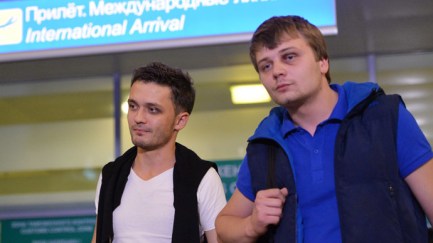
Zvezda TV channel correspondent Evgeny Davydov, left, and sound engineer Nikita Konashenkov who were detained in Dnepropetrovsk are welcomed on their arrival at Moscow’s Sheremetyevo airport after their release. (RIA Novosti/Alexey Kudenko)
Reporters from Russia’s Zvezda TV channel have been freed from captivity in Ukraine, where Right Sector fighters detained, interrogated, and beat them for ransom. Risking their lives, they didn’t turn off their phones, which was crucial for their release.
A plane carrying Evgeny Davydov and Nikita Konashenkov landed at Moscow’s Sheremetyevo Airport at 15:44 GMT on Monday. A few hours before their arrival in the Russian capital, the two journalists were handed over to Russian naval attaché Eduard Belashev in the city of Dnepropetrovsk.
The journalists spent two days in captivity, and were subjected to long questioning, intimidation, and beatings.
Recent images of the two men show the areas around their eyes covered in bruises. Their colleagues say that Davydov has complained of pain in his ear and partial hearing loss.
Zvezda TV channel has shared details of the reporters’ detention and release. The channel’s head, Aleksey Pimanov, said that Davydov and Konashenkov were freed due to “diplomatic efforts.” The station’s management sent pleas to new Ukrainian President Petro Poroshenko, the Security Service of Ukraine (SBU), and the Ukrainian judiciary demanding the journalists’ immediate release.
The Russian Foreign Ministry called the release “good news” and the “result of persistent work of all of our structures with the active participation and support of the Russian media.” Moscow says the “illegal practice of detaining journalists in Ukraine” must stop, and that the right to peaceful and objective press coverage of events in Ukraine must be safeguarded.

Zvezda TV channel correspondent Evgeny Davydov, center, with his family and sound engineer Nikita Konashenkov on their arrival at Moscow’s Sheremetyevo airport. (RIA Novosti/Alexey Kudenko)
The reporters were detained on June 14 while on their way to the airport. Saturday was meant to be the last day of their business trip in turbulent Ukraine and they were expected to fly home. They had been in Ukraine for over a month.
Constantly on the phone with Zvezda TV channel’s editors, Evgeny and Nikita successfully passed several checkpoints. However, they were stopped and detained at a post of the Ukrainian National Guard near Pokrovskoye, and the connection with the reporters was temporarily lost.
Zvezda journalists in Moscow launched a massive operation trying to find their colleagues. Both the Right Sector and the Ukrainian Security Service (SBU) refused to comment on the detentions.
Eventually, the channel managed to determine the address of where Evgeny and Nikita were being held. This finding showed that Right Sector fighters were behind the detention – the building is shared by the SBU and the radical group. As Zvezda journalists found out later, the man who interrogated their detained colleagues was Maksim Miroshnichenko, the Right Sector’s press secretary in Dnepropetrovsk.
During the interrogation process, the journalists kept one of their phones constantly connected to the channel’s headquarters. The recording will now be transferred to authorities, who will launch a torture case. The use of force against the reporters can be heard on the recording.
Throughout the questioning, which was full of cursing, Miroshnichenko reportedly tried to force the journalists to admit they lied about the true purpose of their visit. Under pressure, the interrogators forced the Russian crew to denounce their reporting on the use of white phosphorus by the Ukrainian military in an aerial assault on the outskirts of Slavyansk on Thursday.
After the channel managed to determine the journalists’ whereabouts, representatives of the Right Sector contacted Zvezda demanding a US$200,000 ransom for the reporters, who they called “scum.” Failure to provide the money would result in consequences, with the captors sending a message to family members that the journalists would be “kept for some 10 years.”
On Monday, a YouTube video surfaced showing Davydov and Konashenkov with bruises on their faces. In the footage, the two are seemingly being forced to say they have “no complaints” about their treatment by the Right Sector, and that the visible hemorrhages on their bodies were caused by a fight with a colleague.
Their documents also surfaced on the internet, showing they were accredited by the Central Election Commission of Ukraine. But, in violation of all norms of international law and the Geneva Convention, the reporters were forced to sign statements which falsely declared their lack of professional ethics.
“Everything is done on the orders of the Kremlin in order to use this information in international politics to the detriment of Ukraine,” Davydov’s forced statement allegedly read.
Konashenkov’s written testament apparently claimed that they covered Ukrainian roadblocks, “also on Moscow’s orders,” in order to make “untrue photographs.”
Upon their safe return to Russia, the journalists were taken to hospital for treatment. Before they boarded the ambulance, they gave a few comments to the press crew that greeted them at the airport. They thanked the Russian authorities and media channels for helping secure their release. They also briefly shared the details of their abduction.
“We were traveling from Donetsk to Dnepropetrovsk. We had a direct return flight from Dnepropetrovsk to Moscow on Saturday. About 120 km from Dnepropetrovsk, we were stopped at a roadblock. This was the National Guard’s checkpoint. They stopped us, asked us for our documents, checked all our personal possessions, examining everything,” the duo told journalists.
“Seeing our Russian passports and that we are Zvezda TV staff, their face expressions changed. They smirked and said that they have a jackpot in their hands. They abducted us, blindfolded us, and placed us in a car, before driving us somewhere to a field, then to some base. They threw us in a cellar.”
A press conference with Konashenkov and Davydov is scheduled to take place later on Tuesday.
Russian journalists from a range of media outlets have been repeatedly detained during the conflict in eastern Ukraine. Another set of Zvezda crew members were abducted two weeks ago and released after several days of interrogation on accusations of espionage. RT contributor and UK national Graham Phillips was detained for over 36 hours by Kiev military forces back in May. Earlier, two Russian journalists working for LifeNews TV channel were also captured by Kiev forces, forced on their knees at gunpoint and taken to Kiev for interrogations which lasted almost one week.
June 17, 2014
Posted by aletho |
Deception, Full Spectrum Dominance, War Crimes | Human rights, Ukraine |
Leave a comment
A senior Iranian diplomat has rejected reports about negotiations between Iran and the US over the ongoing crisis in Iraq.
“The Islamic Republic of Iran has had no negotiations with the Americans over mutual cooperation in Iraq,” Iran’s Deputy Foreign Minister for Arab and African Affairs Hossein Amir-Abdollahian said on Monday.
We believe that the Iraqi people and armed forces are capable of handling the crisis in their country on their own, he added.
The Iranian diplomat also dismissed the likelihood of the spillover of the crisis into Iran, saying, “There is no threat against the geographical borders of the Islamic Republic of Iran, but necessary precautions have been taken in this regard.”
Commenting on the quality of Iran’s cooperation with Iraq in fighting terrorism, Amir-Abdollahian rejected any direct military intervention, but noted that the Islamic Republic will assist Iraq through consultations or any other measures which can enable the Iraqi army in its counter-terrorism campaign.
On Sunday, a senior US official said the administration of President Barack Obama is considering the situation to hold talks with Iran over the Iraqi crisis.
Takfiri militants from the so-called Islamic State of Iraq and the Levant (ISIL) have recently been carrying out acts of terror in Iraq, taking over a number of cities and committing atrocities against the people.
June 16, 2014
Posted by aletho |
Deception, Mainstream Media, Warmongering, Militarism, Progressive Hypocrite, War Crimes | Iran, Iraq, Obama, United States |
Leave a comment
Moscow is demanding an immediate UN probe into Kiev’s use of outlawed incendiary bombs in Ukraine’s rebelling southeastern regions. Moscow will present a draft resolution to the UN Security Council, urging the observation of the OSCE roadmap for Ukraine.
The calls come after yesterday’s use of banned incendiary bombs in the village of Semenovka near the Ukraine’s eastern city of Slavyansk. Eyewitnesses to the bombings reported the use of white phosphor bombs on Wednesday night. The Russian RIA Novosty quotes the local self-defense headquarters on Thursday, saying that Semenkova came under an attack that apparently involved fire bombs. The bombs exploded right above the village and split into smoldering fragments, reported eyewitnesses.
The use of phosphor bombs is internationally banned. The burning substance can’t be extinguished and burns through flesh and bones if a person has been hit by the substance. The Itar-Tass news agency quotes Russia’s Foreign Minister Sergey Lavrov as saying:
“We have ordered to our Ambassador to UN Vitaly Churkin to present to the Security Council a draft resolution on the situation in Ukraine, as we are very concerned by the lack of any progress in the efforts to stop the violence, to stop the war, beginning from the end of the punitive operation”.
“In this resolution we have focused on the fact it is necessary to insist the Ukrainian side began implementing the OSCE roadmap, based on the Geneva statement of April 17, and which was presented after the talks with Russia’s President Vladimir Putin, … It is a very important moment, as, we see, there are clear attempts to distance from the balanced and fair character of the approaches in the roadmap, and there are attempts to promote certain unilateral plans, which would ignore interests of Ukraine’s southeast.”
Lavrov stressed that only an equal-rights dialog, a complete consideration of interests of all of Ukraine’s regions without exceptions, and a dialog that also includes discussions about constitutional reform, may result in stability and an improvement of the situation in Ukraine.
The draft resolution expresses Russia’s concerns about the continuing violence and the killing of civilians, the destruction of infrastructure, residential areas, as well as attacks against convoys. Lavrov added that Russia does not speak about sending peace keepers and that Moscow still believes President Poroshenko has credibility.
Moscow does, however, demand an immediate and full investigation into the use of incendiary bombs and other prohibited weapons in Ukraine. Lavrov stressed “We are concerned to hear reports that the Ukrainian military forces use incendiary bombs and some other indiscriminate weapons. These reports should be investigated, immediately”.
June 12, 2014
Posted by aletho |
Militarism, War Crimes | Russia, Semenovka, Slavyansk, Ukraine, UNUNSC |
Leave a comment

 GAZA – The Palestinian interior ministry said that the recent Israeli aerial attacks on the Gaza Strip directly targeted its infrastructure, factories and workshops.
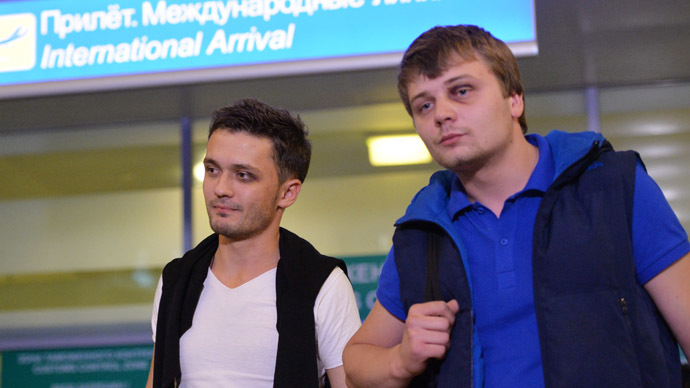

 Aletho News

