The Evolving Story of the Death of Father Murad
By Richard Edmondson | War and Peace | July 3, 2013
Conflicting news reports have been coming out on the death of Father Francois Murad. Initially it was reported by a number of sources, including a press release from the Vatican, that the priest had been beheaded. Today, however, reports are saying that no, this was incorrect, that he was only shot dead, and that the video purporting to show his beheading was an old video. Here is how The Telegraph is reporting the matter:
The footage, said to show Father Francois Murad, 49, as the victim in a brutal summary execution by foreign jihadists is likely to be an older video that bares no relation to the death of the Catholic priest.
Father Murad “died when he was shot inside his church” in the northern Syrian Christian village of Ghassaniyeh on June 23, three separate local sources, who did not wish to be named, told the Telegraph.
Claims that Father Murad was one of two men to be decapitated by a foreign jihadist group went viral, with outrage expressed in blogs and articles worldwide.
The story goes on to describe the contents of the video, noting that it is “too grainy to be able to confirm the identity of either of the victims as Father Francois,” while offering quotes of clarification from Human Rights Watch as well as Holy Land Custos Pierbattista Pizzabala. The latter is quoted as saying, “Islamists attacked the monastery, ransacking it and destroying everything. When Father Francois tried to resist, defending the nuns, rebels shot him.”
According to the HRW spokesperson, the video “looks like it may have been filmed” several months ago, well before Murad’s death, and that the confusion may have arisen due to its appearance “around the same time that the news came out that Father Francois had been killed.”
All of this quite naturally raises some questions. Descriptions of the video, found at both LiveLeak and YouTube, specifically said the two men shown being beheaded were Christians and that Murad was one of them. Who made this video available to the public and what was their motive?
The conflict in Syria is becoming more and more like a house of mirrors—something noted in a report by journalist Patrick Cockburn published Sunday in The Independent and headlined, “Foreign Media Portrayals of the Conflict in Syria are Dangerously Inaccurate.” Cockburn writes:
Every time I come to Syria I am struck by how different the situation is on the ground from the way it is pictured in the outside world. The foreign media reporting of the Syrian conflict is surely as inaccurate and misleading as anything we have seen since the start of the First World War. I can’t think of any other war or crisis I have covered in which propagandistic, biased or second-hand sources have been so readily accepted by journalists as providers of objective facts.
Slogans replace policies: the rebels are pictured as white hats and the government supporters as black hats; given more weapons, the opposition can supposedly win a decisive victory; put under enough military pressure, President Bashar al-Assad will agree to negotiations for which a pre-condition is capitulation by his side in the conflict. One of the many drawbacks of the demonising rhetoric indulged in by the incoming US National Security Adviser Susan Rice, and William Hague, is that it rules out serious negotiations and compromise with the powers-that-be in Damascus. And since Assad controls most of Syria, Rice and Hague have devised a recipe for endless war while pretending humanitarian concern for the Syrian people.
In the midst of all this confusion and pretense over humanitarian concerns comes a report from the Hudson Institute highlighting the horrendous toll the conflict has taken on Syria’s Christian population. The report documents, among other things, deaths of priests, though here again there is some suspicious timing. On June 25, two days after the murder of Father Murad, a pair of congressional subcommittees held a joint hearing on the issue of “Religious Minorities in Syria: Caught in the Middle.” This is the subject of the Hudson Institute’s report, or more specifically the report focuses on the testimony given at the hearing by one of the institute’s chief researchers on the plight of Syria’s Christians.
Such a report becomes all the more remarkable when you consider that the Hudson Institute basically could be thought of as a neocon think tank. Its senior vice president is Lewis “Scooter” Libby, while Douglas Feith is listed as a senior fellow. Is there not something strange about a report documenting rebel atrocities against Syrian Christians being released by such an organization? Doesn’t Israel want to see Assad overthrown, and haven’t the Zionist media been feeding us the spin of the rebels, as Cockburn puts it, wearing the “white hats”? What gives?
I’ll have more on this report in an upcoming post, hopefully in a day or two.
Related articles
- Catholic Online Muddles Story of Priest’s Beheading (alethonews.wordpress.com)
- Vatican confirms horror beheading of Catholic priest by Syrian rebels (independent.ie)
PCHR slams immunity for Israel army chief on UK visit
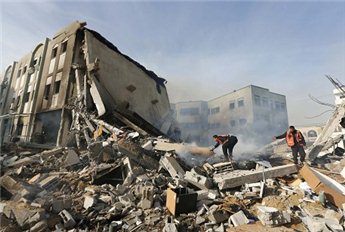
Aftermath of an Israeli air strike on the building of Hamas’ Ministry of Interior in Gaza City Nov. 16, 2012
Ma’an – 03/07/2013
BETHLEHEM – The Palestinian Center for Human Rights on Tuesday condemned a decision by the United Kingdom to grant immunity to Israel’s army chief while visiting the country.
Lt. General Benny Gantz, Chief of Staff of the Israeli Defense Forces, arrived in the UK on Tuesday, in the first visit of an Israeli army chief since 1998.
The UK government granted Gantz’s trip the status of Special Mission, thus granting him immunity from the UK’s criminal justice system, PCHR said.
Hickman & Rose Solicitors, who represent the victims of General Gantz’s actions together with PCHR, said the decision “sends the dangerous message that political considerations will be placed ahead of the rule of law.”
“Credible evidence exists indicating Mr. Gantz’s involvement in the commission of war crimes: these allegations should be investigated and, if appropriate, Mr. Gantz should be prosecuted,” PCHR said.
“He should not be pre-emptively granted immunity by the UK Government, circumventing normal criminal justice procedures.”
Lt. General Gantz is suspected of involvement in the commission of war crimes, particularly with respect to his role in the November 2012 assault on the Gaza Strip, codenamed Operation Pillar of Defense, PCHR says.
A week earlier, the UK government also applied Special Mission status to the visit of Major General Doron Almog, a retired army official suspected of war crimes, granting him immunity from Britain’s criminal justice system.
Mr. Almog canceled his scheduled UK visit at the last minute for unknown reasons.
In 2005, a British court issued an arrest warrant for Major General Doron Almog in relation to the destruction of 59 Palestinian homes in Rafah refugee camp in 2002 as part of a sustained policy of house demolitions in Gaza, PCHR said.
British police were preparing to arrest Almog on suspicion of war crimes after he and his wife flew to the United Kingdom in 2005, but he refused to leave his plane at Heathrow airport following a tip-off about the arrest warrant and was allowed to return to Israel.
The decision to grant immunity to both Israeli officials “sends the clear message that Israel can commit war crimes in the Gaza Strip with impunity,” PCHR said.
There is a risk, the group said, that Special Missions will be used to protect allies of the government and undermine the “basic principle of equal application of the law and the UK’s international legal obligation to seek out and prosecute suspected war criminals.”
Boy’s Death in Drone Strike Tests Obama’s Transparency Pledge
By Cora Currier | ProPublica | July 1, 2013
On June 9, a U.S. drone fired on a vehicle in a remote province of Yemen and killed several militants, according to media reports.
It soon emerged that among those who died was a boy – 10-year-old Abdulaziz, whose elder brother, Saleh Hassan Huraydan, was believed to be the target of the strike. A McClatchy reporter recently confirmed the child’s death with locals. (Update: The London-based Bureau of Investigative Journalism today reported that there was “strong evidence” it was a U.S. drone strike, but it could not confirm the fact.)
It’s the first prominent allegation of a civilian death since President Obama pledged in a major speech in May “to facilitate transparency and debate” about the U.S. war on al Qaida-linked militants beyond Afghanistan. He also said “there must be near-certainty that no civilians will be killed or injured” in a strike.
So what does the administration have to say in response to evidence that a child was killed?
Nothing.
National security spokeswoman Caitlin Hayden would not comment on the June 9 strike or more generally on the White House position on acknowledging civilian deaths. She referred further questions to the CIA, which also declined to comment.
The president’s speech was the capstone on a shift in drone war policy that would reportedly bring the program largely under control of the military (as opposed to the CIA) and impose stricter criteria on who could be targeted. In theory, it could also bring some of the classified program into the open. As part of its transparency effort, the administration released the names of four U.S. citizens who had been killed in drone strikes.
An official White House fact sheet on targeted killing released along with the speech repeated the “near-certainty” standard for avoiding civilian casualties. Secretary of State John Kerry reiterated it a few days later, when he told an audience in Ethiopia: “We do not fire when we know there are children or collateral — we just don’t do it.”
But White House press secretary Jay Carney said in late May that “this commitment to transparency…does not mean that we would be able to discuss the details of every counterterrorism operation.”
The new White House statements don’t address what happens after a strike, even in general terms.
CIA Director John Brennan offered one of the few public explanations of how casualties are assessed during his nomination hearing in February. Before his confirmation, Brennan was the White House counterterrorism adviser, and is considered to be the architect of Obama’s drone war policy.
He told senators that, “analysts draw on a large body of information — human intelligence, signals intelligence, media reports, and surveillance footage — to help us make an informed determination about whether civilians were in fact killed or injured.”
Brennan also said the U.S. could work with local governments to offer condolence payments. As we’ve reported, there’s little visible evidence of that happening.
At the hearing, Sen. Ron Wyden, D-Ore., asked Brennan if the U.S. should acknowledge when it “makes a mistake and kills the wrong person.”
“We need to acknowledge it publicly,” Brennan responded. Brennan also proposed that the government make public “the overall numbers of civilian deaths resulting from U.S. strikes.”
Neither overall numbers nor a policy of acknowledging casualties made it into Obama’s speech, or into the fact sheet. Hayden, the White House spokeswoman, would not say why.
The government sharply disputes that there have been large numbers of civilian deaths but has never released its own figures. Independent counts, largely compiled from news reports, range from about 200 to around 1,000 for Pakistan, Yemen and Somalia combined over the past decade.
Researchers agree that the number of drone strikes and civilian deaths have dropped during the past year. (Before Obama’s speech, an administration official attributed this partly to the new heightened standards.) The London-based Bureau of Investigative Journalism, which generally has the highest tally of civilian dead, has found there were between three and 16 civilians reportedly killed in about 30 drone or other airstrikes in Yemen and Pakistan so far this year. No strikes have been reported in Somalia.
“Official” statistics might not be much help without knowing more about how they were compiled, said Sarah Holewinski, head of the advocacy group Center for Civilians in Conflict.
That’s because it’s still not clear how the U.S. distinguishes between civilians and “militants,” or “combatants.”
In so-called signature strikes, operators sometimes fire on groups of people who appear to be engaged in militant activity without necessarily knowing their identities. The newly instituted drone rules reportedly roll back the military’s ability to use signature strikes, but the CIA can keep firing in Pakistan under the old rules at least through the end of the year.
An administration official told ProPublica last year that when a strike is made, “if a group of fighting-age males are in a home where we know they are constructing explosives or plotting an attack, it’s assumed that all of them are in on that effort.”
The new White House fact sheet contradicts that, stating: “It is not the case that all military-aged males in the vicinity of a target are deemed to be combatants.”
From the outside, in a strike like the recent one in Yemen, it’s impossible to know how these things were determined. McClatchy reported that the target, Saleh Hassan Huraydan, had “largely unquestioned” ties to al Qaida. Yemeni officials said he arranged to bring money and fighters from Saudi Arabia to Yemen.
As for Huraydan’s young brother, “They may not have realized who was in the car. Or they may have realized it and decided collateral damage was okay,” Holewinski says.
The same questions dog the death of another boy that the administration has acknowledged: the 16-year-old son of Anwar al-Awlaki, a U.S.-born cleric tied to terror attacks. Awlaki and his son were killed in separate strikes in Yemen in the fall of 2011. The boy, Attorney General Eric Holder has said, was “not specifically targeted.”
Related article
- For Obama civilian deaths are O.K. because the enemy kill civilians also (alethonews.wordpress.com)
German aid workers ‘kidnapped’ in Syria
Press TV – June 30, 2013
German aid group Gruenhelme says three of its members who had been reported missing in Syria for more than 45 days have been kidnapped in Idlib Province.
“It has been 45 days since three members and employees of Gruenhelme were kidnapped overnight on May 14-15, in the village of Harem” of Idlib, the group’s founder Rupert Neudeck said in a statement on June 28.
The three members have been identified as Bernd Blechschmidt, Simon S. and Ziad Nouri.
Neudeck added that Gruenhelme (Green Helmets) has asked the German Foreign Ministry, German police, and the Syrian opposition in Germany for help, but the identity of the kidnappers has not been clarified yet.
The German Foreign Ministry confirmed that three German nationals have been “reported missing” in Syria, without giving further details.
Neudeck said his group was “very surprised to see that… the media in Germany have been silent” on the issue.
“But we are no longer able to remain silent,” he said.
The aid group has been active in northern Syria for several months to help provide healthcare to local people.
Syria has been gripped by a deadly unrest since March 2011, and many people, including large numbers of Syrian forces, have been killed in the violence.
Foreign-sponsored militants have committed major crimes in the country including kidnapping Syrians and foreigners.
In April, the militants released two Orthodox archbishops kidnapped in the northwestern city of Aleppo.
Several international human rights organizations have also accused militants operating in Syria of committing war crimes.
South Africa: Obama Docket
Muslim Lawyers Association Press Release | June 26, 2013
Lawyers will continue to pursue the case against Obama in the courts
Johannesburg, South Africa – The Muslim Lawyers Association (MLA) brought an application to court on Tuesday, 25 June 2013, to charge US President Barack Obama with a number of crimes, before he enters South Africa on Friday, 28 June 2013.
The North Gauteng High Court today found that the merits of the matter could not be heard as it was not deemed to be sufficiently ‘urgent’. This is despite the imminent arrival of Obama in South Africa this week. However, the (MLA) will continue to pursue the matter through the ordinary course of the courts.
Given the sheer magnitude, gravity, extent and degree of these crimes, as well as the unrelenting vigour with which the Obama Administration continues to commit them, the MLA intends to pursue the review application in accordance with the normal court time periods applicable.
“It is regrettable for the court not to have adjudicated on the merits of the ‘Obama Docket’ at an expedient time when Obama’s visit to the Republic is imminent”, states MLA spokesperson, Attorney Yousha Tayob.
The Obama Docket contains:
– evidence of indiscriminate killing of civilians by the use of USA military drones
– a public acknowledgment by Obama that he authorised the extra judicial assassinations of US citizens and that civilians have been killed by drone attacks authorised by him
– evidence of the continued incarceration without trial of persons detained at Guantanamo Bay and other US detention facilities, and
– evidence that the United States has engaged in rendition programmes contrary
to the prescripts of the norms and standards of International Law.
“South Africa has adopted and ratified the Rome Statute into our law and is therefore obliged to fulfil both its domestic and international responsibilities”, adds Tayob.
The MLA remains undeterred in its resolve to pursue all legal avenues to expose the past and ongoing War Crimes, Crimes against Humanity and Genocide committed by Obama and his administration and is committed to have him brought before a South African court of law or the International Criminal Court to answer the allegations contained in the ‘Obama Docket’.
For more information on the Obama Docket and its contents, or for interviews with an MLA representative, call Attorney Yousha Tayob, + 27 82 926 5408 or email at info@mlajhb.com or visit the MLA website at http:// http://www.mlajhb.com
Related article
- Obama faces protests in South Africa (alethonews.wordpress.com)
Obama called “war criminal” & “hypocrite of the century” in Irish Parliament
Published on June 21, 2013
Clare Daly in Irish Parliament: https://twitter.com/ClareDalyTD
Email her at http://www.claredaly.ie/contact/
The US’s Afghan Exit May Depend on a Syrian One
By Sharmine Narwani | Al-Akhbar | 2013-06-25
Washington’s options in Syria are dwindling – and dwindling fast.
Trumped up chemical weapons charges against the Syrian government this month failed to produce evidence to convince a skeptical global community of any direct linkage. And the US’s follow-up pledge to arm rebels served only to immediately underline the difficulty of such a task, given the fungibility of weapons-flow among increasingly extremist militias.
Yes, for a brief few days, Syrian oppositionists congratulated themselves on this long-awaited American entry into Syria’s bloodied waters. They spoke about “game-changing” weapons that would reverse Syrian army gains and the establishment of a no-fly zone on Syria’s Jordanian border – a la Libya. Eight thousand troops from 19 countries flashed their military hardware in a joint exercise on that border, dangling F-16s and Patriot missiles and “superb cooperation” in a made-for-TV show of force.
But it took only days to realize that Washington’s announcement didn’t really have any legs.
Forget the arguments now slowly dribbling out about why the US won’t/can’t get involved directly. Yes, they all have merit – from the difficulties in selecting militia recipients for their weapons, to the illegalities involved in establishing a no-fly zone, to the fact that more than 70% of Americans don’t support an intervention.
The single most critical reason for why Washington will not risk entering the Syrian military theater – almost entirely ignored by DC policy wonks – may be this: the 2014 US military withdrawal from Afghanistan.
“Help, we can’t get out”
There are around 750,000 major pieces of American military hardware costing approximately $36 billion sitting in Afghanistan right now. The cost of transporting this equipment out of the country is somewhere close to the $7 billion mark. It would be easier to destroy this stuff than removing it, but given tightening US budgets and lousy economic prospects, this hardware is unlikely to be replaced if lost.
Getting all this equipment into Afghanistan over the past decade was a lot easier than getting it out will be. For starters, much of it came via Pakistani corridors – before Americans began droning the hell out of that country and creating dangerous pockets of insurgents now blocking exit routes.
An alternative supply route through Afghan border states Uzbekistan, Turkmenistan and Tajikistan called the Northern Distribution Network was set up in 2009, but is costlier and longer than going via Pakistan. And human rights disputes, onerous conditions on transport and unpredictable domestic sentiment toward the Americans places far too much leverage over these routes in the hands of regional hegemon Russia.
Unlike Iraq, where the US could count on its control over the main ports and Arab allies along the Persian Gulf border, Afghanistan is landlocked, mountainous and surrounded by countries and entities now either hostile to US interests or open to striking deals with American foes.
In short, a smooth US exit from Afghanistan may be entirely dependent on one thing: the assistance of Russia, Iran, and to a lesser degree, China.
All three countries are up against the US and its allies in Syria, refusing, for the better part of 18 months, to allow regime-change or a further escalation of hostilities against the state.
In the past few months, the Russian and Iranian positions have gained strength as the Syrian army – with assistance from its allies – pushed back rebel militias in key towns and provinces throughout the country.
Western allies quickly rushed to change the unfavorable equilibrium on the ground in advance of political talks in Geneva, unashamedly choosing to further weaponize the deadly conflict in order to gain “leverage” at the negotiating table.
But none of that has materialized. As evidence, look to the recent G8 Summit where western leaders sought to undermine Russian President Vladimir Putin, calling him “isolated” and referring to the Summit as “G7+1.”
In the meeting’s final communiqué, Putin won handily on every single Syria point. Not only was it clear that the international community’s only next “play” was the negotiations in Geneva, but there was no mention of excluding President Bashar al-Assad from a future Syrian transitional government, once a key demand of opponents. Furthermore, the declaration made it clear that there was no evidence linking chemical weapons use to the Syrian government – had there been any “evidence” whatsoever, it would have made it to paper – and Syrian security forces were empowered, even encouraged, to weed out extremist militias by all the G8 nations.
This was not an insignificant victory for the Russians – it was the first public revelation that Washington, London and Paris have conceded their advantage in Syria. And it begs the question: what cards do the Russians hold in their hand to bring about this kind of stunning reversal, just a week after Washington came out guns blazing?
America – choose your Afghan exit
The US military establishment has, for the most part, stayed out of the fray in Syria, where special ops have been ceded to the CIA and external contractors.
But as the gargantuan task of extricating the US from its decade-long occupation of Afghanistan nears, President Barack Obama has scrambled to accommodate the Pentagon’s top priority. Having assiduously avoided a negotiated political or diplomatic solution with the Taliban for years, he hopes to now pull a face-saving, 11th hour deal out of his hat with foes who will sell him down the river at a moment’s notice.
“The Americans are deeply worried that if the war continues the Kabul government and army might collapse while American bases, advisers, and special forces remain in the country, thereby putting the U.S. in an extremely difficult position,” says Anatol Lieven, a professor and Afghanistan expert at King’s College London, about the already-stalled US-Taliban talks in Doha last week. “They would obviously like to bring about a ceasefire with the Taliban.”
Even if Americans could get to the table, there are myriad issues that could conclusively disrupt negotiations at any time – in a process that “could take years,” as various US officials concede.
For starters, the involved parties – Afghan President Hamid Karzai’s government (which consists of competing ethnic and tribal leaders) and the “new Taliban” – now have multiple interests with regional players like Iran, Pakistan, Russia, China, and the neighboring “Stans” which puts a serious strain on any straightforward negotiation goals.
As an example, the very same Taliban delegation now sitting with the Americans in Doha, were traipsing through Tehran late last month – ostensibly with the knowledge of all parties. And this was certainly not the first visit between the two.
While the US arrogantly kept its Afghan foes at arm’s length for years, the Iranians were busy employing soft power in their neighborhood – a task facilitated by a decade of US regional policy mismanagement that has aggravated its own allies in and around Afghanistan.
This isn’t just a matter of Pakistan and Iran inaugurating a once-inconceivable gas pipeline, as they did earlier this year. Iran is now participating in infrastructure and social service projects in the heart of Kabul, has forged working relationships with Pakistani intelligence on a variety of mutual security issues, and has built deep networks within Afghanistan’s political and tribal elite – even with the Taliban, courtesy of mentors in Islamabad.
A US security expert and frequent advisor to US military forces inside Afghanistan and Iraq gives me the bottom line:
“Iran has basically exploited our vulnerabilities and filled those gaps well.
The US’s very presence in Afghanistan has helped Iran gain tremendous influence in both Afghanistan and Pakistan because of widespread disdain for US military activities and intervention, period. This is where Iranian diplomacy has excelled. Iran and Pakistan have ramped up their relationship both in military terms and with local insurgents during the past seven years. Iran has moved in and built mosques, schools in the middle of Kabul, for God’s sakes.”
The Iranians may be able to upset hopes of a smooth US military withdrawal from Afghanistan, but, this source warns, the Russians can potentially play “spoiler” in a big way as well:
“In Kyrgyzstan we have a base there to airlift a lot of supplies – mostly food, small scale things, not heavy equipment – for US soldiers and troops inside Afghanistan. Russia has so much influence there that at one point they threatened to give the Kyrgyz more money for the base that we were renting to kick us out and shut down that essential supply route. We were forced to heavily increase our rent payments to stay there.”
A few days ago, the Kyrgyz parliament voted overwhelmingly to shut down this very Manas base by July 2014, a full six months before the US withdrawal from Afghanistan is set to complete. Was it a coincidence that the vote came up around the time of the G8 huddle in Ireland, dominated almost entirely by news about a stand-off on Syria?
The US military source also explains how easily the Russians can sweeten the pot for the Pentagon:
“We have, concurrently, gained some support to withdraw from Afghanistan thru neighboring Tajikistan with the help of the Russians – and in return we are going to have to help build some infrastructure, like roads, under the auspices of US aid. These negotiations within and between the US and Tajik governments are ongoing. On this, the Russians have given their word that if we can find a way to exit through any of these countries, they will not interfere. Of course, the politics are fluid and anything can change at anytime.”
In April, NATO reached out to Moscow for help and advice on their military withdrawal from Afghanistan. NATO is keen to ensure the cleanest exit possible, but is also concerned about volatility in the aftermath of its departure – and desperately wants to avoid the perception of “mission defeat.”
What about the Chinese?
“China’s interests are a bit different. Less focused on our military withdrawal, more inclined to undermine our long-term influences and goals,” explains my source. “The Chinese are hell-bent on influencing countries for resource extraction and allocation, given their huge domestic demand. They are very competitive with the US and are going after the same resource pool. They undermine US influence because they play the game differently – they will bribe where we have strict rules on bidding, etc., and therefore enjoy more flexibility going after these same resources.”
In other words, like just about everybody else in that neighborhood, China will edge out any US gains made over the past decade – in both the political and economic sense.
In terms of near-term domestic and international political perception, however, that loss will pale in comparison to a failure by the Pentagon to secure the safe exit of its assets from Afghanistan.
“In the final analysis,” says the US military source with great irony, “if we want to get out of Afghanistan quickly and with minimum sacrifice to troops and hardware, it would save us a great deal of trouble if we could exit with the help of – and through – Iran.”
Enter James Dobbins, who was named Obama’s special envoy for Afghanistan and Pakistan in May. The veteran US diplomat, who I had the opportunity to interview in Washington three years ago, is an interesting choice for this position precisely because he has been so vocal in advocating for US-Iranian negotiations when few others dared.
Dobbins, notably, engaged actively with Iran in the aftermath of the US invasion of Afghanistan, based on a mutual interest of replacing the extremist Taliban with a more moderate, inclusive government. But further dealings came to an abrupt halt just weeks later, when then-US President George W. Bush delivered his infamous “Axis of Evil” speech, including Iran in this trio of top American foes.
It is doubtful that Dobbins or the Doha talks can work any miracles though. The kind of exit the US needs from Afghanistan must rely on a constellation of determined players and events that would be quite remarkable if amassed.
While it is obvious to all that the combined weight of Russia, Iran and China could tip that balance in favor of an expeditious American exit, what would motivate any of these three – who have all recently been at the receiving end of vicious US political and economic machinations – to help?
A grand bargain over Syria would surely be a sweetener: you and your allies exit Syria, we’ll help you exit Afghanistan.
The problem with Washington though, is that it never fails to botch up an opportunity – always striving for that one last impossible power-play which it thinks will help it gain dominance over a situation, a country, an enemy.
There remains the concern that the US’s oft-repeated Al Qaeda mantra – “disrupt, dismantle, defeat” – will prove to be its one-stop solution for every problem.
And that is the exception to my premise about a Syrian exit. That US spoilers who cannot accept even the perception of vulnerability – let alone an outright defeat – may instead choose to catapult the entire Mideast into a region-wide war for the sake of avoiding a painful compromise.
Sharmine Narwani is a commentary writer and political analyst covering the Middle East. You can follow Sharmine on twitter @snarwani.
Featured Video

Genocide-linked firm handles Britons’ NHS data
or go to
Aletho News Archives – Video-Images
Book Review
Book review: Boiling Point, How America Brought War to Ukraine
By Tim Kirby | Strategic Culture Foundation | November 14, 2026
Did Vladimir Putin just wake up one day on the wrong side of the bed and decide to invade Ukraine in February of 2022 or is there a lot more to this single decision that has been reshaping the 21st century geopolitical landscape?
Obviously, from the way that I just posed the question you can see that I am on the side that views the causes for the war in Ukraine to be very deep, long-term, historical and consciously nefarious, and most importantly, not from within the halls of the Kremlin. So it was a pleasure to take a look at the book “Boiling Point, How America Brought War to Ukraine” by author Stephen Kinzer, who like myself, also believes that the real reasons behind military conflicts around the world are not what CNN and the BBC have been telling you. The main thesis of this book was stated clearly by its creator; the war “may have been illegal, but it was definitely not unprovoked.” … continue
Blog Roll
 Aletho News
- The 10 Disease Renamings That Rescued the Vaccine
- NATO cancels 2027 leaders’ summit
- IAEA’s politicized use of safeguards undermines its impartiality: Russian envoy
- UK must be ready to strike Russian Arctic – ex-PM
- Fico’s Two Red Lines: Russian Energy and the Next Ukraine Loan
- Thousands rally for banned NATO-skeptic presidential candidate
- Ukraine Settlement and New European Security Architecture Must Go Hand in Hand – Kremlin
- Book review: Boiling Point, How America Brought War to Ukraine
- Israel Revives The ‘Iranian Assassination Threat Against Trump’ Deception In A Desperate Bid To Restart The War
- US rewrites history to dodge blame for illegal war on Iran: Foreign Ministry spokesperson
- If Americans Knew
- An error has occurred; the feed is probably down. Try again later.
- No Tricks Zone
- New Study: Barents Sea Temperatures Were Warmer And Sea Ice Less Extensive In The 1700s Than Today
- German Authorities Start Initiative To Evaluate Public Register For Climate “Disinformation” Spreaders!
- Zonal Asymmetry of Temperature Change in the Antarctic Circumpolar Current
- New Study: The Net Fossil Fuel Contribution To Rising Atmospheric CO2 Has Been Zero For 500 Years
- Germany’s Green Energy Transition Becoming Increasingly Expensive…Another 6 Trillion Euros!
- Sudden Stratospheric Warming, Powerful El Niño Combination May Lead To Extreme Europe Cold, Energy Crisis!
- Two New Studies Find Thwaites Glacier Melt Cannot Be Driven By Human Activity Or A Warming Ocean
- E-Cars Reduce CO2 Emissions By Only 41% Compared To Internal Combustion Engine Vehicles
- Predictions Made By Renowned Climate Professor Over Past Decades Have Been Proven To Be Poor
- New Study Suggests Large Regions Of The Pacific Ocean Have Been Cooling For The Last 80 Years

