Ban Ki-moon Slams Syria “Terrorist Attacks”
UN Monitors Continue Mission
Al-Manar | May 1, 2012
UN Secretary General Ban Ki-moon on Monday condemned the terrorist bomb attacks in two Syrian cities but said UN observers had brought some improvement in areas where they have been deployed.
The UN chief called on “all parties” in the Syria conflict to halt violence and work with the growing UN Supervision Mission in Syria, UN deputy spokesperson Eduardo del Buey said in a statement.
Ban “condemns” what he called “terrorist bomb attacks” in Idlib and Damascus on Monday, the spokesperson said.
“While noting improvements in areas where UN monitors are deployed, the secretary general remains gravely concerned by reports of continued violence, killing and abuses in Syria in recent days.”
“He calls for armed violence in all its forms by all parties to cease immediately and full cooperation of all parties with the work of UNSMIS as it expands its presence on the ground,” the spokesperson said in a statement.
The UN monitors are scheduled to visit the western cities of Homs and Hama on Tuesday.
The latest UN schedule comes a day after at least 20 people were martyred and scores of others injured in two bomb attacks in Idlib.
Israel Lobby representative Joe Lieberman in Saudi Arabia advocating “substantive military aid” for terrorists
Al-Manar | May 1, 2012
US Senator Joe Lieberman discussed the Syria crisis with Saudi King Abdullah and other senior officials during a visit to the Kingdom.
Lieberman also met with Saudi Foreign Minister Prince Saud al-Faisal, Defense Minister Prince Salman bin Abdul Aziz — who recently held talks at the Pentagon with Defense Secretary Leon Panetta to discuss the Syria crisis — and General Intelligence chief Prince Muqrin bin Abdul Aziz.
“The senator is traveling in the Middle East this week, focused on the continuing crisis in Syria and other issues related to US national security in the region,” Lieberman aide Whitney Phillips told AFP.
It is the second trip to the region in three weeks for Lieberman, who chairs the Senate Homeland Security Committee and also sits on the Armed Services Committee.
The Senator has advocated further US intervention in Syria, including the arming of Syrian opposition groups against the regime of President Bashar al-Assad. And while he stressed he wanted “no (US) boots on the ground” in Syria, he was “adamant” about the need to provide more “substantive military aid”.
“At some point we simply have to say, ‘we’re going to help them, we’re going to give them weapons to defend themselves,’ and that will make them strong and more organized”, Lieberman said last week at the Brookings Institution, a Washington think tank.
On Sunday he was in Qatar, where he met with the Minister of State for Foreign Affairs Khaled al-Attiyah, Phillips said.
Related articles
- An In-depth Analysis of Lieberman’s Cybersecurity Bill 2011: Giving Birth to Big Brother (nebraskaenergyobserver.wordpress.com)
Russia Destroys 62% of its Chemical Weapons
April 29, 2012 – RIA Novosti
MOSCOW – About 25,000 metric tons of chemical weapons, or 62 percent of Russia’s stockpile, have been destroyed by April 29, the day when the International Chemical Weapons Convention came into force.
In 15 years Russia destroyed about two thirds of its world-largest stockpile of 40,000 metric tons. The goal is to destroy 100 percent of chemical weapons in Russia by 2015.
The 188 states parties to the Convention initially planned to destroy all chemical weapons in the world by 2012. Russia and the United States, who have 40,000 and 27,000 metric tons of chemical weapons, respectively, said they were behind schedule and the deadline was postponed until December 31, 2015.
The U.S. said it had already destroyed about 90 percent of its chemical weapons. The Department of Defense, however, postponed the deadline for destroying the remaining 2,000 metric tons first until 2021 and then until 2023.
As of January 31, 2012, more than 50,000 metric tons of chemical weapons, or 73 percent of the global stockpile, have been destroyed.
The convention came into force on April 29, 1997, and 188 out of 195 UN member states have joined it. Myanmar and Israel are signatories to the treaty, but are yet to ratify it. Only Angola, North Korea, Egypt, Somalia and Syria are still outside the convention.
The countries that officially admitted having chemical weapons are Albania, Libya, Iraq, India, Russia, the United States and South Korea.
Recognizing Heroes
By Ralph Nader | The Nader Page | April 26, 2012
The media regularly cover awards for their reporters, editors and producers. They regularly cover award ceremonies for movie stars, athletes, and business leaders. But they regularly ignore the far more important awards for people who ethically blow the whistle on corruption and suppression in both business and government, risking their careers and more to tell the truth to the American people.
Sure, the Pulitzers, the Academy Awards, the Heisman Trophy and the many business awards may seem exciting. But protecting the health, safety and economic well-being of the American people is important and serious. It is hard to conclude that recalling millions of defective automobiles and dangerous pharmaceuticals, exposing serious contamination of drinking water, lies about the BushObama wars and the huge subprime mortgage crimes should be outside the realm of news coverage.
But this news or features blackout consistently prevails, at least in Washington, D.C., even when the annual Ridenhour prizes are given to heroic figures before packed audiences of notables at the National Press Club. Named after the late Ron Ridenhour, a Vietnam War veteran who wrote to Congress about the horrific massacre at the village of My Lai, this year’s recognitions went to truth-tellers from Countrywide Financial, Bank of America, the Pentagon, the FBI, and the Marine Corps.
Each of them delivered concise, eloquent remarks that would qualify for any “Style Page” feature that requires drama, courage, human interest, resolve and proposed reforms. C-SPAN, replete with astonishingly repetitive right-wing events, was not there. Some members of the fourth estate – reporters, columnists, editorial writers or profilers – were in attendance, but no major news outlets covered this splendid event.
The Ridenhour awardees did not indulge in sentiment and self-pity. They spoke cogently about widespread dereliction or institutional crimes, and they spoke of specific ways a democratic society can foresee and forestall further recurrences. These people know what they are talking about. They are not like the glib pundits, politicians and commentators who get abundant airtime or print column inches for their insipid, ignorant, repetitive or self-serving pontifications.
When Lt. Col. Daniel L. Davis spoke about his assignment for the Army’s Rapid Equipping Force which resulted in a meticulous and well-documented report from the battlefields, contrary to the official “success” claims of the generals, he provided fresh material and a sensitive mind ready to elaborate on any questions by the press.
When Ali Soufan (former FBI interrogator) spoke about the uses of torture that backfire, fail to get useful information, risk the safety of soldiers, violate the laws and stain the reputation of the U.S., he can back it up with book-length details. Soufan’s New York Times op-ed was an eye-opener but the present situation is still festering and exhibiting prevarication. Extensive reporting is still needed on this subject.
Eileen Foster, hired in 2005 by Countrywide to become the executive vice president in charge of their fraud risk management division, proved that there was a “cult” of commission-hungry loan officers who created fraudulent financial papers that expanded toxic mortgages, helping to lead to the great Wall Street-U.S. economy crash of 2008. She showed the various law enforcement paths the Justice Department failed to take against any Wall Street executive, despite ample grounds for prosecution.
And when career Marine Corps Master Sgt. Jerry Ensminger suspected that his nine-year-old daughter’s death might have an environmental cause at Camp Lejeune in North Carolina, he came upon a “cover-up by the Marine Corps of one of the largest drinking water contaminations in U.S. history.” The Marine Corps learned of the carcinogenic chemicals in the groundwater at the base in 1980 and refused to officially notify the residents for another 28 years, an admission finally provoked by Sgt. Ensminger’s indefatigable campaign that went national (see the documentary “Semper Fi: Always Faithful”).
Now compare these heroic stands of the human spirit with the regular, rancid portrayals in the media of misbehaving actors, actresses, and professional athletes. There isn’t even a semblance of balance between informing the moral and voyeuristic instincts of their readers and viewers.
Lt. Colonel Davis, still on active duty, urged the audience to go forth and expand the range of their common concerns represented by these awards to ever larger circles of Americans. He declared that “telling the truth and doing your duty are synonymous.”
(For the fully streamed event, visit Ridenhour)
2012 Ridenhour Prize Winners
- The Ridenhour Prize for Truth-Telling – Eileen Foster, Stood up Against Corruption at Countrywide
- The Ridenhour Prize for Truth-Telling – Lt. Col. Daniel Davis, Exposed Pentagon Deceptions About the Afghan War
- The Ridenhour Documentary Film Prize – Semper Fi, One Marine’s Quest for the Truth
- The Ridenhour Book Prize – Ali Soufan, Former FBI Special Agent and Author of The Black Banners
- The Ridenhour Courage Prize – Rep. John Lewis, Civil Rights Icon and Fierce Advocate for Equality and Justice
Related articles
- Ridenhour Prizes Honor Courageous Truth Tellers (pogoblog.typepad.com)
- The White House Wants to Imprison the CIA Agent Who Blew the Whistle on Torture (motherboard.vice.com)
MSNBC: Evidence of Multiple Shooters, Night Raid in Sgt. Bales Case
By Ralph Lopez – War is a Crime – April 23, 2012
The first story was shaky from the start, that Sgt. Robert Bales “sneaked” off a combat outpost into hostile, landmined territory in the middle of the night, walked north a little over a half mile to a village, engaged in bloody murder, then walked back that half mile, past the base, and another mile south, killed more people, then turned himself in at the gate, all within an hour. Sharp-eyed bloggers did the math and recalled from other reports that Bales has part of a foot missing from a wound in Iraq, making the feat all the more remarkable.
Among the dead were a number of children, including a two-year-old.
Two weeks later the Pentagon’s story changed, and Bales had managed to sneak off the base twice over a longer timeline:
“Staff Sgt. Robert Bales, who is suspected in the shooting deaths this month of 17 Afghans, sneaked off his remote outpost twice during his alleged 90-minute rampage in two Afghan villages, two senior U.S. officials told CNN on Monday.
The officials said that, after the March 11 shootings in one village in Kandahar province, Bales sneaked back onto his base. They said Bales was seen at that point by fellow troops.
One official said investigators believe Bales told other soldiers he had just killed military-aged Afghan men. The officials said they did not know whether those troops told anyone else.
Then Bales sneaked out again and headed to the second village; he was apprehended by a search party as he attempted to re-enter the combat outpost the second time, the officials said.
Before this account, an Afghan guard was believed to have been the sole person who saw Bales that night. The guard alerted U.S. troops on base.”
The UK Guardian noted around the same time:
“Members of the Afghan delegation investigating the killings said one Afghan guard working from midnight to 2am saw a US soldier return to the base around 1.30am. Another Afghan soldier who replaced the first and worked until 4am said he saw a US soldier leaving the base at 2.30am. It’s unknown whether the Afghan guards saw the same US soldier. If the gunman acted alone, information from the Afghan guards would suggest that he returned to base in between the shooting sprees.”
Never mind that this leaves open the question of whether security at a “hot” outpost is routinely left, in this era of attacks coming from inside the wire, to purely indigenous guard, while US troops sleep. Ho Chi Minh would have dreamed of this situation. CNN reported that a US official told them that Bales had returned to the base “unnoticed.”
“One U.S. official with knowledge of the investigation said an Afghan guard allegedly spotted Bales leaving his outpost around 1 a.m. It is not clear why Bales’ superiors weren’t alerted, and the official said Bales was not noticed when he allegedly returned to the compound an hour later.”
The NY Times report quoting one Afghan General Hameed seemed aimed at putting a bit of spin on how Bales could have sashayed on and off the base so easily, saying:
“In recent interviews, American and Afghan officials said that the outpost in the rural Panjwai district was guarded by Afghan soldiers that night, as it probably was on most nights, because there were relatively few American soldiers based there, possibly only a platoon. Platoons typically have between 25 and 40 soldiers. –“Details Offered on How Suspect Could Have Left Afghan Base”“
So let me get this straight. A base in one of the most hostile parts of a war zone is under indigenous guard at night because, out of 25 – 40 tough US soldiers, they all need to be get their beauty sleep? This isn’t the 21st Century Army. This is “F Troop.” If the Pentagon really wants to fool people, they should learn when to shut up.
Jefferson Morley of Salon.com was the first reliable American outlet to report President Karzai’s, and the members of an Afghan Parliament investigative team’s, insistence that there was more than one shooter:
“A group of Afghan parliamentary investigators has concluded that Bales was part of a group of 15-20 soldiers. As Outlook Afghanistan reported Monday, “The team spent two days in the province, interviewing the bereaved families, tribal elders, survivors and collecting evidences at the site in Panjwai district.” One of the parliamentarians told Pajhwok Afghan News that investigators believed 15 to 20 American soldiers carried out the killings.”
The Gulf Times reported the Afghan investigative team’s findings immediately after the shootings, as did other outlets of the regional press:
“After our investigations, we came to know that the killings were not carried out by one single soldier. More than a dozen soldiers went, killed the villagers and then burnt the bodies,” lawmaker Naheem Lalai Hameedzai claimed…..
“All the villagers that we talked to said there were 15 to 20 men (who) had conducted a night raid operation in several areas in the village,” said Hameedzai.”
Disputing this is the governor of the province and the local police chief. The provincial governor who upholds the one gunman scenario says:
“It is time for Afghanistan to calm down and not let the insurgents take advantage of this case. They want foreign troops to leave such areas like this so they can hold those areas. We should be aware of their intentions and try to help the government, not the insurgents.”
The governor does not say where in “try to help the government” the truth figures in.
Interestingly, the initial Reuters report on the scene immediately after the killings made numerous references to multiple shooters, in addition to reporting that one staff sergeant was in custody, and that US officials were insisting on one shooter
“Neighbors and relatives of the dead said they had seen a group of U.S. soldiers arrive at their village in Kandahar’s Panjwayi district at about 2 a.m., enter homes and open fire.
An Afghan man who said his children were killed in the shooting spree accused soldiers of later burning the bodies.
…
“They (Americans) poured chemicals over their dead bodies and burned them,” Samad told Reuters at the scene.Neighbors said they had awoken to crackling gunfire from American soldiers, who they described as laughing and drunk.
“They were all drunk and shooting all over the place,” said neighbor Agha Lala, who visited one of the homes where killings took place.””
Now the first western reporter to gain access to child witnesses in the shooting, which she says the military tried to block, gives accounts of many men with “flashlights” on the ends of their rifles and on their helmets. As carried by MSNBC:
“”the children told Hakim [Yalda Hakim, a journalist for SBS Dateline in Australia] that other Americans were present during the rampage, holding flashlights in the yard.
Noorbinak, 8, told Hakim that the shooter first shot her father’s dog. Then, Noorbinak said in the video, he shot her father in the foot and dragged her mother by the hair. When her father started screaming, he shot her father, the child says. Then he turned the gun on Noorbinak and shot her in the leg.
“One man entered the room and the others were standing in the yard, holding lights,” Noorbinak said in the video.
A brother of one victim told Hakim that his brother’s children mentioned more than one soldier wearing a headlamp. They also had lights at the end of their guns, he said.
“They don’t know whether there were 15 or 20, however many there were,” he said in the video.
Army officials have repeatedly denied that others were involved in the massacre, emphasizing that Bales acted alone.”
The interesting thing here is that Afghan children don’t have videogames. They don’t have TV. In most parts of the country they don’t even have electricity. So night-raid equipment like weapons lights are not likely to arise from their imaginations.
From SureFire catalog “Weapon Lights”, Standard night-raid equipment for US forces

VIDEO: The SureFire Story
Hakim told MSNBC that the reason American investigators gave for trying to prevent her from interviewing the children was that her questions could “traumatize them.”
Stop the presses. In this war of nightly drone attacks on compounds known to have children present, in which hundreds if not thousands of children have been killed, and killed in night raids on such compounds, the interviews might “traumatize” them. I am rarely at a loss for words. This is one of those times.
One story floated about a week after the killings puts down the sighting of more than one soldier to possible confusion with the search party looking for Bales.
“It is unclear whether the soldiers the villagers saw were part of a search party that left the base to look for Bales, who was reported missing.”
But numerous reports make clear that the search party never left the area of the base.
“About 3:30 a.m., the official said, a surveillance camera spotted Bales returning to the base, and the search team found him just outside the compound.”
The NY Times, quoting Afghan Gen. Abdul Hameed, the corps commander for the Afghan National Army in Kandahar, reported:
“When American commanders became aware that a soldier was missing, they first checked sleeping quarters, toilets and the kitchen area before organizing a patrol to look outside the compound, General Hameed said. But before the patrol left, a high-powered infrared camera on a small blimp spotted Sergeant Bales nearby.”
Salon.com’s Morley reports an “unnamed senior U.S. official’ telling the New York Times: “When it all comes out, it will be a combination of stress, alcohol and domestic issues,” leaving aside the question of how the senior official already knows how it will all “come out.”
Morley writes:
“The passing admission that two other soldiers face disciplinary action for drinking with Bales on the night of the massacre might cast doubt on the notion that no one else knew what Bales was going to do. Army spokeswoman Lt. Col Amy Hannah said in telephone interview that she could not confirm the Times’ account. “I am not aware of any releases of information” about other soldiers facing disciplinary action, Hannah said. If the U.S. official’s remarks to the Times were accurate, then the Army is refraining from disclosing how many soldiers are under investigation.
Then there is conflicting eyewitness testimony. In this CNN video, one man describes the actions of a group in carrying out the killings. “They took him my uncle out of the room and shot him,” he says. “They came to this room and martyred all the children.” But one boy seen on the tape says there was only a single gunman. Still other witnesses pointed out a place outside the home, where they said they found footprints of more than one U.S. soldier.
Journalists seeking to clarify the question have been thwarted. In Afghanistan, Pajhaowk Afghan News reports that Lewis Boone, the public affairs director for coalition forces, declined to answer questions about the massacre, saying that a joint Afghan-ISAF team was investigating the killings. As the Seattle Times noted yesterday, the Army has been struggling “to regulate information on the Afghanistan suspect.”
The laugh for the day in Morley’s report comes when Ryan Evans, who worked with ISAF in Afghanistan and is now a research fellow at the Center for National Policy in Washington, said he thought “a cover up is very unlikely.” Now why would anyone think that, after Lt. Col. Daniel Davis just told us in a major report on Afghanistan that:
“We seem significantly challenged to tell the truth in almost any situation.”
And in a fascinating McClatchy report, Karzai’s lead investigator seems to differ with the president’s conclusion of more than one shooter, but then apparently contradicts himself.
KABUL, Afghanistan — The chief Afghan investigator in last month’s slayings of 17 civilians says there’s strong evidence that only one killer was involved, a view that puts him at odds with Afghanistan’s president, Hamid Karzai.
….
Afghan army chief Gen. Sher Mohammad Karimi, whom Karzai sent to Kandahar to investigate the massacre, told McClatchy that two survivors he interviewed offered credible accounts that the killings were the act of a lone person.“They told me the same thing,” Karimi said. “They both said there was (only) one individual who came to their house.”
….
At a meeting at the presidential palace with relatives of the victims days after the massacre, Karzai openly questioned the U.S. account of a lone gunman. The president pointed to one relative and said: “In his family, in four rooms people were killed — children and women were killed — and then they were all brought together in one room and then set on fire. That, one man cannot do.”Karimi said he returned to Kabul to deliver his interim report but the villagers had spoken to Karzai before he did.
“And everybody said (to the president), ‘Sir, it was not one person. … How can one guy shoot people in four rooms, kill them, then lift them, bring them to one room and set them on fire?'”
Underscoring how the incident has become a political football, Karimi himself appeared to parrot Karzai’s line in an interview with an Australian television program broadcast last week, in which he said, “I’m guessing — assumption — that (the killer was) helped by somebody. One person or two persons.”
There are a couple of possibilities here. Karimi could be honestly saying, interpreted by McClatchy as a contradiction, that two survivors said “there was (only) one individual who came to their house.” This would not rule out other men going to other houses or taking positions outside, and McClatchy could be wrong in its interpretation. Or, as McClatchy suggests, Harimi could be trying to play both sides of the fence. However, the rest of Harimi’s witness to the Australian reporter is clear, and MSNBC views it differently than McClatchy:
“Gen. Karimi, assigned by Afghan President Hamid Karzai to investigate the murders, told Hakim that he, too, wonders whether Bales acted alone and how he could left the base without notice.
“Village elders said several soldiers took part and that there is boot prints in the area,” Karimi told Hakim. He said villagers told him that they saw three or four individuals kneeling and that helicopters were overhead during the rampage.
“To search for him?” Karimi said he asked them.
“No,” he said they told him. “They were there from the very beginning.””
Other soldiers who have been stationed at the same base paint a different picture of how hard it would be to sneak off the base. The NY Times tells us:
“A Green Beret who has spent time in Panjwai in the past year said the combat outpost would have been relatively small, protected by dirt-filled containers known as Hesco barriers, with guard towers and perhaps a blimp with a high-powered camera capable of capturing images more than a mile away. It would have been difficult, but not impossible, for Sergeant Bales to slip away at night unnoticed, as the Army says he did.”
Okay. Not impossible. But now it’s twice.
As if this brew needs anymore spice, Bales’ attorney claims the government is withholding evidence:
“UPDATE: The attorney representing the American soldier accused of slaughtering 17 Afghan civilians accused the U.S. government on Friday of withholding evidence that would be crucial to his defense.
Speaking to the Associated Press, lawyer John Henry Browne detailed what he said were numerous examples of the government going out of their way to “hide evidence,” including denying his team access to video allegedly taken from a surveillance blimp showing Staff Sgt. Robert Bales on the night of the killings.”
Perhaps most damning of all, one might ask, isn’t this a simple matter of interviewing the many wounded witnesses? After all, we know beyond doubt that they saw what happened first hand. But Bales’ attorney Brown issued the following statement at the end of March:
“We are facing an almost complete information blackout from the government, which is having a devastating effect on our ability to investigate the charges preferred against our client,” the defense team statement said.
“When we tried to interview the injured civilians being treated at Kandahar Hospital we were denied access and told to coordinate with the prosecution team. The next day the prosecution team interviewed the civilian injured. We found out shortly after the prosecution interviews of the injured civilians that the civilians were all released from the hospital and there was no contact information for them,” the statement said.”
The LA Times reports attorney Browne saying:
“People on our staff in Afghanistan went to the hospital where there supposedly were eyewitnesses to this … and we were told by the prosecutors to come back the next day, which is fine. We went back the next day, and they’d all been released from the hospital and they’d all been scattered throughout Afghanistan. That was a violation of the trust we had in the prosecutors,”…
“We’ve been misled greatly…. They were promised to be there, and they were not,” he said, adding that there isn’t much hope of finding the witnesses now. “People just disappear into the Afghan countryside.”
Finally the Global Post, a project of long-time Boston Globe journalist Charles Sennott, turns in a report which seems to attempt to discount the value of Afghan witness testimony, but in the end relates detail from a witness which corroborates the behavior of soldiers intent on committing war crimes:
“Baran’s brother was killed in the shooting spree, but he didn’t see the shooting happen. Baran said he told Karzai what his sister-in-law, who was at the scene, had told him.
When GlobalPost asked Baran to speak directly with his sister-in-law, he initially refused.
“You don’t need to talk her,” Baran said. “I did, and I can tell you the story.”
Eventually Baran relented, allowing GlobalPost to interview her by phone.
Massouma, who lives in the neighboring village of Najiban, where 12 people were killed, said she heard helicopters fly overhead as a uniformed soldier entered her home. She said he flashed a “big, white light,” and yelled, “Taliban! Taliban! Taliban!”
Massouma said the soldier shouted “walkie-talkie, walkie-talkie.” The rules of engagement in hostile areas in Afghanistan permit US soldiers to shoot Afghans holding walkie-talkies because they could be Taliban spotters.
“He had a radio antenna on his shoulder. He had a walkie-talkie himself, and he was speaking into it,” she said.”
BBC says villagers say they heard helicopters in the night, explained by “correspondents” in the same report by the fact that helicopters are heard often in that part of the country. However helicopters in support of an operation would be distinctly closer and louder than those passing by at altitude.
“A woman in one of the targeted villages told the BBC she first heard helicopters at 02:00 and then gunfire. Others said helicopters and gunfire could be heard from midnight….Some villagers say that helicopters were flying overhead as the killings took place. Many locals appear to believe that they were in fact supporting the operation rather than trying to stop the gunman.
But correspondents say helicopters are frequently heard overhead in parts of the country.”
Reports of Bales’ testimony and behavior seem an intriguing mix of admissions to guilt and confusion. Reuters:
“Army Staff Sgt. Robert Bales initially asserted that he had shot several Afghan men outside a U.S. combat outpost in southern Afghanistan on March 11 and did not mention that a dozen women and children were among the dead, according to a senior U.S. official briefed on the case.
“He indicated to his buddies that he had taken out some military-aged males,” the senior official said. Soldiers normally use that term to denote insurgents.
But Bales’ story soon broke down when commanders on the base learned details of the pre-dawn shooting spree in which 16 Afghan civilians were killed in their homes. At that point, the 38-year-old Army veteran was taken into custody. He refused to talk further and soon asked for a lawyer, two officials said.”
Bales’ wife has stood steadfastly by her husband, saying that whatever he had done, he loved children and could never harm them.
In 2007 after a battle in Iraq, Bales told the Fort Lewis Northwest Guardian:
“I’ve never been more proud to be a part of this unit … for the simple fact that we discriminated between the bad guys and the noncombatants,” he told the after a battle in Iraq in 2007. “Afterward we ended up helping the people that three or four hours before were trying to kill us.”
The Christian Science Monitor reports words from Bales which are startlingly contrary to the charges:
“The charges run contrary to Bales’ own words in the 2007 interview with his local newspaper as well, when he expressed disdain for any insurgent would could put “his family in harm’s way like that,” he said. “I think that’s the real difference between being an American as opposed to being a bad guy.””
Publicintellligence.net notes the irony of the current lack of evidence against Bales when forensics against insurgents in Afghanistan are highly developed:
“A presentation from the U.S. Army’s Office of the Provost Marshal General indicates that as of August 2011 there were three Joint Expeditionary Forensics Facilities (JEFFs) throughout Afghanistan including one in Kandahar, the same province where Staff Sgt. Bales reportedly committed the massacre. These forensics facilities are capable of DNA analysis, latent print identification, photographic forensics, as well as chemical and ballistic analysis.
——-
… it remains to be seen whether the U.S. military will present the same level of forensic evidence that it routinely collects and analyzes when attempting to prosecute suspected insurgents.”
The families of the dead have been paid $50,000 for each victim, an extraordinary sum for most Afghans who often take work, when it is available, which pays one dollar a day. The country is the fifth poorest in the world and suffers a 60% rate of child malnutrition, according to Save the Children. Typical victim compensation in cases of civilian deaths is on the order of $2,000.
Dateline SBC interviews with child witnesses
Related articles
- RT: Bales in court as massacre body count mysteriously rises to 17 (jhaines6.wordpress.com)
Evidence in British court contradicts CIA drone claims
By Chris Woods | The Bureau of Investigative Journalism | April 24th, 2012
A major case in the British High Court has revealed fresh evidence of civilian deaths during a notorious CIA drone strike in Pakistan last year.
Sworn witness testimonies reveal in graphic detail how the village of Datta Khel burned for hours after the attack. Many of the dozens killed had to be buried in pieces.
Legal proceedings were begun in London recently against British Foreign Secretary William Hague, over possible British complicity in CIA drone strikes.
Britain’s GCHQ – its secret monitoring and surveillance agency – is reported to have provided ‘locational evidence’ to US authorities for use in drone strikes, a move which is reportedly illegal in the United Kingdom.
Sworn affidavits
The High Court case focuses in particular on a CIA drone strike in March 2011 which killed up to 53 people.
Sworn affidavits presented in court and seen by the Bureau offer extensive new details of a strike the CIA still apparently claims ‘killed no non-combatants’.
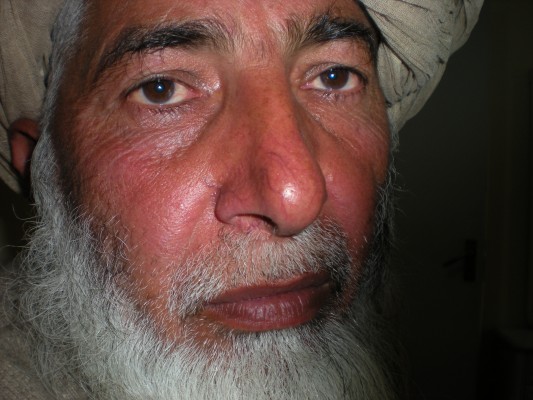 Ahmed Jan (pictured) is a tribal elder in North Waziristan. On March 17 2011 he was attending a gathering with other village elders, to discuss a mining dispute.
‘We were in the middle of our discussion when the missile hit and I was thrown about 24 feet from where I was sitting. I was knocked unconscious and when I awoke I saw many individuals who were dead or injured,’ he says in his affidavit.
Most of those who died in Datta Khel village that day were civilians. The Bureau has so far identified by name 24 of those killed, whilst Associated Press recently reported that it has the names of 42 civilians who died that day.
Pakistan’s president, prime minister and army chief all condemned the Datta Khel attack. A recent Bureau investigation with the Sunday Times quoted Brigadier Abdullah Dogar, who commanded Pakistani military forces in the area at the time.
We in the Pakistan military knew about the meeting, we’d got the request ten days earlier. It was held in broad daylight, people were sitting out in Nomada bus depot when the missile strikes came. Maybe there were one or two Taliban at that Jirga – they have their people attending – but does that justify a drone strike which kills 42 mostly innocent people?
Yet the US intelligence community has consistently denied that any civilians died.
Last year an anonymous US official told the New York Times: ‘The fact is that a large group of heavily armed men, some of whom were clearly connected to al Qaeda and all of whom acted in a manner consistent with AQ [Al Qaeda] -linked militants, were killed.’
The sworn affidavits seen by the Bureau offer a very different perspective. Imran Khan’s father Ismail was another of the elders who died that day. Imran says of his father: ‘He always did the right thing for the community and the tribe. He opposed terrorism and militancy and was not himself in any way connected to these things.’
Khalil Khan’s late father Hajji Babat was a local policeman who was ‘not an enemy of the United States of America or any other country.’ His son describes in his affidavit how he rushed back to his village to find his father dead, the bus station and surrounding buildings still burning six hours after the drone strike.
And Fateh Khan, who once worked for British Telecom, lost his 25-year old nephew Din Mohammed in the CIA attack. He reports that his nephew’s body had to be buried in pieces, and that ‘he left behind four children, all of whom now live in my house. His eldest child is currently only five years old.’
‘Absolute lie’
The most senior tribal elder to die that day was Daud Khan. Initially he was claimed to have been a senior Taliban figure. His son Noor told the Bureau that this was ‘an absolute lie’.
‘My father was not a militant but an elder who was working day and night for his people. There have been many children who have been killed in drone strikes. I ask the US if they think those children were militants and combatants and dangerous enough to be killed in such a manner?’
The CIA declined to comment when asked whether it still believed it had killed no ‘non-combatants’ in Pakistan since May 2010, or that no civilians died in Datta Khel last year.
In London, legal campaigners are seeking a judicial review in the High Court – a process by which senior judges can question and even overturn any government policy on aiding US drone strikes.
The case is being brought by legal charity Reprieve, and by the Islamabad-based lawyer Shahzad Akbar and the Foundation for Fundamental Rights, which focuses on civilian victims of CIA drone strikes in Pakistan.
The British government is understood to have firmly challenged the grounds of the case on a number of fronts.
Follow @chrisjwoods on Twitter
Related articles
- Hague to be sued for aiding US drone attacks in Pakistan (alethonews.wordpress.com)
- The cost and consequences of exposing the drone wars (alethonews.wordpress.com)
- “Drones also targeting mourners and rescuers” (alethonews.wordpress.com)
- NYT Lets Nameless Official Smear Drone Researchers as Al-Qaeda Fans (alethonews.wordpress.com)
- The boy sitting with me in these photos was protesting against deadly US drone strikes… Three days later he was killed ¿ by a US drone, says Jemima Khan (dailymail.co.uk)
- White House OKs broad Yemeni drone drive (upi.com)
Wheat farmers under fire in Gaza: We must continue to work our land
By Nathan Stuckey | International Solidarity Movement | April 23, 2012

Today we went farming with the family of Ahmed Saadat. We arrived in Khuzaa at about 7 AM and met Ahmed. He told us that the Israeli’s had already shot at his family when they went to their land to begin work. We went to the land, which lies 300 meters from the border and directly on the buffer zone. You immediately know the buffer zone, nothing is planted in it, no trees are left, and everything has been destroyed, only weeds grow there.
Ahmed and his family began to work, ten people on their knees harvesting wheat by hand. To harvest the wheat they pull it up by the roots and tie it into sheaves to be taken to a threshing machine. The land is quite large, in the past perhaps they would have hired a combine to harvest the wheat so that they would not have to do it by hand, but now it is dangerous to bring equipment near the buffer zone. Now, they work by hand.
At about 7:45 AM an Israeli Occupation Forces (IOF) Humvee pulled up onto a hill north of us. Soon shots began to ring out, these were not directed at us, they were directed at farmers harvesting wheat to our northwest. At about 8 AM soldiers in a tower next to the Humvee launched either tear gas or a smoke grenade, it landed extremely close to the tower, which was about 400 meters from us. This was soon followed by shooting at us.
Bullets whistled past our ears, they slammed into the ground around us, most of them about 20 meters away from us. The farmers were scared, but most of them kept working. They have little choice, the IOF shoots a lot in this area, it is inevitable that they will be shot at while they try to harvest their wheat. After a minute or two of shooting the bullets stop. Soon the Humvee drives down off of the hill and moves further down the border. All morning long the Humvee drives up and down the border, accompanied by two jeeps.
The farmers continue to work harvesting wheat. At about 8:30 Ahmed receives a phone call. It is from Ma’aan organization. They say that the Red Cross has called them asking Ahmed and advising him to leave the area. He is advised to go two kilometers from the border because of the danger. The Red Cross had been called by the IOF asking them who we were, and if we were internationals with the farmers.
Ahmed laughs, two kilometers is the other side of Khuzaa. The farmers continue harvesting their wheat until about 11 AM. While they work chmed tells us a little bit about his family. Like most Gazans, they are refugees. His family is from Salame, near Jaffa. They were expelled in 1948. His family still has the documents proving that they own the land they were expelled from. Now, his family works what land they have managed to buy in Gaza over the years.
He said, “What am I to do, Israel expelled us from our land, now they steal more of it, they shoot at us, but we need this wheat to live, we must continue to work our land.”
US terror drones, Yemeni army kill 23
Press TV – April 24, 2012
About two dozen people have been killed in attacks by the Yemeni army and US assassination drones in southern and eastern Yemen.
The Yemeni Defense Ministry said on Monday that the army shelled suspected militants in the southern province of Abyan.
The attack occurred near the city of Loder late on Sunday, killing 13 people.
At least three others were killed in an airstrike on several vehicles in a remote desert region in the eastern province of Marib, the Yemeni Defense Ministry said.
Also on Sunday, a strike by a US assassination drone killed three people in the southern province of Shabwa.
Local sources said that four more people lost their lives when a Yemeni jet attacked their vehicles in Loder.
About 275 people have been killed in fighting and airstrikes in southern Yemen over the past two weeks.
The government says the goal of the attacks is to foil potential threats by al-Qaeda — a claim that has not been independently confirmed.
Ali Abdullah Saleh, who ruled Yemen for 33 years, stepped down in February under a US-backed power transfer deal in return for immunity after nearly a year of mass street demonstrations demanding his ouster.
His vice president, UK-trained Field Marshal Abdrabuh Mansur Hadi, replaced him on February 25 following a single-candidate presidential election backed by the United States and Saudi Arabia. Hadi will serve for an interim two-year period as stipulated by the power transfer deal.
On April 6, Hadi dismissed nearly 20 high-ranking officers, including the commander of the country’s air force, Saleh’s half-brother Mohammed Saleh al-Ahmar, but did not replace Saleh’s son, nephew, and other allies, who head important military units.
So far, Al-Ahmar has refused to step down from his post.
Currently, Saleh’s eldest son Ahmed commands the elite Republican Guard, his nephew Yehya heads the central security services, and another nephew, Tariq, controls the Presidential Guard.
Yemenis have repeatedly staged demonstrations across the country to demand the political restructuring of the country and the dismissal of members of Saleh’s regime from their government posts.
The cost and consequences of exposing the drone wars
Drone Wars UK – 16/04/2012
As secret and unaccountable US and British drone strikes continue in remote corners of the globe, closer to home (but firmly behind closed doors), the drone industry continues to research and develop a drone-filled future.
Over the past couple of weeks, protesters in the UK and the US have gathered to turn the spotlight on the increasingly secret use and development of armed drones. In Bristol, at the beginning of April, the great and good of the drone industry came together at the Annual International UAV Conference to be met with a good-natured, noisy protest. Meanwhile, across the Atlantic at the Creech Air Force base, members of the faith-based group Nevada Desert Experience delivered an ‘Indictment for the Violation of Human Rights’ to the commander of the base. At each demonstration protesters were arrested and jailed.
But it’s not just protesting against the drone wars, that can bring serious trouble. Pakistani human rights lawyer Shahzad Akbar, who represent victims of US drone strikes in Pakistan is being denied a travel visa to enter the US to speak at a conference organised by Code Pink and others. Speaking from Pakistan by telephone, Akbar told the Guardian:
“Denying a visa to people like me is denying Americans their right to know what the US government and its intelligence community are doing to children, women and other civilians in this part of the world. The CIA, which operated the drones in Pakistan, does not want anyone challenging their killing spree. But the American people should have a right to know.”
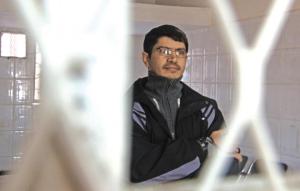
Abdulelah Haider Shaye in court detention cell
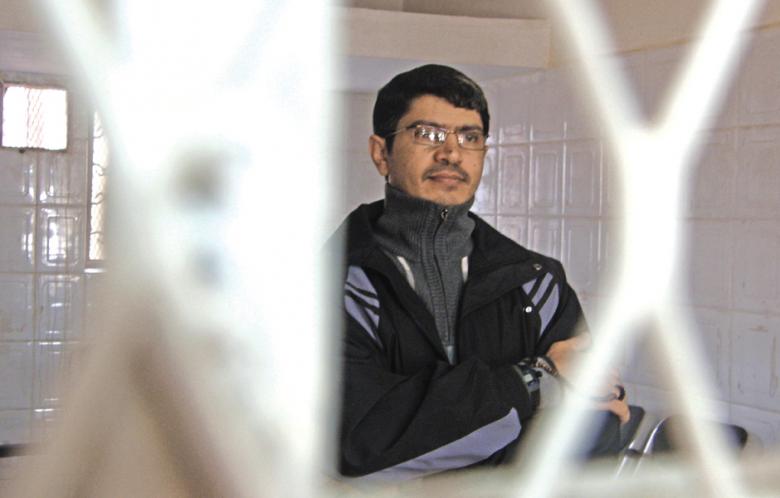
However it is Yemeni journalist Abdulelah Haider Shaye who is suffering the most for exposing the drone wars.
In 2010 Shaye revealed that an airstrike that took place in al Majala, Yemen in December 2009 killing 14 women and 21 children was launched by US drones, not the Yemeni air force, thus embarrassing both the Yemeni and US authorities. Later, Shaye also interviewed AQAP leaders including Anwar Al-Awlaki challenging them about their methods.
In August 2010, Shaye was kidnapped from his house by Yemeni security forces and disappeared for a month. He turned up in detention after being beaten and was sentenced to five years imprisonment for associating with terrorists. Amnesty International and other human rights groups have campaigned for his release, and it looked as though in February 2012 he was about to be freed. However a few days before Ali Abdullah Saleh, was forced to step down as President, Obama called him to “express concern” at the news that Shaye was about to be pardoned. Shaye release was immediately halted and he remains in prison.
Related articles
- Why Is President Obama keeping a journalist in prison in Yemen? (truthaholics.wordpress.com)
- Obama’s personal role in a journalist’s imprisonment (federaljack.com)
- Obama and Shaye: Will the White House Explain its Actions? (motherjones.com)
- Is Barack Obama a Murderous Sociopath? (motherjones.com)
- Pakistani Lawyer Representing Victims of Drone Strikes Prevented From Speaking in U.S. (alethonews.wordpress.com)
- Cluster Bombs: Still Legal, Still Lethal (conflictofconscience.wordpress.com)
‘External forces hampering truce in Syria’ – Lavrov
RT | April 17, 2012
The truce in Syria is still very fragile and all the influential parties on either side of the conflict should be guided by the interests of the Syrian people rather than their own ambitions, says Russian Foreign Minister Sergey Lavrov.
“Indeed, there are forces which are interested in the failure of the Kofi Annan plan, they were saying that even before the plan was released,” Lavrov stated on Tuesday. “And they are doing their best to make their wish come true through arms deliveries to opposition forces and by encouraging militants’ activities.”
This leads to retaliation measures from the government Lavrov added, “so that things are not going smoothly” for now.
Kofi Annan’s peace plan implies a ceasefire under the control of the United Nations, providing humanitarian aid to the victims of the conflict and starting dialogue between the conflicting sides. The proposal was unanimously adopted by the Security Council on March 21.
The Russian Foreign Minister also said that “some countries, some external forces are not interested in the success of the current peaceful efforts of the Security Council.”
These forces he went on to say are trying to substitute the Security Council with various unofficial formats and are using all tools to convince the Syrian opposition no to cooperate with the government.
Lavrov called this stance “counterproductive” and “regrettable”.
Related articles
- Syria and the Annan Plan: The Devil in the Details (alethonews.wordpress.com)
Featured Video

Genocide-linked firm handles Britons’ NHS data
or go to
Aletho News Archives – Video-Images
Book Review
How the U.S. Navy Sold the Vietnam War
By Gareth Porter | TruthDig | March 27, 2019
Dr. Tom Dooley, whose best-selling book “Deliver Us From Evil” helped create a favorable climate of opinion for U.S. intervention in South Vietnam, has long been linked to legendary CIA officer Edward G. Lansdale and his black operations in Vietnam between 1954 and 1955. But the real story about Dooley’s influential book, which has finally emerged from more recent scholarly research, is that it was engineered by an official of the U.S. Navy’s Pacific Command, Capt. William Lederer.
Lederer is best known as the co-author, with Eugene Burdick, of the 1958 novel “The Ugly American,” which was turned into a 1963 movie starring Marlon Brando. Far more important, however, is the fact that from 1951 through 1957 Capt. Lederer was on the staff of the commander in chief of the U.S. Pacific Fleet (CINCPAC), Adm. Felix Stump. … continue
Blog Roll
 Aletho News
- The 10 Disease Renamings That Rescued the Vaccine
- NATO cancels 2027 leaders’ summit
- IAEA’s politicized use of safeguards undermines its impartiality: Russian envoy
- UK must be ready to strike Russian Arctic – ex-PM
- Fico’s Two Red Lines: Russian Energy and the Next Ukraine Loan
- Thousands rally for banned NATO-skeptic presidential candidate
- Ukraine Settlement and New European Security Architecture Must Go Hand in Hand – Kremlin
- Book review: Boiling Point, How America Brought War to Ukraine
- Israel Revives The ‘Iranian Assassination Threat Against Trump’ Deception In A Desperate Bid To Restart The War
- US rewrites history to dodge blame for illegal war on Iran: Foreign Ministry spokesperson
- If Americans Knew
- No, Christians did not invent Zionism
- Hakeem Jeffries & Chuck Schumer: Conduits for Israel Lobby Dark Money
- DAILY UPDATE: Latest essential news on Palestine, Israel, & region
- Aid organizations in Gaza are pulling back, leaving hundreds of thousands of Palestinians without food
- 1.4 Million People in Gaza Live in Tents. Winter Storms Can Be a Death Sentence.
- Israel Used a U.S.-Made Missile to Kill Six at Gaza’s Nasser Hospital
- Congress Might Sneakily Use Lame Duck to Deeply Intertwine the U.S. and Israeli Militaries
- DAILY UPDATE: Latest essential news on Palestine, Israel, & region
- 9-month-old baby dies from severe cold in Gaza, 1st cold-related death this winter: Health Ministry
- Israel Kills over 12, Injures Many Across Gaza
- No Tricks Zone
- New Study: Barents Sea Temperatures Were Warmer And Sea Ice Less Extensive In The 1700s Than Today
- German Authorities Start Initiative To Evaluate Public Register For Climate “Disinformation” Spreaders!
- Zonal Asymmetry of Temperature Change in the Antarctic Circumpolar Current
- New Study: The Net Fossil Fuel Contribution To Rising Atmospheric CO2 Has Been Zero For 500 Years
- Germany’s Green Energy Transition Becoming Increasingly Expensive…Another 6 Trillion Euros!
- Sudden Stratospheric Warming, Powerful El Niño Combination May Lead To Extreme Europe Cold, Energy Crisis!
- Two New Studies Find Thwaites Glacier Melt Cannot Be Driven By Human Activity Or A Warming Ocean
- E-Cars Reduce CO2 Emissions By Only 41% Compared To Internal Combustion Engine Vehicles
- Predictions Made By Renowned Climate Professor Over Past Decades Have Been Proven To Be Poor
- New Study Suggests Large Regions Of The Pacific Ocean Have Been Cooling For The Last 80 Years

